This study examines how intergroup interactions in multigenerational retail teams influence job satisfaction and team commitment. It focuses on the role of contact quality and opportunities to interact, and the mediating role of attitudes toward age-diverse teams.
Survey data were collected from 636 retail workers in Australia and the USA (528 aged 18–35 and 108 aged 55+). Moderated mediation analyses tested whether attitudes toward age-diverse teams mediate the relationship between contact quality and outcomes, moderated by opportunities to interact.
The results showed that high-quality and more frequent interactions with age-diverse colleagues predict more positive attitudes toward age-diverse teams. These attitudes were also associated with greater job satisfaction and stronger team commitment. Results also suggest that some contact conditions may be more influential than others in shaping intergroup outcomes.
Retailers should support age-diverse team structures and encourage frequent, high-quality interaction between younger and older workers to improve satisfaction and strengthen team commitment.
This study offers theoretical and practical value by identifying attitudes toward age-diverse teams as a mediating mechanism within the input–mediator–outcome framework, extending intergroup contact theory to multigenerational retail workplaces.
1. Introduction
According to the World Economic Forum (2025), 58% of retail employers expect increasing difficulty accessing talent by 2030 and 28% anticipate declining retention. Organizations are therefore turning to age-diverse workforces. Although support for age diversity is growing (Köllen, 2021), research shows it can also produce negative outcomes such as interpersonal conflict, reduced task performance, and withdrawal (Becker et al., 2022). Retail labor markets are also transforming as digital technologies and artificial intelligence reshape job roles and skills (Robertson et al., 2025), requiring frontline employees to adapt to new technologies and service models (Andrejevic and Podkalicka, 2025). In this context, age-diverse teams may support knowledge sharing, adaptation and capability development, but realising these benefits requires deliberate management (Rajan, 2004).
Teams are central to retail operations and increasingly viewed as a core workplace competency (Kaila, 2021; Pantano et al., 2021). However, research on multigenerational team performance remains limited, particularly beyond student samples (Paluck et al., 2021), leaving practitioners with little guidance on fostering constructive interactions between younger and older workers (Scheuer et al., 2023). This gap is notable given the large share of younger employees in retail and their vulnerability to negative experiences in age-diverse teams (Jungmann et al., 2020). More broadly, demographic ageing and technological change are reshaping work, increasing the importance of effectively managing age-diverse workforces (Beier and Fisher, 2025). In the context of ageing populations and tightening labor markets, improving how age-diverse teams are managed has implications for workforce participation, inclusion and sustainable employment.
While generational differences in consumer behavior are well studied (e.g. Agrawal, 2022; Sharma and Dutta, 2025), far less attention has been given to how they unfold within retail workforces. Addressing this gap, we examine generational attitudes within retail teams and the conditions that support positive intergenerational workplace experiences. Drawing on Choi and Jarrott's (2021) integration of Intergroup Contact Theory (ICT) (Allport et al., 1954) and the input–mediator–output (IMO) framework (Mathieu et al., 2008), we test whether attitudes about age-diverse teams mediate the relationship between contact quality and job satisfaction and team commitment, moderated by opportunities to interact. Analyses of survey data from 528 younger (18–35) and 108 older (55+) retail workers in Australia and the USA support the proposed model.
This study makes two contributions. First, it provides the first empirical test of attitudes about age-diverse teams as a mediator within the IMO framework, responding to calls for greater attention to mediating mechanisms (Choi and Jarrott, 2021). Second, it advances multigenerational team research by examining how contact quality and interaction opportunities shape intergroup outcomes in retail, offering context-specific insights relevant to retail workplaces. Retail provides a theoretically meaningful context because work is organized through shift structures, task interdependence and customer-facing demands, which shape the frequency and quality of intergenerational contact and, in turn, team dynamics.
2. Literature review
In multigenerational teams, perceived generational differences, often shaped by age-related stereotypes and assumptions, can contribute to tension and conflict between younger and older workers (Lloyd-Jones and Worley, 2018). Older workers are often viewed as resistant to change and lacking digital skills, while younger workers are perceived as inexperienced and unmotivated (Arras-Djabi et al., 2024; Gardiner and Chen, 2022). These differing values and expectations may complicate workplace relationships and conflict resolution (Kunze et al., 2011). Despite this, retail research has paid limited attention to how multigenerational team dynamics shape outcomes such as job satisfaction and team commitment.
Multigenerational workplaces typically include employees at early-, mid- and late-career stages. Mid-career employees may share characteristics with both younger and older cohorts and play an integrative role by balancing adaptability and organizational stability across age groups (Salvadorinho et al., 2025). From a diversity perspective, age diversity can benefit teams by increasing variation in knowledge, experience and perspectives (Harrison and Klein, 2007), with recent evidence suggesting that age variety may strengthen team functioning through the integration of diverse expertise (Chapman et al., 2025). Although this study focuses on interactions between younger and older workers, these insights highlight the broader generational context in which intergenerational contact occurs.
ICT (Allport et al., 1954) is regarded as one of the most influential frameworks for understanding how interactions between opposing groups can be improved. According to ICT, contact quality with an outgroup member is likely to increase positive attitudes toward the outgroup. These positive interactions are more likely to occur if specific contact conditions are met. Examples of these “contact conditions” include equal status (viewing outgroup members as being of equal status), cooperation (working together), friendship (sustained friendly interactions), and common goals (having shared objectives). While different contact conditions can promote better interactions, they are not essential and are best thought of as factors that can support positive intergroup outcomes (Novak and Rogan, 2010; Pettigrew and Tropp, 2006; Pettigrew et al., 2011). Taken together, quality contact with an outgroup, particularly when enhanced through contact conditions, is thought to reduce bias toward the outgroup and lead to greater attitudinal change (Allport et al., 1954; Pettigrew and Tropp, 2006).
Choi and Jarrott (2021) integrated ICT with the IMO framework (Mathieu et al., 2008) to better understand the potential benefits of multigenerational work teams. The IMO framework proposes that team effectiveness develops through a sequence in which inputs, including individual, team, organizational and contextual factors, shape mediators, which in turn influence outcomes such as performance, affective reactions and behaviors. Within this framework, contact conditions are positioned as moderators of the relationship between inputs and mediators. Building on this perspective, the present study proposes that intergroup contact quality in age-diverse teams is positively related to attitudes toward colleagues from different age groups. These attitudes reflect openness to both similarities and differences across age groups, and a willingness to value the unique contributions of team members from different cohorts (Moss et al., 2018). Consistent with this view, research shows that high-quality contact reduces ageism (Lagacé et al., 2022) and age discrimination (Lagacé et al., 2023), whereas poor-quality contact is associated with greater discrimination and turnover intentions, particularly among older workers (Fasbender and Drury, 2022). This is significant because once team members hold positive attitudes about age diversity, they tend to report greater job satisfaction and team commitment (Macdonald and Levy, 2016; McConatha et al., 2022).
However, intergroup contact quality on its own may not be sufficient to produce positive shifts in attitudes toward team members from a different age group. Echoing work by Graf et al. (2014), we suggest that contact quantity (or opportunities to interact) among age-diverse retail team members plays a moderating role on the relationship between contact quality and attitudes about their age-diverse colleagues. In the context of retail, contact quantity can be shaped by factors including shared work schedules and co-location of younger and older team members during tasks or breaks (Novak and Rogan, 2010). These findings are particularly salient in retail settings, where work is organized through shift structures, task interdependence and customer-facing demands, and where emotional labor and service expectations shape the frequency and quality of intergenerational contact.
Unlike contact quality, which is well supported in intergenerational contexts (e.g. Kwong and Yan, 2023), evidence on the impact of contact quantity is mixed. While some studies report no significant effects (e.g. de Paula Sieverding et al., 2024; Johnston and Glasford, 2018), others highlight its potential. For example, de Paula Sieverding et al. (2023) found that, among older adults in Brazil and the USA, both contact quality and quantity contributed to intergenerational solidarity via affinity. Kolos and Kenesei (2023) similarly observed that younger adults (aged 18–35) with frequent and positive contact with older individuals were less likely to hold negative age stereotypes. Sugisawa (2024) also found that supportive interactions with older colleagues reduced discrimination directly and indirectly through changes in stereotypes. These inconsistencies may arise because opportunities for interaction do not uniformly produce positive outcomes; when contact quality is low, more frequent interaction may reinforce negative experiences, and negative contact may exert a stronger influence than positive contact (Graf et al., 2014). Benefits may also only emerge once a sufficient level of contact quality is reached, shaping how contact quantity translates into attitudes. Accordingly, we propose the following hypotheses:
The mediated effect of contact quality on job satisfaction (H1) and team commitment (H2) via attitudes about age-diverse teams will be moderated by opportunities to interact, such that positive attitudes will be strongest when both contact quality and opportunities to interact are high.
3. Method
3.1 Participants and data collection
Participants were eligible if they worked in retail and were either (1) aged 18–35 and working with team members aged 55+, or (2) aged 55+ and working with team members aged 18–35. Objective age was used to classify respondents into younger and older cohorts to capture interactions between distinct age groups. Consistent with intergroup contact theory, focal constructs (e.g. contact quality, contact conditions, and attitudes toward age-diverse teams) were measured through self-reported perceptions and experiences. Australian participants were recruited through a research participant provider and US participants through a US-based platform. After excluding speeders and straight-liners, the final sample comprised N = 636. The study was preregistered on the Open Science Framework and received ethics approval (details removed for blind review).
3.1.1 Sample characteristics
Participants ranged in age from 18 to 76 years (M = 33.30, SD = 14.38), with more younger (18–35 years; 82.3%) than older workers (55+ years; 17.7%). Most participants were from the USA (75.4%) and slightly more were female (52.4%). Employment status was primarily full-time (53.8%), followed by part-time (40.1%) and casual (5.1%). Retail experience ranged from 6 months to 55 years (M = 8.16, SD = 9.00), with 53.7% reporting five or fewer years and 22.1% reporting 10 or more years. Tenure with the current employer ranged from 6 months to 40 years (M = 4.56, SD = 5.28), with 57.8% employed for three years or less. Most participants (75%) worked in teams of 11 or fewer, and teams were typically gender-balanced (41.4%) or mostly female (39.2%). Due to difficulty identifying sufficient age-diverse retail teams in Australia, data collection was extended to the USA, consistent with recommendations to use culturally comparable samples to improve generalisability and reduce cultural bias (Tsui et al., 2007), with country included as a control variable.
3.2 Measures
3.2.1 Independent variable
Contact quality was measured with a 3-item scale by Voci and Hewstone (2003) (ω = 0.842). This scale asks participants to rate the degree to which contact between younger (18–35 years) and older (55+ years) team members is pleasant, cooperative, and superficial on a 5-point Likert scale from 1 (not at all) to 5 (very).
3.2.2 Mediator variable
Attitudes about being in an age-diverse team (attitudes about diversity) was measured with a 4-item scale adapted from Hobman et al. (2016) (ω = 0.890). Sample items include whether younger (18–35 years) and older (55+ years) team members enjoy doing jobs with each other, and avoid contact with each other, measured on a 7-point Likert scale from 1 (strongly disagree) to 7 (strongly agree).
3.2.3 Moderator variable
Opportunities to interact was measured with a 6-item scale adapted from Novak and Rogan (2010) (ω = 0.892). Sample items include whether younger (18–35 years) and older (55+ years) team members work the same average number of hours per week, and take lunchbreaks in the same location, measured on a 7-point Likert scale from 1 (strongly disagree) to 7 (strongly agree).
3.2.4 Outcome variables
Job satisfaction was measured with a 3-item scale adapted from Saks (2006) (ω = 0.937). Items included all in all, I am satisfied with my job, in general I do not like my job, and in general I like working here, measured on a 7-point Likert scale from 1 (strongly disagree) to 7 (strongly agree).
Team commitment was measured with a 4-item scale adapted from Van der Vegt et al. (2000) (ω = 0.938). Sample items include I feel proud to belong to my team, and I am glad I belong to my team and not another team, measured on a 7-point Likert scale from 1 (strongly disagree) to 7 (strongly agree).
3.2.5 Control variables
Age and country (0 = Australia, 1 = US) were included as controls. Consistent with intergroup contact theory, four contact conditions were also controlled. Equal status was measured with a 7-item scale by Novak and Rogan (2010) (ω = 0.868) and relates to the degree to which younger and older members of intergenerational teams perceive their status relative to older or younger team members, respectively. Cooperation was measured with a 5-item scale by Scott (2003) (ω = 0.931) and relates to the extent that team members are willing to work together to achieve company goals. Friendship and common goals were each measured using a 3-item scale by Campion and Medsker (1993) (ω = 0.910, ω = 0.847, respectively). Friendship captures the degree to which team members know one another and develop friendships; and common goals assesses the extent to which team members engage in and share activities that relate to team goals. All items were measured using a seven-point Likert scale (1 = strongly disagree, 7 = strongly agree).
3.2.6 Common method variance
To reduce the risk of common method variance (CMV), several procedural remedies were implemented during survey design (Podsakoff et al., 2012, 2024). Respondent anonymity was assured, established scales were used, different response formats were employed (e.g. 5- and 7-point Likert scales), and predictor, mediator and outcome variables were presented in separate survey sections to create psychological separation. Harman's single-factor test indicated that no single factor accounted for the majority of the variance. As this test is considered an insensitive indicator of CMV, it is interpreted alongside the procedural remedies.
4. Results
4.1 Descriptives
Table 1 presents descriptives and omega total reliabilities (ω). Contact quality was positively correlated with attitudes about diversity (r = 0.622, p = 0.05). Attitudes about diversity were also positively associated with job satisfaction (r = 0.361, p = 0.05) and team commitment (r = 0.490, p = 0.05). These results suggest that better contact quality and more positive diversity attitudes are linked to favorable workplace outcomes. As expected, contact condition variables were significantly intercorrelated.
4.2 Moderated mediation Regression
Relationships between contact quality, diversity attitudes, and outcomes were consistent across countries. Australian participants reported slightly higher job satisfaction and team commitment (Table 2), but controlling for country did not change the overall pattern of results, supporting cross-national generalisability (Tsui et al., 2007).
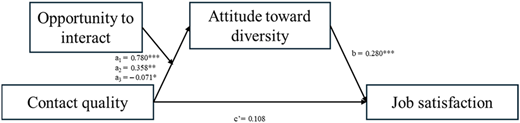
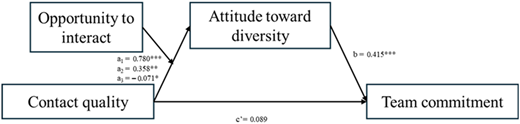
To test H1 and H2, moderated mediation analyses were conducted using Hayes' (2017) PROCESS macro Model 7 for job satisfaction and team commitment. Bootstrapping was set at 5,000 resamples with accelerated 95% confidence intervals. Contact quality (X) was the predictor, attitudes about being in an age-diverse team the mediator (M), and opportunities to interact the moderator (W). Age, country, and the four contact conditions were included as controls. Significant interactions were probed using simple slopes at ±1 SD of the moderator.
Significant indirect effects of contact quality were observed for both job satisfaction (B = 0.116, SE = 0.038, CI = [0.045, 0.196]) and team commitment (B = 0.172, SE = 0.035, CI = [0.108, 0.243]). In both analyses, the direct effect of contact quality on job satisfaction (B = 0.108, SE = 0.099, CI = [–0.086, 0.301]) and team commitment (B = 0.089, SE = 0.074, CI = [–0.056, 0.234]) was not statistically significant after attitudes about diversity were included in the model, a pattern consistent with statistically significant indirect effects in the absence of significant direct effects. Given the cross-sectional design, this result should be interpreted as an indirect pattern of association rather than evidence of a causal pathway.
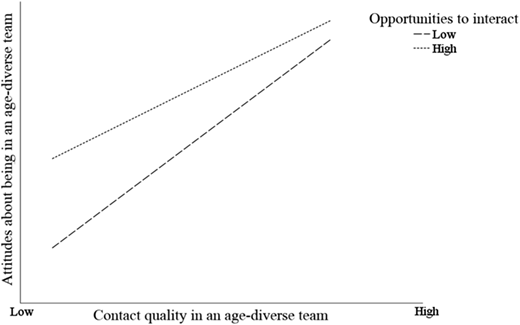
Figure 1 demonstrates the significant interaction of contact quality × opportunities to interact (B = −0.071, SE = 0.030, CI = [–0.129, −0.013]) on attitudes about diversity at low (B = 0.500, SE = 0.058, p < 0.001) and high levels (B = 0.331, SE = 0.057, p < 0.001). Attitudes about being in an age-diverse team are highest when contact quality and opportunities to interact are both high. Conversely, attitudes about being in an age-diverse team are lowest when contact quality and opportunities to interact are both low.
4.2.1 Job satisfaction
The moderated mediation analysis with job satisfaction as the outcome (Figure 2) resulted in a significant index of moderated mediation (IMM) (−0.020, SE = 0.011, CI = [–0.043, −0.001]). The estimated indirect effects of interaction quality on job satisfaction via attitudes about diversity were significant at low (B = 0.140, SE = 0.046, CI = [0.053, 0.237]) and high (B = 0.093, SE = 0.034, CI = [0.034, 0.165]) levels of opportunities to interact. H1 is supported. Significant positive main effects on job satisfaction were also identified for age (B = 0.026, SE = 0.004, CI = [0.017, 0.034], p < 0.001), friendship (B = 0.358, SE = 0.083, CI = [0.195, 0.522], p < 0.001), and common goals (B = 0.111, SE = 0.054, CI = [0.006, 0.216], p = 0.039).
4.2.2 Team commitment
The moderated mediation analysis with team commitment as the outcome (Figure 3) resulted in a significant IMM (−0.030, SE = 0.014, CI = [–0.058, −0.002]). The estimated indirect effects of interaction quality on team commitment via attitudes about diversity were significant at low (B = 0.207, SE = 0.043, CI = [0.128, 0.293]) and high (B = 0.137, SE = 0.034, CI = [0.078, 0.210]) levels of opportunities to interact. H2 is supported. Significant positive main effects on team commitment were also identified for age (B = 0.015, SE = 0.003, CI = [0.008, 0.021], p < 0.001), friendship (B = 0.341, SE = 0.062, CI = [0.219, 0.464], p < 0.001), and common goals (B = 0.151, SE = 0.04, CI = [0.072, 0.229], p < 0.001). Cooperation had a significant negative main effect on team commitment (B = −0.166, SE = 0.063, CI = [–0.290, −0.042], p = 0.009).
5. Discussion
The first key finding of the current work is the significant interaction between contact quality and opportunities to interact in the prediction of attitudes about being in an age-diverse team. Results reveal that attitudes about being in a multigenerational retail team are most positive for individuals who report high levels of contact quality and opportunities to interact with their age-diverse colleagues. In contrast, retail team members who report poor-quality interactions and fewer opportunities to interact with age-different colleagues are more likely to hold negative attitudes about being part of an age-diverse team. These findings suggest that regular, meaningful contact may be linked to team members seeing one another as individuals rather than as representatives of age-based stereotypes. These results align with prior research emphasizing the complementary roles of contact quality and quantity in fostering positive intergroup outcomes (de Paula Sieverding et al., 2023; Kolos and Kenesei, 2023; Sugisawa, 2024).
A second key finding is that attitudes about being in an age-diverse team were found to statistically mediate the association between contact quality and both job satisfaction and team commitment. These indirect associations were moderated by opportunities to interact. Specifically, employees with more positive attitudes about age diversity, particularly those who reported both high-quality contact and frequent intergenerational interaction, reported higher levels of job satisfaction and team commitment. This study presents an early empirical examination of attitudes about being in an age-diverse team as a mediator within the IMO framework, addressing calls for more research on mediating mechanisms in multigenerational teams (Choi and Jarrott, 2021). These findings corroborate prior work, underscoring that openness to both intergroup similarities and differences is central to achieving positive workplace outcomes (McConatha et al., 2022; Moss et al., 2018).
A third key finding is that the contact conditions of equal status, cooperation, friendship and common goals were differentially associated with job satisfaction and team commitment. Only friendship and common goals were significantly associated with both outcomes. While prior research notes that the relevance of contact conditions varies by context (Pettigrew and Tropp, 2006; Pettigrew et al., 2011), it is notable that the two conditions emphasizing shared interests emerged as most salient in the retail context. This supports prior evidence that intergroup friendship and shared goals improve attitudes and reduce prejudice (Paolini et al., 2021; Pettigrew and Tropp, 2006; Tropp et al., 2022). The prominence of friendship also aligns with findings that it can activate other contact conditions, such as cooperation and common goals, while fostering frequent, high-quality interaction, social learning and positive affect (Pettigrew et al., 2011).
Equal status did not significantly predict job satisfaction or team commitment. While equal status is considered a core contact condition within ICT because it reduces the likelihood that interactions reinforce existing group hierarchies (Allport et al., 1954), its relevance may vary across work contexts. In frontline retail settings, employees often work side-by-side in similar roles with shared responsibilities, which may reduce perceived status differences in everyday interactions. In this context, equal status may function more as a baseline condition that enables positive intergroup contact, rather than as a factor that directly explains variation in employee outcomes once other contact conditions are considered. This may help explain why friendship and common goals emerged as stronger predictors of job satisfaction and team commitment.
5.1 Implications
An important research implication of this study is the empirical extension of Choi and Jarrott's (2021) integration of ICT and the IMO model for age-diverse work teams. The findings are consistent with the inclusion of intergroup contact features, specifically contact quality and opportunities to interact, as moderators of the input-to-mediator relationship. While contact conditions can foster positive outcomes such as increased job satisfaction and team commitment, this study demonstrates that not all are equally effective. Equal status, for instance, did not significantly predict either outcome, whereas contact quality and opportunity to interact exerted stronger influences on multigenerational team dynamics. This aligns with Derwik and Hellström's (2023) research on informal learning in retail, which highlights the importance of collaboration, mentoring and observation as processes that inherently rely on high-quality interpersonal contact as mechanisms for competence development. These findings reinforce the value of fostering conditions that support constructive interactions between age-diverse colleagues. Moreover, identifying attitudes about being in an age-diverse team as a mediator within the IMO framework introduces a promising new line of enquiry. It suggests that for diverse teams to function effectively, individuals must hold positive views of age diversity and be open to working with colleagues who differ from themselves.
While this paper focuses on age-diverse teams in retail, much of the broader generational literature in retail management continues to emphasize consumer-facing issues. For instance, studies have examined how generational cohorts engage with retail technologies (Kalayci et al., 2024) and demonstrate distinct purchasing behaviors (Agrawal, 2022). Even when employee experience is considered, generational factors are often peripheral (e.g. Jung et al., 2022; Vieira et al., 2021). Our findings address this gap by positioning generational identity as a meaningful factor in intra-team dynamics and organizational experience. They also complement emerging work that advocates for greater attention to the relational and motivational aspects of multigenerational retail workforces (Masters et al., 2025).
From a practical perspective, even modest improvements in job satisfaction and team commitment can have meaningful implications in retail. Consistent with the service–profit chain, positive employee attitudes contribute to higher service quality, which in turn enhances customer satisfaction, loyalty and organizational performance (Hong et al., 2013). Our findings suggest that these outcomes can be supported by fostering high-quality intergenerational interactions, which shape more positive attitudes toward age-diverse teams and, in turn, strengthen job satisfaction and team commitment. Given high turnover and thin margins, small improvements in workplace interactions may therefore translate into tangible organizational benefits, particularly in the context of widespread disengagement and associated productivity losses (Gallup, 2025).
Retailers can act on these insights by intentionally structuring age-diverse teams to increase opportunities for meaningful intergenerational interaction. Managers can support high-quality contact by designing work in ways that promote sustained, cooperative interaction (Pettigrew et al., 2011), such as pairing younger and older employees on shared tasks, introducing structured mentoring or buddy systems, and aligning shift schedules to increase overlap between age groups (e.g. Novak and Rogan, 2010). Opportunities for informal interaction can be encouraged through shared break times, team-based problem-solving activities and cross-training initiatives that require knowledge exchange (Derwik and Hellström, 2023). Embedding these practices within onboarding and team routines is critical because they shape how employees perceive and evaluate age-diverse teams, building more positive attitudes that underpin job satisfaction and team commitment. Such approaches support informal learning and competence development (Derwik and Hellström, 2023), strengthening team functioning and retention in the context of ongoing skills shortages (Hart et al., 2007).
Beyond organizational practice, these findings have broader societal and labor market implications. As populations age and labor markets tighten, extending workforce participation across the life course has become a central policy concern (World Economic Forum, 2025). Our findings suggest that workplace conditions and everyday interactions are central to how employees experience and evaluate age-diverse teams, highlighting the importance of relational workplace conditions alongside formal workforce policies. In sectors such as retail, where turnover is high and skills shortages persist, improving the quality of intergenerational interaction may therefore contribute to more stable, inclusive and sustainable labor markets (Hart et al., 2007).
5.2 Limitations and future research
These findings should be interpreted in light of several limitations. First, the sample was skewed toward younger workers, so caution is warranted when generalizing to older workers. Second, the cross-sectional design limits causal inference and prevents conclusions about temporal ordering. The findings should therefore be interpreted as theoretically consistent indirect associations rather than causal pathways. Third, because all variables were collected through self-report at a single time point, CMV cannot be fully ruled out. Although procedural remedies were implemented and Harman's single-factor test did not indicate a dominant factor, this diagnostic is not definitive. Future research could address these limitations by using multi-source data, longitudinal or time-lagged designs, or latent method modelling approaches.
Beyond these methodological considerations, future research could advance understanding of how intergenerational dynamics develop within retail teams. Intergroup contact research suggests that contact effects emerge through ongoing interactions and may change over time (Pettigrew et al., 2011; Paolini et al., 2021), meaning employee attitudes may both shape and be shaped by the quality of intergenerational interactions. Age diversity effects are also likely to operate within a broader team context. Multilevel research examining team- or store-level factors, such as age composition, leadership, or diversity climate, would help clarify when age-diverse teams contribute to positive employee outcomes (Mathieu et al., 2008; Kunze et al., 2011).
Declaration of generative AI and AI-assisted technologies in the writing process
During the preparation of this work the author(s) used ChatGPT in the writing process to improve the readability and language of the manuscript. After using this tool, the authors reviewed and edited the content as needed and take full responsibility for the content of the published article.
We would like to extend our gratitude to Professor Gary Mortimer for his critical feedback on earlier versions of this work. We also thank Jackson Scarrabelotti for his contributions during the early stages of the project. Finally, we are grateful to the editor and the anonymous reviewers for their constructive feedback and guidance, which helped shape and strengthen the final version of the manuscript.