This study investigates the effect of spirituality in shaping religious young Muslims' intention to purchase from online second-hand clothing retail, mediated by brand consciousness, consumer felt responsibility for sustainability and perceived social benefits. It also examines the moderating influence of familiarity with the circular economy (CE) within the sustainable fashion context.
Drawing on McNeill and Moore fashion consumer categories (self–sacrifice–social) as the mediators between spirituality and online intention to purchase second-hand clothing, a survey was conducted among 316 religious young Muslims with prior online second-hand fashion purchase experience. Data analysis was conducted using PLS-SEM to test direct, mediating, and moderating effects.
Results indicate that spirituality does not directly influences purchase intention. However, brand consciousness and perceived social benefits mediate this relationship. Familiarity with CE moderates the relationship between spirituality and consumer felt responsibility for sustainability. The feeling of responsibility toward sustainability does not have any significance on the direct and indirect effect between spirituality and purchase intention. This suggests that the main drivers to purchase from online second-hand clothing among young Muslims are hedonic which may contradict the role of spirituality.
This research integrates spirituality with consumer familiarity with CE and extend prior sustainable fashion literature by linking these dimensions with fashion consumer motivation dimensions (self–sacrifice–social) in the world's largest Muslim population that has significant growth of e-retailing activities.
1. Introduction
The rise of second-hand clothing retail has become a growing industry across the world and an increasingly accepted global lifestyle. Forbes (2025) reported the market value is expected to grow to $74B by 2029 in the US market. Low prices and the thrill of finding something of great value at a low cost have been the major drivers for this trend (Lichy et al., 2023). However, there is a great purpose behind as purchasing second-hand clothing is well aligned with Circular Economy (CE) as part of Responsible Consumption and Production in Sustainable Development Goals. This behaviour contributes to sustainable fashion, especially since garment manufacturing industries have led to major catastrophe on environmental and social issues (i.e. the Death of Aral Sea (Gupta, 2020) and Rana Plaza disaster (Comyns and Franklin-Johnson, 2018)).
Despite becoming a global trend, the literature in second-hand clothing consumer behaviour is dominated by the Western context (the US and Europe) and there is a call for more research on different cultural and geographical contexts, along with the use of digital platform to support this retail activity (Mukendi et al., 2020).
The limited attention given to Indonesia is particularly noteworthy because second-hand clothing consumption has developed under a unique regulatory and socio-cultural context. Indonesia prohibits the import of second-hand clothing to protect its domestic textile industry (Syahrivar et al., 2023), contributing to the relatively late development of the second-hand fashion market. In addition, concerns about cleanliness, social status and public image remain important barriers to purchasing pre-owned clothing among Indonesian consumers (Fernando et al., 2018; Kim et al., 2023). These contextual characteristics suggest that consumer motivations identified in Western settings may not fully explain second-hand clothing consumption in Indonesia.
Beyond these regulatory and socio-cultural factors, spiritual and religious beliefs may also influence second-hand clothing consumption. For example, some consumers believe that wearing pre-owned apparel can bring bad luck or carry negative spiritual associations (Wang et al., 2022; Geegamage et al., 2024). In the Islamic context wearing one's best clothes—particularly during worship—is considered part of God's command as stated in the Quran (7:31). This verse highlights the close relationship between spirituality and fashion consumption within Islamic society. Such a relationship may also influence perceptions toward second-hand clothing consumption, where stigma-related concerns surrounding cleanliness, status, or appropriateness may prevent second-hand apparel from being perceived as “the best” attire. Despite the potential influence of spirituality on consumer decision-making, this factor remains underexplored in the second-hand consumption literature (Varma et al., 2024; Razzaq et al., 2018). This is surprising given the significant role spirituality plays in shaping various aspects of consumer behaviour, including sustainable and second-hand fashion consumption (Floren et al., 2020). This gap is particularly significant among the Muslim population which is projected to represent the 25% of the global population in 2030 (Ashraf et al., 2022).
The purpose of this study is to fill these gaps by testing the effect of spirituality on the drivers to make online purchase for second-hand clothing using the mediators proposed by McNeill and Moore (2015) (Self – Sacrifice – Social) in the context of young Muslim consumers. The present study also attempts to investigate how familiarity with CE may moderate the relationship between spirituality and the proposed mediators. This research extends McNeill and Moore's typology of fashion consumers by assessing the impact of spirituality on these dimensions and provide practical and policy recommendations on how to market second-hand clothing products in the online retail to support the global agenda of responsible consumption. The context of this study is Indonesia, which is home to the world's largest Muslim population. Furthermore, the country is experiencing population dividend with young people dominating the population demographic and is predicted to be the fourth largest economy in 2045 (Rahmawati, 2025). The country e-commerce and retailing sector is expected to grow to more than 60% by year 2025 (Ariansyah et al., 2021), this is supported by nearly half of the population as active social media users that have high tendency to engage in online retail shopping (Nurhayati-Wolff, 2021).
2. Literature review
2.1 Consumer orientations toward fashion consumption
Fast fashion thrives on accelerated production cycles, low-cost manufacturing, and rapid style turnover, leading to excessive material use, carbon emissions, and waste (Koay et al., 2024; Mukendi et al., 2020). In contrast, sustainable fashion seeks to counter these impacts through ethical sourcing, durability, and reduced ecological footprints, aligning with broader sustainable consumption agendas (Razzaq et al., 2018). Fast fashion purchasing is often driven by affordability, novelty, pleasure (hedonic) and convenience, while sustainable fashion purchasing is more closely associated with moral obligation, environmental consciousness, and long-term value considerations (Cuong, 2024; Varma et al., 2024).
McNeill and Moore (2015) identified three consumer orientations toward fashion consumption: Self, Sacrifice, and Social. The Self orientation is characterised by consumers who prioritise personal gratification, hedonic enjoyment, and self-expression in fashion purchases. Fashion consumption is valued not only for its functional benefits but also for the pleasure and psychological satisfaction associated with fashion consumption (Hirschman and Holbrook, 1982). Consumers derive enjoyment from brands that reinforce their desired self-concept (Escalas and Bettman, 2005), a relationship that continues to be observed in contemporary branding research (Japutra et al., 2023). Within the Indonesian context, branded fashion has similarly been associated with personal identity construction and self-expression (Kusumawati et al., 2020).
The Sacrifice orientation encompasses consumers motivated by environmental and social responsibility, often willing to forgo convenience or lower costs to reduce negative impacts on the planet and society. This is conceptually aligned with consumers' felt responsibility for sustainability (CFRS), defined as the perceived moral obligation to engage in sustainable consumption practices (Luchs et al., 2015). Sacrifice-oriented consumers perceive sustainable fashion, including second-hand clothing, as a tangible way to uphold their responsibility toward resource conservation and waste reduction.
The Social orientation reflects consumers whose fashion choices are influenced by the desire to project a favourable social image, gain peer approval, or signal membership in certain groups. This directly relates to perceived social benefit, which refers to the belief that a purchase will enhance one's acceptance, reputation, or belonging in a community (Kim et al., 2021). Through these alignments—Self with brand consciousness, Sacrifice with CFRS, and Social with perceived social benefit— McNeill and Moore (2015) provides a theoretically grounded pathway for understanding how spirituality can influence multiple attitudinal drivers that, in turn, shape sustainable fashion purchase intentions.
2.2 Spirituality and purchase intention from online second-hand clothing store services
Spirituality is commonly defined as an individual's sense of connection to something greater than oneself, often expressed through beliefs, values, and behaviours (Varma et al., 2024). Spirituality influences the personal values individuals use to evaluate their decisions, encouraging them to prioritise ethical responsibility, self-restraint, and concern for the welfare of others over purely material or hedonic outcomes (Razzaq et al., 2018). Consequently, consumers with stronger spiritual values are more likely to support consumption practices that minimise environmental harm and contribute to societal well-being. Recent evidence similarly suggests that spirituality positively shapes sustainable consumption intentions by strengthening consumers' ethical orientation and environmentally responsible decision-making (Saxena and Sharma, 2024).
Purchasing second-hand clothing represents one such consumption practice because it extends product lifecycles, reduces textile waste, and supports the principles of the circular economy. Consumers with stronger spiritual values may therefore perceive second-hand clothing not merely as an economical alternative but as a consumption choice that is consistent with their ethical beliefs and personal values.
Previous studies have reported that spirituality influences various fashion-related behaviours. Spirituality has been found to affect conspicuous fashion consumption among Generation Z (Varma et al., 2024) and general fashion purchase intention (Agarwal et al., 2025). Likewise, Islamic religiosity, as a dimension of spirituality, has been shown to strengthen sustainable clothing consumption intention Razzaq et al. (2018). However, Chakraborty and Sadachar (2023) found no significant relationship between spirituality and slow fashion purchase intention. These mixed findings suggest that the influence of spirituality on sustainable fashion consumption remains inconclusive, particularly in the context of online second-hand clothing consumption among young Muslim consumers.
Therefore, the following hypothesis is developed.
Spirituality has significant effect on intention to purchase from online second-hand clothing store services.
2.3 Spirituality and consumer felt responsibility for sustainability
Brand consciousness—central to the Self category—refers to the degree to which consumers value the prestige and image of brand names in their purchasing decisions (Ugalde et al., 2023). For spiritual consumers, brand consciousness may not reflect materialistic tendencies alone but can also involve selecting brands that embody moral and ethical identity (Mathras et al., 2016). Choosing sustainable brands can serve as symbols of self-expression that align with both personal values and spiritual beliefs (Thakur and Budhiraja, 2025).
The Sacrifice orientation described by McNeill and Moore (2015) resonates with consumers' felt responsibility for sustainability (CFRS)—the perceived moral duty to make purchasing decisions that minimise environmental and social harm (Luchs et al., 2015). Spirituality often fosters stewardship values, encouraging actions that protect the planet and support social justice (Mathras et al., 2016). In fashion consumption, this can translate into a preference for second-hand clothing to reduce waste and overproduction. Razzaq et al. (2018) found that religiosity positively influenced sustainable fashion purchases.
The Social dimension highlights the role of fashion in signalling group affiliation and social status. Perceived social benefit refers to the belief that certain purchases enhance social acceptance, reputation, or belonging (Kim et al., 2021). Spiritual consumers may perceive social benefits from engaging in visibly sustainable behaviours, as these align with community norms and moral expectations (Varma et al., 2024). Online second-hand shopping communities—driven by resale platforms, influencer endorsements, and sustainability movements—can amplify these perceptions by framing sustainable choices as aspirational and socially valued (Silva et al., 2021). Therefore, the following hypotheses are developed.
Spirituality has significant effect on brand consciousness.
Spirituality has significant effect on consumers' felt responsibility for sustainability.
Spirituality has a significant effect on perceived social benefit.
2.4 The predictors of purchase intention from online second-hand clothing retail
Online second-hand platforms offering recognised brands allow consumers to maintain identity expression and hedonic satisfaction at a lower cost, while also aligning with sustainable consumption (Koay et al., 2024). Prior studies confirm that brand consciousness positively influences purchase intention in both primary and resale markets (Ugalde et al., 2023).
The sense of Consumers' felt responsibility for sustainability (CFRS) often motivates consumers to support sustainable fashion alternatives, including second-hand clothing, which reduces waste and extends product life cycles (McNeill and Moore, 2015). Findings indicate that individuals with strong sustainability responsibility are more likely to translate these values into purchasing behaviours in the fashion sector (Koay et al., 2024; Razzaq et al., 2018). In online resale contexts, where sustainable messaging is prominent, CFRS can significantly enhance purchase intention.
In the sustainable fashion space, visible participation in eco-conscious consumption can serve as a social signal, communicating one's values and identity to peers (McNeill and Moore, 2015). E-retail platforms enhance this effect by providing community engagement features, user reviews, and influencer endorsements that validate sustainable consumption as socially desirable (Koay et al., 2024). Prior studies show that perceived social benefits significantly influence consumer engagement and purchasing decisions in both fashion retail and resale settings (Kim et al., 2021). Based on the deduced theoretical arguments, this research formulates the following hypotheses.
Brand consciousness has significant effect on intention to purchase from online second-hand clothing store services.
Consumers' felt responsibility for sustainability has significant effect on intention to purchase from online second-hand clothing store services.
Perceived social benefit has significant effect on intention to purchase from online second-hand clothing store services.
2.5 The mediating effect of fashion consumer categories
The Self – Sacrifice – Social dimensions of fashion consumers developed by McNeill and Moore (2015) are determined by personal values of an individual. Given how one's level of spirituality can influence personal values of an individual and drive fashion consumption (Saxena and Sharma, 2024)—especially if they identify themselves as a religious person— the utilisation of these three dimensions as the mediators between spirituality and intention to purchase second-hand clothing online is seen to be highly relevant (Agarwal et al., 2025) to achieve the objective of this study.
In the context of second-hand fashion, spiritually motivated consumers may prefer reputable brands that convey not only quality and style but also social responsibility and sustainability credentials (Koay et al., 2024). Brand-conscious consumers are often more loyal to labels that signal personal values (Kautish et al., 2019) and can translate these attachments into purchasing behaviours in alternative markets such as resale platforms (Ahn and Kwon, 2022). By reinforcing self-image and hedonic satisfaction —Self dimension— in McNeill and Moore (2015), brand consciousness can bridge the gap between intrinsic spiritual values and concrete purchase intentions.
Spirituality, through its emphasis on stewardship, morality, and moderation, has been shown to strengthen sustainable attitudes and behaviours (Luchs et al., 2015). Previous findings suggest that moral obligation is a significant driver of pro-environmental purchase intentions (Rahimah et al., 2018) and that such responsibility can transform abstract values into tangible consumption decisions in the sustainable fashion sector (Koay et al., 2022). Therefore, in online second-hand fashion contexts, where environmental narratives are prominently communicated, CFRS acts as the Sacrifice pathway in McNeill and Moore (2015) framework.
Spirituality can reinforce social benefit perceptions by encouraging alignment with community norms and socially admired practices, such as eco-conscious and ethical consumption (Varma et al., 2024). Individuals adopt visible consumption behaviours to convey desirable traits and gain social capital (Berger, 2019), which may involve purchasing second-hand apparels to signal environmental concern and moral integrity (Nguyen and Nguyen, 2025). Online retail platforms magnified this effect by fostering virtual communities, influencer-led narratives, and peer recognition systems that strengthens sustainable fashion choices (Yang, 2025). This aligns with the Social dimension in McNeill and Moore (2015) typology, whereby purchase behaviour is driven by the pursuit of favourable social image. Therefore, it is proposed that.
Brand consciousness mediates the relationship between spirituality and intention to purchase from online second-hand clothing store services.
Consumers' felt responsibility for sustainability mediates the relationship between spirituality and intention to purchase from online second-hand clothing store services.
Perceived social benefits mediate the relationship between spirituality and intention to purchase from online second-hand clothing store services.
2.6 The moderating effect of familiarity with circular economy
The Circular Economy (CE) is an economic model that emphasises closed-loop production and consumption cycles through strategies such as reuse, repair, remanufacturing, and recycling (Silva et al., 2024). In the fashion retail, CE translates into features such as clothing take-back schemes (i.e. Patagonia), scaling second-hand and rental markets, and using recycled or bio-based materials (Pedersen and Andersen, 2015). Online second-hand clothing platforms are a key enabler of CE principles in fashion, extending product lifespans while satisfying consumer demand for variety and style (Camacho-Otero et al., 2018).
Spirituality can drive brand preferences toward labels that embody ethical and sustainable values (Varma et al., 2024), however the strength of this relationship may depend on how well consumers understand CE principles. Consumers familiar with CE are more likely to appreciate brands that integrate circular practices—such as recycled materials or resale initiatives—into their value propositions (Pedersen and Andersen, 2015). This awareness can amplify the link between spirituality and brand consciousness by framing sustainable brands as both symbolically and morally superior.
Moreover, spirituality fosters stewardship and moral responsibility toward the environment (Mathras et al., 2016), and familiarity with CE can strengthen this effect by providing practical frameworks for action. When consumers understand how CE strategies reduce waste and conserve resources, their spiritual values may more readily translate into a stronger felt responsibility for sustainability (Camacho-Otero et al., 2018). Thus, CE familiarity may act as an amplifier, turning abstract ethical commitments into concrete pro-sustainability intentions. Familiarity with CE helps individuals recognise that participating in circular fashion systems has become the accepted social norms (Alam et al., 2025). Therefore, the following hypotheses are developed.
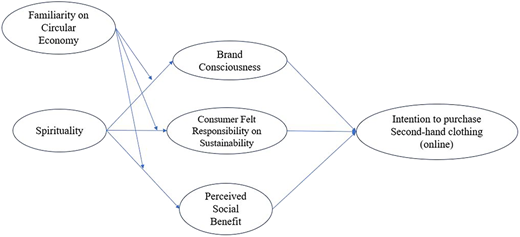
Familiarity with circular economy moderates the relationship between spirituality and brand consciousness.
Familiarity with circular economy moderates the relationship between spirituality and consumers' felt responsibility for sustainability.
Familiarity with circular economy moderates the relationship between spirituality and perceived social benefits.
Figure 1 highlights the conceptual model.
3. Methodology
A survey targeting religious young Muslim consumers in Indonesia who have prior experience in purchasing second-hand clothing online were circulated through various social media account (i.e. Facebook and Instagram) and Whatsapp.
This research adopts a variance-based Structural Equation Modelling (PLS-SEM) due to several methodological considerations. Firstly, PLS-SEM is well-suited for studies aiming to explore theoretical frameworks that involve multiple latent variables with a focus on prediction rather than confirmation (Becker et al., 2023; Shmueli et al., 2019). A two-stage analytical process was applied to assess the PLS-SEM results, consisting of the evaluation of both the measurement model (outer model) and the structural model (inner model) (Hair et al., 2019). The measurement model was assessed through constructs' reliability and validity, while the structural model was examined through the analysis of construct relationships, R2, f2, and Q2 values, as well as the significance of the structural paths using bootstrapping procedures. All statistical analyses were carried out using SmartPLS software version 4.0.
Spirituality was measured using five items adapted from Maulana et al. (2019) (i.e. “God helps to solve my problem”). Brand consciousness was measured using three items adapted from Nan and Heo (2007) (i.e. “I pay attention to the brand names of the products that I buy”). Consumer felt responsibility for sustainability (CFRS) was adapted from Luchs et al. (2015). Perceived social benefit and intention to purchase online second-hand clothing were both measured using three items from previous studies (Cuong, 2024; Kim et al., 2021). All measurement items were evaluated using a seven-point Likert scale.
4. Results
A total of 316 individuals participated in this study, 304 of them are Muslims (96.2%). Most respondents were Gen Z (96.2%) with monthly income lower than $500 USD (90%) and have diploma-bachelor's degrees (60.8%).
The findings suggest participants have relatively strong adherence to religious teachings (M = 5.19), a moderate level of familiarity with the circular economy (M = 4.93), and a moderate tendency to purchase clothing from online second-hand stores (M = 4.62), based on a 7-point Likert scale. Furthermore, a paradigm shift seems to have occurred as the stigmas over their concerns on hygiene, low quality and have previously been worn by others have seem to wane (M = 4.1 and 4.0).
4.1 Measurement model
Reflective measurement models were assessed through indicator loadings, internal consistency reliability, and convergent and discriminant validity (Hair et al., 2019). For indicator loadings, each item should ideally have a loading of 0.7 or higher (Hair et al., 2011). The analysis results show that all indicators exceed this threshold, except for two items. However, this is acceptable according to Chin (1998) since the composite reliability (CR) and average variance extracted (AVE) values are within the recommended thresholds. Therefore, the criterion for indicator loadings has been fulfilled.
Internal consistency reliability was assessed using CR and Cronbach's alpha. Both measures exceeded the recommended threshold of 0.70, indicating satisfactory reliability. In terms of validity, convergent validity was assessed from the AVE. All constructs demonstrated AVE values above 0.50. Discriminant validity was evaluated using the Heterotrait-Monotrait (HTMT) ratio of correlations (Becker et al., 2023). According to Henseler et al. (2015), HTMT values should fall below 0.85. The results confirm that all HTMT ratios meet the HTMT.85 standard, thus providing evidence of adequate discriminant validity. Collectively, these findings confirm that the measurement model demonstrates satisfactory reliability, convergent validity, and discriminant validity. Table 1 presents the measurement model assessment.
4.2 Structural model
Following Kock (2017), the Variance Inflation Factor (VIF) values were assessed to identify common method bias (CMB), and all were found to be below the threshold of 3.3, indicating no issues with collinearity. Furthermore, the model's explanatory power was moderate, with R2 values of 0.340 for INT, 0.322 for CFRS, 0.195 for BC, and 0.084 for PSB. The Q2 values indicated acceptable predictive relevance for CFRS (Q2 = 0.321), BC (Q2 = 0.219), and PSB (Q2 = 0.175), though predictive relevance for INT was relatively weak (Q2 = 0.056) (Hair and Alamer, 2022).
In examining the antecedents, spirituality (SPI) significantly predicted BC (β = 0.291, p < 0.001), CFRS (β = 0.529, p < 0.001), and PSB (β = 0.184, p = 0.023). However, SPI did not exert a significant direct effect on intention (β = 0.095, p = 0.106). Therefore, H1 is rejected, while H2, H3 and H4 are accepted.
Brand consciousness (BC) exhibited a significant positive effect on behavioural intention (INT) (β = 0.238, p = 0.001), as did perceived social benefit (PSB) (β = 0.349, p < 0.001), confirming their relevance as predictors of intention to purchase online second-hand clothing. Consumer felt responsibility for sustainability (CFRS), however, did not significantly influence intention (β = 0.097, p = 0.161). Therefore, H5 and H7 are accepted, while H6 is rejected.
For mediation effect, SPI had a significant indirect effect on intention via BC (β = 0.069, p = 0.036) and a marginally significant effect via PSB (β = 0.064, p = 0.050), whereas the indirect path through CFRS was not significant (β = 0.051, p = 0.175). Therefore, H8 and H10 are accepted, while H9 is rejected.
The moderation analysis examined the role of FCE on the relationship between SPI and the three mediators. The interaction term FCE × SPI significantly moderated the relationship with CFRS (β = 0.139, p = 0.006). However, no significant moderation was observed for the paths SPI → BC (β = 0.041, p = 0.516) and SPI → PSB (β = 0.051, p = 0.388). This suggests that only H12 is accepted, while H11 and 13 are rejected.
According to Cohen's (1988) guidelines, effect sizes of 0.02, 0.15, and 0.35 represent small, medium, and large effects, respectively. The path from SPI to CFRS exhibited a large effect size (f2 = 0.410), indicating a substantial contribution of SPI in explaining CFRS. The paths from PSB to INT (f2 = 0.148) and SPI to BC (f2 = 0.105) showed medium effect sizes, while the path from BC to INT (f2 = 0.063) represented a small-to-medium effect. All other paths, including SPI to PSB (f2 = 0.037), CFRS to INT (f2 = 0.010), SPI to INT (f2 = 0.009), and the moderation paths (ranging from f2 = 0.002 to 0.033), reflected small or negligible effects. Table 2 highlights the results of the structural model.
5. Discussion and implications
Overall, the findings demonstrate that spirituality influences young Muslim consumers' online second-hand clothing purchase intention primarily through the Self and Social consumer orientations proposed by McNeill and Moore (2015), whereas the Sacrifice orientation received only partial support. Although spirituality significantly strengthened brand consciousness (BC), consumers' felt responsibility for sustainability (CFRS), and perceived social benefit (PSB), only BC and PSB significantly mediated the relationship between spirituality and purchase intention. These findings suggest that spirituality alone does not directly motivate online second-hand clothing purchase intention. Rather, spirituality influences behavioural intention by activating different consumer orientations, with self-oriented and socially oriented motivations remaining the dominant psychological pathways.
Among the three consumer orientations, the strongest support emerged for the Self orientation. Spirituality significantly strengthened brand consciousness, which subsequently increased purchase intention through a significant indirect effect. McNeill and Moore (2015) characterise Self-oriented consumers as individuals who seek personal gratification, identity expression, and enjoyment through fashion consumption. The present findings suggest that spirituality does not necessarily suppress these self-oriented motivations. Instead, young Muslim consumers appear able to reconcile spiritual values with the enjoyment of purchasing branded second-hand apparel, allowing them to express their identity while simultaneously engaging in more sustainable consumption. This finding extends previous research suggesting that spirituality discourages materialistic consumption (Varma et al., 2024) by demonstrating that, within the context of second-hand clothing, spirituality may coexist with hedonic motivations when consumption is perceived as ethically acceptable.
The findings also support the Social orientation. Spirituality significantly increased perceived social benefits, which subsequently strengthened purchase intention. McNeill and Moore (2015) propose that Social-oriented consumers seek peer recognition and favourable social image through fashion choices. The present findings suggest that purchasing second-hand clothing may provide young Muslim consumers with opportunities to demonstrate environmentally responsible behaviour while simultaneously enhancing social identity and status. These findings support de Morais et al. (2021) who argued that sustainable consumption may generate social recognition. Within online retail environments, this effect may become even more pronounced because consumers can publicly communicate their sustainable lifestyle through ratings, reviews, community participation, and social media engagement.
By contrast, the Sacrifice orientation received limited empirical support. Although spirituality significantly strengthened consumers' felt responsibility for sustainability, CFRS neither predicted purchase intention nor mediated the relationship between spirituality and purchase intention. Similar findings have been reported in Malaysia, where sustainability values did not significantly influence sustainable fashion consumption despite the predominantly Muslim context (Koay et al., 2022). These findings suggest that environmental responsibility alone may be insufficient to motivate online second-hand clothing purchases among young Muslim consumers. Instead, sustainability-related values appear to require complementary self-oriented or social motivations before translating into behavioural intention.
Finally, familiarity with the circular economy significantly strengthened the relationship between spirituality and consumers' felt responsibility for sustainability. However, because CFRS did not significantly predict purchase intention, greater familiarity with circular economy principles ultimately failed to strengthen behavioural intention. These findings suggest that increasing consumers' knowledge of circular economy principles may strengthen sustainability-related values but is insufficient to change purchasing behaviour unless these values are integrated with identity-related and social motivations associated with second-hand clothing consumption.
5.1 Theoretical implications
The present study extends McNeill and Moore's (2015) consumer orientation framework by empirically demonstrating that the theoretical propositions underlying the Self, Sacrifice, and Social orientations operate differently within the context of online second-hand clothing consumption among young Muslim consumers. The present findings suggest that these motivational pathways are not equally influential. While the Self and Social orientations emerged as the dominant mechanisms linking spirituality to purchase intention, the Sacrifice orientation played a comparatively limited role despite spirituality significantly strengthening consumers' felt responsibility towards sustainability. These findings therefore suggest that the relative importance of the three consumer orientations is context dependent and may vary across different forms of sustainable fashion consumption.
The findings further refine the relationship between spirituality and the Self orientation. Previous research has frequently conceptualised spirituality as discouraging materialistic or self-oriented consumption (Varma et al., 2024). Consistent with McNeill and Moore's (2015) proposition that Self-oriented consumers seek identity expression and personal gratification through fashion, the present findings suggest that spirituality does not necessarily suppress these motivations. Instead, spirituality appears to reshape the way self-oriented motives are expressed, allowing young Muslim consumers to pursue identity expression through second-hand clothing when such consumption is perceived as ethically acceptable (Aruan and Wirdania, 2020). Rather than eliminating self-oriented consumption, spirituality may redirect it towards more sustainable alternatives.
The findings also extend McNeill and Moore's (2015) Social orientation by demonstrating that online retail platforms provide a digital environment in which social recognition associated with sustainable consumption can be amplified. This suggests that digital platform features (i.e. consumer reviews, social media integration, and community participation) may strengthen these socially oriented motivations by increasing the visibility of sustainable purchasing behaviour (Xu et al., 2022). Consequently, the study extends the Social orientation beyond traditional face-to-face interactions by illustrating how digital retail environments actively facilitate the construction and communication of sustainable identities.
5.2 Practical implications
The findings suggest that practitioners should prioritise self-oriented motivations when promoting online second-hand clothing among young Muslim consumers. Because brand consciousness emerged as the strongest mediating mechanism, marketers should reposition second-hand clothing as an opportunity for identity expression rather than merely an economical alternative (Nguyen and Nguyen, 2025). Marketing communications should emphasise the enjoyment of discovering unique branded products while reinforcing that purchasing second-hand clothing represents a modern and responsible lifestyle consistent with consumers' personal values.
The significant role of perceived social benefit further indicates that online platforms should strengthen opportunities for consumers to publicly express their sustainable consumption behaviours. Features such as sustainability badges, customer stories, community forums, social media integration, and referral programmes may reinforce positive social identity and encourage peer influence, making second-hand clothing consumption more socially desirable.
Findings indicate that sustainability messages alone are unlikely to change purchasing behaviour. Although familiarity with circular economy principles strengthened consumers' responsibility towards sustainability, these values did not directly translate into purchase intention. Consequently, educational initiatives should integrate circular economy concepts with messages emphasising identity expression and social recognition rather than relying exclusively on environmental benefits (McNeill and Venter, 2019). Online retailers may complement such initiatives by providing accessible product lifecycle and environmental impact information and facilitating circular practices through repair, resale, and trade-in programmes, thereby making sustainability benefits more visible and relevant to consumers (Herziger and Shmuely, 2024).
Finally, policymakers and religious organisations may play an important role in promoting second-hand clothing consumption by framing sustainable fashion as consistent with broader principles of environmental stewardship and responsible resource use (Setiawan and Arli, 2024). Multi-stakeholder collaborations may help reshape perceptions of second-hand clothing among young Muslim consumers while simultaneously encouraging sustainable consumption practices. Religious organisations may also sell second-hand clothing as an attempt for fundraising for charity or for their own use as demonstrated by similar organisations in Australia (Khan et al., 2023). These approaches may be effective to reframe second-hand clothes as a way to realise prosocial behaviour image which is necessary to influence this lifestyle to the religious young consumers (Hedegård, 2024). Alternatively, a virtual reality retail experience may be applied to amplify the sustainability aspect of online retailing compared with the traditional retails (Ali et al., 2025).
6. Concluding remarks, limitations and future research
Despite its contributions, this study has several limitations. The use of self-reported purchase intention may be subject to social desirability bias. Future studies could incorporate behavioural data or experimental designs to strengthen causal inference. In addition, the culturally specific sample limits the generalisability of the findings, highlighting the need for cross-cultural and longitudinal research to examine whether these relationships remain stable across contexts and over time.
Future research should also explore the drivers of perceived social benefits in online second-hand clothing consumption. Qualitative studies may reveal how factors such as social trends, social recognition, status from acquiring branded items, and Fear of Missing Out (FOMO) influence perceived social benefits, while also explaining why responsibility toward sustainability did not significantly predict purchase intention.
The research team would like to thank Arivaldo Nur Echa Pratama and his survey team for their excellent work in conducting the survey.