


This study examines how different consumer motivations for interacting with collective retail agglomeration digital touchpoints (e.g. websites, social media pages, mobile apps) influence the customer experience of the agglomeration visit, satisfaction and patronage intention. While prior research has shown that such touchpoints can support the visit, little is known about how motivational mechanisms shape experience and related outcomes in this collective, place-based context. Drawing on Uses and Gratifications Theory (UGT), the study examines motivation-driven interaction with these touchpoints.
Using Partial Least Squares Structural Equation Modelling (PLS-SEM), the study examines the effects of four motivations for interacting with collective digital touchpoints (entertainment, convenience, rewards and place-support) on customer experience, satisfaction and patronage intention. It also tests age and gender as moderators of the relationships between motivations and customer experience. Data were collected from 178 Dutch consumers who had interacted with the collective digital touchpoints of a retail agglomeration they had also visited.
The results show that the four motivations for interacting with collective digital touchpoints influence the customer experience of the agglomeration visit differently. Entertainment had the strongest positive effect, followed by place-support-seeking and then convenience. Reward-seeking showed no overall significant effect and was negative among consumers aged 50 and above. Customer experience strongly predicted satisfaction, which in turn predicted patronage intention, indicating a mediating role of satisfaction.
Practitioners involved in the marketing and management of retail agglomerations should align collective digital touchpoints with entertainment-, place-supporting- and convenience-driven motivations. Reward strategies may require tailoring to specific demographic segments, particularly older consumers.
This study applies UGT in a novel context, namely, place-based retail agglomerations, by examining how consumer motivations for interacting with collective digital touchpoints relate to the customer experience of the agglomeration visit and subsequent outcomes. In addition to the standard entertainment, convenience and reward motivations derived from UGT, the study incorporates a place-support motivation to capture consumers' desire to contribute to the continuity of the retail agglomeration and its retailers. The findings identify place-support-seeking as a distinct and influential motivation in shaping the retail agglomeration visit experience, alongside the strong effect of entertainment-seeking. In doing so, the study specifies UGT for the context of place-based retail agglomerations by showing that consumers derive experiential value not only from personal benefits but also from supporting the agglomeration and its local retailers.
1. Introduction
Retail agglomerations, including town-centre shopping areas, shopping malls and high streets, play a vital economic and social role in cities (van den Berg et al., 2021). However, these traditional physical environments face increasing pressure to adapt to digital innovation and competition from online retail (Pantano et al., 2021; AbedRabbo et al., 2021). The resulting “phygital” landscape, blending physical settings with digital touchpoints, has fundamentally transformed consumer behaviour (Del Vecchio et al., 2023; Silva and Cachinho, 2021).
One response has been the rise of collective retail agglomeration digital touchpoints, such as agglomeration websites, area-level social media pages and mobile apps, which represent the agglomeration as a unified entity. These touchpoints centralise information and can shape how consumers perceive and experience the retail agglomeration (AbedRabbo et al., 2022). Although only around 10% of consumers actively interact with such touchpoints (Risselada et al., 2018), this segment is highly involved and strategically relevant as digital interaction has been linked to stronger satisfaction and loyalty in post-pandemic contexts (Salvietti et al., 2022; Schweiger et al., 2024). This underscores the need to understand what motivates consumers to interact with collective retail agglomeration digital touchpoints and how these interactions influence the customer experience of the agglomeration visit.
Despite their growing use, the effects of these touchpoints on the customer experience of the agglomeration visit and behavioural outcomes remain underexplored. In retail marketing research, most studies examine digital touchpoints in single-firm, brand-controlled environments targeting relatively homogeneous audiences (Lemon and Verhoef, 2016; Homburg et al., 2017). These single-firm settings differ from the place-based agglomeration context, where collective touchpoints communicate on behalf of multiple independent and often diverse businesses. As a result, insights from single-retailer environments cannot fully explain how motivations shape the agglomeration visit experience.
A second important stream of work lies in the place-management literature, which has examined how town and city centres maintain vitality and viability (Parker et al., 2017; Ntounis et al., 2023). However, these studies have paid little attention to how collective digital touchpoints shape the experience of a retail agglomeration visit. The limited research on such touchpoints is predominantly qualitative, showing that they can centralise information, facilitate the coordination of consumer journeys and signal attractiveness (e.g. AbedRabbo et al., 2021, 2022). Yet these studies do not offer quantitative evidence on how different consumer motivations for interacting with collective digital touchpoints influence the customer experience of the agglomeration visit or how this experience translates into satisfaction and patronage intention.
To address this gap, this study draws on Uses and Gratifications Theory (UGT), which explains voluntary interaction based on the gratifications individuals seek. UGT is particularly suitable in this context because interaction with collective retail agglomeration digital touchpoints is voluntary and motivation-driven. While prior UGT research has mainly examined motivations in single-retailer digital settings (Boudkouss and Djelassi, 2021; Zielke and Komor, 2025), little is known about how motivations function in a multi-actor, place-based retail context, where value expression may be directed toward support for local businesses and the wider agglomeration. Applying UGT in this setting enables the inclusion of both standard motivations (e.g. entertainment, convenience and rewards) and a place-support motivation directed toward the wider agglomeration and its retailers. This study therefore examines how these motivations shape the customer experience of the agglomeration visit and related outcomes.
This study offers three theoretical contributions. First, it applies UGT to a novel context, namely place-based retail agglomerations, by introducing a place-support motivation alongside the standard entertainment, convenience and reward motivations commonly examined in prior research. In doing so, it specifies how UGT accounts for motivation-driven interaction when digital touchpoints represent the retail agglomeration as a whole. Second, it provides quantitative evidence on the differential effects of these motivations, clarifying their relative influence in shaping the experience of the agglomeration visit and related outcomes. Third, it examines the applicability of the experience–satisfaction–patronage mechanism in a collective, place-based retail context. In addition, the study offers guidance for practitioners seeking to strengthen retail agglomeration customer experience and patronage through collective digital touchpoints.
Building on these contributions, the following research questions guide the study:
How do consumer motivations for interacting with collective retail agglomeration digital touchpoints influence the customer experience of the agglomeration visit?
How does customer experience influence satisfaction and patronage intentions, and does satisfaction mediate the relationship between customer experience and patronage intention?
How do age and gender moderate the effects of consumer motivations on the customer experience of the agglomeration visit?
2. Research background and hypotheses
2.1 Retail agglomeration digital touchpoints and customer experience
Retail agglomerations are complex environments where hospitality, retail and service providers, together with place-management partnerships, jointly shape the customer experience (Hänninen and Paavola, 2021; Teller and Reutterer, 2008). Digital touchpoints are increasingly used to enhance the broader customer experience of the agglomeration visit and can be distinguished as either single-retailer-level touchpoints or collective touchpoints managed at the agglomeration level (AbedRabbo et al., 2022; Hagen et al., 2022).
Single-firm digital touchpoints, such as the websites, social media pages, or mobile apps of specific retailers, engage consumers with individual businesses. In contrast, collective digital touchpoints, including retail agglomeration websites, area-level social media pages, mobile apps, and public Wi-Fi, integrate information and services across multiple independent and often diverse businesses and communicate on behalf of the agglomeration as a unified entity. These touchpoints provide centralised information on accessibility, opening hours, promotions and the hospitality, retail and service offerings within the agglomeration (Risselada et al., 2018; Pantano et al., 2022).
By centralising information at the agglomeration level, collective digital touchpoints help consumers navigate the retail offer, discover businesses they might not otherwise visit, and plan their journeys more efficiently (AbedRabbo et al., 2022; Pantano et al., 2022). In doing so, they can influence how the agglomeration is perceived by signalling coordinated activity, vitality and attractiveness (Silva and Cachinho, 2021; Dizdarevic et al., 2020). Together, these effects contribute to the overall customer experience of the agglomeration visit. To capture this, we draw conceptually on Gahler et al.’s (2023) six-dimensional customer experience framework. However, we treat customer experience as one overall evaluation of the agglomeration visit, which keeps the concept complete and avoids unnecessary complexity in the analysis.
2.2 Uses and Gratifications Theory
Uses and Gratifications Theory (UGT) offers a useful lens for understanding voluntary interactions with collective retail agglomeration digital touchpoints. UGT posits that individuals select and use media and technologies to fulfil specific needs and gratifications (Katz et al., 1973). Although originally developed in mass-media contexts, UGT has been widely applied in digital consumer research at the single-brand or single firm level, including social media, mobile commerce and in-store technologies (e.g. Boudkouss and Djelassi, 2021; Zielke and Komor, 2025).
UGT is well-suited to this context because interaction with collective retail agglomeration digital touchpoints is voluntary and motivation-driven. Consumers can interact with collective touchpoints, single-firm channels, or neither, making motivational analysis particularly relevant in a multi-actor setting.
UGT typically distinguishes four broad types of gratifications: hedonic, utilitarian, incentive-driven and value-expressive (Katz et al., 1973; Ashraf et al., 2021). Whereas value expression is usually conceptualised at the individual level, in collective, place-based retail contexts, it may also reflect support for the continuity, identity and vitality of the agglomeration and its local businesses.
We distinguish between generic gratifications, namely entertainment-seeking, convenience-seeking and reward-seeking, and a place-support motivation that reflects value-expressive interaction with the wider agglomeration and its retailers. In a collective, multi-actor context, gratifications extend beyond individual transactions because consumers may derive value from supporting the broader agglomeration, its continuity, identity and vitality.
Prior UGT research has primarily examined motivations in single-brand or single-retailer contexts, whereas place-based agglomeration research has not examined underlying motivational mechanisms quantitatively. This highlights the research gap addressed here: applying UGT in a collective, place-based retail environment to analyse how motivations for interaction with collective digital touchpoints shape the customer experience of the agglomeration visit, satisfaction and patronage intention.
Together, these insights indicate that prior research has not integrated UGT with place-management perspectives to analyse how motivations for collective digital touchpoint interaction shape agglomeration experience and its related outcomes. Accordingly, UGT provides a coherent framework for analysing how entertainment-, convenience-, reward- and place-support-seeking motivations jointly explain consumer interaction with collective retail agglomeration digital touchpoints.
2.3 Research model and hypotheses
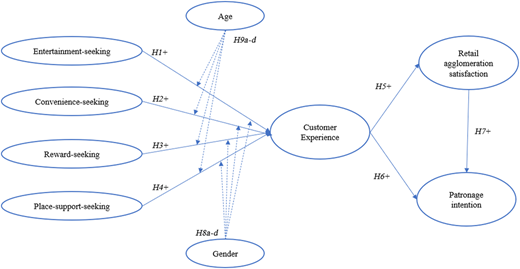
Our research model applies UGT to a collective, place-based context in which multiple independent businesses are represented through collective digital touchpoints. The model (Figure 1) posits that consumer motivations for interacting with collective retail agglomeration digital touchpoints, specifically entertainment-seeking, convenience-seeking, reward-seeking and place-support-seeking, shape the customer experience of the retail agglomeration visit, which in turn influences satisfaction and patronage intention. We also examine whether age and gender moderate the relationships between motivations and the customer experience of the retail agglomeration visit.
2.3.1 Motivations for digital touchpoint interaction as antecedents of customer experience
2.3.1.1 Entertainment-seeking
In retail marketing literature, hedonic motivations reflect the desire for enjoyment, exploration and sensory stimulation during retail interactions (Babin et al., 1994). In single-retailer settings, digital touchpoints can enhance hedonic value by stimulating curiosity, enabling discovery and offering interactive content (Stein and Ramaseshan, 2020; Zeng et al., 2024). In place-management literature, collective digital touchpoints are suggested to enrich the customer experience of the agglomeration visit by exposing consumers to local events, distinctive retailers and unique place characteristics, which may strengthen perceptions of vitality and attractiveness (AbedRabbo et al., 2021; Pantano et al., 2021). Taken together, these streams suggest that entertainment-seeking motivations are likely to broaden opportunities for exploration and affective engagement, potentially enhancing the customer experience during the agglomeration visit.
Entertainment-seeking motivations positively influence the customer experience of the agglomeration visit.
2.3.1.2 Convenience-seeking
In retail marketing literature, utilitarian motivations emphasise efficiency, accuracy and reduced effort during shopping activities (Babin et al., 1994; To et al., 2007). In single-retailer settings, digital touchpoints can enhance convenience by simplifying tasks, reducing search costs and supporting efficient decision-making (Vannucci and Pantano, 2020). In place-management literature, collective digital touchpoints are suggested to centralise accessibility information, opening hours, mobility options and business directories at the agglomeration level, which may reduce the complexity of navigating diverse and dispersed offerings (AbedRabbo et al., 2022; Pantano et al., 2022). Taken together, these mechanisms suggest that convenience-seeking motivations are likely to make the agglomeration easier to navigate and plan, potentially enhancing the customer experience of the agglomeration visit.
Convenience-seeking motivations positively influence the customer experience of the agglomeration visit.
2.3.1.3 Reward-seeking
Retail marketing research conceptualises incentive-driven motivations as the desire for monetary or symbolic benefits such as discounts, promotions or loyalty rewards (Chandon et al., 2000; To et al., 2007). In single-retailer settings, rewards can enhance utilitarian value through savings and hedonic value through excitement (Kesari and Atulkar, 2016). In place-management studies, collective digital touchpoints are suggested to aggregate offers across multiple businesses, which may increase the perceived value of the agglomeration and signal coordinated activity (Salvietti et al., 2022). Taken together, these insights indicate that reward-seeking motivations are likely to heighten perceived value and positive affect, potentially enhancing the customer experience of the agglomeration visit.
Reward-seeking motivations positively influence the customer experience of the agglomeration visit.
2.3.1.4 Place-support-seeking
In retail marketing literature, value-expressive motivations refer to the desire to support causes, values or identities that resonate personally or socially (Ashraf et al., 2021; Davies and Gutsche, 2016). This includes ethical or community-oriented behaviours in consumption, such as seeking to “do the right thing” or supporting responsible business practices. Empirical work indicates that such ethical or community-oriented motivations can enhance perceived quality of retail offerings and loyalty to local retailers, in some cases with stronger effects than hedonic or utilitarian motivations (Tena-Monferrer et al., 2022). This suggests that value-expressive motives can be particularly influential in local retail contexts. In place-management literature, value expression may extend from individual preferences to supporting local businesses and the wider agglomeration, which can contribute to community vitality and reinforce collective place identity (Hagen et al., 2024; Wilson and Hodges, 2022). Collective digital touchpoints are suggested to highlight local retailers, community narratives and shared place identity, which may strengthen attachment to the agglomeration (van den Berg et al., 2021; Hänninen and Paavola, 2021). Taken together, these mechanisms suggest that place-support-seeking may deepen emotional connectedness with the destination, potentially enhancing the customer experience of the agglomeration visit.
Place-support-seeking motivations positively influence the customer experience of the agglomeration visit.
2.3.2 Customer experience as an antecedent of customer satisfaction and patronage intention
In retail marketing research, customer experience is understood as a central driver of post-consumption evaluations, shaping satisfaction, loyalty and longer-term behavioural intentions (Blut et al., 2018). In single-retailer settings, digital touchpoints can influence perceptions and behaviour, contributing to satisfaction and loyalty (Vadruccio et al., 2024; Vannucci and Pantano, 2020; Stein and Ramaseshan, 2020). A positive customer experience typically enhances satisfaction, which in turn reinforces intentions to revisit or continue engaging with a retail offering (Molinillo et al., 2022). In place-management studies, the quality of the agglomeration visit experience has been associated with perceptions of vitality, attractiveness and coordinated place offerings. These place-based evaluations may influence consumers' willingness to return to the agglomeration and to support it through repeat patronage (AbedRabbo et al., 2022). The customer experience of the agglomeration environment, therefore, appears to play an important role not only in shaping individual evaluations but also in strengthening behavioural intentions toward the destination as a whole. Taken together, these streams suggest that customer experience functions as an antecedent of satisfaction and patronage intention and that satisfaction serves as a mechanism through which the agglomeration visit experience translates into behavioural outcomes. On this basis, the following hypotheses are proposed:
Customer experience has a positive influence on customer satisfaction with the retail agglomeration.
Customer experience has a positive influence on retail agglomeration patronage intention.
Customer satisfaction mediates the relationship between customer experience and patronage intention.
2.3.3 The moderating effects of age and gender
In the digital consumer behaviour and retail marketing literature, demographic characteristics such as age and gender have been associated with differences in shopping motivations and digital engagement. Gender differences are frequently observed in shopping motivations: women often prioritise hedonic and value-expressive considerations, whereas men tend to emphasise utilitarian and reward-oriented aspects (Noble et al., 2006; Tena-Monferrer et al., 2022). These patterns suggest that men and women may respond differently to the motivations for engaging with collective digital touchpoints.
Age-related differences have also been reported in retail and digital shopping contexts: younger consumers are generally more receptive to exploratory, interactive, or digitally mediated formats, whereas older consumers tend to value straightforward, functional, and efficiency-oriented information processing (Pantano et al., 2022; Khan et al., 2020). Younger consumers may also display stronger value-expressive orientations toward supporting local or ethical initiatives within retail environments (Wilson and Hodges, 2022). Because collective digital touchpoints can fulfil different motivations, demographic differences are likely to influence how these motivations shape the customer experience of the agglomeration visit. On this basis, the following hypotheses are proposed:
Gender moderates the relationship between entertainment-seeking (H8a), convenience-seeking (H8b), reward-seeking (H8c) and place-support-seeking (H8d) and customer experience.
Age moderates the relationship between entertainment-seeking (H9a), convenience-seeking (H9b), reward-seeking (H9c) and place-support-seeking (H9d) and customer experience.
Figure 1 conceptualises how motivations for interacting with collective retail agglomeration digital touchpoints influence the customer experience of the agglomeration visit, which in turn affects satisfaction and patronage intention. It further examines the moderating roles of age and gender.
3. Methodology
3.1 Data collection and sample
We conducted an online survey in January 2024 to explore consumer motivations for using digital touchpoints in retail agglomerations and their impact on customer experience, satisfaction and patronage intention. Data were collected through a national consumer panel managed by the Dutch market research agency Q&A Retail. The panel consists of adults aged 18 years and older. For this study, the sampling process was monitored to reflect the Dutch population in terms of gender, age, occupation and geographic distribution.
A total of 2,186 panel members responded to the initial survey invitation. Given our research objectives, we included only respondents who had actively interacted with digital touchpoints of a retail agglomeration they had visited within the past six months. To ensure data integrity, respondents were asked to specify the town and name of the retail agglomeration visited, which was consistently referenced throughout the questionnaire. During data cleaning, we verified the existence of these retail agglomerations and their online channels by cross-checking respondents' entries with publicly available information on each agglomeration's official website and social media pages. Respondents whose reported retail agglomerations lacked an identifiable online presence were excluded from further analysis. Additional quality checks included removing respondents who failed attention checks, provided uniform responses or completed the questionnaire in under four minutes.
Prior research indicates that only around 10% of Dutch consumers actively interact with collective retail agglomeration digital touchpoints (Risselada et al., 2018), which helps explain why the eligible pool of respondents for this study was relatively small. The number of eligible respondents was further reduced by the requirement of a recent agglomeration visit and the application of strict data-quality criteria. After applying these conditions, 178 responses remained. The final sample, therefore, represents digitally engaged retail agglomeration visitors rather than the general Dutch population. Although modest, the dataset exceeds recommended sample-size thresholds for PLS-SEM in exploratory research (Hair et al., 2022). A post-hoc power analysis (G*Power) confirmed statistical power of 0.99, reducing the likelihood of Type II error.
The final sample ranged in age from 18 to 80 years (M = 42.9). The gender distribution was 47% male, 52% female and 1% identifying as other. For the moderation analysis, respondents were divided into two age groups: <50 years (n = 119) and 50+ years (n = 59). This segmentation aligns with prior evidence that older consumers (>50) exhibit distinct patterns in their adoption and evaluation of retail technology (Deshwal, 2016) and broader age-related distinctions in digital engagement and shopping values (Pantano et al., 2022; Khan et al., 2020).
Regarding the use of collective digital touchpoints, 71% reported using websites, 39% social media pages, 21% Wi-Fi services, 15% email newsletters, 6% webshops and 8% mobile apps. These patterns reflect the mixed availability of touchpoints across retail agglomerations visited by the respondents.
3.2 Measures
The survey included validated scales adapted from previous studies and refined to suit the context of retail agglomerations (see Appendix A). The scales were pretested with a small subset of respondents to ensure clarity and contextual relevance for retail agglomerations. Feedback from academic domain experts further informed minor refinements. Entertainment-seeking was measured using six items adapted from Ashraf et al. (2021) convenience-seeking and reward-seeking with four and three items, respectively, sourced from Hagen et al. (2024) and place-support-seeking, capturing motivations related to supporting the continuity of the retail agglomeration and its local retailers, was adapted from Zhang et al. (2020). Customer experience was measured using the 16-item scale by Gahler et al. (2023). Given the sample size and model complexity, we modelled the construct as a single reflective factor capturing respondents' overall evaluation of the agglomeration visit. We measured satisfaction and patronage intention using three items adapted from Teller and Reutterer (2008). All motivation items were measured on a 5-point Likert scale, whereas customer experience, satisfaction and patronage intention were measured on a 7-point Likert scale.
We conducted several tests to ensure the reliability and validity of our results (see Table 2). All constructs met acceptable reliability and validity thresholds. Cronbach's alpha and composite reliability (CR) values exceeded 0.70, and average variance extracted (AVE) values were above 0.50, indicating strong internal consistency and convergent validity (Nunnally and Bernstein, 1994; Fornell and Larcker, 1981). Discriminant validity was confirmed through the Fornell-Larcker criterion and heterotrait-monotrait (HTMT) ratio, ensuring that each construct is distinct and free from multicollinearity or measurement overlap.
3.3 Data analysis
We tested the proposed model using partial least squares structural equation modelling (PLS-SEM) with SmartPLS 4, as this method is well-suited for exploratory research involving complex relationships, smaller sample sizes, and the testing of mediation and moderation effects (Hair et al., 2022). This approach enables the simultaneous assessment of measurement and structural models and is particularly effective in handling multiple moderator analyses.
The data were analysed using a two-stage approach. First, we examined the reliability and validity of the measurement model. Then, we estimated the hypothesised model, considering the potential moderating effects of age and gender. To mitigate potential common method bias (CMB), we incorporated procedural controls into the survey design, including randomising the question order and using negatively worded items. These measures aimed to reduce response patterns and promote thoughtful, varied responses. Statistical tests further confirmed the minimal CMB, with Harman's single-factor test showing a 37.71% variance, which is below the 50% threshold (Podsakoff et al., 2003). Kock's (2017) approach also yielded Variance Inflation Factor (VIF) values ranging from 1.000 to 2.008, indicating no significant CMB.
4. Results
4.1 Measurement model
We evaluated the psychometric properties of the measurement model (Table 1) to assess reliability and validity. All constructs met acceptable thresholds for reliability and validity, ensuring robust measurement properties across scales. Cronbach's alpha and composite reliability scores exceeded 0.7 (Cronbach, 1951). Convergent validity was confirmed with item loadings ranging from 0.680 to 0.929, t-values of outer model loadings above 1.96 (Hair et al., 2022), and AVE values above 0.5 (Fornell and Larcker, 1981). HTMT values between reflective constructs were below 0.9, and inter-construct correlations fell below the square root of the AVEs, affirming strong discriminant validity (Henseler et al., 2016).
Psychometric properties
| Cronbach's alpha | Composite reliability | AVE | ES | CS | RS | PSS | CX | ST | PI | |
|---|---|---|---|---|---|---|---|---|---|---|
| Entertainment-seeking (ES) | 0.900 | 0.901 | 0.667 | 0.817 | 0.373 | 0.723 | 0.649 | 0.676 | 0.436 | 0.193 |
| Convenience-seeking (CS) | 0.861 | 0.861 | 0.707 | 0.332 | 0.841 | 0.406 | 0.245 | 0.392 | 0.130 | 0.112 |
| Reward-seeking (RS) | 0.846 | 0.940 | 0.757 | 0.641 | 0.354 | 0.870 | 0.666 | 0.464 | 0.359 | 0.212 |
| Place-support-seeking (PSS) | 0.932 | 0.933 | 0.832 | 0.593 | 0.219 | 0.594 | 0.912 | 0.629 | 0.334 | 0.241 |
| Customer experience (CX) | 0.947 | 0.949 | 0.529 | 0.629 | 0.359 | 0.450 | 0.593 | 0.727 | 0.603 | 0.497 |
| Satisfaction (ST) | 0.886 | 0.890 | 0.815 | 0.390 | 0.113 | 0.313 | 0.304 | 0.556 | 0.903 | 0.773 |
| Patronage Intention (PI) | 0.831 | 0.933 | 0.729 | 0.205 | 0.093 | 0.229 | 0.232 | 0.483 | 0.736 | 0.854 |
Note(s): The square roots of the AVE are shown in the italic diagonal. The Fornell-Larcker criterion results are displayed below the italic diagonal, while the HTMT values are shown above the italic diagonal
4.2 Structural model
The model fit indicators suggest an acceptable fit. While the NFI (0.624) and SRMR (0.084) suggest room for improvement in model fit, these results are common in exploratory research involving complex models and smaller sample sizes. Retaining all items ensures a comprehensive representation of the constructs and preserves theoretical integrity (Hollebeek et al., 2025).
We assessed model fit using the coefficients of determination (R2), significance levels, and t-values of the structural paths (Hair et al., 2022). Following Hair et al. (2022), we applied a PLS-SEM bootstrapping procedure with 5,000 resamples to evaluate the significance of the hypothesised relationships based on standard errors, t-values and confidence intervals. Results are displayed in Table 2 and Figure 2.
Results of the conceptual model assessment
| β | p-value | t-statistic | f2 | VIF | Outcome | Q2 | R2 | |
|---|---|---|---|---|---|---|---|---|
| H1. Entertainment-seeking - > Customer experience | 0.416 | 0.000 | 4.767 | 0.175 | 1.971 | Supported | ||
| H2. Convenience-seeking - > Customer experience | 0.175 | 0.010 | 2.561 | 0.052 | 1.170 | Supported | ||
| H3. Reward-seeking - > Customer experience | −0.095 | 0.212 | 1.249 | 0.009 | 2.008 | Not Supported | ||
| H4. Place-support-seeking - > Customer experience | 0.365 | 0.000 | 4.850 | 0.151 | 1.754 | Supported | ||
| H5. Customer experience - > Satisfaction | 0.556 | 0.000 | 8.158 | 0.448 | 1.000 | Supported | ||
| H6. Customer experience - > Patronage intention | 0.106 | 0.055 | 1.919 | 0.017 | 1.448 | Not supported | ||
| H7. Satisfaction - > Patronage intention | 0.677 | 0.000 | 13.743 | 0.703 | 1.448 | Supported | ||
| Customer experience | 0.460 | 0.498 | ||||||
| Satisfaction | 0.117 | 0.309 | ||||||
| Patronage intention | 0.026 | 0.550 |
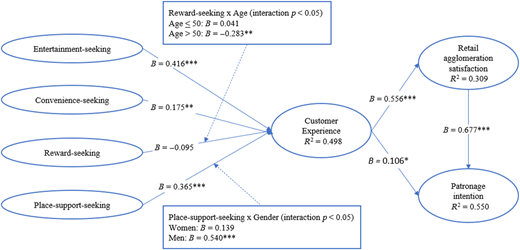
Results of the conceptual model assessment. Note: ***p < 0.001; **p < 0.05; *p < 0.10. Only significant moderation effects are shown
Results of the conceptual model assessment. Note: ***p < 0.001; **p < 0.05; *p < 0.10. Only significant moderation effects are shown
The coefficients of determination (R2) demonstrated the model's predictive power, explaining 49.8% of the variance in customer experience, 30.9% in satisfaction, and 55.0% in patronage intention. Stone-Geisser's Q2 values (customer experience: 0.460, satisfaction: 0.117, and patronage intention: 0.026) confirmed the predictive relevance of endogenous variables (Geisser, 1974).
Table 2 shows that hypotheses H1, H2, H4, and H5 were supported, indicating positive and significant effects of entertainment-seeking (β = 0.416, p = 0.000), convenience-seeking (β = 0.175, p = 0.010), and place-support-seeking (β = 0.365, p = 0.000) motivations on customer experience. Customer experience positively influenced satisfaction (β = 0.556, p = 0.000), and satisfaction significantly impacted patronage intention (β = 0.677, p = 0.000). Conversely, H3 (reward-seeking, β = −0.095, p = 0.212) and H6 (customer experience to patronage intention, β = 0.106, p = 0.055) were not supported. These results suggest that consumers prioritise entertainment-seeking, place-support-seeking, and convenience-seeking over reward-seeking motivations when engaging with digital touchpoints. Similarly, the limited direct effect of customer experience on patronage intention (H6) may reflect the mediating role of satisfaction, underscoring the importance of ensuring a positive customer experience to foster satisfaction, which in turn impacts behavioural intentions.
Effect size was assessed through f2 values, revealing strong impacts of customer experience on satisfaction and satisfaction on patronage intention (f2 > 0.35), moderate impacts of entertainment-seeking and place-support-seeking on customer experience (f2 > 0.15), and low impacts of convenience-seeking, reward-seeking, and customer experience on patronage (f2 < 0.15).
Finally, after establishing measurement invariance, we conducted multi-group analysis (5,000 bootstrap resamples) to examine structural path differences across groups. The results revealed a stronger relationship between place-support-seeking and customer experience among men (β = 0.540, p < 0.001) than among women (β = 0.139, p = 0.163). The moderation analysis between the age groups (under 50 vs. 50+) revealed that reward-seeking had an adverse effect on customer experience among older consumers (β = −0.283, p = 0.029). Still, it showed no significant effect among younger consumers (β = 0.041, p = 0.634). No other path differences reached significance (all p > 0.10). The significant group differences are presented in Figure 2.
5. Discussion of key findings
5.1 Theoretical contributions
This study makes three theoretical contributions to research at the intersection of retail marketing and place management. It examines how consumer motivations for interacting with collective retail agglomeration digital touchpoints relate to the customer experience of the agglomeration visit, satisfaction and patronage intention. Rather than focusing on firm-level digital touchpoints, the study considers motivation-driven interaction in a collective, place-based retail setting in which collective digital touchpoints represent the agglomeration as a whole. This specifies how established theories of consumer motivation and experience apply in this novel, place-based retail agglomeration context.
First, the findings show that UGT also accounts for motivation-driven interaction in this place-based collective context. Whereas prior UGT research has mainly examined hedonic, utilitarian, and reward-driven gratifications in single-retailer settings (Boudkouss and Djelassi, 2021; Zielke and Komor, 2025), our results identify place-support-seeking as a distinct motivation for interaction with collective digital touchpoints that shapes the experience of the retail agglomeration visit. This suggests that consumers derive value not only from personal benefits but also from supporting the continuity of the agglomeration and its local retailers. This finding aligns with earlier work on ethical and community-oriented shopping motivations in firm-level contexts (Tena-Monferrer et al., 2022) and clarifies how UGT's value-expressive gratification applies in the setting of place-based retail agglomerations.
A second contribution concerns the quantitative examination of four motivational effects on the customer experience of the retail agglomeration visit. Prior work in place-management literature has primarily offered qualitative descriptions of why consumers interact with collective digital touchpoints, focusing on how such channels coordinate information, shape journeys, and signal attractiveness (e.g. AbedRabbo et al., 2021, 2022; Pantano et al., 2022), without examining motivational effects quantitatively. Our results show that entertainment- and place-support-seeking motivations have strong positive effects on the agglomeration visit experience, convenience-seeking has a smaller but significant effect, and reward-seeking is statistically insignificant in the full sample. This pattern reinforces retail experience research showing that hedonic value strongly predicts customer experience in single-firm digital contexts (Stein and Ramaseshan, 2020) and that utilitarian or reward-related benefits can enhance satisfaction in multi-store shopping environments (Kesari and Atulkar, 2016). The lack of significance for reward-seeking indicates that incentive-based motivations do not meaningfully contribute to the experience of the agglomeration visit. In the collective retail agglomeration setting, rewards may consist of offers from multiple retailers targeting diverse visitor groups. As a result, such incentives may be less closely aligned with individual visitors' interests and therefore less effective in shaping their experience.
A third contribution is that the well-known experience–satisfaction–patronage sequence also holds in a collective, place-based retail context: customer experience raises satisfaction, and satisfaction supports patronage intention. This mechanism is well established in store-based and firm-controlled environments (Babin et al., 1994; Blut et al., 2018), but has, to our knowledge, not been tested in a context where digital touchpoints represent multiple independent retailers collectively.
In addition, the study adds nuance to existing findings on demographic variation in shopping motivations. Prior research shows that age and gender shape shopping values and responses to digital tools, mainly in single-firm environments (Noble et al., 2006; Pantano et al., 2022). In a collective, place-based digital context, we find that place-support-seeking has a stronger experiential effect among men, and that reward-seeking negatively affects older consumers. This indicates that demographic differences in specific motivations may manifest differently in collective, place-based retail settings than in single-firm contexts.
5.2 Practical implications
The findings provide guidance for practitioners involved in the marketing and management of retail agglomerations who seek to strengthen customer experience and patronage through collective digital touchpoints. Motivational effects differ, indicating that digital communication should align with specific gratifications rather than relying on a uniform approach. Collective touchpoints should prioritise entertainment- and place-support-oriented content, with convenience-oriented content supporting it.
Entertainment- and place-support motivations have the most substantial experiential effects, suggesting that collective touchpoints should emphasise engaging and community-oriented content. Because these touchpoints communicate on behalf of the agglomeration as a whole, content that highlights local stories, events, distinctive retailers, and shared place identity can enhance the visit experience more effectively than product-focused or single-retailer promotion alone.
Convenience-oriented features such as business directories, opening hours or parking information remain useful for coordinating the visit and reducing search effort, but their experiential impact is modest. Functional information appears most effective when integrated into broader experiential storytelling rather than serving as the primary focus.
Reward-seeking did not influence customer experience in the overall sample, indicating that incentive-based communication adds little to the agglomeration visit experience. Rewards may still be valuable for individual retailers, but for collective touchpoints, they appear more effective when combined with experiential or community-oriented messaging rather than offered as stand-alone promotions.
Demographic variation in motivational effects has practical value for touchpoint content. Place-support-seeking has a stronger experiential impact among men, suggesting that messaging emphasising local identity or supporting independent retailers may resonate particularly strongly with this group. The adverse experiential effect of reward-seeking among older consumers indicates that incentive-based messaging should be used with caution in communications aimed at older audiences.
Although only a minority of consumers interact with collective digital touchpoints, this segment voluntarily chooses to do so and exhibits greater interest in the retail agglomeration. Their digital interactions meaningfully shape the agglomeration experience. The strategic value of collective touchpoints, therefore, lies not in mass reach but in effectively serving a loyal and motivated segment. Designing digital communication that aligns with their motivations and characteristics can enhance experience, strengthen satisfaction and increase patronage. In this sense, collective digital touchpoints can serve not only as information channels but also as experiential tools that enhance the agglomeration's attractiveness for a specific and valuable group.
5.3 Limitations and suggestions for further research
Like all research, this study has limitations that offer directions for further investigation. First, although the sample is substantial for this hard-to-reach group of digitally engaged agglomeration visitors, it does not represent all shoppers, consistent with the study's focus on motivations for digital touchpoint interactions and their experiential implications. Future studies could broaden participation within this engaged subgroup by collaborating with place-management organisations or business improvement districts, enabling a larger number of users to be reached. A larger sample within this population would allow more detailed subgroup analyses and enable the separation of digital touchpoints and customer experience dimensions rather than treating them as single categories.
Second, the study relies on self-reported survey data collected at one point in time. Longitudinal, experimental or multi-method designs, including behavioural trace data from digital touchpoints, could offer deeper insight into actual usage patterns, evolving motivational processes and experiential dynamics over time. Such approaches would complement the self-reported measures used here and strengthen causal interpretation.
Third, the study was conducted in a Dutch context, and motivational and experiential dynamics may differ across countries or regions with distinct retail structures, cultural norms or place-management traditions. Comparative studies in international or cross-cultural settings would enhance understanding of generalisability and boundary conditions.
Finally, rapid developments in digital technologies, including AI-enhanced formats, augmented reality and immersive services, may reshape how consumers interact with collective digital touchpoints and how these interactions influence the agglomeration visit experience. Future research could examine how such technologies affect not only experiential evaluations but also the relational dynamics among consumers, retailers, and the retail agglomeration.
Appendix
Constructs, measurement items, and factor loadings
| Construct | Source | Items | Loading | Mean | SD | t-value |
|---|---|---|---|---|---|---|
| Entertainment-seeking | Ashraf et al. (2021) | I interact with the collective digital touchpoints of this retail agglomeration because … | ||||
| it is fun | 0.763 | 0.041 | 0.026 | 18.672 | ||
| it is enjoyable | 0.855 | 0.026 | 0.035 | 32.920 | ||
| it is entertaining | 0.799 | 0.035 | 0.026 | 22.897 | ||
| to enjoy the variety of content it offers | 0.847 | 0.026 | 0.034 | 33.036 | ||
| it is interesting | 0.837 | 0.034 | 0.030 | 24.609 | ||
| I feel a sense of adventure using them | 0.797 | 0.030 | 0.033 | 27.004 | ||
| Convenience-seeking | Hagen et al. (2024) | I interact with the collective digital touchpoints of this retail agglomeration because … | ||||
| it is convenient for me | 0.884 | 0.033 | 0.045 | 27.109 | ||
| it allows me to efficiently manage my time | 0.843 | 0.045 | 0.070 | 18.741 | ||
| it allows me to save time | 0.763 | 0.070 | 0.030 | 10.836 | ||
| it makes tasks (e.g. information search or making less time-consuming | 0.867 | 0.030 | 0.081 | 29.051 | ||
| Reward-seeking | Hagen et al. (2024) | I interact with the collective digital touchpoints of this retail agglomeration … | ||||
| to be rewarded for continued participation | 0.750 | 0.081 | 0.017 | 09.274 | ||
| because of incentives (e.g. promotional deals) | 0.920 | 0.017 | 0.015 | 52.837 | ||
| because of loyalty incentives for my continued participation | 0.929 | 0.015 | 0.019 | 63.300 | ||
| Place-support-seeking | Zhang et al. (2020) | I interact with the collective digital touchpoints of this retail agglomeration because … | ||||
| to support the continuity of the retail agglomeration | 0.893 | 0.019 | 0.013 | 47.989 | ||
| to contribute to the prosperity of the retail agglomeration | 0.923 | 0.013 | 0.015 | 72.566 | ||
| to support local retailers | 0.917 | 0.015 | 0.015 | 59.597 | ||
| because it is important to me to support the retail agglomeration | 0.915 | 0.015 | 0.015 | 60.229 | ||
| Customer experience | Gahler et al. (2023) | Affective dimension | ||||
| Interactions with the retail agglomeration induced good emotions | 0.700 | 0.049 | 0.046 | 14.306 | ||
| I had positive feelings during interactions with the retail agglomeration | 0.700 | 0.046 | 0.037 | 15.228 | ||
| Interactions with the retail agglomeration put me in a good mood | 0.755 | 0.037 | 0.040 | 20.507 | ||
| Cognitive dimension | ||||||
| Interacting with the retail agglomeration piqued my curiosity | 0.727 | 0.040 | 0.049 | 17.971 | ||
| I learned something beneficial during interactions with the retail agglomeration | 0.713 | 0.049 | 0.042 | 14.679 | ||
| I got positive insights during interactions with the retail agglomeration | 0.737 | 0.042 | 0.044 | 17.581 | ||
| Physical dimension | ||||||
| My physical responses during interactions with the retail agglomeration were pleasant | 0.747 | 0.044 | 0.043 | 17.082 | ||
| During interactions with the retail agglomeration, I actively moved in a way I liked | 0.758 | 0.043 | 0.041 | 17.827 | ||
| During interactions with the retail agglomeration, I was active in a way I liked | 0.757 | 0.041 | 0.034 | 18.340 | ||
| Relational dimension | ||||||
| I established a personal relationship with my retail agglomeration | 0.749 | 0.034 | 0.034 | 22.122 | ||
| I felt positively connected with the retail agglomeration | 0.798 | 0.034 | 0.051 | 23.760 | ||
| Interacting with the retail agglomeration made me feel like I belonged to a community | 0.680 | 0.051 | 0.052 | 13.334 | ||
| Sensorial dimension | ||||||
| Interactions with the retail agglomeration had a positive sensory appeal | 0.688 | 0.052 | 0.054 | 13.189 | ||
| Interactions with the retail agglomeration positively impacted my senses | 0.681 | 0.054 | 0.052 | 12.585 | ||
| Interactions with the retail agglomeration positively engaged my senses in various ways | 0.707 | 0.052 | 0.052 | 13.558 | ||
| Symbolic dimension | ||||||
| Interactions with the retail agglomeration were aligned with my personal values | 0.708 | 0.052 | 0.061 | 13.737 | ||
| My personal beliefs were confirmed during interactions with the retail agglomeration | 0.711 | 0.061 | 0.046 | 11.615 | ||
| Interactions with the retail agglomeration align with my self-image | 0.756 | 0.046 | 0.013 | 16.339 | ||
| Satisfaction | Teller and Reutterer (2008) | How satisfied are you with the retail agglomeration? | 0.924 | 0.013 | 0.024 | 69.830 |
| How does the retail agglomeration meet your expectations? | 0.899 | 0.024 | 0.024 | 38.160 | ||
| Think of an ideal retail agglomeration. To what extent does it come close to that? | 0.884 | 0.024 | 0.015 | 36.599 | ||
| Patronage intention | Teller and Reutterer (2008) | Would you recommend the retail agglomeration to others? | 0.864 | 0.015 | 0.046 | 56.825 |
| How likely are you to go to the retail agglomeration again? | 0.852 | 0.046 | 0.053 | 18.404 | ||
| How likely are you to go to the retail agglomeration again and purchase something? | 0.844 | 0.053 | 0.041 | 16.045 | ||
Note(s): Customer experience was measured using the 16-item scale by Gahler et al. (2023). Although the original scale distinguishes six experiential dimensions, in this study the construct was modelled as a single reflective factor. Motivation items were measured on a 5-point Likert scale; customer experience, satisfaction and patronage intention were measured on a 7-point Likert scale

