This study aims to demonstrate how integrating sustainable development into courses and degree programs can be systematically enhanced using a transparent method that ensures high quality and relevance. By presenting findings from the University of Gothenburg, Sweden, this study addresses challenges in advancing education for sustainable development (ESD) at higher education institutions.
This study used action research methodology which is characterized as a reflective and collaborative inquiry. A new mapping tool was used to make sustainable development more visible in the program plans. The tool maps the learning outcomes to a set of sustainability criteria or to the UN sustainable development goals.
One important finding was the identification of different “sustainability tracks,” divided into “weak” or “strong” sustainability. A second finding was that processes and practices that support the integration of sustainable development in education were identified and correlated by both quantitative and qualitative analyses. Finally, three important areas to increase integration of sustainability were identified: understanding ESD in higher education; actors, stakeholders, processes and practices; tools and labelling.
This study analyzed only six degree programs, which may restrict the generalizability of the findings across the entire university curriculum or to other institutions.
This study uniquely connects sustainable development in higher education to systematic labelling of sustainability within degree programs, enhancing transparency, coherence and student engagement. The labelling framework supports curriculum development, promotes institutional growth and ensures traceability, fostering the integration and progression of sustainability competences across courses and programs.
Introduction
The research society is united in the conviction that human patterns of production and consumption cause effects on the Earth’s climate system. There is an urgency to change technologies, social practices and social norms. Currently, there are 17 sustainable development goals (SDGs) guiding the work with global sustainability. It includes the emphasis on: “By 2030, ensure that all learners acquire the knowledge and skills needed to promote sustainable development, including, among others, through education for sustainable development” (United Nations, 2015). Education has a key role for a sustainable future (Kopnina, 2020). Because of their high societal impact, universities are challenged to take a leadership role in sustainability issues. As universities educate the next generation of decision-makers and influencers, universities can have a greater impact on sustainable development than any other single sector in society. Universities, therefore, have an important role in striving to achieve the future SDGs.
Sustainability and sustainable development has continued to become an important topic in higher education and more recently moved from a niche education for students in environmental studies, to an aspect that should permeate all types of degree programs (Weldemariam, 2021). To empower course leaders and degree program managers to integrate sustainability into education, one must begin by analyzing the prevailing state of the art. One way of addressing this is to analyze course and program contents through sustainability maps and sustainability presence maps (Sánchez-Carracedo et al., 2019). Likewise, Hanning et al. (2012) analyzed course and program contents using a method similar to engineering sustainability maps.
The importance of education for sustainable development (ESD) at the University of Gothenburg grows out of the research at the Gothenburg Centre for Sustainable Development and from a global shift to focus on sustainability. From Gothenburg Centre for Sustainable Development, with the support of the vice chancellor and the central board of education, the concept of ESD at the University of Gothenburg has evolved.
At the University of Gothenburg, integrating sustainability into education is guided by a set of university-defined sustainability criteria, Table 1, defined by the university. The criteria have been set up to cover substantial and varied aspects of sustainability. Each criterion is identified by a number, a short description and in a few words the content is presented. Degree programs and courses can be designated as either “sustainability-focused” or “sustainability-related,” depending on the extent to which they incorporate these criteria into their learning outcomes (Boman and Andersson, 2013; Boman et al., 2025a, 2025b). Course leaders and program coordinators are responsible for self-evaluating their courses and programs, subsequently listing them with the university’s central sustainability management. Labelling can also be done according to how the course and program content is linked to the UN SDGs. Many approaches are used in this dual labelling system, like using a tool for bridging the criteria and the SDGs, a more formal procedural description of the process, the use of an online SDG impact assessment tool (Gothenburg centre for sustainable development, 2015) with the continued support of the Section for Sustainable Development at the University of Gothenburg. Since its inception, the use of sustainability criteria has been a way of concretely respond to the 2006 amendment to the Swedish Higher Education Act chapter 1, § 5, where the role of higher education institutions for sustainable development is particularly emphasized:
In the course of their operations, higher education institution shall promote sustainable development that ensures present and future generations a healthy and good environment, economic and social welfare and justice (Ministry of education, 2006).
Sustainability management at the university has been interested in creating more thorough and systematic mechanisms to follow up the implementation of the sustainability criteria. Together with the startup company Enweave, the university analyzed courses and programs and their impact for sustainability, through a method where the program and course learning outcomes are used as a basis for analysis. The six selected degree programs at the university, chosen to cover a broad variety of programs from different disciplines, where sustainability labelled (Table 2). The programs have been analyzed, based on both qualitative and quantitative methods. Qualitative methods use methods similar to engineering sustainability maps, where course learning outcomes are related to the sustainability criteria through semantic annotation. This mapping enables the creation of a quantitative indicator showing the level of sustainability included. This quantitative indicator can inform program managers, course leaders, as well as administrative staff, of gaps in education, showing where more focus should be placed on certain sustainability criteria to reach university goals related to sustainability in education. This method can also be used to create other links, such as linking the UN SDGs to the course learning outcomes.
The aim of this study is to discuss and show how the integration of sustainable development into courses and degree programs can be enhanced through a systematic and transparent method developed to ensure high quality and relevance.
Integration of sustainability in higher education
We are living in times of environmental, social and economic crisis. In response to that, the goal of transforming and reorienting education toward sustainable development was pursued globally in connection with the UN Decade of Education for Sustainable Development (DESD), 2005–2014. The Global Action Program (GAP) 2014–2019 was introduced to accelerate and scale-up ESD endeavors toward the latest decade’s Sustainable Development Goals in Agenda 2030 (Boman et al., 2025a, 2025b; United Nations, 2015). More recently, to respond to the increasing interest across higher education to engage with the SDGs, the notion of Education for the SDGs (ESDGs) was introduced encompassing a broader and more comprehensive focus beyond the already existing ESD endeavors (Kopnina, 2020; SDSN, 2020). Additionally, transformative approaches to education have been central to ESD discourses. Mezirow’s Transformative Learning Theory (Mezirow, 2000), which emphasizes critical reflection and perspective transformation, provides a valuable lens for understanding how learners can develop the capacity to address complex sustainability challenges. Likewise, Sterling (2001) argues for a paradigm shift in education, promoting a move from transmissive to transformative learning to support sustainability in its fullest sense.
In an attempt to analyze successful integration of sustainability in education, Barth et al. (2007), Cincera et al. (2018) and Lozano et al. (2017) focus on development of competences to promote and integrate sustainable development into the education at higher education institutions. They highlight the importance of key competences, which partly links to the thematic challenges identified by Weldemariam (2021). A closer look at the papers reveals that in general, the competences are very similar, based on knowledge, systems and critical thinking, strategic competence. Heleta and Bagus (2021) argue for a more transformative approach to sustainability and the SDGs to better incorporate a broader range of competences. They focus on critical competences and the use of sustainability to address imbalances in society.
A way to enhance the integration of sustainability into education is to use constructive alignment, a teaching and learning approach that involves more than the learning goals (Hailikari et al., 2022). Constructive alignment can bridge the gap between ESD policy and ESD practice identified by Sinakou et al. (2019). Lately, the role of higher ESD has been widely discussed (Wals and Benavot, 2017). It is well recognized that higher education institutions must play a key role and help to shape and lead sustainability agendas. Over the past two decades, the curricular contents of teachings at the University of Gothenburg have shown improvements, but the systematic integration of sustainability into courses and programs has not been evident. How courses can systematically move sustainability forward in a realistic and significant way is still a central and pertinent question. This entails that stakeholders need to engage in deeper curricular discussions and reflections and investigate the ways in which the University of Gothenburg can drive sustainable development through programs and courses and its pedagogical practices.
To assess the existing state of ESD at the University of Gothenburg and identify key challenges, gaps and areas for improvement, a comprehensive baseline study was conducted. The findings revealed a range of practical, pedagogical, administrative and institutional factors that hinder or support the integration of sustainable development in higher education. Based on these insights, the study proposed a set of targeted strategies aimed at enhancing the systematic reorientation of education toward sustainable development across the university’s programs and structures (Weldemariam, 2021).
Khan and Henderson (2020) conducted a case study at Western Michigan University (WMU) on how sustainability was integrated into the curricula of 53 sustainability focused courses at WMU. They used a qualitative approach to collect data by conducting interviews with teachers and administrators as well as reviewing course syllabi of sustainability-focused courses. When mapping WMU’s criteria to the learning outcomes in the syllabi, they found that the courses addressed the three sustainability dimensions and encouraged student’s critical thinking about sustainability issues. In the development of the courses, both bottom-up and top-down approaches had been used.
Despite the progress in embedding sustainability within higher education, significant gaps remain in the systematic and transparent integration of sustainable development across curricula (Biasutti et al., 2018; Lozano et al., 2019; Thomas, 2016). Literature emphasizes the importance of developing competences and using structured frameworks like constructive alignment to foster meaningful sustainability education. However, as revealed in prior studies, including a baseline study at the University of Gothenburg, sustainability initiatives often lack depth, with limited cross-disciplinary engagement and challenges in aligning course content with sustainability criteria. This study addresses these gaps by piloting a novel mapping tool that seeks to bridge policy and practice. By examining the integration of sustainable development into course and program outcomes, this research offers critical insights into the complexities of ESD implementation and presents a replicable method for enhancing both quality and relevance within higher education.
To broaden the geographical lens of ESD integration, comparative multi-country studies, particularly those led by Leal Filho et al. (2021), highlight how institutions in the Global South engage with sustainability challenges in diverse and context-sensitive ways. These perspectives add valuable depth to the global discourse on ESD.
Method
This study used action research methodology which is characterized as a reflective and collaborative inquiry (Caraballo and Lyiscott, 2020). Already in the 1940s, it was stated that action research with its cyclic process of “plan-act-observe-reflect” was a key process to solve specific problems with a focus on continuous development. The researcher is observing the process and results and, through reflections, developing new research questions to be part of the ongoing research process (Rönnerman, 2022). According to Rönnerman (2022), a critical aspect of the action research process is how the analysis is applied and how the resulting knowledge and insights are integrated into practical work.
Short description of the University of Gothenburg
The site of the study, the University of Gothenburg, is integrated in the city of Gothenburg, Sweden’s second largest city. The university has approximately 58,000 students and 6,700 employees. Students at the university can choose from a total of 4,500 courses and 200 degree programs. Over the years, the University of Gothenburg has had clear ambitions regarding the integration of sustainability in education. However, the institution’s considerable size and complexity, with a strongly decentralized organization, presents both logistical and strategic challenges in realizing a cohesive and comprehensive integration of sustainability across all educational levels.
The process of collecting data
Initially, a concrete problem at the University of Gothenburg was identified, that is, the lack of systematic integration of sustainability into courses and programs. To elucidate the problem, the learning outcomes of selected degree programs (Table 2) were mapped against the ten sustainability criteria used at the university (Table 1). To mitigate bias or enhance consistency during the mapping process, we used inter-rater reliability among the researchers and validation workshops. This was followed by interviews with program coordinators – including a deeper discussion and reflection around their earlier effort to integrate sustainability into courses and programs. The obtained data was thematically analyzed yielding both qualitative and quantitative results. Drawing on the data obtained, future directions and three core aspects to be addressed are identified.
The ten sustainability criteria set up by the university were used as the benchmark for the learning outcome mapping. Six educational programs at the university were analyzed (Table 2). The selection was based on their inclusion of sustainable development in the program courses. The degree programs examined are three bachelor programs and three master programs, within different fields of study (Table 2).
The selected degree programs (Table 2), with sustainability labelled courses, were either labelled as “sustainability related” or “sustainability focused.” The selection of programs also included the interest in sustainable development by program managers and the university researchers who had taken part in the process of describing and updating the sustainability criteria. After selecting the programs, all available course syllabi were downloaded, and a database with course learning outcomes was created. This was followed by mapping the learning outcomes to the sustainability criteria. As a learning outcome can encompass quite a large range of topics, a specific learning outcome could be mapped to several sustainability criteria.
In the curricula, the learning outcomes were categorized into three main categories for most programs: “Knowledge and understanding,” “Competence and skills” and “Judgement and approach,” allowing for cross-referencing with sustainability labelling and other classifications in the database. Notably, the mapping of the learning outcomes was conducted by the researchers rather than the course managers, which may introduce a subjective element to the interpretation. However, this approach ensures a consistent scope and judgment across all courses, minimizing the potential for bias from individual course managers’ understandings of sustainability.
To begin the analysis, we collected the program curricula for each of the six selected programs. These documents outlined the courses included in each program, categorized as mandatory, optional or semi-mandatory (i.e. where students could choose between a set of interchangeable courses). Based on this, we created a database for each program, listing all associated courses along with the semester in which they appeared (semesters 1–4 for 120 HEC master’s programs and semesters 1–6 for 180 HEC bachelor’s programs). We then retrieved all course syllabi from the university’s website. These syllabi, available as PDF documents, included general course information, course descriptions and – critically – the course learning outcomes, which formed the core data for our analysis (Table 3).
We manually extracted all course learning outcomes from the syllabi and added them to the program-specific databases. Each learning outcome was given a unique identifier consisting of the official course code (assigned by the university) followed by a sequential number. For syllabi where learning outcomes were already categorized under headings such as “Knowledge and understanding,” “Competence and skills” and “Judgement and approach,” we tagged each outcome with its respective category in the database. This allowed for later analysis of the types of learning being targeted across programs.
After the databases were established, we conducted a manual mapping of each learning outcome to the university’s ten sustainability criteria. Each learning outcome was read in full, and an assessment was made as to whether none, one or multiple sustainability criteria could be matched to it. The university’s guidelines define a course as sustainability-related if at least one learning outcome can be linked to one of the criteria. A course may be considered sustainability-focused if, in addition to this, the overall content and orientation of the course centers on sustainability topics. We did not document rationales for individual coding decisions. Not all authors participated in the initial mapping; however, to ensure consistency, all authors reviewed the complete database and cross-checked each other’s assessments. In cases of disagreement, group discussions were held to reach consensus. This iterative and collaborative validation process helped improve the reliability of the mappings and refine the interpretation framework throughout the study.
While analyzing the collected interview data from the mapping and discussions with program managers, a deductive thematic analysis approach was used, which is systematically described by Braun and Clarke (2006) using a six-phases guide for doing a deductive thematic analysis. The guide includes familiarizing data, generating initial codes, searching for themes, reviewing themes, defining and name themes and producing the reports.
Initially, a series of thorough workshops and discussions were conducted with the aim of observing, reflecting and deepening the understanding of the patterns that emerged from the mapping activity and the ideas generated during the interviews and workshops. In the second phase, initial codes were produced from the data to find meaningful categories (Braun and Clarke, 2006). The third phase, searching for themes involves a broader analysis of themes instead of codes, starts with the initial coded and collated data. It re-focuses by looking into potential themes, gathering all data from different codes to identify overlapping or similar themes. The coded data was collected in candidate themes and sub-themes based on the relationship between codes and between themes. From this, the themes emerged as a framework for analyzing the data: understanding ESD in higher education; actors, stakeholders, processes and practices; and tools and labelling.
At the next phase, the themes were reviewed and refined. The initial material was scrutinized for each theme and checked for coherent patterns of the themes which paved the way to determining the final themes. The validity of individual themes and a candidate thematic map were checked to assure a “accurate” representation of the data set (Braun and Clarke, 2022). In this phase, it was made sure that the themes represent the entire data set and identify any relevant themes that have been missed earlier. With the themes defined, an analysis on the themes was conducted, and the internally consistent extracts were organized, for a clear narrative.
Results
The results are divided into two main categories, quantitative and qualitative results. The quantitative results are based on the mapping of learning outcomes and sustainability criteria. The qualitative results are based on a combination of the quantitative results, as well as data collected from interviews, workshops and other interactions between the authors and university colleagues over a couple of years.
Quantitative results
The degree programs analyzed display a wide range in terms of sustainability integration. One related program includes only four sustainability-related learning outcomes – just 11% of its total – while one of the specialized master’s programs shows a much higher integration, with 50% of its learning outcomes connected to sustainability. The program with the fewest links between learning outcomes and sustainability criteria also scores lowest overall, with only four learning outcomes and three criteria aligned. In the remaining programs, the proportion of sustainability connections ranges from 13% in the business administration program – across both mandatory and elective courses – to 30% or more in the specialized programs.
The focused programs generally address at least half of the sustainability criteria listed in Table 1. The master’s program in ESD covers all criteria except for Criterion 7, “consumer and customer power,” and Criterion 9, “planning and design.” The Global Health and Public Health programs include the same set of criteria: 1, “sustainability as a concept”; 2, “analysis from a globalization perspective”; 5, “human rights and social equity”; 6, “values, cultures, and ethics”; and 8, “governance and management.” This alignment is expected, given that both programs engage with health care – either from a systems perspective or through a global health lens – where these criteria are particularly relevant. However, it is worth questioning the absence of Criterion 3, “natural limits,” and Criterion 4, “maintaining ecosystems,” as health-care systems inevitably impact both areas.
Degree programs identified as sustainability-focused typically included a higher number of courses explicitly labelled as either sustainability-focused or sustainability-related, indicating a strong alignment between overall program orientation and course-level labelling. In contrast, sustainability-related programs featured fewer labelled courses, with the bachelor’s program in Archaeology exhibiting the lowest number. Analysis of the learning outcomes across five selected programs categorized them into three domains: “knowledge and understanding,” “skills and abilities” and “judgement and approach.” The distribution was relatively balanced, with 35% of outcomes related to “knowledge and understanding,” 36% to “skills and abilities” and 24% to “judgement and approach.” An additional 5% of outcomes could not be categorized within these three domains.
Qualitative results
The qualitative results are based on a combination of the quantitative results, as well as data collected from interviews, workshops and other interactions between the authors and university colleagues over a couple of years. Three important areas were identified through the participatory approach, consisting of interviews, workshops and other interactions with colleagues at the university. These three areas are:
Understanding education for sustainable development in higher education.
Throughout the development of the sustainability labelling scheme, several aspects of understanding ESD in higher education emerged, which will influence how ESD is integrated and progresses. A key finding is that engaging faculty in ESD presents a challenge for some faculties and departments. This challenge is multifaceted: some faculty members do not perceive sustainable development as relevant to their specific educational fields, or they find the sustainability criteria too simplistic or narrow, especially in degree programs with a strong sustainability focus. Additionally, there is a perception that labelling programs and courses as “sustainable” can be reductionistic, with some faculty expressing concerns about labelling merely for the sake of labelling.
Actors, stakeholders, processes and practices.
Building on the need for a greater understanding of ESD in higher education, important aspects were identified in relation to the topic, named “Actors, stakeholders, processes and practices.” In the integration of sustainable development (SD) into education, there are actors, which possess different stakeholder features needed for the successful integration of SD in education. There are several ways of analyzing stakeholders, and one method is by listing stakeholders according to their type and how they are affected by the organization’s actions.
Currently, at the University of Gothenburg, there is no centralized system with example questions for surveys asking for follow-up perspectives on the sustainability criteria, and there are no statistics at university level regarding the student opinions on ESD integration, progression and quality.
Processes exist to support the integration and development of the progression of SD at one of the departments at the university, Institute of Health and Care Sciences. The processes and practices at the department are based on an Excel tool that is managed by the program manager for the courses included in their program, and communication regarding the tool is handled via email or occasional program meetings where the entire program faculty participates.
Tools and labelling.
The in-house tool developed for degree programs at the Institute of Health and Care Sciences supports the integration of sustainable development by listing the university’s ten sustainability criteria, with the potential connections to the UN SDGs and examples of how sustainability is relevant to health-care education. The quantitative results show that the two programs in the department (Global Health and Public Health) had connected learning outcomes to almost the same set of criteria and with a similar ratio for each criterion. One plausible reason is that the supportive text on how to map the criteria to the educational topics have favored these criteria, hence explaining the omission of some criteria that could have been included in the course curricula.
Discussion
Analysis of quantitative results
The analysis of the quantitative results revealed interesting patterns regarding how sustainable development is addressed across different types of degree programs. In the two sustainability-related programs, learning outcomes were primarily concentrated on “knowledge and understanding” as well as “judgement and approach,” with minimal emphasis on “skills and abilities.” In contrast, sustainability-focused programs demonstrated varying distributions. The environmental social sciences program strongly emphasized “knowledge and understanding,” followed by “skills and abilities” and “judgement and approach,” while the global health program placed the most weight on “judgement and approach.” Only the public health program displayed a relatively balanced approach across all categories, though with a slight inclination toward “knowledge and understanding” and “judgement and approach” at the expense of “skills and abilities.”
Students enrolled in a degree program can navigate different “sustainability tracks” depending on their course selections. Choosing only a few sustainability-related courses may result in a limited engagement with sustainability, often confined to a general conceptual understanding. In contrast, students who opt for a greater number of sustainability-related and sustainability-focused courses are more likely to develop a deeper and program-relevant understanding of sustainability. Gaining insight into the choices students make in course selection is, therefore, essential. By systematically tracking the alignment between learning outcomes and sustainability criteria and relating this to student throughput, universities can better assess the extent to which students are developing sustainability competencies during their studies (Boman et al., 2025a, 2025b).
Analysis of qualitative results
Understanding education for sustainable development in higher education.
This study reveals that there are different levels of top-management interest in ESD. In some faculties and departments, the top management has a clear interest in the topic and makes executive decisions on why and how ESD should be incorporated in education. While in other faculties and departments, the top-management does not have as much leeway in making decisions and is more reliant on a collegial process of decision-making, which foster more “conservative” decisions when it comes to including “new” or “extra-topical” perspectives. These faculties tend to favor peer learning and processes that arise bottom-up and, at the same time, resisting top-down decisions (Brinkhurst et al., 2011).
Depending on the university structure, this might be relevant for other higher education institutions. In the setting of the University of Gothenburg, the decision-making procedure regarding processes and practices is highly decentralized. Here, collegial decision-making and many decisions are taken on the department level, which means that there are few whole-of-university level strategies and requirements regarding ESD. The University of Gothenburg labelling scheme is highly flexible, as it does neither explicitly state that courses and programs should be labelled nor that they must be labelled using the criteria. Instead, they can be labelled based on their relation to the UN SDGs, or if the department has included the ESD connections of programs and courses in the annual quality review. Hence, it is difficult for the sustainability management of the university to follow-up university-wide statistics on how the sustainability criteria are used. The only follow-up is done is an annual review of the number of degree programs and courses that are labelled. This information is added to the student portal to inform current and future students of which courses and programs are labelled. However, in the student portal, only a few courses and programs clearly show how the sustainability criteria are linked to the learning outcomes.
Actors, stakeholders, processes and practices.
As the university has decided to implement a sustainability labelling scheme for degree programs and courses, there is a downward push from upper management toward faculties and departments to implement the scheme. However, there are no requirements to do so, only intentions, which means that it is left to department management to implement the sustainability labelling, and it is also up to them how to structure the processes and practices. Thus, there are different stakeholders for different aspects of the sustainability labelling at the university. For the processes and practices of integrating SD in education and to build progression for SD, the primary stakeholders are the program managers and the course leaders. Those are the actors tasked with incorporating SD in the education and building a cohesive approach to ESD throughout the degree programs. Another key stakeholder, or stakeholders, is the department management, as they set the rules and allocate funds for working with ESD at the departments. Hence, at least at the University of Gothenburg, they are the key stakeholders needed to accelerate the ESD work at the departments and, hence, at the university. The students can be viewed as secondary stakeholders, as they do not actively take part in the development of new learning outcomes, or the re-writing of such, but they are indirectly affected by this work by the changes to courses and programs that arise because of the changes. Thus, collecting the student opinions on both current and future course descriptions should be a priority to support the development of learning outcomes.
There is a need to develop and implement follow-up processes if the university wants to incorporate student feedback into the development of ESD through more rigorous and standardized means. Also, with the quantitative approach on measuring the level of SD inclusion in courses and programs, processes for relating student feedback to the sustainability criteria could be a means to evaluate the integration of SD in the programs, supporting the process of constructive alignment throughout the university.
Despite the integration processes at the Institute of Health and Care Sciences, there is still a lack of cohesive methods for following up the results of the work done by the program managers and course leaders. The quantitative approach taken in this project, which we have presented to program managers and teachers via several workshops during the past couple of years, has shown that there is a need for tools and methods to follow up on metrics, be it purely quantitative metrics or a mix of quantitative and qualitative metrics. For instance, when assessing the results of the quantitative analysis in this study, it was seen that most degree programs tend to focus less on the “competence and skills” part of the programs. This was results that had not previously been seen by the program managers, as there are no formal ways to follow up on this information. Through the method presented in this study, it is possible to identify gaps in the education, both when it comes to learning outcome types (knowledge and understanding, competence and skills and judgement and approach), as well as gaps in sustainability integration in the programs. For instance, in “low sustainability” tracks, learning outcomes and student throughput show that in some cases, programs can be labelled as sustainable even though students can miss most of the relevant SD courses. On the other hand, there are other departments at the university that can serve as good examples with a clear follow-through of ESD integration in the programs that have worked with ESD tools, methods and processes (Boman et al., 2025a, 2025b).
Tools and labelling.
As course leaders and program coordinators are responsible for self-evaluating their courses and programs, the results may vary, as there are no strict rules for the evaluation. Room for improvement is identified here. Most of the labelling is done using the university specific criteria (Table 1). Labelling can also be done according to how the course and program content is linked to the UN SDGs. This is a quite new possibility that yet has no formal criteria or guidelines, to make it possible to measure progression or results. The most recent outcome of the labelling, from 2023, shows that 876 courses (19.5% of all courses offered by the university) and 49 degree programs (25% of all programs) were sustainability-labelled (University of Gothenburg, 2024).
One very interesting and valuable initiative is the tool developed at the Institute of Health and Care Sciences. It has been instrumental in supporting the inclusion of SD in education. It has been used on a regular basis by both program managers, course leaders and the support staff in yearly staff trainings and annual department-wide meetings in reporting on the progress. An important aspect of the tool was the fact this is not a mere reporting, or labelling, tool. Instead, it is used to enhance the quality of the education by broadening the scope of the learning outcomes and the courses. It has also served as a tool for program managers to support constructive alignment where sustainability criteria are connected to learning outcomes, which in turn are connected to course literature onwards to examination forms. This enables the teachers at the programs to identify which literature is used in the courses and how the material is examined, creating a basis for progress throughout the program, where teachers can build upon the previous courses. As such, the tool has created a basis for SD integration and progression throughout the programs at the department, which is supported by both interview results, as well as the quantitative analysis of the two programs at the department.
Reflections
At the onset of this project, one hypothesis was that degree programs and courses tended to relate to a few sustainability criteria and mainly to Criteria 1, “Sustainability as a concept.” This hypothesis has not been validated, instead programs and courses tend to choose a set of sustainability criteria that are “closest to home” and most directly relevant for the educational topic of the program.
Other results discovered are that programs tend to have a rather even distribution of learning outcomes in the three categories when assessing all the learning outcomes, but when it comes to learning outcomes related to sustainable development, at least in the assessed programs, the focus is not placed on “skills and abilities.” Thus, the programs leave it up to the students to combine their “knowledge and skills,” as well as their “judgement and approach,” to handle sustainability challenges once they start working. The risk with this strategy is that the students will not be equipped with skills, abilities, tools and methods for handling sustainability issues. They only learn about the science behind sustainability, and the values perspectives, and not how to handle sustainability transitions. A gap also identified by Svare et al. (2023).
One of the most important results was the identification of different “sustainability tracks” based on the types of courses the students would select. If a student chooses one of the program tracks that incorporate few sustainability related courses, then there is a risk that they are all relating to criteria 1, “sustainability as a concept.” This result validates our hypothesis of programs with less focus on sustainability only relating to the concept of sustainability.
If, however, a student chooses as many sustainability related and focused courses as possible, then the student will take courses including several of the sustainability criteria with plenty of relations between learning outcomes and sustainability criteria. However, on average, only 10% of the program students on the bachelor program in business administration were enrolled in this track. Hence, most students in this program will follow a “low sustainability track,” even though the program is marketed as sustainability related. This implies that following up both sustainability connections between learning outcomes and criteria and relate this to the throughput of students can yield additional information on the level of sustainability competence the students might attain while studying at the university. From our study, this is an interesting area for further research connected to the concept of “sustainability tracks.” The concept together with the number of students attending different courses, we believe, could be divided into two areas: strong (or high level) sustainability track, as opponent to weak (or low level) sustainability track.
Through the method presented in this study, it is possible to identify gaps in the education, both when it comes to learning outcome types (knowledge and understanding, competence and skills and judgement and approach), as well as gaps in sustainability integration in the programs. For instance, in “low sustainability” tracks, learning outcomes and student throughput show that in some cases, programs can be labelled as sustainable even though students can miss most of the relevant sustainable development courses. On the other hand, there are other departments at the university that can serve as good examples with a clear follow-through of ESD integration in the programs that have worked with ESD tools, methods and processes.
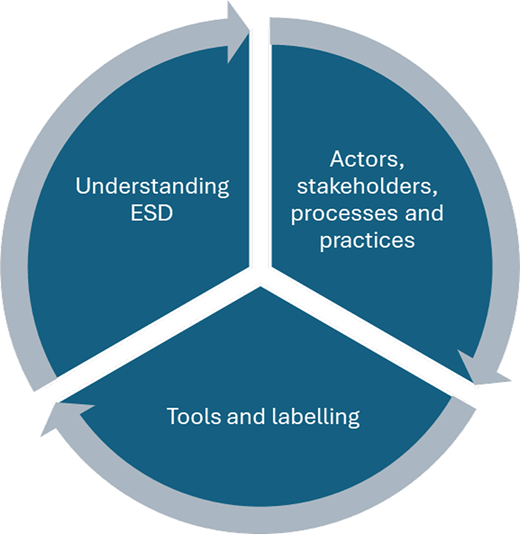
This study identifies three key areas that need to be addressed to enhance the integration of sustainable development and thereby improve the quality of education (Figure 1):
understanding ESD in higher education;
actors, stakeholders, processes and practices; and
tools and labelling.
In some areas of the university, there is a limited understanding of ESD, and interest in incorporating it into education is often lacking (Weldemariam, 2021). Key sustainability competences are also underdeveloped (Barth et al., 2007). This can be attributed to several factors, including insufficient top-down support in certain departments and a lack of bottom-up interest from researchers. For some, sustainable development is not perceived as relevant to their field, so it is excluded from their teaching unless explicitly required. When mandated, some researchers may view it as merely an add-on, leading to a low level of integration and progression, which ultimately affects the quality of ESD (Weldemariam, 2021). A promising way to advance ESD is through facilitators who can support educators in reflecting on and incorporating sustainability into their teaching (Cebrian, 2017).
At the University of Gothenburg, there are examples of how to successfully integrate sustainability in education, as outlined above. Integration has been made possible through several cooperating processes. First, clear top-down support has been instrumental in creating both management approval and management support for working with integrating sustainability in education, originating from the ESD policy of the university. One department management has allotted part of the duty for coworkers to work with ESD, while another department created a position for a researcher to support the department in their ESD integration process, as a facilitator (Cebrian, 2017). The possibility for researchers and teachers to spend time with the topic has eliminated the issues of “not having time to take care of additional topics” problem, in line with research findings (Weiss and Barth, 2019) and ESD development suggestions (SDSN, 2020). The tool developed at the Institute of Health and Care Sciences in a bottom-up approach with several researchers joining the processes in figuring out how to relate the university wide sustainability criteria to the department’s educational topics. This was done in a social learning process (Cincera et al., 2018) that can be explored and adopted by others, as it is a very general and inspirational tool.
As long as the University of Gothenburg has been labelling courses and programs the process has been criticized and discussed (Boman and Andersson, 2013). In the current study, the sustainability criteria were clearly mapped to learning outcomes, and many of the criteria were incorporated in education. In the selected degree programs, some areas included in the criteria were missing, such as “customer and consumer power” which should be an integral part of a program dealing with public health addressing how to incorporate the patient, that is, the customer, perspective in their health care. Additionally, concepts like “maintaining ecosystems” and “natural limits” were absent from the learning outcomes in health-related programs. This raises questions about how future health-care professionals will address critical issues such as the trade-off between disposable items and circularity, or energy consumption within the health-care system, when these topics are not integrated into their education.
The three identified areas are distinct in nature and involve varying degrees of complexity. They are important to consider in not only local course or program development but also broader strategic and policy discussions at the departmental and institutional levels. Our findings suggest that these areas are interrelated – each can either reinforce or hinder the others. However, how these interactions unfold across different levels of the university, and the extent to which they influence the integration of sustainable development into courses and programs, remains unclear, as this was beyond the scope of the present study.
Conclusions
Our initial hypothesis assumed that sustainability labelling would primarily relate to a limited set of sustainability criteria-particularly Criterion 1, “Sustainability as a concept.” However, this assumption was not supported by our findings. Instead, programs and courses tend to align with the sustainability criteria most closely connected to their disciplinary focus and perceived relevance.
In examining how sustainable development is reflected in learning outcomes, we found that, at least in the assessed programs, the emphasis is generally not on skills and abilities. This raises a concern: without deliberate inclusion of competencies, methods and tools, students may gain theoretical knowledge about sustainability but remain ill-equipped to apply it in practice.
One of the study’s most significant findings is the identification of different “sustainability tracks” – pathways that emerge depending on the courses students choose. This insight holds potential for informing curriculum design and planning for sustainability integration in higher education, and we consider it a promising area for further research.
More broadly, this study highlights three key areas critical to the successful integration of sustainability in higher education:
From a more general perspective, it can be concluded that this study has identified three areas needed for successful integration of sustainability in education, and they are:
Understanding ESD in higher education: Program and course leaders must recognize the value of ESD by meaningfully connecting relevant sustainability themes to the goals and content of their specific programs.
Actors, stakeholders, processes and activities: A balanced and coordinated approach is essential – combining clear top-down commitment to ESD with active bottom-up engagement from faculty and staff. This must be supported by effective processes, support structures and mechanisms for continuous follow-up and improvement.
Tools and labelling: Practical tools that support dialogue and implementation of ESD, together with a thoughtful labelling scheme, can facilitate integration. Such schemes should offer nuanced understandings of sustainable development, enabling consistent tracking and assessment across the institution.
These three areas are interrelated. While we observed that they influence one another, sometimes reinforcing and at other times constraining integration, the nature and impact of their interaction at different organizational levels remain unclear. Investigating these dynamics presents an important direction for future research.
Future work
The sustainability integration tool developed at the Institute of Health and Care Sciences demonstrates considerable potential for broader application across other departments and academic disciplines. Its adaptable framework allows for contextualization within various fields of study, making it a promising model for institutions aiming to systematically enhance sustainability integration. Future research should investigate how similar mapping or labelling practices are implemented at other higher education institutions, both nationally and internationally. Such comparative studies could provide valuable insights into the transferability and effectiveness of the approach used in this study, potentially contributing to the development of best practices for embedding ESD across diverse educational settings.
Ongoing efforts at the University of Gothenburg aim to expand the current mapping to include a larger sample of degree programs. While this study focused on six sustainability-labelled programs, the university offers a total of 200 degree programs, of which 49 are currently labelled for sustainability – highlighting significant room for continued analysis. One promising direction for further research is the development of the concept of “sustainability tracks,” which refers to the pathways students navigate based on their course selections. These tracks could be differentiated as “strong” or “high-level” versus “weak” or “low-level” sustainability tracks, depending on the depth and coherence of sustainability content across the curriculum. This concept holds relevance for all HEIs seeking to strengthen their integration of sustainability. Additionally, future studies should include direct student perspectives to better understand how students interpret, value and engage with sustainability in their education. While this study relied primarily on feedback from student union representatives, a more comprehensive student engagement would shed light on how students perceive study program plans and course syllabi and whether their expectations align with current sustainability efforts.
It would be valuable to conduct a study focusing on how the interaction between the three areas: understanding ESD in higher education; actors, stakeholders, processes and practices; and tools and labelling – unfolds at different levels of the university and how this interaction influences the integration of sustainable development into courses and degree programs.