


Higher education institutions (HEIs) play a key role in democratising quality education for sustainability, for all. This study aims to present the outcomes of implementing the EUSTEPs Sustainability Module, which acquaints HEI students with sustainability concepts in an engaging and captivating manner through the lens of the ecological footprint (EF).
A 10-hour module was delivered to over 100 undergraduate students from four European universities using diverse materials, including field visits, a gamified EF game and an online EF calculator. Learning gains in sustainability and EF concepts, as well as perceived course effectiveness, were examined with a mixed-methods design combining questionnaires and group interviews. Pre- and post-questionnaires were analysed with significance tests, Probability of Superiority and Cohen’s d. In total, 43 valid responses were obtained, mainly from Aristotle University of Thessaloniki (AUTh), Greece, and Universidade Aberta, Portugal, and post-teaching group interviews from AUTh students (n = 46) enriched the quantitative findings.
While the results revealed statistically significant differences in participants’ learning, the actual effect of the teaching showed a low degree, suggesting a relatively superficial grasp of the subject. Considering the impact of daily activities on EF, meat consumption was the only category that showed a notable knowledge improvement. With an overall satisfaction of 86%, students appreciated the materials, particularly the EF calculator, as the main contributor to their perceived sustainability knowledge improvement.
The findings of this study show that short, modular sustainability course with the inclusion of an interactive tool – i.e. the EF calculator – can effectively raise students’ awareness and increase their learning satisfaction, making them a practical and flexible option for integration into diverse HEI curricula.
The originality of this paper lies in its use of the EF as a basis for the teaching to university students the concept of sustainability through action learning and the analysis of students’ profiles.
1. Introduction
The ecological footprint (EF) operationalises sustainability by translating planetary boundaries and personal consumption into measurable and relatable metrics (Wackernagel and Rees, 1996; Collins and Flynn, 2015). EF-based learning aligns with UNESCO (2020) Education for Sustainable Development (ESD) goals by fostering critical thinking, systems awareness and reflective action. Moreover, the EF serves as a tool that connects quantitative understanding with the ethical and affective dimensions of sustainability (Barth et al., 2015). It can also facilitate the development of key sustainability competencies (Wiek et al., 2011; Rieckmann, 2012), including systems thinking, anticipatory competence, normative competence and action competence. This study aims to position EF as an educational innovation capable of advancing sustainability learning outcomes in higher education (HE) contexts.
1.1 Research questions
The purpose of the present research is to examine the extent to which the use of the EF concept facilitates and promotes university students’ understanding of sustainability. In particular, the following research questions guided the study:
Does the use of the EF concept in university teaching enhance students’ understanding of the sustainability concept?
Which characteristics of teaching most effectively promote students’ understanding of sustainability?
What are the typologies of students’ knowledge and agency before teaching, and how do they develop following teaching?
The module sought to develop students’ sense of agency, defined as their confidence and capacity to take meaningful action on sustainability issues at personal, community and university levels.
1.2 Significance of the study
The present study aims to make an empirical contribution, introduce pedagogical innovation and advance conceptual understanding of the teaching of the EF, while also offering institutional and policy relevance and informing future research. It provides empirical, quantitative and qualitative evidence of how EF-based teaching enhances university students’ understanding, awareness and reflection on sustainability, thereby addressing a gap in ESD research, which often lacks longitudinal and outcome-based evidence. The study is also pedagogically innovative as it demonstrates that the EF can serve as a potentially transformative teaching tool that integrates the cognitive, affective and behavioural intention dimensions of sustainability learning within HEIs. In addition, it advances students’ conceptual understanding and positions the EF as a concept capable of linking individual learning with systemic transformation, aligning with Sustainable Development Goal (SDG) 4.7 and UNESCO’s ESD for 2030 framework. Moreover, the study has institutional and policy relevance, as it offers a free and replicable educational model that HEIs can adopt to strengthen sustainability curricula, monitor student engagement and connect learning with institutional footprint reduction goals. Finally, the study contributes to research by advancing the evolving discourse on transformative sustainability education and demonstrating that, when taught critically and reflectively, the EF may facilitate students’ transition from awareness to agency and collective responsibility.
2. Literature review
2.1 Sustainability teaching and learning in HEIs
In recent decades, higher education institutions (HEIs) have been recognised as key agents in advancing the global sustainability agenda through education, research, campus operations and community engagement (Lozano et al., 2015; Findler, et al., 2019). As centres for knowledge generation and dissemination, HEIs are increasingly expected to integrate sustainability principles across curricula to prepare graduates capable of addressing complex social-ecological challenges. This shift is reflected in international frameworks such as UNESCO’s ESD for 2030 Roadmap and the United Nations SDGs, particularly SDG 4.7, which emphasise critical thinking, values and transformative learning for more sustainable societies (UNESCO, 2020). At the same time, recent literature suggests that, despite growing attention to sustainability in HE, teaching and learning initiatives in HEIs often remain fragmented and insufficiently transformative. Critical reviews indicate that universities continue to privilege operational and managerial dimensions of sustainability over systematic curricular and pedagogical reform, while implementation is frequently constrained by weak institutional embedding, uneven development across contexts (e.g. Global north and South) and limited alignment between sustainability ambitions and everyday academic practice (Ankareddy et al., 2025; Munaro and John, 2025). Moreover, even promising approaches, such as sustainability-oriented living labs and transformative learning processes, face important challenges related to curriculum design, academic support and the difficulty of fostering meaningful and lasting learner engagement (van der Wee et al., 2024). Taken together, these studies suggest that HEIs still need to move beyond isolated or symbolic initiatives towards more integrated, institution-wide and pedagogically robust approaches to sustainability teaching and learning (Leal Filho et al., 2025; Abo-Khalil, 2024).
2.2 Pedagogical foundations of sustainability teaching in HEIs
Sustainability teaching in HE has evolved from information-based environmental education toward transformative (e.g. self-reflection, disorienting dilemmas and reflective journals) and participatory pedagogies (e.g. problem-based, group work and class debates). Scholars highlight the need for approaches that engage students not only cognitively but also affectively and behaviourally (Barth et al., 2007). The goal is to develop sustainability competencies such as systems thinking, anticipatory thinking, normative and strategic competence and interpersonal collaboration (Wiek et al., 2011). These competencies help learners understand interconnectedness and develop the capacity to act responsibly in complex contexts.
Transformative sustainability learning emphasises experiential, problem-based and interdisciplinary approaches. Problem- and project-based learning allows students to tackle authentic, real-world sustainability issues (Brundiers and Wiek, 2013). Similarly, service-learning and community-based projects link academic knowledge with civic engagement, promoting values such as solidarity and social justice (Aramburuzabala and Cerrillo, 2023). Reflection and dialogue are also central to enabling shifts in worldviews, attitudes and professional identity (Tilbury, 2011).
2.3 Emerging trends in sustainability integration in HEIs
The integration of sustainability across HE curricula occurs through several models, the most important of which are summarised in the following:
Standalone sustainability courses, often within environmental science or education programs.
Curricular mainstreaming, embedding ESD outcomes and competencies into existing disciplinary courses.
Whole-institution approaches, which align curriculum, campus operations and research under sustainability frameworks (Lozano et al., 2022).
Recent developments highlight the rise of transdisciplinary learning spaces like living labs, campus sustainability hubs and online collaborative platforms. Such learning environments connect students, faculty and external stakeholders (Hadfield et al., 2025; Evans et al., 2015). Digital learning technologies, including simulations and footprint calculators, have also expanded opportunities for interactive learning about sustainability systems (Gawel et al., 2022).
However, implementation remains uneven. Many educators still report institutional barriers, such as rigid curricula, lack of support, or limited staff capacity (Veiga Ávila et al., 2019; Elsharkawy et al., 2024). Embedding sustainability meaningfully requires not only pedagogical innovation but also policy support, staff training and assessment mechanisms that value sustainability competencies.
2.4 EF as a teaching and learning tool in HEIs
In recent years, several environmental footprint indicators, like the Ecological, carbon and water footprint (Galli, 2015), have gained prominence as educational tools. Their main advantage is that they translate complex sustainability issues into tangible, measurable concepts. In educational settings, footprint evaluations enable learners to visualise the environmental consequences of their daily actions, fostering awareness, systems thinking and critical reflection on consumption and resource use (Wackernagel and Rees, 1996; Collins and Flynn, 2015). The interactive nature of footprint calculators supports empirical and inquiry-based learning, allowing students to connect personal behaviours with global ecological impacts (Collins et al., 2018; Cordero et al., 2008). By encouraging self-assessment and action planning, footprint activities bridge the gap between knowledge and practice, core goals of ESD (Lambrechts and Van Liedekerke, 2014; Gottlieb et al., 2013). When combined with reflection and collective projects, footprint calculators promote environmental literacy and enhance students’ agency and responsibility toward sustainability challenges at both individual and community levels (Fernández et al., 2016; Uyanık, 2020).
Among these, the EF plays a key role, as it translates otherwise abstract sustainability ideas (planetary limits, biocapacity, consumption) into quantitative, personalised feedback linked to everyday choices (e.g. food, mobility, housing, goods/services). This “making it personal” quality is repeatedly identified as the EF’s key pedagogical affordance because students can see their own results and can test “what-if” scenarios. Such teaching approaches support reflection, dialogue and action planning. Learners typically experience high cognitive salience when EF outputs are visualised as the “number of Earths,” gha and category breakdowns – features standard in Global Footprint Network’s (GFN) calculator and teaching resources (GFN Global Footprint Network, 2026). Moreover, recent research indicates that increasing prospective teachers’ awareness of the EF can play an important role in improving their sustainable consumption behaviours (Arslan and Durmuş, 2025), while another study examines the relationship between EF indicators, happiness and academic performance, finding that academic performance is associated with happiness but not with EF (Giannetti et al., 2025). In addition, EF assessment has been used for the identification of socio-demographic characteristics having significant influence on university students’ EF (Adjei et al., 2021) or for a comprehensive evaluation of campus sustainability and students’ carbon emissions (Zheng et al., 2021).
EF activities align well with experiential and inquiry pedagogies (“learning by doing”): students complete the calculator, interrogate category drivers, compare their results with those of their peers and design strategies for reducing their EF. In such a way, they integrate conceptual knowledge with self-assessment and action competence (e.g. organizing waste-reduction or sustainable transport campaigns, recycling actions and sustainable food interventions). In university courses in the UK and Italy, EF sessions functioned as interactive, 2-hour labs that catalysed informed discussion on consumption drivers and trade-offs; students judged the tool “user-friendly” and effective at revealing the consequences of everyday behaviours (Collins et al, 2018).
The literature on the learning outcomes of using EF in education indicates that it increases awareness, knowledge, attitudes and self-efficacy, while behavioural change shows mixed results. Across secondary and HE contexts, EF tasks reliably increased awareness of environmental impacts and literacy regarding consumption–environment linkages. Interventions in high school and university settings report improved understanding of category drivers (e.g. food and mobility) and more nuanced conversations about systemic constraints (availability of local/organic food, the impact of air travel) (Gottlieb et al., 2013).
Survey and mixed-methods studies with Spanish university students show that EF-based modules help surface consumption profiles and correlate with pro-environmental attitudes/connection to nature, though the strength of these relationships varies (Fernández et al., 2020). In addition, quasi-experimental work in Israeli high schools found EF to be a suitable means for encouraging ecological behaviours, framed through action-competence pedagogy; students developed stronger intentions and a clearer sense of efficacy regarding changes within their control (Gottlieb et al., 2013).
Some programs ask students to design and implement self-led interventions that measurably reduce their EF and report encouraging short-term reductions. However, other studies caution that attitude shifts do not always translate into sustained behaviour change. The implication is to pair EF diagnostics with structured planning, measurement and follow-up, rather than relying solely on single-session calculator use (Wagner and Gibberd, 2022). In the same vein, a Spanish HEI program that embedded EF within an integral sustainability training for pre-service teachers documented changes in consumption patterns; yet broader reviews and follow-ups advise longitudinal tracking and multi-lever strategies (individual + institutional) to sustain gains (Fernández et al., 2016).
However, critical educators warn that EF (and carbon-footprint) exercises can overemphasise individual responsibility and obscure the structural drivers of unsustainability, like policy frameworks, infrastructures and corporate practices. Thus, personal guilt may be elicited rather than civic agency if the need for such systemic changes is not carefully framed (Middlemiss, 2010; Mallett et al., 2013; Hot or Cool Institute, 2026). In this study, EF work was therefore deliberately embedded within a broader ESD design that linked students’ personal diagnostics with systemic analysis and collective action. After calculating their footprints, students critically examined which aspects of their EF were primarily shaped by individual choices and which were conditioned by institutional or socio-technical contexts. Then they co-developed multi-level responses, including individual changes, campus-level initiatives and policy and governance recommendations. In line with ecological citizenship and climate justice perspectives, this approach sought to redirect feelings of concern or guilt towards participation in collective projects and pro-environmental groups. Thus, EF is not used as a tool for moralising individual behaviour, but as a starting point for reflective, citizen-oriented engagement with sustainability transformations (Middlemiss, 2010; Mallett et al., 2013).
Finally, from a methodological point of view, most web calculators use national averages to infer an individual EF (top-down), limiting precision for specific lifestyles and contexts; coverage of categories can be uneven and country lists are sometimes restricted. Educators should position EF results as pedagogical indicators, not exact measurements and invite critique of assumptions as part of the learning (Collins et al, 2018).
In summary, the literature supports the EF as a versatile ESD tool that personalises sustainability, sparks systems thinking and is able to catalyse behaviour change when coupled with goal-setting, measurement and institutional levers. Best results arise when the EF is embedded in multi-session sequences that blend quantitative diagnosis with critical pedagogy and action-competence approaches, especially in pre-service teacher education, where transfer to future classrooms matters. Conversely, single-shot calculator activities tend to shift awareness more than behaviour. Future research should prioritise longitudinal designs, diverse contexts and integrated interventions that connect individual learning with collective transformation (Gottlieb et al., 2013).
2.5 Teaching characteristics that best promote sustainability understanding in HEIs
Fostering sustainability understanding within HEIs requires pedagogies that transcend traditional content delivery and promote transformative, participatory and experiential learning (Blake et al, 2013). Research emphasises that the most effective sustainability teaching in universities engages students as active learners, cultivating their ability to think systemically, critically and ethically about real-world challenges (Wiek et al., 2011; Rieckmann, 2012). Such pedagogies aim to build key sustainability competencies – including systems thinking, anticipatory and strategic competence, and collaborative problem-solving – identified as essential for graduates who will lead transitions toward sustainable futures (Barth et al., 2015; Cebrián and Junyent, 2015).
In HE contexts, problem-based learning approaches are particularly effective in deepening understanding. By working on authentic sustainability issues – such as campus greening, energy management, or community engagement projects – students bridge theory and practice and develop the capacity to address complex sustainability dilemmas (Brundiers and Wiek, 2013). The interdisciplinary and transdisciplinary nature of sustainability challenges further requires teaching designs that integrate insights from multiple fields and promote holistic thinking (Lozano et al., 2015).
Another defining feature of successful sustainability teaching in HEIs is the emphasis on reflection and dialogue. Classroom discussions, reflective journals and peer collaboration encourage students to question underlying assumptions, evaluate competing perspectives and clarify personal and professional values (Tilbury, 2011; Shephard et al., 2015). These reflective processes enable students to connect sustainability to their own academic disciplines and everyday lives, nurturing a sense of moral responsibility and long-term engagement.
Moreover, action-oriented learning – including service-learning, living labs and community partnerships – enhances students’ action competence, the ability to design and implement real sustainability solutions (Mogensen and Schnack, 2010; Lambrechts and Van Liedekerke, 2014). Such initiatives strengthen civic engagement and connect learning outcomes with institutional and societal transformation. They also exemplify the whole-institution (or whole-of-university) approaches where sustainability is integrated across governance, operations, curriculum, research and external engagement, turning HEIs into “microcosms of sustainability” (Christou et al., 2024; Kohl et al., 2022).
Faculty commitment, institutional leadership and supportive policy frameworks are critical in embedding sustainability across the curriculum rather than confining it to isolated environmental programmes (Mulà et al., 2017; Niedlich et al., 2020; Lozano et al., 2013). Universities that foster professional development, encourage innovation and model sustainable practices provide fertile environments for transformative learning.
In summary, sustainability understanding in HEIs is best promoted through active, reflective, interdisciplinary and action-based teaching supported by institutional commitment. When embedded in participatory, values-driven learning environments, such pedagogies can move students beyond awareness to critical thinking, agency and transformative engagement with sustainability challenges.
3. Methodology
A pre/post quasi-experimental research design, using both quantitative (questionnaire) and qualitative (interviews) research tools, was implemented in this study. Parts of the construction of student indices and learner typologies were supported by ChatGPT (OpenAI), whose analytic suggestions were subsequently reviewed, refined and validated by the authors.
3.1 Pedagogical design and implementation of the EF module
The links between the EF module and the characteristics of ESD are provided in Table 1, while the key characteristics of the teaching module are presented in Table 2, along with the pedagogical approaches and materials used (Moreno Pires et al., 2022). In brief, the module was structured as a 10-hour programme (e.g. lectures, EF calculator activity, group reflection and application exercises), and the pedagogical framework comprised experiential and inquiry-based learning, integrating personal reflection, peer discussion and systems analysis. The main tool was Global Footprint Network’s personal EF calculator, combined with EF comparisons, sustainability pledges and post-activity reflection. The educators, who also developed the module, facilitated critical discussions, connecting individual results to social and policy dimensions. The module was also aligned with whole-institution learning and the SDG 4.7 agenda. In general, the module and the teaching were developed to showcase how EF can be embedded as an effective, replicable teaching sequence within HEIs’ courses and curricula.
Links between EUSTEPs teaching module parts and characteristics with ESD pedagogical approaches
| Classification | ESD pedagogical approaches | EUSTEPs part/characteristic | Description |
|---|---|---|---|
| Universal | Case studies | Unit 3:
| Through case studies, students were invited to consider real-world examples and examine issues, aiming to provide qualitatively rich descriptions of settings, problems and controversies in sustainable development |
| Interdisciplinary team teaching/ development | All units | The EUSTEPs module was developed by an interdisciplinary team of researchers and educators. | |
| Lecturing | Units 3, 4, 6 | In these units, lecturing is the dominant approach. The topics tackled include sustainability, SDGs, EF and HEIs’ sustainability | |
| Concept maps | Unit 1: C-map (individual/collective) Unit 7: Class exercise 4 – C-map (individual/collective) | Individual and/or collective concept maps are used for the assessment of students’ entry and exit level of understanding on sustainability and its link with their personal life | |
| Problem-based learning | Unit 3:
| Small scale, real-world problems, related either with students’ personal life or their university were incorporated in the module | |
| Community | Participatory action research | Unit 1:
| The whole module design and development was based on an active participatory process. It was piloted, by members of the research group, in 4 Universities (3 countries) during the 2019–2020 spring semester. Researchers kept note of classroom’s strengths, weaknesses, difficulties and highlights. Students’ feedback regarding the perceived effectiveness of the module, and data regarding its actual learning effect (EF 3-tier pre/post-test) were also recorded. Based on the analysis of all collected data (Moreno Pires et al., 2020a; Moreno Pires et al., 2020b; Moreno Galli et al., 2020c) the module was further elaborated for the second round of implementation in the 2020–2021 winter semester. This second updated version of the module is presented here |
| Environmental education | Place-based environmental education | Unit 3:
| Sustainability learning is linked with students’ universities and their characteristics (Class exercise 2 and Homework 1) and supported by site visits to the university campus as an optional activity within the module |
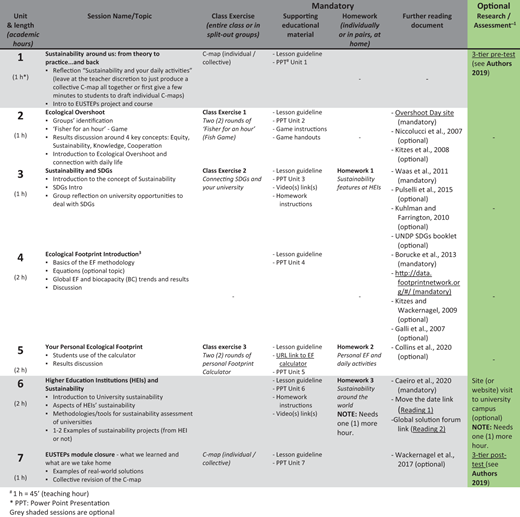
3.2 Participants
More than 100 undergraduate students from four European universities (Aristotle University of Thessaloniki (AUTh), Greece; Universidade Aberta (UAb), Portugal; Universidade Aveiro, Portugal; and University of Siena, Italy) were engaged in the activities, which were part of the larger EU ERASMUS + funded project titled enhancing universities’ sustainability teaching and practices (EUSTEPs) (Enhancing Universities’ Sustainability Teaching and Practices through Ecological Footprint,Link to Because education is keyLink to the cited article). However, complete pre- and post-teaching responses were received from 43 students (8 male, 35 female) from AUTh (n = 34) and UAb (n = 9) only.
Most participants were aged between 18 and 25 years (65%), while two were above 40 years old. Thirty-six students were in the 3rd or 4th year of their undergraduate Bachelor studies, while the remaining seven were enrolled at master’s degree level. UAb students (n = 9) attended the module online, whereas AUTh students, who were from a School of Primary Education, attended through face-to-face teaching. Although the original module materials had been developed in English, they were also translated into the students’ national languages, in which the teaching was delivered.
3.3 Instruments
To properly assess participants’ learning and conceptual development, a triangulation of methods and tools was implemented, including both quantitative (questionnaire) and qualitative (interviews) research tools. Specifically, the researchers developed a questionnaire comprising 28 closed-ended questions focused on assessing the following domains:
participants’ knowledge improvement (5 questions);
their understanding of the impact of various daily activities on their EF (6 questions). In the post-teaching test, three additional domains were included to assess;
the perceived impact of teaching on participants’ knowledge (5 questions) and intentions to take actions (3 questions);
the perceived impact of the various educational materials (8 questions); and
overall satisfaction with the module (1 question).
Questionnaire items assessing participants’ knowledge improvement were presented as multiple-choice questions (with one correct answer), while items concerning the impact of various daily activities on EF included the following 4 response options: “Increases EF”, “Decreases EF”, “It depends on the occasion” and “I am not sure”. All remaining items used a Likert-type response scale ranging from 1 (Not at all/Min) to 5 (Very much/Max).
In addition to the questionnaire, face-to-face group interviews, conducted in the form of reflective discussions, were carried out with all AUTh students who participated in the module (n = 46). These interviews aimed to provide deeper insights into participants’ learning experience and capture qualitative aspects of their understanding. The difference between the number of AUTh students that filled the questionnaire (n = 34) and those who participated in the interviews (n = 46) indicates that 12 of them participated only in the latter. However, we consider that this enhances the study as it incorporates richer qualitative data.
The questionnaire was administered to students a week before (pre-test) and 10 days after the end of teaching (post-test). Interviews were performed two weeks after the end of teaching, and audio was recorded, with the consent of all participants, for further analysis.
3.4 Data analysis
After collecting the questionnaires, students’ answers were coded and entered into SPSS v.25 for further analysis. Specifically, participants’ answers were coded using a five-point Likert scale, where 1=“Not at all”, 2=“A little”, 3=“Moderately”, 4=“Very” and 5=“Very much.” All subsequent analyses were conducted using these numerical values, with lower scores indicating lower understanding/satisfaction on the variables under study, while higher scores indicate greater understanding or satisfaction. Based on these raw scores, descriptive statistics were calculated (i.e. means and standard deviations [SDs]), and inferential statistics were performed to examine potential differences between pre-test and post-test scores. For this purpose, besides significance testing, two effect sizes were also computed:
probability of superiority (PS); and
Cohen’s d.
The former expresses the extent among participants to which even the slightest progression of their learning has been achieved, while the later expresses the magnitude of this improvement (Grissom, 2005).
Due to the small number of participants and the abnormal distribution of students’ scores, for the significance testing we used the non-parametric Wilcoxon signed-rank test. In addition, to all significance testing, the probability values were set to p ≤ 0.05 (≤5%).
Audio-recorded interviews were transcribed verbatim and a bottom-up analysis for the development of participants’ categories of understanding on the topics under study took place. As a unit of analysis, the unit of meaning was used, namely a set of words or phrases expressing a single meaning (Cohen et al., 2000). There were no pre-defined themes, and categories of students’ answers were developed from the scratch based on their answers to specific questions that served as axes of analysis (e.g. What did you learn? What helped you learn?). Categories’ development took place in several repetitive cycles, where the detailed categories of one phase were merged into more comprehensive and general ones for the next one. The first author performed the interview analysis, and the remaining authors examined the produced categories for consistency and conceptual clarity, while selective cross-checking through direct comparison of the categories to raw interview data was also performed. Through this process, minor changes and adaptations, mainly to categories’ labelling, were made, aiming to better attribute the meaning and their relevance to the topic under study.
3.4.1 Construction of indices and learners’ typologies.
To analyse patterns of students’ progression regarding their knowledge and perceived agency, the following were developed:
T1 typologies (pre-teaching), based on expectations (knowledge vs agency);
T2 typologies (post- teaching), based on perceived learning and agency outcomes; and
A Sankey diagram showing the movement between types.
Firstly, a set of composite indexes was developed based on the questionnaire items. Objective sustainability and SDG knowledge was assessed with a five-item test on the Brundtland definition, the three dimensions of sustainability, the number of SDGs/targets and key features of the 2030 Agenda; correct answers were summed to form a knowledge index (0–5). EF literacy was measured with one conceptual item on the definition of EF and six items asking students to identify the direction of impact of everyday practices (e.g. meat consumption, use of rechargeable batteries, clothes drying) on EF; correct answers were summed to an EF literacy index (0–7). In addition, Likert-type items were averaged into pre- and post-teaching scales: expected conceptual gain (anticipated enhancement of understanding of sustainability, SDGs, EF and sustainability in HEIs), expected agency gain (anticipated capacity to reduce one’s EF and act in community and university), perceived conceptual learning (self-reported increase in the same knowledge domains) and perceived agency development (self-reported development of action competence). Further scales captured students’ appraisal of interactive tools (game, EF calculator, EF workshop), traditional media (slides, videos), situated/extended activities (field visit, homework, SDG seminar) and a single item assessed overall satisfaction with the module.
Based on these indices, learner typologies were derived to characterise distinct patterns of participation. Pre-teaching student expectation profiles were defined by applying median splits to the expected conceptual understanding and agency gain scales. Given the exploratory nature and small number size of the present study, median splits were considered more appropriate to construct learner typologies. The median offered a transparent, reproducible and data-driven cut-off for distinguishing comparatively higher and lower levels of expected/perceived learning and action capacity. With a larger number of participants, future research could apply cluster analysis, latent profile analysis or latent transition analysis to derive student profiles empirically and examine transitions between them more robustly. The typology analysis yielded the following four groups:
high-expectation transformative ecological students (T1-A, high expected conceptual and perceived agency gain);
knowledge-focused students (T1-B, high conceptual, low agency expectations);
action-oriented students (T1-C, low conceptual, high agency expectations); and
low-expectations/impact students (T1-D, low expectations in both domains).
Post-teaching learner typologies were then constructed by combining objective literacy (sustainability/SDG and EF indices) with perceived conceptual learning, perceived agency development and overall satisfaction, again using median splits. This resulted in four post-training types (T2) that capture whether students emerge from the module primarily as transformative ecological students (T2-A), knowledge-focused students (T2-B), action-oriented (T2-C) or relatively low-expectations students (T2-D).
3.4.2 Post-teaching learner typologies: final labels and short descriptions.
3.4.2.1 Transformative ecological students (T2-A).
Students in this group combine medium–high initial sustainability/EF literacy with strong perceived gains in both knowledge and perceived action competence and high overall satisfaction. They tend to see the module as confirming and deepening their prior understanding while also expanding their sense of responsibility and capacity to act at personal, community and university levels. For these learners, EF becomes a lens for long-term engagement with sustainability, not just a one-off exercise.
3.4.2.2 Knowledge-focused students (T2-Β).
Learners in this type report clear gains in conceptual understanding (definitions, SDGs, EF, sustainability in HEIs) but more modest growth in perceived action competence. They tend to value more traditional materials, such as slides and videos, and may experience the EF primarily as a cognitive framework rather than as a catalyst for behavioural or civic engagement. For these learners, the module strengthens theoretical literacy more than it transforms their practices.
3.4.2.3 Action-oriented students (T2-C).
These students start from lower sustainability/EF knowledge but report substantial conceptual learning and increased agency by the end of the module. They often appreciate interactive tools (games, EF calculator, workshops) as particularly helpful. The module appears to function as an “entry point” into sustainability for them, shifting EF from a largely unknown concept to a concrete framework for thinking about their lifestyles and potential actions.
3.4.2.4 Low-expectations/impact students (T2-D).
This group is characterised by limited perceived gains in both knowledge and perceived agency and lower satisfaction with the training. Their objective literacy scores may range from low to moderate, but they do not experience the module as particularly helpful or relevant. Time constraints, low initial interest, or a weak perceived connection between EF and their studies may contribute to this pattern. Pedagogically, they point to the need for stronger contextualisation, differentiation or support.
4. Results
4.1 Improvement in students’ understanding of sustainability and EF concepts
Analysis of pre- and post-teaching questionnaires (n = 43) indicated measurable, but low-to-moderate knowledge gains across several sustainability topics (Table 3). More specifically, post-teaching test scores were higher than the corresponding pre-teaching scores for all but one topic, and increases in three topics were statistically significant: (a) the definition of sustainable development (Mpre = 0.63, Mpost = 0.79; p < 0.05; PS = 19, d = 0.36), (b) understanding of the SDGs (0.42→0.84; PS = 42, d = 0.30) and (c) sustainability dimensions e (0.77→0.95; PS = 21, d = 0.13). However, these increased post-teaching scores are not supported by the effect sizes, as both Probability of Superiority and Cohen’s d values sat in the low – medium range. By contrast, the EF concept showed a decline (0.21→0.07; PS = 00, d = −0.41), which was further supported by medium-level Cohen’s d values and zero PS scores.
Topics of participants’ learning improvement (n = 43)
| Topics of learning | Pre | Post | Effect sizes | |||
|---|---|---|---|---|---|---|
| Meana | SD | Meana | SD | PSb | Cohen’s dc | |
| Definition of sustainable development | 0.63 | 0.49 | 0.79*d | 0.41 | 19 | 0.36 |
| Sustainability dimensions | 0.77 | 0.50 | 0.95* | 1.92 | 21 | 0.13 |
| SDGs basic definition | 0.42 | 0.50 | 0.84** | 1.94 | 42 | 0.30 |
| Areas of Agenda 2030 | 0.26 | 0.44 | 0.40 | 0.49 | 26 | 0.30 |
| Ecological footprint concept | 0.21* | 0.41 | 0.07 | 0.26 | 00 | −0.41 |
aTheoretical range: 0 (min) – 1 (max), bProbability of Superiority: <0.40 = low (no shaded cells), 0.40–0.69 = medium (light grey shaded cells), ≤ 70 = large (dark grey shaded cells – not in this table),c Cohen’s d: <0.40 = low (no shaded cells), 0.40–0.69 = medium (light grey shaded cells), ≤ 70 = large (dark grey shaded cells – not in this table),dSignificance testing based on the non-parametric Wilcoxon signed-rank test
Analysis of pre- and post-teaching questionnaires (n = 43) indicated measurable, but low-to-moderate knowledge gains across several sustainability topics (Table 3). More specifically, post-teaching test scores were higher than the corresponding pre-teaching scores for all but one topic, and increases in three topics were statistically significant: (a) the definition of sustainable development (Mpre = 0.63, Mpost = 0.79; p < 0.05; PS = 19, d = 0.36), (b) understanding of the SDGs (0.42→0.84; PS = 42, d = 0.30) and, (c) sustainability dimensions e (0.77→0.95; PS = 21, d = 0.13). However, these increased post-teaching scores are not supported by the effect sizes, as both Probability of Superiority and Cohen’s d values sat in the low – medium range. By contrast, the EF concept showed a decline (0.21→0.07; PS = 00, d = −0.41), which was further supported by medium-level Cohen’s d values and zero PS scores.
Post-teaching self-assessments indicated relatively high knowledge and intentions to act levels (Figure 1). Students self-rated their post-teaching knowledge relatively high regarding the EF concept (M = 4.5/5, SD = 0.8), sustainability and its dimensions (4.3/5 ± 0.8), SDGs (4/5 ± 0.8), the link between sustainability and EF (4/5 ± 0.8) and sustainability in HEIs (3.9/5 ± 0.9). Intentions also became high in post-teaching regarding the reduction of personal EF (4.2/5 ± 0.8), to act in community/daily life (4.1/5 ± 0.9) and to act within the university (3.7/5 ± 0.9). Overall satisfaction with the course was 4.3/5 ± 0.7. These high post-teaching means suggest a strong turn toward sustainability, with substantial headroom primarily in action within HEIs.
 The horizontal scale ranges from 1 to 5. The upper section is labelled Knowledge and contains five items. The concept of Ecological Footprint, E F, has a score of 4.5. Sustainability concept and its dimensions has 4.3. S D G s and their importance has 4.0. The link between sustainability and E F has 4.0. Sustainability issues at H E I s has 3.9. The lower section is labelled Intentions and contains three items. To reduce your personal E F has a score of 4.2. Take actions enhancing sustainability at your community and daily life has 4.1. Take action enhancing sustainability actions in your university has 3.7.
Perceived effect of training on participants’ KNOWLEDGE and INTENTIONS to take actions (1 = Min; 5 = Max) (n = 43)
The horizontal scale ranges from 1 to 5. The upper section is labelled Knowledge and contains five items. The concept of Ecological Footprint, E F, has a score of 4.5. Sustainability concept and its dimensions has 4.3. S D G s and their importance has 4.0. The link between sustainability and E F has 4.0. Sustainability issues at H E I s has 3.9. The lower section is labelled Intentions and contains three items. To reduce your personal E F has a score of 4.2. Take actions enhancing sustainability at your community and daily life has 4.1. Take action enhancing sustainability actions in your university has 3.7.Perceived effect of training on participants’ KNOWLEDGE and INTENTIONS to take actions (1 = Min; 5 = Max) (n = 43)
Based on the above findings, an interesting tension emerges between the objective learning results (Tables 3 and 4) and students’ self-perceived learning (Figure 1). While the objective measures indicate more modest or uneven improvement in some knowledge domains, students reported relatively high perceived gains after the module. This discrepancy suggests that the intervention may have strengthened students’ confidence, awareness and perceived familiarity with EF and sustainability concepts more strongly than it improved measurable factual understanding.
Participants’ self-perceived learning regarding the effect of various daily activities on ecological footprint (EF)
| Pre | Post | Effect sizes | ||||
|---|---|---|---|---|---|---|
| Effect on EF | Meana | SD | Meana | SD | PSb | Cohen’s dc |
| Consumption of meat | 0.81 | 0.4 | 0.95*d | 0.2 | 14 | 0.44 |
| Vegetables from home farms | 0.40 | 0.5 | 0.44 | 0.5 | 19 | 0.09 |
| Use of rechargeable batteries | 0.70 | 0.5 | 0.86 | 0.4 | 23 | 0.40 |
| Use of electric dryer | 0.79 | 0.4 | 0.81 | 0.4 | 12 | 0.06 |
| Exchange of clothes | 0.77 | 0.4 | 0.91 | 0.3 | 19 | 0.38 |
| Shopping from the neighbour | 0.37 | 0.5 | 0.33 | 0.5 | 16 | −0.10 |
aTheoretical range: 0 (min) – 1 (max), bProbability of Superiority: <0.40 = low (no shaded cells), 0.40–0.69 = medium (light grey shaded cells), ≤ 70 = large (dark grey shaded cells – not in this table),cCohen’s d: <0.40 = low (no shaded cells), 0.40–0.69 = medium (light grey shaded cells), ≤ 70 = large (dark grey shaded cells – not in this table),dSignificance testing based on the non-parametric Wilcoxon signed-rank test
Qualitative feedback reinforced the quantitative findings (Figure 2). When asked “What did you learn?” (n = 46), most students mentioned learning about their personal EF and how to reduce it (27/46; 59%). Many respondents also mentioned what sustainability is and its dimensions/interactions (12/46; 26%) and a better understanding of environmental issues/ecology (11/46; 24%). To a smaller but still notable degree, respondents mentioned the 17 SDGs (6/46; 13%), increased environmental awareness (5/46; 11%) and some already changing attitudes/behaviours (4/46; 9%). Teaching-oriented learning was also a prominent topic in respondents’ answers: organising educational/outdoor activities (6/46; 13%), incorporating environmental issues into teaching (6/46; 13%) and tips for better teaching (6/46; 13%), while learning through games/outdoor activities was mentioned by (5/46; 11%). Finally, citizenship action was highlighted by 13% of students (6/46). The following excerpts from students’ interviews are representative:
 The x-axis represents number of students from zero to 30. Four grouped themes appear on the left. Under Various environmental issues, About personal E F and how to reduce it and Various environmental issues has 27 students. What is or about sustainability, S D, interactions, and different aspects of S D has 12. Better understanding of environmental issues and Ecology has 11. The 17 S D G s has 6. Increased environmental awareness or consciousness has 5. Under Behavioural change, Already changed some of my attitudes and behaviours has 4 students. Under Education and Teaching, To organise educational or outdoors activities and Education or Teaching has 6. How to incorporate environmental issues into teaching has 6. Various tips for better teaching has 6. That we can learn better through games and outdoor activities and we remember them has 5. Under Citizenship learning, Need for citizenship action and Citizenship learning has 6 students.
What did you learn? (interviews, n = 46) (SD: sustainable development)
The x-axis represents number of students from zero to 30. Four grouped themes appear on the left. Under Various environmental issues, About personal E F and how to reduce it and Various environmental issues has 27 students. What is or about sustainability, S D, interactions, and different aspects of S D has 12. Better understanding of environmental issues and Ecology has 11. The 17 S D G s has 6. Increased environmental awareness or consciousness has 5. Under Behavioural change, Already changed some of my attitudes and behaviours has 4 students. Under Education and Teaching, To organise educational or outdoors activities and Education or Teaching has 6. How to incorporate environmental issues into teaching has 6. Various tips for better teaching has 6. That we can learn better through games and outdoor activities and we remember them has 5. Under Citizenship learning, Need for citizenship action and Citizenship learning has 6 students.What did you learn? (interviews, n = 46) (SD: sustainable development)
I learned about the Sustainable Development Goals […] How the Sustainable Development Goals will help us improve our future […] And then we learned about the personal ecological footprint […] I had no idea what it was […] By doing the quizzes and the assignments, I realised that I need to acquire this green consciousness so that through the activities I do at home and these, I can help the future and all of humanity. ST5-F*.
*Coding of students corresponds to their number (1-46) and their gender (Female-Male).
From an educational point of view, as a teacher, not as a student, I learned that we can […] while in all the lessons they also said through games […] games, uh, activities that we can learn things, but ultimately through the activities you can really learn things. ST17-F.
4.2 Students’ perceptions about the characteristics of teaching
Students expressed consistently positive evaluations of the pedagogical design and materials used in the EUSTEPs module (Figure 3). When asked “What helped you learn?”, the most common responses included interactive teaching approaches (20/46; 44%) and outdoor activities (15/46; 33%). Others valued the practical, interactive and cooperative nature of sessions (10/46; 22%), as well as complementary components such as homework (7/46; 15%), e-learning resources (e.g. video) (6/46; 13%) and teaching practice opportunities (6/46; 13%). These findings underscore the perceived value of active, experiential and varied pedagogy:
 The horizontal scale represents number of students from zero to 30, with labelled points at zero, 10, 20, and 30. The implemented teaching approaches and techniques has 20 students. The outdoors activities has 15 students. The nature of teaching, for example practical, experiential, interactive, cooperative, and flexible, has 10 students. Previous semester’s lesson has 8 students. Homework has 7 students. The information posted to E-learning, for example videos, has 6 students. The teaching practice has 6 students.
What helped you learn? (interviews, n = 46)
The horizontal scale represents number of students from zero to 30, with labelled points at zero, 10, 20, and 30. The implemented teaching approaches and techniques has 20 students. The outdoors activities has 15 students. The nature of teaching, for example practical, experiential, interactive, cooperative, and flexible, has 10 students. Previous semester’s lesson has 8 students. Homework has 7 students. The information posted to E-learning, for example videos, has 6 students. The teaching practice has 6 students.What helped you learn? (interviews, n = 46)
Because it was very interactive, it was very interesting and you weren’t at all strict in how the lesson would be done. ST15-F.
(Homework) […] to me, they seemed like more than okay, was a lot, so it helped me see the theory, which I don’t like either, so I turned to the theory to do the exercises and it helped me learn some things in the theoretical part. Of course, I liked the field research because it was very inventive, let’s say the various activities that were asked of us, the role play definitely helped me and various things like you had us do the questionnaires and quizzes electronically, and in general you didn’t lecture and you didn’t work alone, like many people do. ST16-F.
Quantitative data corroborated these preferences (Figure 4). Among all educational elements, the field visit achieved the highest mean rating (M = 4.5/5, SD = 0.8), followed by the staff workshop, Fish Game and EF Calculator (M = 4/5). Slightly lower but still favourable ratings were given to homework, videos and slides (M = 3.7–3.8/5). These results underscore the perceived effectiveness of experiential, gamified and hands-on methods compared to more passive materials, highlighting the importance of active engagement and contextualised learning in sustainability education.
 The x-axis is labelled Mean and ranges from zero to 5 in increments of 0.5. The y-axis is labelled Type of Educational Material and lists eight items. Field visit has the highest mean of 4.5. Staff workshop has a mean of 4.0. Fish Game has a mean of 4.0. E F Calculator has a mean of 4.0. Homework has a mean of 3.8. S D G s seminar has a mean of 3.8. Videos has a mean of 3.7. Slides has a mean of 3.7.
Perceived effect of various types of educational material on participants’ learning (1 = min; 5 = max) (n = 43)
The x-axis is labelled Mean and ranges from zero to 5 in increments of 0.5. The y-axis is labelled Type of Educational Material and lists eight items. Field visit has the highest mean of 4.5. Staff workshop has a mean of 4.0. Fish Game has a mean of 4.0. E F Calculator has a mean of 4.0. Homework has a mean of 3.8. S D G s seminar has a mean of 3.8. Videos has a mean of 3.7. Slides has a mean of 3.7.Perceived effect of various types of educational material on participants’ learning (1 = min; 5 = max) (n = 43)
4.3 Typologies of students’ learning and changes based on teaching
pre-teaching expectation profiles (T1)
Based on students’ expected gains prior to the module, four distinct expectation profiles were identified. High-expectation transformative ecological learners (T1-A) formed the largest group (n = 27), reporting high expectations for both conceptual understanding and perceived action competence. Knowledge-focused seekers (T1-B, n = 6) expected mainly to strengthen their theoretical knowledge, with lower expectations for learning how to act. A smaller group of Action-oriented improvers (T1-C, n = 3) expressed relatively modest expectations for conceptual learning but strong interest in acquiring strategies for personal and collective action. Finally, Low-expectation/impact participants (T1-D, n = 7) reported low expectations in both domains, suggesting either limited initial interest in the EF module or uncertainty about its relevance.
post-teaching learner profiles (T2)
After the module, four post-teaching learner profiles were derived by combining perceived conceptual learning and perceived agency development. Transformative ecological learners (T2-A) represented around two-fifths of the participants (n = 18) and were characterised by high perceived gains in both knowledge and action competence. Knowledge-focused learners (T2-B, n = 8) reported strong conceptual gains but more modest increases in their capacity or intention to act. A smaller group of action-oriented improvers (T2-C, n = 4) perceived limited conceptual gains but demonstrated clearer growth in their action-related competence. Finally, low-expectation/impact participants (T2-D, n = 13) reported comparatively lower gains in both domains.
However, given the small number of students in some of these typologies, particularly in relation to post-teaching transitions, the above findings should be interpreted with caution, and no generalisations can be made.
transitions between expectation profiles and learner outcomes
To explore how students moved between profiles, we cross-tabulated the pre- and post-teaching typologies (Figure 5). The transition matrix shows that high-expectation transformative ecological learners (T1-A) followed multiple trajectories, yet the majority progressed into richer learning profiles: 11 of 27 remained in the same (T2-A) type and 7 moved into the Knowledge-focused learner (T2-B) type, whereas 6 moved into the Low-impact profile and 3 became Action-Improvers. Knowledge-focused seekers (T1-B) also developed positively, with 4 of 6 students transitioning into Transformative ecological learners (T2-A), one remained in the same profile (T2-B), and only one moved to the low-expectation/low-impact type (T2-D). In contrast, action-oriented improvers (T1-C) showed a more mixed pattern; one student moved to a Transformative ecological learner (T2-A), whereas two moved to the low-expectation/impact type. Finally, Low-expectation/impact participants (T1-D) exhibited both continuity and change: 2 of 7 transitioned into the High-expectation transformative profile (T2-A) and one into the Action-oriented profile, but 4 remained in the same profile. Overall, despite the small number of participants, the Sankey diagram highlights that the EF module particularly benefited students who already anticipated strong gains and enabled a subset of initially low-expectation and low-impact students to adopt more transformative ecological learner profiles, while a residual group remained relatively unaffected. However, as with the typologies described in the previous section, the limited number of students in the initial profile types and in the transitions between them means that the identified patterns should be considered exploratory in nature rather than definitive or conclusive.
 The left side presents T 1 pre-teaching learners’ profiles. Profile A, High-expectations transformative ecological students, contains 27 students. Profile B, Knowledge-focused students, contains 6. Profile C, Action-oriented students, contains 3. Profile D, Low expectations or uncertain impact students, contains 7. The right side presents T 2 post-teaching learners’ profiles. Profile A contains 18 students, comprising 11 from T 1 A, 4 from T 1 B, one from T 1 C, and 2 from T 1 D. Profile B contains 8 students, comprising 7 from T 1 A and one from T 1 B. Profile C contains 4 students, comprising 3 from T 1 A and one from T 1 D. Profile D contains 13 students, comprising 6 from T 1 A, one from T 1 B, 2 from T 1 C, and 4 from T 1 D. Curved bands connect each T 1 profile to its corresponding T 2 destinations, with band widths representing the displayed student counts.
Sankey diagram illustrating transitions from pre-teaching (T1) to post-teaching learner profiles (T2). Node width represents the number of students in each type (n = 43), and link width represents the frequency of each trajectory. The diagram highlights how many high-expectation transformative students (T1-A) and knowledge-focused students (T1-B) moved into transformative ecological (T2-A), Knowledge-focused (T2-Β) and action-oriented (T2-C) profiles, while a smaller group of low-expectation/impact students (T1-D) remained stable within the same category (T2-D)
The left side presents T 1 pre-teaching learners’ profiles. Profile A, High-expectations transformative ecological students, contains 27 students. Profile B, Knowledge-focused students, contains 6. Profile C, Action-oriented students, contains 3. Profile D, Low expectations or uncertain impact students, contains 7. The right side presents T 2 post-teaching learners’ profiles. Profile A contains 18 students, comprising 11 from T 1 A, 4 from T 1 B, one from T 1 C, and 2 from T 1 D. Profile B contains 8 students, comprising 7 from T 1 A and one from T 1 B. Profile C contains 4 students, comprising 3 from T 1 A and one from T 1 D. Profile D contains 13 students, comprising 6 from T 1 A, one from T 1 B, 2 from T 1 C, and 4 from T 1 D. Curved bands connect each T 1 profile to its corresponding T 2 destinations, with band widths representing the displayed student counts.Sankey diagram illustrating transitions from pre-teaching (T1) to post-teaching learner profiles (T2). Node width represents the number of students in each type (n = 43), and link width represents the frequency of each trajectory. The diagram highlights how many high-expectation transformative students (T1-A) and knowledge-focused students (T1-B) moved into transformative ecological (T2-A), Knowledge-focused (T2-Β) and action-oriented (T2-C) profiles, while a smaller group of low-expectation/impact students (T1-D) remained stable within the same category (T2-D)
Aiming to explain these transitions, we explored whether different T2 learner types show different preferences for pedagogical approaches and different levels of satisfaction. Table 5 illustrates average scores of students’ preferences on the following teaching variables based on their typology:
experiential tools appraisal (e.g. fish game, EF calculator);
traditional tools appraisal (e.g. slides, videos);
situated/extended tools appraisal (e.g. field visit, homework); and
overall satisfaction with the module.
Pivot table with students’ average scores on four teaching variables based on their post-teaching typologies (T2)
| Pedagogical approaches | S10. Overall satisfaction | |||
|---|---|---|---|---|
| T2 Typologies | S7.Experiential tools appraisal (fish game, EF calculator) | S8.Traditional media appraisal (slides, videos) | S9. Situated/extended activities appraisal (field visit, homework) | |
| T2-A High-expectations transformative ecological learner | 4.3 | 3.9 | 4.3 | 4.7 |
| T2-B Knowledge-focused learner | 3.8 | 3.6 | 4.1 | 4.3 |
| T2-C Action-oriented improver | 3.6 | 3.0 | 4.3 | 4.0 |
| T2-D Low-expectations/uncertain impact participant | 3.6 | 3.5 | 4.0 | 3.8 |
| Grand total | 3.9 | 3.6 | 4.2 | 4.3 |
The mean overall satisfaction from the module is very high (M = 4.3/5); however, there is great variance between the High-expectations ecological learners (4.7/5) and the Low-expectations/impact participants (3.8/5). Moreover, situated and extended pedagogical activities, like field visits and homework, were the most favourable for all students’ typologies (4.2/5), while traditional media (slides and videos) were the least satisfactory (3.6/5).
From a typological perspective, High-expectations transformative ecological learners (T2-A) reported the highest appreciation of interactive approaches (S7; fish game and EF calculator, 4.3/5) and situated/extended activities (S9; field visit & homework, 4.3/5), as well as the highest overall satisfaction (4.7/5). Knowledge-focused learners rated situated activities higher than all others, while traditional media (S8; slides and videos) got the lowest scores. Low-expectations/impact participants consistently reported the lowest ratings across almost all pedagogical approach categories and satisfaction (except S8), suggesting that they were less engaged by the pedagogical design. These patterns support the interpretation of the typologies, indicating that students who experienced the module as transformative also tended to value active and situated EF learning formats.
5. Discussion
The findings of this study suggest that a relatively short EF module can do more than transmit concepts: it can shift how university students position themselves as sustainability learners and future ecologically-minded citizens. At the same time, the pre/post typologies and their transitions show that this transformation is uneven and mediated by students’ initial expectations and learning preferences.
5.1 EF as a vehicle for sustainability learning and ecological citizenship
Ecological citizenship emphasises environmental responsibility, social equity, participation and obligations toward future generations. EF has long been used to make abstract sustainability issues visible and personally relevant by translating patterns of resource use and carrying capacity into intuitive metrics (Wackernagel and Rees, 1996). In HE, EF analysis has been used both to assess campus operations and to engage students in reflecting on their lifestyles and environmental impacts (Lambrechts and Van Liedekerke, 2014; Adjei et al., 2021; Aguilos et al., 2025). More recent studies further suggest that EF can operate not only as an environmental metric, but also as a pedagogical resource that links individual lifestyles with broader institutional and societal sustainability concerns (Zheng et al., 2021; Giannetti et al., 2025). The present study contributes to this literature by showing that EF-based teaching can support different patterns of conceptual and action-related learning, while also mapping how students move between expectation profiles and learner profiles. Moreover, the divergence between objective and self-perceived learning warrants attention. Although students reported high perceived gains following the module, objective knowledge measures showed more modest and uneven improvements across concepts. This suggests that the module may have been particularly effective in increasing students’ awareness, confidence and perceived familiarity with sustainability and EF, while deeper conceptual consolidation may require more time, repeated practice and assessment beyond short factual items. Such a finding is not necessarily contradictory; rather, it highlights the multidimensional nature of learning in ESD, where affective engagement, perceived relevance and readiness to act may develop alongside – but not always at the same pace as – measurable conceptual knowledge.
The substantial share of students in the Transformative Ecological Learner (T2-A) and Knowledge-Focused Learner (T2-C) types after teaching suggests that the module was effective in strengthening sustainability/EF literacy and, for many students, perceived action competence, that is, their perceived ability to engage in actions that may improve environmental conditions. This aligns with broader ESD scholarship, which argues that HE should foster key competencies in sustainability – such as systems thinking, anticipatory, normative and strategic competencies – rather than focusing solely on knowledge acquisition (Barth et al., 2007; Wiek et al., 2011; Bianchi, et al., 2022). It also accords with recent evidence that sustainability teaching in HEIs is more effective when it combines knowledge development with reflective, participatory and action-oriented learning processes (Abo-Khalil, 2024; Leal Filho et al., 2025). EF here functioned as a concrete anchor around which these competencies could be practised, for example when students interpreted their own footprints, discussed structural drivers and explored possible interventions at personal, community and university levels. These results are consistent with emerging work from EF-based HE projects such as EUSTEPs, which combine personal footprint calculators with reflection on institutional and societal change (EUSTEPS, 2020; Lambrechts and Van Liedekerke, 2014). At the same time, the persistence of a Low-impact participant group (T2-D) underlines a recurring challenge in ESD: not all learners experience transformative shifts in a short intervention, even when pedagogical design is rich and interactive. This finding is also in line with recent critical literature suggesting that sustainability teaching in HEIs often produces uneven transformative effects and therefore requires sustained pedagogical support, appropriate curriculum design and repeated opportunities for participation and reflection (Van Der Wee et al., 2024; Munaro and John, 2025; Ankareddy et al., 2025). Similar patterns have been documented in sustainability courses where a subset of students show limited change in attitudes or behaviours, pointing to the importance of longer learning trajectories and repeated opportunities for engagement (Tilbury, 2011; Blake et al., 2013).
5.2 Expectation profiles and trajectories of change
A key contribution of this study is its treatment of students not as a homogeneous cohort, but as learners belonging to distinct pre-teaching expectation profiles and post-teaching learner profiles, and its examination of how they move between them. High-expectation transformative learners (T1-A), who already anticipated strong gains in both knowledge and action, were most likely to end in learning-rich profiles after the module. Knowledge-focused students (T1-B) also tended to convert their expectations into substantial conceptual gains, often transitioning into more advanced profiles. This reinforces the importance of initial motivation and epistemic openness in shaping ESD outcomes, an issue also highlighted in research on student engagement and sustainability competence development (Barth et al., 2007; Wiek et al., 2011). This interpretation is also consistent with recent work suggesting that sustainability teaching in HEIs is shaped by considerable variation in students’ starting points, engagement patterns and learning responses, rather than producing uniform outcomes across cohorts (Leal Filho et al., 2025; Abo-Khalil, 2024). Particularly interesting from a pedagogical perspective is that a subset of Low-expectation/impact students (T1-D) moved into Transformative (T2-A) or Action-oriented (T2-C) profiles. This pattern resonates with theories of transformative learning, which suggest that disorienting experiences and critical reflection – such as confronting one’s environmental impact or realising the magnitude of planetary overshoot – can open up new frames of reference for some learners, even when prior interest is low (Blake et al., 2013; Aboytes and Barth, 2020). At the same time, recent critical literature suggests that such shifts depend not only on the content itself, but also on the extent to which pedagogy is participatory, well-scaffolded and connected to learners’ everyday realities (Van Der Wee et al., 2024; Ankareddy et al., 2025). However, other low-expectation students remained in the same category (T2-D), reminding us that such transformation is not automatic; it depends on how well the pedagogical design connects with students’ lived experiences, values and perceived agency. This also supports broader critiques that sustainability teaching in HEIs often has uneven transformative effects and therefore requires sustained support rather than one-off exposure (Munaro and John, 2025). The typology approach thus offers a nuanced picture: EF teaching does not simply “raise awareness” uniformly but differentiates learners into more and less engaged trajectories. For example, diagnosing expectation profiles earlier (e.g. through brief pre-course items) could help educators adapt facilitation strategies more effectively, such as by providing additional relational and motivational support to low-expectation groups, while giving more action-oriented students greater responsibility in co-designing class projects and EF-related interventions.
5.3 Balancing individual responsibility and structural critique
Critical scholars have cautioned that footprint calculator exercises may reinforce a narrow focus on individual responsibility, risk inducing guilt and obscure structural drivers of unsustainability if not explicitly contextualised (Middlemiss, 2010; Maniates, 2001). Experimental work on carbon-footprint feedback further suggests that self-confrontation with a high footprint can increase guilt and support for pro-environmental groups but may not automatically translate into sustained agency if broader options and constraints are not addressed (Mallett et al., 2013). Our EF module was deliberately designed to respond to these critiques by linking personal diagnostics with analysis of infrastructures and policy practices, and by inviting students to imagine collective and institutional interventions. The pre/post typologies and their transitions indicate that this framing partly succeeded: many students not only improved their conceptual understanding but also reported increased capacity to act at community and university levels. This aligns with Middlemiss’s (2010) argument for an ecological citizenship perspective that recognises both the responsibilities and constraints that individuals face and locates action in both private and public spheres. It also accords with more recent literature – within (Abo-Khalil, 2024; Ankareddy et al., 2025) and outside (Hot or Cool Institute, 2026) the HEI context – arguing that sustainability teaching is more meaningful when individual behaviour is connected to institutional conditions, socio-cultural norms and wider societal structures, rather than treated as a matter of personal choice alone. Nonetheless, the persistence of a knowledge-focused profile (T1 and 2-B) suggests that for some students, EF remains primarily a cognitive framework rather than an entry point into civic engagement. This is consistent with recent EF-related research showing that awareness and understanding do not necessarily lead to action, and that the gap between sustainability consciousness and behavioural change remains a persistent challenge among university students (Aguilos et al., 2025; Arslan and Durmuş, 2025). For these learners, additional scaffolding – such as explicit links to student organisations, campus governance processes, living-lab activities or local movements – may be needed to translate understanding into sustained agency. Such an approach may be especially important given recent evidence that participatory and place-based forms of sustainability learning in HEIs require careful facilitation if they are to support meaningful engagement and longer-term action (Van Der Wee et al., 2024).
5.4 Pedagogical design, learning tools and student experience
Although the small and uneven group sizes limit strong inferential claims, exploratory analyses of students’ ratings of educational tools and overall satisfaction offer useful insights for EF pedagogy in HE. The module combined empirical tools (game, EF calculator), traditional media (slides, videos) and situated or extended activities (field visits, homework). This mix is consistent with ESD recommendations to move beyond transmissive lecturing and to incorporate active, problem-oriented and real-world learning that enables students to practise sustainability competencies (Tilbury, 2011; Barth et al., 2007; Wiek et al., 2011). It is also in line with more recent HE literature suggesting that sustainability teaching is more effective when it combines multiple pedagogical formats and creates opportunities for participation, reflection and applied engagement with real-world sustainability issues (Abo-Khalil, 2024; Leal Filho et al., 2025). Descriptive patterns across the post-teaching typologies suggest that learner profiles differ not only in perceived gains but also in how they experience these pedagogical elements. More engaged profiles tended to report higher appreciation of interactive and situated EF activities and greater overall satisfaction, whereas Low-impact participants expressed lower ratings across tools. This is congruent with evidence that experiential, inquiry-based and place-based approaches are particularly effective for developing sustainability competencies and for engaging students who may initially be sceptical or ambivalent (Tilbury, 2011; Barth et al., 2007). At the same time, recent reviews of sustainability-oriented learning environments in HEIs indicate that such approaches do not work automatically, but depend on careful design, facilitation and support if they are to generate meaningful student engagement and learning (Van Der Wee et al., 2024; Ankareddy et al., 2025). For curriculum design, these patterns highlight the value of deliberately integrating EF calculators, games and campus- or community-based tasks, while also providing sufficient conceptual structure to meet the needs of knowledge-focused learners. This interpretation also supports the argument that sustainability teaching in HEIs should not rely on single tools in isolation, but on coherent pedagogical designs that combine interactive experiences with conceptual guidance and opportunities for longer-term engagement (Munaro and John, 2025).
5.5 Implications for whole-institution approaches in HEIs
The study also speaks to debates about whole-institution (or whole-of-university) approaches to sustainability. EF has been advocated not only as a learning tool but also as a metric for assessing institutional sustainability performance and informing strategic decisions (Lambrechts and Van Liedekerke, 2014; EUSTEPS, 2020). Recent work further shows that EF can support campus-level planning by linking student sustainability learning with broader institutional agendas such as low-carbon campus development and sustainability monitoring (Zheng et al., 2021; Giannetti et al., 2025). Whole-institution approaches emphasise the integration of sustainability across governance, curriculum, research, operations and external partnerships, positioning HEIs as “living laboratories” and microcosms of sustainable development (Kohl et al., 2022; Holst et al., 2024). This broader orientation is also reinforced by recent reviews arguing that sustainability in HEIs cannot be advanced through isolated teaching initiatives alone, but requires stronger institutional embedding across structures, practices and cultures (Ankareddy et al., 2025; Munaro and John, 2025). Our findings support this agenda in two ways. First, the presence of learner profiles with strong action orientations, including towards university-level change, suggests that EF teaching can cultivate students who are ready to participate in whole-institution initiatives. Second, the existence of a non-trivial Low-Impact segment implies that institutional culture, leadership and policy remain critical in determining whether such student energy is harnessed or dissipated. This resonates with research showing that cultures of sustainability governance, faculty commitment and supportive frameworks are decisive for moving sustainability from isolated initiatives to embedded practice (Mulà et al., 2017; Niedlich et al., 2020; Bauer et al., 2020). It is also consistent with more recent literature suggesting that the impacts of sustainability teaching in HEIs depend heavily on whether learning opportunities are connected to supportive institutional environments, participatory structures and longer-term opportunities for engagement beyond the classroom (Leal Filho et al., 2025; Abo-Khalil, 2024).
5.6 Educational implications
The typologies developed in this study have practical implications for teaching with the EF in HE. First, they can support more differentiated instructional design. For example, students in more conceptually oriented profiles, such as those showing stronger expected conceptual gains than action-oriented gains, may benefit from activities that strengthen agency, such as action planning, campus-based interventions, or collective problem-solving tasks. In contrast, students in more action-oriented profiles may need stronger conceptual scaffolding to deepen their understanding of the systemic drivers and implications of sustainability issues. This is consistent with recent literature suggesting that sustainability teaching in HEIs is more effective when pedagogical approaches are responsive to diverse learner needs and combine conceptual, participatory and action-oriented dimensions (Abo-Khalil, 2024; Leal Filho et al., 2025). Second, the typologies can function as a diagnostic tool, helping instructors identify different starting points in students’ sustainability learning and provide more targeted support for progression from understanding to action. In this sense, they respond to wider calls for more intentional and better-supported sustainability pedagogy in HEIs, rather than if the same teaching format will affect all students in similar ways (Ankareddy et al., 2025; Munaro and John, 2025). Third, they can inform more balanced course design by encouraging the integration of cognitive, reflective and action-oriented elements, so that EF-based teaching does not remain limited to awareness raising but also fosters critical engagement and sustainability-related agency. This may be especially important considering recent evidence that interactive and situated sustainability learning environments require careful design and facilitation if they are to promote meaningful engagement and longer-term action (Van Der Wee et al., 2024).
5.7 Limitations and future research
Several limitations should be acknowledged. The study is based on a small, matched number of participants, with no comparison group, which restricts generalisability and the statistical power of group comparisons, especially for the smaller typologies. Thus, interpretations and conclusions should be treated with caution and are needed to clarify these findings and provide more conclusive results. This is the case especially for the quantitative results given the small number of participants; thus the interpretation of results was mostly based on effect size values rather than on statistically significant differences. In addition, typologies were derived using median splits on self-reported scales; while suitable for exploratory work, more advanced approaches such as latent class or latent transition analysis could refine these profiles in larger samples. A further limitation is that the study examines students’ perceived action competence, rather than their actual sustainability-related actions or demonstrated competence in real-world settings. Although self-perceived capacity to act is an important indicator of empowerment and readiness, it cannot confirm whether students subsequently engaged in concrete individual, collective or institutional sustainability practices. Future studies should therefore combine self-report measures with behavioural follow-up, performance tasks or observation of student-led sustainability initiatives (Tilbury, 2011; Blake et al, 2013).
Moreover, while the module explicitly attempted to connect individual EF results to systemic analysis, the present data do not fully capture the depth of students’ critical and justice-oriented reasoning. Integrating qualitative data (e.g. reflective journals, open-ended narratives, focus groups) would help illuminate how different learner types talk about responsibility, fairness and structural change, and how these narratives evolve over time. Finally, longitudinal research following students beyond a single module could examine whether belonging to a given EF learner typology predicts subsequent engagement in sustainability courses, campus projects or civic initiatives. Despite these limitations, the study demonstrates that EF can be effectively mobilised within HE not only as a diagnostic of environmental impact but as a pedagogical engine for diverse learning trajectories. Mapping expectation and outcome typologies, and the flows between them, offers a promising lens for understanding how different students respond to ESD interventions and for designing EF-based curricula that are both conceptually robust and action-oriented.
6. Conclusions
The study showed that a relatively short EF module in HE can generate distinct learner trajectories, rather than producing a uniform effect. By constructing pre-teaching expectation profiles and post-teaching learner typologies, and examining transitions between them, we found that many students moved into more learning-rich profiles – especially those who already anticipated strong gains in both knowledge and action. At the same time, a stable low-Impact group remained, reminding us that even well-designed ESD interventions do not automatically transform all learners.
The typologies and the transition of students across them highlight the value of EF as both a cognitive and an action-oriented pedagogical tool. For a substantial proportion of students, EF-based activities – when framed critically and connected to institutional and societal contexts – supported not only conceptual understanding of sustainability and EF, but also a stronger sense of agency at personal, community and university levels. The differentiated patterns across learner types further suggest that combining experiential, interactive and situated activities with more traditional inputs can engage diverse students. At the same time, early diagnosis of expectation profiles could help educators tailor facilitation to low-expectation or more sceptical learners.
Given the small, two-institution sample and reliance on self-perceived outcomes, the findings are necessarily exploratory. Nevertheless, they indicate that mapping expectation and outcome typologies and visualising their transitions, is a promising way to understand how EF teaching “lands” with different students. Future work with larger and more diverse cohorts, mixed methods (including qualitative data on justice-oriented reasoning) and longitudinal follow-up could test the robustness of these typologies and examine whether belonging to a particular learner type is associated with sustained engagement in sustainability courses, campus initiatives and ecological citizenship beyond a single module.
Declaration on the use of AI
The authors acknowledge the use of ChatGPT (OpenAI) to support the preliminary elaboration of student indices and typologies; all outputs were critically examined, and final decisions were made by the authors.

