
Skip to article sections
Purpose

Despite its extensive use, the conceptual foundations and operationalization of service quality in sport remain insufficiently clarified. Therefore, the purpose of this study was to delineate the specific evaluative judgments that constitute sport service quality and clarify the construct boundaries separating service quality from related evaluative constructs.

Design/methodology/approach

A critical review of 85 empirical studies in sport service quality research examined how the construct has been conceptualized, operationalized, and modeled in prior sport management and marketing literature. Studies were coded based on their definitions, measurement approaches, and model specifications.

Findings

The review reveals that the label “service quality” has been used to refer to three distinct evaluative objects: attribute-level performance perceptions, transaction-specific overall quality judgments, and cumulative global attitudes, without consistently distinguishing among them. Controllable service system elements are also frequently mixed with core sport product evaluations, blurring construct boundaries. Advancing sport service quality theory therefore requires sharper theoretical specification of the judgment object, its temporal scope, and the boundaries of the evaluative construct.

Originality/value

This study contributes to sport management and marketing literature by proposing a conceptual framework that distinguishes among attribute-level evaluations, transaction-specific overall service quality judgments, and cumulative global attitudes. By grounding service quality within the controllable service delivery system, the proposed framework establishes a clearer basis for the conceptualization and operationalization of service quality in sport.

For more than 3 decades, Service Quality (SQ) has been one of the most widely studied constructs in sport management and marketing research (Crompton and Mackay, 1989; Polyakova et al., 2025). Service quality has been used to explain satisfaction, perceived value, behavioral intentions, and a variety of consumption outcomes across spectator sports, participant sports, fitness services, and sport events. Empirical findings consistently show that consumers' evaluations of service performance shape sport-related psychological, social, and behavioral responses (Biscaia et al., 2023).

However, despite its extensive use, the conceptual foundations of service quality in sport remain insufficiently clarified (Biscaia et al., 2024). Under the label of “service quality,” the literature has examined different kinds of evaluative judgments that vary in psychological nature, level of abstraction, and temporal scope. In some studies, service quality in sports refers to multidimensional attribute-level performance perceptions (e.g. Kelley and Turley, 2001; Howat et al., 2008), while in others, it denotes an overall evaluation of a specific service transaction (e.g. Hightower et al., 2002; Calabuig et al., 2015). Some studies have treated it as a cumulative, global assessment formed across repeated transactions (e.g. Avourdiadou and Theodorakis, 2014; Theodorakis et al., 2014). These different approaches are not merely alternative measurement strategies developed by researchers but represent distinct judgment objects.

When definitions, measures, and interpretations are not aligned with the specific judgment level under investigation, the meaning of the construct becomes ambiguous. A construct defined as a global evaluation is often operationalized as a battery of attributes, and multidimensional profiles are interpreted as overall judgments. In the literature, some studies rely on evaluations of specific service attributes or dimensions, others measure service quality directly through global items capturing an overall judgment, while hierarchical models have been proposed in which service quality is treated either as a higher-order construct underlying its dimensions or as a composite construct formed by them (Martínez García and Martínez Caro, 2010a, b). This ambiguity is important because different judgment levels imply different evaluative processes and different roles within causal models, making the interpretation of relationships among constructs such as service quality, emotions, satisfaction, value, and loyalty being theoretically imprecise.

This issue is more evident in sport contexts because of the distinctive structure of the sport product. Sport consumption involves both a core product (e.g. team performance, quality of competition) and a peripheral service system (e.g. access, facilities, staff behavior). Although the core product is inherently uncertain and largely uncontrollable, the service system is designed and managed by the sport organization (Greenwell et al., 2002; Yoshida, 2017). In practice, empirical research has frequently treated both core and peripheral elements as part of a single service quality construct (Theodorakis et al., 2013), or incorporated them as components of a formative higher-order construct (Clemes et al., 2011) or as reflective indicators of an overall service quality judgment (Shi et al., 2022), despite calls to distinguish between the core sport product and peripheral services (Biscaia et al., 2023; Byon et al., 2013; Yoshida and James, 2010), which blurs the construct's managerial and theoretical boundaries (Yoshida, 2017). Additionally, another source of ambiguity concerns the interchangeable use of related construct labels such as event quality and sport tourism quality in the literature.

The purpose of this study is to delineate the specific evaluative judgments that constitute service quality in sport. Despite recent calls for greater conceptual precision in sport marketing research (Biscaia et al., 2023), the specific evaluative judgments that constitute service quality in sport remain insufficiently theorized, and the construct boundaries separating service quality from related constructs remain unclear. Drawing on attitude theory (Ajzen, 2001; Fazio, 2007) and integrating service marketing and sport marketing perspectives (Grönroos, 1990; Martínez García and Martínez Caro, 2010b; Yoshida, 2017), this study distinguishes among attribute-level performance, transaction-specific (episode-level) overall quality, and cumulative global attitudes.

This distinction explains why the failure to differentiate these judgment objects has generated construct validity ambiguity in the literature. This is not merely a semantic disagreement; it reflects the inconsistent use of distinct psychological evaluations under a single construct label, which fundamentally limits comparability across empirical studies (Makkonen et al., 2026). Without a clear alignment between definitions and measures, the field may risk producing statistically significant but theoretically distorted findings. This misalignment also prevents sport managers from identifying which specific service attributes drive overall customer evaluations.

By grounding service quality within the controllable service delivery system, this study provides a more precise foundation for future research. More broadly, the proposed framework provides a coherent basis for interpreting existing evidence and advancing sport service quality theory and practice.

Clarifying the meaning of service quality in sport management and marketing research requires first specifying the evaluative object to which the judgment refers. Before distinguishing among levels of evaluation or modeling approaches, it is necessary to determine what exactly sport consumers are evaluating when they report “service quality.” In sport contexts, this task is particularly important because the consumption process includes elements of the core and peripheral products that differ substantially in controllability, managerial responsibility, and experiential impact (Yoshida, 2017).

Traditionally, sport management and marketing scholars have proposed that sport consumption consists of two distinct components: the core product and the product extensions (i.e. peripheral service system) (Mullin, 1985; Mullin et al., 1993). Depending on the sport setting, the core product includes team performance, athletic excellence, and competitive drama, among others (Zhang et al., 2003). The distinction between the core product and the peripheral service system is relatively clear in spectator sport, where the core product is externally produced by athletes and teams and is largely beyond the control of the service organization (Sutton, 1998; Yoshida and James, 2010). However, this boundary is less straightforward in participant sport and fitness contexts, where the core product is co-produced through the consumer's own performance and physical effort. In these settings, the consumer is simultaneously the co-producer and the recipient of the core activity, and the resulting evaluation reflects the quality of the activity as performed rather than an evaluation of the service provider. Consequently, such core product elements should be measured as a separate construct rather than included within service quality instruments. In contrast, the peripheral service system includes organizationally designed and managed elements that support consumption, such as access, crowd management, staff behavior and competence, facility aesthetics, equipment, concessions, and safety (Theodorakis and Alexandris, 2008; Byon et al., 2013; Yoshida and James, 2010).

Although both components influence positive consumer outcomes (e.g. perceived value and satisfaction), they operate as distinct evaluative objects. When items referring to game quality or athletic excellence are incorporated into service quality measures, the evaluative focus extends beyond the service system to the core sport product. To avoid this overlap, core product elements should be measured as separate constructs, allowing researchers to account for their influence on service evaluations (Theodorakis et al., 2013; Yoshida, 2017). This approach preserves the managerial boundary of service quality while acknowledging the affective spillover inherent in sport consumption.

In the present framework, service quality in sport is best defined as a consumer's primarily cognitive, evaluative attitude toward the sport service system.

This definition advances the sport service quality literature in three ways. First, it explicitly specifies the judgment object as the controllable service delivery system, while distinguishing service quality from evaluations of the core sport product and broader sport consumption experiences. Second, it clarifies that service quality represents an overall evaluative judgment rather than a multidimensional profile of service attributes. Third, it establishes clear conceptual boundaries that align construct definition, measurement, and theoretical interpretation, thereby providing a more stable foundation for cumulative knowledge development.

Attitude theory conceptualizes attitudes as object–evaluation associations that represent stored summary evaluations of a specific object (Fazio, 2007). This perspective supports the notion that sport service quality is a distinct construct, a global evaluative attitude directed toward the controllable sport service system, rather than a mere aggregation of attribute perceptions (Martínez García and Martínez Caro, 2010b). This judgment reflects normative standards of proper functioning (e.g. excellence) rather than expectation–disconfirmation or affective fulfillment, a typical judgment process related to the concept of customer satisfaction (Oliver, 1997).

Consistent with Grönroos’ (1990) distinction between functional (process) and technical (outcome) aspects of quality, service system outcomes refer to what remains to the customer once the service delivery process is over. Importantly, in sport service quality, these outcomes represent the results of the service system's operations (i.e. waiting time) (Grönroos, 2001) and differ from the core sport product (Brady and Cronin, 2001; Silcox and Soutar, 2009). They also differ from other consumption outcomes such as psychological benefits and valence that have been proposed as aspects of technical quality by sport management and marketing researchers (Brady et al., 2006; Howat et al., 2008).

On the other hand, this definition does not diminish the importance of the core product. Core product quality influences customer satisfaction, perceived value, emotional engagement, and happiness sport consumers (Byon et al., 2013; Kim et al., 2013; Ma and Kaplanidou, 2020; Theodorakis et al., 2015). Research has shown that core product quality reflects consumers' assessments of the excellence of the sport product itself, including player performance, athletic characteristics, and game outcomes (Biscaia et al., 2023; Yoshida, 2017) and in some studies exerted stronger effects on consumer outcomes than peripheral service quality (Shonk and Chelladurai, 2009; Theodorakis et al., 2013). However, the core product is not a managed service attribute; whether externally produced as in spectator sport or co-created by the consumer as in participant sport and fitness, it lies outside the controllable service delivery system and should therefore not be included within the service quality construct (Yoshida, 2017).

A related issue concerns personal benefits. Personal benefits are not properties of the service system; they are consequences of sport participation experienced by the consumer beyond the service encounter itself. Nevertheless, a review of the sport service quality literature reveals that some studies have incorporated benefits such as health improvements, stress reduction, mood, socialization, and psychological well-being into the outcome quality dimension of service quality instruments (see Table 1), treating what the consumer derives from participation as though it were a property of the service system.

Similarly, valence refers to the consumer's subjective sense that the outcome of the service system was “good” or “bad”, irrespective of how they evaluate any other aspect of the service experience (Brady and Cronin, 2001). Including valence as a dimension of service quality is inconsistent with the logic of a managed service system, as some factors shaping outcome valence lie outside organizational control (Alexandris et al., 2004a; Martínez García and Martínez Caro, 2010b).

Therefore, service quality must be restricted to the evaluation of controllable service operations. Consumer responses that extend beyond the managed service system, including reactions to the core sport product and broader experiential elements, are more appropriately captured by the construct of sport customer experience (Yoshida, 2017), which encompasses cognitive, affective, emotional, sensorial, social, and physical responses to sport consumption (Theodorakis, 2014; Verhoef et al., 2009).

A related source of ambiguity in the sport management and marketing literature concerns the interchangeable use of the terms service quality, event quality, and sport tourism quality. Although these constructs are often treated as conceptually equivalent, they differ in the scope of the evaluative object they encompass. Service quality, as defined in the present framework, refers specifically to consumers' evaluative judgments of the controllable service delivery system. In contrast, event quality typically represents a broader evaluative construct that incorporates not only service system attributes (e.g. staff behavior, facility conditions) and core product elements (e.g. competitive performance), but also experiential components (e.g. event atmosphere, crowd involvement). Similarly, sport tourism quality extends the evaluative object further by including destination-related and travel-related elements such as accommodation, transportation, and ancillary services.

Evidence from the reviewed studies (see Table 1, last column) indicates that many investigations labeled as service quality incorporate elements that extend beyond the controllable service system, including core product attributes, personal benefits, and experiential responses. This expansion alters the evaluative object and introduces conceptual overlap with related constructs such as event quality and sport tourism quality. As a result, comparisons across studies become difficult and the interpretation of empirical findings becomes ambiguous. Maintaining a clear conceptual boundary between service quality and related constructs is therefore necessary to preserve construct validity and ensure meaningful theoretical development. These conceptual distinctions raise important questions regarding how sport service quality has been operationalized and modeled in the literature.

Based on a review of approximately 85 empirical studies in sport service quality research, Table 1 summarizes how the construct has been conceptualized, measured, and modeled in prior work in sport management and marketing literature. Studies were included regardless of the construct label adopted (i.e. service quality, event quality, or sport tourism quality) as these terms are often used in overlapping ways in the literature, without consistent specification of the evaluative object. Each study is coded based on what is explicitly defined and measured, as discussed in Section 2. The purpose of this review was not to provide an exhaustive taxonomy of the literature but to examine a critical mass of studies that allows meaningful observations about how sport service quality has been treated in empirical research.

As evidenced in Table 1, these differences are reflected not only in how service quality is defined, but also in how it is measured and modeled. Some studies conceptualize service quality as an overall evaluative judgment and measure it directly through global items (e.g. Calabuig et al., 2015), whereas other studies operationalize it exclusively through attribute-level performance perceptions without including a direct measure of overall service quality (e.g. Kelley and Turley, 2001). In some studies, service quality is not explicitly defined as a construct, even though its dimensions are specified and used in empirical models, indicating a reliance on implicit conceptualization (e.g. Theodorakis et al., 2013). A critical distinction is that some studies do not attempt to capture service quality as an overall construct but instead deliberately restrict their focus to specific subsets of quality elements, either peripheral only (e.g. Foroughi et al., 2019) or both peripheral and core (e.g. Yoshida and James, 2010), without modeling service quality as a unified construct. In such cases, the absence of an explicit definition or a global measure does not necessarily indicate conceptual oversight but may reflect a deliberate and conceptually consistent research design decision (Yoshida and James, 2011; Yoshida et al., 2013). Taken together, these patterns indicate that the literature operates across different levels of abstraction that are not always explicitly distinguished.

This variation is also evident in earlier work, where studies have approached the construct from different perspectives, reflecting deeper ambiguities in its definition and measurement in sport contexts. Early sport management and marketing studies adopted the expectation–perception gap logic of SERVQUAL (e.g. McDonald et al., 1995), whereas later research shifted toward attribute-based (e.g. Howat and Assaker, 2013) and global (e.g. Avourdiadou and Theodorakis, 2014) conceptualizations of service quality.

Recent work in marketing science has highlighted conceptual clarity as fundamental to cumulative knowledge development (MacInnis, 2011; Makkonen et al., 2026). In sport service quality research, a central source of ambiguity is that the term “service quality” has been used to refer to three distinct judgment objects: attribute-level evaluations, transaction-specific judgments, and cumulative global attitudes, without consistently distinguishing among them.

These differences partly reflect the fact that evaluations of services may occur at multiple levels (Brady and Cronin, 2001). Consumers evaluate discrete performance attributes, form integrated transaction-level judgments, and develop cumulative evaluations across repeated service encounters (Boulding et al., 1993; Chelladurai and Chang, 2000; Oliver, 1997). While related, these evaluations represent distinct forms of judgment and should not be treated as interchangeable (Parasuraman et al., 1988; Spreng et al., 2009).

The first usage treats service quality as a multidimensional profile of performance evaluations across specific service attributes (e.g. staff responsiveness, facility cleanliness, access convenience). In this approach, what is labeled “service quality” represents a set of attribute-level performance perceptions rather than a single overall evaluative judgment. This approach is diagnostically valuable, as it identifies strengths and weaknesses of the service system. However, such assessments are not equivalent to an overall quality judgment and should not be treated as such.

A second usage refers to an overall evaluation formed in response to a specific service encounter (e.g. “Overall, the service I received during my last visit was of high quality”). This transaction-specific overall service quality (OSQ) judgment represents an integrative evaluation of the service system within a concrete episode (Spreng et al., 2009). Although often described as attitude-like, OSQ need not be stable over time. Consumers can form transaction-specific overall quality judgments following a single encounter, which may stabilize into cumulative service quality attitudes through repeated experiences (Oliver, 1997). The distinction between transaction-specific OSQ and cumulative service quality can be understood in terms of temporal scope rather than evaluative nature (Parasuraman et al., 1994; Teas, 1993). Earlier conceptual work in sport management and marketing also recognized that quality judgments may occur at different time periods (Chelladurai and Chang, 2000).

A third usage conceptualizes service quality as a relatively stable evaluation that develops across multiple encounters with an organization, event, or venue (Oliver, 1997). This cumulative or global judgment operates at a higher level of abstraction and may incorporate memory-based and affective elements alongside performance perceptions (Fazio, 2007). The distinction between transaction-specific and global evaluations is maintained through precise survey anchoring (Avourdiadou and Theodorakis, 2014; Brady et al., 2002). By specifying a clear temporal referent, such as “today's game” versus “the whole season,” researchers can ensure they are capturing a specific evaluation rather than a generalized, memory-based attitude. This temporal distinction is particularly relevant in some sport and exercise contexts, where the quality of the service cannot be fully assessed following a single encounter, as intended outcomes emerge only after repeated service episodes (Chelladurai and Chang, 2000).

Therefore, the issue is not the existence of multiple evaluative levels. Each is theoretically legitimate. Rather, ambiguity arises when these levels are not clearly distinguished. When the same term is used to describe different judgment objects, construct identity becomes unstable. Much of the apparent inconsistency in sport service quality research stems not from measurement error, but from insufficient specification of the judgment level under investigation, as illustrated in Table 1.

Finally, it is important to clarify that hierarchical models do not constitute a fourth type of service quality. Rather, they represent empirical strategies for modeling the integration of attribute-level perceptions into transaction-specific or cumulative quality judgments (Brady et al., 2002; Clemes et al., 2011; Ko and Pastore, 2005). Hierarchical specifications should therefore be interpreted as representations of judgment formation processes, not as alternative ontological definitions of service quality. The distinctions outlined above have direct implications for how service quality is conceptualized and modeled in sport research.

At first glance, differences among attribute-level evaluations, transaction-specific overall judgments, and cumulative global attitudes may appear largely semantic. Empirical studies often predict satisfaction or behavioral intentions successfully regardless of how service quality is specified (e.g. Biscaia et al., 2023; Theodorakis et al., 2013; Yoshida and James, 2010). Consistent empirical results, however, can mask important theoretical distinctions.

First, different judgment levels imply different causal mechanisms. Attribute-level evaluations reflect assessments of specific performance attributes. Transaction-specific overall service quality represents an integrative synthesis of those attributes within a particular encounter. Cumulative/global service quality reflects an attitude formed across multiple encounters (e.g. the entire season in sport). When a study models “service quality” as an antecedent of satisfaction without specifying which level is involved, the theoretical meaning of the relationship remains unclear.

Second, construct validity is compromised when definitions and operationalizations are misaligned (MacKenzie, 2003). If sport service quality is defined as a global evaluative judgment but measured exclusively through attribute batteries, the construct under investigation differs from the construct as defined (Table 1). These issues are further compounded when the service system and the core sport product are not clearly distinguished, as discussed above.

In the sport management and marketing field, researchers have also examined service quality as a higher-order construct reflected through or formed by attribute-level sport service evaluations (e.g. Clemes et al., 2011; Jin et al., 2013; Ko et al., 2011). These distinctions have direct implications for hierarchical modeling in sport service quality research. Hierarchical models are often introduced as statements about the internal structure of service quality. Hierarchical specification could also be understood as a representation of how consumers integrate attribute-level evaluations into an overall quality judgment at the encounter or cumulative level. The appropriate specification depends not on a universal rule, but on the judgment object under investigation. When service quality is conceptualized as an overall evaluative judgment (OSQ), a reflective higher-order specification may be appropriate, whereby attribute-level dimensions are conceptualized as manifestations of the overall quality judgment. By contrast, when researchers treat multidimensional attribute batteries as a composite representation of service performance without positing a distinct integrative judgment, a formative specification may be appropriate (Jarvis et al., 2003; Martínez García and Martínez Caro, 2010b). In that case, service quality represents an aggregation of performance evaluations across service dimensions rather than a distinct overall judgment. The critical issue is consistency between conceptual definition and measurement specification (MacKenzie, 2003). Hierarchical modeling decisions must follow from explicit specification of whether sport service quality is treated as (a) a multidimensional performance profile or (b) an integrative evaluative judgment. Without such clarification, the interpretation of higher-order models remains ambiguous.

In the broader services literature, service quality has traditionally been defined as an overall evaluative judgment of service excellence or superiority (Bitner and Hubbert, 1994; Zeithaml, 1988; Zeithaml and Bitner, 2003). Consumers, along with evaluating different service attributes, form a separate overall evaluation of service quality that is not a straightforward sum of its components (Dabholkar et al., 2000; Martínez García and Martínez Caro, 2010a). OSQ captures the consumer's integrative evaluation of service performance while remaining analytically distinct from both attribute-level evaluations and core sport product perceptions. As such, the construct should not be equated with the sum of its dimensional components (Dabholkar et al., 2000).

The appropriate modeling structure follows from this conceptualization. Service attributes (frequently labeled as dimensions in the sport service quality literature) function as drivers of OSQ rather than as its constituent components (Dabholkar et al., 2000). Empirical evidence supports this approach: Dabholkar et al. (2000) demonstrated that the antecedents model is superior to the components model, while Shonk and Chelladurai (2009) and Theodorakis et al. (2011) provided sport-specific support by showing that OSQ fully or partially mediates the relationship between service attribute perceptions and customer satisfaction.

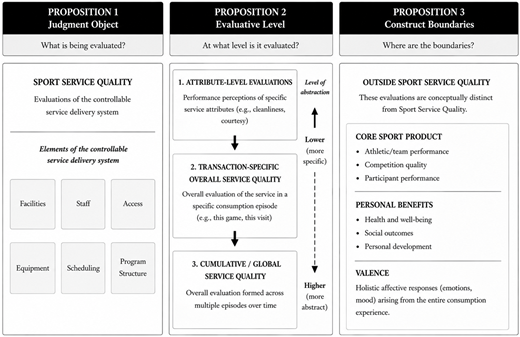
Attribute-level evaluations remain diagnostically valuable because they identify the specific service elements that shape overall quality judgments and subsequent consumer responses. However, they should not be treated as equivalent to service quality itself. Accordingly, researchers should clearly distinguish attribute-level performance perceptions from overall evaluative judgments and specify the temporal referent of the evaluation, whether it relates to a specific service encounter or to accumulated experience across multiple encounters. This reasoning leads to the following propositions:

P1.

Sport service quality is most construct-validly represented as an overall evaluative judgment of the controllable service delivery system, with attribute-level dimensions serving as its antecedents rather than its components (Dabholkar et al., 2000).

P2.

In sport contexts where core product elements are highly salient (Zhang et al., 2003), overall evaluations labeled as service quality will exhibit construct validity threats unless core product perceptions are measured separately and discriminant validity is established. Failure to do so compromises the theoretical interpretation of findings and limits the precision of managerial recommendations derived from such studies.

P3.

When the evaluative object of service quality extends beyond the controllable service delivery system to include core sport product elements, personal benefits, or broader experiential responses, the resulting construct is more appropriately conceptualized as sport customer experience quality rather than service quality (Yoshida, 2017). The three propositions are illustrated in Figure 1.

The conceptual distinctions advanced in this paper have implications that extend beyond construct clarification. They provide researchers with a clearer framework for conceptualizing, operationalizing, and evaluating service quality in sport. More specifically, these broader conceptual contributions translate into several recommendations for future sport service quality research.

First, researchers should explicitly state which judgment object is under investigation. Rather than referring generically to “service quality,” studies should clarify whether they examine attribute-level evaluations, transaction-specific OSQ, or cumulative/global attitudes. This specification should appear at the level of conceptual definition, not merely in measurement description.

Second, research questions and hypotheses should align with the chosen judgment level. Diagnostic objectives are best addressed through attribute-level evaluations. Explanations of how consumers form overall judgments of a specific encounter require explicit modeling of transaction-specific OSQ. Investigations of long-term organizational evaluations should focus on cumulative/global service quality and future sport customer behaviors.

Third, measurement instruments should anchor the temporal referent clearly. Similar “overall excellence” items can capture either transaction-specific or cumulative judgments depending on whether the referent is a specific encounter (e.g. “From your last visit to the fitness club”) or the organization in general (e.g. “Team's services throughout the season”). Failure to anchor the referent risks mixing distinct evaluative levels and compromising construct validity.

Fourth, hierarchical models should be interpreted as representations of evaluative integration rather than as definitive statements about the ontological structure of service quality. Researchers should avoid using dimensional profiles and overall judgments simultaneously as parallel predictors in causal models, as this confounds input and output judgments within the same explanatory structure.

Finally, studies conducted in sport contexts should separate evaluations of the controllable service system from evaluations of the core sport product. When these boundaries are not maintained, researchers risk measuring experience quality rather than service quality, which is a broader construct that encompasses core product quality, service quality, social network quality, and relationship investment quality dimensions (Yoshida, 2017). This distinction also has practical value, as directing managerial attention toward controllable service factors allows sport organizations to more effectively shape consumer perceptions and drive fan engagement (Jones et al., 2019).

The proposed framework also has important implications for sport practitioners as it helps managers collect and use service quality information more effectively when making managerial decisions. Specifically, the framework has three practical implications for sport organizations: First, sport organizations should use instruments that include both attribute-level measures and overall quality items and specify the temporal referent clearly, whether the evaluation refers to a specific encounter or to accumulated experience. This distinction allows sport managers and marketers to separate from diagnostic service performance information and overall quality perceptions. In addition, the relative importance of specific service attributes may vary across consumer segments and levels of experience, as less experienced consumers may rely more on search service attributes (e.g. facility design), whereas experienced participants may place greater emphasis on credence service attributes (e.g. instructor's expertise) (Dagger and Sweeney, 2007). As Avourdiadou and Theodorakis (2014) mentioned, overall service quality measures may be more appropriate when examining loyalty among novice sport consumers, who may lack the experience and knowledge required to evaluate all service attributes.

Second, as mentioned above, service improvement efforts should be directed toward elements within organizational control. In spectator sport settings, this means focusing on peripheral service elements such as facility condition, access, and staff responsiveness. In participant sport and sport programming contexts, it means focusing on the service delivery (scheduling, equipment, facility, and program structure) that supports the co-produced activity, rather than on participant performance outcomes which lie outside direct managerial control.

Third, managers should interpret feedback from an individual service encounter with caution, since a single poor service rating may reflect a transaction-specific judgment rather than a shift in cumulative service quality attitudes (Oliver, 1997).

In sum, the issues mentioned above do not call for new scales, but for sharper theoretical specification. Conceptual clarity, the extent to which a concept is coherently articulated, distinct from related constructs, and systematically organized to support empirical inquiry (Makkonen et al., 2026) regarding the evaluative object of service quality is a necessary condition for advancing sport service quality theory and for ensuring that increasingly complex empirical models rest on stable construct foundations.

The preceding conceptual analysis demonstrates that the central challenge in sport service quality research is not measurement sophistication but construct clarity. Under a single label, the literature has examined multiple evaluative levels (attribute-level performance perceptions, transaction-specific overall service quality judgments, and cumulative/global attitudes), without consistently distinguishing among them.

The central argument advanced here is that being theoretically precise requires explicit specification of the judgment object under investigation. Ambiguity arises not from empirical weakness, but from conceptual misalignment between definition, measurement, and interpretation. This misalignment is most evident when multidimensional performance profiles are used in place of an overall quality judgment, making the construct theoretically unstable and empirical findings difficult to interpret. This interpretation is consistent with Proposition 1, suggesting that studies evaluating different judgment objects may appear comparable but represent conceptually distinct evaluations. Consequently, service quality should not be interpreted independently of its judgment object.

In sport contexts, this issue is compounded by the confusion between the controllable service delivery system and the core sport product. Expanding the evaluative object to include core product outcomes may be understandable from an experiential perspective, but it alters the meaning of the construct and its managerial implications. As highlighted in Proposition 2, failing to distinguish overall evaluations of the controllable service delivery system from evaluations that incorporate core sport product elements threatens construct validity and limits both theoretical interpretation and managerial precision. Preserving these conceptual boundaries is therefore essential for theoretical clarity. Proposition 3 extends this argument by providing a conceptual criterion for distinguishing service quality from customer experience quality. Evaluations that extend beyond the controllable service delivery system to include core sport product elements, personal benefits, or broader experiential responses are more appropriately interpreted as customer experience quality rather than service quality.

The present framework may be particularly valuable for clarifying service quality conceptualization in participant sport and sport programming settings, where the distinction between core product evaluations and service delivery evaluations may become less clearly delineated. In fitness programs and recreational sport activities, for example, instructors, program design, interpersonal interaction, and participant involvement may jointly shape both the service process and outcome-related perceptions. Consequently, future research may need to examine how service delivery evaluations, co-produced service offerings, and outcome perceptions jointly shape broader evaluations of sport consumption experiences. In such contexts, evaluations of the sport offering may also partly reflect participants' own effort and involvement in the co-production process.

Importantly, the framework proposed here reframes prior findings by clarifying the evaluative judgments they represent rather than challenging their empirical validity. Most prior studies have successfully examined what their measures captured, typically attribute-level performance perceptions (see Table 1). The primary contribution of this paper lies in providing a conceptual framework for interpreting prior findings according to the evaluative judgments they represent while offering a more coherent basis for future theory development and empirical investigation.

The distinctions proposed in this paper may also help explain inconsistencies in the relationships reported across the sport service quality literature. Different evaluative levels are unlikely to exhibit identical relationships with related constructs such as satisfaction, perceived value, loyalty, attachment, or behavioral intentions. Studies operationalizing service quality through multidimensional attribute evaluations may therefore report different predictive patterns than studies employing broader overall evaluations of service quality. Such variability may partly reflect differences in the evaluative level being measured rather than inconsistencies in the underlying phenomenon itself. From this perspective, conceptual precision becomes essential not only for construct definition, but also for the interpretation and accumulation of theoretical knowledge in sport service research.

Temporal distinctions may further complicate the interpretation of service quality relationships in sport settings. Oliver (1997) argued that at the transaction-specific level, perceived quality may function as an antecedent to satisfaction, whereas at the cumulative level, repeated satisfaction experiences may contribute to broader overall quality evaluations. Consequently, studies examining transaction-specific judgments and those examining cumulative evaluations may not necessarily reflect the same theoretical process, even when both are discussed under the broader label of service quality.

Advancing sport service quality theory does not require additional scales before it achieves greater conceptual clarity. It requires sharper theoretical specification of the judgment object, its temporal scope, and the boundaries of the evaluative construct. When these conditions are met, service quality provides a construct-valid foundation for linking multidimensional service perceptions to satisfaction and subsequent consumer responses.

As sport management and marketing research continues to develop increasingly sophisticated causal models, theoretical progress will depend less on methodological complexity and more on conceptual precision. As MacInnis (2011) argued, conceptual thinking is central to scientific advancement because it enables scholars to identify, revise, differentiate, and integrate ideas, reconcile inconsistent findings, and develop constructs that serve as basic units of knowledge advancement. The present paper seeks to contribute to sport service quality theory and practice in this direction.
Ajzen
,
I.
(
2001
), “
Nature and operation of attitudes
”,
Annual Review of Psychology
, Vol. 
52
No. 
1
, pp. 
27
-
58
, doi: .
Alexandris
,
K.
,
Dimitriadis
,
N.
and
Kasiara
,
A.
(
2001
), “
The behavioural consequences of perceived service quality: an exploratory study in the context of private fitness clubs in Greece
”,
European Sport Management Quarterly
, Vol. 
1
No. 
4
, pp. 
280
-
299
, doi: .
Alexandris
,
K.
,
Theodorakis
,
N.D.
,
Kaplanidou
,
K.
and
Papadimitriou
,
D.
(
2017
), “
Event quality and loyalty among runners with different running involvement levels: The case of ‘The Alexander the Great’ International Marathon
”,
International Journal of Event and Festival Management
, Vol. 
8
, pp.
292
-
307
, doi: .
Alexandris
,
K.
,
Zahariadis
,
C.
,
Tsorbatzoudis
,
C.
and
Grouios
,
G.
(
2004a
), “
An empirical investigation of the relationships among service quality, customer satisfaction and psychological commitment in a health club context
”,
European Sport Management Quarterly
, Vol. 
4
No. 
1
, pp. 
36
-
52
, doi: .
Alexandris
,
K.
,
Zahariadis
,
P.
,
Tsorbatzoudis
,
C.
and
Grouios
,
G.
(
2004b
), “
An empirical investigation into the role of the outcome dimension in measuring perceived service quality in a health club context
”,
International Journal of Sport Management
, Vol. 
5
, pp. 
1
-
14
.
Alexandris
,
K.
,
Kouthouris
,
C.
and
Meligdis
,
A.
(
2006
), “
Increasing customers' loyalty in a skiing resort: the contribution of place attachment and service quality
”,
International Journal of Contemporary Hospitality Management
, Vol. 
18
No. 
5
, pp. 
414
-
425
, doi: .
Alexandris
,
K.
,
Douka
,
S.
,
Papadopoulos
,
P.
and
Kaltsatou
,
A.
(
2008
), “
Testing the role of service quality on the development of brand associations and brand loyalty
”,
Managing Service Quality: An International Journal
, Vol. 
18
No. 
3
, pp. 
239
-
254
, doi: .
An
,
B.
,
Harada
,
M.
and
Sato
,
S.
(
2020
), “
Service quality, satisfaction, and behavioral intention in a triathlon event: the different experiences between local and non-local participants
”,
Journal of Sport and Tourism
, Vol. 
24
No. 
2
, pp. 
127
-
142
, doi: .
Avourdiadou
,
S.
and
Theodorakis
,
N.D.
(
2014
), “
The development of loyalty among novice and experienced customers of sport and fitness centres
”,
Sport Management Review
, Vol. 
17
No. 
4
, pp. 
419
-
431
, doi: .
Berry
,
L.L.
,
Parasuraman
,
A.
and
Zeithaml
,
V.A.
(
1988
), “
The service-quality puzzle
”,
Business Horizons
,
September–October
, Vol. 
31
No. 
5
, pp. 
35
-
43
, doi: .
Biscaia
,
R.
,
Correia
,
A.
,
Yoshida
,
M.
,
Rosado
,
A.
and
Marôco
,
J.
(
2013
), “
The role of service quality and ticket pricing on satisfaction and behavioural intention within professional football
”,
International Journal of Sports Marketing and Sponsorship
, Vol. 
14
No. 
4
, pp. 
42
-
66
, doi: .
Biscaia
,
R.
,
Correia
,
A.
,
Santos
,
T.
,
Ross
,
S.
and
Yoshida
,
M.
(
2017
), “
Service quality and value perceptions of the 2014 FIFA World Cup in Brazil
”,
Event Management
, Vol. 
21
No. 
2
, pp. 
201
-
216
, doi: .
Biscaia
,
R.
,
Yoshida
,
M.
and
Kim
,
Y.
(
2023
), “
Service quality and its effects on consumer outcomes: a meta-analytic review in spectator sport
”,
European Sport Management Quarterly
, Vol. 
23
No. 
3
, pp. 
897
-
921
, doi: .
Biscaia
,
R.
,
Ramos
,
R.F.
,
Yoshida
,
M.
and
Kim
,
Y.
(
2024
), “
Service quality in spectator sports: a review and research agenda
”,
International Journal of Consumer Studies
, Vol. 
48
No. 
6
, e13086, doi: .
Bitner
,
M.J.
and
Hubbert
,
A.R.
(
1994
), “Encounter satisfaction versus overall satisfaction versus quality: the customer's voice”, in
Rust
,
R.T.
and
Oliver
,
R.L.
(Eds),
Service Quality: New Directions in Theory and Practice
,
Sage
,
Thousand Oaks, CA
, pp. 
72
-
94
.
Boulding
,
W.
,
Kalra
,
A.
,
Staelin
,
R.
and
Zeithaml
,
V.A.
(
1993
), “
A dynamic process model of service quality: from expectations to behavioral intentions
”,
Journal of Marketing Research
, Vol. 
30
No. 
1
,
February
, pp. 
7
-
27
, doi: .
Brady
,
M.K.
and
Cronin
,
J.J.
(
2001
), “
Some new thoughts on conceptualizing perceived service quality: a hierarchical approach
”,
Journal of Marketing
, Vol. 
65
,
July
, pp. 
34
-
49
, doi: .
Brady
,
M.K.
,
Cronin
,
J.J.
and
Brand
,
R.R.
(
2002
), “
Performance-only measurement of service quality: a replication and extension
”,
Journal of Business Research
, Vol. 
55
No. 
1
, pp. 
17
-
31
, doi: .
Brady
,
M.K.
,
Voorhees
,
C.M.
,
Cronin
,
J.J.
and
Bourdeau
,
B.L.
(
2006
), “
The good guys don't always win: the effect of valence on service perceptions and consequences
”,
Journal of Services Marketing
, Vol. 
20
No. 
2
, pp. 
83
-
91
, doi: .
Byon
,
K.
,
Zhang
,
J.
and
Baker
,
T.
(
2013
), “
Impact of core and peripheral service quality on consumption behavior of professional team sport spectators as mediated by perceived value
”,
European Sport Management Quarterly
, Vol. 
13
No. 
2
, pp. 
232
-
263
, doi: .
Calabuig
,
F.
,
Prado-Gascó
,
V.
,
Crespo-Hervás
,
J.
,
Núñez-Pomar
,
J.
and
Añó
,
V.
(
2015
), “
Spectator emotions: effects on quality, satisfaction, value, and future intentions
”,
Journal of Business Research
, Vol. 
68
No. 
7
, pp. 
1445
-
1449
, doi: .
Carman
,
J.M.
(
1990
), “
Consumer perceptions of service quality: an assessment of the SERVQUAL dimensions
”,
Journal of Retailing
, Vol. 
66
No. 
1
, pp. 
33
-
55
.
Chelladurai
,
P.
and
Chang
,
K.
(
2000
), “
Targets and standards of quality in sport services
”,
Sport Management Review
, Vol. 
3
No. 
1
, pp. 
1
-
22
, doi: .
Chen
,
L.H.
,
Chen
,
M.Y.
,
Ye
,
Y.C.
,
Tung
,
I.W.
,
Cheng
,
C.F.
and
Tung
,
S.
(
2012
), “
Perceived service quality and life satisfaction: the mediating role of the actor's satisfaction-with-event
”,
International Journal of Sports Marketing and Sponsorship
, Vol. 
13
No. 
4
, pp. 
7
-
24
, doi: .
Clemes
,
M.D.
,
Brush
,
G.J.
and
Collins
,
M.J.
(
2011
), “
Analysing the professional sport experience: a hierarchical approach
”,
Sport Management Review
, Vol. 
14
No. 
4
, pp. 
370
-
388
, doi: .
Crompton
,
J.L.
and
MacKay
,
K.J.
(
1989
), “
Users' perceptions of the relative importance of service quality dimensions in selected public recreation programs
”,
Leisure Sciences
, Vol. 
11
No. 
4
, pp. 
367
-
375
, doi: .
Dabholkar
,
P.A.
,
Shepherd
,
C.D.
and
Thorpe
,
D.I.
(
2000
), “
A comprehensive framework for service quality: an investigation of critical conceptual and measurement issues through a longitudinal study
”,
Journal of Retailing
, Vol. 
76
No. 
2
, pp. 
139
-
173
, doi: .
Dagger
,
T.S.
and
Sweeney
,
J.C.
(
2007
), “
Service quality attribute weights: how do novice and longer-term customers construct service quality perceptions?
”,
Journal of Service Research
, Vol. 
10
No. 
1
, pp. 
22
-
42
, doi: .
Fazio
,
R.H.
(
2007
), “
Attitudes as object-evaluation associations of varying strength
”,
Social Cognition
, Vol. 
25
No. 
5
, pp. 
603
-
637
, doi: .
Foroughi
,
B.
,
Shah
,
K.A.M.
,
Nikbin
,
D.
and
Hyun
,
S.S.
(
2014
), “
The impact of event quality on fan satisfaction and game attendance in the context of professional soccer in Iran
”,
International Journal of Sports Marketing and Sponsorship
, Vol. 
15
No. 
3
, pp. 
40
-
56
, doi: .
Foroughi
,
B.
,
Nikbin
,
D.
,
Hyun
,
S.S.
and
Iranmanesh
,
M.
(
2016
), “
Impact of core product quality on sport fans' emotions and behavioral intentions
”,
International Journal of Sports Marketing and Sponsorship
, Vol. 
17
No. 
2
, pp. 
110
-
129
, doi: .
Foroughi
,
B.
,
Mohammad Shah
,
K.A.
,
Ramayah
,
T.
and
Iranmanesh
,
M.
(
2019
), “
The effects of peripheral service quality on spectators' emotions and behavioural intentions
”,
International Journal of Sports Marketing and Sponsorship
, Vol. 
20
No. 
3
, pp. 
495
-
515
, doi: .
Greenwell
,
T.C.
,
Fink
,
J.S.
and
Pastore
,
D.L.
(
2002
), “
Assessing the influence of the physical sports facility on customer satisfaction within the context of the service experience
”,
Sport Management Review
, Vol. 
5
No. 
2
, pp. 
129
-
148
, doi: .
Grönroos
,
C.
(
1990
),
Service Management and Marketing: Managing the Moments of Truth in Service Competition
,
Lexington Books
,
Lexington, MA
.
Grönroos
,
C.
(
2001
), “
The perceived service quality concept - a mistake?
”,
Managing Service Quality
, Vol. 
11
No. 
3
, pp. 
150
-
152
, doi: .
Hennig-Thurau
,
T.
,
Gwinner
,
K.P.
and
Gremler
,
D.D.
(
2002
), “
Understanding relationship marketing outcomes: an integration of relational benefits and relationship quality
”,
Journal of Service Research
, Vol. 
4
No. 
3
, pp. 
230
-
247
, doi: .
Hightower
,
R.
,
Brady
,
M.K.
and
Baker
,
T.L.
(
2002
), “
Investigating the role of the physical environment in hedonic service consumption: an exploratory study of sporting events
”,
Journal of Business Research
, Vol. 
55
No. 
9
, pp. 
697
-
707
, doi: .
Howat
,
G.
and
Assaker
,
G.
(
2013
), “
The hierarchical effects of perceived quality on perceived value, satisfaction, and loyalty: empirical results from public, outdoor aquatic centres in Australia
”,
Sport Management Review
, Vol. 
16
No. 
3
, pp. 
268
-
284
, doi: .
Howat
,
G.
and
Assaker
,
G.
(
2016
), “
Outcome quality in participant sport and recreation service quality models: empirical results from public aquatic centres in Australia
”,
Sport Management Review
, Vol. 
19
No. 
5
, pp. 
520
-
535
, doi: .
Howat
,
G.
and
Crilley
,
G.
(
2007
), “
Customer service quality, satisfaction, and operational performance: a proposed model for Australian public aquatic centres
”,
Annals of Leisure Research
, Vol. 
10
No. 
2
, pp. 
168
-
195
, doi: .
Howat
,
G.
,
Crilley
,
G.
,
Mikilewicz
,
S.
,
Edgecombe
,
S.
,
March
,
H.
,
Murray
,
D.
and
Bell
,
B.
(
2002
), “
Service quality, customer satisfaction and behavioural intentions of Australian aquatic centre customers, 1999-2001
”,
Annals of Leisure Research
, Vol. 
5
No. 
1
, pp. 
51
-
64
, doi: .
Howat
,
G.
,
Crilley
,
G.
and
McGrath
,
R.
(
2008
), “
A focussed service quality, benefits, overall satisfaction and loyalty model for public aquatic centres
”,
Managing Leisure
, Vol. 
13
, pp. 
1
-
23
.
Hu
,
J.
,
Ye
,
X.
and
Gu
,
S.
(
2024
), “
The impact of subjective consumer knowledge on consumer behavioral loyalty through psychological involvement and perceived service quality: sports clubs
”,
Asia Pacific Journal of Marketing and Logistics
, Vol. 
36
No. 
8
, pp. 
1988
-
2007
, doi: .
Jarvis
,
C.B.
,
MacKenzie
,
S.B.
and
Podsakoff
,
P.M.
(
2003
), “
A critical review of construct indicators and measurement model misspecification in marketing and consumer research
”,
Journal of Consumer Research
, Vol. 
30
No. 
2
, pp. 
199
-
218
, doi: .
Jeong
,
Y.
and
Kim
,
S.
(
2020
), “
A study of event quality, destination image, perceived value, tourist satisfaction, and destination loyalty among sport tourists
”,
Asia Pacific Journal of Marketing and Logistics
, Vol. 
32
No. 
4
, pp. 
940
-
960
, doi: .
Jin
,
N.
,
Lee
,
H.
and
Lee
,
S.
(
2013
), “
Event quality, perceived value, destination image, and behavioral intention of sports events: the case of the IAAF World Championship, Daegu 2011
”,
Asia Pacific Journal of Tourism Research
, Vol. 
18
No. 
8
, pp. 
849
-
864
, doi: .
Jones
,
C.W.
,
Byon
,
K.K.
and
Huang
,
H.
(
2019
), “
Service quality, perceived value, and fan engagement: case of Shanghai formula one racing
”,
Sport Marketing Quarterly
, Vol. 
28
No. 
2
, pp. 
63
-
76
, doi: .
Kelley
,
S.W.
and
Turley
,
L.
(
2001
), “
Consumer perceptions of service quality attributes at sporting events
”,
Journal of Business Research
, Vol. 
54
No. 
2
, pp. 
161
-
166
, doi: .
Kim
,
H.D.
,
LaVetter
,
D.
and
Lee
,
J.H.
(
2006
), “
The influence of service quality factors on customer satisfaction and repurchase intention in the Korean Professional Basketball League
”,
International Journal of Applied Sports Sciences
, Vol. 
18
No. 
1
, pp. 
39
-
58
.
Kim
,
T.H.
,
Ko
,
Y.J.
and
Park
,
C.M.
(
2013
), “
The influence of event quality on revisit intention
”,
Managing Service Quality: An International Journal
, Vol. 
23
No. 
3
, pp. 
205
-
224
, doi: .
Kim
,
S.K.
,
Yim
,
B.H.
,
Byon
,
K.K.
,
Yu
,
J.G.
,
Lee
,
S.M.
and
Park
,
J.A.
(
2016
), “
Spectator perception of service quality attributes associated with Shanghai formula one
”,
International Journal of Sports Marketing and Sponsorship
, Vol. 
17
No. 
2
, pp. 
153
-
171
, doi: .
Ko
,
Y.J.
and
Pastore
,
D.L.
(
2005
), “
A hierarchical model of service quality for the recreational sport industry
”,
Sport Marketing Quarterly
, Vol. 
14
No. 
2
, pp. 
84
-
97
, doi: .
Ko
,
Y.J.
,
Kim
,
Y.K.
,
Kim
,
M.K.
and
Lee
,
J.H.
(
2010
), “
The role of involvement and identification on event quality perceptions and satisfaction: a case of US Taekwondo Open
”,
Asian Pacific Journal of Marketing and Logistics
, Vol. 
22
No. 
1
, pp. 
25
-
39
.
Ko
,
Y.J.
,
Zhang
,
J.
,
Cattani
,
K.
and
Pastore
,
D.
(
2011
), “
Assessment of event quality in major spectator sports
”,
Managing Service Quality
, Vol. 
21
No. 
3
, pp. 
304
-
322
.
Ko
,
Y.J.
,
Kwon
,
H.H.
,
Kim
,
T.
,
Park
,
C.
and
Song
,
K.
(
2023
), “
Assessment of event quality in major spectator sports: single-item measures
”,
Journal of Global Sport Management
, Vol. 
8
No. 
4
, pp. 
1008
-
1024
, doi: .
Koo
,
G.
,
Hardin
,
R.
,
McClung
,
S.
,
Jung
,
T.
,
Cronin
,
J.J.
,
Voorhees
,
C.M.
and
Bourdeau
,
B.L.
(
2009
), “
Examination of the causal effects between the dimensions of service quality and spectator satisfaction in minor league baseball
”,
International Journal of Sports Marketing and Sponsorship
, Vol. 
11
No. 
1
, pp. 
46
-
59
.
Koronios
,
K.
,
Kriemadis
,
A.
and
Papadopoulos
,
A.
(
2019
), “
Exploring service quality and its customer consequences in the sports spectating sector
”,
Journal of Entrepreneurship and Public Policy
, Vol. 
8
No. 
1
, pp. 
187
-
206
, doi: .
Kouthouris
,
C.
and
Alexandris
,
K.
(
2005
), “
Can service quality predict customer satisfaction and behavioral intentions in the sport tourism industry? An application of the SERVQUAL model in an outdoors setting
”,
Journal of Sport Tourism
, Vol. 
10
No. 
2
, pp. 
101
-
111
, doi: .
Kyle
,
G.T.
,
Theodorakis
,
N.D.
,
Karageorgiou
,
A.
and
Lafazani
,
M.
(
2010
), “
The effect of service quality on customer loyalty within the context of ski resorts
”,
Journal of Park and Recreation Administration
, Vol. 
28
No. 
1
, pp. 
1
-
15
.
Lam
,
E.
,
Zhang
,
J.
and
Jensen
,
B.
(
2005
), “
Service quality assessment scale (SQAS): an instrument for evaluating service quality of health-fitness clubs
”,
Measurement in Physical Education and Exercise Science
, Vol. 
9
No. 
2
, pp. 
79
-
111
, doi: .
Lee
,
J.H.
,
Kim
,
H.D.
,
Ko
,
Y.J.
and
Sagas
,
M.
(
2011
), “
The influence of service quality on satisfaction and intention: a gender segmentation strategy
”,
Sport Management Review
, Vol. 
14
No. 
1
, pp. 
54
-
63
, doi: .
Liu
,
Y.D.
,
Taylor
,
P.
and
Shibli
,
S.
(
2009
), “
Measuring customer service quality of English public sport facilities
”,
International Journal of Sport Management and Marketing
, Vol. 
6
No. 
3
, pp. 
229
-
252
, doi: .
Ma
,
S.C.
and
Kaplanidou
,
K.
(
2020
), “
Service quality, perceived value and behavioral intentions among highly and lowly identified baseball consumers across nations
”,
International Journal of Sports Marketing and Sponsorship
, Vol. 
21
No. 
1
, pp. 
46
-
67
, doi: .
MacInnis
,
D.J.
(
2011
), “
A framework for conceptual contributions in marketing
”,
Journal of Marketing
, Vol. 
75
No. 
4
, pp. 
136
-
154
, doi: .
MacKay
,
K.J.
and
Crompton
,
J.L.
(
1988
), “
A conceptual model of consumer evaluation of recreation service quality
”,
Leisure Studies
, Vol. 
7
No. 
1
, pp. 
41
-
49
, doi: .
MacKenzie
,
S.B.
(
2003
), “
The dangers of poor construct conceptualization
”,
Journal of the Academy of Marketing Science
, Vol. 
31
No. 
3
, pp. 
323
-
326
, doi: .
Makkonen
,
H.
,
Aspara
,
J.
,
Grönroos
,
C.
and
Mäntymäki
,
M.
(
2026
 
In press
), “
Advancing conceptual clarity in marketing science: delineating process and systems perspectives on value co-creation
”,
Marketing Theory
, pp.
1
-
24
.
Martínez García
,
J.A.
and
Martínez Caro
,
L.
(
2010a
), “
Rethinking perceived service quality: an alternative to hierarchical and multidimensional models
”,
Total Quality Management and Business Excellence
, Vol. 
21
No. 
1
, pp. 
93
-
118
, doi: .
Martínez García
,
J.A.
and
Martínez Caro
,
L.
(
2010b
), “
Some insights on conceptualizing and measuring service quality
”,
Journal of Retailing and Consumer Services
, Vol. 
17
No. 
1
, pp. 
29
-
42
, doi: .
Matic
,
R.M.
,
Karagiorgos
,
T.
,
Maksimovic
,
N.
,
Alexandris
,
K.
,
Bujkovic
,
R.
and
Drid
,
P.
(
2020
), “
Testing the influence of destination image and event quality on athletes' intentions to re-visit the city: a case study of the 2017 world youth and juniors' sambo championships in Novi Sad, Serbia
”,
Managing Sport and Leisure
, Vol. 
25
No. 
5
, pp. 
390
-
401
, doi: .
McDonald
,
M.A.
,
Sutton
,
W.A.
and
Milne
,
G.R.
(
1995
), “
TEAMQUAL: measuring service quality in professional sports
”,
Sport Marketing Quarterly
, Vol. 
4
No. 
2
, pp. 
9
-
15
, doi: .
Moon
,
K.S.
,
Kim
,
M.
,
Ko
,
Y.J.
,
Connaughton
,
D.P.
and
Lee
,
J.H.
(
2011
), “
The influence of consumer's event quality perception on destination image
”,
Managing Service Quality: An International Journal
, Vol. 
21
No. 
3
, pp. 
287
-
303
, doi: .
Moon
,
K.-S.
,
Ko
,
Y.J.
,
Connaughton
,
D.P.
and
Lee
,
J.-H.
(
2013
), “
A mediating role of destination image in the relationship between event quality, perceived value, and behavioral intention
”,
Journal of Sport and Tourism
, Vol. 
18
No. 
1
, pp. 
49
-
66
, doi: .
Mullin
,
B.
(
1985
), “Characteristics of sport marketing”, in
Lewis
,
G.
and
Appenzeller
,
H.
(Eds),
Successful Sport Management
,
The Michie Company
,
Charlottesville, VA
, pp. 
101
-
124
.
Mullin
,
B.J.
,
Hardy
,
S.
and
Sutton
,
W.A.
(
1993
),
Sport Marketing
,
Human Kinetics
,
Champaign, IL
.
Oh
,
S.H.
,
Lee
,
H.S.
and
Kim
,
S.J.
(
2011
), “
The effects of service quality and relationship benefits on relationship commitment and customer loyalty in membership fitness club
”,
Journal of Global Scholars of Marketing Science
, Vol. 
21
No. 
3
, pp. 
115
-
125
, doi: .
Oliver
,
R.L.
(
1997
),
Satisfaction: A Behavioral Perspective on the Consumer
,
McGraw-Hill
,
New York
.
Parasuraman
,
A.
,
Zeithaml
,
V.A.
and
Berry
,
L.L.
(
1985
), “
A conceptual model of service quality and its implications for future research
”,
Journal of Marketing
, Vol. 
49
No. 
4
, pp. 
41
-
50
, doi: .
Parasuraman
,
A.
,
Zeithaml
,
V.A.
and
Berry
,
L.L.
(
1988
), “
SERVQUAL: a multi-item scale for measuring consumer perceptions of service quality
”,
Journal of Retailing
, Vol. 
64
No. 
1
, pp. 
12
-
40
.
Parasuraman
,
A.
,
Zeithaml
,
V.A.
and
Berry
,
L.L.
(
1994
), “
Reassessment of expectations as a comparison standard in measuring service quality: implications for further research
”,
Journal of Marketing
, Vol. 
58
, pp.
111
-
124
.
Phonthanukitithaworn
,
C.
and
Sellitto
,
C.
(
2018
), “
Perceptions of service quality at football stadiums: influence on fans' intention to attend future games
”,
Managing Sport and Leisure
, Vol. 
23
No. 
3
, pp. 
204
-
224
, doi: .
Polyakova
,
O.
and
Ramchandani
,
G.
(
2023
), “
Perceived service quality among regular users of gyms in public sports centres in the UK
”,
Managing Sport and Leisure
, Vol. 
28
No. 
1
, pp. 
35
-
54
, doi: .
Polyakova
,
O.
,
Karagiorgos
,
T.
,
Konstantinidis
,
K.
,
Ntovoli
,
A.
and
Alexandris
,
K.
(
2025
), “
Can event service quality predict memorable tourism experience in a participatory recurring sport event?
”,
Event Management
, Vol. 
29
No. 
2
, pp. 
185
-
202
, doi: .
Rai
,
J.S.
,
Foroughi
,
B.
,
Itani
,
M.N.
and
Singh
,
A.
(
2023
), “
Measuring spectators' perception toward peripheral stadium quality services after COVID-19: impact on their emotions and attendance intentions
”,
International Journal of Sports Marketing and Sponsorship
, Vol. 
24
No. 
2
, pp. 
375
-
394
, doi: .
Ribeiro
,
T.M.
,
Correia
,
A.
,
Biscaia
,
R.
and
Figueiredo
,
C.
(
2018
), “
Examining service quality and social impact perceptions of the 2016 Rio de Janeiro Olympic Games
”,
International Journal of Sports Marketing and Sponsorship
, Vol. 
19
No. 
2
, pp. 
160
-
177
, doi: .
Rust
,
R.T.
and
Oliver
,
R.L.
(
1994
),
Service Quality: New Directions in Theory and Practice
,
Sage
,
London
.
Shi
,
Y.
,
Pyun
,
D.Y.
and
Manoli
,
A.E.
(
2022
), “
Assessment of the service quality measurement model for youth football academies
”,
Sport Marketing Quarterly
, Vol. 
31
No. 
4
, pp. 
305
-
321
, doi: .
Shonk
,
D.J.
and
Chelladurai
,
P.
(
2008
), “
Service quality, satisfaction and intent to return in event sports tourism
”,
Journal of Sport Management
, Vol. 
22
, pp. 
578
-
602
.
Shonk
,
D.J.
and
Chelladurai
,
P.
(
2009
), “
Model of service quality in event sport tourism: development of a scale
”,
International Journal of Sport Management and Marketing
, Vol. 
6
No. 
3
, pp. 
292
-
307
, doi: .
Shonk
,
D.J.
,
Bravo
,
G.A.
,
Velez-Colon
,
L.
and
Lee
,
C.
(
2017
), “
Measuring event quality, satisfaction, and intent to return at an international sport event: the ICF Canoe Slalom world championships
”,
Journal of Global Sport Management
, Vol. 
2
No. 
2
, pp. 
79
-
95
, doi: .
Silcox
,
S.
and
Soutar
,
G.N.
(
2009
), “
Patrons' intentions to continue using a recreation centre: a suggested model
”,
Managing Leisure
, Vol. 
14
No. 
3
, pp. 
177
-
194
, doi: .
Smith
,
J.
,
Murray
,
D.
and
Howat
,
G.
(
2014
), “
How perceptions of physique can influence customer satisfaction in health and fitness centres
”,
Managing Leisure
, Vol. 
19
No. 
6
, pp. 
442
-
460
, doi: .
Spreng
,
R.A.
,
Shi
,
L.H.
and
Page
,
T.G.
(
2009
), “
Service quality and satisfaction in business-to-business services
”,
Journal of Business and Industrial Marketing
, Vol. 
24
No. 
8
, pp. 
537
-
548
.
Stergiou
,
D.P.
,
Karagiorgos
,
T.
,
Alexandris
,
K.
,
Benetatos
,
T.
and
Balaska
,
P.
(
2022
), “
The contribution of event quality factors on the development of memorable tourism experiences: evidence from the 2018 FIFA World Cup
”,
Event Management
, Vol. 
26
No. 
5
, pp. 
1007
-
1024
, doi: .
Sutton
,
W.A.
(
1998
), “Marketing principles applied to sport management”, in
Masteralexis
,
L.P.
,
Barr
,
C.A.
and
Hums
,
M.A.
(Eds),
Principles and Practices of Sport Management
,
Aspen
,
Gaithersburg, MD
, pp. 
39
-
61
.
Teas
,
R.K.
(
1993
), “
Expectations, performance evaluation, and consumers' perceptions of quality
”,
Journal of Marketing
, Vol. 
57
No. 
4
, pp. 
18
-
34
, doi: .
Theodorakis
,
N.D.
(
2014
), “Customer experience in spectator sports”, in
Kandampully
,
J.
(Ed.),
Customer Experience Management: Enhancing Experience and Value through Service Management
,
Kendall Hunt
,
USA
, pp. 
205
-
219
.
Theodorakis
,
N.D.
and
Alexandris
,
K.
(
2008
), “
Can service quality predict spectators' behavioral intentions in professional soccer?
”,
Managing Leisure
, Vol. 
13
Nos
3-4
, pp. 
162
-
178
, doi: .
Theodorakis
,
N.D.
,
Kambitsis
,
C.
and
Laios
,
A.
(
2001
), “
Relationship between measures of service quality and satisfaction of spectators in professional sports
”,
Managing Service Quality
, Vol. 
11
No. 
6
, pp. 
431
-
438
, doi: .
Theodorakis
,
N.
,
Koustelios
,
A.
,
Robinson
,
L.
and
Barlas
,
A.
(
2009a
), “
Moderating role of team identification on the relationship between service quality and repurchase intentions among spectators of professional sports
”,
Managing Service Quality
, Vol. 
19
No. 
4
, pp. 
456
-
473
, doi: .
Theodorakis
,
N.D.
,
Tsigilis
,
N.
and
Alexandris
,
K.
(
2009b
), “
The mediating role of place attachment on the relationship between service quality and loyalty in the context of skiing
”,
International Journal of Sport Management and Marketing
, Vol. 
6
No. 
3
, pp. 
277
-
291
, doi: .
Theodorakis
,
N.D.
,
Alexandris
,
K.
and
Ko
,
Y.J.
(
2011
), “
A service quality framework in the context of professional football in Greece
”,
International Journal of Sports Marketing and Sponsorship
, Vol. 
12
No. 
4
, pp. 
57
-
71
, doi: .
Theodorakis
,
N.
,
Alexandris
,
K.
,
Tsigilis
,
N.
and
Karvounis
,
S.
(
2013
), “
Predicting spectators' behavioural intentions in professional football: the role of satisfaction and service quality
”,
Sport Management Review
, Vol. 
16
No. 
1
, pp. 
85
-
96
, doi: .
Theodorakis
,
N.D.
,
Howat
,
G.
,
Ko
,
Y.J.
and
Avourdiadou
,
S.
(
2014
), “
A comparison of service evaluation models in the context of sport and fitness in Greece
”,
Managing Leisure
, Vol. 
19
No. 
1
, pp. 
18
-
35
, doi: .
Theodorakis
,
N.D.
,
Kaplanidou
,
K.
and
Karabaxoglou
,
I.
(
2015
), “
The effect of service quality and satisfaction on happiness among runners of a small-scale recurring sport event
”,
Leisure Sciences
, Vol. 
37
No. 
1
, pp. 
87
-
107
, doi: .
Theodorakis
,
N.D.
,
Kaplanidou
,
K.
,
Alexandris
,
K.
and
Papadimitriou
,
D.
(
2019
), “
From sport event quality to quality of life: the role of purchase happiness and event satisfaction
”,
Journal of Convention and Event Tourism
, Vol. 
20
No. 
3
, pp. 
241
-
260
, doi: .
Tsitskari
,
E.
,
Vernadakis
,
N.
,
Tzetzis
,
G.
,
Aggeloussis
,
N.
and
Costa
,
G.
(
2009
), “
Expected and perceived service quality at basketball stadiums in Greece
”,
World Leisure Journal
, Vol. 
51
No. 
2
, pp. 
94
-
104
, doi: .
Tsuji
,
Y.
,
Bennett
,
G.
and
Zhang
,
J.
(
2007
), “
Consumer satisfaction with an action sports event
”,
Sport Marketing Quarterly
, Vol. 
16
No. 
4
, pp. 
199
-
208
, doi: .
Tzetzis
,
G.
,
Alexandris
,
K.
and
Kapsampeli
,
S.
(
2014
), “
Predicting visitors' satisfaction and behavioral intentions from service quality in the context of a small-scale outdoor sport event
”,
International Journal of Event and Festival Management
, Vol. 
5
No. 
1
, pp. 
4
-
21
, doi: .
Verhoef
,
P.C.
,
Lemon
,
K.N.
,
Parasuraman
,
A.
,
Roggeveen
,
A.
,
Tsiros
,
M.
and
Schlesinger
,
L.A.
(
2009
), “
Customer experience creation: determinants, dynamics and management strategies
”,
Journal of Retailing
, Vol. 
85
No. 
1
, pp. 
31
-
41
, doi: .
Voon
,
B.H.
,
Lee
,
N.
and
Murray
,
D.
(
2014
), “
Sports service quality for event venues: evidence from Malaysia
”,
Sport, Business and Management: An International Journal
, Vol. 
4
No. 
2
, pp. 
125
-
141
, doi: .
Wakefield
,
K.L.
and
Blodgett
,
J.G.
(
1994
), “
The importance of servicescapes in leisure service settings
”,
Journal of Services Marketing
, Vol. 
8
No. 
3
, pp. 
66
-
76
, doi: .
Won
,
D.
and
Lee
,
C.
(
2024
), “
What influences season ticket holders' satisfaction and renewal intention? The role of season ticket service quality
”,
Managing Sport and Leisure
, Vol. 
29
No. 
4
, pp. 
572
-
590
, doi: .
Xiao
,
Y.
,
Ren
,
X.
,
Zhang
,
P.
and
Ketlhoafetse
,
A.
(
2020
), “
The effect of service quality on foreign participants' satisfaction and behavioral intention with the 2016 Shanghai International Marathon
”,
International Journal of Sports Marketing and Sponsorship
, Vol. 
21
No. 
1
, pp. 
91
-
105
, doi: .
Yildiz
,
S.M.
and
Kara
,
A.
(
2012
), “
A re-examination and extension of measuring perceived service quality in physical activity and sports centres (PSC): QSport-14 scale
”,
International Journal of Sports Marketing and Sponsorship
, Vol. 
13
No. 
3
, pp. 
26
-
45
, doi: .
Yoshida
,
M.
(
2017
), “
Consumer experience quality: a review and extension of the sport management literature
”,
Sport Management Review
, Vol. 
20
No. 
5
, pp. 
427
-
442
, doi: .
Yoshida
,
M.
and
James
,
J.D.
(
2010
), “
Customer satisfaction with game and service experiences: antecedents and consequences
”,
Journal of Sport Management
, Vol. 
24
No. 
3
, pp. 
338
-
361
, doi: .
Yoshida
,
M.
and
James
,
J.D.
(
2011
), “
Service quality at sporting events: is aesthetic quality a missing dimension?
”,
Sport Management Review
, Vol. 
14
No. 
1
, pp. 
13
-
24
, doi: .
Yoshida
,
M.
,
James
,
J.D.
and
Cronin
,
J.J.
(
2013
), “
Value creation: assessing the relationships between quality, consumption value and behavioural intentions at sporting events
”,
International Journal of Sports Marketing and Sponsorship
, Vol. 
14
No. 
2
, pp. 
51
-
73
, doi: .
Yu
,
H.S.
,
Zhang
,
J.J.
,
Kim
,
D.H.
,
Chen
,
K.K.
,
Henderson
,
C.
,
Min
,
S.D.
and
Huang
,
H.
(
2014
), “
Service quality, perceived value, customer satisfaction, and behavioral intention among fitness center members aged 60
”,
Social Behavior and Personality
, Vol. 
42
No. 
5
, pp. 
757
-
768
.
Zeithaml
,
V.A.
(
1987
),
Defining and Relating Price, Perceived Quality and Perceived Value
,
Marketing Science Institute
,
Cambridge, MA
.
Zeithaml
,
V.A.
(
1988
), “
Consumer perceptions of price, quality, and value: a means-end model and synthesis of evidence
”,
Journal of Marketing
, Vol. 
52
No. 
3
, pp. 
2
-
22
, doi: .
Zeithaml
,
V.A.
and
Bitner
,
M.J.
(
2000
),
Services Marketing: Integrating Customer Focus across the Firm
, (2nd ed.) ,
McGraw-Hill
,
New York
.
Zeithaml
,
V.A.
and
Bitner
,
M.J.
(
2003
),
Services Marketing: Integrating Customer Focus across the Firm
, (3rd ed.) ,
McGraw-Hill
,
New York
.
Zeithaml
,
V.A.
and
Bitner
,
M.J.
(
2006
),
Services Marketing: Integrating Customer Focus across the Firm
, (4th ed.) ,
McGraw-Hill
,
New York
.
Zeithaml
,
V.A.
,
Bitner
,
M.J.
and
Gremler
,
D.D.
(
2009
),
Services Marketing: Integrating Customer Focus across the Firm
, (5th ed.) ,
McGraw-Hill
,
New York
.
Zhang
,
J.J.
,
Lam
,
E.T.C.
and
Connaughton
,
D.P.
(
2003
), “
General market demand variables associated with professional sport consumption
”,
International Journal of Sports Marketing and Sponsorship
, Vol. 
5
No. 
1
, pp. 
33
-
55
, doi: .
Crompton
,
J.L.
,
MacKay
,
K.J.
and
Fesenmaier
,
D.R.
(
1991
), “
Identifying dimensions of service quality in public recreation
”,
Journal of Park and Recreation Administration
, Vol. 
9
, pp. 
15
-
28
.
Cronin
,
J.J.
,
Brady
,
M.K.
and
Hult
,
G.T.M.
(
2000
), “
Assessing the effects of quality, value and customer satisfaction on consumer behavioral intentions in service environments
”,
Journal of Retailing
, Vol. 
76
No. 
2
, pp. 
193
-
218
, doi: .
Oliver
,
R.L.
(
1981
), “
Measurement and evaluation of satisfaction processes in retail settings
”,
Journal of Retailing
, Vol. 
57
, pp. 
25
-
48
.
Yen
,
C.C.
,
Ho
,
L.H.
,
Hsueh
,
Y.S.
,
Su
,
W.S.
and
Chang
,
C.M.
(
2012
), “
Impact of Japanese professional baseball fans' satisfaction on sports participation behavior
”,
Social Behavior and Personality
, Vol. 
40
No. 
9
, pp. 
1465
-
1475
, doi: .
Yim
,
B.H.
,
Byon
,
K.K.
,
Baker
,
T.A.
and
Zhang
,
J.J.
(
2021
), “
Identifying critical factors in sport consumption decision making of millennial sport fans: a mixed-methods approach
”,
European Sport Management Quarterly
, Vol. 
21
No. 
4
, pp. 
484
-
503
, doi: .
Published by Emerald Publishing Limited. This article is published under the Creative Commons Attribution (CC BY 4.0) license. Anyone may reproduce, distribute, translate and create derivative works of this article (for both commercial and non-commercial purposes), subject to full attribution to the original publication and authors. The full terms of this license may be seen at Link to the terms of the CC BY 4.0 licence.

Data & Figures

Figure 1
A conceptual framework of sport service quality divided into three propositions: judgment object, evaluative level, and construct boundaries.A conceptual framework of sport service quality divided into three propositions. Proposition 1, titled Judgment Object, focuses on what is being evaluated. It includes evaluations of the controllable service delivery system, which consists of elements such as facilities, staff, access, equipment, scheduling, and program structure. Proposition 2, titled Evaluative Level, addresses the level at which evaluations are made. It includes three levels: attribute-level evaluations, which involve performance perceptions of specific service attributes like cleanliness and courtesy; transaction-specific overall service quality, which is the overall evaluation of the service in a specific consumption episode; and cumulative or global service quality, which is the overall evaluation formed across multiple episodes over time. Proposition 3, titled Construct Boundaries, defines where the boundaries of sport service quality lie. These include core sport product, personal benefits, and valence.

Proposed conceptual framework of sport service quality

Figure 1
A conceptual framework of sport service quality divided into three propositions: judgment object, evaluative level, and construct boundaries.A conceptual framework of sport service quality divided into three propositions. Proposition 1, titled Judgment Object, focuses on what is being evaluated. It includes evaluations of the controllable service delivery system, which consists of elements such as facilities, staff, access, equipment, scheduling, and program structure. Proposition 2, titled Evaluative Level, addresses the level at which evaluations are made. It includes three levels: attribute-level evaluations, which involve performance perceptions of specific service attributes like cleanliness and courtesy; transaction-specific overall service quality, which is the overall evaluation of the service in a specific consumption episode; and cumulative or global service quality, which is the overall evaluation formed across multiple episodes over time. Proposition 3, titled Construct Boundaries, defines where the boundaries of sport service quality lie. These include core sport product, personal benefits, and valence.

Proposed conceptual framework of sport service quality

Close modal
Table 1

Review of sport service quality studies: conceptualization, measurement, and modeling

#StudySQ definitionOSQ measuredJudgment objectSQ model specificationService quality elements
1Alexandris et al. (2001) Global judgment or attitude relating to the superiority of a service (Zeithaml and Bitner, 2000)NoAttributesMultidimensional attribute-based model (no SQ construct)Peripheral (e.g. provides its services at the time it promises to do so, the employees give me personal attention)
2Alexandris et al. (2004a) Not explicitly definedNoAttributesMultidimensional attribute-based model (no SQ construct)Peripheral (e.g. employees respond quickly to members), Benefits (e.g. improve psychological well-being)
3Alexandris et al. (2004b) Not explicitly definedNoAttributesMultidimensional attribute-based model (no SQ construct)Peripheral (e.g. polite staff), Benefits (e.g. improve psychological well-being)
4Alexandris et al. (2006) Not explicitly definedNoAttributesMultidimensional attribute-based model (no SQ construct)Peripheral (e.g. employees are friendly), Benefits (e.g. skiing helped me to socialize)
5Alexandris et al. (2008) Global judgment or attitude relating to the superiority of a service (Zeithaml and Bitner, 2006)NoAttributesMultidimensional attribute-based model (no SQ construct)Peripheral (e.g. responsiveness, reliability), Outcome content not explicitly specified; instrument referenced to Alexandris et al. (2004b) 
6Alexandris et al. (2017) Global judgment of service superiority (Zeithaml and Bitner, 2003)NoAttributesMultidimensional attribute-based model (no SQ construct)Peripheral (e.g. personnel were responsive), Benefits (e.g. running this event made me a better athlete)
7An et al. (2020) Not explicitly definedNoAttributesMultidimensional attribute-based model (no SQ construct)Peripheral (e.g. staff were friendly), Valence (e.g. evaluate the outcome of my race participation favorably), Benefits (e.g. get emotionally refreshed through participating in the event)
8Avourdiadou and Theodorakis (2014) Global judgment of service superiority (Zeithaml and Bitner, 2003)YesService systemOSQ as antecedent constructNo specific elements (global evaluation)
9Biscaia et al. (2013) Global judgment of service superiority (Zeithaml and Bitner, 2003)NoAttributesMultidimensional attribute-based model (no SQ construct)Peripheral (e.g. employees respond quickly to my needs), Core (e.g. players always try to do their best)
10Biscaia et al. (2017) Global judgment of service superiority (Zeithaml and Bitner, 2003)NoAttributesMultidimensional attribute-based model (no SQ construct)Peripheral (e.g. employees are available to help the fans), Core (e.g. the players of the teams play well)
11Brady et al. (2006) Not explicitly definedNoAttributesMultidimensional attribute-based model (no SQ construct)Peripheral (e.g. treated well by employees), Valence (e.g. evaluate feelings about game outcome)
12Byon et al. (2013) Not explicitly definedNoAttributesMultidimensional attribute-based model (no SQ construct)Peripheral (e.g. game entertainment, security), Core (e.g. opposing team's performance)
13Calabuig et al. (2015) Overall impression of the superiority of a service provider and its services (Zeithaml, 1988)YesService SystemSQ as antecedent constructNo specific elements (global evaluation)
14Chen et al. (2012) Expectation–perception comparison at the service dimension level (Shonk and Chelladurai, 2008)NoAttributesHierarchicalPeripheral (e.g. employees know their jobs), Valence (e.g. feel that I have a good experience)
15Clemes et al. (2011) Global judgment relating to superiority of the service (Carman, 1990)YesAttributesHierarchical modelPeripheral (e.g. car parking is secure), Core (e.g. games are usually fast and flowing)
16Crompton and Mackay (1989) Judgment of service's overall excellence or superiority (Berry et al., 1988)NoAttributesNot modeled (comparison of dimension importance)Peripheral (e.g. personnel responsiveness, empathy)
17Foroughi et al. (2014) Overall impression of game performance, amenities, additional services, event staff and service-delivery systemsNoAttributesMultidimensional attribute-based model (no SQ construct)Peripheral (e.g. employees seem very knowledgeable about their jobs), Core (e.g. skill performance of my team's player is excellent), Benefits (quality time with my friends/family at the event)
18Foroughi et al. (2016) Not explicitly definedNoAttributesMultidimensional attribute-based model (no SQ construct)Core (e.g. team characteristics, player performance)
19Foroughi et al. (2019) Not explicitly definedNoAttributesMultidimensional attribute-based model (no SQ construct)Peripheral (e.g. half-time programmes are attractive, seating is comfortable)
20Greenwell et al. (2002) Not explicitly definedNoAttributesMultidimensional attribute-based model (no SQ construct)Peripheral (e.g. staff is responsive to my needs), Core (e.g. number of star players on the team)
21Hightower et al. (2002) Not explicitly definedYesService systemSQ as antecedent constructNo specific elements (global evaluation)
22Howat and Assaker (2013) Cognitive evaluation of service attributes (Zeithaml et al., 2009)NoAttributesHierarchicalPeripheral (e.g. staff is friendly, broad range of activities)
23Howat and Assaker (2016) Not explicitly definedNoAttributesMultidimensional attribute-based model (no SQ construct)Peripheral (e.g. centre is always clean), Benefits (e.g. socialising with family and/or friends)
24Howat and Crilley (2007) Cognitive evaluation of a service provider's performance (Brady and Cronin, 2001)NoAttributesSQ as antecedent constructPeripheral (e.g. presentable and easily identified staff, parking area safety and security)
25Howat et al. (2002) Not explicitly definedNoAttributesAttribute-based evaluation (no SQ construct)Peripheral (e.g. facility cleanliness, broad range of activities)
26Howat et al. (2008) Customers' evaluation of the perceived performance of service attributes to their prior expectations (Parasuraman et al., 1988)NoAttributesMultidimensional attribute-based model (no SQ construct)Peripheral (e.g. safe and secure parking), Benefits (e.g. relaxation)
27Hu et al. (2024) Not explicitly definedNoAttributesSQ as antecedent constructPeripheral (e.g. attractive facilities), Benefits (e.g. psychological well-being)
28Jeong and Kim (2020) Overall impression of the relative inferiority/superiority of the organization and its services (Bitner and Hubbert, 1994)NoAttributesMultidimensional attribute-based model (no SQ construct)Peripheral (e.g. information about this event was easy to obtain Core (e.g. skill performance of players was excellent Benefits (e.g. spent quality time with friends/family)
29Jin et al. (2013) Global judgment of service superiority (Parasuraman et al., 1985)NoAttributesHierarchicalPeripheral (e.g. safe facility), Core (players' performance)
30Jones et al. (2019) Not explicitly definedNoAttributesMultidimensional attribute-based model (no SQ construct)Peripheral (e.g. employees were very professional, venue provides comfortable seats)
31Kelley and Turley (2001) Expectation – perception comparison (Parasuraman et al., 1988)NoAttributesMultidimensional attribute-based model (no SQ construct)Peripheral (e.g. cleanliness of the arena), Core (e.g. game quality)
32Kim et al. (2006) Not explicitly definedNoAttributesMultidimensional attribute-based model (no SQ construct)Peripheral (e.g. employees' responsiveness, reliability)
33Kim et al. (2013) Overall impression of the superiority/inferiority of organization and its services (Bitner and Hubbert, 1994)NoAttributesMultidimensional attribute-based model (no SQ construct)Peripheral (e.g. safe facility), Core (e.g. team performance)
34Kim et al. (2016) Not explicitly definedNoAttributesAttribute-based evaluation (no SQ construct)Peripheral (e.g. arena access, good seating)
35Ko and Pastore (2005) Not explicitly definedNoΑttributesHierarchicalPeripheral (e.g. knowledgeable employees), Valence (e.g. feel good about what I get), Benefits (e.g. sense of family)
36Ko et al. (2010) Consumer attitudes relating to the superiority of service (Parasuraman et al., 1988)NoAttributesMultidimensional attribute-based model (no SQ construct)Peripheral (e.g. employee interaction) Core (e.g. skill performance), Valence (item not reported), Benefits (e.g. social interaction)
37Ko et al. (2011) Global judgment, or attitude relating to the superiority of service (Parasuraman et al., 1985)NoAttributesHierarchicalPeripheral (e.g. knowledgeable employees), Core (e.g. skill performance of team's players), Valence (e.g. feel good from what I get), Benefits (e.g. sense of family)
38Ko et al. (2023) Not explicitly definedNoAttributesHierarchicalPeripheral (e.g. design of the facility), Core (e.g. excellent game), Benefits (positive social interaction)
39Koo et al. (2009) Overall evaluation of service deliveryYesService systemSQ as antecedent constructNo specific elements (global evaluation)
40Koronios et al. (2019) Overall perception of service performance, systems of delivery, and overall consumption experiencesNoAttributesMultidimensional attribute-based model (no SQ construct)Peripheral (e.g. pre and after game shows), Core (e.g. skill performance of team's players), Benefits (e.g. spend quality time with my friends/family)
41Kouthouris and Alexandris (2005) Global judgment or attitude of service superiority (Zeithaml and Bitner, 2003)NoAttributesMultidimensional attribute-based model (no SQ construct)Peripheral (e.g. employees should always be willing to help; give participants individualized attention)
42Kyle et al. (2010) Not explicitly definedNoAttributesMultidimensional attribute-based model (no SQ construct)Peripheral (e.g. employees' friendliness), Benefits (e.g. skiing in this resort allows me to socialize)
43Lam et al. (2005) Not explicitly definedNoAttributesMultidimensional attribute-based model (no SQ construct)Peripheral (e.g. staff responsiveness to complaints, adequacy of signs and directions)
44Lee et al. (2011) Overall impression/global judgment of service superiority (Bitner and Hubbert, 1994; Parasuraman et al., 1985)NoAttributesMultidimensional attribute-based model (no SQ construct)Peripheral (e.g. responsiveness, empathy)
45Liu et al. (2009) Customers' perception of service excellenceNoAttributesMultidimensional attribute-based model (no SQ construct)Peripheral (e.g. availability of parking, friendliness of staff)
46Ma and Kaplanidou (2020) Consumers' judgment regarding the overall excellence or superiority of ancillary services (Yoshida and James, 2010)NoAttributesMultidimensional attribute-based (no SQ construct)Peripheral (e.g. entering the stadium was easy), Core (e.g. opposing team's overall performance)
47Mackay and Crompton (1988) Expectation–performance comparison (Parasuraman et al., 1985)NoAttributesMultidimensional attribute-based (no SQ construct)Peripheral (e.g. tangibles, responsiveness)
48Matic et al. (2020) Not explicitly definedNoAttributesMultidimensional attribute-based (no SQ construct)Peripheral (e.g. tangibles), Core (e.g. competition) – authors' own classification
49McDonald et al. (1995) Expectations – performance comparison (Zeithaml, 1988)NoAttributesMultidimensional attribute-based model (no SQ construct)Peripheral (e.g. ticket ushers give prompt, ticket ushers have the knowledge to answer questions)
50Moon et al. (2011) Overall impression of the relative inferiority/superiority of the organization and its services (Bitner and Hubbert, 1994)NoAttributesMultidimensional attribute-based model (no SQ construct)Peripheral (e.g. responsiveness, equipment)
51Moon et al. (2013) Overall impression of the relative inferiority/superiority of the organization and its services (Bitner and Hubbert, 1994)NoAttributesSQ as antecedent constructPeripheral (e.g. reliability, equipment)
52Oh et al. (2011) Customers' evaluation of the provider's service based on their experiences and impressions (Hennig-Thurau et al., 2002)NoAttributesMultidimensional attribute-based model (no SQ construct)Peripheral, Core (items not reported by the authors)
53Phonthanukitithaworn and Sellitto (2018) Οverall impression of the relative inferiority/superiority of the organization and its services (Bitner and Hubbert, 1994)NoAttributesMultidimensional attribute-based model (no SQ construct)Peripheral (e.g. signs at the stadium help me know where I am going), Core (e.g. team plays hard all the time)
54Polyakova and Ramchandani (2023) Global judgment of service excellence/superiority (Zeithaml, 1987)NoAttributesMultidimensional attribute-based model (no SQ construct)Peripheral (e.g. friendly staff), Benefits (e.g. psychological benefits), Valence (e.g. to have a good feeling)
55Polyakova et al. (2025) Consumer's judgment about an entity's overall excellence or superiority (Parasuraman et al., 1985)NoAttributesMultidimensional attribute-based (no SQ construct)Peripheral (e.g. employee behavior), Core (e.g. racing routes)
56Rai et al. (2023) Not explicitly definedNoAttributesMultidimensional attribute-based model (no SQ construct)Peripheral (e.g. security, equipment)
57Ribeiro et al. (2018) Consumer's impression of service excellence (Liu et al., 2009)NoAttributesHierarchicalPeripheral (e.g. easy to get to the facilities), Core (e.g. athletes are excellent)
58Shi et al. (2022) Not explicitly definedNoAttributesHierarchicalPeripheral (e.g. employees are friendly), Core (e.g. classes/courses cover different skill levels)
59Shonk and Chelladurai (2008) Expectation-perception comparison (MacKay and Crompton, 1988)N/AAttributesHierarchical (conceptual)Peripheral (e.g. accessibility of venue) Core (e.g. contest quality)
60Shonk and Chelladurai (2009) Expectation-perception comparison (MacKay and Crompton, 1988)YesAttributesHierarchicalPeripheral (e.g. getting to the stadium was not difficult), Core (e.g. players make the game exciting)
61Shonk et al. (2017) Overall impression/global judgment of service superiority (Bitner and Hubbert, 1994; Parasuraman et al., 1985)NoAttributesHierarchicalPeripheral (e.g. Parking is easily accessible), Core (e.g. skill of athletes competing is excellent), Valence (e.g. feel good about what get from this event) Benefits (e.g. spent quality time with friends/family at this event)
62Silcox and Soutar (2009) Not explicitly definedNoAttributesMultidimensional attribute-based model (no SQ construct)Peripheral (e.g. employees gave prompt service, employees know what they are talking about)
63Smith et al. (2014) Expectation–perception comparison (Parasuraman et al., 1988)NoAttributesMultidimensional attribute-based model (no SQ construct)Peripheral (e.g. employees are knowledgeable), Benefits (e.g. improve mood)
64Stergiou et al. (2022) Not explicitly definedΝοAttributesMultidimensional attribute-based model (no SQ construct)Peripheral (e.g. easy to park), Core (e.g. strong competition), Benefits (e.g. opportunity to socialize with friends/family)
65Theodorakis and Alexandris (2008) Global judgment of service superiority (Zeithaml and Bitner, 2003)NoAttributesMultidimensional attribute-based model (no SQ construct)Peripheral (e.g. accessibility of stadium, services provided right first time)
66Theodorakis et al. (2001) Comparison to excellence in service encounters (Rust and Oliver, 1994)NoAttributesMultidimensional attribute-based model (no SQ construct)Peripheral (e.g. parking availability, personnel provide prompt service)
67Theodorakis et al. (2009a) Global judgment of service superiority (Zeithaml and Bitner, 2003)NoAttributesMultidimensional attribute-based model (no SQ construct)Peripheral (e.g. comfort of seats, parking availability)
68Theodorakis et al. (2009b) Not explicitly definedNoAttributesMultidimensional attribute-based model (no SQ construct)Peripheral (e.g. employees are friendly), Benefits (e.g. skiing was fun)
69Theodorakis et al. (2011) Overall impression/global judgment of service superiority (Parasuraman et al., 1985; Bitner and Hubbert, 1994)YesService systemSQ as antecedent constructPeripheral (e.g. cleanliness of the facility, personnel willingness to help)
70Theodorakis et al. (2013) Not explicitly definedNoAttributesMultidimensional attribute-based model (no SQ construct)Peripheral (e.g. comfortable seats), Core (e.g. players perform well executed plays)
71Theodorakis et al. (2014) Consumer's overall impression of service superiority (Bitner and Hubbert, 1994)YesService systemSQ as antecedent constructNo specific elements (global evaluation)
72Theodorakis et al. (2015) Not explicitly definedNoAttributesMultidimensional attribute-based model (no SQ construct)Peripheral (e.g. personnel was courteous), Valence (e.g. participation was very positive), Benefits (e.g. participation made me a better athlete)
73Theodorakis et al. (2019) Not explicitly definedNoService attributesMultidimensional attribute-based model (no SQ construct)Peripheral (e.g. personnel answered all my questions), Valence (e.g. participation was very positive), Benefits (e.g. gained a lot as a runner)
74Tsitskari et al. (2009) Not explicitly definedNoAttributesMultidimensional attribute-based model (no SQ construct)Peripheral (e.g. pre-game entertainment, accessibility of facility)
75Tsuji et al. (2007) Not explicitly definedNoService attributesMultidimensional attribute-based model (no SQ construct)Peripheral (e.g. staff courtesy), Core (e.g. aggressive inline skating)
76Tzetzis et al. (2014) Not explicitly definedNoAttributesMultidimensional attribute-based model (no SQ construct)Peripheral (e.g. parking makes it easy to get in and out quickly), Core (e.g. players made the game exciting)
77Voon et al. (2014) Not explicitly definedNoAttributesMultidimensional attribute-based model (no SQ construct)Peripheral (e.g. provide services as promised, enough parking space)
78Wakefield and Blodgett (1994) Not explicitly definedNoAttributesSQ as antecedent constructPeripheral (e.g. facility cleanliness, stadium seats)
79Won and Lee (2024) Not explicitly definedNoAttributesMultidimensional attribute-based model (no SQ construct)Peripheral (e.g. organization has top-notch customer service during the season), Core (e.g. games are exciting)
80Xiao et al. (2020) Overall subjective impression after consumption (Bitner and Hubbert, 1994)NoAttributesMultidimensional attribute-based model (no SQ construct)Peripheral (e.g. personnel was courteous), Valence (e.g. participation was very positive), Benefits (e.g. participation made me a better athlete)
81Yildiz and Kara (2012) Not explicitly definedNoAttributesMultidimensional attribute-based model (no SQ construct)Peripheral (e.g. physical environment is well maintained), Core (e.g. rigorous and rich exercise programmes)
82Yoshida and James (2010) Not explicitly definedNoAttributesMultidimensional attribute-based model (no SQ construct)Peripheral (e.g. employees respond quickly to your needs), Core (e.g. players perform well-executed plays)
83Yoshida and James (2011) Not explicitly definedNoAttributesMultidimensional attribute-based model (no SQ construct)Peripheral (e.g. employees respond quickly to your needs), Core (e.g. players perform well-executed plays)
84Yoshida et al. (2013) Not explicitly definedNoAttributesMultidimensional attribute-based model (no SQ construct)Peripheral (e.g. signs help you know where you are going), Core (e.g. team plays hard all the time)
85Yu et al. (2014) Not explicitly definedNoAttributesHierarchicalPeripheral (e.g. locker room, staff)

Note(s): Based on a systematic review of 85 empirical and conceptual studies in sport service quality research. SQ Definition refers to how service quality is explicitly defined in each study, based only on statements in the conceptual section, including definitions adopted from prior literature. OSQ = Overall Service Quality and is coded “Yes” when direct global items are used. Judgment Object refers to what respondents evaluate (i.e. service attributes, service encounter, or the service system), based on item wording. SQ Model Specification refers to how service quality is structurally treated: SQ as antecedent construct = SQ exists as a distinct construct predicting outcomes; Multidimensional attribute-based model = service attributes are labeled as SQ without a distinct SQ construct; Hierarchical model = a higher-order SQ construct is modeled through lower-order dimensions; Not modeled = conceptual or descriptive paper. Service Quality Elements refer to what is measured: Peripheral = controllable service delivery elements; Core = sport product elements; Benefit = consumer outcome elements; Valence = subjective post-consumption evaluation. The taxonomy is based on reported measurement structures (constructs used in analysis), even when item-level detail is not fully disclosed. Some studies employ constructs (e.g. valence) without fully reporting their operationalization, which limits comparability

Source(s): The author’s own work

Supplements

References

Ajzen
,
I.
(
2001
), “
Nature and operation of attitudes
”,
Annual Review of Psychology
, Vol. 
52
No. 
1
, pp. 
27
-
58
, doi: .
Alexandris
,
K.
,
Dimitriadis
,
N.
and
Kasiara
,
A.
(
2001
), “
The behavioural consequences of perceived service quality: an exploratory study in the context of private fitness clubs in Greece
”,
European Sport Management Quarterly
, Vol. 
1
No. 
4
, pp. 
280
-
299
, doi: .
Alexandris
,
K.
,
Theodorakis
,
N.D.
,
Kaplanidou
,
K.
and
Papadimitriou
,
D.
(
2017
), “
Event quality and loyalty among runners with different running involvement levels: The case of ‘The Alexander the Great’ International Marathon
”,
International Journal of Event and Festival Management
, Vol. 
8
, pp.
292
-
307
, doi: .
Alexandris
,
K.
,
Zahariadis
,
C.
,
Tsorbatzoudis
,
C.
and
Grouios
,
G.
(
2004a
), “
An empirical investigation of the relationships among service quality, customer satisfaction and psychological commitment in a health club context
”,
European Sport Management Quarterly
, Vol. 
4
No. 
1
, pp. 
36
-
52
, doi: .
Alexandris
,
K.
,
Zahariadis
,
P.
,
Tsorbatzoudis
,
C.
and
Grouios
,
G.
(
2004b
), “
An empirical investigation into the role of the outcome dimension in measuring perceived service quality in a health club context
”,
International Journal of Sport Management
, Vol. 
5
, pp. 
1
-
14
.
Alexandris
,
K.
,
Kouthouris
,
C.
and
Meligdis
,
A.
(
2006
), “
Increasing customers' loyalty in a skiing resort: the contribution of place attachment and service quality
”,
International Journal of Contemporary Hospitality Management
, Vol. 
18
No. 
5
, pp. 
414
-
425
, doi: .
Alexandris
,
K.
,
Douka
,
S.
,
Papadopoulos
,
P.
and
Kaltsatou
,
A.
(
2008
), “
Testing the role of service quality on the development of brand associations and brand loyalty
”,
Managing Service Quality: An International Journal
, Vol. 
18
No. 
3
, pp. 
239
-
254
, doi: .
An
,
B.
,
Harada
,
M.
and
Sato
,
S.
(
2020
), “
Service quality, satisfaction, and behavioral intention in a triathlon event: the different experiences between local and non-local participants
”,
Journal of Sport and Tourism
, Vol. 
24
No. 
2
, pp. 
127
-
142
, doi: .
Avourdiadou
,
S.
and
Theodorakis
,
N.D.
(
2014
), “
The development of loyalty among novice and experienced customers of sport and fitness centres
”,
Sport Management Review
, Vol. 
17
No. 
4
, pp. 
419
-
431
, doi: .
Berry
,
L.L.
,
Parasuraman
,
A.
and
Zeithaml
,
V.A.
(
1988
), “
The service-quality puzzle
”,
Business Horizons
,
September–October
, Vol. 
31
No. 
5
, pp. 
35
-
43
, doi: .
Biscaia
,
R.
,
Correia
,
A.
,
Yoshida
,
M.
,
Rosado
,
A.
and
Marôco
,
J.
(
2013
), “
The role of service quality and ticket pricing on satisfaction and behavioural intention within professional football
”,
International Journal of Sports Marketing and Sponsorship
, Vol. 
14
No. 
4
, pp. 
42
-
66
, doi: .
Biscaia
,
R.
,
Correia
,
A.
,
Santos
,
T.
,
Ross
,
S.
and
Yoshida
,
M.
(
2017
), “
Service quality and value perceptions of the 2014 FIFA World Cup in Brazil
”,
Event Management
, Vol. 
21
No. 
2
, pp. 
201
-
216
, doi: .
Biscaia
,
R.
,
Yoshida
,
M.
and
Kim
,
Y.
(
2023
), “
Service quality and its effects on consumer outcomes: a meta-analytic review in spectator sport
”,
European Sport Management Quarterly
, Vol. 
23
No. 
3
, pp. 
897
-
921
, doi: .
Biscaia
,
R.
,
Ramos
,
R.F.
,
Yoshida
,
M.
and
Kim
,
Y.
(
2024
), “
Service quality in spectator sports: a review and research agenda
”,
International Journal of Consumer Studies
, Vol. 
48
No. 
6
, e13086, doi: .
Bitner
,
M.J.
and
Hubbert
,
A.R.
(
1994
), “Encounter satisfaction versus overall satisfaction versus quality: the customer's voice”, in
Rust
,
R.T.
and
Oliver
,
R.L.
(Eds),
Service Quality: New Directions in Theory and Practice
,
Sage
,
Thousand Oaks, CA
, pp. 
72
-
94
.
Boulding
,
W.
,
Kalra
,
A.
,
Staelin
,
R.
and
Zeithaml
,
V.A.
(
1993
), “
A dynamic process model of service quality: from expectations to behavioral intentions
”,
Journal of Marketing Research
, Vol. 
30
No. 
1
,
February
, pp. 
7
-
27
, doi: .
Brady
,
M.K.
and
Cronin
,
J.J.
(
2001
), “
Some new thoughts on conceptualizing perceived service quality: a hierarchical approach
”,
Journal of Marketing
, Vol. 
65
,
July
, pp. 
34
-
49
, doi: .
Brady
,
M.K.
,
Cronin
,
J.J.
and
Brand
,
R.R.
(
2002
), “
Performance-only measurement of service quality: a replication and extension
”,
Journal of Business Research
, Vol. 
55
No. 
1
, pp. 
17
-
31
, doi: .
Brady
,
M.K.
,
Voorhees
,
C.M.
,
Cronin
,
J.J.
and
Bourdeau
,
B.L.
(
2006
), “
The good guys don't always win: the effect of valence on service perceptions and consequences
”,
Journal of Services Marketing
, Vol. 
20
No. 
2
, pp. 
83
-
91
, doi: .
Byon
,
K.
,
Zhang
,
J.
and
Baker
,
T.
(
2013
), “
Impact of core and peripheral service quality on consumption behavior of professional team sport spectators as mediated by perceived value
”,
European Sport Management Quarterly
, Vol. 
13
No. 
2
, pp. 
232
-
263
, doi: .
Calabuig
,
F.
,
Prado-Gascó
,
V.
,
Crespo-Hervás
,
J.
,
Núñez-Pomar
,
J.
and
Añó
,
V.
(
2015
), “
Spectator emotions: effects on quality, satisfaction, value, and future intentions
”,
Journal of Business Research
, Vol. 
68
No. 
7
, pp. 
1445
-
1449
, doi: .
Carman
,
J.M.
(
1990
), “
Consumer perceptions of service quality: an assessment of the SERVQUAL dimensions
”,
Journal of Retailing
, Vol. 
66
No. 
1
, pp. 
33
-
55
.
Chelladurai
,
P.
and
Chang
,
K.
(
2000
), “
Targets and standards of quality in sport services
”,
Sport Management Review
, Vol. 
3
No. 
1
, pp. 
1
-
22
, doi: .
Chen
,
L.H.
,
Chen
,
M.Y.
,
Ye
,
Y.C.
,
Tung
,
I.W.
,
Cheng
,
C.F.
and
Tung
,
S.
(
2012
), “
Perceived service quality and life satisfaction: the mediating role of the actor's satisfaction-with-event
”,
International Journal of Sports Marketing and Sponsorship
, Vol. 
13
No. 
4
, pp. 
7
-
24
, doi: .
Clemes
,
M.D.
,
Brush
,
G.J.
and
Collins
,
M.J.
(
2011
), “
Analysing the professional sport experience: a hierarchical approach
”,
Sport Management Review
, Vol. 
14
No. 
4
, pp. 
370
-
388
, doi: .
Crompton
,
J.L.
and
MacKay
,
K.J.
(
1989
), “
Users' perceptions of the relative importance of service quality dimensions in selected public recreation programs
”,
Leisure Sciences
, Vol. 
11
No. 
4
, pp. 
367
-
375
, doi: .
Dabholkar
,
P.A.
,
Shepherd
,
C.D.
and
Thorpe
,
D.I.
(
2000
), “
A comprehensive framework for service quality: an investigation of critical conceptual and measurement issues through a longitudinal study
”,
Journal of Retailing
, Vol. 
76
No. 
2
, pp. 
139
-
173
, doi: .
Dagger
,
T.S.
and
Sweeney
,
J.C.
(
2007
), “
Service quality attribute weights: how do novice and longer-term customers construct service quality perceptions?
”,
Journal of Service Research
, Vol. 
10
No. 
1
, pp. 
22
-
42
, doi: .
Fazio
,
R.H.
(
2007
), “
Attitudes as object-evaluation associations of varying strength
”,
Social Cognition
, Vol. 
25
No. 
5
, pp. 
603
-
637
, doi: .
Foroughi
,
B.
,
Shah
,
K.A.M.
,
Nikbin
,
D.
and
Hyun
,
S.S.
(
2014
), “
The impact of event quality on fan satisfaction and game attendance in the context of professional soccer in Iran
”,
International Journal of Sports Marketing and Sponsorship
, Vol. 
15
No. 
3
, pp. 
40
-
56
, doi: .
Foroughi
,
B.
,
Nikbin
,
D.
,
Hyun
,
S.S.
and
Iranmanesh
,
M.
(
2016
), “
Impact of core product quality on sport fans' emotions and behavioral intentions
”,
International Journal of Sports Marketing and Sponsorship
, Vol. 
17
No. 
2
, pp. 
110
-
129
, doi: .
Foroughi
,
B.
,
Mohammad Shah
,
K.A.
,
Ramayah
,
T.
and
Iranmanesh
,
M.
(
2019
), “
The effects of peripheral service quality on spectators' emotions and behavioural intentions
”,
International Journal of Sports Marketing and Sponsorship
, Vol. 
20
No. 
3
, pp. 
495
-
515
, doi: .
Greenwell
,
T.C.
,
Fink
,
J.S.
and
Pastore
,
D.L.
(
2002
), “
Assessing the influence of the physical sports facility on customer satisfaction within the context of the service experience
”,
Sport Management Review
, Vol. 
5
No. 
2
, pp. 
129
-
148
, doi: .
Grönroos
,
C.
(
1990
),
Service Management and Marketing: Managing the Moments of Truth in Service Competition
,
Lexington Books
,
Lexington, MA
.
Grönroos
,
C.
(
2001
), “
The perceived service quality concept - a mistake?
”,
Managing Service Quality
, Vol. 
11
No. 
3
, pp. 
150
-
152
, doi: .
Hennig-Thurau
,
T.
,
Gwinner
,
K.P.
and
Gremler
,
D.D.
(
2002
), “
Understanding relationship marketing outcomes: an integration of relational benefits and relationship quality
”,
Journal of Service Research
, Vol. 
4
No. 
3
, pp. 
230
-
247
, doi: .
Hightower
,
R.
,
Brady
,
M.K.
and
Baker
,
T.L.
(
2002
), “
Investigating the role of the physical environment in hedonic service consumption: an exploratory study of sporting events
”,
Journal of Business Research
, Vol. 
55
No. 
9
, pp. 
697
-
707
, doi: .
Howat
,
G.
and
Assaker
,
G.
(
2013
), “
The hierarchical effects of perceived quality on perceived value, satisfaction, and loyalty: empirical results from public, outdoor aquatic centres in Australia
”,
Sport Management Review
, Vol. 
16
No. 
3
, pp. 
268
-
284
, doi: .
Howat
,
G.
and
Assaker
,
G.
(
2016
), “
Outcome quality in participant sport and recreation service quality models: empirical results from public aquatic centres in Australia
”,
Sport Management Review
, Vol. 
19
No. 
5
, pp. 
520
-
535
, doi: .
Howat
,
G.
and
Crilley
,
G.
(
2007
), “
Customer service quality, satisfaction, and operational performance: a proposed model for Australian public aquatic centres
”,
Annals of Leisure Research
, Vol. 
10
No. 
2
, pp. 
168
-
195
, doi: .
Howat
,
G.
,
Crilley
,
G.
,
Mikilewicz
,
S.
,
Edgecombe
,
S.
,
March
,
H.
,
Murray
,
D.
and
Bell
,
B.
(
2002
), “
Service quality, customer satisfaction and behavioural intentions of Australian aquatic centre customers, 1999-2001
”,
Annals of Leisure Research
, Vol. 
5
No. 
1
, pp. 
51
-
64
, doi: .
Howat
,
G.
,
Crilley
,
G.
and
McGrath
,
R.
(
2008
), “
A focussed service quality, benefits, overall satisfaction and loyalty model for public aquatic centres
”,
Managing Leisure
, Vol. 
13
, pp. 
1
-
23
.
Hu
,
J.
,
Ye
,
X.
and
Gu
,
S.
(
2024
), “
The impact of subjective consumer knowledge on consumer behavioral loyalty through psychological involvement and perceived service quality: sports clubs
”,
Asia Pacific Journal of Marketing and Logistics
, Vol. 
36
No. 
8
, pp. 
1988
-
2007
, doi: .
Jarvis
,
C.B.
,
MacKenzie
,
S.B.
and
Podsakoff
,
P.M.
(
2003
), “
A critical review of construct indicators and measurement model misspecification in marketing and consumer research
”,
Journal of Consumer Research
, Vol. 
30
No. 
2
, pp. 
199
-
218
, doi: .
Jeong
,
Y.
and
Kim
,
S.
(
2020
), “
A study of event quality, destination image, perceived value, tourist satisfaction, and destination loyalty among sport tourists
”,
Asia Pacific Journal of Marketing and Logistics
, Vol. 
32
No. 
4
, pp. 
940
-
960
, doi: .
Jin
,
N.
,
Lee
,
H.
and
Lee
,
S.
(
2013
), “
Event quality, perceived value, destination image, and behavioral intention of sports events: the case of the IAAF World Championship, Daegu 2011
”,
Asia Pacific Journal of Tourism Research
, Vol. 
18
No. 
8
, pp. 
849
-
864
, doi: .
Jones
,
C.W.
,
Byon
,
K.K.
and
Huang
,
H.
(
2019
), “
Service quality, perceived value, and fan engagement: case of Shanghai formula one racing
”,
Sport Marketing Quarterly
, Vol. 
28
No. 
2
, pp. 
63
-
76
, doi: .
Kelley
,
S.W.
and
Turley
,
L.
(
2001
), “
Consumer perceptions of service quality attributes at sporting events
”,
Journal of Business Research
, Vol. 
54
No. 
2
, pp. 
161
-
166
, doi: .
Kim
,
H.D.
,
LaVetter
,
D.
and
Lee
,
J.H.
(
2006
), “
The influence of service quality factors on customer satisfaction and repurchase intention in the Korean Professional Basketball League
”,
International Journal of Applied Sports Sciences
, Vol. 
18
No. 
1
, pp. 
39
-
58
.
Kim
,
T.H.
,
Ko
,
Y.J.
and
Park
,
C.M.
(
2013
), “
The influence of event quality on revisit intention
”,
Managing Service Quality: An International Journal
, Vol. 
23
No. 
3
, pp. 
205
-
224
, doi: .
Kim
,
S.K.
,
Yim
,
B.H.
,
Byon
,
K.K.
,
Yu
,
J.G.
,
Lee
,
S.M.
and
Park
,
J.A.
(
2016
), “
Spectator perception of service quality attributes associated with Shanghai formula one
”,
International Journal of Sports Marketing and Sponsorship
, Vol. 
17
No. 
2
, pp. 
153
-
171
, doi: .
Ko
,
Y.J.
and
Pastore
,
D.L.
(
2005
), “
A hierarchical model of service quality for the recreational sport industry
”,
Sport Marketing Quarterly
, Vol. 
14
No. 
2
, pp. 
84
-
97
, doi: .
Ko
,
Y.J.
,
Kim
,
Y.K.
,
Kim
,
M.K.
and
Lee
,
J.H.
(
2010
), “
The role of involvement and identification on event quality perceptions and satisfaction: a case of US Taekwondo Open
”,
Asian Pacific Journal of Marketing and Logistics
, Vol. 
22
No. 
1
, pp. 
25
-
39
.
Ko
,
Y.J.
,
Zhang
,
J.
,
Cattani
,
K.
and
Pastore
,
D.
(
2011
), “
Assessment of event quality in major spectator sports
”,
Managing Service Quality
, Vol. 
21
No. 
3
, pp. 
304
-
322
.
Ko
,
Y.J.
,
Kwon
,
H.H.
,
Kim
,
T.
,
Park
,
C.
and
Song
,
K.
(
2023
), “
Assessment of event quality in major spectator sports: single-item measures
”,
Journal of Global Sport Management
, Vol. 
8
No. 
4
, pp. 
1008
-
1024
, doi: .
Koo
,
G.
,
Hardin
,
R.
,
McClung
,
S.
,
Jung
,
T.
,
Cronin
,
J.J.
,
Voorhees
,
C.M.
and
Bourdeau
,
B.L.
(
2009
), “
Examination of the causal effects between the dimensions of service quality and spectator satisfaction in minor league baseball
”,
International Journal of Sports Marketing and Sponsorship
, Vol. 
11
No. 
1
, pp. 
46
-
59
.
Koronios
,
K.
,
Kriemadis
,
A.
and
Papadopoulos
,
A.
(
2019
), “
Exploring service quality and its customer consequences in the sports spectating sector
”,
Journal of Entrepreneurship and Public Policy
, Vol. 
8
No. 
1
, pp. 
187
-
206
, doi: .
Kouthouris
,
C.
and
Alexandris
,
K.
(
2005
), “
Can service quality predict customer satisfaction and behavioral intentions in the sport tourism industry? An application of the SERVQUAL model in an outdoors setting
”,
Journal of Sport Tourism
, Vol. 
10
No. 
2
, pp. 
101
-
111
, doi: .
Kyle
,
G.T.
,
Theodorakis
,
N.D.
,
Karageorgiou
,
A.
and
Lafazani
,
M.
(
2010
), “
The effect of service quality on customer loyalty within the context of ski resorts
”,
Journal of Park and Recreation Administration
, Vol. 
28
No. 
1
, pp. 
1
-
15
.
Lam
,
E.
,
Zhang
,
J.
and
Jensen
,
B.
(
2005
), “
Service quality assessment scale (SQAS): an instrument for evaluating service quality of health-fitness clubs
”,
Measurement in Physical Education and Exercise Science
, Vol. 
9
No. 
2
, pp. 
79
-
111
, doi: .
Lee
,
J.H.
,
Kim
,
H.D.
,
Ko
,
Y.J.
and
Sagas
,
M.
(
2011
), “
The influence of service quality on satisfaction and intention: a gender segmentation strategy
”,
Sport Management Review
, Vol. 
14
No. 
1
, pp. 
54
-
63
, doi: .
Liu
,
Y.D.
,
Taylor
,
P.
and
Shibli
,
S.
(
2009
), “
Measuring customer service quality of English public sport facilities
”,
International Journal of Sport Management and Marketing
, Vol. 
6
No. 
3
, pp. 
229
-
252
, doi: .
Ma
,
S.C.
and
Kaplanidou
,
K.
(
2020
), “
Service quality, perceived value and behavioral intentions among highly and lowly identified baseball consumers across nations
”,
International Journal of Sports Marketing and Sponsorship
, Vol. 
21
No. 
1
, pp. 
46
-
67
, doi: .
MacInnis
,
D.J.
(
2011
), “
A framework for conceptual contributions in marketing
”,
Journal of Marketing
, Vol. 
75
No. 
4
, pp. 
136
-
154
, doi: .
MacKay
,
K.J.
and
Crompton
,
J.L.
(
1988
), “
A conceptual model of consumer evaluation of recreation service quality
”,
Leisure Studies
, Vol. 
7
No. 
1
, pp. 
41
-
49
, doi: .
MacKenzie
,
S.B.
(
2003
), “
The dangers of poor construct conceptualization
”,
Journal of the Academy of Marketing Science
, Vol. 
31
No. 
3
, pp. 
323
-
326
, doi: .
Makkonen
,
H.
,
Aspara
,
J.
,
Grönroos
,
C.
and
Mäntymäki
,
M.
(
2026
 
In press
), “
Advancing conceptual clarity in marketing science: delineating process and systems perspectives on value co-creation
”,
Marketing Theory
, pp.
1
-
24
.
Martínez García
,
J.A.
and
Martínez Caro
,
L.
(
2010a
), “
Rethinking perceived service quality: an alternative to hierarchical and multidimensional models
”,
Total Quality Management and Business Excellence
, Vol. 
21
No. 
1
, pp. 
93
-
118
, doi: .
Martínez García
,
J.A.
and
Martínez Caro
,
L.
(
2010b
), “
Some insights on conceptualizing and measuring service quality
”,
Journal of Retailing and Consumer Services
, Vol. 
17
No. 
1
, pp. 
29
-
42
, doi: .
Matic
,
R.M.
,
Karagiorgos
,
T.
,
Maksimovic
,
N.
,
Alexandris
,
K.
,
Bujkovic
,
R.
and
Drid
,
P.
(
2020
), “
Testing the influence of destination image and event quality on athletes' intentions to re-visit the city: a case study of the 2017 world youth and juniors' sambo championships in Novi Sad, Serbia
”,
Managing Sport and Leisure
, Vol. 
25
No. 
5
, pp. 
390
-
401
, doi: .
McDonald
,
M.A.
,
Sutton
,
W.A.
and
Milne
,
G.R.
(
1995
), “
TEAMQUAL: measuring service quality in professional sports
”,
Sport Marketing Quarterly
, Vol. 
4
No. 
2
, pp. 
9
-
15
, doi: .
Moon
,
K.S.
,
Kim
,
M.
,
Ko
,
Y.J.
,
Connaughton
,
D.P.
and
Lee
,
J.H.
(
2011
), “
The influence of consumer's event quality perception on destination image
”,
Managing Service Quality: An International Journal
, Vol. 
21
No. 
3
, pp. 
287
-
303
, doi: .
Moon
,
K.-S.
,
Ko
,
Y.J.
,
Connaughton
,
D.P.
and
Lee
,
J.-H.
(
2013
), “
A mediating role of destination image in the relationship between event quality, perceived value, and behavioral intention
”,
Journal of Sport and Tourism
, Vol. 
18
No. 
1
, pp. 
49
-
66
, doi: .
Mullin
,
B.
(
1985
), “Characteristics of sport marketing”, in
Lewis
,
G.
and
Appenzeller
,
H.
(Eds),
Successful Sport Management
,
The Michie Company
,
Charlottesville, VA
, pp. 
101
-
124
.
Mullin
,
B.J.
,
Hardy
,
S.
and
Sutton
,
W.A.
(
1993
),
Sport Marketing
,
Human Kinetics
,
Champaign, IL
.
Oh
,
S.H.
,
Lee
,
H.S.
and
Kim
,
S.J.
(
2011
), “
The effects of service quality and relationship benefits on relationship commitment and customer loyalty in membership fitness club
”,
Journal of Global Scholars of Marketing Science
, Vol. 
21
No. 
3
, pp. 
115
-
125
, doi: .
Oliver
,
R.L.
(
1997
),
Satisfaction: A Behavioral Perspective on the Consumer
,
McGraw-Hill
,
New York
.
Parasuraman
,
A.
,
Zeithaml
,
V.A.
and
Berry
,
L.L.
(
1985
), “
A conceptual model of service quality and its implications for future research
”,
Journal of Marketing
, Vol. 
49
No. 
4
, pp. 
41
-
50
, doi: .
Parasuraman
,
A.
,
Zeithaml
,
V.A.
and
Berry
,
L.L.
(
1988
), “
SERVQUAL: a multi-item scale for measuring consumer perceptions of service quality
”,
Journal of Retailing
, Vol. 
64
No. 
1
, pp. 
12
-
40
.
Parasuraman
,
A.
,
Zeithaml
,
V.A.
and
Berry
,
L.L.
(
1994
), “
Reassessment of expectations as a comparison standard in measuring service quality: implications for further research
”,
Journal of Marketing
, Vol. 
58
, pp.
111
-
124
.
Phonthanukitithaworn
,
C.
and
Sellitto
,
C.
(
2018
), “
Perceptions of service quality at football stadiums: influence on fans' intention to attend future games
”,
Managing Sport and Leisure
, Vol. 
23
No. 
3
, pp. 
204
-
224
, doi: .
Polyakova
,
O.
and
Ramchandani
,
G.
(
2023
), “
Perceived service quality among regular users of gyms in public sports centres in the UK
”,
Managing Sport and Leisure
, Vol. 
28
No. 
1
, pp. 
35
-
54
, doi: .
Polyakova
,
O.
,
Karagiorgos
,
T.
,
Konstantinidis
,
K.
,
Ntovoli
,
A.
and
Alexandris
,
K.
(
2025
), “
Can event service quality predict memorable tourism experience in a participatory recurring sport event?
”,
Event Management
, Vol. 
29
No. 
2
, pp. 
185
-
202
, doi: .
Rai
,
J.S.
,
Foroughi
,
B.
,
Itani
,
M.N.
and
Singh
,
A.
(
2023
), “
Measuring spectators' perception toward peripheral stadium quality services after COVID-19: impact on their emotions and attendance intentions
”,
International Journal of Sports Marketing and Sponsorship
, Vol. 
24
No. 
2
, pp. 
375
-
394
, doi: .
Ribeiro
,
T.M.
,
Correia
,
A.
,
Biscaia
,
R.
and
Figueiredo
,
C.
(
2018
), “
Examining service quality and social impact perceptions of the 2016 Rio de Janeiro Olympic Games
”,
International Journal of Sports Marketing and Sponsorship
, Vol. 
19
No. 
2
, pp. 
160
-
177
, doi: .
Rust
,
R.T.
and
Oliver
,
R.L.
(
1994
),
Service Quality: New Directions in Theory and Practice
,
Sage
,
London
.
Shi
,
Y.
,
Pyun
,
D.Y.
and
Manoli
,
A.E.
(
2022
), “
Assessment of the service quality measurement model for youth football academies
”,
Sport Marketing Quarterly
, Vol. 
31
No. 
4
, pp. 
305
-
321
, doi: .
Shonk
,
D.J.
and
Chelladurai
,
P.
(
2008
), “
Service quality, satisfaction and intent to return in event sports tourism
”,
Journal of Sport Management
, Vol. 
22
, pp. 
578
-
602
.
Shonk
,
D.J.
and
Chelladurai
,
P.
(
2009
), “
Model of service quality in event sport tourism: development of a scale
”,
International Journal of Sport Management and Marketing
, Vol. 
6
No. 
3
, pp. 
292
-
307
, doi: .
Shonk
,
D.J.
,
Bravo
,
G.A.
,
Velez-Colon
,
L.
and
Lee
,
C.
(
2017
), “
Measuring event quality, satisfaction, and intent to return at an international sport event: the ICF Canoe Slalom world championships
”,
Journal of Global Sport Management
, Vol. 
2
No. 
2
, pp. 
79
-
95
, doi: .
Silcox
,
S.
and
Soutar
,
G.N.
(
2009
), “
Patrons' intentions to continue using a recreation centre: a suggested model
”,
Managing Leisure
, Vol. 
14
No. 
3
, pp. 
177
-
194
, doi: .
Smith
,
J.
,
Murray
,
D.
and
Howat
,
G.
(
2014
), “
How perceptions of physique can influence customer satisfaction in health and fitness centres
”,
Managing Leisure
, Vol. 
19
No. 
6
, pp. 
442
-
460
, doi: .
Spreng
,
R.A.
,
Shi
,
L.H.
and
Page
,
T.G.
(
2009
), “
Service quality and satisfaction in business-to-business services
”,
Journal of Business and Industrial Marketing
, Vol. 
24
No. 
8
, pp. 
537
-
548
.
Stergiou
,
D.P.
,
Karagiorgos
,
T.
,
Alexandris
,
K.
,
Benetatos
,
T.
and
Balaska
,
P.
(
2022
), “
The contribution of event quality factors on the development of memorable tourism experiences: evidence from the 2018 FIFA World Cup
”,
Event Management
, Vol. 
26
No. 
5
, pp. 
1007
-
1024
, doi: .
Sutton
,
W.A.
(
1998
), “Marketing principles applied to sport management”, in
Masteralexis
,
L.P.
,
Barr
,
C.A.
and
Hums
,
M.A.
(Eds),
Principles and Practices of Sport Management
,
Aspen
,
Gaithersburg, MD
, pp. 
39
-
61
.
Teas
,
R.K.
(
1993
), “
Expectations, performance evaluation, and consumers' perceptions of quality
”,
Journal of Marketing
, Vol. 
57
No. 
4
, pp. 
18
-
34
, doi: .
Theodorakis
,
N.D.
(
2014
), “Customer experience in spectator sports”, in
Kandampully
,
J.
(Ed.),
Customer Experience Management: Enhancing Experience and Value through Service Management
,
Kendall Hunt
,
USA
, pp. 
205
-
219
.
Theodorakis
,
N.D.
and
Alexandris
,
K.
(
2008
), “
Can service quality predict spectators' behavioral intentions in professional soccer?
”,
Managing Leisure
, Vol. 
13
Nos
3-4
, pp. 
162
-
178
, doi: .
Theodorakis
,
N.D.
,
Kambitsis
,
C.
and
Laios
,
A.
(
2001
), “
Relationship between measures of service quality and satisfaction of spectators in professional sports
”,
Managing Service Quality
, Vol. 
11
No. 
6
, pp. 
431
-
438
, doi: .
Theodorakis
,
N.
,
Koustelios
,
A.
,
Robinson
,
L.
and
Barlas
,
A.
(
2009a
), “
Moderating role of team identification on the relationship between service quality and repurchase intentions among spectators of professional sports
”,
Managing Service Quality
, Vol. 
19
No. 
4
, pp. 
456
-
473
, doi: .
Theodorakis
,
N.D.
,
Tsigilis
,
N.
and
Alexandris
,
K.
(
2009b
), “
The mediating role of place attachment on the relationship between service quality and loyalty in the context of skiing
”,
International Journal of Sport Management and Marketing
, Vol. 
6
No. 
3
, pp. 
277
-
291
, doi: .
Theodorakis
,
N.D.
,
Alexandris
,
K.
and
Ko
,
Y.J.
(
2011
), “
A service quality framework in the context of professional football in Greece
”,
International Journal of Sports Marketing and Sponsorship
, Vol. 
12
No. 
4
, pp. 
57
-
71
, doi: .
Theodorakis
,
N.
,
Alexandris
,
K.
,
Tsigilis
,
N.
and
Karvounis
,
S.
(
2013
), “
Predicting spectators' behavioural intentions in professional football: the role of satisfaction and service quality
”,
Sport Management Review
, Vol. 
16
No. 
1
, pp. 
85
-
96
, doi: .
Theodorakis
,
N.D.
,
Howat
,
G.
,
Ko
,
Y.J.
and
Avourdiadou
,
S.
(
2014
), “
A comparison of service evaluation models in the context of sport and fitness in Greece
”,
Managing Leisure
, Vol. 
19
No. 
1
, pp. 
18
-
35
, doi: .
Theodorakis
,
N.D.
,
Kaplanidou
,
K.
and
Karabaxoglou
,
I.
(
2015
), “
The effect of service quality and satisfaction on happiness among runners of a small-scale recurring sport event
”,
Leisure Sciences
, Vol. 
37
No. 
1
, pp. 
87
-
107
, doi: .
Theodorakis
,
N.D.
,
Kaplanidou
,
K.
,
Alexandris
,
K.
and
Papadimitriou
,
D.
(
2019
), “
From sport event quality to quality of life: the role of purchase happiness and event satisfaction
”,
Journal of Convention and Event Tourism
, Vol. 
20
No. 
3
, pp. 
241
-
260
, doi: .
Tsitskari
,
E.
,
Vernadakis
,
N.
,
Tzetzis
,
G.
,
Aggeloussis
,
N.
and
Costa
,
G.
(
2009
), “
Expected and perceived service quality at basketball stadiums in Greece
”,
World Leisure Journal
, Vol. 
51
No. 
2
, pp. 
94
-
104
, doi: .
Tsuji
,
Y.
,
Bennett
,
G.
and
Zhang
,
J.
(
2007
), “
Consumer satisfaction with an action sports event
”,
Sport Marketing Quarterly
, Vol. 
16
No. 
4
, pp. 
199
-
208
, doi: .
Tzetzis
,
G.
,
Alexandris
,
K.
and
Kapsampeli
,
S.
(
2014
), “
Predicting visitors' satisfaction and behavioral intentions from service quality in the context of a small-scale outdoor sport event
”,
International Journal of Event and Festival Management
, Vol. 
5
No. 
1
, pp. 
4
-
21
, doi: .
Verhoef
,
P.C.
,
Lemon
,
K.N.
,
Parasuraman
,
A.
,
Roggeveen
,
A.
,
Tsiros
,
M.
and
Schlesinger
,
L.A.
(
2009
), “
Customer experience creation: determinants, dynamics and management strategies
”,
Journal of Retailing
, Vol. 
85
No. 
1
, pp. 
31
-
41
, doi: .
Voon
,
B.H.
,
Lee
,
N.
and
Murray
,
D.
(
2014
), “
Sports service quality for event venues: evidence from Malaysia
”,
Sport, Business and Management: An International Journal
, Vol. 
4
No. 
2
, pp. 
125
-
141
, doi: .
Wakefield
,
K.L.
and
Blodgett
,
J.G.
(
1994
), “
The importance of servicescapes in leisure service settings
”,
Journal of Services Marketing
, Vol. 
8
No. 
3
, pp. 
66
-
76
, doi: .
Won
,
D.
and
Lee
,
C.
(
2024
), “
What influences season ticket holders' satisfaction and renewal intention? The role of season ticket service quality
”,
Managing Sport and Leisure
, Vol. 
29
No. 
4
, pp. 
572
-
590
, doi: .
Xiao
,
Y.
,
Ren
,
X.
,
Zhang
,
P.
and
Ketlhoafetse
,
A.
(
2020
), “
The effect of service quality on foreign participants' satisfaction and behavioral intention with the 2016 Shanghai International Marathon
”,
International Journal of Sports Marketing and Sponsorship
, Vol. 
21
No. 
1
, pp. 
91
-
105
, doi: .
Yildiz
,
S.M.
and
Kara
,
A.
(
2012
), “
A re-examination and extension of measuring perceived service quality in physical activity and sports centres (PSC): QSport-14 scale
”,
International Journal of Sports Marketing and Sponsorship
, Vol. 
13
No. 
3
, pp. 
26
-
45
, doi: .
Yoshida
,
M.
(
2017
), “
Consumer experience quality: a review and extension of the sport management literature
”,
Sport Management Review
, Vol. 
20
No. 
5
, pp. 
427
-
442
, doi: .
Yoshida
,
M.
and
James
,
J.D.
(
2010
), “
Customer satisfaction with game and service experiences: antecedents and consequences
”,
Journal of Sport Management
, Vol. 
24
No. 
3
, pp. 
338
-
361
, doi: .
Yoshida
,
M.
and
James
,
J.D.
(
2011
), “
Service quality at sporting events: is aesthetic quality a missing dimension?
”,
Sport Management Review
, Vol. 
14
No. 
1
, pp. 
13
-
24
, doi: .
Yoshida
,
M.
,
James
,
J.D.
and
Cronin
,
J.J.
(
2013
), “
Value creation: assessing the relationships between quality, consumption value and behavioural intentions at sporting events
”,
International Journal of Sports Marketing and Sponsorship
, Vol. 
14
No. 
2
, pp. 
51
-
73
, doi: .
Yu
,
H.S.
,
Zhang
,
J.J.
,
Kim
,
D.H.
,
Chen
,
K.K.
,
Henderson
,
C.
,
Min
,
S.D.
and
Huang
,
H.
(
2014
), “
Service quality, perceived value, customer satisfaction, and behavioral intention among fitness center members aged 60
”,
Social Behavior and Personality
, Vol. 
42
No. 
5
, pp. 
757
-
768
.
Zeithaml
,
V.A.
(
1987
),
Defining and Relating Price, Perceived Quality and Perceived Value
,
Marketing Science Institute
,
Cambridge, MA
.
Zeithaml
,
V.A.
(
1988
), “
Consumer perceptions of price, quality, and value: a means-end model and synthesis of evidence
”,
Journal of Marketing
, Vol. 
52
No. 
3
, pp. 
2
-
22
, doi: .
Zeithaml
,
V.A.
and
Bitner
,
M.J.
(
2000
),
Services Marketing: Integrating Customer Focus across the Firm
, (2nd ed.) ,
McGraw-Hill
,
New York
.
Zeithaml
,
V.A.
and
Bitner
,
M.J.
(
2003
),
Services Marketing: Integrating Customer Focus across the Firm
, (3rd ed.) ,
McGraw-Hill
,
New York
.
Zeithaml
,
V.A.
and
Bitner
,
M.J.
(
2006
),
Services Marketing: Integrating Customer Focus across the Firm
, (4th ed.) ,
McGraw-Hill
,
New York
.
Zeithaml
,
V.A.
,
Bitner
,
M.J.
and
Gremler
,
D.D.
(
2009
),
Services Marketing: Integrating Customer Focus across the Firm
, (5th ed.) ,
McGraw-Hill
,
New York
.
Zhang
,
J.J.
,
Lam
,
E.T.C.
and
Connaughton
,
D.P.
(
2003
), “
General market demand variables associated with professional sport consumption
”,
International Journal of Sports Marketing and Sponsorship
, Vol. 
5
No. 
1
, pp. 
33
-
55
, doi: .
Crompton
,
J.L.
,
MacKay
,
K.J.
and
Fesenmaier
,
D.R.
(
1991
), “
Identifying dimensions of service quality in public recreation
”,
Journal of Park and Recreation Administration
, Vol. 
9
, pp. 
15
-
28
.
Cronin
,
J.J.
,
Brady
,
M.K.
and
Hult
,
G.T.M.
(
2000
), “
Assessing the effects of quality, value and customer satisfaction on consumer behavioral intentions in service environments
”,
Journal of Retailing
, Vol. 
76
No. 
2
, pp. 
193
-
218
, doi: .
Oliver
,
R.L.
(
1981
), “
Measurement and evaluation of satisfaction processes in retail settings
”,
Journal of Retailing
, Vol. 
57
, pp. 
25
-
48
.
Yen
,
C.C.
,
Ho
,
L.H.
,
Hsueh
,
Y.S.
,
Su
,
W.S.
and
Chang
,
C.M.
(
2012
), “
Impact of Japanese professional baseball fans' satisfaction on sports participation behavior
”,
Social Behavior and Personality
, Vol. 
40
No. 
9
, pp. 
1465
-
1475
, doi: .
Yim
,
B.H.
,
Byon
,
K.K.
,
Baker
,
T.A.
and
Zhang
,
J.J.
(
2021
), “
Identifying critical factors in sport consumption decision making of millennial sport fans: a mixed-methods approach
”,
European Sport Management Quarterly
, Vol. 
21
No. 
4
, pp. 
484
-
503
, doi: .

Languages

or Create an Account

Close Modal
Close Modal
