This study examines which psychosocial work characteristics, drawn from multiple theories of work stress and work design, retain predictive relevance for objectively recorded sickness absence when considered jointly rather than in isolation.
Using the Copenhagen Psychosocial Questionnaire (COPSOQ), 19 work characteristics were assessed in 1,935 employees from 63 organizational units in the German construction materials sector. Least absolute shrinkage and selection operator regression was applied to aggregated unit-level data to predict sickness absence rate, frequency, and duration recorded 12 months after baseline.
Results revealed distinct predictor constellations across absence metrics. Gender composition was the sole predictor of absence rate (R2 = 0.12). Absence frequency (R2 = 0.21) was additionally predicted by work–privacy conflict and social support, while absence duration (R2 = 0.24) was associated with role clarity, social support, quality of leadership, and trust and justice. Sensitivity analyses excluding gender confirmed that psychosocial predictors were robust and not reducible to demographic composition effects.
The findings inform targeted approaches to psychosocial risk assessment and workplace health management, suggesting that organizational climate and justice factors are particularly relevant for reducing prolonged absences.
Unlike prior research relying on narrow sets of work characteristics from single theoretical frameworks and treating absence as a unitary construct, this study integrates predictors from multiple work stress theories and demonstrates that sickness absence rate, frequency, and duration are shaped by different work characteristics.
Introduction
Work stress has been identified as a major contributor to adverse outcomes in occupational health and organizational performance (Sonnentag et al., 2023; Taibi et al., 2021; Parker et al., 2017a; Bliese et al., 2017), with sickness absence frequently highlighted as a key indicator of its impact and costs. Existing research has done much to clarify the links between specific work characteristics - such as quantitative and emotional demands, job control, or organizational justice - and sickness absence (Clausen et al., 2023; Milner et al., 2015; Ybema et al., 2016; Framke et al., 2021).
Yet two fundamental issues limit the conclusions that can be drawn from this body of work. First, the dominant theoretical models are typically tested in isolation, leaving unclear which work characteristics retain their predictive relevance when confronted with correlated alternatives from competing frameworks. Second, sickness absence is a multidimensional construct, comprising rate, frequency, and duration, that may be shaped by distinct pathways: health impairment processes linking sustained demands such as work–privacy conflict to prolonged absence, motivational withdrawal connecting resource deficits to frequent short episodes, and recovery conditions where organizational climate factors such as leadership quality, social support, and trust influence return-to-work trajectories. Treating absence as an undifferentiated outcome risks conflating these mechanisms and obscuring which work characteristics matter for which type of absence.
Drawing on multiple theoretical perspectives from work stress and work design, this study subjects a comprehensive set of work characteristics to theory-informed competitive testing for objectively recorded sickness absence 12 months later. The sample comprises 1,935 employees nested in 63 organizational units from the German construction materials sector, with work characteristics assessed via the Copenhagen Psychosocial Questionnaire (COPSOQ). Using least absolute shrinkage and selection operator (LASSO) regression as a theory-informed selection test, the analysis examines which baseline work characteristics remain salient in predicting absenteeism rate, frequency and duration. The findings may inform the refinement of work design practices that help reduce sickness absence, thereby improving both employee well-being and organizational outcomes. At the theoretical level, this research contributes to integrating work stress and work design theories by indicating which work characteristics demonstrate robust predictive relevance under direct competition, and whether their relevance differs across the distinct behavioural manifestations of sickness absence.
Competing theoretical perspectives on work characteristics and sickness absence
Among the most critical outcomes of adverse work conditions is sickness absence, which represents not only a substantial economic cost but also a meaningful behavioural signal of underlying strain and deteriorating well-being (Vander Weerdt et al., 2023; Darr and Johns, 2008; Bertilsson et al., 2015). Understanding how work characteristics shape sickness absence requires drawing on a range of complementary theoretical models. Work-related stress theories such as the job demand–control (JDC) model (Karasek, 1979), the effort–reward imbalance (ERI) model (Siegrist, 1996) and the job demands–resources (JD-R) model (Bakker and Demerouti, 2024), or more specific approaches like role stress theory (Kahn et al., 1964), have provided widely accepted frameworks for investigating how work conditions contribute to health-related outcomes, including absenteeism. Each of these frameworks illuminates specific mechanisms, but each also excludes substantial portions from the full range of variables that form the psychosocial work environment (Burr et al., 2019), and they are rarely tested against one another.
The JDC model focuses on the interaction between psychological demands and decision latitude. High demands combined with low control are hypothesized to produce psychological strain, which over time manifests in adverse health outcomes, including sickness absence. The later extension to the job demand–control–support (JDCS) model added social support as a buffer. Empirical evidence for the main effects of demands and control on sickness absence is robust: low job control in particular has been linked to increased risk of depression, cardiovascular disease and long-term absence (Duchaine et al., 2020; Taouk et al., 2020; Åhlin et al., 2018). Critically, the JDC model structurally excludes organizational climate factors such as justice, trust or leadership quality, which have emerged as independent predictors of absence in their own right (Sørensen et al., 2020; Kivimäki et al., 2005).
The ERI model (Siegrist, 1996) addresses a dimension that JDC ignores: the reciprocity between effort and reward. A mismatch between high effort and low reward – whether financial, esteem-related or in terms of career opportunities – is posited to generate sustained stress at work. ERI has been linked to sickness absence, with some evidence suggesting stronger associations with absence duration than frequency, consistent with the idea that perceived injustice erodes motivation over time rather than triggering acute episodes (Nielsen et al., 2013; Derycke et al., 2013). However, the set of work characteristics within ERI is narrow: effort, reward and overcommitment do not capture demands such as work–privacy conflict, role ambiguity or the quality of leadership – factors that other frameworks identify as relevant.
The JD-R model (Bakker and Demerouti, 2024) was developed in part to overcome the rigidity of existing models, proposing a flexible framework that accommodates any work characteristic as either a demand or a resource. Its central contribution is the distinction between two processes: a health impairment process, in which demands lead to exhaustion and eventually to health deterioration, and a motivational process, in which resources foster engagement and commitment. This dual-process architecture is directly relevant to sickness absence because it suggests that different types of work characteristics may operate through different psychological mechanisms. Bakker et al. (2003) found that demands predicted absence duration through exhaustion, while resources predicted absence frequency through organizational commitment. Schaufeli et al. (2009) tested the full dual-process model longitudinally and found that increases in job demands and decreases in job resources predicted burnout, which in turn predicted absence duration but not frequency, while increases in job resources predicted engagement, which predicted lower absence frequency but not duration. These findings confirm that the two sets of work characteristics affect sickness absence through distinct mediating processes, with each pathway mapping onto a different type of absence.
Yet even the JD-R model, despite its flexibility, is typically applied with a selected set of work characteristics chosen for their relevance to a specific occupation or research question. The relative contribution of work characteristics from different theoretical traditions – for instance, whether role clarity or trust and justice from organizational justice theory (Cachón-Alonso and Elovainio, 2022) adds predictive value beyond demands and support from JDC – remains largely untested. This is a consequential omission: because work characteristics are usually intercorrelated at least to some degree (Burr et al., 2019), associations observed in any single framework may partly reflect shared variance with unmeasured factors from other traditions. Without subjecting a comprehensive set of work characteristics to simultaneous competition, it is not possible to determine which associations reflect genuine independent effects and which are artefacts of model specification.
The consequences of this selective testing are visible in the empirical record. Emotional demands, for example, have repeatedly been linked to long-term sickness absence in large-scale studies (Framke et al., 2021; Clausen et al., 2023). Yet other studies, controlling for a broader set of work characteristics, find that leadership quality (Sørensen et al., 2020) or organizational justice perceptions (Kivimäki et al., 2005) are more robust predictors of extended absence. These findings are not necessarily contradictory – they may reflect genuine differences in occupational context – but they raise a critical question: are we observing theory-specific effects, or shared variance among correlated work characteristics? This question cannot be answered within any single theoretical framework; it requires an integrative design that allows work characteristics from competing traditions to compete for explanatory relevance.
This reasoning is consistent with recent conceptual developments. Elovainio et al. (2022) have argued that the psychosocial work environment should be understood as an interconnected network in which factors from different theoretical traditions overlap, compete and mutually influence one another. Parker et al. (2017b) similarly called for integrative approaches that move beyond testing isolated pathways. The need for a simultaneous, competitive examination of work characteristics across theoretical traditions is thus both theoretically motivated and methodologically pressing.
Sickness absence as a multidimensional construct
The problem of theoretical narrowness is compounded by a second limitation: how sickness absence is measured. Most studies examine sickness absence as a single indicator, typically measured as cumulative days absent, via self-report measures (Miraglia and Johns, 2021) or objective metrics (Thorsen et al., 2019) gathered from organizational, medical or insurance records. Yet it is well established that absenteeism comprises distinct components: the rate of absence (total time lost), frequency (number of absence spells) and duration (length per spell) (Hensing et al., 1998). Each of these may have different antecedents (Johns, 2010), and both work characteristics and absence behaviour are additionally shaped by occupational norms and constraints (Miraglia and Johns, 2021). For example, high emotional demands might predict frequent absences due to psychological strain, whereas low influence at work or low rewards may relate more closely to prolonged episodes of disengagement or burnout-related absences. In this sense, absence from work might be a reaction to encountering adverse events at work, such as being chronically exposed to work stress, or a voluntary withdrawal resulting from motivational aspects tied to job satisfaction (Munch-Hansen et al., 2009; Roelen et al., 2011).
Hensing et al. (1998) have already emphasized that absence frequency and absence duration constitute different behavioural constructs. Frequency is often interpreted as an indicator of voluntary absence behaviour, whereas duration is typically linked to involuntary absence, such as serious illness or burnout. Smulders and Nijhuis (1999), in a four-wave Dutch longitudinal study, explicitly used absence rate and absence frequency and pointed out their differing theoretical significance. Absence rate captures the overall burden of lost workdays, a metric relevant for organizational planning and cost estimation, but one that conflates how many employees are absent with how long each episode lasts. Absence frequency, the number of discrete episodes, reflects repeated disengagement rather than serious illness. Absence duration, the average length per episode, is more closely linked to involuntary absence driven by health impairment, burnout or difficulties in the recovery and return-to-work process (Hensing et al., 1998; Schaufeli et al., 2009).
This distinction is consequential for the theoretical narrowness problem outlined above: if different work characteristics drive different types of absence, then testing any single predictor against only one absence metric will systematically miss parts of its effect profile. Conversely, testing a comprehensive set of work characteristics against only a composite rate will average across distinct processes and mask the specific associations that would be visible in disaggregated metrics. The two issues – narrow predictor sets and undifferentiated outcomes – thus reinforce each other, and addressing only one of them is insufficient.
Three pathways from work characteristics to different types of absence
The existing literature provides both theoretical and empirical grounds for expecting that different work characteristics relate differently to absence frequency and duration. Based on the theoretical models reviewed above and the available evidence, three pathways can be distinguished that link specific work characteristics to specific absence metrics.
Health impairment and prolonged absence. The health impairment pathway predicts that sustained job demands deplete employees' resources, leading through exhaustion to genuine health deterioration that necessitates extended absence (Bakker and Demerouti, 2024). As mentioned above, Schaufeli et al. (2009) found that demands predicted absence duration but not frequency, consistent with the idea that health impairment manifests in longer episodes rather than repeated short ones. Clausen et al. (2012) similarly showed that high demands and low resources predicted long-term absence (≥3 weeks) in Danish eldercare workers. Framke et al. (2021), in a cohort of 1.5 million Danish employees, demonstrated that emotional demands predicted long-term absence, with the risk increasing with duration of exposure. These findings suggest that demand-related work characteristics – such as work–privacy conflict, emotional demands and quantitative demands – should be particularly associated with absence duration when sustained over time.
Motivational withdrawal and frequent absence. The motivational pathway proposes that insufficient resources undermine engagement and organizational commitment, leading to volitional disengagement from work. Sickness absence itself can even function as a coping strategy (van Rhenen et al., 2008), a rational response to aversive conditions that allows employees to temporarily distance themselves from work. From this perspective, especially frequent short absences do not primarily reflect ill health but rather a behavioural adaptation to unsatisfying or unjust work conditions. Munch-Hansen et al. (2009) provided empirical support for this view, finding that dissatisfaction with work predicted absence frequency at the workplace level. Roelen et al. (2011) showed that low job satisfaction predicted short absences, lending further support to the withdrawal interpretation. These findings suggest that motivational and climate-related work characteristics, such as perceived fairness, commitment and job satisfaction, may be more closely linked to absence frequency than to duration.
Recovery conditions and absence duration. A third mechanism concerns the organizational conditions that influence how quickly employees recover and return after an absence episode. This perspective is well-established in occupational rehabilitation and health services research, where substantial evidence base has identified workplace and social factors that facilitate or hinder return to work after illness or injury (Gragnano et al., 2018; Villotti et al., 2021). However, it has rarely been integrated into the work stress frameworks. Once absent, the duration of an episode depends not only on the severity of the health problem but also on the social and organizational context to which the employee returns.
Social support from colleagues and supervisors, quality of leadership and an organizational climate characterized by trust and fairness have been consistently identified as key facilitators of return to work (White et al., 2019; Knapstad et al., 2014; Aas et al., 2008). Stengård et al. (2021) demonstrated that poor managerial leadership predicted long-term sickness absence independently of other psychosocial conditions. Kivimäki et al. (2005) showed that low role clarity predicted a threefold increase in very long absences (>21 days) among white-collar men, while poor organizational climate predicted short absences among blue-collar women, illustrating that even within climate-related work characteristics, specific associations with absence type and occupational group exist. Joosen et al. (2022), in qualitative research on workers with common mental disorders, found that poor work relationships and lack of supervisor support were among the most frequently reported barriers to return to work, particularly in long-term absence.
Taken together, these three pathways generate a testable prediction: if sickness absence were driven by a single mechanism, the same work characteristics should emerge as predictors regardless of which metric is used. If, however, the health impairment, motivational withdrawal and recovery pathways operate as distinct processes, as the evidence reviewed above suggests, then the predictor constellations should differ systematically across rate, frequency and duration even when assessed jointly. In particular, demand-related work characteristics should show stronger associations with frequency (via withdrawal) and duration (via health impairment), while climate and relational work characteristics should predominantly predict duration through their influence on recovery conditions. Absence rate, as a composite that conflates frequency and duration, may obscure these differential patterns. Testing this prediction requires a design that simultaneously subjects a comprehensive set of work characteristics to competition across all three metrics.
The present study
The preceding analysis identifies two reinforcing problems: work characteristics from competing theoretical traditions are rarely subjected to simultaneous competition, and sickness absence metrics that may respond to different work characteristics are rarely disaggregated. The evidence reviewed above provides pieces of the puzzle - Fischer et al. (2020) demonstrated that group-level psychosocial characteristics predict workforce absence rates; Slany et al. (2014), in a European study using COPSOQ scales across 34 countries, found that demands, role conflict, leadership and social support simultaneously predicted long sickness absence; Bertrais et al. (2023) showed that some work characteristics more strongly predicted absence spells than absence days; Väänänen et al. (2003) showed that job autonomy and social support predicted absence duration but not frequency – but no study has assembled the full picture by allowing a comprehensive set of work characteristics to compete simultaneously across rate, frequency and duration. Without such integrative testing, the apparent importance of specific work characteristics may reflect shared variance rather than theory-specific mechanisms.
This gap has both theoretical and practical implications. If different work characteristics drive different absence types through distinct mechanisms, then interventions that target overall absence rates without distinguishing frequency from duration risk address the wrong factors (Aust et al., 2023). At the same time, both work analysis and work design research have a long tradition of operating at the job or group level as the primary unit of analysis, and psychosocial risk assessment frameworks similarly target the job or organizational unit rather than the individual employee (Metzler et al., 2019). Objectively recorded sickness absence data are also frequently available only at the group level, especially when using practice data (Croon and van Veldhoven, 2007), and aggregate psychosocial scores have been shown to predict workforce sickness absence with substantial explanatory power (Fischer et al., 2020). Research that operates at the unit level to examine how the constellation of work characteristics relates to disaggregated absence metrics, therefore aligns with this tradition while addressing the theoretical gap identified above.
The present study addresses both problems simultaneously by providing a theory-informed competitive test of work characteristics across distinct behavioural manifestations of sickness absence. The study draws on the Copenhagen Psychosocial Questionnaire (COPSOQ; Lincke et al., 2021), a comprehensive instrument not confined to a single theoretical tradition but spanning demands, resources, social relations, leadership and organizational climate across 19 dimensions (Burr et al., 2019).
LASSO regression serves as the analytical strategy because it directly operationalizes the theoretical question at stake: which work characteristics retain predictive relevance when all are forced to compete, and which become redundant? By imposing a penalty that shrinks coefficients towards zero and eliminates work characteristics whose contribution is subsumed by correlated factors, LASSO provides a principled method for assessing the relative explanatory strength of work characteristics from different theoretical traditions – not as an exploratory screening tool, but as a direct test of theoretical redundancy under competition (Tibshirani, 1996).
Based on the theoretical analysis above, three expectations guide the analysis:
Demand-related work characteristics, particularly work–privacy conflict and emotional demands, are expected to be associated with absence frequency, reflecting short-term strain responses and motivational withdrawal.
Organizational climate and relational work characteristics, such as leadership quality, social support, role clarity, and trust and justice, are expected to be more closely associated with absence duration, reflecting both the cumulative effects of a poor social work environment and the conditions that impede recovery and return to work.
Absence rate, as a composite metric that conflates frequency and duration, may be less sensitive to specific work characteristics than the disaggregated metrics, because it averages across different underlying processes.
These expectations are tested through two research questions:
Which work characteristics remain salient predictors of sickness absence when work characteristics from multiple theoretical traditions are considered jointly, controlling for demographic composition?
How do these work characteristics differentially relate to sickness absence rate, frequency and duration?
The study uses data from 1,935 employees in 63 organizational units from the German construction materials sector, with work characteristics assessed at baseline and sickness absence recorded from organizational records 12 months later. The study received ethical approval from the ethics committee of the Leibniz Research Centre of Working Environment and Human Factors (ID 249) and adhered to all relevant guidelines, including obtaining informed consent.
Methods
Sample description
The current sample as displayed in Table 1 consists of 1,935 employees from the construction materials sector, nested in a total of 63 organizational units. These units are shifts comprising blue-collar production workers from non-metallic mining and quarrying. On average, a unit comprises approximately 30 employees. Distributions of gender and age reflect the prevailing patterns of a male-dominated and aging sector-specific workforce in Germany (Hauke and Neitzner, 2020). Recorded sickness absences are available as a percentage rate of sickness absence (SR), i.e. the percentage of absent workers of an organizational unit 12 months after baseline measurement of work characteristics. Furthermore, data is available on sickness frequency (SF) and sickness duration (SD) as shown in Table 2.
Measures
The third German standard version of the COPSOQ as applied in the study consists of 84 items and 31 scales within five dimensions. These are demands (quantitative and emotional demands, demands for hiding emotions, work-privacy conflict, dissolution), influence and development (influence at work, degrees of freedom, possibilities for development, meaning of work, commitment), social relations and leadership (predictability, role clarity and conflicts, leadership quality, support at work, feedback, social relations, sense of community, unfair treatment, trust and justice, recognition), an additional dimension called further aspects (work environment and physical demands, job insecurity, insecurity over working conditions) and a dimension comprising the outcomes (intention to leave the job, job satisfaction, work engagement, general health, burnout symptoms, presenteeism, inability to relax). The COPSOQ is an internationally recognized, research-based instrument designed to assess a wide range of work characteristics (Burr et al., 2019). As a generic tool, it is not confined to a single theoretical framework but instead draws on multiple influential models of work stress and design.
Unit-specific sickness absence data were obtained directly from organizational records. Sickness rates are calculated by dividing the number of available working days by absence days per month. To ensure data quality, records were cross-checked for consistency, and incomplete or ambiguous entries were excluded.
Data collection procedure
The survey was conducted as part of a standardized psychosocial risk assessment process within the organization. The process was approved by the occupational review boards for data protection and work safety, and a working council's agreement, including the data protection officer's approval was adopted to ensure compliance with all relevant data privacy regulations and to clarify the procedure and roles involved in the psychosocial hazard analysis. To increase acceptance, time to complete the pen-and-paper questionnaire was granted as working time. The survey took place directly on the shopfloor during regular shift meetings and was accompanied by a field expert who provided information beforehand and answered questions during the survey. Completed questionnaires were placed into sealed ballot boxes to ensure anonymity. Written informed consent was obtained from all participants. The average completion time was approximately 20–25 min, suggesting adequate engagement with the survey items. An overall response rate of 76% was achieved.
Data curation
Approximately 7% of the data were missing and imputed using the k-nearest neighbours (k-NN) imputation method in R version 4.4.3. Sickness absence metrics were obtained at the unit level. Consequently, the individual-level COPSOQ data were aggregated to the unit level, resulting in a dataset comprising 63 cases. To at least preserve some distributional information about demographic covariates despite aggregation, composite scores for gender and age were constructed following common practices in epidemiological research (Song et al., 2013): for gender, a unit-specific ratio of males to females was calculated and multiplied by the within-unit standard deviation; for age, the median age within each unit was multiplied by the within-unit standard deviation. These composite scores capture both the central tendency and variability of demographic composition within units. It should be noted that these composites represent structural properties of the unit's demographic composition rather than individual-level gender or age effects – a distinction that is important for interpretation and is also addressed later in the Discussion.
Analytical strategy
A two-step analytical approach was employed. First, the psychometric properties of the data were assessed to evaluate reliability and suitability for aggregation. Specifically, Cronbach's alpha, ICC(3) and rWG were evaluated. ICC(3) is preferred over ICC(2) when the interest lies in the reliability of ratings by a specific set of raters, rather than in generalizing to a broader population of raters. Generally, satisfactory Cronbach's alpha values range from 0.7 to 0.9 (Hussey et al., 2025), and ICC(3) values fall between 0.7 and 0.9 or higher (Liljequist et al., 2019). According to LeBreton and Senter (2008), rWG values are interpreted as moderate starting at 0.51, strong at 0.71 and very strong between 0.91 and 1.00.
Second, LASSO regression was used to identify which work characteristics remain most relevant in predicting each sickness absence metric. LASSO was chosen over alternative approaches for its ability to perform automatic variable selection by imposing an L1 penalty that shrinks less important coefficients to exactly zero (Tibshirani, 1996). This is particularly valuable given 19 COPSOQ dimensions alongside two demographic variables and the comparatively small sample after aggregation (N = 63), where ordinary least squares (OLS) regression would be prone to coefficient instability, inflated standard errors and overfitting. LASSO produces parsimonious, interpretable models that directly address the research question of which variables retain predictive relevance under simultaneous competition.
A 10-fold cross-validation was used to determine λ.min (minimizing cross-validated error) and the more conservative λ.1se (one standard-error rule). For model evaluation and interpretation, λ.1se was chosen as it provides a more robust, regularized model with reduced risk of overfitting. The different sickness absence metrics – rate, frequency and duration – were modelled separately to capture potential distinctions.
The resulting standardized coefficients from LASSO regression indicate relative importance and direction of associations, but are shrunk towards zero relative to OLS estimates. Hence, the coefficients should be interpreted as indicators of variable importance rather than precise effect sizes. LASSO does not provide p-values; coefficients are either selected (non-zero) or not selected (zero).
Results
LASSO regression
The LASSO regressions reveal differential selection patterns across sickness absence metrics as shown in Table 3. The sickness rate model achieved R2 = 0.12 with prediction errors of 2.38% points (RMSE = 2.38), indicating the model's predictions typically deviate by approximately 2.4% points from actual absence rates. The model retained only the gender composition composite as a predictor (β = −0.235) under relatively low regularization (λ = 0.141).
The sickness frequency model demonstrated improved explanatory power (R2 = 0.21) with a prediction error of 6.39. The higher regularization parameter (λ = 1.217) reflects stricter variable selection, yet four predictors remained: the gender composition composite (β = 0.428) showed the strongest association, followed by work–privacy conflict (β = 0.370), age (β = 0.106) and social support (β = 0.070).
The sickness duration model achieved the highest variance explained (R2 = 0.24) with prediction errors of 8.49. Despite the highest regularization parameter (λ = 1.485), indicating the most stringent selection criteria, this model retained the most predictors (five), suggesting that multiple factors contribute to absence length. The gender composition composite remained the strongest predictor (β = 0.440), followed by role clarity (β = 0.271), social support (β = 0.205), quality of leadership (β = 0.138) and trust and justice (β = 0.056).
To assess whether the work characteristics were contingent on the inclusion of the gender composite, an additional sensitivity analysis was conducted in which the LASSO models were re-estimated, excluding the gender variable. The COPSOQ work characteristics identified in the main analysis remained consistently selected: work–privacy conflict and social support for sickness frequency (R2 = 0.08), and role clarity, quality of leadership, and trust and justice for sickness duration (R2 = 0.14).
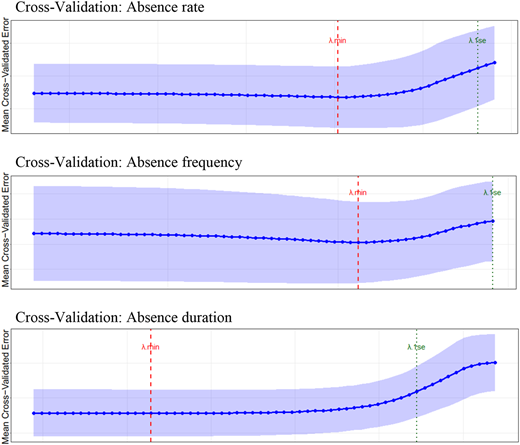
Figure 1 displays the cross-validation curves for each absence metric. The horizontal axis represents the regularization parameter λ (log-scaled), with higher values imposing stronger penalization and thus selecting fewer predictors. The vertical axis shows the mean cross-validated prediction error, with the shaded ribbon indicating ±1 standard error. Two vertical lines mark the optimal λ values: the dashed line indicates λ.min (the value that minimizes prediction error), while the dotted line indicates λ.1se (the most parsimonious model within one standard error of the minimum). For absence rate and frequency, the lowest prediction error is reached at a moderate level of penalization, indicating that few predictors suffice. In contrast, absence duration reaches its lowest error at a substantially lower level of penalization, meaning the model requires more predictors with smaller individual effects to achieve optimal performance.
Discussion
The present study set out to investigate how a comprehensive set of work characteristics, encompassing leading theories of work stress and design, relates to recorded sickness absence rates, frequency and duration in 1,935 employees nested in 63 organizational units from the construction materials sector.
Drawing on the COPSOQ as a tool for capturing a wide range of work characteristics and controlling for demographic composition, the study aimed to (RQ1) identify which work characteristics remain relevant in predicting sickness absence at a 12-month follow-up when considered jointly, and (RQ2) investigate how they differentially relate to absence rate, frequency and duration.
Work characteristics and sickness absence: distinct predictor constellations
The analysis revealed distinct constellations of work characteristics across sickness absence metrics. The relatively low prediction errors suggest reasonable model precision for aggregate-level analysis, and the findings support the relevance of drawing on multiple theoretical frameworks, as variables from several traditions emerged as relevant.
The model on sickness absence rate was the most parsimonious, with only the gender composition composite retained under regularization and 12% variance explained. This does not mean that variables other than gender exert no influence at all, but the exclusion of all work characteristics suggests that overall absence rates at the unit level may be more strongly shaped by the demographic composition of the workforce than by the work characteristics. This is consistent with evidence that gender and age composition are strongly associated with sickness absence at the group level (Laaksonen et al., 2010; Fischer et al., 2020). This finding also aligns with expectation (3): absence rate, as a composite metric, proved less sensitive to specific work characteristics than the disaggregated metrics.
The gender composition composite appeared in all three models, though with opposing directional effects: units with a higher proportion of female employees showed lower overall absence rates but higher absence frequency and longer absence duration. At the unit level, this pattern could potentially indicate that the demographic composition at the group level is associated with distinct absence patterns - a finding that likely reflects a combination of structural, organizational, and health-related factors that covary with gender composition. These findings echo existing discussions on the complex gender dynamics in absence behaviours (Løset et al., 2018; Timp et al., 2024a, b) that may probably reflect differences in many domains, ranging from health-related factors (Østby et al., 2018) to work-family roles and interferences (Harkko et al., 2024; Jansen et al., 2006; Salonsalmi et al., 2024).
However, it is important to note that these associations describe properties of the organizational unit, not of individual employees. The gender composition composite captures the demographic structure of the shifts and may be associated with a range of unit-level characteristics, such as job type, physical demands or organizational culture, that are not directly measured. Interpreting this variable as an individual-level gender effect would constitute an ecological fallacy (Snijders and Bosker, 2016). The sensitivity analysis excluding the gender composite confirmed that the work characteristics are robust and not reducible to demographic composition, though the analysis cannot rule out that the gender composite itself captures variance attributable to unmeasured unit-level confounders.
Absence frequency showed increased model complexity with four variables after regularization and 21% of variance explained. The retention of work–privacy conflict is plausible in light of evidence that work–life interference is associated with more frequent absence episodes at both the individual and organizational level (Salonsalmi et al., 2024; Jansen et al., 2006). This aligns with expectation (1) that demand-related work characteristics may be particularly relevant for absence frequency, reflecting short-term strain responses. However, the expectation was only partially confirmed: while work–privacy conflict emerged as expected, emotional demands did not survive the competition, a point discussed further below.
Sickness duration retained the most comprehensive set of work characteristics despite the strongest regularization, explaining 24% variance. The selected work characteristics – role clarity, social support, quality of leadership, and trust and justice – predominantly reflect the organizational climate and social environment of the workplace. This is consistent with expectation (2) that climate and relational work characteristics are more closely linked to prolonged absences, reflecting both the cumulative effects of the broader social work environment and the conditions that influence recovery and return to work (Knapstad et al., 2014; White et al., 2019; Cachón-Alonso and Elovainio, 2022). Social support showed a stronger association with duration than frequency, suggesting that the absence of collegial support may particularly impede return-to-work processes.
Interestingly, none of the more prominent scales derived from the JDCS model emerged as dominant. Instead, variables from organizational climate and justice frameworks showed the strongest associations. It was also notable that emotional demands, despite their established link to sickness absence (Framke et al., 2021), did not emerge. However, because several of the selected work characteristics, such as leadership quality, role clarity, and trust and justice, address emotion-related aspects of work to varying degrees (Dasborough and Ashkanasy, 2002; Rubin et al., 2005; McFarland et al., 2013), it is plausible that emotional demands were masked by shared variance with these variables during the shrinkage process. This illustrates precisely the theoretical point motivating the present study: work characteristics that appear important in isolation may become redundant when competing work characteristics from other theoretical traditions are included. However, longitudinal designs with larger data sets need to be carried out to further research these associations.
Implications for workplace health management
In workplace health management, organizations routinely rely on sickness absence data to evaluate the effectiveness of their health and safety programs. In this context, absence metrics function as lagging indicators, reactive outcome measures that capture problems after they have already manifested (Sheehan et al., 2016). Work characteristics, by contrast, can serve as leading indicators: proactive measures that capture conditions in the work environment before they translate into adverse outcomes. The logic of psychosocial risk assessment rests on this relationship, namely that monitoring and improving leading indicators should, over time, reduce lagging indicators (Metzler et al., 2019). However, the present findings suggest that this relationship is not uniform: different work characteristics predict different types of absence. This implies that monitoring overall absence rates alone – probably the most used lagging indicator in organizational practice – may obscure the diagnostic information needed to determine which leading indicators should be targeted.
The stronger influence of organizational climate and justice work characteristics on absence duration provides specific targets for group-level interventions aimed at reducing prolonged absences (Fischer et al., 2020; Aust et al., 2023). Practitioners may benefit from differentiating between absence metrics, as the work characteristics most relevant for absence frequency differ from those relevant for duration. This distinction may also help explain why organizational-level interventions aimed at reducing sickness absence have shown limited or inconsistent effects in systematic reviews (Akerstrom et al., 2024). If interventions target overall absence rates without distinguishing whether the problem lies in frequent short absences or prolonged episodes, they may address the wrong mechanisms – for instance, improving social support and leadership quality when the primary issue is frequent withdrawal driven by work–privacy conflict, or vice versa. The present findings suggest that a diagnostic differentiation of absence patterns should precede the design of interventions.
The study also underscores the importance of examining multiple dimensions of sickness absence, beyond simple absence rates, in both research and practice. As highlighted earlier, examining both frequency and duration captures distinct behavioural patterns that remain hidden in composite rate measures. The increasing regularization parameters across outcomes (0.141 → 1.217 → 1.485) and the cross-validation curves (Figure 1) reflect different complexity–accuracy trade-offs, with absence duration requiring more work characteristics to achieve optimal prediction. From these findings, it appears that absence duration is influenced by a wider range of predictors, each contributing to a modest extent, rather than being driven by a few dominant factors. Consequently, absence duration emerges as a more complex phenomenon that calls for a more comprehensive approach, particularly within workplace health management.
It is important to emphasize, however, that the present design captures prospective associations between baseline work characteristics and subsequent absence, not causal or dynamic relationships. The findings identify which unit-level work characteristics are associated with future absence patterns and what this could imply for targeted interventions.
Limitations and future directions
Several limitations should be acknowledged. First, although the study uses a prospective design with work characteristics measured at baseline and absence recorded 12 months later, causal inferences cannot be drawn. Work characteristics were measured at a single time point, and the study cannot capture how they change over time or how reciprocal processes between work conditions and absence may unfold. Future studies could incorporate repeated measurements or adopt advanced modelling techniques, such as time-series analysis or dynamic network models (Elovainio et al., 2020; Elovainio et al., 2022), to better capture temporal dynamics and identify optimal periods for intervention.
Second, sickness absence data were only available at the unit level due to data protection constraints, precluding individual-level analyses. As noted in the Introduction, this is consistent with the tradition of job-level analysis in work design research and with psychosocial risk assessment practice. However, unit-level analysis introduces the possibility of ecological fallacy: associations observed at the unit level may not hold at the individual level (Snijders and Bosker, 2016). In particular, the gender composition composite captures a structural property of the unit and should not be interpreted as reflecting individual-level gender differences in sickness absence. A multilevel decomposition of this effect, i.e. separating individual-level from unit-level variance, would require objectively recorded individual-level absence records, which were not available. Future research with access to individual-level absence data should employ multilevel modelling to disentangle compositional and contextual effects.
Third, non-linear relationships or interactions among the study variables were not tested, in order to balance model complexity and interpretability. The LASSO approach was deliberately chosen to produce robust, sparse models, but it may exclude variables that, while less influential in the presence of correlated alternatives, remain substantively important. The sensitivity analyses suggest that the core findings are robust to methodological variations, but the instability of marginal variables under LASSO with correlated work characteristics at small sample sizes should be acknowledged.
Fourth, while data aggregation likely reduced the available variance, this is an inherent feature of unit-level analysis and is offset by the advantage of using objectively recorded absence data rather than self-reports. The moderate R2 values (12–24%) are comparable to those reported in other aggregate-level studies of psychosocial work characteristics and sickness absence (Fischer et al., 2020).
Conclusion
This study highlights the importance of integrating multiple theoretical perspectives on work characteristics to understand sickness absence more comprehensively. By employing LASSO regression to capture distinct effects on absence rate, frequency and duration, the findings reveal that predictors such as gender, work-privacy conflict and indicators from organizational climate and justice matter in different ways for each absence metric. Notably, only gender remained in predicting absence rate, while the highest explanatory power from the work characteristics emerged for absence duration. As gender entered the models as a unit-level composition variable, its association may also reflect unit-level confounders that covary with gender composition rather than individual differences alone. Future studies employing multilevel designs with linked individual- and unit-level data would be well suited to disentangle such compositional and contextual effects. The results thereby emphasize the value of evaluating multiple dimensions of absenteeism for more precise organizational interventions. Overall, these insights can guide practitioners in designing more targeted work design strategies, advancing both employee well-being and organizational performance.