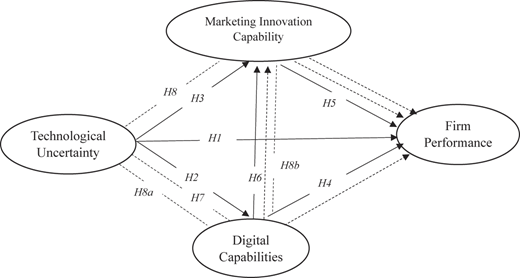
The study aims to clarify the impact of technological uncertainty (TU) on emerging market retail SMEs' performance with the mediating roles of digital capabilities (DCs) and marketing innovation capability (MarIC).
The research applied a convenience sampling including 271 valid responses collected from Vietnamese small and medium-sized enterprises (SMEs) in the retail industry. The paper employed partial least squares-structural equation modeling as an analysis technique.
The findings show that TU has a positive significant statistical impact on retail SMEs' performance. Furthermore, DCs and MarIC serve as mediators in the relationship between TU and firm performance.
This research emphasizes both theoretical and practical contributions, especially practical implications for emerging market retail SMEs in enhancing DCs and innovation capability in marketing to facilitate firms to adapt to TU.
1. Introduction
Digital transformation has significantly impacted social and economic dimensions, particularly in emerging markets (Malkowska, Urbaniec, & Kosala, 2021). SMEs are active participants in this process, playing crucial roles in sustainable growth through technological progress (Chatzistamoulou, 2023). Technological uncertainty (TU) inevitably affects SMEs, especially retail SMEs in emerging markets' dynamic business environments, directly impacting performance (Didonet, Simmons, Díaz-Villavicencio, & Palmer, 2012; Kang, Gwon, Kim, & Cho, 2013). TU encompasses unpredictability and complexity surrounding technological changes, including advancement rates, technological alternatives diversity, and implementation outcome uncertainty (Song & Montoya-Weiss, 2001). For retail SMEs, TU manifests in e-commerce platform adoption, digital payment systems, and AI-driven analytics decisions (Goldman, Van Herk, Verhagen, & Weltevreden, 2021). SMEs' digital capabilities (DCs) during digital transformation significantly influence the relationship between TU and firm performance (FP) (Skare, de Obesso, & Ribeiro-Navarrete, 2023). Additionally, technological unpredictability affects companies' innovative marketing approaches (Doole & Lowe, 2012). Therefore, in-depth research investigating these relationships among retail SMEs in emerging markets is essential.
Emerging markets demonstrate distinctive technological evolution and business dynamics characteristics. Recent research indicates unprecedented digital transformation growth, particularly in retail sectors. Kumar, Ramachandran, and Kumar (2021) document that emerging market SMEs exhibit accelerated technology adoption rates compared to developed nations, especially evident in Asian emerging markets (Xie, Zeng, Peng, & Tam, 2013). Behl et al. (2024) emphasize that emerging market retail SMEs encounter specific technological hurdles from infrastructural limitations and evolving regulatory frameworks, exhibiting distinct technological adaptation patterns with varying digital implementation success. These findings underscore examining TU's impact specifically within emerging market contexts, where effects may be more pronounced for retail SMEs.
Limited studies on TU's FP (Appendix 1) impact reveal significant relationships. DC enables firms to adapt quickly to technological changes and uncertainties (Saarikko, Westergren, & Blomquist, 2020), allowing rapid process, product or service reconfiguration responding to emerging technologies (Heredia et al., 2022). This adaptability mitigates TU's negative FP impacts by maintaining competitiveness in dynamic markets (Kraus et al., 2021). Marketing innovation capability (MarIC) allows firms to adapt marketing strategies to emerging technologies (Hanaysha, Al-Shaikh, Joghee, & Alzoubi, 2022). When TU is high, strong MarIC enables quick technology incorporation into marketing efforts, enhancing FP (Wang, Hong, Li, & Gao, 2020). Previous studies predominantly focused on uncertainty's effects on technological activities rather than TU's FP impact (Drnevich & West, 2023a, 2023b), necessitating further relationship research.
Amid rapid digital advancement, emerging market firms face various environmental uncertainties, including market, competitive and technical uncertainties. TU has been investigated regarding resource orchestration (Chen & Tian, 2022) and dynamic capabilities (Jiao, Yang, Zhou, & Li, 2019), particularly promoting digital transformation and achieving performance advantages (Drnevich & West, 2023a, 2023b). TU prevalence characterizes retail sectors, especially emerging market SMEs, due to rapid digital advancement, changing consumer behaviors and increasing e-commerce adoption. Retail SMEs face constant pressure integrating technologies like mobile payments, CRM software and advanced analytics to remain competitive. Technological innovation dynamics create uncertainty environments as retail SMEs continuously adapt while managing limited resources and expertise. This proves especially challenging in emerging markets where infrastructure and technological support may lag, exacerbating uncertainty. Dynamic, resource-constrained SMEs operate under high TU levels due to fast-paced technological evolution essential for market relevance. However, limited scholarly attention addresses TU–FP relationships considering DC and MarIC mediating roles in emerging market retail SMEs.
This research addresses: How does TU influence retail SMEs' FP in emerging markets? The main objective develops and empirically tests comprehensive frameworks examining TU's FP impact through DC and MarIC mediating effects in emerging markets. This research specifically focuses on retail SMEs facing unique technological adoption challenges compared to larger enterprises. Vietnam's retail sector transformation, driven by technological advancement and changing consumer preferences, makes navigating TU significant for SME survival and growth (Sharma, Nigam, & Das, 2020).
This research extends current TU–FP understanding distinctively. While prior studies examined TU primarily as moderators in European industrial suppliers (Gelderman, Semeijn, & Mertschuweit, 2016) and large Turkish firms (Zehir & Vural, 2024) or independent variables in general small businesses (Drnevich & West, 2023a, 2023b), our study investigates TU's direct and indirect effects specifically in emerging market retail SMEs. Unlike Wei & Zhang's (2020) broad Chinese firm examination, we focus on retail sectors where technological disruption proves particularly acute. Our comprehensive framework incorporates both DC and MarIC as mediating mechanisms, advancing theoretical understanding of how retail SMEs transform TU challenges into performance advantages through capability development.
Findings provide valuable insights to policymakers, business owners and stakeholders, enabling strategy formulation and support mechanisms enhancing emerging market retail SME resilience and competitiveness during rapid technological disruption. This research elucidates positive TU–FP correlations mediated by DC and MarIC, suggesting retail SMEs can leverage TU as catalysts for enhancing capabilities, boosting FP. These contributions prove significant for local and global contexts, providing frameworks for SMEs to navigate technological disruption complexities effectively.
2. Literature review and hypothesis development
2.1 Retail SMEs in emerging markets of technological uncertainty
Retail SMEs in emerging markets face significant TU due to rapid technological advancements like e-commerce platforms and mobile payment systems requiring continuous adaptation, inconsistent consumer technology adoption creating fragmented markets and limited technological infrastructure access heightening uncertainty as SMEs lack resources to leverage new technologies effectively (Papadopoulos & Cleveland, 2023; Zahoor & Lew, 2023). Despite challenges, TU positively impacts retail SMEs' performance by driving innovation and fostering agility, compelling firms to explore new technologies and develop unique products enhancing customer satisfaction (Troise, Corvello, Ghobadian, & O’Regan, 2022). MarIC enables effective marketing of new products, ensuring technological advancements translate into market benefits (Aljanabi, 2022). DC streamline processes, improve efficiency and enhance customer interactions, enabling quick technology adoption and implementation for competitive advantage (Khin & Ho, 2019).
2.2 Technological uncertainty, firm performance, digital capabilities and marketing innovation capability
TU encompasses three critical dimensions: the rate of technological change, complexity of new technologies, and breadth of technological alternatives (Song & Montoya-Weiss, 2001). In retail contexts, TU relates to unpredictability of technological standards, implementation requirements, adoption timing and potential returns on investment (Vendrell-Herrero et al., 2018). This includes ambiguity of technological trajectories and implementation risks firms face in dynamic environments. Moreover, TU is classified into four levels: type A (low-tech using existing technologies), type B (medium-tech with some new technology), type C (high-tech using mostly new technology) and type D (super high-tech using non-existent technologies) (Shenhar & Dvir, 1996). Emerging market retail SMEs predominantly operate between type B and type C levels, adopting new retail technologies while maintaining existing systems. They typically engage with established e-commerce platforms and digital payment systems (type B), while experimenting with AI-driven analytics and IoT-based inventory management (type C) (Goldman et al., 2021).
The TU–FP relationship yields mixed findings. Positive perspectives suggest TU creates competitive advantages through technological innovation and market differentiation, encouraging stronger collaborative capabilities and innovative solutions (Murray, Kotabe, & Zhou, 2005). Conversely, negative implications include higher failure rates among new firms and increased exit rates among resource-constrained SMEs facing technological disruptions (Gartner & Liao, 2012; Honjo, 2000; Kamalipoor, Akbari, Hejazi, & Nazarian, 2023). In emerging market retail contexts, unique conditions may alter TU–FP dynamics. Retail SMEs demonstrate greater agility in managing TU due to fewer legacy constraints and can leverage TU more effectively through direct adoption of cutting-edge solutions (Pingali, Singha, Arunachalam, & Pedada, 2023; Zahoor, Khan, Donbesuur, Khan, & Rajwani, 2024).
TU has a positively significant impact on FP.
DC represents a dynamic attribute where businesses integrate digital technologies into management systems, facilitating product and service transformation (Heredia et al., 2022). DC enhances organizational efficiency, cuts operational expenses and establishes competitive edges (Vial, 2019). Dynamic capabilities view suggests enhancing DC cultivates companies' adaptability in unpredictable business environments, empowering organizations to address uncertain conditions by improving products and streamlining processes (Khin & Ho, 2019). Significant TU necessitates companies adapting business processes to sophisticated technologies (Xu & Yongyuan, 2018). Rapid digital technology evolution creates TU, stimulating DC development and opening opportunities (Son, Kim, Hur, & Subramanian, 2021). In emerging markets, the TU–DC relationship assumes particular significance. Retail SMEs develop unique DC responding to TU due to distinctive institutional environments. These firms demonstrate stronger motivation building DC when facing TU, as digital technologies offer opportunities overcoming infrastructural limitations and competing effectively (Ahmed, Bhatti, Gölgeci, & Arslan, 2022).
TU has a positively significant impact on DC.
Marketing capability pertains to companies' capacity to effectively employ resources executing marketing activities, achieving desired goals. Innovation capability plays pivotal roles in crafting competitive edges and is fundamental for company success (Saunila, 2014). MarIC, an innovation capability attribute, entails adopting novel or substantially enhanced marketing approaches, encompassing alterations in product design, packaging, positioning, promotion or pricing (Rajapathirana & Hui, 2018). TU brings opportunities and paves ways for SMEs developing new products and markets, enhancing MarIC. In emerging markets, retail SMEs approach MarIC development distinctively under TU conditions. These firms leverage TU creating innovative marketing approaches addressing local market needs and resource constraints. Rapid digital transformation creates unique opportunities for SMEs developing MarIC through novel digital marketing channels and localized customer engagement strategies (Ghosh, Hughes, Hodgkinson, & Hughes, 2022; Wu, Wood, Chen, Meyer, & Liu, 2020).
TU has a positively significant impact on MarIC.
The dynamic view's emphasis on DC being comprised of sensing, seizing and reconfiguring capabilities has garnered significant attention from scholars (Annarelli, Battistella, Nonino, Parida, & Pessot, 2021; Dubey et al., 2023). DC also serves as a valuable tool for firms to recognize and evaluate their digital assets, ensuring continued market competitiveness (Ansong & Boateng, 2019), thus positively affecting FP. Additionally, numerous studies (Heredia et al., 2022; Khin & Ho, 2019) have substantiated the significant and positive impact of DC on FP because DC helps to improve a company's operational efficiency, reducing costs and bolstering its competitive edge (Vial, 2021). The DC–FP relationship exhibits distinct characteristics in emerging markets. Soluk, Kammerlander, and Darwin (2021) find that retail SMEs in emerging markets leverage DC to overcome institutional voids and resource constraints more effectively than their developed market counterparts. These firms often achieve superior FP through DC by rapidly adapting to local market conditions and leveraging digital technologies to serve underserved customer segments (Zhou, Zhou, Feng, & Jiang, 2019).
DC has a positively significant impact on FP.
MarIC refers to a company's ability to develop and implement innovative marketing strategies, tactics and processes that differentiate it from competitors and resonate with customers (Ngamsutti & Ussahawanitchakit, 2016). Meanwhile, innovative marketing strategies can open up new market opportunities by identifying and targeting previously untapped customer segments (Wang et al., 2020), thus resulting in increased market share and revenue growth. On the other hand, the integration of DCs in SMEs has a profound impact on their MarIC (Xie, Han, Anderson, & Ribeiro-Navarrete, 2022). It enables SMEs to gather insights, engage with customers (Matarazzo, Penco, Profumo, & Quaglia, 2021), operate cost-effectively and expand their reach (Dubey et al., 2023). Moreover, it promotes data-driven decision-making and agile practices, fostering a culture of continuous marketing innovation within these enterprises (González-Varona, Acebes, Poza, & López-Paredes, 2020). MarIC plays a particularly crucial role for retail SMEs in emerging markets. Chang, Knight, and Fong (2024) observe that these firms often achieve superior FP through MarIC by developing market-specific innovations that address local consumer needs and purchasing behaviors. Similarly, the relationship between DC and MarIC in emerging markets is strengthened by the rapid digital adoption rates and unique market conditions (Zahoor & Lew, 2023).
MarIC has a positively significant impact on FP.
DC has a positively significant impact on MarIC.
2.3 Mediating roles of digital capabilities, and marketing innovation capability
In PLS-SEM analysis, mediation represents indirect effects where independent variables influence dependent variables through intervening variables. Following Zhao, Huo, Flynn, and Yeung (2008) guidelines, we examine direct and indirect effects determining mediation nature through bootstrapping procedures with 5,000 resamples (Sarstedt, Ringle, & Hair, 2022). Heightened TU necessitates businesses adapting operational processes accommodating sophisticated technologies. Firms must implement disruptive technologies enhancing DC, leading to digital transformation (Broekhuizen, Broekhuis, Gijsenberg, & Wieringa, 2021; Khin & Ho, 2019; Nayal, Raut, Yadav, Priyadarshinee, & Narkhede, 2022). Rapid emerging digital technology progression creates TU, stimulating DC development and opportunities (Elia, Giuffrida, Mariani, & Bresciani, 2021). Consequently, DC serves as mediator between TU and FP. Mediation mechanisms linking TU and FP demonstrate unique characteristics in emerging markets. Institutional voids and limited resources intensify retail SMEs' dependence on DC as key mediating factor. Rapid technological shifts create distinctive pathways for MarIC bridging TU and FP (Jin, Liu, Liu, Gu, & Shao, 2022; Soluk et al., 2021).
DC mediates the relationship between TU and FP.
SMEs with a high MarIC are more agile in adapting to technological uncertainties (Chan, Teoh, Yeow, & Pan, 2019) because they can quickly identify and seize opportunities presented by new technologies or adapt their marketing strategies in response to unexpected changes (O'Cass & Sok, 2014). On the other hand, through effective marketing innovation, firms can achieve better marketing outcomes, such as increased brand awareness, customer acquisition, and revenue generation, which ultimately contribute to improved FP (Lee, Lee, & Garrett, 2019).
MarIC mediates the relationship between TU and FP.
DC mediates the relationship between TU and MarIC.
MarIC mediates the relationship between DC and MarFP.
DC and MarIC mediate the relationship between TU and FP.
3. Methodology
3.1 Research design and research model
This study employed two research approaches encompassing in-depth interviews and quantitative methodology. In the initial phase, the authors conducted comprehensive interviews to achieve the following objectives: (1) to gain empirical insights into how TU influences FP within the context of emerging market retail SMEs in the digital technology era; (2) to explore the various factors that impact the relationship between TU and FP within these retail SMEs; (3) to validate our research framework. Subsequently, in the second stage, the researchers performed a quantitative analysis by collecting empirical data from Vietnamese retail SMEs to evaluate the proposed hypotheses.
During the first stage, we conducted in-depth interviews with ten managers from Vietnamese retail SMEs. These interviews aimed to assess the influence of TU on FP and to identify the factors that influence this relationship (see Table 1).
The majority of respondents concurred that TU indeed exerts a significant influence on FP. Moreover, they provided insights into additional factors affecting this relationship. Additionally, we sought their opinions on the role of DC and MarIC. Most interviewees expressed agreement that both DC and MarIC play pivotal roles in this relationship. Respondents elaborated that TU is a motivator for these retail SMEs to upgrade their DC while DC facilitates firms in generating digitally innovative ideas, thus enhancing firms' MarIC. Firms with strong MarIC can improve their FP. Drawing from the insights shared by these managers, coupled with the pre-existing literature review, we confirmed the validity of our research model (see Figure 1).
3.2 Sampling and data collection
3.2.1 Survey questionnaire, sampling and measurement
We followed a two-step process creating the questionnaire. Initially, we conducted thorough literature review and collaborated with experts identifying measurement items (Appendix 2). TU measurement comprises four items from Chen, Sharma, Zhan, and Liu (2019), FP uses six items from Hogan and Coote (2014), DC uses five items from Khin and Ho (2019), and MarIC uses seven items from Aksoy (2017). We drew items from existing research and engaged detailed discussions with experts enhancing measurement reliability and validity. Subsequently, we conducted pilot study involving 30 participants assessing measurement reliability and validity. Pilot test results indicated reliable and valid measurement items, as Cronbach's alpha exceeded 0.7, meeting established criteria. This successful outcome allowed proceeding with official data collection. In the survey questionnaire, respondents used five-point Likert scale indicating agreement levels with each item. Responses ranged from 1 (“strongly disagree”) to 5 (“strongly agree”). We selected five-point Likert scale for simplicity and allowing respondents expressing neutral opinions choosing “neither disagree nor agree” option.
3.2.2 Data collection
The survey occurred from February to August 2023, involving participants holding managerial positions in Vietnamese retail SMEs, from middle to top-level management. Following Decree 80/2021/ND-CP, we defined retail SMEs as enterprises with total capital not exceeding VND 100 billion (approximately USD 4.1 million) or annual revenue not exceeding VND 300 billion (approximately USD 12.3 million), and fewer than 100 employees, aligning with official Vietnamese government classification.
Using convenience sampling, we targeted retail SMEs across regions to approximate population distribution. Participants were knowledgeable about company operations and capable of influencing decision-making processes. Research was conducted using online and direct surveys. We obtained email addresses from Vietnam Retailers Association, while direct surveys were conducted at retail SMEs in key commercial areas. Survey invitations detailed study purpose and assured confidentiality.
According to the Ministry of Planning and Investment (2022), Vietnam had approximately 15,000 retail SMEs: 30% northern region, 4% central region and 66% southern region. We distributed 500 questionnaires to retail SME managers, collecting 356 responses. After filtering we utilized 271 responses for analysis using SmartPLS 4.0. Our sample exceeds Hair's (2009) minimum requirement of 200 for models with fewer than seven constructs, achieving 95% confidence level with 5.9% margin of error (Sarstedt et al., 2022). Regional distribution (32% northern, 5% central, 63% southern) closely mirrors actual geographic dispersion, enhancing representativeness (see Table 2).
4. Data analysis and results
4.1 Common method bias
As cross-sectional, self-administered surveys are prone to common method bias (CMB), this research adopted Podsakoff, MacKenzie, Lee, and Podsakoff (2003) strategy to mitigate CMB. Methodologically, the study ensured respondents' anonymity and confidentiality, guaranteeing secure preservation of responses. The questionnaire provided precise term definitions and clear instructions preventing ambiguities. Our survey instrument incorporated linguistic qualifiers using varied question phrasings and response formats reducing CMB likelihood. We included differently structured items like rating agreement extent versus frequency scales, aligning with literature best practices ensuring reliability and validity. The study employed Harman's single factor test in PLS-SEM checking CMB (Kock, 2015). If all VIFs in inner model from full collinearity test equal or lower than 3.3, the model is CMB-free. All VIFs (1.000 for DC and TU; 1.428 for FP and DC; 1.473 for FP and MarIC; 1.188 for FP and TU; 1.119 for MarIC and DC; 1.119 for MarIC and TU) are lower than 3.3, indicating no CMB exists.
4.2 Outer model and scale validation
Item reliability was assessed examining corresponding loadings indicating construct measurement extent. Chin and Newsted's (1999) threshold value of 0.7 demonstrated individual reliability. Fornell and Larcker's (1981) guidelines state that when predictor factor loading and average variance extracted (AVE) exceed 0.5, it indicates convergent validity for each construct. Discriminant validity, illustrating distinction between variables and construct criteria, demonstrated strong validity. Items DCap5, MarIC1, MarIC6 and MarIC7 not meeting criteria were removed from the research model.
Discriminant validity assesses differentiation extent between tested construct criteria. Henseler, Ringle, and Sarstedt (2015) introduced heterotrait-monotrait ratio (HTMT) testing method utilizing multitrait-multimethod matrix. We applied Fornell and Larcker's (1981) criteria evaluating discriminant validity. Table 3 indicates all construct values below 0.9, confirming discriminant validity. Similarly, Table 3 reveals values meet discrimination criteria outlined by Fornell and Larcker (1981).
4.3 Inner model result, mediation effects and hypothesis testing
In this research, the primary objective of the inner model PLS analysis was to assess the hypotheses. The results of hypothesis testing, including path coefficients, p-values and t-values, are presented in Table 4.
Regarding testing of mediation effects, to assess the importance of the mediating impact, the authors employed the bootstrapping technique as outlined by Hair et al. (2021). The bootstrapping analysis revealed the presence of a mediating effect, as initially proposed by Preacher and Hayes (2008, 2004). The outcomes of the bootstrapping analysis are summarized in Table 4, demonstrating statistically significant mediation occurring between MarIC and DC across different relationships among the variables.
5. Discussion and conclusion
This study presents the positive correlation between TU and FP in emerging market retail SMEs, whereby DC and MarIC present a mediating role in this relationship. TU is demonstrated to have a positive impact on FP, which aligns with the findings from previous research (Erdogan & Çemberci, 2018; Parnell, 2013). However, this finding contradicts with the claims of some prior studies stating that SMEs encounter higher mortality rates, especially when economic turbulence is prevalent (Honjo, 2000). Consequently, these prior studies have typically demonstrated that uncertainty leads to a decline in performance (Ghosal & Loungani, 2000), even in certain instances, it shows no discernible association (Gartner & Liao, 2012). The reason of such difference is due to the fact that firms in emerging markets in the digital era are currently competing with competitors in technological innovation (Anderson, 2001), thus the higher the level of TU, the more motivation for these SMEs to develop (Drnevich & West, 2023a).
The research outcomes also reveal that TU positively affects DC, which is in line with the findings of Benner and Tripsas (2012), Son et al. (2021) and positively impact MarIC, which is in alignment with the claims of Ngamsutti and Ussahawanitchakit (2016). Moreover, DC and MarIC also serve as mediators in the relationship between TU and FP. This shows that DC can help firms adapt to and capitalize on TU, leading to a more positive impact on FP (Grewal & Tansuhaj, 2001). Similarly, MarIC mediates the correlation between DC and FP. Under the effect of TU, firms with strong DC may use them to drive marketing innovation, resulting in better FP (Sarwar, Gao, & Khan, 2023). As TU becomes increasingly challenging for SMEs in emerging markets, particularly in the digital era (Reis & Melão, 2023), it is evident that firms must invest in upgrading their DC to maintain their competitive edge (Warner & Wäger, 2019).
5.1 Theoretical implications
The current study significantly enriches the existing body of knowledge by elucidating the intricate relationships among TU, DC, MarIC and FP within emerging market retail SMEs. By simultaneously examining these variables, our research extends the theoretical framework of TU, particularly within the context of emerging markets. Previous literature has predominantly focused on the isolated impacts of TU on FP (Adner & Kapoor, 2010; Ilmudeen, 2022), often neglecting the mediating roles of DC and MarIC. Our findings offer a nuanced understanding of how TU can act as a catalyst for enhancing DC and MarIC, which in turn positively affect FP. This study contributes to the TU literature by demonstrating that TU is not solely a disruptive force but can also be leveraged to foster digital and marketing innovations (Saarikko et al., 2020; Zahoor & Lew, 2023).
Moreover, the study makes significant contributions to the dynamic capabilities view, which serves as the theoretical underpinning of DC. Our research highlights how the development of DC enables retail SMEs to effectively respond to the challenges posed by TU. Specifically, we demonstrate that TU stimulates firms to enhance their DC, allowing them to adapt their business processes and product offerings in response to technological changes. This aligns with the dynamic capabilities view by showing that the ability to reconfigure digital resources and capabilities is essential for maintaining competitive advantage in uncertain environments (Heredia et al., 2022; Khin & Ho, 2019). By emphasizing the mediating role of DC, our study underscores the strategic importance of dynamic capabilities in enabling firms to navigate and thrive amidst TU.
5.2 Managerial implications
This research has important implications for SMEs in emerging markets and their leaders seeking to enhance their adaptability in the face of TU. Developing DC empowers businesses to sustain their competitive advantages (Khin & Ho, 2019), while MarIC positively impact FP (Purwati, Budiyanto, Suhermin, & Hamzah, 2021). In today's digital age, TU presents both opportunities and challenges for retail SMEs in emerging markets. Effectively navigating this uncertainty requires strategic planning, adaptability and a keen awareness of market dynamics and technological trends. Embracing uncertainty as an opportunity and making informed decisions are key to thriving in this rapidly evolving landscape. Managers should view TU as an opportunity, be ready to pivot in response to emerging technologies, and leverage uncertainty to achieve sustainable growth and competitiveness (Day & Schoemaker, 2000). Mediating roles of DC and MarIC highlight the importance of prioritizing their development, investing in innovative marketing strategies and establishing agile organizational structures that adapt swiftly to technological shifts and market changes. Continuous monitoring and assessment of DC and marketing innovation ensure effective mediation of TU's impact on FP, ultimately driving competitiveness in the retail SME sector in emerging markets.
6. Limitations and future work
This study has limitations to acknowledge. Firstly, the framework conceptualization did not consider factors like firm size and age affecting TU-FP correlation. Secondly, research used retail SME samples from various sectors, suggesting future studies could explore variables separately within specific industries for comprehensive understanding. Thirdly, examining TU impacts on FP with DC and MarIC mediating roles requires other research methodologies comparing findings. Future research could extend investigations beyond retail sector. Examining TU impacts on SMEs in other emerging markets could provide valuable comparative insights given distinct economic and technological landscapes. Contrasting findings with studies on SMEs in developed economies could highlight contextual differences and commonalities in DC and MarIC mediating TU–FP relationships. Expanding research to manufacturing or services within diverse geographical contexts would enrich understanding of TU's broader implications and strategic importance of developing dynamic capabilities across industries and regions.
The supplementary material for this article can be found online