


Our study seeks to supplement the Uppsala model of internationalization by incorporating two underexplored dimensions, namely, the transformative effects of macroenvironmental shifts driven by Industry 4.0 (I4.0) technologies and the theoretical insights provided by the microfoundation approach, which focuses on how managers perceive, process, and respond to external stimuli on the basis of their cognition.
This research employs a dual network capability framework through the exploration–exploitation lens to investigate how managerial cognition and I4.0 technologies influence internationalization. A fuzzy-set qualitative comparative analysis (fsQCA) is applied to data collected from a sample of 116 small and medium-sized enterprises (SMEs) from a developed country.
This study reveals that decision-making strategies associated with higher and lower levels of internationalization are distinct from each other. These findings suggest that the interplay between managerial cognition, network capabilities, and I4.0 technologies plays a significant role in shaping internationalization outcomes.
This research contributes to the internationalization literature by addressing critical gaps in the Uppsala model, particularly through the integration of cognitive and technological factors. This study offers new insights into the decision-making processes underpinning internationalization, advancing both the Uppsala model and the broader field of strategic management.
1. Introduction
The international business (IB) literature increasingly explores how individual cognition shapes firm internationalization (Maitland & Sammartino, 2015; Silva, González-Loureiro, & Braga, 2021). Managers rely on cognition to decide where, how, and when to enter foreign markets and to design subsequent strategies (Clark, Li, & Shepherd, 2018). Within the Uppsala model (Vahlne & Johanson, 2017), scholars stress the need to unpack cognitive microfoundations to explain how internationalization evolves over time (Coviello, Kano, & Liesch, 2017; Vahlne & Johanson, 2017). Empirical studies, both quantitative and qualitative, confirm that managerial cognition plays a central role in the process (e.g. Maitland & Sammartino, 2015; Silva et al., 2021; Vlačić, Almeida Santos, Silva, & González-Loureiro, 2022). They show that entrepreneurs use cognition to manage resource constraints and environmental pressures while identifying and exploiting innovative international opportunities.
Scholars and practitioners also emphasize the need to leverage Industry 4.0 (I4.0) technologies globally (Hannibal, 2020; Strange & Zucchella, 2017). Adopting I4.0 accelerates internationalization (Hannibal, 2020; Castagnoli, Büchi, Coeurderoy, & Cugno, 2022) by providing digital tools—such as big data analytics, the Internet of Things (IoT), artificial intelligence, and autonomous robotics—that strengthen international competitiveness (Bhatti, Vahlne, Glowik, & Larimo, 2022; Strange & Zucchella, 2017). More broadly, I4.0-driven digitalization is reshaping business networks, value creation, and the very concept of internationalization (Klingenberg, Borges, & do Vale Antunes, 2022; Luo & Zahra, 2023).
Coviello et al. (2017) highlight ways to extend the Uppsala model (Vahlne & Johanson, 2017) by addressing two underexplored dimensions: macroenvironmental changes driven by I4.0 (Luo & Zahra, 2023) and cognitive microfoundations at the individual level (Vahlne & Schweizer, 2022). We respond to these calls by examining how I4.0 technologies and managerial cognition shape postinternationalization. Our research asks the following questions: What configurations of managerial cognition, I4.0 technologies, and dual network capability [1] lead to high or low internationalization? We apply a fuzzy-set qualitative comparative analysis (fsQCA) to data from internationalizing small and medium-sized enterprises (SMEs) in Portugal.
We extend the Uppsala model by integrating microfoundational and macrofoundational dimensions, showing how managerial cognition and I4.0 technologies jointly shape internationalization. By embedding digital transformation and cognitive logics into the framework, we conceptualize internationalization as a coevolutionary process in which cognition, technology, and strategic orientation interact rather than as a purely gradual path of learning and network development. Our findings show that cognitive styles, intuitive and analytical, shape how managers interpret and exploit international opportunities, whereas cognitive ambidexterity supports adaptation in dynamic environments. We also find that I4.0 adoption enhances knowledge acquisition, strengthens network capabilities, and accelerates international engagement when aligned with managerial cognition. These results refine the explanatory power of the Uppsala model in digital contexts and offer actionable implications for managers and policy-makers seeking to support SME internationalization through cognitive and technological alignment.
2. Literature review
2.1 Managerial cognition and internationalization
As conceptualized by Kahneman (2003) and Evans and Stanovich (2013), cognition refers to how individuals transform and use neurological inputs, including perception, memory, and thinking. Interactions between individuals and their environments, including firms, shape these processes and highlight the role of context. Decision-making constitutes a core component of cognition and involves the translation of external stimuli into action (Vlačić et al., 2022). Dual-process theory (DPT) explains how such decisions occur (Evans & Stanovich, 2013), particularly in internationalization contexts.
Decision-making in internationalization involves risk and uncertainty (Vlačić et al., 2022). Risk refers to situations with known outcome probabilities, whereas uncertainty arises when probabilities cannot be quantified, often under bounded rationality (Simon, 1987). Fellows (2004) identifies three decision-making stages: identifying options, evaluating alternatives, and selecting a final decision. Building on Kahneman (2003), Vlačić, González-Loureiro, and Eduardsen (2023) add a prior perception stage, which underpins evaluation and supports satisfactory decisions. Perception enables managers to recognize international opportunities that shape subsequent choices (Vlačić et al., 2023).
DPT distinguishes two cognitive systems: an experience-based system X, which operates intuitively and produces rapid responses, and an analytic-based system C, which relies on deliberate and effortful reasoning (Evans & Stanovich, 2013; Kahneman, 2003). Bounded rationality constrains System C, as managers face limits in information, time, and cognitive capacity (Simon, 1987). These constraints shape how they perceive and manage risk and uncertainty. Thus, the analytical process cannot eliminate uncertainty; instead, it complements experiential cognition in internationalization decisions.
System X develops through experience. When managers encounter situations resembling prior decisions, they can apply similar logic, provided that the contexts align. However, effective experiential learning requires time and a valid learning environment with clear and unambiguous feedback, as Kahneman (2003) emphasizes. Reflection on past decisions enables managers to refine intuition and reuse it in comparable situations. Intuitive cognition operates faster than analytical reasoning but remains more prone to cognitive biases (Kahneman, 2003; Evans & Stanovich, 2013).
These cognitive mechanisms are central to internationalization, in which managerial expertise and learning in foreign markets shape expansion capabilities (Johanson & Vahlne, 1977; Vahlne & Johanson, 2020). Because managerial cognition integrates both cognitive systems, it can accelerate or slow internationalization (Vlačić et al., 2022).
2.2 I4.0 technologies and internationalization
The integration of information and communication technologies (ICTs) signals a new industrial paradigm, usually labeled the Fourth Industrial Revolution or Industry 4.0 (Klingenberg et al., 2022). Cyber-physical systems (CPSs) anchor this shift, including “[…] smart machines, warehousing systems, and production facilities […]” that rely on ICT-enabled integration across logistics, production, and services (Kagermann et al., 2013, p. 14). Culot, Nassimbeni, Orzes, and Sartor (2020) distinguish four I4.0 technology types: (1) physical-digital interfaces enabling real-time control of virtualized systems (e.g. IoT and CPS); (2) network technologies providing remote device access (e.g. cloud computing); (3) data-processing technologies supporting decision-making and adaptability (e.g. analytics, machine learning, and artificial intelligence); and (4) physical-digital process technologies enabling flexible production (e.g. additive manufacturing and advanced robotics).
Small and medium-sized enterprises (SMEs) face distinct barriers to adopting digital technologies because of resource constraints that limit investment and implementation (Clemente-Almendros, Nicoara-Popescu, & Pastor-Sanz, 2024). Adoption also requires business model changes, process restructuring, and the development of digital skills (Clemente-Almendros et al., 2024). The IB and international entrepreneurship research still lacks theoretical clarity on how I4.0, despite its recognized benefits, will reshape internationalization models (Bhatti et al., 2022; Luo & Zahra, 2023). The rise of born-digital firms, which leverage digital technologies for early internationalization, has attracted growing attention (Monaghan, Tippmann, & Coviello, 2020). Combined with organizational adaptation, I4.0 adoption accelerates internationalization (Lu, 2017). More recent evidence confirms that I4.0 technologies enable faster international expansion (Castagnoli et al., 2022). Building on this work, we argue that a higher (lower) degree of willingness to adopt I4.0 technologies increases (decreases) the level of internationalization.
2.3 Explorative–exploitative network capabilities and internationalization
Scholars argue that a firm's external connections form a network only when the firm engages actively with its partners (e.g. Johanson & Vahlne, 2009; Vahlne & Johanson, 2020). Network ties alone are insufficient; firms must mobilize their ability to access resources effectively (Faroque, Morrish, Kuivalainen, Sundqvist, & Torkkeli, 2021). Context shapes how individuals learn and create, extending knowledge development beyond the individual and organizational levels to a collective, network-based dimension (Vahlne & Schweizer, 2022; Faroque et al., 2021; Johanson & Vahlne, 2009). This collective learning among network actors supports internationalization over time (Johanson & Vahlne, 2009; Vahlne & Johanson, 2017).
Faroque et al. (2021) conceptualize networks as dynamic capabilities that drive internationalization. In this view, network capability, rather than the mere presence of ties, enables firms to initiate, develop, and activate relationships. Exploration and exploitation underpin these capabilities (Zhan & Chen, 2013). March (1991) and Levinthal and March (1993) describe exploration as involving the acquisition of new knowledge, whereas exploitation focuses on using and refining existing knowledge. Exploitation prioritizes short-term outcomes, whereas exploration targets future opportunities (He & Wong, 2004). Building on this framework, we examine network-based capabilities through the exploration–exploitation lens (Faroque et al., 2021), focusing on their antecedents and their effects on the level of internationalization.
3. A configurational approach to the internationalization process
Configurational approaches to internationalization remain scarce in the IB research (Figure 1). Unlike regression-based methods, configurational analyses use Boolean algebra to explore how multiple conditions combine to produce outcomes (Ragin, 2008; Schneider & Wagemann, 2010). This perspective suits internationalization, where managerial behavior varies across contexts (Kahneman, 2003; Vahlne & Johanson, 2017; Vahlne & Schweizer, 2022; Vlačić et al., 2022). Following Pappas, Kourouthanassis, Giannakos, and Chrissikopoulos (2016), Figure 1 presents two schematic Venn diagrams that depict the configurational logic of low (Outcome A) and high (Outcome B) internationalization intensity, illustrating how interrelated conditions combine to generate distinct outcomes.
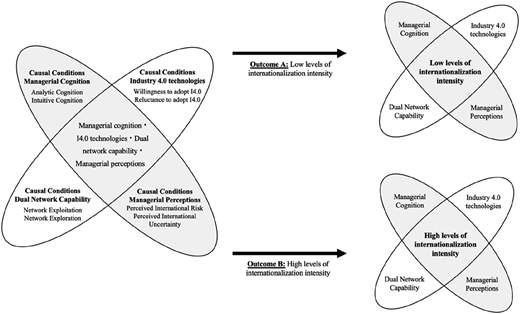
We aggregate related measures into four higher-order sets representing key causal conditions: managerial cognition (experience-based system X and analytic-based system C), I4.0 technologies (willingness and reluctance to adopt), managerial environmental perceptions (perceived international risk and uncertainty), and dual network capability (exploration and exploitation). Their intersections capture the configurations identified through fsQCA: combinations of cognition, technological orientation, environmental perception, and network capability sufficient to explain internationalization intensity, measured by the foreign sales to total sales (FSTS) ratio.
Although we draw on the Uppsala model, DPT, and dual network capability, we anchor our framework in the Uppsala model. We extend it by showing how cognitive microfoundations and technological macrofoundations jointly increase its explanatory power. DPT and dual network capability add depth by clarifying how managerial cognition and network behavior interact with technological change to shape internationalization outcomes.
Building on Section 2.2, we follow Castagnoli et al. (2022) in arguing that higher (lower) willingness to adopt I4.0 technologies increases (decreases) internationalization. However, this relationship is not linear. Instead, it reflects digital strategic coevolution, during which process technological choices and international strategies evolve jointly and influence each other. This perspective suggests that I4.0 adoption reshapes internationalization pathways, as captured by our configurational approach (Figure 1). SMEs do not simply respond to technological change; they actively reconfigure their strategies together with emerging digital opportunities and constraints.
Therefore, a configurational approach is particularly suited to SME internationalization in the I4.0 context. The Uppsala model emphasizes incremental learning and gradual resource commitment, but it does not fully capture the coevolutionary dynamics of contemporary internationalization (Yang, Bai, Chen, & Rong, 2025). Cognitive strategies, network capabilities, risk perceptions, and digital technologies evolve simultaneously rather than independently. As Castagnoli et al. (2022) argue, digital strategic coevolution reflects the mutual reinforcement of technological adoption and strategic reconfiguration, often producing unexpected internationalization paths.
These dynamics are especially salient for SMEs. Resource constraints and managerial discretion make their decisions highly contingent on the interaction between cognition and external pressures. Compared with larger firms, SMEs have less international experience and face greater uncertainty (Clemente-Almendros et al., 2024; Silva et al., 2021). Therefore, their internationalization depends strongly on managerial cognition, selective I4.0 adoption, and the effective management of dual network capabilities.
We tailor our hypotheses to the SME context. Drawing on a cognitive perspective, we distinguish between experience-based system X (intuitive) and analytic-based system C (rational) (Vlačić et al., 2022). System X enables rapid, trust-based judgments grounded in experience and performs well in familiar contexts (Evans & Stanovich, 2013). Repeated exposure to stable environments allows managers to recognize patterns and make efficient intuitive decisions (Kahneman, 2003).
With respect to internationalization, System X is most effective when firms enter markets similar to those they already know. Managers who rely on experiential cognition acquire relevant knowledge faster in such contexts and respond intuitively to environmental cues, particularly under conditions of uncertainty (Shapiro & Spence, 1997; Vlačić et al., 2022). When managers enter similar markets, they tend to replicate established business models and rely on prior experience to manage risk. Therefore, we propose the following:
A predominance of experience-based System X in processing levels of international risk and uncertainty among managers willing to adopt I4.0 technologies will lead to a high level of internationalization.
However, relying exclusively on experiential processing can lead managers to overlook critical information and produce suboptimal or adverse outcomes (Clarke & Mackaness, 2001). This risk is particularly relevant in internationalization, which involves high levels of uncertainty and risk (Eduardsen & Marinova, 2020). Although analytic-based system C helps address these challenges, bounded rationality constrains its effectiveness (Simon, 1987). Managers operate under limited information, time, and cognitive capacity, which restricts decision quality. As a result, those relying on System C acquire knowledge more gradually, as this system depends on deliberate, information-intensive processing and slower responses to external stimuli (Vlačić et al., 2022). When entering dissimilar foreign markets, managers engage in rational analyses to reduce uncertainty by transforming uncertainty (the unknown) into measurable risk (the known). Accordingly, we hypothesize the following:
A predominance of the analytic-based system C to process the levels of international risk and uncertainty in managers reluctant to adopt I4.0 technologies will lead to a low level of internationalization.
The literature identifies two core organizational activities, exploitation and exploration, that guide how firms allocate attention and resources (March, 1991). Extending this logic, Faroque et al. (2021) apply this dichotomy to network capabilities. They define network exploitation as the ability to leverage existing relationships to capture opportunities and network exploration as the ability to build and develop new ties. Both dimensions shape how firms mobilize relationships and adapt to foreign markets (Faroque et al., 2021; Vahlne & Johanson, 2017), supporting Hypotheses 1 and 2. Network exploitation is particularly effective in foreign markets that resemble a firm's existing markets, as it relies on leveraging established relationships to access opportunities (Faroque et al., 2021). It improves efficiency and accuracy in familiar environments, reflecting System X's reliance on fast, experience-based reasoning. These mechanisms reinforce each other under stable and familiar conditions. Hence, we propose the following:
A predominance of experience-based system X combined with network exploitation among managers reluctant to adopt I4.0 technologies will lead to a low level of internationalization.
Conversely, when foreign markets differ from existing ones, network exploitation loses effectiveness, while network exploration becomes more appropriate (Faroque et al., 2021). Such environments are typically dynamic and uncertain, as shifts in customer preferences, competition, and technology increase unpredictability (Miller, 1987). In these contexts, reliance on existing networks can increase costs and limit adaptability, constraining international commitment. Firms confined to established ties risk reduced access to new knowledge and opportunities. To address this limitation, firms must pursue network exploration by developing new partnerships that provide access to new resources and market information (Faroque et al., 2021). Because analytic-based system C and network exploration both support informed decision-making in dissimilar markets, their interaction should facilitate higher levels of internationalization. Accordingly, we posit the following:
A predominance of the analytic-based system C combined with network exploration among managers willing to adopt I4.0 technologies will lead to a high level of internationalization.
Although the Venn diagrams in Figure 1 share structural similarities, their conceptual differences emerge when the subdimensions at their intersections are examined. Outcome A, representing low internationalization intensity, reflects Hypotheses 2 and 3 (Figure 2). Hypothesis 2 predicts that a predominance of analytic-based system C, combined with perceived risk and uncertainty among managers reluctant to adopt I4.0 technologies, leads to low internationalization. Hypothesis 3 instead posits that experience-based system X, combined with network exploitation and technological reluctance, also produces low internationalization. These configurations show that both cognitive styles, analytical and experiential, can constrain international expansion under technological reluctance, albeit through distinct mechanisms: cautious, information-intensive processing versus replication of existing ties with limited innovation.
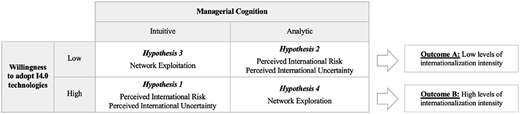
Outcome B represents high internationalization intensity and reflects Hypotheses 1 and 4 (Figure 2). Hypothesis 1 predicts that experience-based System X, combined with a willingness to adopt I4.0 technologies, enhances internationalization, as intuitive managers use digital tools to scale activities in familiar markets. Hypothesis 4 posits that analytic-based System C, combined with network exploration and technological openness, also leads to high internationalization. These configurations emphasize accurate interpretation and adaptive knowledge search, as analytical managers rely on deliberate processing and new partnerships to reduce uncertainty, identify opportunities, and build alliances in unfamiliar environments.
These distinctions explain why Outcomes A and B appear visually similar yet reflect fundamentally different managerial logics, strategic orientations, and configurations (Figure 1). Outcome A captures replication under technological reluctance, whereas Outcome B reflects adaptation and expansion under technological openness.
Figure 2 reinforces this logic by integrating the study's core constructs—managerial cognition, I4.0 technologies, network exploration and exploitation, managerial environmental perceptions, and internationalization intensity—in a unified framework. Rather than treating these elements in isolation, the figure shows their interdependence within the configurational model. Cognitive styles, managerial environmental perceptions, technological orientation, and network capabilities jointly shape internationalization outcomes. Their apparent overlap is intentional: cognition and environmental perceptions depend on the enabling or constraining role of I4.0 technologies, whereas network activities remain embedded in decision-making processes. Thus, Figure 2 clarifies the theoretical linkages and pathways leading to lower or higher internationalization.
4. Methodology
4.1 Data collection and sample
We tested our hypotheses with data gathered through an online structured questionnaire, which targeted Portuguese internationalized SMEs across several industries. These firms were established between 2005 and 2010 and had been engaged in international activities for at least one year within the period from 2005 to −2015. This 10-year interval was chosen to include SMEs at different stages of their life cycles. The sampling frame, obtained from the Iberian Balance Analysis System (SABI database), included 4,533 firms with contact details.
The questionnaire was initially drafted and refined on the basis of feedback from executives at Portuguese internationalized SMEs and subsequently tested for comprehension and duration with academics and experts. After adjustments were made, an email containing a survey link was sent to all the identified firms, with data collection occurring from June to December 2021. A total of 165 responses were received, resulting in an initial response rate of 3.64%. However, 41 responses were excluded because of missing values, resulting in 124 usable responses (2.74% response rate). Further elimination of 8 responses due to failed instrumental manipulation checks resulted in a final sample size of 116 firms, all with fewer than 250 employees, following the European Union's SME classification. Further details on the sample characteristics can be found in the Supplementary Material.
4.2 Measures
The constructs were assessed using multi-item scales validated by previous studies (see Supplementary Material). The respondents were asked to indicate the degree of their agreement with a specific statement using a 5-point Likert scale (ranging from 1 = “Strongly disagree” to 5 = “Strongly agree”). To measure the level of internationalization intensity, we employed one of the most widely used metrics in the literature (e.g. Hilmersson & Johanson, 2016; Hsieh et al., 2019; Schmuck, Lagerström, & Sallis, 2022): the foreign sales to total sales (FSTS) ratio, calculated as the average of the FSTS ratio over a three-year period (2019–2021).
4.3 Measurement validation
To evaluate the reliability and validity of the latent variables, we performed both exploratory and confirmatory factor analyses (EFA and CFA, respectively). After a rigorous normality test was conducted, an EFA was employed to assess all the items and constructs used in this study. To support the interpretation, an oblique rotation was applied, and items exhibiting cross-loadings or communalities <0.50 were removed (Hair, Black, Babin, & Anderson, 2009). To examine the internal consistency, validity, and reliability of the constructs, we conducted a CFA on the items resulting from the EFA. We used the lavaan package of R software v4.2.0 (Rosseel, 2012) for the estimation. In doing so, we used the maximum likelihood restricted estimator (MLR) with robust estimates of standard errors because the variables were not normally distributed.
We examined the standardized factor loadings of the items and identified those with low values that contributed to the poor fit of the measurement models; these items were subsequently removed. This analysis resulted in the removal of two items from the analytic-based system C, two items from the experience-based system X, and one low-order construct from perceived international uncertainty. As shown in the Supplementary Material, with the exception of five items with values close to the threshold (0.616, 0.620, 0.629, 0.664, and 0.669), all of the other items exhibited standardized factor loadings >0.70 (Bagozzi & Yi, 2012). Complementarily, almost all of the variables displayed Cronbach's alpha (α) and composite reliability (CR) values exceeding the 0.70 threshold (Fornell & Larcker, 1981), with three exceptions that revealed an α between 0.60 and 0.70: competitive intensity (α = 0.605, CR = 0.770), environmental volatility (α = 0.645, CR = 0.808), and perceived international uncertainty (α = 0.616, CR = 0.738).
Additionally, the average variance extracted (AVE) for all of the variables exceeded the recommended cutoff point of 0.50 (Fornell & Larcker, 1981), with the lowest value being observed for the variable network exploration (AVE = 0.528). Collectively, these results confirm the convergent validity and reliability of the variables (Hair et al., 2009). Discriminant validity was assessed using the Fornell and Larcker (1981) criterion, which showed that the square root value for the AVE for each variable was greater than the correlations between that variable and any other variables included in the analysis (see Supplementary Material), thereby ensuring discriminant validity.
To evaluate the model fit, we examined several fit indices: the root mean square error of approximation (RMSEA: reasonable fit ≤0.08; good fit ≤0.06), the standardized root mean square residual (SRMR: reasonable fit ≤0.08; good fit ≤0.05), the normed chi-square (χ2/df) (reasonable fit ≤3; good fit ≤2), the parsimony goodness-of-fit index (PCFI: reasonable fit >0.50), and the comparative fit index (CFI: good fit >0.90) (Hair et al., 2009). The overall measurement model showed a good fit, as all indices exceeded the recommended cutoff values. Although the chi-square test was statistically significant (χ2(440) = 807.955, p < 0.001), the remaining indices indicated good fit: χ2/df = 1.83; PCFI = 0.776; RMSEA = 0.068; SRMR = 0.073; and CFI = 0.916.
4.4 Nonresponse and common-method bias
To assess potential nonresponse bias, we compared early and late respondents across all study variables and demographic characteristics, including age, gender, industry experience, organizational position, firm size, industry type, technological intensity, and years to internationalize (Armstrong & Overton, 1977). We applied paired-sample t tests and found no significant differences between groups. Therefore, following Armstrong and Overton (1977), we conclude that nonresponse bias is unlikely. We also tested for self-selection bias by comparing included and excluded respondents and found no significant differences.
To reduce the potential for common method bias (CMB) associated with single-informant SME data, we implemented several procedural remedies (Podsakoff & Organ, 1986; Podsakoff, MacKenzie, Lee, & Podsakoff, 2003). We randomized the item order to avoid alignment with the hypothesized relationships and did not disclose the constructs' interrelations. We included reverse-coded items to reduce the number of patterned responses. As the survey formed part of a broader project, it contained additional constructs beyond those analyzed here, reducing respondent priming (Siemsen, Roth, & Oliveira, 2010). We also clearly defined scale anchors (1, 3, and 5) to improve response consistency. Finally, we assured anonymity and confidentiality in both the invitation email and the questionnaire introduction to encourage honest and unbiased responses (Podsakoff & Organ, 1986; Podsakoff et al., 2003).
We complemented these procedural remedies with two post hoc tests for CMB. First, we conducted Harman's (1976) single-factor test using an unrotated EFA that included all of the variables. The results yielded 27 factors with eigenvalues above one, explaining 64.131% of the total variance. The first factor accounted for 13.411%, well below the 50% threshold, indicating problematic CMB (Podsakoff et al., 2003). Second, we applied the marker variable technique (Lindell & Whitney, 2001), using an item capturing intraorganizational employee-related behavior theoretically unrelated to our constructs. The marker variable showed an average correlation of −0.06 with the study variables, indicating negligible shared variance due to CMB. Overall, these results provide strong evidence that CMB does not threaten the validity of our findings.
5. Results
5.1 Contrarian case analysis
Empirical studies that focus on bivariate relationships typically assume that most cases follow a dominant positive or negative pattern between variables. However, datasets often contain contrarian cases, in which relationships diverge or show no association. Identifying such cases is essential to justify a configurational approach (Woodside, 2014). We therefore conducted a contrarian case analysis. Following Woodside (2014), we split all of the variables into quintiles and performed cross-tabulations on the basis of these groupings (see Supplementary Material). The results revealed multiple instances of divergent relationships, reinforcing the need for a configurational analysis (Pappas & Woodside, 2021).
5.2 Calibration and findings
The first stage of the fsQCA involves calibration. As our variables were measured using 5-point Likert scales, we rescaled the raw data into fuzzy-set membership scores. Following Ragin (2008), we assigned membership scores ranging from 0 (full nonmembership) to 1 (full membership). We applied the direct method, a percentile-based procedure widely used in fsQCAs to ensure conceptual clarity and empirical consistency (Machado, Correia, Braga, Salamzadeh, & Braga, 2025; Marzi, Manesh, Caputo, Pellegrini, & Vlačić, 2023; Pappas & Woodside, 2021; Xie & Wang, 2020). This method defines three qualitative thresholds: full membership, the crossover point (maximum ambiguity), and full nonmembership.
Consistent with established guidelines (e.g. Fiss, 2011; Pappas & Woodside, 2021; Ragin, 2008; Rihoux & Ragin, 2009), we set thresholds at the 95th percentile for full membership (0.95), the 50th percentile for the crossover point (0.50), and the 5th percentile for full nonmembership (0.05) (Table 1). This approach follows Ragin's (2008) direct calibration method and aligns with fsQCA best practices [2], ensuring that the calibration reflects both the empirical distribution and the theoretical meaning of each condition.
fsQCA calibration
| Fuzzy set scores | |||||
|---|---|---|---|---|---|
| Minimum | Maximum | Fully out (0.05) | Crossover (0.50) | Fully in (0.95) | |
| Perceived International Risk | 1.000 | 5.000 | 1.667 | 3.333 | 4.383 |
| Perceived International Uncertainty | 2.500 | 4.330 | 2.808 | 3.333 | 4.192 |
| Willingness to adopt I4.0 technologies | 2.000 | 5.000 | 3.000 | 3.750 | 4.750 |
| Network Exploration | 1.000 | 5.000 | 2.000 | 3.667 | 5.000 |
| Network Exploitation | 1.000 | 4.670 | 1.333 | 3.000 | 4.333 |
| Analytic-Based System C | 2.500 | 5.000 | 2.963 | 4.000 | 4.750 |
| Experience-Based System X | 1.000 | 4.250 | 2.000 | 3.250 | 4.000 |
| Average FSTS Ratio | 0.000 | 1.000 | 0.001 | 0.119 | 0.931 |
Before analyzing sufficient conditions for high (or low) internationalization intensity, we tested for necessary conditions. Necessity analyses assess whether any single condition is consistently present when the outcome occurs. The results show that no individual condition is necessary for either high or low levels of internationalization intensity. All of the conditions display consistency and coverage values < 0.90, as recommended by Ragin (2008) and Schneider and Wagemann (2010). These results support the analysis of configurational combinations (Schneider & Wagemann, 2010). We set the frequency threshold at 2 (Fiss, 2011; Ragin, 2008) and the consistency threshold at ≥ 0.75 (Rihoux & Ragin, 2009).
Following Fiss (2011), we checked robustness by varying the calibration thresholds. The results revealed only minor, nonsignificant changes in the solution configurations. We further tested robustness by randomly splitting the dataset into two subsamples and comparing the results (Woodside, 2014). These checks revealed no substantive differences, supporting the stability of the fsQCA solutions (see Supplementary Material).
Table 2 shows three configurations leading to high internationalization intensity and four leading to low intensity among internationalizing SMEs. Both solution sets show satisfactory coverage and consistency, aligning with Ragin's (2008) criteria for valid fsQCA solutions. Coverage indicates the proportion of cases explained by a configuration, whereas consistency reflects the extent to which cases sharing a configuration also display the outcome (Pappas & Woodside, 2021).
Configurations leading to high vs. low levels of internationalization intensity
| Higher FSTS | Lower FSTS | ||||||
|---|---|---|---|---|---|---|---|
| 1 | 2 | 3 | 1 | 2 | 3 | 4 | |
| Perceived International Risk | • | • | • | ||||
| Perceived International Uncertainty | • | • | • | • | |||
| Willingness to adopt I4.0 technologies | • | • | ⊗ | ⊗ | |||
| Network Exploration | • | • | ⊗ | • | |||
| Network Exploitation | ⊗ | ⊗ | • | • | • | ||
| Analytic-Based System C | • | • | • | ⊗ | ⊗ | • | |
| Experience-Based System X | • | ⊗ | • | ⊗ | • | • | |
| Consistency | 0.895 | 0.837 | 0.818 | 0.876 | 0.839 | 0.830 | 0.848 |
| Unique coverage | 0.078 | 0.062 | 0.057 | 0.072 | 0.031 | 0.024 | 0.053 |
| Raw coverage | 0.415 | 0.393 | 0.387 | 0.426 | 0.358 | 0.314 | 0.295 |
| Overall solution consistency | 0.829 | 0.887 | |||||
| Overall solution coverage | 0.608 | 0.667 | |||||
| Overlapping coverage | 0.411 | 0.487 | |||||
Note(s): Black circles (•) indicate the presence of a condition; circles with “x” (⊗) indicate its absence; Blank space; “don't care” condition. The overlapping coverage score is obtained by subtracting the sum of each path's unique coverage from the solution coverage. “Raw” reflects the extent to which that set of reasons (i.e. the path) explains the outcome (when the “Raw” value is higher, those reasons factored in more heavily)
Table 2 indicates that the overall solution coverage for cases associated with high levels of internationalization intensity accounted for 60.8% of the cases. These configurations also showed acceptable independent levels of coverage and consistency, offering different possibilities for increasing the average FSTS ratio in a three-year timeframe. Similarly, Table 2 reveals that the overall solution coverage for the cases associated with low levels of internationalization intensity explained 66.7% of the cases. Notably, the configurations linked to a decrease in the average FSTS ratio over a three-year timeframe were not merely the inverse of those associated with higher FSTS ratios; rather, they involved distinct sets of combinations. The nonbinary nature of these configurations emphasizes that low levels of internationalization intensity follow different decision-making paths than those leading to higher levels of internationalization intensity, which will be further discussed in the next section.
6. Discussion
With respect to the hypothesized configurations producing high levels of internationalization (Table 2), Configuration 1 combines experience-based system X for processing international risk and uncertainty with managerial willingness to adopt I4.0 technologies. Network exploitation is absent, regardless of network exploration and analytic-based system C. This configuration reflects managers who rely on experiential cognition, using fast, confidence-driven processing that performs well in familiar contexts (Shapiro & Spence, 1997). They replicate domestic practices in similar foreign environments. I4.0 adoption further supports internationalization (Castagnoli et al., 2022), suggesting that intuitive managers who embrace these technologies achieve higher levels of internationalization intensity, which is consistent with Hypothesis 1.
Configuration 2 combines analytic-based System C and network exploration with the willingness to adopt I4.0 technologies. Network exploitation and experience-based System X are absent, regardless of perceived risk and uncertainty. This configuration reflects analytical managers who deliberately seek new partners in unfamiliar markets, enabling opportunity recognition (Faroque et al., 2021). Although slower and more resource intensive, this approach improves accuracy in dissimilar environments and supports the evaluation of I4.0 benefits, supporting Hypothesis 4.
Configuration 3 reflects a cognitively balanced decision-maker using both System X and System C as predicted by DPT (Evans & Stanovich, 2013; Kahneman, 2003). It also requires both network exploration and exploitation, regardless of risk, uncertainty, and willingness to adopt I4.0 technologies. This ambidextrous profile appears less frequently in the sample. Penney, Combs, Gaffney, and Sexton (2020) show that ambidextrous alliances are feasible and beneficial for internationalization. This solution requires time to develop, as experiential learning depends on repeated exposure and valid feedback environments. This interpretation aligns with the Uppsala model's emphasis on experiential learning and explains the gradual nature of internationalization. Combining both cognitive systems also requires time: System X learns from experience, whereas System C processes information deliberately. System C may also correct biases generated by System X, highlighting their complementarity.
The hypothesized configurations producing low levels of internationalization (Table 2) are not simply symmetrical to the ones that led to high levels of internationalization intensity (Ragin, 2008; Woodside, 2014). As such, the decisional paths producing a lower FSTS ratio in the short term follow different routes and deserve additional attention. Configuration 1 combines analytic-based system C to process the levels of international risk and uncertainty with managerial reluctance to adopt I4.0 technologies. Experience-based system X is absent, regardless of network exploration and exploitation. These results reflect risk-averse managers who rely on analytical processing to assess international opportunities, resulting in low internationalization intensity. Low levels of technological openness combined with weak experiential reliance support Hypothesis 2.
Configuration 2 supports Hypothesis 3 and reflects experience-based system X combined with network exploitation under reluctance to adopt I4.0 technologies. Network exploration, analytic-based system C, and technological willingness are absent, regardless of risk and uncertainty. This configuration includes managers focused on exploiting existing relationships in familiar markets (Faroque et al., 2021). However, reliance on System X, prone to cognitive biases, limits recognition of I4.0 opportunities, reducing internationalization intensity.
Similarly, Configuration 3 shows a nonanalytic manager combined with network exploitation, revealing potential biases and preconceptions in the internationalization process, as also observed in Configuration 2. The key difference between Configurations 2 and 3 lies in perceived international uncertainty. Configuration 3 requires the presence of perceived international uncertainty and network exploration, regardless of perceived risk, willingness to adopt I4.0 technologies, and experience-based system X. Although network exploration supports opportunity recognition (Faroque et al., 2021), decisions about its allocation, at the expense of exploitation, depend on expectations about future environmental conditions, particularly contingent uncertainty, defined as the unknown aspects of foreign markets that can be addressed through contingency planning (Figueira-de-Lemos et al., 2011). In this configuration, perceived uncertainty combined with exploitation creates a reinforcing cycle that discourages further internationalization.
Finally, Configuration 4 reflects cognitively fluent managers who refrain from international expansion in risky and uncertain environments, regardless of network capabilities or I4.0 adoption. After evaluating foreign markets, they decide not to increase international commitment. This finding partially aligns with Liesch, Welch, and Buckley (2011), who argue that perceived risk and uncertainty reduce international expansion.
7. Conclusion
This research aimed to refine and extend the Uppsala model of internationalization by integrating two underexplored dimensions: (1) the transformative influence of macroenvironmental changes driven by I4.0 technologies and (2) a microfoundational perspective that explores how managers perceive, process, and respond to external environmental signals through their cognitive frameworks. The findings reveal that decision-making strategies associated with higher levels of internationalization differ from those linked to lower levels, indicating that the interplay between managerial cognition, network capabilities, and I4.0 technologies influences internationalization outcomes strongly.
By embedding the notion of digital strategic coevolution within the Uppsala framework, this study demonstrates that SME internationalization extends beyond a gradual process of experiential learning and network development. Instead, it constitutes a dynamic and coevolutionary phenomenon shaped by the simultaneous evolution of managerial cognition and technological adoption. This perspective provides a nuanced explanation for the emergence of unexpected configurations revealed through the fsQCA, which can be interpreted as adaptive responses to the intertwined pressures of cognition, networking dynamics, and digital transformation.
7.1 Theoretical implications
This study advances the Uppsala model by integrating the effects of I4-0 technologies and managerial cognition and addressing macroenvironmental transformation and microfoundational processes. We show that managerial willingness (or reluctance) to adopt I4.0 technologies shapes internationalization intensity significantly, extending the Uppsala model to account for firms' digital evolution rather than treating internationalization as an isolated process. By highlighting how I4.0 reshapes organizational boundaries and competitive advantage, we emphasize the importance of SMEs' ability to manage the transition toward I4.0 as a condition for higher internationalization intensity.
We further link the Uppsala model and I4.0 through the notion of digital strategic coevolution (Castagnoli et al., 2022), a process during which technological adoption and strategic orientation evolve jointly. Our findings show that this coevolution emerges through interactions between managerial cognition and willingness (or reluctance) to adopt I4.0 technologies, producing nonlinear and contextually dependent configurations. Some firms combine experiential cognition with digital adoption to replicate domestic strategies abroad, whereas others combine analytical reasoning with network exploration to adapt to dissimilar and uncertain environments. These results show that cognition and technology coevolve with strategic change, extending the explanatory power of the Uppsala model. The results also suggest that exploitation aligns effectively with analytic cognition to manage risk in opportunity search, whereas exploration aligns with intuitive cognition in environments that are more familiar and replicable.
Building on this literature, we integrate microfoundational and macrofoundational dimensions into the Uppsala model. The original model (Johanson & Vahlne, 1977, 2009) explains internationalization as gradual, path-dependent learning through experiential knowledge and network commitment. Although still valid, it does not fully capture how cognition and digital technologies jointly shape internationalization under contemporary complexity and uncertainty. By introducing managerial cognition as a microfoundation and I4.0 technologies as a macrofoundation, we reconceptualize internationalization as a coevolutionary process in which cognition, networks, and technology interact to produce alternative pathways. This extension also highlights equifinality: multiple configurations can lead to similar internationalization outcomes.
From a microfoundational perspective, we show that managerial cognition, how managers perceive and respond to environmental signals, shapes internationalization outcomes. We also identify when distinct cognitive strategies are more effective. Experience-based system X is more effective in familiar, time-sensitive contexts in which firms deepen existing international markets or operate in stable environments. Conversely, analytic-based system C is more suitable for entry into dissimilar, uncertain, or competitive markets requiring deliberate analyses. These findings confirm that no single cognitive strategy is dominant; effectiveness depends on context and technological orientation. Cognitive ambidexterity, shifting between System C and System C, emerges as a key dynamic capability for internationalization in complex environments. System X performs better in valid environments even under highly complex conditions (Dijksterhuis, Bos, Nordgren, & Van Baaren, 2006) but is less reliable in unfamiliar environments where validity is untested.
Finally, by distinguishing exploration and exploitation within internationalization, we extend the Uppsala model through organizational ambidexterity. We show that network capabilities enhance or constrain international commitment depending on managerial cognition, which is critical for successful internationalization.
7.2 Practical implications
Our findings offer several managerial implications. First, I4.0 adoption can accelerate internationalization by improving access to foreign market knowledge, enhancing global value chain coordination, and strengthening relationships with international stakeholders. Therefore, managers should integrate technology adoption into internationalization strategies so digital transformation and market expansion progress together. Second, managerial cognition plays a central role under risk and uncertainty, especially in culturally or institutionally distant markets. In such contexts, managers must discern when to rely on experiential knowledge and when to apply analytical reasoning, depending on market similarity and environmental familiarity. Third, the ability to shift between network exploitation and exploration emerges as a critical capability, with its effectiveness depending on market conditions and openness to I4.0 technologies. In similar markets, intuitive cognition combined with network exploitation is more effective, whereas in distant or dynamic markets, analytical reasoning combined with network exploration better supports sustained internationalization.
Managers who understand their dominant cognitive orientation, and adjust it to situational demands, are better positioned to leverage networks and technologies for international performance. Intuitive decision-making supports rapid entry into proximate markets, whereas analytical reasoning is essential in distant or uncertain environments. Cognition also interacts with technological intensity in shaping outcomes. In low-technology industries, the willingness to adopt I4.0 technologies can compensate for resource constraints and extend experiential knowledge across borders. However, in high-technology industries, the combination of advanced digitalization and analytical cognition supports more deliberate, knowledge-intensive international expansion. Overall, aligning cognitive strategies with the firm's technological profile is critical for coherent and sustainable international growth.
Beyond managerial implications, this study offers policy recommendations for fostering international entrepreneurship through export promotion programs. Policy-makers should support SMEs operating in unfamiliar or institutionally distant environments where existing network structures are insufficient. Policy-makers can enable internationalization by facilitating network formation through trade fairs, financial and logistical support for international exhibitions, and participation in trade missions. Export promotion should also align with technological upgrading policies, strengthening knowledge infrastructures and innovation ecosystems that support SMEs' transition toward technology-driven business models. Such integrated policies enhance SMEs' ability to compete and grow in digital international markets.
7.3 Limitations and research directions
Despite its contributions, this study has several limitations. First, the three-year timeframe used to measure internationalization constrains our ability to capture temporal dynamics and evolving causal configurations. Second, reliance on self-reported data may introduce optimism bias in assessing causal conditions. Future research should adopt longitudinal designs to explore how configurations evolve over time. Further work should also examine the intersection between network exploitation and exploration, as their joint effects on internationalization remain underexplored and offer a promising research avenue.
Additionally, several methodological limitations merit discussion. First, the low response rate (2.74%) and the focus on Portuguese SMEs restrict generalizability beyond this institutional context. Although this setting, a small open economy, facilitates comparison with similar economies (Castagnoli et al., 2022), replication in other regions would strengthen external validity. Second, excluding nonsurviving firms may introduce survivorship bias, as only continuing firms could respond, potentially overstating successful configurations. This methodology might overstate the efficacy of certain configurations associated with international success. Third, although robustness checks support stability, the sample size and percentile-based calibration warrant cautious interpretation of the results. Future research should use larger cross-country samples and complementary methods to refine the configurational findings.
A further methodological limitation concerns the time lag between the internationalization period (2005–2015) and data collection (2021), which may introduce recall bias, as managers could reconstruct past decisions on the basis of later experiences. To reduce this risk, the survey focused on decision-making patterns, cognitive orientations, and technology adoption rather than isolated events. However, retrospective data remain imperfect. Future longitudinal studies tracking firms over time would provide a stronger understanding of decision-making dynamics as they evolve.
We also acknowledge limitations associated with the FSTS ratio, consistent with Certo, Busenbark, Kalm, & LePin (2020). As a ratio, the FSTS ratio may vary because of changes in foreign sales, total sales, or both, meaning that it may reflect domestic performance rather than pure international expansion. It also does not capture differences in value chain activities or stages of internationalization. Despite these limitations, the FSTS ratio remains widely used and validated (e.g. Hilmersson & Johanson, 2016; Hsieh et al., 2019; Schmuck et al., 2022). Regardless of whether changes occur in the numerator (foreign sales) or the denominator (total sales), the ratio reflects internationalization intensity. Future research should complement the FSTS ratio with measures capturing geographic diversification and resource commitment abroad.
Overall, this study opens new avenues for research on managerial cognition (System X and System C), dual network capability (exploration and exploitation) and SME internationalization, advancing theories of international decision-making.
Notes
Dual network capability refers to the firm's ability to balance both network exploration and network exploitation. Network exploration involves establishing new ties to access new knowledge and opportunities, whereas network exploitation refers to deepening existing relationships to leverage known resources (Faroque et al., 2021). By integrating this dual perspective, our study aligns with the growing literature on organizational ambidexterity (March, 1991), which emphasizes the importance of reconciling these two orientations in dynamic international environments.
When external or theory-driven thresholds are unavailable, or when variables are measured using Likert-type scales, several scholars recommend employing a percentile-based implementation of the direct method (e.g. Fiss, 2011; Pappas & Woodside, 2021; Ragin, 2008; Rihoux & Ragin, 2009). In this approach, percentiles—typically the 5th, 50th, and 95th percentiles—are used to establish the numerical values corresponding to the three qualitative thresholds of fuzzy-set calibration (0.05 for full nonmembership, 0.50 for the crossover point, and 0.95 for full membership). This percentile-based strategy preserves the substantive interpretation of the thresholds while aligning them with the data distribution, avoiding arbitrary cutoffs that could distort the underlying meaning of the constructs. Accordingly, the percentile-based direct method provides an effective balance between theoretical interpretability and empirical validity, and has become a widely accepted practice in fsQCA research (e.g. Machado et al., 2025; Marzi et al., 2023; Pappas & Woodside, 2021; Xie & Wang, 2020). However, we acknowledge that this approach may exhibit sensitivity to distributional characteristics, particularly in small-sample contexts. To address this potential limitation, we performed a series of robustness checks (see Supplementary Material), including sensitivity analyses using alternative calibration thresholds and subsample validation tests.
The supplementary material for this article can be found online.

