


Flexible work, defined by its adaptability to changing global conditions, marks a shift from traditional to modern practices. In this environment, employees can choose their preferred working style. This study reviews existing research and highlights new themes in the field.
The research data has been organized through a bibliometric analysis, including a systematic literature review and thematic analysis. Using Scopus, data from 2000 to 2024 was collected, and 400 articles were finalized for study on FWC. Vos Viewer, R Studio and Excel were used for analysis.
The research emphasizes embracing a flexible work culture, crucial for workforce adaptability. This can be achieved through telecommuting, compressed workweeks, part-time schedules and flexible hours. The study categorizes four main themes through cluster analysis: T1 (Framework, employee well-being and work experience), T2 (Gender-based study, supervisor support, perceived usability and career development), T3 (Parental experience, child care and virtual offices) and T4 (Present and futuristic agenda, work-intensification, teleworking and traditional vs modern work environment).
This study will offer a blueprint for modern office job requirements. This Work structure will assist in addressing several difficulties for the business and its personnel, enabling managers and staff to effectively manage workloads while embracing flexibility to promote a positive workplace culture.
This study's prime implication is to provide clarity to managers to start working in a new modernize work set up where managers can help employees to build resilience and enjoy pros and work upon the cons within their work setup.
This paper emphasizes the need to boost employee resilience and modernize traditional work systems. Key recommendations for improving workplace culture and well-being include recognizing gender differences in telework acceptance and providing related training, fostering ethical work practices and positive interpersonal beliefs and enhancing managers' leadership skills through targeted training.
This paper explores flexible work cultures, focusing on caregivers and elder care, to guide researchers and organizations in enhancing work–life balance.
1. Introduction
Flexible working practices (FWP) have become increasingly vital in today's rapidly changing world. The COVID-19 pandemic has underscored the importance of a flexible work culture (FWC), highlighting the need for organizations to adapt to evolving work environments. According to Hill et al. (2008), FWC allows employees to choose when, where and how they work, offering greater autonomy regarding working hours, career development, benefits and work location. These flexible arrangements can manifest in various forms, including part-time work, reduced workweeks and flexible scheduling, practices that have gained traction (Soga, Bolade-Ogunfodun, Mariani, Nasr, & Laker, 2022; Bal & Izak, 2021) since the 1970s and have become more prevalent in the West by the 1980s (Galinsky, David, & Hughes, 1990). In developed nations, the rigid 8-h and 40-h workweek is increasingly giving way to more adaptable schedules, allowing employees greater control over their time (Lyness, Gornick, Stone, & Grotto, 2012).
Several factors, including the workforce's growing diversity, drive the shift towards greater workforce flexibility. Critical contributors to flexibility include the rise of single-parent and dual-earner households, an aging population, increased elder care responsibilities, working women's workforce, reducing gender inequalities and fostering a more equitable society (Lyness et al., 2012). Research has shown that flexible work arrangements, such as part-time work, job-sharing and telecommuting, boost job satisfaction and decrease employee turnover (Masuda et al., 2012). Hopkins and Bardoel (2023) state that workplace flexibility is gaining popularity as it helps workers adapt quickly and supports sustainability, leading to new models like hot-desking and hybrid work. Chua, Myeda, and Teo (2023) add that these practices foster creativity by blending social connections and adaptable environments (Mattarelli, Cochis, Bertolotti, & Ungureanu, 2024). Yeves, Bargsted, Orlandini, and Ureta (2024) and Sunaryo, Sawitri, Suyono, Wahyudi, and Sarwoto (2022) note that the COVID-19 pandemic prompted these changes, with up to 85% of individuals aged 29–56 favoring flexible work schedules and wishing to continue them post-pandemic (Wilson, Potter-Nelson, Gaffney, Redman, & Rudinger, 2023; Shao, Martensen, Martensen, & Reindl, 2024). However, working from home poses challenges such as technology limitations, balancing work and family, lack of social support and frequent home interruptions, which can reduce effectiveness (Barbieri et al., 2024). Systematic studies lack a deeper and more contextual exploration that effectively captures the past, present and future perspectives of FWC (Bal & Izak, 2021; Soga et al., 2022).
Table 1 provides an overview of studies on flexible work culture (FWC), highlighting critical knowledge gaps the present research aims to address. Mokrytska and Dolynska (2019) examined part-time employment in Europe, offering theoretical insights but needing more relevance to recent FWC trends. This study bridges that gap by focusing on current developments. Lorenz, Whittaker, Tazzeo, and Williams (2021) analyzed caregiving-related policies, yet their thematic analysis needed methodological rigor; the current study fills this by employing a more robust bibliographic coupling approach. Renard, Cornu, Emery, and Giauque (2021) assessed new working methods' benefits and drawbacks but still need to see broader bibliometric trends; our study includes these trends for a more comprehensive view of FWC. Bibliometric analyses by Kumar, Sarkar, and Chahar (2023) and Rashmi and Kataria (2022) also have gaps: Kumar's work on work–life integration needed more future research directions, while Rashmi's focus on flexible work arrangements omitted broader concepts like family-supportive. The current study addresses these limitations by proposing new research questions and expanding the scope to include diverse FWC terminologies, enhancing theoretical and practical contributions to FWC literature.
Reviews relating to flexible work culture
| Author | Studies covered | Search terms/search string | Method | Gap |
|---|---|---|---|---|
| Mokrytska and Dolynska (2019) | – | Part-time Working | SR | The study needs to include bibliographic information |
| Lorenz et al. (2021) | 82 | Caregiver, care, caregiving, adult care, elder care, senior care, spouse care, organization, employee, policies, policy and program | T, P, C* | The study requires including bibliographic and cluster information; future research avenues are also not given |
| Renard et al. (2021) | 21 | New ways of working | SLR | The study lacks bibliographic information, thematic analysis and future research avenues |
| Kataria, Kumar, and Pandey (2021) | 101 | Flexible work arrangements, WLB/I | SLRB.A. | The study reports the absence of thematic and cluster analysis |
| Rashmi and Kataria (2022) | 945 | WLB | BA, SLR, T & C. | Future recommendations and areas in the study need to be considered |
Note(s): WLB/I – work–life balance/integration. S.R. – systematic reviews, (SLR) – systematic literature reviews, B.A. – bibliometric analysis, T – thematic analysis, C – cluster analysis, C* – comparison between different organizations and sectors, P – percentage
Source(s): Authors' own development
To explore FWC amid these complexities, this study addresses the need for focused seminal works and theme elaborations to guide future research. It aims to fill existing gaps and advance the theoretical understanding of FWC by addressing the following research questions:
What are the publication trends in this field?
What is the theoretical and methodological structure of FWC research?
What is the most significant collaboration between authors in this research?
What is the bibliographic evolution of flexible work culture research from 2000 to 2024?
What are the recent trends and futuristic approaches in FWC research?
1.1 Aim of the study
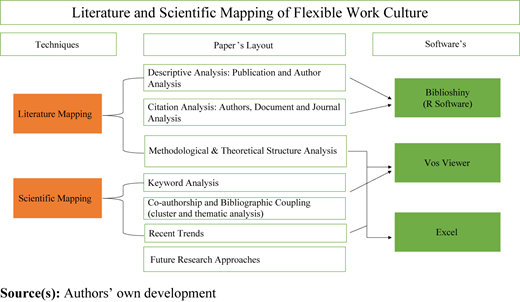
This study offers a comprehensive review of flexible work culture (FWC) research, addressing underexplored areas using advanced analytical techniques like citation analysis, co-authorship networks and thematic analysis see Figure 1. It evaluates past methodologies and, through cluster analysis, examines flexible work practices in various contexts. Findings highlight that female employees significantly adopt FWC practices, underscoring the need for strong organizational and managerial support. The study contrasts traditional and modern FWC strategies, tracing the evolution of workplace practices. It identifies emerging trends, explores relationships with other variables and suggests future research directions to fill gaps and improve FWC implementation.
2. Research methodology
This study employs a bibliometric approach to analyze flexible work culture (FWC), incorporating bibliometric analysis, SLR, thematic and content analysis, with SLR organizing the articles' methodological and theoretical frameworks (Donthu, Kumar, Mukherjee, Pandey, & Lim, 2021).
2.1 Search string
The analysis is based on bibliographic information extracted from the SCOPUS database, considering articles published between 2000 and 2024. Specific keywords were used for data extraction following expert discussions, with the search string: title-abs-key (“flexible work culture” OR “flexible work arrangement” OR “family supportive culture” OR “alternate work culture” OR “flexible work practice”) AND (limit-to (sub-area, “busi”) OR limit-to (sub-area, “soci”) OR limit-to (sub-area, “psyc”) OR limit-to (sub-area, “arts”) OR limit-to (sub-area, “mult”)) AND (limit-to (doctype, “ar”) AND limit-to (language, “English”)). The latest published data included is from 1st February 2024. The inclusion and exclusion criteria along with the Prisma framework in Figure 2 illustrate the data extraction process. Initially, 743 articles were identified, but only 400 were included after applying the criteria (see Figure 2. Articles before 2000 were excluded due to the few publications and significant citable work published post-2000. Descriptive, thematic and content analyses are detailed in the article. Data analysis was further conducted using R Studio (Biblioshiny) and Vos Viewer software.
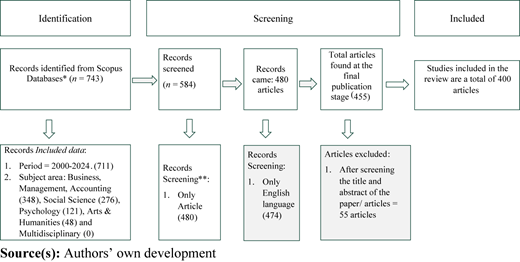
Study identification via Scopus using inclusion/exclusion criteria and the PRISMA framework
Study identification via Scopus using inclusion/exclusion criteria and the PRISMA framework
3. Results and analysis
3.1 Publication trends
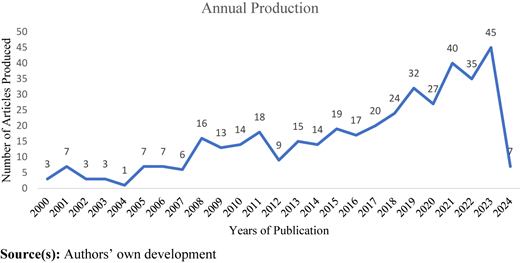
Figure 3 shows the historical evolution of Flexible Work Culture (FWC) research over the past 23 years. Before 2000, publications were sparse, but technological advancements and the growth of the Internet increased awareness and feasibility. Key studies in 2008 (Origo & Pagani, 2008; Grzywacz, Carlson, & Shulkin, 2008; Hill et al., 2008) highlighted FWC's benefits, fueling consistent growth in research. Between 2021 and 2023, 109 articles were published, underscoring its status as a trending topic, though many variable combinations remain underexplored.
3.2 Country-wise analysis
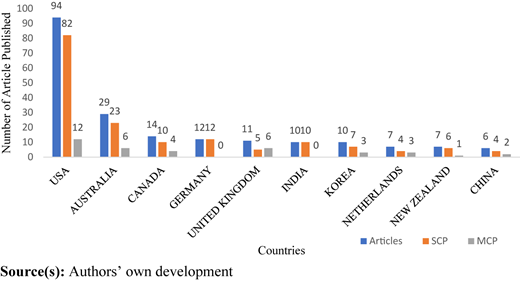
Figure 4 shows that the USA leads in FWC publications, followed by Australia, Canada, Germany, the UK and India. The USA also has the highest single-author publications (82%), followed by Australia (23%) out of 114 articles. Notably, India and China are the only developing countries contributing significantly to this research.
3.3 Citation analysis
Citation analysis highlights key authors, documents and journals, revealing influential research frequently cited by others. Citations illustrate scientific collaboration, the impact of research outcomes and the topic’s growth over time (Baker, Pandey, Kumar, & Haldar, 2020). They serve as indicators of research significance and connections.
3.3.1 Author analysis
Table 2 shows that 924 contributors produced 1,060 FWC articles, with key contributions from frequently cited authors like Allen T. D., Kossek E. E. and Lee M. D., who focus on career patterns, reduced workload, turnover intentions and work–family conflict. Table 3 highlights top-cited documents.
Top cited authors and publications
| Authors | H | G | M | TC | NP | PY_start | Research area | Articles published |
|---|---|---|---|---|---|---|---|---|
| Allen, T. D. | 7 | 7 | 0.3 | 1,012 | 7 | 2001 | Work–Family Conflict/Balance, Turnover Intentions, Job Satisfaction | 7 |
| Kossek, E. E. | 6 | 6 | 0.33 | 831 | 6 | 2006 | Sustainable Careers, Reduced workload, Telecommuting | 6 |
| Lee, M. D. | 5 | 5 | 0.23 | 195 | 5 | 2002 | Career Pattern, Reduced Load Work, Balancing Alternate Work Arrangement | 5 |
| Mcdonald, P. | 5 | 5 | 0.26 | 117 | 5 | 2005 | Flexible work (supporting, managing and using) | 5 |
| Pitt-Catsouphes, M. | 5 | 5 | 0.31 | 323 | 5 | 2008 | Flexible Work Arrangement (uses and options) | 5 |
| Kröll, C. | 4 | 4 | 0.57 | 124 | 4 | 2017 | Flexible Work Practices, Employee Attitude, Meta-analysis study | 4 |
| Nüesch, S. | 4 | 4 | 0.57 | 124 | 4 | 2017 | Flexible Work Practices, Organization Attractiveness, Panel and Meta-analysis Study | 4 |
| Ollier-Malaterre, A. | 4 | 4 | 0.36 | 192 | 4 | 2013 | Employee Career, Reduced Load Work, Work-life Policies and Arrangement | 4 |
| Shockley, K. M. | 4 | 4 | 0.24 | 773 | 4 | 2007 | Motives of Flexible Work Arrangement, Work–Family Conflict | 4 |
| Sweet, S. | 4 | 4 | 0.4 | 85 | 4 | 2014 | Flexible Work Arrangements and uses | 4 |
Note(s): H – h_index, g – g_index, m – m_index, T.C. – total citation, N.P. – net papers, area – subject area in where the articles got published by the authors
Source(s): Authors' own development
Top cited documents
| Sr. No. | Document | TC | TCpy | NTC | Sampling and research techniques | Main argument | Future recommendations |
|---|---|---|---|---|---|---|---|
| 1 | Kossek et al. (2006) | 601 | 31.63 | 4.55 |
| Job control reduces conflict, turnover and sadness, but boundary control may heighten work–family conflicts. Telecommuting aids mothers and aligns with manager evaluations | Future studies should examine the difference between actual flexibility and its mental effects |
| 2 | Allen et al. (2013) | 466 | 38.83 | 7.31 |
| Flexibility impacts work–family conflict, benefiting workers with higher family responsibilities | Future research should identify types of work–family conflict and explore strategies to reduce stressors like lack of support or negative feedback |
| 3 | Hill, Ferris, and Märtinson (2003) | 354 | 16.09 | 2.46 |
| Home offices are preferred, while traditional offices harm work–life balance. Virtual offices benefit work but can strain personal life | Further research should assess job location impact, incorporating qualitative studies to mitigate monomethod bias |
| 4 | Hornung, Rousseau, and Glaser (2008) | 306 | 18 | 3.47 |
| Developmental ideals positively correlate with work–family conflicts and overtime more than flexibility ideals | Future studies should explore group and colleague perceptions of ideal working arrangements |
| 5 | Rau and Hyland (2002) | 266 | 11.57 | 2.25 |
| Boundary theory shows that those with higher role conflict are more attracted to flexible work | Future studies should focus on understanding job seekers' needs to attract talent |
| 6 | Leslie, Manchester, Park, and Mehng (2012) | 266 | 20.46 | 3.11 |
| Flexibility leads to career success, with positive outcomes linked to leader approval | More research is needed on factors mitigating the negative effects of flexible work policies (FWP) |
| 7 | Hill et al. (2008) | 261 | 15.35 | 2.96 |
| A conceptual study on defining flexibility and its cause-effect relationship | Future studies should explore the relationship between workplace flexibility and holistic approaches |
| 8 | Shockley and Allen (2007) | 248 | 13.78 | 2.16 |
| Family responsibilities and time flexibility influence each other more than work–family dynamics | Future research should assess both the usage and implementation of flexibility to understand variations in results |
| 9 | Mcnall et al. (2009) | 222 | 13.88 | 4.79 |
| Access to flexible work arrangements improves work–life balance, and job satisfaction, and reduces turnover intentions | Future research should apply these assumptions in diverse settings |
| 10 | Putnam et al. (2014) | 182 | 16.55 | 3.85 |
| Flexible work environments can cause stress and guilt due to task juggling | Further study is needed on how recreational spaces help employees manage flexibility stress |
Note(s): T.C. is the total citation, TCpy is the total citation per year and NTC is the normalized total citation
Source(s): Authors' own development
3.3.2 Journal citation analysis
Table 4 displays major FWC publications and the top-referenced journals with their index scores. The International Journal of Human Resource Management (18), Community, Work and Family (15), Human Relations (10) and Journal of Vocational Behavior (10) are the most cited. Sage is the leading publisher.
Top cited research journal and articles publication
| Journals | H | G | M | IF | SJR | SNIP | S | A | TC | NP | PY_start | Articles |
|---|---|---|---|---|---|---|---|---|---|---|---|---|
| International Journal of Human Resource Management | 14 | 18 | 0.538 | 5.6 | 1.571 | 2.35 | Y | A | 433 | 18 | 1998 | 18 |
| Community, Work and Family | 11 | 15 | 0.688 | 2.3 | 0.651 | 1.226 | Y | C | 824 | 15 | 2008 | 15 |
| Journal of Vocational Behavior | 10 | 10 | 0.435 | 11.1 | 2.926 | 3.666 | Y | A* | 1,522 | 10 | 2001 | 10 |
| Human Relations | 9 | 10 | 0.474 | 5.7 | 3.508 | 3.468 | Y | A* | 767 | 10 | 2005 | 10 |
| British Journal of Management | 7 | 7 | 0.304 | 5.6 | 2.153 | 2.523 | Y | A | 323 | 7 | 2001 | 7 |
| Employee Relations | 7 | 8 | 0.318 | 3.4 | 0.897 | 1.49 | Y | B | 180 | 8 | 2002 | 8 |
| Human Resource Management | 7 | 7 | 0.219 | 6.6 | 2.338 | 2.782 | Y | A* | 303 | 7 | 1992 | 7 |
| Personnel Review | 6 | 8 | 0.4 | 3.9 | 1.078 | 1.729 | Y | A | 138 | 8 | 2009 | 8 |
| Advances in Developing Human Resources | 4 | 5 | 0.235 | 3.1 | 0.758 | 1.296 | Y | C | 185 | 5 | 2007 | 5 |
| European Management Journal | 4 | 4 | 0.364 | 7.5 | 1.625 | 2.275 | Y | B | 166 | 4 | 2013 | 4 |
Note(s): H– h_index, g – g_index, M – m_index, IF- Impact Factor, SJR – scimago journal research, SNIP – source normalized impact per paper, S – Scopus indexed, A –ABDC category journal, T.C. – total citation, N.P. – net paper, PY_start – starting of the research
Source(s): Authors' own development
4. Methodological and theoretical structures
We reviewed 400 FWC studies, categorizing the literature to address research gaps and guide future scholarly work.
4.1 Research methods and studies
Our review found that 262 studies used quantitative methods, 134 qualitative and only 4 mixed methods. Most were cross-sectional; further exploration of case study methodology is needed.
4.2 Sampling method, techniques and sizes
In our review of 239 studies, 136 used random sampling and 103 non-random sampling. Common techniques included convenience (26), stratified (19) and purposive (12). Many studies utilized surveys like the Cranet, Current Population and NSCW surveys. Most samples were under 1,000 (171), while some panel studies exceeded 4,000. Future research should prioritize random sampling techniques.
4.3 Theoretical basis
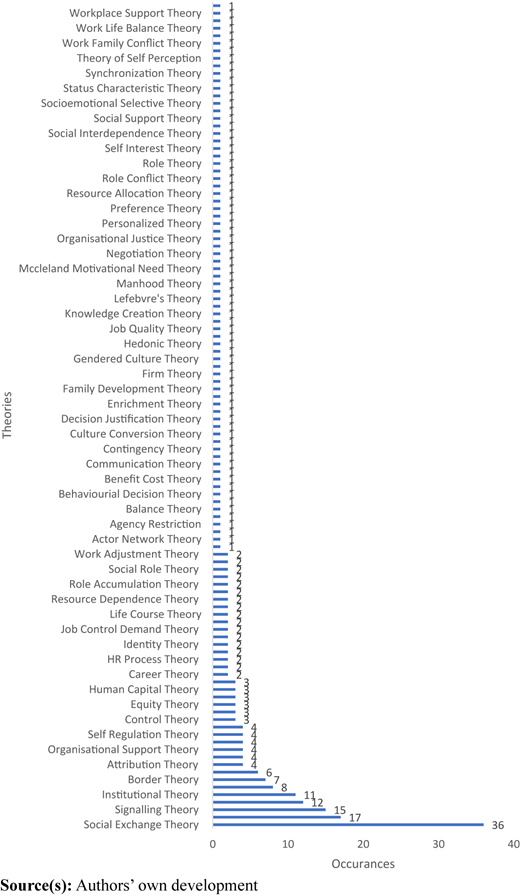
This section outlines the theoretical frameworks in FWC studies see Figure 5, with Social Exchange Theory as the most significant, emphasizing the exchange of social costs and benefits. Other key theories include Signaling, Institutional, Border, Attribution, Organizational Support, Self-Regulation, Control, Equity and Human Capital Theories. Future research can integrate these theories into their frameworks.
4.4 Statistical researching techniques
The final section reviews quantitative tools in FWC research, analyzing 125 studies. Common methods included various regression tests, correlation analysis (83), descriptive statistics (72), Structural Equation Modeling (60), ANOVA (31) and Chi-Square tests (12). Future research should focus on advanced tools like SEM and Chi-Square for deeper insights.
5. Keyword analysis
5.1 Author keywords analysis
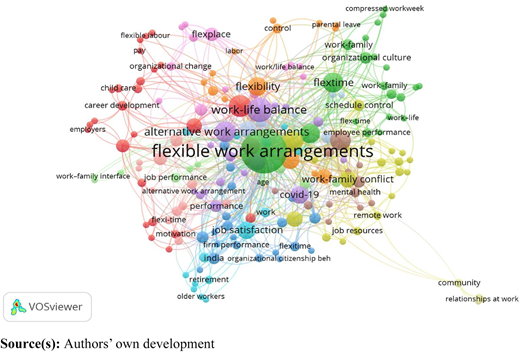
Figure 6 highlights the significance of author keyword analysis using Vos Viewer to identify research themes (Baker et al., 2020). Out of 1,058 keyword documents, 200 had at least two occurrences. The most frequent keyword was “Flexible Work Arrangement” (83), followed by “Work–Life Balance” (25), “Telecommuting” (18), “Flex Time” (17) and “Flexibility” (15). Other keywords included “Gender,” “Workplace Flexibility,” and “Job Satisfaction.” Future research should investigate variables like “Flexible Labor,” “Pay,” “Relationships at Work,” and “Job Resources.”
6. Co-authorship analysis
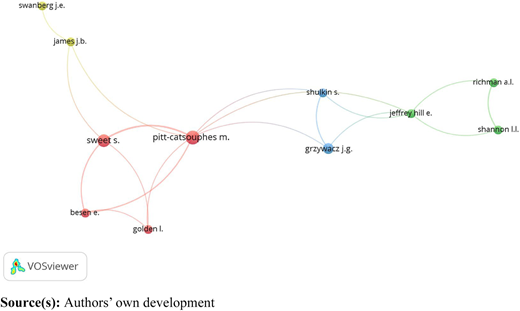
Figure 7 showcases the co-authorship analysis, highlighting the collaborative efforts of 91 authors from a pool of 923, enhancing research on complex topics (Donthu et al., 2021). Key studies include Hill et al. (2008), which presented a workplace flexibility framework, and Johnson, Lowe, and Reckers (2008), which emphasized its impact on job engagement. Grzywacz et al. (2008) and Richman, Civian, Shannon, Jeffrey Hill, and Brennan (2008) found that flexibility and supportive life policies enhance employee engagement and reduce work–life conflict. Swanberg, Watson, and Eastman (2014) noted that flexibility lowers stress and burnout. Sweet, Pitt-Catsouphes, Besen, and Golden (2014) observed that while U.S. firms offer flexibility, it’s not universally accessible and recommended training and support to improve its usage.
7. Bibliographic coupling
Bibliographic coupling is a method of analyzing shared references among research articles (Donthu et al., 2021). Articles from 2000 to 2024 were examined (Zupic & Čater, 2015), revealing relationships between topics through shared citations. Using VOS viewer software and the Linlog Modularity method (Newman, 2004; Noack, 2007, 2009), 131 articles met the threshold limit out of 400 papers with over 25 citations. Article selection based on criteria from Nagariya, Kumar, and Kumar (2021). These formed four distinct clusters, highlighting various issues related to flexible work culture see Figure 8.
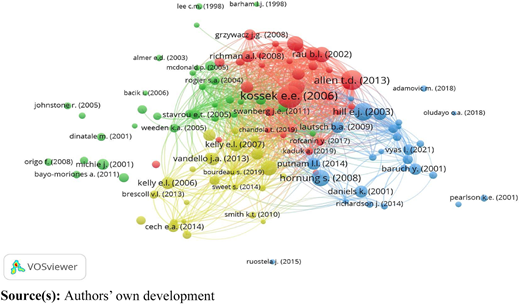
Cluster 1 (33 articles) explores flexible work frameworks, job perspectives, work–family conflict and work–life balance. Cluster 2 (32 articles) delves into demographic studies, supervisor support, flexibility usability, employee experiences and career development. Cluster 3 (26 articles) focuses on parental experiences, childcare and virtual office spaces. Cluster 4 (27 articles) discusses future agendas, work intensification, telecommuting and traditional versus modern workspaces see Table 5.
Clusters and themes details
| Clusters | Colour | Total articles | Themes |
|---|---|---|---|
| Cluster 1 | Red | 33 | Focused on Framework, Employee Well-Being and Work Experience |
| Cluster 2 | Green | 32 | Focused on Gender-Based Study, Supervisor Support, Perceived Usability and Career Development |
| Cluster 3 | Yellow | 26 | Focused on Parental Experience, Child Care and Virtual Offices |
| Cluster 4 | Blue | 27 | Focused on Present and Futuristic Agenda, Work-Intensification, Teleworking and Traditional vs Modern Work Environment |
Source(s): Authors' own development
7.1 Content and thematic analysis
Content analysis is crucial for analyzing large volumes of textual data in research. Content and thematic analysis of the articles selected in the coupling process was conducted. Articles with a Total Global Citation >25 were included, while recent developments from lower-cited papers were covered under recent trends. This approach offers a comprehensive understanding of the research findings and their relevance to the field.
Framework, Employee Well-Being and Work Experience.
In this cluster, Allen, Johnson, Kiburz, and Shockley (2013) are the most cited, followed by Chen, Zhang, Sanders, and Xu (2018). The first sub-theme, based on Hill et al. (2008) framework, emphasizes how flexible work culture (FWC) enhances work engagement and influences individual behavior, home life and community, relying on mutual trust between employer and employee. The second sub-theme addresses employee well-being in the form of work–family conflicts, where Kossek, Lautsch, and Eaton (2006) suggest flexible workers don’t always experience better job control or reduced conflicts. Also, family-supportive policies have little impact on work–family conflict (WFC), highlighting the need for deeper insight into flexibility’s effects. Benefits like flex time (McNall, Masuda, & Nicklin, 2009) and compressed workweeks (Facer & Wadsworth, 2008) show organizational care, and managers favor flexibility to reduce family-based stress, though preferences vary by country (Masuda et al., 2012). Allen et al. (2013) found that while flexibility helps reduce WFC, traditional work arrangements are still preferred due to gender differences in perceptions of job satisfaction and turnover (Chen et al., 2018).
The last sub-theme, discusses employee work experience where Timms et al. (2015) noted that flexible work affects turnover intentions more than work engagement, underscoring the importance of a supportive work culture. Extended hours can boost careers, and different flexible work types impact job attitudes differently. Grzywacz et al. (2008) found that flexibility reduces stress, with varying effects based on gender and partner status. Shockley and Allen (2010) showed that flexitime helps separate work from personal life, appealing to those with high work ambitions and family demands. Peer support can also encourage flexible habits (Lambert, Marler, & Gueutal, 2008), though organizations offer limited work–life balance support (Grotto & Lyness, 2010). The rise of virtual work, including digital nomadism, indicates growing digitalization in the U.K. and Europe (Valenduc & Vendramin, 2017). Flexible hours and sabbaticals improve job satisfaction, while remote work reduces turnover, though health impacts are minimal (Kröll & Nüesch, 2019).
Gender-Based Study, Supervisor Support, Perceived Usability and Career Development.
In this cluster, the most cited authors are Michie and Sheehan-Quinn (2001) and Stavrou (2005), with works from Bacik and Drew (2006) and Hayman (2009) contributing significantly. The first sub-theme highlights demographic issues, particularly gender. Research shows that employee involvement, multi-skilling and training improve satisfaction, with non-monetary rewards being more valued (Origo & Pagani, 2008). Flexibility preferences show little gender difference, though younger employees favor functional flexibility. Women, especially in the legal profession, benefit from flexible work arrangements, often relying on partners for childcare (Bacik & Drew, 2006). Gender biases in accounting firms favor women in performance appraisals (Johnson et al., 2008), and while men prefer traditional hours, women often choose part-time roles due to uncooperative environments (Macdermid, Dean Lee, Buck, & Williams, 2001). Flexibility and its impact on turnover, absenteeism and productivity vary across organizations and regions, with limited research in some areas (Stavrou & Kilaniotis, 2010). Social exchange theory links flexible work to lower absenteeism and turnover and higher productivity.
The second sub-theme focuses on remote employees, who need consistent support to remain motivated. Even minimal support reduces turnover intentions, while positive assistance fosters collaboration and retention, preventing a shift to full-time remote work (McDonald, Pini, & Bradley, 2007). Flexible policies can reduce work–life conflicts and job pressures (Hayman, 2009), though they may not significantly boost innovation. Smaller companies often excel in innovative practices like job rotation, teamwork and quality circles, reducing mental health risks (Michie & Sheehan-Quinn, 2001), though these practices vary across cultures and can cause strain (Brenner, Fairris, & Ruser, 2004).
The last sub-theme highlights how reduced workloads allow employees to spend more time with family, recharge or pursue other tasks (Lee, MacDermid, Williams, Buck, & Leiba-O’Sullivan, 2002). In the hotel industry, flexible schedules are valued more (Knox & Walsh, 2005). Part-time female employees often have more opportunities and report greater job satisfaction than full-time workers (Lee et al., 2002; McDonald, Guthrie, Bradley, & Shakespeare-Finch, 2005). Employers who promote efficient work practices also encourage organizational citizenship (van Dyne, Kossek, & Lobel, 2007). Flexible workers also tend to earn more than traditional full-timers (Glass, 2002), but wage disparities between mothers and non-mothers persist, needing organizational attention (Weeden, 2005). While flexibility can enhance career growth, it may also undermine job autonomy and stability for women.
Parental Experience, Child Care and Virtual Offices.
The most cited authors in this cluster are Vandello, Hettinger, Bosson, and Siddiqi (2013), Lyness et al. (2012), Leslie et al. (2012), Kelly and Kelly (2006), Kelly and Moen (2007), Golden (2008) and Cech and Blair-Loy (2014). The first sub-theme addresses the experiences of dual-earner parents balancing caregiving and professional responsibilities. Women in flexible work arrangements report higher comfort levels (Chesley & Moen, 2006), but African American employees face more obstacles to accessing such flexibility (Golden, 2008). Experts recommend state-supported policies to enhance parental control and family support (Den Dulk, Groeneveld, Ollier-Malaterre, & Valcour, 2013).
The second sub-theme examines the impact of flexibility on the pay gap for working mothers who work from home or part-time (Fuller & Hirsh, 2019) and the unclear career progression for mothers in the tertiary sector (Webber & Williams, 2008; Brown, 2010). Additionally, parental leave benefits for fathers regarding childcare are uncertain, with some studies suggesting it may cause stress (Brandth & Kvande, 2016; Munsch, 2016). The final sub-theme considers virtual offices, where internet access is crucial for remote employees, who often use it more for personal than work-related tasks (Wajcman, Rose, Brown, & Bittman, 2010). Monitoring is necessary to prevent remote work from causing mental stress and affecting work–life balance (Kelly & Moen, 2007). Managers may perceive flexible employees as less committed (Leslie et al., 2012). Studies indicate that men require more support in flexible work arrangements due to workplace partiality, while women are eager to participate and advance their careers (Vandello et al., 2013; Brescoll, Glass, & Sedlovskaya, 2013). Effective implementation of flexible work policies requires cooperation between employees and managers (Lirio, Lee, Williams, Haugen, & Kossek, 2008) and strong managerial support. Balancing flexibility and structure is vital for the success of virtual offices (Kelly & Kelly, 2006).
Present and Futuristic Agenda, Work-Intensification, Teleworking and Traditional vs Modern Work Environment.
The most cited authors in this cluster are Hill et al. (2003), Morganson, Major, Oborn, Verive, and Heelan (2010), Lautsch, Kossek, and Eaton (2009) and Baruch (2001). The first sub-theme examines how employers in India's I.T. sector use remote work to control employees, pushing them to accept excessive workloads and reducing employer costs (Bathini & Kandathil, 2019).
The second sub-theme focuses on teleworking, which gained popularity in the 1980s and 1990s (Nilles, Carlson, Gray, & Hanneman, 1976). Effective teleworking requires good communication, facilities and a proper work–life balance. Supervisors should maintain close contact with their teams and share information promptly (Tavares, Santos, Diogo, & Ratten, 2020; Putnam, Myers, & Gailliard, 2014). Teleworking reduces travel expenses, improves well-being (He & Hu, 2015; Henke et al., 2016) and highlights behavioral differences between remote and on-site workers (Lautsch et al., 2009). A multilevel analysis is needed to understand its impact on health and productivity fully. While telecommuting can lead to isolation (Virick, DaSilva, & Arrington, 2010), it can also improve negative perceptions (Cañibano, 2019). Differences in teleworking experiences can occur across departments (Maruyama & Tietze, 2012). Teleworking benefits both employees and organizations but requires careful management.
The third sub-theme compares traditional, home and virtual work environments, noting that all three offer benefits like motivation, performance and retention, but do not significantly affect career advancement (Hill et al., 2003). Home workdays provide better mental stability for complex tasks (Biron & van Veldhoven, 2016), while traditional office environments result in higher job satisfaction and participation (Morganson et al., 2010). The last sub-theme focuses on the Present and Futuristic Agenda. Managers must ensure a seamless integration of workspaces and home life, showing confidence in their colleagues (Richardson & Mckenna, 2014). HR managers should lead in maximizing employee participation in these practices by identifying five critical aspects of work: identity, competency, context, role demand and outcome Baruch (2001). Performance appraisal often involves subjective or traditional methods requiring group or leader input. The focus should be shifted from performance to the impact on global growth and business ecosystems, emphasizing the role of global virtual teams.
8. Recent trends
Through text data analysis in VOS Viewer, we examined documents from 2021 to 2024 to identify current trends in flexible work arrangements. Previous research emphasizes that managerial and organizational support is crucial for success (Arora & Anon, 2022), with ineffective culture being a major barrier (Kwon, Cho, & Song, 2021). Employees prefer job-crafting roles over flexible work due to perceived benefits (Waples & Brock Baskin, 2021). Organizational culture significantly influences virtual team effectiveness and work–life balance, impacting employee happiness, especially during the COVID-19 pandemic (Sunaryo et al., 2022). While flexible work attracts job seekers, it requires effective task management and can negatively impact career success, with varied effects on men and women (Coron & Garbe, 2023). To implement flexible work successfully, key requirements include advanced technology and effective managerial communication (Hosoi, Reiter, & Zabel, 2021). Recent studies also explore trends like the 4-day workweek (Jahal, Bardoel, & Hopkins, 2024) and parental leave policies, highlighting differential treatments for mothers and fathers (Shum et al., 2023; Augustine, Kim, & Lee, 2024).
9. Theoretical contribution, implications and future research agenda
The theoretical contribution of this research highlighted in Cluster 1 (2008) examines FWC’s effects on family conflicts and traditional work preferences, suggesting comparisons across various work settings. Cluster 2 (2001) studies demographics in flexible arrangements, emphasizing gender and age studies to address specific employee needs. Cluster 3 (2005) explores parent and virtual worker experiences, highlighting flexibility preferences and pay disparities and recommending research on policy effects for parents. Cluster 4 links flexible work to work intensification, noting some still prefer traditional settings. Future studies should investigate employee outcomes using theories like Workplace Support and Social Interdependence (see Table 6).
Future research questions (cluster wise)
| Clusters and potential themes | Future research question |
|---|---|
| Cluster 1: policies and Impact | How does flexible work affect job embedding? |
| Does flexibility make a workplace more attractive? | |
| Is flexible work beneficial for the digital economy? | |
| What benefits do family members gain from flexible schedules? | |
| Explore alternative work models like co-working, digital nomadism and online platforms | |
| How do organizations manage cultural diversity in flexible work? | |
| Cluster 2: implementation and organizational culture | Can flexible work cultures become more professional? |
| Does workplace flexibility lead to career rebranding? | |
| What organizational factors promote or hinder flexibility? | |
| How do routine work patterns normalize flexible scheduling? | |
| What are the neural impacts of flexible work experiences? | |
| How do leadership and organizational culture influence flexible workers? | |
| How does workplace restructure support varied work styles? | |
| Cluster 3: gender, social class and financial impact | What flexible practices do men and women prefer? |
| Does flexibility offer equal career opportunities for both genders? | |
| How does flexibility coexist with employees’ social class? | |
| What impact does flexibility have on parenting and financial performance? | |
| How does flexibility shape employee perceptions and behavior? | |
| How does flexibility impact workload management and boundaries? | |
| How does the Internet of Things influence work cultures? | |
| What supports caregivers who practice flexibility? | |
| How can biases around flexibility be reduced? | |
| Cluster 4: regulations and Telecommuting | What labour laws are needed to regulate flexibility? |
| What factors help overcome job separation? | |
| How does supervisory support affect telecommuters? | |
| Investigate technology-enabled teleworking | |
| Explore new ways to manage work–life conflicts |
Source(s): Authors' own development
9.1 Managerial and social implications
The FWC literature and thematic analysis suggest that managers should foster collaboration, offer career growth and address gender differences. Social implications emphasize increasing employee resilience and modernizing traditional work systems. Recommendations to improve workplace culture and employee well-being include:
Recognizing gender differences in work practice acceptance and providing teleworking training.
Promoting ethical work practices and interpersonal beliefs.
Enhancing leadership skills of managers through training.
The COVID-19 pandemic has underscored the importance of flexible work arrangements for employee satisfaction. Organizations should develop a flexible work culture tailored to their settings and regulations to address employee reluctance, loneliness, workload and health issues.
9.1.1 Future research agenda
Based on current literature and cluster findings, the study recommends further research on flexible work conditions (FWC), with key areas and potential themes outlined in Table 5. Future studies should explore case studies across different regions, sectors and economic contexts, as well as longitudinal studies for practical guidelines. Key research areas include:
Job-crafting roles,
Workplace transformation (e.g. gig workers),
Career development,
Counterproductive and innovative behavior,
Firm financial performance,
Organizational attractiveness and
AI's impact on work culture.
The COVID-19 pandemic accelerated these trends, and future studies should address workcation, hot desking, emotional exhaustion, collective bargaining and income disparities. Emerging variables include organizational fairness, ethical fit, employee control and job embeddedness.
10. Conclusion and limitations
This study provides new perspectives on FWC from 2000 to 2024, analyzing 400 items using bibliometric and SLR techniques. The analysis covers article publications, country contributions, citation trends, theoretical-methodological gaps, keyword frequency and co-authorship in areas like work–-life balance, employee attitudes and supportive environments. Vos Viewer was used for thematic clustering and content analysis, with findings emphasizing global management practices. Future research could adopt advanced SLR methods (e.g. meta-analysis, ADO, TCCM) and explore multiple databases. Additional tools like Bibexcel, UCInet, Gephi and Microsoft Office are recommended for expanded analysis.
The authors declare no conflict of interest, competing financial interests, personal relationships or funding that could have influenced this research.
Note: T1,2,3,4 are Themes identified in this research.

