Skip to Main Content
Purpose

The study aims to examine the correlates of work-related social media use. Specifically, it investigates the role of work-related social media use (WRSMU) and frequency of social media use (FSMU) in the relationship between workplace fear of missing out (FoMO), organizational support, innovative performance, and routine performance at the workplace.

Design/methodology/approach

A sample of 245 employees from India working in various organizations. The data were analyzed using partial least squares structural equation modeling (PLS-SEM).

Findings

The findings indicate that work-related social media use has a positive and significant association with innovative and routine performance. Additionally, organizational support is positively and significantly associated with work-related social media use and performance. Workplace fear of missing out is positively associated with work-related social media use, but not with performance. The mediation analysis showed that work-related social media use mediates between workplace FoMO and performance, and organizational support and performance. Furthermore, moderation analysis revealed that the frequency of social media use moderates between work-related social media use and innovative performance.

Originality/value

This study’s findings provide new insights into the impact of social media use on individual and organizational functioning. This study demonstrates this impact and contributes to the existing literature on the social and cultural impacts of information technology.

A recent report has revealed that about 5.44 billion active social media users are recorded worldwide, which is more than 59% of the global population (We Are Social and Meltwater, 2023). More importantly, this report has also stated that around 41% of employees have adopted social media for work-related purposes. Extant literature confirms that social media are extensively used by employees and organizations for work-related purposes (Yen et al., 2020; Van Zoonen et al., 2016) and influence various work-related outcomes, such as job satisfaction and performance (Halawani et al., 2020; Louati and Hadoussa, 2021; Luqman et al., 2021; Sohaib, 2021). Work-related social media use (WRSMU) refers to the content shared on social media platforms related to work experience, organizational or industry-related information, arranging meetings, sharing documents, and work-related information within and outside the organization (Bodhi et al., 2023). Social media use in the workplace and its associations with employee-related outcomes have gained substantial research attention (Chu, 2020), given its impact on individual wellbeing (e.g. Van Zoonen et al., 2022), job performance (Chen et al., 2020; Moqbel et al., 2013; Yu et al., 2018), and organizational functioning (Garcia-Morales et al., 2018).

Prior studies demonstrated positive and negative associations between social media use and employee-related outcomes such as work performance, well-being, creativity, and organizational commitment (Bodhi et al., 2024; Jiang et al., 2021; Luqman et al., 2021; Song et al., 2019; van Zoonen and Rice, 2017). For instance, Pitafi et al. (2020) argue that social media is associated with interrupting work, distraction, and information overload at the workplace. However, Olfat et al. (2020) stated that social media use improves knowledge sharing and organizational commitment. Research examined two dimensions of work performance, i.e. innovative and routine (e.g. Ali-Hassan et al., 2015; Madjar et al., 2011). However, limited studies have examined the relationships between WRSMU and employees’ innovative and routine performance (e.g. Pekkala and van Zoonen, 2022). A focus on innovative and routine job performance is relevant because employees are encouraged to take initiative and be innovative in solving work-related problems (i.e. innovative performance), yet at the same time making their work more standardized, cost-effective, and efficient (i.e. routine performance (Madjar et al., 2011). Previous studies have already demonstrated that a nuanced perspective on job performance may provide more meaningful insights into the mechanisms that link social media use to different performance outcomes – routine and innovative performance (Ali-Hassan et al., 2015). For instance, the relationship between social media use and employee innovative behavior is positive but not significant (Han and Xia, 2020). Moreover, another study shows a positive and significant relationship between work-related social media use and innovative work performance (Bodhi et al., 2023). Given previously inconclusive findings and the prevalence of social media technologies in organizations (Ali-Hassan et al., 2015), distinguishing between routine and innovative performance may provide a more in-depth understanding of the relationship between social media use and job performance.

To advance our understanding of social media use in organizations, we follow recommendations about conceptualizing ICT use, as behaviors that can be understood as the ways in which users employ social media (i.e. work-related use), and the extent to which users employ social media (i.e. frequency) (Wang et al., 2020). Hence, we seek to illuminate the ways in which WRSMU may support different aspects of performance – i.e. innovative and routine performance (Ali-Hassan et al., 2015).

We draw on the conservation of resources theory principles to suggest that WRSMU can be an important mediator in the relationship between workplace FoMO (Budnick et al., 2020), organizational support (Pekkala and van Zoonen, 2022) and employee’s innovative and routine performance. In doing so, we seek to contribute to research on social media use and performance, which to date has yielded inconclusive results (Caya and Mosconi, 2023; Chen et al., 2020; Ma et al., 2022). For instance, social media use at work and job performance relationship is initially positive before an inflection point and then turns negative (Zahmat Doost and Zhang, 2024). However, another study shows a positive result between work-related social media and job performance (Chen et al., 2022). Yet, the role of work-related social media use in supporting knowledge sharing, communication, and collaboration is increasingly important in today’s multilocational work environment.

Workplace FoMO refers to a pervasive apprehension that one might miss out on valuable resources and opportunities or overall positive experiences when away or disconnected from work (Bodhi, 2024; Budnick et al., 2020; Przybylski et al., 2013). A recent study has reported that FoMO is negatively related to employee well-being (Bodhi et al., 2023) and sleep quality (Tandon et al., 2020). Additionally, FoMO was found to increase employees’ retrieval of work-related information from social media (Van Zoonen et al., 2022). Hence, research on workplace FoMO has started to explore the implications for individual well-being and technology use (Tandon et al., 2021a, b). However, it is still unclear whether and how FoMO may relate to employee performance through employees’ media choices (Dhir et al., 2021; Tandon et al., 2021a, b).

Furthermore, the role of organizational support for WSMU is important as social media technologies are taking a central role in organizational communication processes (Pekkala and van Zoonen, 2022). Organizational support is recognized as an essential factor that is significantly and positively related to any technology or system use (Venkatesh et al., 2003). While social media technologies in organizations are often used voluntarily, organizational support may improve the acceptance and adoption of these technologies, for instance by relieving stress associated with fear, failure or misguided use (Eisenberger et al., 2020).

This study contributes to ongoing efforts to better understand WRSMU, which is important because social media technologies are increasingly important to organizational functioning (Safadi, 2024). Drawing on principles of COR theory we contribute to ongoing efforts of understanding the role of social media in individual job performance (Chen et al., 2020; Moqbel et al., 2013; Yu et al., 2018). This relationship has proven to elude our understanding yielding inconclusive results (Caya and Mosconi, 2023; Ma et al., 2022). COR theory provides a theoretical framework for understanding how WRSMU may operate as an important mechanism that helps employees to, gain, protect, and cultivate important resources that support innovative and routine performance.

We apply the principles of conservation of resources (COR) theory to understand the role of WRSMU in the relationship between organizational support, fear of missing out and job performance. As a theory of employee motivation, the central premise of COR theory is that employees are motivated to protect resources and acquire new ones (Halbesleben et al., 2014; Hobfoll, 1989). Resources can be loosely defined as objects, conditions, or something of value to an individual (Hobfoll, 1989). Job resources are important job conditions underlying employee well-being and performance (e.g. Bakker et al., 2005; Bakker et al., 2004).

A closer look at the psychological process underlying the conservation and acquisition of resources reminds us of several principles of COR theory relevant to the current study. The first principle is the primacy of resource loss, which refers to the notion that a loss of resources is more harmful to an individual than a similar gain in resources. This means employees are motivated to avoid resource losses (Whitman et al., 2013). A second principle pertains to resource investment. This suggests that employees invest resources to protect against loss, recover from loss, and gain resources (Hobfoll, 2002). Research suggests that resource investment refers to both gaining and spending resources (Halbesleben et al., 2014).

Extending the principles of resource conservation and acquisition to the current study, we suggest that employees may use resources to protect and gain additional resources, and are motivated to avoid a potential resource loss. Several studies have suggested that the use of social media for work-related purposes can be seen as a resource that may help employees achieve individual or organizational goals (e.g. Bulgurcu et al., 2018). The facilitating conditions that assist employees and offer the opportunity to adopt and use new technology (Thompson et al., 1991; Venkatesh et al., 2003). Based on the unified theory of acceptance and use of technology (UTAUT) model, prior studies show that facilitating conditions are an essential antecedent for any system or technology use (Venkatesh et al., 2012). If the organization provides support or facilitates conditions, it can represent technological support and guidance provided by the organization to engage in work-related social media use (Bodhi, 2021). Moreover, prior studies show that organizational support is recognized as an essential factor that is significantly and positively related to any technology use (Venkatesh et al., 2012) or enterprise social media use (Bodhi, 2024). Furthermore, organizational support is an oft-cited psychological resource central to COR theory, as it is a resource that employees typically seek to protect and cultivate to further individual and organizational performance (Luqman et al., 2021).

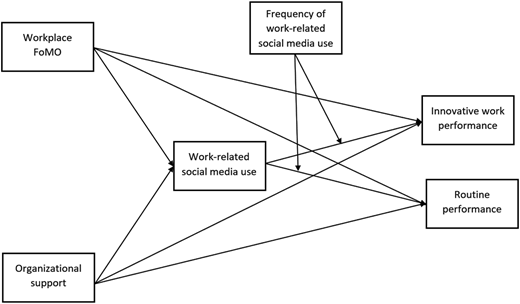
Finally, our focus on FoMO is informed by COR theorizing because workplace FoMO highlights employees’ apprehension of missing out on valuable career opportunities, relative to other employees, when disconnected from work (Budnick et al., 2020). COR theory articulates that employee seek to avoid resource loss, repair such losses, and seek to gain new resources (Hobfoll, 1989). However, research drawing on COR theory has also cautioned against the reliance on technologies as excessive technology use may deplete resources, increase performance pressure, and lead to long hours (Dutta and Mishra, 2024). Based on this central assumption, we posit that workplace FoMO may motivate WRSMU as employees attempt to prevent missing out on valuable resources (e.g. information) while organizational support for social media can be viewed as an intangible resource that enables employees to gain additional resources (e.g. informational resources through WRSMU; Ellison et al., 2007). Moreover, drawing upon the Elaboration Likelihood Model (Petty and Cacioppo, 1986) and Social Influence Theory (Kelman, 1958), the use of technology as an informational resource in the area of health care (Bhagat and Kim, 2023). Moreover, based on COR theory, a recent study considers enterprise social media use as an informational resource that positively affects work performance (Bodhi, 2024). Thus, the present study considers WRSMU as an essential informational resource that may affect the performance of employees. Furthermore, the frequency of social media use may moderate these relationships as frequent technology use may deplete resources (Dutta and Mishra, 2024). We visualize the nomological network based on COR theory (See Figure 1). Below, we present empirical evidence to support our hypotheses.

With the advent of social media technologies FoMO has become a more central part of social and working life (Buglass et al., 2017). FoMO refers to an individual’s feeling of missing out on positive social experiences and potential social exclusion (Przybylski et al., 2013). Prior studies have found a positive relationship between FoMO and non-work social media use (Elhai et al., 2018; Roberts and David, 2020), digital device usage (Alt, 2017; Beyens et al., 2016), and social media engagement (Alt, 2017, 2018; Reer et al., 2019) in a general context. In organizational contexts, FoMO is typically referred to as workplace FoMO (Budnick et al., 2020). Budnick et al. (2020) define workplace FoMO as “pervasive apprehension that, relative to other employees, one might miss valuable career opportunities when away or disconnected from work.” Prior studies have stated that workplace FoMO is positively associated with information-seeking and social media engagement. Moreover, several studies have established a direct relationship between workplace FoMO and social media use (Tandon et al., 2021a, b; Van Zoonen et al., 2022). Workplace FoMO might serve as a motivational resource that triggers employees to engage in organizational-related communication (Budnick et al., 2020). Moreover, we argue that employees may be motivated to engage in work-related social media to avoid the feeling of missing out on valuable resources. Hence, we hypothesized that

H1.

Workplace FoMO is positively related to work-related use of social media.

Recent years have witnessed growing research attention to FoMO in disciplines such as management and behavioral sciences. Prior studies have extensively studied FoMO and its association with psychological outcomes such as well-being, especially in non-work settings (e.g. Elhai et al., 2020; Stead and Bibby, 2017). However, research has only scratched the surface of examining the relationship between workplace FoMO and work-related outcomes such as job performance. A notable exception is a recent study by Fridchay and Reizer (2022) who demonstrated that FoMO is negatively and significantly associated with overall job performance. Employees high in FoMO might be particularly alert to their technological devices and expand resources and attention to notification and technological interferences. This results in lower employee performance levels (Fridchay and Reizer, 2022). Bodhi et al. (2022) have stated that FoMO is negatively but insignificantly associated with innovative work performance. Furthermore, Budnick et al. (2020) suggest that FoMO may harm employees’ health and performance. Hence, based on the above, we hypothesized that:

H2a.

Workplace FoMO is negatively related to employees’ routine work performance.

H2b.

Workplace FoMO is negatively related to employees’ innovative work performance.

Interestingly, while workplace FoMO may reduce employee performance (Fridchay and Reizer, 2022), workplace FoMO also increases WRSMU (Van Zoonen et al., 2022). However, in the presence of WRSMU, fear of missing out may positively influence routine performance, in statistical terms referring to competitive mediation (Hair et al., 2016). Conceptually, we suggest that while the negative relationship between FoMO and performance is rooted in the anxiety and diverts attention away from work tasks, FoMO may also trigger a compensatory mechanism by motivating WRSMU, allowing employees to build resources and acquire information that may aid their performance. In addition, especially concerning work-related use, we suggest that social media may not merely represent a distraction from tasks but may actually help employees to be informed and connected, enhancing task performance.

While the relationship between WRSMU and performance is not univocally positive, a recent meta-analysis indicated that using social media makes employees more productive (Wu et al., 2021). Conversely, if workplace FoMO motivates the use of social media for work, and such use represents important resources that support job performance, we could argue that FoMO enhances job performance through WRSMU. Hence, we suggest, drawing on COR principles, that the workplace FoMO represents the threat of missing out on valued resources, which motivates employees to obtain and protect informational resources through social media use (Van Zoonen et al., 2022). These resources, in turn, may contribute to employee performance (Bakker et al., 2004). Hence, we hypothesize:

H3a.

Workplace FoMO is positively related to employees’ routine work performance through work-related social media use.

H3b.

Workplace FoMO is positively related to employees’ innovative work performance through work-related social media use.

Organizational support is essential for motivating the adoption and use of any technology or system (Eisenberger et al., 2020; Venkatesh et al., 2008). Organizational support refers to facilitating conditions that assist employees and offer the opportunity to adopt and use a new technology (Thompson et al., 1991; Venkatesh et al., 2003). Facilitating conditions are “the degree to which an individual believes that an organizational and technical infrastructure exists to support use of the system” (Venkatesh et al., 2003). In the context of technology use, providing support for users may be one type of facilitating condition (Venkatesh et al., 2003, 2008). Thus, organizational support refers to facilitating conditions in context to support related to technologies or system uses (Bodhi, 2021; Venkatesh et al., 2003). Guenzi and Nijssen (2020) stated that organizational support would help build skills and self-efficacy in using social media. Organizational support can be a valuable resource for employees to alleviate stress associated with fear, failure, or uncertainty surrounding technology use in organizations (Eisenberger et al., 2020). Importantly, organizational support, in general, is an important resource employees seek to protect and enhance (Halbesleben et al., 2014). Research has suggested that work-related social media communication can enhance occupational resources such as support (Oksa et al., 2021). Hence, in line with COR principles, we suggest that organizational support is an important antecedent to WRSMU, as employees can engage in such social media use to enhance supportive resources.

Indeed, prior studies show a positive and significant relationship between organizational support (e.g. facilitating condition) and social media usage behavior (El Ouirdi et al., 2016). In addition, Pekkala and van Zoonen (2022) demonstrate that organizational support increases WRSMU. Moreover, Schmidt et al. (2016) reported a positive correlation between organizational support and the number of co-worker connections on social media. Hence, we propose that organizational support is an important resource that helps employees obtain additional (informational) resources through WRSMU. We hypothesize that:

H4.

Organizational support is positively related to work-related use of social media.

Organizational support strengthens self-efficacy, increases employees' positive orientation, and supports individual and organizational goal attainment (Eisenberger et al., 2020). Prior studies have researched the impact of organizational support on employees' abilities and performance. A meta-analysis, covering twenty years of study, indicates that organizational support has a moderate but positive impact on employee performance (Riggle et al., 2009). These findings were later corroborated in a meta-analytical review of 558 studies on organizational support theory (Kurtessis et al., 2017). Thus, if employees receive high organizational support, they are more likely to perform better at their jobs (Zhong et al., 2016). Organizational support is a valued resource that could bolster employees’ confidence and ability to cope with demands and stressors at work (Jawahar et al., 2007), thus enhancing performance. Hence, we hypothesize:

H5a.

Organizational support is positively related to employees’ routine work performance.

H5b.

Organizational support is positively related to employees’ innovative work performance.

We have already established that social media use in organizational settings may enhance employee performance (Jafar et al., 2019; Song et al., 2019; Sun et al., 2020). For instance, extant literature shows that WRSMU (e.g. information sharing, learning, and innovation) enhances overall employee performance (Jafar et al., 2019). In addition, we have also argued that organizational support is positively related to WRSMU. Conversely, we forward the assumption that organizational support may help employee obtain additional resources through WRSMU, which will be positively associated with their performance.

H6a.

Organizational support is positively related to employees’ routine work performance through work-related social media use.

H6b.

Organizational support is positively related to employees’ innovative work performance through work-related social media use.

Various studies on social media use in organizations warn about excessive or addictive usage patterns. Indeed, building on COR theory, this may be problematic as frequent use of social media may lead to the depletion of resources due to demands for attention and information processing (Luqman et al., 2021; Yu et al., 2018). Hence, while WRSMU may facilitate routine and innovative performance at high frequencies, social media use may stifle performance. For instance, the high-frequency usage or problematic social media use leads to low self-control, difficulties in impulse control, and goal-oriented behavior (Lewin et al., 2022; Leijse et al., 2023). Wang et al. (2022) argued that the frequency of social media use may moderate the implications of WRSMU for employees’ creative performance, as it decreases the quality of interactions.

In addition, according to the resource conservation tenet of COR theory, a higher frequency and intensity of social media use may deplete resources, mitigating the benefits of WRSMU for routine and innovative performance. In line with this, research has demonstrated the moderating effects of the frequency of attention regulation through enterprise social media on the relationship between social-related enterprise social media use and collaboration (Zhang et al., 2023). We extend this reasoning to WRSMU and suggest that higher frequencies of social media use may ultimately mitigate the benefits of WRSMU for job performance by depleting available resources. Hence, in line with COR theory, drawing on the notion that excessive usage patterns may deplete rather than generate resources, we suggest that the frequency of social media use for work will moderate the relationship between WRSMU and work performance. Thus, leading to the following assumptions:

H7a.

FSMU negatively moderates the relationship between work-related social media use and employees’ routine work performance.

H7b.

FSMU negatively moderates the relationship between work-related social media use and employees’ innovative work performance.

For this study, we invited respondents through e-mail in selected organizations. We used a purposive and random sampling approach for the data collection. First, we engaged in purposive sampling by identifying organizations that had implemented social media technologies. In these organizations, employees are enabled to access work-related social media, such as enterprise social media, for use at work. At first, 16 organizations were identified for the survey in northern and southern India. However, only 12 organizations’ HR managers or organizational channels agreed. We continued drawing a random sample of employees in these organizations using a simple random sampling approach, sending invites to a total of 300 individual participants. This resulted in a sample of working professionals employed at different organizations in the services industry (i.e. IT and ITeS; information technology enables services). We received responses from 267 employees. After discarding 32 responses due to unfilled responses, the final sample consisted of 235 employees. During the data collection process, the authors guaranteed respondents’ confidentiality and anonymity, encouraging them to provide genuine answers. Of our respondents, 68.9% were male, and their ages ranged between 18 and 54 years. These respondents worked at junior (36.2%), middle (51.5%) or senior (12.3%) level.

The survey items were adapted from existing literature and it measured on five-point Likert scale “strongly disagree = 1” to “strongly agree = 5”. The items are listed in  appendix

Workplace Fear of missing out (FoMO) was measured with a five-item scale previously reported by Budnick et al. (2020) and Tandon et al. (2021a). A sample of these items was “I get worried when I might miss important work-related updates.” The Cronbach’s alpha values is 0.85. Organizational support was measured with a four-item scale from Thompson et al. (1991) and Bodhi (2021). A sample of these items was “A guidance is available to me for selection of different social media platform”. The Cronbach’s alpha values is 0.87. Innovative work performance was measured using three items previously reported by Janssen and Van Yperen (2004), Ali-Hassan et al. (2015) and Zhang et al. (2021). A sample of these items was “Create new ideas for improvements.” The Cronbach’s alpha values is 0.85. Routine work performance was measured using three items from Janssen and Van Yperen (2004) and Ali-Hassan et al. (2015). A sample of these items was “I always complete the duties specified in my job description.” The Cronbach’s alpha values is 0.81. Work-related social media use (WRSMU) was measured with a six-item scale previously reported by Bodhi et al. (2023). A sample of these items was “Social media has become part of my daily routine.” The Cronbach’s alpha value is 0.86. Frequency of social media use (FSMU): Employees were asked to provide the frequency of using social media during work time to interact, communicate, and share information. We used a single-item reading: “When you are at work, how often do you use social media?” (a) Never (b) About once a day (c) 2–5 times a day (d) 6–10 times a day (e) Every hour (Phillips and Wisniewski, 2021; Swirsky et al., 2021). Beyond conceptual differences, we opted for this classification over, for instance, time spent in minutes, given known measurement error due to respondent recall of technology use (Araujo et al., 2017). Finally, we included several control variables: Prior studies have emphasized that job performance may be affected by gender and age (Bernerth and Aguinis, 2016; Siders et al., 2001). Thus, the present study has controlled “gender” and “age” as control variables to mitigate the confounding impact of such variables in the analysis.

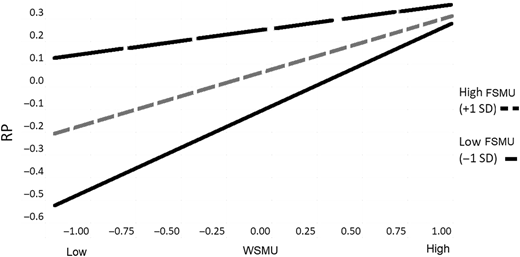
To test the reliability and validity of study constructs, we employed a confirmatory factor analysis on partial least squares structural equation modeling (PLS-SEM) 3.0. We also utilized PLS-SEM 3.0 to test the structural model (hypotheses testing). We utilized PLS-SEM as the method of data analysis because (a) it is less restrictive and has more statistical power than covariance-based SEM (CB-SEM), and (2) it estimates complex models without imposing distributional assumptions on the data (Hair et al., 2016). The reliability and validity results are shown in Table 1 and Table 2. Moreover, the variance inflation factor (VIF) values have been calculated to check multicollinearity issues (Table 2). Furthermore, the Harman’s single-factor test was also performed before hypothesis testing to check common method bias (CMB). Additionally, we utilized a common latent factor (CLF) test and compared the standardized regression weights of all measurement items of the model with and without CLF. The differences in standardized regression weights were less than 0.20, which confirms CMB is not a concern (Archimi et al., 2018) in the present study. Subsequently, the path analysis was performed, and the results are shown in Tables 3 and 4. The path analysis (SEM) considered the bootstrapping approach as per the guidelines of Hair et al. (2016). Furthermore, the interaction plots for moderation analysis are exhibited in Figure 3.

First, we evaluated the construct’s validity and reliability. Cronbach’s alpha and composite reliability values were more than 0.80, indicating good construct reliability and internal consistency (Hair et al., 2019). The average variance extracted (AVE) values for all constructs are above 0.50, which implies good convergent validity (Fornell and Larcker, 1981). Factor loadings were higher than 0.7, suggesting good convergent validity, exceeding the recommended value, i.e. 0.70.

Moreover, discriminant validity was examined as recommended by Fornell and Larcker (1981). We compared the value of squared roots of AVEs to its applicable construct’s correlations, and the square roots of AVE scores were higher than the construct’s correlations, indicating good discriminant validity.

Furthermore, we assessed the discriminant validity of our study constructs. In this vein, the heterotrait-monotrait ratio (HTMT) values are evaluated. The scores of study constructs were all under 0.85 (Henseler et al., 2016), which supports the discriminant validity of the constructs. Additionally, we evaluated VIF values presented in Table 2 to check multicollinearity issues and found that the VIF values were not higher than the cut-off value of 3.0 (Hair et al., 2016). Hence, multicollinearity is not an issue for this study.

Since this study relies on cross-sectional survey data collected from employees, we performed different tests to find any concern regarding the common method bias. First, Harman’s single test was employed, and it observed that the maximum covariance explained by a single factor is 36.65%, which is far less than 50%. Second, to limit the response bias, we also examined the correlation matrix and found none of the associations exceeded 0.90 (Pavlou et al., 2007). Third, during the data collection process, authors guarantee respondents' confidentiality and anonymity, encouraging them to provide genuine responses (Mahmood et al., 2019). Hence, it concluded that method bias is not a concern in the present study.

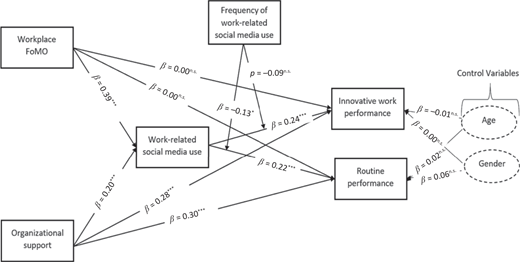
Direct effect. Figure 2 shows that workplace FoMO is positively related to social media use (β = 0.39, t = 7.29, p = 0.00), while the effect of workplace FoMO on routine performance (β = 0.07, t = 1.12, p = 0.26) and innovative work performance (β = 0.01, t = 0.08, p = 0.97) are not significant. Thus, hypotheses H1 is supported, and hypotheses H2a and H2b are not supported. Organizational support is positively related to social media use (β = 0.23, t = 2.98, p = 0.01), moreover, while the effect of organizational support on routine performance (β = 0.30, t = 5.29, p = 0.00) and innovative work performance (β = 0.28, t = 4.30, p = 0.00) are positive and significant. Hence, hypotheses H4, H5a and H5b are supported.

Mediation analysis. The path analysis of indirect effect illustrates in Table 4, shows WRSMU is significant and fully mediates the association between workplace FoMO and routine performance (β = 0.10, t = 2.88, p = 0.01); and innovative work performance (β = 0.09, t = 3.39, p = 0.001). Thus, hypotheses 3a and 3b are supported. Moreover, WRSMU is positively, significantly, and partially mediating the association between organizational support and routine performance (β = 0.05, t = 2.84, p = 0.01); innovative work performance (β = 0.05, t = 2.12, p = 0.01). Hence, hypotheses H6a and H6b are supported.

Moderation analysis. The present study also examined the moderating role of FSMU. The moderation analysis revealed that FSMU significantly but negatively moderates between WSMU and RP (β = −0.13, t = 2.66, p = 0.01). Moreover, work-related social media use is better for routine performance, especially when the frequency of WRSMU is low (β = 0.33, t = 4.50, p = 0.00) rather than high (β = 0.13, t = 1.95, p = 0.05) (Figure 3). However, FSMU did not moderate between WSMU and IP (β = −0.09, t = 1.58, p > 0.10). Hence, hypothesis H7a is supported, and H7 b is not supported.

The present study examined the mediating role of WRSMU in the association between workplace FoMO and organizational support and employee performance. Furthermore, the moderating role of FSMU in the association between WRSMU and performance. Our PLS-SEM findings revealed that workplace FoMO is positively and significantly associated with innovative and routine performance through WSMU. Workplace FoMO was not directly associated with innovative or routine performance. In contrast, the results demonstrate a direct and positive association between organizational support and innovative and routine performance. Furthermore, the results indicate that organizational support is positively associated with innovative and routine performance, suggesting partial mediation. Finally, we highlight that the FSMU moderates the relationship between WRSMU and routine performance, such that the relationship between WRSMU and performance is stronger when the frequency of social media use is low (rather than high). The frequency of social media use did not moderate the relationship between WRSMU and innovative performance. These findings have several implications for theorizing about the role of social media use in organizational contexts.

This study focused on the central role of WRSMU in underlying employee performance. Several studies have explored this relationship in the past, suggesting that WRSMU was positively related to job performance through informational benefits (Jafar et al., 2019), social exchange theory (Chen and Wei, 2020), increased job satisfaction (Moqbel et al., 2013), and social capital (Ali-Hassan et al., 2015; Cao et al., 2016). However, others demonstrated negative relationships with job performance, especially due to excessive social media usage patterns (Yu et al., 2018; Zivnuska et al., 2019). This study sheds new light on the role of WRSMU. Specifically, utilizing COR principles, we suggest that social media can act as a significant resource within the organizational context. COR theory posits that individuals strive to acquire, retain, and protect their valuable resources. Our findings suggest that WRSMU emerges as a resource that employees leverage to mitigate the potential resource loss associated with workplace FoMO. Furthermore, WRSMU can help employees capitalize on the resource gains provided by organizational support. This mechanism is positively associated with routine and innovative performance.

The results indicate that workplace FoMO and organizational support are important antecedents to WRSMU. We suggest that workplace FoMO signals the potential to miss out on important informational resources, motivating employees to engage in WRSMU to reduce the potential of missing out. Hence, we extend the notion that employees are motivated to avoid resource loss (Halbesleben et al., 2014) to argue that employees are also motivated to avoid missing out on valuable resources. The findings further highlight that workplace FoMO is positively related to routine and innovative performance through WRSMU. Hence, we demonstrate that WRSMU may operate as an important resource that benefits job performance. Hence, using COR as our framework, we synthesize earlier findings by connecting the notion that FoMO is positively associated with WRSMU (Van Zoonen et al., 2022) and that social media use may enhance employee productivity (Wu et al., 2021).

It should also be noted that workplace FoMO does not directly affect routine or innovative performance. Research that demonstrated a link between workplace FoMO and motivation and health outcomes called for further exploration of the relationship between FoMO and performance (Budnick et al., 2020). In line with previous studies (Fridchay and Reizer, 2022), we find that workplace FoMO is only indirectly related to performance. The absence of a direct relationship between FoMO and performance seems to suggest that FoMO relates positively to performance only when it compels employees to engage in WRSMU to keep themselves informed and connected.

Conversely, the findings indicate that organizational support is positively associated with WRSMU. These findings suggest that organizational support for social media can be viewed as intangible resources that help employees obtain more resources, i.e. use social media for work. We argued that support may alleviate stress and reduce anxiety related to technology use in organizations (Eisenberger et al., 2020). This is especially important in the context of social media use that has often been described as a technology of accountability due to the visibility they afford (e.g. Treem, 2015). When support is high, employees are more likely to utilize social media for work, which benefits routine and innovative performance. Hence, taken together, this study demonstrates that COR theory provides a valuable framework for developing an in-depth understanding of WRSMU.

Finally, this study contributes to research on the potentially adverse implications of social media in organizations by examining the moderating role of frequency of social media use. Research has indicated that WRSMU may have negative consequences for employees and organizations (e.g. Yu et al., 2018, 2022). Negative implications are mostly associated with excessive usage patterns (Cao et al., 2016). Our findings only partially support this idea by demonstrating that negative moderation exists between WRSMU and the frequency of social media use on routine performance. Specifically, we show that the positive impact of social media on routine performance is stronger when the frequency of social media use is low. However, we do not find a negative relationship (as opposed to a less strong positive relationship) at high social media frequencies. In addition, we could not confirm a negative moderation for innovative performance. Overall, this suggests that while low to moderate social media use may be beneficial for routine performance, we do not find that high usage frequencies lead to negative implications for performance. Arguably, the high use frequencies reported in our sample were not high enough to detect an interaction effect. Future studies should explore the extent to which user frequencies are related to negative ramifications of social media use in the workplace, or the conditions under which such effects exist.

The present study has several implications for employees and organizations. First, this study confirms that WRSMU positively influences employees' routine and innovative work performance. As such, we would encourage organizations and employees to consider how social media technologies can be embedded within organizational processes. The findings indicate that providing organizational support may increase social media use. In addition, research showed that social media training and experience with social media are important antecedents for WRSMU (Pekkala and van Zoonen, 2022). As such, it would behove organizations to offer employees social media training and help them gain experience with using social media technologies for work.

Second, the results indicate that the relationship between WRSMU and routine performance is stronger when the frequency of social media use is low, rather than high. This indicates that the benefits of social media use for work may decrease when the frequency of social media use becomes too high. As such organizations should be wary of excessive usage patterns among employees. Similar to how other communication technologies in organizations ought to be used, managers and employees should aim at establishing social norms that promote healthy connectivity expectations and behaviors.

As with any study, several limitations need to be considered. First, the data reported in this study are cross-sectional and self-reported. This limits our opportunities to draw causal conclusions from the data. Furthermore, it is not possible to examine temporal dynamics or changes over time. In addition, the data are self-reported, which introduces measurement bias such as social desirability bias. Future research should study the antecedents and consequences of WRSMU using longitudinal and multi-sourced data. For instance, longitudinal data allows for studying the directionality of relations and draws conclusions beyond correlations. Multi-sourced research designs could include content analysis of employees’ social media data to examine work-related communication behavior and link that to survey data (van Zoonen and Treem, 2019).

In addition, COR theory is a relevant framework for studying WRSMU. However, beyond workplace FoMO and organizational support, the framework leaves room for the inclusion of other resources that may be drained, or gained, in the context of social media use. For instance, we did not consider how social media use may expand finite resources of employees, leading to communication or information overload (Zhang et al., 2023) or work-life conflicts (Zivnuska et al., 2019). In addition, we did not consider personal characteristics such as self-regulatory focus (Luqman et al., 2021). Moreover, organizational support or supervisor support may be used as a moderator in future studies.

Moreover, the study relies on employees from a variety of different organizations. While this may improve the generalizability, it limits opportunities to consider organization-specific conditions or obtain supervisor-rated performance metrics. A case study in one organization may help to advance our understanding of WRSMU as it will allow examination of organization-specific factors such as social media policies, leader-member exchange, and social networks. Ultimately, we support calls for expanding the theoretical and methodological repertoire to study social technologies in organizations (Leonardi and Vaast, 2017).

Finally, it is notable that FSMU did not moderate the relationship between WRSMU and innovative performance. Arguably, frequency plays a more complex role in influencing these relationships. For instance, high-frequency usage or problematic social media use may lead to low self-control, difficulties in impulse control, and goal-oriented behavior (Lewin et al., 2022; Leijse et al., 2023). Future research could explore why high-frequency social media use does not necessarily enhance the relationship between WRSMU and innovative performance. One promising avenue is to examine the potential double-edged effects, such as information overload, which may counteract the benefits of increased communication and idea exchange. Perhaps industry differences based on creativity and social media intensity provide a good starting point for such exploration. For instance, a recent report shows that the sports industry uses 19.8 weekly posts for user engagement, followed by media, health, and beauty sectors (Rival IQ, 2025).

Social media technologies have become increasingly popular in organizations, affording a wide range of communication and collaboration opportunities (Safadi, 2024). The findings of this study contribute to theorizing about the role of these technologies in shaping the way employees work and perform job tasks. By leveraging the core tenets of COR theory, we conceptualized how workplace FoMO and organizational support inform innovative and routine job performance through WRSMU. We demonstrate that work-related social media plays a central role in helping employees prevent potential resource loss and help gain additional resources. Furthermore, we find that WRSMU positively influences routine and innovative performance. Interestingly, the positive relationship between WRSMU and routine performance becomes weaker at higher frequencies of social media use, suggesting moderate and mindful use of social media for work might particularly improve workforce productivity.

This research did not require IRB approval because it involved a minimal-risk survey among consenting adults, did not collect sensitive personal data or personally identifiable information, and was conducted in accordance with the ethical principles outlined by the Finnish National Board on Research Integrity (TENK) and the Declaration of Helsinki. According to these guidelines, such research does not require prior ethical review when participants are fully informed, and participation is voluntary.

Workplace FoMO (Budnick et al., 2020; Tandon et al., 2021a).

  1. I get worried when I might miss important work-related updates.

  2. I get anxious when I miss out on an opportunity to make important business connections.

  3. When I go on vacation, I continue to keep tabs on what is happening at work.

  4. I worry that I will miss out on important work-related news.

  5. When I have a good time during work hours, it is important for me to share the details online (e.g. updating status).

Organizational support (Thompson et al., 1991; Bodhi, 2021).

  1. Guidance is available to me for a selection of different social media platforms.

  2. A specific person is available for assistance related to technical issues with social media.

  3. My co-worker frequently supports me when I face difficulties related to social media use.

  4. I frequently support my co-worker when I face difficulties related to social media use.

Work-related social media use (Bodhi et al., 2023).

  1. Social media has become part of my daily routine.

  2. I use social media to share work plan/objective information with colleagues.

  3. I use social media to arrange meetings with colleagues about work projects.

  4. I use social media to share work-related information with colleagues.

  5. I use social media to share documents and files with colleagues within the organization.

  6. I feel I am part of the social media community.

Routine performance (Janssen and Van Yperen, 2004; Ali-Hassan et al., 2015).

  1. I always complete the duties specified in my job description.

  2. I always meet all the formal performance requirements of my job.

  3. I always fulfil all responsibilities required by my job.

  4. I often fail to perform essential duties (r). *

Innovative performance (Janssen and Van Yperen, 2004; Ali-Hassan et al., 2015; Zhang et al., 2021)

How often do you perform the following work activities?
  1. Create new ideas for improvements.

  2. Search out novel working methods.

  3. Transform innovative ideas into useful applications.

  4. Mobilize support for innovative ideas. *

Frequency of using social media use (Phillips and Wisniewski, 2021; Swirsky et al., 2021).

  1. When you are at work, how often do you use social media?

    (a) Never (b) About once a day (c) 2–5 times a day (d) 6–10 times a day (e) Every hour

*Deleted due to weak factor loading.
Ali-Hassan
,
H.
,
Nevo
,
D.
and
Wade
,
M.
(
2015
), “
Linking dimensions of social media use to job performance: the role of social capital
”,
The Journal of Strategic Information Systems
, Vol. 
24
No. 
2
, pp. 
65
-
89
, doi: .
Alt
,
D.
(
2017
), “
Students' social media engagement and fear of missing out (FoMO) in a diverse classroom
”,
Journal of Computing in Higher Education
, Vol. 
29
No. 
2
, pp. 
388
-
410
, doi: .
Alt
,
D.
(
2018
), “
Students' wellbeing, fear of missing out, and social media engagement for leisure in higher education learning environments
”,
Current Psychology
, Vol. 
37
No. 
1
, pp. 
128
-
138
, doi: .
Araujo
,
T.
,
Wonneberger
,
A.
,
Neijens
,
P.
and
de Vreese
,
C.
(
2017
), “
How much time do you spend online? Understanding and improving the accuracy of self-reported measures of internet use
”,
Communication Methods and Measures
, Vol. 
11
No. 
3
, pp. 
173
-
190
, doi: .
Archimi
,
C.S.
,
Reynaud
,
E.
,
Yasin
,
H.M.
and
Bhatti
,
Z.A.
(
2018
), “
How perceived corporate social responsibility affects employee cynicism: the mediating role of organizational trust
”,
Journal of Business Ethics
, Vol. 
151
No. 
4
, pp. 
907
-
921
, doi: .
Bakker
,
A.B.
,
Demerouti
,
E.
and
Verbeke
,
W.
(
2004
), “
Using the job demands‐resources model to predict burnout and performance
”,
Human Resource Management: Published in Cooperation with the School of Business Administration, The University of Michigan and in alliance with the Society of Human Resources Management
, Vol. 
43
No. 
1
, pp. 
83
-
104
, doi: .
Bakker
,
A.B.
,
Demerouti
,
E.
and
Euwema
,
M.C.
(
2005
), “
Job resources buffer the impact of job demands on burnout
”,
Journal of Occupational Health Psychology
, Vol. 
10
No. 
2
, pp. 
170
-
180
, doi: .
Bernerth
,
J.B.
and
Aguinis
,
H.
(
2016
), “
A critical review and best‐practice recommendations for control variable usage
”,
Personnel Psychology
, Vol. 
69
No. 
1
, pp. 
229
-
283
, doi: .
Beyens
,
I.
,
Frison
,
E.
and
Eggermont
,
S.
(
2016
), “
‘I don't want to miss a thing’: adolescents' fear of missing out and its relationship to adolescents' social needs, Facebook use, and Facebook related stress
”,
Computers in Human Behavior
, Vol. 
64
, pp. 
1
-
8
, doi: .
Bhagat
,
S.
and
Kim
,
D.J.
(
2023
), “
Examining users' news sharing behaviour on social media: role of perception of online civic engagement and dual social influences
”,
Behaviour and Information Technology
, Vol. 
42
No. 
8
, pp. 
1194
-
1215
, doi: .
Bodhi
,
R.
(
2021
), “
Social media usage and its impact on employee performance and well-being in the context of IT industry in India
”,
Thesis, Motilal Nehru National Institute of Technology
,
INFLIBNET Centre
.
Bodhi
,
R.
(
2024
 
In press
), “
How does enterprise social media use affect employees’ psychological well-being and innovative work performance? Findings from hybrid approaches
”,
Information Technology and People
, Vol. 
ahead-of-print
 
ahead-of-print
, doi: .
Bodhi
,
R.
,
Singh
,
T.
and
Joshi
,
Y.
(
2022
), “
Modelling the role of social media usage in improving users well-being: a social enhancement model perspective
”,
Benchmarking: An International Journal
, Vol.
29
No.
8
, pp.
2450
-
2470
, doi: .
Bodhi
,
R.
,
Luqman
,
A.
,
Hina
,
M.
and
Papa
,
A.
(
2023
), “
Work-related social media use and employee-related outcomes: a moderated mediation model
”,
International Journal of Emerging Markets
, Vol. 
18
No. 
11
, pp.
4948
-
4967
, doi: .
Bodhi
,
R.
,
Chaturvedi
,
S.
and
Purohit
,
S.
(
2024
), “
The influence of organizational commitment on employee green behavior: mediating role of work-related social media use
”,
International Journal of Manpower
, Vol. 
ahead-of-print
No. 
ahead-of-print
, pp. 
605
-
631
, doi: .
Budnick
,
C.J.
,
Rogers
,
A.P.
and
Barber
,
L.K.
(
2020
), “
The fear of missing out at work: examining costs and benefits to employee health and motivation
”,
Computers in Human Behavior
, Vol. 
104
, 106161, doi: .
Buglass
,
S.L.
,
Binder
,
J.F.
,
Betts
,
L.R.
and
Underwood
,
J.D.
(
2017
), “
Motivators of online vulnerability: the impact of social network site use and FOMO
”,
Computers in Human Behavior
, Vol. 
66
, pp. 
248
-
255
, doi: .
Bulgurcu
,
B.
,
Van Osch
,
W.
and
Kane
,
G.C.
(
2018
), “
The rise of the promoters: user classes and contribution patterns in enterprise social media
”,
Journal of Management Information Systems
, Vol. 
35
No. 
2
, pp.
610
-
646
, doi: .
Cao
,
X.
,
Guo
,
X.
,
Vogel
,
D.
and
Zhang
,
X.
(
2016
), “
Exploring the influence of social media on employee work performance
”,
Internet Research
, Vol. 
26
No. 
2
, pp. 
529
-
545
, doi: .
Caya
,
O.
and
Mosconi
,
E.
(
2023
), “
Citizen behaviors, enterprise social media and firm performance
”,
Information Technology and People
, Vol. 
36
No. 
3
, pp. 
1298
-
1325
, doi: .
Chen
,
X.
and
Wei
,
S.
(
2020
), “
The impact of social media use for communication and social exchange relationship on employee performance
”,
Journal of Knowledge Management
, Vol. 
24
No. 
6
, pp. 
1289
-
1314
, doi: .
Chen
,
X.
,
Wei
,
S.
,
Davison
,
R.M.
and
Rice
,
R.E.
(
2020
), “
How do enterprise social media affordances affect social network ties and job performance?
”,
Information Technology and People
, Vol. 
33
No. 
1
, pp. 
361
-
388
, doi: .
Chen
,
X.
,
Ou
,
C.X.
and
Davison
,
R.M.
(
2022
), “
Internal or external social media? The effects of work-related and social-related use of social media on improving employee performance
”,
Internet Research
, Vol. 
32
No. 
3
, pp. 
680
-
707
, doi: .
Chu
,
T.H.
(
2020
), “
A meta-analytic review of the relationship between social media use and employee outcomes
”,
Telematics and Informatics
, Vol. 
50
, 101379, doi: .
Dhir
,
A.
,
Talwar
,
S.
,
Kaur
,
P.
,
Budhiraja
,
S.
and
Islam
,
N.
(
2021
), “
The dark side of social media: stalking, online self‐disclosure and problematic sleep
”,
International Journal of Consumer Studies
, Vol. 
45
No. 
6
, pp. 
1373
-
1391
, doi: .
Dutta
,
D.
and
Mishra
,
S.K.
(
2024
), “
Bots for mental health: the boundaries of human and technology agencies for enabling mental well-being within organizations
”,
Personnel Review
, Vol. 
53
No. 
5
, pp.
1129
-
1156
, doi: .
Eisenberger
,
R.
,
Rhoades Shanock
,
L.
and
Wen
,
X.
(
2020
), “
Perceived organizational support: why caring about employees counts
”,
Annual Review of Organizational Psychology and Organizational Behavior
, Vol. 
7
No. 
1
, pp. 
101
-
124
, doi: .
El Ouirdi
,
M.
,
El Ouirdi
,
A.
,
Segers
,
J.
and
Pais
,
I.
(
2016
), “
Technology adoption in employee recruitment: the case of social media in Central and Eastern Europe
”,
Computers in Human Behavior
, Vol. 
57
, pp. 
240
-
249
, doi: .
Elhai
,
J.D.
,
Levine
,
J.C.
,
Alghraibeh
,
A.M.
,
Alafnan
,
A.A.
,
Aldraiweesh
,
A.A.
and
Hall
,
B.J.
(
2018
), “
Fear of missing out: testing relationships with negative affectivity, online social engagement, and problematic smartphone use
”,
Computers in Human Behavior
, Vol. 
89
, pp. 
289
-
298
, doi: .
Elhai
,
J.D.
,
Yang
,
H.
and
Montag
,
C.
(
2020
), “
Fear of missing out (FOMO): overview, theoretical underpinnings, and literature review on relations with severity of negative affectivity and problematic technology use
”,
Brazilian Journal of Psychiatry
, Vol. 
43
No. 
2
, pp. 
203
-
209
, doi: .
Ellison
,
N.B.
,
Steinfield
,
C.
and
Lampe
,
C.
(
2007
), “
The benefits of Facebook ‘friends:’ Social capital and college students' use of online social network sites
”,
Journal of Computer-Mediated Communication
, Vol. 
12
No. 
4
, pp. 
1143
-
1168
, doi: .
Fornell
,
C.
and
Larcker
,
D.F.
(
1981
), “
Evaluating structural equation models with unobservable variables and measurement error
”,
Journal of Marketing Research
, Vol. 
18
No. 
1
, pp. 
39
-
50
, doi: .
Fridchay
,
J.
and
Reizer
,
A.
(
2022
), “
Fear of missing out (FOMO): implications for employees and job performance
”,
The Journal of Psychology
, Vol. 
156
No. 
4
, pp. 
257
-
277
, doi: .
Garcia-Morales
,
V.J.
,
Martín-Rojas
,
R.
and
Lardón-López
,
M.E.
(
2018
), “
Influence of social media technologies on organizational performance through knowledge and innovation
”,
Baltic Journal of Management
, Vol. 
13
No. 
3
, pp. 
345
-
367
, doi: .
Guenzi
,
P.
and
Nijssen
,
E.J.
(
2020
), “
Studying the antecedents and outcome of social media use by salespeople using a MOA framework
”,
Industrial Marketing Management
, Vol. 
90
, pp. 
346
-
359
, doi: .
Hair
,
J.F.
,
Black
,
W.C.
,
Babin
,
B.J.
and
Anderson
,
R.E.
(
2019
),
Multivariate Data Analysis
, (8th) ed.,
CENGAGE
,
Hampshire
.
Hair
,
J.F.
,
Hult
,
G.T.M.
,
Ringle
,
C.M.
and
Sarstedt
,
M.
(
2016
),
A Primer on Partial Least Squares Structural Equation Modeling (PLS-SEM)
, (2 ed.) ,
Sage
,
Thousand Oaks, CA
.
Halawani
,
F.M.
,
Soh
,
P.C.
and
Halawani
,
Y.M.
(
2020
), “
Social media utilisation and business performance of hotels in Lebanon: exploring the moderating effects of hotel classification
”,
Journal of Global Information Management
, Vol. 
28
No. 
3
, pp. 
58
-
76
, doi: .
Halbesleben
,
J.R.
,
Neveu
,
J.P.
,
Paustian-Underdahl
,
S.C.
and
Westman
,
M.
(
2014
), “
Getting to the “COR” understanding the role of resources in conservation of resources theory
”,
Journal of Management
, Vol. 
40
No. 
5
, pp. 
1334
-
1364
, doi: .
Han
,
Q.
and
Xia
,
L.
(
2020
), “
Social media use and employee innovative behavior: the mediating role of employee voice
”,
Social Behavior and Personality: An International Journal
, Vol. 
48
No. 
3
, pp. 
1
-
7
, doi: .
Henseler
,
J.
,
Hubona
,
G.
and
Ray
,
P.A.
(
2016
), “
Using PLS path modeling in new technology research: updated guidelines
”,
Industrial Management and Data Systems
, Vol. 
116
No. 
1
, pp. 
2
-
20
, doi: .
Hobfoll
,
S.E.
(
1989
), “
Conservation of resources: a new attempt at conceptualizing stress
”,
American Psychologist
, Vol. 
44
No. 
3
, pp. 
513
-
524
, doi: .
Hobfoll
,
S.E.
(
2002
), “
Social and psychological resources and adaptation
”,
Review of General Psychology
, Vol. 
6
No. 
4
, pp. 
307
-
324
, doi: .
Jafar
,
R.M.S.
,
Geng
,
S.
,
Ahmad
,
W.
,
Niu
,
B.
and
Chan
,
F.T.
(
2019
), “
Social media usage and employee's job performance: the moderating role of social media rules
”,
Industrial Management and Data Systems
, Vol. 
119
No. 
9
, pp. 
1908
-
1925
, doi: .
Janssen
,
O.
and
Van Yperen
,
N.W.
(
2004
), “
Employees' goal orientations, the quality of leader-member exchange, and the outcomes of job performance and job satisfaction
”,
Academy of Management Journal
, Vol. 
47
No. 
3
, pp. 
368
-
384
, doi: .
Jawahar
,
I.M.
,
Stone
,
T.H.
and
Kisamore
,
J.L.
(
2007
), “
Role conflict and burnout: the direct and moderating effects of political skill and perceived organizational support on burnout dimensions
”,
International Journal of Stress Management
, Vol. 
14
No. 
2
, pp. 
142
-
159
, doi: .
Jiang
,
F.
,
Lu
,
S.
,
Zhu
,
X.
and
Song
,
X.
(
2021
), “
Social media impacts the relation between interpersonal conflict and job performance
”,
Asia Pacific Journal of Human Resources
, Vol. 
59
No. 
3
, pp. 
420
-
441
, doi: .
Kelman
,
H.C.
(
1958
), “
Compliance, identification, and internalization three processes of attitude change
”,
Journal of Conflict Resolution
, Vol. 
2
No. 
1
, pp. 
51
-
60
, doi: .
Kurtessis
,
J.N.
,
Eisenberger
,
R.
,
Ford
,
M.T.
,
Buffardi
,
L.C.
,
Stewart
,
K.A.
and
Adis
,
C.S.
(
2017
), “
Perceived organizational support: a meta-analytic evaluation of organizational support theory?
”,
Journal of Management
, Vol. 
43
No. 
6
, pp. 
1854
-
1884
, doi: .
Leijse
,
M.M.
,
Koning
,
I.M.
and
Van den Eijnden
,
R.J.
(
2023
), “
The influence of parents and peers on adolescents' problematic social media use revealed
”,
Computers in Human Behavior
, Vol. 
143
, 107705, doi: .
Leonardi
,
P.M.
and
Vaast
,
E.
(
2017
), “
Social media and their affordances for organizing: a review and agenda for research
”,
Academy of Management Annals
, Vol. 
11
No. 
1
, pp. 
150
-
188
, doi: .
Lewin
,
K.M.
,
Ellithorpe
,
M.E.
and
Meshi
,
D.
(
2022
), “
Social comparison and problematic social media use: relationships between five different social media platforms and three different social comparison constructs
”,
Personality and Individual Differences
, Vol. 
199
, 111865, doi: .
Louati
,
H.
and
Hadoussa
,
S.
(
2021
), “
Study of social media impacts on social capital and employee performance–evidence from Tunisia Telecom
”,
Journal of Decision Systems
, Vol. 
30
Nos
2-3
, pp. 
1
-
32
, doi: .
Luqman
,
A.
,
Talwar
,
S.
,
Masood
,
A.
and
Dhir
,
A.
(
2021
), “
Does enterprise social media use promote employee creativity and well-being?
”,
Journal of Business Research
, Vol. 
131
, pp. 
40
-
54
, doi: .
Ma
,
L.
,
Zhang
,
X.
and
Wang
,
G.
(
2022
), “
The impact of enterprise social media use on employee performance: a grounded theory approach
”,
Journal of Enterprise Information Management
, Vol. 
3
No. 
2
, pp. 
481
-
503
, doi: .
Madjar
,
N.
,
Greenberg
,
E.
and
Chen
,
Z.
(
2011
), “
Factors for radical creativity, incremental creativity, and routine, noncreative performance
”,
Journal of Applied Psychology
, Vol. 
96
No. 
4
, pp. 
730
-
743
, doi: .
Mahmood
,
M.
,
Uddin
,
M.A.
and
Luo
,
F.
(
2019
), “
Influence of transformational leadership on employees' creative process engagement: a multi-level analysis
”,
Management Decision
, Vol. 
57
No. 
3
, pp. 
741
-
764
.
Moqbel
,
M.
,
Nevo
,
S.
and
Kock
,
N.
(
2013
), “
Organizational members' use of social networking sites and job performance: an exploratory study
”,
Information Technology and People
, Vol. 
26
No. 
3
, pp. 
240
-
264
, doi: .
Oksa
,
R.
,
Kaakinen
,
M.
,
Savela
,
N.
,
Hakanen
,
J.J.
and
Oksanen
,
A.
(
2021
), “
Professional social media usage and work engagement among professionals in Finland before and during the COVID-19 pandemic: four-wave follow-up study
”,
Journal of Medical Internet Research
, Vol. 
23
No. 
6
, e29036, doi: .
Olfat
,
M.
,
Shokouhyar
,
S.
,
Ahmadi
,
S.
,
Tabarsa
,
G.A.
and
Sedaghat
,
A.
(
2020
), “
Organizational commitment and work-related implementation of enterprise social networks (ESNs): the mediating roles of employees' organizational concern and prosocial values
”,
Online Information Review
, Vol. 
44
No. 
6
, pp. 
1223
-
1243
, doi: .
Pavlou
,
P.A.
,
Liang
,
H.
and
Xue
,
Y.
(
2007
), “
Understanding and mitigating uncertainty in online exchange relationships: a principal-agent perspective
”,
Management Information Systems Quarterly
, Vol. 
31
No. 
1
, pp. 
105
-
136
, doi: .
Pekkala
,
K.
and
van Zoonen
,
W.
(
2022
), “
Work-related social media use: the mediating role of social media communication self-efficacy
”,
European Management Journal
, Vol. 
40
No. 
1
, pp. 
67
-
76
, doi: .
Petty
,
R.E.
and
Cacioppo
,
J.T.
(
1986
), “The elaboration likelihood model of persuasion”, in
Berkovitz
,
L.
(Ed.),
Advances in Experimental Social Psychology
,
Academic Press
,
New York
, Vol. 
19
, pp. 
123
-
205
, doi: .
Phillips
,
W.J.
and
Wisniewski
,
A.T.
(
2021
), “
Self-compassion moderates the predictive effects of social media use profiles on depression and anxiety
”,
Computers in Human Behavior Reports
, Vol. 
4
, 100128, doi: .
Pitafi
,
A.H.
,
Khan
,
A.N.
,
Khan
,
N.A.
and
Ren
,
M.
(
2020
), “
Using enterprise social media to investigate the effect of workplace conflict on employee creativity
”,
Telematics and Informatics
, Vol. 
55
, 101451, doi: .
Przybylski
,
A.K.
,
Murayama
,
K.
,
DeHaan
,
C.R.
and
Gladwell
,
V.
(
2013
), “
Motivational, emotional, and behavioral correlates of fear of missing out
”,
Computers in Human Behavior
, Vol. 
29
No. 
4
, pp. 
1841
-
1848
, doi: .
Reer
,
F.
,
Tang
,
W.Y.
and
Quandt
,
T.
(
2019
), “
Psychosocial well-being and social media engagement: the mediating roles of social comparison orientation and fear of missing out
”,
New Media and Society
, Vol. 
21
No. 
7
, pp. 
1486
-
1505
, doi: .
Riggle
,
R.J.
,
Edmondson
,
D.R.
and
Hansen
,
J.D.
(
2009
), “
A meta-analysis of the relationship between perceived organizational support and job outcomes: 20 years of research
”,
Journal of Business Research
, Vol. 
62
No. 
10
, pp. 
1027
-
1030
, doi: .
Rival
 
IQ
(
2025
),
2025 Social Media Industry Benchmark Report
,
available at:
 https://www.rivaliq.com/blog/social-media-industry-benchmark-report/
Roberts
,
J.A.
and
David
,
M.E.
(
2020
), “
The social media party: fear of missing out (FoMO), social media intensity, connection, and well-being
”,
International Journal of Human-Computer Interaction
, Vol. 
36
No. 
4
, pp. 
386
-
392
, doi: .
Safadi
,
H.
(
2024
), “
Balancing affordances and constraints: designing enterprise social media for organizational knowledge work
”,
MIS Quarterly
, Vol. 
48
No. 
1
, pp. 
347
-
374
, doi: .
Schmidt
,
G.B.
,
Lelchook
,
A.M.
and
Martin
,
J.E.
(
2016
), “
The relationship between social media co-worker connections and work-related attitudes
”,
Computers in Human Behavior
, Vol. 
55
, pp. 
439
-
445
, doi: .
Siders
,
M.A.
,
George
,
G.
and
Dharwadkar
,
R.
(
2001
), “
The relationship of internal and external commitment foci to objective job performance measures
”,
Academy of Management Journal
, Vol. 
44
No. 
3
, pp. 
570
-
579
, doi: .
Sohaib
,
O.
(
2021
), “
Social networking services and social trust in social commerce: a PLS-SEM approach
”,
Journal of Global Information Management
, Vol. 
29
No. 
2
, pp. 
23
-
44
, doi: .
Song
,
Q.
,
Wang
,
Y.
,
Chen
,
Y.
,
Benitez
,
J.
and
Hu
,
J.
(
2019
), “
Impact of the usage of social media in the workplace on team and employee performance
”,
Information and Management
, Vol. 
56
No. 
8
, 103160, doi: .
Stead
,
H.
and
Bibby
,
P.A.
(
2017
), “
Personality, fear of missing out and problematic internet use and their relationship to subjective well-being
”,
Computers in Human Behavior
, Vol. 
76
, pp. 
534
-
540
, doi: .
Sun
,
Y.
,
Zhu
,
M.
and
Jeyaraj
,
A.
(
2020
), “
Motivations of enterprise social media feature set usage
”,
Industrial Management and Data Systems
, Vol. 
120
No. 
7
, pp. 
1421
-
1438
, doi: .
Swirsky
,
J.M.
,
Rosie
,
M.
and
Xie
,
H.
(
2021
), “
Adjustment correlates of social media engagement among early adolescents
”,
Journal of Youth and Adolescence
, Vol. 
50
No. 
12
, pp. 
1
-
14
, doi: .
Tandon
,
A.
,
Kaur
,
P.
,
Dhir
,
A.
and
Mäntymäki
,
M.
(
2020
), “
Sleepless due to social media? Investigating problematic sleep due to social media and social media sleep hygiene
”,
Computers in Human Behavior
, Vol. 
113
, 106487, doi: .
Tandon
,
A.
,
Dhir
,
A.
,
Islam
,
N.
,
Talwar
,
S.
and
Mäntymäki
,
M.
(
2021a
), “
Psychological and behavioral outcomes of social media-induced fear of missing out at the workplace
”,
Journal of Business Research
, Vol. 
136
, pp. 
186
-
197
, doi: .
Tandon
,
A.
,
Dhir
,
A.
,
Almugren
,
I.
,
AlNemer
,
G.N.
and
Mantymaki
,
M.
(
2021b
), “
Fear of missing out (FoMO) among social media users: a systematic literature review, synthesis and framework for future research
”,
Internet Research
, Vol. 
31
No. 
3
, pp. 
782
-
821
, doi: .
Thompson
,
R.L.
,
Higgins
,
C.A.
and
Howell
,
J.M.
(
1991
), “
Personal computing: toward a conceptual model of utilization
”,
MIS Quarterly
, Vol. 
15
No. 
1
, pp. 
125
-
143
, doi: .
Treem
,
J.W.
(
2015
), “
Social media as technologies of accountability: explaining resistance to implementation within organizations
”,
American Behavioral Scientist
, Vol. 
59
No. 
1
, pp. 
53
-
74
, doi: .
van Zoonen
,
W.
and
Rice
,
R.E.
(
2017
), “
Paradoxical implications of personal social media use for work
”,
New Technology, Work and Employment
, Vol. 
32
No. 
3
, pp.
228
-
246
, doi: .
van Zoonen
,
W.
and
Treem
,
J.W.
(
2019
), “
The role of organizational identification and the desire to succeed in employees' use of personal Twitter accounts for work
”,
Computers in Human Behavior
, Vol. 
100
, pp. 
26
-
34
, doi: .
Van Zoonen
,
W.
,
Verhoeven
,
J.W.
and
Vliegenthart
,
R.
(
2016
), “
How employees use Twitter to talk about work: a typology of work-related tweets
”,
Computers in Human Behavior
, Vol. 
55
, pp. 
329
-
339
, doi: .
Van Zoonen
,
W.
,
Treem
,
J.W.
and
Sivunen
,
A.
(
2022
), “
An analysis of fear factors predicting enterprise social media use in an era of communication visibility
”,
Internet Research
, Vol. 
32
No. 
7
, pp. 
354
-
375
, doi: .
Venkatesh
,
V.
,
Brown
,
S.A.
,
Maruping
,
L.M.
and
Bala
,
H.
(
2008
), “
Predicting different conceptualizations of system use: the competing roles of behavioral intention, facilitating conditions, and behavioral expectation
”,
MIS Quarterly
, Vol. 
32
No. 
3
, pp. 
483
-
502
, doi: .
Venkatesh
,
V.
,
Morris
,
M.G.
,
Davis
,
G.B.
and
Davis
,
F.D.
(
2003
), “
User acceptance of information technology: toward a unified view
”,
MIS Quarterly
, Vol. 
27
No. 
3
, pp. 
425
-
478
, doi: .
Venkatesh
,
V.
,
Thong
,
J.Y.L.
and
Xu
,
X.
(
2012
), “
Consumer acceptance and use of information technology: extending the unified theory of acceptance and use of technology
”,
MIS Quarterly
, Vol. 
36
No. 
1
, pp.
157
-
178
, doi: .
Wang
,
B.
,
Liu
,
Y.
and
Parker
,
S.K.
(
2020
), “
How does the use of information communication technology affect individuals? A work design perspective
”,
Academy of Management Annals
, Vol. 
14
No. 
2
, pp. 
695
-
725
, doi: .
Wang
,
Z.
,
Hangeldiyeva
,
M.
,
Ali
,
A.
and
Guo
,
M.
(
2022
), “
Effect of enterprise social media on employee creativity: social exchange theory perspective
”,
Frontiers in Psychology
, Vol. 
12
, 812490, doi: .
We Are Social and Meltwater
(
2023
), “
Digital 2023 global overview report
”,
available at:
 https://datareportal.com/reports/digital-2023-global-overview-report (
accessed
 31 March 2025).
Whitman
,
M.V.
,
Halbesleben
,
J.R.B.
and
Holmes
,
O.
(
2013
), “
Abusive supervision and feedback avoidance: the mediating role of emotional exhaustion
”,
Journal of Organizational Behavior
, Vol. 
35
No. 
1
, pp.
38
-
53
, doi: .
Wu
,
C.
,
Zhang
,
Y.
,
Huang
,
S.
and
Yuan
,
Q.
(
2021
), “
Does enterprise social media usage make the employee more productive? A meta-analysis
”,
Telematics and Informatics
, Vol. 
60
, 101578, doi: .
Yen
,
Y.S.
,
Chen
,
M.C.
and
Su
,
C.H.
(
2020
), “
Social capital affects job performance through social media
”,
Industrial Management and Data Systems
, Vol. 
120
No. 
5
, pp. 
903
-
922
, doi: .
Yu
,
L.
,
Cao
,
X.
,
Liu
,
Z.
and
Wang
,
J.
(
2018
), “
Excessive social media use at work: exploring the effects of social media overload on job performance
”,
Information Technology and People
, Vol. 
31
No. 
6
, pp. 
1091
-
1112
, doi: .
Yu
,
L.
,
Zhong
,
Y.
,
Sun
,
Y.
and
Qin
,
G.
(
2022
), “
The impact of excessive social media use at work: a usage experience–stressor–strain perspective
”,
Behaviour and Information Technology
, Vol. 
42
No. 
7
, pp. 
985
-
1004
, doi: .
Zahmat Doost
,
E.
and
Zhang
,
W.
(
2024
), “
The effect of social media use on job performance with moderating effects of cyberloafing and job complexity
”,
Information Technology and People
, Vol. 
37
No. 
4
, pp. 
1775
-
1801
, doi: .
Zhang
,
J.
,
van Eerde
,
W.
,
Gevers
,
J.M.P.
and
Zhu
,
W.
(
2021
), “
How temporal leadership boosts employee innovative job performance
”,
European Journal of Innovation Management
, Vol. 
24
No. 
1
, pp. 
23
-
42
, doi: .
Zhang
,
J.
,
Jiang
,
R.
,
Wu
,
X.
and
Jiang
,
J.J.
(
2023
), “
The moderating role of enterprise social media functionalities on employees' social-related use during work time
”,
Information and Management
, Vol. 
60
No. 
3
, 103770, doi: .
Zhong
,
L.
,
Wayne
,
S.J.
and
Liden
,
R.C.
(
2016
), “
Job engagement, perceived organizational support, high‐performance human resource practices, and cultural value orientations: a cross‐level investigation
”,
Journal of Organizational Behavior
, Vol. 
37
No. 
6
, pp. 
823
-
844
, doi: .
Zivnuska
,
S.
,
Carlson
,
J.R.
,
Carlson
,
D.S.
,
Harris
,
R.B.
and
Harris
,
K.J.
(
2019
), “
Social media addiction and social media reactions: the implications for job performance
”,
The Journal of Social Psychology
, Vol. 
159
No. 
6
, pp. 
746
-
760
, doi: .
Published by Emerald Publishing Limited. This article is published under the Creative Commons Attribution (CC BY 4.0) licence. Anyone may reproduce, distribute, translate and create derivative works of this article (for both commercial and non-commercial purposes), subject to full attribution to the original publication and authors. The full terms of this licence may be seen at http://creativecommons.org/licences/by/4.0/legalcode

Data & Figures

Figure 1
A research model linking different factors for developing a hypothesis.The model starts with two text boxes on the left. The first text box on the top left is labeled “Workplace FoMO” and the second text box at the bottom left is labeled “Organizational support.” Three solid arrows arise from the workplace FoMO text box, leading to three different text boxes, one at the center and two on the right, labeled as follows: Center text box: “Work-related social media use.” Center right text box: “Innovative work performance.” Bottom right text box: “Routine performance.” From the organizational support, three solid arrows arise, each leading to work-related social media use, innovative work performance, and routine performance text boxes, respectively. From the work-related social media use text box, two arrows arise, leading to innovative work performance and routine performance text boxes, respectively. At the top center, a text box labeled “Frequency of work-related social media use” is present, from which two solid arrows arise, pointing to the two arrows arising from the work-related social media use text box.

Hypothesized research model. Source(s): Authors’ own work

Figure 1
A research model linking different factors for developing a hypothesis.The model starts with two text boxes on the left. The first text box on the top left is labeled “Workplace FoMO” and the second text box at the bottom left is labeled “Organizational support.” Three solid arrows arise from the workplace FoMO text box, leading to three different text boxes, one at the center and two on the right, labeled as follows: Center text box: “Work-related social media use.” Center right text box: “Innovative work performance.” Bottom right text box: “Routine performance.” From the organizational support, three solid arrows arise, each leading to work-related social media use, innovative work performance, and routine performance text boxes, respectively. From the work-related social media use text box, two arrows arise, leading to innovative work performance and routine performance text boxes, respectively. At the top center, a text box labeled “Frequency of work-related social media use” is present, from which two solid arrows arise, pointing to the two arrows arising from the work-related social media use text box.

Hypothesized research model. Source(s): Authors’ own work

Close modal
Figure 2
A flow diagram linking different factors with their significance levels in the development of a hypothesis.The model starts with two text boxes on the left. The first text box on the top left is labeled “Workplace FoMO,” and the second text box at the bottom left is labeled “Organizational support.” From the “Workplace FoMO” text box, three solid arrows arise: the first arrow labeled “beta equals point three nine triple asterisks” leads to the “Work-related social media use” text box at the center, the second arrow labeled “beta equals point zero zero superscript n. s.” leads to the “Routine performance” square text box at the bottom right, and the third arrow labeled “beta equals point zero zero superscript n. s.” leads to the “Innovative work performance” text box at the center right. From the “Organizational support” text box, three solid arrows arise: the first arrow labeled “beta equals point two zero triple asterisks” leads to the “Work-related social media use” text box at the center, the second arrow labeled “beta equals point two eight triple asterisks” leads to the “Innovative work performance” text box at the center right, and the third arrow labeled “beta equals point three zero triple asterisks” leads to the “Routine performance” text box at the bottom right. From the “Work-related social media use” text box at the center, two solid arrows arise: the first arrow labeled “beta equals point two four triple asterisks” leads to the “Innovative work performance” text box at the center right, and the second arrow labeled “beta equals point two two triple asterisks” leads to the “Routine performance” text box at the bottom right. At the top center, another text box labeled “Frequency of work-related social media use” is positioned between work-related social media use and innovative work performance text boxes. From the “Frequency of work-related social media use” text box, two solid arrows arise: the first arrow, labeled “p equals negative point zero nine superscript n. s.,” points to the arrow labeled “beta equals point two four triple asterisks” leading to the innovative work performance text box. Similarly, the second arrow labeled “beta equals negative point one three single asterisk” points to the arrow labeled “beta equals point two two triple asterisks,” leading to the routine performance text box. On the far right, a section labeled “Control Variables” contains two dashed ovals labeled “Age” and “Gender.” From “Age,” an arrow labeled “beta equals negative point zero one superscript n. s.” leads to the “Innovative work performance” text box at the center right, and another arrow labeled “beta equals point zero two superscript n. s.” leads to the “Routine performance” text box at the bottom right. From “Gender,” an arrow labeled “beta equals point zero zero superscript n. s.” leads to the “Innovative work performance” text box at the center right, and another arrow labeled “beta equals point zero six superscript n. s.” leads to the “Routine performance” text box at the bottom right. At the bottom, a note states: “Significance level: single asterisk p less than zero point five; double asterisks p less than zero point zero one; triple asterisks p less than zero point zero zero one; n. s. equals Not Significant.”

Results of hypotheses testing. Note(s): Significance level: *p < 0.5; **p < 0.01; **p < 0.001; n.s. = Not Significant. Source(s): Authors’ own work

Figure 2
A flow diagram linking different factors with their significance levels in the development of a hypothesis.The model starts with two text boxes on the left. The first text box on the top left is labeled “Workplace FoMO,” and the second text box at the bottom left is labeled “Organizational support.” From the “Workplace FoMO” text box, three solid arrows arise: the first arrow labeled “beta equals point three nine triple asterisks” leads to the “Work-related social media use” text box at the center, the second arrow labeled “beta equals point zero zero superscript n. s.” leads to the “Routine performance” square text box at the bottom right, and the third arrow labeled “beta equals point zero zero superscript n. s.” leads to the “Innovative work performance” text box at the center right. From the “Organizational support” text box, three solid arrows arise: the first arrow labeled “beta equals point two zero triple asterisks” leads to the “Work-related social media use” text box at the center, the second arrow labeled “beta equals point two eight triple asterisks” leads to the “Innovative work performance” text box at the center right, and the third arrow labeled “beta equals point three zero triple asterisks” leads to the “Routine performance” text box at the bottom right. From the “Work-related social media use” text box at the center, two solid arrows arise: the first arrow labeled “beta equals point two four triple asterisks” leads to the “Innovative work performance” text box at the center right, and the second arrow labeled “beta equals point two two triple asterisks” leads to the “Routine performance” text box at the bottom right. At the top center, another text box labeled “Frequency of work-related social media use” is positioned between work-related social media use and innovative work performance text boxes. From the “Frequency of work-related social media use” text box, two solid arrows arise: the first arrow, labeled “p equals negative point zero nine superscript n. s.,” points to the arrow labeled “beta equals point two four triple asterisks” leading to the innovative work performance text box. Similarly, the second arrow labeled “beta equals negative point one three single asterisk” points to the arrow labeled “beta equals point two two triple asterisks,” leading to the routine performance text box. On the far right, a section labeled “Control Variables” contains two dashed ovals labeled “Age” and “Gender.” From “Age,” an arrow labeled “beta equals negative point zero one superscript n. s.” leads to the “Innovative work performance” text box at the center right, and another arrow labeled “beta equals point zero two superscript n. s.” leads to the “Routine performance” text box at the bottom right. From “Gender,” an arrow labeled “beta equals point zero zero superscript n. s.” leads to the “Innovative work performance” text box at the center right, and another arrow labeled “beta equals point zero six superscript n. s.” leads to the “Routine performance” text box at the bottom right. At the bottom, a note states: “Significance level: single asterisk p less than zero point five; double asterisks p less than zero point zero one; triple asterisks p less than zero point zero zero one; n. s. equals Not Significant.”

Results of hypotheses testing. Note(s): Significance level: *p < 0.5; **p < 0.01; **p < 0.001; n.s. = Not Significant. Source(s): Authors’ own work

Close modal
Figure 3
A line graph showing the relationship between W S M U and R P, with higher F S M U weakening the positive effect.The horizontal axis is labeled “W S M U,” and ranges from negative 1.00 labeled “Low,” to 1.00 labeled “High,” in increments of 0.25 units. The vertical axis is labeled “R P” and ranges from negative 0.6 to 0.3 in increments of 0.1 units. The graph shows the data for two lines, “High F S M U (positive 1 S D)” and “Low F S M U (negative 1 S D)” as a dashed line and a solid line, respectively. The legend for these lines is presented on the right. The high F S M U (positive 1 S D) line begins at the coordinates (negative 1.20, 0.1), shows a moderate increase in the slope, and terminates at (1.00, 0.25). A faded dashed line is shown between high F S M U and low F S M U lines. It begins at (negative 1.20, negative 0.24), shows a moderate increase in slope, and terminates at (1.0, 0.15). The low F S M U (negative 1 S D) line begins with the coordinates (negative 1.20, negative 0.57), shows a steady increase in the slope, and terminates at (1.00, 0.1). Note: All numerical data values are approximated.

Interaction effect (WSMU x FSMU → RP). Note(s): Simple slopes of moderation effects. Lines represent slopes at -1SD (β = 0.33, t = 4.50, p = 0.00), 0 (β = 0.23, t = 3.10, p = 0.00) and +1SD (β = 0.13, t = 1.95, p = 0.05). Source(s): Authors’ own work

Figure 3
A line graph showing the relationship between W S M U and R P, with higher F S M U weakening the positive effect.The horizontal axis is labeled “W S M U,” and ranges from negative 1.00 labeled “Low,” to 1.00 labeled “High,” in increments of 0.25 units. The vertical axis is labeled “R P” and ranges from negative 0.6 to 0.3 in increments of 0.1 units. The graph shows the data for two lines, “High F S M U (positive 1 S D)” and “Low F S M U (negative 1 S D)” as a dashed line and a solid line, respectively. The legend for these lines is presented on the right. The high F S M U (positive 1 S D) line begins at the coordinates (negative 1.20, 0.1), shows a moderate increase in the slope, and terminates at (1.00, 0.25). A faded dashed line is shown between high F S M U and low F S M U lines. It begins at (negative 1.20, negative 0.24), shows a moderate increase in slope, and terminates at (1.0, 0.15). The low F S M U (negative 1 S D) line begins with the coordinates (negative 1.20, negative 0.57), shows a steady increase in the slope, and terminates at (1.00, 0.1). Note: All numerical data values are approximated.

Interaction effect (WSMU x FSMU → RP). Note(s): Simple slopes of moderation effects. Lines represent slopes at -1SD (β = 0.33, t = 4.50, p = 0.00), 0 (β = 0.23, t = 3.10, p = 0.00) and +1SD (β = 0.13, t = 1.95, p = 0.05). Source(s): Authors’ own work

Close modal
Table 1

Reliability and validity

ConstructsαCRAVErho_A
Workplace FoMO0.850.900.630.86
OS0.870.910.710.87
WSMU0.860.900.600.87
RP0.810.890.720.81
IP0.850.910.760.85
123456
Fornell-Larcker criterion
Workplace FoMO (1)0.80     
IP (2)0.26*0.87    
OS (3)0.38**0.41***0.84   
RP (4)0.33**0.67***0.46***0.85  
WSMU (5)0.47***0.40***0.38***0.42***0.77 
FSMU (6)0.23**0.29**0.21*0.27**0.35**--
HTMT ratio
Workplace FoMO (1)--     
IP (2)0.29    
OS (3)0.450.48   
RP (4)0.400.820.55  
WSMU (5)0.530.460.430.51-- 
FSMU (6)0.250.310.230.300.37

Note(s): α = Cronbach’s alpha, CR = Composite reliability, AVE = Average variance extracted, rho_A = Dijkstra-Henseler’s rho, Workplace FoMO = Workplace Fear of missing out, OS = Organizational support, WRSMU = Work-related social media use, FSMU = Frequency of social media use, RP = Routine work performance, IP = Innovative work performance Significance of Correlations: *p < 0.050, **p < 0.010, ***p < 0.001

Source(s): Authors’ own work
Table 2

Factor loadings of indicators

ConstructsIndicators no.VIF (outer)CFASEM
Workplace fear of missing out (Workplace FoMO)Workplace FoMO 12.090.780.78
Workplace FoMO 22.640.870.87
Workplace FoMO 31.550.740.74
Workplace FoMO 42.180.830.83
Workplace FoMO 51.810.750.75
Innovative work performance (IP)IP12.250.890.89
IP22.520.900.90
IP31.740.820.82
Organizational support (OS)OS12.350.830.83
OS22.460.850.85
OS32.930.880.88
OS42.470.820.82
Routine work performance (RP)RP11.860.850.85
RP21.970.870.87
RP31.560.820.82
Work-related social media use (WRSMU)WSMU11.720.710.71
WSMU22.360.840.84
WSMU32.050.820.82
WSMU41.720.740.74
WSMU51.890.770.77
WSMU61.820.760.76

Note(s): VIF = Variance inflation factor, CFA = Confirmatory factor analysis, SEM = Structural equation modelling

Source(s): Authors’ own work
Table 3

Path Analysis (direct effect)

HsPathΒt-statisticsp-valuesResults
H1Workplace FoMO → WSMU0.397.290.00Supported
H2aWorkplace FoMO → RP0.071.120.26Not Supported
H2bWorkplace FoMO → IP0.010.080.97Not Supported
H4OS → WSMU0.232.900.01Supported
H5aOS → RP0.305.290.00Supported
H5bOS → IP0.284.300.00Supported

Note(s): Work place FoMO = Workplace fear of missing out, OS = Organizational support, WRSMU = Work-related social media use, RP = Routine work performance, IP = Innovative work performance

Source(s): Authors’ own work
Table 4

Mediating analysis

HypothesesPathsDirect effectIndirect effectInference
H3aWorkplace FoMO → WSMU → RP0.07n.s.0.10**Full Mediation
H3bWorkplace FoMO → WSMU → IP0.01n.s.0.09***Full Mediation
H6aOS → WSMU → RP0.30***0.05*Partial Mediation
H6bOS → WSMU → IP0.28***0.06*Partial Mediation

Note(s): Workplace FoMO = Workplace fear of missing out, OS = Organizational support, WSMU = Work-related social media use, RP = Routine work performance, IP = Innovative work performance, Significance level: *p < 0.5, **p < 0.01, **p < 0.001, n.s. = Not Significant

Source(s): Authors’ own work

Supplements

References

Ali-Hassan
,
H.
,
Nevo
,
D.
and
Wade
,
M.
(
2015
), “
Linking dimensions of social media use to job performance: the role of social capital
”,
The Journal of Strategic Information Systems
, Vol. 
24
No. 
2
, pp. 
65
-
89
, doi: .
Alt
,
D.
(
2017
), “
Students' social media engagement and fear of missing out (FoMO) in a diverse classroom
”,
Journal of Computing in Higher Education
, Vol. 
29
No. 
2
, pp. 
388
-
410
, doi: .
Alt
,
D.
(
2018
), “
Students' wellbeing, fear of missing out, and social media engagement for leisure in higher education learning environments
”,
Current Psychology
, Vol. 
37
No. 
1
, pp. 
128
-
138
, doi: .
Araujo
,
T.
,
Wonneberger
,
A.
,
Neijens
,
P.
and
de Vreese
,
C.
(
2017
), “
How much time do you spend online? Understanding and improving the accuracy of self-reported measures of internet use
”,
Communication Methods and Measures
, Vol. 
11
No. 
3
, pp. 
173
-
190
, doi: .
Archimi
,
C.S.
,
Reynaud
,
E.
,
Yasin
,
H.M.
and
Bhatti
,
Z.A.
(
2018
), “
How perceived corporate social responsibility affects employee cynicism: the mediating role of organizational trust
”,
Journal of Business Ethics
, Vol. 
151
No. 
4
, pp. 
907
-
921
, doi: .
Bakker
,
A.B.
,
Demerouti
,
E.
and
Verbeke
,
W.
(
2004
), “
Using the job demands‐resources model to predict burnout and performance
”,
Human Resource Management: Published in Cooperation with the School of Business Administration, The University of Michigan and in alliance with the Society of Human Resources Management
, Vol. 
43
No. 
1
, pp. 
83
-
104
, doi: .
Bakker
,
A.B.
,
Demerouti
,
E.
and
Euwema
,
M.C.
(
2005
), “
Job resources buffer the impact of job demands on burnout
”,
Journal of Occupational Health Psychology
, Vol. 
10
No. 
2
, pp. 
170
-
180
, doi: .
Bernerth
,
J.B.
and
Aguinis
,
H.
(
2016
), “
A critical review and best‐practice recommendations for control variable usage
”,
Personnel Psychology
, Vol. 
69
No. 
1
, pp. 
229
-
283
, doi: .
Beyens
,
I.
,
Frison
,
E.
and
Eggermont
,
S.
(
2016
), “
‘I don't want to miss a thing’: adolescents' fear of missing out and its relationship to adolescents' social needs, Facebook use, and Facebook related stress
”,
Computers in Human Behavior
, Vol. 
64
, pp. 
1
-
8
, doi: .
Bhagat
,
S.
and
Kim
,
D.J.
(
2023
), “
Examining users' news sharing behaviour on social media: role of perception of online civic engagement and dual social influences
”,
Behaviour and Information Technology
, Vol. 
42
No. 
8
, pp. 
1194
-
1215
, doi: .
Bodhi
,
R.
(
2021
), “
Social media usage and its impact on employee performance and well-being in the context of IT industry in India
”,
Thesis, Motilal Nehru National Institute of Technology
,
INFLIBNET Centre
.
Bodhi
,
R.
(
2024
 
In press
), “
How does enterprise social media use affect employees’ psychological well-being and innovative work performance? Findings from hybrid approaches
”,
Information Technology and People
, Vol. 
ahead-of-print
 
ahead-of-print
, doi: .
Bodhi
,
R.
,
Singh
,
T.
and
Joshi
,
Y.
(
2022
), “
Modelling the role of social media usage in improving users well-being: a social enhancement model perspective
”,
Benchmarking: An International Journal
, Vol.
29
No.
8
, pp.
2450
-
2470
, doi: .
Bodhi
,
R.
,
Luqman
,
A.
,
Hina
,
M.
and
Papa
,
A.
(
2023
), “
Work-related social media use and employee-related outcomes: a moderated mediation model
”,
International Journal of Emerging Markets
, Vol. 
18
No. 
11
, pp.
4948
-
4967
, doi: .
Bodhi
,
R.
,
Chaturvedi
,
S.
and
Purohit
,
S.
(
2024
), “
The influence of organizational commitment on employee green behavior: mediating role of work-related social media use
”,
International Journal of Manpower
, Vol. 
ahead-of-print
No. 
ahead-of-print
, pp. 
605
-
631
, doi: .
Budnick
,
C.J.
,
Rogers
,
A.P.
and
Barber
,
L.K.
(
2020
), “
The fear of missing out at work: examining costs and benefits to employee health and motivation
”,
Computers in Human Behavior
, Vol. 
104
, 106161, doi: .
Buglass
,
S.L.
,
Binder
,
J.F.
,
Betts
,
L.R.
and
Underwood
,
J.D.
(
2017
), “
Motivators of online vulnerability: the impact of social network site use and FOMO
”,
Computers in Human Behavior
, Vol. 
66
, pp. 
248
-
255
, doi: .
Bulgurcu
,
B.
,
Van Osch
,
W.
and
Kane
,
G.C.
(
2018
), “
The rise of the promoters: user classes and contribution patterns in enterprise social media
”,
Journal of Management Information Systems
, Vol. 
35
No. 
2
, pp.
610
-
646
, doi: .
Cao
,
X.
,
Guo
,
X.
,
Vogel
,
D.
and
Zhang
,
X.
(
2016
), “
Exploring the influence of social media on employee work performance
”,
Internet Research
, Vol. 
26
No. 
2
, pp. 
529
-
545
, doi: .
Caya
,
O.
and
Mosconi
,
E.
(
2023
), “
Citizen behaviors, enterprise social media and firm performance
”,
Information Technology and People
, Vol. 
36
No. 
3
, pp. 
1298
-
1325
, doi: .
Chen
,
X.
and
Wei
,
S.
(
2020
), “
The impact of social media use for communication and social exchange relationship on employee performance
”,
Journal of Knowledge Management
, Vol. 
24
No. 
6
, pp. 
1289
-
1314
, doi: .
Chen
,
X.
,
Wei
,
S.
,
Davison
,
R.M.
and
Rice
,
R.E.
(
2020
), “
How do enterprise social media affordances affect social network ties and job performance?
”,
Information Technology and People
, Vol. 
33
No. 
1
, pp. 
361
-
388
, doi: .
Chen
,
X.
,
Ou
,
C.X.
and
Davison
,
R.M.
(
2022
), “
Internal or external social media? The effects of work-related and social-related use of social media on improving employee performance
”,
Internet Research
, Vol. 
32
No. 
3
, pp. 
680
-
707
, doi: .
Chu
,
T.H.
(
2020
), “
A meta-analytic review of the relationship between social media use and employee outcomes
”,
Telematics and Informatics
, Vol. 
50
, 101379, doi: .
Dhir
,
A.
,
Talwar
,
S.
,
Kaur
,
P.
,
Budhiraja
,
S.
and
Islam
,
N.
(
2021
), “
The dark side of social media: stalking, online self‐disclosure and problematic sleep
”,
International Journal of Consumer Studies
, Vol. 
45
No. 
6
, pp. 
1373
-
1391
, doi: .
Dutta
,
D.
and
Mishra
,
S.K.
(
2024
), “
Bots for mental health: the boundaries of human and technology agencies for enabling mental well-being within organizations
”,
Personnel Review
, Vol. 
53
No. 
5
, pp.
1129
-
1156
, doi: .
Eisenberger
,
R.
,
Rhoades Shanock
,
L.
and
Wen
,
X.
(
2020
), “
Perceived organizational support: why caring about employees counts
”,
Annual Review of Organizational Psychology and Organizational Behavior
, Vol. 
7
No. 
1
, pp. 
101
-
124
, doi: .
El Ouirdi
,
M.
,
El Ouirdi
,
A.
,
Segers
,
J.
and
Pais
,
I.
(
2016
), “
Technology adoption in employee recruitment: the case of social media in Central and Eastern Europe
”,
Computers in Human Behavior
, Vol. 
57
, pp. 
240
-
249
, doi: .
Elhai
,
J.D.
,
Levine
,
J.C.
,
Alghraibeh
,
A.M.
,
Alafnan
,
A.A.
,
Aldraiweesh
,
A.A.
and
Hall
,
B.J.
(
2018
), “
Fear of missing out: testing relationships with negative affectivity, online social engagement, and problematic smartphone use
”,
Computers in Human Behavior
, Vol. 
89
, pp. 
289
-
298
, doi: .
Elhai
,
J.D.
,
Yang
,
H.
and
Montag
,
C.
(
2020
), “
Fear of missing out (FOMO): overview, theoretical underpinnings, and literature review on relations with severity of negative affectivity and problematic technology use
”,
Brazilian Journal of Psychiatry
, Vol. 
43
No. 
2
, pp. 
203
-
209
, doi: .
Ellison
,
N.B.
,
Steinfield
,
C.
and
Lampe
,
C.
(
2007
), “
The benefits of Facebook ‘friends:’ Social capital and college students' use of online social network sites
”,
Journal of Computer-Mediated Communication
, Vol. 
12
No. 
4
, pp. 
1143
-
1168
, doi: .
Fornell
,
C.
and
Larcker
,
D.F.
(
1981
), “
Evaluating structural equation models with unobservable variables and measurement error
”,
Journal of Marketing Research
, Vol. 
18
No. 
1
, pp. 
39
-
50
, doi: .
Fridchay
,
J.
and
Reizer
,
A.
(
2022
), “
Fear of missing out (FOMO): implications for employees and job performance
”,
The Journal of Psychology
, Vol. 
156
No. 
4
, pp. 
257
-
277
, doi: .
Garcia-Morales
,
V.J.
,
Martín-Rojas
,
R.
and
Lardón-López
,
M.E.
(
2018
), “
Influence of social media technologies on organizational performance through knowledge and innovation
”,
Baltic Journal of Management
, Vol. 
13
No. 
3
, pp. 
345
-
367
, doi: .
Guenzi
,
P.
and
Nijssen
,
E.J.
(
2020
), “
Studying the antecedents and outcome of social media use by salespeople using a MOA framework
”,
Industrial Marketing Management
, Vol. 
90
, pp. 
346
-
359
, doi: .
Hair
,
J.F.
,
Black
,
W.C.
,
Babin
,
B.J.
and
Anderson
,
R.E.
(
2019
),
Multivariate Data Analysis
, (8th) ed.,
CENGAGE
,
Hampshire
.
Hair
,
J.F.
,
Hult
,
G.T.M.
,
Ringle
,
C.M.
and
Sarstedt
,
M.
(
2016
),
A Primer on Partial Least Squares Structural Equation Modeling (PLS-SEM)
, (2 ed.) ,
Sage
,
Thousand Oaks, CA
.
Halawani
,
F.M.
,
Soh
,
P.C.
and
Halawani
,
Y.M.
(
2020
), “
Social media utilisation and business performance of hotels in Lebanon: exploring the moderating effects of hotel classification
”,
Journal of Global Information Management
, Vol. 
28
No. 
3
, pp. 
58
-
76
, doi: .
Halbesleben
,
J.R.
,
Neveu
,
J.P.
,
Paustian-Underdahl
,
S.C.
and
Westman
,
M.
(
2014
), “
Getting to the “COR” understanding the role of resources in conservation of resources theory
”,
Journal of Management
, Vol. 
40
No. 
5
, pp. 
1334
-
1364
, doi: .
Han
,
Q.
and
Xia
,
L.
(
2020
), “
Social media use and employee innovative behavior: the mediating role of employee voice
”,
Social Behavior and Personality: An International Journal
, Vol. 
48
No. 
3
, pp. 
1
-
7
, doi: .
Henseler
,
J.
,
Hubona
,
G.
and
Ray
,
P.A.
(
2016
), “
Using PLS path modeling in new technology research: updated guidelines
”,
Industrial Management and Data Systems
, Vol. 
116
No. 
1
, pp. 
2
-
20
, doi: .
Hobfoll
,
S.E.
(
1989
), “
Conservation of resources: a new attempt at conceptualizing stress
”,
American Psychologist
, Vol. 
44
No. 
3
, pp. 
513
-
524
, doi: .
Hobfoll
,
S.E.
(
2002
), “
Social and psychological resources and adaptation
”,
Review of General Psychology
, Vol. 
6
No. 
4
, pp. 
307
-
324
, doi: .
Jafar
,
R.M.S.
,
Geng
,
S.
,
Ahmad
,
W.
,
Niu
,
B.
and
Chan
,
F.T.
(
2019
), “
Social media usage and employee's job performance: the moderating role of social media rules
”,
Industrial Management and Data Systems
, Vol. 
119
No. 
9
, pp. 
1908
-
1925
, doi: .
Janssen
,
O.
and
Van Yperen
,
N.W.
(
2004
), “
Employees' goal orientations, the quality of leader-member exchange, and the outcomes of job performance and job satisfaction
”,
Academy of Management Journal
, Vol. 
47
No. 
3
, pp. 
368
-
384
, doi: .
Jawahar
,
I.M.
,
Stone
,
T.H.
and
Kisamore
,
J.L.
(
2007
), “
Role conflict and burnout: the direct and moderating effects of political skill and perceived organizational support on burnout dimensions
”,
International Journal of Stress Management
, Vol. 
14
No. 
2
, pp. 
142
-
159
, doi: .
Jiang
,
F.
,
Lu
,
S.
,
Zhu
,
X.
and
Song
,
X.
(
2021
), “
Social media impacts the relation between interpersonal conflict and job performance
”,
Asia Pacific Journal of Human Resources
, Vol. 
59
No. 
3
, pp. 
420
-
441
, doi: .
Kelman
,
H.C.
(
1958
), “
Compliance, identification, and internalization three processes of attitude change
”,
Journal of Conflict Resolution
, Vol. 
2
No. 
1
, pp. 
51
-
60
, doi: .
Kurtessis
,
J.N.
,
Eisenberger
,
R.
,
Ford
,
M.T.
,
Buffardi
,
L.C.
,
Stewart
,
K.A.
and
Adis
,
C.S.
(
2017
), “
Perceived organizational support: a meta-analytic evaluation of organizational support theory?
”,
Journal of Management
, Vol. 
43
No. 
6
, pp. 
1854
-
1884
, doi: .
Leijse
,
M.M.
,
Koning
,
I.M.
and
Van den Eijnden
,
R.J.
(
2023
), “
The influence of parents and peers on adolescents' problematic social media use revealed
”,
Computers in Human Behavior
, Vol. 
143
, 107705, doi: .
Leonardi
,
P.M.
and
Vaast
,
E.
(
2017
), “
Social media and their affordances for organizing: a review and agenda for research
”,
Academy of Management Annals
, Vol. 
11
No. 
1
, pp. 
150
-
188
, doi: .
Lewin
,
K.M.
,
Ellithorpe
,
M.E.
and
Meshi
,
D.
(
2022
), “
Social comparison and problematic social media use: relationships between five different social media platforms and three different social comparison constructs
”,
Personality and Individual Differences
, Vol. 
199
, 111865, doi: .
Louati
,
H.
and
Hadoussa
,
S.
(
2021
), “
Study of social media impacts on social capital and employee performance–evidence from Tunisia Telecom
”,
Journal of Decision Systems
, Vol. 
30
Nos
2-3
, pp. 
1
-
32
, doi: .
Luqman
,
A.
,
Talwar
,
S.
,
Masood
,
A.
and
Dhir
,
A.
(
2021
), “
Does enterprise social media use promote employee creativity and well-being?
”,
Journal of Business Research
, Vol. 
131
, pp. 
40
-
54
, doi: .
Ma
,
L.
,
Zhang
,
X.
and
Wang
,
G.
(
2022
), “
The impact of enterprise social media use on employee performance: a grounded theory approach
”,
Journal of Enterprise Information Management
, Vol. 
3
No. 
2
, pp. 
481
-
503
, doi: .
Madjar
,
N.
,
Greenberg
,
E.
and
Chen
,
Z.
(
2011
), “
Factors for radical creativity, incremental creativity, and routine, noncreative performance
”,
Journal of Applied Psychology
, Vol. 
96
No. 
4
, pp. 
730
-
743
, doi: .
Mahmood
,
M.
,
Uddin
,
M.A.
and
Luo
,
F.
(
2019
), “
Influence of transformational leadership on employees' creative process engagement: a multi-level analysis
”,
Management Decision
, Vol. 
57
No. 
3
, pp. 
741
-
764
.
Moqbel
,
M.
,
Nevo
,
S.
and
Kock
,
N.
(
2013
), “
Organizational members' use of social networking sites and job performance: an exploratory study
”,
Information Technology and People
, Vol. 
26
No. 
3
, pp. 
240
-
264
, doi: .
Oksa
,
R.
,
Kaakinen
,
M.
,
Savela
,
N.
,
Hakanen
,
J.J.
and
Oksanen
,
A.
(
2021
), “
Professional social media usage and work engagement among professionals in Finland before and during the COVID-19 pandemic: four-wave follow-up study
”,
Journal of Medical Internet Research
, Vol. 
23
No. 
6
, e29036, doi: .
Olfat
,
M.
,
Shokouhyar
,
S.
,
Ahmadi
,
S.
,
Tabarsa
,
G.A.
and
Sedaghat
,
A.
(
2020
), “
Organizational commitment and work-related implementation of enterprise social networks (ESNs): the mediating roles of employees' organizational concern and prosocial values
”,
Online Information Review
, Vol. 
44
No. 
6
, pp. 
1223
-
1243
, doi: .
Pavlou
,
P.A.
,
Liang
,
H.
and
Xue
,
Y.
(
2007
), “
Understanding and mitigating uncertainty in online exchange relationships: a principal-agent perspective
”,
Management Information Systems Quarterly
, Vol. 
31
No. 
1
, pp. 
105
-
136
, doi: .
Pekkala
,
K.
and
van Zoonen
,
W.
(
2022
), “
Work-related social media use: the mediating role of social media communication self-efficacy
”,
European Management Journal
, Vol. 
40
No. 
1
, pp. 
67
-
76
, doi: .
Petty
,
R.E.
and
Cacioppo
,
J.T.
(
1986
), “The elaboration likelihood model of persuasion”, in
Berkovitz
,
L.
(Ed.),
Advances in Experimental Social Psychology
,
Academic Press
,
New York
, Vol. 
19
, pp. 
123
-
205
, doi: .
Phillips
,
W.J.
and
Wisniewski
,
A.T.
(
2021
), “
Self-compassion moderates the predictive effects of social media use profiles on depression and anxiety
”,
Computers in Human Behavior Reports
, Vol. 
4
, 100128, doi: .
Pitafi
,
A.H.
,
Khan
,
A.N.
,
Khan
,
N.A.
and
Ren
,
M.
(
2020
), “
Using enterprise social media to investigate the effect of workplace conflict on employee creativity
”,
Telematics and Informatics
, Vol. 
55
, 101451, doi: .
Przybylski
,
A.K.
,
Murayama
,
K.
,
DeHaan
,
C.R.
and
Gladwell
,
V.
(
2013
), “
Motivational, emotional, and behavioral correlates of fear of missing out
”,
Computers in Human Behavior
, Vol. 
29
No. 
4
, pp. 
1841
-
1848
, doi: .
Reer
,
F.
,
Tang
,
W.Y.
and
Quandt
,
T.
(
2019
), “
Psychosocial well-being and social media engagement: the mediating roles of social comparison orientation and fear of missing out
”,
New Media and Society
, Vol. 
21
No. 
7
, pp. 
1486
-
1505
, doi: .
Riggle
,
R.J.
,
Edmondson
,
D.R.
and
Hansen
,
J.D.
(
2009
), “
A meta-analysis of the relationship between perceived organizational support and job outcomes: 20 years of research
”,
Journal of Business Research
, Vol. 
62
No. 
10
, pp. 
1027
-
1030
, doi: .
Rival
 
IQ
(
2025
),
2025 Social Media Industry Benchmark Report
,
available at:
 https://www.rivaliq.com/blog/social-media-industry-benchmark-report/
Roberts
,
J.A.
and
David
,
M.E.
(
2020
), “
The social media party: fear of missing out (FoMO), social media intensity, connection, and well-being
”,
International Journal of Human-Computer Interaction
, Vol. 
36
No. 
4
, pp. 
386
-
392
, doi: .
Safadi
,
H.
(
2024
), “
Balancing affordances and constraints: designing enterprise social media for organizational knowledge work
”,
MIS Quarterly
, Vol. 
48
No. 
1
, pp. 
347
-
374
, doi: .
Schmidt
,
G.B.
,
Lelchook
,
A.M.
and
Martin
,
J.E.
(
2016
), “
The relationship between social media co-worker connections and work-related attitudes
”,
Computers in Human Behavior
, Vol. 
55
, pp. 
439
-
445
, doi: .
Siders
,
M.A.
,
George
,
G.
and
Dharwadkar
,
R.
(
2001
), “
The relationship of internal and external commitment foci to objective job performance measures
”,
Academy of Management Journal
, Vol. 
44
No. 
3
, pp. 
570
-
579
, doi: .
Sohaib
,
O.
(
2021
), “
Social networking services and social trust in social commerce: a PLS-SEM approach
”,
Journal of Global Information Management
, Vol. 
29
No. 
2
, pp. 
23
-
44
, doi: .
Song
,
Q.
,
Wang
,
Y.
,
Chen
,
Y.
,
Benitez
,
J.
and
Hu
,
J.
(
2019
), “
Impact of the usage of social media in the workplace on team and employee performance
”,
Information and Management
, Vol. 
56
No. 
8
, 103160, doi: .
Stead
,
H.
and
Bibby
,
P.A.
(
2017
), “
Personality, fear of missing out and problematic internet use and their relationship to subjective well-being
”,
Computers in Human Behavior
, Vol. 
76
, pp. 
534
-
540
, doi: .
Sun
,
Y.
,
Zhu
,
M.
and
Jeyaraj
,
A.
(
2020
), “
Motivations of enterprise social media feature set usage
”,
Industrial Management and Data Systems
, Vol. 
120
No. 
7
, pp. 
1421
-
1438
, doi: .
Swirsky
,
J.M.
,
Rosie
,
M.
and
Xie
,
H.
(
2021
), “
Adjustment correlates of social media engagement among early adolescents
”,
Journal of Youth and Adolescence
, Vol. 
50
No. 
12
, pp. 
1
-
14
, doi: .
Tandon
,
A.
,
Kaur
,
P.
,
Dhir
,
A.
and
Mäntymäki
,
M.
(
2020
), “
Sleepless due to social media? Investigating problematic sleep due to social media and social media sleep hygiene
”,
Computers in Human Behavior
, Vol. 
113
, 106487, doi: .
Tandon
,
A.
,
Dhir
,
A.
,
Islam
,
N.
,
Talwar
,
S.
and
Mäntymäki
,
M.
(
2021a
), “
Psychological and behavioral outcomes of social media-induced fear of missing out at the workplace
”,
Journal of Business Research
, Vol. 
136
, pp. 
186
-
197
, doi: .
Tandon
,
A.
,
Dhir
,
A.
,
Almugren
,
I.
,
AlNemer
,
G.N.
and
Mantymaki
,
M.
(
2021b
), “
Fear of missing out (FoMO) among social media users: a systematic literature review, synthesis and framework for future research
”,
Internet Research
, Vol. 
31
No. 
3
, pp. 
782
-
821
, doi: .
Thompson
,
R.L.
,
Higgins
,
C.A.
and
Howell
,
J.M.
(
1991
), “
Personal computing: toward a conceptual model of utilization
”,
MIS Quarterly
, Vol. 
15
No. 
1
, pp. 
125
-
143
, doi: .
Treem
,
J.W.
(
2015
), “
Social media as technologies of accountability: explaining resistance to implementation within organizations
”,
American Behavioral Scientist
, Vol. 
59
No. 
1
, pp. 
53
-
74
, doi: .
van Zoonen
,
W.
and
Rice
,
R.E.
(
2017
), “
Paradoxical implications of personal social media use for work
”,
New Technology, Work and Employment
, Vol. 
32
No. 
3
, pp.
228
-
246
, doi: .
van Zoonen
,
W.
and
Treem
,
J.W.
(
2019
), “
The role of organizational identification and the desire to succeed in employees' use of personal Twitter accounts for work
”,
Computers in Human Behavior
, Vol. 
100
, pp. 
26
-
34
, doi: .
Van Zoonen
,
W.
,
Verhoeven
,
J.W.
and
Vliegenthart
,
R.
(
2016
), “
How employees use Twitter to talk about work: a typology of work-related tweets
”,
Computers in Human Behavior
, Vol. 
55
, pp. 
329
-
339
, doi: .
Van Zoonen
,
W.
,
Treem
,
J.W.
and
Sivunen
,
A.
(
2022
), “
An analysis of fear factors predicting enterprise social media use in an era of communication visibility
”,
Internet Research
, Vol. 
32
No. 
7
, pp. 
354
-
375
, doi: .
Venkatesh
,
V.
,
Brown
,
S.A.
,
Maruping
,
L.M.
and
Bala
,
H.
(
2008
), “
Predicting different conceptualizations of system use: the competing roles of behavioral intention, facilitating conditions, and behavioral expectation
”,
MIS Quarterly
, Vol. 
32
No. 
3
, pp. 
483
-
502
, doi: .
Venkatesh
,
V.
,
Morris
,
M.G.
,
Davis
,
G.B.
and
Davis
,
F.D.
(
2003
), “
User acceptance of information technology: toward a unified view
”,
MIS Quarterly
, Vol. 
27
No. 
3
, pp. 
425
-
478
, doi: .
Venkatesh
,
V.
,
Thong
,
J.Y.L.
and
Xu
,
X.
(
2012
), “
Consumer acceptance and use of information technology: extending the unified theory of acceptance and use of technology
”,
MIS Quarterly
, Vol. 
36
No. 
1
, pp.
157
-
178
, doi: .
Wang
,
B.
,
Liu
,
Y.
and
Parker
,
S.K.
(
2020
), “
How does the use of information communication technology affect individuals? A work design perspective
”,
Academy of Management Annals
, Vol. 
14
No. 
2
, pp. 
695
-
725
, doi: .
Wang
,
Z.
,
Hangeldiyeva
,
M.
,
Ali
,
A.
and
Guo
,
M.
(
2022
), “
Effect of enterprise social media on employee creativity: social exchange theory perspective
”,
Frontiers in Psychology
, Vol. 
12
, 812490, doi: .
We Are Social and Meltwater
(
2023
), “
Digital 2023 global overview report
”,
available at:
 https://datareportal.com/reports/digital-2023-global-overview-report (
accessed
 31 March 2025).
Whitman
,
M.V.
,
Halbesleben
,
J.R.B.
and
Holmes
,
O.
(
2013
), “
Abusive supervision and feedback avoidance: the mediating role of emotional exhaustion
”,
Journal of Organizational Behavior
, Vol. 
35
No. 
1
, pp.
38
-
53
, doi: .
Wu
,
C.
,
Zhang
,
Y.
,
Huang
,
S.
and
Yuan
,
Q.
(
2021
), “
Does enterprise social media usage make the employee more productive? A meta-analysis
”,
Telematics and Informatics
, Vol. 
60
, 101578, doi: .
Yen
,
Y.S.
,
Chen
,
M.C.
and
Su
,
C.H.
(
2020
), “
Social capital affects job performance through social media
”,
Industrial Management and Data Systems
, Vol. 
120
No. 
5
, pp. 
903
-
922
, doi: .
Yu
,
L.
,
Cao
,
X.
,
Liu
,
Z.
and
Wang
,
J.
(
2018
), “
Excessive social media use at work: exploring the effects of social media overload on job performance
”,
Information Technology and People
, Vol. 
31
No. 
6
, pp. 
1091
-
1112
, doi: .
Yu
,
L.
,
Zhong
,
Y.
,
Sun
,
Y.
and
Qin
,
G.
(
2022
), “
The impact of excessive social media use at work: a usage experience–stressor–strain perspective
”,
Behaviour and Information Technology
, Vol. 
42
No. 
7
, pp. 
985
-
1004
, doi: .
Zahmat Doost
,
E.
and
Zhang
,
W.
(
2024
), “
The effect of social media use on job performance with moderating effects of cyberloafing and job complexity
”,
Information Technology and People
, Vol. 
37
No. 
4
, pp. 
1775
-
1801
, doi: .
Zhang
,
J.
,
van Eerde
,
W.
,
Gevers
,
J.M.P.
and
Zhu
,
W.
(
2021
), “
How temporal leadership boosts employee innovative job performance
”,
European Journal of Innovation Management
, Vol. 
24
No. 
1
, pp. 
23
-
42
, doi: .
Zhang
,
J.
,
Jiang
,
R.
,
Wu
,
X.
and
Jiang
,
J.J.
(
2023
), “
The moderating role of enterprise social media functionalities on employees' social-related use during work time
”,
Information and Management
, Vol. 
60
No. 
3
, 103770, doi: .
Zhong
,
L.
,
Wayne
,
S.J.
and
Liden
,
R.C.
(
2016
), “
Job engagement, perceived organizational support, high‐performance human resource practices, and cultural value orientations: a cross‐level investigation
”,
Journal of Organizational Behavior
, Vol. 
37
No. 
6
, pp. 
823
-
844
, doi: .
Zivnuska
,
S.
,
Carlson
,
J.R.
,
Carlson
,
D.S.
,
Harris
,
R.B.
and
Harris
,
K.J.
(
2019
), “
Social media addiction and social media reactions: the implications for job performance
”,
The Journal of Social Psychology
, Vol. 
159
No. 
6
, pp. 
746
-
760
, doi: .

Languages

or Create an Account

Close Modal
Close Modal