


The study aims to explore the role of sustainability reporting in strategic management. It examines how sustainability reporting affects strategy implementation (single-loop learning) and strategy formulation (double-loop learning).
Using a case-study methodology, 22 semi-structured interviews were conducted at a large mining company. Additionally, secondary data, including the company’s sustainability reports from 2018 to 2023, were gathered. A thematic data analysis was used.
The study shows that sustainability reporting contributes to strategic management. More specifically, sustainability reporting facilitates strategy implementation (single-loop learning) by identifying deviations, prescribing actions and clarifying responsibilities. Moreover, it facilitates strategy formulation (double-loop learning) by supporting materiality analysis and external benchmarking, identifying strategic uncertainties and reassessing and adjusting the strategy.
This case study is exploratory. While NordMine represents a unique case, it is possible that studying a different company would result in different insights. Therefore, future longitudinal case studies are suggested to build on and further develop the findings presented in this paper.
The findings originate from a resource-intensive company that is at the forefront of sustainability transition and has recently reformulated its strategy toward sustainability. The study provides detailed insights into how sustainability reporting can be used by practitioners in different industries to facilitate strategic management, for example, by identifying sustainability key performance indicators and improving their follow-up.
The study contributes to the literature by problematizing the link between sustainability reporting accounting and strategic management. It shows how sustainability reporting affects processes and activities that are usually considered to be related to strategy formulation (interactive control) and implementation (diagnostic control).
1. Introduction
In accounting practice and research, there is a tradition of separating financial accounting (FA) and management control (MC) (e.g. Johnson and Kaplan, 1987). The reason for this “paradigmatic divide” is that these two accounting systems serve the needs of different stakeholders and hence have different purposes (Nilsson and Stockenstrand, 2015). For example, Frostenson and Johnstone (2023, p. 137) argue that “Reporting is […] not the same as controlling.”
Following this line of argumentation, it is not surprising that studies of sustainability reporting (SR) tend to focus on external stakeholder’s expectations (e.g. Burritt and Schaltegger, 2010; Herzig and Schaltegger, 2006). Studies in the area of management and sustainability control, on the other hand, have more of a focus on internal decision-making (Mikes and Metzner, 2023). This is in line with a research perspective that considers management control (Harris, 2018; Harris et al., 2018) and sustainability control (SC) (Beusch et al., 2022; Johnstone, 2019) important in strategic management (SM).
Few scholars, however, have focused on the relationship between SR and organizational change (Adams and McNicholas, 2007; Domingues et al., 2017; Maas et al., 2016) and learning (Mitchell et al., 2012; Washington-Ottombre, 2024). These studies indicate that SR is not only useful for stakeholders outside the organization but can also affect decisions made inside the organization. They also show that organizational change and learning are important dimensions of SM efforts (Traxler et al., 2020).
Despite the existence of promising research efforts, our knowledge is limited about the role of SR for internal decision-making and, in particular, how it is used in SM (Maas et al., 2016). In a literature review by Traxler et al. (2020, p. 14) it is concluded “that the interplay between SR and MCS is still a largely under-researched field. This is true in general, but especially when it comes to empirically investigated linkages.” A similar conclusion is reached in the literature review by Rahi et al. (2022, p. 22) claiming that researchers “either focus on MC or SR.” Finally, and fully in line with the conclusions of Traxler et al. (2020) and Rahi et al. (2022), Garcia-Torea et al. (2023, p. 29) suggest that studies of the interplay between SR and MC “could enrich our understanding of the nuances of sustainability accounting to generate sustainable organizational change.”
These results are intriguing. External stakeholders expect sustainability to be integrated into strategies and operations (Beusch et al., 2022) and that effects of sustainability strategies are reported (Herzig and Schaltegger, 2011). It is assumed that formal policy (i.e. environmental strategies) is linked to practices (Frostenson and Johnstone, 2023). Since sustainability reports are scrutinized by external and internal stakeholders, it is reasonable to anticipate that they affect how sustainability strategies are being implemented and formulated.
The significant gap identified in the literature awakened our interest to examine the relationship between SR and SM. The context is a large mining company undergoing a transformation toward sustainability. We apply organizational learning theory (Argyris and Schön, 1978) as our method theory (Lukka and Vinnari, 2014) to understand how SR affects strategy implementation (single-loop learning) and strategy formulation (double-loop learning). This overall objective led us to address two research questions:
How does SR influence strategy implementation in the mining company?
How does SR influence strategy formulation in the mining company?
2. Literature review and conceptual model
2.1 Sustainability reporting
It is indisputable that SR is important for presenting sustainability-related practices (Domingues et al., 2017; Lozano and Huisingh, 2011). However, many studies – mainly drawing on stakeholder, institutional and legitimacy theories – consider SR to be an end in itself, fulfilling disclosure purposes (e.g. De Micco et al., 2021; Maas et al., 2016). Because of this orientation, they tend to neglect the managerial perspective on SR. While institutional forces, such as regulatory pressures, are crucial for SR in the early stages, internal motives (e.g. improving sustainability performance and using the report as an internal decision-making document) are also important for a company’s SR in later stages (Herremans et al., 2010).
Therefore, some scholars have studied how SR develops within the organizational context (Adams, 2002). This stream of literature is characterized by an emphasis on SR as a process that influences and is influenced by organizational procedures and activities. For instance, using an action research approach, Adams and McNicholas (2007) examine how SR can facilitate a transformation of a government-owned water supply company toward accountability and improved sustainability-related performance. They show that sustainability self-assessment checklists enable managers to assess their progress toward sustainability and identify practices to be improved. This helps managers to embed sustainability in their planning and strategic decisions, such as developing new Key Performance Indicators (KPIs).
How the preparation of sustainability reports can trigger changes in organizations is also the focus of Lozano et al. (2016). Their survey of different industries (e.g. energy, financial services, telecommunications) shows that changes relate to: (1) data-gathering processes; (2) improved transparency; (3) dialogues with stakeholders; and (4) strategy and organizational change. The latter includes effects like having a strategic view on SR and fostering learning. In a similar vein, Domingues et al. (2017) conducted a survey study of public sector organizations. It shows that SR enables managers to track and integrate sustainability into operations. Farooq and De Villiers (2019) add to these insights through an interview study with SR managers based in Australia and New Zealand, explaining how SR is institutionalised and affects organizational change. That process has four phases with a gradual increase in SR maturity, complexity and sophistication. It is only in the last phase that sustainability KPIs are used in SM. Moreover, in a different context, Asogwa et al. (2022) show how SR facilitates organizational changes in NGOs. These changes are mainly associated with improving sustainability performance. For example, SR influences cost and benefit evaluation, improves the quality of service and modifies individual attitudes toward sustainability. Finally, a study of a chemical company by Stacchezzini et al. (2023) shows that the preparation of SR (in the form of Integrated Reporting (IR)) requires the following organizational changes: (1) creation of cross-functional teams; (2) undertaking stakeholders dialogues; (3) development of integrated measurement systems; and (4) combining a push approach (“which imposes IR on the organizational processes and structures”) with a pull approach (“which assumes IR is a result of an integrated business”) (Stacchezzini et al., 2023, p. 229). In sum, these studies show that SR affects organizational change. The next section reviews studies that discuss how SR can be used in SM.
2.2 Sustainability reporting in strategic management
MC processes and structures are of significant importance in SM (Simons, 1995). The results of SM, i.e. to what extent the strategy is successfully implemented, are reported in the annual financial and sustainability reports, referred to as FA. This separation between MC and FA is well described in the literature. For example, Nilsson and Stockenstrand (2015) argue, based on a comprehensive literature review, that MC and FA are two different types of accounting systems. The former needs to be adapted to the specific strategy of the organization leading to a unique control system. The latter is used by owners and funders to compare the organization’s value creation to that of competitors. To facilitate comparison, FA reports must be uniform, and accounting regulations are therefore written in that spirit. According to Nilsson and Stockenstrand (2015), the demand for uniqueness and the demand for uniformity are not easy to reconcile, and, as a result, tensions can be observed between the two accounting systems. Even though there is a tradition of separating MC and FA, Nilsson and Stockenstrand (2015) show that there are studies that question the relevance of that separation (e.g. Taipaleenmäki and Ikäheimo, 2013).
An example of an early study in the area of SR and SM that focus on their relationship, rather than treating them as separate accounting systems, is Adams and Frost (2008). They show that SR enables organizations, in the banking, utility, telecommunications and forestry industries, to redefine and develop KPIs and that leads them to: (1) develop data collection and reporting systems; (2) integrate social and environmental issues in strategic decision-making; and (3) ensure that sustainability performance is in line with the organization’s overall values and objectives. There are also other studies with similar orientations and results, as shown in the literature review by Traxler et al. (2020). At an overall level, these studies demonstrate that SR can affect strategy implementation and formulation, for example, by supporting the development of sustainability KPIs.
Interesting results are also found in studies of the role that MC plays in organizational change processes toward sustainability. For example, Arroyo (2017) shows that a sustainability assessment and reporting tool for two Quebec universities was not integrated with MC. Despite the decoupling, it was used both internally (for reflection, monitoring and planning) and externally (for comparing and as a legitimizing device). Similarly, Arjaliès and Mundy’s (2013) survey of the largest listed companies in France, shows that MC – through the four levers of control in Simons’ (1995) framework – is important in managing a Corporate Social Responsibility (CSR) strategy. The authors also note that a third of the companies do not integrate CSR indicators with reporting. Hence, the link between SM and SR seems rather weak. In contrast, Traxler et al. (2023) found in interviews with Austrian and German companies in the energy, automotive, plant engineering and financial industries, that there is a link between SR and MC in most of the controls identified in Malmi and Brown’s (2008) framework. However, since their study has a focus on the whole management control package (Malmi and Brown, 2008), there is a lack of detail regarding SM. Finally, the study by Cortés et al. (2024) shows how MC supports the transformation of construction companies toward sustainability. The authors acknowledge that SR and MC are related, and they also use the former to analyze the latter. Even though we learn a lot about how MC affects a transformation toward sustainability, the discussion about how SR is used in SM is more limited.
Despite some interesting results from many different industries and types of organizations, there is a lack of detail regarding how SR and SM are related. Hence there is a need for empirical research in the form of rich case studies (Garcia-Torea et al., 2023; Maas et al., 2016; Rahi et al., 2022; Traxler et al., 2020). Following this call, we discuss in the sections below that applying a single- and double-loop learning perspective (Argyris and Schön, 1978) as our method theory (Lukka and Vinnari, 2014) is suitable for analyzing how SR affects organizational learning and specifically strategy implementation and formulation.
2.3 Organizational learning
While there are various perspectives on organizational learning, the one suggested by Argyris and Schön (1978) is probably one of the most influential (Basten and Haamann, 2018). Argyris and Schön (1978) analytically separate single- and double-loop learning. According to them, single-loop learning “involves the detection and correction of error” (Argyris and Schön, 1978, p. 2). However, sometimes organizations face a situation where they need to modify their norms and values (Argyris, 1977, 1999; Argyris and Schön, 1978, 1996). In this situation, double-loop learning enables the organization to adopt a new approach that can lead to a change in strategic direction (Argyris and Schön, 1996).
Applying a single- and double-loop learning perspective, Albrecht et al. (2007) show how a university SR affected organizational learning in the production of the report itself. SR facilitated single-loop learning by indicating changes in the data collection and methods used when preparing the report. The authors argue that SR, and especially public visualization of energy consumption, resulted in double-loop learning because the university had never published such a report before. Specifically, SR contributed to changing the organizational culture toward an increased importance attached to transparency and accountability. In a similar context (i.e. higher-education institutions), Washington-Ottombre (2024) examines the role of the campus SR tool (STARS) in organizational learning. The SR tool supported single- and double-loop learning by: (1) facilitating the spread of sustainability knowledge; (2) guiding planning and targeting of sustainability-related measures; and (3) benchmarking the progress of change. However, the SR tool did not support third-loop learning, which is associated with a “capacity to learn how to learn” (Washington-Ottombre, 2024, p. 1629). Finally, Mitchell et al. (2012) examine triple-bottom-line reporting in an irrigation equipment supply company in Australia. Their research shows that the organization needs to have efficient and effective systems for data collection. To accomplish that, managers should question what they do, how they do it and why they do it. By referring to single- and double-loop learning, the authors argue that answering these questions aids in rethinking the overall strategy of the organization. However, it is not entirely clear how SR could both impact the strategies of action (single-loop learning) and underlying governing variables (double-loop learning).
A single- and double-loop learning approach (Argyris and Schön, 1978) has also been used in the broad area of SM. Some of these studies have had a focus on how learning takes place at the operational level in a manufacturing context (see for example, Jönsson and Grönlund, 1988). Other studies have more of a top-management perspective and relate that to learning at the operational level (e.g. McAdam and Leonard, 1998). In later studies, the terms diagnostic and interactive controls, introduced by Simons in 1995, are sometimes used instead of single- and double-loop learning. Simons (1995) has also acknowledged this relationship. He writes: “Diagnostic control systems are designed to trigger the adjustment of the targets embedded in the plans and programs required for the implementation of intended strategies. Argris and Schön have termed this single-loop learning” (Simons, 1995 p. 68f). In interactive control, MC is used to facilitate a dialogue between top managers and managers at lower levels about the best strategy to pursue, that is, strategy formulation. As pointed out by Harris (2018), among others, the concepts introduced by Simons (1995) have had considerable influence in the area of SM. They have also been applied to sustainability control research (Beusch et al., 2022; Johnstone, 2019). Nevertheless, and to the best of our knowledge, the concepts of diagnostic and interactive control are seldom used to study the role of SR in SM (Traxler et al., 2020). One exemption is the study by Arjaliès and Mundy (2013). However, as pointed out earlier, this survey, in line with many other studies (Garcia-Torea et al., 2023; Rahi et al., 2022), provides few empirical details about the link between SR and SM.
2.4 Conceptual model
As discussed above, research on SR and its role in SM is still in its early stages (e.g. Maas et al., 2016). Therefore, it remains to be answered how SR affects SM. Since organizational learning is necessary for successful SM, for example, in diagnostic and interactive control (Simons, 1995), we have chosen to draw on the ground-breaking work of Argyris and Schön (1978). Below we discuss the conceptual model used in our research endeavour. The model, illustrated in Figure 1, is based on the work by Argyris (1977, 1999) and Argyris and Schön (1978, 1996). Similar models to the one we are proposing are common in studies of organizational learning (see for example, Basten and Haamann, 2018).
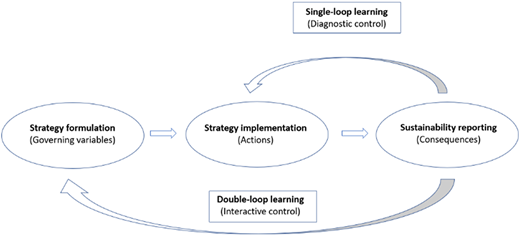
Conceptual model. Source: based on Argyris (1977, 1999) and Argyris and Schön (1978, 1996) [2]
Conceptual model. Source: based on Argyris (1977, 1999) and Argyris and Schön (1978, 1996) [2]
Figure 1 shows possible relationships between SR, strategy implementation (single-loop learning) and strategy formulation (double-loop learning). According to the conceptual model, strategy formulation (based on governing variables) can be expected to influence how strategies are implemented, or in other words, the pattern of operations (actions) [1]. To what extent the formulated strategy is successfully implemented will be presented in the sustainability report (the consequences of actions taken) (e.g. Schaltegger, 2012). If there is a deviation from expected consequences, two types of learning are possible: (1) Single-loop learning, in which there is a need to change actions in order to have consequences that are in line with the chosen strategy; and/or (2) Double-loop learning, in which the strategy, and the underlying governing variables, need to change (Argyris, 1977, 1999; Argyris and Schön, 1978, 1996). In the extant literature, diagnostic control is often used instead of, or together with, single-loop learning. In the same way, interactive control and double-loop learning are used as synonyms.
3. Research design and methodology
3.1 Research design
The research design is based on an abductive approach (Van de Ven, 2007), using a qualitative case-study method. This type of methodology facilitates a more detailed investigation and understanding of a phenomenon by providing rich contextual information (Gerring, 2004). Thus, a case-study method enabled us to increase our understanding of the complex relationships between SR and SM in a specific context. Influenced by Yin’s (1989) suggestions of how to increase the validity and reliability of case study research; considerable attention has been paid to case selection (e.g. case uniqueness), data collection (e.g. data sources, design of the interview guide) and data analysis (e.g. the use of thematic analysis).
3.2 Case selection
NordMine is one of Europe’s largest iron ore producers and a pioneer in making fossil-free sponge iron. NordMine is a unique case because of: (1) its strategic transformation toward producing fossil-free sponge iron; (2) its ambition to develop a new global standard for mining; and (3) its achievements in SR (e.g. in 2021 it was awarded best digital annual and sustainability report in its home country).
At an initial meeting with NordMine representatives, the overall objective of the research project was presented. Methods for data collection, analysis and presentation of results were also discussed, such as the use of interview guides and that the company and interviewees would be anonymous in the published paper. Finally, the applicable national and university ethical protocols were introduced (e.g. that sensitive personal information was not to be collected). After the meeting, NordMine agreed to participate. Based on our analysis of NordMine, and a discussion with their representatives, it was decided to study the period 2018–2024.
3.3 Data collection
From 2022 to 2024, 22 semi-structured interviews were conducted. The interviewees were selected by using snowball sampling in close co-operation with the company. To reduce the selection bias associated with snowball sampling (Parker et al., 2019) and to include diverse perspectives, the interviewees were chosen based on their domain-specific knowledge and position (i.e. area of responsibility) in the company. For the first round of interviews, an interview guide was developed – inspired by the JSW strategy model of Johnson et al. (2009) as well as the strategy formulation model of Hofer and Schendel (1978). The themes covered in the interview guide were: (1) the impact of strategy on SR; (2) the impact of SR on strategy implementation; and (3) the impact of SR on strategy formulation. For the second round of interviews, the interview guide was designed based on: (1) NordMine’s specific KPIs from 2018 to 2030 (Table 1); and (2) Simons’ (1995) “Levers of Control” model. The objective was to explore how SR influences changes in strategy implementation (diagnostic control) and strategy formulation (interactive control). Both interview guides contained a set of open-ended questions to be explored with each interviewee and shared with them some days before the interview. It served as a checklist during the interviews to ensure that relevant themes and questions were covered. The longest interview was 45 minutes long and the shortest was 30 minutes long. They were recorded and later transcribed verbatim. Quotes used in the paper were confirmed by the interviewees. A table with information about interviews can be found in a supplementary file.
NordMine’s sustainability-related KPIs
| Economic sustainability | Social sustainability | Environmental sustainability | |
|---|---|---|---|
| 2018–2021 | Return on equity of at least 12% over a business cycle | Reduce accidents resulting in absence to a rate of 3.5 per million hours worked by 2021 | Reduce carbon emissions by at least 12% per tonne of finished products by 2021 |
| Net debt / equity ratio 0–30% | Women to make up at least 25% of employees by 2021 | Reduce energy intensity by at least 17% by 2021 | |
| Ordinary dividend of 40–60% of profit for the year | Women to make up at least 25% of management by 2021 | Reduce discharges of Nitrogen to water by at least 20% per tonne of finished products by 2021 | |
| Compliance with NordMine’s code of conduct and well-functioning dialogue with stakeholders | Reduce emissions of particles to air from scrubbing equipment by at least 40% by 2021 | ||
| 2022–2030 | Return on equity of at least 9% over a business cycle* | Reduce accidents resulting in absence to a rate of 2 per million hours worked by 2030* | Reduce carbon emissions to 536 (kilotonnes) – or 25% – by 2030* |
| Net debt / equity ratio 60%* | Long-term sick leave 0.8% | Energy use should not exceed 154 (kilowatt-hours per tonne of finished products) – a decrease of 10% – by 2030* | |
| Ordinary dividend of 40–60% of profit for the year | Women to make up at least 30% of employees by 2030* | Making a net contribution to biodiversity by 2030* [in progress] | |
| Women to make up at least 30% of management by 2030* |
Source(s): NordMine’s sustainability reports 2018–2023
In addition to the semi-structured interviews, we collected secondary data from NordMine. An important data source was the external sustainability reports (from 2018 to 2023). Moreover, we had access to some internal documents (e.g. the strategic planning wheel, PowerPoint slides from strategic meetings) as well as business publications and archival data on the company’s website. These data sources enabled us to develop an understanding of the SR process and its interaction with SM.
3.4 Data analysis
At an early stage of the project, the external sustainability reports were read and analyzed. The emphasis was on understanding how NordMine’s vision, mission and strategy changed during the study period. The next step was to uncover if, and in that case how, these changes were related to the risk and opportunity analysis as well as changes in operations and KPIs used. This analysis was necessary in order to put the interview data into the context of NordMine’s transformation into a sustainable mining company.
Early on it was also decided to conduct a multi-level analysis covering strategic, tactical and operational levels. The reason for that choice is that SR and SM processes comprise a collective practice involving managers from different organizational levels. Thus, the research design increased our understanding of how SR influences, and is influenced by, SM in the whole company (Dooley, 2002).
Following the iterative processes of data collection and analysis used in an abductive approach, we moved back and forth between empirical findings, the literature, the conceptual model and emerging concepts (Van de Ven, 2007). In practice, this meant that, after the initial phase of the literature review, we formulated our preliminary research questions and chose to use a conceptual model drawing on Argyris’ (1977, 1999) and Argyris and Schön’s (1978, 1996) work on organizational learning. After that, we developed two interview guides, as described earlier.
In the second phase, the analysis of interview data was initiated. We aimed to give voice to our interviewees at an early stage of data gathering and analysis. This provided us with an opportunity to discover new concepts and aspects related to SR and SM (Gioia et al., 2013). As a consequence, we reformulated our preliminary research questions and made the conceptual model more precise by illustrating the relationships between SR and SM. As the data collection and data analysis processes unfolded, the findings were further developed with a focus on gaps in the existing literature.
To organize and condense data, tables were used. The analysis began with a first-order analysis (Gioia et al., 2013). In this phase, data extracts from interview transcripts and sustainability reports were grouped into sub-themes (e.g. operational changes related to KPIs introduced). In the next phase, the second-order analysis (Gioia et al., 2013), the focus was on the relationships among and within sub-themes, and as a result, some of them were merged. Finally, similar sub-themes were gathered into overarching themes in line with the conceptual model (i.e. SR and strategy implementation; and SR and strategy formulation). This, in turn, helped us to develop a coherent presentation and analysis of the empirical findings and to relate them to the gaps in the literature. The final results were presented and confirmed at a meeting with NordMine managers.
4. Empirical findings
4.1 Strategy as described in sustainability reporting
The sustainability reports show that there were significant changes in the environment of NordMine during the time period of 2018–2023, affecting its long-term strategy. In 2018, NordMine defined its mission in the following way: “to utilize [the country’s] iron ore resources in a responsible way and secure lasting competitiveness and long-term value creation.” In 2020, the vision had shifted completely, stating that “we are leading the transformation of our industry toward a sustainable future.” This, in turn, required the company to adjust its mission to emphasize the importance of product and process innovation.
The company had been a leading producer of high-grade iron ore pellets for a long time; following a differentiation strategy. It also strived to maximize and expand production. Securing stable and high production volumes was a pre-condition for improving the company’s competitiveness and profitability, and to enable investments in technology development. This strategy was further accentuated in 2019.
In 2020, the company introduced a refined product: fossil-free sponge iron. The strategy was adjusted accordingly and now had an overall objective “to achieve zero carbon emissions from its own processes and products by 2045.” It aimed to secure its competitiveness by mining development and developing the production technology for sponge iron. By taking these steps NordMine would take a leap toward a sustainable value chain, and as a result, it would continue to get a price premium for its products. The new strategy also led to a focus on operational excellence in 2021 and 2022. In doing so, there was an emphasis on safe, stable and efficient production processes and minimal impact on the environment and climate. As a consequence, the board of directors set new strategic goals for the period 2022 to 2030. In line with these changes, the sustainability report for 2022 shows that the KPIs were adjusted for the period 2022–2030. These changes are marked with “*” in Table 1.
4.2 Sustainability reporting’s impacts on strategy implementation
The former section (Table 1) shows that KPIs have been introduced to report on progress in achieving objectives important for strategy implementation. This, in turn, helps both group-level management teams and site managers to take action toward sustainability (Table 2).
KPIs reporting and their effect on strategy implementation
| KPIs | Empirical examples |
|---|---|
| Economic Return, debt level, dividend | “Return on equity [KPI] enables us to make some major investments in our transformation processes such as moving from mining and processing with coal and oil to a hydrogen-driven process, to be able to keep up with the CO2 reduction.” # Interview 16 |
| Social Safety and sick-leave absence | “[Following KPIs about reducing accidents] if there is an accident, it needs to be deeply investigated. A lot of people need to be involved [in this process] such as quality people, to help managers to dig into what is the root cause for the accident […], and how can we avoid it from happening again, like a good lesson that can be learned.” # Interview 19 |
| Social Gender balance | “[Following our KPIs], now we have more consideration in the recruitment process when we select candidates, […] it’s very important that the job ads also are more open so that people feel that this is something that they could apply for, that they would feel included.” # Interview 19 |
| Environmental Reducing carbon emission | “To reduce carbon emissions [following environmental KPIs], we have a lot of R&D [projects] to know how we could heat these enormous furnaces, and what type of fuel we can use. We put a lot of effort at the moment into researching if we can use hydrogen gas as fuel. In one of our plants, we moved from fossil-based to bio-based oil. And, that’s a very big investment, which reduced our emissions quite a lot.” # Interview 17 |
| Environmental Logistics | “We have started to report on scope 1 and 2 of our business. We have requirements from external parties, and our customers that they want us to give to the CO2 report […], we have a goal and would do whatever we can to contribute to lower CO2. When it comes to CO2 emissions connected to transportation we have started the journey to collect the data.” #Interview 3 |
| Environmental Energy use | “One example [of following up energy use] is that our company started to use more electric-driven vehicles, which are more energy efficient than diesel ones.” #Interview 16 |
| Environmental Biodiversity | “For biodiversity KPI, we are setting the scene basically; [to understand] what our footprint is at our sites at the moment, that is the first step. And the second step is, what we can do in our production areas. That’s something that will come maybe next year when we have done all the mapping on our environmental footprint for biodiversity.” #Interview 17 |
Note(s): Quotes are adjusted for increased readability
Source(s): Table created by authors
From 2022, setting new economic KPIs was an important decision affecting the sustainability transition process. For example, lowering the required return on equity from 12% to 9% facilitated investment decisions (i.e. transforming mining and processing from fossil fuel to hydrogen-based processes), in line with the strategy to become a sustainable company. Furthermore, by increasing (target) net debt from 0–30% to 60%, it has been possible to use external funding for significant investments, such as building new processing plants to extract rare earth minerals from the mine waste.
Safety has always been at the forefront of mining and processing at NordMine. In 2022, in tandem with changes in social KPIs, the safety guidelines were changed. Consequently, the group-level checklist was updated with measurable targets for safety, health, well-being and inclusion issues. The main aim of this change was to integrate safety into the daily operations. Additionally, root-cause analysis was introduced to facilitate learning from accidents.
To succeed in implementing the new business strategy, significantly reducing carbon emissions is necessary. Therefore, these KPIs in the sustainability report get a lot of attention. As a result, substantial investments have been made in research and development, as well as mining and processing techniques and facilities. SR has also led to substantial changes in transportation and logistics. For example, Scope 1 and 2 reporting requirements have prompted the company to plan for changes in railway maintenance and full electrification of the railway system. Finally, adding a KPI capturing biodiversity has led to some initial activities (e.g., training workshops and mapping the environmental footprint).
At a more general level, SR has contributed to strategy implementation (single-loop learning) in three distinct areas, related to activities usually found in diagnostic control systems (Simons, 1995), that is: (1) to identify deviations between target and performance; (2) to take action based on an analysis of these deviations; and (3) to clarify responsibilities (Table 3).
Reporting reasons and effects on strategy implementation
Reporting reasons | Empirical examples |
|---|---|
| To identify deviations | “I think the sustainability report helps us to be better […]. We need to have many supporting documents and verifications for sustainability reporting. That is good for us to do mapping and ask if our activities are good enough or if they need to be adjusted.” #Interview 3 “When we follow up, we can see that we’re not moving towards our goals as fast as we should. We need to take a step back, maybe rethink and refocus. I think that’s the interaction. We use reporting to see whether we are moving towards the goals at a pace that is needed or not.” #Interview 13 |
| To take action | “[…] The way that we collect sustainability data and make that transparent [contributes to changes in our mining activities]. […] Sustainability reporting is good because it spreads information and collects data and makes things structured in a better way. It is an iterative process.” #Interview 6 “I would say that the focus on energy use, CO2 emissions, environmental impact, HR [issues] has been influenced [by sustainability reporting]. It has changed what kind of fuel we use to reduce carbon dioxide, and also looking at different energy-saving measures.” #Interview 9 |
| To clarify responsibilities | “[…] The report have made the social responsibilities clear for the operational functions because we used to have [the view] that ‘sustainability is someone else’s problem or topic to handle.’ But with the sustainability report, we have pushed the responsibility downward; now operations more clearly need to describe how their business affects the nearby societies or the communities.” #Interview 10 “Sustainability reporting may contribute to operational excellence [in business areas]. We are a mining company, and we [need to] know how we affect communities and lands, we need to do it responsibly.” #Interview 3 |
Note(s): Quotes are adjusted for increased readability
Source(s): Table created by authors
SR helps managers to map how far NordMine has come in the sustainability transition process and evaluate if performance is “good enough” or needs to be adjusted. Thus, SR supports managers to analyze how far they have come in their efforts to implement the chosen strategy and, if it is necessary, take actions to adjust the trajectory. An explanation is given in interview 15: “Sustainability reporting provides a framework to measure progress and success. Although, not all reporting is like this, of course [it is the] external report. If it is external, and we have publicized targets, then that’s a strong driver to reach those, because no one wants to be seen as someone who doesn’t reach the goals. And [we want to] do what we have said we were going to do.”
Furthermore, SR contributes to changing operations, since managers have full ownership of the sustainability-related data they report. This means that managers are accountable for the data they report to the group-level sustainability team. As a consequence, the responsibility for sustainability follow-up and reporting is pushed down to different organizational areas.
4.3 Sustainability reporting’s impacts on strategy formulation
At a general level, SR contributes to strategy formulation (double-loop learning) in three areas. Activities in these areas resemble strategy formulation as a type of interactive control identified by Simons (1995). They are: (1) materiality analysis and external benchmarking; (2) identifying strategic uncertainties; and (3) strategy re-assessment and adjustments (Table 4).
Reporting reasons and effects on strategy formulation
| Reporting reasons | Empirical examples |
|---|---|
| Materiality analysis and external benchmarking | “[…] sustainability reporting is connected to the strategy […] because, in sustainability reporting, we have the materiality analysis, that is the way we do it now connected to CSRD, its [about] internal and external [analysis] and what [would] get material, what gets important, and also, what gets into the strategy. […] Sustainability reporting can influence strategy through the door of materiality analysis.” #Interview 22 “When we produce the annual report, we also compare ourselves to other companies, looking into what others report about, how they report and what kind of topics they are bringing up. So, I think it is also a way to have some benchmarking. Even if it is a desktop benchmarking, we can actually get some input on the way forward, as well.” # Interview 10 |
| Identifying strategic uncertainties | “ It is obvious that sustainability reporting will be much more integrated with the strategy process. So, all the gaps that we’ve found [lead to] changes in risk assessments, we also need to find KPIs and when we’ve identified them, we also [need to] see progress in performance […] when we start to see the performance, we can also start to set [new] targets and follow-ups.” # Interview 22 “Sustainability reporting impacts KPIs, mainly on the environmental and social parts. […] And it is a good way to find the gaps. The gap between what we think is important and what our stakeholders think is important to talk about or to show.” #Interview 10 “I think [sustainability reporting] drives us to question the importance of the environment, to ask, what are we doing to our environment? Because reporting itself has that effect on us, it tries to question and make us realize what is important […] sustainability reporting’s biggest contribution is raising questions […] our basic fundamental thinking is changing.” #Interview 12 |
| Strategy re-assessment and adjustments | “We report on KPIs connected to the strategy’s targets and we realize […] we need to adjust the strategy and ask: Can we do it in a different way? Can we find another strategy? So, that feedback is really important because reporting is the answer to how well we are doing and how our activities affect and what kind of effect our activities result in.” #Interview 4 “Sustainability reporting is a wonderful tool for establishing what we have done and what we intend to do in the future, and many details on how we want to do it, and that reflects the strategy we are developing.” #Interview 2 “The sustainability report could be quite an important input to what we call the management yearly review. And that is because they are produced at the same time, and then they look at: […] Have we achieved our targets? Why didn’t we achieve the targets? What do we need to do? What changes do we need to make?” #Interview 11 |
Note(s): Quotes are adjusted for increased readability
Source(s): Table created by authors
The management review and the strategic analysis phases help group management to do a gap analysis. The analysis shows the company’s current position toward achieving its objectives and identifies if adjustments to the strategy are necessary. Additionally, the production of a sustainability report requires the sustainability group and business area managers to identify and analyze deviations from the strategy. This forces managers not only to understand current performance in relation to intended targets but also to compare NordMine with other companies in a benchmarking exercise. An explanation is given in interview 9: “[…] we can also compare what we have in our sustainability report with other companies’ to see what we are good at and what we can do better.” This means that SR is used as both an external and internal communication tool.
NordMine has also started to perform materiality analyses of their mining sites. This enables group management to get closer to the source of information about business risks and opportunities at the operational levels. By doing so, they get information support not only for SR purposes but also for the strategic planning process. The materiality analysis provides information to help to identify crucial sustainability-related areas to focus on and be reflected in the strategy. Hence, SR embraces an ongoing planning and follow-up process that helps managers evaluate whether they are implementing the “right” strategy toward sustainability. In that way, the feedback from SR contributes to strategic changes (double-loop learning) in NordMine by identifying future areas of strategic importance (i.e. strategic uncertainties). An explanation is given in interview 4: “We report on certain KPIs [in sustainability reporting] connecting to the strategy’s targets, and we realize that it will be tough or impossible to reach a certain level. We need to adjust the strategy and ask: Can we do it in a different way? Can we find another strategy? So, that feedback is really important.”
By introducing specific KPIs on environmental and social issues, iterations in the strategy formulation process enabling double-loop learning and improvements are facilitated. For instance, in one of the business areas, an external rating and consultancy company has been used to make executive managers aware of a need to add, adjust and follow new KPIs related to SR. In this process, NordMine has identified a need to fill the gap between what managers think is important according to the current strategy and what is actually important in view of new SR requirements. Finally, the empirics show that sustainability-related risk-management reporting requirements, specifically value-chain risk-management disclosure, have contributed to strategic changes in NordMine (e.g. the elimination of dependencies on certain suppliers).
5. Discussion
5.1 Sustainability reporting and strategy
The analysis of NordMine’s sustainability reports shows that the risk landscape, its vision and mission – and consequently its strategy and operations – have changed considerably. The reports describe the ambitious plans to transform the company into a leading manufacturer of fossil-free sponge iron and what has been achieved so far. This way of presenting the strategy of the company is in line with literature suggesting external reporting to have an inside-out perspective (e.g. Schaltegger, 2012). It thus considers the role of SR to be a mirror of the company’s strategy and performance with an aim to maintain legitimacy as well as meet stakeholders’ information needs (Burritt and Schaltegger, 2010; De Micco et al., 2021; Schaltegger, 2012). According to this stream of literature, SR is used for disclosure purposes.
Still, and based on the findings from the present study, we add to this perspective. We argue that SR is not solely driven by regulations, stakeholder needs and other external factors. As shown in the extant literature, SR is also important in SM (e.g. Arjaliès and Mundy, 2013; Traxler et al., 2023), and more specifically as a facilitator of single- and double-loop learning (e.g. Washington-Ottombre, 2024). The present study contributes to this stream of literature (Garcia-Torea et al., 2023; Maas et al., 2016; Rahi et al., 2022; Traxler et al., 2020) by demonstrating how SR affects organizational change through its impact on strategy implementation and formulation. By drawing on organizational learning theories (Argyris and Schön, 1978), and combining them with the concepts of diagnostic and interactive control (Simons, 1995), we are able to provide more detailed insights into the relationships of SR and SM. The two following sections discuss this in detail.
5.2 Sustainability reporting as a facilitator of single-loop learning
Based on the empirical evidence of our study (see Tables 1–3), there are several reasons for arguing that SR facilitates single-loop learning and by doing so contributes to strategy implementation. First, we have found that SR helps managers to identify and analyze deviations between objectives set and performance. Second, by using these insights, managers can make incremental changes in operations, as well as apply new technology and work methods. Third, it clarifies responsibilities.
These three reasons show that SR facilitates single-loop learning since it involves “the detection and correction of errors” (Argyris and Schön, 1978, p. 2). In other words, SR can be considered to be an assessment and communication tool for corporate sustainability-related practices (e.g. Adams and Frost, 2008; Domingues et al., 2017; Lozano and Huisingh, 2011). A prominent example of that is the introduction of new KPIs (see Tables 1 and 2). These measures, and their reporting of progress toward strategic objectives, are important in the implementation of NordMine’s new strategy. The measures are used as diagnostic control mechanisms (Simons, 1995) at the same time as they are essential in external reporting (e.g. Burritt and Schaltegger, 2010; Schaltegger, 2012). Thus, they help managers to identify differences between what Albrecht et al. (2007, p. 411) call actual and expected outcomes, and, as a reaction to any inconsistencies, make changes in operations to ensure that the company is making progress in areas of critical importance to the strategy.
The present study contributes to the literature by identifying how consequences reported in SR affect what actions are taken to implement the sustainability strategy. The study also identifies three activities that are crucial in facilitating single-loop learning and diagnostic control. It confirms results from earlier studies that SR can be used for identifying deviations and prescribing actions (e.g. Adams and McNicholas, 2007; Adams and Frost, 2008). To these insights, it adds the importance of clarifying responsibilities, an activity that is necessary to ensure successful strategy implementation. Finally, it extends insights from earlier studies by providing detailed empirics (Traxler et al., 2020).
5.3 Sustainability reporting as a facilitator of double-loop learning
The empirical evidence shows how SR facilitates double-loop learning, that is, strategy formulation (see Table 4). First, the process related to strategic planning in NordMine takes place at the same time as the SR process. Furthermore, the sustainability team at the group level are involved in both of these processes. Second, much of the information gathered for SR is also used in the strategy-making process. Therefore, SR not only leads to incremental changes in operations (single-loop learning) but also encourages managers to question the viability of the underlying strategies (Argyris and Schön, 1978, 1996). Hence, SR can affect double-loop learning by filling the gap between the current strategy and an even more suitable (or modified) strategy based on sustainability-related requirements. An explanation is given in interview 3: “Sustainability reporting can be value added to the strategy and strategy can add value to sustainability reporting.”
The present study contributes to the literature by identifying how consequences reported in SR affect sustainability strategy formulation, that is, activities crucial in double-loop learning (Argyris and Schön, 1978) and interactive control (Simons, 1995). Compared to strategy implementation and single-loop learning, there are few studies of how SR is used for strategy formulation. Most of them indicate that SR can be used for double-loop learning without being specific about the activities (e.g. Arjaliès and Mundy, 2013; Cortés et al., 2024; Mitchell et al., 2012; Traxler et al., 2023). One exception is the study by Washington-Ottombre (2024) in which they identify that the spread of sustainability knowledge and benchmarking are important activities in SM. The present study adds to this stream of literature by presenting detailed empirical evidence of how SR affects materiality analysis and benchmarking, identifying strategic uncertainties and strategy re-assessment and adjustments (Traxler et al., 2020). It increases our understanding of what activities are important and also how SR is used in these activities.
6. Conclusions
The aim of the present study is to empirically examine how SR influences strategy implementation and formulation. It contributes to an improved and holistic understanding of the role of SR in SM. It is thus an answer to recent calls for much more detailed empirical studies as discussed in several literature reviews (Garcia-Torea et al., 2023; Maas et al., 2016; Rahi et al., 2022; Traxler et al., 2020).
In line with earlier studies, we can conclude that SR is strategy-driven and mirrors past events (e.g. Burritt and Schaltegger, 2010; De Micco et al., 2021; Schaltegger, 2012). However, the present study adds to such a description of SR by examining other roles of importance. In this regard, we can conclude that SR also contributes to SM. More specifically, SR not only facilitates the detection of deviations from set objectives (single-loop learning) but also makes it possible to question these objectives, and if necessary, change or modify the strategy being pursued (double-loop learning).
Drawing on the works by Argyris (1977, 1999) and Argyris and Schön (1978, 1996), the present study provides insights into how organizational learning is facilitated by SR. Moreover, building on literature promoting the linkages between FA and MC (e.g. Nilsson and Stockenstrand, 2015), the findings show how SR could contribute to SM, a fundamental process in MC (Simons, 1995). Resembling diagnostic control, it facilitates strategy implementation by identifying deviations, prescribing actions and clarifying responsibilities. Moreover, it facilitates the strategy formulation process, resembling interactive control, by promoting materiality analysis and external benchmarking, identifying strategic uncertainties and reassessing and adjusting the strategy.
Since the results presented are surprising, there are reasons to look more closely at the case itself. We believe that NordMine is a unique and interesting case because it is leading the transformation of the mining industry. Because of that, it is reasonable to believe that NordMine’s use of SR in SM is innovative and represents a case that we can learn from. For example, some of the results are rather general in nature, focusing on the processes and structures found in many large organizations. Still, the findings from a single-case study must, as always, be interpreted with care.
That being said, it is quite possible that other cases would have yielded different results. Additionally, NordMine is in an early stage of strategic transformation, as well as in its implementation of the Corporate Sustainability Reporting Directive (CSRD) framework for the annual reporting process. Because of that, our insights into how SR contributes to SM are explorative in character. Thus, it would advance our knowledge if future research would emphasize the collection of longitudinal data in order to provide a deeper understanding of how these changes develop over time. Another suggestion for future research is how external factors, like regulatory and stakeholder pressures, affect both SR and SM. Finally, as SR requirements are evolving further (e.g. Scope 3 emissions reporting), there is a need to better understand how SR and SM are affected not only within one single company but also across companies in a value chain.
We would like to thank the participants at the Management Accounting Research Group Conference 2023 (MARG 2023), members of the Swedish Research School of Management and IT (MIT), members of the Research School in Accounting (FIRE) and the Accounting Group at Uppsala University for valuable comments. We would also like to thank Anette Mikes for insightful comments that have contributed to improving the paper. Finally, we would like to thank the editors and the reviewers for helpful and constructive comments on earlier versions of the paper. The research reported in this paper has been partly funded by the Swedish Research School of Management and IT.
Notes
Strategy formulation is also affected by the environment (e.g. stakeholders and regulations) in which the organization is operating. Hence we consider the company to be an open system (Hrebiniak et al., 1989). However, in our conceptual model, we have chosen not to illustrate this relationship but instead focus on the relationships that are covered in detail in the empirical study.
In the model presented in the book by Argyris (1999, p. 68) the author uses the term “governing variables” instead of “strategy formulation.” “Actions” is used instead of “strategy implementation” and finally “consequences” instead of “sustainability reporting.” We have also added the terms “diagnostic control” and “interactive control” (Simons, 1995) to the model.
Submission declaration: The present study is part of a large research project with the provisional title “An integrated view on risk reporting and control systems” published in (Crawford et al., 2023; Monazzam and Crawford, 2024). Even though the data collection process for this study overlaps with another paper, the present paper represents a unique and original contribution.
References
The supplementary material for this article can be found online.

