Various barriers discourage small and medium-sized enterprises (SMEs) from entering or expanding their export activities in the international markets, especially SMEs in emerging markets. The purpose of this study is to look at capacity building to accelerate SMEs’ export performance.
This study draws on contingency theory and takes a resource-based and market-based view to provide a holistic understanding of the issue. This study uses primary data collected via extensive surveys from active SMEs in three main industrial regions in Vietnam to undertake confirmatory factor analysis and structural equation modeling for quantitative analysis.
The results confirm and show the significant effects of various determinants on firms’ export performance. These research findings have scientific contribution and significant implications by understanding the effective internal and external export drivers and mediators in an emerging market and enhancing SMEs’ export performance.
This study helps SMEs to improve their export performance by systemizing their decision-making in export activities, improving main export drivers highlighted in this study and developing required training programs for their teams. The outcomes also helps policymakers and regulators to improve the current SME ecosystem in Vietnam through training programs, improving policies, facilitating trades, providing more government assistance etc. The results of this study can be extended to other emerging markets with a similar economic structure and legal system.
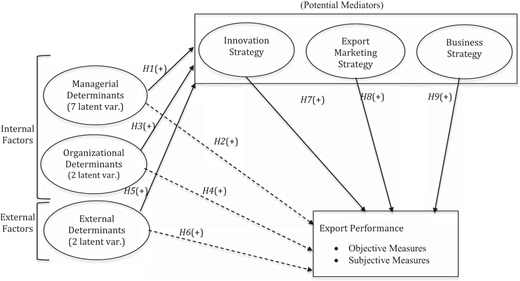
Given the need for more work on export performance, this paper develops and tests a holistic conceptual framework that accounts for all aspects of export drivers, and provides a more comprehensive model for examining SMEs’ export drivers. This theoretical framework also incorporates three potential mediators (i.e. innovation strategy, export marketing strategy and business strategy) to investigate the effect of internal and external factors on export performance, highlighting the importance of the mediating effects on SMEs in achieving growth and competing in the international arena.
Introduction
Market globalization, rapid technological improvements, government support and recent changes to the global economy, such as market and trade liberalization initiatives, have all played a positive role in increasing the internationalization of small and medium enterprises (SMEs) through exporting their products or services (Andersson et al., 2004; Fillis, 2007; Krammer et al., 2018). The significant contribution of SMEs to job creation, innovation and economic restoration is well known (Westhead et al., 2004). Efforts to improve SMEs’ Export Performance (EP) have thus become prominent in the area of export-related research.
Given the growth of SMEs’ international activities for exporting, the relevant literature covers relatively a broad range of areas including the choice between direct or indirect exporting for internationalization (Hessels and Terjesen, 2010), the decision to create a new export venture (Ibeh, 2003) and problems related to this solution (Wennberg and Holmquist, 2008), as well as markets and location selection (Zain and Ng, 2006; Gallego and Casillas, 2014; Huett et al., 2014), export and innovation (Añón Higón and Driffield, 2011), the management team impacts on the decision to internationalize (Reuber and Fischer, 2002), decisions on the timing of entry to the market and resource constraints (Zhao and Hsu, 2007; Cheng and Yu, 2008). The SMEs export growth is discussed in the literature of international entrepreneurship as well (Keupp and Gassmann, 2009; Zhou et al., 2007; Fernández and Nieto, 2006; and Brouthers and Nakos, 2004) . Keupp and Gassmann (2009) discuss the export intensity and growth of small firms at a higher level in an international entrepreneurship framework and highlight the scarce of research to analyze the impacts of antecedents or independent variables and internationalization, including export growth.
Even though recent literature in the area of EP (Yi et al., 2013; Gaur et al., 2014; Agnihotri and Bhattacharya, 2015; Anil and Shoham, 2017; Jin and Cho, 2018) has focused on firms from emerging countries, studies in this area are still limited (Krammer et al., 2018). Most earlier research in this area has focused solely on the determinants of EP arising from internal factors, external factors or both (Freeman et al., 2012; Sousa et al., 2010; Stoian et al., 2011; Arteaga‐Ortiz and Fernández‐Ortiz, 2010; Theingi and Purchase, 2004; Njinyah, 2018) without including adequate potential mediating factors that could affect EP. Additionally, many other studies in this area have focused on larger organizations and have little relevance to smaller firms, and the empirical findings are diverse and inconclusive (Glaum and Oesterle, 2007; Hennart, 2007; Hitt et al., 2006; Sullivan, 1994). It is also important to focus not only on the direct effects of the internal and external factors on EP but also on any potential mediating factors (indirect factors) that can influence EP, especially in the case of SME exporters.
Given these points and existing research gap, this study contributes to the existing literature by developing an integrative model that accounts for all internal and external aspects of export drivers, and provides and examines a more comprehensive framework for understanding SMEs’ export drivers. The model is based on the contingency theory, the resource-based view (RBV) and dynamic capabilities theory (Yeoh and Jeong, 1995; Robertson and Chetty, 2000; Dhanaraj and Beamish, 2003; Theingi and Purchase, 2004; Estrin et al., 2008; Krammer et al., 2018). This model is designed to be suitable in the context of emerging economies, such as Vietnam. Empirical literature analyzing internal determinants of EP tend to be oriented toward the RBV approach, and maintain that corporate EP is governed by corporate regulations and administration. On the other side, Yeoh and Jeong (1995) adopted contingency approach to conceptualize firms’ EP. Their approach is based on the integration of entrepreneurship, organizational behavior and exporting literature (Yeoh and Jeong, 1995). According to the contingency theory, a firm’s superior performance is contingent on both internal and external environments of the firm (Scott, 1981; Venkatraman,1989; Donaldson, 2001). Robertson and Chetty (2000) use contingency theory to show that the firms’ EP is directly related to the context in which the firm operates. Gnizy et al. (2017) also use this theory to illustrate that the effects of export dispersion (or the concentration level of export decision-making process) on the firms’ EP are based on internal and external environmental firms’ factors (contingencies of the firms). According to Beleska-Spasova (2014), RBV and contingency theory are effective for understanding the concept of EP and export barriers. Beleska-Spasova also argues that the EP of a firm depends primarily on the firms’ management. Additionally, the external determinants (ED) are backed by contingency theory (Cavusgil and Zou, 1994). This theory states that a firm should take external environmental factors into account to prosper and grow (Beleska-Spasova, 2014).
This study has contributed both theoretical and empirical insights to the literature by examining the direct and indirect effects of internal and external factors on EP, with and without three potential mediators. It focuses on several critical drivers of EP and explores another missing but seldom addressed factor: the potential mediating factors that can influence EP. This research introduces an integrative theoretical framework that incorporates and examines three potential mediators (i.e. innovation strategy, export marketing strategy and business strategy) to investigate the effects of internal and external factors on EP, highlighting the importance of these mediating effects for SMEs in their attempts to grow and compete in the international arena.
Consequently, this study develops nine hypotheses and empirically examines them by using primary data from the Vietnamese service sector collected from 364 SME exporters in three regions across Vietnam. The data is analyzed by confirmatory factor analysis (CFA) and structural equation modeling (SEM) techniques to examine the direct and indirect effects of internal and external factors (with and without mediators) on the EP of SME exporters in Vietnam.
Research shows that the number of SMEs engaging in export practices has increased considerably with technological improvements. Nevertheless, few research studies on Vietnamese SMEs can be found. The current study seeks to fill this research gap by concentrating on the EP of Vietnamese SMEs, considering all factors and potential mediators. The PWC (2012) report ranks Vietnam among the nations with the highest potential economic growth by 2050. Nevertheless, the current economy is facing some challenges, such as high inflation rates, high levels of corruption, low foreign exchange reserves and more. As Vietnam is a developing nation with a high economic growth rate, Vietnamese SMEs’ export efforts are an interesting topic to study.
Vietnam, as a successful emerging economy is a fascinating context in which to investigate this topic, because the country has undergone tremendous transformation from a tightly controlled economy to an open economy. Many Vietnamese firms, including SMEs, are now able to enter international markets (Thai and Chong, 2008). Despite this significant transformation, only a few studies focus on the EP of SMEs across Vietnam, and even fewer investigate this issue by using primary data and applying an integrative model to cover all aspects of export drivers, and provide a more comprehensive framework for examining SMEs’ export drivers. Although there are some studies on the challenges faced by Vietnamese SME exporters, these studies mainly use secondary data at the national level (Nguyen and Wolfe, 2016; Kokko and Sjöholm, 2005; Nguyen, 2016).
Facilitating and enhancing Vietnam’s exporting efforts to connect the nation to the global supply chain has become an important issue for the nation’s policymakers and researchers (World Bank, 2011). The recent “Master Plan for Vietnam’s Trade Development in the Period 2011–2015 and Vision for 2030” issued by the Ministry of Trade and Industry (2011) emphasized the need for diversifying the export basket and markets. This important document highlights the development of value-added manufacturing and industrial products while limiting low-cost commodity exporters for international markets. Nevertheless, the World Bank (2011) observes that there is a lack of dynamism in Vietnamese exports, and it is unclear which factors contribute to export dynamism and success. The purpose of this paper is therefore to empirically identify the key export drivers and provide recommendations for Vietnam’s export activities, and to develop and implement relevant interventions to achieve the goals outlined in the Master Plan.
Export performance perspective and hypotheses
Research on the key determinants of SMEs export has attracted a growing amount of interest in the literature over the past few decades because of the importance of SMEs in terms of exports and job creation (Sousa et al., 2008; Zou and Stan, 1998; Rua et al., 2018; Dhanaraj and Beamish, 2003; Krammer et al., 2018; Anil and Shoham, 2017; Manzanares, 2019). These studies contributed to the literature in terms of finding many relevant determinants of EP and how to measure them. According to Beleska-Spasova (2014), achieving effective EP is at the core of the tactical legislative procedure for both businesses and other entities. For corporations, successful EP shows the extent of a firm’s goals, both financial and non-financial. Such goals are achieved in the global setting within an agreed period, and they can be evaluated by the appropriateness of the selected export approach, given the particular internal and external factors (Beleska-Spasova, 2014).
However, in the literature related to EP, it is recognized that key drivers of EP fall into two categories that should be evaluated separately: internal factors and external environmental characteristics (Cavusgil and Zou, 1994; Leonidou, 1995, 2004; Sousa et al., 2008; Agnihotri and Bhattacharya, 2015). The internal forces include firm- and product-related features, whereas external forces include industry-level features and export market determinants (Cavusgil and Zou, 1994). Leonidou (2004), for example, argues that the export barriers of SMEs should be divided into internal barriers (e.g. marketing barriers) and external barriers (e.g. governmental and environmental barriers). Therefore, we conducted a literature review to discover the internal and external influences on EP, which are presented next.
Morgan et al. (2004) surveyed 287 exporter companies to test their theoretical model empirically. Their study widely supports resources and capabilities as being the main competitive strategy that helps position companies within the export market and affects their performance, which is consistent with the RBV and dynamic capability theory. However, this was not the case for competitive intensity, which was found to have only a moderating effect instead of a direct relationship with EP.
Some authors have hypothesized that a firm’s EP is directly related to competitive capacity and the available resources (Manzanares, 2019). In addition, the feasibility and applicability of different strategies rely on intangible amenities that can be mobilized (Manzanares, 2019). On the other hand, capacity for innovation and global knowledge are some of the determinants frequently associated with the export procedures of some companies (Oura, 2016). Conversely, corporations from developing nations seem to experience advantageous consequences from internationalization that differ from those of corporations in developed nations (Oura, 2016). The findings show that global experience has a more significant effect on EP than capacity for innovation, indicating the function of novelty in the export efforts of SMEs (Oura, 2016).
The main EP factors are considered firms’ internal and external issues (Sousa et al., 2008). The two categories align with the theoretical approaches supporting the empirical study of export efforts: contingency theory and the RBV. Empirical literature analyzing the internal determinants tends to focus on the RBV approach and supports the concept that a firm’s EP is governed by corporate regulations and the firm’s administration. Both the RBV and contingency theory are effective and applicable for understanding the concept of EP and SMEs’ export barriers (Beleska-Spasova, 2014).
Sousa et al. (2008) state that the RBV focuses on establishing a competitive edge through amassing resources, such as assets, proficiencies, organizational procedures, knowledge, corporate attributes and data. The RBV approach relies on key determinants, namely, Managerial Determinants (MDs), Organizational Determinants (ODs), external factors and control factors (i.e. mediators), such as export strategies, business strategies and innovation strategies. Sousa et al. (2008) argue that there could be up to 40 different key export drivers, 31 of which are internal and nine are external. The internal determinants that have been the focus of most studies are those related to the product strategy, price, promotion and distribution. Additionally, variables related to firms’ characteristics, such as size, international experience are commonly used as drivers of EP. Generally, the results are in line with those of reviews in earlier decades [i.e. reviews of Aaby and Slater (1989) for the period 1978-1988, Zou and Stan (1998) for the period 1987-1997, and Arteaga‐Ortiz and Fernández‐Ortiz (2010)].
Mai (2008) argues that apart from other acknowledged challenges of SMEs, such as a lack of managerial skills and a lack of adequate economic capacities, SMEs face specific barriers derived from Vietnamese organization setting. These challenges or barriers are related to weak legislative systems, unproductive associations, sophisticated bureaucracy, poor business services, endemic corruption, the inadequacy of investment capital, among others (Phan, 2013). Among all these internal challenges, Phan (2013) considers attitudinal obstacles and management inadequacies to be the key hindrances to SMEs’ internationalization. Other experts have separated exporting obstacles into three key categories, namely, external factors, managerial factors, and organizational factors (Phan, 2013). Managerial factors include the characteristics of managers, such as education level, capabilities, skills and knowledge, expectations, international experience and perceptions of globalizing a business. In comparison to external barriers, scholars argue that internal barriers have a greater effect on SMEs’ expansion strategies (Phan, 2013). The determinants of EP can be either barriers or advantages; however, their effects are determined by the implementation and objectives of the management. It is evident that determinants become barriers if they are not adequately exploited or maximized by firms (Mai, 2008).
Perks and Hughes (2008) conclude that many studies about SME internationalization failed to consider the nature of the decision-making process and how the motivation of individuals affects the decision-making process. Similarly, Sousa et al. (2010) examined the impact of the manager’s values on the firm’s performance as well as the mediating role of customer responsiveness by using a sample of exporting companies in Galicia, Spain. However, Halikias and Panayotopoulou (2003) maintain that the cognitive and personality characteristics, motivation, and experience of individual decision-makers strongly influence the internationalization decisions of firms.
OECD and APEC (2007) conducted a survey and concluded that inactive exporters face problems such as finding markets and opportunities, and identifying foreign customers, whereas active exporters face challenges arising from tariffs, currency, regulations and competition. This is in line with the findings of Pinho and Martin (2010), who concluded that the perceived challenges are not the same for non-exporters and exporters. For instance, non-exporters are concerned about the lack of information on prospective markets, a lack of staff with foreign experience, a lack of technical skills, and inadequate governmental and financial support. In contrast, exporters see the other challenges as the main ones, such as identifying the target market, warehousing and control of the physical product flow (Pinho and Martin, 2010).
An exploratory study of exporters in Queensland, Australia, by Freeman et al. (2012) confirmed the importance of location on EP, as location has a positive impact on network access, resources and firms’ export-related infrastructure and services. More recently, Love et al. (2016) considered the factors of SME EP by reviewing globally participating UK SMEs. The authors developed a prototypical framework incorporating managers’ education and experiences as well as organizational impacts. The study recognized the beneficial consequences of the global familiarity of the corporation for exporting and the deleterious consequences of the firm’s condition (Love et al., 2016). Positive exporting determinants are also created by the embedded knowledge that managers acquire through recruiting staff with the necessary skills (Love et al., 2016).
More recently, Oura (2016) investigated several variables that influence the export efforts of firms, including variables associated with managerial, physical, organizational and relational resources. The managerial variables include export commitment, perceived export barriers and international orientation, whereas the company's capacity, financial amenities and the firm's positioning make up the physical variables (Oura, 2016) The ODs include the firm's capabilities, product strengths and export strategy, whereas the relationship attributes include customer relationships, foreign market visits, distribution channels and interpersonal research (Oura, 2016).
Cardoza et al. (2016) used an institutional concept analysis to study the interaction between public policies and other determinants of SME development in regards to access to financial resources, admission to public procurement contracts, legal frameworks and public market support by using data from 465 SMEs in Colombia, Peru, and Brazil. They concluded that having limited access to all the above public facilities negatively affected SMEs’ performance. According to their study, the government plays a crucial role as a facilitator for SMEs’ internationalization.
However, despite the importance of these studies described above, the literature tends to focus solely on the determinants of EP arising from internal factors, external factors or both without using adequate potential mediating factors such as innovation strategies, export marketing strategies and business strategies, which could directly or indirectly affect EP. These three potential mediating factors are yet to be investigated in the EP business literature, especially in a developing country, such as Vietnam, despite the potential and crucial role of strategic planning for business success. Therefore, this study contributes to the literature by developing an integrative model based on contingency theory and the RBV of firms. This theoretical framework also incorporates three potential mediators and examines their effect on EP, and highlighting the outcomes of these mediators within the context of literature on SMEs’ EP. We can therefore argue that managers and policymakers should focus on developing these mediating factors to affect EP.
Development of hypotheses
This paper proposes a number of EP factors based on the literature review above and on feedback from SMEs gathered via focus group meetings with over 60 Vietnamese SMEs. The choice of the sample SMEs was not limited to any specific business type but the sample covers industries operating in the three selected regions (i.e. North, Central and South of Vietnam). Figure 1 presents the conceptual model with the relevant constructs. We specifically look at the issues faced by SMEs in Vietnam in their efforts to internationalize their activities. In the first step of developing this model, as indicated earlier, we looked at the contingency theory and the RBV of a firm (Dhanaraj and Beamish, 2003; Theingi and Purchase, 2004; Estrin et al., 2008; Krammer et al., 2018). The contingency theory and RBV approaches are effective and applicable for understanding the concept of EP and SMEs’ export barriers (Beleska-Spasova, 2014). This study focuses on developing an integrative model that takes all aspects of export drivers into account, and provides and examines a more comprehensive framework for examining SMEs’ export drivers. Hence, this study focuses on several important factors of EP and explores an important part of the literature that has been overlooked, namely, the potential mediating factors of EP. Consequently, this research develops nine hypotheses and examines them empirically by using data from the Vietnamese service sectors.
Based on the theory outlined above, and our focus group study through 60 active Vietnamese SMEs, this research tries to answer two main questions:
What are the key effective internal and external drivers of SMEs’ export in Vietnam?
Do firm’s strategies (i.e. innovation strategy, export marketing strategy and business strategy as mediators) play significant role in SMEs’ export in Vietnam?
What types of help do SMEs need to overcome their export limitations and challenges?
Answering these two questions help us to understand the effective factors and mediators, and their level of impacts. Internal factors include (MDs and ODs. The MDs include technical and technological skills, motivation to export, networks, perceived benefits from exporting, expected export outcomes, cultural and psychological distance, export stimuli, self-efficacy and risk-taking propensity (Bandura, 1995; Morgan, 1997; Audretsch, 2001; Filipe Lages and Montgomery, 2004; Oviatt and McDougall, 2005; Foreman-Peck et al., 2006; Sousa and Bradley, 2006; Siu et al., 2007; Saini and Martin, 2009; Harvie, 2010; Tang, 2011; Alsaaty and Makhlouf , 2012; Freeman et al., 2012; Love et al., 2016; Navarro-García et al., 2016). The ODs include firm size, skilled labor, finance, firm experience, export commitment and attitude toward risk (Hultman et al., 2009; Saini and Martin, 2009; Harvie, 2010; Stoian et al., 2011; Freeman et al., 2012; Fernando et al., 2017).
Many existing studies also focus on external factors such as demand in the domestic and export markets, business infrastructure and information availability, environmental uncertainty, international market opportunities, the influence of competitors and government policies or assistance, which affect SMEs’ EP (Moini, 1998; Gençtürk, and Kotabe, 2001; Silverman et al., 2002; Majocchi et al., 2005; Harvie, 2010; Stoian et al., 2011; Njinyah, 2018).
Stoian et al. (2011), for instance, examined the determinants of 146 Spanish SMEs’ EP. They developed a theoretical framework based on the RBV of a firm and used regression analysis and SEM to test this model. They concluded that the foreign language skills of managers, global business knowledge and the firm’s export commitment are the most important determinants affecting EP. Likewise, Jin and Cho (2018) recently developed a similar theoretical framework based on RBV and contingency theory. They used 470 South Korean SMEs’ data and found the positive effects of domestic competition as an external factor on EP of firms.
Beleska-Spasova (2014) compared MDs and EP and considered the directors’ perceptions of exporting to play a key role. Other studies, however, assessed the connection between the internal and ED by using either subjective or objective EP measures. Various EP frameworks have developed based on the underlying intentions and statistical analysis approach (Beleska-Spasova, 2014). Business and managerial knowledge and skills can assist firms to develop their export capabilities, and the managers’ education and experience have strongly positive effects on EP (Love et al., 2016). One of these subjective constructs is that of self-efficacy, which relates to person’s belief in his or her ability to successfully fulfill certain tasks (Bosscher and Smit, 1998). Self-efficacy theory indicates that efficacy beliefs influence people to choose their types of engagement (Bandura, 1997), and we hypothesize that it will affect the decision to internationalize and will affect EP. Zhou et al. (2007) show that the firms’ knowledge and learning can be improved through social network ties which in turn increases inward and outward internationalization, including export activities.
More recently, Beleska-Spasova (2014) explored MDs as the main determinants of a firm’s capacity to leverage their assets successfully in the global setting. The author focused on the effects of MD on firms’ EP through subjective and objective measures. The results show that in addition to objective measures, subjective measures are an effective approach for assessing EP and establishing a connection between EP and the managers’ roles and decisions (Zou et al., 1998; Rose and Shoham, 2002; Sousa, 2004; Beleska-Spasova, 2014; Navarro-García et al., 2016). Furthermore, Chugan and Singh (2015) examined a firm’s commitment regarding exports by evaluation the level of managerial resources devoted to export activities. They argue that export commitment depends on the various resources allocated by the firm to exporting practices. This has been conceptualized as the attitude of managers toward EP. The results showed that a higher degree of managerial commitment is a fundamental to achieving better EP outcomes (Chugan and Singh, 2015).
Based on the literature and our research questions, we have developed a number of hypotheses shown below and in Figure 1, which can be used to test the effects of internal and external constructs or factors on SMEs’ EP in Vietnam. The firms’ EP, as our model’s outcome, is measured through both objective and subjective measures, shown in Table II.
Hence, based on the above studies, we can hypothesize that:
MDs (X1i) have significant indirect impacts on firms’ EP through mediators/strategies.
MDs (X1i) have significant direct impacts on firms’ EP.
The ODs are also important internal factors that can influence SMEs’ EP. These factors are defined as organizational characteristics such as the firm’s size, resources, competences, proficiencies, processes and objectives. The ODs concern the factors that can be managed by a firm to achieve its objectives (Fernando et al., 2017). These determinants are essential for understanding how Vietnamese SMEs are faring with their exports activities despite the numerous challenges they face.
The different sub-constructs chosen for this study are firms’ objectives and the resources, because the study is based on the RBV approach as well. Empirical studies have shown a clear relationship between ODs and EP. Most of the results show that the export marketing approach, the firm’s conditions and functionalities, and leadership features are significantly connected to EP. These factors are clearly linked to OD factors, because they cover many organizational characteristics and goals. The findings propose that in the context of unstable and uncertain economic conditions, shorter product life cycles and unstable and unpredictable market demand changes, it is crucial for firms to be able to react effectively to these external uncertainties and changes beyond their control (Fernando et al., 2017).
As indicated earlier, Love et al. (2016) studied the determinants of SME EP and developed a prototypical framework incorporating the effects of managers’ education and organizational impacts. Their results indicate that the recruitment of staff with international experience and skills had a positive impact on EP (Love et al., 2016).
Oura (2016) examined variables that affect EP such as managerial, physical, organizational and relational resources. The author argued that ODs should include a firm’s capabilities, product strengths and export strategy, whereas relational resources include customer relationships, foreign market visits, distribution channels and interpersonal research (Oura, 2016). However, because of space limitations, the present study concentrates on MDs, ODs, external factors and control factors such as a firm’s business strategy, export marketing strategy and innovation strategy.
Sousa et al. (2008) considered the RBV view of the firm that focuses on the establishment of competitive edge through amassing resources, such as assets, proficiencies, organizational procedures, knowledge, corporate attributes and data. The authors reiterate that the sources of a competitive edge are corporate amenities that are valued, intermittent, non-substitutable and imperfectly imitable. The RBV relies on key determinants such as MD, OD, external factors and control factors, such as export marketing strategy, business strategy and innovation strategy.
Hence, we can present our second category of hypotheses:
ODs (X2i) have significant indirect impacts on firms’ EP through various mediators (strategies).
ODs (X2i) have significant direct impacts on firms’ EP.
Firms’ ED (X3k) have significant indirect impacts on EP through various mediators (strategies).
Firms’ ED (X3k) have significant direct impacts on EP.
In addition to these hypotheses, as indicated earlier, it is important to note that the existing literature has focused mostly on the determinants of EP arising from internal factors, external factors or both without using adequate potential mediating factors, such as business strategy, export marketing strategy and innovation strategy, which could affect EP. These three potential mediating factors are yet to be investigated in the EP literature. Business strategy is defined as the processes an organization uses to manage its operations and generate income. The business strategy concept has rarely been considered within the framework of export functions and productivity. Most studies have concentrated on adopting these approaches in the setting of local EP capacity (Singh and Mahmood, 2014). Despite a lack of prior studies, this determinant is essential for the scope of this study. Previous research has shown the significance of business strategy for EP and its connection to MD and OD. In spite of numerous studies on EP, only a few studies have integrated the relationships of business strategy with a firm’s EP (Singh and Mahmood, 2014). Studies on the relationship between business strategy and EP are still very limited; therefore, such a relationship is an ideal subject for further research and fits well within the scope of the current study.
The export marketing strategy is essential, because it acts as an intermediary in various EP constructs such as the MD/OD–EP relationship. This strategy is about international marketing research and plan as well. In this context, applying marketing intelligence is an effective strategic source to analyze and respond to international customers’ needs, expectations and preferences, and it has positive impacts on SMEs’ EP (Khan and Bamber, 2012; Navarro-García et al., 2016), and this approach can serve all export-related business activities (Adidam et al., 2012). The studies of Cavusgil and Zou (1994), Jalali (2012) and Manzanares, (2019) argued that the effect of export marketing strategy on EP is crucial, because it guides the operations of EP, and it links different concepts of exportation through various constructs. Innovation is one of the constructs that is seriously considered when export strategy is implemented. Innovation helps organizations to ease the export process and to achieve success. It also helps them to develop their core competencies and competitive advantages, which enable them to outperform their competitors in local and international markets (Calantone et al., 2002; Siguaw et al., 2006; Faroque et al., 2017). This leads to our third mediator, that of innovation strategy.
Innovation strategy within the export process refers to a strategic plan to expand the market segment or increase income by using innovative approaches for products and services, as well as internationalization. Innovation strategy is crucial, as it involves creating new solutions, improving products or services and finding solutions for overcoming problems. Some recent studies have demonstrated the crucial role of innovation in creating competitive advantages in internal markets and enhancing EP (Lepak et al., 2007; Fernandez-Mesa and Alegre, 2015; Silva et al., 2017; Faroque et al., 2017).
Hence, these mediators lead us to formulate the following three hypotheses:
Innovation strategy (a mediator) (X4) has significant direct impacts on firms’ EP.
Export marketing strategy (X5) has significant direct impacts on firms’ EP.
Business strategy (X6) has significant direct impacts on firms’ EP.
Figure 1 shows the potential impacts of all internal and external factors or determinants of SMEs’ EP directly or indirectly through the main mediators of innovation strategy, business strategy and export marketing strategy. This framework shows our research model and hypotheses. In this study, we test the effects of all of these direct and indirect factors as latent variables on Vietnamese SMEs’ EP.
In this framework, H1, H3 and H5 are about the effects of main internal and external factors on EP through mediators. There are three empirical conditions for our mediators:
significant relationships between direct variables (internal and external factors) and response variables (EP);
significant relationship between direct variables and mediators; and
mediators are significant predictors of the outcome variables, including both direct variables and mediators (Alwin and Hauser, 1975; Judd and Kenny, 1981; Baron and Kenny, 1986; MacKinnon et al., 2000).
According to Cole and Maxwell (2003), if mediator variables completely mediate the relationship between direct variables and EP, the relation between direct variables and EP should approach zero (controlling for mediators). According to MacKinnon et al. (2000) and Little (2013), mediators decrease or filter the casual effect between independent or direct (X) and dependent (Y) variables (if there is any), because the mediators (Ms) explain part or all of the relationship between these variables, based on the fact that X impacts M, and M causes Y. Therefore, the mediation effect can be described as a chain of casual effect. As such, mediators are endogenous relative to direct variables (internal and external factors), but exogenous relative to EP, our dependent variables. Indeed, we conduct a causality test as well, as we analyze how one variable causes change in another variable, which in turn, causes change in the response or outcome variable. This test also helps to validate robustness and reliability of the effects.
Methods and data
Empirically, this research develops nine hypotheses and examines them by using data from various Vietnamese sectors (manufacturing, services and construction) provided by 364 SME exporters in three regions across Vietnam (i.e. North, Central and South). A random sample of various Vietnamese SMEs from all industries and locations across North, South and Central Vietnam was selected. In addition to detailed data about their enterprises and the demographics of the owners, information about employment, net annual sales and the EP of these SMEs was collected as well. The survey comprised 17 main questionnaires (with over 100 technical questions) to address and examine all determinants of EP.
This survey aimed to collect Vietnamese SMEs’ opinions regarding the most important factors needed to be a successful exporter of goods or services, and the main influences on their EP. This study collected the descriptive statistics, and applied the CFA and SEM methods for data analysis. The data was analyzed on various statistical software packages. The descriptive statistics highlight the demographic characteristics and regional information of the Vietnamese SMEs in the sample. They are also helpful for describing the basic features of datasets and summarizing the samples and measures in graphical or tabular form. This analysis forms the basis for our advanced quantitative analysis. The CFA method was applied to test whether the measures of our construct are consistent with our proposed framework of export determinants or factors. In other words, the method tests whether the data fits the hypothesized measurement model. Finally, the SEM method examines the fitness of our network of constructs to the data. SEM includes CFA, path analysis, partial least squares path modeling and latent growth modeling.
Sample characteristics
As indicated in Table III, the largest proportion of the SMEs exporters are in the South region of Vietnam, and they mainly operate in the manufacturing and service industries,134 firms (59.8 per cent) and 83 firms (37.1 per cent), respectively. In the North, the share of manufacturing activities is much greater than in other regions for both exporters and non-exporters.
In terms of business location (Table IV), the SME exporters in the sample are operated in different regions. It is noticeable that the Central region has the highest percentage of SME exporters, followed by the North and South in that order. However, the South region has the highest number of firms in the survey with 356 exporters and non-exporters, followed by the North and Central regions with 294 and 251 firms, respectively.
From the industry subsector perspective, as illustrated in Table AI (in Appendix A), the SME respondents operate in a variety of sectors within the manufacturing and service industries, mostly in the food and beverages; machinery and equipment and wood and wood products sectors within the Vietnamese manufacturing segment. Based on the results in Table AI, it seems that the manufacturing subsectors such as machinery and equipment, and food and beverages are more concentrated in the South and Central regions of Vietnam. However, it seems the South region is playing an important role in terms of exporting activities as well as manufacturing activities.
Based on the SMEs’ exporters responses to our structured survey, as shown in Table AI for the service segment, the majority of respondents are from five service areas: education and training, hotel and restaurants, wholesale, retail trade and repairs. In terms of region, the South plays an important role in service export activities, especially in the areas of wholesale, retail trade and repairs. For the non-exporter service segment, the Central region is more active, concentrating more on wholesale, retail trade and repairs activities, but this region is not very active for exporting these types of service products.
In terms of the gender of SME owners in the exporter segment, Table AII shows that 75.5 per cent of the respondents are male and only 24.5 per cent of them are female in the North region. In the Central region, 93.1 per cent are male and only 6.9 per cent are female, and in the South, the proportions are 77.2 and 22.8 per cent for males and females, respectively. In the non-exporter segment, we still see significant differences in the male–female ratio in all three regions. In the North, 93.4 per cent of respondents are male and only 6.6 per cent are female. In the Central region, 85.4 per cent are male and 14.6 per cent are female, and in the South, 82.6 per cent of the respondents are male but only 17.4 per cent are female. This data shows that all regions had a much lower rate of female ownership.
Furthermore, Table AIV in Appendix A shows the employment data for SME exporters and non-exporters in the three regions of Vietnam. About 41.5 per cent of SME exporters in the North region employed 11-49 employees, 37.7 per cent employed between 50 and 200 workers, 9.4 per cent employed over 300 workers and 7.5 per cent employed between 201 and 300 workers. Only two SME exporters (3.8 per cent) employed fewer than 11 workers. In the Central region, 46.0 per cent of SMEs employed 50–200 employees, 19.5 per cent employed 201–300 workers, 18.4 per cent employed 11–49 workers and 11.5 per cent employed 6–10 workers. Only four exporters SMEs (4.6 per cent) employed over 300 workers. In the South, 39.7 per cent of SMEs employed between 11 and 49 employees, 32.6 per cent employed between 50 and 200 workers, 9.8 per cent employed between 201 and 300 workers, 9.8 per cent employed over 300 workers and 7.1 per cent exporters employed between 6 and 10 workers. Only two SME exporters (0.9 per cent) employed fewer than five workers in this region. It seems that as we move away from the North, the firms employ increasingly greater numbers of workers and are characterized by their larger size. This clearly shows that each region might be experiencing a different level of business development and may have a different capacity to employ more workers. It is also noticeable that the SME exporters in the South have the highest share of larger firms (i.e. those that employ >300 workers). The SME exporters in the North are characterized by their smaller size, as the majority in the sample employed fewer than 200 workers.
In the non-exporter section of Table AIV, it is noticeable that the SMEs in the three regions are characterized by their small to medium size, as the majority employed <200 workers. The non-exporter firms in the North are smaller, with the majority employing below 50 workers. The South and North have the highest share of larger firms (those employing >300 workers). However, the frequency of larger firms in both regions is small.
Concerning the export markets of SMEs across the three different regions, as Table AV indicates, the majority of Northern firms in the sample (364 firms) export their products to Association of Southeast Asian Nations (ASEAN) countries (32.1 per cent), South America (24.5 per cent), South Asia (20.8 per cent) and Europe (13.2 per cent). In the Central region, the majority of firms export their products to the ASEAN region (31 per cent), South America (21.8 per cent) and South Asia (12.6 per cent). Finally, most Southern firms export to ASEAN countries (38.4 per cent), South America (29.5 per cent) and Australasia (11.2 per cent). Based on these results, it is noticeable that the Vietnamese SMEs mainly focus on the ASEAN and South American export markets, followed by South Asia and other regions. Furthermore, it is interesting to note that the SMEs in the South region are quite diverse in terms of export markets in comparison with other regions. For instance, as shown in Table AV, SMEs in this region export to Australasia as well. Perhaps, it can be argued that the psychological distance factor might play an important role in motivating these firms to export their products to countries that might share similar economic and political systems (e.g. the ASEAN region). Additionally, it can be noted that the Vietnamese SMEs have not been able to access export markets in other regions very well, such as the Middle East and North America. The Southern SMEs have managed to access to export markets in the Middle East and North America, but their total exports to these regions are very low, compared with their exports to other world regions.
Results and discussion
In this study, we first examined the fitness of the questions (the observed variables) and constructs (the latent variables) via the SEM method. As the results show (Table II), except for four questions (or observed variables) related to the self-efficacy construct (a latent variable), the questions show strong association with the constructs. The four non-significant observed variables were removed from the final model.
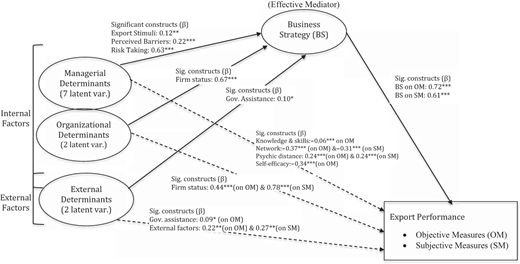
Based on the theoretical framework shown in Figure 1, we examined the entire model with and without mediators. The model with the three mediators (i.e. business strategy, export market strategy and innovation strategy) was more effective and significant than the model with no mediators (i.e. the model that shows the direct effects of all latent variables on EP). However, both export market strategy and innovation strategy mediators did not have significant effects on EP (their p-values are much less than 0.2). Based on this result and our examination of alternative models, the most effective model is the one that includes the business strategy mediator, as shown in Figure 2. The SEM results of this final model are shown in Table V.
As illustrated earlier, the three hypotheses of H1, H3 and H5 are about the effects of main internal and external factors on EP through mediators. According to Cole and Maxwell (2003), if mediator variables completely mediate the relationship between direct variables and EP, the relation between direct variables and EP should approach zero, which is not the case in this study as illustrated in Table V. According to MacKinnon et al. (2000) and Little (2013), mediators decrease or filter the casual effect between independent or direct (X) and dependent (Y) variables (if there is any), because the mediators explain part or all of the relationship between these variables, based on the fact that X impacts M, and M causes Y. Therefore, the mediation effect can be described as a chain of casual effect (mediators are endogenous relative to the internal and external factors, but exogenous relative to EP, our dependent variables. Based on our results and this discussion about the role of mediators in analyzing causalities, export stimuli, perceived barriers, risk taking, firm status and government assistance, as independent variables (X’s) positively affect firms’ business strategy as a mediator (M), which in turn, causes firms’ export or dependent variable (Y) increase. That means X’s cause Y not vice versa.
As the final model shows, various determinants drive firm’s EP. For the EP measure, the model outcome is divided into two categories (objective and subjective measures) to provide more details about the outcomes. According to our analysis, although all MDs, ODs and ED have significant effects on innovation strategies, business strategies and export marketing strategies (the three mediators in the model), a strong relationship only exists between business strategy and EP. Most of these determinants have significant direct influences on firms’ EP as well. These determinants or constructs are knowledge and skills, networks, psychological distance, self-efficacy, firm status, government assistance and other external factors.
As shown in Figure 2, both internal and external factors have positive and direct impacts on business strategy and indirect impacts on EP. These MDs (e.g. skills, network, export motivation, psychological distance and risk-taking behavior), EDs (e.g. firm status, firm export commitment), government assistance (e.g. training, assistance in finding finance) and other external factors (e.g. availability of information about foreign opportunities) are important determinants of EP in the case of SME exporters in Vietnam. These results are in line with the findings of Stoian et al. (2011), Navarro-García et al. (2016), and Oura (2016). Stoian et al. (2011) examined the EP determinants of 146 Spanish SMEs and found that the foreign language skills of managers, global business knowledge, and a firm’s export commitment were the key drivers of EP. Navarro-García et al. (2016) proved the positive influence of greater psychic distance on export strategy adaptation and EP. Oura (2016) showed that the global experience of managers has a greater effect on EP than capacity for innovation, indicating the function of novelty in the export efforts of SMEs. Therefore, the Vietnamese Government could develop and implement new policies related to MDs and ODs, such as assisting SMEs to develop marketing strategies; developing SMEs’ business networks locally and abroad; understanding the requirements of the business market; improving import/export policies related to the legal environment; training SMEs’ staff in basic knowledge about export markets, digital tools and e-commerce skills, and English language skills; and encouraging SME’s to employ staff with better foreign language skills.
Moreover, our results show that ODs (mainly firm status and firm export commitment) have positive and significant direct and indirect effects on EP. Hence, the government in Vietnam should train or assist SME exporters through various specialized workshops about developing business strategies related to export activities, and the government could establish an export department, conduct various research activities on international markets and conduct regular export market research. Our results are consistent with the findings of Fernando et al. (2017), who found that both MDs and ODs have positive and significant impacts on EP. Understanding the importance of these determinants is essential for evaluating how Vietnamese SMEs deal with their export activities despite the numerous challenges they face. It is clear that these enterprises can only succeed when they consider these key determinants.
Additionally, our results show that psychological distance has a significant and positive impact on exports. In this context, psychological distance considers differences between Vietnam’s business environment and that of foreign markets in terms of language, legal systems, business practices, market structure and power relations between employees and employers. It can be argued that these differences are crucial and have a negative influence on export activities. Therefore, these differences create business and communication barriers rather than facilitating effective international collaboration. Our results are also in line with earlier study by Sousa and Lengler (2009), who found that psychological distance has a negative impact on the EP of the firm, suggesting that greater psychological distance decreases export activities.
As our data shows, Vietnamese SMEs mainly focus on ASEAN and South American markets, followed by South Asia and other regions for exports. Furthermore, it is interesting to note that SMEs in South Vietnam are quite diverse in terms of their export markets in comparison with other regions. Perhaps it could be argued that the psychological distance factor might play an important role in motivating these firms to export their products to countries that might share similar economic and political systems (e.g. the ASEAN region).
The self-efficacy construct also shows significant but negative effects on subjective EP, measures. As the observed variables for the self-efficacy construct (Table II) indicates, we measure the inefficiency or failure of a firm or its management to make the best use of time or resources. Therefore, because this variable measures the negative attributes of a firm and its management, it has a negative coefficient, indicating the negative impact on EP. With regard to the cultural aspects, the Vietnamese Government can develop and implement training programs or new initiatives to assist SME exporters in understanding the international business culture and markets.
Additionally, as shown in Figure 2, business strategy has a direct and significant impact on EP. This is not surprising, as SME exporters in Vietnam need to be proactive in terms of introducing new products or services. These firms should have effective business strategies to grow and develop their competitive advantages and have a strong competitive position in local and international markets. Therefore, the role of the government in this respect is crucial to assist SME exporters in becoming more innovative and producing new products and services, so they can achieve continuous growth and enter new markets, such as the Middle East and North America. As mentioned above, Vietnamese SMEs mainly focus on the ASEAN and South American export markets, followed by South Asia, Australasia and other regions. Therefore, the Vietnamese Government needs to assist SMEs to penetrate into new export markets and to develop new business networks with these markets, possibly via international trade shows and exhibitions.
Finally, our results show that all regions experience much lower levels of female ownership. Therefore, there is a problem of discrimination or gender inequality among SME exporters. Hence, the Vietnamese Government should enhance the participation of women in entrepreneurship and within SME management in the country by encouraging them to develop businesses, attend customized training programs developed for women, and encouraging higher education for women. These in turn assist Vietnamese women to improve their skills and knowledge level about business activities (e.g. ICT, foreign languages, operations management, marketing etc.), which are necessary for SMEs.
Conclusions and further implications for practice
This research has developed a model for examining the EP of SME exporters in an emerging market, Vietnam by focusing on the direct and indirect effects of internal and external factors on EP. The study highlights the importance of mediators to help SMEs grow and compete internationally in a context where there is a need for more empirical and theoretical research. The potential mediators that have been tested include innovation strategy, export marketing strategy and business strategy. Our model is based on contingency theory and the RBV approach. Even though recent literature in the area of EP has focused on firms from emerging countries, studies in this area are still limited.
As highlighted in the literature and discussed earlier, the key drivers of EP fall into two categories that should be evaluated separately: internal factors and external environmental characteristics. The internal forces include firm- and product-related features, whereas external forces include industry-level features and export market determinants. Therefore, earlier research in this area has focused solely on the determinants of EP arising from internal factors, external factors or both, and there is a lack of study to consider strategies as the potential mediators, which can enhance export.
This study developed nine hypotheses and examined them empirically by using Vietnamese service sector data from 364 SME exporters in three regions across Vietnam. The data was analyzed via CFA and SEM techniques to examine all the potential factors affecting SMEs’ EP. This study found support for seven out of nine hypotheses. Specifically, this study suggests that SME exporters in Vietnam could enhance their EP by focusing directly on building their business strategy, which, in turn, would enhance their EP. SMEs should be more proactive in terms of introducing new products and services and should take the initiatives to compete to achieve competitive advantages and growth. SMEs may not be able to do this effort alone without proper government intervention to assist them in being more innovative so they can enter new markets, such as the Middle East and North America.
Based on the outcomes, SMEs in Vietnam can enhance their export activities by focusing on marketing strategies, developing their business networks locally and abroad and understanding the requirements of the business market. In addition, SMEs should provide training to equip their staff with basic knowledge about export markets, import/export policies related to the legal environment, information technology and e-commerce, English language skills. SMEs should employ new staff with better foreign language skills. SMEs in Vietnam should also receive more government support to help them penetrate into new export markets, such as the Middle East, and South and North America, rather than focusing mainly on ASEAN markets. They can do this by working with various government departments, such as the Agency for SME Development to build new business networks with the new markets via international trade shows and exhibitions.
Furthermore, our results assert that the South Vietnam region plays an important role in terms of export activities as well as manufacturing in general. According to our results, Vietnamese regions experience different levels of business development and have different capacities for employing larger numbers of workers. It is also noticeable that the SME exporters in the South have the highest number of larger firms that employ more than 300 workers. According to the SME exporters’ responses to our structured survey, within the service segment, the majority of respondents are from five service areas: education and training, hotels and restaurants, wholesale, retail trade and repairs. The South seems to concentrate its service export activities particularly in the areas of wholesale, retail trade and repairs. For the non-exporters, the Central region is more active in the service segment, concentrating more on wholesale, retail trade and repairs, but this region is not very active in exporting these services. Therefore, the government in the Central region needs to assist SMEs with new initiatives, such as providing training workshops aimed at these SMEs to help them increase the export of their services. SMEs in the Central region can leverage the international experience of SMEs in the South to be more innovative and be aware of the benefits of international markets and how to engage with these markets.
This research demonstrates that psychological distance has a significant and positive impact on exports. In this context, psychological distance describes the difference between Vietnam’s business environment and foreign markets in terms of language, legal systems, business practices, market structure and power relations between employees and employers. It can be claimed that these differences are crucial and larger differences have more influences on the export activities of the firms.
As shown earlier, all regions experience very low rates of female ownership. Hence, the government in Vietnam should pay more attention to reducing gender discrimination and enhancing female entrepreneurship by encouraging women to participate in SMEs activities in the country through to developing their business ideas, attending specialized training programs for women and continuing education.
This study has contributed both theoretical and empirical insights to the literature by examining the direct and indirect effects of internal and external factors as well as three potential mediators (i.e. innovation strategy, export marketing strategy and business strategy) on EP. The most effective direct factors include knowledge and skills, network, psychic distance, self-efficacy, firm status, government assistance and external factors. Based on the outcomes, the only significant mediator that enhances firms’ export activities in Vietnam is business strategy.
Our empirical findings help SMEs to improve their EP by understanding, evaluating and improving their key export drivers highlighted in this study and developing required training programs for their teams to overcome their existing gaps and limitations and to enhance their international engagement and reap the benefits of global markets. Through enhancing SMEs’ international engagement, the Vietnamese Government can also expect to benefit through socio-economic development inherent in building a stronger private sector. Opportunities that are more global, greater competitiveness and more growth within the private sector will support the government’s drive towards slimming the public sector, without affecting upon social stability through unemployment and economic uncertainty.
Policymakers and regulators around the world are continuously working on improving the export process and encouraging firms to export by developing and implementing effective rules, simplifying processes, increasing incentives and other strategic initiatives. This study provides practical solutions that help policymakers, regulators and service providers to improve the current SME ecosystem and process as well as export drivers and develop crucial initiatives described above to enhance SMEs’ internationalization and their export of goods and services to regional and global markets and to help them to overcome their existing export obstacles and challenges.
Vietnam is an emerging economy with civil law system, and its economy is being integrated to the global economy recently. Vietnamese economy is mostly relied on SMEs and it is an attractive place for foreign direct investment (Saleh et al., 2017). Because there are various regional and global emerging economies that have similar legal and economic structure as Vietnamese structure, this study can be useful for them as well.
Future studies can focus on adding more economies and industries from the region.
The results of final model: RMSEA = 0.076, CFI = 0.643 and TLI = 0.631. BS stands for business strategy, OM stands for objective measures, and SM stands for subjective measures.
Funding: The authors gratefully acknowledge the funding received from the Australian Agency for International Development towards supporting this research.