This paper aims to examine how resource interfaces change as manufacturing firms move toward advanced IoT-based services in digital transformation.
Through a qualitative case study of two manufacturers, Alpha and Beta, the study compares their resource networks and interfaces across two periods: when selling mainly analog machines versus after starting selling advanced IoT-based services along with digitalized machines. Grounded in the Resource Interaction Approach (RIA), this study uses the 4R-model to analyze technical, organizational and mixed resource interfaces.
One key finding is that the complexity level of digital services offered by the manufacturing firms influences the type of resource interfaces involved in the resource combinations. The study reveals “bridging interfaces,” which enable manufacturers to navigate knowledge gaps to achieve novel resource combinations with specialized digital providers. It also shows that digital transformation increases the number of technical and mixed interfaces while introducing new actors, such as global cloud providers.
The paper contributes to RIA literature by identifying “bridging interfaces” and proposing adaptations to the 4R model to better categorize digital facilities (e.g. cloud systems) and the service component of digital offerings.
Managers should prioritize investments in human expertise and organizational interfaces, as technical connectivity alone is insufficient to sustain advanced IoT-based service models in digital transformation.
The study uniquely adapts the 4R model for digital contexts, it applies snapshots as an approach for exploring structural resource interface changes, while it describes the configuration of technical, organizational and mixed interfaces in digital transformation.
1. Introduction
Shifting from analog to digital, digital transformation involves the modernization of machine operations, service delivery and managerial tasks (Pagani and Pardo, 2017). This shift offers potential for enhanced connectivity, efficiency and scalability (Fitzgerald et al., 2014) and fundamentally reconfigures the structural interdependencies within a wider business network (Galvani and Bocconcelli, 2022). In recent years, this transformation has been increasingly recognized as relational efforts, wherein interaction between firms in business networks is essential (Baah et al., 2026; Fremont, 2021; Galvani et al., 2025; Hamalainen and Salmi, 2022; Mosch et al., 2022; Pagani and Pardo, 2017; Pardo et al., 2022; Sabatini et al., 2023; Sklyar et al., 2019; Tronvoll et al., 2020).
In industrial markets, digital transformation requires firms to move their focus from internal resources toward how resources are accessed from other actors in the network. Within this digital context, the introduction of new digital technologies alters how resources are accessed, exchanged and used (Eklinder-Frick et al., 2023; Fremont et al., 2019). The complexity of these emerging resource constellations is further reinforced by the arrival of digital platforms and AI (Kyrdoda et al., 2025). Thus, digital transformation constitutes a profound shift in how actors develop and combine resources in the network, rather than being a matter of individual technological advancement.
To understand resource combination in business networks, the concept of resource interfaces is crucial. Resource interfaces are defined as “interconnections between two or more entities at a shared boundary” (Dubois and Araujo, 2006p. 22), and they influence the technical, economic and social characteristics of the resources involved (Prenkert et al., 2019). As resource interfaces change over time, the points where they interact and share boundaries adapt accordingly (Prenkert et al., 2019).
Scholarships have begun to study the concept of resources in digital transformation, including investigations into how telemedicine technology becomes both a resource and an interface (Dóra et al., 2023), studies on resource combinations in conversational agents (Kot and Leszczyński, 2022), and on value creation and destruction in digital transformation involving traditional business processes (Hauke-Lopes et al., 2023). Furthermore, combinations between digital and non-digital resources have been defined and explored (Ferreira et al., 2025).
Even though recent research has started to explore resources in digital transformation, a significant conceptual gap remains. While it is known that digital resources can be combined to create value (Ferreira et al., 2025), it lacks a detailed understanding of how the shared boundaries, the specific resource interfaces between networked actors in digital transformation, are changed. This is particularly critical for manufacturing firms that are transitioning toward IoT-based services, where the development of these interfaces often involves deep operational dependencies, new digital infrastructures and increasing need for knowledge of customer workflows. Without understanding how these shared boundaries evolve, digital transformation risks being viewed as a discrete technical upgrade rather than a complex structural change involving multiple resource and interface adaptations. Hence, digital transformation requires a more comprehensive and deeper analysis of resource interface change and development, particularly as manufacturing firms move toward advanced IoT-based services. This paper addresses this gap by answering the following research question:
How are resource interfaces changed when manufacturing firms move toward advanced IoT-based services in digital transformation?
Applying the definition of digital transformation from Pagani and Pardo (2017, p.185) “the digitalization of previously analog machine and service operations, organizational tasks and managerial processes,” this research specifically compares resource interfaces in two distinct stages. Stage one, when a manufacturing firm was selling mainly analog machines, hence before it began to digitalize the offerings. And stage two, following a successful transition to digitized machines, when the manufacturing firm started selling IoT-based service offerings to its B2B customers.
While Hauke-Lopes et al. (2023) demonstrated the value of using the Resource Interaction Approach (RIA) (Baraldi et al., 2024, 2012; Prenkert et al., 2022) to study digital transformation, the complexity of this phenomenon requires a deeper investigation into resource interfaces using RIA. This study achieved the desired depth by applying the 4R model, which allowed this work to unveil details about how resource interfaces develop when companies move through the two distinct stages mentioned above.
Given the exploratory nature of the research, this inquiry is addressed through a case study of two firms in the manufacturing industry. Both firms are traditionally product-oriented and have recently transitioned their product portfolios from completely analog machines to digitalized machines with IoT-based services.
Findings show that the complexity of technical and mixed resource interfaces increases in digital transformation, while it is still vital to keep the organizational interfaces for sustaining industrial business relationships. The research reveals an IoT-based service complexity contingency, where advanced IoT-based digital services necessitate more organizational interfaces, including human expertise, whereas modular digital services can use mainly technical interfaces. Furthermore, the study identifies “bridging interfaces,” through which intermediary actors help manufacturers overcome digital knowledge gaps to access critical digital infrastructure and achieve novel resource combinations.
The paper contributes to the emerging discussion on resources in digital transformation (Dóra et al., 2023; Ferreira and Lind, 2022; Hauke-Lopes et al., 2023), and addresses calls for more research into how digital transformation impacts business network (Baraldi et al., 2024), and for more research specifically on resource interfaces (Prenkert et al., 2019).
The paper is structured as follows: Section 2 presents the theoretical frame of reference, exploring digital transformation within business networks and the specific conceptualization of resource interfaces through the RIA. Section 3 describes the qualitative methodology, detailing the research design, the selection of the two case firms and the iterative data analysis process using the 4R model. Section 4 provides case descriptions for Alpha and Beta, outlining their transition from traditional product-centric models to IoT-enabled offerings. Section 5 presents the analysis of the individual cases and the subsequent cross-case findings. Finally, Section 6 offers a concluding discussion, highlights theoretical and managerial implications and identifies limitations and directions for future research.
2. Theoretical frame of reference
This section presents the theoretical framework of the paper. It integrates literature on digital transformation within business networks with the RIA, with focus on the conceptualization of resource interfaces.
2.1 Digital transformation in business networks
Over the past two decades, the phenomenon of digital transformation has been investigated, increasing the understanding and implications of digital technologies on industrial networks and business relationships (Baraldi and Nadin, 2006; Hadjikhani and Lindh, 2021; Michel et al., 2025; Salo et al., 2021; Salo and Wendelin, 2013). Rather than viewing digital transformation as a stand-alone technological shift, Industrial Marketing and Purchasing based research highlights how digital transformation unfolds through the interaction of actors, recombination of resources and evolution of network structures. Scholars have examined how digital technologies reshape business interactions and resources (Fremont, 2021; Fremont et al., 2019; Kot and Leszczyński, 2020; Pagani and Pardo, 2017), the IoT-enabled networks (Andersson and Mattsson, 2015) and the evolving roles of actors within digitalized networks (Mosch et al., 2022; Pardo et al., 2022).
Digital transformation is a transformative force that affects the structures of business networks (Pagani and Pardo, 2017). Through analyzing how internet-connected digital technologies reshape interorganizational relationships in B2B contexts, a new typology of B2B digitalization has been developed by Pagani and Pardo (2017), drawing on the ARA (Actors–Resources–Activities) model. Their conceptualization emphasizes the structural transformations in business networks initiated by digital resources and highlights multiple “paths” of digital evolution in interfirm relationships, aiming to understand how digital technology impacts relationships into a business network and, consequently, how value is cocreated in the digital era.
Recent studies have emphasized how the interplay between digital and non-digital resources can enable or hinder value co-creation within business relationships (Falkenreck and Wagner, 2022; Ferreira et al., 2025; Hauke-Lopes et al., 2023). Digital resources, defined by their binary encoding and capacity for replication, reconfiguration and instant transmission (Faulkner and Runde, 2019; Piccoli et al., 2024), interact with more traditional, analog resources that remain critical in many industries. The frictions arising from this interaction can either support or compromise the development of business relationships, depending on how firms navigate these resource combinations (Hauke-Lopes et al., 2023).
The evolving digital context also calls for reshaping the role of actors within business relationships. Digital transformation challenges traditional assumptions of network structure by introducing nonhuman actors (e.g. AI systems, IoT devices) into business relationships (Kyrdoda et al., 2025). Such new actors reshape the sensemaking processes of managers, leading to the growing need for orchestration mechanisms that can adapt to the increasing complexity and fluidity of digitally enabled networks (Guercini et al., 2024). The adoption of digital technologies and platforms enables new forms of interaction and coordination between firms, often involving nonhuman agents. These technological developments blur traditional distinctions between actors and resources, as digital artifacts may acquire agency and participate in relationship-building processes. Consequently, actor bonds – traditionally understood as socially constructed – may now also emerge through interactions with or mediated by digital tools (Pardo et al., 2022).
Digital tools allow for the shift from episodic, face-to-face interactions to more continuous, technology-mediated relationships. Firms that decide to use digital technologies in their buyer-seller relationships need to deal with different interrelated elements, such as digital infrastructure, digital communication and the degree of digitalization of the involved actors (Salo et al., 2021). While traditional physical interactions, such as those facilitated by salespeople, remain pivotal in building trust and offering contextualized support (Durmusoglu et al., 2022; Panagopoulos et al., 2017), firms increasingly rely on digital mechanisms to initiate, sustain and evolve relationships. These include the use of chatbots, digital communication platforms and data-driven services that allow real-time engagement and personalization at scale (Hallikainen et al., 2019; Lundin and Kindström, 2023). As a result, business relationships become hybrid in nature: combining offline and online interactions and requiring capabilities to orchestrate consistency and coherence across these diverse modes of exchange.
2.2 Resource interfaces
According to the IMP and the RIA, the conduits through which resources connect and influence each other are defined as resource interfaces (Prenkert et al., 2019). These interfaces act as contact points along a shared boundary between at least two specific resources, influencing the technical, economic and social characteristics of the involved elements (Prenkert et al., 2019; Dubois and Araujo, 2006). It is essential to distinguish these interfaces from the broader concept of resource interaction; while interaction describes resources generally affecting one another (Baraldi et al., 2012), not all interactions result in resource interfaces (Cantillon and Håkansson, 2009). For instance, “pure exchange” - where resources are traded at a set price without mutual adaptation – does not lead to the creation of resource interfaces (Cantillon and Håkansson, 2009). Instead, interfaces emerge from interaction processes where resources mutually shape one another to facilitate productive configurations (Baraldi et al., 2012; Jahre et al., 2006).
To understand how these connections function within a broader system, a distinction is made between direct and indirect interfaces (Jahre et al., 2006). A direct interface is the specific contact point where two resources “fit” and are used together (Prenkert et al., 2019). However, because resources are part of a network structure (Håkansson and Snehota, 1995), they are also connected via indirect or “connected” interfaces, which link a focal resource to the wider web of resources in the environment (Jahre et al., 2006; Dubois and Araujo, 2006). These indirect connections transmit imprints – pressures to satisfy the technical or economic requirements of distant resources to ensure a better fit in the overall network (Baraldi et al., 2012). As companies adapt through these connections, interfaces become increasingly structured and interdependent, creating what Håkansson and Waluszewski (2002) describe as a “heavy” interface. This heaviness reflects accumulated investments and routines that stabilize a relationship (Håkansson and Snehota, 1995; Håkansson and Waluszewski, 2002). While heaviness enables productive interaction, it also creates path dependency, making it difficult to modify established resource combinations (Baraldi et al., 2012). Conversely, variety refers to the numerous ways resources can be recombined as a counterpoint to these restrictions (Håkansson and Waluszewski, 2002).
The value of a resource is context-dependent and determined by its interplay with other resources (Håkansson, 1987). Modifying established resource structures often creates friction, a force arising when new resources are embedded into existing ones (Baraldi et al., 2012; Håkansson and Waluszewski, 2002). While friction can hinder development, it is a neutral force that can facilitate innovation by activating problem-solving efforts (Hoholm and Olsen, 2012). Negative effects of friction can be minimized by lubricants, such as smooth communication and mutual reliance (Hauke-Lopes et al., 2023). Knowledge about developing these interfaces only appears through conscious interaction over time (Waluszewski and Johanson, 2008). In “thick” interaction patterns, interfaces are developed regardless of company borders, whereas hierarchical “thin” interaction treats companies as “islands,” neglecting critical interfaces and reducing efficiency (Waluszewski and Johanson, 2008). By improving both direct and indirect interfaces, firms make their offerings more functionally effective, allowing them to navigate the landscape of modern industrial exchange (Baraldi et al., 2012; Waluszewski and Johanson, 2008).
An important analytical framework for investigating these interactions is the 4R model (Baraldi et al., 2012), which classifies resources into four categories: products, facilities, business units and business relationships (Prenkert et al., 2022). Products and facilities represent physical resources; products are shaped through interaction to fit the usage context, while facilities are the tangible assets, like warehouses, necessary for development (Baraldi et al., 2012; Baraldi and Bocconcelli, 2001; Håkansson and Waluszewski, 2002). Business units encompass organizational knowledge and routines, while business relationships emerge at the interfaces between these units, carrying historical memories and future expectations that both enable opportunities and impose constraints (Bocconcelli et al., 2020; Håkansson and Snehota, 1995, 1989).
The 4R model identifies three interface types: technical (products and facilities), organizational (units and relationships) and mixed interfaces connecting technical resources with organizational ones. Economic advancement is often dependent on these mixed interfaces, which link physical and social dimensions (Baraldi and Strömsten, 2008; Huang and Nenonen, 2022). The longer interaction persists, the heavier and more durable the interface becomes due to specific investments (Baraldi and Waluszewski, 2005; Håkansson et al., 2009). This embeddedness in direct and indirect interfaces results in interdependencies where changes in one resource combination entail economic costs (Håkansson and Snehota, 1995).
Manufacturing firms are shifting from a network prepared for producing and selling only analog machines toward a network that facilitates IoT platform functionality and service offerings. This phenomenon can be defined as digital transformation and is expected to reshape both direct and indirect resource interfaces. Digital transformation necessitates the reconfiguration of shared boundaries between physical products and facilities, as well as the organizational interfaces involving specialized digital suppliers and customers. Within this emerging network, resources are mutually adapted to meet the technical and economic requirements of the IoT-based network, ensuring that digitalized machines and their related services achieve a productive fit within the broader industrial landscape.
This study argues that the concept of resource interfaces and the 4R model (Håkansson and Waluszewski, 2002; Baraldi et al., 2012; Jahre et al., 2006) are particularly suited for an exploration of digital transformation in manufacturing firms. Specifically, these lenses allow for analysis of the relational changes that happen in the transition from a stage with a portfolio of only traditional analog machines being sold to a stage where a portfolio with digitalized, interconnected machines integrated with IoT-based services is sold.
As noted above, digital transformation is characterized by the growing presence of digital resources such as cloud systems and digital platforms networks (Faulkner and Runde, 2019; Piccoli et al., 2024), alongside the analog machines and the facilities that have traditionally populated industrial settings. This raises a representational challenge for the 4R model (Baraldi et al., 2012; Prenkert et al., 2022): developed to capture interfaces between physical products, facilities, business units and relationships in predominantly analog settings, the model does not yet offer a clear way to represent the service component of digital offerings, or resources such as cloud systems, that support them. In this context, digital services are produced and consumed simultaneously, also cloud systems can blur the boundary between tangible and “not so tangible” facilities. Hence, applying the 4R model unmodified to digital transformation risks obscuring precisely the interface changes it is meant to reveal.
3. Methodology
This section outlines the methodology used to investigate how digital transformation reshapes resource interfaces.
3.1 Research design
Given the exploratory nature of the research question, this paper adopts a qualitative research approach, which is particularly suitable for investigating ongoing under-investigated phenomena (Siggelkow, 2007; Yin, 2009), like interorganizational relationships in digital transformation. This work relies on a complementary case study analysis aimed at investigating how resource interfaces evolve following the introduction of new digital resources. Adopting a focal firm perspective (Halinen and Törnroos, 2005), Alpha and Beta serve as the primary units of analysis. While the RIA is inherently a network-based framework, adopting it through a focal firm perspective allows us to trace a specific actor’s perspective on the resource interfaces that are reconfigured.
Alpha and Beta operate in mechatronics – a sector traditionally marked by strong product orientation and conservative business models. However, both began their digital transformations over a decade ago. This study focuses on the digitalization of previously analog machines and services supplied to B2B customers. Recently, these machines underwent a radical shift through IoT platform implementation and servitized business models, yielding several new resource interfaces relevant to the intensified digital push.
Firm selection follows criteria of similarity and differentiation. Similarities comprise:
operating in the same industry;
comparable firm size (large multinationals);
parallel IoT-centered transformation paths; and
three-year observational access.
Differentiation emerges primarily in the configuration of digital resource interfaces adopted. For instance, while both companies introduced monitoring software applications, Alpha also developed a chat box interface, whereas Beta invested in a video remote assistance tool and an online service request platform. This diversity allows us to explore a broader spectrum of interfaces and their implications in terms of actors, resources and activities.
Rather than serving merely as an ex post tool, the RIA – specifically the 4R model (Håkansson and Waluszewski, 2002) – constitutes a core design element shaping data collection and interpretation. Aligning with Håkansson and Waluszewski (2016), who warn against “methodomania” (prioritizing methodological rigor over theoretical depth), theory actively guides observation, interaction framing and visible resource configurations. The 4R model informed interview design, data selection and iterative movement between theory and data through systematic combining and abductive reasoning (Dubois and Gadde, 2002). Demonstrating prior efficacy in technology-related phenomena, including phenomena involving IT systems (Baraldi and Waluszewski, 2005; Bocconcelli et al., 2018), the 4R model helped map each firm’s interface structure across two temporal snapshots: pre-IoT implementation (“the machine” and “free services”) and post-IoT implementation/customer adoption (“machine with IoT” and “IoT-based services”). All relevant resources and interfaces were mapped accordingly.
This research design aligns directly with the study’s refined focus. First, Alpha and Beta’s differing interface configurations allow empirical tracing of resource interface changes – revealing links between service complexity and interface configuration. Second, tracking each firm’s trajectory from an internal knowledge gap to establish digital interfaces across pre- and post-IoT snapshots reveals how bridging interfaces form dynamically over time rather than remaining static features.
3.2 Data collection
Data collection relies on primary data from in-depth semi-structured interviews, supported by secondary sources for verification. The primary units of analysis are the manufacturing firms’ IoT-related business networks. Because these firms face structural changes – from supplier shifts to portfolio reconfigurations and new go-to-market strategies – most interviews targeted respondents directly involved in digital transformation initiatives. Using a snowballing approach (Johnson, 2014; Naderifar et al., 2017), additional actors (customers and external partners) were identified based on their relevance to emerging resource interactions and digital interfaces. Interviews with customers and partners served to triangulate interpretations, validate focal-firm perspectives and confirm network-wide interface consistency, ensuring empirical adequacy for this exploratory study.
Given the structural differences between cases and the diversity of actors, interviews followed a flexible, topic-based framework rather than a rigid protocol (Yin, 2009). Authors agreed on core research themes while allowing interviewees freedom to elaborate, ensuring rich exploration of participant experiences (Granot et al., 2012). Interviews were conducted individually or by multiple authors in English (Alpha) and Italian (Beta), recorded, transcribed verbatim, translated into English where necessary and stored in a shared folder.
Between 2019 and 2023, 34 interviews were completed (average duration: 59 min; see Table 1 for details). Interviewees were selected via purposive criteria based on firm experience and digital transformation involvement (Yin, 2009). Key interview topics covered the IoT platform, current business plans and customer interaction dynamics using digital channels. To ground responses, interviewees were asked to focus on a specific customer. Respondents frequently highlighted a Brazilian customer for Alpha and a German customer for Beta; thus, these relationships became the focal analytical settings.
The selection of these two customers followed a purposive sampling logic (Ahmad and Wilkins, 2025) to identify information-rich cases. Both were long-standing, trusted pilot customers involved in early IoT experimentation, prototype testing and prelaunch feedback. Rather than representing extensive international networks, these selected customer relationships provided analytically relevant settings to explore digital resource interface dynamics in depth.
Finally, secondary data sources include the exploration of public material about the two realities, useful for each author to gain a comprehensive understanding of the two firms and enrich information availability. Such material includes websites, public articles and social media pages.
3.3 Data analysis
The data analysis followed an iterative approach grounded in systematic combining (Dubois and Gadde, 2002), balancing empirical data with theoretical assumptions through continuous triangulation. The 4R model (Håkansson and Waluszewski, 2002) served as the primary analytical framework to examine how resources interact across four categories: products, facilities, organizational units and organizational relationships.
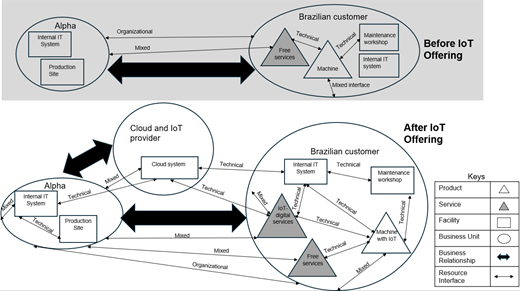
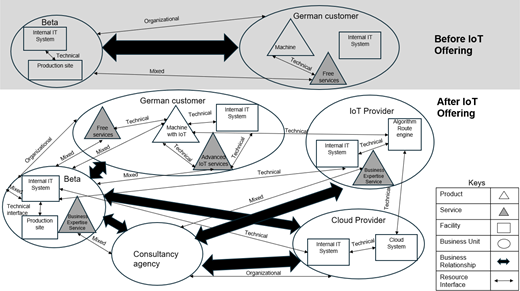
However, applying the standard 4R model to digital, IoT-based service transformations required two specific adaptations. First, regarding the product category, although the standard 4R model subsumes both goods and services under “products” (Bocconcelli et al., 2020), this study explicitly separates them to distinguish their operational roles in a digital context. The service component was positioned within the customer’s business unit using distinct visual symbols: a filled triangle for digital/servitized offerings and an unfilled triangle for physical products (Figures 1 and 2), enabling precise mapping of how digital services interact with physical machinery. Second, regarding the facilities category, while facilities typically denote tangible physical assets such as factories, trucks, or warehouses (Baraldi et al., 2012), this study expands the category to include cloud systems. Although cloud systems possess non-tangible digital properties, they function as core operational infrastructure within the network – analogous to a traditional physical plant – and are indispensable for producing and delivering digital services.
These adaptations allowed detailed “before and after” observations of IoT adoption across two temporal snapshots: Snapshot 1 (pre-IoT platform) and Snapshot 2 (postlaunch commercial adoption). Implementation was conceptualized as an evolving process; multi-year data collection (2019–2023) enabled tracking intermediate developments.
Analysis focused specifically on newly introduced or reconfigured resources and interfaces resulting from IoT adoption and new digital services – such as video remote assistance, online service requests and chatbots – rather than comparing full pre- and post-states. Preexisting tools (e.g. email, CRM) were categorized under Snapshot 1 baseline routines. Interface categories emerged inductively based on technological content and interaction types. Authors held weekly or bi-weekly meetings to align interpretations, triangulate data and ground findings in existing literature to ensure analytical reliability and validity.
4. Case descriptions
To ensure confidentiality, the case companies are anonymized as Alpha and Beta. Alpha, founded in the early twentieth century, is a global leader in welding and cutting technologies, recognized for advancing process efficiency, precision and safety. Its portfolio includes welding consumables (electrodes, wires, fluxes), equipment (machines, power sources, accessories) and cutting systems (plasma, oxy-fuel, laser). Strategically, Alpha fosters customer independence through technical support and training programs. Prior to IoT integration, Alpha operated a traditional sales model: portable machines were distributed via third parties, whereas large automated systems were sold directly with on-site installation. These stand-alone units lacked connectivity to customer IT infrastructure, requiring process engineers to interact physically for setup and operation. Ordering and “free services” (e.g. warranty claims) were managed manually via phone, email and basic ordering systems.
Beta, founded nearly 50 years ago in central Italy, is a global provider of processing machinery for woodworking, glass, stone, plastic and metal industries. Incorporating Industry 4.0, automation and digitalization, Beta offers CNC machining centers, edge-banders, panel saws, sanding machines and drilling machines tailored for operations from small workshops to large facilities. Market strategy emphasizes customer training and 24-hour assistance. Pre-IoT communication interfaces remained traditional, relying on phone and email. A standard business-hours hotline handled technical support on a first-come, first-served basis subject to technician availability, scheduling on-site visits for unresolved complex issues. This structure presented three operational limitations: lack of request triage, absence of out-of-hours coverage and inefficient advance planning for field interventions in terms of cost and time.
In their attempt to anticipate market needs and offer innovative solutions to customers, both Alpha and Beta invested in the creation of a Digital Service Platform, supported by IoT technology. “We thought that software is a great way to […] provide solutions to our customers and we create our own competitive game” Alpha’s General Manager Digital Solutions. Indeed, nearly at the same time (from 2015 to 2016) the two firms started experimenting with the implementation of sensors to their products to connect them online, collect big data and analyze them to develop customized IoT-based services to improve customers’ workflows:
We want to get closer to the customer. We want to build a better relationship with the customer. So, so that’s why when we did the software, we really focused well, obviously the focus on the customer. Everything we do has the customer in focus, but with software specifically, we focus on the workflows. So, we look at what the customer is doing, what workflows are on the customer side and how we can use software to make those workflows more effective.
Alpha’s General Manager Digital Solutions. Along this digital transformation path, Alpha and Beta introduced new, digitally based channels to achieve customers or, in some cases, switched existing traditional channels into digital ones.
Among the various communication channels, Alpha implemented a chat box, conceived as a way through which businesses can interact with their customers in real-time via text-based messaging. This tool allows users to ask questions, seek support, or engage in discussions with company representatives. Chat boxes can serve as convenient communication channels to provide customer support, address inquiries, or help related to products or services. Firms can use them to resolve issues promptly and build closer customer relationships. Both Alpha and Beta also developed a monitoring application, consisting of software technology that enables customers to access information and services based on IoT sensor data. These applications support functionalities such as remote monitoring, predictive maintenance, asset tracking and performance optimization. In addition, Beta invested in a video remote assistance tool – an advanced digital solution that enables companies to deliver real-time visual support or guidance to customers using video communication technology. This tool allows firms to remotely troubleshoot issues and provide technical support quickly. It enables experts to visually assess problems and guide users step-by-step in resolving issues. Beta also developed a service request management tool, intended as a software application through which customers can autonomously generate specific service requests. This tool supports the efficient and organized handling of requests, inquiries or support tickets from customers and streamlines the process of receiving, tracking, prioritizing and resolving service-related issues. These examples illustrate the variety and strategic relevance of the new interfaces introduced by Alpha and Beta throughout their digital transformation journey and analyzed in this study.
5. Analysis
This section analyzes how IoT services and connected machines reshaped Alpha and Beta’s resource networks and interfaces. Section 5.1 details Alpha’s evolution from a transactional model with a Brazilian customer to a software-as-a-service (SaaS) configuration. Section 5.2 explores Beta’s network transformation with a German customer, establishing a multi-actor structure involving cloud, technology and consultancy partners. Finally, Section 5.3 presents cross-case findings on shared interface complexity patterns and strategic dependencies on a common global cloud provider.
5.1 The Alpha case: from a transactional exchange model into a software as-a-service configuration
The Alpha case demonstrates how incorporating IoT technologies into the firm’s portfolio catalyzed a restructuring of its broader business network. These structural changes, centered on a focal Brazilian customer, were marked by an escalation in both the complexity and mutual dependency of resource interfaces. A comparative overview of these resource network snapshots, capturing the configuration prior to and following the adoption of the IoT offering, is illustrated in Figure 1.
5.1.1 Before the Internet-of-Things offering – Alpha
Before the IoT offering and customer adoption, Alpha’s business network was quite simple. It had only a few resource interfaces and a straightforward, linear way of exchanging things between the main companies. On top of that, Alpha had very little internal knowledge about IoT: “It started to gain this competence 2 or 3 years ago.” R&D manager Digital Solutions. In this first snapshot, before the IoT solution was introduced, Alpha’s relationship with its welding machine buyers – including the main Brazilian customer – involved a lot of variety but focused mostly on just selling standard machines with few extra services.
As shown in Figure 1, the resource interfaces in this early phase came down to three basic types. First, a main technical interface connected the physical machine directly to the customer’s maintenance workshop and factory floor, but it completely lacked digital connectivity or any way to send data automatically to the customer’s internal IT systems. Second, an organizational interface handles basic communication using standard tools like order systems, phone calls and emails to take care of “free services” such as warranty claims. Third, a mixed interface existed where human workers met physical products, specifically when the customer’s process engineers worked with the machine during setup and manual tasks. Ultimately, this setup was stable but limited in terms of services and digital services, with interfaces that only served basic day-to-day operations and routine communication.
5.1.2 After the Internet of Things offering – Alpha
The introduction of the IoT platform changed Alpha’s business network by adding complexity following the inclusion of the IoT offering into the portfolio and subsequent customer adoption. This transformation was characterized by the introduction of the IoT platform and cloud provider as a single new actor, and the establishment of several new resource interfaces. The analysis reveals that this single IoT platform and cloud supplier – a globally recognized software leader – contributes with critical technical resources, including cybersecurity, infrastructure and specialized expertise, thereby fundamentally altering the nature and complexity of resource interfaces within the network. The R&D Manager of Digital Solutions highlights the criticality of this newly established technical interface with their partner:
This partnership provides two main advantages: first, it ensures high-level security; and second, it significantly shortens our time-to-market when developing new solutions. While there is still a substantial amount of internal development required, leveraging these established platforms allows us to focus on our core components rather than the complexities of building an underlying IoT infrastructure from scratch.
Concurrently, the organizational interface shifted toward a recurring, license-based continuous interaction that reflects the increased complexity of the new, digitally based business network. The Product Manager for Digital Solutions explains this evolved structure:
The customer signs up for our software. They order licenses and we bill them on a recurring basis. For the productivity module, the customer buys a license per connected machine […] For the “Alpha Notes module,” it’s a “per user” type of license.
This more sophisticated network configuration requires small technical adaptations in the customer’s internal IT infrastructure to interface effectively with the cloud platform, heightening technical interdependence across organizational boundaries and requiring a high level of trust in the cybersecurity systems provided by the partner. The General Manager of Digital Solutions emphasizes how these continuous technical connections strengthen actor bonds and embed Alpha deeper into the customer’s daily operations:
Basically, they use our software every day. The welding engineers, they go into the ‘cloud solution’ platform on a daily basis and that brings us a lot closer […] they can easily see, OK, do I have productivity issues somewhere?
There was a considerable increase in technical interfaces within the network, as shown in Figure 1. These technical interfaces have surged as physical welding machines are systematically linked to cloud-hosted SaaS platforms, facilitating Alpha’s transition from a standard product supplier to a product and digital service provider. A critical technical interface now exists between Alpha’s internal IT system and the cloud system; because the offering is built entirely on the partner’s architecture, the costs of switching are prohibitive, underscoring a deep operational dependency. Concurrently, the organizational interface has evolved through a new cross-functional Digital Solutions team that interacts with customer business units. Mixed interfaces - the intersection of resources (product and digital services) and human actors - are vital in this configuration. A metallurgical engineer from the Brazilian customer noted that the “Notes module,” which is a digital service, streamlined tasks done by the engineers by replacing generic templates with project-specific documentation and integrated drawings. Important to note that this Brazilian customer acted also as a pilot collaborator for a period of time, providing recurrent feedback that shaped the development of the “Productivity module.”
A further mixed interface emerged between Alpha’s Value Engineering (VA) team and the digital service, reflecting how advanced services require both digital platform interactions and human expertise. This example demonstrates that while technical interfaces support real-time data flow, human expertise remains in the center of the network. The importance of the human aspect is clearly demonstrated when despite the automated reporting functionalities of the platform, Alpha continues to provide specialized engineering services to adapt to specific customer requirements:
Today, we offer our “Alpha Cloud” customers a proactive service where our Value Engineering (VA) team analyzes their data once or twice a year to recommend productivity improvements […] We can identify specific adjustments, such as changing the welding wire, optimizing part preparation, or switching materials.
R&D Manager of Digital Solutions. The mixed interface reflects a clear complementarity where digital tools enhance knowledge creation and managerial decision-making rather than replacing personal interaction. Furthermore, it is also identified that the IoT platform changes how human expertise is combined with the products and customers workflows to create knowledge, as there is a profound transition from physical, localized data collection to remote digital analysis. This is further explained by the R&D Manager of Digital Solutions:
In the past […] our VA team would physically travel to the site and use a stopwatch to manually measure every process […] Now, with the customer’s consent, the VA team can analyze the data remotely from their offices or homes […] These recommendations are now driven by remote data and statistics rather than on-site manual observation.
Ultimately, this configuration of technical, organizational and mixed interfaces reflects a transition from discrete product exchanges to a model of deep resource embedding. From a 4R perspective, the structural standard of the technical interface with the cloud provider creates a significant dependency from Alpha’s side, while the mixed interfaces ensure that digital resources are combined with human expertise, sometimes remotely. This systemic interdependence shifts the relationship’s gravity from the physical product toward the continuous interactions of digital resources in a variety of interfaces.
5.2 The Beta case: from a simple bilateral structure to a multi-actor network enabling Internet of Things-based services and interactions
The Beta case illustrates how the introduction of IoT technologies into the firm’s portfolio triggered a genuine transformation of its business network. This transformation, centered on a German customer, involved the emergence of multiple actors assuming new roles and engaging in continuous interaction and resource combinations to cocreate value. Figure 2 shows Beta’s resource network before and after the IoT implementation.
5.2.1 Before the Internet of Things offering – Beta
Prior to IoT offerings and customer adoption, Beta’s business network was a relatively simple bilateral structure centered on its established relationship with a German luxury furniture manufacturer, characterized by a limited number of resource interfaces and a linear exchange pattern between the two actors.
The resource interfaces in this initial phase encompassed three main typologies. First, a technical interface linked Beta’s production facility directly to the woodworking machinery installed at the customer’s manufacturing site, enabling basic operational connectivity but no digital data flows or remote monitoring, with machines functioning as stand-alone units. Second, a technical interface connected the customer’s internal IT systems to the installed machinery, supporting only basic data handling with no integration into broader digital infrastructures. Third, an organizational interface managed the Beta–customer relationship through conventional channels, i.e. phone calls, email correspondence and periodic face-to-face interactions with sales personnel. Services provided were largely unstructured and delivered at no additional cost, relying predominantly on personal interactions and manual processes. This bilateral arrangement represented a stable but limited exchange pattern, with interfaces primarily serving basic operational and communication needs rather than enabling advanced value-creating activities. “But the IoT platform will go far beyond this. This solution is inspired by Beta’s desire to accompany its customers through a process of growth that enables the optimization of all major assets – technological, strategic, organizational and human” – Beta’s Service Director.
5.2.2 After the Internet of Things offering – Beta
The implementation of the IoT platform fundamentally transformed Beta’s business network into a complex multi-actor network: “When the IoT platform idea emerged and the collaboration with Beta’s Consultant 1 started, Beta integrated new knowledge by collaborating with new suppliers characterized by more advanced technological expertise” – Service Director of Beta. This transformation introduced three new actors – a consultancy agency, an IoT provider and a cloud provider – each bringing distinct resources to the network. The consultancy agency became a strategic partner through a formal codevelopment agreement with Beta, contributing technical and business knowledge while linking Beta to the IoT provider. From a resource interface perspective, two mixed interfaces emerged: one linking Beta’s business unit with the consultancy agency’s service resources, transferring IoT-specific business knowledge into Beta’s routines; the other linking the consultancy agency’s business unit with the IoT provider’s service resources, enabling technical integration between Beta’s platform and the provider’s infrastructure. Together, these function as “bridging interfaces,” allowing Beta to interact effectively with the IoT provider by closing IoT-related knowledge gaps. As a result, the technical interface between Beta’s Internal IT system and the IoT Provider’s Internal IT System is effective and positively influences the platform’s technical characteristics. In Beta’s case, these “bridging interfaces” are represented by the mixed interface linking the service resource received by Alpha (triangle “Alpha’s Business Expertise Service”) with the Consultancy Agency Business Unit, and the mixed interface linking the service resource received by the IoT provider (triangle “IoT provider’s Business Expertise Service”) with the same unit.
The IoT provider, a world leader in technological solutions for both B2B and B2C markets, became central to Beta’s digital service delivery. A cloud provider also joined the network to support data storage and processing, transforming from a peripheral CRM supplier into a core network participant. As noted by the Business Project Manager of Beta’s Consultant 1:
Beta uses advanced digital technologies to transform its core operations, its worker and customer experiences and ultimately its business models. New levels of efficiency are achieved in the core of R&D, engineering, production, manufacturing and business support through integrated systems, processes, sensors and new intelligence […] For industrial manufacturers like Beta, digitalization usually starts with digitizing and enhancing existing products to enable new service offerings.
The IoT implementation altered the nature and complexity of the network’s resource interfaces (Figure 2): the pre-IoT configuration featured only three basic interfaces, while the post-IoT architecture introduced multiple layers of technical, organizational and mixed interfaces.
The most significant change was the steady expansion of technical interfaces, now including machine-to-system connections, machine-to-cloud data flows and system-to-system integrations enabling real-time monitoring, predictive maintenance and advanced analytics. Specifically, four new technical interfaces became central to Beta’s post-IoT configuration: a machine-to-cloud interface for continuous data transmission from the woodworking equipment to the cloud; a system-to-system interface connecting Beta’s internal IT environment with the IoT provider’s system; and a machine-to-system interface integrating the customer’s machinery with Beta’s remote monitoring and analytics, accessed through the cloud system where data was previously processed by the IoT provider’s algorithm route engine – adding another system-to-system interface. Each interface added a new layer of technical interdependence, requiring significant adaptation of both Beta’s and the customer’s existing technical resources. As underlined by Beta’s Service Director, “Among the main barriers, there were issues related to infrastructure and machine components, which had to be modified to enable connectivity. The company also needed to develop the capability to analyze data through dedicated functions and specialized personnel. The main difficulty was not so much the launch of the platform as a brand, but rather its internal integration and adoption, especially within the technical and commercial areas.”
The IoT platform created new technical pathways between Beta’s facilities and external systems, notably through mixed interfaces combining technical and organizational elements. These interfaces reflect the complexity of the new digital business network, where technological exchanges coexist with human-mediated interactions for organizational alignment. For instance, the route engine communicates directly with cloud systems through purely technical interfaces, while advanced services for the German customer require both digital and human expertise, creating mixed configurations. The customer also becomes an active part of this process:
Over time, the IoT platform evolved into a tool designed to support the customer directly, enabling them to become more autonomous and informed. The ultimate objective is the integration of the entire production chain to generate customized and ad hoc production programs […] The data collected along the entire chain are integrated to allow customers themselves to become part of the network.
Beta’s CEO Assistant. Rather than disappearing, traditional organizational interfaces evolved to complement new digital touchpoints: phone, email and sales personnel interactions persist, now augmented by the IoT application, video remote assistance and the website. The Key Account Manager of Beta makes this technical-human integration clear:
The hotline service aims to be proactive, meaning that Beta is able to notify the customer of a machine stoppage as soon as it receives the input from the IoT platform, potentially even before the customer becomes aware of it.
This represents a shift from purely organizational to organizationally embedded technical interfaces. In sum, Beta’s post-IoT interfaces reflect a layered architecture: technical interfaces support automated, standardized delivery, while mixed interfaces combining digital and human expertise remain indispensable for advanced, context-specific services – a complementarity mirroring the Alpha case, differing mainly in network complexity and intermediary actors.
The IoT implementation revealed further changes in the business network, with existing relationships assuming new roles. Network integration is fundamental to developing digital capabilities:
Among the digital capabilities we identified as crucial for transitioning toward an IoT platform there is creating ecosystems and making them work. No company will be able to own the entire digital value chain on its own. It will therefore be essential to collaborate with suppliers, customers, technology partners, start-ups, academia, competitors, and other stakeholders.
Beta’s Consultant 2 Market Analyst. The cloud provider exemplifies this shift, evolving from a peripheral CRM supplier established in 2008 into a central participant providing Big Data storage and processing. Beta’s Digital Project Manager described this relationship:
The Cloud Provider now evolved to an internal Beta platform used by the Service department, customer support, and all technicians. It is mainly employed for the overall management of service activities, such as scheduling on-site interventions, accessing customer history, organizing assistance operations, and related tasks.
The German customer’s network position also transformed: no longer limited to bilateral interactions with Beta, the customer now accesses IoT-based services through technical and mixed interfaces with multiple actors, enabling machine-to-system, machine-to-cloud, and system-to-system integrations that deliver enhanced functionality and value.
The new configuration of interfaces also depended on service type and delivery mechanism. Fully digital services – such as automated monitoring and predictive analytics – operate through purely technical interfaces with minimal human intervention. Conversely, services requiring high human interaction – such as 24-hour technical support and customized solutions – necessitate mixed interfaces combining technological and organizational resources. This diversification let Beta deliver a broader range of services while adapting interface configurations to specific requirements:
The IoT Platform provides the customer with full visibility of the production status of their machines, with performance parameters summarized historically and an overview of the machines in operation. Where a machine stoppage occurs, the corresponding ID code is displayed, with the relevant details if the assistance operations have already been taken over by the Beta Service Team.
Service Data Analysis Manager. The result is a more sophisticated architecture supporting both standardized digital offerings and customized, human-expertise-driven solutions.
5.3 Cross case findings
The analysis of Alpha and Beta cases reveals several shared patterns in how IoT implementation reshaped their resource interfaces in business relationships. In both cases, the introduction of digital technologies led to an increase in the number and complexity of resource interfaces, particularly technical and mixed ones. This expansion reflects a broader shift from traditional, transactional exchange models toward IoT-based service-oriented configurations, where there is continuous digital interaction.
Despite the growth in automation and technical connectivity, organizational interfaces remained highly relevant. Both firms continued to rely on human actors to support customer engagement, interpret data and facilitate the integration of digital services into operational routines. The emergence of mixed interfaces – where human and technological resources interact – highlighted the complementary nature of digital tools and organizational expertise. In addition, the implementation of IoT solutions has increased both firms’ dependence on external digital partners, such as cloud service providers, underscoring the importance of a broader digital network in enabling and sustaining these new business models.
During the study, the researchers discovered that both Alpha and Beta are using a solution from the same actor, the “Cloud provider,” to provide the cloud system to their customers. This cloud provider is a very strong global IT player who is acting in both B2B and B2C areas. Alpha and Beta are highly dependent on the cloud provider to have their IoT platform up and running for their customers, and they had to extensively adapt their technical resources to be compatible with the cloud provider’s technical resources (backbone). While this adaptation facilitated the collaboration and resource combinations, it also increased dependencies in the network. The Cloud provider’s centrality is further reinforced by preexisting activity links with end-customers. Since these customers were already adapted to the Cloud provider software services of various forms, the transition to the IoT platform was eased by technical familiarity and established relationships. Interviewees from both manufacturing firms confirmed that these prior business relationships between the Cloud provider and the machines’ customers were decisive in the provider’s selection, effectively leveraging the Cloud provider’s position to consolidate its role as a central actor when it comes to IoT infrastructure within the business network.
6. Concluding discussion and implications
This section presents the study’s concluding discussion and theoretical and practical implications. Section 6.1 structures the discussion around four primary insights: the enduring value of organizational interfaces, the link between service complexity and interface configuration, the role of “bridging interfaces,” and the evolution of preexisting network roles. Section 6.2 details theoretical contributions, showing how this study advances the RIA and the 4R model in digital contexts. Finally, Section 6.3 outlines managerial implications, research limitations and avenues for future research.
6.1 Concluding discussion
First, digital transformation increases technical interfaces, yet organizational interfaces remain vital. The Alpha and Beta cases highlight a clear expansion of technical interfaces following digital technology implementation, particularly IoT platforms. These interfaces – such as machine-to-cloud connections – are central to enabling advanced service functionalities, including remote monitoring, predictive analytics and platform-based subscription models used by B2B customers. This shift reflects a broader industrial transformation, where connectivity and automation alter how resources interact across boundaries, increasing technical adaptations and dependencies among manufacturing firms, digital-service customers and specialized suppliers. Despite this expansion, the cases demonstrate that organizational interfaces remain essential to sustain and enhance business relationships. In both Alpha and Beta, human actors continue playing critical roles in interpreting system-generated data, supporting customer onboarding, facilitating services and coordinating complex, multi-actor networks. Alpha’s digital solutions team and Beta’s service team show that organizational interfaces are not replaced in digital contexts, but reconfigured and intensified. This supports Fremont’s (2021) view that organizational elements play a central role in digital transformation. Resource context changes, such as new roles and working methods, enable value creation beyond technological improvements by maintaining relational continuity, building trust and providing needed flexibility.
Second, the research reveals a contingency between service complexity and resource interface configuration. Comparing Alpha and Beta indicates that the type and complexity of the IoT-based service offered by the focal company significantly influences the balance between technical and organizational interfaces. Advanced IoT-based digital services require ongoing provider involvement, demanding stronger organizational interfaces, whereas standardized or modular digital services can rely heavily on technical interfaces. Beta offers complex, integrated services requiring continuous customer interaction and coordination through 24-hour availability, real-time video support and ongoing involvement in interpreting data and advising customers. In this context, technical interfaces (e.g. the IoT platform) are complemented – and often enabled – by organizational interfaces such as dedicated personnel, personal relationships and synchronous communication tools. These are essential for contextual understanding, adaptability and trust in advanced IoT service delivery. Consequently, the business relationships between Beta and its digital-service customers have become increasingly critical, as has the role of individual actors, aligning with Håkansson and Ford (2002) findings on complex business networks.
In contrast, Alpha adopts a more modular and delegated approach. Apart from services provided by the Value-Added Engineering team and chat box, most of Alpha’s IoT-related digital services generate basic usage, monitoring and workflow performance reports. Maintenance and daily support are outsourced to external partners or handled by the customer. Alpha’s IoT technical interface serves primarily as an information delivery tool rather than an active engagement channel, resulting in minimal organizational interfaces with end-customers.
The comparison underscores that technical interfaces alone cannot support complex, personalized, or operationally embedded services. This carries significant implications for understanding actors and resources in digital transformation. While Kyrdoda et al. (2025) demonstrated how digital transformation introduces nonhuman actors and reshapes operational processes, our findings regarding Alpha’s Value Engineering team and Beta’s proactive hotline show that nonhuman interactions do not replace human bonds. Instead, for complex IoT services, technology-mediated bonds must be anchored by human expertise. This affirms that human involvement is the prerequisite for converting digital data into productive value, acting as the essential “glue” that sustains actor bonds. The need for such “glue” highlights the critical role of mutual interconnections and organizational interfaces in enabling joint development and learning (Håkansson and Snehota, 1995) in IoT-based service delivery.
Third, the research identifies “bridging interfaces” – specific mixed interfaces where intermediary actors facilitate interaction between manufacturers and technology providers. These interfaces address knowledge gaps regarding IoT platforms, enabling novel resource combinations across the network. By establishing shared boundaries, bridging interfaces allow firms lacking digital expertise to navigate digital transformation, access critical digital resources and infrastructures and reconfigure their position within the business network. Bridging interfaces can also introduce interdependence (Prenkert et al., 2019), as seen in Beta’s case: growing interdependence between Beta, the consultancy agency and the IoT provider added network complexity and reinforced lock-in mechanisms. However, these bridging resource interfaces also facilitate relational coordination and effective platform functionality.
Fourth, reconfiguring roles and evolving preexisting relationships is another key insight. Digital transformation affects not only network scale by introducing new actors, but also network structure by reshaping existing relationships. In Beta’s case, the cloud provider had been involved since 2008 primarily as a CRM supplier. However, IoT implementation redefined this role, elevating the provider to a strategic position and creating a new interface with the IoT provider. This illuminates the importance of network breadth, diversity and peripheral actors in business relationship networks, including their impact on resource access and network development (Granovetter, 1973; Håkansson and Snehota, 1989). Moreover, this evidence aligns with the conceptualization of resource interaction and interfaces as dynamic, path-dependent phenomena (Prenkert et al., 2019; Baraldi et al., 2012), where resources acquire new meanings through mutual adaptation and recombination. The cloud provider’s CRM involvement laid the foundation for an embedded partnership in IoT-based services. This shift illustrates how digital transformation stimulates the inclusion and repositioning of resources, reinforcing that resource value is contingent on interaction (Baraldi et al., 2012; Penrose, 1959). The cloud provider’s evolving role exemplifies how firms strategically renew relational configurations to meet digital complexity.
Taking together, these four insights form one coherent pattern rather than four separate observations. The complexity of the IoT-based service offered determines how much organizational “glue” is needed to sustain corresponding technical interfaces. When manufacturers face internal digital knowledge gaps, bridging interfaces close that gap by bringing in external digital expertise through intermediary actors. Both processes unfold as manufacturers reconfigure roles and evolve preexisting relationships, turning previously peripheral actors – such as cloud service providers – into central partners. In short, digital transformation does not simply add interfaces: it shifts where organizational interfaces and human expertise are needed, moving from the manufacturer’s internal organization toward specialized digital providers, in step with service complexity.
6.2 Theoretical contributions
This study makes four theoretical contributions to the RIA and to the IMP literature on digital transformation in business relationships, elaborated below.
First, this study advances the emerging understanding of resources in digital transformation (Dóra et al., 2023; Ferreira and Lind, 2022; Hauke-Lopes et al., 2023) by showing that digital transformation leads to the mutual intensification of different resource interfaces in the business network. While IoT platforms expand into technical interfaces (e.g. machine-to-cloud links), this increased structural dependency requires stronger organizational interfaces to function. Human actors remain essential for providing advanced IoT-based services, interpreting data and coordinating multi-actor networks, proving that organizational adaptation is a prerequisite for activating digital resource combinations. Beyond the interface level, this finding speaks to the broader question of how digitalization affects business relationships: it suggests that digitalization does not substitute organizational interfaces and human expertise with technology but relocates where they are needed – a distinction with implications for how IMP research theorizes business relationships in digital transformation.
Second, this work identifies a theoretical contingency: the complexity of the digital service dictates the required resource interface configuration. While advanced IoT-based services rely on high-complexity offerings (such as 24-hour assistance) requiring more organizational interfaces to provide necessary trust and context, modular IoT-based services rely on standardized offerings where technical interfaces serve primarily as information conduits. Productive fit in IoT-based service offering thus depends on balancing technical resources with human coordination aligned with operational service complexity. This contingency extends prior IMP accounts of digitalization (e.g. Pagani and Pardo, 2017; Pardo et al., 2022) by specifying when organizational interfaces intensify rather than diminish, offering a more precise account of when – not only whether – digitalization reconfigures business relationships.
Third, this study contributes to the RIA by highlighting necessary adaptations when applying the resource categories “product” and “facilities” within the 4R model to IoT-based service offerings. While the 4R model defines “product” as combinations of goods and services exchanged between business units (Bocconcelli et al., 2020), it lacks clarity on visually representing and positioning services given their simultaneous production and consumption. This gap was addressed by positioning service symbols within the customer’s business unit and differentiating physical and service components using separate symbols (filled triangles for services and unfilled triangles for products). Regarding facilities, which Baraldi et al. (2012) restrict to tangible artifacts such as warehouses and trucks, this study adopts a broader interpretation by classifying cloud systems as facilities that produce digital services. The study thus provides a modified approach for mapping the interplay between tangible, digital and service resources. Extending the widely used 4R model to represent digital services and cloud infrastructure equips future IMP research with a framework capable of analyzing digital transformation beyond the context of this study.
Fourthly, this research identifies “bridging interfaces” as specialized mixed interfaces that emerge when manufacturers face significant knowledge gaps preventing direct interaction with digital providers. These interfaces function as critical shared boundaries where intermediary actors – such as the consultancy agency in the Beta case – facilitate interaction between industrial firms and specialized digital resources. Bridging interfaces are vital for navigating structural barriers in digital transformation, enabling manufacturers to achieve novel resource combinations and integrate IoT-based services into traditional product portfolios. However, establishing these interfaces introduces a new degree of structural interdependence, as the manufacturer’s digital operations become tied to mediating partners’ routines and protocols. Ultimately, bridging interfaces explain how manufacturers reconfigure their position within the wider business network by leveraging external digital expertise to overcome internal resource limitations. More broadly, bridging interfaces reveal a mechanism through which digitalization reshapes business relationships indirectly – not only by altering the interface between manufacturer and customer, but by inserting new relationships with intermediary actors into the network, reinforcing the interdependence and lock-in effects discussed above.
6.3 Managerial implications, limitations and future research
For managers, digital transformation requires blending digital tools with human relationships. Manufacturing firms implementing IoT platforms must complement data with internal “data translator” teams that interpret machine data, onboard clients and handle daily service coordination – treating this organizational layer as a prerequisite for value creation rather than a supporting cost. Managers must also mitigate cloud vendor lock-in by treating tech suppliers as key partners, with explicit rules on data ownership and system connectivity that preserve room for future strategic choices. Using external experts as “bridging interfaces” to fill skill gaps requires clear guidelines to accelerate the digital transition without compromising firm autonomy or direct customer relationships.
These findings also inform B2B marketing and industrial network education by demonstrating how actor roles and relationship structures evolve in hybrid digital-physical environments.
Regarding limitations, focusing primarily on Alpha and Beta restricts customer and partner insights. Future research should examine customer-side adoption and network engagement, analyze value co-creation and co-destruction across technical, organizational and mixed interfaces and employ longitudinal designs to track real-time interface stabilization beyond snapshots.
Finally, both cases revealed a cloud provider paradox: despite striving for unique resource combinations, both firms relied on the same global cloud provider due to reputation and resource access, interconnecting distinct business networks around shared infrastructure. This suggests that different business networks are becoming connected because they share the same resource base (Lind et al., 2012). Future scholarship should investigate how global digital actors shape resource combinations and drive dependencies. This also carries policy implications, as reliance on few global cloud providers creates cross-network dependencies and potential infrastructure vulnerabilities.