Although searching for and discovering a purpose in life has been associated with a variety of psychological, physical, and academic benefits, the experience is relatively rare (Bronk, 2013). Only about one fifth of adolescents and one third of young adults report leading a life of purpose (Damon, 2008). Accordingly, we designed and tested 2 brief online interventions that help young people search for and identify a purpose for their lives. One toolkit approached purpose from the perspective of goal setting and values exploration, while the other used gratitude as a springboard. A test of these toolkits suggests they effectively spur both the search for purpose and identification of a purpose in life. In addition to outlining the design and testing of these interventions for young adults, implications for their use with adolescents are also addressed.
A purpose in life represents a long-term, forward-looking intention to accomplish aims that are both meaningful to the self and of consequence to the world beyond-the-self (Damon, Menon, & Bronk, 2003). This definition includes three key dimensions. First, a purpose is a goal of sorts, but it is a particularly far-reaching, long-term aim, and the value it provides can be found in the sense of direction it provides. Second, a purpose in life is personally meaningful. In some cases, it is so personally significant that it represents a core component of one’s identity. It is not uncommon for young people to describe themselves based on their purpose in life. This is evident when an environmentalist describes herself as a “tree hugger,” a gun control advocate calls himself “a security guru,” or a youth who finds purpose in serving God identifies herself as “a Christian” (Bronk, 2011). Third, although a purpose is meaningful to the self, it also has an external component. A purpose represents a long-term goal inspired, in large part, by a desire to make a difference in the broader world. In this way, a purpose helps young people find their place in the broader world.
Empirical studies and measures distinguish between an identified purpose in life and searching for a purpose (see Bronk, 2013). Identified purpose refers to the extent to which individuals know what their purpose is and actively pursue it. Searching for purpose, on the other hand, refers to finding the motivation to discover the noetic or spiritual, inspirational, aspirational, or nonmaterial, larger-than-the-self aspects of life (Crumbaugh, 1977). Some empirical research finds the search for purpose precedes the identification of purpose (Crumbaugh, 1977; Reker & Cousins, 1979), but other studies, using different measures of purpose, find the processes are more iterative (Bronk, Hill, Lapsley, Finch, & Talib, 2009; Steger & Kashdan, 2007).
In addition to finding that searching for and leading a life of purpose are distinct experiences, recent research has also explored the construct’s correlates; in particular, studies find purpose is related to hope. Feeling inspired to work toward a personally meaningful, long-term aim because of how doing so allows one to contribute to the broader world implies a sense of hope. Hopeful individuals are goal directed, and their goal-directed thoughts can be understood according to two interrelated components: agency and pathways (Snyder et al., 1997). This concept is often referred to as the will and ways of hope. Hopeful individuals hold personally meaningful goals, and they can identify ways of achieving these goals (pathways) and believe they have the will to do so (agency). Developing purpose can inspire hope when it provides individuals with clear goals for enacting personally meaningful change in the broader world. Empirical studies have borne out the close relationship between purpose and hope (Bronk, Hill, Lapsley, Talib, & Finch, 2009; Feldman & Snyder, 2005).
In recent years, the number of empirical studies on purpose has increased dramatically (Bronk, 2013; Pinquart, 2002), and this research has yielded at least two important findings. The first is that leading a life of purpose is a good thing. Purpose is associated with optimal psychological, physical, and academic development. From a psychological health perspective, the pursuit of purpose has been linked to hope, optimism, and life satisfaction (Bronk et al., 2009; Ho, Cheung, & Cheung, 2010; Krause, 2003), and from a physical health perspective, it has been linked to lower rates of mild cognitive impairment, a regression in some cancers, improved markers of cardiovascular health, and even longevity (Boyle, Barnes, Buchman, & Bennett, 2009; Hill & Turiano, 2014; Krause, 2009; Melnechuk, 1988; Ryff, Singer, & Love, 2004). Relevant to adolescents and young adults, the development of purpose has also been associated with indicators of academic success, including academic efficacy, grit, resiliency, and an internal locus of control (Benard, 1991; Hill, Burrow, & Bronk, 2014; Pizzolato, Brown, & Kanny, 2011; Solberg, O’Brien, Villarreal, Kennel, & Davis, 1993), and compared to other young people, individuals with purpose report that their school work is more meaningful (Yeager & Bundick, 2009).
The second compelling finding to emerge from recent psychological research on purpose is that the experience is relatively rare. The growth of purpose appears to follow, roughly, the development of identity (Bronk, 2011; Hill & Burrow, 2012; Hill, Burrow, O’Dell, & Thornton, 2010; Sumner, Burrow, & Hill, 2015). Accordingly, like identity, purpose develops across the second and third decades of life, but whereas most youth eventually settle on an identity, most do not discover a purpose in life. Studies find that only about one in five high school students and one in three college-aged youth reports leading a life of purpose (Bronk, Finch, & Talib, 2010; Damon, 2008; Moran, 2009).
Taking these two findings together—that leading a life of purpose is a good thing and that doing so occurs among a minority of young people—a small but growing number of researchers and practitioners have become interested in designing interventions that foster the search for and identification of purpose. Interventions have taken place in therapeutic, work, educational, and career counseling settings (Dik, Steger, Gibson, & Peisner, 2011; Frankl, 1984; Pizzolato et al., 2011). Many purpose-fostering interventions lack an empirical basis or a rigorous evaluation of results, and others have been offered as a one-time event and therefore fail to reach a significant number of youth. What is needed is an empirically based and rigorously tested purpose-fostering intervention that can be made available to large numbers of young people. Designing and testing such an intervention represents the aim of the current study.
Young Adults
Empirical research and pragmatism guided our decision to design and test an intervention with young adults in the roughly third decade of life. Studies find that in the absence of interventions, rates of purpose increase from the second to the third decades of life. Whereas only 20% of high school aged youth report leading lives of purpose, closer to a third of college aged youth report doing so (Damon, 2008). Accordingly, compared to their teenage peers, young adults may be more developmentally prepared to discover their purpose in life, and this makes sense in light of identity development. During identity development, young people experiment with different roles and varied ways of being. They consider who they are and who they hope to become. Identity development used to be associated with roughly the second decade of life (Erikson, 1968, 1980). However, as young people marry later and spend more time in school and exploring professional opportunities, the moratorium that is adolescence has lengthened, and today identity formation often extends well into the third decade of life (Côté & Allahar, 1996). Purpose formation and identity development are iterative, interconnected processes (Hill & Burrow, 2012). Healthy identity development results in what Erikson (1968, 1980) referred to as fidelity, or a commitment to relationships, a set of beliefs, and a value system. In other words, healthy identity development means committing to a set of values that will guide the young person into the next phase of life and beyond. A clear manifestation of fidelity, at least for some young people, is the development of a purpose in life. Given that purpose formation is closely related to identity development, and that identity development extends into young adulthood, designing an intervention to foster purpose during young adulthood makes sense.
Probably because young adulthood is a developmentally appropriate time to discover purpose, young adults report that it is a particularly satisfying time to seriously consider the things that matter most to them. A recent empirical study concluded that leading a life of purpose was associated with life satisfaction across adolescence, young adulthood, and midlife, but searching for purpose was only associated with life satisfaction during the late teens and twenties (Bronk et al., 2009). Taking these findings together, young adulthood (18–30 years of age) represents a developmentally appropriate stage during which to cultivate purpose, and one during which individuals are likely to find the experience satisfying. If our intervention did not work well with young adults, it seems unlikely it would have worked well with adolescents. At the same time, if it did work well with these individuals, our next aim would be to tailor it to meet the needs of adolescents.
Designing the Interventions
Surprisingly little research has identified strategies for intentionally fostering purpose among young people (Koshy & Mariano, 2011). However, findings from a small cluster of studies suggest purpose may be cultivated through interventions (e.g., Bundick, 2011; Damon, 2008; Pizzolato et. al., 2011). Reviewing these studies provided important guidance for the format, structure, and content of our purpose-fostering toolkits.
With regards to the toolkit format, research on media use suggested that an online toolkit would be an effective way of reaching young people. It is widely known that young people spend a significant amount of time on computers, and studies of media use bear this out. A nationally representative study revealed that young people in their teens and twenties in the United States spend on average 1 hour and 39 minutes a day using computers (Kaiser Family Foundation, 2010). This same study concluded that fully 93% of teens and young adults in the United States have a computer at home and 84% have Internet access. Accordingly, we felt confident that young adults would feel comfortable with an online toolkit, and since our goal was to create a tool that could reach as many young people as possible, the online format offered an appealing platform.
With regards to the toolkit structure, findings from the few empirically substantiated purpose-fostering studies suggest that time to consider and discuss the things that matter most can contribute to the discovery of purpose (e.g., Bundick, 2011; Pizzolato, et. al., 2011). Underscoring the need for time to reflect, a growing body of neuroscience research finds that the time when the brain is allowed to wander is critical to the internally focused, psychosocial mental processing that allows the mind to engage in meaning making and reflect on abstract aims, such as a purpose in life (Immordino-Yang, Christodoulou, & Singh, 2012). At the same time, results from this small body of purpose-cultivating studies suggest that purpose can be fostered in a relatively brief time frame. For instance, a recent study surveyed late adolescents about their purpose in life twice, 9 months apart (Bundick, 2011). A subset of participants was interviewed for about 45 minutes after the time one survey, and they showed significantly higher scores on Ryff’s (1989) purpose in life subscale several months later. It seems likely the interview encouraged youth to think more deeply about their purpose, and this was reflected in significantly higher purpose scores months later. Based on these findings, we created a toolkit that provides structured time and space for reflection over a short time frame (1 week).
Finally, the content of the toolkits was derived from both theoretical and empirical research. We ultimately created two toolkits. One fosters the search for purpose by encouraging goal setting and values exploration and the other by cultivating gratitude.
Purpose Toolkit. In line with the definition of purpose, the first toolkit cultivates purpose through a series of activities designed to help young adults (1) consider how they could use their talents to contribute to the world beyond themselves, (2) reflect on the long-term aims that matter most to them, and (3) contemplate their personally significant values and beliefs. Empirical research suggests that encouraging young people to think about the world beyond-the-self is key to fostering purpose (Damon, 2008). The interview study discussed earlier, which determined that a one-time interview effectively cultivated the purpose, included a question designed to do just this (Bundick, 2011). Toward the beginning of the interview, youth were asked to consider what they would change about the world, if they could change anything they liked. What would an ideal world look like, in their estimation? What could they do to make the world look more like their ideal world? This brief line of questioning encouraged youth inclined to contribute to consider how they might do so (Reilly & Damon, 2013). Accordingly, we posed these same questions to young people in our toolkit, and we asked them to write about the changes they would like to see and their ability to effect those changes. Other effective purpose-fostering interventions have featured goal-setting activities (Dik et al., 2011; Pizzolato et al., 2011), and theoretical research that identifies values as the foundation of one’s purpose in life (Damon, 2008) points to the importance of values exploration as a means of discovering purpose.
Gratitude Toolkit. The second toolkit took a less intuitive approach. Rather than foster purpose directly, it featured activities designed to cultivate gratitude. Theoretical research suggests youth focused on the blessings in their lives, are likely to consider how they want to give back (Damon, 2008). Others have similarly argued that the recognition that others have helped them triggers the urge to repay the benefactor or others to alleviate the uncomfortable sense of indebtedness (Trivers, 1971). Acting from a desire to make a difference in the broader world represents a key component of purpose.
The prosocial behavior that results from a sense of gratitude is referred to as upstream reciprocity, which includes direct upstream reciprocity (where individuals pay back the person who helped them) and indirect upstream reciprocity (where individuals pay the favor forward to another individual or group; Nowak & Roch, 2007). In short, studies conclude that compared to others, more grateful individuals are more likely to contribute to the world beyond themselves (McCullough, Emmons, & Tsang, 2002), and the relationship appears to be a causal one where gratitude leads to prosocial action. For instance, in a recent empirical study, researchers (Bartlett & DeSteno, 2006) induced feelings of gratitude and then measured prosocial behavior. Participants were asked to complete a computer task. In the gratitude condition, the computer lost power during the task, and a confederate helped the participant fix the computer. In the amused condition, which served to control for the potential effects of experiencing a positive mood, participants watched a humorous video clip. After, the confederate requested each participant’s help with a different project that involved completing surveys for as long as possible. Participants in the gratitude condition spent significantly longer helping than participants in the amused condition. Studies like this and others suggest that inducing a grateful state helps foster a desire for prosocial action in the broader world (Froh, Bono, & Emmons, 2010; Tsang, 2007), and this prosocial action could take the form of purpose. It seems likely that cultivating gratitude would encourage individuals to think broadly about the good things in their lives, which would evoke a desire to contribute to the broader world in a personally meaningful way. This motivated state could lead people to consider their purpose in life. To our knowledge, the relationship between purpose and gratitude has not been tested empirically.
Present Study
The present study tested two online, empirically based toolkits designed to foster purpose among young adults. We hypothesized that, compared to individuals in the control group, participants completing the Purpose and Gratitude Toolkits would demonstrate significant increases in both the search for purpose (H1) and identified purpose (H2). Given the relationship between purpose and hope, we also expected to find that individuals completing the Purpose and Gratitude Toolkits (but not the control activities) would show significant increases in hope (H3). Finally, based on the link between gratitude and prosociality (McCullough et al., 2002; Nowak & Roch, 2007), we hypothesized that completing the Gratitude Toolkit (but not the Purpose Toolkit or control activities) would foster prosocial intentions (H4).
Method
Participants
The sample included 224 young adults recruited from Amazon’s Mechanical Turk (MTurk). Research indicates that MTurk worker samples tend to be slightly more liberal than the broader U.S. population but are representative in terms of ethnicity, socioeconomic status, religion, and geographical locations (see Difallah, Filatova, & Ipeirotis, 2018, for more information on MTurk workers’ demographic characteristics). Participants recruited from MTurk also tend to produce reliable data (Azzam & Jacobson, 2013; Casler, Bickel, & Hackett, 2013; Goodman, Cryder, & Cheema, 2013). Participant ages ranged from 18 to 30 years of age (M = 26.09, SD = 3.06, Median = 27, Mode = 29). Slightly more than half (59%) were female (40% were male and 2% identified as androgynous), and most were Caucasian (Caucasian 73%, African American 10%, Hispanic/Latino 8%, Asian 5%, more than one ethnicity 3%).
Materials
Purpose Toolkit. The Purpose Toolkit featured activities designed to encourage participants to reflect on their values, goals, and how they wanted to leave their mark on the world. On each of 3 days, participants completed between 15 and 20 minutes of activities. The activities, described below, were made available online through Qualtrics.com to allow easy access and dissemination.
On day one, participants viewed a brief video clip that introduced the concept of purpose. Next, they were presented with a quotation about purpose, and they were encouraged to write open-ended response about if and how the quotation related to their future goals. After this, participants wrote their response to the following prompt: “Imagine you were given a magic wand, and you could change anything you about the world. What would you want to be different? Why?”
On day two, participants watched a video clip of comedian Jimmy Fallon describing his purpose in life. Next, participants completed a Q-sort (Block, 1961) in which they sorted values (e.g., volunteering, caring for my family, etc.) into three categories: “Exactly like me,” “Not at all like me,” and “Neither like me nor unlike me.” Then, they were asked to write briefly about why they selected the values that they rated as “Exactly like me.”
On day three, participants completed a Best Possible Selves activity (Layous, Nelson, & Luybomirsky, 2012) in which they were encouraged to imagine and write about the best possible vision of their life 20 years in the future. Next, they were asked to create or choose a tattoo design that symbolized what they valued most and hoped to accomplish in their lives. In addition to designing or choosing a tattoo, they wrote about why this symbol was important to who they were and what they wanted out of life. Participants also considered potential challenges or obstacles they might face as they worked toward those goals.
Gratitude Toolkit. The Gratitude Toolkit included three activities designed to promote grateful thinking, feeling, and behavior. Similar to the Purpose Toolkit, each activity took between 15 and 20 minutes to complete.
One day one, participants watched a short video clip that introduced the concept of gratitude and some benefits of practicing gratitude. Next, participants were asked to take a “Gratitude Walk,” during which they reflected on the blessings in their lives for 5 minutes. Upon returning from the walk, participants were asked to do a modified version of the “three good things” exercise (Seligman, Steen, Park, & Peterson, 2005) in which they listed five things they were grateful for, explained why they were grateful for each, and why they thought these things happened to them. They were encouraged to continue this practice on their own each day for the duration of the week.
On day two, participants read about benefit appraisals, or the components of gratitude (e.g. gratitude means someone has benefited and someone has incurred a cost). They were then asked to reflect further on and write briefly about the blessings in their own lives. They were also encouraged to practice benefit appraisals when people helped them in the future.
On day three, participants watched a brief video clip that spelled out the benefits of practicing gratitude (Seligman et al., 2005) and expressing gratitude (Toepfer & Walker, 2009). Participants were asked to write a letter of gratitude to someone who had helped them. They were encouraged to email or deliver their letters, although this was not enforced.
Control Activities. Control group activities focused on teaching memorization strategies. Participants spent between 15 and 20 minutes on each of three sets of activities.
On day one participants practiced making “preordered” lists to help memorize information. In this activity, participants were encouraged to make up short stories about the words that would help them remember their order. For example, participants should remember that “sun” is the number “one” word because the two words rhyme. They should remember that “eyes” is the second word because people have two eyes.
On day two, participants practiced “location memory,” which involves associating a piece of information with a particular location. Participants could then recall the information using visualization. For instance, participants were given the example, “If I were asked to remember the first 10 presidents of the United States I might imagine going on a trip to Washington, DC. At 1 o’clock, I prepare for my trip by washing ONE ton of clothes (I connected President Washington with the number one). Then I can imagine getting on the airplane and sitting next to a guy with TWO Adam’s apples (connecting President Adams with the number two).” After reading these instructions, participants were asked to try out the strategy to memorize the location of the first twelve elements of the periodic table.
On day three, participants were asked to use the MAPS (Music, Association, Picturing, Stories) technique to remember individual pieces of information. For instance, for the “M” portion of this activity, participants were asked to think of a way to make the information they needed to memorize into a song or rhyme. As an example, a helpful pneumonic for remembering a grammar rule is, “I before E except after C, or when sounding like A as in neighbor or weigh.”
Measures
Survey data were collected before participants began the activities (pretest), immediately after they completed the last activity (posttest), and a week after completing the final activity (lagged posttest.) Each of the measures below were administered at the pretest, posttest, and lagged posttest. The only exception was the self-concordant motivation measure, which was only completed at the pretest.
Searching for Purpose. Designed for use with adolescents and young adults, the 6-item Searching for Purpose measure (Dubon, Riches, Benevides, & Bronk, 2019) asks participants to reflect on the past 3 days, and to report on the degree to which they agree with the statements, “I thought about what is most meaningful to me,” “I thought about my long-term goals,” and “I thought about how I want to contribute to the world.” These items are rated on a 5-point Likert scale, with response options ranging from 1 (strongly disagree) to 5 (strongly agree). This scale demonstrated good internal reliability (α = .83).
Identified Purpose. Designed for use with adolescents and young adults, the 12-item Claremont Purpose Scale (Bronk, Riches, & Mangan, 2018) was administered to measure the three dimensions of purpose, including personal meaningfulness (e.g., “How well do you understand what gives your life meaning?”), goal orientation (e.g., “How hard are you working to make your long-term goals a reality?”), and a beyond-the-self motivation (e.g. “How often do you find yourself hoping that you will make a meaningful contribution to the world beyond yourself?”). In its initial validation, the scale demonstrated strong psychometric properties. For instance, it demonstrated good internal consistency in multiple samples (α = .92 −.94), strong construct validity (e.g. scores correlated as expected other measures of purpose, life satisfaction, and depression), and items loaded as expected onto the three factors (e.g., personal meaningfulness, goalorientation, and beyond-the-self motivation). It also demonstrated good internal consistency in this study (α = .90).
Gratitude. Gratitude was measured using the three-item Gratitude Adjective Checklist (McCcullough et al., 2002), which asks participants to rate how much of each of three emotions (thankfulness, gratitude, and appreciation) they experienced on a Likert scale from 1 (not at all) to 5 (a lot). This scale demonstrated good internal consistency in this study (α = .92) as well as in previous studies with adults (α = .87; McCullough et al., 2002) and adolescents (α = .78−.88, Froh, Sefick, & Emmons, 2008).
Hope. Hope was measured using the 6-item Children’s Hope Scale (Snyder et al., 1997). This scale was designed to measure a goal-oriented agency and pathways conception of hope in children and adolescents between 8–16 years of age (Snyder et al., 1997). Although our participants were older, a review of the items suggests they should be equally applicable to young adults. For instance, participants were asked to rate items such as, “When I have a problem, I can come up with lots of ways to solve it,” “I think the things I have done in the past will help me in the future,” and “I think I’m doing pretty well” on a Likert scale ranging from 1 (strongly disagree) to 5 (strongly agree). The measure demonstrated good internal consistency in this administration (α = .90) and in previous studies (α = .83; Valle, Huebner, & Suldo, 2004).
Prosocial Intentions. The 4-item prosocial behavioral intentions scale (Baumsteiger & Siegel, 2018) measures the likelihood that individuals will help others in the future. Items include examples of prosocial behavior such as “Help care for a sick friend or relative” that participants rate on a Likert scale from 1 (definitely would not do this) to 5 (definitely would do this). This scale demonstrated good internal consistency in this study (α = .84) and in previous studies (α = .80–. 82; Baumsteiger & Siegel, 2018). In its initial validation studies, it also demonstrated convergent validity with moral identity (r = .50−.55), past prosocial behavior (r = .52−.51), and materialism (r = − .25); and it predicted prosocial behavior (Baumsteiger & Siegel, 2018).
Self-Concordant Motivation. Self-concordant motivation is a concept that captures the source of motivation—be it intrinsic, introjected, identified, or extrinsic—for a person to complete the activity at hand (Sheldon & Elliot, 1999). This was measured by asking participants to rate why they decided to participate in this study, from 1 (strongly disagree) to 5 (strongly agree). Items included “I value and identify with doing this program; I plan to do it freely even when it is not enjoyable” (intrinsic); “I think I will really enjoy doing it; I think I will find it to be interesting and challenging (identified); “I want to get paid” (extrinsic) and “I would feel ashamed, guilty, or anxious if I don’t do it; I will force myself” (introjected). Previous studies have found adequate levels of internal validity for this scale, α = .67 (Sheldon & Elliot, 1999). This measure exhibited slightly lower internal consistency in the current study (α = .54). This was likely because the measure only contains two items for each of two dimensions, whereas previous research (e.g., Sheldon & Elliot, 1999) used three items for each dimension.
Attention Checks. One item was embedded into each survey to evaluate whether participants were paying attention while responding to questions. For instance, on the pretest, in the middle of items asking about gratitude, participants were asked, “Please select ‘1’ to indicate that the survey is displayed correctly.” This procedure follows recommendations for ensuring that survey responses reflect high-quality data (Berinsky, Margolis, & Sances, 2014).
Procedure
An advertisement for study participants from ages 18 to 30 was posted on MTurk. Individuals who clicked on the survey link were taken to the pretest survey, which was hosted on Qualtrics.com. After providing consent, participants completed the pretest, which included measures of searching for purpose, identified purpose, gratitude, hope, prosocial intentions, and self-concordant motivation, as well as demographic questions. Next, participants were randomly assigned to complete either the Purpose Toolkit, the Gratitude Toolkit, or the control activities. One day after the pretest, participants in each condition received an email link to the first set of activities. One day after this, they received the link to the second set of activities, and so on until they had completed 3 days of activities. On the following day, all participants received a link to the posttest survey. One week later, they were sent a link to the lagged posttest. Participants were paid $10 for completing all activities and surveys.
We used a complete case analysis to evaluate intervention effects. In other words, we only analyzed data from participants who completed at least the pretest and the posttest. We selected this approach instead of an intention to treat (ITT) analysis, which involves analyzing all cases regardless of whether they completed the intervention or posttest. The primary advantage of the intention to treat approach is that it accounts for attrition rates that tend to occur when interventions are implemented— both during research studies and in more natural settings (Fisher et al., 1990). However, given that longitudinal studies with MTurk samples tend to have substantially higher attrition rates than studies with more traditional samples (Zhou & Fishbach, 2016), we believed a complete case analysis would generate a more accurate estimation of the intervention effects. Participants who dropped out of the study (31% of people who completed the pretest) had similar demographics to the sample who completed the full study, including age (age range = 18–30, M = 25.50, SD = 3.03), gender (57% female, 43% male, 2% < 1% androgynous), ethnicity (74% Caucasian, 10% African American, 9% Hispanic/ Latino, 5% Asian, and 3% more than one ethnicity). They also had similar baseline scores on the main variables, including gratitude (M = 3.96, SD = .85), searching for purpose (M = 3.82, SD = .84), identified purpose (M = 3.34, SD = .75), hope (M = 3.52, SD = .86), and prosocial intentions (M = 4.73, SD = .75).
After matching cases and cleaning data, paired t tests were run to evaluate significant changes in each outcome within each group from the pretest to the posttest and from the posttest to the lagged posttest. Next, differences scores were calculated to reflect changes from the pretest to the posttest. Regression analyses were then conducted to evaluate the extent to which age influenced these differences within each group. Difference scores were entered as the dependent variables; the condition (gratitude or purpose) and age were entered in Block 1; and a condition by age interaction term was entered in Block 2. The changes to model fit indices between steps 1 and 2 were used to evaluate potential moderation.
Results
Preliminary Analyses
Three hundred and twenty-four participants completed the pretest; however, 87 of those did not complete the activities and 13 did not complete the posttest. Those 100 participants were excluded from analyses. All participants passed the attention checks, meaning they selected the numbers that they were instructed to select, and there were no outliers or additional missing data, so all remaining cases were retained (N = 224). Baseline composite scores were relatively normally distributed for all main variables, including searching for purpose (M = 3.82, SD = .80), identified purpose (M = 3.33, SD = .75), gratitude (M = 3.99; SD = .80), hope (M = 3.48, SD = .86), and prosocial intentions (M = 4.26, SD = .78), with skewness ranging from −1.33 to −.09, and kurtosis ranging from −.23 to 2.41. Approximately one third of the sample participated in each condition: 74 (33%) in the gratitude condition, 79 (35%) in the purpose condition, and 71 (32%) in the control condition. Demographic characteristics and baseline scores were roughly equivalent across groups. Specifically, there were no significant differences across groups based on age, F(2, 220) = 2.68, p = .07; gender, χ2(4) = 7.03, p = .14; ethnicity, F(8) = 6.47, p = .56; or pretest scores on gratitude, F(2, 221) = .06, p = .95; searching for purpose, F(2, 221) = .70, p = .50; identified purpose, F(2, 221) = .10, p = .91; hope, F(2, 221) = .52, p = .60; or prosocial intentions, F(2, 221) = .01, p = .99. See Table 1 for descriptive statistics.
Approximately two thirds (67%) of participants completed the lagged posttest. A significantly higher percentage of participants who completed the Gratitude Toolkit (87%) than the Purpose Toolkit (58%) or Control activities (56%), χ2(2) = 19.10, p < .001 completed the lagged follow-up. Because we did not have the full sample in the final survey, we compared the characteristics of participants who did and did not complete the lagged posttest to evaluate potential selection effects. Participants who completed the lagged posttest reported significantly higher intrinsic motivation to participate at the pretest (M = 1.11, SD = 1.03) than those who did not take the lagged posttest (M = .64, SD = 1.28), t(120.83) = 2.77, p = .006. There were no other significant differences between the groups in terms of age, t(221) = .28, p = .78; gender, χ2(2) = 1.81, p = .41; or pretest scores on gratitude, t(163.41) = 1.16, p = .25; searching for purpose, t(188.75) = 1.67, p = .10; identified purpose, t(178.51) = .86, p = .39; hope, t(172.06) = .26, p = .80; or prosocial intentions, t(205) = .35, p = .73.
Intervention Effects
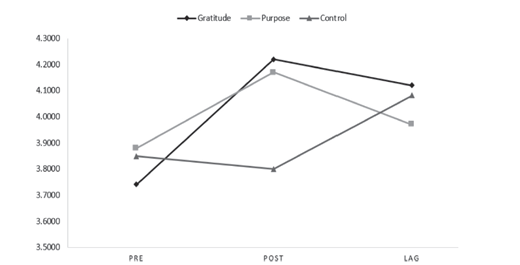
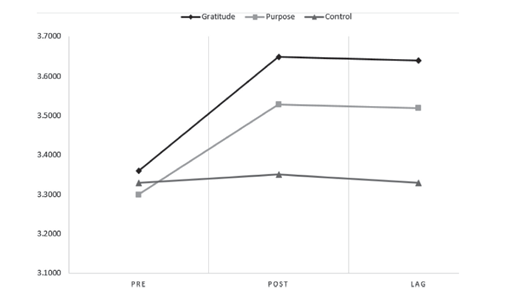
Table 2 displays correlations among baseline scores for all study variables. Table 3 provides details on the intervention effects from the pretest to the posttest within each group. Changes in the main outcomes (searching for purpose and identified purpose) are also depicted in Figures 1 and 2.
Searching for Purpose. Participants who completed the Purpose Toolkit increased significantly in the search for purpose between the pretest and posttest, t(78) = 2.88, p = .005. They then decreased from the posttest to the lagged posttest, although this change was only trending toward significance, t(45) = 2.00, p = .05. Participants who completed the Gratitude Toolkit increased even more in the search for purpose from the pretest to the posttest, t(73) = 5.58, p < .001, and they too decreased slightly from the posttest to the lagged posttest, but this change was not significant, t(63) = .63, p = .53. In contrast, participants in the control group did not show significant changes from pretest to posttest, t(70) = −.50, p = .62; or from the posttest to lagged posttest, t(38) = .83, p = .41.
Identified purpose. From the pretest to the posttest, participants who completed the Purpose Toolkit increased significantly in identified purpose, t(78) = 2.74, p = .008, and they did not change significantly between the posttest and lagged posttest, t(45) = .14, p = .89. Participants who completed the Gratitude Toolkit showed even larger increases in identified purpose between the pretest and posttest, t(73) = 5.06, p<.001, and again, there were no significant changes between the posttest and lagged posttest, t(63) = .21, p = .84. Participants in the control group did not exhibit significant changes in identified purpose from pretest to posttest, t(70) = .32, p = .75; or from posttest to lagged posttest, t(39) = .27, p = .79.
Gratitude. Participants who completed the Purpose Toolkit increased in gratitude from the pretest to posttest, but this increase was only trending toward significance, t(78) = 1.97, p = .05. There were no significant changes in gratitude between the posttest and lagged posttest, t(45) = .35, p = .73. Participants who completed the Gratitude Toolkit increased significantly in gratitude from the pretest to the posttest, t(73) = 2.38, p = .02, and here again, there were no significant changes between the posttest and lagged posttest, t(63) = .15, p = .88. The control group did not exhibit significant differences in gratitude from pre to posttest, t(70) = .11, p = .91; or from the posttest to lagged posttest, t(39) = .07, p = .95.
Hope. Participants completing the Purpose Toolkit did not report a significant change in hope between the pretest and posttest, t(78) = .81, p = .42; or between the posttest and lagged posttest, t(45) = 1.26, p = .21. Participants who completed the Gratitude Toolkit increased significantly in hope from the pretest to the posttest, t(73) = 2.06, p = .04; and did not change significantly from the posttest to the lagged posttest, t(63) = .47, p = .64. The control group participants showed significant decreases in hope between the pretest and posttest, t(53) = 4.87, p < .001. Not enough control group participants completed the hope measure on the lagged posttest (n = 5) to assess changes between the posttest and lagged posttest.
Prosocial Intentions. Participants who completed the Purpose Toolkit did not exhibit significant changes in prosocial intentions between the pretest and posttest, t(78) = .35, p = .73; or from the posttest to the lagged posttest, t(45) = 1.40, p = .17. On the other hand, participants in the Gratitude Toolkit increased significantly in prosocial intentions from the pretest to the posttest, t(73) = 2.79, p = .007, and they did not exhibit significant changes from the posttest to the lagged posttest, t(63) = 1.61, p = .11. Finally, participants in the control group significantly decreased in prosocial intentions from the pretest to the posttest, t(53) = 5.94, p < .001. Not enough control group participants completed the prosocial intentions measure on the lagged posttest (n = 5) to assess changes between the posttest and lagged posttest.
Age as a Moderator. Participants’ ages did not significantly moderate the effects of the intervention on changes in searching for purpose (R2 change = .00, p = .66), identified purpose (R2 change = .00, p = .95), gratitude (R2 change = .00, p = .98), hope (R2 change = .00, p = .71), or prosocial intentions (R2 change = .00, p = .89).
Discussion
This study tested two empirically based toolkits, one featuring activities designed to foster purpose among young adults via goal setting and values exploration (Purpose Toolkit) and one designed to foster purpose via gratitude (Gratitude Toolkit). Our aim was to determine if individuals completing these toolkits reported significant increases in the search for and identified purpose from the pretest to the posttest and compared to individuals in a control group, who spent the same amount of time completing activities designed enhance memory. We also wanted to see if gains in purpose endured across at least a week. We found, consistent with our hypotheses, that compared to individuals in the control group, participants completing the Purpose and Gratitude Toolkits increased significantly in both the search for purpose (H1) and identified purpose (H2), and these increases were sustained a week later.
Given the relationship between purpose and hope, we also expected to find that individuals completing the Purpose and Gratitude Toolkits (but not the control activities) would show significant increases in hope (H3). Results suggest that young adults completing the Gratitude Toolkit, but not the Purpose Toolkit or control activities, significantly increased in hope, and these changes were maintained across a week.
Finally, based on the link between gratitude and prosociality (McCullough et al., 2002; Nowak & Roch, 2007), we expected to find that completing the Gratitude Toolkit (but not the Purpose Toolkit or control activities) would foster prosocial intentions (H4), and it did, and the increase was sustained across a week. Given the clearly prosocial nature of gratitude, this finding makes sense. In contrast, completing the Purpose Toolkit appears to have had no impact on prosocial intentions. This finding also makes sense, especially in light of the definition of purpose, which does not specify that a purpose in life need be prosocial in nature. Some individuals find purpose in decidedly prosocial aims (e.g., Mother Teresa sought to care for the poorest of the poor), others in more neutral aims (e.g., Picasso helped establish cubism), and still others in pursuing decidedly destructive aims (e.g., suicide bombers fly planes into the World Trade Center buildings and the Pentagon). The Purpose Toolkit did not feature examples of destructive purposes, but it did feature examples of prosocial and more neutral aims. Helping individuals find purpose in neutral aims, such as designing bridges or writing entertaining novels, was not expected to influence participants prosocial intentions, and it appears that they did not.
All findings were anticipated, except one. We expected the Purpose Toolkit would increase hope levels from the pretest to the posttest, but it did not. As noted in the literature review, hopeful individuals are goal directed, and they believe they know how (pathways) to reach their goals and are capable of doing so (agency). It seems likely the Purpose Toolkit helped participants identify meaningful goals, but it did not help them identify pathways for pursuing those goals, nor did it increase their belief that they could achieve these goals. In other words, the Toolkit activities may have failed to cultivate the will and ways of hope.
It is interesting to note that individuals in the control condition experienced a significant drop in prosocial intentions and hope, at least in the short-run. Perhaps the act of focusing on a self-oriented task, such as memory enhancement, narrowed participants’ attention in such a way as to discourage prosocial or hopeful thinking. The fact that scores on both measures rebounded by the lagged posttest suggests this effect was only temporary.
It is also interesting to note that there were no significant differences across groups based on age. This suggests the toolkits were as likely to foster purpose among 18-year-olds as they were among 28-year-olds. This finding also suggests our toolkits may be promising purpose-fostering tools for high school aged youth as well; however, this remains to be tested. Although we only tested the toolkits for use with young adults, we designed them with adolescents and young adults in mind. Therefore, we do not anticipate many (if any of the) activities would need to be edited to meet the needs of high school aged youth. However, edits would likely be required for middle school youth. For instance, early adolescents may not recognize Jimmy Fallon and they may not have begun to seriously consider their career options. Before testing these toolkits with early adolescents, it would be advisable to conduct a thorough review of the activities with an eye toward ensuring they are age appropriate.
This study is the first, to our knowledge, to supply empirical evidence for the link between gratitude and purpose. Asking people to reflect on the blessings in their lives significantly increased their likelihood of searching for and identifying a purpose in life. To our surprise, the gratitude activities fostered even greater increases in purpose than the purpose-fostering activities. The link between purpose and gratitude could be interpreted in light of the broaden-and-build theory (Fredrickson, 1998): gratitude, as a positive emotion, could encourage the search for purpose by broadening people’s cognitive scopes and motivating them to seek out experiences such as building relationships and pursuing activities they enjoy and that contribute to meaning and personal growth. Additional empirical work is needed to test the mechanism behind the relationship between purpose and gratitude.
Regardless of the mechanism, this finding is exciting because it identifies a new route for fostering purpose, and this finding has both important scholarly as well as practical implications. From a scholarly perspective, this finding augments our understanding of purpose as it provides empirical evidence for the oft-proposed relationship between purpose and gratitude to date (e.g., Damon, 2008). From a practical perspective, it suggests there may be many ways of cultivating purpose beyond just focusing on goal setting and values exploration, as other purpose-fostering exercises have done in the past (e.g., Dik et al., 2011; Frankl, 1984; Pizzolato et al., 2011). Because it seems unlikely that one avenue to fostering purpose will be effective for all young people, it is useful to have an alternative approach. The gratitude approach might be particularly useful for adolescents and young adults who find direct questions about their purpose in life overwhelming. This finding also suggests it may be worthwhile to test other theoretically likely approaches to fostering purpose.
Although the finding that cultivating gratitude encourages purpose is interesting, the most significant finding to emerge from this study is that two toolkits, one focused on cultivating goal setting and values exploration and the other cultivating gratitude, effectively fostered both the search for purpose and identified sources of purpose, and that increases in purpose in both cases were maintained over at least a week. Although other interventions have fostered purpose through interviews (Bundick, 2011) and face-to-face interventions (Dik et al., 2011; Frankl, 1984; Pizzolato et al., 2011), this is the first time, to our knowledge, that purpose has been effectively fostered in a relatively short time frame, using an online tool.
Given that these toolkits effectively fostered purpose, the next step is to share them widely to help young people discover the things that matter most to them. As a means of doing this, the authors have been working with the University of California Berkeley Greater Good Science Center and the social impact firm Prosocial Consulting to share the Purpose Toolkit with thousands of rising high school seniors across the United States. The Purpose Challenge (www.purposechallenge.org), which featured the Purpose Toolkit, invited youth to complete the purpose-fostering activities, write a purpose-focused college essay, and enter that essay for a chance to win a college scholarship. In addition, both the Purpose Toolkit and Gratitude Toolkit are being shared with parents, educators, mentors, and youth in hopes of expanding the benefits of purpose to a larger group of young people. The tools are available for free here: www.fosterpurpose.org.
Although this study generated some interesting and important findings regarding how to foster purpose, like all studies, it is not without its limitations. For instance, this study reached an online sample of young adults via MTurk rather than via a more normative adolescent context (e.g., through school). The toolkits are currently being tested with samples of adolescents in school settings, and those results are forthcoming. However, since the activities were designed to be completed online, the MTurk sample offers a useful approximation of what we expect to find accessing young people through schools and other typical young adult settings. In addition, as noted above, only the most motivated participants completed the lagged posttest, which likely resulted in inflated lagged posttest scores. Unfortunately, this shortcoming was unavoidable, but the lagged posttest scores should be interpreted in light of this limitation. Another weakness is the relatively short time between the posttest and lagged posttest. In hindsight, it would have been useful to continue administering lagged posttests to gain a better understanding of how long the intervention effects last. However, it is useful to know that effects remained for at least a week after the intervention ended. Another opportunity for further investigation involves exploring for whom each of these interventions works best. Are some groups of young people better suited to discover their purpose in life through gratitude? Are others more likely to find their purpose through goal setting activities? Future tests should dig deeper into these questions to begin to understand for whom and under what circumstances each of these toolkits most effectively fosters purpose. Finally, these toolkits were designed to offer a quick and easy way to spur young adults to consider their purpose in life. Although they were effective, it is important to keep in mind that this is a short-term intervention, the effects of which are likely to be short-lived.
Despite these relatively minor limitations, this study yields several significant findings. Namely, it provides evidence that two brief online toolkits can cultivate purpose among young adults. Second, it offers empirical support for the relationship between purpose and gratitude, something that had been previously suggested but not tested. These findings have important implications for how we might share the benefits of purpose with young people.