A plethora of terms and related programs have been used to describe and teach the behaviors, skills, attitudes and strategies needed to help students develop in both intelligence and moral maturity—character education, socioemotional learning (SEL), and positive youth development, to name a few. This article provides an overview of the existing terms, definitions, and programs; describes some of the frameworks that have been created in the past to organize them; discusses some more recent developments in the field; and, recommends a model to help bridge the gap between research, policy, and practice.
A century ago, Dewey (1916) held that schools must be places where students directly experience the skills and dispositions they need to be productive adult citizens. Over time, the nature of this preparation has become more encompassing: “Education should develop intellectual character, moral character, civic character, and performance character, along with the collective character of the school” (Shields, 2011, p. 49). Over the past decades, individuals from different perspectives have come forward to share what they believe to be essential attributes that need to be cultivated in students to help prepare them for a “flourishing” life in today’s society.
As a primary example of this, those within the realm of character education believe that the main goals of educating character are to identify and develop human strengths—in essence, to help students become “smart” and “good,” or to develop in both intelligence and moral maturity (Davidson et al., 2008). The goals of character education have been defined broadly as developing students’ ability to make ethical decisions and engage in prosocial behavior in academic and life settings—that is, to integrate knowledge of the good, love of the good, and doing the good through planned experiences in the school curriculum and through positive connections with adult role models in the community (Wangaard et al., 2014). The aim of character education is, then, the development of good sense, or practical wisdom, through strengthening traits that sustain a well-rounded life and a thriving society (Jubilee Centre, 2017) such as critical thinking and reasoning, courage and humility, and service and perseverance.
Another term that has gained currency and popularity in recent years is SEL. SEL is defined as the skills, attitudes and values that provide children and adults with the capacity to understand and manage emotions, navigate social situations, and to make responsible and ethical decisions. In From a Nation at Risk to a Nation at Hope, the product of a National Commission on Social, Emotional, and Academic Development (Aspen Institute, 2019), SEL competencies are addressed as necessary skillsets that allow students to become motivated, responsible, and focused learners in their classrooms in the context of developing supportive relationships; this, in turn, leads to outcomes such as improved academic performance, and reduced levels of bullying and other aggressive, violent behaviors. According to the Collaborative for Academic, Social, and Emotional Learning (CASEL), one of the leaders in promoting research on the relationship between academics and SEL, the core competencies of SEL programming include self-awareness, self-management, social awareness, responsible decisionmaking, and relationship skills (Brown & Elias, 2012), which are now known as the “CASEL 5” (CASEL, n.d). The most recent (2018-2020) revision of Character.org’s 11 Principles also addresses SEL skills as necessary for students to become ethical citizens, to form positive relationships and maintain effective communication with others (Character.org, n.d).
Over the past 2 decades, additional terms have been proferred to describe this broad domain, sometimes used interchangeably and often interwoven in academic literature about optimal youth development. These terms reflect particular aspects of character and SEL that their advocates feel require special emphasis. Thus, terms such as growth mindset, mindfulness, resilience, soft skills, noncognitive skills, and grit have been used in many educational dialogues and in research literature (Farrington et al., 2012; Kamenetz, 2017; Whitehurst, 2016). With the growing positive psychology (Seligman & Csikszentmihalyi, 2000) and positive youth development (Damon, 2004) movements, the development of inherent strengths and virtues, rather than reduction of pathology and weakness, also have been emphasized. Scholars such as Damon and Berkowitz have decried an overemphasis on skills, and, in particular, extrinsic motivation to build those skills, demanding a greater emphasis on the development of moral character and noble purpose as the basis of building young peoples’ ability to act in a caring, altruistic, and ethical manner (Berkowitz, 2012; Damon, 1999, 2004; Snyder & Flay, 2012).
On the other side of the pendulum, a related initiative, known as Positive Behavioral Interventions and Supports, is also widely prevalent in the education system, and is known for its commitment to increasing prosocial behaviors in students by making use of tangible rewards (e.g., tokens, tickets) as positive reinforcement (Bear et al., 2015). Although the Positive Behavioral Interventions and Supports approach—which has its roots in traditional applied behavioral analysis interventions for individuals with intellectual and developmental disabilities—primarily focuses on teacher-led management of student behavior, with less emphasis on students’ cognitions or emotions, it features overlapping and complementary aims with both SEL and character education, including encouraging positive behaviors to facilitate teacher-student relationships, improving school climate, and providing students with a foundation on which further academic learning can occur (Bear et al., 2015; O’Connell, 2012).
Some of the terms advanced by various perspectives implicitly or explicitly tap into the two dimensions identified earlier by Shields (2011): attributes of individuals and the nature of the environments in which the attributes will be developed (i.e., schools). Clearly, there is an interconnection between the two that strongly influences the outcomes produced by either. Just so, positive youth development is a multidimensional construct focusing on youth assets and their contexts (Snyder & Flay, 2012). Signature documents in both the SEL (Berman et al., 2018; Elias et al., 1997) and character education (Arthur et al., 2008) fields also discuss the importance of context.
Does a Rose by Many Other Names Still Smell as Sweet?
It is clear that there are many descriptions and constructs that share a common focus on enhancing the development of youth—and yet, the heterogeneity of terminology also reflects a lack of consensus in the field (Snyder & Flay, 2012). As a result, many policymakers and practitioners run into difficulties when trying to have dialogue, sometimes referring to almost identical constructs with different terminologies, and other times using the same terms with meaningfully different definitions. This lack of precision in semantics to explain similar concepts contributes to ambiguity, lack of efficiency, and nonconsensus from a policy perspective, as well as to confusion in the field (less so in the literature) with regard to what constitutes “best practice” (Jones et al., 2016). In fact, one can describe the current state of the field as a “Tower of Babel” due to the marked dispersion of research literature, abstraction of concepts, and lack of coherence in terminology (Elias, 2013; Whitehurst, 2016).
Some have suggested ways to ameliorate this lack of organization in terminology by aligning all constructs into a single existing framework, or creating an umbrella framework that seeks to organize all existing terms into one system (Jones et al., 2016). For example, Farrington and colleagues at the University of Chicago (2012) conducted an extensive review in order to organize existing literature into a conceptual framework under the term “noncognitive skills,” in contrast to cognitive or intellectual ability. The broad category of non-cognitive factors is divided into five subcategories related to academic performance: (1) academic behaviors (e.g., regularly attending class, paying attention, participating in class discussions, devoting time to studying and completing homework); (2) academic perseverance (e.g., grit, delay of gratification, self-discipline, self-control); (3) academic mindsets (e.g., growth mindset, academic self-efficacy, academic interest); (4) learning strategies (e.g., strategies to help one recall facts such as mnemonic devices, goal-setting and time management); and (5) social skills (e.g., cooperation, assertion, responsibility, and empathy (Farrington et al., 2012). Others have attempted to unify the broad domain consisting of SEL, character education, and positive youth development under the umbrella term prosocial education, and have integrated school-based programs falling into one of the aforementioned categories into this new term (Brown & Elias, 2012).
Building Consensus Viaa Grand Convening
However, it is unclear if the strategy of trying to come up with new unifying frameworks is contributing to systematic and lasting improvements in the field. One may argue instead that such a strategy is just setting the stage for constant cycles of new conceptual frameworks by different groups of researchers. The disadvantage of this is that new frameworks often do not completely clarify specific terms, meanings, and definitions, and their relationships to each other within the field, thus failing to allow for the efficient transition from research to practice (Jones et al., 2016). Policymakers likely are not interested in navigating between overlapping terms and conceptual definitions, and may become lost amidst separate attempts at unifying frameworks that are essentially trying to convey a similar message. If those in the field insist on maintaining semantic differences and on creating disparate frameworks and terminology, then policymakers may simply turn their attention to different issues and look away from the thrust of socioemotional and character competencies and school culture and climate to embrace, or reembrace, more limited and less proactive concerns such as suicide, bullying, and mental health. Therefore, it is clear that from a policy perspective, there must be a collaborative, or uniting effort for the field to move forward.
One solution, proposed by Stephanie Jones and colleagues at the Harvard Graduate School of Education, is the ongoing Taxonomy Project, which seeks to create a tool connecting existing frameworks to each other by creating a nomological network of noncognitive skills across frameworks to more clearly illustrate how noncognitive constructs are related across disciplines, as well as to link the evidence base for these constructs (Jones et al., 2016). Indeed, this project resulted in the Explore SEL tool (http:/?exploreSEL.gse.arvard.edu/), which aims to help researchers, educators, and policymakers to group programs and policies under specific targeted skills, in term leading to increased precision in research and practice. The hope is that with such a tool, researchers and policymakers can group programs and policies under specific targeted skills, in turn leading to increased precision in research and practice. While the Explore SEL tool holds great promise in creating more precision in semantics and navigating SEL skills through diverse domains and frameworks, one can argue that perhaps the primary issue in the field is more pragmatic than conceptual. After all, even with great unifying conceptual frameworks and research tools, there must be a plan for consensual dissemination and adoption. This, of course, heads us toward the idea of creating a context in which the proponents of these different labels can come together—not necessarily with the aim of trying to create another uniformly accepted standard or system, but rather, with the goal of taking into account the varying frameworks and policies, acknowledging the benefits and functional limitations of each one, and building on one another’s knowledge and expertise (Rothman, 1995).
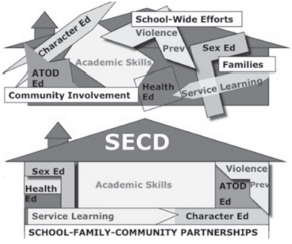
Another collaborative effort in the field, known as socioemotional and character development, is the outcome of empirical study supporting the need for both SEL and character education to equip and enable students to reach their full potential (Elias, 2009, 2014; Elias et al., 2015; Hatchimonji et al., 2017). The SECD approach is founded on the principle that the minimal unit of instruction for any programs aiming to influence sustainable positive development in youth is the cultivation of both socioemotional skills (e.g., emotional regulation, empathy, conflict resolution, and responsible decisionmaking) and sound moral and ethical character (e.g., honesty, integrity, compassion, fairness, and diligence; Elias, 2009; Elias et al., 1997). Whether or not explicitly stated, every school addresses the aforementioned SECD skills and virtues in each of the students that pass through its doors—whether implicitly through codes of conduct and disciplinary systems, through health education, substance use prevention, and violence prevention programs, or through direct instruction in character or SEL (Elias et al., 2015). However, despite the overlapping aims of these programs, there are many instances where lack of clear integration strategies and of long-term, sustainable vision plague existing program mandates in these schools (Elias et al., 1997, 2015; Hatchimonji et al., 2017). Still, evidence supports the finding that successful implementation of programs, tailored to each school’s respective context and needs, can take place only through synergistic, coordinated, and collaborative efforts among multiple stakeholders, with SECD as the common denominator (Elias, 2009; Elias & Leverett, 2011; Elias et al., 2015; see Figure 1.)
Perhaps the most comprehensive effort at SECD coordination is the outcome of 2 years of work by the Aspen Institute’s National Commission on Social, Emotional and Academic Development. The commission’s report alluded to earlier, From a Nation at Risk to a Nation at Hope, attempts to create a unified, integrated version of SEL and academics, outlining recommendations for policy and practice, including building structures that support relationships, and creating schoolwide cultures that encourage student voice and agency. The report advocates a paradigm shift in our current approach, and calls for the forging of closer relationships between research and practice, as well as the creation of new tools to improve dissemination to a wider audience (Aspen Institute, 2019). It is clear, from the Aspen Institute’s report, that we know a great deal about how to help students develop effective interpersonal and emotion-recognition skills, as well as a solid moral compass to help them navigate through adult life; however, we still lack a clear path forward with regard to implementation, especially in an equitable, socially just manner. Further, as of this writing, while the Commission showed great sensitivity and inclusiveness with regard to the various perspectives outlined in this article, the framing is unambiguously that of socioemotional learning, making it open to interpretation as “partisan” to that particular brand.
If indeed progress depends more on pragmatics than conceptualization, one model that holds promise is that of the Breakthrough Series Collaborative—a short-term (6- to 15-month) learning system designed to help close the gap between research and practice in education and health-related domains by creating teams combining experts in specific subject matter areas with application experts (American Diabetes Association, 2004; Casey Family Programs, 2011; Walsh et al., 2016). Breakthrough Series Collaboratives function by identifying particular problems or issues and work toward solutions, alternating between separate learning sessions and action periods. In such a process, the participating organizations would come together, learn about their chosen topics, and plan changes (i.e., learning sessions), and then return to their organizations and implement the planned changes (i.e., action periods). Then results are presented to nonparticipating organizations at national and international conferences (American Diabetes Association, 2004). This system has been successfully implemented in domains such as health policy, trauma-informed early education, and child welfare, by creating multiple platforms connecting researchers and practitioners, and allowing for the testing of strategies to improve prevailing challenges (American Diabetes Association, 2004; Casey Family Programs, 2011; Walsh et al., 2016). Perhaps a similar model can be adopted in the domain of SEL and character education to help narrow the gap between research and practice, and to forge closer connections between those involved in both domains. The spirit of these approaches is highly consistent with the work of Bryk and colleagues on the development of networked improvement communities in education (Bryk et al., 2015). However, while this work is increasingly cited, its implementation in ongoing educational contexts related to character or SEL has been lagging.
Conclusion
In the end, it is clear that many in the field, with similar well-intentioned goals of enhancing student strengths and creating caring, challenging, and supportive environments for youth, would benefit from building consensus and collaborating on a way to improve policy and to create sustained, lasting change (Brown & Elias, 2012). For this to happen, it will be necessary for all factions to align around the rallying cry of Blankstein (2004), that where education is concerned, “Failure is not an option.”
Instead of focusing on creating new integrating frameworks, we recommend that all relevant researchers, application experts, and policy makers purposefully come together to bridge existing research and practice through vehicles such as the Breakthrough Series Collaborative or the creation of collaborative, cross-perspective networked improvement communities, so that the individual strands of different approaches and programs are woven together into a beautiful and functional tapestry to create sustained and lasting improvements in our education system (American Diabetes Association, 2004; Brown & Elias, 2012; Bryk et al., 2015). Marshalling resources to support such a grand convening— whether in-person, virtual, or a combination— would be the best use of educational and philanthropic resources in the interest of children, schools, and our collective future.