Catholic and charter schools share some similarities, including a strong college-preparatory focus, small class sizes, strict discipline, and high requirements for parental involvement. Yet, these 2 school types are also distinguished by differences in their secular and religious missions. Using data from over 200 interviews in 14 Catholic and charter schools across the United States, we examine how educational leaders in each of these school types approach character education. Our results highlight that differences in approach to goals and outcomes when it comes to creating a good person, and differences in associated day-to-day practice, are less about Catholic or charter status and more about the level of experience of educational leaders and the level of formality that characterizes the character education system. We classify schools into 4 categories: holistic, systems driven, rewards driven, and rules driven. Educational leaders with many years of experience working in schools with more informal character education systems are most likely to put a greater emphasis on a holistic approach that emphasizes not just academic performance but altruism and responsibility to others.
Introduction
Charter schools and Catholic schools in America share an interesting and inverse trajectory of growth and decline. As the total number of charter schools and the students they serve have increased since the 1990s, the number of Catholic schools and enrollments have simultaneously decreased (MacGregor, 2012). In fact, in some places with large historically atholic populations, charter schools have literally taken over the buildings of former Catholic schools as dioceses sell vacant buildings (Lussier, 2018). Indeed, in many places the target student population is the same as the historical stereotype of Catholic education: predominantly minority, lower to middle class families of origin, and located in urban areas (McCloskey, 2010). Moreover, charter schools, in their effort to adopt innovative and successful educational practices, have come to be known for some of the same pillars of Catholic schools: small class sizes, strict discipline, and extensive parental involvement in school activities (Ladner, 2007). There are also some Catholic schools that have attempted “charter conversions” to try to maximize funding for their own alternative educational model (McShane & Kelly, 2014).
In spite of the similarities, charter schools remain public schools. This may lead to an assumption that charter and Catholic schools are quite different in their conceptions of what the “good student” and “good person” are, as well as a prediction that the character education programs their educational leaders employ to achieve those ends would be separated by secular versus religious distinctions. However, through a qualitative investigation of eight Catholic and six charter secondary schools, we find evidence of institutional isomorphism across these two school types in the educational organizational field. That is, both types of schools generally display a focus on academic achievement and college placement with strong and pervasive in-school cultures that rely on a belief system that is more similar than a simple secular versus religious dichotomy would suggest. While we also find that there are many variations between schools, these variations are not necessarily by school type.
Educational Leaders and the Formation of Character
Education is a key mechanism of socialization. There is a sizeable body of research that examines the relationship between education and civic engagement (Campbell, 2006; Campbell et al., 2012; Hill & den Dulk, 2013). Much of this literature examines the question of what type of educational experience is likely to foster civic engagement. For example, Jeynes (2019) completed a meta-analysis of 52 different studies about the relationship between character education and educational outcomes to find that the presence of a formal character education system heavily internalized and utilized by school stakeholders is strongly associated with higher educational outcomes, particularly in high school. Teachers, principals, and other educational leaders are on the front lines of socialization efforts and can impact students in direct and indirect ways. While there has been some research on how educational leaders’ approaches to character formation vary within school type (e.g., Seider, 2012, for charter schools), there is little work that directly compares approaches across school types.1
Charter Schools and Character Education
Charter schools, as a concept, began in 1991, and are based on what we term an “XYZ” definition: the schools must sign a contract, or charter, with the local authority-granting institution like a school district to serve X number of students for Y years and achieve Z test scores. At the end of their charter, the certifying body must either continue or discontinue the charter based on the school’s success. Because this success is often based so explicitly on standardized test scores, character education can become a means to an end for some schools: a way to keep students behaving well enough to learn the material for the tests (Maloney, 2018).
There is surprisingly little written about character or moral education in charter schools, given that many of these schools overtly claim to be in existence to teach students not only academic but also social and life skills. One notable exception is Seider’s book, Character Compass: How Powerful School Culture Can Point Students Towards Success (2012), in which three charters in Boston were compared to see that, despite highly different character education systems, each school had a goal of increasing academic achievement. These systems were chosen to maximize that possibility for very different student populations. In a somewhat oppositional finding, Henig et al. (2005) found that many charters symbolically chose themes like character education as a signaling effect to stakeholders (parents, students, etc.) about the school’s community, rather than directly seeing them as a means to raise academic achievement.
Character Education and Educational Leadership in Catholic Schools
Historically, there was great concern that independent and religious schools might fail to meet the “common school” ideal where public schools play a vital role in preparing future voters and citizens (Gutmann, 1999). Empirically, there is little need for concern. Indeed, most studies show no differences or a slight advantage for religious schools in promoting civic and prosocial outcomes (Campbell, 2008; Dill, 2009; Hill & den Dulk, 2012; Sikkink, 2004).
Much of the research on the role of Catholic schools on promoting civic engagement has suggested that Catholic schools’ small size, shared values, and commitment to subsidiarity—allowing decisions to be made by those who are most likely to be impacted by the decision—actually foster improved academic outcomes and a commitment to the common good. In their seminal work on this topic, Byrk et al. (1995) suggest that teachers and administrators working in Catholic schools have much more freedom to bring values into the classroom and to make decisions on curriculum and pedagogy that do not require layers of bureaucratic approval. They may also deal with discipline issues in a more localized and contextspecific manner than a teacher working in a public school. In this environment, Catholic school educators are likely to play an important role in defining what the expected goals and outcomes of character education should be. They also are primarily responsible for development of curricula and activities that support the development of character and an understanding of the obligations of citizenship. Yet, we know little about how Catholic educational leaders’ ability to shape and implement these systems might vary by level of experience or school culture. There is likely to be significant interschool and interschool type diversity. This study highlights this diversity.
Theoretical Framework
Humans learn new skills and knowledge in complex but usually predictable ways. Learning theory predicts that the less secure a person is in the new knowledge or skills, the more likely the individual is to either want or develop concrete and complete rules for the new knowledge or skills and to adhere closely to those rules (cf. Blakemore & Frith, 2005). Then, when the task or content is solidified and the individual feels less insecure, the rules become internalized and become more flexible or even more easily violated (Fosnot & Perry, 2005). This can be most obviously seen in how children acquire both academic and social skills (cf. Webster-Stratton et al., 2001), but can also be seen in the literature that focuses on how to overtly teach new social skills. Teachers or therapists are told to be discrete, complete, and factual when explaining new rules (Mashburn et al., 2008). Even more specifically, Vygotsky’s social constructivist learning theory argues that learning is not a completely internal process, but occurs through interactions with other individuals and organizations over time (John-Steiner & Mahn 1996; Vygotsky, 1978).
Since schools as institutions are made up of individuals who are capable of learning both by themselves and in concert with the other stakeholders in the institution via social construction of norms (Palincsar, 1998), social constructivist learning theory can certainly apply to how character education is done in these organizations, both on the individual and group level (Tappan, 2006). That is, educational leaders who are relatively new to the profession (particularly as character educators) should be more likely to be insecure in their ability to foster the development of character. Thus, they should be more likely to want those discrete rules and systems that are more standardized across time and people. Conversely, those educational leaders who are more experienced in character education should be more comfortable with ambiguity and more likely to be individualistic with how they foster character because they have had the chance, as social constructivist learning theory predicts, to interact more often and more deeply with other people on those concepts. While the results of our study developed inductively, using grounded theory, they fit neatly within this larger paradigm—as will be discussed further in the results section.
Methods
Data Collection
The data for this article were collected through qualitative methods at eight Catholic and six charter secondary schools across the United States as part of a larger study of character formation practices at different types of schools (see Hunter & Olson, 2018, for an overview of the findings of the larger project). The charter schools were chosen by Maloney from the list of accredited secondary schools maintained by the U.S. Department of Education that teach students in Grades 9–12 and are brick and mortar schools (that is, are not online schools). We went down a randomized list until six in six different states agreed to participate. The Catholic schools were chosen by MacGregor using purposive sampling to capture some of the key differences within the Catholic school sector. Specifically, the schools include all-boys, all-girls, and coed schools, schools run by religious orders and those administered by dioceses, and schools that serve upper middle class suburban students and schools that serve, through innovative work programs, students who could not otherwise afford Catholic education. At each school, we conducted approximately 2 weeks of observational fieldwork and interviewed students, faculty, administrators, and parents, for more than 200 total interviews. Interviews varied significantly in length from less than 15 minutes to more than 3 hours, with questions about what a good person is, how that was taught in school, and how the respondent thought it should be taught. Interviews with school leaders and personnel were about the same length in each school, with a little variation based on time pressures. Classroom observations, including notes about lesson content, teacher-student interaction, student-student interaction, and descriptions of the classroom environment, took place predominantly in English and social studies/history classes under the assumption that more conversations about ethics and character were likely to occur in these subjects. In Catholic schools, religious studies classes were also observed. When possible, after-school activities and other school events were also included in the study. To measure average experience level of educational leaders, we asked each teacher/principal (among other questions) how long they had been in the profession, their experience in the profession, and their tenure at a given school.
Data Analysis
The large amounts of qualitative data collected necessitate that we organize the data by topic for better and more focused data analysis. For example, for this paper about the effects of educational leaders, we first gathered all the interviews with teachers and administrators, as well as any student/parent interviews or fieldwork that had been open-coded as having to do with the effects of educational leaders on school culture or student character. Once the data were isolated, we used a grounded theory coding strategy (Charmaz 2005; Corbin & Strauss 1990; Glaser & Strauss 1967) to determine inductively whether there were patterns in how educational leaders enacted character education systems, and whether there were any school- or individual-level variables that correlated with particular behaviors or rationales. After separately open- and axial-coding our data, we compared results via iterative conversations to develop a selective code that led to our theoretical findings (Charmaz, 2005). While spatial constraints do not allow for a very in-depth explanation of data analysis methods, inductive data analysis methods prioritize authenticity of findings by developing the theory of a given social situation from the data itself, rather than preconceived, deductively-based hypotheses that may allow for higher levels of generalizability, but may not authentically and accurately depict the social interactions at hand. Table 1 offers a brief example of how we moved from data to findings.
Results
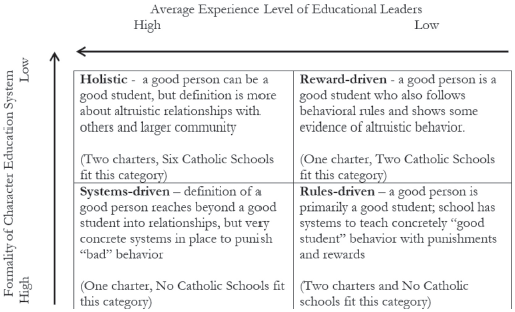
Our data highlight that there are more differences by experience level of educational leaders and formality of character education systems than between the Catholic and charter school types. As can be seen in Table 1, the schools broke down into four quadrants: holistic schools (on average, highly experienced educational leaders and low formality of character education systems), systems-driven schools (high levels of average experience among educational leaders and highly formal character education systems), reward-driven schools (on average, low levels of leadership experience and inworld. As one Catholic school administrator offormal character education systems), and rules-driven schools (low levels of average experience among educational leaders but highly formal character education systems). Here, we inductively define high levels of experience in educational leaders as more than about 15 years of average teaching/administrating experience. Formality of character education system is based on (1) whether the school has a formal merit/demerit system such as comprehensive guidelines detailed in written school policies that are widely known and referenced within a school or, rather, relies more on informal but amorphous techniques like role-modeling and sporadic disciplinary referrals and (2) how strictly that system is followed by teachers and administrators and, therefore, students.
In charter schools, fitting with learning theory, the formality of the character education system negatively correlated with the age of the school. That is, the older (greater than 15 years) charter schools in this sample tended to have less formal systems and rely more on the relationships that educational leaders built with students for character education and to maintain in-school discipline. The younger schools were more likely to have very formal, very involved merit and demerit systems that standardized discipline and caused teachers to note that they felt that character education was “out of my hands. I act like everyone else in the school because there’s no variance allowed. Sometimes, I think I’m not trusted enough.”
Since the Catholic schools in this sample were all established well before the charters, age was less of a factor in determining the formality of their character education systems. Indeed, we found no formal character education systems developed by third party providers or reinforced by token economies in this sample. While schools did have policies and procedures related to behavioral standards and students were subject to disciplinary measures in most instances, these systems were informal and highly negotiable and in most instances, were implemented only after educational leaders examined the larger context of an infraction.
Figure 1 highlights our key organizing variables using the example of how these variables related to how each school defines “a good person.” While there is much more to moral formation and character education that simply being defined as “good,” our interview guide specifically asked respondents to describe in their own words the definition of a good person and to describe how their school attempts to create “good people.”
Holistic Schools
The data gathered from interviews in both the Catholic and the charter schools indicate that school personnel and students believe that the combination of well-established institutional cultures that support informal character education systems and experienced educational administrators has, at least in the view of schools leaders, powerful and positive results on student outcomes related to morality, citizenship, and service to others. The view of school leaders is largely supported by the empirical literature in this area (e.g., Jeynes, 2019). In these Holistic school settings, students are routinely socialized to believe that a strong academic record is insufficient if one wants to truly be considered a good person. Rather, students are encouraged to be well-rounded and to consider the implications of their choices on others both at the local level in their school community but also in the larger world. As one Catholic school administrator of an all-girls noted:
We have the idea that our girls are probably going to be in leadership positions and we don’t want to have people in leadership positions who are not informed with a very strong sense of morality and compassion, wisdom, and faith. They need to be able to translate Catholic values, Catholic moral tradition, or general humanitarian moral values if they’re not Catholic.
In many instances, this view of the good life projected onto students mirrored the experiences and values of teachers themselves. In Catholic schools, it was common for faculty to speak of their work as a vocation or calling that transcended a job that one simply engages in for money. Indeed, many were quick to note that they could likely make more money if they were willing to work at a public school. Despite this, teachers spoke enthusiastically of their love for their work and spoke of their abiding belief that they made a difference in people’s lives.
Educators in Catholic schools spoke frequently and often about their desire to see students thrive not just in the classroom but in their social interactions and through commitments to justice, equality, and fairness. For example, one teacher noted:
Interviewer: How do you understand your role as teacher? What do you think of as your primary obligations to students?
Teacher: To help them to become more civic minded, happy, well balanced, citizens of a democracy.
Further evidence of this comes in the form of school mottos such as “all of which woman is capable” and “harmonizing faith, culture, and life.” which are highly visible in school environments, literally painted on the walls, and frequently referenced by teachers and students in interviews. These mottos point to another extraordinarily common feature of Catholic schools: an entrenched institutional culture formed over several generations, and often centered around the charisma of a patron saint or religious order. One girls’ school in the study was named for a Catholic saint who once said “if we train the mind, we thereby educate the heart (the whole person) and instill into our youth the principles of religion and honesty so that they will become good Christian citizens.” This quote was not only present on the school’s website, it was lived in the hallways and cafeteria as students connected the saint’s work serving immigrants with their school’s expectation that they treat all people with dignity and respect.
The two charter schools in this quadrant were among the oldest charter schools in the country (founded in the 1990s), so had distinctive and entrenched school cultures that had evolved over time in those schools. The administrators and teachers were confident in their school’s ability to educate children and, as multiple educational leaders told us, “had nothing to prove anymore.” Academically, these schools produced above average results, with the majority of students attending a 4-year college or university after graduation, but did not regularly produce graduates who attended Ivy League or Ivy equivalent schools. These schools did not have formal character education systems like merit/demerit programs or acronyms with the school’s designated virtues emblazoned on posters. Rather, as one teacher told us, “we can tell a good person by his or her relationships with others. Are they thoughtful of others? Do they treat others with kindness? Do they think of ways to give back to the community, both on the local and larger levels?” Another administrator said that “a good person is well-rounded. It’s hard to say exactly what that means, specifically, in terms of adjectives, but it’s about being good in many categories. Being kind, helping others, doing the right thing, having integrity.” We labeled these schools the holistic schools precisely because of their more generalized attitudes about the goals of character education, but also because of how they worked to achieve that goal: in a more informal, indirect method, rather than a distinct system. As one administrator put it:
We have a looser culture. We’ve made a consistent move away from the no excuses model, which was definitely the way our school was founded … we want to be a school that educates all students and wants to reach them all … we want to try to create a more sustainable model for both teachers and students.
A teacher in the other charter school in this quadrant concurred, noting that:
We reference these values and talk about them and make it part of our language, but I think it is less formally teaching kids like [deepens voice to make fun of next statement] “this is how you’re a good person” because that’s not really effective with older students.
These schools (both Catholic and charter) focused on the importance of role-modeling for students. Educational leaders were not just pedagogical leaders, but exemplars of what it means to devote one’s life not just to academic excellence but to service to, and care for, others. They instilled these virtues in their students through displaying them themselves, rather than attempting to use a particular system to externalize those traits and then input them into students. They were comfortable with character education to the extent that it was almost second nature and, so were able to innovate beyond needing discrete or standardized systems. Our findings here echo similar work on “common good” approaches to public and Catholic education (Bryk et al., 1995; Tyack & Hansot, 1982).
Systems-Driven Schools
Systems-driven schools tended to have highly formal character education systems in terms of merits and demerits, as well as clear characteristics for teachers to communicate and students to embody. However, they also had highly experienced educational leaders (greater than 15 years). These schools relied on the relationships that those experienced leaders built with students to both discipline and communicate the idea of the good person (and how to personify that ideal), but still had distinct and concrete systems in place to punish behaviors that did not fit those ideals. As a principal told us:
Most schools create these chaotic systems in which every teacher’s expectations are different. So kids misbehave because they go from one really strict teacher to one really loose teacher and they have no idea where the downfalls are and that’s unfair because kids get kicked out of class for one misbehavior because the teacher’s pissed off. What we’re trying to do is create a sense of predictability. Because, ultimately, that brings fairness, and we think that, if you’re a teenager, that’s what you care the most about.
Here, in response to a question about how they teach good character, the focus of her answer is telling. That is, she linked teacher expectations and student behavior, rather than necessarily talking about what a good person is or how to teach students to be one. She does speak about standardization of those expectations and developing positive relationships to make the students feel school is fair. This is unlike a rules-driven school that would lack that characteristic.
In this school, most of the classrooms also had a poster of the Kohlberg mountain, the other piece of the school’s character education plan. The Kohlberg mountain sets out the motivations for an individual’s action (external locus of control, internal locus of control, etc.). According to the teachers, they want their students to spend most of their time at the middle or higher of this mountain (in internal locus) because “it’s not just about the values that you spout—it’s how you use those values, and why you have them. You could be excellent and disciplined at genocide, for God’s sake—those are relatively amoral character traits. You’ve got to think about how you’re affecting other people and how you’re expressing your moral code.” The juxtaposition of a very extrinsically motivated discipline system (the merit and demerit system) with the desire for students to act upon intrinsic motivation (the higher levels of the Kohlberg mountain) provided a conflict:
Interviewer: Do you ever worry that the merit and demerit system makes character something you do for extrinsic motivation?
Teacher: To an extent. In reality, we want them to do something for those higher levels of the Kohlberg mountain (points to poster on wall). Ideally, the kids go beyond the system. And, some are - but sometimes I forget that they’re teenagers. Developmentally, their brains aren’t fully developed yet. They haven’t yet figured out what is right and wrong … It’s a way to help them move forward. It’s just the beginning and the way to start. We give them the terms.
In the above, the teacher does state that she wants the students to present the school’s values because they have internalized them and recognize their importance in and of themselves, but also shows what they see as a more realistic knowledge of adolescent psychology: “they haven’t yet figured out what is right and wrong … it’s a way to help them move forward.” Here, without explicitly saying it, she assumes that the school is the place where teenagers learn what is right and wrong, almost in opposition to the family (“we give them the terms.”). Other teachers echoed this attitude, with answers like “we need to make up for the home life and what they’re taught there so the kids can be successful” and “if they’re not getting the right message elsewhere, we need to supply it.” This replacement strategy was an attitude that was prevalent among teachers, though not in students. The student attitudes regarding where they learned morality are nuanced and dependent on factors like student socioeconomic status, race, school, and family background. While we do not have the space for a full exploration of this interesting topic because of this special issue’s focus on educational leadership, our other research (Maloney, 2018; MacGregor, 2018) are in-depth analyses of student attitudes.
The average experience level of educational leaders in this charter school was still quite high, but the character education system was formal. In this school in this quadrant, we argue that it became a systems-driven school instead of a holistic school because it was only about 8 years old. The individuals in place did not yet have a chance to become comfortable with one another to develop the socially constructed norms and camaraderie of the holistic Charter schools, which were all at least 15 to 20 years old. It may be that, given enough time, the systems-driven school will become a holistic one.
Rewards-Driven Schools:
Rewards-driven schools have a relatively low level of educational leader experience, as well as relatively low formality of character education systems. The educational leaders in these schools tend to define a good person as a good student, but they go beyond that to talk about a good person needing to have some level of altruism in their interactions with others.
While many Catholic schools are decades old, three of the schools in this study had been founded fewer than 12 years ago. Two of these three schools fall into the “rewards-driven” category. While these schools sometimes poached experienced Catholic educational administrators from other schools, they were working in new schools and in many ways, were “starting over” by working with a new population of students. Many of the educational leaders were still novices. They were still in the earlier stages of developing character formation programs and their cultures were not as firmly established as the older schools’. These schools were often focused on helping students from disadvantaged backgrounds get on the path to college and were spending considerable administrator energy on setting up organizational systems and creating a collective identity. The principal of the newest school in the Catholic school type study noted that part of why she was interested in participating in the study was that character education was something she wanted to improve. She felt the school had made great strides in academics but needed to focus more intentionally on more holistic aspects:
I mean in the first couple of years I think it is important in establishing a school to establish theschool piece. We won’t be successful and attract good students if we don’t have a strong academic program. But now, I am kind of dreaming a little bit bigger. If you don’t like school, if you’re not good at school, then your life is going to be miserable here because there’s not a ton of clubs or activities just because we don’t have the manpower.
Interestingly, the older of the two “new” Catholic schools showed clear progress on the path to having an entrenched institutional culture like the older schools in the study that are captured in the Holistic category. The school had an explicit “Be St. Redacted” motto. The aim appeared to be two-fold: to encourage a collective identity around membership in the school community and to encourage the role-modeling of behavior. For example, teachers and school leaders spoke of reminding students that they should follow the example of this saint and that collectively all behavior represented the school. The difference between this school and the schools in the holistic group was that there had to be much more vigilant attention to fostering this aspect of the school community. It was in no way taken for granted and was often tied to efforts to improve academic performance.
This emphasis on linking formation to academic performance can be seen clearly in the charter school in this category that wanted students to display not only academic skills, but also character skills. Interestingly, in response to “how do you teach being a good person?” the teacher below links character, life skills, and social skills:
As a staff, we do a good job showing what a role model really looks like, of what a good person should look like, and I think because our teachers are so passionate about what they teach that that is sort of instilled into our students and they’re like “wow” … our teachers must step away from the academics and do insert life skill training for our students [because] our students are very high academically but social skills sometimes are a little shaky … so, I think our teachers are constantly reinforcing those good social skills—you know, being kind to others and making sure everyone feels a part of the community. Are everyone’s needs met?
Here, social skills are not just about making friends and getting along with others. It’s about making others feel comfortable within the community while at the same time “constantly reinforcing those good social skills” via a character education system that gave students points for displaying both academic virtues (e.g., persistence, punctuality, writing a good essay) but allowed students to give each other points for being a good friend (e.g., sitting with someone new at lunch, saying something positive to someone else). Notably, there were no demerits in this school and formal punishments such as detention occurred rarely. It may be that the schools in this quadrant will move away from even such informal merit-based systems as the educational leaders gain in experience and consequently do not feel the need for them. It may also be that the educational leaders believe that this system is best for achieving their academic goals, since these schools were also quite young and needed evidence to maintain or renew their charter.
Rules-Driven Schools
The schools in this quadrant, which were characterized by educational leaders with relatively low levels of experience (teachers and administrators with, on average, less than about 15 years in the profession) and institutional histories of also less than approximately 15 years, operated very differently than schools in the other quadrants of Table 1. That is, the definition of a good person in these schools focused on character traits that mark a good student. Rather than being relational, these character traits were individualistic and instrumental, and were inculcated by educational leaders through very distinct and all-encompassing character education systems that provided immediate feedback to student through both rewards and punishments. These systems were driven by a focus on behavioral rules, rather than a focus on relationships between students or between the student and her community. Schools in this quadrant predominantly served lower-income and minority communities in urban areas, and had predominantly white and middle class teachers. This created a situation in which educational leaders were attempting to erase or make up for what they perceived as a home life that would not allow the students to succeed in the labor market. Thus, the good person became the good student because that’s what the educational leaders were comfortable with—it is what they themselves were.
At one school, a teacher was quite overt about this linkage:
Interviewer: So, what is a good person?
Teacher: It’s doing what’s right even when no one’s looking.
I: What does it mean to do what’s right?
T: Hmmm. To exemplify the core values [gestures at poster on wall with core values: grit, integrity, leadership, independence, and excellence].
I: So, those core values are what it means to be a good person?
T: Well, it’s a start! I don’t think you can be a good person without those.
I: Is a good student the same thing as a good person?
T: A good student must be a good person, but they also have to get their work done to a high standard and listen to teachers. Actually, that would be excellence and grit, wouldn’t it? Hmmm. I guess you got me. They’re the same thing.
However, many were insecure about their ability to produce successful students because of external factors, thus reverted to being extremely rules driven and, at times, punitive. As one teacher-administrator told us, “there are just so many things that fight us on this mission: poverty, culture, media, and sometimes even the community and parents and students themselves. We can say and do all we want in this building, but once they leave …” The implicit structure in this answer—moving from macro- to microlevel factors—is a window into the respondent’s conceptualization of the oppositional forces to the school’s “mission.” What can the school agents do to increase the odds of success for this mission? Develop what they see as a strong culture with very clear behavioral and attitude rules for students:
In such a fight, you have to be very, very clear and all-encompassing. There’s no room for loopholes or letting in influences that might distract. So, yeah, I get that we seem draconian and stupidly fixated on things like proper socks. But, as the small things go, so do the big, so it’s better to send a message that students get with the program. They actually prefer us to be strong, I think. It lets them blame us when questioned about uniform, or doing homework, or anything like that. And, yes, demerits, detention, and even suspension for breaking those rules.
Implicit within the above quotation is the assumption of an oppositional culture (Ogbu 1978): outside forces that may discourage their generally low-income students of color from succeeding at school. At another charter school with strict and stringently enforced rules, one administrator spoke about how their concrete and highly quantified merit-demerit system produced good people and taught positive character traits:
optimal human functioning is a 4:1 ratio [of positive to negative interactions]. Our thinking is that our kids do amazing things every day. If we are constantly narrating the positive things that our kids are doing then the majority of the students in our school are experiencing a 2:1 or better ratio, then you’re going to have happy, productive, hard-working kids. So, our system allows us to quantify that and pull up on a weekly basis how our kids are experiencing our school.
Not only could this school keep track of individuals in this system, they saw it as a barometer of how students were experiencing the school. Demerits could disqualify a student from privileges like nonuniform days all the way to suspension or expulsion with either enough demerits over time or a severe one. Students, unsurprisingly, had mixed emotions about these sorts of systems in schools. Some embraced the rules as a form of certainty and a stepping stone to perceived later labor market success. Others decried the lack of reason behind rules. Often times, a student would say both of these responses during the same interview. For more information on student responses, see Maloney (2018).
One of the surprises of this study was the extent to which rules were not, as they seemed to be in the just-described school, the guiding focus of any of the Catholic schools in this study. One teacher, in a holistic school, when asked about core behavioral expectations, noted that the students were so good that she had not thrown one out of her classroom in 20 years. While Catholic schools do maintain an emphasis on discipline and often had comprehensive behavioral standards and sanctions, most approached the notion of discipline in a restorative way (making amends for behavior that created a problem) rather than a punitive way and viewed deviations as part of a need to understand a student holistically. With the exception of uniform violations, most rules were flexible and most punishments pastoral instead of punitive: “They know they are all welcome at the table.” Another teacher at a Catholic school that fell into the rewards-oriented quadrant explained the approach to discipline in the following way:
Interviewer: What’s the overarching approach to discipline?
Administrator: I think the overarching approach is one of formation. That disciplinary opportunities are an opportunity for growth and so is the reflection component. We try to align conversation, reconstruction of relationship if there’s a disciplinary issue that roots in something that destroyed a relationship between an adult and a kid or two kids. I think it’s seen as an opportunity for growth.
This approach, which is consistent, with the large literature on the use of restorative justice in schools, is in contrast to the rules oriented approaches of the charter schools outlined in this section (Fronius et al., 2016).
Conclusion
Using an in-depth and large qualitative dataset including interviews with Catholic and charter school educational leaders, we find, then, that it is not the school type—charter or Catholic—that matters as much as the experience of educational leaders and the formality of the character education system. These findings are consistent with social constructivist learning theory which suggests students learn through models of socially acceptable behavior more than simple proscriptions of conduct.
While this study has shed light on important nuances in the approaches within Catholic and charter schools, it is important to note that our data are not a quantitative random sample of all schools in each school type. There are Catholic schools that are not holistic and charter schools that are not rules driven. In addition, Catholic and charter schools are just two types of schools in the American educational landscape. Future studies might consider whether our findings about educational leader experience and formality of character education system hold in noncharter public schools, other religious schools, and nonreligious private schools. One might also wonder if social desirability bias led school leaders to present only the best versions of themselves and their institutions during interviews. Because this is likely to occur, we took care to speak to a wide variety of members of the school communities and to spend time observing school cultures ourselves. While this special volume focuses on educational leadership and we use this manuscript to focus on leadership perspectives, other research in this large project speaks to students’ views and contributes to scholarly discussions in that area. Similarly, our typology is only meant to show how school leadership tenure, school type, and formality of character education systems intersect. As a result, this typology does not replace categories or typologies, such as virtue generated, to explain student outcomes (such as intrinsic/extrinsic motivation), curricular approaches, or complete school cultures. By including experience of school leaders, we move beyond a broad focus on virtue- or pillar -based approaches or communitarian language and focus in on the ways in which school and leader biographies lead to the differential implementation of formal and informal character education systems in ways that emphasize systems, rewards, rules, or a more holistic approach to the work of formation.
The popular press often paints charter schools as a revolutionary change that threatens to overtake enrollments in traditional public and private schools alike. While there are many reasons that charter schools should continue to be examined, our results suggest that it is not the school type that matters as much as the experience of educational leaders and the level of formality in the character education system in reflecting and creating the values of the school. More specifically, we find that schools with more established institutional cultures and highly qualified leadership teams are able to foster a more holistic approach that moves beyond academic outcomes and is highly student and context specific. In contrast, schools with inexperienced leadership teams often default to more rigid and formal character education systems that focus on rules in hopes of maintaining order, which fits neatly with social constructivist learning theory. Our findings suggest that character education in charter schools may well become more isomorphic over time as the school type becomes more institutionalized and the number of educational leaders working in this setting with 15 or more years of experience grows.
Note
We could find one article that compared character education in religious and public schools. Meidl and Meidl (2013) did fieldwork in Catholic, Quaker, and public schools to examine school stakeholders’ perceptions of character education. Overall, they found that private schools tended to be more community-based and have holistic character education programs built into academic curriculum. The public schools tended to struggle to integrate character education into academics, likely because of their vague goals about character education.