It may be argued that, from a virtue-ethical perspective, three aspects of a teacher’s role in moral classroom conversations are of primary importance: (1) encouraging students to be morally reasonable, (2) stimulating the students’ emotional involvement, and (3) guiding students toward a normative ideal of virtue. This study sets out to explore the possibility of recognizing these elements in moral classroom conversations about citizenship education so as to assess the quality of such conversations. The qualitative analysis of teacher utterances in four moral classroom conversations indicates that this is indeed possible. The outcome of the study also warrants an assumption that quantifications of teacher utterances can be used to compare larger samples of moral classroom conversations and to investigate relationships with other variables.
Introduction
Ever since the early 1990s, interest in citizenship education has been on the rise among political and educational theorists in the Western world. It is commonly recognized that one of the goals of citizenship education is to develop certain attitudes that enable citizens to contribute to the quality of society. Such attitudes are usually called civic virtues. Some of the major civic virtues in Western liberal, democratic, multicultural society are justice (safeguarding the rights of others), tolerance (allowing other citizens to express their views and choose their conception of the good life, even if one does not agree with them) and solidarity (relating to, and taking care of, fellow citizens). These three qualities, which may be seen as core virtues of citizenship (Willems, Denessen, Hermans, & Vermeer, 2012), are also central to this study.
Viewing citizenship in terms of virtue is consonant with another recent trend. The virtue-ethical approach to moral education has been drawing increasing attention over the past few decades. Virtue ethicists have claimed that their portrayal of the moral person is a robust and lifelike one, particularly because it takes emotions and motives into account (Carr, 2006; Steutel & Carr, 1999; Van der Ven, 1998).
One of the basic assumptions of a virtue-ethical approach is that children need to realize the meaning and significance of the virtues (Kupperman, 1999; Sherman, 1999; Sprod, 2001). High-quality classroom conversations about moral issues are probably the most appropriate and promising means of stimulating such insights at school (Farr Darling, 2002; Skillen, 1997; Sprod, 2001). In this article we shall identify the characteristics of moral classroom conversations and analyze, in terms of these features, four conversations about a citizenship subject. Our goal is to determine whether these characteristics can indeed be recognized in lessons given by teachers, and whether they can be used to assess qualities of the lessons.
Normative Framework for Moral Classroom Conversations
Before presenting our empirical research, we propose to identify those characteristics of moral conversations that, according to the theory of virtue ethics, have a potential to stimulate the development of virtue in students.
The content of a moral classroom conversation is always a moral issue: an issue with a potential for helping or harming someone, including oneself. Since virtue ethicists emphasize the importance of student involvement, it seems best to discuss moral issues arising from lifelike situations that are actually related to students’ perception of their environment, rather than abstract moral dilemmas (Sprod, 2001). For example, children might be asked to imagine an encounter with a Muslim girl being bullied by two boys because of her headscarf. This situation (which relates to civic virtues such as justice, tolerance and solidarity) may be so presented that students can imagine it happening in their own school or home environment, or relate it to experiences of their own. Starting from such a situation, students may be challenged to find the solution most appropriate to themselves as moral persons.
As regards the didactics of moral classroom conversation, we have identified three aspects that teachers can highlight to stimulate the development of virtue in their students. These rely on the virtue-ethical conception that the growth of virtue involves the development of moral reason (Aspect 1) as well as moral emotional involvement (Aspect 2) in the service of a normative ideal of virtue (Aspect 3) (cf. Carr, 2005, pp. 140-144; Sprod, 2001, pp. 92-96; Van der Ven, 1998, p. 381). The next few paragraphs provide an outline of these three aspects.
Aspect 1: Encouraging Students to Be Morally Reasonable
This aspect is prioritized in most approaches to moral education. Value transmission approaches have been criticized for neglecting it (Puka, 2000; Sprod, 2001), but most other approaches seem to regard moral development as a basically cognitive process: children have to develop reasonable, well substantiated moral beliefs and consistent moral behavioral repertoires. This is important in virtue ethics as well. After all, phronesis (the practical wisdom needed to estimate, judge, evaluate and contemplate situations and possible actions) is presumed in each and every virtue (Hirst, 1999; Sherman, 1999; Van Tongeren, 2003). Educators who want to follow a virtue-ethical approach must encourage children to think for themselves; to make their own moral choices and decisions. We distinguish two kinds of teacher intervention that might stimulate moral reasonableness in students:
Questioning Students About Their Moral Opinions and Behaviors. It is important for teachers to ask questions that will set students thinking about their own opinions on (aspects of) the situation and their inclination to act in certain ways. Their opinions and actions may well reflect their own virtues (Steutel & Carr, 1999; Ryan & Bohlin, 1999). In questioning students about their opinions and actions, teachers can help them discover these virtues and the full range of moral options (cf. Sprod, 2001).
Asking Students “Why” Questions. Students should learn to account for their opinions and give sound, sensible reasons for their actions. Thus, in a moral conversation, it is important for the teacher to ask questions that get at the deeper reasons and motives: why students think, feel or (want to) act in a specific way (Sprod, 2001; cf. Ryan & Bohlin, 1999). Students must learn to reflect on their motives; on whether their thoughts, feelings and inclinations are appropriate and legitimate. In virtue ethics, questions about reasons and motives are even more essential. Without knowing these, one cannot know whether someone is really virtuous (cf. MacIntyre, 1999). A virtuous person thinks, feels and does the right things for the right reasons. Students should therefore be encouraged to think about the reasons.
Aspect 2: Encouraging Students to Be Emotionally Involved
It has long been held that the moral life is basically rational and that moral education is a matter of enhancing reason. Defenders of values clarification and moral dilemma stage theories have assumed that if people were better at moral reasoning, this would influence their moral behavior. However, as many authors (e.g. Puka, 2000; Van der Ven, 1998) have pointed out, the transfer between moral judgment and moral behavior is far from self-evident. Something more is needed: people should not only know how to be good, they must also care about being good (Sprod, 2001). This is why virtue ethicists insist that moral development has to appeal to the feelings and desires of students (Sherman, 1999; Sprod, 2001). Teachers have to encourage emotional involvement with the moral issue at stake. Sprod (2001, p. 165; cf. Van der Ven 1998, p. 337) distinguishes two kinds of teacher intervention that can stimulate students to become emotionally involved:
Asking Students to Empathize With Involved Persons. To be emotionally involved, one needs to identify with others and try to imagine their perspectives and motivations. A teacher can encourage this by asking questions about the thoughts, feelings and inclinations of others (Nucci, 2001; Sprod, 2001; Van der Ven, 1998). This is particularly vital in the development of empathy, or identification with the feelings of another (Nucci 2001). Empathy may be considered an important moral emotion because most virtues, especially the civic virtues that are the crux of this article, are oriented toward others (fellow citizens). Teachers who want to promote these virtues in their students should encourage them to empathize with others (cf. Kristjánsson, 2004; Kupperman, 1999).
Asking Students to Relate a Given Situation to a Personal Life Experience. In real-life anecdotes, students present themselves “as whole, embodied persons” (Sprod, 2001, p. 195). Thus, relating a given case to a real-life situation or event can bring it to life for students, introduce emotions and desires, strengthen moral imagination and evoke reflection about their own actions (Nucci, 2001; Sprod, 2001). A teacher can encourage this by asking students to call to mind a personal experience and/or asking questions about an experience that a student has related. In the case of the bullied Muslim girl, for instance, the teacher can ask students to recall a situation in which they were bullied, bullied someone or watched someone being bullied, encouraging them to remember their thoughts and feelings at the time.
Aspect 3: Guiding Students Toward Virtue
Some approaches to moral education, especially those aimed at values clarification, encourage teachers to adopt a more or less neutral role so as to avoid the dangers of indoctrination. However, the danger of a neutral role is that the teacher transmits a message of moral relativism or moral indifference (Puka, 2000; Ryan & Bohlin, 1999; Van der Ven, 1998). In a virtue-ethical approach, however, the teacher constitutes a moral example whose comments and explanations may inspire students and encourage them to examine their own ideas and beliefs (Ryan & Bohlin, 1999; Sprod, 2001).
In this study we distinguish two ways in which teachers can do this: nonmotivated moral statements and motivated moral statements. Both can help to familiarize students with the significance of certain virtues. According to our theory, however, motivated moral statements have more potential to stimulate the development of virtue; and therefore, for several reasons, motivated moral statements are preferable to nonmotivated ones.
In a nonmotivated moral statement, the teacher implicitly shows that she considers something to be of importance or value. For example: the teacher may praise a student who shows moral qualities or admonish one who lacks them. Another example: a teacher may ask a normative question, one that presumes her own normative point of view. In the case of the bullied Muslim girl, the teacher might ask: “How can you help this girl?” This implicitly shows that the teacher thinks it important to help if you can.
In a motivated moral statement, the teacher explicitly states or defends her moral values and beliefs. In the case of the bullied Muslim girl, the teacher might say: “Helping this girl is a courageous act because it shows that you care about the feelings of others and about making them happy rather than sad.” Such statements are arguably more conducive than nonmotivated ones to the development of virtue in students (Nucci, 2001; Sprod, 2001)—because students need to understand why a certain opinion, emotion or inclination can be called virtuous (Sprod, 2001), and that actions are virtuous only in so far as they reflect underlying good motives (cf. MacIntyre, 1999).
Summary of the Model
Table 1 lists the aspects and teacher interventions we have distinguished. It also gives examples of these teacher interventions that could be used in a classroom conversation—for instance, about the bullied Muslim girl.
In the next section we present the four teachers who participated in our study, and the lessons they organized. We shall see whether the relevant aspects and interventions can be recognized in what they said and in how their students reacted. This will help us to understand how our model can be used to judge qualities of a lesson.
Moral Classroom Conversation in Practice
Methodology
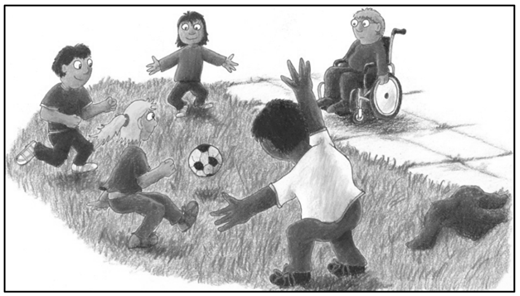
We now propose to take a closer look at the classroom conversations of four fifth- to sixth-grade teachers (student age: 10-12 years) in four Dutch primary schools: Mrs. Adams (47 years old), Mrs. Becker (30), Mr. Mulder (38) and Mr. West (51).1 These four teachers organized classroom conversations based on a situation depicted on a poster. The situation is supposed to be lifelike and related to the students’ perception of their environment (we have already drawn attention to the importance of this factor). The poster shows four children playing soccer. At the edge of the playing field there is a boy in a wheelchair (see Figure 1).
The participating teachers were given written instructions for the lesson. They were asked to present the situation as a moral issue: the boy in the wheelchair might like to join in the game, but he can’t. Presented in this way, the situation links up with questions related to civic virtues, such as: “How do I take the needs and interests of others into account?” (justice); “How do I deal with people who are different from me?” (tolerance); and “How do I consider the well-being of others?” (solidarity). The teachers were asked to organize a classroom conversation of about 15 minutes’ duration. The goals of the lesson were broadly formulated: (1) developing students’ reasonableness about moral problems in their daily lives, and (2) developing their awareness of and involvement with such moral problems. Both are considered important in the development of virtue.2 Teachers were asked to present the situation to the children and have them imagine themselves involved in it (introduction); then enter into a conversation with them (essence) and provide a summary or conclusion at the end (closure). No further directions were given as to methodology, because we were interested in the different kinds of teacher utterances that would come up spontaneously during the discussion.
The four teachers did indeed present the situation to their students in an introduction. They elaborated on the picture, sometimes adding extra information to make the story more vivid. A conversation then followed between teacher and class. Though all the teachers seemed to conclude the conversation by making one or more normative statements, the transition to the closure was not easily recognizable as such.
The classroom conversations were audio taped and transcribed. In the subparagraphs that follow, we take a closer look at these transcripts in terms of the aspects and interventions pinpointed before, giving one or two examples from the transcript in each case.
Aspect 1: Developing Students’ Moral Reasonableness
We have distinguished two kinds of teacher intervention that can encourage students to be morally reasonable:
Questioning students about their moral opinions and behaviors
All four teachers asked questions about students’ opinions and behaviors—Mrs. Becker, in particular, asked many. Most of them were formulated as “what would you do” questions:
Mrs. Adams: “What would you do at that moment?”
Student: “Well, I would ask him to join in, but that wouldn’t be any good.”
Mrs. Adams: “What do you think of that, Sarah?” Sarah:“Well, I would suggest playing some other game. For instance, we could play hide and seek, and someone could push his wheelchair.”
Such questions seemed to encourage the children to think about their intended behavior, which indicates that they were indeed relevant questions with regard to virtue development.
Asking students “why” questions
Sometimes students motivated their answers by means of reasons, as in this case:
Mrs. Adams: “I think Aron [the boy in the wheelchair] will be in a wheelchair all his life. What kind of a life would that be? Robert?”
Robert: “A bad life, because you are always in the wheelchair and you can do almost nothing.”
Students did not often come up with such reasons spontaneously; and this is not surprising, because giving reasons is one of the things that we hope students will learn in these conversations. That is why teachers not only need to question students about their opinions and behavior, but also to ask “why” questions to elicit reasons. However, the teachers in our study did not do this very often. Mr. Mulder did not ask any “why” questions; Mrs. Adams, Mrs. Becker and Mr. West only asked one or two in the course of the conversation:
Mrs. Adams: “You say it would be a bad life, but I heard someone else say it doesn’t have to be like that … I think it was you over there who said that. Why do you think it doesn’t have to be a bad life?” [.]
Student: “No, you can still have a nice life. You can’t play all the games, but you are with your parents, you’re with family and you still have a nice life.”
Mrs. Adams: “Peter.”
Peter: “You can still do fun things.”
In such cases, when a “why” question was asked, it seemed to encourage students to think about the reasons behind their answers.
Aspect 2: Developing Students’ Emotional Involvement
In our virtue-ethical model we have distinguished two kinds of teacher intervention that should stimulate students to feel emotionally involved:
Asking students to empathize with the persons concerned
Mrs. Adams and Mr. West asked empathic questions during the conversation whereas Mr. Mulder asked none. Most of the empathic questions related to the feelings of the boy in the wheelchair:
Mr. West: “And how do you think he feels?”
Student: “He feels excluded.”
Mr. West: “Yes, and what else?”
Student: “A bit sad because he can’t walk himself.”
The questions did seem to encourage the children to feel emotionally involved with the situation and the persons in it, especially the boy in the wheelchair.
Asking students to relate the given situation to a personal life experience
We found a few questions about personal life experiences in the conversations of Mrs. Adams, Mrs. Becker and Mr. West. They asked, for instance, whether their students had ever experienced something similar:
Mrs. Becker: “Did any of you ever experience something like this? Meeting someone who was in a wheelchair or had some other handicap, but you still tried to make friends… Kelly?”
Kelly: “Yes, there was someone who was handicapped and he was in a wheelchair and he went past <inaudible> and he wanted to kiss her, and she said: No, we don’t do that. And then she ran away.”
Mrs. Becker: “Well, I understand that, because she didn’t like the idea. He didn’t just want to play, he wanted more. It feels different then.”
Cases like these seemed to help children relate the given situation to real-life experiences. Particularly when students came up with the cases themselves, they seemed to be making such a connection. Some teachers, especially Mrs. Adams, used these experiences to make students feel more involved and concerned by asking questions about their thoughts, feelings and inclinations.
Student: “Jennifer was in a wheelchair for a while, wasn’t she?”
[…]
Mrs. Adams: “Did you find there were things you couldn’t do?”
Jennifer: “Well, err. I couldn’t run and walk, for example. Or do a handstand.”
Mrs. Adams: “Did you find it a handicap, sitting in that wheelchair?”
Jennifer: “Yes.”
Mrs. Adams: “Just a bit, eh? So can you imagine how people feel who sit in a wheelchair all their lives? Just a bit, eh?”
One might question whether such individual experiences have any relevance for the other children in the classroom. After all, the rest of the children have not had that particular experience. It may be argued, however, that just hearing about their classmates’ experiences will stimulate emotional involvement, because students are more closely related, emotionally, to their classmates than to the children in the poster picture. The mere fact of realizing that such situations are happening “in real life” might make the hypothetical situation more lifelike and appealing.
Mr. Mulder was the only teacher in this study who did not ask students to empathize or to relate a given situation to their own experiences (the two interventions we have distinguished regarding Aspect 2). Remarkably, he did not seem able to engage his students’ empathy for the boy in the wheelchair. At one stage they even made fun of the boy:
Student: “He can be a ball boy” (classmates laugh)
This gives an indication that the other teachers (those who used the listed interventions) were indeed better able to involve their students emotionally.
Aspect 3: Guiding Students Toward Virtue
We have reasoned that, from a virtue-ethical perspective, the teacher’s role should not be a completely neutral one. Teachers should guide their students toward virtue, and in that role it may be legitimate to comment on student statements or the discussion in general. We have also argued that when teachers motivate their moral values and beliefs, their utterances have a stronger potential for the stimulation of students’ virtue development than when they do not.
The four teachers in our study all made moral statements. This means that none of them maintained a completely neutral role. However, they differed not only in the number of moral statements but also in the extent to which they motivated them. We have already concluded that motivated moral statements are preferable to nonmotivated ones. Of the four teachers, Mr. West used the greatest number of normative utterances, usually referring to some kind of moral content. Mrs. Becker and Mr. Mulder used fewer normative utterances, mostly without any clear motivation. Mrs. Adams, while she used fewer normative utterances, nearly always supplied some motivation.
Nonmotivated moral statements (feedback without moral motivation, normative questions)
We have defined nonmotivated moral statements as utterances in which the teacher implies that she considers something to be important or valuable but does not provide a motivation. All the teachers in the study used utterances of this kind and thereby demonstrated their own beliefs and values, which might influence the moral development of the children.
We have looked for two kinds of nonmotivated moral statements: teacher feedback without moral motivation, and “normative questions.” Here is an example of a teacher praising a student without supplying a motivation:
Student: “Well, I think they should adjust the game so that the boy can join in.”
Mr. West: “Yes, that is a good option. Does anyone else have some other idea?”
In this example Mr. West comments on a moral utterance that showed the moral priorities of the student3 in question. However, he does not (yet) motivate why he thinks the student’s suggestion is “a good option” (nor does he invite the student to motivate his answer).
An example of a normative question would be the following:
Mr. West: “How would you help someone to feel part of the group?”
Student: “Play some other game that he can take part in.”
[…]
Student: “He could be a referee or something.”
This question could be labelled a normative question, because the meaning and significance of “helping someone feel part of the group” is presupposed. The only answer the students can give is about how this can be done.
Motivated moral statements (referring to justice, tolerance or solidarity)
We have argued that it is better when teachers motivate their moral values and beliefs than when they do not. Hence, in their statements, it is best to mention the moral relevance and meaning of a thought, feeling or action. To be able to recognize such teacher statements, we needed a normative framework. Because this study concentrates on classroom conversation as a means of stimulating the civic virtue development of students, we have chosen to focus on the three aforementioned civic virtues: justice, tolerance and solidarity. We have argued elsewhere that these virtues can be seen as core virtues of good citizenship solidarity (Willems, Denessen, Hermans, & Vermeer, 2012), so a lesson in citizenship education should invite teachers and students to refer to these virtues in particular. We have looked for justice-related utterances, which we have defined as teacher statements which declare that people should be recognized as having value in themselves, intrinsic value; or that others are people like oneself, with comparable thoughts, desires, feelings and inclinations. We have looked for tolerance-related utterances, which we defined as teacher statements that it is good to engage people in conversation about what they think, feel, or want; or in which the teacher encourages students to put themselves in the place of the (somewhat strange or unfamiliar) other. And we have looked for solidarity-related utterances, which we defined as teacher statements that it is good to be part of the group, or that it is important to devote oneself to the happiness of others. Our elaborations ofjustice, tolerance and solidarity helped us to label a number of utterances in terms of their moral content. We found such statements in the conversations of Mrs. Adams, Mrs. Becker and Mr. West. The following example refers to tolerance:
Mr. West: “It is always important to talk to people as much as possible instead of passing judgement right away. Try to put yourself in the other person’s shoes; try to grasp how they think. Then you sometimes understand them better.”
Mr. West was encouraging students to put themselves in the place of other (somewhat strange or unfamiliar) people and engage them in conversation.
The following example refers to both solidarity and justice:
Mrs. Adams: “And that is what we call respecting each other. Well okay, actually you all agree that Aron [the boy in the wheelchair] should join in the game.… We are looking for a way to involve him. You want him to join in. Disabled people, well, we don’t think disabled people are sad.”
In this utterance, Mrs. Adams attaches positive value to helping other children feel part of the group. Her statement about disabled people can also be seen as a plea to see the disabled as persons equal to you, especially in the light of the rest of her conversation.
In terms of our theory, we presume that motivated moral utterances have more effect on the virtue development of students than nonmotivated ones. However, it is hard to be sure how the students were influenced by normative utterances of this kind: most of the time they did not respond directly. We also have to be aware that moral statements vary in scope. Brief remarks might not have the same effect on virtue development as larger elaborations.
Assessing Qualities of the Four Lessons
In this study we have presented a didactical model, based on virtue-ethical theory, for moral classroom conversations. We used this model to assess qualities of four moral classroom conversations. In applying the indicators, we discovered many differences between the teachers. Some seem to use a broader moral didactical repertoire to stimulate the students’ moral reasonableness (Aspect 1) and emotional commitment (Aspect 2) as well as to guide them toward virtue (Aspect 3).
In this study, Mrs. Adams seems to fit the virtue-ethical criteria best. In her conversation we recognize utterances relating to all three aspects. It is particularly striking that most of her moral statements are followed by a motivation, and that she often encourages students to get emotionally involved in the situation by asking them to empathize or to relate the situation to their own experience.
Mrs. Becker, on the other hand, does not often intervene in the ways we have defined as conducive to the students’ emotional involvement. Her focus seems to be simply on making an inventory of students’ opinions and inclinations. She asks many questions about what students would do in the situation (sometimes changing the situation a little and then asking the question again). Sometimes she praises students for their answers, but her praise is never motivated.
Mr. Mulder seems to have used a more limited moral didactical repertoire. He only asks some questions about the students’ behavior and makes a few normative statements, usually without a moral motivation. He does not seem to be stimulating students to feel emotionally involved and he does not ask “why” questions.
While utterances referring to all three aspects can be recognized in the conversation of Mr. West, the gist of his utterances seems to be normative. More than the three other teachers, he seems to follow a value transmission approach. Compared to the others, he does not ask many questions to stimulate moral reasonableness.
It is interesting to note that the extent of a teacher’s moral didactical repertoire seems to be linked to the time the conversation takes. Mrs. Adams ended her conversation after 20 minutes, Mrs. Becker after 12 minutes, Mr. West after 9 minutes and Mr. Mulder after only 6 minutes. This also gives some indication that our indicators cover the total scope of moral didactical teacher interventions: the more limited a teacher’s moral didactical repertoire, the sooner a point is reached where there is nothing more to discuss.
Quantifying Relevant Teacher Utterances
We have tried to assess qualities of moral classroom conversations by looking at the concrete utterances of four teachers. To compare larger samples of teachers and to investigate relationships with other variables, it would be interesting to know whether these qualities can be assessed by way of quantification. To explore this, the transcribed texts of the four lessons were coded and the coded instances were counted. Table 2 presents quantifications of all relevant utterances by the four teachers.4The two listed teacher interventions are shown under each aspect, except for Aspect 3. Because there is a qualitative difference between motivated and nonmotivated moral teacher statements, we have presented the total number of moral statements, followed by the number of motivated moral statements in brackets. We presume that teachers who often motivate their moral statements (so that the bold number almost equals the number in brackets) do better than teachers who do not do this.
What do these quantifications tell us about the quality of the lessons? We can look at the numbers from different perspectives, all designed to clarify different aspects of the lesson’s quality. For example, we can consider how many relevant utterances the teachers used during their lessons, giving us an idea of the extent to which they took the opportunity of stimulating the virtue development of students. Mrs. Adams and Mr. West both used 18 utterances, Mrs. Becker 16 and Mr. Mulder only 8. We can look at the extent to which the teachers referred to all three aspects in their lessons, fully stimulating the virtue development of their students. Mrs. Adams, Mrs. Becker and Mr. West did so; Mr. Mulder referred to only two aspects. We can look at the extent to which the teachers used different kinds of teacher interventions that are relevant according to our theory. Mrs. Adams, Mrs. Becker and Mr. West used all five kinds, Mr. Mulder only used two. We can look at the extent to which the teachers motivated their moral statements, teaching students about reasons and virtues underlying their opinions and behaviors. Mrs. Adams did so in 75% of her moral statements, Mr. West in 64%, Mr. Mulder in 25%, and Mrs. Becker in only 20%. We can even consider which aspects teachers emphasized most strongly. Mr. West seems quite directive in his approach, laying the emphasis on aspect 3. Mrs. Becker and Mr. Mulder, for their part, do not seem to lay much emphasis on the affective part of the conversation (aspect 2). Compared to the others, Mrs. Adams seems to be the teacher who refers to the three aspects more or less equally. However, we have to guard against drawing conclusions like these on the basis of numbers alone: the same question can occupy a large as well as a small part of the discussion. And a moral statement can be a brief remark as well as a lecture.
Using perspectives of this kind to look at the results in table II, it seems possible to get a valid impression of a lesson’s qualities. Whichever perspective is taken, Mrs. Adams scores highest; Mr. Mulder, in most cases, scores lowest. This conclusion fits the teacher profiles we have sketched above.
Conclusion
The goal of this study was to discover whether qualities of moral classroom conversations can be assessed by means of a moral didactical model inspired by virtue-ethical theory. The results of the study justify us in presuming that this is indeed possible. We have seen, furthermore, that our model could yield an observation tool for comparing the moral didactical qualities of larger numbers of teachers. An advantage of presenting the features of a lesson in a more quantitative way is that relationships between moral didactical qualities and other variables can be analyzed. In previous research, for instance, teachers have been asked to complete questionnaires about their preferences for certain models or goals of moral education. Klaassen and Leeferink (1998) and Maas (2010) have done this in the Dutch context. However, even a teacher who reports a preference for a certain approach may not consciously follow it in the classroom. Combining the results of such surveys with the results of analyses of actual classroom conversations might shed some light on the relationship between what teachers say they prefer and what they actually do. Moreover, the relationship between classroom conversations and other morally loaded teacher variables might be interesting to research. For instance, the extent to which teachers can be seen as moral exemplars of justice, tolerance and solidarity (Willems, Denessen, Hermans, & Vermeer, 2012) might relate to their interventions in moral classroom conversations and even to the moral statements they make concerning these virtues.
Future research might also include analyses of more lessons by the same teacher. Since only one classroom conversation per teacher was analyzed in this study, we cannot say anything about the representativeness of these lessons. Teacher interventions might differ from one lesson to another. What teachers say does not depend on their own behavioral repertoires only; it might also depend on what students come up with and on the subject discussed. More conversations by the same teacher could be recorded and coded to explore the extent to which they differ. These could be moral conversations about given (hypothetical) situations like the one in our study, but also other kinds—for instance, about a recent quarrel between students in the schoolyard. Starting with a real rather than a hypothetical situation may result in different teacher interventions.
We have to emphasize that an exclusive focus on teacher utterances probably will not give us a complete picture of the quality of a moral classroom conversation. Sprod (2001) has suggested that, in an ideal moral conversation, the students would ask most of the questions and discuss the answers among themselves. Our model gives us no insight into the quality of such student interaction (though we noted in our four analyzed lessons that students rarely react to the utterances of other students)—only into the quality of teachers’ attempts to influence the interaction.
We conclude by emphasizing once again that, in this study, we have followed a normative approach. We set out from a specific theory (the theory of virtue ethics) to identify criteria that have the potential to stimulate the virtue development of students. Yet we do not know whether teachers who meet these criteria really influence students differently from teachers who do not. Because virtue development is a very slow process, and because it is influenced by so many other factors, an extensive longitudinal study may be the best way to clarify this.
Implications for Teacher Practice
The model we have outlined might be used not only as an analytical research tool for moral classroom conversations but also as a training tool for teacher education and educational practice. The model might help (student) teachers to become aware of their own moral didactical behavioral repertoire and limitations. Mr. Mulder, for example, might discover that he could do more to make students feel involved and concerned. In future lessons he might try questioning them about their own experiences and asking more empathic questions about their feelings. Mr. West, on the other hand, might realize that he is rather normative in his approach: he may need to give students more room to reflect critically on their own virtues. The moral didactical model we present in this article may help teachers to make their moral classroom conversations more structured, rich and attractive.
Notes
To guarantee the anonymity of teachers, teacher names as well as student names have been changed in this article.
The three aspects of our model are related to these goals: They are (didactical) means to stimulate the development toward these goals. The first aspect can be seen as a means to reach the first goal, which is more cognitive. The second aspect can be seen as a means to reach the second goal, which is more affective. The third aspect is, although more indirectly, related to both goals. Being a moral example, a teacher can provide her students with an horizon of virtue toward which they may develop (cognitively as well as affectively).
We only considered teacher feedback to be a nonmotivated moral statement when the feedback followed a moral statement of a student. When a teacher gave feedback on a statement in which a student just shows nonmoral knowledge, than we the feedback was not considered to be relevant. An example of nonrelevant teacher feedback is the following:
Student: “There even are Olympic Games for people who are in a wheelchair.”
Mrs. Adams: “Yes indeed. Who knows what’s the name for that?”
[…]
Student: “The Paralympics.”
Mrs. Adams: “Very good!”
Only “new” teacher utterances were counted: when teachers asked the exact same question twice (for example, while turning to a different student), it was coded only once. However, when teachers changed or developed the given situation and then asked the same question again, it was coded again. We presumed that changing or developing the situation would put the question in a different light, making it a “new” question.