


David Levin, cofounder of both the Relay Graduate School of Education and KIPP Charter Schools, invites teachers, administrators, and anyone with Internet access to take his free course “Teaching Character and Creating Positive Classrooms” from Coursera.org, a web-based provider of free online courses. As a middle school writing teacher in a low-income Philadelphia school, I enrolled in David Levin’s course hoping to avoid a recurring frustration with character education programs. The latest character curriculum championed by my administration often arrives prepackaged, all-included and top-down with little room for flexibility. I would often have to abandon cherished classroom strategies to follow the rigid new protocol. This was contrary to my instincts—every year as a teacher I felt most successful at influencing my students’ character after adopting then adapting strategies from psychological research to complement the other systems and structures in my classroom. What could explain my frustration? Was this indicative of urban education, the way my administration rolled out new programs, or the field of character education? This article explores, from a teacher’s perspective, how David Levin’s course, and the entire field, could benefit from recognizing where and when teachers could adapt such strategies to even better address the needs of their students. Such a change could have tremendous benefits for teachers like me who often see fascinating discoveries in basic research become overly simple and scripted to offer quick results in our complex and dynamic classroom settings. I have divided David Levin’s course into its four main parts. I evaluate each part in terms of its connection to academic research on character education before addressing how I wish David Levin and other scholars in the field reformed their pedagogical strategies to benefit the many teachers who feel the way I do.
Part 1: The Goal of the Course
Levin believes, like me, that education should do more than instill academic information; it should leave students happier and with the habits of self-discipline to succeed in the workforce and beyond. His goal is PERMA, an approach to well-being articulated by positive psychologist Martin Seligman in his book, Flourish: A Visionary New Understanding of Happiness and Well-Being (2011). To promote PERMA is to promote:
Positive emotions, such as optimism and gratitude;
Engagement or willfully working on a fulfilling task;
Relationships between family, friends, and peers;
Meaning or finding goals and purposes greater than one’s self; and
Achievement or successfully reaching goals.
In the first week’s lessons, Levin interviews Seligman who says, “If you increase PERMA, you increase how much kids learn in school. If you increase how much they learn, you increase PERMA.”
The symbiotic relationship between academic achievement and well-being is nourished by teachers cultivating, and students discovering, their 24 character strengths (see the Figure 1).
Connection to Other Research and Approaches in Character Education
Martin Seligman’s Flourish (2011) details the research and interventions that he and his colleagues have conducted across a variety of schools and student populations. From class gratitude letters for supportive adults to analyses of the character of famous historical figures, Seligman’s interventions supplement subject area and school wide efforts to boost well-being and achievement. From the best of my exploration through the scientific literature, this framework seems pretty solid. There is a large body of science that shows a reciprocal relationship between academic achievement, intrinsic motivation, and well-being (Ryan & Deci, 2000). Not only do students who approach education for the joy and interest of their education earn higher grades, but they are more likely to process information at a deeper level, recall it better, demonstrate creativity and make connections across content areas (Kohn, 1999; Ryan & Deci, 2009;). Additionally, many of the 24 character strengths are conceptually related to other psychological phenomena like perseverance, interest development and self-regulation, all of which promote academic achievement and motivation (Farrington et al., 2010). As a teacher, the course’s goals seem not only compatible with the academic instruction required of me but a great way to facilitate learning. Helping students to build awareness of their virtues could certainly help students visualize how to connect learning to their capabilities and future aspirations.
While “virtue” represents a rather nebulous term, something between a talent and a personality trait, such a construct can be found across cultures and contexts—see Christopher Peterson and Martin Seligman’s Character Strengths and Virtues: A Handbook and Classification (2004) for detailed exploration of the topic. Perhaps most appealing about the concept of virtues is that it recognizes a middle ground when discussing human capabilities. Measurements of intelligence, such as IQ scores, share only small correlations with occupational success, academic grades, and even income (Stanovich, 2010). Other construals of intelligence, such as multiple intelligence theory, are equally problematic because it fails to separate a person’s situation-specific ability (or “talent”) from a person’s centralized cognitive processing ability (or “intelligence”) (Willingham, 2009). Coherently packaging all human capabilities into 24 character strengths may seem a bit contrived and under representative of the diversity of human thought, but it provides a practical language to describe a diversity of academically important abilities grounded in scientific research.
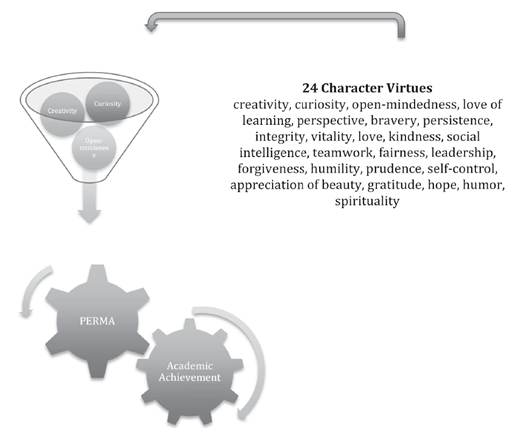
A Visual Representation of the Course’s Character Education Framework
A Visual Representation of the Course’s Character Education Framework
Martin Seligman’s PERMA model of well-being is also very similar to other well-validated measures of well-being, such as psychological well-being and subjective well-being. As Table 1 indicates, the elements of PERMA are more similar than different to the components of other models of happiness.
What This All Means to Teachers Like Me
All things considered, I think Levin’s framework for education proves a suitable framework for educators interested in promoting the well-being of their students. Given the nexus of learning, well-being, and motivation, preferring Levin’s call for PERMA, character strengths, and academic achievement seems warranted. In fact, this underlying approach represents the very reason I and many other educators in my school continue to teach. I am an educator in a dramatically underfunded and underperforming Philadelphia school. The most successful teachers I admire recognize that academic achievement is too simple an end goal. It must be paired with relevancy, personal growth and pleasurable learning experiences for students to fully realize why people from Charles Darwin to Beyonce have happily immersed themselves in their crafts.
Different Constructs of Well-Being
| PERMA | Subjective Well-Being | Psychological Well-Being |
|---|---|---|
| Positive emotions | Positive emotions | Self-acceptance |
| Engagement | Negative emotions | Control (or mastery) of environment |
| Relationships | Life satisfaction | Relationships |
| Meaning | Meaning* | |
| Achievement | Autonomy | |
| Personal growth |
Note: *Meaning in psychological well-being is called “purpose in life.” Bolded items indicate which components are shared across the models. See Ryff and Singer (2008) Diener (2001) for a more detailed discussion of the alternative well-being models.
But some warning signs have popped into my head during this portion of Levin’s course that remind me of my more dissatisfying experiences with character education programs. Virtues appear to be a promising construct to celebrate with students as long as educators and parents recognize that not all aptitudes neatly fall into 24 character virtues (public speaking skills or metacognitive ability, for example). Given American cultural norms that often emphasize test scores, grades, and how classmates compare to their peers, a more broad scope for child development provides a productive step toward creating more positive classrooms. But if the 24 character virtues become regarded as the new holy grail of education, what was emancipatory becomes suppressive. I have seen teachers and administrators paradoxically overlook students’ ability to create their own practice tests, translate confusing directions into a new classmate’s native language or challenge a teacher’s way of grading an essay because it did not neatly fit into the tracking and incentive system of our very rigid character education system. Finding our uniqueness is certainly a necessary element of self-actualization and well-being. Recognizing 24 character virtues over GPA sees the forest for the trees when it comes to student potential and achievement. We also cannot let the forest distract us from the greater biome of human capacities and strengths. I doubt American icons, like Abraham Lincoln to Mae Jemison, could have had their success boiled down to just 24 traits.
Part 2: The Micromoment Triangle: Growth Mindset + Constructive Responding + Character Behavior Language
Levin offers several big picture recommendations to promote positive classrooms. The first involves a trifecta of emphasizing how intelligence and academic abilities can change with hard work (growth mindset), offering encouraging feedback even when a student offers either a correct or incorrect response (constructive responding), and framing this current moment in the classroom with the 24 character virtues, whether it be demonstrating grit by working hard to get the correct answer or zest by excitingly approaching the remainder of the lesson. He calls this the micromoment triangle, which is reprinted below in Figure 2.
For example, a video from a KIPP Charter School classroom features a student who was presented with a task framed as a challenging but solvable math problem (growth mindset).
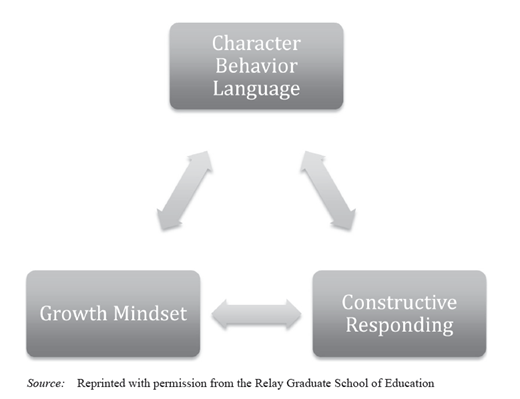
The student was recognized and encouraged for her correct answer and her effort that led her to the correct answer (constructive responding), and she was asked to share which character strength she exemplified, namely grit (character behavior language). Levin’s micromoment triangle introduces teachers with a way to build character, positivity, and academic ability simultaneously.
Connection to Other Research and Approaches in Character Education
In isolation, each part of Levin’s model has ample research to back it up. Not only has research demonstrated that students find curricula that involve character virtues engaging (Steen, Kachoreck, & Peterson, 2003), but character virtues both predict adolescent well-being and academic achievement (Gilham et al., 2011; Toner, Haslam, Robinson, & Williams, 2012; Weber & Ruch, 2012; White & Waters, 2014). Carol Dweck’s (2006) research on growth mindsets demonstrates how a belief in the malleable nature of intelligence with hard work leads to higher academic achievement, resiliency in the face of setbacks, and preference for more challenging tasks. While research on constructive responding has primarily been done to examine relationship well-being among romantic partners (see Gable, Gonzaga, & Strachman, 2006), it is probably not a stretch to assume that such discourse practices benefit how safe and encouraged students feel in the classroom. In fact, Malcolm Gladwell’s Blink: The Power of Thinking Without Thinking(2005) provides powerful testimony to this idea, showing how constructive and validating conversations robustly predict marriage success and the avoidance of malpractice lawsuits for doctors.
What This All Means to Teachers Like Me
While science supports each of these three strategies separately, they have not been studied in tandem as the micromoment triangle. As an educator myself, I am not concerned with this realization—I use pedagogical strategies that probably haven’t been tested in the particular combination I employ them, but that is the nature of education when the teacher has the ability for professional discretion. Effective instructional strategies are always being mixed and tinkered with by motivated educators who are given the freedom to do so in their schools.
I see no reason I could not employ this strategy as it has been modeled in the course, but I think the frequency of such simple execution would (hopefully) be less common among experienced teachers. I have yet to sit in a classroom without seeing some part of the lesson rightfully require students to share out answers to questions and defend their reasoning. (The micromoment model of teacher-student discourse would lend itself very well to this part of a lesson.) However, I’m worried if educators try to make all their questioning follow this question, answer, connection to character formula. Tying character language to accepting peer feedback, building a sophisticated idea from a class debate, or self-monitoring a written product based on a rubric could certainly be linked with character language. But this sophistication is not what is demonstrated in the course. If Levin, and other character educator designers, are not explicitly encouraging teachers to differentiate their character building model to complement the complexity of the academic work, I worry parents, teachers, and administrators (those his course is designed for) will think lessons should be this simple and automatized.
Perhaps I am being fearful, but I do not think I am being irrational. With the simultaneous increase in high-stakes testing and budget cuts to Philadelphia schools, multiple-choice questions in English classes invaded my classroom more each year. (Last year I was instructed to begin class with multiple choice questions and move onto “prompt attack” writing assignments for 6 straight weeks.) With the birth of a new instructional strategy often comes a desire to script it, package it, and require teachers to adopt it en masse. A school that encourages, trains, and supports teachers to adapt the micromoment triangle, or any other character building strategy, to their school context is likely to lead to the best results. Modifying this strategy along with engaging curricula and classroom activities that encourage cooperation, perspective, and community would certainly enhance the character development of students. I wish I heard this qualification more frequently among Levin and those who design such strategies. The micromoment triangle could be an amazing asset for schools that promote motivation alongside academics, but it could also be foolishly used to justify a lecture, textbook, or test-prep lesson that promoted an overly simple classroom discourse of question, answer and explanation.
For example, essay writing was a foundational aspect of my English course when I taught ninth grade at a previous school. For a variety of reasons endemic to urban education, my ninth graders usually have never written an essay before entering my class. The micromoment triangle in its represented form would certainly lend itself when students are critiquing exemplar and nonexemplar introductory paragraphs. However, by our second essay I am no longer requiring students to follow simple grammatical and rhetorical conventions. They are expected to include anecdotes, subtle humor, rebuttals, quotations, and choose among these strategies based on what is most appropriate for their argument. The micromoment triangle would need to undergo equally substantial changes as the academic product I was requiring of my students.
Growth mindset would not simply be returning to a problem after having gotten it wrong; it would be recognizing and tracking their own growth on a spectrum of essay writing skills. Capturing the tenacity of rewriting essays drafts based on teacher and peer feedback in a simple question, answer, explanation format would prove challenging to do in front of a 40-student class. Constructive responding would become more like Constructive conversations. As the complexity of the academic product increases, so too does the complexity of the academic feedback. (I am sure any professor who has helped graduate students edit papers for publication can attest to this.) Given my context as an educator who sees many good educational practices become overused precisely because they were effective initially, I wish David Levin, and his contemporaries influencing character education across the nation, would explain that his micromoment triangle should adapt alongside the instruction.
Part 3: Macromoments
While Levin’s micromoment triangle deals with how teachers deliver a lesson, his macromoment structures tackle the actual lesson being delivered. Levin defines macromoments as “any system or routine that explicitly or implicitly teaches character.” He suggests that lessons combine the academic content and skills of the subject with the content of PERMA and the character virtues. For example, in the featured videos in his course an AP history teacher has students rewrite essay drafts to promote grit; an elementary school teacher discusses the importance of following certain norms during recess to promote social intelligence; and another elementary school teacher asks the class to analyze the character strengths of a singer.
Connection to Other Research and Approaches in Character Education
Marvin Berkowitz (2012), a leading scholar on moral and character development, compares research on character education to the Tower of Babel. Like the residents of this Biblical city who found themselves speaking different languages amongst each other, making communication impossible, the field of moral and character developed is muddled with terms, research methods, theories, and interventions that vary in definition and number, producing inconsistent strategies to develop the ethical fiber of a child. While research has shown that there are successful character building schools and classroom practices, little is known if these changes are long lasting or what psychological processes make some programs more effective than others (Berkowtiz, Battistich, & Bier, 2008). When David Levin uses the three illustrations of teachers creating their own character education interventions in their classroom, we certainly fall victim to the Tower of Babel complication. Teachers are operationalizing grit, social intelligence, and other character education terminology in very different ways.
I am not a psychologist, so I cannot speak to how problematic or promising it is for teachers to create their own character education strategies in their classroom, which is what the very fluid macromoment strategy encourages. As a teacher, such an approach is not alarming; what could be more complex than building industrious and socially minded human beings? Social intelligence in my English class would require sensitivity in how students critique one another’s work while it might translate to passing the ball more in a physical education class. I would be surprised and skeptical about any character education program that was insensitive to subject area, instructional method, or curriculum.
What This All Means to Teachers Like Me
I have a similar qualified endorsement of Levin’s approach as I did with his micromoment triangle. If such strategies codevelop alongside engaging and relevant curricula and instructional strategies, with attention to student interests and goals, they would make excellent additions to a classroom. Mine included! But if educators are not adapting this approach alongside their instruction and curriculum, then these strategies become a tool leveraged against the needs of a child. I am encouraged when I see David Levin’s teachers incorporate the new character terminology with their old assignments and instructional methods (like recess and essay writing), but it is a bit limited. As a professional educator, I should not only look to pair a character education term to an instructional strategy. I should look to interweave the two so they are inseparable. Perhaps the Advanced Placement history teacher in David Levin’s example could promote grit even better by requiring students to not only rewrite their essays but also maintain a running list of their own common mistakes. Perhaps the elementary school teacher rationalizing the importance of playground etiquette could teach her students what to say to a peer when they saw one of them violate a recess norm. I’m not saying that this is exactly what each of those teachers should do. I’m only arguing that David Levin’s message around creating macromoments could be tweaked so that students see the academic end goal and the character end goal as indivisible. Perhaps other character education programs should follow suit.
This suggestion is again rooted in my teaching experiences. During my first year of teaching, a school contracted a company that encouraged us to rate students on their leadership—Do students redirect misbehaving peers? Are they actively engaged in class? Students receive certain privileges for the degree of leadership they exemplify. As directed, I clarified what student actions would lead my students to earn the highest leadership rating. I, like most teachers, emphasized class behavior and work completion as the mark of a student leader. However, I should have been thinking of what classroom structures and leadership expectations I could modify concurrently. Perhaps a student could have passed out talking chips to every participant in a class debate to encourage full class participation. Perhaps a different student could have been in charge of tracking tables that remained most focused during flashcards.
Levin’s macromoment strategy seems to have as much potential as the amount teachers are trained to promote the interaction of character with academic assignments. I wish Levin would have explained this in his course just as I wish the people training me on the student leadership program would have done so years ago.
Part 4: The Character Growth Card
The final major strategy offered in the course is documented information from teachers about the character development of the student over a longer period of time. Levin acknowledges that different schools have opted for a more quantitative approach (offering numbers and grades) while others have gone a more qualitative route (providing narratives about when and a student does or does not exhibit the character strengths). This strategy offers students, parents, and educators to engage in systematic reflection and conversations about conversations outside the classroom. Levin even encourages his listeners to view the growth card not as a report card but as a piece of feedback to stimulate self-awareness.
Connection to Other Research and Approaches in Character Education
Research into the effectiveness of character growth cards is in its infancy (Sparks, 2014). But the strategy has received intense praise and criticism. While proponents argue that such formal feedback on student motivation leaves children and parents with greater knowledge on how to develop behaviors that promote greater academic achievement, critics argue it does more damage than good. Besides the well-documented negative effects that rewards and extrinsic motivation have on intrinsic motivation, some argue that evaluating character presents an incentive for pretense (Kohn, 1999). The comments and scores on a character growth card encourage students to appear to have a certain character, not genuinely manifest those traits. To have grit and self-control is one thing; to prove to your teacher you have it and get the highest scores and best comments on a growth card is something different.
What This All Means to Teachers Like Me
Again, I am skeptical that I, or anyone, could make any meaningful conclusion about this strategy without consideration for the other instructional supports available to the child. I teach in a school that uses “merit cards.” If any staff member sees any child doing something that demonstrates a growth mindset, grit, or another school value, we are to initial the merit card. A full merit card can be exchanged for a reward. Does this incentive structure promote behaviors that are done for the reward and not because of the intrinsic value of the behavior? Yes. Do I believe this system subverts legitimate character growth? Not necessarily. I could certainly give the merit and walk away, which leaves the student more excited about their ever-closer prize than the self-satisfaction of an admirable act. But, perhaps this routine becomes invaluable if I take a small moment to add, “I know you are excited for your merit, but because of you your partner realized that writing is something he is good at.”
I hesitate to encourage or discourage character growth cards, in general, without attention to the systems throughout the school. I’m not an administrator, so I have very limited local knowledge about what would explain successful interventions that span multiple classrooms of even my own school. The local knowledge I do have is when I have chosen to rely on such systems. During very rigorous nonfiction units I usually explain to the class what previous students had found most challenging. I use this as an opportunity to be forthcoming, clear, and objective in what student behaviors translate to favorable and unfavorable marks on their merit cards. This is certainly used to reinforce actions and can be considered extrinsic motivation. It’s also a very successful support I only need to use during very rigorous and independent units.
Conclusion
A classroom is a dynamic place. It is where peer influences, teacher efficacy, content, mindsets, and everything else combine together to affect student actions (Kaplan, Katz, & Flum, 2012). In a short class period, every student, teacher and parent hopes a child has left a little more inspired, educated, and personally enriched. When considering David Levin’s online course “Teaching Character and Creating Positive Classrooms,” it is an educational tool. A hammer can build or break a house. The presented strategies could be arranged and adapted alongside other quality classroom systems, or it can be dropped into a classroom as a disconnected facet of the class culture. David Levin’s course provides an illustration of the promise and hesitation I have experienced with character education programs. For teachers like me who return after each summer vacation to literally open the latest box set of our school’s new approach toward character, David Levin’s course is filled with intriguing new ideas based on research, but it needs to support and encourage teachers to adapt the strategies to support, enhance, and blend with the class structures they find most successful. No aspect of his course seems to preclude this qualification.

