


Both the Bible and the early Greek philosophers reflect deep concern with understanding and conducting the emotional and social aspects of our lives. This enduring interest is expressed in current educational systems under the banners of social-emotional learning (SEL) and character and moral education (CME). In schools, these approaches often appear to be distinctly different and sometimes in competition. Here, the authors analyze the potential for synergy or divergence in SEL and CME primarily by presenting a detailed background of the evolution of three streams of influence on contemporary SEL: social learning theory, the role of affect, and a community psychology and socioecological perspective.
The earliest known writings, and certainly as far back as the Bible and ancient Greek philosophy, reflect a concern with the impact of strong emotions on people’s social interactions and decisions. Some have considered the question of how individuals or groups of individuals might acquire more effective ways of regulating their emotional responses and/or social relations. Others have wondered how individuals or groups learn to guide their behavior in proper or virtuous ways. Educational environments, as one of the primary cultural institutions responsible for transmitting information and values from one generation to the next, have been seen as places to make progress toward these aims. Implicitly or explicitly, schools have long been involved in attending to the social-emotional well-being and moral direction of their students.
Not surprisingly, character and moral education (CME) and social-emotional learning (SEL) have emerged as two prominent formal approaches used in schools to provide guidance for students’ behavior. CME emphasizes values, and SEL emphasizes the skills and attitudes needed to function in relevant social environments. The two approaches have come to differ even more in pedagogical practice than in their deeper conceptualizations. Character and moral education has focused more on the power of “right thinking” and “knowing the good,” and social-emotional learning has focused more on the power of problem solving (Elias et al., 1997; Huitt, 2004). The most discerning theorists and practitioners in both areas have recognized the role of affect (Lemerise & Arsenio, 2000; Nucci, 2001) in this endeavor. But this is not new; the tempering of anger was a highly prominent concern of the Bible and Greek philosophers as applied to God, the gods, and humans. However, recent research into the strong role of emotions in everyday life has spurred CME and SEL toward a common pedagogy involving coordination of affect, behavior, and cognition, articulation of core values, and organization of the ecological-developmental contexts in which learning occurs.
Paradoxically, CME and SEL are valuesneutral approaches to aspects of socialization. Though there may be differences in determining the authoritative source of moral values, America’s public, secular education system, in a nation committed to democratic principles, recognizes sets of values and moral principles that can be seen as consensual. Dewey has written about these with particular eloquence. Nucci (2001) has found that even among religious children of different denominations, there is a consensus about moral values that transcend religion and degree of belief (e.g., most children would believe that stealing is wrong even if God commanded people to steal).
There is a pragmatic activity that can help to identify implicit commonalities in people’s understanding of different values. Gather educators or parents into groups and ask each member to think about one child they know well. Ask the first group to think about a child who is highly responsible. Ask the next one to think about a child who is respectful. Have members of the third group think about one who is honest. Have the final group think about a young person that they would say is an exemplary citizen in their school or community. Ask them to picture the child they are thinking about and then write down and/or discuss what it is about that child that has earned the label of responsible, respectful, and so on, in their eyes. Make it clear that you are not interested in abstract conceptualizations about these attributes, but rather you want people to mention things specific to the child they are envisioning. Then have each group share their responses and come up with a consensus statement containing their observations.
When one leads a discussion and records each group’s responses in ways for all to see, a pattern invariably emerges: to enact any of the values and attributes, a large number of skills are needed. Responsibility involves time and task management, tracking, and organization; respect involves empathy and social approach behaviors; honesty involves self-awareness and communication skills; good citizenship involves problem solving, decision making, and conflict resolution, as well as group and teamwork skills. Ultimately, efforts at character and moral education, however their objectives may be defined, are intended to inform behavior and experience. Enacting moral principles requires skills (Berkowitz & Bier, 2005).
Berman (1997) has defined these skills as essential for the development of social consciousness for living as an engaged citizen. Dalton, Wandersman, and Elias (2007) refer to these as cross-cultural “participatory competencies,” specific cognitive, behavioral, and affective skills needed to effectively enact key roles in a given social context. Lickona and Davidson (2005) have articulated an often implicit distinction between moral and performance character, codifying that “doing the good” does not follow automatically from “knowing the good.” Most current writings about CME and SEL seem aligned with these prevailing notions.
Possible convergence between SEL and CME would be enhanced if practitioners, theorists, and researchers had a better understanding of the trajectory of these fields and their assets and limitations. Because much has been written about the evolution of moral and character education (e.g., Lickona, 1976, 1991; Nucci, 1989; Nucci & Narvaez, in press; Wynne & Ryan, 1997), here, we will emphasize the development of SEL and elucidate its underlying bases. Our emphasis will be on the context of public schools in a democracy and related moral principles or values and their associated interpersonal skills. In contexts with differing sources of moral authority, such as faith-based schools, specific focal values and requisite social-emotional skills might vary from those that will be highlighted here.
The Evolution of Social and Emotional Learning
Traditional views of the development and evaluation of SEL point to some of the first known writings about social and emotional skills in Aristotle’s The Nicomachean Ethics and go on to discuss Darwin’s exploration of the importance of emotion in evolution, in The Expression of the Emotions in Man and Animals (Goleman, 1995; Mayer, 2001). More recently, the roots of SEL are traced to Thorndike’s view that “social intelligence”— the ability to comprehend others and relate to them effectively—was an element of overall intelligence (Elias, 2001). More recent explications of this idea include Sternberg’s work (1985) on what he then referred to as “practical intelligence,” and Gardner’s research (1993) on the multiple intelligences components of intrapersonal (emotional) and interpersonal (social) intelligence. Sternberg and Gardner’s work began to shift the consensus away from studying intelligence, emotion, and social relations as separate, rather than interrelated phenomena (Mayer, 2001), although others (e.g., Piaget and Dewey) had noted these interrelationships much earlier. By the early 1990s, the Consortium on the School-Based Promotion of Social Competence (1994) emphasized that curriculum-based approaches to building interpersonal effectiveness and resilience must integrate cognition, affect, and behavior to address developmental and contextual challenges and tasks.
While not an early part of the SEL trajectory, the construct of “emotional intelligence” has emerged as a powerful and popular, though ill-defined, construct relating to children’s interpersonal development (Zeidner, 2007). In the first half of the 1990s, Mayer and Salovey produced a seminal series of reviews and studies supporting the construct of emotional intelligence, including a strong definition and a measure for assessing it reliably (Mayer, 2001). Goleman popularized the concept and added some social components to the definition in his book, Emotional Intelligence (1995). Shortly thereafter, Reuven Bar-On’s (Bar-On, Maree, & Elias, 2007) extensive work in defining and assessing emotional intelligence came to prominence. Table 1 contains a summary of the way in which these contributors to SEL defined key skills and attitudes that have been part of the SEL construct.
At the same time, educators had a growing interest in applying the ideas of social and emotional intelligence in educational environments. John Dewey (1933) proposed that empathy and effective interpersonal management were important skills to be conveyed and practiced in the educational environment. It was not until the early 1990s, however—contemporaneous with the work of Mayer and Salovey—that the Collaborative for Academic, Social, and Emotional Learning (CASEL) was founded to connect theory, research, and practice on social competence to the emerging construct of emotional intelligence and its application to schools.
As Zins, Elias, and Greenberg (2007) explain, the term “social-emotional learning” began with a shift in thinking from prevention of mental illness, behavioral-emotional disorders, and problem behaviors as a goal and moved toward the broader goal of promoting social competence. Looking at the prior literature on social competence, task analyses of the skills needed for sound functioning in schools, and at the emerging research on the importance of emotions, CASEL drew on Goleman’s (1995) formulation of key SEL skill clusters and expanded them (Table 1). Indeed, in selecting the name, “social and emotional learning,” CASEL recognized that it was essential to link academic achievement with the skills necessary for succeeding in school, family, community, workplace, and other interpersonal contexts. According to the emerging SEL theory, young people equipped with skills, and the corresponding prosocial attitudes and beliefs, would be more likely to make healthy, caring, ethical and responsible decisions, and to avoid engaging in behaviors with negative consequences such as interpersonal violence, substance abuse and bullying (Elias et al. 1997; Lemerise & Arsenio, 2000).
Primary Conceptualizations of Social-Emotional Learning/Emotional Intelligence Skills
The Salovey and Mayer (Brackett & Geher, 2006) approach to emotional intelligence:
|
Bar-On et al.’s five key components (1997):
|
Goleman (1998) and CASEL’s (2005) five clusters of SEL, each of which is linked to a collection of skills:
|
CASEL’s Elaboration of Social and Emotional Learning/Emotional Intelligence Skills (Kress & Elias, 2006):
|
SEL theory emphasized that emotions affect how and what students learn, and that their being able to engage in and sustain caring relationships was a necessary vehicle for deep and lasting learning (Elias et al. 1997). In a landmark book that brought together the research evidence about SEL and academic success, Zins, Weissberg, Wang, and Walberg (2004) concluded that successful academic performance by students depends on (a) students’ social-emotional skills for participatory competence, (b) their approaching education with a sense of positive purpose, and (c) the presence of safe, supportive classroom and school climates that fosters respectful, challenging, and engaging learning communities. It is the totality of these conditions and the processes they imply that are now best referred to collectively as social-emotional learning, rather than continuing to view SEL as linked primarily to a set of skills and programs that teach them.
The logic model behind this view, in simplified form, is that (a) students become open to learning in environments that are respectful, orderly, safe, academically challenging, caring, involving/engaging, and well-managed, (b) effective SEL-related programs emphasize, impart, and develop key attitudes and skills that are essential for reducing emotional barriers to learning and successful interpersonal interactions, and (c) reducing emotional barriers to effective learning and interaction is essential for low performing students to learn academic content and skills deeply and for all students to reach their potential and apply what they learn in school to life inside and out of school. Research by CASEL and others (Adelman & Taylor, 2006; CASEL, 2005; Elias & Arnold, 2006; Elias et al., 1997; Greenberg et al., 2003; Osher, Dwyer, & Jackson, 2004; Weissberg, Durlak, Taylor, Dymnicki, & O’Brien, 2007; Zins et al., 2004) supports this logic model. Further, this body of work suggests that schools of social, emotional, and academic excellence generally share five main characteristics:
A school climate that articulates specific themes, character elements, or values, such as respect, responsibility, fairness, and honesty, and conveys an overall sense of purpose for attending school;
Explicit instruction and practice in skills for participatory competence;
Developmentally appropriate instruction in ways to promote health and prevent problems;
Services and systems that enhance students’ coping skills and provide social support for handling transitions, crises, and conflicts; and
Widespread, systematic opportunities for positive, contributory service.
Schools with these features send messages about character, how students should conduct themselves as learners and members of common school communities, the respectful ways staff members should conduct themselves as educators, and how staff and parents should conduct themselves as supporters of learning
CASEL’s definition of SEL reflects growing sophistication in theoretical understanding of how children learn key social competencies in four ways, compared with earlier views of social skills acquisition: (1) there is recognition that social performance involves the coordination of affect, cognition, and behavior, and that these areas, as well as their coordination, develop over time; (2) skill acquisition is the ongoing outcome of processes that depend on nurturance, support, and appreciation in various environmental contexts; (3) the presence of strong, caring relationships is an essential medium for the foregoing to thrive; and (4) there is pressure and modeling in the mass culture for impulsive behavior, quick decision making, short-term goal setting, extreme emotions, and violent problem solving. Students acquire and internalize life skills in a maelstrom of many competing forces of socialization and development. Skills necessarily functionally evolve and adapt to their environments.
Research has gone beyond showing that SEL is fundamental to children’s health, ethical development, citizenship, academic learning, and motivation to achieve (Zins et al., 2004). It has also demonstrated the impact of systematic attempts to improve children’s SEL. SEL interventions are generally premised on the understanding that learning is facilitated (or hindered) by students’ internal experience and their relationships and interactions with teachers and/or peers. In general, having better-developed social-emotional abilities will enable students to more effectively navigate the challenges and processes of learning. For example, children with a poor understanding of how to manage their impulses or human relationships may be unable to communicate their needs to teachers or to others in the classroom environment, or unable to function well in cooperative learning groups; either of these will likely impede students’ learning.
SEL curricula are also based on the growing body of evidence that students’ emotional experiences affect their learning and their demonstration of that learning (Damasio, 1994; Patti & Tobin, 2003). This is most effectively illustrated by contrasting the differences in information acquisition between a child who is enthusiastic about a topic and one who is not, or the differences in test results between a child who can channel her anxiety about an exam into better information recall and a child who is overwhelmed by his fear of assessment. SEL programs aim to help students develop skills that can help them better manage their own emotional states and their interactions with other people in the educational environment in order to maximize their learning experiences (Elias, Kress, & Hunter, 2006). Progress toward these goals is made most quickly and enduringly when programs adopt a two-pronged approach to SEL: intervention components aimed at individual students and at the school climate in general. Yet, progress still requires that students practice and regularly perform new thinking, emotive, and behavior patterns in their everyday interactions at school. Additionally, it requires that teachers and administrators develop their own social and emotional skills and incorporate SEL paradigms and techniques on a broad level throughout the school (e.g., within the disciplinary and evaluative structure) (Elias, 2001; Elias et al., 1997; Elias, O’Brien, & Weissberg, 2006). As these processes take hold, the classroom and school become places where social and emotional matters are openly discussed, reflected on, valued, and practiced. When the educational culture changes this way, it is much more likely that any new skills being attempted by students will be supported.
Research suggests that SEL curricula designed in accordance with the aforementioned considerations have demonstrated positive effects on school-related attitudes and behavior and also on students’ academic achievement and test scores (Zins, Bloodworth, Weissberg, & Walberg, 2004). Weissberg et al.’s (2007) meta-analysis of 270 studies of school-based SEL preventive interventions found that they had a significant impact on social-emotional skill performance, positive self-perceptions, school bonding, and adherence to social norms, with effect sizes ranging from .22 to .61. Findings related to reduced negative behavior, school violence, and substance abuse and were sustained through a follow up period of at least six months. Perhaps most salient in the current education climate is that SEL-related programs significantly improved test scores (mean effect size = .37) and grades (mean effect size = .25).
The Role of Affect
In a formal sense, SEL emerged from emotional intelligence as popularized by Daniel Goleman (1995). While Goleman’s work placed a strong focus on the role of emotion, or affect, in everyday behavior, he was far from the first to do so. Piaget’s relatively undernoticed work, Intelligence and Affectivity (1981), spoke clearly about the integration of affect and cognition and was pessimistic about attempts to disentangle them. Piaget saw emotions as having directive and energizing functions, among others, and as vital for the implementation of intelligent action in the world. Importantly, Goleman’s emphasis was accompanied by a resurgence of research in the area.
The work of Carolyn Saarni (2007) perhaps best illuminates the SEL perspective on the role of affect in everyday life. Saarni began to study the development of emotional competence well before “emotional intelligence” became defined, and her work is an essential part of that field’s development. Her view of the eight skills of emotional competence takes a sophisticated developmental/transactional perspective (Saarni, 2007):
Awareness of emotional states, including the possibility of experiencing multiple emotions at levels we may not be aware of consciously at all times.
Skill in discerning and understanding the emotions of others, based on situational and expressive cues that have a degree of cultural consensus as to their emotional meaning.
Skill in using the vocabulary of emotion available in one’s subculture and the link of emotional with social roles.
Capacity for empathic involvement in others’ emotional experiences.
Skill in understanding that inner emotional states need not correspond to outer expression, both in ourselves and others, and how our emotional expression may impact on others.
Skill in adaptive coping with aversive emotions and distressing circumstances by using self-regulatory strategies and by employing effective problem-solving strategies for dealing with problematic situations.
Awareness that relationships are largely defined by how emotions are communicated within the relationships.
Capacity for emotional self-efficacy, including viewing our emotional experience as justified and in accord with our moral beliefs.
Saarni’s view of emotional competence contains many bridges to social problem solving and other cognitive skills, much as problem solving can contain bridges to the affective domain. Skill #8 above recognizes the directive and contextual influence that moral beliefs provide.
Indeed, researchers such as Adolphs and Damasio (2001) now view emotional competence as being among the earliest human capacities to develop and essential for sound decision-making and relationship formation. They derive this in part from examination of how isolated frontal lobe damage prevents the integration of emotional information into everyday life. Forgas and Wyland (2006) believe that affect is best seen as integral to what we think and do and how we understand and use social information, rather than being an interference with rational judgment. As Damasio (1994) puts it, feelings are not external to how we function; they are best relied upon as both internal and external guides to empathy, to understanding the perspective and feelings of others, and to our decisions and their impact on self and others.
Nevertheless, its potency and perhaps its evolutionary primacy often create challenges in interpreting and managing emotional influences (what Forgas & Wyland, 2006, refer to as “affective blindness,” p. 81), including passionate desires for certain things for reasons that are faulty and may lead to harm. In highly emotionally charged situations, people often suffer a decline in their ability to carefully and fully examine all consequences of their potential actions. This point of view has not been lost on those who are concerned about CME and the process by which students make moral decisions and take corresponding action.
Lemerise and Arsenio (2000) believe that emotions are stored as part of the way in which we represent events. Further, they find that the nature of the affective charge associated with an event, situation, or decision, whether due to past or current circumstances, influences the way in which information available in a given context is used or valued. This provides support for Turiel’s (1983) idea of moral understanding not necessarily being uniform across all life domains. Nucci (2001) reviews data suggesting that some children who are aggressive believe, based on the history of their experiences and their interpretation of situations, that they have a right to act this way. In other words, their moral code is constructed in such a way to as to elicit none of the warning bells that might go off in other youth to inhibit their aggressive actions. So while cultures and contexts often provide strong socialization around social conventions and moral guideposts, individual and subgroup circumstances, particularly in salient microsystems (e.g., families, peer groups), can create competing frameworks. Thus, predicting emotional responses in groups may be easier than doing so for individuals.
Bechara, Damasio, and Bar-On (2007) provide an important explanatory mechanism for this phenomenon based on recent anatomical research into the emotions. They identify two key processes that mediate between an observed event and the emotional reaction and experience of the individuals involved. Secondary inducers of emotion are activated by memories, thoughts, and feelings related to an experienced emotional state. As these secondary inducers are brought into awareness, they influence our emotional responses. The other process is second-order mapping. A first-order map refers to the most immediate awareness of a feeling as a neurological representation of bodily changes resulting from an encounter with an emotional object, event, or situation, either experienced or recalled. Second-order mapping is a re-representation of this feeling filtered through a consideration of the relationship between the individual and the emotion-inducing circumstance and the integration of this information with the present bodily state and the surrounding world.
Bechara et al. (2007) report that lesion and injury studies provide more precise neurological localization of these functions and show how impaired judgment, failure to learn from experience, and compromised decision making in everyday life situations result from failures in the emotional integration system. They feel the most important affective processes to which parents and educators should attend most closely are children’s awareness of bodily sensations and when they arise, their ability to track connections between feelings and emotional labels, their mechanisms for controlling emotions, and the way in which they integrate emotions constructively into problem solving and decision making. These are among the most basic concerns of SEL approaches (as well as increasingly reflected in CME practices), anticipating the findings derived from neurobiology. Indeed, Davidson (2007) maintains that behavioral changes created by SEL and CME approaches can only be explained by positing corresponding changes in the brain and he presents some preliminary imaging data in support of this view. However, regardless of the mechanism by which emotional competence and related skills and processes are believed to work, introducing SEL and CME systematically into the mainstream socialization practices of schools and families requires considerations beyond those at the individual level (Dalton et al., 2007).
A Community Psychology-Social Ecological Perspective
SEL theorists and researchers agree that SEL interventions must do more than change direct, immediate reinforcement contingencies that maintain antisocial behavior. They also must alter systems through interventions that target classrooms, schools, districts, and communities. This understanding began in part with field theory, in which Lewin examined how individuals exist in the midst of complex systems of interactions between forces at multiple levels (Lewin, 1951). Lewin was among the first to assert that behavior was influenced at least as strongly by context as by individual traits and preferences. Building on this view, the community psychology/socioecology perspective sought to define the multiple, interactive, and dynamic levels of systems within which individuals develop and adapt (Belsky, 1984; Bronfenbrenner, 1979; Dalton et al., 2007).
From this perspective, children’s social-emotional skills (and moral values) emerge out of interactions with parents and caregivers, family members, educators, medical personnel, and others whose responsibilities include navigating children through the socialization process. However, these interactions are framed by the nature of the formal and informal groups and organizations in which these interactions occur, the neighborhoods and communities within which they reside, and the overall zeitgeist that is communicated through the mass media. While social ecology theory is clear that small group interactions are the most powerful developmental influence, the way in which digital media invade lives of families means that elements of the macrosystem have greater potency through the perception of reduced distance (Dalton et al., 2007). This implies that the influence of SEL programs must be understood in a large ecological frame and implies that their potency and impact will be related to their congruence with messages being imparted by other sources of influence.
Consider several simple examples. Programs teaching skills in delay of gratification must contend with social influences urging individuals to “just do it” and to take quick, and often violent, action. Pressures to be best or first will balance the skill of waiting one’s turn. In an example that intersects both SEL and character and moral education, the discipline and skills needed for studying for a test are too often offset by an almost desperate need to succeed, and hence to cheat.
Our understanding of the background of SEL shows its progression toward an ecological, developmental, and systemic conceptualization of how skills are acquired and maintained and the nexus within which interventions work. Finally, we examine potential pathways of convergence between SEL and CME.
Areas of Convergence Between CME and SEL
In recent years, formal organizations have developed to help codify and promulgate theory, research, and practice in moral and character education and SEL. The Association for Moral Education, founded in 1976, was the first of these (www.amenetwork.org/about/ index.htm). The Character Education Partnership was founded in 1993 for the purpose of advancing the field in schools (www.character.org/site/c.gwKUJhNYJrF/b.1046953/ k.C538/History.htm). And as noted earlier CASEL was founded in 1993 to bring SEL into schools (www.CASEL.org).
Huitt (2004) points out that fundamental to many approaches to CME, and a criticism of some of Kohlberg’s (1984) work, is a reliance on “right thinking” as leading to “right behavior.” This is linked to a pedagogy that emphasizes values clarification/analysis/inculcation, methods that have not found strong empirical support. However, in more recent years, as work in the schools emerged under the aegis of character education, greater concern has been devoted to elucidating the connections between “right thinking” and proper behavior. Conceptually, this is embodied most prominently in Lickona and Davidson’s (2005) distinction between moral character and performance character. They suggest that an emphasis on moral values is necessary but not sufficient to yield behaviors that would allow one to be seen as having “good character.” As was implied by the earlier exercise about recalling persons who embody different aspects of admirable character, such a perspective leads to greater convergence between SEL and moral/character education. The basic set of SEL interpersonal competencies can be used for good or ill; but to be used for good, they must be mastered well—and after mastery their application will be guided by the values maintained by the individual. Responsibility, respect, honesty, and other desirable aspects of character all require sound SEL competencies. Therefore, we conclude that these SEL skills can be considered as participatory competencies.
How a Convergence of CME and SEL can Create Stronger Moral Sensibilities and Morally-Guided Action in Youth
Dewey (1916)’s view of moral education anticipated current conceptual trends. He emphasized schools as social and moral learning communities that provide a fertile ground for instructing children in moral action. A contemporary individual sharing Dewey’s insights, James Comer (2003), has said that children cannot be taught character, but rather “catch” it from the adults around them and the interactions they experience. From an operational point of view, guidance is still needed as to what children need to be exposed to, for how long and in what ways, if they are to become “infected” with sound character. SEL has a great deal to say about how well an individual will be able to pick up the cues and experiences being provided by the environmental context. However, even if the skills are functioning well, the question remains about what kinds of experiences are necessary, or desirable, to create a strong moral compass and the fortitude to act as the compass directs.
In discussing a moral compass, as noted earlier, the question of the source of moral authority, the equivalent of the North Star, must be addressed. Religions provide varied sets of moral codes, albeit with strong overlap, but they go farther and provide a comprehensive system of socialization. Simply exposing students to a set of moral precepts without a corresponding integration into a lifestyle is unlikely to have a powerful impact. Dewey understood this well and therefore forged a strong link between democracy (as an organizing principle for morality) and education (as one potent source of moral experience); for similar reasons, CME approaches have implicitly or explicitly used frameworks drawn from religious observance as organizing principles for sets or pillars of values/morals (Peterson & Seligman, 2004).
Brendtro, Brokenleg, and Van Bockern (2002) offer a related view of how adults can design experiences that can build a coherent sense of morality and moral action in young people. In their view, morality involves children’s sympathy, empathy, and compassion for others. Sympathy refers to the capacity to understand what is happening to others and to take the perspective of walking in their shoes. Empathy adds emotional attunement, so that one not only understands but also shares the emotions of the others in their situation. Compassion brings in a behavioral component, such that one understands, feels, and is moved to act in a situation. The distinction between these three emotions underscores that moral action does not follow automatically from being empathic.
In contemporary society, the print and digital media bring many moral situations to individuals’ attention in the comfort of their homes. Children regularly view tragedies of hunger and disease, horrors of war and genocide, and the ravages of natural disasters. Such exposures rarely give rise to action, though they may engender moral objections to what is being heard and seen. It will require a convergence and, indeed, an integration of SEL and CME to provide children with a strong, positive moral compass, an orientation toward moral actions, and the skills to carry out their actions effectively (Brendtro et al., 2002, Elias, Tobias, & Friedlander, 2002; Kessler, 2000).
It is clear that solely educating about morality and about social-emotional competence is not effective as a pedagogic strategy. Further, SEL has evolved from being identified with sets of skills delivered via programs, to participatory competencies that are derived in explicit and implicit ways from ongoing interactions in settings. However, these competencies are not neutral; as Dewey articulated, they are aligned with fundamental, common values and attributes of good character and sound moral development.
The education system has the responsibility of preparing children for citizenship in a democracy and for leading a morally guided life. It is not schools’ responsibility alone to do this. However, schools’ ability to educate all children and move them forward depends on their being organized as places where children can “catch” character; therefore, schools cannot “wait” for other responsible agents to act. Figure 1 depicts one useful way to conceptualize the strongest linking point in SEL and CME: problem solving and decision making. From a pedagogic and curricular point of view, schools may find their path to both CME and SEL guided and supported by a concern with teaching children how to solve problems and arrive at sound decisions in all domains of literacy: academic, technological, interpersonal, artistic, cultural, and civic. And, as Dewey urged, the school must be more of an ecological context in which caring and constructive relationships are forged, problems are solved, and relevant decisions made.
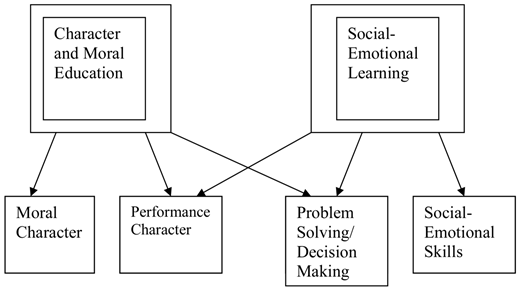
However, such a path is not created casually. To enable children to live successful, moral and social emotionally competent lives, an integrated plan of SEL and CME is necessary. Without SEL, students will not be able to implement and live by their values. Without CME, students will not know how to use their skills in a healthy, productive and community enhancing way. And without a strong ecological and developmental orientation, students will not receive the ongoing guidance they need to help them grow in these areas. Hence, current work in the Rutgers Social-Emotional Learning Lab that is integrating SEL and CME is proceeding from a new term, Social-Emotional and Character Development (SECD). Educators, parents, and policy makers appear to have a positive, intuitive understanding of the three implied elements in SECD, as well as the need for ongoing nurturance.
In the Rutgers SECD work, the converging elements of SEL and CME are to (a) provide a deep and visceral understanding of moral character by organizing schools as moral, caring communities of character with clear values, and (b) ensure that children are given opportunities and competences to enact their moral character in deep and meaningful ways by becoming active participants in the moral community of the school. The implied logic model being developed suggests that having been socialized in this way, children will want to seek out such communities as places to live and work and worship, as well as structure their homes as similar communities in which to raise their own children some day. The promise of SEL and its connection to CME, is contained in this abbreviated logic model: civil, caring, competence-building, and challenging schools of character ^ engaged students (and staff) → prepared and participatory family members and citizens of character.
Conclusion
For at least as long as recorded history, humankind’s potential to learn more effective ways of managing emotional experiences and social relationships has been a source of concern and interest; SEL and moral and character education offer at least one possible route to address this potential. We have shown that the philosophical positions underlying moral education and SEL have something to learn from one another. Proponents of SEL have acknowledged that skills require direction and that maladaptive direction, such as might come from extremist or criminal ideologies, can be pursued effectively through SEL competencies. Moral and character educators are recognizing that it takes more than volition and intention to act with sound character. Sometimes certain behavioral skills are needed to assert one’s values when the mainstream is not in agreement.
In other instances, lack of skills in affective awareness or problem solving and decision making may lead to an inability to see or take advantage of opportunities for moral action that may exist in one’s environment. Proponents of both views appear ready to move beyond a focus on programs and content and examine how individuals develop in the context of their ecological environments over time and how those environments can be modified to impart skills and values that can lead all children toward productive futures.

