


Service-learning is an instructional approach for learning curricular objectives. In implementing service-learning, young people identify community needs, plan ways in which they can help meet those needs, implement their plans through provision of community service, and reflect on their successes and challenges. As a character education approach, service-learning emphasizes the development of social responsibility, citizenship and civic engagement, efficacy, and skills related to tackling community issues, such as research, planning, decision making, and problem solving. This article provides results and analysis from a 4-year service-learning character education grant in Philadelphia. Middle and high school students engaged in a variety of service-learning projects facilitated by community partner organizations and well-prepared teachers. Using primarily quantitative data, the study shows that service-learning can be an effective tool for reaching character education outcomes. Significant differences were found between service-learning participants and nonparticipants in multiple areas, including citizenship and civic engagement, social responsibility, and caring, as measured by surveys; suspensions and serious incidents; and academic achievement scores. Moderators of outcomes included teacher experience and quality of service-learning practice.
Service-learning is an instructional approach whereby young people perform service as a way of learning important curricular objectives. Young people generally have a choice in the area and type of community service to provide. For example, they may work to resolve needs associated with the environment; homelessness; justice; senior citizens; literacy; the foster care system; prison populations; or any social issues that they believe they can address.
Service-learning is a strategy being widely implemented in K–12 schools. In 2005, Scales and Roehlkepartain estimated that service-learning was in 28% of all public schools and 44% of high schools. The percentages in private schools are even higher (Pritchard, 2002). Service-learning does not produce singular outcomes, but rather tends to be associated with outcomes in multiple youth development areas, including academic, civic, social/emotional, and career (Billig, Root, & Jesse, 2005).
The use of service-learning explicitly to meet character education outcomes appears to have increased over time. In 2002, when the U.S. Department of Education initially funded character education grants, only three featured service-learning. In 2007, that number has substantially increased, with more than half of the grantees using service-learning as one of their primary character education approaches.
A review of the literature in character education and service-learning provides a rationale for the acceleration of service-learning practice. Billig, Root, and Jesse (2005) and Billig and Root (2006), for example, conducted a national quasi-experimental study with 2,400 students and found that participation in high quality service-learning programs resulted in an increase in high school students’rates of acquisition of reading, writing, and computer skills; academic engagement and valuing school; levels of civic knowledge and the intention to vote; and work-related skills such as project management and teamwork. Berkowitz and Bier (2005) reviewed 33 successful character education programs and found that service-learning was one of the pedagogical strategies utilized in the best practice sites. Scott and Jackson (2005) found that middle school students who learned guidance skills and worked with elementary school students reported learning character education skills and how to be better citizens.
Lickona and Davidson (2005) conducted a comprehensive research review in the field of character education and visited 24 successful high schools in order to distill those characteristics of character education approaches that appeared to be most effective. Their report identified contributing community members as one of the eight strengths of character and described service-learning as an effective strategy to involve students in service to achieve this goal.
Laird and Black (2002) found that ninth-grade students who participated in service-learning classes had statistically significantly more positive scores on all measures of resilience, and that service-learning students had a lower risk of dropping out compared to their nonparticipating peers. This study also demonstrated that more service hours were related to higher scores on several areas, particularly measures of positive community values and interpersonal competencies.
Blozis, Scalise, Waterman, and Wells (2002) conducted a study of middle and high school students in several communities in northern Illinois and reported that service-learning, coupled with other approaches, can be an effective intervention strategy for increasing students’understanding of their roles and responsibilities as citizens and their sensitivity to diverse cultures. Other studies have shown that service-learning can promote civic engagement, responsibility, and formation of social capital (e.g., Ammon, Furco, Chi, & Middaugh, 2001; Billig, 2002; Furco, 2002; Henness, 2001; Kahne, Chi, & Middaugh, 2002; Melchior, 1999; Yamauchi, Billig, Meyer, & Hofschire, 2006) and empathy (e.g., Meyer, 2004; Meyer, Billig, & Hofschire, 2003; Morgan & Streb, 1999; Scales, Blyth, Berkas, & Kielsmeier, 2000).
Nearly all of these studies qualify their results, though, by stating that only students who engage in high-quality service-learning reach the specified outcomes. Typically, high quality was defined as meeting the Essential Elements of Service-Learning (National Youth Leadership Council, 1998). These elements were developed during meetings of expert practitioners and include:
clear educational goals that require the application of concepts, content and skills from the academic disciplines, and the construction of one’ s own knowledge;
student engagement in tasks that challenge them cognitively and developmentally;
use of assessment to enhance student learning and to document and evaluate how well students have met content and skills standards;
service tasks that have clear goals, are designed to meet genuine needs in the school or community and have significant consequences for themselves and others;
formative evaluation of the service effort and its outcomes;
student participation in selecting, designing, implementing, and evaluating the service project;
activities that promote the value of diversity in participants, practice, and outcomes;
activities that promote communication and interaction with the community and encourage partnerships and collaboration;
student preparation for all aspects of their service work, including a clear understanding of the task, the skills and information required to complete the task, awareness of safety precautions, and knowledge about and sensitivity to colleagues;
student reflection that takes place before, during, and after service; uses multiple methods to encourage critical thinking; and is central in the design and fulfillment of curricular objectives; and
multiple methods to acknowledge, celebrate, and validate student service work.
Service-Learning in The School District of Philadelphia
The School District of Philadelphia has a long history of service-learning implementation. Beginning in 1998, the district has required student engagement in citizenship projects (through service-learning) as a condition for promotion to middle school and high school, and for graduation. The requirement explicitly recognized that service-learning was a more powerful approach than community service, and that having such a project would simultaneously reach the twin goals of producing socially responsible citizens and academic achievement (Holdsman & Tuchmann, 2004; Hornbeck, 2000). Service-learning was implemented district-wide, though the quality and intensity varied greatly (Holdsman & Tuchmann, 2004).
In 2002, the school district was awarded a Partnerships in Character Education grant from the U.S. Department of Education. The grant was to provide greater support for middle and high schools serving students with the greatest number of risk factors, including schools with high percentages of students from economically disadvantaged families, high drop out rates, high disciplinary referral rates, and low academic achievement scores. The intent of the initiative was to raise the quality of the students’service-learning experiences, which was hypothesized to impact character development, including students’dispositions toward enacting prosocial behaviors such as altruism, empathy, caring, and ethical behavior; students’academic engagement, persistence, valuing of school, and efficacy; and students’civic engagement and citizenship, including recognition of the rights and responsibilities of citizens in a democracy and social responsibilities. These areas were determined through a needs assessment process, examining the research on the outcomes associated with service-learning, and by matching needs with the requirement of the character education grant.
During the first year of the grant, community partners were procured, classrooms were identified, and teachers were provided with professional development and support by the community partners to help them implement service-learning. Initial community partners included Champions of Caring, City Year Philadelphia, and Earth Force. Need in Deed was added during the last 2 years of the project.
Champions of Caring is an initiative guided by a service-learning curriculum. Champions worked with teachers to provide a full-year program based on studies of the Holocaust and other events related to racism and discrimination. The program helped students to help the community identify and address issues related to discrimination, and students became local “champions” for those in need. City Year Philadelphia implemented more organic approaches depending upon the schools’needs. Generally, City Year utilized its Corps members (young people, ages 18–26, who had graduated from high school or college and were serving as volunteers to help meet challenges in urban areas) to engage middle and high school students by providing tutoring, opportunities to organize and participate in community service events, and/or to become members in specific programs such as City Heroes, a group of students who regularly identified and met specific local community needs. Earth Force assisted teachers in conducting environmental projects including recycling and campus beautification. Need in Deed provided facilitation for teachers as they engaged students in the My Voice curriculum process wherein students identified specific community needs, brainstormed ways to meet needs, engaged in service activities, and then reflected on their progress and impact. In addition to choosing between these programmatic approaches, schools had the option of creating their own service-learning programs.
The support from the community groups continued throughout the duration of the grant through the provision of workshops and technical assistance. In addition, three of the partners (Champions, Earth Force, and Need in Deed) formed teacher networks for support.
During the project, each school had a character education/service-learning liaison who helped with the logistics of the program. Principals were also involved in varying ways: those who were minimally involved simply approved the project and those who were more involved monitored progress, engaged in activities, and assisted in recognizing results.
During the final 2 years of the project, teachers were required to align their service-learning projects more closely with district content standards. The district curriculum was revised and teachers were shown where the connections to character education most logically and powerfully occurred.
Also during the project, personnel shifts occurred, resulting in some discontinuity. The project was implemented for 9 months without a director, during year 2. The partners and liaisons continued their work during this period, even without the project director. The only difference was that the comparison schools dropped out since there were no incentives to participate. When a new project director was hired, both teachers and partners were relieved since the vision became clearer and the project was easier to manage, and the comparison groups rejoined.
This article provides results from the last (third) year of the study. The program was mature at this point, and the changes that had occurred over time including the link to curriculum, additions of community partners, and oversight of a director, were in place. The research addressed the question, “To what extent does service-learning impact students’character development in the areas of prosocial attitudes and behaviors; citizenship and civic engagement attitudes and behaviors; academic performance; and behaviors related to disciplinary referrals?”
Methodology
The research reported here was based on a quasi-experimental study, with matched groups of participating and nonparticipating middle and high school students. Pre/post surveys were administered to students and post-only surveys were administered to teachers. This section describes the instrumentation, sample, and data analysis techniques.
Student Surveys
Student surveys contained 57 items. The first section of the survey measured demographic information, participation in school-related activities and service, and approximate grade point average (GPA). The next sections contained scales that measured 13 outcome areas of interest related to project goals. The survey items were developed by RMC Research or adapted from a wide variety of existing scales, though none was taken as a whole scale from another source. Survey items were piloted, and only those that emerged with high loadings in a factor analysis were retained in the study. Response categories were either agreement/disagreement scales or frequency scales. Some items were reverse coded so that all higher scores indicated positive results.
Internal reliabilities and other characteristics of the surveys for the year in which this study occurred are displayed in Table 1. Student survey items formed scales in the acceptable range in the areas of caring and altruism, school community, citizenship and civic engagement, valuing school, and respect.
Teacher Surveys
Teacher surveys included number of years teaching, frequency of character education activities, and quality of service-learning activities based on the Essential Elements of Service-learning (National Youth Leadership Council, 1998). Items measuring the 11 Essential Elements were derived explicitly from the elements themselves, splitting the Elements into their component parts when multiple concepts were provided within a given component. Quality items related to the Essential Elements were rated on a 4-point Likert-type scale where 1 = never or almost never and 4 = always or almost always. Items from the quality scale were used to construct an overall quality score as well as a score for each of the 11 Essential Elements. Greater mean scores were used to indicate higher quality service-learning. Internal reliability on all scales was in the acceptable to excellent range. Table 2 displays the internal reliabilities of the Essential Elements measures.
Descriptive Statistics and Internal Reliabilities of Measures of Service-Learning Essential Elements, Spring 2004
| Service-Learning Element | N | Number of Items | Mean or Average | SD | Internal Reliability |
|---|---|---|---|---|---|
| 1. Clear educational goals. | 57 | 6 | 3.31 | .64 | .866 |
| 2. Involvement of students in cognitively challenging tasks. | 57 | 3 | 3.44 | .67 | .870 |
| 3. Assessment used to evaluate and enhance student learning. | 56 | 2 | 3.09 | .88 | .917 |
| 4. Service tasks meet genuine community needs and have significant consequences. | 57 | 4 | 3.20 | .70 | .812 |
| 5. Use of evaluation results for improvement. | 55 | 1 | 3.02 | .95 | - |
| 6. Youth voice in selecting, designing, implementing, and evaluating service-learning projects. | 57 | 4 | 2.98 | .77 | .813 |
| 7. Valuing diversity. | 55 | 1 | 3.38 | .76 | - |
| 8. Partnerships with the community. | 56 | 5 | 2.90 | .67 | .872 |
| 9. Student preparation for all aspects of their service work. | 57 | 5 | 3.34 | .65 | .871 |
| 10. Use of reflection activities. | 55 | 3 | 3.20 | .73 | .887 |
| 11. Celebration and acknowledgment of | 54 | 1 | 2.63 | .98 | - |
Responses were rated on a 4-point scale where 1 = never or almost never and 4 = always or almost always.
A series of student performance measures were collected from the School District of Philadelphia in 2006 to determine the impact of participation in the Partnerships in Character Education project on student achievement and student behaviors. The TerraNova/Supera scores were collected to analyze changes in student achievement scores. In addition, other behavioral measures were examined, including attendance rates, in-school suspensions, out-of-school suspensions, and serious incidents. Each of these measures was analyzed to determine whether there was a difference between the character education and comparison students.
Finally, analyses of teacher and student survey responses were conducted to determine moderators of student outcomes and relationships between student achievement and behaviors.
Sample
The sample consisted of students in middle and high schools in the School District of Philadelphia. The schools with teachers in the character education initiative were matched with schools that did not have character education. Selection of comparison schools was made on the basis of demographics and academic achievement score averages. Classrooms were matched for content area and grade level. Matches had no more than 10% variation on demographics (percent of specific minority groups) or achievement scores (percent proficient).
Surveys from 840 participating students and 155 comparison students from matched comparison classrooms in the School District of Philadelphia were collected in the fall of 2005 and spring of 2006. Of these, 568 were middle school students and 427 were high school students. Student surveys were administered only to those who agreed to participate and whose parents consented through passive permission. Only data from students who completed both pre- and post-surveys were analyzed.
Demographic information from the matched sample of students in this study is displayed in Table 3. Respondents’mean age was 14.2 years and there were many more males than females. The sample had more African American students than White or Hispanic/Latino students. On average, students reported they earned mostly Bs and Cs. The schools in the sample were those designated as having multiple risk factors. Because the samples had some variation, gender and ethnicity were controlled statistically, as explained below.
Demographic Profile of Students with Matched Pre-Survey and Post-Survey Scores (N = 995)
| Character Education Students (N = 840) | Comparison Students (N = 155) | |||
|---|---|---|---|---|
| Characteristic | Frequency | Percentage | Frequency | Percentage |
| Gender | ||||
| Male | 379 | 45.8 | 107 | 70.9 |
| Female | 449 | 54.2 | 44 | 29.1 |
| Ethnicitya | ||||
| White | 131 | 15.6 | 17 | 11.0 |
| Asian | 82 | 19.8 | 14 | 9.0 |
| Black/African American | 493 | 58.7 | 114 | 73.5 |
| American Indian | 36 | 4.3 | 4 | 2.6 |
| Hispanic/Latino | 132 | 15.7 | 15 | 9.7 |
| Other | 66 | 7.9 | 9 | 5.8 |
| Language Spoken at Home | ||||
| English | 684 | 84.7 | 136 | 88.3 |
| Spanish | 49 | 6.1 | 4 | 2.6 |
| Korean | 5 | 0.6 | 0 | 0.0 |
| Chinese | 12 | 1.5 | 1 | 0.6 |
| Other | 57 | 7.1 | 13 | 8.4 |
| Gradesa | ||||
| Mostly As | 136 | 16.2 | 35 | 22.6 |
| Mostly Bs | 420 | 50.0 | 81 | 52.3 |
| Mostly Cs | 338 | 40.2 | 50 | 32.3 |
| Mostly Ds | 47 | 5.6 | 5 | 3.2 |
| Mostly Fs | 11 | 1.3 | 1 | 0.6 |
aPercentages do not sum to 100 because respondents could select more than one answer and some students did not respond. Responses are from pre-surveys given in the fall of 2005. Percentages are calculated by using all valid responses.
Surveys were collected from 38 teachers in 15 schools. The sample had 26 teachers from participating sites and 12 teachers from matched comparison sites. Twelve of the teachers taught at the middle school level and 26 taught at the high school level. Teachers’years of experience in implementing service-learning ranged from 1 to 35 years. The average was just over 6 years, with 41% reporting over 6 years and 59% reporting 5 or fewer years of service-learning teaching experience.
Data Analysis
Student survey data were examined for changes over time, as determined by reporting differences between pretest and posttest measures. A mixed analysis of covariance (ANCOVA) model with pre-survey and post-survey repeated measures was used to analyze subscales and individual items. Ethnicity and gender main effects and interactions were included to control for additional variance. To further adjust for preexisting differences between the character education and comparison groups, four covariates were also included: (1) GPAs calculated from pre-survey student grade estimates; (2) the sum of service activities in which students reported participation (in school, with a youth organization, with a church, with family and with neighborhood); (3) the sum of clubs (academic clubs, service clubs, student leadership groups, or other clubs); and (4) age.
Student survey responses were linked to the survey responses made by teachers. This data set was used to determine the relationship of teacher perceptions to student outcomes.
Results
Survey results from participating and nonparticipating students were compared in terms of changes from pre- to posttest. As shown in Table 4, student subscale measures tended to decrease from fall to spring. However, character education student subscale scores declined less than scores for comparison students.
Students’Subscale Average Scores
| Service-Learning Character Education | Comparison | |||||||
|---|---|---|---|---|---|---|---|---|
| Time | N | Mean | SD | Time | N | Mean | SD | |
| Caring and altruism | Pre-survey | 748 | 2.98 | .110 | Pre-survey | 142 | 3.07 | .183 |
| Post-survey | 748 | 2.93 | .145 | Post-survey | 142 | 2.95 | .226 | |
| School community*** | Pre-survey | 783 | 2.56 | .193 | Pre-survey | 150 | 2.71 | .167 |
| Post-survey | 783 | 2.51 | .219 | Post-survey | 150 | 2.43 | .243 | |
| Citizenship and civic engagement** | Pre-Survey | 770 | 3.05 | .158 | Pre-survey | 149 | 3.22 | .153 |
| Post-survey | 770 | 3.00 | .146 | Post-survey | 149 | 3.07 | .210 | |
| Valuing school | Pre-survey | 789 | 3.43 | .229 | Pre-survey | 151 | 3.73 | .190 |
| Post-survey | 789 | 3.36 | .193 | Post-survey | 151 | 3.51 | .211 | |
| Respect | Pre-survey | 769 | 2.88 | .137 | Pre-survey | 147 | 2.82 | .173 |
| Post-survey | 769 | 2.86 | .124 | Post-survey | 147 | 2.80 | .212 | |
| Aggregate*** | Pre-survey | 798 | 2.98 | .141 | Pre-survey | 151 | 3.12 | .118 |
| Post-survey | 798 | 2.92 | .143 | Post-survey | 151 | 2.95 | .177 | |
Note: **p < .01,
***p < .001, group by time interaction. Means are adjusted for estimated GPA, number of service activities, number of clubs, and age.
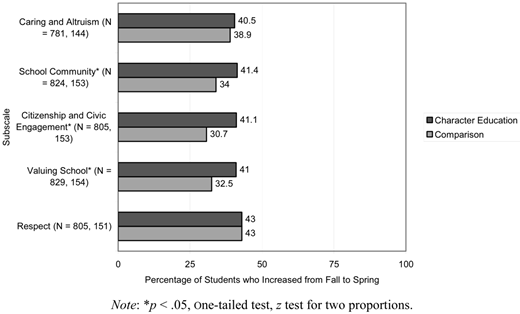
Students who engaged in the service-learning character education program outperformed their nonparticipating peers over time on the scales measuring school community, citizenship and civic engagement, and an aggregate score of all of the subscales. Differences approaching statistical significance were also found for valuing school (p = .074) and for respect (p = .059) that favored the service-learning character education students.
Figure 1 shows that in all areas, over 40 percent of the service-learning character education students measured showed gains over time. The percentage of service-learning character education students who increased from fall 2005 to spring 2006 was significantly higher for school community, citizenship and civic engagement, and valuing school.
Moderators of Impact
Multiple analyses were conducted to determine the factors that may have moderated impact. Years of teaching were positively related to all student subscale post-survey scores, and significantly correlated with both caring and altruism (r(471) = .159, p < .01) and valuing school, ( r(477) = .228, p < .001). Teacher experience with service-learning was not related to student growth on any subscales.
The relationship between the Essential Elements of Service-Learning and student outcomes, expressed as pre-/post-survey difference scores, was tested by using the Essential Elements of Service-Learning as moderators. As demonstrated in Table 5, three outcomes were related to the Essential Elements of Service-Learning: citizenship and civic engagement; valuing school; and respect. Follow-up regression analyses revealed that only Element 3, assessment used to enhance student learning and evaluate how well students have met content and skill standards, was positively related to student growth in citizenship and civic engagement, t = 4.092, p < .001. The same pattern was found for valuing school, t = 3.756, p < .001. Follow-up univariate analyses revealed no significant relationships between individual elements and growth in respect.
Relationships Between Student Difference Scores andthe Essential Elements of Service-Learning
| Growth in Student Outcomes | df | F | Partial ETA Squared |
|---|---|---|---|
| Caring and Altruism | 11, 385 | 1.065 | .030 |
| School Community | 11, 405 | 2.919 | .073 |
| Citizenship and Civic Engagement | 11, 403 | 4.669*** | .113 |
| Valuing School | 11, 407 | 2.626** | .021 |
| Respect | 11, 398 | 2.014* | .053 |
*p < .05,
**p < 01,
***p <. 001
Suspensions and Serious Incidents
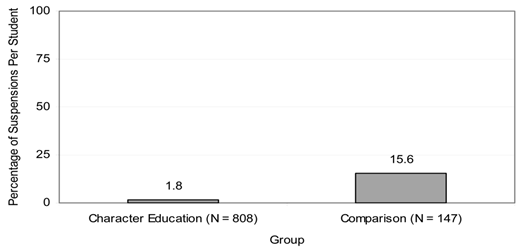
The number of in-school suspensions for participating students was compared to the number of in-school suspensions for nonparticipating students. Figure 2 reveals that there were significantly fewer in-school suspensions for the character education students than there were for their comparison group counterparts.
In-School Suspensions for character education students and comparison group students
In-School Suspensions for character education students and comparison group students
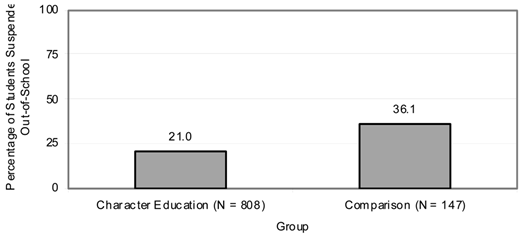
Analysis of data on out-of-school suspensions shows similar results. Figure 3 reveals that there were significantly fewer out-of-school suspensions for character education students than there were for their comparison group counterparts.
Out-of-School Suspensions for Character Education Students and Comparison Group Students.
Out-of-School Suspensions for Character Education Students and Comparison Group Students.
Finally, an analysis of data about serious incidents was conducted using school district data. Serious incidents include carrying or using weapons, fighting, and other acts of violence or abuse. The number of character education students who were involved in any serious incidents (75 of 808) was compared to the number of comparison group students involved in any serious incidents (11 of 147) during the 2005–2006 school year. There were no statistically significant differences between these two groups.
Student Achievement
A series of linear regressions were used to examine the relationship between student growth on the five survey measures and Terra- Nova/Supera reading, language, mathematics, and science scores. Results were statistically significant for character education students, but not for comparison group students for reading and science. Summary results are displayed in Table 6 and show that the greater the growth on character education measures, the higher the achievement score in language and science for character education students. Caring and altruism growth for character education students was positively correlated with language scores, t = 3.033, p = .003. Caring and altruism growth for character education students was also positively related to science scores, t = 2.918, p = .004. However, the test scores are static indicators and should be treated with caution, since measures of growth on achievement scores over time were not available.
Student Survey Subscale Change Scores Correlated with TerraNova/Supera Results
| Character Education Students | Comparison Group Students | |||||
|---|---|---|---|---|---|---|
| TerraNova/SuperaSubscale (in NCEs) | df | R2 | P | df | R2 | p |
| Reading | 5.537 | .019 | .067 | 5.110 | .047 | .370 |
| Language | 5.537 | .021 | .041* | 5.110 | .042 | .444 |
| Mathematics | 5.539 | .009 | .462 | 5.111 | .029 | .654 |
| Science | 5.531 | .021 | .050* | 5.108 | .034 | .568 |
*p < .05.
Discussion
This study shows the promise of service-learning as an instructional approach for impacting character education outcomes. While survey scores in the aggregate declined over time (a) phenomenon that often occurs by virtue of administering surveys in the last 2 weeks of school), scores for students in character education programs decreases significantly less than the scores for students who were not in the programs. In addition, greater percentages of participating middle and high school students were more likely than their nonparticipating peers to increase their self-reported dispositions and behaviors in the areas of citizenship and civic engagement, caring and altruism, attachment to the school, and seeing the value of schooling. Perhaps more significantly, there is evidence that character education may be related to fewer incidences of suspension; lower incidences of serious school events, such as violence or abuse; and higher performance on some test score subscales.
The findings presented here contribute to the growing body of literature that has begun to identify key factors related to character development. By engaging in service-learning, students had opportunities to think more deeply about social problems thus possibly prompting them to see their place in the world. Harkavy (2004) has shown that understanding and relating to others in a more global and task-oriented way rather than in a more ego-centric way was associated with acquisition of citizenship and other positive character traits. Students engaged in service-learning worked more closely than their nonparticipating peers with caring adults outside of their families and teachers, thus becoming exposed to positive role models. Eccles (2007) has shown that these types of adult bonds are often associated with character development.
Service-learning also provided students with an opportunity to engage in meaningful activities that potentially make a real difference in others’lives, possibly prompting a sense of efficacy and civic engagement. They worked with others in teams or other groupings to organize activities and cooperative in solving authentic problems, a factor associated with acquisition of citizenship and civic engagement skills (Flanagan, 2006). By providing these opportunities to students, service-learning capitalizes on what other studies have shown to make a difference in the development of positive character traits (Billig, 2000).
Teacher experience, but not teacher experience in service-learning, moderated the effects of participation. Inclusion of particular elements of quality, especially assessment, preparation, reflection, and acknowledgment of student work, also moderated certain outcomes. This is consistent with the more general findings in the
The study has some serious limitations; thus, results should be viewed with some caution. The survey data are all self-reports and even though the data were triangulated through other means not reported here (such as case studies using classroom observations, focus groups, and interviews), the self-reports are perceptions from the students rather than an actual behavioral measure.
The correlations between participation in character education programs and student performance data, such as suspensions, serious incidents, and test scores, should be interpreted with extreme caution since many other factors, such as teacher quality and curricular content, may have had a much stronger influence on outcomes than participation in the character education program. However, since the school district requires teachers to implement the same curriculum in every school and since there were few differences in the demographics of the teachers in the study, at least two elements of influence were controlled, providing a slightly higher degree of confidence in the findings than if this were not the case.
Finally, there is a need for more research on the connection between service-learning and character development. While this and other studies have shown positive results, it is not clear exactly why these results occur since service-learning has so many components associated with strong character development, including formation of bonds with positive role models, having an opportunity to make a difference, seeing one’s place in the world, working in cooperative groups to solve real world problems, and engaging in meaningful activities that feature student autonomy. Deconstructing the service-learning experience and showing the relationship between the service-learning components (investigation, planning, action, reflection, and demonstration/ celebration) and features may provide greater clarity about the ways that the service-learning experience prompts character development and which factors within the service-learning experience should be maximized.

