

Discussion
Readers can send in comments of up to 200 words on all papers and articles published in Civil Engineering. Subject to being approved by the editorial panel, full texts of readers' comments and authors' responses are published in the on-line version of the journal at www.ice.org.uk/services/journals_civil.asp (select Civil Engineering site link, then click on text link to Discussions). Edited highlights of the discussion on papers in recent issues are published here.
12844: Crowd-related failure of bridges by Bill Wolmuth and John Surtees (August 2003)
Contribution by A. Beal
A senior engineer at Freeman Fox & Partners told me in the late 1970s that the estimated loading imposed on Bosporus bridge by the opening day crowd was three times the design imposed loading.
He attributed the bridge's survival to the fact that it was designed to a permissible stress code (BS 153), rather than a 'limit state' code using partial safety factors (such as BS 5400). A 'limit state' Bosporus Bridge would have had a higher partial safety factor on live loads and a lower factor on dead loads, so its deck plates would have been heavier but its main cables and towers would have been lighter. Would the difference have been sufficient to cause disaster on opening day?
Authors' reply
Very little information has been released about the seriousness of overcrowding during the opening of the first Bosporus bridge. We have always felt that the comments attributed to Sir Ralph Freeman and reproduced in our paper were mistaken.
An estimated 5 persons/m2 on opening day is cited in the comments. This implies a crowd size of 150 000 people and is well outside the 60–100 000 quoted in most press reports. The latter numbers are equivalent to 2 and 3 persons/m2 respectively and reflect between 2 and 3 times design imposed loading for the all-pedestrian load case of 1 person/m2 quoted.
Clearly the bridge was overloaded and the fact that it did not collapse and was apparently undamaged speaks much more for the quality of detailed design and construction than for primary member capacities.
The notion that BS 5400 might have produced a less safe design than BS 153 can be discounted if we consider that the former was not officially available until eight years after the Bosporus opening and, when introduced, specified HA and pedestrian loading intensities that were 50% higher than corresponding values associated with the Bosporus design.
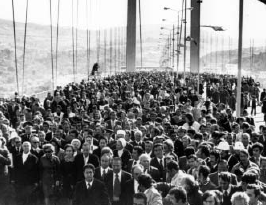
Close to disaster? Crowds on the opening of the first Bosporus bridge in 1973 are believed to have caused an imposed loading up to three times higher than the bridge was designed for
Close to disaster? Crowds on the opening of the first Bosporus bridge in 1973 are believed to have caused an imposed loading up to three times higher than the bridge was designed for
12917: Cuileig—a benchmark for future hydropower schemes: by Michael Seaton and Neil Sandilands (August 2003)
Contribution by J. C. Third
There are other locations in the Scottish Highlands offering considerably greater potential than the 3 MW contribution from the Cuileig burn. These include the potential 200 m head of Loch Quoich, which is not yet fully utilised and would have less impact on the environment than other renewable energy schemes.
Authors' reply
Though not directly related to the Cuileig scheme, potential development of Loch Quoich—the largest reservoir in the UK by some margin—does illustrate some of the issues facing hydro developers today.
However, the under-utilisation of the Quoich scheme is not as great as suggested. Whereas Quoich power station with a gross head of 101 m only uses around half of the potential head of Loch Quoich, a further 53 m of head is utilised through Invergarry power station. The construction of a new power station in the west would not be economically viable. The output will not attract any additional payments under the renewables obligation because of the common civil engineering works with the existing Quoich power station.
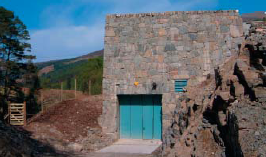
The small, low-profile Cuileig scheme was Scotland's first new hydro project for 40 years – but would development of existing schemes have had even less environmental impact?
The small, low-profile Cuileig scheme was Scotland's first new hydro project for 40 years – but would development of existing schemes have had even less environmental impact?
The authors nevertheless agree that there are larger schemes available in the Highlands and Scottish and Southern Energy is currently promoting the 100 MW Glendoe scheme near Fort Augustus.
The combination of environmental restriction, land issues, high capital cost and grid connection problems greatly inhibits the development of large-scale hydro even with the renewables obligation. The development of small hydro schemes which under-utilise the resource but prevent further development is also a significant factor.
13411: Channel Tunnel Rail Link section 1: Medway viaduct: by Ken Martin, Steve Bennett and Martin Kirk (November 2003 special issue)
Contribution by J. Weekes
I live on the housing estate right next to the Medway Viaduct. The paper states that sound barriers have been put up along the line but there do not appear to be any where I live and the noise from the trains is horrendous. It does vary according to the weather but, at times, it now sounds like I live at Heathrow airport.
Authors' reply
Noise caused by trains was carefully studied following the practice of ‘as low as reasonably practicable’ (see also papers 13463 and 13464 in the same issue). Complaints should be addressed to Union Railways South.
Contribution by R. Freer
The Medway Viaduct on the Channel Tunnel Rail Link appears to have been built at much the same time as the new M2 motorway crossing. Can the authors tell us whether there was any consideration given to building these two bridges as one structure?
On one structure the railway and motorway could have been separated vertically or horizontally to ensure there was no interference, and there could have been a significant saving in cost and time by having one structure instead of two. Also it would be less visually intrusive.
The single structure alternative presumably would have required some joined-up thinking between government departments but, if the Government was not prepared to take the initiative, did the engineers want to put this alternative forward themselves?
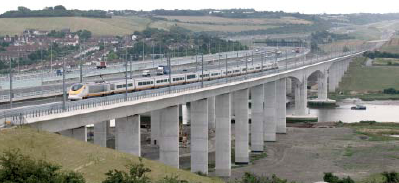
Living by the new Medway Viaduct on the Channel Tunnel Rail Link is said to be like living at Heathrow Airport
Living by the new Medway Viaduct on the Channel Tunnel Rail Link is said to be like living at Heathrow Airport
Authors' reply
The engineers involved reviewed and reported to the Parliamentary Committee in early 1995. After the Channel Tunnel Rail Link Act had been passed in December 1996, the alignment was fixed and it was no longer possible to consider combining the structures.
Combining the two would have given fairly major engineering problems although not necessarily insurmountable. The idea of placing one above the other would have resulted in a deck at least twice as deep, which was aesthetically unacceptable. Providing a combined bridge at the same level might have been possible but would have given major difficulties in developing the alignment with the slip road of the motorway on the west end.
When Royal Fine Art Commission approval was being sought, for example, the go-ahead for both Rail Link and M2 widening was uncertain. Not only was the Rail Link affected by financial crises but also the Government go-ahead for road schemes was consistently subject to delay. Approval to proceed with the M2 widening was not received till 1998.
While it might have resulted in a cost saving on bridgework alone, a time saving would not have resulted because of the complex interaction. The rail bridge construction started in October 1998 and was opened to Eurostar traffic in September 2003. However, the M2 road bridge was started in 1999 and opened to road traffic in 2002.

