


An appeal to reason – a cool look at global warming
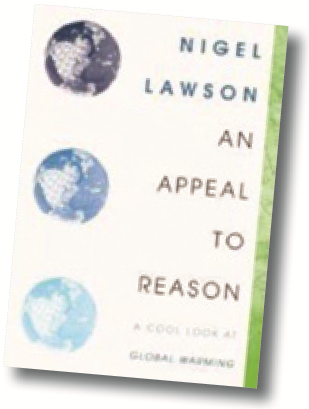
Unpalatable though the conclusions may be for dedicated believers, Nigel Lawson’s slant on the great warming debate is nothing if not innovative, with an economist’s firm perspective of optimistic scepticism. This handy, pocket-sized volume stands as a challenge to what the author abhors as the ‘conventional wisdom’ of the case for our species’ contribution to rising carbon-dioxide concentrations in the atmosphere and their knock-on effects.
The author is one who cannot be taken lightly. As a former UK chancellor of the exchequer, Nigel Lawson brings with his arguments a wealth of knowledge of the subtleties of economics and, as a UK minister for energy, he also brings knowledge of the technology and arguments favouring non-fossil fuel substitution. It is as an economist that his contribution to the debate inevitably shines through.
Lawson asserts that natural scientists have not necessarily got it right – and in justification he refers to competing arguments with regard to the cyclicality of temperature fluxes and the external influences arising from solar rather than homocentric causes. What makes this book interesting is his effort to argue that whether the scientists are right or wrong, the laws of economics will introduce their own solutions and that history will look back on the global warming debate as, if not a swindle, then certainly a classic example of collective hysteria which introduced major government-led distortions to produce (in his words) ‘medicine which will kill the patient’.
It is hard to put this book down at its end, however, and feel that one is utterly convinced. Some of the arguments on the scientific evidence are simply wrong, while the belief in the flexibility and strength of natural capitalism to come to the rescue have taken a severe dent since August 2008. Nevertheless, it does deserve reading for the insights it offers into the mind of an optimistic capitalist seeking to lend what he genuinely perceives as a sorely needed sense of perspective and more rational distancing to the current debate.
Edge futures

Futures is a boxed set of five short books by different authors commissioned by The Edge, a think tank sponsored by the building industry professions to stimulate public interest in policy questions that affect the built environment. Each book is written by a different author and considers the future from different perspectives.
In Globalism and Regionalism, Jonathan Porritt begins by identifying climate change as the first truly global political phenomenon that will require every single country to contribute. Hank Dittmar, in Transport and Networks, then considers how government policy is seeking to drive the country to a low-carbon transport network. Frank Duffy, in Work and the City, next looks at the origins of the office and how it has developed to how we know it today and considers the impacts of technology and the virtual office on the work environment.
In Education and Creativity, Simon Foxell looks back from 2027 and reviews the impacts of today’s current government policy. Co-author William Mitchell then discusses the impacts of technology on teaching and learning from his experiences at the Massachusetts Institute of Technology. Finally, in Living and Community, Geoff Mulgan discusses the complex interactions that occur in the places we live.
These are all thought-provoking books concerning every aspect of our lives and therefore relevant to us all. The books are very well researched, clearly referenced and set out the arguments in a clear and concise manner with comprehensive further reading lists and provide for a very interesting read.

