


09-00016 EUROCODES IN BRITAIN: THE QUESTIONS THAT STILL NEED ANSWERING
by Alasdair Beal (February 2010)
Contribution by Martin Redston
I now realise that the Eurocodes are an academic exercise with no particular advantage to the client. At first I thought that the loading options were beneficial, but the increased time on design and the uncertainty of outcome outweigh the current codes' possibly slightly larger member outputs. Apart from the ludicrous cost of retraining (assuming that experienced engineers can really assimilate this information quickly), I now have to tell my clients that the design fees have increased. If students are being trained in Eurocodes, should I sack my team of nine engineers and employ new graduates? It might be cheaper in the long run.
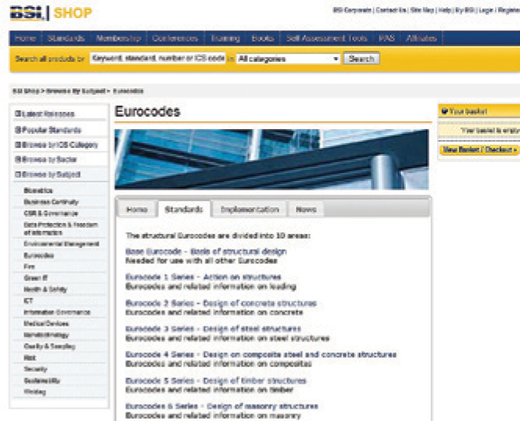
The Eurocodes – an academic exercise with no particular advantage to the client?
The Eurocodes – an academic exercise with no particular advantage to the client?
Author's reply
I can understand the temptation for the contributor to recruit new graduates to carry out his Eurocode work and save on retraining costs. However, it would be a formula for disaster to delegate Eurocode design to unsupervised young engineers unless their work is checked by experienced engineers who fully understand Eurocodes.
Contribution by Denis Donohue
The transposition of commas and decimal points in Eurocodes is an accident waiting to happen. Our schools will not be teaching about it, the workforce on site is unaware of it, as are our computers and software. Since this is a risk that can be designed out by retaining the existing system, I believe that under the Construction (Design and Management) Regulations (HMG, 2007), this should be done as a matter of course.
I can now begin to comprehend the magnitude of what all engineers in Britain must face
Author's reply
I share the contributor's concern that if UK engineers try to adopt continental decimal notation while everyone else continues to use standard UK notation, there will be a risk of misunderstandings and accidents. As he says, engineers have a legal duty to try to ‘design out’ this kind of foreseeable risk and I hope that the Eurocode national annexes will be revised as soon as possible to make clear that UK decimal notation should be used for projects in this country.
Contribution by Godfrey Ackers
As I understand it, the Eurocodes are for design so that European construction contractors will not be inhibited from tendering for constructing the designs. But why cannot British codes continue to be used, amended by BSI to make use of any improvements perceived in the Eurocodes? Again, as I understand it, the adoption of Eurocodes is not a decision of the European Commission, so that any relevant directive is subject to the provisions of subsidiarity in the Maastricht Treaty.
Author's reply
I am not an expert on the Maastricht Treaty, so I cannot give definitive answers to the contributor's question. However, European contractors are certainly free to tender to build projects which have been designed to UK codes. Many engineers are likely to continue to use superseded UK codes for many years to come, relying on the provision in the EU directive which permits the use of alternative design codes provided the results are similar to those which would be obtained from Eurocodes.
Contribution by Kristian Ravnkilde
The author has highlighted the language used in Eurocodes. As a translator, I keep coming across documents obviously translated by non-engineers, which is how these strange usages creep in, and then become very difficult to eradicate. ‘Eurospeak’ is not inevitable if the right people deal with it – our typical disdain for European matters is as much to blame as anything. Presumably, British representatives on Eurocodes drafting committees have been concentrating on the technical elements, and either lost the battle for the wording, or did not engage in it at all in the expectation that it would be sorted out later. They must have seen drafts and should have realised the problems it would cause – unless they thought the whole thing was a joke that somehow would not affect us. Something along the same lines must go for the inconsistencies the author highlights with the national annexes.
Author's reply
I agree with the contributor's views about the ‘Eurospeak’ problem: the failure to produce editions of Eurocodes translated into ‘UK English’ is an obstacle to their adoption in this country and a potential source of confusion and errors. The ‘Euro-English’ texts are also the base documents for producing Eurocodes in other languages, which must have led to problems for the translators, who will generally be used to working with standard UK or American English. It would be interesting to know how some of the more confusing and difficult passages have ended up when translated into the many other languages of the European Union.
Contribution by Rob Wallbank
I can now begin to comprehend the magnitude of what all engineers in Britain must face. The author should be applauded for his research and depth of knowledge into this subject, and I can only hope that his findings are duly noted by those endeavouring to implement them. His paper was written in English using recognisable words that we all use, so anyone trying to understand it in Euro-English may struggle.
The briefing article by Haig Gulvanessian in the same issue is a defiant one, but less convincing: adopt Eurocodes and stop whingeing. Is that really the attitude?
Reference
08-00017 ACEH EMERGENCY SUPPORT FOR IRRIGATION – BUILDING BACK BETTER
by David Meigh (November 2009)
Contribution by David Stacey
The author gives an overall figure for the cost of the earthquake and tsunami emergency support project funded by the Asian Development Bank. In view of the special measures that were taken to upgrade the main irrigation infrastructure and to line the tertiary canals, what was the average cost per hectare of, ‘building the irrigation schemes back better’?
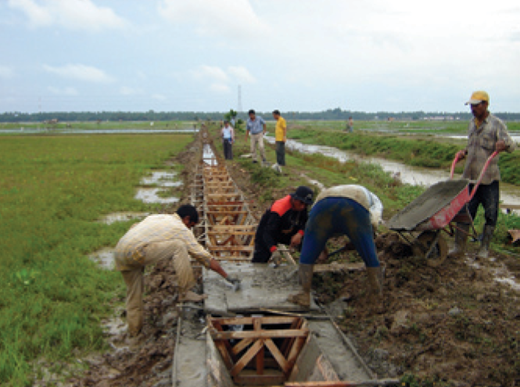
Emergency rebuilding of tsunami-damaged imigation in Aceh cost roughly US$ 440 per hectare
Emergency rebuilding of tsunami-damaged imigation in Aceh cost roughly US$ 440 per hectare
Author's reply
The programme targeted badly damaged works, and in Aceh there was a broad spectrum from schemes only lightly damaged to ones that had lost their headworks and had major canal problems. We carried out detailed walkthrough surveys with the water-user associations our project helped to form, and let them prioritise works rather than systematically rebuild schemes from scratch. Consequently I cannot really give overall costs per hectare unless you divide the overall project budget, about US$26 million, by the scheme area, which was 59 000 ha on 93 schemes.
08-00047 WHAT SHOULD WE TEACH IN STRUCTURAL ENGINEERING DESIGN?
by lan May (November 2009)
Contribution by John Atkinson
The author discusses the role of design and the place of standards and codes in university undergraduate courses and he refers to my earlier paper (Atkinson, 2008), in which I proposed removing codes and standards from undergraduate courses. Safe, economic and innovative design requires the understanding and skills developed by doing it from first principles and this is part of an engineer's university education. But teaching engineers how to design to specific standards and codes is training; it is not part of a university course and it is the duty of industry to provide. I contend that profession-driven addition of design to specific codes and standards and other ‘soft’ topics into already over-loaded university courses has not had the desired effect of improving the overall quality of UK civil engineering. It would be interesting to learn more of the experiences of employers who, in one sense, are the customers – they buy the universities' products.
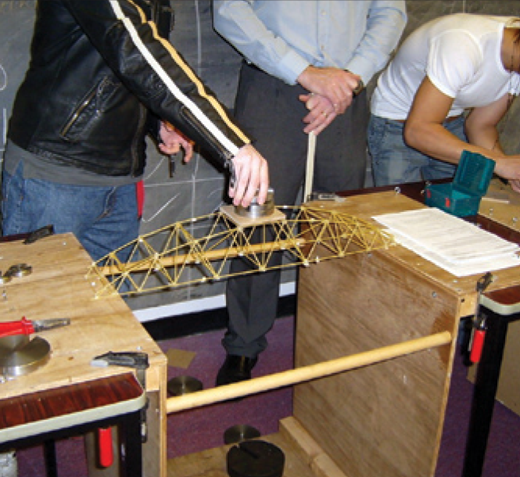
Codes and standards should be removed from university courses so that the focus is on design principles
Codes and standards should be removed from university courses so that the focus is on design principles
Author's reply
While I suspect that the contributor's view of removing all codes and standards from university courses would not gain universal acceptance, I do think that first degree courses should concentrate on the principles in these rather than applying them by rote. Some of the views of industry are given by IStructE (2010) but I agree with the contributor that more feedback from employers will always be useful.

