This article summarises the technical tour undertaken by a group attending ICOLD 2011, including members of the BDS, Andy Hughes and Tracey Williamson. The tour group travelled through the Reuss Valley in the south of Switzerland up to the Gotthard Pass with a visit to the 69 m high Lucendro buttress dam, completed just after Word War II. The buttresses have been laterally reinforced by massive struts to increase the stability of the structure. This was followed by a visit to the 155 m high Göscheneralp dam, completed in 1962, which consists of a central impervious core with rockfill shoulders.
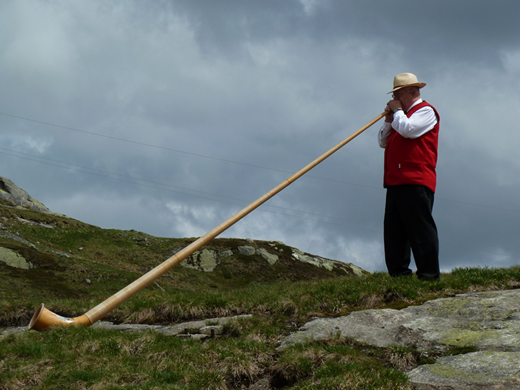
On Thursday 2 June 2011, four coaches left for the T3 trip, commencing with a 2-hour journey south towards the Italian border. Following coffee at the foot of the Lucendro dam to the accompaniment of a Swiss alpine horn player (Figure 1), the groups climbed the left abutment to a point above the 69 m high and 270 m wide concrete dam (Figure 2).
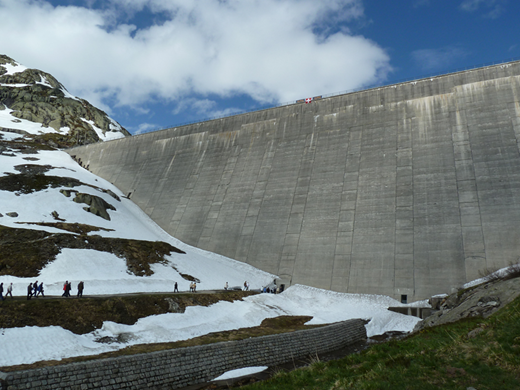
Construction of the dam started during World War II in 1942 and was completed in 1947. The highlight of the visit was the screening of an original, black and white movie showing, in detail, the construction process. The dam is located in a remote site, which is completely inaccessible during the winter months, and it was remarkable to see the extremely ingenious mechanical processes put in place for transporting the materials to site. It was also an eye-opener to see the risks taken by the site workers and note how far health and safety practices have advanced since this time.
The reservoir has a capacity of 25 million m3 and is fed into a 4·8 km long headrace tunnel to the Airolo power station retention basin. The average annual generation of Airolo is 100 million kWh from two generator groups that are powered by two 3 m dia. turbine rotors.
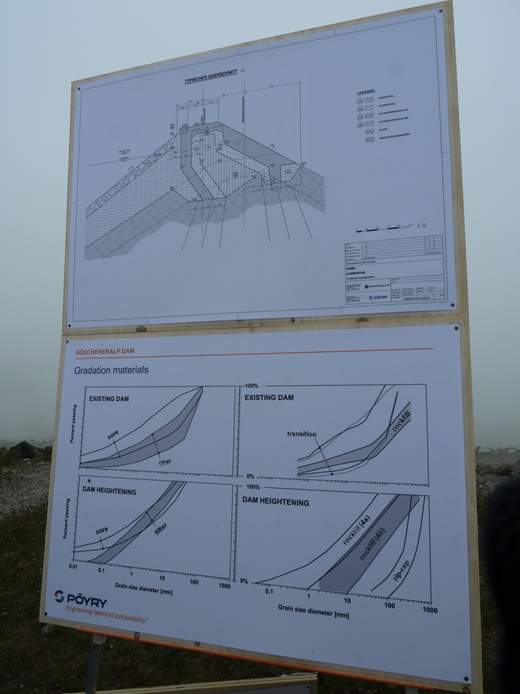
Following a typical Swiss lunch of goulash and noodles in Andermatt, the groups proceeded to Göscheneralp dam. The only good shot of the dam was taken on the walk to the dam crest (Figure 3). While the groups were shown presentations on the proposed dam heightening project, the clouds rose up the valley and no further views were visible. It was, however, still possible to stand in the 155 m high rockfill dam and look down the 1:1·45 grassed downstream slope and be impressed at its size and steepness.
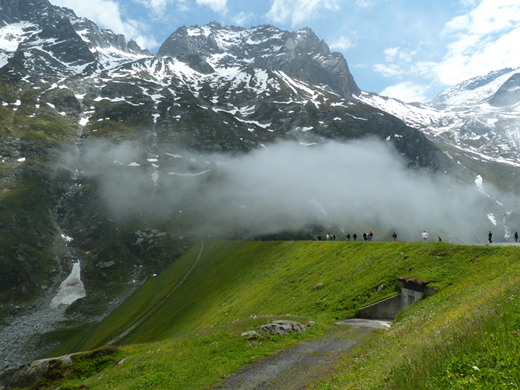
The side channel spillway, apparently designed to contain the probable maximum flood (PMF) has not been used since construction.
The hydropower scheme produces around 251 gwh. The reservoir water is conveyed through the 7·2 km long headrace tunnel to the four Pelton units, providing a total capacity of around 160 MW.
The dam was built between 1955 and 1962 and the proposals are for the 78 million m3 capacity reservoir to be increased by 15% as a result of heightening the dam by 8 m.
In order to keep the appearance of the dam (with grass cover up to the crest), the proposed dam design for the heightening includes for the central core to be kinked in an upstream direction to allow for an inclined contact surface between the existing and new core material (Figure 4). This minimises preferential horizontal seepage paths. For further details on the project, refer to this year's ICOLD special issue of Hydropower and Dams (volume 18, issue 3).