Influencer marketing strategy has the potential to stimulate sustainable consumer behaviour. However, the literature on how influencer marketing impacts sustainable consumer behaviour is divergent and disintegrated. Subsequently, it provides fewer insights for practitioners about strategically using influencer marketing to promote sustainable consumption. To address the problem, this study synthesises and integrates the literature on the nexus of influencer marketing and sustainable consumer behaviour.
A systematic literature review methodology was used. The study employed a scientific procedure and rationales for systematic literature review protocols (SPAR-4-SLR) to review 42 journal articles published from 2015 to 2025. The results were organised by using the antecedents, decision and outcomes (ADO) model.
Based on the review, an integrated framework suggests that influencer characteristics, content and brand-related factors are important in shaping sustainable consumer behaviour. Developed trust in influencers, attitude towards the product, perceived brand ethicality, message authenticity, green advert credibility, parasocial relationship and brand image are important mediators. Besides, social ties, brand image and influencer type play a moderating role.
This study advances the field of influencer marketing by synthesising the fragmented literature on influencer marketing and sustainable consumer behaviour. Thus, it offers integrated insights to practitioners on utilising influencers to foster sustainable consumption. Additionally, it offers suggestions for further research, particularly on avenues such as antecedents, mediators, moderators and sustainable behavioural outcomes.
1. Introduction
Climate change challenges are among the growing threats to society's well-being (Obradovich, Migliorini, Paulus, & Rahwan, 2018). The challenges are attributed to business activities and consumption behaviour (Polonsky, 2015). Accordingly, sustainable development goals (SDGs) address the challenges by encouraging sustainability practices, including sustainable consumption (UNDP, 2025). In the same vein, business functions such as marketing have the potential to mitigate the environmental challenges by promoting sustainable consumption behaviour (Geng & Maimaituerxun, 2022; Polonsky, 2015). Sustainable consumption behaviour refers to the consumers’ choices and actions, such as purchasing, using and disposing of products with minimal impact on the environment and society at present and for future generations (Borges-Tiago, Almeida, Tiago, & Avelar, 2024). Also, it involves engaging in sustainability initiatives such as contributing to environmental causes and advocating for sustainable behaviours. One of the contemporary strategies to promote sustainable consumer behaviours is influencer marketing (Jacobson & Harrison, 2022; Pittman & Abell, 2021; Zhang, Chintagunta, & Kalwani, 2021). Currently, companies collaborate with influencers to market products in exchange for monetary or in-kind rewards (Liu, Yang, & Cong, 2022). Influencers are individuals who use their knowledge, experience and skills to share their opinions about a particular topic on social media platforms (Leung, Gu, & Palmatier, 2022; Lou & Yuan, 2019).
In addition, influencers build relationships with their followers, enhance engagement and shape consumers’ attitudes (Sicilia & López, 2023). Accordingly, influencers affect consumers’ purchase decisions (Kilumile & Zuo, 2024; Mrisha & Xixiang, 2024; Spörl-Wang, Krause, & Henkel, 2025) and potentially foster consumers' engagement in sustainable behaviours (König & Maier, 2024b; Verma & Kapoor, 2025). Therefore, leveraging their reach, engagement and persuasive power, influencers can effectively educate and inspire their followers about sustainable consumption practices. However, regardless of the potential of influencers in stimulating sustainable consumption practices such as purchases, usage and disposal behaviours, how to strategically collaborate with influencers to foster sustainable consumption has remained blurry. Thus, leaving a significant gap in promoting sustainable consumption behaviours. Subsequently, achieving sustainable consumption remains difficult. This necessitates research to provide insights to practitioners on how to capitalise on influencers' power to drive sustainable consumer behaviour. Fostering sustainable consumption behaviour is key in supporting the achievement of the SDGs, particularly goal 12, promoting sustainable consumption (UNDP, 2025). Therefore, this study aims to provide a clear understanding of how influencer marketing strategy can foster sustainable consumer behaviour by synthesising the literature.
The literature on influencer marketing and sustainable consumer behaviour has been growing tremendously. Several studies have attempted to investigate the impact of influencer marketing on sustainable consumer behaviour (e.g. Haines, Fares, Mohan, Lee, & Mark, 2023; Kılıç & Gürlek, 2023; Pittman & Abell, 2021; Zhang et al., 2021). Although there is good progress in the scholarly debate about influencer marketing and sustainable consumer behaviour, the knowledge is still disintegrated. There are limited holistic and integrated approaches to explain how consumers react to sustainable influencer marketing campaigns. The scattered and disintegrated literature provides fewer insights for practitioners, such as policymakers and marketers, about utilising influencer marketing to strategically promote sustainable consumer behaviour. Therefore, there is a need for establishing a framework providing a snapshot of antecedents and decision factors explaining the mechanism and underlying process by which influencer marketing shapes sustainable consumer behaviour. Doing so offers a holistic and comprehensive understanding of the interplay of influencer marketing and sustainable consumer behaviour. Thus, providing useful insights to practitioners, particularly on how they can strategically collaborate with influencers to drive sustainable consumer behaviour.
Based on an extensive search on reputable databases, few studies have attempted to systematically analyse the literature on the effect of influencer marketing on sustainable consumer behaviour. Some available literature reviews on sustainable consumer behaviour were conducted without considering the influencer marketing aspects. For example, the literature review study by Bryła, Chatterjee, and Ciabiada-Bryła (2022) focused on the effect of social media marketing on sustainable consumption behaviour. Although this study provides a holistic overview of how consumers behave sustainably because of marketing, it does not consider influencer marketing aspects. Another study by Elhoushy and Lanzini (2021) offers a snapshot of what drives sustainable behaviour among consumers in the Middle East and North Africa (MENA) region. Correspondingly, the review was region-focused and did not consider influencer marketing factors. Additionally, some studies attempted to conduct a comprehensive review of sustainable consumer behaviour literature but did not follow the systematic literature review protocols. For example, Hanna, Kantenbacher, Cohen, and Gössling (2018) focused on the effect of role models in shaping sustainable transport usage. Another study, by Nisbet and Kotcher (2009), focused on the contributions of opinion leaders’ campaigns on climate change. Not following systematic review procedures may hinder drawing key insights. Therefore, it is evident that the knowledge about influencer marketing and sustainable consumer behaviour is not well synthesised in the literature. This necessitates the need for more rigorous reviews to get more reliable insights on the interplay of influencer marketing and sustainable consumer behaviour. Accordingly, by using a systematic literature review (SLR) approach, this study aims to address the question: How does influencer marketing affect sustainable consumer behaviour? In addressing this research question, we identify the antecedents and decision factors that explain the mechanism and underlying process by which influencer marketing affects sustainable consumer behaviour.
It is essential to apply an SLR approach because the approach follows rigorous scientific procedures, therefore guaranteeing transparency and quality in the process of developing knowledge (Sauer & Seuring, 2023). Nevertheless, the SLR approach is highly accepted among business and management scholars (Paul, Khatri, & Kaur Duggal, 2023). For this reason, several studies considered applying it in providing a comprehensive understanding of the role of social media influencer marketing on consumer behaviour (see Joshi, Lim, Jagani, & Kumar, 2023; Kanaveedu & Kalapurackal, 2022; Tanwar, Chaudhry, & Srivastava, 2022; Vrontis, Makrides, Christofi, & Thrassou, 2021).
The study offers several practical and theoretical contributions. First, this is one of the earliest reviews providing a snapshot of how influencer marketing shapes sustainable consumer behaviour. It suggests a framework that indicates antecedents and decision factors that explain the mechanism and underlying process by which influencer marketing affects sustainable consumer behaviour. Second, it provides some avenues for future research that could be investigated to enrich the research field. Lastly, the study provides insights to practitioners on how to strategically collaborate with influencers to foster sustainable consumer behaviours.
2. Methodology
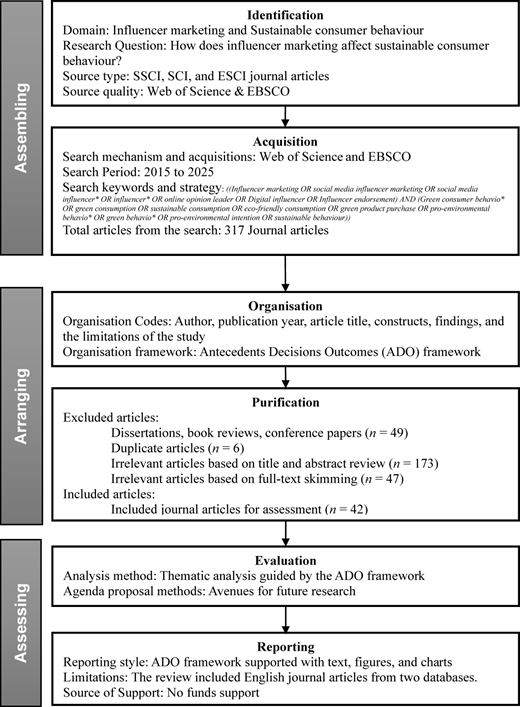
Given the disintegration of literature about influencer marketing and sustainable consumer behaviour, an SLR approach was employed. The SLR approach synthesises the literature and suggests areas for further studies (Paul, Lim, O’Cass, Hao, & Bresciani, 2021; Sauer & Seuring, 2023). To ensure transparency and quality in the process, we employed the scientific procedures and the rationale for the systematic literature review (SPAR-4-SLR) protocol (Paul et al., 2021). By using this protocol, our review was guided by the following process: First, article assembling, second, article arrangement, and lastly, the assessment process (see Figure 1).
2.1 Assembling
Based on the SPAR-4-SLR protocol, we started by identifying the research question to define the scope of the study. Based on the defined scope of the study, the Web of Science (WoS) and EBSCO were considered as sources of journal articles. The two databases are rich in business-related publications and have rigorous procedures to enhance quality in the publication process (Paul et al., 2021). The advanced search on the databases was conducted using a Boolean search with the truncation technique. Based on a combination of popular keywords in this topic, the following search keywords and strategy were applied: ((Influencer marketing OR social media influencer marketing OR social media influencer* OR influencer* OR online opinion leader OR Digital influencer OR Influencer endorsement) AND (Green consumer behavio* OR green consumption OR sustainable consumption OR eco-friendly consumption OR green product purchase OR pro-environmental behavio* OR green behavio* OR pro-environmental intention OR sustainable behaviour). Our search involved only journal articles published in the English language from 2015 to 2025. The choice of studies from 2015 to 2025 was because influencer marketing is a new phenomenon and has gained interest among scholars in the 2010s (Vrontis et al., 2021). Therefore, selecting research articles published during this period offers rich insights and an overview of how influencer marketing shapes sustainable consumer behaviours. A total of 317 journal articles were retrieved, whereby 41 were from EBSCO and 276 from WoS.
2.2 Arranging
In this process, the purification and proper arrangements of articles were conducted. We excluded 49 articles relating to conference papers, dissertations and book reviews. Therefore, we remained with 268 for examination. Thereafter, six duplicate articles and 173 irrelevant articles based on the title and abstract checking were removed. Hence, the 89 articles were downloaded for full-text scanning. After full-text scanning, a total of 47 articles were excluded, as they were not aligned with the scope of the study. Hence, we remained with 42 articles for final assessment, exceeding the minimum recommended amount by Paul et al. (2021), who suggest that a rigorous systematic review should at least involve 40 articles.
2.3 Assessing
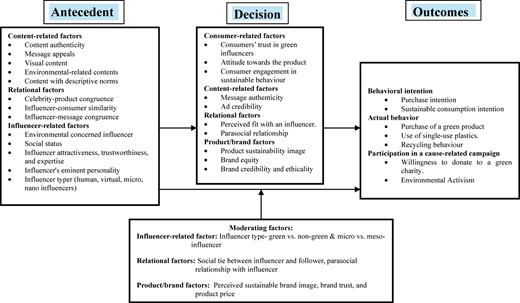
The last step is assessing, whereby the extensive reading of 42 articles was conducted. With the help of Microsoft Excel, a summary of the extract was made based on author, publication year, article title, discussed constructs, findings and the limitations of the study. The findings have been presented by using the ADO framework (Paul et al., 2023). As presented in Figure 3, the antecedents, decisions (mediating and moderating factors) and sustainable consumer behaviour outcomes were identified.
3. Results and discussion
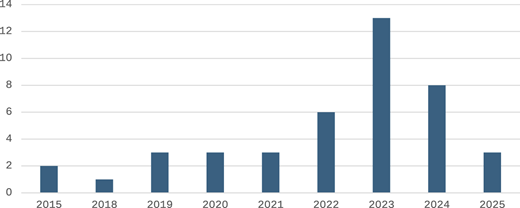
This study aimed to synthesise and integrate the literature on the effects of influencer marketing and sustainable consumer behaviour. The study reviewed 42 journal articles published from 2015 to 2025. Between 2015 and 2025, publications on influencer marketing and sustainable consumer behaviour varied significantly. As presented in Figure 2 in 2015, two papers were published, accounting for 4.76% of the reviewed papers. Thereafter, the number of papers decreased to 1 (2.38%) in 2018 and then increased slightly in 2019 to three papers (7.14%). Similarly, in 2020 there were three articles published (7.14%) and in the same trend there were three articles published (7.14%) in 2021. In 2022 the number of papers increased to 6 (14.29%). Additionally, there was the highest number of publications observed in 2023, with 13 papers (30.95%). The increase in publications in 2023 could be due to marketing and behavioural shifts during and after the pandemic. During the pandemic, most influencers encouraged healthy consumption. This attracted researchers' interest in investigating the interplay of influencer marketing and sustainable consumption. Besides, eight papers (19.05%) were also published in 2024. Lastly, there were only three papers (7.14%) in the first quarter of 2025. Generally, the trend indicates that there were a significant number of publications on influencer marketing and sustainable consumer behaviour from 2022 to 2024, especially in 2023.
3.1 Antecedents of sustainable consumers’ behaviour
The review addressed the question of what are the key antecedents of influencer marketing that shape sustainable consumer behaviour? As presented in Table 1 and Figure 3, this review identified several antecedents ranging from influencer, content and relational aspects. The antecedents of influencer marketing have been presented and discussed along with its sustainable consumer behaviour outcomes.
3.1.1 Influencer-related antecedents
Influencer-related factors have a stake in the literature explaining consumers’ green consumption behaviour. Green-oriented influencers significantly sway consumers’ participation in environmental-cause-related campaigns (Dekoninck & Schmuck, 2023). Endorsers with higher social status reinforce positive attitudes toward green adverts, thus resulting in higher consumers’ intentions to act environmentally (He, Fu, Li, & Guo, 2019). Additionally, the effect of endorsers’ social status becomes higher when aligned with injunctive norms appeals (He et al., 2019). Moreover, the attractiveness and trustworthiness of endorsers impact consumers’ attitudes towards green cosmetics (Lili et al., 2022) and subsequently increase consumers’ willingness to purchase endorsed green products (Al Mamun, Naznen, Yang, Ali, & Hashim, 2023; Lili et al., 2022). Furthermore, influencers practising intimate self-disclosure, showing environmental concern and exercising self-control may positively affect sustainable food purchase intention (Cui, Tang, & Iqbal, 2024; Ding, Legendre, Lee, & Min, 2024; Verma & Kapoor, 2025; Wu, Yang, & Liu, 2023). Additionally, consumers' willingness to donate is found to increase when the message is conveyed by an influencer with a low following (Pittman & Abell, 2021). Furthermore, local or village influencers with eminent personalities stimulate the adoption of eco-friendly products among farmers in China (Zhang et al., 2021). Correspondingly, influencers demonstrating credibility aspects such as competence, trustworthiness, skills, knowledge and overall expertise on green issues influence the use of eco-labels and the purchase of green products (Añaña & Barbosa, 2023; Panopoulos, Poulis, Theodoridis, & Kalampakas, 2023). This underscores that characteristics embodying an influencer are important in swaying consumer behaviours. Thus, in designing a sustainable-oriented influencer marketing campaign, it is important to collaborate with credible, eminent, micro and environmentally concerned influencers. Moreover, virtual influencers are also reported to have a significant role in fostering sustainable consumption behaviour (see Hartmann, Apaolaza, Paredes, & D’Souza, 2025; Hoai Lan, Minh Tung, Thi Kim Oanh, & Thi Kim Cuc, 2025; Jiang, Zheng, & Luo, 2024). Correspondingly, the effectiveness of virtual influencers relies on the use of storytelling, captivating visuals and human–animal connections to foster emotional attachment with consumers (Tung & Lan, 2024). Highlighting the need to consider employing non-human influencers to advocate sustainable consumption. Using a non-human influencer reduces reputation risks associated with human influencers. However, more research is still needed to understand the mechanism behind the power of virtual influencers.
3.1.2 Content-related antecedents
Content shared by an influencer potentially affects sustainable consumer behaviour. Perceived content credibility is determined by expert opinion referenced within it, which shapes sustainable consumption (Buvár, Zsila, & Orosz, 2023). Besides, body-shape-focused visual content showing dietary supplements and wearing tight-fitting branded sportswear stimulates trust and friendship among their followers (Pilgrim & Bohnet-Joschko, 2019). Further, it is reported that environmental content posted by influencers drives pro-environmental behaviour intentions (Dekoninck & Schmuck, 2022; König & Maier, 2024a). Similarly, content manifesting celebrity environmental involvement appeals by using first-person pronouns affects more positive attitudes and sustainable product choice (Park, 2020; Verma & Kapoor, 2025). Alongside Park (2020) contends that the fear appeals of the message are more active than hope appeals in influencing consumers’ participation in activism. Correspondingly, influencer posts with gain frames influence consumer engagement, which results in more sustainable purchase intention (König & Maier, 2024b). In line with the message appeal, Kapoor, Balaji, and Jiang (2023) add that a concrete message appeal affects a higher purchase intention of the advertised product than an abstract message appeal. Another study by De Keyzer (2023) on sustainable food content reports that sustainable food content is more often recognised as adverts compared to non-sustainable food content when the influencer discloses. This highlights the need to consider disclosure mechanisms; explicit and implicit disclosure of endorsement may have different effects. Thus, future studies may consider investigating the effect of endorsement disclosure. This will help influencers to plan for content creation. In the same vein, content value styles are also important in shaping sustainable consumer behaviour. Informative content affects consumers’ decisions to purchase green products more than entertainment content (Zhao et al., 2024). Additionally, warm messages improve positive consumers' attitudes towards pro-environmental causes and subsequently impact consumer engagement in environmental causes (Gerrath, Olya, Shah, & Li, 2024). Consequently, it is evident that in line with the potential role of content itself, communication styles such as embedding malcontent may amplify collective and responsible actions (Hopkinson & Cronin, 2015). Hence, using storytelling and video content is important in enhancing the effectiveness of sustainable marketing campaigns.
3.1.3 Relational antecedents
The perceived relational factors have also been recognised in the literature to influence sustainable consumer behaviour. For example, the endorser-product congruence predicts the celebrity's perceived altruism and the brand’s perceived altruism (Li, Xiong, Wang, & Zhang, 2022). Correspondingly, influencer-message congruence increases influencer credibility and pro-environmental intentions (Boerman, Meijers, & Zwart, 2022). Parasocial relationship between an influencer and consumers enforces green influencer identification, which subsequently develops consumers' green life attitude and consumption (Breves & Liebers, 2022; Cui et al., 2024). Moreover, consumers develop relationships with their’ celebrity chefs and subsequently induce them to engage in sustainable food consumption behaviour (Craig, 2019; Lewis & Huber, 2015). In the same vein, consumer-endorser companionship positively affects the attitude towards the endorsed green products and subsequently increases the likelihood of consumers purchasing the endorsed green product (Al Mamun et al., 2023). This underlines that consumers wish to associate with influencers with green orientations. Therefore, practitioners should consider aligning green influencers with the target audience to foster perceived relationships between consumers and influencers. Doing so may subsequently result in sustainable consumption behaviour among consumers.
3.2 Decision factors: mediators
The current review also addressed the question of what are the key decision factors that explain the mechanistic effect of influencer marketing on sustainable consumer behaviour. In this review, several mediating factors ranging from consumer, relational, content and product- or brand-related factors were identified (see Table 2).
3.2.1 Consumer-related factors
Consumers' environmental consciousness mediates the effect of green influencer marketing on green behavioural intention (Kılıç & Gürlek, 2023). Further, the social and epistemic values of consumers bridge the effect of influencers” intimate self-disclosure, environmental concern and spending self-control on sustainable food purchase intention (Wu et al., 2023). Besides, green involvement catalyses the effect of endorsers in affecting the purchase of green clothes (Khare, Sadachar, & Chakraborty, 2022). Developed attitudes towards green cosmetics and brand equity have a strong impact on the willingness to purchase green cosmetics (Lili et al., 2022). Correspondingly, the perceived trust and attitude towards the product in influencers mediate the effect of green influencer popularity and purchase intention of a green product (Pittman & Abell, 2021). Also, consumers’ attitude towards green ads partially mediates the effect of a credible influencer’s recommendation on consumers’ willingness to pay premium prices for green skincare products (Al Mamun et al., 2023). Additionally, the more consumers engage in sustainable consumption, the more influencers are likely to trigger consumers’ sustainable choice of recommended products (Verma & Kapoor, 2025). This emphasises the need for influencer marketing campaigns to trigger the consumers’ cognitive and emotional state to enhance their decisions to behave responsibly.
3.2.2 Relational factors
Parasocial relationships developed between an influencer and an audience mediate the effect of engagement with green influencers on low- and high-effort activism (Knupfer, Neureiter, & Jörg, 2023). Correspondingly, parasocial relationships are found to mediate the effect of influencer’s expertise and attraction on followers’ intention to purchase energy-saving products (Luo, Nie, & Ji, 2023). Also, our review found that the indirect effect of eco-friendly products on green behavioural intention goes through a perceived fit of consumers’ interests with the influencer (Kılıç & Gürlek, 2023). Therefore, the psychological relationship consolidated between the influencers and followers is crucial in promoting green consumption behaviour (Folkvord, Roes, & Bevelander, 2020). This implies that partnering with influencers who resonate with the target audience may have more impact on swaying sustainable consumer behaviour. Therefore, partner influencers should be encouraged to share their lifestyles and intimate stories about environmental and sustainable consumption. Doing so develops emotional and friendly attachment with followers. Thus, making consumers respond positively to sustainable behaviour recommendations.
3.2.3 Content-related factors
Content is essential in developing the power of influencers in shaping sustainable consumption behaviour (Dekoninck & Schmuck, 2022; Haines et al., 2023). Further, content-related factors are also reported to explain how influencer marketing antecedents affect sustainable consumption. For example, Kapoor et al. (2023) report that message authenticity explains how concrete message appeals affect the purchase intention of the promoted product more than an abstract message appeal. Also, credible ads subsequently affect consumers’ intention to purchase non-overpacked products (Elgaaied-Gambier, Monnot, & Reniou, 2018). Thus, emphasising that in designing effective influencer marketing communication strategies, it is important to embed persuasive elements. Combining emotionally engaging (appeal) and realistically reliable (credibility) aspects in creating content develops interest in sustainable behaviours. Additionally, leveraging user-generated testimonials may also enhance the perceived credibility of the message, subsequently increasing the likelihood of consumers engaging in sustainable behaviours.
3.2.4 Product-related factors
Product and brand factors are key in inducing green consumption behaviour. Kapoor et al. (2023) contend that the product sustainability image mediates the effect of a concrete message appeal on the purchase intention of the promoted product more than an abstract message appeal. Further, brand ethicality and brand credibility help generate attitudes towards the brand and purchase intention (Cespedes-Dominguez, Fernandez-Robin, & McCoy, 2021). Similarly, Lili et al. (2022) portray that attitude towards green products mediates the effect of endorsers’ credibility on willingness to purchase green cosmetics. Therefore, influencer marketing campaigns promoting sustainable products must properly position the green product in consumers’ minds. Crafting content, demonstrating the green production process and green product performance creates consumers’ positive attitude towards green products. Also, using storytelling to demonstrate how others enjoy and reduce living costs by using green products may improve the acceptance of green products.
3.3 Decision factors: moderators
Our review also addressed the question: Under what conditions or situations does influencer marketing impact sustainable consumer behaviour? Several moderating factors that affect the interplay between influencer marketing and sustainable consumer behaviour were identified. The factors range from influencer-related, relational and product or brand-related factors (see Table 3).
3.3.1 Influencer-related factors
Green endorsers moderate the relationship between perceived consumer effectiveness and green smartphone purchase intentions (Raj, Singh, & Lascu, 2023). Alongside, ordinary consumer endorsers have a strong effect on attitudes and behavioural intentions when the descriptive norm appeals are used (He et al., 2019). Besides, a green influencer moderates the effect of a less-popular influencer on consumers’ willingness to donate higher amounts (Pittman & Abell, 2021). While influencers have the power to sway sustainable consumer behaviour, a proper choice of a partner influencer may improve the acceptance of sustainable consumer behaviour. This emphasises that less-established influencers are potential partners in fostering sustainable consumption behaviours. While less established influencers have fewer followers and are known to a small niche, their influence is likely to be higher as they are more friendly and closer to their followers.
3.3.2 Relational factors
The social ties between the influencer and audience moderate the effect of cognitive or emotional proximity on attitudes toward recycling and recycling intentions (Lee et al., 2020). The study by Dekoninck and Schmuck (2023) reports that parasocial relationships moderate the effect of environmental influencers on consumers’ participation in environmental-oriented causes. This underscores the importance of designing an influencer marketing campaign that fosters emotional attachment between influencers and the target audience. Therefore, by capitalising on technology such as generative AI, practitioners may enhance friendly, customised and seamless interaction with consumers on social media platforms throughout the campaign.
3.3.3 Product or brand-related factors
Product type and brand factors were also found to be prevalent in the literature. Product type (hedonic vs utilitarian) moderates the impact of message appeal (concrete vs abstract) on intention to purchase the green product. When green influencers promote utilitarian products, concrete messaging improves purchase intention. Whereas, for hedonic products, abstract messaging is suitable to drive purchases (Kapoor et al., 2023). This underscores the need to balance the product type and message design. For example, when influencers promote green products such as eco-friendly lights and water sensors, they should use concrete messages focusing on reducing energy and water bills. But when green pleasure-driven products such as organic chocolates are promoted, emotional messages should be used to exert more effect. Additionally, the price of green products moderates the effect of consumer engagement with sustainable behaviour on sustainable food choice (Verma & Kapoor, 2025). Thus, highlighting that price sensitivity should also be considered in designing a sustainable-oriented influencer marketing campaign. Messages insisting on cost-saving benefits should be directed to price-sensitive consumers, while planet-serving and status quo benefits should be communicated to less price-sensitive consumers. With this fact, it is important to strategically combine product category (utilitarian vs hedonic), message crafting (concrete vs abstract) and price positioning when designing an influencer marketing campaign.
4. Proposed integrative framework
The proposed integrative framework, as presented in Figure 3, is based on a synthesis of literature about influencer marketing and its impact on sustainable consumer behaviour. The framework addresses the fragmented and disintegrated state of the literature in explaining the complex association between influencer marketing and sustainable consumer behaviour. Our framework takes into consideration that sustainable consumer behaviour cannot be explained by a single antecedent, as it is complex and evolves. Different categories of antecedents, ranging from influencer, content and relational factors, were identified. The results underline the value of partnering with a credible influencer with green-oriented content supported with visual proof and message appeal. Besides, proper similarity between influencers and recommended green products, consumers and messages exert more effect on sustainable consumer behaviours. Correspondingly, credible influencers with high social status, eminent personality and environmental concern amplify the effect of influencer marketing.
In the same vein, the effect of influencer, content and relational factors on sustainable consumer behaviours is mediated by consumer, relational, content and product or brand-related factors. Suggesting that, while practitioners aim to sway sustainable consumer behaviour, factors such as consumers’ trust in green influencers, attitude towards the product, perceived message authenticity, parasocial relationship and brand image should not be ignored. Highlight the complex underlying process of influencer marketing in shaping sustainable consumer behaviour.
Moreover, the integrated framework presents the conditions and situations under which influencer marketing impacts sustainable consumer behaviour. The effect of influencer marketing on sustainable consumer behaviour is moderated by influencer, relational and brand-related factors. Less established influencers are more likely to enhance sustainable consumer behaviour than well-established or mega influencers. In the same vein, green influencers fostering strong ties and parasocial relationships strengthen the impact of influencer marketing on sustainable consumer behaviour. Besides, brands with a green image and trust strengthen sustainable consumer behaviour. In addition, price sensitivity is also important in determining consumers’ acceptance of sustainable behaviours. Highlighting that while enhancing emotional connections with the target audience, pricing and crafting messages that elevate consumers’ positive attitude towards green products remain essential to fostering sustainable consumption.
The proposed integrated framework serves as a snapshot, suggesting useful insights into how to design influencer marketing campaigns that effectively promote sustainable consumer behaviours. It further identifies the driving forces behind influencer marketing and explains how consumers respond to such sustainable-focused campaigns. Additionally, it provides researchers with a clear foundation for understanding the complex relationship between influencer marketing and sustainable consumer behaviours, thereby inspiring new directions for future research.
5. Contributions and implications
5.1 Theoretical contribution
Our study provides several contributions and implications to the theory. Based on an extensive search in the reputable databases, this is one of the earliest SLR studies to consider providing a snapshot of how influencer marketing impacts sustainable consumer behaviour. This study developed an integrated framework explaining the interplay of antecedents of influencer marketing and sustainable consumer behaviour. The study unveils that influencer, content and relational factors drive sustainable consumer behaviour. Additionally, the study uniquely advances the literature by highlighting the decision factors that explain the mechanism and underlying process by which the influencer, content and relational antecedents shape sustainable consumer behaviour. Whereby consumer, relational, content and product or brand factors mediate the relationships. Additionally, influencer type, influencer size, social ties and parasocial relationships potentially moderate sustainable consumption among consumers. Thus, the framework serves as a snapshot, providing useful insights to practitioners on how to foster sustainable consumption using influencer marketing. In particular, the review highlights useful insights on how practitioners can decide on content design, communication style, target the audience and select the right influencer to collaborate with.
Additionally, the study contributes to the literature by identifying different categories of sustainable consumer behaviour. The study found that influencer marketing may impact sustainable consumer behaviour differently. Consumers demonstrate sustainable consumption behaviour by developing intention, actual consumption behaviour and participation in environmental-related causes. The intention-related behaviour entails consumers’ intention to evolve in buying green products and engaging in environmental cause campaigns. The actual behaviour includes buying sustainable goods, recycling, using single-use plastic bags, participating in environmental-related discussions and environmental activism, among others. Underscoring that influencer marketing strategies should apply a multi-faceted approach. Practitioners should not only focus on fostering intentions but also on eliminating the barriers to action (actual behaviour). Accordingly, future research may explore the interrelationship of these dimensions, particularly determining whether they operate interactively or sequentially. Doing so will provide more insights into the starting point to intervene.
5.2 Practical implications
Our review provides several recommendations to the influencers and practitioners, such as non-governmental actors, marketers, government agencies and policymakers, among others. First, consumers pay attention to content shared by influencers on social media platforms. Therefore, in collaboration with influencers, practitioners should creatively create engaging content demonstrating various green lifestyles. For example, making content that demonstrates individuals selecting products with care for the environment, using used water cans to make a flower garden and guiding fellow friends about eco-friendly disposal. This can make the audience feel and think that this kind of living is the contemporary standard of living, thus sparking the green lifestyle.
Second, relational factors such as parasocial relationships with influencers are key in fostering sustainable consumer behaviours. With the help of generative AI (Gen AI), such as Grok, practitioners and influencers can amplify conversations about environmental issues on social media platforms such as X. Additionally, chatbots may enhance seamless, friendly and customised interactivity, which may increase consumers’ likelihood to act responsibly. Also, influencers may decide to have a home visitation programme for followers who claim to live green lifestyle. Doing so builds true friendship and makes consumers feel closer and indirectly making them stay committed to sustainable consumption behaviours.
Third, practitioners promoting sustainable consumption behaviours should consider embedding descriptive norms in communicating about sustainable issues. For example, nano-influencers may leverage Gen-AI to create effective and cognitively engaging content, preferably videos, showing them engaging in sustainable actions such as recycling, using green products, green disposing and discussing sustainability issues with friends. Additionally, the videos may indicate social proof by sharing testimonials and analytics about green conversation on social media platforms. Doing so will create a sense that sustainable consumption behaviour is common and socially acceptable.
Fourth, dealing with human influencers is somehow risky; their actions can ruin the credibility of the campaign. For example, an influencer might claim to be environmentally concerned but then get caught by the public engaging in non-sustainable actions. Besides, virtual influencers can potentially drive sustainable consumption (Gerrath et al., 2024). Therefore, to maintain the credibility of the campaign, practitioners may collaborate with virtual green influencers to foster sustainable consumer behaviours.
Fifth, our review found that less-established influencers, such as nano influencers, are effective in driving sustainable consumer behaviour than well-established ones, such as mega influencers. However, practitioners often normatively prioritise mega influencers, ignoring the potential of nano-influencers. Nano-influencers are perceived as friendly and close to their followers (John, Qiu, Kilumile, & Mofulu, 2025), hence, practitioners may capitalise on them to effectively foster sustainable consumer behaviour at low cost. Additionally, making a localised or regional-based campaign featuring locally accepted influencers may have a greater impact. For example, using local influencers, partitioners may design dramas, songs and discussions advocating environmental issues using local languages.
Sixth, perceived credibility, eminence and environmental concern of an influencer may sway sustainable consumption actions. In designing a campaign, practitioners should collaborate with green eminence influencers demonstrating environmental concerns. Additionally, dwelling on storytelling demonstrating how an individual benefits from sustainable consumption could have more impact. For example, an influencer may enhance persuasiveness by crafting a story showing how individuals save on the cost of living by upcycling denim collections, using sensor lights, using solar panels and installing water sensors, among others.
Lastly, our review also informs policymakers on how to accelerate the utilisation of influencers to foster sustainable consumer behaviour. Our review reveals the notable role of influencers in fostering sustainable consumption behaviour. However, for financial gain reasons, influencers may engage in greenwashing advertising, which negatively affects the consumption of sustainable products. Therefore, this study encourages policymakers to consider making proper guidelines that will guide influencers and content creators. For example, the guidelines or legal framework could guide some ethical conduct in creating content, disclosure of sponsored content and the qualities of a credible influencer.
5.3 Future research directions
This study suggests avenues for further research to enrich the research domain. First, most studies have used intention to predict sustainable consumer behaviour. However, consumer intention may not result in actual behaviour and may evolve. Therefore, future studies may incorporate a field experimental design (Li et al., 2022) and longitudinal design (Breves & Liebers, 2022; Wu et al., 2023) to examine the impact of influencer marketing on sustainable consumer behaviour. Investigating actual behaviours provides practitioners with more precise and reliable insights. For example, using a longitudinal design, researchers can track how the effect of green influencers (antecedent) on wishful identifications (mediator) evolves when nano-green influencers promote activism and co-creation of sustainable brands (outcomes).
Second, several moderating variables have been identified in the literature. However, consumer-related factors such as gender (Raj et al., 2023), age (Panopoulos et al., 2023) and socioeconomic status (Kapoor et al., 2023) may explain well the situations under which influencer marketing impacts sustainable consumer behaviour. However, the factors have received little attention in the literature. Therefore, future studies may consider examining the moderating effect of consumer-related factors such as age, gender, reciprocity norms and socioeconomic status. Researchers may address questions such as does the effect of influencer marketing campaigns on sustainable consumer behaviour varies across females and males, Gen Z and millennials? Does the impact of a sustainability-focused influencer marketing campaign vary across consumers with high vs income, high vs low education and high vs low internet access?
Third, several sustainable consumer behaviour outcomes have been investigated in the literature. These include the intention to buy and use green products and participate in environmental causes. However, little attention has been paid to environmental activism and the co-creation of sustainable products or brand. Environmental activism involves individuals’ efforts advocating for environmental protection. Unlike the purchase of eco-friendly products, environmental activism requires slightly fewer resources; hence, it could easily be adopted among consumers. Co-creation refers to the involvement of consumers in creating brand meanings, experiences and identities. Influencers have the potential to foster brand co-creation (Kilumile & Zuo, 2024), which is key in fostering sustainable consumer behaviour (Liu et al., 2022). Therefore, understanding how influencer marketing may stimulate consumer environmental activism and co-creation of sustainable brands or products is key to addressing environmental challenges. Additionally, given that research on energy-saving behavioural outcomes is still at a nascent stage (Elgaaied-Gambier et al., 2018; Luo et al., 2023). Future research could address questions such as how influencers' content, credibility and parasocial relationships foster individuals' energy-serving behavour.
Fourth, the ineffectiveness of established influencers, such as mega influencers, in shaping sustainable consumption practices challenges the normative practice in influencer marketing. This essential insight necessitates the need for revisiting the interplay of mega influencers and sustainable consumer behaviour. Advancing the understanding of the process and underlying mechanisms that shape the persuasiveness of mega influencers will provide a new perspective on how to drive sustainable consumer behaviour. In most cases, mega influencers showcase their expensive properties and their lifestyle and brag. Such practices may create envy, thus reducing attachment to their followers (Feng, Chang, & Sun, 2023). Thus, future studies may consider investigating how linguistic styles such as humble bragging and straightforward bragging affect consumers’ emotional attachment and their subsequent effect on consumers’ sustainable behavioural responses.
Lastly, the literature indicates that influencer type plays a role in fostering sustainable consumer behaviour. Some studies investigated the effect of virtual influencers, non-green influencers and green types of influencers. All types of influencers have the potential to significantly sway sustainable consumer behaviours. However, the question of whether the magnitude effect varies across the influencer types remains unanswered. Therefore, future studies could conduct a comparative study to investigate whether consumer responses, particularly green activism, differ between green and non-green influencers or between virtual and human influencers.
6. Conclusion
Our review progresses the literature on influencer marketing and consumer behaviour, particularly sustainable consumer behaviour. The study aimed to provide a snapshot of the antecedents and decision factors that explain the mechanism and underlying process by which influencer marketing impacts sustainable consumer behaviour. The study employed an SLR methodology to review 42 journal articles published on WOS and EBSCO from 2015 to 2025. The study found that influencer-related factors, content-related factors and relational factors are important antecedents in fostering sustainable consumer behaviours. Besides, trust in influencers, attitude towards the product, message authenticity, perceived fit with an influencer, parasocial relationship and brand image are important pathways to sustainable consumer behaviours. Additionally, influencer type, product image and influencer–audience ties moderate the sustainable consumer behaviours. Moreover, the study presents an integrated framework summarising the antecedents of influencer marketing and decision factors impacting sustainable consumer behaviour. Accordingly, the study provides useful insights to practitioners on how to strategically collaborate with influencers to foster sustainable consumer behaviour. Additionally, this study provides a foundation for future studies in influencer marketing and sustainable consumer behaviour. Lastly, the study reviewed included English journal articles from WoS and EBSCO only. Therefore, future reviews may consider employing other reputable databases, such Scopus database, to get wider results.