The objective of this article is to fill the gaps in understanding the impact of the emergence of Industry 4.0 on technology services companies. It discusses the barriers, challenges, innovations and management types that influence the implementation of these advanced technologies in the technology services sector. The article also develops a structured theoretical framework and conducts a systematic review of the literature on the proposed subject.
We started by developing a theoretical approach to guide the analysis; then, we divided the study into three phases: planning, execution and reporting. Using search terms and the inclusion and exclusion criteria, we selected 24 articles from the main academic databases. These articles were reviewed in detail to provide comprehensive understanding of the challenges and opportunities resulting from the implementation of these technologies in the technology services sector, as shown in a framework at the end.
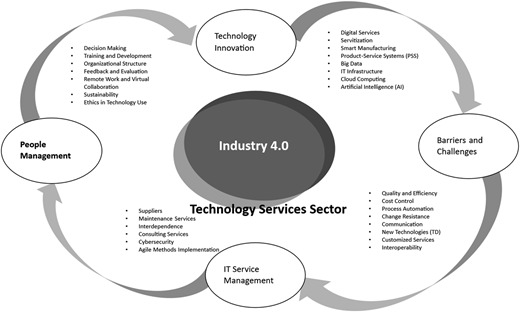
The study uncovers an interdependent triad driving the implementation of Industry 4.0 in the technology services sector: technological innovation, technology services management and people management. This triad involves the companies' technical capacity to implement advanced technologies, proving to be essential in optimizing operations and developing new business models. The implementation of Industry 4.0 also brings important challenges, such as resistance to change, cost control and interoperability. Conversely, effective technology management involves partners that bring opportunities for value creation and innovation; and cybersecurity can reduce problems, ensuring the safety of companies and customers.
Despite providing valuable insights into the implementation of Industry 4.0 in technology services, this study has some limitations, including the lack of practical research and specific regional perspectives, which may affect the generalization of results. Future research should use varied sources and methods for a deeper understanding of these processes. Also, this research provides a basis for future studies approaching the transition from supply chain 4.0 to supply chain 5.0 in the technology services sector.
Investing in infrastructure and staff training is essential to support the implementation of advanced technologies, and addressing barriers such as resistance to change and cybersecurity is fundamental. Also, ethical issues should be valued within the organizational culture. These implications help companies meet the challenges and seize the opportunities presented by Industry 4.0.
The study highlights the interdependence between technological innovation, technology services management and people management, which promotes an effective transition to Industry 4.0 in the technology services sector. In addition, it provides valuable insights for researchers and professionals interested in this area.
1. Introduction
Industry 4.0 is an important breakthrough in industrial processes, bringing together advanced technologies and increased productivity, flexibility, and customization in the production and delivery of goods and services (Capello & Lenzi, 2021; Castelo-Branco, Cruz-Jesus, & Oliveira, 2019; Dalenogare, Benitez, Ayala, & Frank, 2018; Chiarello, Trivelli, Bonaccorsi, & Fantoni, 2018). This industrial revolution and the resulting global transformation are all-encompassing, from the vertical and horizontal integration of manufacturing processes to product connectivity, representing a fundamental shift in how manufacturing is operated. Despite all this technological progress, some major challenges still need to be overcome, especially in developing countries, where the potential of Industry 4.0 technologies is not yet fully understood.
Despite these technological advances, the existing academic discussion reveals important gaps. Although Industry 4.0 has been widely explored in manufacturing, the literature on its implications for technology services remains fragmented. Existing studies rarely integrate service management theory with digital transformation concepts, resulting in a lack of sector-specific understanding about how Industry 4.0 reshapes service operations, customer support processes, field services and digital service delivery models. This gap becomes even more relevant considering the strategic role that technology services play in enabling digital transformation across industries. Therefore, a systematic and sector-focused literature review is necessary to consolidate current knowledge, identify conceptual and managerial implications, and advance the theoretical understanding of Industry 4.0 from a service-oriented perspective.
Efficiently managing the global supply chain is essential for successful companies, but they should overcome many challenges such as dependence on electronic spreadsheets and lack of transparency (Yanling, Lakovou, & Shi, 2020; Frederico, Garza-Reyes, Anosike, & Kumar, 2020; Chiarello et al., 2018; Muniz et al., 2023). The implementation of cutting-edge technologies improves the benefits of Supply Chain 4.0, which range from competitive advantages and reduced costs to challenges such as cybersecurity and interoperability between systems. With new technologies, such as artificial intelligence (AI), Internet of things (IoT), big data and augmented reality, the services sector is going through significant advances that stimulate innovation in business models and enhance customer experience (Frederico et al., 2020; Raj, Dwivedi, Sharma, Jabbour, & Rajak, 2020; Niroomand, Cafolla, Morgan, & Wales, 2022).
Technology services play an important role in this context of accelerated transformation and great challenges, supporting the entire lifecycle of equipment and introducing new intelligent services that provide both opportunities and challenges (Frank, Dalenogare, & Ayala, 2019a; Grandinetti, Ciasullo, Paiola, & Schiavone, 2020). The objective of this study is to develop a structured theoretical framework to identify the concepts, dimensions and impacts of Industry 4.0 in the technology services sector. This includes a systematic review of the literature on Industry 4.0 in this sector, as well as an analysis of factors influencing the implementation of Industry 4.0 in this context.
It analyzes technology services transformations and trends and seeks to identify the strategic implications of Industry 4.0 in the sector. It further offers a structured bibliographic framework and theoretical insights that support deeper academic understanding and future research developments. In contrast to existing systematic literature reviews (SLRs) on Industry 4.0, this study provides a service-sector-specific perspective and integrates Industry 4.0, Supply Chain 4.0 and Service Management 4.0 into a unified conceptual view, representing its key theoretical and practical contribution. Thus, this study seeks to clarify the challenges and opportunities brought by Industry 4.0 to a specific sector, answering the central research question:
What are the strategic implications of Industry 4.0 on the technology services sector?
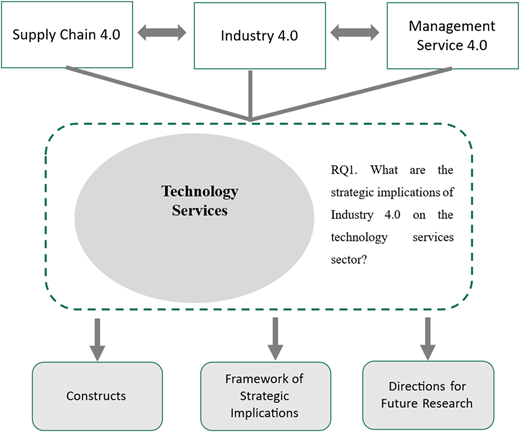
Based on the above, Figure 1 outlines the interaction between the theoretical foundations and the research question, highlighting the objectives of this study and illustrating how the theoretical background supports and guides the investigation. The figure also represents the conceptual relationship among the three pillars, where Industry 4.0 serves as the foundation enabling both Supply Chain 4.0 and Service Management 4.0, emphasizing their interdependence and complementarity. This enables clear understanding of the methodological structure implemented to achieve the established objectives.
This article was divided into six sections. Section 1 introduces the subject, problem, objective and method. Section 2 approaches the conceptual-theoretical basis, analyzing the theoretical basis of three main subjects in the technology services sector: Industry 4.0, Supply Chain 4.0 and Service Management 4.0. Section 3 highlights the SLR plan, defining the criteria, search strategy and keywords used. Section 4 presents the analyses of the results obtained and addresses the framework of the impacts of Industry 4.0 on the technology services sector. Finally, section 5 presents the conclusions of the study, encompassing the theoretical and practical implications of its objective results and limitations, in addition to suggestions for future studies.
2. Theoretical background
Industry 4.0 has become a prominent topic in both academic and professional environments, triggering intense debate between researchers, professionals and governments around the world. This phenomenon, broadly documented in a series of recent studies, has significant implications in both the economic and social spheres. A critical analysis can help understand the complexity of Industry 4.0 and its impact on different sectors, promoting innovation, digital transformation and strategic adaptation in a constantly evolving scenario (Chiarello et al., 2018; Frank, Mendes, Ayala, & Ghezzi, 2019b).
Within this broader concept, Supply Chain 4.0 and Service Management 4.0 emerge as specific domains of application. The former focuses on the digital integration of logistics and production networks, while the latter extends the principles of Industry 4.0 to service operations and customer interaction (Paschou, Adrodegari, Rapaccini, Saccani, & Perona, 2018; Frederico et al., 2020; Ghobakhloo, 2018).
2.1 Industry 4.0
Raj et al. (2020) consider Industry 4.0 as a set of emerging concepts and technologies, such as radio-frequency identification (RFID), big data, cloud computing, smart sensors, machine learning (ML), robotics, additive manufacturing (AM), AI, augmented reality and IoT. In contrast, Deloitte (2014) provides a simpler definition, describing Industry 4.0 as an umbrella term that refers to changes that have occurred over time in the industry value chain process, driven by emerging technologies. These changes aim to provide better organization and management of standard processes, including prototyping, development, production, logistics, supplies and services. They connect all the different dimensions of work into a unified digital ecosystem.
According to Ghobakhloo (2018), the big question regarding the Fourth Industrial Revolution is: How do manufacturers transition from their current to their desired situation through digitalization processes? Mariani and Borghi (2019) state that Industry 4.0 will impact all aspects of business value chains, which is generating increasing interest by management researchers.
2.2 Supply chain 4.0
As an application of Industry 4.0 in logistics and production networks, Supply Chain 4.0 integrates advanced technologies to enhance visibility, flexibility and efficiency across interconnected processes, and personalization of the production and delivery of goods and services. Supply Chain 4.0 also brings strategic benefits, enabling the integration of digitally connected physical objects, tracking and interaction of links along the value chain. It also increases visibility and agility in information sharing and translates into greater value creation throughout the supply network (García-Reyes, Avilés-González, & Avilés-Sacoto, 2022; Ghobakhloo, 2018).
There is a consensus that the effective implementation of Industry 4.0 and its technologies goes far beyond the simple use of technology. It involves understanding requirements such as infrastructure, people skills and coordination, and influences the supply chain performance criteria, which include transparency, responsiveness, efficiency, flexibility and strategic objectives (Frederico et al., 2020; García-Reyes et al., 2022; Ghobakhloo, 2018).
2.3 Service management 4.0
Building on the principles of Industry 4.0, Service Management 4.0 extends the digital transformation to the service domain, combining servitization and advanced digital technologies to enable more efficient processes, data-driven decision-making and higher value creation (Paschou et al., 2018).
These technologies enabled machine interconnections, creating greater value by offering value-added services and transforming business models and the performance of manufacturing companies. A quality relationship is essential between supplier and customer, as it influences the collaboration and success of companies, promoting relational innovation and driving digital servitization (Repetto, 2023; Grandinetti et al., 2020).
But in today's business environment, effective competition is shaped by several factors, including time, price, innovation and reliability. Equipment maintenance and reliability are key, directly affecting the organizational skills to compete. Machine modernization is a relatively new field for many companies, requiring the development of new tools that facilitate the decision-making process related to these issues. Equipment maintenance and reliability management should be included in the business strategy to achieve competitive advantage, with the integration of operational data being essential to improving the life cycle of machinery (Madu, 2000; Sagarna, Uribetxebarria, Castellano, & Erguido, 2016).
3. Systematic literature review – SLR
Within the results section of the SLR, the flow diagram should be presented to outline the volume of studies initially captured, the removals occurring throughout each screening phase, and the final number of papers that progressed to the analytical stage (Moher, Liberati, Tetzlaff, Altman, & The PRISMA Group, 2009).
This section outlines the SLR process adopted in this study, with a focus on gathering up-to-date evidence on the effects of Industry 4.0 within the technology services sector. The initial stage involved defining the databases that would support the literature search; Scopus and Web of Science (WoS) were selected due to their broad recognition and complementary coverage, despite their methodological differences. Searches in both sources were conducted using predefined inclusion and exclusion criteria, taking into account the relevance of the studies to academic and professional contexts as well as the overall rigor and reliability of the published material.
The PRISMA methodology provides a structured framework for conducting the SLR, ensuring that all essential elements of the review process are addressed comprehensively (Moher et al., 2009).
3.1 PRISMA phases: identification, screening, eligibility and inclusion
To obtain an overview of ongoing research, keyword searches were conducted in major research databases relevant to the study area. The searched terms and combinations were: Industry 4.0 and its variations (fourth industrial revolution, Supply Chain 4.0, smart manufacturing, digital manufacturing, connected industry, cyber-physical systems, intelligent manufacturing and digital transformation), along with service 4.0 and its possible variations (digital services, smart services, connected services, service innovation, service automation, service delivery 4.0, service value chain 4.0, break fix service, MSP, services technologies, reactive maintenance, on-demand repair services, troubleshooting and repair, incident resolution services, repair and maintenance service, service call support, incident response services and reactive support services).
The review was conducted following the PRISMA guidelines, particularly the phases of Identification and Screening. The inclusion criteria were scientific articles from journals and magazines indexed in recognized academic databases, in English, and published from 2015 onwards.
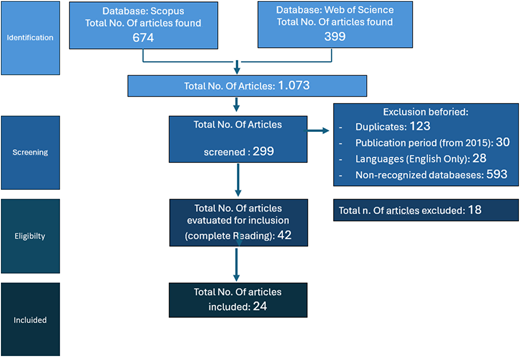
The screening criteria were replications and articles presenting the keywords only in the bibliographical references or in isolated parts of the text. Articles indexed exclusively in recognized academic repositories were retained to ensure the quality, rigor and reliability of the studies analyzed, considering that this process often requires rigorous peer review. In the Identification phase, a total of 1,073 studies were initially retrieved, 30 were excluded for being published before 2015; 123 for being replicated; 28 for being written in a language other than English and 593 for being published in non-recognized databases.
As a result, 299 articles from the digital library with the largest number of studies selected were included for reading. In alignment with the PRISMA Eligibility phase, we read the abstract and, in some cases, the introduction and conclusion of the included articles to exclude those irrelevant to our study or not adhering to the concept clusters identified in the theoretical basis, which comprises technological innovation, technology services management and people management, in addition to barriers and challenges. A total of 257 articles were excluded in this phase, with 42 articles selected for full and detailed reading. His subsequent step corresponds to the PRISMA Inclusion phase; Of these, only 24 were deemed relevant to the research, according to their adherence to key concept clusters. It is worth noting that a significant number of articles presented the searched keywords only in bibliographic references or in isolation, thus being excluded. Figure 2 presents the execution process since the initial phase, including a summary of each stage.
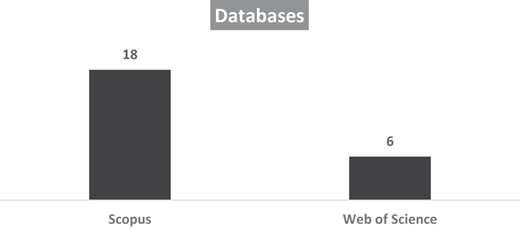
The studies were predominantly found in the Scopus (18 articles) and WoS databases (6 articles) (Figure 3). Scopus was the main source of academic literature on the subject analyzed, and, although smaller, WoS also contributed to our analysis. The combination of these two databases ensured a comprehensive and diverse sample of publications, which were essential for understanding the challenges and benefits of Industry 4.0 in the technology services sector.
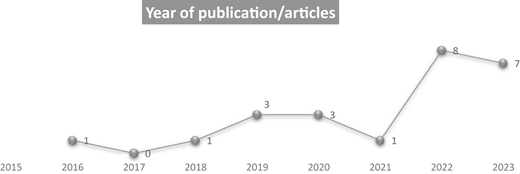
Few studies address the topic of Industry 4.0 in the technology services sector, most being relatively recent. This indicates an increasing interest in recent years, as shown in Figure 4, which represents the temporal evolution of research on the subject, according to the articles analyzed in this study.
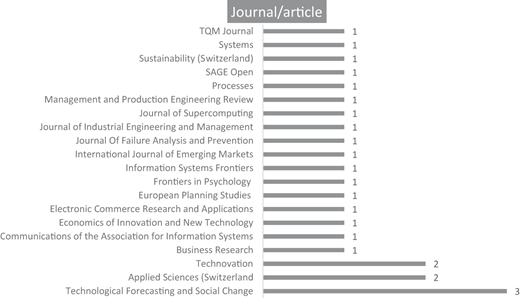
The Technological Forecasting and Social Change (3 articles), Applied Sciences (2 articles) and Technovation (2 articles) journals published most of the selected articles on Industry 4.0 and technology services (Figure 5). The other journals mentioned contributed with one article each.
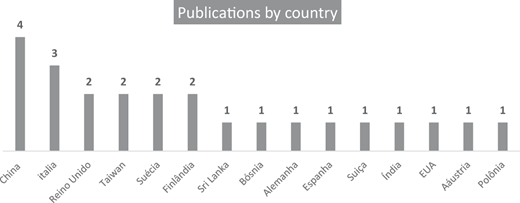
Figure 6 shows that China leads in number of publications on Industry 4.0 and Technology Services, with a total of four articles, followed by Italy, with three articles. Germany, Switzerland, the Netherlands, Portugal, Spain, Brazil, India, the United States, South Korea, Australia, Türkiye, Ireland, Israel, Canada, Poland, Malaysia, Denmark, Austria, Norway, Greece, Belgium, Singapore and Hungary had one publication each. This distribution suggests that academic discussions are still emergent and geographically dispersed, reflecting the absence of consolidated theoretical models for Industry 4.0 in service-oriented industries.
Table 1 provides a comprehensive overview of the 24 selected articles, including their authors, titles, journals that published them and associated databases. It also shows a brief analysis of the primary contribution of each article to the field of Industry 4.0 and its applications in technology services.
4. SLR findings and discussion
Watson and Webster (2002) state that a literature review should be guided by concepts that indicate the structure of the review. We followed their orientation and conducted complete reading associated with the analysis of the articles listed in Table 1, which allowed us to identify the main concepts (dimensions) and subcategories. These data were used to create Table 2, which describes each of the articles based on a comprehensive analysis aligned with the key concepts described in the theoretical framework.
This underrepresentation indicates that human and organizational dimensions remain undervalued in current studies, despite their centrality to digital transformation. This gap reinforces the need for a service-oriented framework that incorporates cultural readiness, capability development and leadership.
We identified four categories, three of them being highlighted: technological innovation (24), barriers and challenges (20) and technology service management (19) (Table 2). The category “people management” was discussed in only ten studies, indicating that authors have relatively less interest in this specific subject. This suggests opportunities for further studies due to the intrinsic relevance of this category in the context analyzed.
Beyond the quantitative distribution of studies across the four dimensions, a deeper comparative reading reveals convergences in how technological innovation is positioned as the primary driver of service transformation, yet contradictions emerge regarding the conditions required for its success. While several papers assume that technological maturity alone enables the transition to Industry 4.0, others argue that organizational and human readiness are equally decisive. This misalignment indicates a conceptual fragmentation in current research, suggesting the need for integrative models that account for both technological deployment and workforce capability development. A thorough analysis was conducted considering the four key dimensions identified (technological innovation, barriers and challenges, technology service management and people management), which were divided into relevant subcategories. This approach enabled deeper understanding of the subjects investigated in the included articles.
Table 3 presents the technological innovation subcategories, showing specific patterns of interest in technology, particularly digital services and service transformation, with 22 and 20 citations, respectively. This indicates a broad recognition of digitalization in business. In addition, we highlight smart manufacturing (18 citations) and smart PSS (17), which show the integration of advanced technologies in service production and provision. The most cited subcategories were digital services (22), service transformation (servitization) (20), smart manufacturing (18), smart PSS (17), big data (15), IT infrastructure (15) and cloud computing (13). Table 3 also indicates a bias toward enabling technologies such as big data and cloud computing, with 15 and 13 citations, respectively. Conversely, AI and ML are less frequently addressed, with 11 citations. Consolidated topics such as IoT and remote support, each with ten citations, reflect ongoing interest in connectivity and operational efficiency. Meanwhile, less explored concepts such as 3D printing and digital twins highlight areas with potential for further investigation. The unique nature of iOS suggests a limitation or specificity in the selected literature.
In barriers and challenges (Table 4), the authors highlight the presence of significant challenges in the implementation of Industry 4.0 in technology services. Critical areas such as quality and efficiency (22 citations), cost control (21), process automation (17), resistance to change (17) and communication (17) are strongly emphasized. The search for personalized services (14) and the integration of new technologies/digital transformation (16) are identified priorities, while challenges such as interoperability (8), customer loyalty (5) and downtime minimization (5) are also recognized. Issues related to low-skill labor and globalization are mentioned in only two articles, demonstrating a need for more targeted analysis. These challenges and barriers underscore the importance of effective management and adaptation strategies for a successful transition to Industry 4.0, concomitantly with a lack of more detailed approaches in the included articles.
Table 5 underscores the predominance of the subcategory “suppliers”, cited in 21 articles, and the importance of partnerships and supply relationships for effective IT service management. It also demonstrates the predominance of “maintenance services”, cited in 19 articles, showing significant concerns with the efficient maintenance of the technology services sector. Other subjects cited were interdependence, consulting services and cyber security, which provide a comprehensive view of the field, highlighting both the predominant and poorly explored areas in IT service management.
Despite being a relevant topic, the use of agile methods was little explored in the articles, being cited by only four authors, which may indicate a possible lack of interest in the subject in academia or reflect a temporal issue, considering the date of the selected articles. The use of agile methods is a recent procedure in other areas, which may justify this limited representation in the literature analyzed.
Table 6 shows key patterns in the focus areas of the selected articles, with emphasis on “people management”. Among the subcategories analyzed, “decision making” and “training and development” stand out as the most discussed topics, with 20 citations each. This shows the importance of these crucial topics for technological and organizational progress. Conversely, “organizational structure” and “remote work and virtual collaboration” are less frequent topics, with 14 and five citations, respectively, indicating a gap in the literature. The prevalence of “feedback and evaluation” is also notable, with 13 citations, suggesting a growing recognition of the importance of human aspects in the transition to Industry 4.0. These patterns reflect the importance of the intersection between technology and people management, indicating consolidated areas and possible gaps to be further explored.
The literature reveals a significant prevalence of four main dimensions: technological innovation, technology services management, barriers and challenges, and people management. Managing the effective technology services sector, fostering technological innovation, overcoming barriers such as cybersecurity and transparency, and ethically and socially managing teams with responsibility are crucial for the competitiveness and sustainability of companies in the Industry 4.0 digital era. This approach helps balance the constructs of the study, deepening the understanding of digital transformation drivers in the sector.
This integrated analysis highlights the crucial role that corporate technical skills used to implement advanced technologies play in maintaining competitiveness. Technology services management enables innovation and explores digital technologies to create value and develop new products and services. Barriers and challenges, such as lack of transparency and cybersecurity, reflect the companies' motivation to overcome obstacles and improve efficiency and profitability. In addition to technological and services management, people management stands out as a prominent dimension. Ethical and social perspectives should be integrated in all categories to theoretically sustain the progress of Industry 4.0. People management, particularly the ethical and social aspects, highlights the importance of ethical leaders in addressing the challenges and opportunities of Industry 4.0.
This holistic perspective underscores the need for an integrated approach that improves operational efficiency and promotes ethical and socially responsible decisions in the context of the digital transformation of Industry 4.0 (Figure 7). Emerging subjects such as digital services, services transformation (servitization), smart manufacturing and smart PSS stand out as key areas of interest. Concomitantly, areas such as 3D printing and digital twins provide significant opportunities for further research, increasing the potential for innovation and efficiency in the dynamic scenario of Industry 4.0.
When contrasting the selected studies, two patterns become evident. First, there is strong consensus on the central role of digital technologies, especially IoT, smart PSS and cloud-based infrastructures, in enabling new service models and operational efficiency. However, a second pattern exposes divergence: some studies argue that digital transformation is primarily technology-driven, whereas others highlight the dependency on training, decision-making processes and cultural adaptation. These conflicting perspectives represent not only a theoretical gap but also an empirical void, as few studies evaluate how technological outcomes vary according to human capability maturity.
5. Conclusion
The findings reveal that technological innovation dominates current research, while people-related factors receive limited attention, despite being decisive for successful adoption. This asymmetry suggests that existing frameworks overemphasize technological readiness and underexplore organizational readiness.
Building on this evidence, the analysis of the results shows the complexity of Industry 4.0 constructs in technology services, particularly technological innovation, barriers and challenges, technology services management and people management. These constructs provide a comprehensive view of the key areas influencing the implementation of Industry 4.0, from the integration of advanced technologies to the organizational and management challenges associated with this transformation.
Research on technological innovation demonstrates that business and advanced technology digitalization in service production and provision have transformed business processes. Advances such as AI, automation, IoT and cloud computing are optimizing operational efficiency, enabling new business models and customer experiences and marking a significant milestone in the evolution of Industry 4.0.
The identified barriers and challenges shed light on obstacles that can jeopardize the transition of technology services to Industry 4.0, including resistance to change, cost control and quality and efficiency, which represent key concerns, highlighting the need for strategic and innovative approaches to address these issues.
In technology services management, the analysis highlights the importance of partnerships and supply relationships, as well as interdependence, consulting services and cybersecurity, which ensure the continuity and efficiency of technological services.
In people management, decision-making and training and development are essential to the success of the operation. Furthermore, ethical and social perspectives are fundamental to supporting the advancement of Industry 4.0 in the services sector, indicating areas for future research.
Therefore, the analysis of these constructs provides valuable insights for researchers and professionals interested in Industry 4.0 in technology services. Future studies should investigate the balanced integration between technological innovation, technology services management, barriers and challenges, and people management. Identifying how decision making, training, organizational structure, remote work and virtual collaboration influence the implementation of Industry 4.0 can guide practical and theoretical strategies.
5.1 Practical and theoretical implications
The results of this study identified the following practical requirements.
Investment in training and workforce development, which are essential when implementing new technologies.
Creation of a disruptive and dynamic environment capable of supporting the changes required by the implementation of these technologies.
Strengthened partnerships to establish strategic bonds and optimized supply relationships that can result in effective technology services management.
As for the theoretical implications, the results of this study helped understand the intersection between technology and organizational efficiency and highlighted important areas for further investigation.
Different emerging technologies. Future research should investigate technological innovations such as IoT, AI and how they influence business strategies and create value throughout the service chain.
Barriers and challenges in implementing Industry 4.0 in the sector. Future research should investigate strategies to overcome the barriers and challenges identified in this article, including resistance to change, cybersecurity, interoperability, and interdependence between technical and human aspects.
The practical and theoretical implications discussed can base future studies and practical applications and promote a deeper understanding of digital transformation. These insights should be further researched and applied to help understand the complex strategies that can decrease risks, challenges and barriers in the implementation of Industry 4.0, ensuring the companies' competitiveness and sustainability.
5.2 Limitations and directions for future research
This study presents certain limitations that should be acknowledged. First, although the SLR followed a structured approach, the scope of available studies and the rapidly evolving nature of Industry 4.0 may restrict the generalizability of the findings. Future research should expand the evidence base through empirical investigations, including in-depth case studies of technology service providers, cross-country comparative analyses to capture contextual differences in adoption and longitudinal examinations of digital transformation processes. Moreover, integrating sustainability and ethical perspectives—such as the environmental impact of digital infrastructures, labor implications and the social effects of automation—represents a promising avenue for extending the understanding of Industry 4.0 in the technology services sector as well as the transition to Industry 5.0 in supply chains (Supply Chain 5.0). Such directions can strengthen the theoretical foundation and provide more robust guidance for practitioners navigating this transformative context, especially considering that this asymmetry suggests that existing frameworks overemphasize technological readiness while underexploring organizational readiness.