This study investigates how Smart Food Safety Management Systems (SFSMS), supported by emerging digital technologies, can be leveraged as enterprise information systems (EIS) to achieve both carbon neutrality and economic performance, contributing to the broader objectives of a net-zero economy within the food industry.
A mixed-method research design is employed using quantitative survey data collected from 269 food-related enterprises in Vietnam and China. The study applies structural equation modeling and moderated regression analysis to examine the relationships between SFSMS, Critical Success Factors (CSFs), and sustainable performance outcomes.
The findings demonstrate that SFSMS components such as Smart Quality Standards and digitally integrated ecosystems are positively associated with carbon neutrality but have limited direct economic benefits. However, when SFSMS are supported by tailored CSFs, particularly Top Management Support and system-wide Integration, they significantly enhance both environmental and economic performance. These results suggest that the integration of compliance-driven systems with strategic digital leadership and enterprise-level enablers is key to achieving net-zero goals.
This study advances the discourse on enterprise information systems by reframing food safety compliance mechanisms as enablers of eco-innovation and sustainable transformation. The originality of this study lies not in claiming that standards create business value per se, but in showing that food safety compliance, as a non-environmental and safety-critical system, may generate sustainability spillovers through traceability, process discipline, and waste reduction, conditional on capabilities such as robustness, top management support, and integration. The research offers actionable insights for managers, policymakers, and system designers in the food supply chain seeking to align operational, technological, and sustainability objectives.
Acronym and full term
1. Introduction
Achieving a net-zero economy, which balances carbon neutrality and economic performance, is not only a global priority but also an urgent imperative in the face of accelerating climate change and increasing economic pressures on businesses worldwide (Singh and Modgil, 2024; Singh and Sharma, 2025; Virmani et al., 2022). The urgency stems from the growing evidence of climate change's devastating impacts on ecosystems, human health, and economies, prompting global policymakers to set ambitious net-zero carbon targets. For instance, the Paris Agreement aims to limit global warming to below 2°C above pre-industrial levels, with many countries committing to net-zero carbon emissions by mid-century (Jackson et al., 2018). However, this transition requires more than just reducing carbon emissions; it demands a systemic shift in how businesses operate to ensure both environmental sustainability and economic viability.
More recently, information systems research has positioned digital technologies and enterprise-wide information infrastructures as central levers for “digital sustainability” and climate action, while also noting that their benefits depend on how they are governed and embedded into organizational routines (Dwivedi et al., 2022; Pan et al., 2022a,b). In parallel, operations management research frames carbon neutrality (net-zero) as a cross-functional and supply-chain challenge that requires integrated measurement and control capabilities, making enterprise systems a critical, but not sufficient, backbone for implementation (Zhang et al., 2024a, b).
In this study, Smart Food Safety Management Systems (SFSMS) are defined as systems that are digitally enabled, standards-based enterprise control systems that integrate HACCP/ISO processes with IoT sensing, data analytics/AI, and end-to-end traceability to prevent, detect, and correct food-safety hazards while improving process efficiency and sustainability (Mu et al., 2024). To assure producers, suppliers, and vendors about their capability, SFSMS generally offers specified and unambiguous standards, audit methodology, and mutual acceptance of audits (Mensah and Julien, 2011). SFSMS are designed to ensure that food production processes meet stringent food safety standards, ensuring public health and reducing the risk of contamination. However, SFSMS also hold potential as a mechanism for improving both environmental and economic outcomes. Through the implementation of robust SFSMS, firms can improve process efficiency, reduce waste, and optimize resource use, all of which contribute to carbon neutrality.
Critical Success Factors (CSFs) are the small set of priority conditions that determine whether complex managerial systems succeed; they concentrate attention and resources on what most directly drives performance (Saade and Nijher, 2016). In the food sector, food sector-oriented CSFs help firms target the capabilities that most influence the effectiveness of Food Safety Management, thereby raising the likelihood that SFSMS deliver reliable safety outcomes and spillover gains in efficiency and sustainability (Yilmaz et al., 2022). Within this study, six food-oriented CSFs structure how SFSMS connect to environmental and economic results. Top Management Support (TMS) aligns strategy, budgets, and incentives so that food safety and sustainability are treated as core performance objectives rather than compliance add-ons. Human Resource Management (HRM) builds the skills, accountability, and learning routines that sustain hazard prevention and reduce waste through better execution. Infrastructure (IF), including plant, cold-chain, and digital instrumentation, creates the technical basis for cleaner, more efficient processes, while Integration (IT) (inter- and intra-firm data/process integration) links SFSMS with suppliers and internal systems to improve traceability, coordination, and resource allocation. External Assistance (EA) (e.g. expert support, industry programs, finance) lowers capability and capital barriers for smaller firms to adopt and scale SFSMS. Finally, Food Safety Administration (FSA) provides the regulatory scaffolding and audit regimes that both enforce minimum standards and moderate firm behavior toward wider adoption of sustainable practices. Together, these CSFs act as enablers and contingencies: they shape when and how SFSMS yield dual benefits, robust food safety and progress toward net-zero via efficiency, waste reduction, and energy optimization, thereby clarifying the pathways that managers should prioritize in the food sector (Xiong et al., 2017; Yilmaz et al., 2022).
A recurrent theme in the environmental regulation literature is a persistent tension between regulatory compliance and firms' economic performance. Prior work indicates that stricter policies can improve environmental outcomes, yet may also impose adjustment and compliance costs that can erode profitability or competitiveness, depending on firms' capabilities and operating conditions (Jaffe et al., 1995; Ambec and Barla, 2006). This perceived “cost of compliance” remains salient for managers because the balance between environmental gains and economic outcomes is often context-dependent, shaped by how compliance is implemented and supported internally. In parallel, much of the net-zero literature prioritizes carbon neutrality and global climate targets, while giving less systematic attention to the organizational-level economic consequences of decarbonization pathways (Rogelj et al., 2015; Rockström et al., 2017). Notable exceptions argue that achieving the net-zero target requires balancing emissions reduction with economic resilience, but the mechanisms that enable firms to navigate this tension remain underexplored (Fankhauser et al., 2022). Against this backdrop, our study re-examines the compliance-performance tension in a digitally enabled, standard-based setting and tests whether specific enabling conditions create conditional pathways through which compliance-oriented systems can generate environmental benefits without necessarily undermining economic performance.
This study addresses the gap by specifying and testing the mechanisms through which quality standards, ecosystem practices, and process robustness, contingent on CSFs, are associated with variation in carbon neutrality and economic performance, thereby mitigating, rather than the sustainability-profitability trade-off. Specifically, using data from 269 food-related firms in Vietnam and China, we examine whether food safety standards, supported by CSFs, are associated with carbon-neutrality and economic-performance outcomes in this regulated setting.
Recent digital transformation scholarship similarly cautions that technology integration rarely delivers strategic outcomes by itself unless it is accompanied by broader organizational design choices, e.g. prioritizing digital resources and aligning culture and coordination mechanisms to the transformation agenda (Butt et al., 2024; Piccoli et al., 2024). These insights motivate our research questions by treating SFSMS professional standards and food-safety-oriented CSFs as complementary conditions that may jointly create “win-win” pathways for carbon neutrality and economic performance, or alternatively, reveal tensions that help explain why performance gains can be conditional.
Building on this motivation, we articulate three research questions. RQ1: To what extent do core components of SFSMS, e.g. quality standards (QS), ecosystem practices (E), and system robustness (R), associated with firms' net-zero economy performance, operationalized as both carbon neutrality and economic performance? RQ2: Which food-safety-oriented CSFs, e.g. top management support, human resource management, infrastructure, supply-chain integration, external assistance, and food safety administration, directly drive these outcomes? RQ3: Do these CSFs moderate the effects of SFSMS on net-zero economy performance, amplifying or dampening the environmental-economic payoffs of compliance-driven systems? We answer these questions with a mixed-method design centered on a large-scale survey of 269 food-related enterprises in Vietnam and China, analyzed using confirmatory factor analysis, structural equation modeling, and moderated regression to test direct and interaction effects while establishing reliability and validity of the constructs. Moreover, given the heterogeneous emission profiles across food-supply-chain nodes, e.g. agricultural production (enteric methane, manure management, land-use) vs. factory processing (fuel/electricity, process heat, refrigerants), we do not claim a unified carbon-accounting standard across all nodes. Rather, our focus is on how SFSMS, as an enterprise information and control system, relates to process discipline, defect/waste reduction, and traceability, which can support node-appropriate carbon-management practices at the firm level.
This study's originality lies in reframing food safety compliance as an enterprise information system (EIS) lever for eco-innovation. We theorize and empirically examine whether SFSMS, when digitally enabled and supported by enterprise-level CSFs, can generate carbon-related spillovers and, under enabling conditions, improve both environmental and economic outcomes. Whereas much of the net-zero literature prioritizes carbon targets with limited simultaneous attention to economic performance (Mishra et al., 2023; Peng et al., 2025), and food-safety scholarship largely focuses on its benefits and treats compliance as a cost center (Antle, 1999; Fung et al., 2018), we theorize and empirically demonstrate that SFSMS can generate positive externalities for decarbonization and, under the right CSFs (especially top management support and system-wide integration), deliver joint environmental and economic gains. By integrating insights from stakeholder theory and the circular economy with evidence from an emerging-market, multi-country context, we advance the EIS and operations literature and provide a testable pathway for managers and policymakers seeking alignment between regulatory compliance, digital transformation, and net-zero objectives.
This study contributes in three ways. First, it examines whether a compliance-oriented food safety system can be associated with both carbon-neutrality and economic-performance outcomes in regulated food-sector firms. Second, it shows that these effects are conditional rather than automatic: quality standards and ecosystem conditions are more consistently associated with carbon-neutrality improvements than with economic gains, while robustness is the only SFSMS dimension that comes closest to supporting both. Third, it demonstrates that critical success factors do not operate uniformly, with top management support and integration emerging as the strongest enablers, but with some interactions indicating that excessive control or overly tight integration may reduce the expected benefits. Overall, the study positions SFSMS as a digitally enabled enterprise information system whose sustainability value depends on organizational fit between standards, governance, and integration.
This study follows a structured outline. Sections 2 and 3 explore the theoretical foundations of the research and the implications of the proposed hypotheses. Section 4 outlines the methodology employed to achieve the research objectives. In Section 5, factor and moderated analysis are used to test the hypotheses regarding the relationship between CSFs, SFSMS, and sustainable performance. Section 6 discusses the broader implications of the findings, while Section 7 concludes by highlighting the importance of the research and suggesting directions for future studies.
2. Literature review
2.1 Theoretical underpinnings
This study draws on stakeholder theory, circular economy theory, and the concept of positive externalities to explore how compliance with food safety standards and the food-safety oriented CSFs can contribute to achieving a net-zero economy. By integrating these theoretical frameworks, we seek to explain the broader implications of food safety standards and CSFs for firms operating in the global food supply chain. The circular economy theory and the concept of positive externalities converge in this context to illustrate how compliance with food safety standards can foster economic and environmental benefits, even when the firm's primary focus is on safety and compliance. The adoption of strict safety standards can lead to operational improvements that not only enhance safety but also reduce resource consumption and waste, contributing to economic efficiency and carbon neutrality (Matthews et al., 2021).
Recent information-systems research on digital sustainability emphasizes that digitally enabled control and information systems can generate “dual value” (economic and sustainability outcomes) when they institutionalize shared data, monitoring routines, and decision rights across organizational boundaries (Kotlarsky et al., 2023). In parallel, operations management scholarship increasingly frames carbon neutrality as an organizational design and coordination challenge, requiring measurement infrastructures and cross-functional integration, rather than an isolated “green” initiative (Zhang et al., 2024a, b). However, empirical evidence remains limited on compliance-driven enterprise systems in regulated sectors, where sustainability outcomes may emerge as positive externalities and depend on complementary capabilities and governance choices, thereby motivating the contingency logic in RQ3.
In this study, SFSMS can be conceptualized not only as a compliance framework but also as an IT-enabled organizational capability. Prior IS research argues that digital systems create value when they support sensing, coordinating, learning, and reconfiguring organizational routines under changing conditions, rather than when they merely automate existing procedures (El Sawy et al., 2010; Pavlou and El Sawy, 2006, 2011). From this perspective, the “smart” value of SFSMS lies not simply in the presence of standards or digital tools, but in how food-safety data are embedded into enterprise architectures and operational workflows to support traceability, exception handling, process adaptation, and cross-functional integration. This framing also connects SFSMS to the digital transformation and digital sustainability literature, which emphasize that organizational value from digital technologies depends on governance, integration, and the ability to translate data into coordinated operational change (Pan et al., 2022a,b; Vial, 2019).
The circular economy theory advocates for resource efficiency, waste minimization, and the creation of closed-loop systems where materials and energy are continuously reused, thereby reducing the environmental impact of production processes (Geissdoerfer et al., 2017). In the context of food safety compliance, the theory suggests that adherence to food safety standards can support carbon neutrality through waste reduction, cleaner operations, and resource efficiency. By ensuring strict quality control measures, reducing waste, and optimizing resource use, firms contribute to environmental sustainability even though their primary focus is compliance with safety regulations (Manning and Soon, 2016). More specifically, QS and E components of SFSMS (supplier collaboration, traceability) institutionalize prevention, defect reduction, and cleaner operations (Manning and Soon, 2016), leading us to expect positive associations with carbon neutrality and, where savings outweigh compliance costs, improvements in economic performance which provide underlying rationales to empirically establish and test the RQ1 and RQ2.
The concept of positive externalities refers to the unintended benefits that arise from certain actions, particularly when those benefits extend beyond the organization to society as a whole (Galunic et al., 2012). In this study, compliance with food safety standards is identified as generating positive externalities in the form of carbon neutrality. While the primary objective of SFSMS is safety and regulatory compliance, these systems may also generate carbon-related benefits (Kafetzopoulos and Gotzamani, 2014). This perspective refines RQ1 by anticipating systematic, positive links between SFSMS and carbon neutrality even when short-run profits are muted, and it informs RQ3 by predicting that enabling CSFs amplify these spillovers while coercive or over-engineered governance can blunt them.
Stakeholder theory explains the interconnectedness between organizations and their stakeholders. Stakeholders include anyone with an interest in the company's performance, such as suppliers, distributors, employees, customers, competitors, and the broader community (Freeman and Reed, 1983). This theory has been widely applied in studies related to environmental and sustainability issues, illustrating how stakeholder pressure drives companies to go beyond standard practices and adopt more significant measures, such as innovative SFSMS or proactive carbon reduction strategies (Huang and Chen, 2022). Achieving long-term sustainability, therefore, requires companies to implement supply chain strategies that involve all relevant stakeholders (Gong et al., 2018). Pressures from buyers, regulators, and communities, coupled with internal salience (top management, employees), push firms beyond minimal compliance toward innovative SFSMS and proactive decarbonization (Huang and Chen, 2022; Gong et al., 2018). This logic motivates RQ2 and the direct-effect of CSFs on higher carbon neutrality and (where capabilities align) better economic performance. It also motivates RQ3 and moderating effects of CSFs (e.g. TMS and Integration strengthen the effects of SFSMS on outcomes by aligning incentives, data, and decision rights).
We also deepen the stakeholder-theory framing by moving from a general “stakeholder pressure” argument to a more specific stakeholder salience logic. In this view, stakeholders differ in their relevance according to their power, legitimacy, and urgency (Mitchell et al., 1997), which helps clarify why some mechanisms in this study matter more than others. In the present context, top management is especially salient because it controls resources, priorities, and integration decisions; major buyers, certifiers, and regulators shape external legitimacy and compliance pressure; and suppliers and logistics partners influence the quality of inter-organizational data, traceability, and coordination. This more differentiated perspective helps explain why top management support and integration are more strongly associated with the two outcomes than other contextual factors, while also suggesting that stakeholder pressures may vary across national and institutional settings in ways not directly tested here.
2.2 SFSMS implementation
The Smart food safety management system (SFSMS) is a structured framework aimed at meeting the quality assurance and regulatory compliance requirements across a company's operations, infrastructure, and environment (Manning et al., 2019). For instance, key international regulations and guidelines, such as the EU food safety statute (EC, 2002), the Code of Federal Regulation (FDA, 2001), the Codex Alimentarius (CAC, 2009), and ISO 22000 (ISO, 2005), highlight the essential elements of SFSMS, including ecosystems, quality standards, and other robustness components like traceability, nonconformity management, validation, verification, and continuous improvement. These components are commonly used to assess SFSMS implementation and thus are also used in this study for investigating firms' compliance with food safety standards.
In particular, ecosystems (E) are crucial for maintaining a hygienic environment throughout the food supply chain, supporting safe food production, processing, and transportation (ISO, 2005). Ecosystems underpin quality assurance programs by creating hygienic working conditions and taking a proactive approach to food safety, as opposed to solely focusing on raw materials and production methods (Nguyen and Li, 2022). Guidelines from BSI EN ISO 22002–1 (ISO, 2009) for food facilities highlight the importance of factory layout, support services, hazard monitoring, and cleaning protocols to ensure food safety (Lewis, 2003).
Additionally, quality standards (QS) are a scientifically validated framework designed to identify potential hazards and implement preventive measures to ensure food safety and quality (Arvanitoyiannis et al., 2009). The seven key principles of quality standards, such as hazard assessment and Critical Control Points (CCPs) identification, serve as a guide for companies to design a quality plan that minimizes risks to food safety, following Codex Alimentarius guidelines (Quang et al., 2016). Quality standards are essential in every SFSMS, as they help reduce the risks of foodborne illnesses (Nguyen and Li, 2022; Lewis, 2003).
Beyond ecosystems and quality standards, SFSMS also focuses on robustness system (R) including traceability, nonconformity management, validation, and capacity improvement. Traceability refers to the ability to track food products and their components throughout the supply chain (CAC, 2009; EC, 2002), providing transparency about material batches, transportation, and transformation processes. Nonconformity management is a formal system for identifying and controlling potentially unsafe products that exceed CCP critical limits or fail to meet ecosystem standards (Bui et al., 2025). Manufacturers must take corrective action, such as reprocessing, recalling, or destroying non-compliant products. Validation involves gathering data to confirm that control measures effectively mitigate risks, while verification ensures the reliability of these measures through monitoring, testing, and audits (Duong et al., 2023a, b; CAC, 2009). Internal audits are essential for evaluating the performance and continuous improvement of SFSMS (Fernandes et al., 2017).
Consistent with this view, evidence from green IS/enterprise systems research suggests that the performance implications of standards-based digital initiatives are often heterogeneous and contingent: formal standards tend to yield stronger sustainability and financial benefits when coupled with complementary organizational strategies and monitoring capabilities, whereas misfit may produce uncertain (or even adverse) outcomes (Saldanha et al., 2022). This contingency logic is particularly relevant for SFSMS-as-EIS integrated with ERP, where compliance routines may contribute to carbon neutrality yet generate economic value only under specific organizational conditions.
Moreover, SFSMS, if enabled by artificial intelligence (AI), Internet of Things (IoT) sensors, big data analytics, and related edge technologies, could offer an enterprise information framework that can raise assurance levels across safety, traceability, and compliance while also unlocking operational efficiencies. This study treats AI, blockchain, IoT, digital twins, and related data technologies not as standalone tools but as digital enablers of specific SFSMS functions. IoT strengthens real-time monitoring and early detection of deviations, while AI, machine learning, and big data analytics convert process data into prediction, anomaly detection, and decision support that can improve preventive controls and reduce spoilage, rework, and energy-intensive disruptions (Mu et al., 2024; Yu et al., 2024; Zhang et al., 2025). Blockchain-enabled traceability enhances robustness by improving batch genealogy, recall execution, and inter-organizational transparency, thereby reducing information asymmetry and waste associated with delayed or broad recalls (Duan et al., 2024; Hema and Manickavasagan, 2024). Digital twins extend these functions by enabling scenario testing and real-time process adjustment, helping firms identify safer and more resource-efficient production or cold-chain configurations (Huang et al., 2024). Thus, the “smart” aspect of SFSMS lies in how digital technologies turn food-safety routines into data-rich, coordinated, and adaptive control systems that support both food safety assurance and sustainability-related process improvement.
2.3 Customized CSFs for food safety management
Previous studies on food safety management generally treat critical success factors (CSFs) as the essential conditions for effective implementation (Walsh and Leva, 2019; Kafetzopoulos and Gotzamani, 2014). However, this literature often groups together very different types of influences, e.g. capabilities, contextual enablers, and even barriers, under the same broad label of “critical factors,” which can blur their analytical roles and weaken theoretical precision. Although identifying CSFs is useful for reducing food safety failures and improving implementation quality (De Boeck et al., 2018), the literature is less clear on whether these factors operate as direct drivers of performance, supporting conditions for implementation, or contingencies that shape when food safety systems become effective. To address this ambiguity, we define CSFs more narrowly in this study as firm-related and context-related capabilities that support compliance with food safety standards and condition the extent to which such compliance translates into broader performance outcomes.
Seen in this way, the CSF literature points to a broad but uneven set of influences operating at organizational, inter-organizational, and contextual levels (see Table 1). At the organizational level, prior studies emphasize leadership commitment, standardized procedures, and human resource development as necessary for sustaining food safety routines in practice (Wilcock et al., 2011). Infrastructure, tools, and technology also matter because they shape whether firms can operationalize standards in a stable and scalable way (Pincheira et al., 2022). At the inter-organizational level, collaboration with supply chain partners improves information flows, planning, and the execution of food safety practices across the chain (Kafetzopoulos and Gotzamani, 2014; Dora et al., 2021). Yet prior work has tended to present these factors as a broad list of important elements rather than asking why some should matter more than others or how they may reinforce, or weaken, one another when combined with specific food safety system components.
A similar tension appears at the broader contextual level. External information, regulatory and commercial opportunities, and technical or financial support are often viewed as necessary for implementation, especially in resource-constrained settings (Yadav et al., 2021). Public policy and food safety administration also shape day-to-day compliance through inspections, audits, penalties, incentives, and education (Kirezieva et al., 2015a). However, the literature provides limited insight into whether such external supports directly improve longer-term business and sustainability outcomes, or whether their role is mainly indirect and contingent on firms' internal ability to absorb and use them effectively. This gap is important because it suggests that CSFs may not operate uniformly: some may be more proximal to performance, while others may matter only when aligned with particular organizational conditions. On this basis, the present study focuses on six food-safety-oriented CSFs, i.e. HRM, TMS, IF, IT, FSA, and EA, not simply as a checklist of relevant factors, but as potentially differentiated enablers whose relative importance and interaction with SFSMS require empirical examination.
2.4 Net-zero economy
In recent years, the concepts of net-zero economy and carbon neutrality have gained significant attention as global priorities for mitigating climate change and transitioning towards sustainable development. While the two terms are often used interchangeably, there are critical distinctions between them. The net-zero economy refers to a comprehensive, systemic transformation in which economic activities no longer result in a net increase in greenhouse gases (GHG) in the atmosphere. Unlike traditional economies, which are often driven by fossil fuel consumption, a net-zero economy requires a fundamental shift towards renewable energy, circular economic practices, and innovations in technology and infrastructure. According to Rogelj et al. (2015), achieving net-zero emissions is essential to limiting global temperature rise to 1.5 °C above pre-industrial levels, a target outlined in the Paris Agreement. This transition involves reducing emissions across all sectors, including energy, transportation, agriculture, and industry, while simultaneously implementing carbon capture, utilization, and storage (CCUS) technologies to offset any residual emissions.
A net-zero economy is characterized by a holistic approach that integrates environmental sustainability with economic development. This model emphasizes not only the reduction of emissions but also the creation of sustainable jobs, advancements in green technology, and the restructuring of industrial processes to minimize waste and energy consumption (Geissdoerfer et al., 2017). Rockström et al. (2017) argue that a net-zero economy is crucial for creating resilient and adaptive systems capable of withstanding the impacts of climate change while maintaining economic growth. The transformation towards a net-zero economy involves a wide range of stakeholders, including governments, businesses, civil society, and financial institutions, all of whom must work collaboratively to achieve this goal.
On the other hand, carbon neutrality is a more focused concept that refers specifically to balancing the amount of carbon dioxide (CO2) emitted with an equivalent amount sequestered or offset through various means, such as reforestation, carbon credits, or technological solutions like carbon capture (Gössling, 2009). Carbon neutrality can be achieved by reducing emissions as much as possible and compensating for the remaining emissions by investing in carbon offset projects (Dhanda and Hartman, 2011). Carbon neutrality is often applied at the organizational or national level, and many companies have committed to achieving carbon neutrality by certain target dates, typically through a combination of emissions reductions and carbon offsetting (Chen et al., 2022).
The transition to a net-zero economy presents more profound challenges than those of carbon neutrality goals, as it requires rethinking entire economic structures, investing in green technologies, and transforming energy systems. Fankhauser et al. (2022) highlight the need for significant financial investments, policy frameworks, and international cooperation to achieve net-zero targets. However, the opportunities are also significant. The net-zero economy can drive innovation, create new markets for clean technologies, and enhance economic resilience in the face of climate risks (Geissdoerfer et al., 2017). In this study, we build on the dual objective of the net-zero economy, which encompasses both economic performance and carbon neutrality and explore their relationship with food safety practices.
The food sector is pivotal to the net-zero transition because agrifood systems account for a large, system-wide share of emissions and are simultaneously highly exposed to climate risks. FAO's most recent update estimates 16.2 GtCO2e in 2022 from global agrifood systems–about 30% of total emissions when including on-farm, land-use change, processing, transport, retail, and consumption (FAO, 2024). At the same time, the IPCC AR6 Synthesis Report highlights mounting risks to food and nutrition security from warming, droughts, and extremes, underscoring the sector's vulnerability and the urgency of mitigation-adaptation co-benefits (IPCC, 2023). Importantly, several cost-effective levers exist within food systems: cutting food loss and waste, responsible for ∼8–10% of global GHGs, alongside improving cold-chain and processing energy efficiency, and optimizing production systems (UNEP, 2024).
Policy and market signals further amplify the case for focused research and firm-level action. The World Bank's 2024 roadmap lays out a sector-specific path to achieve net-zero in agrifood while feeding a growing population, emphasizing six pillars from on-farm mitigation to enabling infrastructure and markets (World Bank, 2024). Corporate climate governance is tightening for land-linked sectors: the Science Based Targets initiative (SBTi) requires separate FLAG targets from May 1, 2023, compelling food and agriculture companies to account for land-use emissions and carbon sinks with 1.5 °C-aligned trajectories (SBTi, 2023). In major export markets, the EU Deforestation-free Products Regulation (EUDR) is reshaping traceability and due-diligence expectations for commodities central to food value chains; recent decisions have adjusted the application timeline while keeping stringent requirements in place (European Commission, 2023).
3. Hypotheses
3.1 Smart food safety management systems and net-zero economy
In addition to ensuring food safety, an effective SFSMS is anticipated to significantly and positively affect both economic performance and carbon neutrality. Numerous studies have shown that SFSMS enhances process productivity, fosters collaboration across the global food value chain, and strengthens managerial responsibility, all of which contribute to improved business outcomes (Song et al., 2017; Bui et al., 2025). The implementation of SFSMS also involves the development of infrastructure and the training of competent staff to handle the increasing complexities of food safety systems (Duong et al., 2019; Fernandes et al., 2017). Economically, these improvements help companies reduce operational costs, lower insurance premiums for incidents related to food safety, and improve efficiency and control, leading to better risk management and enhanced financial performance (Marucheck et al., 2011). Furthermore, SFSMS helps businesses meet stakeholder demands for both food safety and sustainability, which is crucial in enhancing customer trust and brand reputation (Fotopoulos et al., 2011).
From an environmental perspective, the deployment of SFSMS has been shown to directly support climate neutrality goals. For instance, the use of SFSMS within smart indoor closed-loop farming systems enables food production processes that are both highly efficient and environmentally sustainable, as they minimize resource usage and reduce carbon emissions (Wang et al., 2021). These advanced systems, which integrate IoT, machine learning, and artificial intelligence, allow companies to maintain high-quality food safety standards while simultaneously contributing to climate neutrality by reducing waste and optimizing resource management (Qijun and Batt, 2016). As a result, SFSMS enables companies to not only ensure food safety but also play a significant role in minimizing their environmental impact (Mensah and Julien, 2011).
Recent work on FSMS digitalisation emphasizes that moving from standards-as-documents to standards-as-data requires interoperable information architectures and workforce capabilities to translate safety requirements into real-time monitoring and process control (Sartoni et al., 2025). Likewise, blockchain-focused IS research positions food traceability as an enterprise integration and data-governance problem, highlighting both the promise (auditability, recall readiness) and persistent implementation challenges across partners and legacy systems (Vasileiou et al., 2025). The following hypotheses are formulated as follows:
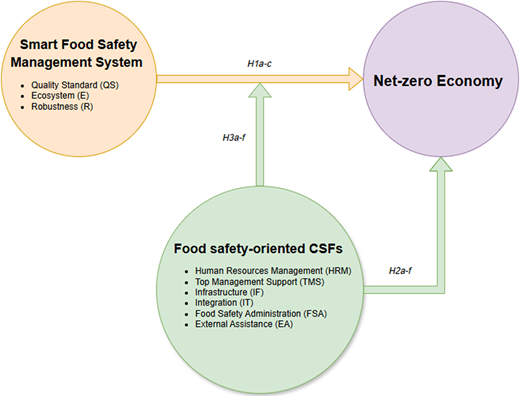
SFSMS professional standards, including Quality standards, Ecosystem and Robustness, positively influence firms' net-zero economy performance.
3.2 Food safety-oriented CSFs and net-zero economy
More recent food-safety culture research also shows that leadership behaviors and top management commitment are central mechanisms through which formal systems become sustained routines in day-to-day practice, especially in operationally dispersed settings (Taha et al., 2025). At the same time, digital traceability studies emphasize that adoption barriers frequently sit beyond the focal firm (e.g. partner readiness, data governance, regulatory alignment), underscoring the practical role of external assistance and public administration in enabling system-wide compliance (Kashyap et al., 2026). Critically, most CSF research remains largely additive, offering limited insight into whether specific CSFs amplify or dampen the effects of distinct standards-based components (QS, E, R), a gap that our moderation analysis explicitly addresses. This contingency perspective aligns with broader supply chain digitisation research showing that technology value creation depends on complementary managerial and governance practices, not technology deployment alone (Tiwari et al., 2024).
More specifically, top management support is important because it aligns resources, priorities, and implementation discipline. Studies have shown that leadership commitment ensures that resources are allocated effectively, and food safety systems are continuously improved (Bui et al., 2025). In terms of achieving a net-zero economy, top management plays a pivotal role by setting the company's carbon reduction goals and integrating these objectives into the broader strategic framework (Phelan et al., 2024). By aligning food safety goals with climate neutrality objectives, top management can drive both carbon emission reductions and economic growth, as seen through improved operational efficiency, enhanced brand trust, and long-term financial outcomes (Singh and Sharma, 2025).
HRM is equally vital for the successful implementation of food safety practices. Well-trained and engaged employees are not only crucial for maintaining food safety standards but also for adopting sustainable practices that minimize waste, reduce emissions, and optimize resource use (Kafetzopoulos and Gotzamani, 2014). Studies suggest that employee involvement in sustainable practices, such as energy management and waste reduction, significantly supports both carbon neutrality and cost efficiency (Nyarugwe et al., 2016).
IF is also a key driver in achieving both food safety and the net-zero economy. Adequate infrastructure ensures that food safety standards are met while also promoting energy efficiency and resource optimization. Investment in modern facilities and technologies leads to reduced carbon footprints and supports economic performance by improving operational efficiency (Kirezieva et al., 2015a). Thus, upgrading infrastructure not only enhances food safety but also directly contributes to carbon reduction effort.
IT enhances the ability of food companies to adopt sustainable practices and reduce carbon emissions throughout the supply chain. Collaborative and integrated supply chains improve transparency, coordination, and efficiency, which in turn helps reduce waste, lower emissions, and improve economic outcomes (Nguyen and Li, 2022). Integration across the supply chain fosters cooperation between suppliers and manufacturers, which is crucial for achieving carbon neutrality while maintaining competitive pricing and economic resilience (Despoudi et al., 2018).
EA plays an essential role in helping firms, especially in developing economies, upgrade their food safety systems and integrate carbon reduction strategies. Financial and technological support from governments, international organizations, or industry partners is critical in facilitating access to the resources needed to meet both food safety standards and carbon neutrality goals (Xiong et al., 2017).
Finally, the FSA ensures compliance with both regulatory standards and sustainability objectives. Regulatory frameworks for food safety can also drive environmental sustainability by promoting practices that reduce waste and improve resource efficiency (Rouvière and Caswell, 2012). Compliance with food safety regulations helps firms reduce risks of contamination and spoilage, which in turn reduces waste and emissions, supporting the broader goals of the net-zero economy (Lu et al., 2021). By ensuring adherence to food safety and environmental standards, the Food Safety Administration supports businesses in achieving both carbon neutrality and economic performance.
All above, the hypotheses H2a-f are proposed below:
Food safety-oriented CSFs of Human resources, Top management support, Infrastructure, Integration, External assistance, and Food safety administration positively influence firms' net-zero economy performance.
3.3 The moderating effect of food safety-oriented CSFs
The food safety-oriented CSFs play a critical moderating role in enhancing the relationship between SFSMS and the net-zero economy, particularly by influencing both economic performance and carbon neutrality. CSFs such as TMS, HRM, IF, IT, and EA ensure that SFSMS implementation is not merely compliance-driven but also aligned with broader sustainability goals. Research shows that TMS fosters a culture of sustainability and ensures that resources are directed toward both food safety and environmental targets, such as carbon neutrality (Phelan et al., 2024; Bui et al., 2025). HRM further supports the relationship by equipping employees with the necessary skills to adopt sustainable practices, thus increasing operational efficiency and reducing waste, which are essential for net-zero objectives (Kafetzopoulos and Gotzamani, 2014). Meanwhile, the integration of supply chains ensures collaboration between different stakeholders, promoting transparency and reducing emissions throughout the food supply chain (Nguyen and Li, 2022). The role of infrastructure is equally important, as modern facilities enable firms to meet both food safety standards and carbon reduction targets by improving energy efficiency and reducing waste (Kirezieva et al., 2015a, b). Furthermore, external assistance provides financial and technological resources that allow firms to adopt advanced SFSMS technologies, thereby enhancing their ability to achieve carbon neutrality and meet economic goals (Xiong et al., 2017). Finally, FSA supports the adoption of sustainable innovations, such as energy-efficient technologies and eco-friendly processes, by promoting a regulatory framework that incentivizes businesses to invest in clean technologies and sustainable practices (Kirezieva et al., 2015a, b). Additionally, the administration can provide guidance and education, which helps businesses, especially SMEs, to implement food safety practices that are also aligned with carbon reduction efforts, ensuring a smoother transition toward a net-zero economy (Rouvière and Caswell, 2012). Therefore, the presence of strong food safety-oriented CSFs moderates and strengthens the link between SFSMS implementation and the achievement of the net-zero economy, ensuring that food safety initiatives contribute to both environmental sustainability and economic performance.
Recent operations management research argues that carbon neutrality has matured into a distinct performance objective that requires firm-level theorizing on how organizations build measurement systems, process controls, and coordination mechanisms to decarbonize while sustaining competitiveness (Zhang et al., 2024a, b). Yet much of the net-zero literature remains oriented toward macro pathways and technology portfolios, offering limited insight into how standards-based enterprise control systems in regulated industries operationalize the dual objective in everyday routines. This motivates our focus on SFSMS as a digitally enabled enterprise information/control system and our examination of when performance synergies, or tensions, emerge between SFSMS x CSFs. Such assertion substantiates the following hypothesis:
Food safety-oriented CSFs of Human resources, Top management support, Infrastructure, Integration, External assistance, and Food safety administration significantly moderate the impacts of SFSMS professional standards on firms' net-zero economy performance.
All proposed hypotheses are presented in the following conceptual research model in Figure 1.
4. Research method
4.1 Research methodology
4.1.1 Sample
This study employed quantitative survey data collected from 269 food-related enterprises operating in Vietnam (n = 225) and China (n = 44) to examine the implementation of Smart Food Safety Management Systems (SFSMS). Each response was obtained from one managerial representative per firm, confirming that all 269 responses represent distinct enterprises. The target population comprised food production and exporting firms, reflecting the importance of both Vietnam and China as major food exporters in the region. Respondent selection followed a key-informant design. We targeted food-related enterprises engaged in production and/or exporting in Vietnam and China and invited one managerial representative per firm to complete the survey. Eligible respondents were those holding roles with direct responsibility for quality control/food safety compliance, supply chain, or operational decision-making, ensuring informed reporting on SFSMS routines and related enterprise integration. To ensure independence and avoid contamination, firms/managers involved in the pilot survey were excluded, and each retained response represents a distinct enterprise. Data were collected through a structured questionnaire administered via online and door-to-door surveys, ensuring wide participation across firm types, ownership forms, and market segments.
The majority of firms fall within the small and medium-sized enterprise (SME) category, confirming the study's focus on SMEs in emerging economies. Specifically, 35 firms (13%) were micro (1–10 employees), 100 firms (37.2%) small (11–50 employees), 94 firms (34.9%) medium (51–250 employees), and 40 firms (14.9%) large (>250 employees). By country, Vietnamese firms are generally smaller, while Chinese firms are more represented among medium and large categories.
Regarding ownership structure, the sample includes limited liability companies (40.9%), joint stock companies (18.2%), private enterprises (34.6%), state-owned enterprises (1.9%), cooperatives (2.6%), and a small number of others (1.9%). This composition captures a broad institutional mix representative of both countries' food production sectors.
Respondents primarily held managerial positions directly responsible for quality and operational decision-making. The largest groups were supply chain managers (31.2%) and quality control managers (29.7%), followed by CEOs/directors (8.2%), trading managers (1.9%), and others (29%). This managerial distribution ensures that responses reflect informed perspectives on firm-level SFSMS implementation.
The surveyed firms represent a diverse range of food-related sectors. The largest subsector is fishery (46.8%, 126 firms), followed by fresh fruit and vegetables (21.2%, 57 firms), dairy (9.7%, 26 firms), poultry (8.6%, 23 firms), drinks and beverages (7.8%, 21 firms), rice and grains (2.6%, 7 firms), and other categories (3.3%, 9 firms). This sectoral mix highlights the strong export orientation of the sample, especially within aquatic and agricultural products.
The firms also vary in export volumes, reflecting different levels of global market integration. Approximately 50.9% exported less than 500 tonnes/year, 23.4% exported 500–1,000 tonnes/year, 10.8% exported 1,000–2,000 tonnes/year, 4.1% exported 2,000–3,000 tonnes/year, and 10.8% exported more than 3,000 tonnes/year. Vietnamese firms generally accounted for smaller export volumes, while Chinese firms tended to export higher quantities per year.
Verification of food safety standard adherence confirms the varying degrees of compliance among the surveyed firms (see Online Appendix 1). The majority (82.9%, 223 firms) have implemented HACCP (Hazard Analysis and Critical Control Points), demonstrating strong baseline compliance with preventive safety systems. In addition, 127 firms (47.2%) are certified under ISO 9001, while 50 firms (18.6%) hold ISO 22000 certification. Fewer firms comply with international retailer or sustainability-oriented standards such as BRC (12.3%), GlobalGAP (15.2%), SFQ (7.1%), IFS (6.7%), or other standards (4.1%). Notably, China's sample exhibited higher adoption rates of ISO-based and retailer-oriented certifications, whereas Vietnamese firms more commonly focused on HACCP.
4.1.2 Development of the instrument and metrics
The process of testing for reliability and validity utilized the previously mentioned theoretical framework to identify and confine the measurement variables to representative indicators. A five-point Likert scale questionnaire was developed and revised with input from four academics, three business leaders, and two advisors. This questionnaire, ranging from 1 (insignificant) to 5 (unquestionably essential), was used in an online pilot survey involving 50 food enterprises. The pilot survey data helped to assess and remove any irrelevant or biased questions. Importantly, the firms and managers involved in this pilot stage were excluded from the final survey to prevent any response contamination and ensure data independence. This integration strengthens construct clarity upstream and enhances the explanatory power and practical relevance of the quantitative model downstream (Venkatesh et al., 2013). Further details on the research constructs and statistical analyses can be found in Online Appendix 2. In this study, the carbon neutrality construct captures perceived environmental performance based on managerial assessments of carbon-, energy-, resource-, and waste-related improvements, rather than objective emissions-accounting outcomes. Accordingly, it should be interpreted as a perceptual proxy for carbon-neutrality progress rather than a direct measure of actual emissions reductions.
4.2 Method of data analysis
The fundamental constructs of the variables, including firms' food safety practices, management-based critical success factors (CSFs), and the net-zero economy, were examined using Confirmatory Factor Analysis (CFA) to determine if the factors and variable loadings aligned with theoretical expectations. Additionally, tests were conducted to assess multicollinearity, one-dimensionality, scale accuracy, and construct validity (Hair et al., 2019). The model and hypotheses were evaluated through Structural Equation Modeling (SEM) via path analysis and the bootstrapping technique, using IBM SPSS and AMOS version 25. To obtain robust standard errors, we applied nonparametric bootstrapping with 5,000 resamples (with replacement). This resample size is commonly used to ensure stable estimation of bootstrap standard errors and confidence intervals.
To test a theory-driven network of relationships among multi-dimensional, latent constructs (SFSMS and CSFs) and two performance outcomes (economic performance and carbon neutrality), we employ covariance-based structural equation modeling (CB-SEM). SEM is preferred over separate regressions because it models latent variables with explicit correction for measurement error and estimates all structural paths simultaneously, thereby improving parameter accuracy and theory testing (Hair et al., 2019; Kline, 2023). Consistent with best practice, we establish a sound measurement model via confirmatory factor analysis (CFA), assess convergent validity (e.g. standardized loadings, AVE) and reliability, and evaluate discriminant validity using the Fornell-Larcker criterion (Fornell and Larcker, 1981; Hair et al., 2019). Given that survey indicators in organizational research often depart from multivariate normality, we use maximum-likelihood estimation with bootstrap resampling to obtain robust standard errors and confidence intervals (Kline, 2023).
To examine whether CSFs condition the effects of SFSMS on performance, we complement SEM with moderated regression using mean-centered composites and product terms. Regression-based moderation remains the standard for probing interactions, graphing simple slopes, and communicating conditional effects with clarity (Aiken and West, 1991; Hayes and Rockwood, 2020). As a robustness principle, this two-tool strategy, SEM for the main effects and structure; moderated regression for interactions, aligns with established practice in operations and management research where construct validity and interpretability are jointly prioritized (Hair et al., 2019; Kline, 2023).
5. Data evaluation and findings
5.1 Construct reliability and validity
The reliability and validity of the measurement instruments were evaluated using conventional psychometric procedures, following the methodology outlined by Hair et al. (1995). After excluding variables with non-threshold values, all remaining items were loaded onto their respective components with Standardized Regression Weights (SRWs) greater than 0.564 and R2 values exceeding 0.318, indicating that the scales met the standards for convergent validity. More specifically, the Average Variance Extracted (AVE) values ranged from 50.6% to 73.2%, while Composite Reliability (CR) scores were between 0.680 and 0.940, further confirming the construct reliability of the measurement scales (see Online Appendix 2 for details). This indicates that the constructs used in this study are both reliable and valid, supporting their suitability for analyzing relationships in the structural model.
5.2 SFSMS and net-zero economy
The analysis of the three core components of the SFSMS, e.g. QS, E, and R, from both Table 2 (economic performance) and Table 3 (carbon neutrality) reveals distinct impacts on these two objectives. The comparison shows that while SFSMS components are positively associated with carbon-neutrality outcomes, their influence on economic performance is less pronounced, suggesting that SFSMS may not fully achieve the dual objective of the net-zero economy (balancing environmental sustainability and economic growth).
The effect of QS on economic performance (Table 2) is insignificant in Model 1 (0.086) and turns negative in Model 2 (−0.151*) and Model 3 (−0.176*). This suggests that adherence to food safety standards is negatively associated with economic performance in this sample. This negative association should be interpreted cautiously. While one plausible explanation is that standards compliance imposes short-run monitoring, documentation, and coordination costs, the data does not allow us to confirm that mechanism directly. Because QS is measured as adherence to standards-based routines rather than as compliance cost, the result may also reflect ineffective implementation, reverse causality, or omitted contextual factors such as subsector heterogeneity, certification pressure, or managerial capability. We therefore treat this finding as a context-specific puzzle rather than as definitive evidence that stronger quality standards are economically harmful. Conversely, QS has a significant positive impact on carbon neutrality across all models (Table 3), starting with 0.267** in Model 1 and stabilizing around 0.105* in Model 3. This indicates that focusing on quality standards helps reduce carbon emissions, likely through improved operational efficiency and waste reduction associated with stricter food safety controls.
The E component has a positive but weak impact on economic performance in Table 2 -Model 1 (0.137*), but its influence diminishes and becomes insignificant in Model 2 (0.032) and Model 3 (−0.008). Given that E captures hygiene-enabling ecosystem conditions (e.g. facility utilities and support services, waste/sewage management, equipment suitability, materials-procurement control, and systematic cleaning/disinfection; Online Appendix 2), its primary role may be compliance and risk reduction, with economic benefits that are indirect or longer-term. In contrast, the effect of E on carbon neutrality is consistently positive and significant in Table 3, with a high coefficient of 0.332*** in Model 1 and remaining positive (0.156*) in Model 3. This strong positive impact indicates that ecosystem management practices, such as sustainable sourcing and reducing environmental impacts, significantly contribute to reducing carbon emissions and improving sustainability. Similar to QS, E has a clear positive impact on carbon neutrality but does not substantially enhance economic performance.
Lastly, R has a positive and significant impact on economic performance (Table 2) across all models. In Model 1, its coefficient is 0.237*, increasing to 0.314** in Model 3, indicating that robustness is positively associated with economic outcomes. One possible interpretation is that more robust systems may be linked to lower disruption and better operational stability, although the present design does not permit causal inference (Duong et al., 2024a, b). The effect of R on carbon neutrality in Table 3 is weaker but still positive, with coefficients of 0.109* in Model 1 and 0.152* in Model 3. Although the impact is smaller than for other components like E, R still contributes to reducing carbon emissions, likely by improving operational resilience and efficiency.
Among the three SFSMS components, R comes closest to achieving the dual objective of the net-zero economy. It has a positive impact on both economic performance and carbon neutrality, albeit with a stronger influence on economic performance. This suggests that robust SFSMS practices can support both financial stability and environmental goals, though the environmental benefits are not as pronounced as the economic ones.
5.3 CSFs and net-zero economy
The analysis of CSFs reveals mixed impacts on both economic performance (Table 2) and carbon neutrality (Table 3). Unlike SFSMS, which focuses on food safety, CSFs address broader organizational and operational aspects, offering a wider scope for achieving the dual objective of the net-zero economy (balancing environmental sustainability and economic growth). However, the results suggest that not all CSFs contribute equally to this dual objective.
The results in Tables 2 and 3 show that TMS and IT are the most effective CSFs for both outcomes. TMS has a positive and significant impact on economic performance with a standardized regression coefficient of 0.133* in Model 2 and 0.120* in Model 3 (Table 2), while also positively influencing carbon neutrality with coefficients of 0.128** in Model 2 and 0.124** in Model 3 (Table 3). The strong positive TMS coefficients suggest that more integrated systems and processes are associated with better operational and sustainability outcomes. Similarly, IT significantly enhances economic performance, with standardized regression coefficients of 0.353*** in Model 2 and 0.298*** in Model 3 (Table 2), while also contributing positively to carbon neutrality, with coefficients of 0.318*** in Model 2 and 0.233*** in Model 3 (Table 3). The strong positive IT coefficients suggest that more integrated systems and processes are associated with better operational and sustainability outcomes.
Conversely, HRM has a negative and significant impact on economic performance, with coefficients of −0.102* in Model 2 and -0.147*** in Model 3 (Table 2), and shows no significant effect on carbon neutrality, indicating that HR practices could hinder both economic and environmental outcomes. IF, while contributing significantly to carbon neutrality, with coefficients of 0.119** in Model 2 and 0.080* in Model 3 (Table 3), has an insignificant impact on economic performance, suggesting that infrastructure investments are more focused on environmental sustainability rather than directly improving financial performance. Furthermore, FSA and EA do not exhibit significant effects on either economic performance or carbon neutrality, with FSA coefficients of 0.089 in Model 2 and 0.058 in Model 3 for economic performance (Table 2), and −0.004 in Model 2 and -0.043 in Model 3 for carbon neutrality (Table 3). EA's influence is similarly negligible, with coefficients of 0.064 in Model 2 and 0.066 in Model 3 for economic performance (Table 2), and −0.019 in Model 2 and -0.014 in Model 3 for carbon neutrality (Table 3).
These findings suggest that while TMS and IT contribute significantly to both economic performance and carbon neutrality, other factors like HRM, IF, FSA, and EA either have limited impact or only contribute to one of the two objectives. Within this sample, the joint pursuit of carbon-neutrality and economic-performance outcomes appears more strongly associated with leadership and integration than with the other CSFs examined.
5.4 Moderating effects model
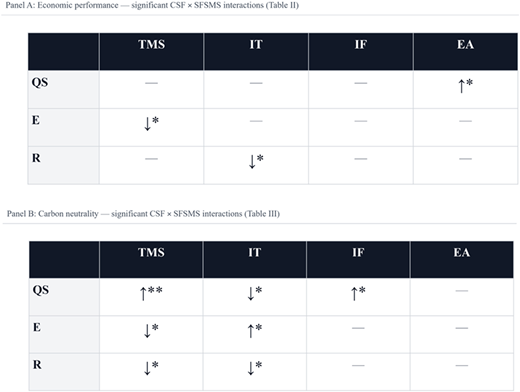
The interaction effects from Table 2 and 3 highlight how the combination of CSFs and SFSMS components impacts both economic performance and carbon neutrality, providing insight into whether these combinations can achieve the dual objective of the net-zero economy. For economic performance, the interaction between QS and TMS is positive but insignificant (0.004), indicating that the presence of strong leadership does not significantly enhance the financial benefits of implementing quality standards. Similarly, the interaction between QS and IF is negative and insignificant (−0.058), suggesting that combining infrastructure investments with quality standards may not result in financial gains. The interaction between QS and IT is positive but also insignificant (0.037), showing that although integration individually contributes to economic performance, its combination with quality standards does not lead to additional financial benefits. However, the interaction between R and IT is negative and significant (−0.113*), indicating that when both robustness and integration are emphasized, it introduces complexities or rigidities that negatively affect financial outcomes. Additionally, the interaction between R and TMS is insignificant (0.030), while the interaction between R and EA is negative and insignificant (−0.074), further suggesting that these combinations do not significantly enhance economic performance.
In terms of carbon neutrality (Table 3), the interaction effects are more varied. The interaction between QS and TMS is positive and significant (0.205**), indicating that strong top management support amplifies the positive effects of quality standards on carbon emissions reduction. Similarly, the interaction between QS and Infrastructure is also positive and significant (0.101*), suggesting that infrastructure investments complement the use of quality standards in achieving carbon neutrality, likely through energy efficiency and sustainability improvements. Conversely, the interaction between QS and IT is negative and significant (−0.12*), indicating that while integration is beneficial on its own, its combination with strict quality standards may reduce efficiency in achieving carbon neutrality due to potential over-complexity. The interaction between R and IT is negative and significant (−0.176*), suggesting that the combined emphasis on robustness and integration can hinder progress toward carbon neutrality, likely due to the rigidities and inefficiencies introduced by such combinations. Similarly, the interaction between R and TMS is also negative and significant (−0.147*), indicating that when both top management support and robustness are strongly emphasized, their interaction can reduce the overall effectiveness of carbon reduction efforts. The interaction between R and EA is negative but insignificant (−0.066), showing no substantial influence on carbon neutrality. Figure 2 summarizes the moderating effects between CSF x SFSMS.
In summary, the interaction effects on economic performance reveal that while individual factors such as IT and R are beneficial, their combined effects tend to introduce inefficiencies, particularly in the case of R x IT. This suggests that overemphasizing both robustness and integration can detract from financial performance, limiting the ability to achieve the dual objective of the net-zero economy. For carbon neutrality, the positive interaction between QS and TMS and QS and IF highlights that strong leadership and infrastructure investments can significantly enhance the positive effects of quality standards on emissions reduction. However, negative interactions involving R, particularly with IT and TMS, indicate that over-reliance on stringent systems and controls can reduce the effectiveness of sustainability efforts. Similarly, the negative and significant R × TMS interaction for carbon neutrality indicates that stronger top management emphasis does not always amplify the environmental benefits of robustness. While one possible explanation is that tighter control and standardization may reduce local flexibility in implementing process-level sustainability improvements, the present study cannot directly verify that mechanism. We therefore interpret this as a tentative, post-hoc explanation rather than a definitive conclusion, and future research should examine more directly how governance intensity shapes the environmental value of robust compliance systems.
6. Discussion
While SFSMS and CSFs play pivotal roles in driving both environmental and financial outcomes, the impacts of these systems vary in their effectiveness at achieving the dual objective of the net-zero economy: carbon neutrality and economic growth. Given the number of interaction terms tested, the moderation findings should be interpreted with caution, especially where significance is observed only at p < 0.10. Accordingly, we focus on broader patterns, such as the repeated importance of integration and top management support, and the recurring negative interactions involving robustness, rather than treating each individual interaction as equally robust.
6.1 SFSMS and net-zero economy
The findings suggest that SFSMS components are more consistently associated with carbon-neutrality outcomes than with economic performance. These findings are consistent with the findings of Madilo et al. (2024), who discovered that the costs of adhering to rigorous food safety standards are frequently high and do not instantaneously translate into financial benefits. Investments in food safety technologies and processes, while necessary for regulatory compliance and reducing environmental impacts, may require significant upfront investments that hinder short-term profitability (Cupertino et al., 2021). For instance, the negative impact of QS on economic performance reflects these challenges, supporting the notion that food safety measures are primarily compliance-driven and not economically oriented. This partly supports the hypotheses H1a and H1b oriented toward environmental benefits but does not support the direct economic benefits (H1a and H1b: QS and E have positive effect on carbon neutrality only). This pattern is consistent with evidence that environmental collaboration and controls are often associated with improvements in environmental and operational outcomes, whereas short-run profits do not always rise due to compliance costs and upfront investments (Duong et al., 2025; Tanveer et al., 2026).
The positive impact of QS and E on carbon neutrality aligns with the broader circular economy literature, which emphasizes that operational improvements tied to safety and quality controls can reduce environmental impacts, such as waste and emissions (Geissdoerfer et al., 2017; Benson et al., 2024; Binh et al., 2025). These results are consistent with the possibility that SFSMS components may be linked to sustainability through resource efficiency, contamination control, and waste reduction, although the present data do not allow causal verification. These results are supported by the findings of Yudhistira et al. (2024), who demonstrated that artificial intelligence could be leveraged to maintain food quality and minimize carbon footprint.
More importantly, the study also shows that R components stand out as the most effective SFSMS component in balancing economic and environmental goals which support the H1c hypothesis (H1c: R positively affects both carbon neutrality and economic outcome). This is in line with the argument made by Munir et al. (2020), who suggested that robust systems robust systems may be associated with lower operational disruption and better process stability, which could help explain their positive associations with financial and environmental outcomes. The positive impact of R on both economic performance and carbon neutrality suggests that the development of resilient systems can help firms manage both safety and sustainability, although the environmental benefits of robustness are not as pronounced.
6.2 Customized CSFs and net-zero economy
The findings in the investigation of CSFs fully support hypotheses H2b/H2d (TMS/IT positively impact on sustainable and economic outcomes). This is consistent with evidence that leadership commitment and supply-chain integration are core levers that translate sustainability goals into improvements in operational and business performance (Journeault et al., 2021; Duong et al., 2024a, b). Infrastructure (IF) has a positive effect on carbon but insignificant effects on economics, reflecting the logic that investments in energy-efficient infrastructure and cold-chain technology deliver environmental benefits first, which then translate, more slowly, into financial outcomes (supporting the environmental side of H2c but not the economic side).
The findings indicate that TMS and IT are the most effective CSFs for both economic performance and carbon neutrality. This is in accordance with Journeault et al. (2021), who have shown that stakeholders' support and effective leadership in sustainable objectives are essential for advancing both operational efficiency and sustainability initiatives, which in turn contribute to economic performance. The significant positive impact of TMS highlights the importance of top management in aligning business strategies with sustainability goals. Similarly, IT with partners plays a critical role in improving both financial and environmental outcomes, with Fontoura and Coelho (2022) emphasizing that supply chain collaboration allow for better resource management, leading to both green innovation, higher efficiency and sustainability. The insignificant impact of IF on economic performance, despite its positive contribution to carbon neutrality, supports the view that infrastructure investments in sustainability often focus more on reducing environmental impacts than on generating immediate financial returns (Luthra et al., 2016; Duong et al., 2023a, b). This highlights a common challenge faced by firms attempting to balance long-term environmental investments with short-term profitability.
While TMS and IT emerge as the strongest CSFs in the model, the non-significant effects of food safety administration (FSA) and external assistance (EA) should not be interpreted too quickly as evidence that these factors are unimportant. In the studied emerging-market setting, regulatory and external support systems may still operate more as compliance-monitoring or fragmented support mechanisms than as strong enabling platforms for capability building, inter-organizational learning, or access to innovation resources. Under such conditions, firms may rely more heavily on internal drivers such as top management support and integration, while public administration and external assistance remain too uneven or weakly aligned to generate measurable direct effects.
The negative HRM effect on economic performance should be interpreted cautiously. One possible explanation is that, in this context, HRM related to food safety may be implemented in a compliance-heavy way that increases training, supervision, documentation, and coordination costs without producing immediate productivity gains, especially in SMEs with limited resources. It is also possible that the measured HRM practices capture formalization intensity rather than strategic fit, so firms may be investing in generic or bureaucratic routines that add cost but do not sufficiently improve execution or sustainability outcomes. In addition, reverse causality cannot be ruled out, as weaker-performing firms may intensify HRM efforts in response to existing problems.
Beyond statistical significance, the results also vary in practical magnitude. For example, the inclusion of CSFs increases the R2 for economic performance from 0.195 to 0.327, indicating meaningful model-level explanatory gain. However, not all significant coefficients are equally important for managers. Integration (IT) is the strongest and most practically meaningful predictor because it has the largest and most consistent positive effects across both outcomes, while TMS and IF are better interpreted as modest enabling conditions. Among the SFSMS dimensions, robustness (R) appears most managerially meaningful because it is the only component associated with both economic performance and carbon neutrality, whereas the negative QS effect is statistically noticeable but moderate in magnitude and should be interpreted cautiously.
6.3 Moderating effects and combinations of SFSMS and CSFs
The interaction effects reveal that combining SFSMS components with CSFs often introduces complexities that limit their effectiveness in achieving economic performance. We found QS×IF and QS×TMS positively affect carbon neutrality (supporting partly H3b and H3c for these combinations with QS): quality standards, when backed by leadership and underpinned by infrastructure, translate into tangible emissions reductions (consistent with work on standards/ISO and environmental performance). This discovery is consistent with Mahmood et al. (2024), who determined that the attainment of sustainability objectives necessitates infrastructure investments and robust leadership support.
By contrast, several negative interaction terms indicate that the moderating role of CSFs is not uniformly positive. In particular, R×IT is negative for economic performance and carbon neutrality, R×TMS is negative for carbon neutrality, and E×TMS is negative for both outcomes. These results suggest that stronger integration or management emphasis does not always amplify the benefits of SFSMS components. However, the present data does not allow us to identify the underlying mechanisms directly. One possible interpretation is that, under some conditions, greater standardization, tighter coordination, or stronger managerial emphasis may coincide with added rigidity or coordination burden, which mirrors the findings of Kafetzopoulos et al. (2015). Future research should test these mechanisms more directly, for example by examining when governance intensity strengthens implementation and when it begins to constrain flexibility or local adaptation.
The R×TMS interaction is negative and significant for carbon neutrality, indicating that strong top-down control layered onto already robust, highly standardized systems can suppress local discretion and experimentation, the very capabilities sustainability initiatives need to deliver emissions gains, consistent with Liu et al. (2021). Similarly, the E×TMS term is negative for both carbon neutrality and economic performance, suggesting that when leadership centralizes or formalizes ecosystem practices, it can introduce coordination overload and compliance-oriented routines that slow boundary-spanning problem solving and blunt performance improvements. Together, these findings contradict H3b if it posited a uniformly positive moderating role of TMS on net-zero outcomes. Instead, they reveal configuration-contingent moderation: TMS may weaken the link between SFSMS and net-zero/economic when paired with routines that either prioritize tight control (R) or require distributed autonomy (E).
6.4 Implications
6.4.1 Theoretical implications
Our findings broadly confirm and refine circular-economy reasoning and the positive-externalities view. The two moderators of QS and E consistently raise carbon neutrality, aligning with the expectation that tighter regulations and controls reduce waste and energy intensity, hallmarks of circular resource use, while their direct economic payoffs are limited in the short run (Shang et al., 2022). In the models, QS and E are positive and significant for carbon neutrality across specifications, whereas the QS effect on economic performance is negligible or negative, indicating compliance costs may dominate near-term returns. This pattern supports the idea that food-safety compliance generates environmental benefits as positive spillovers even when immediate profits do not rise, thus complementing the theoretical claim that SFSMS can produce sustainability gains as unintended by-products of safety assurance. At the same time, the findings qualify the compliance–profitability trade-off by showing that R is the SFSMS component most capable of jointly advancing both aims. R has a clear, positive association with economic performance and a smaller but significant association with carbon neutrality, suggesting that process reliability, traceability, and nonconformity control improve risk-adjusted efficiency and, indirectly, emissions outcomes. This complements circular-economy logic (operational stability reduces waste) and extends the positive-externality lens by identifying which safety capabilities translate into dual benefits rather than only environmental ones.
Results tied to stakeholder theory are strongly confirmatory. TMS and IT, two levers that operationalize stakeholder alignment and interfirm coordination, positively affect both economic performance and carbon neutrality. Moreover, leadership and infrastructure amplify the environmental returns to quality through significant QS×TMS and QS×IF interactions on carbon neutrality. Together these patterns validate the theoretical claim that when salient stakeholders (internal leadership, supply-chain partners, and enabling assets) are mobilized, compliance systems deliver broader enterprise and societal value (Gurzawska, 2020).
However, we also uncover boundary conditions that complicate a “more is better” interpretation. Several interaction terms are negative: R×IT (economic performance) and R×IT/R×TMS (carbon neutrality) are significant and adverse, indicating that layering high robustness onto tightly integrated networks, or coupling it with strong top-down emphasis, can introduce rigidity, coordination load, or over-control that dampens returns (Tsay et al., 2018). This does not contradict stakeholders or circular-economy premises; rather, it refines them by showing that efficacy depends on fit and balance between governance intensity and system complexity.
Synthesizing across theories, the study confirms that SFSMS can act as eco-innovation infrastructure consistent with circular-economy and positive-externalities perspectives, while stakeholder mobilization (TMS, IT) is the decisive conduit that turns compliance into joint environmental–economic gains. The novel contribution is to show that the dual objective is conditional: it emerges when robustness and quality are paired with leadership and integration, and it attenuates when system controls are stacked without regard to organizational absorptive capacity or coordination costs. These insights advance the literature by moving from generic compliance narratives to a contingency view of how enterprise information systems for food safety create value for the net-zero economy.
In addition, our moderation results also suggest a configurational (contingency) logic consistent with broader organizational design thinking and the “too much of a good thing” effect. Rather than uniformly amplifying SFSMS benefits, several CSF × SFSMS interactions are negative (e.g. E×TMS, R×IT, R×TMS, and QS×IT for carbon neutrality; E×TMS and R×IT for economic performance), indicating that increasing managerial attention or technological integration does not monotonically strengthen outcomes. From an organizational design perspective, this pattern is compatible with classic tensions between control and flexibility: when standards and robustness are already elevated, additional layers of top-down support or tighter IT-enabled integration may inadvertently introduce rigidity, escalation of compliance workload, slower problem resolution, or reduced local discretion, thereby dampening the marginal value of further standardization. Theoretically, this deepens our stakeholder- and circular-economy framing by showing that sustainability value from compliance-enabled enterprise information systems depends not only on adopting professional standards, but on achieving an appropriate fit between the intensity of SFSMS components and the organization's enabling design parameters, where “more” can become counterproductive under certain configurations.
Finally, our findings are best understood through the combined lens of stakeholder theory, circular economy, and positive externalities. Stakeholder theory explains why leadership and integration matter, as firms need aligned internal and external actors to translate food safety compliance into broader sustainability action. Circular economy reasoning helps explain why QS and E are more consistently linked to carbon neutrality, as these standards-based routines improve resource efficiency, reduce waste, and support cleaner operations. The positive-externalities perspective then clarifies why these compliance activities, although not primarily designed for environmental purposes, can still generate carbon-reduction benefits. At the same time, the mixed and negative interaction effects show that these benefits are not automatic, but depend on achieving an appropriate fit between standards, governance, and system integration. In this way, the study contributes not by applying the three theories separately, but by showing how they jointly explain when compliance-driven systems can support net-zero outcomes.
6.4.2 Managerial implications
The results indicate that SFSMS are more consistently associated with carbon-neutrality outcomes but yield weaker, and sometimes negative, short-run economic returns, whereas R, supported by TMS and IT, is the configuration most likely to deliver joint environmental-economic gains. Managers should therefore reposition SFSMS from a narrow compliance cost to a platform for efficiency, risk reduction, and eco-innovation. Concretely, firms should set dual targets at the outset and embed these into annual operating plans, internal audits, and management incentives. More specially, food companies could prioritize. Robustness capabilities that are linked to lower waste and more stable yield: end-to-end digital traceability (batch/lot genealogy), statistical process control on critical control points, automated non-conformity and CAPA workflows, and predictive maintenance on energy-intensive assets. These robust tools are the most reliable levers for turning compliance into measurable operating and carbon benefits according to the findings.
Moreover, the trade-offs between SFSMS compliance and financial performance require careful resource allocation decisions. Managers should balance investments in food safety with efforts to improve sustainability and profitability, exploring external partnerships and leveraging government incentives to support carbon reduction without overburdening financial resources. The study also highlights the potential for SFSMS to generate positive externalities in the form of environmental benefits. Managers should capitalize on these externalities by communicating the environmental contributions of their food safety systems to stakeholders, enhancing the company's reputation and attracting environmentally conscious consumers and investors. Because IF supports carbon neutrality more than short-run profit, firms should evaluate SFSMS-adjacent CAPEX (sensors, data historians, energy meters, cold-chain upgrades) with life-cycle costing, shadow prices for carbon, and payback as a default hurdle. To mitigate near-term earnings pressure, combine supplier co-financing, green-credit lines, and available government incentives for energy efficiency or digital transformation. Stage investments via stage-gates tied to verified reductions in non-conformities per million, kWh/unit, and scrap/rework cost.
Additionally, food companies should recalibrate HRM to avoid cost drag and aim at better eco-innovation, given the mixed HRM effects in the study's findings. Replace generic compliance training with role-specific micro-credentials (e.g. HACCP data literacy, root-cause analytics) and tie completion to demonstrated on-the-job transfer (fewer deviations, faster CAPA closure). Shift performance management from training hours to outcome metrics and link a portion of variable pay for supervisors to the dual KPI set (carbon + cost). More importantly, the negative HRM result suggests that firms may need more than additional training or micro-credentials. Instead, managers should consider more fundamental changes, such as redesigning roles so that food safety and sustainability responsibilities are embedded in day-to-day operations, reducing overly bureaucratic compliance routines, concentrating expertise in smaller cross-functional teams, and using digital tools to reduce labor-intensive monitoring and reporting tasks. In addition, one potential way to mitigate the negative HRM burden is through open-innovation practices that allow firms to access external knowledge, training support, and implementation expertise rather than relying solely on internal human resources. In this sense, collaboration with technology providers, industry associations, universities, and other supply-chain partners may help firms strengthen employee capabilities for SFSMS and net-zero practices while reducing the internal cost pressure associated with HRM development.
Although our estimates show limited direct short-run gains from SFSMS, combining with food-focused CSFs, SFSMS can still provide their dual objectives of long-term economic and environmental benefits. Case evidence indicates meaningful conditional long-term value through market access, risk mitigation, audit efficiency, and price premia. First, certification-anchored SFSMS (e.g. BRCGS/FSSC 22000) function as retailer “gatekeepers,” expanding access to premium channels and reducing duplicative customer audits (e.g. >40% of sites reported fewer audits after BRCGS certification), outcomes that support sales growth and lower transaction costs (BRCGS, 2021). Second, robust traceability layers, especially blockchain-linked programs, shrink recall scope and speed traceback from days to seconds, reducing the financial shock of safety incidents (Walmart Inc, 2018). The economic stakes are visible in recent events: Quaker Foods North America experienced a double-digit sales decline following recalls, underscoring the cost of brand/reputation risk that SFSMS seeks to preempt (PepsiCo, Inc, 2024). Finally, consumers exhibit substantial willingness to pay for traceability attributes, meta-analytic estimates center around ∼30% price premia, creating revenue upside when SFSMS data are translated into credible on-pack claims or digital product passports (Tran et al., 2024). Together, these pathways explain how SFSMS, even when near-term P&L savings are modest, can yield material, indirect economic gains via access, resilience, efficiency, and willingness-to-pay channels.
For small and medium-sized (SME) food enterprises or SME in general, the evidence suggests prioritizing Robustness within Smart Food Safety Management Systems (e.g. digital lot/batch traceability, statistical process control at critical control points, and basic predictive maintenance) as the first mile toward simultaneous carbon and efficiency gains. Pair these with enabling top management support (clear goals, rapid feedback, and discretion at the line level) rather than coercive oversight, to avoid rigidity that can dampen environmental improvements. Where capital is limited, adopt modular, low-cost tools (cloud traceability, low-cost sensors/data loggers) and pilot on 1–2 high-risk SKUs for 90–120 days before scaling. Use supplier collaboration selectively (shared energy/waste audits with top suppliers; pooled cold-chain services) to lower per-unit costs, and sequence infrastructure investments with life-cycle criteria (e.g. simple payback ≤36 months where possible). In practice, such tools may include QR- or spreadsheet-based lot traceability, temperature and humidity data loggers at key control points, digital checklists, simple logs, and basic energy meters on cold-room or processing equipment. Operationally, the 90–120 days pilot could begin with a two-week baseline on deviations, scrap/rework, traceability time, and kWh per unit, followed by limited deployment on 1–2 high-risk SKUs, weekly review of exceptions and corrective actions, and a final scale-up decision based on payback, process stability, and waste reduction. Even if SMEs cannot implement full-scale systems immediately, exemplar cases suggest that targeted investments in certification readiness and traceability can still create value: certification-anchored systems such as BRCGS/FSSC 22000 have been associated with reduced audit duplication and improved channel access, while stronger traceability systems, as illustrated by the Walmart leafy-greens case, can materially improve recall speed and risk control.
Additionally, the interaction effects observed between SFSMS components and CSFs indicate that overemphasis on system rigidity, e.g. the combination of R and IT or R and TMS, can create operational inefficiencies. Thus, food companies could leverage TMS and IT as force multipliers but avoid rigidity. TMS should formalize a cross-functional SFSMS-net-zero Steering Group (QA, operations, procurement, sustainability, finance) with monthly reviews and clear decision rights over standards, supplier interventions, and CAPEX. On integration, connect SFSMS data with ERP/MES/WMS/EMS through modular, event-driven interfaces (rather than monolithic workflows) so plants can standardize “what” to control while keeping local discretion on “how.” This design preserves the environmental gains from quality and traceability yet limits the negative interaction we observe when R and IT are pushed to over-control.
Beyond firm-level outcomes, our findings also carry societal implications because SFSMS, when treated as a standards-based, digitally enabled enterprise information system and connected with ERP, may support more transparent and scalable operational routines. First, stronger and more reliable compliance and monitoring (especially the robustness component) can improve the integrity of food safety assurance while simultaneously supporting carbon-neutral practices, which benefits consumers through safer products and may reduce the public costs associated with food incidents and environmental externalities. Second, ERP-linked SFSMS can improve traceability and data standardization across internal functions and, where applicable, across business partners, enabling more credible reporting to regulators, customers, and other stakeholders and reducing information asymmetry around sustainability claims. Third, the moderation results suggest that these societal benefits are not automatic: “more” management pressure or tighter IT integration can, under some configurations, dampen carbon-neutral gains, implying that policy makers and industry bodies should encourage capability-building and fit-for-purpose digitalization, rather than one-size-fits-all compliance intensification. Overall, by showing conditional pathways through which compliance-enabled systems can support carbon neutrality, the study speaks to how digital governance infrastructures in essential sectors can contribute to broader public goals, e.g. food safety, trust, and decarbonization, when designed and implemented appropriately.
For policymakers in Vietnam, China, and similar emerging economies, the findings suggest that food safety regulation should be viewed not only as a compliance instrument, but also as a possible platform for process-based sustainability improvement. In particular, robustness capabilities, such as traceability, monitoring, corrective-action systems, and continuous improvement routines, come closest to supporting both carbon-neutrality and economic-performance outcomes, while top management support, integration, and infrastructure appear to be key enabling conditions. By contrast, the relatively weak effects of food safety administration (FSA) and external assistance (EA) may indicate that existing public support arrangements are not yet sufficiently aligned with the broader food-safety-sustainability transition. This suggests that regulatory systems in such contexts may still be oriented more toward oversight than toward capability building or access to external innovation resources. Accordingly, policy frameworks could move beyond general regulatory tightening by combining food safety and carbon-related goals with targeted guidance, interoperable digital standards, and support mechanisms that help firms, especially SMEs, access open-innovation resources such as training networks, university-industry collaboration, technology providers, industry associations, and shared digital platforms. In this way, public policy could play a stronger enabling role in reducing firms' internal capability burden and improving the practical contribution of food safety systems to both environmental and economic upgrading.
Finally, for the policy makers, the combination of SFSMS and CSFs found in this study can be adapted to other regulated, safety-critical sectors (e.g. pharmaceuticals/biotech, medical devices, cosmetics) by treating Smart Safety Management Systems (SSMS) as a broader class of digitally enabled, standards-based compliance–operations systems (see Table 4). However, this adaptation should be interpreted cautiously, as the present findings are derived from food-sector firms operating in two emerging-market settings with specific regulatory, operational, and institutional characteristics. Accordingly, the relevance of this framework to other industries should be treated as illustrative rather than directly generalizable, and would require sector-specific empirical validation before broader application.
Practically, (1) map SSMS components, e.g. QS, E, and R, to sector norms (e.g. GMP/ISO, IATF, RoHS/REACH) and redefine hazards/controls accordingly; (2) retain the CSFs but localize them to specific context of the targeted sectors: Top Management Support (governance and incentives), Integration (ERP/MES/LIMS/PLM connectivity), Infrastructure (sensing, energy meters, cold/clean utilities), HRM (role-specific credentials), External Assistance (auditors, consortia, finance), and Administration (regulatory bodies, notified/standards organizations); (3) pursue the dual KPI set that worked here, defect/waste intensity and energy/carbon intensity, so that compliance improvements translate into environmental and economic outcomes; (4) scale via modular integrations (event-driven interfaces and data lakes), starting with pilot value streams before plant/network roll-outs; (5) add ML for anomaly detection, blockchain where multi-party traceability is material, and digital twins for “what-if” optimization; and (6) guard against over-control (our moderation results) by designing enabling, not coercive, governance. This pathway preserves the model's core insight, that emphasizing Robustness, backed by leadership and systems integration, is most likely to yield joint environmental–economic gains, while respecting sector-specific standards, processes, and data realities.
7. Conclusion
This study contributes to the EIS literature by demonstrating how SFSMS, when supported by tailored CSFs, may function as context-specific enablers associated with net-zero-related outcomes. Grounded in circular economy principles, stakeholder theory, and CSF theory, the research provides empirical evidence from 269 food-related enterprises across Vietnam and China using structural equation modeling and moderated regression analysis. Our findings reveal that while SFSMS, especially components like Smart Quality Standards and Ecosystem Integration, are associated with carbon-neutrality outcomes, their standalone impact on economic performance is limited. However, when integrated with enterprise-level CSFs such as Digitally Enabled Top Management Support and System-Wide Integration, the effectiveness of SFSMS appears stronger. These insights underscore the importance of embedding smart food safety systems within broader enterprise digital infrastructure, supported by advanced technologies such as IoT, AI, and data analytics, to enhance strategic decision-making and system resilience.
Despite its contributions, this study has several limitations. It relies on a cross-sectional, self-reported survey, which limits causal inference and remains vulnerable to common method bias despite standard procedural and statistical remedies. The use of a single managerial respondent per firm further means that the findings should be interpreted as perception-based associations rather than objectively verified firm-level outcomes, particularly for carbon-neutrality performance. In addition, although country was included as a control variable, the analysis pools firms from Vietnam and China without formal measurement invariance testing or robust country-specific estimation; given the unequal sample sizes and possible institutional, operational, and certification differences across the two settings, the results should be interpreted as pooled associations rather than evidence of fully equivalent mechanisms in both countries. More broadly, the sample is limited to food firms in two emerging-market contexts, which may constrain generalizability across geographies, subsectors, and ownership structures, while unobserved heterogeneity and non-response bias cannot be fully ruled out. Finally, because the moderation analysis includes many interaction terms, some marginally significant effects may reflect Type I error and should therefore be treated as suggestive rather than definitive. Future research should use longitudinal or quasi-experimental designs, combine survey data with more objective operational and emissions measures, test measurement invariance and country-specific effects more directly, and replicate the moderation patterns in richer model settings.
The supplementary material for this article can be found online.