While global retailers are taking steps to improve their ecological footprint, these efforts alone remain insufficient to handle textile waste. To advance this understanding, the study identifies the antecedents that influence second-hand clothing consumption by developing a conceptual framework that draws on an extended Theory of Planned Behaviour model. In addition, the study incorporates ecofeminism to examine whether gendered perspectives play a role in shaping purchase intentions toward second-hand fashion as a form of pro-environmental behaviour that supports the circular economy.
The proposed model was tested on data collected from 610 participants. Structural Equation Modelling using AMOS 28 was employed to assess the relationships among the constructs, and multigroup analysis was conducted to examine the role of gender.
Intrinsic motivation for sustainability and environmental concerns did not directly predict pro-environmental behaviour, their effects were fully mediated by attitudes, subjective norms, and perceived behavioural control. The findings highlight the central role of TPB variables in influencing consumer behaviour. Gender, assessed through the lens of ecofeminist theory, further revealed how gendered perspectives influenced these relationships.
The study advances theoretical understanding by extending the Theory of Planned Behaviour and integrating ecofeminist perspectives. It provides a broader view of the drivers influencing second-hand clothing consumption, offering practical insights for retailers on how to position and promote second-hand fashion as part of circular economy initiatives. Importantly, it highlights how gender-based segmentation can further enhance strategies to engage diverse consumer groups in supporting sustainable consumption.
1. Introduction
The fashion and textiles industry is one of the largest global polluters, ranked as the fourth most environmentally damaging lifestyle sector in the EU (European Parliament, 2020). The global second-hand clothing market was valued at approximately $ 177 billion US dollars, and projections suggest it will continue to expand, potentially doubling to an estimated $ 351 billion by 2027 (Sepe et al., 2025). While this growth creates economic opportunities, it also intensifies the sector's environmental impact. Its complex supply chains, high consumption of energy and water, heavy reliance on chemicals, and contribution to waste, air, and water pollution all raise major sustainability concerns (Jacometti, 2019). This is problematic, as the textile chain is unsustainable from raw material sourcing to garment production, use, and eventual waste (Kleinhückelkotten and Neitzke, 2019).
Furthermore, fast fashion has encouraged consumers to overspend on non-essential clothing. While it benefits fashion companies by enabling them to release new collections at low prices, it also accelerates the obsolescence of existing garments, prompting consumers to continuously replace their clothing with new purchases (Koay et al., 2022). Second-hand clothing offers a more sustainable alternative by extending product lifecycles and supporting circular economy principles. However, its potential remains underutilized due to consumer resistance, limited awareness, and weak retail positioning (Koay et al., 2024). Despite these barriers that highlight the importance of understanding consumer motivations and behaviours toward second-hand clothing, there remains a significant gap in understanding how second-hand clothing consumption can effectively contribute to the circular economy, which is a regenerative system that reduces resource use and waste by extending product life through design, repair, reuse, and recycling (Geissdoerfer et al. (2017).
Recycling and reusing clothing are central strategies for advancing the circular economy Hultberg, 2025. Beyond reducing waste, second-hand clothing carries broader social and cultural value by fostering networks of shared practices and meanings (Norris, 2012). While some consumers consciously consider environmental impact when purchasing sustainable clothing (Harris et al., 2016), evidence suggests that sustainability is not always the primary motivation for choosing second-hand apparel. Instead, functionality, affordability, and uniqueness often serve as stronger drivers of purchase decisions. In such cases, the sustainability benefit is perceived as secondary (D'Souza et al., 2011) and requires an understanding of consumers' intrinsic motivations and intentions. This highlights the need to better understand consumer motivations and barriers, to strengthen the role of second-hand clothing in supporting sustainable consumption and the principles of the circular economy.
Against this backdrop, examining second-hand clothing provides an important avenue to understand consumer behaviour that can mitigate these impacts. Sustainability attributes and eco-friendly product claims play a crucial role in influencing consumer behaviour (Gilg et al., 2005). This is not only becoming popular in the fashion industry (Khare and Kautish, 2022) but such influences are significant, as they alert to greater environmental consciousness in product selection and recycling practices that directly contribute to environmental protection (Hartmann and Siegrist, 2017).
Furthermore, the role of gender within the scope of ecofeminism in shaping these motivations has not been sufficiently examined, even though gendered consumption patterns are well-documented in broader consumer research. Ecofeminism is part of feminism and environmentalism, exploring the relationship between women and the earth as a foundation for practice (Zein and Setiawan, 2019). Rather than positioning women in dominant roles, the theory promotes egalitarian and collaborative social structures where groups are equal (Merchant, 2005). By integrating feminism and environmentalism (Hajad and Ikhsan, 2024), ecofeminism provides a critical perspective on sustainability, particularly in consumption practices. Holy et al. (2021, p. 128) challenge whether buying “green” products alone is a sufficient response to pressing environmental issues, drawing attention to the deeper socio-cultural dynamics at play. Given that women are often primary household buyers, their consumption choices play a central role in the demand for sustainable products and waste mitigation (Agarwal, 2019). Moreover, widespread notions of women's responsibility for sustainable living highlight the gendered dimensions of environmental action. The social-ecological framework reinforces this view, recognising gender equality both as a precursor to and an outcome of sustainability (Lawless et al., 2022). Incorporating ecofeminism into second-hand clothing research is therefore valuable, as it connects gendered consumption patterns with sustainable fashion practices, revealing how women's purchasing decisions and social roles influence the TPB model in fashion.
Addressing this gap is important because it offers both theoretical and practical contributions: theoretically, it expands knowledge of consumer behavior in sustainable fashion; practically, it equips retailers with insights into demand drivers and purchase motivations that can inform strategies to promote second-hand clothing. In doing so, this research supports the development of market approaches that align with and strengthen the principles of the circular economy. The following sections present the literature review and the development of our hypotheses.
2. Literature review
The Theory of Planned Behaviour (thereafter TPB) by Ajzen (1988, 1991) has sparked considerable attention within the literature. The TPB is a psychological theory that explains human behavior through three key factors: attitudes, subjective norms, and perceived behavioural control (PBC). These factors influence a consumer's behavioural intention and are the strongest predictors of actual behaviour (Ajzen, 1988). While the list is exhaustive, the theory assumes that the intention to perform a behaviour is the best predictor of actual behaviour (Ajzen, 1991). By grounding the hypotheses in these general constructs, the study positions second-hand retail not as an isolated phenomenon but as an extension of broader consumer behavior theories.
The Theory of Planned Behaviour is useful for determining purchase design, but also for designing strategies to help consumers adopt behaviours under various contexts. Recent studies have either used or extended the TPB model under different contexts (Mclaughlin et al., 2020; D'Souza, 2022). According to the TPB (Ajzen, 1991), the intention to perform is influenced by attitudes, subjective norms, and PBC. Those with strong intentions will make an effort to perform the behaviour of buying second-hand clothing. TPB has been applied to many areas and was found to be successful for sustainable fashion consumption (Brandão and da Costa, 2021). Becker-Leifhold (2018) examined the roles of value by using the TPB. More recent research has shown that attitude, social norms, and perceived behavioural control are related predictors of the intention to accept collaborative consumption in fashion and supportive of the model (Iran et al., 2019). While the TPB's capability to predict a variety of behaviours and explain intentions (Conner and Sparks, 2002) has been successfully applied, it has not been tested on pro-environmental behaviour supporting the circular economy. In terms of the fashion industry, scholars such as Lang and Armstrong (2018) have integrated the theory of planned behaviour (TPB) to investigate fashion leadership with self-interest and social values in consumers' intention for adopting the CPSS (Clothing product-service system) in the USA.
There is limited information on consumers' willingness to participate in the circular economy (Borrello et al., 2017). While there are many definitions of the circular economy, we have used the definition offered by Geissdoerfer et al. (2017 p. 759) …. “as a regenerative system in which resource input and waste, emission, and energy leakage are minimised by slowing, closing, and narrowing material and energy loops. This can be achieved through long-lasting design, maintenance, repair, reuse, remanufacturing, refurbishing, and recycling”. Thus, indicating that the circular economy can be operationalised by extending the product lifecycle through its reuse (Geissdoerfer et al., 2017). In fashion, this regenerative system highlights how the circular economy can be operationalised by extending the product lifecycle through strategies such as design, repair, reuse, and recycling. For our study, the emphasis on reuse is particularly relevant, as it directly connects to consumers' intention to purchase second-hand products.
Studies show that the role of consumers' motivations within the context of CE demonstrated interrelationships, and consumers play an active role (Machado et al., 2019). Others showed that efficient harvesting management and internal competition for cost-effective collection are essential business drivers, while responsible consumption and its benefits offer valuable opportunities for consumers within the CE framework (D'Adamo et al., 2022). Consumers are more susceptible to buying second-hand clothing when they are provided with information verified by a third party (Pretner et al., 2021). The hierarchy of consumption behaviour concerning the circular economy shows that consumers are at the centre of the value change and second-hand products are preferred to new ones (Maitre Ekern and Dalhammar, 2019). Other research showed that consumers didn't want to purchase used clothes, despite expressing no concerns about purchasing second-hand items (Colasante and D'Adamo, 2021). There are mixed views; thus, the following paragraphs advance our hypotheses.
2.1 Pro-environmental behaviour
Pro-environmental behaviour refers to actions individuals take that are intended to minimize harm to the environment or contribute to its protection, such as recycling, conserving energy, or choosing sustainable products (Khan, 2007). It can leverage sustainable consumption, more specifically, when consumers buy second-hand clothing to support the circular economy. Research suggests that the two major requirements for an individual to function in a pro-environmental manner. First is the awareness of an individual for their actions on the welfare of others, and second is accepting responsibility for their actions on the dire consequences (De Groot and Steg, 2009). Consumers engaging in pro-environmental behaviours can be motivated by different factors and may not necessarily support all pro-environmental behaviours (Kahn, 2006). Thus, there are general pro-environmental behaviours and more specific behaviours that lend support for the circular economy. Some researchers show that environmental benefits, such as sustainability, were not regarded as significant factors (Hamari et al., 2015) and were seen more from an economic perspective rather than a change for the circular economy. Thus, further investigating pro-environmental behaviour for the circular economy (Lavelle et al., 2015) can offer more meaningful insights. To extend the Theory of Planned Behaviour model, we add environmental concerns and intrinsic motivation for sustainability and investigate it from the point of pro-environmental actions.
2.2 Environmental concern
Environmental concerns are individuals' awareness of and worry about environmental issues such as pollution, climate change, biodiversity loss, and resource depletion that are likely to threaten ecosystems, human health, and future sustainability (Bamberg, 2003). Another factor driving the popularity of sustainable consumption is that heightened environmental concern can influence consumer behavior, making it an important variable to consider. D'Souza et al. (2007) emphasize the role of consumers' environmental concerns and actions in mitigating environmental problems, while other studies have found a positive correlation between environmental concern and pro-environmental behavior (Bhaduri, 2020). Within the sustainable apparel context, the Theory of Planned Behaviour (TPB) has been widely applied to incorporate environmental concerns (Sobuj et al., 2021). Bamberg (2003) further highlights that environmental concern can serve as an indirect determinant of specific environmental behaviors, operating through situation-specific cognition. For routine decisions, consumers often rely on heuristics such as general attitudes toward environmental concerns to guide their actions. However, Bamberg (2003) also notes that environmental concerns may not have a direct effect on behavioral intention, illustrating the complexity of this relationship.
Given these theoretical insights and mixed findings, we hypothesize the following.
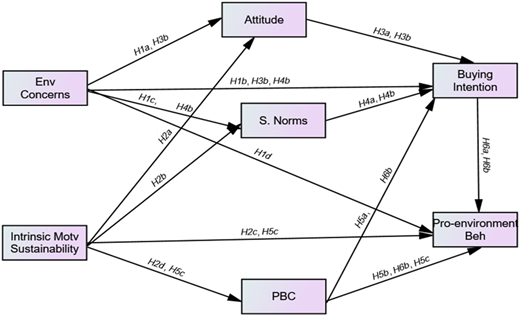
Environmental concerns positively influence attitudes toward second-hand clothing.
Environmental concerns positively influence behavioural intention to purchase second-hand clothing.
Environmental concerns positively influence subjective norms regarding second-hand clothing.
Environmental concerns are positively related to pro-environmental behaviour to support the circular economy.
2.3 Intrinsic motivational sustainability
Intrinsic motivational sustainability refers to the internal drive or personal desire to engage in sustainable behaviours or practices because they are inherently rewarding, meaningful, or aligned with one's values, rather than for external rewards, social approval, or obligations. Self-expressive and hedonic values, which align with intrinsic motivational sustainability, have been identified as important factors in second-hand clothing purchases, where consumers consider their sustainability contribution as a key value (Hur, 2020). Emotional intelligence also plays a role in these decisions (Seinauskiene et al., 2025). Hamari et al. (2015) highlight that perceived sustainability is a critical factor in forming positive attitudes toward the circular economy. They note that when consumers prefer greener consumption, it is important to operationalize intrinsic motivation linked to norms such as ecological sustainability. Intrinsic motivation can be categorized into two types: enjoyment-based, which emphasizes the personal pleasure of the behavior, and obligation-based, which emphasizes adherence to norms, rules, or principles (Van der Werff et al., 2013). In this study, we focus on the latter.
Sustainable consumers demonstrate high purchase intentions for environmentally friendly products, with sustainability serving as a major antecedent to buying second-hand clothing (Ek Styvén and Mariani, 2020). Intrinsic motivational sustainability captures the internalised is therefore relevant, as it influences sustainable behavior (Butt et al., 2017). Similarly, Evans et al. (2022) found that higher ecological consciousness is significantly associated with second-hand shopping behavior, a finding supported by other studies (Ferraro et al., 2016). Following the logic that consumers act in line with their sustainable values (Rausch and Kopplin, 2021), we propose that intrinsic motivational sustainability is likely to have direct effects on attitudes, subjective norms, perceived behavioral control (PBC), behavioral intention, and pro-environmental behavior.
Intrinsic motivation for sustainability positively influences attitudes toward second-hand clothing.
Intrinsic motivation for sustainability positively influences subjective norms regarding second-hand clothing.
Intrinsic motivation for sustainability positively influences pro-environmental behaviour.
Intrinsic motivation for sustainability positively influences perceived behavioural control toward second-hand clothing.
2.4 Attitudes
Attitudes are dispositions toward behaviour, and the stronger the attitudes, the more predictable the behaviour (Conners and Sparks, 2002). Instead of relying solely on semantic differential scales, selective adjectives may be employed to test dimensionality through methods such as the Guttman-scale (Brinton, 1961). Attitudes reflect judgments along dimensions, for example, wise–foolish or enjoyable–unenjoyable. Since attitudes are evaluative dispositions that influence behavior, adjectives describing second-hand clothing such as cool, good, flattering, proud, and confident are often used. Prior research generally reports positive attitudes toward second-hand clothing and purchase intentions (Rendel, 2021; Seo and Kim, 2019; Koay et al., 2024; 2022; Hamari et al., 2015), although negative attitudes have also been documented (Guiot and Roux, 2010).
The Theory of Planned Behavior suggests that a positive attitude toward performing a behavior precedes and shapes behavioral intention, and attitudes can also serve as mediators (Ajzen, 2020). Empirical studies indicate that attitudes mediate the relationship between sustainability and purchase intention, highlighting an indirect effect (Gidaković et al., 2022). Similarly, attitudes mediate the relationship between environmental concerns and behavioral intentions. While general attitudes may not directly cause specific behaviors, they exert an indirect influence on actions (Bamberg, 2003). Accordingly, we anticipate both direct and indirect effects of attitudes toward second-hand clothing and propose the following hypotheses.
Consumer attitudes positively influence buying intention towards second-hand clothing.
Attitudes positively mediate the relationship between environmental concerns and buying intention.
2.5 Subjective norms
Subjective norm refers to an individual's perception of social expectations regarding a behavior. In the context of second-hand clothing, subjective norms reflect perceived pressure from significant others such as peers, family, and reference groups regarding the desirability of purchasing second-hand items (Ajzen, 2020). This social pressure significantly influences consumer behavior and motivation to comply, though it may vary across individuals, situations, and behaviors. Individuals can be directly asked whether the people most important to them would approve of their purchase of second-hand clothing. Empirical evidence indicates that injunctive norms positively influence purchase intention for second-hand clothing (Rendel, 2021; Koay et al., 2024; 2022).
However, purchasing second-hand clothing can involve perceived social risk, with subjective norms also exerting indirect effects on purchase intention (Seo and Kim, 2019). Social pressures have been shown to influence pro-environmental behaviors more broadly (Truelove and Gillis, 2018). This social validation is particularly relevant for buying intentions: if a consumer's social network supports circular economy values, it is likely to enhance their intention to purchase second-hand clothing. Based on this, we propose the following hypotheses.
Subjective norms have a direct positive influence on buying intention for second-hand clothing.
Subjective norms positively mediate the relationship between environmental concerns and behavioural intention.
2.6 Perceived behavioural control (PBC)
Perceived Behavioral Control (PBC) refers to an individual's perception of their ability or ease in performing a specific behavior, reflecting both self-confidence and control over external factors that may facilitate or impede the behavior (Ajzen, 2020). The underlying control beliefs form the basis of PBC: the more resources and information consumers perceive themselves to have, the greater their perceived control over the behavior (Ajzen, 2020). PBC is also expected to predict behavior when consumers are confident in evaluating their skills, resources, and other prerequisites required to perform the behavior (Ajzen, 2020; Ajzen and Madden, 1986). In the context of second-hand clothing, this rationale implies that consumers who feel capable of navigating the second-hand market are more likely to engage in purchasing behavior.
Empirical findings regarding PBC and second-hand clothing are mixed. Some studies report non-significant effects of PBC on purchase intention (Seo and Kim, 2019; Rendel, 2021), whereas others find a significant relationship (Koay et al., 2022; da Silva, 2020). This inconsistency may reflect the perception of second-hand clothing as a niche market. Integrating the theoretical rationale of PBC with the specific characteristics of the second-hand market, we argue that PBC is likely to influence both buying intention and pro-environmental behavior. In support of this argument, we propose the following hypotheses.
PBC positively influences buying intention towards second-hand clothing.
PBC positively influences pro-environmental behaviour for the circular economy.
2.7 Buying intention
Buying intention refers to a consumer's conscious plan or likelihood to purchase a specific product or service in the near future, often influenced by attitudes, beliefs, and external factors (Ajzen, 2020). Past and current behavior have been examined as measures while controlling for the Theory of Planned Behavior (TPB). For unstable TPB cognitions, past behavior is often a significant predictor, as cognitions typically precede behavior (Conner and Sparks, 2002; Ajzen, 2020). However, forming an intention does not always guarantee that consumers will purchase second-hand clothing, as other factors such as price, quality, and product characteristics may prevent the behavior. Consumers purchase second-hand clothing for reasons including affordability, uniqueness, environmental considerations, and the desire to experiment (Norum and Norton, 2017). To assess whether buying intention serves as a necessary condition for action within the TPB framework, we propose the following hypotheses.
Buying intention positively influences pro-environmental behaviour for the circular economy.
Buying intention positively mediates the relationship between PBC and pro-collaborative consumption behaviour for the circular economy.
Based on the above discussion, in Figure 1, we present the following hypothesised conceptual model.
3. Measures
This component forms part of a larger study and was carried out by a professional market research firm, ensuring methodological rigor and the reliability of findings. Operationalisations of the variables in the conceptual model were founded in the literature reported in consumer and marketing journals. We employed self-reported measures using a series of adjectives describing the attitudinal object, with responses rated on a Likert scale. These scores reflected the degree of favourableness or unfavourableness toward the object, thereby capturing participants' attitudes. This was used to take advantage of the specificity of the statement-based approach on how I feel about second-hand clothing (Chapman, 2003). The other items that were used to measure the Theory of Planned Behaviour components survey instrument were standard measures adapted and taken from (Ajzen, 2020). Sustainability was assessed by five items adopted from (Hamari et al., 2015). Polonsky et al. (2012) used general pro-environmental behaviour scales as their focus was on self-report behaviour. We believed this would be useful for our study and modified the measures to suit this study by referring it to the CE. The intent here is to identify pro-environmentalism as a precursor for the circular economy. Environmental concern was evaluated using scales from Rausch and Kopplin's (2021). These were anchored on a 7-point Likert scale (where 1 = strongly disagree, 7 = strongly agree). Table 1 analyses the descriptive statistics for the demographics below. There is an equal distribution presented in the table.
3.1 Model estimation
This two-stage approach was adopted to assess the quality of the measurement items prior to proceeding to the structural model stage (Scherer et al., 2019). We first used exploratory factor analysis (EFA) to check the data and all measurement items loaded on intended factors with reasonable loading. SEM (AMOS 28) was used to analyse the data. All items, except one, were included. CFA (Confirmatory Factor Analysis) showed a reasonable model fit for both models, considering sample sensitivity and model complexity as seen in Table 2.
3.1.1 Model
Given that the TPB model reveals reliable justification, we proceed with adding two more variables as antecedents, i.e. environmental concerns and intrinsic motivational sustainability. We extended the TPB model to include sustainability and environmental concerns. The Chi-square showed a reasonable model fit considering sample sensitivity and model complexity (χ2 752.702), df 265; PCMIN/DF = 2.840, the root means squared error of approximation [RMSEA] = 0.055; the confirmatory fit index [CFI] = 0.97; Tucker–Lewis index [TLI] = 0.96), Convergent validity was established by investigating the magnitude, direction, and statistical significance of the factor loadings. All of these were above 0.70, the average variance extracted (AVE) values were above 0.5 and the CR values were well above 0.7; all of which support convergent validity (Scherer et al., 2019).
Following the confirmation of the measurement model, the structural model was examined to test the estimated hypotheses. Table 2 includes the measures' operational indicators, along with the Average Variance Extracted (AVE) and CR measures. The reported factor loadings are all above 0.70 and within the acceptable level. The AVEs are all above 0.5 and CR values above 0.70, thus confirming convergent validity. In Table 3, we show the square roots of each AVE construct in the diagonal, indicating that the square root of each AVE construct was larger than its correlation with other constructs. We were able to establish discriminant validity (Fornell and Larcker, 1981).
To obtain the parsimonious fit between the data and the model, the exogenous latent variable was co-varied (Kline, 2005). The fit indices of the full structural path model showed a reasonable model fit (χ2 5.872) df 2, RMSEA = 0.056, GFI = 0.99; AGFI = 0.96; IFI = 0.99, TLI = 0.98, and CFI = 0.99. The model explains 72% of the variances for purchase intention and 54% of the variance for pro-environmental collaboration consumption which is a good fit.
Table 4 shows the standardised β, t-value, level of significance (p), and hypotheses. The results indicate many of the above hypotheses were supported, except for hypotheses H4a, H1b, H2c and H5b. There is a positive and significant direct relationship between environmental concerns and attitudes (β = 0.137, p = 0.001), subjective norms (β = 0.121, p = 0.05), and pro-environmental behaviour (β = 0.601, p = 0.001), thus supporting H1a, H1c and H1d. This confirms that consumers' awareness of environmental issues influences both their mindset and behaviour towards sustainable consumption. On the other hand, there was also a significantly positive direct relationship between intrinsic motivation for sustainability and PBC (β = 0.681, p = 0.005); attitudes (β = 0.532, p = 0.000); subjective norms (β = 0.509, p = 0.000). Therefore, supporting H2d, H2a, and H2b. This highlights the importance of internalised sustainability values in driving intentions and shaping social and cognitive factors related to consumption.
Attitudes were found to be positively significant on behavioural intention (β = 0.547, p = 0.000), supporting H3a. This confirms that positive perceptions of second-hand clothing are a key determinant of intended behaviour. Hypothesis H5a was also supported. PBC was also found to be significantly positive on behavioural intentions (β = 0.464, p = 0.001), which suggests that confidence in one's ability to purchase second-hand clothing plays an important role in outlining actual intentions. H6a was also supported by behavioural intentions found to be significantly positively related to pro-environmental behaviour (β = 0.256, p = 0.000). reinforcing the role of intention in translating cognitive and motivational factors into actual behaviour. showing which factors are most influential for encouraging second-hand clothing consumption and guiding strategies for retailers to promote sustainable behaviour.
Table 5 shows the Total, Direct, and Indirect effects. To establish the Indirect Effects, the research uses AMOS 27 mediation bootstrapping analysis using 5,000 bootstrap samples with 95% bias-corrected bootstrap confidence intervals and two-tailed significance.
Regarding mediating effects, hypothesis, the following hypothesis, only two of the three hypotheses were supported and significant.
H3b: Attitudes positively mediate the relationship between environmental concerns and buying intention – Fully mediates, thus supports H3b.
H4b: Subjective norms positively mediate the relationship between environmental concern and behavioural intention – fully mediates, thus supports H4b.
H6b: Buying intention positively mediates the relationship between PBC and pro-collaborative consumption behaviour. Fully mediates, thus supports H6b.
Subjective norms, attitudes and buying intention had full mediating effects. These results are discussed in the preceding paragraph.
4. Multi-group analysis
Multigroup analysis will identify whether there are gender differences and whether females support ecofeminism in terms of sustainable consumption of second-hand clothes. These findings will equip us to provide recommendations as gender plays a crucial role in the circular economy. There are not only differences in gender in the amount and type of consumption in sustainability; but also stereotypes in gender and norms that determine how men and women think regarding a subject matter and how they choose to act (Bloodhart and Swim, 2020). Older females are more inclined to support buying sustainable products (Kim and Jin, 2019). Furthermore, gender research is equally important when attempting to achieve a more equitable society. Gender issues also fulfil two UN sustainable development goals, one is achieving gender equality and empowerment, and the second goal is reducing our ecological footprint (Bloodhart and Swim, 2020), understanding this is useful for retailers.
Gender differences have been noticed; women expressed greater pro-environmental actions than men (Kennedy and Kmec, 2018). More recent results show that gender did not show any significant difference (Bizuneh et al., 2021). However, other research indicates females are expected to purchase more second-hand clothing and are more inclined to buy second-hand fashion clothing on social media or other online platforms (Markova and Grajeda, 2018). Investigating whether there is an observable difference between males and females will provide insights for retailers to develop more cutting-edge circular economy strategies targeted to these groups.
5. Measurement invariance
Byrne (2010) requests to test the confirmatory factor analysis with each of the gender groups to acknowledge some element of the fit. The use of configural, metric, and scalar invariance is therefore necessary. The invariance test output is examined by considering the difference in the χ2 (Δχ2) value. The estimates for Δχ2 and ΔCFI ≤0.01 of the two nested models should indicate support for invariance testing (Byrne, 2010; Cheung and Rensvold, 2002). Only the configural and metric variance were tested, the scalar invariance was not examined at this point (Steenkamp and Baumgartner, 1998). The intercept of one item caused an increase in the chi-square value. Thus, we deleted that item and considered the partial scalar invariance. After this, the test for the structural model is examined by comparing multigroup with the same model.
6. Analysis
The two-step method was used to examine the multigroup comparison test. The outcome of this analysis shows significant differences between the structural weight model and the measurement weight model (Δχ2 = 13.658, Δdf = 13, p > 0.05), there is an insignificant Chi-square difference suggesting that the models were invariant. Indicating that there are no differences between genders. The unconstrained model was retained for further analysis. The model shows differences in the path levels. The structural path from PBC to pro-environmental behaviour; intrinsic motivational sustainability to pro-environmental behaviour; subjective norms to behavioural intentions and environmental concerns to behavioural intentions for males and females showed non-significant outcomes. Males also had non-significant outcomes for structural paths from environmental concerns to attitudes, and subjective norms to behavioral intentions.
This indicates that people and peers' influence does not affect environmental concerns and buying intentions for second-hand clothing. This also indicates that environmental concerns do not explain the general attitudes when second-hand clothes are examined for male consumers, while for females this is significant.
In Table 6, the structural path from intrinsic motivational sustainability to PBC was significant and was much higher for the females than males ((β = 0.689, p < 0.001: β = 0.672, p < 0.001), however the structural path of intrinsic motivational sustainability to attitudes (β = 0.490, p < 0.001; β = 0.584, p < 0.001 respectively) and subjective norms were significantly much higher in the males than females (β = 0.484, p < 0.001) and (β = 0.540; p < 0.001) respectively. The structural path of attitudes to behavioural intention was also marginally higher for males (β = 0.528, p < 0.001; β = 0.581, p < 0.001). The structural path of PBC and behavioural intentions were higher for females than males (β = 0.482, p < 0.001; β = 0.458, p < 0.001). The structural path of Behavioural Intentions with pro-environmental collaborative consumption was higher for males (β = 0.243, p < 0.001; β = 0.273, p < 0.001), and lastly environmental concerns and Pro-environmental collaborative consumption structural paths were slightly higher in the case of males than females (β = 0.568, p < 0.001; β = 0.634, p < 0.001).
7. Discussion
The purpose of this study was to examine the psychological and motivational drivers such as environmental concerns and intrinsic motivation for sustainability, in the TPB model for purchasing second-hand clothing. The study also sought to explore how these drivers align with circular economy principles and broader sustainability frameworks, including ecofeminism. To improve the predictive ability of the model, Ajzen (2020) suggests the inclusion of other predictors if there is theoretical support for their inclusion. These two factors: environmental concern and intrinsic motivation for sustainability, were included to improve the theoretical rigor and sufficiency for understanding buying decisions of second-hand clothing.
7.1 Extended model
The extended model demonstrated intrinsic motivation for sustainability concerning the TPB variables, i.e. attitudes, subjective norms, and PBC were all significant (H2a, H2b, and H2d). This is supportive of Ek Styvén and Mariani's (2020) findings that found perceived sustainability influences attitudes toward second-hand clothing. Intrinsic sustainable motivation is likely to influence attitudes towards second-hand clothing, while attitudes are likely to shape human behaviour, based on a positive relationship between attitudes and behavioural intentions (H3a). Taken together, the results highlight that internal motivation for sustainability plays a foundational role in influencing the cognitive and social components of TPB, which in turn guide behavioural intentions. This signifies the importance of targeting intrinsic motivations in promoting pro-environmental behaviour through second-hand clothing consumption.
7.2 PBC
Ajzen (1991) is of the view that attitude is a stronger contributing factor than the other two. In our case, it was PBC that claimed to be stronger than attitudes and subjective norms. Thus, the sustainability influence on PBC should be considered an important factor to support the circular economy. Strengthening PBC implies enabling consumers to feel capable and confident in purchasing second-hand clothing. This can be achieved by creating more accessible opportunities, such as increasing the availability of conveniently located outlets, implementing supportive policies, or providing financial incentives. Such measures would not only empower consumers but also encourage broader participation in second-hand clothing markets, thereby contributing to a sustainable circular economy.
7.3 Intrinsic motivation
Interestingly, intrinsic motivation for sustainability was not found to significantly influence pro-environmental collaborative consumption in the context of second-hand clothing. This suggests that consumers may be driven more by economic motivations rather than environmental concerns when purchasing second-hand apparel. An alternative explanation lies in psychological barriers, such as social embarrassment, feelings of disgust, or fear (Hur, 2020; Laitala and Klepp, 2018). However, these negative perceptions are less prevalent when it comes to vintage or luxury second-hand clothing, which are often associated with status and uniqueness (Fischer, 2015). Encouragingly, recent studies point to a shifting consumer mindset, with growing acceptance and positive attitudes toward second-hand fashion (Machado et al., 2019; Lang and Zhang, 2019). This indicates that while intrinsic sustainability motivations may be weak drivers, changing social norms and evolving consumer perceptions are gradually reshaping the appeal of second-hand clothing.
7.4 Subjective norms
Subjective norms were found to significantly influence behavioural intentions (H4a). This highlights the importance of social communication with significant others, such as peers and family, in shaping consumer attitudes toward second-hand clothing. Strengthening positive expectations and ideals around sustainable fashion can help normalise second-hand purchases. To foster growth in the circular economy, greater emphasis should be placed on social change initiatives that highlight sustainability-oriented behaviours as desirable, aspirational, and mainstream. Retailers, in particular, can play a pivotal role by framing second-hand clothing not merely as an alternative, but as a socially valued and environmentally responsible choice.
7.5 Mediating effects
Perceived behavioural control (PBC) was not found to have a direct effect on pro-environmental collaborative consumption; however, intention to buy fully mediated this relationship. This aligns with prior studies where buying intention has been identified as a critical mediator linking antecedents to behaviour (Jaiswal and Kant, 2018). Similarly, attitudes and subjective norms were found to fully mediate the relationship between environmental concerns and behavioural intentions. Moreover, attitudes showed a strong positive association with buying intentions, reinforcing their central role in predicting consumer behaviour. These findings highlight that attitude formation is essential for influencing purchasing behaviour and remains one of the most reliable predictors of second-hand clothing consumption.
7.6 Environmental concerns
Environmental concerns and behavioural intentions were not directly significant but operated through the mediating effects of TPB variables. Notably, environmental concerns were significant for pro-environmental behaviour in the case of pre-used clothing, indicating strong support for resource conservation, which underpins collaborative consumption. However, intrinsic motivation towards sustainability did not significantly influence pro-environmental collaborative consumption. This suggests that consumers do not perceive buying second-hand clothing as an act that meaningfully benefits the environment. A possible explanation is that the environmental damage is seen as already embedded in the initial production process, with second-hand purchases viewed merely as prolonging the product life cycle rather than substituting for new production. Similar patterns have been observed in prior studies, where second-hand clothing decisions were not strongly tied to environmental considerations (Colasante and D'Adamo, 2021; Silva et al., 2021). This is a critical finding, raising the need for further research into why consumers fail to associate second-hand clothing with environmental contribution. It also highlights an urgent need for retailers to adopt persistent strategies such as subsidies, awareness campaigns, and clear communication of non-monetary benefits to strengthen the environmental narrative around second-hand fashion.
7.7 Gender
Regarding gender, environmental concerns were found to influence attitudes more strongly among females than males, while other hypotheses were equally supported. While our results indicate no significant differences between male and female consumers in certain aspects, this provides an opportunity for retailers to develop unified strategies that can appeal across genders. Examples include emphasizing the economic value of high-quality second-hand clothing, highlighting style diversity, and promoting ease of access (such as curated online platforms). These strategies can be effective for both menswear and womenswear markets, while niche targeting can still be pursued where subtle differences may exist.
This research is important because it extends understanding of how sustainability motivations and TPB components jointly shape consumer purchase intentions in second-hand clothing markets. While prior studies (e.g. Hamari et al., 2015; Guiot and Roux, 2010) established that sustainability concerns can influence pro-environmental behaviour, our findings demonstrate that these effects are not uniform across all consumer segments. By showing that TPB components account for a substantial proportion of the variance in purchase intention (77.3%), the study provides strong evidence of their predictive power, underlining the relevance of attitudes, norms, and perceived control in driving sustainable fashion choices. Furthermore, by capturing the more modest role of satisfaction (4% of variance), the research highlights the need to differentiate between intention and post-purchase experiences. Collectively, these insights contribute to both theory and practice: theoretically, by refining understanding of behavioural drivers in sustainable consumption, and practically, by equipping retailers and policymakers with actionable knowledge to design targeted interventions that encourage adoption of second-hand fashion.
8. Strategic implications for practitioners
For practitioners, ensuring a consistent flow of second-hand clothing requires encouraging customers to recycle and donate their garments. Understanding the factors that shape donation behaviour is critical, as it not only sustains stock levels but can also yield unique, one-off pieces that enhance store appeal. Retailers can further strengthen sales by creating variety and sparking consumer curiosity, since rare or unexpected finds add perceived value (D'Souza, 2022). Offering one-size or limited items can be positioned as “exclusive discoveries,” tapping into the thrill of rarity. Since PBC was considered an important factor, retailers can take advantage of the time and money factors. Retailers can reduce perceived time barriers by streamlining the shopping experience. For example, integrating second-hand clothing sections within mainstream retail stores or online platforms would make products more accessible and quicker to purchase. Since the buying intention relationship was significant for pro-environmental behaviour, there is an opportunity for retailers to recycle their own bands under the same roof or align or co-brand with charities (Hagtevdt and Patrick, 2016). Enhanced search functions, categorization, and curated collections can also reduce the time required to locate items. Furthermore, regarding money, PBC can also be strengthened through pricing strategies that reinforce affordability. Transparent value-for-money communication (e.g. durability, uniqueness, and environmental benefits) helps consumers feel financially capable of purchasing second-hand clothing. Loyalty programs, discounts, or bundled offers may further reduce the perceived economic burden.
Our research reveals that buying intention positively influences pro-environmental behavior for the circular economy, thus two purchase characteristics can be highlighted to create need recognition, one is the compromise needed to buy a sustainable product, and the other is the trust in the sustainability of the product. Positioning strategies would help build consumers' confidence. Many consumers associate second-hand clothing with negative stereotypes (old, worn, unhygienic), positioning second-hand clothing as trendy, sustainable, and socially responsible re-frames the category as aspirational. In the case of high-quality second-hand clothing, buying high-quality second-hand fashion allows consumers to access luxury at lower cost, benefit from durability, retain resale value, and enjoy exclusivity making it both an economically smart and status-enhancing choice.
Lastly, retailers need to be aware that consumers are turning towards second-hand retail stores and platforms to purchase fashion goods (Evans et al., 2022). Either this could be a lost opportunity or an opportunity for retailers to recycle their merchandise through different outlets which would support sustainability. This shift promises market advantages, as all actors not only respond to the growing consumer demand but also become accountable and responsible to facilitate changes.
9. Limitations and future research
The findings should be viewed in light of the following limitations. Although the sample was diverse, there could be groups that were underrepresented. Future research could include these groups. Including consumers with other contextual variables can offer a broader explanatory power of the model (D'Souza et al., 2022). We control for the economic effects, and the trust of the service provider was not included, future research can use trust within the TPB framework, as it emanates as an important finding (Armstrong et al., 2015), and include the economics of buying second-hand, if the retailers have an intent of measuring it.
Future research should further explore store choice in second-hand fashion, particularly considering concerns around stigma and cleanliness. Differences may exist for second-hand luxury brands, which consumers often view as investments, with willingness to pay less steeply affected compared to new items. Consumer contamination theory could provide valuable insights into these behaviours. Generational differences also warrant further investigation. While this study found no significant differences between older and younger cohorts, consistent with prior research (Ajitha and Sivakumar, 2019). Examining diverse age groups could help retailers identify ways to attract broader segments. From a sustainability perspective, ecofeminism highlights that environmental responsibility and sustainable consumption are not confined to a single gender; our findings showed no differences between male and female consumers. Additionally, second-hand luxury items can carry deep personal meaning, sometimes fostering closer attachment than brand-new luxury products (Turunen and Pöyry, 2019), which presents an opportunity to explore recycling and reuse behaviours through both ecofeminist and circular economy lenses.
We want to acknowledge the late Dr Mehdi Taghian from Deakin University, whose contributions at the onset of this project were invaluable. Dr Taghian played a significant role in shaping the early direction of this research, and we are grateful for their insight and dedication. This work is, in part, a tribute to their memory and scholarly legacy.