


This study aims to investigate the role of consumer emotional intelligence in view of perceived value and behavioural intentions for online second-hand clothing renting or purchasing.
Norstat and Amazon MTurk were used to collect data and administer an online survey among European respondents (N = 473) from the UK and LT.
We found that emotional intelligence positively influences the perceived emotional, economic, green, social, and functional value of second-hand clothing transactions online. As hypothesised, we found that emotional, economic, and green perceived values of second-hand clothing transactions online mediate the relationship between emotional intelligence and behavioural intentions. Although emotional intelligence boosts perceived social and functional value, it does not translate into behavioural intentions.
Our research utilises the construal level theory to propose novel explanations by looking into the nuanced relationship between emotional intelligence and the value consumers perceive from purchasing or renting second-hand clothing online and their respective behavioural intentions.
1. Introduction
Consumers are becoming increasingly aware of the of the fashion industry’s environmental and ethical impact (Papasolomou et al., 2023). Excessive production and waste from fast fashion contribute significantly to pollution and resource depletion (Geneva Environment Network, 2023; Stallard, 2022). This awareness translates into a demand for more sustainable practices. Second-hand clothing offers a readily available alternative, reducing the need for new clothing production (Bairrada et al., 2024).
Despite growing interest in consumer behaviour in the context of second-hand clothing, scholars have gained little insight into why and how consumers make more sustainable decisions (Bairrada et al., 2024) and, thus, requires further attention from researchers. Moreover, with increasing attention to how to address environmental pollution (Papasolomou et al., 2023), practitioners are becoming increasingly eager to promote sustainable consumption among consumers through increasing the perceived consumer value of second-hand clothing (Ki et al., 2024). The second-hand clothing market currently carries a social stigma as not all individuals are comfortable with second-hand clothing acquisition and they do not see much value in purchasing such clothing (Silva et al., 2021; Fernando et al., 2018). The traditional perception of second-hand clothing can be negative, associated with being worn-out, out-of-style or lacking quality (Valor et al., 2022).
Understanding emotional intelligence (EI) in this context becomes surprisingly relevant, encouraging consumers to choose second-hand clothing options. Individuals with high self-awareness are more likely to prioritise circular consumption (Aycock et al., 2023). They understand the emotional satisfaction that comes from making responsible choices. Prior research has primarily focused on personality traits, such as Big Five, and their connection with perceived consumer value and intentions (Guido et al., 2015; Fanea-Ivanovici et al., 2023). Identifying how individual differences in terms of consumer EI relate to perceived value and behavioural intentions has received less attention among academics. Since we do not know yet what specific predictors influence circular consumption, our study raises the following research questions:
What are the values that consumers associate with second-hand clothing renting or buying online?
What is the effect of emotional intelligence on consumer perceived value in the context of second-hand clothing renting or buying online?
How does perceived consumer value of second-hand clothing renting and buying online affect behavioural intentions of individuals associated with purchasing or renting second-hand clothing online?
2. Theoretical background
Theoretical background will introduce construal level theory, including consumer ideologies in purchasing decisions and emotional intelligence. The section will then move to introducing perceived value and behavioural intentions and will conclude with the development of the hypotheses.
2.1 Psychological barriers: leveraging consumer ideologies
While consumers recognise the economic and environmental benefits of second-hand clothing (Hur, 2020), academic research reveals that one of the most important obstacles to purchasing reusable clothing is the perceived “stigma” associated with second-hand clothing (Valor et al., 2022), which is attributed to the cultural meanings of second-hand clothing as low-status goods and the perception of “negative contamination” (Hur, 2020). The belief that second-hand clothes may be of poor quality or outdated activates disgust, fear and confusion and these emotions can explain consumer resistance to purchasing such clothing (Silva et al., 2021; Valor et al., 2022). When buying online, additional factors, such as purchase uncertainty, lack of trust towards the online platform and the poor perceived quality of that product (Calvo-Porral et al., 2024) are actualised. These barriers may imply that consumers who unfavourably approach second-hand clothing could be susceptible to construing those goods in more concrete terms. Fear of contamination and belief about poor quality or outdatedness ascribed to those goods may demonstrate the focus on the object’s more specific details that exemplify the low-level construal. In contrast, preferences for second-hand clothing might be attributed to the specific mindset of consumers, who can construe second-hand items at a higher level of abstraction. Such consumers deliberately assign desirable meanings to the purchased objects, thus evidencing that they exhibit the mindset adept to abstract thinking and the ability to envision the broader implications of purchasing or renting second-hand clothing.
Schmitt et al. (2022) describe consumer ideologies as action-oriented ideas shared by individuals with certain values, beliefs and identities. As a result, the manifestation of consumer ideologies in behaviour is justified since they arise from the conflict between consumer desires and the system of consumerism. In today’s modern context, this is associated with identity conflict, which is especially noticeable when it comes to consumer desires and their socially and environmentally responsible decisions (Giesler and Veresiu, 2014). This echoes the case of second-hand clothing, which represents the field of ethical consumption. The conflict between consumer desires and consumerism in this field is based on the ethical consumption “gap” ideology (Carrington et al., 2016).
The growing body of evidence suggests that consumption practices can have ideological origins and potentially shape social conditions. However, ideologically motivated consumer behaviour would hardly be imaginable without the high construal-level mindsets of consumers. High-level construal individuals view action goals as superordinate. They are more concerned with why the action is taken rather than how (Trope and Liberman, 2003). It is widely accepted that consumption items can be used for emphasising abstract values, for example, social signalling. Consumer activism shows that consumers believe in their power to ascribe different meanings to the purchased objects. Such consumers purposely announce the higher, more abstract meanings of their purchasing and consumption practices by conveying a specific stance toward the ideals and values they profess individually or collectively. For example, in the luxury fashion domain, consumers resist social unfairness by addressing inequality through the consumption of counterfeit luxury goods (Liu et al., 2024). It suggests that consumers deliberately change the meanings of luxury items, reflected in their purchasing motives that are not status-related (as conventionally can be suggested) but driven by the abstract idea - egalitarian value.
Similarly, Sandikci and Ger’s (2010) study reveals how once-stigmatised veiling among urban Turkish women transformed into fashionable and routinised fashion clothing, allowing women to construct their identities as moral subjects through their consumption practices. According to Schmitt et al. (2022), upcycling is another example of consumption ideology in which consumers reconcile their resistance to consumerist pressure for new product acquisition with their concern for the environmental impact of those behaviours by accepting upcycling as a new form of fashion. Another example of how consumers use their consumption strategically comes from food activism – the food-embedded emerging ideology known as locavorism (Reich et al., 2018). Consistent with the principles of ideology, locavorism gives consumers a sense of purpose and morality through local food consumption. In addition, such consumers persistently try to convert others to the same beliefs. This is also supported by Balzano and Vianelli’s (2022) study, which states that the formation of consumer ideologies is interpreted through social practices.
The consumer ideologies-related higher construal-level mindsets are assumed to be enabled because of the specific capacity of consumers, in this case, their EI. Emotionally intelligent consumers are better at effectively harnessing and using emotional information for their social adaptation and are known for capitalising on emotions instrumentally for their decision-making (Ford and Tamir, 2012). High EI consumer abilities to understand and manage others’ emotions suggest they are more empathetic and socially aware of the broader impact of their consumption implications. Thus, EI-related heightened perceptiveness to other feelings can motivate them to engage in ideological consumption, where consumers attach more abstract values and ethical aspects to the consumption that convey their individual and socially shared beliefs.
Thus, the existing research suggests that to eliminate existing psychological barriers or mitigate their negative impact on the purchase of second-hand clothes, it is important to identify predictors explaining perceived value of second-hand clothing and related intentions of this behaviour. One of them is EI.
2.2 Emotional intelligence, perceived value, and behavioural intentions of second-hand clothing: a conceptual foundation
EI has its roots in social intelligence and is regarded as one of the significant aspects of intelligence (Wong and Law, 2002). The concept was first introduced by Salovey and Mayer (1990), referring to an individual’s capacity to manage emotions. They defined emotional intelligence as “the ability to monitor one’s own and others’ feelings and emotions, to discriminate among them, and to use this information to guide one’s thinking and actions” (p. 189).
Based on the original conceptualisation, several approaches to EI eventually crystallised, also emphasising the personality trait-based EI (Petrides and Furnham, 2001) and another approach, which encompasses ability, knowledge and trait as the intertwined characteristics of emotional intelligence (Mikolajczak et al., 2009). Regardless of the approach, it is commonly accepted that EI encompasses understanding, perception and management of self and others’ emotions and using emotional information to facilitate individual decision-making and constructive functioning (Mayer and Salovey, 1997). Literature predominantly reveals that high EI benefits the individuals possessing these traits or abilities and guides their thinking and decision-making. Given that personality characteristics can influence value perception (Zeithaml et al., 2020), it is reasonable to assume that EI may link with perceived consumer value in the context of purchasing or renting second-hand clothing online.
The conceptualisation of the perceived value (PV) of purchasing or renting second-hand clothing online is based on the framework suggested by Baek and Oh (2021) to reflect the PERVAL model (Sweeney and Soutar, 2001). It includes a fifth dimension of perceived value, the green value, which is relevant in the domain of circular economy. Economic value is understood as consumers’ desire to save money and pay a reasonable price, i.e. to obtain some financial benefit from renting or buying second-hand clothing online (Baek and Oh, 2021). Functional value is associated with consumers’ desire to buy clothes faster, and more conveniently online (Baek and Oh, 2021). Emotional value refers to the pleasure of searching for an exclusive product (Brand et al., 2023). Social value is associated with the desire to gain approval from others, to make a good impression (Baek and Oh, 2021), and to behave in a way that the consumer’s environment expects of them. Green value refers to the consumer’s perceived contribution to protecting the environment, reducing pollution, and conserving natural resources (Baek and Oh, 2021; Koay et al., 2022).
Consumer behavioural intentions (BI) in terms of acquisition or renting of second-hand clothing online are most often analysed with an emphasis on BI to purchase or rent second-hand clothing (Koay et al., 2022). However, others include willingness to recommend when studying consumer behavioural intentions towards second-hand clothing (Aycock et al., 2023). Here, consumer BI comprise intentions to purchase or rent second-hand clothing online and willingness to recommend purchasing or renting second-hand clothing online to others (Keiningham et al., 2007). Intention to purchase is the result of the value judgement process made by the consumer during the transaction and is an essential predictor of an actual purchase (Syahrivar et al., 2023; Wang and Hazen, 2016). Meanwhile, willingness to recommend expresses the superior consumer experience (Reichheld, 2003) and is pivotal in the online environment (Aycock et al., 2023).
Researchers agree that there is a strong link between PV and BI (Adel et al., 2023). The higher the PV, the more likely the consumer is to purchase the item. Some researchers sought to substantiate the relationship between PV and consumer purchase intentions only (e.g. Wang and Hazen, 2016). Others analysed BI in more detailed and in the case of second-hand clothing found that PV not only had a significant impact on consumer online purchase intentions, but also on their willingness to recommend (Aycock et al., 2023). However, the findings of prior research regarding the effect of different types of values on BI are contradictory. The reason for such contradictions may be context-specific findings, and findings depend on the conceptualisation of PV (Blut et al., 2023). Brochado et al. (2022) suggest that each dimension of PV plays a distinct role in shaping BI.
In the context of second-hand clothing, it was proved that various consumer values – social (Chi, 2015; Koay et al., 2022; Şener et al., 2023), emotional (Amin and Tarun, 2021; Koay et al., 2022), green (Baek and Oh, 2021; Koay et al., 2022), economic (Chi, 2015; Hamari et al., 2016), and functional (Baek and Oh, 2021; Dangelico et al., 2022) - strongly influence behavioural intentions.
2.3 Construal level theory: contextualisation
The role of consumer EI in relation to perceived value and behaviour intentions for purchasing or renting second-hand clothing online can be explained by construal level theory (Trope and Liberman, 2003). Previous research has successfully used construal level theory in explaining emotions (Schwartz et al., 2018), morality (Moran et al., 2021), moral identity (McGowan et al., 2020), and emotional self-regulation (Wan and Agrawal, 2011). This theory suggests that individuals can interpret events at different levels of abstraction, ranging from concrete, specific details to abstract, holistic concepts (Fiedler, 2007) and this depends on psychological distance. Psychological distance influences how individuals perceive and evaluate information in terms of time, space, social distance and hypotheticality. For example, individuals tend to perceive events that are closer in time, space, or social distance as more concrete or specific, while events that are farther away are perceived as more abstract or general. When considering a purchase, consumer may perceive second-hand clothing differently based on their psychological distance from the decision. For example, in terms of time, consumers might prioritise convenience, brand recognition and immediate gratification when considering a purchase in the near future, and on the contrary, when considering future purchases, consumers might be more likely to prioritise sustainability, ethical sourcing and long-term value. This could increase their willingness to consider second-hand options.
Our study applies this social psychology theory to explain consumer decision-making through EI. EI refers to emotional understanding and regulation of emotions, which often requires consideration of broader perspectives and long-term consequences. Those capabilities suggest a proneness to abstract thinking, a key feature of high-level construal. For example, Mayer et al.’s (2001) EI model reasons that the strongest relation is expected between an emotional understanding branch of EI and abstract reasoning. It suggests that emotionally intelligent people are more likely to engage in abstract thinking and corresponding mental representations of objects, in our case, second-hand clothing and its value. For example, individuals with high EI prefer to feel even unpleasant emotions (e.g. anger) if they can contribute to attaining higher-order goals (Ford and Tamir, 2012). Further, studies show that high construal level has a positive impact on instrumental emotion regulation, which involves pursuing a higher-order goal (Schwartz et al., 2018). High-level construal promotes self-control-related behaviour, such as a negative attitude toward indulging in temptations (Fujita et al., 2006). It represents prioritising the ultimate, more abstract value of the behaviour’s final state. Such empirical evidence is consistent with the theory’s desirability considerations, in which the focus on the desirability of the activity’s end state indicates a high construal level (Trope and Liberman, 2003). Overall, the above reasoning suggests that individuals with high EI are more likely to adopt a high construal-level mindset.
In sum, high-level perspective can significantly enhance the perceived value of second-hand transactions beyond their monetary cost. Such consumers would appreciate the value of finding unique garments and view second-hand clothing as an economically wise, sustainable choice with long-term benefits, like investing in valuable vintage items.
2.4 Hypotheses development
Given that EI guides thinking and action, there should be certain patterns in its relationship with consumer perceived value and behavioural intentions. The existing body of research demonstrates a persistent association between EI, prosocial and ethical inclinations. For example, a nurse’s EI directly influences their ethical conduct (Deshpande and Joseph, 2009), EI predicts an increased moral disgust (Wang et al., 2023), and pro-environmental attitude and behaviour (Robinson et al., 2019). We state that the above rationale can be extended to the domain of circular consumption. Consumers who demonstrate greater awareness of their own and others’ emotions and possess the ability to manage them effectively will likely make more ethical decisions. It is, therefore, plausible to suggest that these individuals will perceive higher green and social value when acquiring or renting second-hand clothing online. This activity indicates concern for environmental issues and may also elicit positive emotions, such as moral pride (i.e. emotional value), which can further reinforce ethical consumption by enhancing commitment to it in the future.
Indirect support for the capacity of EI to affect perceived green and social value from second-hand clothing purchasing or renting and behavioural intentions can also be found in studies related to moral emotions. According to Tangney et al. (2007), these can be broadly classified into two categories – self-conscious emotions (e.g. guilt, moral pride) and other-focused moral emotions (e.g. contempt, disgust, elevation). Individuals may associate aversive emotions with immoral actions or decisions, thereby attempting to avoid them, or, conversely, if rewarding, persist in behaving the same way. Chowdhury’s (2017) study supports these claims by showing that EI positively affects consumer ethical beliefs, with the appraisal and expression of emotions in oneself playing a pivotal role.
Research investigating moral emotions such as compassion in relation to EI also lends support to the capacity of EI to envision greater social and green value derived from second-hand clothing acquisition or renting it online. The human capacity for empathy and compassion is positively related to the EI trait (Di Fabio and Saklofske, 2021). Emotionally intelligent consumers might be more sensitive to others’ interests (e.g. the interests of future generations), they can be more prosocial and more tolerant of uncomfortable feelings. For example, some consumers resist buying second-hand clothes due to feelings of loathing or fear of contamination (Argo et al., 2006). However, highly emotionally intelligent individuals, being more compassionate, should be less susceptible to these irrational fears. They may even exert better control over them, thus being more likely to perceive value in second-hand clothing acquisition or renting online and, in turn, show stronger behavioural intentions.
Since clothing is often considered a symbolic extension of self (Belk, 1988), second-hand items might be used intentionally to challenge widespread consumerism, thereby expressing pro-environmental stances and attributing symbolic value to second-hand clothing as a manifestation of an acceptable lifestyle and personality type with a clear ideology. Identification with like-minded individuals and corresponding professing of consumer ideologies allude to the importance of social value in second-hand clothing online transactions. Other studies suggest that vintage items are bought not only for their symbolic meaning but also as a response to trendiness (Cervellon et al., 2012). Such behaviour, whether motivated by belief-based ideological consumption or social-acceptance-motivated trendiness, indicates the importance of social value from second-hand clothing transactions. Given the preceding reasoning, it is plausible to assume that:
Consumer EI positively influences the perceived social value from second-hand clothing transactions.
Perceived social value from second-hand clothing transactions positively influences behavioural intentions in the online context.
Consumer EI positively influences the perceived green value from second-hand clothing transactions.
Perceived green value from second-hand clothing transactions positively influences behavioural intentions in the online context.
Shopping second-hand offers emotional satisfaction and self-expression, as individuals curate unique styles not found in mainstream retail. EI enhances appreciation for the emotional value of these unique finds. For example, Vredeveld (2018) found that EI predicts stronger emotional connections to brands, linking them to significant memories and experiences. Emotionally intelligent consumers may likely gain more emotional value from online second-hand purchases or rentals, leveraging their adeptness at managing emotional information to forge meaningful connections with relational objects. Therefore, the following hypothesis is proposed:
Consumer EI positively influences the perceived emotional value from second-hand clothing transactions.
Perceived emotional value from second-hand clothing transactions positively influences behavioural intentions in the online context.
The literature shows that EI is negatively related to various types of addictions (Kun and Demetrovics, 2010; Maddi et al., 2013). Such evidence implies that consumers with higher EI are likely to make more considered purchasing decisions to circumvent future regret. Consumers high on EI have a heightened capacity to understand their own emotions and those of others and utilise these emotions adaptively, resulting in positive outcomes (e.g. subjective well-being) (Sánchez-Álvarez et al., 2016). The perceived functional and economic value and purchase intentions should be more pronounced among consumers adept at utilising emotional information to their advantage. Emotionally intelligent consumers are better at appraising situations more adequately with regard to anticipated outcomes. Research shows that more emotionally intelligent consumers experience greater sense of self-efficacy (Tsarenko and Strizhakova, 2013), they are skilled at integrating emotions with cognition to guide their behaviour and are better at coping with urgent impulses (Jie et al., 2022). Empirical evidence exists that online consumers with high EI prioritise utilitarian value over hedonic shopping value (Lim and Kim, 2020). EI predicts wise reasoning (Schneider et al., 2023), suggesting the anticipation of well-thought economic and functional value from second-hand clothing purchasing or renting online. Given the above, the following hypothesis has been suggested:
Consumer EI positively influences perceived economic value from second-hand clothing transactions.
Perceived economic value from second-hand clothing transactions positively influences behavioural intentions in the online context.
Consumer EI positively influences perceived functional value from second-hand clothing transactions.
Perceived functional value from second-hand clothing transactions positively influences behavioural intentions in the online context.
Emotional processes that are integral to emotional intelligence resemble cognitive processing abilities such as perception, reasoning, and problem-solving (Kidwell et al., 2008). Consequently, EI abilities can predict evaluations of purchasing objects. Emotionally intelligent consumers are better at understanding which emotion they will feel, for example, after a purchase (Kidwell et al., 2008). This ability to anticipate feelings about future consumption-related outcomes thus should shape consumer perceptions of the object of consumption and should influence the value consumers place on purchasing items.
Perceived value from a consumer perspective refers to the general perceived utility derived from the consumption-related object (Baek and Oh, 2021). While there are various conceptualisations of perceived value, recent studies favour a multidimensional approach that acknowledges its cognitive and affective nature (Sweeney and Soutar, 2001). Perceived value is viewed as preferential, perceptual, and involves cognitive and affective processes (Sánchez-Fernández and Iniesta-Bonillo, 2007). It is recognised that consumers may value the same object differently due to personal heterogeneity, an antecedent relatively underexplored in consumer research (Zeithaml et al., 2020). Therefore, variations in value perception may emerge from personal characteristics such as EI. The above reasoning suggests a sequential linkage where EI is a precursor to the perceived value of second-hand clothing transactions, while perceived value subsequently predicts behavioural intentions. Thus, we propose that personal characteristics such as EI shape the anticipated value of second-hand clothing transactions. This, in turn, influences behavioural intentions involving purchasing and renting of second-hand clothing online and the willingness to recomend these activities. Thus, we hypothesise:
Perceived social value from second-hand clothing transactions positively mediates the relationship between consumer EI and behavioural intentions in the online context.
Perceived green value from second-hand clothing transactions positively mediates the relationship between consumer EI and behavioural intentions in the online context.
Perceived emotional value from second-hand clothing transactions positively mediates the relationship between consumer EI and behavioural intentions in the online context.
Perceived economic value from second-hand clothing transactions positively mediates the relationship between consumer EI and behavioural intentions in the online context.
Perceived functional value from second-hand clothing transactions positively mediates the relationship between consumer EI and behavioural intentions in the online context.
3. Method
Our study examines whether high EI consumers derive more value from second-hand clothing transactions online and whether perceived value, in turn, positively associates with purchasing and renting intentions and willingness to recommend purchasing or renting second-hand clothing online.
3.1 Research context
Due to increasing second-hand sales in recent years (Future Marketing Insights, 2024; Statista, 2024), Europe has been selected for our empirical study. European consumers prioritise sustainability, individuality, and unique finds when it comes to second-hand clothing, contributing to the growth of the second-hand market in the European region. Such online market-places as Depop, Vintage and Ebay.com have experienced a surge in second-hand listings, while charity shop visits have increased significantly (Consultancy, 2024).
In our study, both Lithuania and the UK represent a European perspective on second-hand clothing consumption. In Lithuania, the second-hand goods retailing industry is valued at $38.7m in 2024 (Ibis World, 2024). Both countries, Lithuania and the UK, are classified as advanced economies (World Bank, 2023; International Monetary Fund, 2023). The UK has a well-established second-hand clothing market (i.e. charity shops, online marketplaces comprise over 3,800 second-hand stores) (Statista, 2024). Consumers both in the UK and Lithuania are motivated by sustainability, affordability, vintage trends, or unique finds (Reichheld et al., 2023).
3.2 Participants and procedure
A quantitative research approach was applied to empirically test the hypotheses while employing an online survey for the data gathering. The cross-sectional study data were obtained from two samples of Lithuanian (N = 220) and British (N = 260) adults who purchased/rented second-hand clothes online at least once. We used non-probability quota sampling method and set quota for equal representation of males and females in the sample. This approach helped us to mitigate the risk of oversampling one gender and potentially skewing our results due to gender differences or biases. The LT data were gathered using the market research agency “Norstat”, while the UK data were collected via Amazon MTurk and “Norstat”. The study received ethical approval (No. M6-2023-18) from the Research Ethics Commission of KTU. Informed consent was obtained from all the survey participants. After screening the dataset, seven cases were eliminated because the respondents reported not purchasing/renting second-hand clothes online. Consequently, the final combined sample size was N = 473 (age: M = 42, SD = 12.5; females: 50.1%, males: 49.5%, others: 0.4%).
3.3 Measures
LT sample study constructs were measured on a 7-point Likert-type scale (ranging from 1 – “strongly disagree” to 7 – “strongly agree”). The UK respondents were surveyed using a 5-point Likert-type scale with the same extreme scale response anchors. To analyse the pooled data from both samples, the UK sample scales were converted from 5 to 7 points following the linear transformation procedure by IBM Support (2020).
Both research instruments relied on well-established scales. A WLEIS scale developed by Wong and Law (2002) comprising 16 measurement items was adopted to capture EI. PV was measured using 18 items subscales from Baek and Oh (2021). Consumer BI (willingness to recommend and intentions to purchase or rent) were measured with the 9-item scale adapted from Aycock et al. (2023) and Baek and Oh (2021). For an overview see Table 1.
Measurement model assessment (stage 1 and stage 2)
| Constructs and measurement items | Outer loadings | CA | rho_a | CR | AVE | |
|---|---|---|---|---|---|---|
| Item code | Item label | |||||
| 1st stage: assessment of lower-order reflective constructs | ||||||
| Emotional intelligence (WLEIS scale developed by Wong and Law (2002) | ||||||
| Self-emotion appraisal (EIsea) | 0.859 | 0.862 | 0.905 | 0.704 | ||
| EIsea1 | I have a good sense of why I have certain feelings most of the time. | 0.848 | ||||
| EIsea2 | I have good understanding of my own emotions. | 0.841 | ||||
| EIsea3 | I really understand what I feel. | 0.880 | ||||
| EIsea4 | I always know whether or not I am happy. | 0.786 | ||||
| Others’ emotion appraisal (EIoea) | 0.823 | 0.824 | 0.883 | 0.655 | ||
| EIoea5 | I always know my friends’ emotions from their behaviour. | 0.782 | ||||
| EIoea6 | I am a good observer of others’ emotions. | 0.856 | ||||
| EIoea7 | I am sensitive to the feelings and emotions of others. | 0.749 | ||||
| EIoea8 | I have good understanding of the emotions of people around me. | 0.844 | ||||
| Use of emotion (EIuoe) | 0.832 | 0.835 | 0.888 | 0.665 | ||
| EIuoe9 | I always set goals for myself and then try my best to achieve them. | 0.803 | ||||
| EIuoe10 | I always tell myself I am a competent person. | 0.797 | ||||
| EIuoe11 | I am a self-motivated person. | 0.848 | ||||
| Eluoe12 | I would always encourage myself to try my best. | 0.812 | ||||
| Regulation of emotions (EIroe) | 0.893 | 0.901 | 0.926 | 0.757 | ||
| EIroe13 | I am capable to control my temper so that I can handle difficulties rationally. | 0.837 | ||||
| EIroe14 | I am quite capable of controlling my own emotions. | 0.905 | ||||
| EIroe15 | I can always calm down quickly when I am very angry. | 0.836 | ||||
| EIroe16 | I have good control of my own emotions. | 0.900 | ||||
| Consumer perceived value of purchasing or renting second-hand clothing online (scale adapted from Baek and Oh (2021)) | ||||||
| Functional value (FV) | 0.879 | 0.880 | 0.926 | 0.806 | ||
| FV1 | Renting clothing/buying second-hand clothing online enables me to get the garments I want more quickly. | 0.882 | ||||
| FV2 | Renting clothing/buying second-hand clothing online enhances my effectiveness in getting the garments I want. | 0.890 | ||||
| FV3 | Renting clothing/buying second-hand clothing online enables me to get the garments I want more easily. | 0.921 | ||||
| Economic value (EV) | 0.823 | 0.825 | 0.883 | 0.653 | ||
| EV4 | I can use more clothing because I pay less for renting clothing/buying second-hand clothing. | 0.821 | ||||
| EV5 | One can wear more clothing for the same amount of money if one rents clothing/buys second-hand clothing. | 0.824 | ||||
| EV6 | I feel that I have lots of clothing for not much money by renting them/buying second-hand clothing. | 0.805 | ||||
| EV7 | I don’t want to pay more for clothing just because it’s new. | Item removed | ||||
| EV8 | By renting clothing/buying second-hand clothing. I feel l I’m paying a fair price for clothing. | 0.781 | ||||
| Social value (SV) | 0.832 | 0.832 | 0.923 | 0.857 | ||
| SV9 | Renting clothing/buying second-hand clothing online helps me feel accepted. | 0.926 | ||||
| SV10 | Renting clothing/buying second-hand clothing online makes a good impression on other people. | 0.925 | ||||
| Emotional value (EMV) | 0.928 | 0.932 | 0.946 | 0.778 | ||
| EMV11 | I found it to be fun to rent clothing/buy second-hand clothing online. | 0.836 | ||||
| EMV12 | I enjoy renting clothing/buying second-hand clothing online. | 0.901 | ||||
| EMV13 | Renting clothing/buying second-hand clothing online is a real pleasure. | 0.908 | ||||
| EMV14 | Renting clothing/buying second-hand clothing online is enjoyable. | 0.907 | ||||
| EMV15 | Renting clothing/buying second-hand clothing online is a great play activity. | 0.854 | ||||
| Green value (GV) | 0.893 | 0.893 | 0.933 | 0.824 | ||
| GV16 | Renting clothing/buying second-hand clothing online reduces pollution. | 0.885 | ||||
| GV17 | Renting clothing/buying second-hand clothing online is important to save natural resources. | 0.927 | ||||
| GV18 | Renting clothing/buying second-hand clothing online saves land that is used as dumpsites for clothing disposal. | 0.910 | ||||
| Behavioural intentions (scale adapted from Aycock et al. (2023) and Baek and Oh (2021)) | ||||||
| Willingness to recommend (WilRec) | 0.936 | 0.937 | 0.954 | 0.838 | ||
| WilRec1 | I am willing to share positive things about renting clothing/buying second-hand clothing online. | 0.909 | ||||
| WilRec2 | I am willing to share with others the website/mobile app I use to rent clothing/buy second-hand clothing. | 0.911 | ||||
| WilRec3 | I am willing to introduce others to rent/shop for online second-hand clothing. | 0.925 | ||||
| WilRec4 | I am willing to recommend the rental buying second-hand clothing online service to my friends. | 0.916 | ||||
| Intentions to purchase or rent (Intent) | 0.950 | 0.950 | 0.962 | 0.834 | ||
| Intent5 | The likelihood of me renting clothing/buying second-hand clothing online is high. | 0.909 | ||||
| Intent6 | My willingness to rent clothing/buy second-hand clothing online is high. | 0.901 | ||||
| Intent7 | The probability that I would consider renting clothing/buying second-hand clothing online is high. | 0.923 | ||||
| Intent8 | I am willing to use the rental/buying second-hand clothing online service. | 0.906 | ||||
| Intent9 | The likelihood I would use the rental/buying second-hand clothing online service is high. | 0.926 | ||||
| 2nd stage: assessment of higher-order reflective constructs | ||||||
| Emotional intelligence (EI_HOC) | 0.810 | 0.848 | 0.871 | 0.629 | ||
| EIsea | Self-emotion appraisal | 0.827 | ||||
| EIoea | Others’ emotion appraisal | 0.828 | ||||
| EIuoe | Use of emotion | 0.802 | ||||
| EIroe | Regulation of emotions | 0.709 | ||||
| Behavioural intentions (BInt_HOC) | 0.835 | 0.847 | 0.923 | 0.858 | ||
| WilRec | Willingness to recommend | 0.915 | ||||
| Intent | Intentions to purchase or rent | 0.937 | ||||
Source(s): Authors’ own work
3.4 Measurement model analysis
The structural model complexity accommodates the PLS-SEM approach (Hair et al., 2019) with the usage of the SmartPLS Version 4.1.0.6 software package. The data points fell within acceptable ranges (Vaithilingam et al., 2024): Skewness values ranged between −0.982 and −0.168, yet Kurtosis values were between −0.692 and 1.117.
The measurement models of our study involve hierarchical component models (HCM) where the EI and behavioural intentions were specified as the reflective-reflective higher-order constructs (HOC). The four underlying dimensions of the EI can be theoretically considered as the reflection of the more abstract EI construct. Four dimensions of the emotional intelligence WLEIS scale are measured reflectively and represent the lower-order components (LOC) of the more general higher-order construct EI_HOC. Previous literature has also documented the reflective-reflective specification type of the WLEIS scale (Kafetsios and Zampetakis, 2008; Iliceto and Fino, 2017). Next, the nature of the relationship of the intentions and willingness to recommend indicators with their respective constructs (items are manifestations of the construct) and high intercorrelation also suggest the reflective-reflective type of the HOC specification in the case of the behavioural intentions construct (Huang et al., 2014). The remaining constructs (functional, economic, green, social and emotional values) are operationalised as the lower-order reflective type constructs. To estimate higher-order constructs, we employed a disjoint two-stage approach (Sarstedt et al., 2019; Becker et al., 2023).
In the first stage, we evaluated the measurement model that connected all lower-order components (LOC). We connected four lower-order components of EI to the five lower-order constructs of perceived functional, economic, social, emotional and green values. We also connected all five perceived value constructs with lower-order components of willingness to recommend and intentions to purchase/rent. The LOCs’ measurement in this stage was assessed using reflective measurement models. Inspection of outer loadings in the first stage resulted in eliminating one item (EV7) (see Table 1). The iterative evaluation of the first stage of LOC’s measurement model demonstrated that the internal consistency, convergent validity, and discriminant validity values meet the established criteria (Hair et al., 2019). More specifically, the results in Table 1 show that the indicators’ outer loadings surpass the recommended threshold of 0.708. Next, the average variance extracted (AVE) values are above 0.5, providing evidence of the convergence validity of LOCs. Next, internal consistency reliability values (Cronbach’s Alpha, Reliability Coefficient rho_a, and Composite Reliability) are above 0.7 (with CR not exceeding the maximum of 0.95). These outcomes collectively affirm the reliability and validity of the LOC measurement model. Table 2 provides further evidence of the discriminant validity of all constructs through the Heterotrait-Monotrait Ratio (HTMT) and Fornell-Larcker criterion. The HTMT values are below the conservative threshold of 0.85, and the square root of AVE for each construct exceeded its largest correlation with any other construct.
Discriminant validity assessment: HTMT ratio and Fornell-Lacker criterion
| EIsea | EIoea | EIuoe | EIroe | FV | EV | SV | EMV | GV | WilRec | Intent | EI_ HOC | BInt_ HOC | |
|---|---|---|---|---|---|---|---|---|---|---|---|---|---|
| Heterotrait-Monotrait (HTMT) ratio | |||||||||||||
| 1st stage | |||||||||||||
| EIsea | |||||||||||||
| EIoea | 0.673 | ||||||||||||
| EIuoe | 0.640 | 0.600 | |||||||||||
| EIroe | 0.579 | 0.448 | 0.705 | ||||||||||
| FV | 0.207 | 0.306 | 0.206 | 0.145 | |||||||||
| EV | 0.346 | 0.353 | 0.251 | 0.155 | 0.712 | ||||||||
| SV | 0.146 | 0.340 | 0.295 | 0.214 | 0.680 | 0.479 | |||||||
| EMV | 0.245 | 0.337 | 0.203 | 0.167 | 0.755 | 0.656 | 0.746 | ||||||
| GV | 0.298 | 0.339 | 0.196 | 0.118 | 0.460 | 0.526 | 0.390 | 0.604 | |||||
| WilRec | 0.269 | 0.327 | 0.209 | 0.148 | 0.549 | 0.590 | 0.521 | 0.653 | 0.612 | ||||
| Intent | 0.262 | 0.300 | 0.185 | 0.136 | 0.679 | 0.670 | 0.538 | 0.797 | 0.591 | 0.759 | |||
| 2nd stage | |||||||||||||
| EI_HOC | 0.278 | 0.356 | 0.324 | 0.307 | 0.307 | ||||||||
| BInt_HOC | 0.705 | 0.723 | 0.608 | 0.832 | 0.690 | 0.340 | |||||||
| Fornell-Lacker criterion | |||||||||||||
| 1st stage | |||||||||||||
| EIsea | 0.839 | ||||||||||||
| EIoea | 0.566 | 0.809 | |||||||||||
| EIuoe | 0.542 | 0.493 | 0.815 | ||||||||||
| EIroe | 0.508 | 0.376 | 0.606 | 0.870 | |||||||||
| FV | 0.180 | 0.260 | 0.178 | 0.129 | 0.898 | ||||||||
| EV | 0.296 | 0.297 | 0.209 | 0.133 | 0.610 | 0.808 | |||||||
| SV | 0.124 | 0.281 | 0.250 | 0.186 | 0.581 | 0.401 | 0.925 | ||||||
| EMV | 0.219 | 0.295 | 0.179 | 0.154 | 0.682 | 0.581 | 0.653 | 0.882 | |||||
| GV | 0.262 | 0.295 | 0.172 | 0.104 | 0.408 | 0.457 | 0.336 | 0.552 | 0.908 | ||||
| WilRec | 0.241 | 0.290 | 0.187 | 0.136 | 0.498 | 0.522 | 0.460 | 0.611 | 0.560 | 0.915 | |||
| Intent | 0.236 | 0.268 | 0.167 | 0.127 | 0.621 | 0.596 | 0.913 | 0.751 | 0.544 | 0.716 | 0.913 | ||
| 2nd stage | |||||||||||||
| EI_HOC | 0.247 | 0.310 | 0.271 | 0.280 | 0.282 | 0.793 | |||||||
| BInt_HOC | 0.608 | 0.606 | 0.507 | 0.740 | 0.595 | 0.926 | |||||||
Source(s): Authors’ own work
The second stage involved the assessment of the reflective measurement model of the higher-order constructs. The latent variable scores from the LOCs of stage one were used to form and estimate the stage two model. As can be seen from Table 1, the latent variable scores of EIsea, EIoea, EIuoe, and EIroe served as the manifest variables of the HOC of emotional intelligence (EI_HOC). Similarly, the scores of the latent variables of WilRec and Intent were used at the indicator level for the HOC of behavioural intentions (BInt_HOC) (see Table 1). All other path model constructs (LOCs) were estimated using stage one multi-item measures. For EI_HOC, the loadings of four dimensions ranged from 0.709 to 0.828 (all above the threshold of 0.708). Similarly, loadings were high with the higher order component BInt_HOC (0.915 and 0.937), establishing indicator reliabilities. The AVE for both HOCs was above 0.5. The internal consistency reliability values were also satisfactory (>0.7). Based on the HTMT and Fornell-Larcker criteria, discriminant validity with EI_HOC and BInt_HOC can be established. Table 2 outlines the second-stage results.
4. Results
Given that the assessment results of the LOC and HOC reflective measurement models demonstrated acceptable levels of reliability and validity, we proceeded with the evaluation of the structural model and hypothesis testing. The inner model VIF values ranging from 1.502 to 2.829 are below the threshold of 3, indicating that collinearity is not a concern (Hair et al., 2019). Figure 1 contains the path coefficient estimates of the structural model.
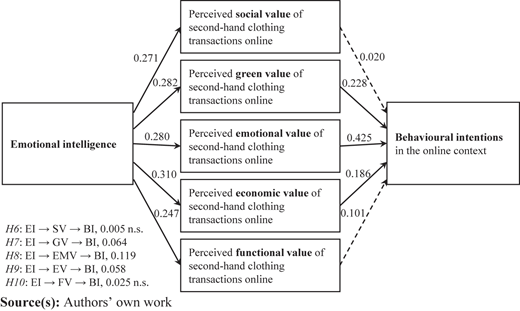
The bootstrapping (10,000 resamples) results show that most path coefficients are statistically significant (see Figure 1). More specifically, emotional intelligence EI_HOC has significant (p < 0.05) and positive effects on all perceived values: social value SV (β = 0.271; H1a supported), green value GV (β = 0.282; H2a supported), emotional value EMV (β = 0.280; H3a supported), economic value EV (β = 0.310; H4a supported), functional value FV (β = 0.247; H5a supported). Similarly, the green value GV (β = 0.228; H2b supported), emotional value EMV (β = 0.425; H3b supported) and economic value EV (β = 0.186; H4b supported) each have a significant and positive effect on behavioural intentions BInt_HOC, whereas this is not the case for social value (β = 0.020, p = 0.639; H1b not supported) and functional value (β = 0.101, p = 0.065; H5b not supported). Table 3 delineates the direct and indirect effects between variables, which reveal the hypotheses testing results.
Summary results of hypotheses testing
| Hypotheses | Type of effect | Std. Beta | Bias-corrected confidence intervals | Support | |
|---|---|---|---|---|---|
| H1a | EI_HOC - > SV | Direct effect | 0.271*** | [0.175, 0.356] | Yes |
| H1b | EI_HOC - > GV | Direct effect | 0.282*** | [0.175, 0.375] | Yes |
| H2a | EI_HOC - > EMV | Direct effect | 0.280*** | [0.184, 0.369] | Yes |
| H2b | EI_HOC - > EV | Direct effect | 0.310*** | [0.204, 0.401] | Yes |
| H3a | EI_HOC - > FV | Direct effect | 0.247*** | [0.146, 0.339] | Yes |
| H3b | SV - > BInt_HOC | Direct effect | 0.020 | [-0.062, 0.106] | No |
| H4a | GV - > BInt_HOC | Direct effect | 0.228*** | [0.152, 0.310] | Yes |
| H4b | EMV - > BInt_HOC | Direct effect | 0.425*** | [0.315, 0.527] | Yes |
| H5a | EV - > BInt_HOC | Direct effect | 0.186*** | [0.094, 0.275] | Yes |
| H5b | FV - > BInt_HOC | Direct effect | 0.101 | [-0.009, 0.206] | No |
| H6 | EI_HOC - > SV - > BInt_HOC | Specific indirect effect | 0.005 | [-0.017, 0.030] | No |
| H7 | EI_HOC - > GV - > BInt_HOC | Specific indirect effect | 0.064*** | [0.035, 0.102] | Yes |
| H8 | EI_HOC - > EMV - > BInt_HOC | Specific indirect effect | 0.119*** | [0.072, 0.175] | Yes |
| H9 | EI_HOC - > EV - > BInt_HOC | Specific indirect effect | 0.058** | [0.029, 0.094] | Yes |
| H10 | EI_HOC - > FV - > BInt_HOC | Specific indirect effect | 0.025 | [-0.001, 0.058] | No |
| EI_HOC - > BInt_HOC | Total indirect effect | 0.271*** | [0.191, 0.344] | ||
Note(s): 95% bias-corrected confidence intervals based on percentile bootstrapping (10,000); ***p < 0.001, **p < 0.01
Source(s): Authors’ own work
Bootstrapping results (10,000 resamples, BCCI) verify that emotional intelligence EI_HOC indirectly affects behavioural intentions through perceived green (β = 0.064, p = 0.00; H7 supported), emotional (β = 0.119, p = 0.00; H8 supported), and economic (β = 0.058, p = 0.001; H9 supported) values. However, the indirect effect of emotional intelligence EI_HOC through perceived social value (β = 0.005, p = 0.649; H6 not supported) and functional value (β = 0.025, p = 0.098; H10 not supported) was not statistically significant. The total indirect effect through perceived values was also positive and significant (β = 0.271, BCCI [0.191, 0.344]).
Robustness checks. The robustness of PLS-SEM results was assessed to verify structural model validity, which included nonlinear effects checks, endogeneity, and unobserved heterogeneity tests (Hair et al., 2019; Sarstedt et al., 2020). The nonsignificant quadratic terms (Vaithilingam et al., 2024) showed evidence of the linear effect’s robustness. Next, the check identified three segments (S1: 0.358, S2: 0.338, S3: 0.304) with no significant correlations to observable variables. Results inferred segment 2-related unobserved heterogeneity. Details of robustness checks are in the Supplementary_Material_Robustness.
5. Discussion
Despite extensive research on consumer behaviour in offline and online retail contexts, the specific domain of online second-hand clothing transactions, particularly the impact of individual differences like EI on PV and behavioural intentions, remains underexplored. Based on the construal level theory, we propose that consumers with high EI possess a high-level construal mindset. This enables them to recognise beyond immediate value the more abstract value of engaging in online transactions for second-hand clothing. This finding contributes to the current research on personal characteristics (i.e. EI) and their effects on value (i.e. PV dimensions) and certain behaviours in relation to second-hand goods (Fernando et al., 2018). Our study shows that EI significantly predicts the perceived social, green, emotional, economic, and functional values of second-hand clothing purchasing or renting online. As expected, EI positively relates to all five PVs. In turn, only three of these values increase BI with respect to purchase or rental intentions and willingness to recommend such actions. Thus, emotional, green, and economic perceived values positively mediate the impact of emotional intelligence on behavioural intentions toward second-hand clothing transactions online.
In our study, not all perceived values translate into actionable behaviour. This highlights the attitude-intentions gap, a well-known phenomenon that has been extensively researched in various contexts of consumer behaviour (e.g. Wang et al., 2021). Contrary to our expectations, social and functional values do not influence behavioural intentions in the context of second-hand clothing purchasing and renting online.
Our findings on social value align with those of Şener et al. (2023), who examined the relationship between perceived value and purchase intentions for recycled content clothing and Baek and Oh (2021) who did not find the social value to be related to attitudes in case of renting clothes online. The insufficient social value may be explained by consumers’ choice not to communicate to their surroundings about the ways of acquiring their clothes, as they may not feel trendy enough wearing second-hand clothes. It is more common to talk about extending the life of things by giving them away or selling them than about buying second-hand ones. Perhaps the results would be different if purchase-related survey questions would have been separated from rental-related questions.
Our results also challenge previous findings of functional value to be one of the most important antecedents of consumer behavioural intentions for sustainable fashion products (Dangelico et al., 2022) and the main driver of collaborative consumption in the case of renting fashion products online (Baek and Oh, 2021). These findings could be explained by Koay et al. (2022) presumption that in the case of second-hand clothes it is not worth to explore the role of functional value because second hand clothes are perceived as less valuable and of lower quality, and this perception may influence a functional value of renting or purchasing clothes online. Or there may be other overlooked reasons determining that second hand clothing acquisition process-related features, such like renting or buying simplicity and effectiveness, turned out not to be relevant to behavioural intentions towards renting or buying second-hand clothes online. Therefore, our results support the theory of consumption values, which asserts that perceived consumption values have differential contributions depending on the consumption-related context (Sheth et al., 1991). More specifically, our findings show that in the particular context of second-hand clothing transactions online, green, emotional, and economic values contribute the most to behavioural intentions.
Our contribution suggests that EI allows consumers to anticipate the multiple values associated with second-hand clothing transactions. This finding underlines the capacity of emotionally intelligent consumers to integrate emotions with cognition effectively in ascribing value to second-hand clothing purchasing or renting online, thus corroborating prior research linking EI not only with emotional value but also with wise reasoning and impulse control (Jie et al., 2022; Schneider et al., 2023).
Our study differs from other studies in exploring the previously relatively neglected role of the green value dimension in second-hand clothing transactions online. The positive effect of emotional intelligence on perceived green value from second-hand clothing transactions online resembles Chowdhury’s (2017) findings on consumer ethical beliefs, which found that appraisal and recognition of emotions in others (a component of EI) was positively related to pro-environmental buying.
Furthermore, the relatively weaker relationship between EI and social value calls into question the significance of impression-management-based social value, as operationalised in our study. Such findings may imply that other, more nuanced aspects of social value are more relevant and that a doing-good social value perspective better aligns with the high construal-level mindset of consumers. Impression management refers to the concern for self. In contrast, idealistically charged consumption with the more abstract goal of benefiting society and believing in doing good to others highlights a high construal level mindset. Furthermore, emphasising self rather than others signifies the low psychological distance, which is consistent with the low-level construal. Thus, the current finding that high-emotional intelligence consumers are relatively less concerned with impression-management-driven social value as compared with other perceived value dimensions resembles our construal-level theory-based reasoning.
In sum, our findings support our hypothesis that high EI consumers derive more value from second-hand clothing transactions online. That is, consumers who derive higher perceived value have stronger intentions to purchase and rent second-hand clothing online. This finding also contributes to the growing importance of sustainability and ethical consumption in consumer decision-making (Fernando et al., 2018) where consumers are redefining PV to include environmental benefits along with traditional emotional, functional and economic benefits.
6. Conclusion
Our study aimed to uncover the relationship between EI, PV and behavioural intentions associated with the second-hand clothing context. Consumers motivated by a strong EI are more likely to strive for sustainable consumption and choose second-hand options. High EI consumers find fulfilment in making responsible choices and participating in a more sustainable future.
The contribution of our study to consumer behaviour and marketing ethics refers to EI as a predictor of consumer decision-making. That is, by examining EI influence on the perceived value of second-hand clothing purchasing or renting online and consumer behavioural intentions, this study enhances our understanding of circular consumption in the second-hand context and advances our knowledge in the circular consumer behaviour and marketing ethics fields. Understanding how EI interacts with PV and intentions for second-hand clothing transactions online can help businesses to resonate with consumers on a deeper level, promoting sustainability and ethical fashion with greater effectiveness. Identified link between PV and EI will enable retailers to overcome traditional negative perceptions, build emotional connections with their target audience, and at the same time contribute to a more sustainable fashion industry.
The second-hand market provides opportunities to meet consumers’ inherent needs for wardrobe upgrades and belongingness in a more sustainable way, whether they are motivated by emotional, social, functional, economic, or green values. Our findings have practical implications for better leveraging circular economy opportunities without neglecting the values consumers expect from transactions. Furthermore, this study provides businesses with insights into how to improve their brand strategies by tailoring emphasis on different values of second-hand clothing transactions online for consumer segments with varying degrees of EI. Policymakers and businesses may direct their efforts towards raising EI among individuals as individuals with high EI might feel more comfortable shopping at second-hand stores or promoting them to their friends and family and influencing others towards more sustainable choices.
EI allows consumers to recognise the emotional benefit and appreciate the intrinsic value it adds to the vinted garments. Searching for and discovering nice garments on online platforms engages an individual’s sense of adventure and accomplishment. EI enables consumers to enjoy this emotional journey, transforming the shopping experience into a treasure search, further increasing the perceived value of the item and the process. Consumers with high EI are more likely to recognise these connections and feel a sense of belongingness to a community of like-minded individuals, strengthening the perceived values of their second-hand choices and online interactions. It is important to note that individual levels of EI vary, and these influences on perceived value and behavioural intentions are complex and multifaceted.
We acknowledge limitations of our study. First, given the correlational design-attributed limitation of our study in establishing causality, future studies could employ experimental designs to test the proposed hypotheses. Since our study only focused on purchasing/renting second-hand clothing online, further research could explore additional behavioural intentions of individuals to get involved in circular consumption such as their willingness to resell second-hand clothing online or engage in clothing repair and maintenance to extend the life of garments to contribute to more sustainable consumption practices.
Second, subsequent research could also measure social value by considering both self-centred and other-sensitive, altruistic aspects of social value, which correspond more closely to the origins of consumer ideologies and the high construal level mindset of consumers. This approach to social value operationalisation could reveal whether second-hand clothing and renting are intended to be used instrumentally to express collectively shared beliefs and ideals and to what extent social value is attributable to a self-sacrificing stance with the more abstract goal of gaining collective consumer power to alter conventional meanings of consumption objects.
Third, we should also acknowledge the measurement limitation of our study regarding behavioural intentions toward purchasing and renting second-hand clothing online. In our study, we combined both activities (purchasing and renting) within each measurement item of the used scale. Although such a holistic approach to behavioural intentions aligns with other studies, such as collaborative consumption-related behavioural intentions (e.g. Hamari et al., 2016), separating these two activities into distinct constructs could provide a more nuanced picture of whether and how perceived values contribute to renting and purchasing intentions. Fourth, we acknowledge that our sample is not homogeneous, with three segments arising. However, this heterogeneity could not be fully captured by the sample’s observable characteristics and may be an area for further research.
Finally, further research could dissect the underlying motivations behind different dimensions of perceived value and their potential hierarchical interrelationships. For example, green value may be an explicit manifestation of the not-so-evident and implicit social, emotional, or economic values because green value can be driven by both altruistic and egoistic motivation.
This project has received funding from the Research Council of Lithuania (LMTLT), agreement No [S-MIP-22-27].
References
The supplementary material for this article can be found online.

