

The purpose of this study is to describe and analyse the effect of a set of determinants on initial trust and behavioural intention to use financial robo-advisors (FRAs).
The theory of perceived risk and the behavioural finance paradigm were used to develop a conceptual model of retail investors’ initial trust in FRAs. Data collected from 554 young retail investors (YRIs) from Sweden and Malaysia were analysed using structural equation modelling.
The results of this study indicate that the amount of public information, social media information-seeking and a rational decision style are significantly related to initial trust in FRAs, which in turn is significantly and positively related to the behavioural intention to use this technology. However, none of the risks under study significantly affect the initial trust in FRAs.
Information is vital to inducing YRIs to rely on FRAs, so the more public and social media information is available, the higher their intention to use this technology. However, YRIs vary in decision style, and the results suggest implementing a more sophisticated system than the current “one-size-fits-all” approach to YRI behaviour.
The empirical-based model enhances the knowledge of the initial phase of trust-building, when YRIs lack sufficient experience of FRAs. By collecting data from two countries, the study’s novel conclusions may help in developing effective FRA services for the youth segment.
1. Introduction
Non-professional investors buy and sell securities through financial advisors, sharing their experiences to maximize the value of their investments (Kinder, 2015). Relying on human advisors in financial decision-making could be beneficial but exposes retail investors to the risk of receiving deceptive advice (D’Acunto et al., 2019). In fact, retail investors who fear being victimized by biased financial advice tend to rely on financial robo-advisors (FRAs), that is, cutting-edge financial technology (FinTech) solutions offering affordable automated services (Brenner and Meyll, 2020). At the same time, the ongoing shift from “human-to-human” to “human-to-machine” relationships in the financial sector raises questions as to how trust can be built in a machine-based environment (Goldstein et al., 2019; Kostovetsky, 2016). The initial phase of such trust-building seems particularly critical, because it will likely determine the intention to use FRAs (Cheng et al., 2019).
Relying on FRAs exposes retail investors to various risks. FRAs normally use an online questionnaire to evaluate their risk tolerance, that is, their risk profile, and this could lead investors with different risk profiles to be treated similarly (European Commission, 2018). In the same vein, Scherer (2017, p. 50) reported that “prominent German robo-advisor firms (Vaamo, Liqid, Quirion, and Scalable Capital) … fail to consider the influence of human capital, financial assets, financial liabilities, or real estate on recommended asset allocations”. This indicates that FRA questionnaires lack sophisticated questions that could correctly identify individual risk profiles.
Previous studies have emphasized the importance of information in building the relationship between retail investors and human financial advisors (Kostovetsky, 2016), and this seems equally relevant in the FRA context (Jung et al., 2018a). The supply of public information is essential in determining initial trust in FinTech solutions (McKnight et al., 1998), and social media are nowadays an essential source of information regarding financial decision-making (Florendo and Estelami, 2019; TIAA, 2021). The degree to which retail investors can rely on FRAs is also subject to individuals’ decision styles. In contrast to a rational decision style, those who are used to making intuitive decisions tend to use FRAs without in-depth investigations of the main features of this technology (Hamilton et al., 2016).
Retail investors’ perceptions of risk, access to available information and their decision style may differ depending on their experience or age (Koestner et al., 2017; Stålnacke, 2019). Consequently, previous studies divide retail investors into various categories. This research focuses on young retail investors (YRIs), that is, individuals 18–29 years old. Despite their modest portfolios, they represent a promising market for the financial sector.
FRAs offer impartial financial advice anytime and anywhere at an affordable price and with almost no restrictions in terms of the minimum invested amount. For example, an account with only US$50 could be opened through most FRAs with annual fees of under 1% of the value of the investor’s portfolio. Such advantages enable this technology to target the less profitable segment of the financial market (Anagnostopoulos, 2018; Brenner and Meyll, 2020). Previous studies have raised concerns about FRAs in terms of the possibility of designing algorithms that guide YRIs to invest in specific assets (European Commission, 2018) and whether FRAs are intended to be used without any personal contact (Jung et al., 2018a). Another concern is whether the “one-size-fits-all” FRA approach is sufficient regardless of the investor’s decision style (Abraham et al., 2019). However, few empirical investigations have focused on how retail investors build trust in FRAs (Gan et al., 2021).
This study describes and analyses the relationship between perceived risks (i.e. financial, performance, security and privacy and social risks), information (i.e. amount of public information and social media information-seeking) and decision style (i.e. rational vs intuitive), on one hand, and YRIs’ initial trust in FRAs, on the other. It also highlights the relationship between initial trust and behavioural intention to use FRAs and compares YRIs in different locations.
The study enriches our knowledge of YRIs’ preferences related to FRAs based on their experience of various cultural conditions (Hofstede, 2001). Regarding ongoing development in the FinTech area, Sweden and Malaysia have the necessary prerequisites to enable use of FRAs. Both countries have well-developed technological facilities and are on their way towards being cashless societies (Nourallah and Öhman, 2021). They also represent hubs of FinTech solutions, including FRAs. Recent figures indicate that the amount of assets under management in FRAs has increased in Sweden and Malaysia from US$143 and 12.1m in 2017, respectively, to US$473 and 62m in 2019 and is expected to reach approximately US$1,894 and 294m in 2023 (Statista, 2019a, 2019b). Despite these similarities, it is important to follow the recommendations of Ameen et al. (2021) and investigate whether cultural differences may influence YRIs’ perceptions of FRAs. Conducting research on Swedish and Malaysian YRIs may also help improve the development of FRAs in these highly technology-based parts of the world.
The rest of the paper is structured as follows: Section 2 introduces the frame of reference, Section 3 presents the hypotheses and research model and Section 4 discusses the methods used. Section 5 reports the data analysis and the empirical results, and Section 6 presents the concluding remarks, including a discussion, implications, limitations and suggestions for further research.
2. Frame of reference
2.1 Theory of perceived risk and financial robo-advisors
The theory of perceived risk views individuals’ behaviour in terms of their interior estimates of uncertainty and of the negative consequences of given situations (Bauer, 1960). According to Mitchell (1999, p. 168), perceived risk represents the “subjectively-determined expectation of loss; the greater the probability of this loss, the greater the risk thought to exist for an individual”.
Jacoby and Kaplan (1972) presented a general five-dimension scale of perceived risk, comprising financial, performance, physical, psychological and social risks. More recently, Chen (2013) found that financial, performance, time, psychological and privacy risks are related to perceived risk. In an empirical investigation of how the young generation perceives the risk of mobile payment, Akturan and Tezcan (2012) found that social and performance risks are significantly related to total perceived risk.
While some studies have used one scale consisting of several dimensions (Chen, 2013), others have used one-item scales (Alalwan et al., 2016). Besides these two approaches, FinTech studies (Lee, 2009) have used several independent constructs of perceived risk, finding that types of perceived risk vary based on the service offered (Featherman and Pavlou, 2003).
To determine the types of perceived risk that could be considered by YRIs, the FRA literature was consulted. It showed, first, that there is no guarantee that the use of FRAs will lead to desirable financial outcomes, that is, financial risk does exist (Abraham et al., 2019). Second, FRA performance influences the extent to which YRIs can benefit from using this technology. Errors or difficulties associated with using FRAs are examples of performance risk (Jung et al., 2018a). In this regard, Beketov et al. (2018) investigated 219 FRAs globally and found that only 73 disclosed information regarding the asset allocation method. Their study prompted inquiries as to why only one-third of the studied FRAs were transparent about this matter. Third, privacy and security matters represent a significant issue, as this technology demands that YRIs provide sensitive financial information. Berg et al. (2020) reported that even general information, for example, about the type of device (i.e. digital footprint), could reveal important information about individuals. Fourth, issues such as peers’ opinions emphasize a certain type of perceived risk: namely, social risk. Ayton et al. (2020, p. 1) argued that an “extensive and burgeoning body of research reveals that factors associated with the social environment play a critical role”. Overall and in line with the theory of perceived risk, it can be argued that financial, performance, privacy and security and social risks might influence YRIs’ initial trust in FRAs.
2.2 The behavioural finance paradigm and financial robo-advisors
The behavioural finance paradigm concerns how individuals behave in financial decision-making processes (Thaler, 1993). In contrast to traditional finance assumptions, in which individuals are seen as rational and able to maximize their utility (Andrikopoulos and Vagenas-Nanos, 2017), the behavioural finance paradigm claims that individuals are limited in their mental ability (Kahneman and Tversky, 1979), have bounded rationality (Simon, 1991) and are often influenced by various cognitive biases (Kahneman, 2011). In this regard, Baker and Nofsinger (2010, p. 3) argued that “the thinking process does not work like a computer. Instead, the human brain often processes information using shortcuts and emotional filters. These processes influence financial decision-makers such that people often act in a seemingly irrational manner, routinely violate traditional concepts of risk aversion, and make predictable errors in their forecasts”.
The behavioural finance paradigm incorporates finance theory and psychology to identify solutions to financial problems, especially those that traditional finance seems unable to explain (Hirshleifer, 2015). DeBondt et al. (2010) argued that the contribution of psychology to the behavioural finance paradigm has led to three streams of research: first, emotional finance, that is, a paradigm that uses emotional responses and investigates investment activity by incorporating emotions in financial decision-making (Andrikopoulos and Vagenas-Nanos, 2017); second, social finance, that is, a paradigm that uses social psychology and considers the influence of social norms, moral attitudes, religions and ideologies on individuals’ financial behaviour (Hirshleifer, 2015); and third, cognitive finance, that is, a paradigm that uses cognitive psychology and focuses on decision style in the financial context of spending, saving and investing (Otto, 2007). The last stream of research, that is, cognitive finance, emphasizes the role of information and decision style in the financial decision-making of retail investors, which is the focus of this study.
The information delivered to individuals has a significant role in the reliance on FRAs (Litterscheidt and Streich, 2020). In the initial phase of dealing with FRAs, YRIs lack sufficient information about this technology but might access public information. An important source of such information is the methodology section of the FRA’s website (or mobile application), which provides details about the asset allocation method used. Such information is important, as it explains how the FRA works. However, many FRAs do not disclose the method used for asset allocation (Beketov et al., 2018). Previous results have further indicated that information obtained from social media can influence retail investors’ decisions (Tan and Tas, 2021).
Individuals’ decision styles perform a vital role in their financial decision-making. Kahneman (2011) distinguished between two decision styles. The first is a fast style, or an intuitive style, which is used by individuals who make decisions emotionally, such as by using personal feelings to make a move in a chess game. The second is a slow style, or a rational style, which is used by individuals who likely follow a logical approach, such as by making calculations before making a decision.
Taken together and in line with the behavioural finance paradigm, information (i.e. amount of public information and social media information-seeking) and decision style (i.e. rational or intuitive) might influence YRIs’ initial trust in FRAs.
2.3 Initial trust and behavioural intention to use financial robo-advisors
The literature on trust reveals two important things. First, there is a lack of agreement on how to characterize trust (Schoorman et al., 2007). Economists are likely to use trust in a calculative sense based on cost and benefit theory. Psychologists focus on the attributes of trustors and trustees, and sociologists argue that trust is a phenomenon that evolves in individual relationships (Rousseau et al., 1998). Second, previous studies agree on the dynamic nature of trust, meaning that trust development starts from a certain level and can later increase or decrease (Schoorman et al., 2007). Initial trust refers to the trust-building phase in which two parties meet or interact without prior experience or knowledge of each other, and they may accept vulnerability to fulfil their wants and needs (McKnight et al., 1998).
Rousseau et al. (1998) asserted that trust is not a behaviour as such but an underlying psychological state that could cause choice behaviour. Fishbein and Ajzen (1975) defined behavioural intention as a subjective estimate of the probability of a particular behaviour, and Zeithaml et al. (1996) argued that behavioural intention to use concerns whether individuals, such as users of a certain technology, will remain with or leave the service provider. Similarly, previous studies have found a relationship between initial trust and intention to use and noted that the latter concept is dominant in the FinTech context (Alalwan et al., 2016; Tam and Oliveira, 2017).
In the FinTech context, trust determines the adoption of FinTech solutions (Jüngera and Mietznerb, 2020), and the initial phase of developing trust (i.e. initial trust) is equally important (Bhatia et al., 2020). Initial trust represents the willingness to trust a party without previous knowledge and is built on the stimuli provided by FinTech solutions (Lee and Kim, 2020) or their reputation (Bhatia et al., 2020). Initial trust is critical, as it can lead individuals to continue trusting FRAs and determines whether they will allocate money to invest while relying on this technology (Jung et al., 2018a, 2018b).
3. Hypothesis development and research model
Financial risk can be described as the chance of someone suffering from significant losses or not achieving expected return (Vlaev et al., 2009). Previous studies have concluded that financial risk influences trust-building. Lee (2009) reported that financial risk is negatively related to use of e-banking, and Chiu et al. (2016) found that perceived cost has a direct relationship with initial trust. Like anyone else, YRIs try to avoid risks when they make investments using securities brokerages. If they think that using FRAs is risky, then they will not trust them. Current FRA practices attempt to minimize financial risk through “risk profiling”, that is, matching a potential user’s characteristics with a predesigned risk profile. Such profiling will likely address YRIs’ perceptions of the risk of FRAs, influencing their initial trust in this technology (McKnight et al., 1998). Although recent results indicate that financial risk could have a limited effect on retail investors because investment always carries such risk (Chong et al., 2021), the current study hypothesizes that:
The higher the financial risk, the lower the initial trust in financial robo-advisors.
Performance risk can be described as the possibility that a service provider does not operate in the way individuals expect or fails to deliver the desired benefit (Lee, 2009). In the FRA context, several algorithms are used to analyse YRIs’ answers in online questionnaires and then suggest various investment portfolios in terms of risk and return (Bhatia et al., 2020). These suggested portfolios largely determine the risk YRIs might face and the expected return on their investments (Brenner and Meyll, 2020). The better the FRA performance, the more appropriate portfolio suggestions the YRIs will get. In contrast, inconsistent FRA performance guides YRIs to make bad decisions.
Lee (2009) reported that performance risk is negatively related to the attitude towards using E-banking, and Chiu et al. (2016) suggested that the quality of infrastructure is directly related to initial trust. In addition, Seiler and Fanenbruck (2021) found no significant relationship between ease of use and the intention to use FRAs. Based on these findings, it can be argued that FRA performance will likely influence initial trust, so it is hypothesized that:
The higher the performance risk, the lower the initial trust in financial robo-advisors.
Security and privacy risk can be described as the harms and threats that mitigate service safety and the individuals’ concerns about their personal information (Al-Khalaf and Choe, 2020). This risk seems to concern trust in financial service providers (Lee, 2009). Previous studies have reported a negative relationship between privacy and security risk, on one hand, and initial trust, on the other (Chiu et al., 2016). Similarly, Zhou (2012) found empirical evidence that e-banking’s assurance, confidence and robust attributes influence initial trust. In contrast, Amirtha et al. (2021) reported an insignificant relationship between privacy risk and behavioural intention to use.
When using FRAs, YRIs need to answer several personal questions regarding their bank accounts and income (Brenner and Meyll, 2020). Although FRAs consider security and privacy to protect investors (Gan et al., 2021), problems might arise and mishandling of sensitive information could negatively affect initial trust in this technology. Thus, in a relationship like the one between YRIs and FRAs, security and privacy risk will likely determine the initial trust in FRAs. This study hypothesizes that:
The higher the security and privacy risk, the lower the initial trust in financial robo-advisors.
Retail investors are subject to the influence of peer opinions, including advise from friends and family members (Stålnacke, 2019). Because of YRIs’ strong family relationships (Gudmunson et al., 2016), family support and related advice will likely affect their trust in FRAs. Peers’ opinions about a particular FinTech solution might determine retail investors’ decisions to use this solution (Gomber et al., 2017). For example, YRIs consider peers’ opinions expressed via social media platforms when determining what FRAs they might use (TIAA, 2021). Alalwan et al. (2016) reported that social risk directly relates to the adoption of mobile banking, and Tandon et al. (2018) argued that this risk decreases satisfaction. In the e-banking context, Kaabachi et al. (2019) reported that social influence affects initial trust. Although studies like that of Dharmesti et al. (2021) have found that social motives will reduce the purchase intentions of youth, most arguments point to the following hypothesis:
The higher the social risk, the lower the initial trust in financial robo-advisors.
FRAs disseminate public information to inform YRIs about their services, benefits, etc. This type of information represents unfiltered financial information (Stålnacke, 2019), for example, regarding the methodology used to match the characteristics of a potential user with a predesigned risk profile. Learning about FRA services and how to use them increases the trust in FRAs (Chiu et al., 2016). Getting information issued by regulated parties such as FRAs helps YRIs feel that they have the information they need. In the e-banking context, Kaabachi et al. (2019) reported that information provided to individuals has a direct and positive relationship with the initial trust. Previous studies have also found that the quality of the information provided determines the initial trust (Zhou, 2012). Thus, the hypothesis is as follows:
The higher amount of public information young retail investors receive, the higher their initial trust in financial robo-advisors.
Social media information-seeking is defined as “the extent to which news shared in social media can provide users with relevant and timely information” (Lee and Ma, 2012, p. 336). Although there are questions about the reliability of this information source (Florendo and Estelami, 2019), the young generation uses social media to share information and stay up to date on “mega-trends” (Yoshida et al., 2018). A recent example is the sharing of opinions via the Reddit social media platform, which helped build YRIs’ initial trust in the Robinhood FRA. Al-Khalaf and Choe (2020) found that social media influences trust in the e-commerce context, and Laroche et al. (2012) reported that individuals who seek information in social media communities will likely trust the provider. Pentina et al. (2013) stated that information aligns individuals’ preferences directly with trust. Hence, the current study hypothesizes that:
The greater the social media information-seeking conducted by young retail investors, the higher their initial trust in financial robo-advisors.
An individual’s style of perceiving, processing and responding in decision-making situations represents a stable personal pattern (Cosenza et al., 2019). A rational decision style refers to individuals who conduct a comprehensive search for information and a systematic assessment of all potential choices. In contrast, an intuitive decision style refers to individuals who use a quick decision-making process that relies on hunches and feelings (Hamilton et al., 2017).
Gambetti and Giusberti (2019) reported a positive relationship between the rational but not the intuitive, decision-making style and the decision to invest in various stocks. Thus, the decision style helps in identifying decision-making-related differences among individuals (Kahneman, 2011), and YRIs’ decision styles might affect their behaviour. For example, YRIs with a rational decision style often read the methodology section provided by FRAs to know more about the services. A contradictory scenario might happen with YRIs using an intuitive decision style. Thus, the current study hypothesizes that:
There is a significant relationship between a rational decision style and initial trust in financial robo-advisors.
There is no significant relationship between an intuitive decision style and initial trust in financial robo-advisors.
As indicated, individuals show a tendency to act in a certain way based on their initial trust in a situation (McKnight et al., 1998). This means that trust determines behaviour (Rousseau et al., 1998) and influences the intention to act (Jung et al., 2018b). Previous studies have suggested that initial trust plays an essential role in enhancing behavioural intention (Kaabachi et al., 2019), and Ofori et al. (2018) found a significant relationship between trust and behavioural intention to use e-commerce services. In this context, YRIs who trust FRAs seem more likely to continue to use the technology. The current study hypothesizes the following:
The higher the initial trust in financial robo-advisors, the higher the behavioural intention to use financial robo-advisors.
4. Methods
4.1 Measurement development
Items adapted from previous studies and forming a preliminary questionnaire were presented at an academic seminar. Based on the received comments, English and Swedish versions were sent to three Swedish YRIs and two experts in the field of the study to check their clarity and readability. After additional language revisions, the questionnaire was sent to five YRIs in each of Sweden and Malaysia. Their feedback helped us avoid minor issues related to readability.
The final questionnaire was based on a seven-point Likert scale ranging from 1 = “strongly disagree” to 7 = “strongly agree”. The appendix shows the items included in the questionnaire and operationalizations, concepts and references. The background variables were age, gender, preferred device used for electronic financial transactions, FRA experience and investment experience.
4.2 Sample, data collection and descriptive statistics
Individuals who might use FRAs are likely to be young (US Financial Industry Regulatory Authority, 2016), to have modest income and wealth (Fulk et al., 2018) and to have limited investment experience (Welch, 2022). Without having built trust towards FRAs yet, these individuals can adequately respond to questions on initial trust. Thus, the questionnaire was distributed to 202 university students in Sweden and 352 university students in Malaysia, of whom 116 (57% response rate) and 280 (86% response rate) submitted completed questionnaires. The respondents studied business administration, finance and economics and engineering. Issues related to the confidentiality of the collected data and data storage were taken into consideration, and respondents over 29 years old were eliminated from the sample.
Table 1 shows that the Swedish respondents were relatively balanced between the two age groups (i.e. 18–23 and 24–29 years old), while most Malaysian respondents belonged to the younger subgroup. Regarding gender, Swedish respondents included a rather equal number of males and females, while the Malaysian ones were mainly females. The responses revealed that most respondents in both countries used mobiles to conduct electronic financial transactions and lacked prior experience of FRAs. In Sweden and Malaysia, only 12.9% and 3.2% of the respondents conducted more than 36 transactions a year, respectively.
Descriptive statistics
| Sweden | Malaysia | |
|---|---|---|
| Age | 18–23 years (55.2%) 24–29 years (44.8%) | 18–23 years (95.7%) 24–29 years (4.3%) |
| Gender | Female (47%) Male (50%) Prefer not to say (3%) | Female (60%) Male (39.1%) Prefer not to say (0.9%) |
| Which of the following devices do you use to conduct electronic financial transactions?* | Mobile app (96.6%) Computer or laptop (67.2%) Smartwatch (1.7%) Tablet (7.8%) Other (0.9%) | Mobile app (86.1%) Computer or laptop (52.9%) Smartwatch (1.4%) Tablet (6.4%) Other (6.4%) |
| Do you have experience in using FRAs? | No (87.9%) Yes, less than 1 year (5.2%) Yes, at least 1 year and less than 2 years (2.6%) Yes, at least 2 years and less than 3 years (2.6%) Yes, at least 3 years (1.7%) | No (94.6%) Yes, less than 1 year (3.6%) Yes, at least 1 year and less than 2 years (1.4%); Yes, at least 2 years and less than 3 years (0.4%); Yes, at least 3 years (0%) |
| How many investment transactions do you make during a year?§ | No transactions (25%) 1–2 transaction(s) a year (10.4%) 3–10 transactions a year (16.4%) 11–35 transactions a year (35.3%) More than 36 transactions a year (12.9%) | No transactions (61.2%) 1–2 transaction(s) a year (19.6%) 3–10 transactions a year (9.9%) 11–35 transactions a year (6.1%) More than 36 transactions a year (3.2%) |
Notes:
*More than one answer was allowed.
The ranges used were determined based on a phone interview with an expert in the investment of international markets
5. Data analysis and empirical results
Smart PLS software, version 3.0, developed by Ringle et al. (2005) was used to run the measurement and structural models. According to Hair et al. (2019), partial least squares-structural equation modelling is a causal-predictive technique highlighting prediction in estimating statistical models, and there are several reasons for applying such a procedure: sample size, distributional assumptions and statistical power.
5.1 Measurement model
Following Hair et al. (2019), internal consistency reliability, convergent validity and discriminant validity were calculated in the measurement model. Regarding internal consistency reliability, Cronbach’s alpha ranged from 0.817 to 0.951. Regarding convergent validity, the factor loadings, composite reliability (CR) and average variance extracted (AVE) were calculated for each construct. As shown in Table 2, the ranges of the factor loadings, CR and AVE indicate that all constructs reached recommended levels (cf. Anderson and Gerbing, 1988).
Construct validity
| Constructs | Items | Loadings | Cronbach’s alpha | CR | AVE | Constructs | Items | Loadings | Cronbach’s alpha | CR | AVE |
|---|---|---|---|---|---|---|---|---|---|---|---|
| Financial risk | FR1 | 0.778 | 0.898 | 0.925 | 0.711 | Social media information-seeking | SMIS1 | 0.917 | 0.919 | 0.949 | 0.861 |
| FR2 | 0.872 | SMIS2 | 0.937 | ||||||||
| FR3 | 0.891 | SMIS3 | 0.929 | ||||||||
| FR4 | 0.807 | Rational decision style | RDS1 | 0.891 | 0.951 | 0.962 | 0.837 | ||||
| FR5 | 0.863 | RDS2 | 0.915 | ||||||||
| Performance risk | PeR1 | 0.814 | 0.817 | 0.891 | 0.732 | RDS3 | 0.931 | ||||
| PeR2 | 0.901 | RDS4 | 0.922 | ||||||||
| PeR3 | 0.849 | RDs5 | 0.913 | ||||||||
| Security and privacy risk | SPR1 | 0.849 | 0.842 | 0.904 | 0.759 | Intuitive decision style | IDS1 | 0.845 | 0.893 | 0.922 | 0.702 |
| SPR2 | 0.901 | IDS2 | 0.860 | ||||||||
| SPR3 | 0.863 | IDs3 | 0.855 | ||||||||
| Social risk | SoR1 | 0.913 | 0.936 | 0.954 | 0.837 | IDS4 | 0.846 | ||||
| SoR2 | 0.937 | IDS5 | 0.779 | ||||||||
| SoR3 | 0.917 | Initial trust | IT1 | 0.887 | 0.913 | 0.939 | 0.793 | ||||
| SoR4 | 0.893 | IT2 | 0.897 | ||||||||
| Amount of public information | LPI1 | 0.906 | 0.951 | 0.965 | 0.872 | IT3 | 0.887 | ||||
| LPI2 | 0.949 | IT4 | 0.891 | ||||||||
| LPI3 | 0.964 | Behavioural intention | BIU1 | 0.942 | 0.915 | 0.946 | 0.855 | ||||
| LPI4 | 0.916 | BIU2 | 0.935 | ||||||||
| BIU3 | 0.896 |
Notes:
CR = composite reliability; and AVE = average variance extracted
Regarding discriminant validity, Fornell and Larcker’s (1981) procedure and the heterotrait–monotrait (HTMT) ratio of correlations (Henseler et al., 2016) were used. Fornell and Larcker results in Table 3 indicate that the square root of the AVE between each pair of constructs was higher than the correlation estimated between constructs, establishing acceptable discriminant validity. The HTMT ratio of correlations clarifies that all values were lower than the recommended level of 0.85 (Hair et al., 2019), indicating satisfactory discriminant validity.
Discriminant validity
| Constructs | 1 | 2 | 3 | 4 | 5 | 6 | 7 | 8 | 9 | 10 |
|---|---|---|---|---|---|---|---|---|---|---|
| Fornell and Larcker’s procedure | ||||||||||
| 1. Financial risk | 0.843 | |||||||||
| 2. Performance risk | 0.817 | 0.855 | ||||||||
| 3. Security and privacy risk | 0.612 | 0.642 | 0.871 | |||||||
| 4. Social risk | 0.591 | 0.59 | 0.518 | 0.915 | ||||||
| 5. Amount of public information | 0.215 | 0.297 | 0.201 | 0.024 | 0.934 | |||||
| 6. Social media information-seeking | 0.344 | 0.362 | 0.417 | 0.563 | 0.362 | 0.928 | ||||
| 7. Rational decision style | 0.152 | 0.236 | 0.235 | 0.103 | 0.471 | 0.158 | 0.915 | |||
| 8. Intuitive decision style | 0.196 | 0.206 | 0.285 | 0.376 | 0.152 | 0.489 | 0.257 | 0.838 | ||
| 9. Initial trust | 0.344 | 0.424 | 0.383 | 0.368 | 0.62 | 0.622 | 0.412 | 0.381 | 0.890 | |
| 10. Behavioural intention | 0.259 | 0.295 | 0.299 | 0.56 | 0.183 | 0.572 | 0.103 | 0.462 | 0.613 | 0.925 |
| Heterotrait–monotrait (HTMT) ratio of correlations | ||||||||||
| 1. Financial risk | ||||||||||
| 2. Performance risk | 0.961 | |||||||||
| 3. Security and privacy risk | 0.698 | 0.767 | ||||||||
| 4. Social risk | 0.652 | 0.672 | 0.587 | |||||||
| 5. Amount of public information | 0.229 | 0.34 | 0.219 | 0.045 | ||||||
| 6. Social media information-seeking | 0.380 | 0.414 | 0.478 | 0.605 | 0.386 | |||||
| 7. Rational decision style | 0.159 | 0.270 | 0.257 | 0.113 | 0.494 | 0.164 | ||||
| 8. Intuitive decision style | 0.222 | 0.236 | 0.324 | 0.407 | 0.163 | 0.538 | 0.274 | |||
| 9. Initial trust | 0.378 | 0.488 | 0.432 | 0.394 | 0.665 | 0.679 | 0.439 | 0.419 | ||
| 10. Behavioural intention | 0.288 | 0.338 | 0.345 | 0.600 | 0.195 | 0.623 | 0.114 | 0.511 | 0.666 | |
5.2 Structural model
The path coefficient (β), coefficient of determination (R2) and effect size (f2) are reported in the structural model. Using a bootstrapping procedure with a resampling of 5,000, the path estimates and t-statistics were calculated for the hypothesized interactions (Figure 1). As shown in Table 4, the relationships between financial risk, performance risk and security and privacy risk, on one hand, on initial trust, on the other, are not significant. Accordingly, H1, H2 and H3 are not supported. The significant relationship between social risk is in the opposite direction in relation to the hypothesis, meaning that H4 is also rejected. The relationships between amount of public information, social media information-seeking and rational decision style, respectively, and initial trust are significant and in the direction suggested by H5, H6 and H7. The relationship between intuitive decision style and initial trust is insignificant, so H8 is supported. As initial trust is significantly and positively related to behavioural intention to use FRAs, H9 is supported. The R2 values in Table 4 show that the initial trust is explained by 61.9% of the determining variables under study and that behavioural intention is explained by 37.6% of the initial trust. The f2 values indicate each construct’s small, medium and large effects.
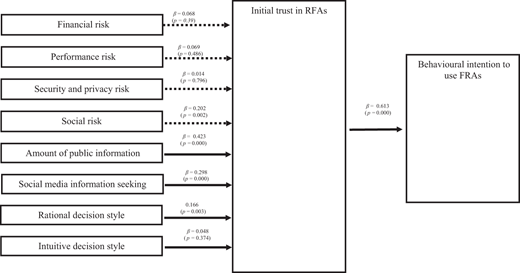
Results for structural model of initial trust in financial robo-advisors (dotted lines indicate non-significant results and dashed lines indicate significant results)
Results for structural model of initial trust in financial robo-advisors (dotted lines indicate non-significant results and dashed lines indicate significant results)
Structural model
| Hypothesis | β | SD | t-statistics | p-values | R2 | f2 | BCI LL | BCI UL | Decision |
|---|---|---|---|---|---|---|---|---|---|
| H1. Financial risk → Initial trust | –0.068 | 0.079 | 0.860 | 0.390 | 0.619 | 0.004 | –0.227 | 0.083 | Not supported |
| H2. Performance risk → Initial trust | 0.069 | 0.098 | 0.697 | 0.486 | 0.619 | 0.003 | –0.127 | 0.255 | Not supported |
| H3. Security and privacy risk → Initial trust | 0.014 | 0.054 | 0.258 | 0.796 | 0.619 | 0.000 | –0.091 | 0.116 | Not supported |
| H4. Social risk → Initial trust | 0.202 | 0.066 | 3.061 | 0.002 | 0.619 | 0.037 | 0.075 | 0.328 | Not supported |
| H5. Amount of public information → Initial trust | 0.423 | 0.056 | 7.585 | 0.000 | 0.619 | 0.279 | 0.306 | 0.518 | Supported |
| H6. Social media information-seeking → Initial trust | 0.298 | 0.068 | 4.369 | 0.000 | 0.619 | 0.109 | 0.167 | 0.427 | Supported |
| H7. Rational Decision style → Initial trust | 0.166 | 0.056 | 2.977 | 0.003 | 0.619 | 0.046 | 0.063 | 0.278 | Supported |
| H8. Intuitive decision style –/> Initial trust | 0.048 | 0.054 | 0.890 | 0.374 | 0.619 | 0.004 | –0.059 | 0.158 | Supported |
| H9. Initial trust → Behavioural intention | 0.613 | 0.045 | 13.672 | 0.000 | 0.376 | 0.602 | 0.514 | 0.692 | Supported |
Notes:
→ = relationship; –/> = no relationship; β = the path coefficient; R2 = coefficient of determination; f2 = effect size; BCI LL = Beta coefficient lower level; BCI UL = Beta coefficient upper level; and p-value at 5%
5.3 Multi-group analysis
The multi-group data analysis (MGA) was conducted to compare the Swedish (n = 116) and Malaysian (n = 280) respondents. Following Henseler et al. (2016), the procedure to determine the measurement invariance of composites procedure was performed in three steps: configural invariance assessment, establishment of compositional invariance assessment and assessment of equal means and variances. The partial measurement invariance of the two groups was generated as a requirement for comparing and interpreting the MGA group-specific differences in the partial least squares-structural equation modelling results. As shown in Table 5, there are no significant differences between the two groups in the determinants under study regarding initial trust. However, regarding initial trust and behavioural intention to use FRAs, there is a significant difference between the Swedish and Malaysian YRIs.
Model comparison
| Hypothesis | Malaysian | Swedish | Malaysian–Swedish | BCI LL | BCI UL | p-values | Decision |
|---|---|---|---|---|---|---|---|
| β | Β | β differences | |||||
| H1. Financial risk → Initial trust | –0.082 | –0.166 | 0.084 | –0.370 | 0.331 | 0.657 | Not supported |
| H2. Performance risk → Initial trust | 0.109 | 0.056 | 0.053 | –0.435 | 0.391 | 0.834 | Not supported |
| H3. Security and privacy risk → Initial trust | 0.042 | 0.073 | –0.031 | –0.246 | 0.259 | 0.815 | Not supported |
| H4. Social risk → Initial trust | 0.133 | 0.186 | –0.053 | –0.281 | 0.310 | 0.717 | Not supported |
| H5. Amount of public information → Initial trust | 0.362 | 0.397 | –0.035 | –0.222 | 0.259 | 0.798 | Not supported |
| H6. Social media information-seeking → Initial trust | 0.282 | 0.248 | 0.034 | –0.297 | 0.333 | 0.855 | Not supported |
| H7. Rational decision style → Initial trust | 0.126 | 0.145 | –0.019 | –0.247 | 0.235 | 0.881 | Not supported |
| H8. Intuitive decision style –/> Initial trust | 0.076 | 0.116 | –0.040 | –0.237 | 0.235 | 0.735 | Not supported |
| H8. Initial trust → Behavioural intention | 0.796 | 0.479 | 0.317 | –0.190 | 0.205 | 0.002 | Supported |
Notes:
→ = relationship; –/> = no relationship; β = the path coefficient; BCI LL = Beta coefficient lower level; and BCI UL = Beta coefficient upper level
6. Concluding remarks
6.1 Discussion
The theory of perceived risk suggests various types of risk that could influence initial trust in FRAs. However, this study concludes that none of the risks under study significantly affects the initial trust in FRAs. Although the perceived risk results are in contrast to what was hypothesized, they confirm the work of Chong et al. (2021), who found no significant relationship between YRIs’ perceived risk and the intention to adopt mobile stock trading. One possible explanation for the lack of relationships is that FRAs have to some extent customized their services (Bhatia et al., 2020; Jung et al., 2018b). In line with this, Wu and Gao (2021, p. 273) found that “customized features were beneficial to decrease users’ perceived risk of a robo-advisor”. It can also be argued that, because of YRIs’ modest portfolios (Fulk et al., 2018), the role of financial risk seems limited. Moreover, because of YRIs’ good technological skills and their potential lack of trust in human financial advisors, they are less likely to face performance-related issues when using FRAs. This could be related to the findings of Seiler and Fanenbruck (2021), who reported no significant relationship between ease of use of FRAs and the intention to use this technology.
It seems as though YRIs have a good capacity to deal with technical issues concerning security and privacy. For example, they are aware of the need to update their operating system frequently and download robust antivirus software. Previous studies have argued that the members of the young generation behave differently in different application contexts, prioritizing things differently when using applications for instrumental purposes, such as investment, than for emotional and social purposes (Nourallah, 2022). In other words, YRIs might be less worried about security and privacy issues when they invest their modest portfolio than when they use digital social media apps, which could convey information about their life events. Considering social risk, this result indicates a significant positive relationship with initial trust. This result echoes the work of Dharmesti et al. (2021), who found that social motives negatively affect the online purchase intentions of the young generation. One possible explanation is that youths like to experience adventure, so peers’ concerns about emerging technologies may not deter YRIs but rather encourage them to try such technologies.
In line with the behavioural finance paradigm, this study supports the hypothesized role of information in addressing YRIs’ initial trust in FRAs. The amount of public information is essential for retail investors (Stålnacke, 2019), making them more familiar with the financial services and possibly strengthening both their intention to use and actual use of app technology (Rezaei et al., 2016). Bapat (2020) found that public information – such as interest rate, credit score and investment details – is important in financial planning. The more information the financial service providers deliver, the higher the initial trust will be (Kaabachi et al., 2019). This supports Chiu et al. (2016), who argued that acquiring information about how to use FinTech solutions is vital to building trust in these technologies. In line with Dharmesti et al. (2021), the current results also suggest that YRIs tend to search for information on various online platforms such as social media apps. According to Shaheen et al. (2020), information such as online reviews seems to be helpful in building trust among members of the younger generation.
The results support the hypothesized relationships between the rational and intuitive decision styles, respectively, and initial trust, confirming the results of Gambetti and Giusberti (2019). It is no surprise that YRIs with a rational decision style are more likely to feel initial trust in FRAs than are their peers with an intuitive decision style. Rational decision style individuals tend to adopt analytical decision strategies (Zhu et al., 2021) and will likely use information in making decisions (Hamilton et al., 2017). For example, in contrast to YRIs with an intuitive decision style, those with a rational decision style search for available information in FRA websites or apps to build trust in this technology.
As hypothesized, there is a positive and significant relationship between initial trust in FRAs and the intention to use this technology, confirming the work of Alkraiji and Ameen (2021), who emphasized the role of trust in stimulating the young generations’ intention to use digital platforms.
It appears that YRIs’ similar lifestyles – listening to music via Spotify, watching movies via Netflix, chatting via WhatsApp, etc. – have led the ones in this generation to perceive the relationships between the determinants of initial trust and initial trust similarly. The results of the MGA analysis indicate that the only significant difference between the Swedish and Malaysian groups concerns the relationship between initial trust and behavioural intention to use FRAs. The Malaysian group has a significantly higher Beta of 0.796 > 0.479, indicating that the action plans seem to differ depending on the YRIs’ locations. Gan et al. (2021, p. 12) reported that in Malaysia, rigorously restricted personal contact during the COVID-19 pandemic encouraged individuals to trust FRAs for financial and wealth management and argued that “the augmented trust then led to a stronger intention to adopt FRAs among Malaysians”. The questionnaires were sent to YRIs during the lockdown period (between October 2020 and February 2021), and the restrictions, including the lack of opportunities to contact human financial advisors, may have increased the Malaysians’ intention to use FRAs. The restrictions in Sweden were not as strict during the pandemic as they were in Malaysia.
6.2 Theoretical implications
Based on the theory of perceived risk, the behavioural finance paradigm and previous studies of initial trust, this study developed a conceptual model. The suggested model provides novel insights into YRIs and FRAs and enhances our knowledge of the initial phase of trust-building when YRIs still lack sufficient experience of FRAs. The empirical investigation emphasizes the role that public and social media information could have in building trust in FRAs. This contributes to the literature on emerging technology in the FinTech context and indicates that the two information variables are essential in studying the trust-building phase. Thus, the higher the availability of information about a certain FinTech solution, the higher the initial trust that could form, and, as a result, individuals will likely have a higher intention to use this technology, that is, information → initial trust → behavioural intention to use.
Moreover, the literature on retail investing has more or less ignored personal characteristics such as decision style (Gambetti and Giusberti, 2019), instead prioritizing other social-economic factors such as gender and income. This study emphasizes that decision style could reveal relatively more about the behaviour of retail investors in the FinTech context than could many other factors.
6.3 Managerial implications
The financial sector, including wealth management and financial advice, has witnessed the rise of advanced technology that allows new parties, such as FinTech companies, to offer digital services (Nourallah and Öhman, 2021). Among these parties, FRAs have attracted the attention of YRIs (Brenner and Meyll, 2020). To achieve initial trust, FRAs could deliver more public information, illustrating how risk profiles are constructed and describing the method used for asset allocation. It is also important to make information available via social media sources. Regarding the issue of the credibility of social media sources, FRAs would benefit from sharing verified information via these sources.
Most FRAs strive to attract investors through “easy to complete” questionnaires. However, this “one-size-fits-all” approach has been criticized (Abraham et al., 2019; Scherer, 2017), and it is recommended that FRAs should use a more sophisticated system to correctly identify and categorize YRI behaviour. This study highlights the need to customize the available information in a way that suits the decision styles of retail investors and enables them to obtain knowledge about the most critical matters, such as asset allocation processes.
6.4 Limitation and suggestions for future research
This study collected and analysed data on university students in two countries having good technological infrastructure. Future studies should select respondents with more diverse educational backgrounds and geographical locations. As suggested by Ameen et al. (2021), future research could investigate the moderating role of cultural dimensions. As most of the respondents lacked experience in using technology to build their investment portfolios, this study did not investigate potential differences between less- and more-experienced retail investors. Future studies could, therefore, consider making such comparisons. Future studies could also apply other theories, such as the unified theory of acceptance and use of technology, to further develop the empirically based model of initial trust in FRAs presented here. Our study failed to demonstrate the expected influences of financial, performance, security and privacy and social risks, indicating a need for further studies of these factors.
References
Appendix
The questionnaire
| Background variables | ||||
| 18–23 years | 24–29 years | Over 29 years | ||
| Gender | ||||
| Female | Male | Prefer not to say | ||
| Which of the following devices do you use to conduct electronic financial transactions? (more than one choice can be made) | ||||
| Mobile app | Computer (or laptop) | Smartwatch | Tablet | Other |
| Do you have experience in using financial robo-advisors (FRAs)? | ||||
| No | Yes, less than 1 year | Yes, at least 1 year and less than 2 years | ||
| Yes, at least 2 years and less than 3 years | Yes, at least 3 years | |||
| How many investment transactions do you make during a year? | ||||
| 0 | 1–2 | 3–10 | 11–35 | More than 36 |
| Risk, information, initial trust and behavioural intention to use variables | ||||
| Item | Operationalization | Concept | Source | |
| FR1 | I believe there would be problems with my financial transactions when using FRAs | Financial risk | Akturan and Tezcan (2012) | |
| FR2 | I believe that using FRAs is financially risky | |||
| FR3 | I believe that there is a potential risk of large loss by using FRAs | |||
| FR4 | I believe that there is a potential risk of returns below my initial target when using FRAs | |||
| FR5 | I believe that I may lose money because of using FRAs | |||
| PeR1 | I am concerned that the FRAs will not provide the level of benefits I expect | Performance risk | Akturan and Tezcan (2012), Chen (2013) | |
| PeR2 | The efficiency of FRAs differs from what I expect | |||
| PeR3 | The performance of FRAs is inferior to that of human financial advisors | |||
| SPR1 | I am worried that FRAs are not secure for making financial decisions | Security and privacy risk | Chen (2013), Tandon et al. (2018) | |
| SPR2 | My personal information (such as income) may be disclosed to others when using FRAs | |||
| SPR3 | My private information may be subject to hacking issues when using FRAs | |||
| SoR1 | I believe that using FRAs would not provide me with higher social status | Social risk | Akturan and Tezcan (2012), Tandon et al. (2018) | |
| SoR2 | I believe that I would not be held in higher esteem by my associates at work if I used FRAs | |||
| SoR3 | The thought of using FRAs causes me concern because some friends would think I was just showing off | |||
| SoR4 | I believe that using FRAs may result in disapproval from my community | |||
| LPI1 | I believe in being totally informed about the range of products and services offered by FRAs | Amount of public information | Kaabachi et al. (2019) | |
| LPI2 | I believe in being totally informed about the benefits of using FRAs | |||
| LPI3 | I believe in being totally informed about using FRAs | |||
| LPI4 | I believe in being totally informed about security and privacy issues when using FRAs | |||
| SMIS1 | Social media helps me to find useful information about FRAs | Social media information-seeking | Lee and Ma (2012) | |
| SMIS2 | Social media helps me to find information about FRAs when I need it | |||
| SMIS3 | Social media helps me to keep updated on the latest news and events about FRAs | |||
| IT1 | I believe that FRAs provide safe services | Initial trust | Kaabachi et al. (2019) | |
| IT2 | I believe that FRAs provide detailed information about their terms and conditions | |||
| IT3 | I believe that FRAs provide accurate services | |||
| IT4 | I believe that FRAs are trustworthy | |||
| BIU1 | I intend to use FRAs in the near future | Behavioural intention to use | Oliveira et al. (2016), Venkatesh et al. (2012) | |
| BIU2 | I plan to use FRAs in the near future | |||
| BIU3 | I will try to use FRAs in the near future | |||
| Decision style index | ||||
| Item | Operationalization | Concept | Source | |
| RDS1 | I prefer to gather all the necessary information before committing to a decision | Rational items | Hamilton et al. (2016) | |
| RDS2 | I thoroughly evaluate decision alternatives before making a final choice | |||
| RDS3 | In decision-making, I take time to contemplate the pros/cons or risks/benefits of a situation | |||
| RDS4 | Investigating the facts is an important part of my decision-making process | |||
| RDS5 | I weigh a number of different factors when making decisions | |||
| IDS1 | When making decisions, I rely mainly on my gut feelings | Intuitive items | ||
| IDS2 | My initial hunch about decisions is generally what I follow | |||
| IDS3 | I make decisions based on intuition | |||
| IDS4 | I rely on my first impressions when making decisions | |||
| IDS5 | I weigh feelings more than analysis in making decisions | |||

