The purpose of this paper is to discuss and to help address the need for quantitative models to support and improve procurement in the context of humanitarian relief efforts.
This research presents a two‐stage stochastic decision model with recourse for procurement in humanitarian relief supply chains, and compares its effectiveness on an illustrative example with respect to a standard solution approach.
Results show the ability of the new model to capture and model both the procurement process and the uncertainty inherent in a disaster relief situation, in support of more efficient and effective procurement plans.
The research focus is on sudden onset disasters and it does not differentiate between local and international suppliers. A number of extensions of the base model could be implemented, however, so as to address the specific needs of a given organization and their procurement process.
Despite the prevalence of procurement expenditures in humanitarian efforts, procurement in humanitarian contexts is a topic that previously has only been discussed in a qualitative manner in the literature. This work provides practitioners with a new approach to quantitatively assess and improve their procurement decision processes.
This study adds to the existing literature by demonstrating the applicability and effectiveness of an analytic modeling technique based on uncertainty, such as stochastic programming with recourse, in the context of humanitarian relief procurement activities.
Introduction
Humanitarian relief and aid organizations all over the world implement a wide variety of efforts aimed at recovering from disasters, reducing poverty, and promoting human rights. In the process, they procure an estimated US$50 billion worth of goods and services from local and international suppliers, with the procurement of goods representing around 60 percent of all procurement expenditures in these areas (Taupiac, 2001). The volume of goods and services procured by these organizations has also been steadily increasing, to the extent that procurement by the United Nations alone increased by around 40 percent between 1996 and 2000 (Taupiac, 2001).
Such humanitarian‐focussed procurement activities can be divided into two main categories: procurement for development aid and procurement for humanitarian relief. Even though these two categories have some characteristics in common, there are some important differences. The first category represents development aid efforts aimed at long‐term social and economic development. Goods and services for development can be delivered following normal lead times which, in turn, allows for evaluation and bidding procedures that resemble the functioning of commercial supply chains. In humanitarian relief procurement, however, the primary emphasis is on speed and availability in order to save lives. Although goods procured for humanitarian relief operations tend to be relatively simple items, they also tend to be fairly expensive since quick delivery of requested relief supplies is the main concern (Taupiac, 2001). The focus of this paper is on improving the process of humanitarian relief procurement.
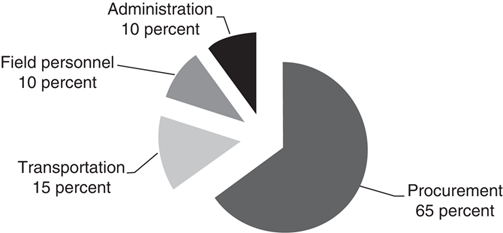
As shown in Figure 1 below (based on data presented by Blecken and Hellingrath, 2008), it is estimated that procurement activities account for 65 percent of the expenditures within disaster relief logistics.
Despite the relative proportion of such expenditures, however, the existing humanitarian relief logistics literature has focussed primarily on problems of facility location, inventory management, and transportation. To date, procurement in humanitarian relief is a topic that has only been discussed in a qualitative manner in the literature and has not been based upon scientific methodology. For this reason, we will develop a decision model to improve the procurement of goods in humanitarian relief operations.
We begin our discussion by describing the existing research within the areas of humanitarian relief logistics and stochastic decision modeling for disaster relief. This is followed by a focussed look at procurement activities in the context of humanitarian relief efforts, where we establish the need for a multistage decision‐making process under conditions of extreme uncertainty. We then introduce a two‐stage stochastic programming model for the humanitarian procurement process and demonstrate its effectiveness by comparing its performance to that of a standard decision‐making approach.
Background
The humanitarian relief procurement problem falls within the area of humanitarian logistics and supply chain management, which has been defined by Thomas and Kopczak (2005) as the process of planning, implementing, and controlling the efficient, cost‐effective flow, and storage of goods and materials, as well as related information, from the point of origin to the point of consumption for the purpose of improving social welfare and alleviating the situation of vulnerable people. The humanitarian logistics function encompasses a wide range of activities, which include disaster preparedness and planning, procurement, transportation, warehousing, tracking and tracing, and customs clearance (Thomas and Kopczak, 2005).
Despite its important role, supply chain management has received limited consideration within the humanitarian aid literature (Tatham and Pettit, 2010). In general, most papers provide qualitative insights into the problem (Long, 1997; Moody, 2001; Alexander, 2006; Van Wassenhove, 2006; Kovács and Spens, 2007; Pettit and Beresford, 2009; Oloruntoba and Gray, 2009). The literature in the area of humanitarian relief logistics also contains a wide array of handbooks developed by non‐governmental organizations. The Fritz Institute, for example, has published different reports that survey the performance of humanitarian logistics efforts and provide qualitative insights related to the relevance of logistics in disaster relief (Thomas and Kopczak, 2005; Thomas and Ramalingam, 2005; Bliss and Larsen, 2006; Bliss and Campbell, 2008).
From a quantitative supply chain decision‐modeling perspective, the existing literature can be classified into three main categories: inventory management, facility location, and transportation applications. The inventory management literature in the context of humanitarian relief operations is focussed on warehouse management (i.e. determining the size and frequency of orders, as well as the levels of safety stocks). Representative of the literature in this specific area are the papers by Beamon and Kotleba (2006a, b). In their research, the authors discussed a project where an inventory management system for World Vision International warehouses was developed. They presented a humanitarian relief inventory model to determine optimal order quantities and re‐order points for relief warehouses, and used simulation to compare the performance of the proposed mathematical model to both a heuristic and a naive inventory model. The authors showed how the mathematical model was able to minimize relevant inventory costs, achieve improved flexibility, and reduced response time.
Facility location research in the context of humanitarian relief is focussed on determining the location of warehouses and distribution centers. Akkihal (2006), for example, developed a mixed‐integer linear program to determine facility configurations where the objective is to minimize the average global distance from the nearest warehouse to the victims. Ultimately, the model is designed to determine the optimal locations for warehouses of non‐consumable inventories required for the deployment of aid efforts. In a similar line of research, Ukkusuri and Yushimito (2008) developed a facility location model for the pre‐positioning of supplies that takes into consideration the routing of vehicles as well as possible disruptions in the transportation network. This model combines the most reliable path and an integer programming model to find the optimal location of supplies.
In comparison, Balcik and Beamon (2008) integrated facility location and inventory decisions for humanitarian relief in the context of quick‐onset disasters. In particular, the authors developed a mixed‐integer linear program that can be used to determine not only the number and location of distribution centers in a relief network but also the amount of relief supplies to be stocked at each distribution center in order to meet the needs of people affected by the disasters. The proposed model considers multiple item types, budgetary constraints, and capacity restrictions. The authors developed scenarios for disaster locations and minimized the expected response time over all scenarios.
The literature related to the transportation and delivery of goods in humanitarian relief chains also presents a number of relevant applications. Haghani and Oh (1996) were the first to formulate the transportation of multiple commodities on a network as a multicommodity, multimodal network with the objective of minimizing the loss of lives. Barbarosoglu et al. (2002) developed a mixed‐integer mathematical programming model for helicopter mission planning during a disaster relief operation while Nolz et al. (2010) developed an algorithm for planning water distribution tours in disaster relief.
In spite of efforts such as these, little to no quantitative work has been done in another important domain of humanitarian relief supply chain logistics: procurement. Although a number of qualitative studies, some of which are referenced below, have sought to characterize the nature of the procurement process in this context, very little quantitative analysis has actually been performed. In fact, a review of the literature focussed on quantitative modeling for procurement in humanitarian applications resulted in only a single article. Trestrail et al. (2009) developed a deterministic mixed‐integer programming decision model that approximates US Department of Agriculture bidding approaches, and which thus provides support for improving bid pricing strategies on behalf of both ocean carriers and food suppliers.
Trestrail et al. (2009) are able to offer valuable insights into the complexities of the food aid and government procurement processes from the bidders’ perspective, but their model does not explicitly consider the uncertainty inherent in disaster relief scenarios. Including such uncertainty within humanitarian relief decision models can be important from the standpoint of accurately representing the impact of different parameters (such as the demand for relief) on the underlying process being modeled. With this in mind, the quantitative procurement model introduced in this paper is designed explicitly to address the need for supporting procurement decisions for humanitarian relief in the presence of uncertain information.
Procurement in humanitarian supply chains
The purpose of the procurement process in humanitarian supply chains is to ensure that humanitarian organizations have the supplies required to meet the needs for relief (PAHO, 2001). Russell (2005) describes different features that help characterize the procurement process in humanitarian supply chains. The author explains that goods and services enter the relief supply chain through different sources, forms, and locations. Goods and services can enter the chain as in‐kind donations (i.e. non‐monetary goods and services) which may be solicited or unsolicited, or may be procured from suppliers. Goods commonly procured by humanitarian organizations include food items, water supply and sanitation equipment, shelter items, as well as medical equipment and drugs (Taupiac, 2001).
In order to procure goods and services from suppliers, financial resources must be mobilized. Humanitarian organizations have multiple funding sources for each relief effort. They typically receive financial donations or grants, which come from a variety of sources. Donations and grants can be multilateral, administered by institutions that collect resources from sources in different countries and redistribute them, or bilateral, given directly from a donor institution to a recipient organization (Russell, 2005).
Goods can be acquired in different ways such as in bulk or stored at the vendor until needed (Russell, 2005), and the procurement of goods can be done using local or global suppliers (Blecken, 2010). Local procurement, whenever possible, has the advantages of faster delivery times and lower transportation costs (PAHO, 2001). Local procurement can also help in the recovery of the affected region by stimulating the local economy. However, local suppliers may not be able to provide the level of quality needed. In addition, local procurement can generate competition between organizations and result in shortages (PAHO, 2001).
On the other hand, international procurement is done primarily to have access to larger quantities, lower prices, and consistent quality. As long as delivery times and transportation costs are acceptable, procurement from global suppliers is a valid option for relief organizations. For example, international organizations such as the International Federation of Red Cross (IFRC) and Red Crescent Societies have agreements with global suppliers for items used consistently across disasters such as blankets, tents, tarps, and medical kits (Sowinski, 2003). In most cases, humanitarian organizations will have multiple suppliers for each relief effort.
The role of information technology
Humanitarian relief organizations have a common need for flexible information technology solutions that support procurement (Thomas and Kopczak, 2005). As pointed out by the authors, the development of flexible technology‐based solutions can help improve the responsiveness and the visibility of the materials pipeline.
Blecken and Hellingrath (2008) performed a review and assessment of supply chain management software tools available for humanitarian operations and identified those systems that included procurement modules. Procurement information may be stored in and retrieved from computerized disaster management software systems such as Sahana or the Humanitarian Logistics Software (HLS). HLS, for example, is a software system developed by the logistics department of the IFRC and the Fritz Institute, which can be used to capture data and track information related to the procurement and distribution of goods to field units. Even though these software systems do not include any type of decision support functionality, they could be used as databases in order to support decision models such as the one presented in this paper.
The humanitarian relief procurement process
In responding to a disaster, relief organizations generally follow the basic process described below.
Immediately after a disaster occurs, relief organizations perform an initial assessment (usually within one day of the occurrence of the disaster) to estimate the expected amount of supplies required to meet the relief needs of the affected population (Thomas, 2003). At the same time, pre‐positioned supplies available to the organization are also assessed in order to determine what supplies will need to be procured from suppliers. It should be noted that even though the pre‐positioning of relief supplies increases the ability of humanitarian organizations to deliver aid faster, not all humanitarian organizations can afford to maintain a network of warehouses and distribution centers (Balcik and Beamon, 2008). This fact illustrates the importance of developing a procurement decision model for humanitarian organizations.
Next in the process, logisticians translate the assessment into supply requirements. Demand for humanitarian relief supplies varies in terms of the magnitude, the criticality, and the type of materials required. This demand is particularly hard to quantify due to the fact that it is caused by natural and man‐made disasters and their magnitude, location, and timing can be highly unpredictable. As pointed out by Thomas (2003), logisticians base their calculations on early rough estimates which can differ significantly in either direction as more accurate information is obtained.
Once all estimates have been developed, the humanitarian organization will try to procure the relief supplies from local suppliers and/or from centralized warehouses, should the required supplies be available in the organization's warehouses (Beamon and Balcik, 2008). Those supplies that cannot be fulfilled by local suppliers or from centralized warehouses are procured from other global suppliers. Appeals for donations are also made within one or two days of the onset of the disaster (Thomas, 2003). Note that, as explained in the previous section, humanitarian organizations can receive both monetary and relief supplies donations.
As discussed above, logisticians’ calculations can differ significantly in either direction as new information is obtained. In the case of the 2005 South Asia earthquake, for example, the IFRC preliminary estimate was to aid 30,000 families. As more information was received, the estimate was increased to 150,000 families (Davidson, 2006). This example helps illustrate the point that it is difficult to quantify the impact of a disaster and that, as a result, humanitarian organizations will typically need to revise their initial estimates and decisions.
Multistage stochastic decision modeling for disaster relief
Charles et al. (2010) point out that humanitarian organizations constantly work in environments with high degree of uncertainty. In a dynamic situation such as the recovery from a disaster, multistage stochastic programming represents a technique that can be used to deal with the uncertainty that characterizes some of the parameters in a relief decision model.
Two‐stage stochastic programming models have been one of the most widely used formulations adopted in the literature. In these models, the decision maker is required to make a decision in the first stage, prior to knowing what value some random variable (typically, the demand for relief items) will assume. In the second stage, a recourse action is taken in order to compensate for the decision made in the first stage. The uncertain variables are usually modeled using a set of scenarios with associated probabilities of occurrence.
Since its inception by Dantzig (1955), several authors have studied different aspects of stochastic programming with recourse (Beraldi et al., 2000; Haneveld and Vlerk, 1999; Riis and Andersen, 2005; Vladimirou and Zenios, 1997). The work by Birge and Louveaux (1997) discusses the most important concepts and applications.
Two‐stage stochastic programming has been successfully applied to the study of different relief supply chain activities. In this line of research, Viswanath et al. (2002) focussed on the transportation aspect of disaster relief. The authors developed a two‐stage stochastic integer program with recourse for the disaster‐related strategic problem of investing in the links of a stochastic network to improve its expected post‐disaster performance. The proposed solution procedure is the optimization of the expected shortest path over the connected network realizations, subject to a bound on the probability of disconnected realizations.
In the same line of research, Barbarosoglu and Arda (2004) developed a two‐stage stochastic programming model to plan the transportation of vital first‐aid commodities to disaster‐affected areas during emergency response. The authors developed a multicommodity, multimodal network flow formulation that describes the flow of relief materials over a transportation network. In their model, randomness is represented by a finite sample of scenarios for capacity, supply, and demand triplets. The model was tested using problem instances generated out of earthquake‐related data.
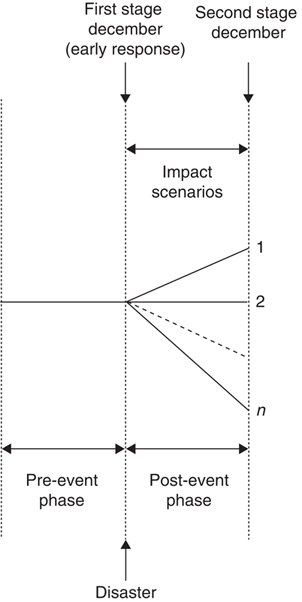
Our current approach to analytically modeling the procurement process is most closely related to this research on two‐stage programs. Specifically, we intend to extend the existing body of knowledge and develop a model that will allow humanitarian relief logisticians to find the optimal quantities of relief items to order from the different available suppliers at each stage, when some of the parameters are not known with certainty. In relief operations, humanitarian organizations must determine their initial procurement plans right after a disaster occurs, before the demand for relief is known with certainty (see Figure 2).
In our proposed decision approach, the initial rounds of procurement decisions are considered first‐stage decisions, since they must be made before the random quantities are known. After the demand for relief and the available resources are known with more certainty, humanitarian organizations can make changes to their procurement plans in order to compensate for discrepancies with the actual impact of the disaster. At this point, decision makers will determine how many additional items to order as well as how much demand for relief must be left unmet. These decisions are considered second‐stage or recourse decisions.
Model
The following discussion describes a two‐stage stochastic program with recourse that will allow humanitarian organizations to determine how much to order right after a disaster occurs, as well as what second‐stage decisions they should make once more accurate information about the impact of the disaster is received. The uncertain parameters include the demand level for each relief item as well as the sizes of monetary and in‐kind donations.
Data elements
The required data elements and the model formulation for the two‐stage stochastic humanitarian relief procurement model are presented as follows:
Decision variables
xij=Quantity of relief item i to order from supplier j at stage 1
yijω=Additional quantity of relief item i to order from supplier j at stage 2 under scenario ω
ziω=Integer decision variable that quantifies the unmet demand for relief item i under scenario ω
wij=1 if supplier j is selected to deliver relief item i, 0 otherwise
Data sets
I=The set of relief items
S=The set of available suppliers
Ω=Set of scenarios
Parameters
ai=Quantity of item i available from warehouses (pre‐positioned)
b=Available budget
cij1=Unit purchase price from supplier j for item i at stage 1
cij2=Unit purchase price from supplier j for item i at stage 2
fi=Penalty cost for each unit of unmet demand for item i
si=Number of suppliers to be selected for item i
(Inline Equation 1)= Total number of available suppliers for item i
(Inline Equation 2)= Maximum capacity for item i available from supplier j
(Inline Equation 3)= Minimum order quantity for item i available from supplier j
(Inline Equation 4)= Maximum amount of business to be given to supplier j for item i
(Inline Equation 5)= Minimum amount of business to be given to supplier j for item i
Scenario‐dependent data
diω=Demand for relief item i over the planning horizon under scenario ω
kiω=Quantity of in‐kind relief item i donations under scenario ω
mω=Monetary donations under scenario ω
pω=Probability of scenario ω occurring
Model formulation:
(Equation 1) st: (Equation 2) (Equation 3) (Equation 4) (Equation 5) (Equation 6) (Equation 7) (Equation 8) (Equation 9) (Equation 10)
The objective function (1), minimizes procurement and shortage costs across all possible scenarios. Our objective function has two distinct components: total relief shortage costs, denoted by: (Equation 11) and total procurement costs, denoted by:
Procurement costs are represented by the sum of first‐stage procurement costs plus the expected second‐stage procurement costs. To compute total procurement costs, we use the same first‐stage decisions about how many items to order as we would in the case of a single‐stage deterministic model. However, in our model we also need to determine second‐stage order quantities for each possible impact scenario. For this purpose, the objective functions weigh each of the second‐stage costs by their associated probability of occurring. The expected second‐stage procurement costs are then added to the first‐stage costs to determine the total procurement costs.
Constraint set (2) tries to ensure that the quantity procured for each relief item is appropriate in order to satisfy the quantity demanded during the planning horizon. Quantities of relief items available include pre‐positioned items, items procured from suppliers, and items in the form of in‐kind donations. The right hand side of constraint set (2) represents the set of possible demand scenarios. Constraint (3) makes certain that total procurement costs do not exceed the level of funds available (which include both budgeted funds as well as monetary donations).
Constraint set (4) ensures that a supplier's capacity for an item, or the extent of the desire of the organization to procure from that supplier, is not exceeded. For example, a humanitarian organization may want to limit the amount of business from a particular supplier in order to balance the mix between international and local suppliers. In a similar way, suppliers may want to limit the number of items provided to any one organization in order to maintain existing relationships with a number of different organizations. Alternatively, an aid organization might be interested in reducing its dependence on a particular supplier, and thus in increasing its supply chain resilience to supply disruptions.
Constraint set (5), on the other hand, enforces the size of any minimum order quantities that might be determined by the supplier or by the organization. As discussed in previous sections, humanitarian organizations may have already signed agreements with suppliers for items used consistently across disasters. Constraint (6) establishes the maximum number of suppliers from which the organization would be interested in procuring a certain item.
Finally, constraint sets (7) and (8) ensure that order sizes be non‐negative, while constraint sets (9) and (10) enforce additional binary and non‐negativity conditions.
Testing and analysis
To support the usefulness of the proposed model as a decision‐making tool for humanitarian relief organizations, we evaluate the performance of the model using a set of randomly generated impact scenarios. In our example, the humanitarian organization must determine its procurement plan right after a sudden onset disaster occurs (e.g. an earthquake), before knowing with certainty what the level of donations and the demand for relief will look like. After the uncertain parameters are realized, the humanitarian organization must decide how many additional items to order and thus how much demand for relief to leave unmet.
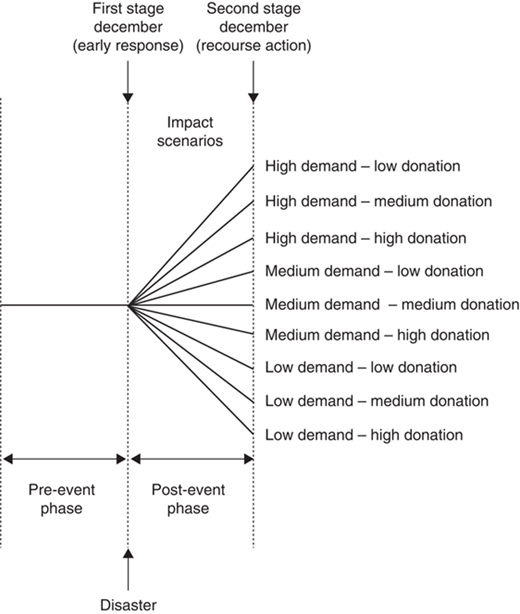
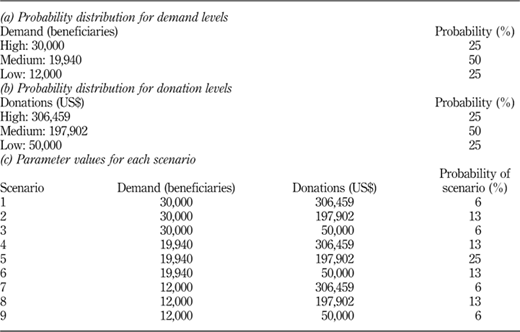
We consider three possible levels of demand for relief (low, medium, and high) and three possible donation levels (low, medium, and high) for a total of nine possible scenarios (see Figure 3). As shown in the figure below, the best possible scenario would be characterized by a low level of demand for relief and a high level of donations, while the worst case scenario would be characterized by a high demand for relief and a low level of donations.
In order to apply the two‐stage stochastic model in this context, the decision maker must estimate the probability of observing each different level of demand and donations. One approach to doing this is to first estimate the smallest, largest, and most likely values for each parameter, using the available information and the expertise of the decision maker. These values can then be used to form a triangular distribution for each parameter to approximate the range of possible values that might be observed in each case. The different levels of demand or donations to be used within the model can then be specified by choosing the single value corresponding to each discrete demand or donation level from within the domain defined by its triangular distribution. The probability of observing each corresponding level then can be determined by analyzing the values’ relative positions within the distribution.
In the case of demand, for example, in order to satisfy a specified “low” level of demand it is important to provide enough relief supplies to satisfy any amount of demand up to and including that amount. We may therefore define the probability of observing “low” demand to be the cumulative probability of observing any amount of demand up to that representative value. In a similar manner, we may define the probability of observing a “medium” level of demand to be the cumulative probability of seeing demand at a level which is no greater than the level specified for “medium” demand but more than the value for “low” demand. This general approach can be extended to derive probabilities for any number of different levels of demand, depending on the decision‐maker's preferences. The process could also be applied in reverse, in order to determine the specific value within the distribution that would correspond, for example, to a pre‐specified probability of having “low” demand.
Although the probabilities for the different levels of donations could be developed in a similar manner to those for demand, the decision maker could also take a more “pessimistic” view. Instead of the probability of receiving donations less than the specified amount, he or she may wish to assign to each level the cumulative probability of receiving more donations than specified. Thus the probability of receiving a “low” level of donations would be the likelihood of receiving more than that value but less than the amount corresponding to a “medium” level, and the probability of a “medium” level of donations would be the cumulative probability of receiving between a “medium” and a “high” level of donations. This approach could help protect the organization against over‐committing their resources without sufficient funding to support their efforts.
Given this discussion, we now apply these techniques in the context of the nine sample scenarios introduced above (three levels of demand and three levels of donations). To simplify comparisons across different scenarios, we adopt the “reverse” method of pre‐specifying the probabilities and then deriving the corresponding point estimates for each of the levels.
In the case of demand, suppose that the decision maker estimates a minimum amount of 3,000, a most likely amount of 15,000 and a maximum amount of 30,000. The 25th percentile of the corresponding triangular distribution is then 12,000, the 75th percentile is 20,000 (actually 19,940), and the 100th percentile is 30,000. Associating these values with “low,” “medium,” and “high” levels of demand gives the results displayed in the Table Ia. In a similar fashion, suppose that the decision maker assumes a minimum level of US$50,000 of donations, a most likely level of US$300,000 and a maximum level of US$400,000. The 0th percentile of the triangular distribution for donations is then US$50,000, the 25th percentile is around US$200,000 (actually US$197,902), and the 75th percentile is around US$300,000 (actually US$306,459). These values translate into the probabilities given in Table Ib. The probability associated with each of the nine scenarios then can be determined by computing the product of the two corresponding probabilities. Table Ic gives the resulting values and probabilities for each scenario.
Typically, relief commodities are delivered in the form of standard modules such as hygiene kits (Balcik and Beamon, 2008). For this reason, the number of different commodities that must be selected in relief operations does not tend to be considerable. In our example, we consider five relief items and ten candidate suppliers. The organization is working from an initial budget of US$200,000, and unit purchase prices ranged between US$3 and US$7 while penalty costs per unit of unmet demand were set at US$20. It is particularly important to set a big enough penalty cost for unmet demands because, otherwise, the model could conceivable minimize total overall costs by choosing to not fulfill relief demand, even though resources might be available.
We first solved the humanitarian procurement problem using the stochastic formulation. In order to validate the results of the proposed model and place them into context, we then solved the problem using a standard solution approach that uses expected demand and donation levels. This second approach is briefly described next.
Expected value solution approach
In this solution approach, the humanitarian organization bases its initial procurement plan on the average (expected) value of the uncertain parameters, rather than specifically planning for each possible scenario. This alternative solution is called the Expected Value Solution, and it models a typical decision‐making approach that would be taken under such uncertain conditions. In this case, we calculate both the expected demand for relief and the expected level of donations. From Table I, we can determine an expected demand value of 20,470 beneficiaries and an expected donations level of US$188,066. In our example, we replace our uncertain parameters by their expected values and then determine the optimal initial procurement decision based on those estimates. At the second stage of the process, when the actual demand becomes known, a secondary procurement decision is then made based on the particular scenario that actually occurs.
Results
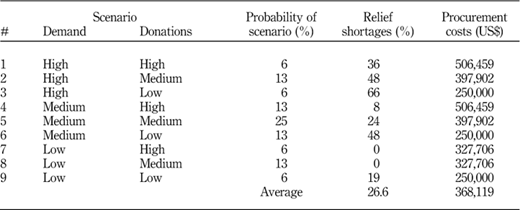
We now present the computational results from our randomly generated instances. The software used to solve the model was the Risk Solver Platform from Frontline Systems Inc. (www.solver.com), and the results of the new stochastic approach are displayed in Table II.
We can identify a series of patterns in the results that illustrate how the stochastic model is able to capture the interrelationships between the uncertain parameters. It can be observed that as the level of donations increases, the level of relief shortages is reduced. On the other hand, as the severity of the disaster increases, the level of shortages increases, with all other things held equal.
With respect to procurement costs, the patterns are not as clear. However, it can be observed that, in general, procurement activities increase as the level of donations is increased which, in turn, results in reduced relief shortages. The reason that helps to explain this pattern is the following: as a humanitarian organization receives donations, more funds are available to procure items; at the same time, if demand increases, the organization will then try to procure more items to satisfy the increased demand for relief.
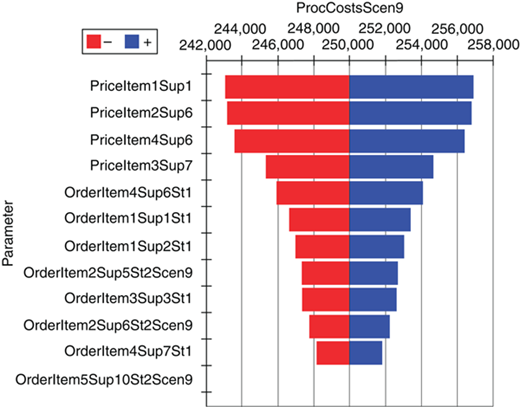
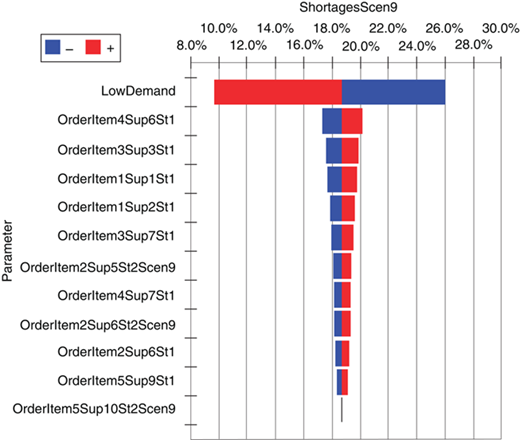
There are a number of questions that the decision maker might want to ask regarding the sensitivity of the optimal solutions to changes in the data. Performing a sensitivity analysis of these solutions can help the decision maker to address these questions. With this in mind, Figures 4 and 5 display a set of sensitivity charts that were generated using the Risk Solver Platform.
The tornado chart given in Figure 4 shows the model decision variables and parameters with the most significant impact on the total procurement costs for Scenario 9. In this particular case, we can see that the parameter with the highest impact is the Item 1 price charged by Supplier 1. The chart also allows the decision maker to identify what would happen to total procurement costs if the parameters were to change by ±10 percent. For example, the humanitarian organization might be interested in analyzing what would be the impact of a discount on the Item 1 price charged by Supplier 1. The sensitivity chart would allow the organization to determine that a 10 percent discount would reduce procurement costs by approximately US$7,000. The tornado chart presented in Figure 5 displays the model decision variables and parameters with the most significant impact on relief shortages for Scenario 9. Similar charts could be generated for any of the remaining eight scenarios.
Comparison of results
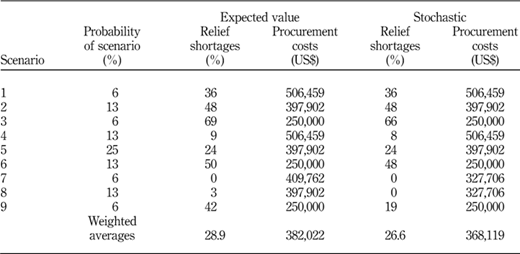
In order to validate the results of the stochastic model, we compare the stochastic programming solution to that of the expected value approach. A summary of the results for the two solution approaches is presented in Table III.
As shown in Table III, 67 percent of the time the stochastic approach performed better than the expected value approach on at least one of the two objectives, while the other 33 percent of the time it performed just as well. On average, the stochastic model yields a solution that is 4 percent better than the expected value solution in terms of procurement costs. With respect to relief shortages, the stochastic model is actually able to reduce shortages from 28.9 to 26.6 percent (a relative decrease of 8.2 percent). As shown in Table III, this improvement in relief shortages corresponds primarily to the scenarios associated with lower than expected donations. This indicates that without enough available resources at the beginning of the second stage of the process, the expected value approach's recourse decision simply cannot make up for the inaccuracies inherent in the first‐stage procurement decision.
The expected value solution effectively represents a “one size fits all” procurement plan based on a hypothetical average scenario. The new stochastic model, however, leads to a more effective use of the same level of resources by explicitly considering all nine scenarios in its calculations. This also allows it to use the available funds more efficiently, as in the case of low demand together with medium or high donations. Given the relative scarcity of resources available to humanitarian organizations, the stochastic model thus represents a more appropriate decision‐making tool from the perspective of humanitarian logistics.
Discussion and conclusions
This paper represents the first step in developing procurement decision models for humanitarian relief. We have formulated and solved a two‐stage stochastic optimization model to provide guidance in relief operations. The model takes into account different relief uncertainties (such as the level of donations), different logistics constraints (e.g. the capacity of suppliers) and other operational constraints in order to minimize expected demand shortages as well as total procurement costs.
A sudden onset disaster test case was developed and tested. The results illustrate how our stochastic decision‐modeling tool can allow decision makers to deal with parameters characterized by uncertainty (such as the demand for relief items) and provide a way to compensate for any bad effects that might be experienced as a result of making early response decisions based on limited information. We also discussed how the decision maker could use sensitivity analysis to study the sensitivity of the optimal solutions to changes in the data.
As Scholten et al. (2010) point out, there exists increasing pressure on humanitarian organizations to use their resources more efficiently. In this sense, the test case results showed the ability of our approach both to capture and model the procurement process and to capture the uncertainty inherent in a disaster relief situation, in support of more efficient and effective procurement plans.
Lessons from humanitarian logistics can also be relevant to commercial supply chains (Van Wassenhove, 2006). As commercial supply chains become increasingly agile, many of the ideas from the field of humanitarian relief supply chain management will prove relevant to the commercial sector. Our work thus provides researchers in supply chain management with a new application of mathematical programming and allows them to compare and contrast procurement decisions in humanitarian relief supply chains and commercial supply chains.
This research focussed on sudden onset disasters and did not differentiate between local and international suppliers. Our model formulation also assumed that there were no item losses in the relief effort. In some humanitarian relief situations, however, decision makers may need to estimate how much material might be lost before it gets to the recipients (due to corruption, etc.) and make decisions accordingly. With additional development and testing, the model could also be applied to a wider range of relief scenarios.
A number of extensions of the base model could be implemented so as to address the specific needs of a given humanitarian organization. Future work may look at formulating a combined procurement and transportation model. As discussed in previous sections, the humanitarian logistics literature presents a number of relevant applications related to the transportation and delivery of goods in humanitarian relief chains (Haghani and Oh, 1996; Barbarosoglu and Arda, 2004; Barbarosoglu et al., 2002). The development of a combined procurement and transportation model would further strengthen the importance of this work in the context of providing computer‐aided decision support for humanitarian logistics.
References
About the authors
Mauro Falasca is an Assistant Professor in the Department of Marketing and Supply Chain Management at East Carolina University. He received his PhD in Operations Management and Decision Support Systems from Virginia Tech. His primary research interests focus on the areas of disaster operations management and spreadsheet decision modeling. He is a member of the Decision Sciences Institute (DSI), the Institute for Operations Research and the Management Sciences (INFORMS), and the International Association for the Study of Information Systems for Crisis Response and Management (ISCRAM).
Christopher W. Zobel is an Associate Professor of Business Information Technology at Virginia Tech. His primary research interests are in the area of intelligent decision support systems and disaster operations management, and he has published articles in Decision Sciences, Decision Support Systems, the International Journal of Production Research, and the European Journal of Operational Research, among others. He is a member of the Decision Sciences Institute (DSI), the Institute for Operations Research and the Management Sciences (INFORMS), and the International Association for the Study of Information Systems for Crisis Response and Management (ISCRAM). Christopher W. Zobel is the corresponding author and can be contacted at: czobel@vt.edu