Skip to article sections
Purpose

To coordinate humanitarian organisations with different mandates that flock the scenes of disasters to save lives and respond to varied needs arising from the increased number of victims is not easy. Therefore, the level at which organisations self-organise, network and adapt to the dynamic operational environment may be related to inter-organisational coordination. The authors studied self-organisation, organisational networks and adaptability as important and often overlooked organisational factors hypothesised to be related to inter-organisational coordination in the context of humanitarian organisations.

Design/methodology/approach

The study’s sample consisted of 101 humanitarian organisations with 315 respondents. To decrease the problem of common method variance, the authors split the samples within each humanitarian organisation into two subsamples: one subsample was used for the measurement of self-organisation, organisational network and adaptability, while the other was for the measurement of inter-organisational coordination.

Findings

The partial least square structural equation modelling (PLS-SEM) analysis using SmartPLS 3.2.8 indicated that self-organisation is related to inter-organisational coordination. Organisational network and adaptability were found to be mediators for the relationship between self-organisation and inter-organisational coordination and all combined accounted for 57.8% variance in inter-organisational coordination.

Research limitations/implications

The study was cross sectional, hence imposing a limitation on changes in perceptions over time. Perhaps, a longitudinal study in future is desirable. Data were collected only from humanitarian organisations that had delivered relief to refugees in the stated camps by 2018. Above all, this study considered self-organisation, adaptability and organisational networks in the explanation of inter-organisational coordination, although there are other factors that could still be explored.

Practical implications

A potential implication is that humanitarian organisations which need to coordinate with others in emergency situations may need to examine their ability to self-organise, network and adapt.

Social implications

Social transformation is a function of active social entities that cannot work in isolation. Hence, for each to be able to make a contribution to meaningful social change, there is need to develop organisational networks with sister organisations so as to secure rare resources that facilitate change efforts coupled with the ability to reorganise themselves and adapt to changing environmental circumstances.

Originality/value

The paper examines (1) the extent to which self-organisation, adaptability and organisational networks influence inter-organisational coordination; (2) the mediating role of both adaptability and organisational networks between self-organisation and inter-organisational coordination in the context of humanitarian organisations against the backdrop of complex adaptive system (CAS) theory.

The purpose of this paper is to examine the extent to which self-organisation, adaptability and organisational networks influence inter-organisational coordination in the context of humanitarian organisations. Both natural and human-made disasters that strike various regions of the world result in loss of lives and property and traumatise people, leading to a rise in environmental devastation. According to Emergency Disaster Database (2019), earthquakes are the worst disasters that cause death, followed by storms, extreme temperature and floods, whereas in terms of causing economic losses, storms are ranked highest, followed by floods and earthquakes. Globally, evidence indicates that Asia is the worst-affected continent, followed by America, Europe and Africa. In terms of countries that are most affected by disasters, India records the highest number of people affected by disasters, followed by the Philippines, China and Indonesia in Asia, the United States in America and France in Europe (CRED, 2019). In Africa, Somalia is the worst affected, followed by Algeria, Mozambique and Nigeria (CRED, 2019). As indicated above, when disasters strike globally, some countries are more affected than others. This has been particularly true of Africa since 2000, with Kenya (60 events), Mozambique (55 events) and South Africa (54 events) having experienced the highest number of disasters in the form of regular fierce storms, droughts and floods. Other affected African countries are Nigeria (49 events), Ethiopia (43 events) and the Democratic Republic of Congo (DRC) (41 events). Although Uganda is not among the highly disaster-affected countries, it has experienced landslides in the Bududa district and disastrous floods in Kasese in (2014). Further, Uganda has witnessed an influx of refugees from South Sudan and the DRC due to internal conflicts that have left millions dead or displaced.

Clearly, such disasters exert pressure on the already constrained public resources. Moreover, they are associated with traumatic and devastating effects which demand swift action in an inter-organisational–coordinated manner amongst the humanitarian organisations to save and stabilise people's lives. However, most humanitarian organisations have differing goals. For instance, the United Nations Children's Fund (UNICEF), Plan International and ChildFund have common goals that address elementary education, whereas the World Food Programme (WFP) and Action Against Hunger espouse differing goals that target the provision of food to ensure food security. Indeed, the multiple goals of non-governmental organisations (NGOs) include human resource provision during disasters, water, sanitation and hygiene (WASH) and the provision of basic necessities like clothes, shelter, medicine and psychosocial support to save and stabilise the lives of disaster victims (Akhtar et al., 2012; Oloruntoba, 2013; Ramsden, 2014).

Owing to the differing goals of humanitarian organisations, there is need for proper coordination of activities as this helps to achieve timely delivery of relief, which is the comprehensive support intended to save lives and stabilise affected persons. In addition, inter-organisational coordination amongst relief organisations is essential for successful relief operations. An example is the successful rescue of the Thailand football team, which saw local non-governmental organisations (LNGOs), international humanitarian organisations (IHOs) and foreign countries all undertaking a joint rescue mission. However, Uganda's experience with regard to coordination continues to pose a challenge. A case in point is the influx of South Sudanese refugees into the West Nile region of Uganda, of Congolese refugees into Western Uganda, where the refugees barely receive aid, and even when they receive such aid, many times it arrives late and often from dominant agencies at the expense of others, which evidently have the will but are hampered by limited authorisation to act (Mutebi et al., 2020).

Previous scholars have conducted extensive research on coordination and its benefits amongst humanitarian organisations (Kabra and Ramesh, 2015; Moshtari, 2016; Pazirandeh and Maghsoudi, 2018). However, evidence shows that research on the precursors of inter-organisational coordination is still scarce (L'Hermitte et al., 2016; Moshtari, 2016), whereas prior research considered a number of factors in explaining inter-organisational coordination: big data and predictive analytics (Dubey et al., 2018a, b); swift trust and commitment (Dubey et al., 2019); organisational culture (Venkatesan, 2018); resource sharing (Pazirandeh and Maghsoudi, 2018); coordination roles (Jensen and Hertz, 2016); mutual trust, partner compatibility, relationship management capability, reciprocal commitment and resource complementarity (Behl and Dutta, 2019a, b; Eftekhar et al., 2017; Moshtari, 2016); social and financial aid for disaster relief operations using corporate social responsibility (CSR) and crowdfunding (Behl and Dutta, 2019a, b) and the role of media exposure (Eftekhar et al., 2017). In sum, practitioners and theorists of coordination alike discuss the importance of self-organisation for coordination to occur. However, there are no studies on self-organisation and inter-organisational coordination, although other complex adaptive system factors have been shown to be important for inter-organisational coordination (Day, 2014; Hasgall, 2013; McCarthy, 2003; Nilsson, 2003; Pathak et al., 2007; Surana et al., 2005; Wycisk et al., 2008).

Our article aims to contribute to the literature by filling theoretical and empirical gaps on self-organisation and inter-organisational coordination as well as the mechanism through which self-organisation influences inter-organisational coordination. First, when an organisation develops a positive mindset towards self-organisation, this may help its coordination process with other organisations (Choi et al., 2001). This does not mean that reorganisation or being prepared per se buttresses inter-organisational coordination, in the sense that the more an organisation reorganises, the more it is ready to coordinate with other organisations. Rather, we suggest that self-organisation needs to be dealt with in a certain way to allow coordination to occur (Nilsson, 2003; Surana et al., 2005). Second, we contribute by exemplifying the facilitating role of adaptability and organisational networks in enabling the occurrence of the relationship between self-organisation and inter-organisational coordination amongst humanitarian organisations in developing countries. This study therefore extends contribution to complex adaptive system (CAS) theory. The rest of the paper is structured as follows: section 2 presents the theoretical underpinning of this study and the literature review; section 3 discusses the research methodology and methods followed; section 4 presents the results of the study; while sections 5 and 6 present the discussion of results and conclusion, implications, limitations and areas for further research.

On theoretical grounds, inter-organisational coordination is rooted in CAS theory, which asserts that inter-organisational coordination is partly a result of the emergence of order and new patterns within an organisational structure, processes and function alongside the creation and strengthening of ties with other cooperating agencies (Holland, 1995; McMillan, 2008). Such new structures are intended to facilitate the ability of an organisation to adapt to emergent operational circumstances. To this extent, it is implied that the emergence of order and new patterns as guidelines on the formal operations of an organisation represent the essence of self-organisation. The creation and strengthening of ties with sister agencies indicate the centrality of organisational networks and the formation of new structures and processes to deal appropriately with emergency operational circumstances. This denotes the adaptability of the organisation in the pursuit of ultimate inter-organisational coordination. Therefore, CAS theory explains self-organisation, adaptability and organisational networks as relevant in fostering inter-organisational coordination amongst humanitarian relief organisations in Uganda.

The literature that explains inter-organisational coordination is extensive (Dubey et al., 2018a, b, 2019; Tatham et al., 2017). However, no consensus has been established on how inter-organisational coordination is constituted, its antecedents and how it should be studied, given the differences in the mandates of various actors. One common idea shared in these studies reveals the complex and dynamic nature of the emergency response (Bambulyak and Frantzen, 2009; Behl and Dutta, 2019a, b), which makes inter-organisational coordination challenging and problematic in multi-organisational environments. The current study, although it does not discount these lenses, introduces constructs from CAS theory to explain inter-organisational coordination aimed at determining the degree of a relationship inherent in the hypothesised relationship as well as making known the gaps in the assumed relationships, which serves to justify undertaking the study. The reviews are as follows:

2.2.1 Self-organising and inter-organisational coordination

Self-organisation is conceptualised as the spontaneous creation of coherent patterns and order out of local interaction in natural, physical and social systems (Kauffman, 1993). Apparently, – self-organisation is observed in organisational networks of community organisations that emerge after natural disasters (Comfort, 1994). According to Goldstein et al. (2010), institutions that self-organise can sustain cooperation and solve coordination problems in a repeated game context. Le Roux and Van Niekerk (2019) investigated the challenges encountered and opportunities that emerged when stakeholders spontaneously self-organised communication efforts during a disaster and noted that self-organisation smoothened the communication process, which was relevant during the coordination of rescue and relief efforts amongst collaborative partners. According to Gershenson (2015), self-organisation is known to produce systems which can adapt to the requisite variety of their environment, offering more efficient solutions to problems that change in time than those obtained with traditional techniques. Self-organisation affects integrative understanding of the operational issues amongst coordinating partners (Donaire-Gonzalez et al., 2019). Ricciardelli et al. (2018) posited that self-organisation enhances the resilience of each actor to respond because it allows inter-coordinating members to share information and acquire the necessary knowledge about modes and places of engagement and collaboration to deliver the necessary relief items to meet the needs of the beneficiaries. However, Pazirandeh and Maghsoudi (2018) argued that inter-organisational coordination influences self-organisation if organisations are to develop long-term relationships, which is true for commercial firms as self-organisation helps them to complement one another as an essential element that influences resource sharing during coordination (Mahapatra et al., 2010). This points to the significance of complementarity or mutual exclusiveness for creating a situation where agents in a coalition recognise that there are more benefits realised through self-organisation by sharing resources with other members of the network during relief delivery. Thus, the hypothesis below was derived:

H1.

Self-organisation positively affects inter-organisational coordination.

2.2.2 Self-organisation and adaptability

According to scholars (Birdsey et al., 2017; Carapiet and Harris, 2007; Kauffman, 1993), organisations with a high ability to self-organise will learn and adapt more effectively to changing operational environments than those with less ability to self-organise because the system arranges itself into a more ordered pattern, which gradually helps it to adapt to changing conditions and basing on the ongoing non-linear interaction of elements within the system, the elements adapt to each other's actions (Uhl-Bien and Marion, 2009). Thus, self-organisation facilitates communication as well as the exchange of information and learning amongst interacting agents, which enhances the capacity of each to adapt to changes in the operating environment (Uhl-Bien and Arena, 2018). Tzafestas (2018a, b) posited that adaptability is a process through which organisations self-organise for optimal operations. Adaptability compels an organisational system to accept the inevitable, to conform to the unavoidable and to harmonise with changing conditions. It is noted that in the context of humanitarian relief delivery, little empirical work exists; hence, the need to document self-organisation as an antecedent of adaptability. The following hypothesis for empirical testing is hereby fronted:

H2.

Self-organisation positively affects adaptability.

2.2.3 Adaptability and inter-organisational coordination

According to Lee (2004), adaptability is “the adjustment of organisational systems to meet a structure shift in the relief operational environment”. Adaptability is operationalised as “the ability of an organisation to track changes in the operational environment, increasing flexibility through service and product modularisation, matching supply chain design for beneficiaries” needs patterns. Scholars (Arshinder et al., 2007; Chan et al., 2009; Feizabadi et al., 2019) emphasised the importance of adaptability in inter-organisational coordination. Arshinder et al. (2007) advanced that adaptability increases the flexibility of coordinating partners through interactions that cause sharing information regarding beneficiaries' needs and utilise locations which allow them to deliver the relief in a timely manner. Further, Arshinder et al. (2007) noted that adaptability allows coordinating partners to have vision and to adapt both flexible processes and different coordination mechanisms, a view that Chan et al. (2009) explored when they argued that coordinating partners can adjust their solutions in order to deliver the best possible services to the beneficiaries, subjected to limited availability of resources at differing occurrences. Relatedly, adaptability allows coordinating actors to understand each other fully based on both managerial and technical issues and regarding coordination mechanisms, which makes them perform their role better to meet the common needs, so that each achieves their respective set goals (Uhl-Bien and Marion, 2009). Significantly, adaptability enables an operating partner to cope with a volatile operating environment, increases the level of flexibility to meet beneficiaries' needs and allows partners to deliver as expected (Dubey et al., 2018a, b). Akhtar et al. (2012) advanced that effective and efficient coordination required each link of the supply chain to share information, taking into account the impact its actions have on other stages. The lack of coordination was often due to conflict amongst the humanitarian actors resulting from information asymmetry and lack of trust (Altay and Pal, 2013; Tatham and Kovacs, 2010). Adobor and McMullen (2018) noted that a joint system-level response requires adaptive capabilities and transformational behaviours as they enable partners to complement each other, which ultimately improves synergies. Both adaptive capabilities and transformational behaviours are characteristics of a self-organising system (Tukamuhabwa et al., 2015). Following the foregoing debates, we hypothesise below that

H3.

Adaptability positively affects inter-organisational coordination.

2.2.4 Self-organising and organisational networks

All complex systems are organisational networks of many independent agents that interact, giving rise to emergent properties that differ from the properties of individual agents, which, ultimately, is a consequence of self-organisation. The emergence of a common understanding through interaction leads to a degree of dynamic stability underneath the randomness (the edge of chaos) of such complex systems (Marion and Uhl-Bien, 2001). Furthermore, the process of self-organisation in the context of disaster environments generates interactions amongst organisations and their operating environments in newly evolving complex systems, offering important insights into the general problem of initiating change and learning (Comfort, 1994). This is attributed to the dissipative structures that are created when organisations self-organise, dissipative structures which enable the exchange of information amongst actors are considered organisational networks. Initially, actors interact more or less randomly with whatever other actors happen to pass as neighbours, resulting in interactions which are preferentially retained because they are synergetic. Clearly, such preferentially stabilised interactions may be called a bond, a relationship or link and the different links turn the assembly of agents into organisational networks (Durrani, 2011).

Silva and Guerrini (2018) argued that if self-organised behaviour within the network is to add value to a business, then it requires the alignment of agents in relation to the overall objectives of the organisational network; that learning which creates and employs knowledge functions as a pivot for relationships and future feedback interactions; that the occurrence of spontaneous efforts from problems and/or isolated opportunities is related to the macro objectives; incentives to support dissemination of idea with innovative potentials through the network and that partners share values within an organisational identification framework. In this case, even if local efforts are momentarily divergent, they are aligned with the overall objective and contribute to achieving the desired benefits. Despite the quick formation of collaborative organisational networks in order to respond to specific opportunities, Duchek (2019) argued that without considering self-organisation in the network’s operational phase, organisations may not stimulate innovation, reduce costs and transfer knowledge, which hinders learning. Notably, CAS theory emphasises that self-organisation and organisational networks operate in a dynamic changing environment with non-linear projections to access resources. Hence, we hereby hypothesise that

H4.

Self-organisation positively affects organisational networks.

2.2.5 Organisational networks and inter-organisational coordination

Organisational networks are referred to as dyadic relations and interdependence amongst actors (Gretzel, 2001; Wasserman and Faust, 2012). Other critics similarly advance that network analysis can measure partnership characteristics and can be used to predict collaboration and effectiveness in organisations (Honeycutt and Strong, 2012). According to Borgatti and Foster (2003), social network ties not only serve as conduits for the flow of information and resources but also for the diffusion of ideas, beliefs and practices. For Podolny (2001), a diversity of network ties amongst humanitarian organisations is more likely to result in access to diverse and complementary resources that could be creatively combined or harnessed for the achievement of NGOs' mandates during catastrophes. Hence, through organisational networks, as discussed earlier, the success rate of efforts by humanitarian organisations to deliver relief to disaster victims can be significantly enhanced (Baharmand et al., 2019; Baum et al., 2000), implying that inter-organisational relationships enable actors to gain access to a variety of resources held by other actors. For example, network relations provide emotional support for risk taking by persons giving the aid and this, in turn, is likely to enhance the persistence to remain in aid-giving activities (Hoang and Antoncic, 2003). A number of studies reveal that successful inter-organisational relationships consistently use organisational networks to get ideas and gather information and advice (Cachia and Ramos, 2020). Gulati (1998) and Teece (1992) averred that alliances enable firms to gain access to resources, particularly when time is of the essence. Additionally, network ties offer opportunities and constraints for inter-organisational coordination amongst humanitarian organisations and serve as conduits for the flow of resources, a necessary condition for cooperative action (Borgatti and Halgin, 2011). Indeed, vast network research in organisational literature has established a relationship in which social actors are embedded, whereby the individual attributes of those actors are important determinants of the actions and performance (Brass et al., 2004). Tatham and Kovacs (2010) argued that network ties may not be effective without swift trust, which is important for network members to access human and other resources and information from organisational networks in hastily formed supply chain collaborations. However, the empirical test of the role of swift trust is scanty. On the other hand, ignoring the scanty alignment of values and trust that is necessary amongst partners strains the relationships which are crucial in developing systems and processes for coordination. Hence, as advanced, shared values guide partners' decision-making and build accountability to achieve the shared goals (Wei-Skillern and Silver, 2013). Further, Dubey et al. (2018a, b) discovered that big data and predictive analytics (BDPA) have a significant influence on building swift trust to access the necessary resources amongst actors in humanitarian supply chains.

Knox Clarke and Campbell (2016) suggested that a high level of competition within organisational networks can be a barrier to coordination amongst humanitarian organisations. Organisations that form disaster relief organisational networks are different units with differing mandates, objectives, work cultures and procedures, which need to compete for limited resources. Consequently, in the initial phases of relief work, humanitarian organisations often act independently and autonomously, a context that poses a different challenge in vertical partnerships and horizontal organisational networks in commercial settings. In vertical partnerships, competition at the same level does not exist between organisations. On the other hand, successful horizontal organisational networks are often coordinated by contractual, relational and associational agreements or norms such as developed trustworthiness (Pazirandeh and Maghsoudi, 2018). Such obligatory or regulatory terms and norms are often not present in relief organisational networks. Hence, the following hypothesis is formulated:

H5.

Organisational networks positively affect inter-organisational coordination.

2.2.6 Self-organisation, adaptability and inter-organisational coordination

In a joint effort by humanitarian organisations to deliver humanitarian relief, it is of paramount importance to have a spontaneous emergence of order in organisational structures, processes and functions (Heylighen, 2012, 2013). The spontaneous emergence of order in organisational structures, processes and functions is referred to as “self-organisation”, and it is one of the requirements for inter-organisational coordination in humanitarian relief delivery that enhances an organisation's ability to share temporal tasks of rescuing victims and restoring order in times of emergency (Page, 2001). However, for self-organisation to be effective in allowing organisational flexibility and robustness, it needs adaptability to cope and the alignment of its goals with those of others (Tukamuhabwa et al., 2015). Organisational adaptability helps actors to restore order, cooperate and share roles to provide relief as per their mandates with the aim to achieve desirable goals. Birdsey et al. (2017) inferred that adaptability can influence self-organisation and coordination teams to effectively deliver emergency support. Further, Garmer (2017) and Nyland et al. (2017) revealed that adaptability plays a vital role in enhancing coordination amongst organisation and team members, respectively. Although adaptability can mediate the relationship between self-organisation and inter-organisational coordination in some instances, mediation may not occur when organisations have bureaucratic structures, rigid policies and low levels of interaction with the employees (Dubey and Gunasekaran, 2016). Organisational adaptability may result in significant cost savings. Significantly, structural flexibility facilitates the organisation to improve its responsiveness regarding self-organisation and inter-organisational coordination (Amui et al., 2017). We therefore hypothesise that

H6.

Adaptability mediates the relationship between self-organisation and inter-organisational coordination.

2.2.7 Self-organisation, organisational networks and inter-organisational coordination

Organisational networks are groups of three or more organisations connected in ways that facilitate the achievement of common goals (Evans et al., 2017). Berthod (2018) proposed three major issues for firms interested in harnessing their own network: first, get rid of scenarios; second, plan for “all-in”; third, make a case for a troubleshooting unit. This means that organisational networks and self-organisation lead to inter-organisational coordination. As Chow and Chan (2008) advanced, organisational networks influence the intentions of organisations, resulting in collaborations in different activities. This view is shared by Qiu et al. (2015), who advanced that if an organisation creates team-based game designs, a desirable interdependent structure can successfully make it a winner. Similarly, Neal (2009) averred that organisational networks play an important role in self-organising, resulting in coordination behaviour. However, the case study by Berthod (2018) on promising practices in an organisation that are used to cope with the most extreme of crises and disruptions illustrated how organisations strategically managed networks of public organisations, nonprofits and firms in which they operated: by courtship and by paying attention to systemic vulnerability and collective prototyping. Based on the foregoing, here we hypothesise that

H7.

Organisational networks mediate in the relationship between self-organisation and inter-organisational coordination.

This study adopted a cross-sectional survey that utilised a positivistic view of the inter-organisational coordination in complex environments of disasters. Humanitarian organisations that delivered relief services to beneficiaries in refugee settlements of Bidibidi, Palorinya, Imvepi, Nakivale, Kyaka II and Kiryandongo in Uganda (Office of the Prime Minister, 2018) and the United Nations High Commissioner for Refugees (UNHCR, 2018) were used to understand inter-organisational coordination. The refugee settlements in the western and northern regions were selected because they have the majority of the camps that host internally displaced people and refugees from South Sudan, the DRC and Burundi. Second, according to the World Relief Report (2019), Uganda is ranked third amongst the least developed countries, yet, ironically, Uganda hosts refugees. This is partly because Uganda borders countries with serious political instability in the region: South Sudan, the DRC, Burundi, Rwanda, Somalia and Eritrea. Regardless of the challenges associated with refugee management, Uganda has been able to counteract the associated challenges. Hence, as a specialist in supply and logistics management, there lies an opportunity for me to make a contribution by generating an explanatory framework for continuing high coordination mechanisms amongst humanitarian organisations that continue to support Uganda to improve refugee management. From 136 humanitarian organisations, a sample of 108 was utilised. This sample was arrived at by utilising Krejcie and Morgan's (1970) sample size determination method. This sample size is also considered to be statistically significant based on the recommendations of Cohen (1988), Kock and Hadaya (2018) and Hair et al. (2019a, b). In keeping with Abrahantes et al. (2004) proposal, the unit of analysis is a humanitarian organisation as this is deemed to fit into the provision of a detailed understanding of how coordinating organisations with differing mandates work together to save life. The unit of enquiry was constituted by logistics coordinators, programme and project managers in humanitarian organisations and managers selected as they are deemed to be knowledgeable about humanitarian relief delivery and the subject under investigation.

The population of study comprised humanitarian organisations that delivered relief in categories such as logistics, health, WASH, food security and nutrition, protection and human rights and education. Stratified random sampling was utilised to select the initial sample of 108 humanitarian organisations in proportion to the population in each stratum that was compiled and validated using database provided by the UNHCR and the United States Office of Personnel Management (OPM). After obtaining the list of humanitarian organisations, a kth number (1.26) was derived by dividing the total population with a sample size. Then, the number of organisations {1, 3, 5, … Kth} was selected, followed by the name of the organisation traced on the list and subsequently located in the respective strata where the organisation falls to deliver the questionnaires.

To collect data, the researcher handed a close-ended questionnaire to various humanitarian organisations together with the cover letter explaining the purpose of the research study to the respondents. Also, the e-mail and telephone contacts of respondents were requested for purposes of subsequent follow-up. After a fortnight, the researcher sent each respondent an e-mail as a reminder with a follow-up via a telephone call. Out of the initial sample of 108 humanitarian organisations that received the questionnaires, the final sample totalling 101 humanitarian organisations returned useable questionnaires, representing a response rate of 91%. Based on survey length, such a response rate is rated as very good (Brtnikova et al., 2018).

According to Armstrong and Overton (1977) and Podsakoff et al. (2012) non-response bias occurs when the researcher is unsuccessful in obtaining information from sampling units selected for the sample. This, therefore, means that those who respond are different from those who do not respond in some meaningful ways, which affects the sample’s significance of the study population (Bryman and Bell, 2015; Chen and Paulraj, 2004). Procedural remedies were undertaken to alleviate any likely non-response bias problems where a formal letter of “invitation to participate in the survey” and an introductory letter were used and distributed along with the questionnaire to all invited participants to create confidence and explain the practical significance of the study to all respondents. Data were collected over a single wave distributing the two questionnaire versions to various potential participants randomly selected from the sample. This procedure is similar to the concurrent wave method (Armstrong and Overton, 1977; Hulland et al., 2018). Utilising responses to the two questionnaire versions, we compared respondents and non-respondents by running Mann–Whitney U-tests on several variables. The results in Table 1 indicate that there are no statistically significant differences between the two groups of respondents on all constructs being investigated, suggesting that non-response bias is not a major concern (Blome et al., 2013; Dubey and Gunasekaran, 2016).

Measurement items for the constructs under study were adapted from previous studies (Table 2), with various response categories anchored in a six-point scale ranging from 1 (“strongly disagree”) to 6 (“strongly agree”). A six-point Likert scale was used to eliminate the middle points of “neither agree nor disagree” and to reduce the deviation arising from respondents' indecision (Chomeya, 2010). Then, before pretesting for validity and reliability, all item scales were subjected to the expert critique of three experienced professors of humanitarian logistics and ten humanitarian supply chain managers working in humanitarian relief delivery, who were then requested to review the instrument for structure, readability, ambiguity and completeness, a process that enabled us to thoroughly clear the instrument of ambiguity, sharpened clarity and ensured the appropriateness of measurement items. Further, the process ultimately enabled us to secure a valid and reliable instrument. Note that all our study constructs were operationalised as reflective (Table 2).

As indicated above, the measures for the study’s constructs and subconstructs were derived from the literaturewhere reliability has been ensured. Established measures capturing the dimensions of particular constructs may have a greater propensity to hold their measurement properties across studies, whereas measurement quality remains an empirical concern that needs to be addressed as one moves from context to context (Barclay et al., 1995). Therefore, we conducted a multistep questionnaire development procedure to be certain of the validity and reliability of the operationalised constructs (DeSarbo et al., 2005). Primary data were collected for this study by using a semi-structured questionnaire that was designed based on guidelines stipulated by Saunders et al. (2009), to collect data on demographics and the study variables. The draft questionnaire was refined through a pilot study process conducted with five relief operations managers and a senior professor in the field of logistics and supply chain with a bias to humanitarian relief delivery, whose views were used to refine the instrument items in terms of wording for clarity and readability.

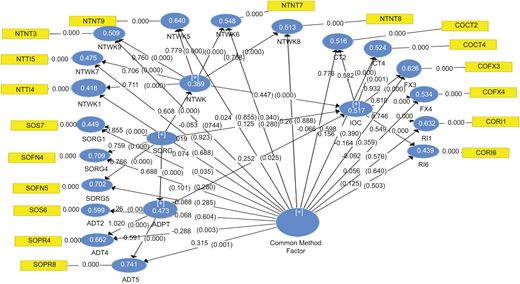
The fact that this study utilises a cross-sectional survey design to test research hypotheses raises concerns about common method bias (CMB) (Ketokiv, 2019). To address this concern, we followed the guidelines by Podsakoff et al. (2003), where both procedural and statistical methods as articulated by Podsakoff et al. (2012) were employed to deal with CMB. Procedural remedies included (1) the adoption of item scales that were previously developed and used in previous studies, then modified to suit the study context and double-barrelled questions were deleted where necessary. (2) A total of two samples were created in an organisation where one sample responded on self-organisation, organisational networks and adaptability, while the other sample responded on inter-organisational coordination. (3) The study utilised response categories that minimised middle points associated with bias and a six-point response scale was used to avoid middle points, where 1 = strongly disagree and 6 = strongly agree. In addition, Harman’s single-factor test and the common method factor (CMF) approach were conducted to assess for this possibility further (Podsakoff et al., 2003). In Harman’s (1967) single-factor test, all variables were entered into component factor analysis. The results indicated that a single-factor solution does not emerge since the maximum covariance explained by one factor is only 27.538%, which is significantly below the threshold value of 50% meaning that CMB is likely not an issue. The CMF is recommended for field studies were the independent and dependent variables are obtained from the same source and the source of method bias cannot be identified (Liang et al., 2007; Podsakoff et al., 2012) and also, the CMF approach controls for any systematic variance amongst the items that are independent of the covariance due to the constructs of interest (Kalubanga, 2019). The results of the CMF model are presented in Table 3. The average substantively explained variance of the indicators is 0.701, while the average method-based variance is 0.016. The ratio of substantive variance to method variance is about 44.204:1. These results indicate that the indicator's substantive variances are significantly greater than their method variances. Further, drawing on the bootstrapping procedure (using 5,000 subsamples, two-tailed test at 5% margin of error, with the no sign change options and bias-corrected and accelerated confidence intervals (BCa CI)), the CMF loadings are all insignificant, yet the loadings for the substantive constructs are all significant. This analysis further suggests that CMB is unlikely.

Our assessment of the potential for endogeneity in all regressors in the partial least square structural equation modelling (PLS-SEM) model used Durbin's (Durbin, 1954) X2-score and Wu–Hausman's (Wu, 1974; Hausman, 1978) F-statistic, following model estimation using the two-stage least square estimation procedure. The appropriateness of instruments (H0 size and location of the humanitarian organisation) was tested using the Sargan (Sargan, 1958) score chi2 test and Basmann (1960) chi2 test. The adopted test did not reject the null hypotheses of exogeneity of SORG, ADT and NTWK on IOC which yielded a non-significance of Durbin X2-score and Wu–Hausman test and Sargan X2 score and Basmann X2 test at 5% level of significance. Results are summarised in Table 4 below. Based on the presented results, we conclude that endogeneity is not present in this study, which supports the robustness of structural model results (Hult et al., 2018).

After finding that regressors are exogenous, we went on to use ordinary least square (OLS) model results, then OLS, a heteroskedasticity test, was administered using the Breusch–Pagan/Cook–Weisberg test and the results indicated the presence of heteroskedasticity (X2 = 8.02, p = 0.0046). This was then corrected where the final model was estimated with OLS with robust standard errors to correct the effects of heteroskedasticity. The results reflect robust standard errors (Table 10).

We utilised Svensson et al.'s (2018) guidelines to test for potential non-linearities in structural equation model relationships. First, we used Ramsey's test (1969) RESET on latent variable scores extracted after the convergence of the original model's PLS-SEM algorithm. The results in Table 5 revealed that neither partial regression of ADPT and NTWK on SORG (F (5.609) = 0.037, p = 0.020) nor F (18.103) = 0.095, p = 0.000) are subject to non-linearity. Second, we included interaction terms to represent quadratic effects between IOC on NTWK, (4) IOC on ADPT and (6) SORG, NTWK and ADPT on IOC. The results of bootstrapping with 5,000 samples and using no sign change revealed that neither of the non-linear effects is significant (F (3.364) = 0.015, p = 0.070). We concluded that the linear effect model is robust.

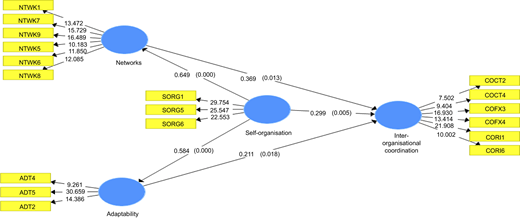
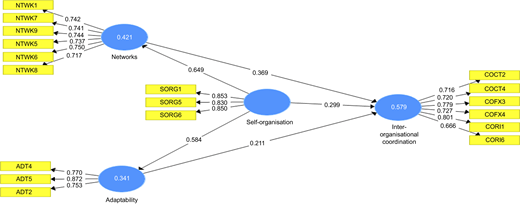
Before assessing the conceptual model, reliability and validity of measurement items were verified. Both measurement and structural models were tested using PLS-SEM techniques since our sample is statistically significant, as based on the recommendations by Cohen (1988), Hair et al. (2019a, b) and Kock and Hadaya (2018). However, the measurement model was used to validate both construct reliability and validity (Figure 1), while the structural model tested the theorised model (Figure 2). An analysis was performed using SmartPLS (Ringle et al., 2015), SmartPLS 3.2.8 professional version. The results are hereby presented (1) the measurement model; (2) the descriptive statistics of constructs; (3) an analysis of structure or testing of the hypotheses. Results of the indicator and construct reliability, convergent and discriminant validity are summarised in (Tables 1 above and 2 below). For indicator reliability, loadings of all items presented in Table 1 exceed the minimum recommended threshold value of 0.70 (Hair et al., 2017), implying that the items used in this study reliably estimate the construct.

For construct reliability, the composite reliability measure and Cronbach's alpha coefficients for all constructs were assessed and are presented in Table 6. All measures were found to be above the threshold 0.70 (Hair et al., 2017), implying that the indicators adequately measure their associated construct. As recommended by Fornell and Larcker (1981), three measures were used to examine convergent validity: (1) loading of items (>0.70), (2) composite reliability (>0.70) and (3) average variance extracted (AVE) for each construct (>0.50), respectively, to ultimately conclude that convergent validity has been met (Table 6). It should be mentioned that all these measures were found to be satisfactory above the accepted cut-off. The study also assessed model for effect size (f2), cross-validation (CV) communality and cross-validation redundancy, which serve as indicators of quality of measurement and structural model, respectively. Significantly, all values are greater than 0, implying that the model is predictive (see Table 6).

Next, we tested for multicollinearity by calculating the variance inflation factor (VIF) for each construct. The VIF values ranged from 1.436 to 1.740, significantly below the recommended threshold value of 5 (Hair et al., 2018).

Discriminant validity is established in order to observe the extent to which a factor truly differs from others (Hair et al., 2014). Hence, to assess discriminant validity (Fornell and Larcker, 1981), a recommendation to compare the square root of study construct AVE with correlations between constructs associated with these factors was followed. The rule of thumb is that the square root of the AVE for each construct should be greater than any correlation estimate. As the figures in Table 7 below show, the square root of the study construct is higher than the study construct correlation. It can, therefore, be concluded that there is sufficient evidence of discriminant validity.

In addition, the heterotrait–monotrait ratio (HTMT), as recommended by Henseler et al. (2015), was used to further confirm discriminant validity between similar and different indicators. As shown in Table 4a, all inference values are below 0.85 as recommended by Hair et al. (2017) and Henseler et al. (2015). Subsequently, the HTMT inference was calculated by examining bootstrapping from 5,000 subsamples. Where the resultant interval is lower than 1, discriminant validity exists (see Table 8). All previous data show that the indicators displayed to measure the different given factors are reliable and have discriminant validity.

To assess the unidimensionality of the study’s theoretical model construct, the conditions recommended by Anderson and Gerbing (1988) were used. That is, the item has to be significantly associated with empirical indicators of the construct and has to be associated with one and only one construct (Chen and Paulraj, 2004). Also, the overall PLS-SEM fit indices for the model were considered to evaluate for unidimensionality of study constructs. Basing on Henseler et al. (2016), multiple model fit criteria are utilised to evaluate model fit of the implied model and the empirical correlation matrix by running both confirmatory factor and confirmatory composite analyses. Henseler et al. (2016) provided three measures of discrepancy between the empirical and the model-implied correlation matrices, together with 95% quantile of its distribution if the model is correct (HI95), then a standardised root mean square residual (SRMR) as a measure of the distance between the two matrices of the model-implied and the empirical correlation is 0.051 (HI95 = 0.100), a dULS value of 0.516 (HI95 = 1.284) and a dG value of 0.516 (HI95 = 0.598). All these measures of discrepancy are below their corresponding value of (HI95), implying that the discrepancy between the empirical and the implied correlation matrices is not significant. This suggests that the information loss owing to the composite of self-organisation, organisational networks, adaptability and inter-organisational coordination is negligible and can be defended that the study constructs exhibit unidimensionality as they converge into composites (Bijmolt et al., 2017). In addition, the Bentler–Bonett index or normed fit index (NFI) (Bentler and Bonett, 1980) value of 0.960 is below the recommended cut-off of 0.9, which further indicates presence of convergent validity in the model (Lohmöller, 1989).

Table 9 shows the mean and standard deviation values of the constructs, with descriptive results revealing that on the scale of 1–6, most humanitarian organisations coordinate their humanitarian efforts during disasters (mean: 4.69; S.D: 0.49). There is the mean score for organisational networks (4.71, S.D 0.51), which reveals that the humanitarian organisations rely on one another for the delivery of relief to the beneficiaries in disaster-related situations. The results further stress the importance of adaptability (mean: 4.53) and self-organisation (mean: 4.54; S.D: 0.58). Note that the results for skewness and kurtosis for all the variables are close to 0, as recommended by Field (2018). Without doubt, the results displayed in Table 9 allow us to establish the face validity of the data.

The results in Table 10 below reveal that most of the respondents to the questionnaires were male (52.4%), while female accounted for 47.6% of the respondents. The results revealed that the majority of respondents in the total sample were aged between 34 and 45 years (41.6%) and had worked with individual organisations for 4–6 years (44.2%). The highest level of education amongst the respondents was a university degree, at 62.9%. Amongst the sample respondents, 32.7% to 32.3% were programme and project managers, respectively, and were knowledgeable about inter-organisational coordination.

Out of the sampled humanitarian organisations, the majority were development-oriented (NGOs), followed by service delivery (NGOs), which offers hope since in an emergency, there is quite a number of developmental organisations that operate in areas beyond relief activities. The results further revealed that the majority of humanitarian organisations had been engaged in relief operations for over 10 years, hence confirming that most of them were well versed in relief operations, both internationally and locally, and therefore, their responses were valuable to this study. In relation to employment, 21.8% were employing over 100 people, 41.6% had between 50 and 100 employees, while 36.6% employed between 1 and 50 employees. Such figures imply that these humanitarian organisations not only had the capacity to deliver but also the huge number of their employees emphasised relevance of this field in the country. In addition, the majority of humanitarian organisations operated in northern Uganda (47.5%) and in the central region (42.5%). This was justifiable because the most recent refugee influx is from South Sudan into northern Uganda, while most humanitarian organisations prefer having their headquarters in the central region for easy access to auxiliary services. Table 11 below provides details.

The study aimed at testing the mediating role of adaptability and organisational networks in the relationship between self-organisation and inter-organisational coordination amongst humanitarian organisations. To achieve this purpose, the hypotheses were evaluated in two stages: the direct hypotheses and the indirect hypotheses using PLS-SEM, which represents relationships between latent variables which are hypothesised in the conceptual model. PLS-SEM is assessed using criteria recommended by Hair et al. (2019a, b), which included determining the variance explained (R2), path coefficients (β), path significance (p-values based on 95% bootstrap CI), VIF and the predictive quality based on the blindfolding Q2 values (Hair et al., 2011). In addition, a goodness-of-fit (GoF) index was used to determine the model fit, which varies from 0 to 1 and can be seen as an index for validating PLS-SEM globally. The GoF index used in this study is 0.607, inferring that the model under investigation has better explaining power compared with the baseline values (GoFsmall = 0.1, GoFmedium = 0.25, GoFlarge = 0.36). Finally, the bootstrap re-sampling method was employed to test the statistical significance of each path coefficient (Chin, 1988). A total of 5,000 iterations using randomly selected subsamples were performed to estimate the theoretical model and hypothesised relationships. Hence, decisions to accept a stated hypothesis were arrived at by considering both the sign and significance of the beta coefficient (Chin et al., 2003). Hypotheses are supported at p < 0.01 and p < 0.05.

The results for the direct hypotheses are presented in Table 12 below. In line with the hypothesised relationships, H1, H2, H3, H4 and H5 were substantiated, with results revealing a significant positive relationship between self-organisation and inter-organisational coordination (β = 0.299; p ≤ 0.01); self-organisation and adaptability (β = 0.584; p ≤ 0.001); adaptability and inter-organisational coordination (β = 0.211; p ≤ 0.05); self-organisation and organisational networks (β = 0.467; p ≤ 0.001); organisational networks and inter-organisational coordination (β = 0.367; p ≤ 0.05). Subsequently, the results indicate that self-organisation, adaptability and organisational networks predict 56.6% of the variance in inter-organisational coordination results (Hair et al., 2017). Table 9 shows that self-organisation predicts 33.5% of the variance in adaptability, while self-organisation predicts 41.5% of the variance in organisational networks.

To test for the mediation paths (H6) in the model, bootstrapping was done using 5,000 subsamples at 95%, which were considered adequate to ensure the stability of results (Hair et al., 2017). Bootstrapping was used twice: first without a mediator andsecond, in the presence of a mediator construct. According to Hair et al. (2017), initially if the direct path is not significant, then there is no mediation effect and when the direct path is significant, a mediator variable is introduced and bootstrapped again to test the significance of the indirect path. If the indirect path is not significant, then there is no mediation; if it is, then the variance is computed and accounted for (VAF); if above 80%, then it indicates full mediation, between 20% and 80% as partial mediation, whereas a value less than 20% indicates no mediation (Hair et al., 2017). Table 5 shows that all the direct paths between self-organisation, adaptability, organisational networks and inter-organisational coordination are significant; therefore, testing the mediating role of adaptability and organisational networks in the relationship between self-organisation and inter-organisation coordination is meaningful. The results in Table 13 further reveal that adaptability plays a partial mediation role between self-organisation and inter-organisational coordination (β = 0.158, p ≤ 0.05), (VAF 23.87%). The results also reveal that organisational networks partially mediate the relationship between self-organisation and inter-organisational coordination (β = 0.240, p ≤ 0.05), (VAF 36.25%) as all fall in the range suggested by Hair et al. (2017). Overall, direct and indirect paths being significant does not only indicate that self-organisation directly relates to inter-organisational coordination but also goes through adaptability and organisational networks (see Table 13).

In this study, CAS theory was used to investigate how self-organisation, adaptability and organisational networks affect inter-organisational coordination in humanitarian relief delivery. The study established that self-organisation, adaptability and organisational networks positively and significantly relate with inter-organisational coordination amongst humanitarian organisation. The results are hereby discussed following relationships based on those that were hypothesised.

First, the study established that self-organisation is related to inter-organisational coordination, thereby posing the following meanings: self-organising systems help to increase the flexibility of an organisation so as to deliver its mandate in a timely manner when working with others in the delivery of relief services to the beneficiaries. This result is consistent with that of the study by Jobidon et al. (2017), who underscore the importance of self-organisation during crisis management. Also, Jobidon et al. (2017) noted that self-organising teams perform and coordinate better during crisis management, by showing more role variability across and within teams. Similar to Jobidon et al.'s (2017), the findings in this study revealed that an organisation's ability to self-organise its functions amongst its subsystems helps it to coordinate well with other organisations in the delivery of relief to the beneficiaries.

Additionally, the above study’s finding implies that a humanitarian organisation that self-organises by decentralising its activities is capable of handling emergencies. This is because decentralisation as a mechanism of self-organisation allows the distribution of authority in an organisation at every level of management. In turn, this leads to quick decision-making regarding its functions in times of emergency. This relationship is supported by Hermansson (2019), who argued that decentralisation helps in handling disasters more effectively because it is believed to lead to good disaster governance. In contrast to Hermansson's (2019) interpretivist lens, this study employed a positivistic lens to establish the association between self-organisation and effective collaboration amongst humanitarian organisations.

The relationship discussed above was subsequently supported, giving rise to implications such as when an organisation is able to adjust its priorities to meet the needs of its clients, it can be in a position to handle emergencies because the opportunity to adjust the priorities to suit the circumstances of the day facilitates such an organisation to cater for what may arise at any time. Note that any possibility to adjust makes an organisation able to proactively respond to any new and probably unplanned activities. This is a relationship supported by existing literature because, inadvertently, there is adaptability or the ability to adjust and handle emergencies (Uitdewilligen et al., 2010). This implies that an organisation that changes its capacity plans to meet the changing needs of its clients usually makes available competent human resources to deliver its mandate.

In other words, when an organisation has the capacity that is at all times needed to produce output within a given period, it is likely that it will be able to present the human resources that are necessary to perform its duties. This finding is supported with empirical literature by Zietlow et al. (2018), who insinuated that risk management that points to capacity planning ultimately has an effect on the use and availability of financial and other resources. In addition, when an organisation is able to adjust the resource budgets, it is able to reallocate resources to ensure that all needed items are delivered because rational adjustment of the resources available to an organisation usually comes with reprioritisation. This is a relationship supported by existing literature. For instance, Tremblay et al. (2012) posited that adaptive teams can organise their roles and resources during particular scenarios so as to perform better activities.

This relationship was supported, hence implying the following: self-organisation of humanitarian organisations, particularly with regard to aligning of their goals to the needs of beneficiaries, can influence the changes of operational guidelines that enhance the ability to adapt to changing conditions by coming up with new patterns of delivering responses to the beneficiaries. The findings correlate with previous literature that predicts the benefits of self-organisation. For example, Stone and Rahimifard (2018) suggested that the adaptability of an organisation is a result of the ability of an organisational system to reorganise. In addition, Geng et al. (2013) argued that humanitarian organisations need to have a self-organising recovery ability to increase their adaptive ability and to collaborate with cluster supply chain members. Smith and Palmberg (2009) posited that self-organisation across humanitarian organisation systems can increase an organisation's level of adaptability by enabling it to learn through the feedback mechanism.

The study’s findings similarly support this relationship and correspondingly translate into the following implications: a humanitarian organisation with the ability to reorganise its structures, function and the logical flow of activities and resources can improve its linkage with other humanitarian organisations. This could be in terms of knowing which humanitarian organisation to contact and interact and share experiences with. This finding is in line with Silva and Guerrini's (2018) argument that self-organisation fosters joint conflict resolution in organisational networks through open and transparent communication and interaction with network members. In addition, Zou et al. (2015) advanced that self-organisation increases the attachment of network members, which then increases resource sharing and control planning.

Second, the results affirm a positive significant relationship between adaptability and inter-organisational coordination. This relationship was equally supported, bearing the following meanings: when an organisation is able to change operational guidelines by way of being able to come up with new patterns of delivering response, it can enhance inter-organisational coordination of humanitarian organisations, in terms of commitment and flexibility as each organisation performs according to its mandate. This finding resonates with that of Christopher and Holweg (2011), who mentioned that, as a component of adaptability, structural flexibility improves responsible communication and coordination which, in turn, increases the reactive capacity of collaborating humanitarian organisations. Further, Dubey and Gunasekaran (2016) argued that adaptability is a key characteristic of humanitarian supply network members. Furthermore, Balcik et al. (2010) mentioned that adaptability provides distinct competitive advantage to each organisation participating in humanitarian supply chain activities by increasing flexibility and timeliness.

Third, the results as well support a relationship between organisational networks and inter-organisational coordination. This implies that organisational networks can improve the level of inter-organisational coordination in relief delivery, a result which complements the research findings on inter-organisational cooperation (Adem et al., 2018; Chandes and Paché, 2010; Comfort, 1994; Mamavi et al., 2015; Shumate et al., 2016; Tatham et al., 2017; Tomasinia and Van Wassenhove, 2009; Van Fenema et al., 2014). The argument raised is that organisational networks improve the efficiency and effectiveness of inter-organisational coordination (Moshtari, 2016) by creating awareness of who to contact in times of emergency. This helps organisations to access information and resources that are vital to support long-term relationships as they also establish new contacts with those humanitarian organisations they have collaboratively worked with in similar relief operations. Also, the establishment of contacts helps organisations to learn and share advice, which enables them to deliver as per their mandate (Turner et al., 2019). This finding suggests that organisational networks enable humanitarian organisations to exchange information on beneficiaries' needs (through telephones and during inter-agency meetings), which then improves on the timeliness of delivery. The study’s finding also illustrates that networking is an effective way of avoiding operational conflicts, which is possible because network partners respond to requests of sister humanitarian organisations differently. Indeed, through continuous interactions, members' commitment and role integrity scale up the provision of relief services to the beneficiaries. It can therefore be deduced that organisational networks contribute to a rise in the level of trust required between partners that is intended to create an effective collaborative working environment (Dubey et al., 2018a, b; Lu et al., 2018). This is a state which encompasses the works that advance organisational networks and inter-organisational coordination are fundamentally complementary or offer substitutable mechanisms for effective relief delivery (Moshtari and Gonçalves, 2017).

Furthermore, this study’s finding indicates that there is an indirect effect of self-organisation on inter-organisational coordination that is partially mediated by adaptability. Also, the study’s findings indicate that adaptive capabilities can help humanitarian organisations' self-organising capabilities, leading to better inter-organisational coordination. This implies that the characteristics of CAS may well result in inter-organisational coordination benefits in relief delivery. In this respect, even though self-organisation and inter-organisational coordination are directly related, the effect of self-organisation on inter-organisational coordination might as well be indirect, implying that it could be mediated by adaptability. This indirect effect of self-organisation through adaptability accounted for 23.70% variance in organisational networks.

Finally, the hypothesis that organisational networks mediate the relationship between self-organisation and inter-organisational coordination in humanitarian relief delivery was partially supported, inferring that organisational networks partly act as a conduit through which self-organisation could affect inter-organisational coordination. Also, self-organisation can affect inter-organisational coordination without the help of organisational networks. This is a result that further reveals that self-organisation traits could increase the level of organisational networks amongst humanitarian organisations, which could, in turn, increase inter-organisational coordination amongst humanitarian organisations. This indirect effect of adaptability through organisational networks accounted for 35.28% variance in inter-organisational coordination.

Basing on the support of CAS theory, self-organisation affects inter-organisational coordination in humanitarian relief delivery. In addition, organisational networks and adaptability mechanisms partially mediate the relationship between self-organisation and inter-organisational coordination. Significantly, this study offers evidence that self-organisation leads to organisational networks, which then improve inter-organisational coordination. Self-organisation also improves the level of adaptability and ultimately increases the level of inter-organisational coordination.

Theoretically, self-organisation, organisational networks and adaptability are elements of CAS theory because organisations need to reorganise themselves in a bid to facilitate their adaptability and networking with sister organisations if there is to be meaningful inter- organisational coordination under complex operating circumstances. Methodologically, numerous studies against which a relationship between self-organisation and inter-organisational coordination was determined were qualitative. Notably, this study used a scientific approach to examine the relationship. Regarding policy, the current humanitarian policies require self-organisation so as to increase the organisations' ability to match the pace which emergency responses require, as part of measures demanded by the United Nations, and this will go a long way in managing the associated negative effects of catastrophes for Uganda,. In terms of management, managers of humanitarian organisations, when they work collaboratively with other humanitarian organisations during relief operations should align their respective organisational goals to the needs of the beneficiaries by adjusting their budgets. This may be achieved through sharing feedback and information regarding the needs assessment. These are found to be mainly important for improving operational performance and organisations seem to be more willing to share them than aid stocks or other supplies. Humanitarian organisations' management can use consortium models, contracts, knowledge-sharing or innovation platforms or inter-agency meetings to improve their collaborations and relief delivery. Organisations are advised to be aware of environmental and organisational barriers that may slow down the adoption of these mechanisms, such as spillover effects, resistance to change, turf protection, cross training of employees or costs of developing standard interfaces or modular resources.

This study has examined the antecedents of inter-organisational coordination in humanitarian relief delivery with a focus on self-organisation, adaptability and organisational networks, while reflecting on the mediating role of adaptability and organisational networks in the relationship between self-organisation and inter-organisational coordination. It then tested for the mediation effect adaptability in the relationship between self-organisation and organisational networks. Since the study variables bear complexity in nature, they may have a reversal causal relationship as a potential limitation of this study, thereby creating the demand to use a mixed-research design to investigate the phenomenon of inter-organisational coordination in future studies. It has been noted that this study used objective measures to collect data at a particular point in time, which may have limited its capacity to capture the change in the respondents' perception regarding inter-organisational coordination over time. Without doubt, the demand is to employ a longitudinal and experimental design in future studies.

We are thankful to the almighty God who has enabled us to write this piece of work to its completion. In addition, we recognize the financial and moral support received from Makerere University Business School management. This paper is part of my PhD work and the listed co-authors are my PhD supervisors. The authors thank the Journal Editor and editorial board together with the anonymous reviewers for their timely constructive feedback.
Abrahantes
,
J.C.
,
Molenberghs
,
G.
,
Burzykowski
,
T.
,
Shkedy
,
Z.
,
Abad
,
A.A.
and
Renard
,
D.
(
2004
), “
Choice of units of analysis and modeling strategies in multilevel hierarchical models
”,
Computational Statistics and Data Analysis
, Vol.
47
No.
3
, pp.
537
-
563
.
Adem
,
S.A.
,
Childerhouse
,
P.
,
Egbelakin
,
T.
and
Wang
,
B.
(
2018
), “
International and local NGO supply chain collaboration
”,
Journal of Humanitarian Logistics and Supply Chain Management
, doi: .
Adobor
,
H.
and
McMullen
,
R.S.
(
2018
), “
Supply chain resilience: a dynamic and multidimensional approach
”,
International Journal of Logistics Management
, doi: .
Akhtar
,
P.
,
Marr
,
N.E.
and
Garnevska
,
E.V.
(
2012
), “
Coordination in humanitarian relief chains: chain coordinators
”,
Journal of Humanitarian Logistics and Supply Chain Management
, Vol.
2
No.
1
, pp.
85
-
103
, doi: .
Altay
,
N.
and
Pal
,
R.
(
2013
), “
Information diffusion among agents: implications for humanitarian operations
”,
Production and Operations Management
, Vol.
23
No.
6
, pp.
1015
-
1027
, doi: .
Alter
,
C.
and
Hage
,
J.
(
Eds
) (
1993
),
Organizations Working Together
,
Sage, Newbury Park
.
Amui
,
L.B.L.
,
Jabbour
,
C.J.C.
,
de Sousa Jabbour
,
A.B.L.
and
Kannan
,
D.
(
2017
), “
Sustainability as a dynamic organizational capability: a systematic review and a future agenda toward a sustainable transition
”,
Journal of Cleaner Production
, Vol.
142
, pp.
308
-
322
.
Anderson
,
J.C.
and
Gerbing
,
D.W.
(
1988
), “
Structural equation modeling in practice: a review and recommended two-step approach
”,
Psychological Bulletin
, Vol.
103
No.
3
, pp.
411
-
423
, doi: .
Armstrong
,
J.S.
and
Overton
,
T.S.
(
1977
), “
Estimating nonresponse bias in mail surveys
”,
Journal of Marketing Research
, Vol.
14
No.
3
, pp.
396
-
402
, doi: .
Arshinder
,
Kanda
,
A.
and
Deshmukh
,
S.G.
(
2007
), “
Supply chain coordination issues: an SAP‐LAP framework
”,
Asia Pacific Journal of Marketing and Logistics
, Vol.
19
No.
3
, pp.
240
-
264
, doi: .
Baharmand
,
H.
,
Comes
,
T.
and
Lauras
,
M.
(
2019
), “
Defining and measuring the network flexibility of humanitarian supply chains: insights from the 2015 Nepal earthquake
”,
Annals of Operations Research
, Vol.
283
No.
1
, pp.
961
-
1000
.
Balcik
,
B.
,
Beamon
,
B.M.
,
Krejci
,
C.C.
,
Muramatsu
,
K.M.
and
Ramirez
,
M.
(
2010
), “
Coordination in humanitarian relief chains: practices, challenges and opportunities
”,
International Journal of Production Economics
, Vol.
126
No.
1
, pp.
22
-
34
, doi: .
Bambulyak
,
A.
and
Frantzen
,
B.
(
2009
), “
Oil transportation from the Russian part of the Barents Region
”,
Status per January 2009 [online]
,
The Norwegian Barents Secretariat and Akvaplan-niva
,
Norway
,
available at:
http://www.barentswatch.com/innhold/oil_gas/repport_oiltransp/2009_oil_transport_eng.pdf (
accessed
 14 August 2020).
Barclay
,
D.
,
Higgins
,
C.
and
Thompson
,
R.
(
1995
), “
The partial least squares (PLS) approach to causal modeling: personal computer adoption and use as an illustration
”,
Technology Studies
, Vol.
2
, pp.
285
-
309
.
Basmann
,
R.L.
(
1960
), “
On finite sample distributions of generalized classical linear identifiability test statistics
”,
Journal of the American Statistical Association
, Vol.
55
, pp.
650
-
659
.
Baum
,
J.A.C.
,
Calabrese
,
T.
and
Silverman
,
B.S.
(
2000
), “
Don't go it alone: alliance network composition and startups' performance in Canadian biotechnology
”,
Strategic Management Journal
, Vol.
21
No.
3
, pp.
267
-
294
, doi: .
Behl
,
A.
and
Dutta
,
P.
(
2019a
), “
Social and financial aid for disaster relief operations using CSR and crowdfunding moderating effect of information quality
”,
Benchmarking: An International Journal
, pp.
1463
-
5771
, doi: .
Behl
,
A.
and
Dutta
,
P.
(
2019b
), “
Humanitarian supply chain management: a thematic literature review and future directions of research
”,
Annals of Operations Research
, Vol.
283
, pp.
1001
-
1044
, doi: .
Bentler
,
P.M.
and
Bonett
,
D.G.
(
1980
), “
Significance tests and goodness of fit in the analysis of covariance structures
”,
Psychological Bulletin
, Vol.
88
No.
3
, pp.
588
-
606
.
Berthod
,
O.
(
2018
), “
Operating at the edge: firefighters, organisational networks and lessons for minimal disruption during crisis
”,
Journal of Business Strategy
, pp.
34
-
39
.
Bijmolt
,
T.H.
,
Leeflang
,
P.S.
,
Pauwels
,
K.H.
and
Wieringa
,
J.E.
(
2017
),
Advanced Methods for Modeling Markets
,
Springer International Publishing, AG
,
Cham
.
Birdsey
,
L.
,
Szabo
,
C.
and
Falkner
,
K.
(
2017
), “
Identifying self-organization and adaptability in complex adaptive systems
”,
11th IEEE International Conference on Self-Adaptive and Self-Organizing Systems
,
IEEE Computer Society
, pp.
131
-
140
.
Blome
,
C.
,
Schoenherr
,
T.
and
Rexhausen
,
D.
(
2013
), “
Antecedents and enablers of supply chain agility and its effect on performance: a dynamic capabilities perspective
”,
International Journal of Production Research
, Vol.
51
No.
4
, pp.
1295
-
1318
.
Borgatti
,
S.
and
Foster
,
P.C.
(
2003
), “
The network paradigm in organizational research: a review and typology
”,
Journal of Management
, Vol.
29
No.
6
, pp.
991
-
1013
, doi: .
Borgatti
,
S.P.
and
Halgin
,
D.S.
(
2011
), “
On network theory
”,
Organization Science
, Vol.
22
No.
5
, pp.
1168
-
1181
.
Brass
,
D.J.
,
Galaskiewicz
,
J.
,
Greve
,
H.R.
and
Tsai
,
W.
(
2004
), “
Taking stock of networks and organizations: a multilevel perspective
”,
Academy of Management Journal
, Vol.
47
No.
6
, pp.
795
-
817
.
Brtnikova
,
M.
,
Crane
,
L.A.
,
Allison
,
M.A.
,
Hurley
,
L.P.
,
Beaty
,
B.L.
and
Kempe
,
A.
(
2018
), “
A method for achieving high response rates in national surveys of U.S. primary care physicians
”,
PloS One
, Vol.
13
No.
8
, doi: ,
[PubMed]
.
Bryman
,
A.
and
Bell
,
E.
(
2015
),
Business Research Methods
,
Oxford University Press
.
Carapiet
,
S.
and
Harris
,
H.
(
2007
), “
Role of self-organisation in facilitating adaptive organisation: a proposed index for the ability to self-organise
”,
Production Planning and Control
, Vol.
18
No.
6
, pp.
466
-
474
, doi: .
Chan
,
H.K.
,
Wang
,
W.Y.C.
,
Luong
,
L.H.S.
and
Chan
,
F.T.S.
(
2009
), “
Flexibility and adaptability in supply chains: a lesson learnt from a practitioner
”,
Supply Chain Management: International Journal
, Vol.
14
No.
6
, pp.
407
-
410
, doi: .
Chandes
,
J.
and
Paché
,
G.
(
2010
), “
Investigating humanitarian logistics issues: from operations management to strategic action
”,
Journal of Manufacturing Technology Management
, Vol.
21
No.
3
, pp.
320
-
340
, doi: .
Cachia
,
R.
and
Ramos
,
D.H.
(
2020
), “
Network analysis as a tool for humanitarian protection: research and practice
”,
Journal of International Humanitarian Action
, Vol.
5
No.
1
, pp.
1
-
14
.
Chen
and
Paulraj
,
A.
(
2004
), “
Towards a theory of supply chain management: the constructs and measurements
”,
Journal of Operations Management
, Vol.
22
No.
2
, pp.
119
-
150
.
Chin
,
W.W.
,
Marcolin
,
B.L.
and
Newsted
,
P.R.
(
2003
), “
A partial least squares latent variable modeling approach for measuring interaction effects: results from a Monte Carlo simulation study and an electronic-mail emotion/adoption study
”,
Information Systems Research
, Vol.
14
No.
2
, pp.
189
-
217
.
Chin
,
W.W.
(
1988
), “
The partial least squares approach to structural equation modeling
”, in
Marcoulides
,
G.A.
(Ed.),
Modern Methods for Business Research
,
Lawrence Eribaum Associates Publisher
,
London
, pp.
296
-
336
.
Choi
,
T.
,
Dooley
,
K.
and
Rungtusanatham
,
M.
(
2001
), “
Supply networks and complex adaptive systems: control versus emergence
”,
Journal of Operations Management
, Vol.
19
No.
3
, pp.
351
-
366
.
Chomeya
,
R.
(
2010
), “
Quality of psychology test between likert scale 5 and 6 points
”,
Journal of Social Sciences
, Vol.
6
No.
3
, pp.
399
-
403
.
Chow
,
W.S.
and
Chan
,
L.S.
(
2008
), “
Social network, social trust and shared goals in organizational knowledge sharing
”,
Information and management
, Vol.
45
No.
7
, pp.
458
-
465
.
Christopher
,
M.
and
Holweg
,
M.
(
2011
), “
‘Supply chain 2.0’: managing supply chains in the era of turbulence
”,
International Journal of Physical Distribution and Logistics Management
, Vol.
41
No.
1
, pp.
63
-
82
.
Cohen
,
J.
(
1988
),
Statistical Power Analysis for the Behavioral Sciences
, (2nd ed.) ,
Lawrence Erlbaum Associates
.
Comfort
,
L.K.
(
1994
), “
Risk and resilience: interorganizational learning following the Northridge earthquake of 17 January 1994
”,
Journal of Contingencies and Crisis Management
, pp.
157
-
170
.
CRED
(
2019
),
Natural Disasters 2018
,
CRED
,
Brussels
,
available at:
https://reliefweb.int: Issue No. 56.
Day
,
M.
(
2014
), “
Fostering emergent resilience: the complex adaptive supply network of disaster relief
”,
International Journal of Production Research
, Vol.
52
No.
7
, pp.
1970
-
1988
.
DeSarbo
,
W.S.
,
Anthony Di Benedetto
,
C.
,
Song
,
M.
and
Sinha
,
I.
(
2005
), “
Revisiting the miles and Snow strategic framework: uncovering interrelationships between strategic types, capabilities, environmental uncertainty, and firm performance
”,
Strategic Management Journal
, Vol.
26
No.
1
, pp.
47
-
74
.
Di Marzo Serugendo
,
G.
,
Gleizes
,
M.P.
and
Karageorgos
,
A.
(
2005
), “
Self-organization in multi-agent systems
”,
The Knowledge Engineering Review
, Vol.
20
No.
2
, pp.
165
-
189
.
Donaire-Gonzalez
,
D.
,
Valentín
,
A.
,
Van Nunen
,
E.
,
Curto
,
A.
,
Rodriguez
,
A.
,
Fernandez-Nieto
,
M., ...
and
Vermeulen
,
R.
(
2019
), “
ExpoApp: an integrated system to assess multiple personal environmental exposures
”,
Environment International
, Vol.
126
, pp.
494
-
503
.
Dubey
,
R.
and
Gunasekaran
,
A.
(
2016
), “
The sustainable humanitarian supply chain design: agility, adaptability and alignment
”,
International Journal of Logistics Research and Applications
, Vol.
19
No.
1
, pp.
62
-
82
.
Dubey
,
R.
,
Altay
,
N.
,
Gunasekaran
,
A.
,
Blome
,
C.
,
Papadopoulos
,
T.
and
Childe
,
S.J.
(
2018a
), “
Supply chain agility, adaptability and alignment: empirical evidence from the Indian auto components industry
”,
International Journal of Operations and Production Management
, Vol.
38
No.
1
, pp.
129
-
148
.
Dubey
,
R.
,
Luo
,
Z.
,
Gunasekaran
,
A.
,
Akter
,
S.
,
Hazen
,
B.T.
and
Douglas
,
M.A.
(
2018b
), “
Big data and predictive analytics in humanitarian supply chains: enabling visibility and coordination in the presence of swift trust
”,
International Journal of Logistics Management
, Vol.
29
No.
2
, pp.
485
-
512
.
Dubey
,
R.
,
Altay
,
N.
and
Blome
,
C.
(
2019
), “
Swift trust and commitment: the missing links for humanitarian supply chain coordination?
”,
Annals of Operations Research
, Vol.
283
No.
1
, pp.
159
-
177
.
Duchek
,
S.
(
2019
), “
Organisational resilience: a capability-based conceptualization
”,
Business Research
, pp.
1
-
32
.
Durbin
,
J.
(
1954
), “
Errors in variables
”,
Review of the International Statistical Institute
, Vol.
22
, pp.
23
-
32
.
Durrani
,
I.R.
(
2011
), “
Complexity and self-organization
”,
Bulletin of Pure and Applied Sciences-Physics
, Vol.
30
No.
2
, pp.
281
-
299
.
Eftekhar
,
M.
,
Li
,
H.
,
Van Wassenhove
,
L.N.
and
Webster
,
S.
(
2017
), “
The role of media exposure on coordination in the humanitarian setting
”,
Production and Operations Management
, Vol.
26
No.
5
, pp.
802
-
816
.
Evans
,
S.
,
Vladimirova
,
D.
,
Holgado
,
M.
,
Van Fossen
,
K.
,
Yang
,
M.
,
Silva
,
E.A.
and
Barlow
,
C.Y.
(
2017
), “
Business model innovation for sustainability: towards a unified perspective for creation of sustainable business models
”,
Business Strategy and the Environment
, Vol.
26
No.
5
, pp.
597
-
608
.
Feizabadi
,
J.
,
Maloni
,
M.
and
Gligor
,
D.
(
2019
), “
Benchmarking the triple-A supply chain: orchestrating agility, adaptability, and alignment
”,
Benchmarking: An International Journal
, pp.
1463
-
5771
.
Field
,
A.
(
2018
),
Discovering Statistics Using IBM SPSS Statistics
, (5th ed.) ,
SAGE, Publications
,
London
.
Fornell
,
C.
and
Larcker
,
D.F.
(
1981
), “
Evaluating structural equation models with unobservable variables and measurement error
”,
Journal of Marketing Research
, Vol.
18
No.
1
, pp.
39
-
50
.
Garmer
,
L.
(
2017
),
Institutional and Coordination Mechanisms
,
United Nations Development Programme
,
New York, NY
.
Geng
,
L.
,
Xiao
,
R.
and
Xie
,
S.
(
2013
), “
Research on self-organization in resilient recovery of cluster supply chains
”,
Discrete Dynamics in Nature and Society
, pp.
1
-
11
, doi: .
Gershenson
,
C.
(
2015
), “
Requisite variety, autopoiesis, and self-organization
”,
Kybernetes
, pp.
866
-
873
.
Goldstein
,
J.
,
Hazy
,
J.K.
and
Lichtenstein
,
B.B.
(
2010
),
Complexity and the Nexus of Leadership: Leveraging Non-linear Science to Create Ecologies of Innovation
,
Palgrave Macmillan
,
London
.
Gretzel
,
U.
(
2001
), “
Social network analysis: introduction and resources
”,
Technology Studies in Education
.
Gulati
,
R.
(
1998
), “
Alliances and networks
”,
Strategic Management Journal
, Vol.
19
No.
4
, pp.
293
-
317
.
Hair
,
J.F.
,
Ringle
,
C.M.
and
Sarstedt
,
M.
(
2011
), “
PLS-SEM: indeed a silver bullet
”,
Journal of Marketing Theory and Practice
, Vol.
19
No.
2
, pp.
139
-
152
.
Hair
,
J.F.
,
Hult
,
G.T.
,
Ringle
,
C.M.
and
Sarstedt
,
M.
(
2017
),
A Primer on Partial Least Squares Structural Equation Modeling (PLS-SEM)
,
Sage
,
Thousand Oaks, CA
.
Hair
,
J.F.
,
Hult
,
G.T.M.
,
Ringle
,
C.
and
Sarstedt
,
M.
(
2014
),
A Primer on Partial Least Squares Structural Equation Modeling (PLS-SEM)
,
SAGE Publications
, ISBN:
[PubMed]
.
Hair
,
J.F.
,
Sarstedt
,
M.
,
Ringle
,
C.M.
and
Gudergan
,
S.P.
(
2018
),
Advanced Issues in Partial Least Squares Structural Equation Modeling (PLS-SEM)
,
Sage
,
Thousand Oaks, CA
.
Hair
,
J.F.
,
Ringle
,
C.M.
,
Gudergan
,
S.P.
,
Fischer
,
A.
,
Nitzl
,
C.
and
Menictas
,
C.
(
2019a
), “
Partial least squares structural equation modeling-based discrete choice modeling: an illustration in modeling retailer choice
”,
Business Research
, Vol.
12
No.
1
, pp.
115
-
142
.
Hair
,
J.F.
,
Risher
,
J.J.
,
Sarstedt
,
M.
and
Ringle
,
C.M.
(
2019b
), “
When to use and how to report the results of PLS-SEM
”,
European Business Review
, doi: .
Harman
,
D.
(
1967
), “
A single factor test of common method variance
”,
Journal of Psychology
, Vol.
35
No.
1
, pp.
359
-
378
.
Hasgall
,
A.
(
2013
), “
Digital social networks as complex adaptive systems
”,
The Journal of Information and Knowledge Management Systems
, Vol.
43
No.
1
, pp.
78
-
95
.
Hausman
,
J.A.
(
1978
), “
Specification tests in econometrics
”,
Econometrica: Journal of the Econometric Society
, pp.
1251
-
1271
.
Henseler
,
J.
,
Ringle
,
C.M.
and
Sarstedt
,
M.
(
2015
), “
A new criterion for assessing discriminant validity in variance-based structural equation modeling
”,
Journal of the Academy of Marketing Science
, Vol.
43
No.
1
, pp.
115
-
135
.
Henseler
,
J.
,
Hubona
,
g. S.
and
Ray
,
P.A.
(
2016
), “
Using PLS path modeling in new technology research: updated guidelines
”,
Industrial Management and Data Systems
, Vol.
116
No.
1
, pp.
2
-
20
.
Hermansson
,
H.
(
2019
), “
Challenges to decentralization of disaster management in Turkey: the role of political-administrative context
”,
International Journal of Public Administration
, Vol.
42
No.
5
, pp.
417
-
431
.
Heylighen
,
F.
(
2012
),
The Science of Self-Organization and Adaptivity
,
Center “Leo Apostel”, Free University of Brussels
,
Belgium
.
Heylighen
,
F.
(
2013
), “
Self-organization in communicating groups: the emergence of coordination, shared references and collective intelligence
”, in
Complexity Perspectives on Language, Communication and Society
,
Springer
,
Berlin, Heidelberg
, pp.
117
-
149
.
Hoang
,
H.
and
Antoncic
,
B.
(
2003
), “
Network-based research in entrepreneurship
”,
Journal of Business Venturing
, Vol.
18
No.
2
, pp.
165
-
187
, doi: .
Holland
,
J.H.
(
1995
), “
Hidden order: how adaptation builds complexity
”,
Artificial Life
, pp.
333
-
335
.
Honeycutt
,
T.C.
and
Strong
,
D.A.
(
2012
), “
Using social network analysis to predict early collaboration within health advocacy coalitions
”,
American Journal of Evaluation
, Vol.
33
No.
2
, pp.
221
-
239
.
Hulland
,
J.
,
Baumgartner
,
H.
and
Smith
,
K.M.
(
2018
), “
Marketing survey research best practices: evidence and recommendations from a review of JAMS articles
”,
Journal of the Academy of Marketing Science
, Vol.
46
No.
1
, pp.
92
-
108
.
Hult
,
G.T.M.
,
Hair
,
J.F.
 Jr
,
Proksch
,
D.
,
Sarstedt
,
M.
,
Pinkwart
,
A.
and
Ringle
,
C.M.
(
2018
), “
Addressing endogeneity in international marketing applications of partial least squares structural equation modeling
”,
Journal of International Marketing
, Vol.
26
No.
3
, pp.
1
-
21
.
Jensen
,
L.M.
and
Hertz
,
S.
(
2016
), “
The coordination roles of relief organisations in humanitarian logistics
”,
International Journal of Logistics Research and Applications
, Vol.
19
No.
5
, pp.
465
-
485
.
Jobidon
,
M.
,
Turcotte
,
I.
,
Aubé
,
C.
,
Labrecque
,
A.
,
Kelsey
,
S.
and
Tremblay
,
S.
(
2017
), “
Role variability in self-organising teams working in crisis management
”,
Small Group Research
, pp.
62
-
92
.
Kabra
,
G.
and
Ramesh
,
A.
(
2015
), “
Analyzing drivers and barriers of coordination in humanitarian supply chain management under fuzzy environment
”,
Benchmarking: An International Journal
, Vol.
22
No.
4
, pp.
559
-
587
.
Kalubanga
,
M.
(
2019
),
Firm Performance under Conditions of Environmental Turbulence and Dependence in Supply Chain Contexts
,
Newcastle Business School, Faculty of Business and Law, University of Newcastle
,
New South Wales
.
Kauffman
,
S.A.
(
1993
), “
The origins of order: self-organization and selection in evolution
”,
Biophysical Journal
, pp.
2698
-
2699
.
Ketokivi
,
M.
(
2019
), “
Avoiding bias and fallacy in survey research: a behavioral multilevel approach
”,
Journal of Operations Management
, Vol.
65
No.
1
, pp.
380
-
402
.
Knox Clarke
,
P.
and
Campbell
,
L.
(
2016
), “
Improving humanitarian action
”,
ALNAP Working Paper
,
ALNAP/ODI
,
London
.
Kock
,
N.
and
Hadaya
,
P.
(
2018
), “
Minimum sample size estimation in PLS‐SEM: the inverse square root and gamma‐exponential methods
”,
Information Systems Journal
, Vol.
28
No.
1
, pp.
227
-
261
.
Krejcie
,
R.V.
and
Morgan
,
D.W.
(
1970
), “
Determining sample size for research activities
”,
Educational and Psychological Measurement
, Vol.
30
No.
3
, pp.
607
-
610
.
Le Roux
,
T.
and
Van Niekerk
,
D.
(
2019
), “
Challenges in stakeholders self-organising to enhance disaster communication
”,
Corporate Communications: An International Journal
, Vol.
25
No.
1
, pp.
128
-
142
.
Lee
,
H.L.
(
2004
), “
The triple-A supply chain
”,
Harvard Business Review
, Vol.
82
No.
10
, pp.
102
-
113
.
L'Hermitte
,
C.
,
Tatham
,
P.
,
Brooks
,
B.
and
Bowles
,
M.
(
2016
), “
Supply chain agility in humanitarian protracted operations
”,
Journal of Humanitarian Logistics and Supply Chain Management
, Vol.
6
No.
2
, pp.
173
-
201
, doi: .
Liang
,
H.
,
Saraf
,
N.
,
Hu
,
Q.
and
Xue
,
Y.
(
2007
), “
Assimilation of enterprise systems: the effect of institutional pressures and the mediating role of top management
”,
MIS Quarterly
, pp.
59
-
87
.
Lohmöller
,
J.-B.
(
1989
),
Latent Variable Path Modeling with Partial Least Squares
,
Physica
,
Heidelberg
.
Lu
,
Q.
,
Goh
,
M.
and
De Souza
,
R.
(
2018
), “
An empirical investigation of swift trust in humanitarian logistics operations
”,
Journal of Humanitarian Logistics and Supply Chain Management
, Vol.
8
No.
1
, pp.
70
-
86
, doi: .
Mahapatra
,
S.
,
Das
,
J.P.
,
Stack-Cutler
,
H.
and
Parrila
,
R.
(
2010
), “
Remediating reading comprehension difficulties: a cognitive processing approach
”,
Reading Psychology
, Vol.
31
No.
5
, pp.
428
-
453
.
Mamavi
,
O.
,
Meier
,
O.
and
Zerbib
,
R.
(
2015
), “
Alliance management capability: the roles of alliance control and strength of ties
”,
Management Decision
, Vol.
53
No.
10
, pp.
2250
-
2267
, doi: .
Marion
,
R.
and
Uhl-Bien
,
M.
(
2001
), “
Leadership in complex organizations
”,
The Leadership Quarterly
, Vol.
12
No.
4
, pp.
389
-
418
, doi: .
McCarthy
,
I.P.
(
2003
), “
Technology management – a complex adaptive systems approach
”,
International Journal of Technology Management
, Vol.
25
No.
8
, pp.
728
-
745
.
McMillan
,
E.
(
2008
),
Complexity, Management and the Dynamics of Change: Challenges for Practice
,
Routledge
,
Abingdon
.
Medlin
,
C.J.
,
Aurifeille
,
J.M.
and
Quester
,
P.G.
(
2005
), “
A collaborative interest model of relational coordination and empirical results
”,
Journal of Business Research
, Vol.
58
No.
2
, pp.
214
-
222
.
Moshtari
,
M.
and
Gonçalves
,
P.
(
2017
), “
Factors influencing interorganizational collaboration within a disaster relief context
”,
Voluntas: International Journal of Voluntary and Nonprofit Organizations
, Vol.
28
, pp.
1673
-
1694
.
Moshtari
,
M.
(
2016
), “
Inter‐organizational fit, relationship management capability, and collaborative performance within a humanitarian setting
”,
Production and Operations Management
, Vol.
25
No.
9
, pp.
1542
-
1557
.
Mutebi
,
H.
,
Muhwezi
,
M.
,
Ntayi
,
J.M.
and
Munene
,
J.C.K.
(
2020
), “
Organisation size, innovativeness, self-organisation and inter-organisational coordination
”,
International Journal of Emergency Services
, doi: .
Neal
,
J.W.
(
2009
), “
Network ties and mean lies: a relational approach to relational aggression
”,
Journal of Community Psychology
, Vol.
37
No.
6
, pp.
737
-
753
.
Nilsson
,
F.
(
2003
),
A Complex Adaptive Systems Approach on Logistics - Implications of Adopting a Complexity Perspective
,
Lund University
, ISBN:
[PubMed]
.
Nyland
,
K.
,
Morland
,
C.
and
Burns
,
J.
(
2017
), “
The interplay of managerial and non-managerial controls, institutional work, and the coordination of laterally dependent hospital activities
”,
Qualitative Research in Accounting and Management
, pp.
467
-
495
.
Okello Candiya Bongomin
,
G.
,
Munene
,
J.C.
,
Ntayi Mpeera
,
J.
and
Malinga Akol
,
C.
(
2017
), “
Financial inclusion in rural Uganda: the role of social capital and generational values
”,
Cogent Business and Management
, Vol.
4
No.
1
, p.
1302866
.
Oloruntoba
,
R.
(
2013
), “
Plans never go according to plan: an empirical analysis of challenges to plans during the 2009 Victoria bushfires
”,
Technological Forecasting and Social Change
, Vol.
80
No.
9
, pp.
1674
-
1702
.
Page
,
S.E.
(
2001
), “
Self-organization and coordination
”,
Computational Economics
, Vol.
18
No.
1
, pp.
25
-
48
.
Pathak
,
S.D.
,
Day
,
J.
,
Nair
,
A.
,
Sawaya
,
W.
and
Krista
,
M.
(
2007
), “
Complexity and adaptivity in supply networks: building supply network theory using a complex adaptive systems perspective
”,
Decision Sciences
, Vol.
38
No.
4
, pp.
547
-
580
.
Pazirandeh
,
A.
and
Maghsoudi
,
A.
(
2018
), “
Improved coordination during disaster relief operations through sharing of resources
”,
Journal of the Operational Research Society
, Vol.
69
No.
8
, pp.
1227
-
1241
.
Podolny
,
J.M.
(
2001
), “
Networks as the pipes and prisms of the market
”,
American Journal of Sociology
, Vol.
107
No.
1
, pp.
33
-
60
.
Podsakoff
,
P.M.
,
MacKenzie
,
S.B.
,
Lee
,
J.-Y.
and
Podsakoff
,
N.P.
(
2003
), “
Common method biases in behavioral research: a critical review of the literature and recommended remedies
”,
Journal of Applied Psychology
, Vol.
88
No.
5
, p.
879
.
Podsakoff
,
P.M.
,
MacKenzie
,
S.B.
and
Podsakoff
,
N.P.
(
2012
), “
Sources of method bias in social science research and recommendations on how to control it
”,
Annual Review of Psychology
, Vol.
63
, pp.
539
-
569
.
Qiu
,
L.
,
Cai
,
S.
,
Lin
,
X.
and
Pang
,
X.
(
2015
), “
The effects of social ties and interdependence on social network game player behavior: a research-in-progress
”,
WHICEB 2015 Proceedings
,
Association for Information Systems
,
Shanghai
, p.
56
.
Ramsden
,
G.P.
(
2014
),
Managing the Humanitarian Supply Chain - A Collaborative Approach?
,
University of Lincoln
,
New York
.
Ramsey
,
J.B.
(
1969
), “
Tests for specification errors in classical linear least squares analysis
”,
Journal of the Royal Statistical Association, Series B
, Vol.
71
, pp.
350
-
371
.
Ricciardelli
,
A.
,
Manfredi
,
F.
and
Antonicelli
,
M.
(
2018
), “
Impacts for implementing SDGs: sustainable collaborative communities after disasters. The city of Macerata at the aftermath of the earthquake
”,
Corporate Governance: The International Journal of Business in Society
, doi: .
Ringle
,
C.M.
,
Wende
,
S.
and
Becker
,
J.M.
(
2015
),
SmartPLS 3
,
SmartPLS
,
Bönningstedt
.
Sargan
,
J.D.
(
1958
), “
The estimation of economic relationships using instrumental variables
”,
Econometrica
, Vol.
26
, pp.
393
-
415
.
Saunders
,
M.
,
Lewis
,
P.
and
Thornhill
,
A.
(
2009
),
Research Methods for Business Students
,
Pearson Education Limited
,
Harlow
.
Shumate
,
M.
,
Atouba
,
Y.
,
Cooper
,
K.R.
and
Pilny
,
A.
(
2016
), “
Inter-organizational communication
”,
The International Encyclopedia of Organizational Communication
, pp.
1
-
24
.
Silva
,
A.L.
and
Guerrini
,
F.M.
(
2018
), “
Self-organized innovation organisational networks from the perspective of complex systems
”,
Journal of Organizational Change Management
, doi: .
Smith
,
P.A.
and
Palmberg
,
K.
(
2009
), “
Complex adaptive systems as metaphors for organizational management
”,
The Learning Organization
.
Stone
,
J.
and
Rahimifard
,
S.
(
2018
), “
Resilience in agri-food supply chains: a critical analysis of the literature and synthesis of a novel framework
”,
Supply Chain Management: International Journal
, pp.
207
-
238
.
Surana
,
A.
,
Kumara
,
S.
,
Greaves
,
M.
and
Raghavan
,
U.
(
2005
), “
Supply-chain networks: a complex adaptive systems perspective
”,
International Journal of Production Research
, Vol.
43
No.
20
, pp.
4235
-
4265
.
Svensson
,
G.
,
Ferro
,
C.
,
Høgevold
,
N.
,
Padin
,
C.
,
Carlos Sosa Varela
,
J.
and
Sarstedt
,
M.
(
2018
), “
Framing the triple bottom line approach: direct and mediation effects between economic, social and environmental elements
”,
Journal of Cleaner Production
, Vol.
197
, pp.
972
-
991
, doi: .
Tatham
,
P.
and
Kovács
,
G.
(
2010
), “
The application of “swift trust” to humanitarian logistics
”,
International Journal of Production Economics
, Vol.
126
No.
1
, pp.
35
-
45
, doi: .
Tatham
,
P.
,
Spens
,
K.
and
Kovács
,
G.
(
2017
), “
The humanitarian common logistic operating picture: a solution to the inter‐agency coordination challenge
”,
Disasters
, Vol.
41
No.
1
, pp.
77
-
100
.
Teece
,
D.J.
(
1992
), “
Competition, cooperation, and innovation: organizational arrangements for regimes of rapid technological progress
”,
Journal of Economic Behavior and Organization
, Vol.
18
No.
1
, pp.
1
-
25
.
Tomasini
,
R.M.
and
Van Wassenhove
,
L.N.
(
2009
), “
From preparedness to partnerships: case study research on humanitarian logistics
”,
International Transactions in operational Research
, Vol.
16
No.
5
, pp.
549
-
559
.
Tremblay
,
S.
,
Vachon
,
F.
,
Lafond
,
D.
and
Kramer
,
C.
(
2012
), “
Dealing with task interruptions in complex dynamic environments: are two heads better than one?
”,
Human factors
, Vol.
54
No.
1
, pp.
70
-
83
.
Tukamuhabwa
,
B.R.
,
Stevenson
,
M.
,
Busby
,
J.
and
Zorzini
,
M.
(
2015
), “
Supply chain resilience: definition, review and theoretical foundations for further study
”,
International Journal of Production Research
, Vol.
53
No.
18
, pp.
5592
-
5623
.
Turner
,
K.
,
Weinberger
,
M.
,
Renfro
,
C.
,
Ferreri
,
S.
,
Trygstad
,
T.
,
Trogdon
,
J.
and
Shea
,
C.M.
(
2019
), “
The role of network ties to support implementation of a community pharmacy enhanced services network
”,
Research in Social and Administrative Pharmacy
, Vol.
15
No.
9
, pp.
1118
-
1125
.
Tzafestas
,
S.G.
(
2018a
), “
Mobile robot control and navigation: a global overview
”,
Journal of Intelligent and Robotic Systems
, Vol.
91
No.
1
, pp.
35
-
58
.
Tzafestas
,
S.G.
(
2018b
), “
Adaptation and self-organization in life and society
”,
Energy, Information, Feedback, Adaptation, and Self-Organization
, pp.
627
-
660
, doi: .
Uhl-Bien
,
M.
and
Arena
,
M.
(
2018
), “
Leadership for organizational adaptability: a theoretical synthesis and integrative framework
”,
The Leadership Quarterly
, Vol.
29
No.
1
, pp.
89
-
104
.
Uhl-Bien
,
M.
and
Marion
,
R.
(
2009
), “
Complexity leadership in bureaucratic forms of organizing: a meso model
”,
The Leadership Quarterly
, Vol.
20
No.
4
, pp.
631
-
650
.
Uitdewilligen
,
S.
,
Waller
,
M.J.
and
Zijlstra
,
F.R.
(
2010
), “
Team cognition and adaptability in dynamic settings: a review of pertinent work
”, in
Hodgkinson
,
G.P.
and
Ford
,
K.J.
(Eds),
International Review of Industrial and Organisational Psychology
,
John Wiley & Sons
,
New Delhi
, pp.
293
-
335
.
UNHCR
(
2018
),
Operational Update
,
UNHCR
,
Kampala
.
Van Fenema
,
P.C.
,
Keers
,
B.
and
Zijm
,
H.
(
2014
), “
Inter-organisational shared services: creating value across organisational boundaries
”,
Shared Services as a New Organisational Form
, pp.
175
-
217
.
Venkatesan
,
S.R.
(
2018
),
The Relationship between Organisational Culture and Humanitarian Supply Chain Collaboration in Long-Term Aid
,
Hanken School of Economics
,
Helsinki
.
Wasserman
,
S.
and
Faust
,
K.
(
2012
),
Social Network Analysis: Methods and Applications
,
Cambridge University Press
,
London
.
Wei-Skillern
,
J.
and
Silver
,
N.
(
2013
), “
Four network principles for collaboration success
”,
The Foundation Review
, Vol.
5
No.
1
, doi: .
Whitten
,
D.G.
,
Green
,
K.W.
 Jr
and
Zelbst
,
P.J.
(
2012
), “
Triple-A supply chain performance
”,
International Journal of Operations and Production Management
, pp.
28
-
48
.
Wu
,
J.
(
1974
), “
Evaporation due to spray
”,
Journal of Geophysical Research
, Vol.
79
No.
27
, pp.
4107
-
4109
.
Wycisk
,
C.
,
McKelvey
,
B.
and
Hülsmann
,
M.
(
2008
), “
Smart parts supply networks as complex adaptive systems: analysis and implications
”,
International Journal of Physical Distribution and Logistics Management
, Vol.
38
No.
2
, pp.
108
-
125
.
Zietlow
,
J.
,
Hankin
,
J.A.
,
Seidner
,
A.
and
O'Brien
,
T.
(
2018
),
Financial Management for Nonprofit Organizations: Policies and Practices
, (3rd ed.) ,
Wiley
,
London
, pp.
1
-
768
.
Zou
,
Z.
, ,
L.P.
,
Zhou
,
S.
,
Xiao
,
Y.
,
Xu
,
X.
and
Gao
,
J.
(
2015
), “
Analysis on evolving model with modular growth of urban roadway network topology structure
”,
Kybernetes
, pp.
505
-
517
.
Abbasi
,
A.
,
Owen
,
C.
,
Hossain
,
L.
and
Hamra
,
J.
(
2013
), “
Social connectedness and adaptive team coordination during fire events
”,
Fire Safety Journal
, Vol.
59
, pp.
30
-
36
.
Amonde
,
T.M.
,
Ajagunna
,
I.
and
Iyare
,
N.F.
(
2017
), “
Last mile logistics and tourist destinations in the Caribbean
”,
Worldwide Hospitality and Tourism Themes
, Vol.
9
No.
1
, pp.
17
-
30
, doi: .
Anzola
,
D.
,
Barbrook-Johnson
,
P.
and
Cano
,
J.I.
(
2017
), “
Self-organization and social science
”,
Computational and Mathematical Organization Theory
, Vol.
23
No.
2
, pp.
221
-
257
.
Barré
,
J.
,
Bishop
,
A.R.
,
Lookman
,
T.
and
Saxena
,
A.
(
2018
),
On Adaptability and “Intermediate Phase” in Randomly Connected Organisational Networks
,
Los Alamos, NM
.
Bealt
,
J.
,
Fernández Barrera
,
J.C.
and
Mansouri
,
S.A.
(
2016
), “
Collaborative relationships between logistics service providers and humanitarian organizations during disaster relief operations
”,
Journal of Humanitarian Logistics and Supply Chain Management
, Vol.
6
No.
2
, pp.
118
-
144
.
Birley
,
S.
(
1985
), “
The role of networks in the entrepreneurial process
”,
Journal of Business Venturing
, Vol.
1
No.
1
, pp.
107
-
117
.
Camplin
,
T.
(
2011
), “
Getting to the hayekian
”,
Advances in Austrian Economics
, Vol.
15
, pp.
259
-
283
.
Choi
,
C.G.
and
Choi
,
S.O.
(
2012
), “
Collaborative partnerships and crime in disorganized communities
”,
Public Administration Review
, Vol.
72
No.
2
, pp.
228
-
238
, doi: .
Comes
,
T.
,
Sandvik
,
K.B.
and
Van de Walle
,
B.
(
2018
), “
Cold chains, interrupted: the use of technology and information for decisions that keep humanitarian vaccines cool
”,
Journal of Humanitarian Logistics and Supply Chain Management
, pp.
49
-
69
.
Comfort
,
L.K.
,
Dunn
,
M.
,
Johnson
,
D.
,
Skertich
,
R.
and
Zagorecki
,
A.
(
2004
), “
Coordination in complex systems: increasing efficiency in disaster mitigation and response
”,
International Journal of Emergency Management
, Vol.
2
Nos
1/2
, p.
62
, doi: .
Comfort
,
L.K.
,
Hauskrecht
,
M.
and
Lin
,
J.
(
2008
), “
Dynamic organisational networks: modeling change in environments exposed to risk
”, in
Fiedrich
,
F.
and
Van de Walle
,
B.
(Eds),
Proceedings of the 5th International ISCRAM Conference
,
Washington, DC
, pp.
1
-
10
.
Di Marzo Serugendo
,
G.
,
Gleizes
,
M.P.
and
Karageorgos
,
A.
(
2006
), “
Self-organisation and emergence in MAS: an overview
”,
Informatica
(
03505596
), Vol.
30
No.
1
.
Doerfel
,
M.L.
and
Taylor
,
M.
(
2004
), “
Network dynamics of interorganizational cooperation: the Croatian civil society movement
”,
Communication Monographs
, Vol.
71
No.
4
, pp.
373
-
394
.
Drakaki
,
M.
and
Tzionas
,
P.
(
2017
), “
Community-based social partnerships in crisis resilience: a case example in Greece
”,
Disaster Prevention and Management
, Vol.
26
No.
2
, pp.
203
-
216
, doi:.
Dyer
,
J.H.
and
Singh
,
H.
(
1998
), “
The relational view: cooperative strategy and sources of interorganizational competitive advantage
”,
Academy of Management Review
, Vol.
23
No.
4
, pp.
660
-
679
.
Dyer
,
J.H.
,
Singh
,
H.
and
Hesterly
,
W.S.
(
2018
), “
The relational view revisited: a dynamic perspective on value creation and value capture
”,
Strategic Management Journal
, pp.
3140
-
3162
, doi: .
Espejo
,
R.
(
2015a
), “
The cybernetics of self-organisation
”,
Kybernetes
, Vol.
44
Nos
6/7
.
Espejo
,
R.
(
2015b
), “
Good social cybernetics is a must in policy processes
”,
Kybernetes
, Vol.
44
Nos
6/7
, pp.
874
-
890
, doi: .
Fornell
,
C.
and
Cha
,
J.
(
1994
), “
Partial least squares
”,
Advanced Methods of Marketing Research
, Vol.
407
, pp.
52
-
78
.
Fuchs
,
C.
and
Hofkirchner
,
W.
(
2005
), “
Self-organization, knowledge and responsibility
”,
Kybernetes
, pp.
241
-
260
.
Fateh Rad
,
M.
,
Seyedesfahani
,
M.M.
and
Jalilvand
,
M.R.
(
2015
), “
An effective collaboration model between industry and university based on the theory of self-organization
”,
Journal of Science and Technology Policy Management
, Vol.
6
No.
1
, pp.
2
-
24
, doi: .
Gershenson
,
C.
and
Rosenblueth
,
D.A.
(
2012
), “
Adaptive self-organization vs static optimization: a qualitative comparison in traffic light coordination
”,
Kybernetes
, Vol.
41
Nos
3/4
, pp.
386
-
403
.
Guimera
,
R.
(
2005
), “
Team assembly mechanisms determine collaboration network structure and team performance
”,
Science
, Vol.
308
No.
5722
, pp.
697
-
702
, doi: .
Gulati
,
R.
and
Singh
,
H.
(
1998
), “
The architecture of cooperation: managing coordination costs and appropriation concerns in strategic alliances
”,
Administrative Science Quarterly
, Vol.
43
No.
4
, p.
781
, doi: .
Gulati
,
R.
,
Nohria
,
N.
and
Zaheer
,
A.
(
2000
), “
Strategic networks
”,
Strategic Management Journal
, Vol.
21
No.
3
, pp.
203
-
215
.
Gulati
,
R.
(
1999
), “
Network location and learning: the influence of network resources and firm capabilities on alliance formation
”,
Strategic Management Journal
, Vol.
20
No.
5
, pp.
397
-
420
.
Hurley
,
A.D.
(
2018
),
An Exploration of a Nationwide Social Network of U.S. Local Governments and Climate Change Policy Partners
,
Voinovich School of Leadership and Public Affairs of Ohio University
,
Ohio
.
Ivanova
,
M.
and
Sydnes
,
A.K.
(
2010
), “
Interorganizational coordination in oil spill emergency response: a case study of the Murmansk region of Northwest Russia
”,
Polar Geography
, Vol.
33
Nos
3-4
, pp.
139
-
164
.
Jahre
,
M.
and
Jensen
,
L.-M.
(
2010
), “
Coordination in humanitarian logistics through clusters
”,
International Journal of Physical Distribution and Logistics Management
, Vol.
40
Nos
8/9
, pp.
657
-
674
.
Jahre
,
M.
and
Fabbe-Costes
,
N.
(
2005
), “
Adaptation and adaptability in logistics networks
”,
International Journal of Logistics: Research and Applications
, Vol.
8
No.
2
, pp.
143
-
157
.
Jahre
,
M.
and
Jensen
,
L.-M.
(
2009
), “
Supply chain design and coordination in humanitarian logistics through clusters
”,
NOFOMA-Proceedings June 2009
,
International Business School
,
Jönköping
, pp.
1
-
16
.
Jennings
,
E.T.
 Jr
(
1994
), “
Building bridges in the intergovernmental arena: coordinating employment and training programs in the American states
”,
Public Administration Review
, pp.
52
-
60
.
Jennings
,
J.E.
and
Ewalt
,
J.A.
(
1998
), “
Inter-organizational coordination, administrative consolidation, and policy performance
”,
Public Administration Review
, pp.
417
-
428
.
Jiang
,
Y.
and
Yuan
,
Y.
(
2019
), “
Emergency logistics in a large-scale disaster context: achievements and challenges
”,
International Journal of Environmental Research and Public Health
, Vol.
16
No.
5
, p.
779
.
Kasianiuk
,
K.
(
2016
), “
White box, black box and self-organization: a system-to-environment approach to leadership
”,
Kybernetes
, Vol.
45
No.
1
, pp.
1
-
16
.
Kelso
,
J.S.
and
Schöner
,
G.
(
1988
), “
Self-organization of coordinative movement patterns
”,
Human Movement Science
, Vol.
7
No.
1
, pp.
27
-
46
.
Kovács
,
G.
,
Matopoulos
,
A.
and
Hayes
,
O.
(
2010
), “
A community-based approach to supply chain design
”,
International Journal of Logistics: Research and Applications
, Vol.
13
No.
5
, pp.
411
-
422
.
Krejci
,
C.C.
(
2015
), “
Hybrid simulation modeling for humanitarian relief chain coordination
”,
Journal of Humanitarian Logistics and Supply Chain Management
, Vol.
5
No.
3
, pp.
325
-
347
.
Kristal
,
M.M.
,
Huang
,
X.
and
Roth
,
A.V.
(
2010
), “
The effect of an ambidextrous supply chain strategy on combinative competitive capabilities and business performance
”,
Journal of Operations Management
, Vol.
28
No.
5
, pp.
415
-
429
.
LI
,
M.
and
BI
,
C.
(
2017
), “
Adaptability simulation of enterprise innovation network based on extended NK-model
”, (
EMSE 2017
),
2017 2nd International Conference on Education, Management and Systems Engineering (EMSE 2017)
,
Management and Systems Engineering
,
Wuhan
, pp.
223
-
227
.
MacKenzie
,
S.B.
and
Podsakoff
,
P.M.
(
2012
), “
Common method bias in marketing: causes, mechanisms, and procedural remedies
”,
Journal of Retailing
, Vol.
88
, pp.
556
-
562
.
Maghfiroh
,
M.F.
and
Hanaoka
,
S.
(
2018
), “
Dynamic truck and trailer routing problem for last mile distribution in disaster response
”,
Journal of Humanitarian Logistics and Supply Chain Management
, pp.
2042
-
6747
.
Maghsoudi
,
A.
,
Zailani
,
S.
,
Ramayah
,
T.
and
Pazirandeh
,
A.
(
2018
), “
Coordination of efforts in disaster relief supply chains: the moderating role of resource scarcity and redundancy
”,
International Journal of Logistics Research and Applications
, Vol.
21
No.
4
, pp.
407
-
430
, doi: .
Mendiwelso-Bendek
,
Z.
(
2015
), “
Community-based research: enabling civil society's self-organisation
”,
Kybernetes
, Vol.
44
Nos
6/7
, pp.
903
-
912
, doi: .
Morgan
,
R.M.
and
Hunt
,
S.D.
(
1994
), “
The commitment-trust theory of relationship marketing
”,
Journal of Marketing
, Vol.
58
No.
3
, pp.
20
-
38
.
Moshtari
,
M.
and
Gonçalves
,
P.
(
2012
), “
Understanding the drivers and barriers of coordination among humanitarian organizations
”,
23rd annual conference of the production and operations management society
.
Neal
,
Z.P.
and
Neal
,
J.W.
(
2017
), “
Network analysis in community psychology: looking back, looking forward
”,
American Journal of Community Psychology
, Vol.
60
Nos
1-2
, pp.
279
-
295
.
Paulraj
,
A.
,
Lado
,
A.A.
and
Chen
,
I.J.
(
2008
), “
Inter-organizational communication as a relational competency: antecedents and performance outcomes in collaborative buyer–supplier relationships
”,
Journal of Operations Management
, Vol.
26
No.
1
, pp.
45
-
64
.
Pike
,
A.
,
Dawley
,
S.
and
Tomaney
,
J.
(
2010
), “
Resilience, adaptation and adaptability
”,
Cambridge Journal of Regions, Economy and Society
, Vol.
3
No.
1
, pp.
59
-
70
.
Prasanna
,
S.R.
and
Haavisto
,
I.
(
2018
), “
Collaboration in humanitarian supply chains: an organisational culture framework
”,
International Journal of Production Research
, pp.
1
-
15
.
Provan
,
K.G.
and
Kenis
,
P.
(
2008
), “
Modes of network governance: structure, management, and effectiveness
”,
Journal of Public Administration Research and Theory
, Vol.
18
No.
2
, pp.
229
-
252
.
Provan
,
K.G.
,
Fish
,
A.
and
Sydow
,
J.
(
2007
), “
Interorganizational networks at the network level: a review of the empirical literature on whole networks
”,
Journal of management
, Vol.
33
No.
3
, pp.
479
-
516
.
Rietjens
,
S.J.H.
,
Voordijk
,
H.
and
De Boer
,
S.J.
(
2007
), “
Co‐ordinating humanitarian operations in peace support missions
”,
Disaster Prevention and Management: An International Journal
, Vol.
16
No.
1
, pp.
56
-
69
, doi: .
Safeer
,
M.
,
Anbuudayasankar
,
S.P.
,
Balkumar
,
K.
and
Ganesh
,
K.
(
2014
), “
Analyzing transportation and distribution in emergency humanitarian logistics
”,
Procedia Engineering
, Vol.
97
, pp.
2248
-
2258
.
Schulz
,
S.F.
and
Blecken
,
A.
(
2010
), “
Horizontal cooperation in disaster relief logistics: benefits and impediments
”,
International Journal of Physical Distribution and Logistics Management
, Vol.
40
Nos
8-9
, pp.
636
-
656
, doi: .
Smeltzer
,
L.R.
,
Van Hook
,
B.L.
and
Hutt
,
R.W.
(
1991
), “
Analysis of the use of advisors as information sources in venture startups
”,
Journal of Small Business Management
, Vol.
29
No.
3
, pp.
10
-
20
.
Statsenko
,
L.
,
Gorod
,
A.
and
Ireland
,
V.
(
2018
), “
A supply network governance framework: a case study of the South Australian mining industry
”,
Journal of Global Operations and Strategic Sourcing
, Vol.
11
No.
1
, pp.
55
-
78
, doi: .
Stevenson
,
M.
and
Spring
,
M.
(
2007
), “
Flexibility from a supply chain perspective: definition and review
”,
International Journal of Operations and Production Management
, Vol.
27
No.
7
, pp.
685
-
713
, doi: .
Tapia
,
A.H.
,
Maldonado
,
E.
,
Tchouakeu
,
L.-M.N.
and
Maitland
,
C.F.
(
2012
), “
Coordinating humanitarian information: the problem of organisational and technical trajectories
”,
Information Technology and People
, pp.
240
-
258
.
Tselios
,
V.
and
Tompkins
,
E.
(
2017
), “
Local government, political decentralisation and resilience to natural hazard-associated disasters
”,
Environmental Hazards
, Vol.
16
No.
3
, pp.
228
-
252
.
Uhl-Bien
,
M.
,
Marion
,
R.
and
McKelvey
,
B.
(
2007
), “
Complexity leadership theory: shifting leadership from the industrial age to the knowledge era
”,
The Leadership Quarterly
, Vol.
18
No.
4
, pp.
298
-
318
.
Unit
,
T.E.
(
2005
),
Disaster-response Management: Going the Last Mile
,
Economist Intelligence Unit
.
Van Wassenhove
,
L.N.
(
2006
), “
Humanitarian aid logistics: supply chain management in high gear
”,
Journal of the Operational Research Society
, Vol.
57
No.
5
, pp.
475
-
489
.
Vega
,
D.
and
Roussat
,
C.
(
2015
), “
Humanitarian logistics: the role of logistics service providers
”,
International Journal of Physical Distribution and Logistic Management
, Vol.
45
No.
4
, pp.
352
-
375
.
Yong-Xin
,
Y.
and
Xiao-Yan
,
X.
(
2012
), “
Adaptability and coordination of retailer's dual-channels
”,
Journal of System and Management
.
Ysa
,
T.
,
Sierra
,
V.
and
Esteve
,
M.
(
2014
), “
Determinants of network outcomes: the impact of management strategies
”,
Public administration
, Vol.
92
No.
3
, pp.
636
-
655
.
Licensed re-use rights only

Data & Figures

Figure 3

Diagrammatical illustration of the common method factor model

Figure 3

Diagrammatical illustration of the common method factor model

Close Figure 3
Figure 1

PLS model A for inter-organisational coordination predicted by self-organisation, adaptability and organisational networks

Figure 1

PLS model A for inter-organisational coordination predicted by self-organisation, adaptability and organisational networks

Close Figure 1
Figure 2

PLS-SEM for inter-organisational coordination predicted by self-organisation, adaptability and organisational networks

Figure 2

PLS-SEM for inter-organisational coordination predicted by self-organisation, adaptability and organisational networks

Close Figure 2
Table 1

The Mann–Whitney U-test results: assessing for non-response bias

Test statisticsa
Inter-organisational coordinationAdaptabilitySelf-organisationNetworks
Mann–Whitney U-test913.5001189.5001267.5001028.000
Wilcoxon W2344.5002620.5002443.5002459.000
Z−2.453−0.569−0.031−1.673
Asymptotic significance (two-tailed)0.0540.5700.9750.094

Note(s): agrouping variable: gender

Table 2

Study constructs’ operationalisation

ConstructTypeRelevant literatureMeasurement items
Inter-organisational coordinationReflectiveMedlin et al. (2005) This organisation always provides accurate information to other relief organisations; always invests money in working with other relief organisations; always supplies relief materials as expected; makes adjustments in its operations to respond to emergencies as they arise; has a system of handling conflicts while working with other relief organisations
Self-organisationReflectiveHeylighen (2012, 2013), Di Marzo Serugendo et al. (2005) This humanitarian organisation changes its response plans while working with other relief organisations; changes its logical flow of relief activities; aligns its goals to the needs of the beneficiaries
AdaptabilityReflectiveLee (2004), Dubey and Gunasekaran, (2016), Whitten et al. (2012) This humanitarian organisation monitors the environment to come up with new operational guidelines for delivering the required relief operation activities; comes up with patterns and logistics infrastructure to deliver relief; evaluates the needs of ultimate beneficiaries, not just immediate beneficiaries; creates flexible process and service designs to adapt to changing conditions; determines where the organisation's relief stands in terms of technology cycles and relief life cycles
Organisational networksReflectiveAlter and Hage (1993), Okello et al. (2017) This humanitarian organisation always talks to the other relief organisations; knows the other relief organisations to contact in case of any disaster; establishes new contacts with other relief organisations; always avoids serious harm to the other relief organisations; is willing to help other relief organisations; responds to other relief organisations' requests
Table 3

Thecommon method bias analysis using the common method factor model

Lower-order constructIndicatorSubstantive factorCommon method factor
Loading R1SignificanceR12Loading R2SignificanceR22
Inter-organisational coordinationCT20.776*0.602−0.066NS0.004
CT40.582*0.3390.156NS0.024
FX30.932*0.869−0.164NS0.027
FX40.81*0.656−0.092NS0.008
RI10.746*0.5570.056NS0.003
R160.549*0.3010.125NS0.016
AdaptabilityADT41.02*1.040−0.288NS0.083
ADT50.591*0.3490.315NS0.099
ADT20.826*0.682−0.068NS0.005
Self-organisationSORG10.855*0.731−0.071NS0.005
SORG40.759*0.5760.026NS0.001
SORG50.766*0.587−0.026NS0.001
NetworksNTWK10.711*0.5060.184NS0.034
NTWK70.706*0.498−0.019NS0.000
NTWK90.76*0.578−0.053NS0.003
NTWK50.779*0.6070.024NS0.001
NTWK60.622*0.3870.132NS0.017
NTWK80.738*0.545−0.026NS0.001
Sum 14.949 12.6202−0.001 0.2855
Average 0.8305 0.7010.000 0.016
Ratio  44.204  1 

Note(s): * significance (p < 0.05). NS is for not significant. Figure 3 on page is the diagrammatical presentation of the SmartPLS-SEM CMF model from which these results are derived

Table 4

Assessment of endogeneity test using two-stage ordinary regression approach results

Endogeneity testOver identification test (instruments are valid)
VariableNull hypothesisDurbin X2 score (p-value)Wu–Hausman (p-value)Null hypothesisSargan X2 score (p-value)Basmann X2 (p-value)
SORGH0: SORG0.045 (0.832)0.043 (0.836)H0: SORG1.677 (0.195)1.620 (0.203)
ADAPTH0: ADAPT1.715 (0.190)1.656 (0.201)H0: ADAPT0.578 (0.447)0.553 (0.457)
NTWKSH0: NTWK1.839 (0.175)1.780 (0.185)H0: NTWKS0.393 (0.531)0.375 (0.540)
Table 10

The individual respondent’s characteristics

CharacteristicsF%CharacteristicsF%
GenderMale16552.4PositionProgramme10332.7
Female15047.6 Projects10232.3
Age bracket<338226 Emergency268.3
34–4513141.6 Logistics coordinator8426.7
46–558426.7 Total315100.0
56–64175.4Respondents' years of operation3 January12439.4
>6510.36 April13944.2
QualificationDiploma47159 July3812.1
Degree19862.910 and above144.4
Master's7022.2 Total315100.0
Total 315100.0    
Table 5

Assessment of non-linear effects

Non-linear relationshipCoefficientp-valuef2Ramsey's RESET
SORG*SORG → ADPT1.3490.0010.057F (46.914) = 0.322, p = 0.000
F (5.609) = 0.037, p = 0.020
SORG*SORG → NTWRK2.6290.0010.185F (62.864) = 0.388, p = 0.000
F (18.103) = 0.095, p = 0.000
SORG*SORG → IOC0.2200.4910.005F (39.786) = 0.552, p = 0.000
NTWRK*NTWRK → 1OC0.2470.4450.005F (3.364) = 0.015, p = 0.070
ADPT*ADPT → IOC0.1440.4980.006 
Table 6

Constructs’ measurement, validity and reliability

Measures/constructsWeight/loadingVIFCVb communalityCVb redundancyαRho-ACRAVEa
SORG10.8531.7160.33     
SORG50.8301.6150.32     
SORG60.8501.8580.34     
Self-organisation 1.7300.34 0.7990.8020.8820.713
ADT40.7711.4480.340.28    
ADT80.8771.5220.350.30    
ADT60.7451.3380.260.27    
Adaptability 1.4360.290.230.7220.7740.8410.639
NTWK10.7431.6510.490.34    
NTWK70.7441.7300.470.35    
NTWK90.7501.7330.460.36    
NTWK50.7351.7450.470.34    
NTWK60.7471.7550.460.37    
NTWK80.7111.6220.420.43    
Organisational networks 1.7060.460.350.8330.8350.8780.545
COCT20.7161.6710.370.35    
COCT40.7201.6820.370.35    
COFX30.7791.9890.360.34    
COFX40.7271.7080.420.41    
CORI10.8012.0010.490.43    
CORI60.6661.3780.490.46    
Inter-organisational coordination 1.7400.450.410.8300.8340.8760.542

Note(s): aaverage variance extracted

bcross validation

Table 7

The zero-order correlation amongst study variables and the square root of average variance extracted (diagonal elements) of constructs

Study variables1234
Adaptability (1)0.80   
Self-organisation (2)0.590.85  
Organisational networks (3)0.590.650.74 
Inter-organisational coordination (4)0.600.660.690.74
Table 8

The heterotrait–monotrait ratio (HTMT) inference between the study variables examined through bootstrapping from 5,000 subsamples

 Study hypothesesOriginal sample (O)Mean (M)BiasLower boundaryUpper boundary
Inter-organisational coordination → adaptability0.750.760.010.510.92
Organisational networks → inter-organisational coordination0.830.830.000.541.00
Self-organisation → adaptability0.750.750.010.510.92
Self-organisation → inter-organisational coordination0.810.810.000.620.93
Self-organisation → organisational networks0.790.790.000.600.91
Table 9

The study variables’ descriptive statistics

Study variablesNMinMaxMeanStd. dev.
Adaptability1011.006.004.530.49
Self-organisation1011.006.004.540.58
Organisational networks1011.006.004.700.51
Inter-organisational coordination1011.006.004.690.49
Table 11

Characteristics of humanitarian organisations

SectorF%Age of organisationF%No. of staffF%
Service delivery NGO2827.71–5551–252019.8
Development-oriented NGO3029.76–101615.826–501716.8
Professional NGO98.911–151918.851–752423.8
Advocacy NGO2827.7>156160.476–1001817.8
Government department66   >1002221.8
Total101100Total101100Total101100
Location
Central4342.5
Northern4847.5
Western1010
Total101100
Table 12

Direct path coefficients and hypothesised relationship

Direct relationshipsHypothesisf2(β)Robust std. errort- statistics95% confidence intervals bias corrected
Self-organisation → inter-organisational coordinationH1 supported0.1100.299**0.0833.6020.094–0.512
Self-organisation → adaptabilityH2 supported0.5200.584***0.0807.3000.412–0.704
Adaptability → inter-organisational coordinationH3 supported0.0620.211*0.0802.6380.044–0.397
Self-organisation → organisational networksH4 supported0.2790.649***0.0689.5440.299–0.610
Organisational networks → inter-organisational coordinationH5 supported0.1640.369*0.1342.7540.044–0.618
Quality criteriaQ2R2Adjusted R2
Adaptability0.1970.3410.335   
Organisational networks0.2390.4210.415   
Inter-organisational coordination0.2860.5790.566   

Note(s): *regression coefficient significant at 0.05, **regression coefficient significant at 0.01, ***regression coefficient significant at 0.001

Q2 is cross-validated redundancy

Table 13

Test results for mediation effects

Direct path effect(β)t- statistics95% confidence intervals bias corrected
Self-organisation → inter-organisational coordination0.299**2.8410.094–0.512  
Self-organisation → adaptability0.584***8.0490.412–0.704  
Adaptability → inter-organisational coordination0.211*2.3550.044–0.397  
Self-organisation → organisational networks0.649***5.9680.299–0.610  
Organisational networks → inter-organisational coordination0.369*2.5120.044–0.618  
Indirect path effect(β)t-statistics95% confidence intervals bias correctedVAF %Type
Self-organisation → adaptability → inter-organisational coordination0.158*2.1280.026–0.25023.87Partial
Self-organisation → organisational networks → inter-organisational coordination0.240*2.2250.032–0.44936.25Partial
Total path effect(β)t-statistics95% confidence intervals bias corrected
Self-organisation → inter-organisational coordination0.662***9.3750.487–0.775  
Self-organisation → adaptability0.584***8.0490.412–0.704  
Adaptability → inter-organisational coordination0.211*3.9430.159–0.478  
Self-organisation → organisational networks0.649***9.8790.489–0.757  
Organisational networks → inter-organisational coordination0.369*2.5120.044–0.618  

Note(s): *significant at 0.05 level, **significant at 0.01 level, ***significant at 0.001 level

Supplements

References

Abrahantes
,
J.C.
,
Molenberghs
,
G.
,
Burzykowski
,
T.
,
Shkedy
,
Z.
,
Abad
,
A.A.
and
Renard
,
D.
(
2004
), “
Choice of units of analysis and modeling strategies in multilevel hierarchical models
”,
Computational Statistics and Data Analysis
, Vol.
47
No.
3
, pp.
537
-
563
.
Adem
,
S.A.
,
Childerhouse
,
P.
,
Egbelakin
,
T.
and
Wang
,
B.
(
2018
), “
International and local NGO supply chain collaboration
”,
Journal of Humanitarian Logistics and Supply Chain Management
, doi: .
Adobor
,
H.
and
McMullen
,
R.S.
(
2018
), “
Supply chain resilience: a dynamic and multidimensional approach
”,
International Journal of Logistics Management
, doi: .
Akhtar
,
P.
,
Marr
,
N.E.
and
Garnevska
,
E.V.
(
2012
), “
Coordination in humanitarian relief chains: chain coordinators
”,
Journal of Humanitarian Logistics and Supply Chain Management
, Vol.
2
No.
1
, pp.
85
-
103
, doi: .
Altay
,
N.
and
Pal
,
R.
(
2013
), “
Information diffusion among agents: implications for humanitarian operations
”,
Production and Operations Management
, Vol.
23
No.
6
, pp.
1015
-
1027
, doi: .
Alter
,
C.
and
Hage
,
J.
(
Eds
) (
1993
),
Organizations Working Together
,
Sage, Newbury Park
.
Amui
,
L.B.L.
,
Jabbour
,
C.J.C.
,
de Sousa Jabbour
,
A.B.L.
and
Kannan
,
D.
(
2017
), “
Sustainability as a dynamic organizational capability: a systematic review and a future agenda toward a sustainable transition
”,
Journal of Cleaner Production
, Vol.
142
, pp.
308
-
322
.
Anderson
,
J.C.
and
Gerbing
,
D.W.
(
1988
), “
Structural equation modeling in practice: a review and recommended two-step approach
”,
Psychological Bulletin
, Vol.
103
No.
3
, pp.
411
-
423
, doi: .
Armstrong
,
J.S.
and
Overton
,
T.S.
(
1977
), “
Estimating nonresponse bias in mail surveys
”,
Journal of Marketing Research
, Vol.
14
No.
3
, pp.
396
-
402
, doi: .
Arshinder
,
Kanda
,
A.
and
Deshmukh
,
S.G.
(
2007
), “
Supply chain coordination issues: an SAP‐LAP framework
”,
Asia Pacific Journal of Marketing and Logistics
, Vol.
19
No.
3
, pp.
240
-
264
, doi: .
Baharmand
,
H.
,
Comes
,
T.
and
Lauras
,
M.
(
2019
), “
Defining and measuring the network flexibility of humanitarian supply chains: insights from the 2015 Nepal earthquake
”,
Annals of Operations Research
, Vol.
283
No.
1
, pp.
961
-
1000
.
Balcik
,
B.
,
Beamon
,
B.M.
,
Krejci
,
C.C.
,
Muramatsu
,
K.M.
and
Ramirez
,
M.
(
2010
), “
Coordination in humanitarian relief chains: practices, challenges and opportunities
”,
International Journal of Production Economics
, Vol.
126
No.
1
, pp.
22
-
34
, doi: .
Bambulyak
,
A.
and
Frantzen
,
B.
(
2009
), “
Oil transportation from the Russian part of the Barents Region
”,
Status per January 2009 [online]
,
The Norwegian Barents Secretariat and Akvaplan-niva
,
Norway
,
available at:
http://www.barentswatch.com/innhold/oil_gas/repport_oiltransp/2009_oil_transport_eng.pdf (
accessed
 14 August 2020).
Barclay
,
D.
,
Higgins
,
C.
and
Thompson
,
R.
(
1995
), “
The partial least squares (PLS) approach to causal modeling: personal computer adoption and use as an illustration
”,
Technology Studies
, Vol.
2
, pp.
285
-
309
.
Basmann
,
R.L.
(
1960
), “
On finite sample distributions of generalized classical linear identifiability test statistics
”,
Journal of the American Statistical Association
, Vol.
55
, pp.
650
-
659
.
Baum
,
J.A.C.
,
Calabrese
,
T.
and
Silverman
,
B.S.
(
2000
), “
Don't go it alone: alliance network composition and startups' performance in Canadian biotechnology
”,
Strategic Management Journal
, Vol.
21
No.
3
, pp.
267
-
294
, doi: .
Behl
,
A.
and
Dutta
,
P.
(
2019a
), “
Social and financial aid for disaster relief operations using CSR and crowdfunding moderating effect of information quality
”,
Benchmarking: An International Journal
, pp.
1463
-
5771
, doi: .
Behl
,
A.
and
Dutta
,
P.
(
2019b
), “
Humanitarian supply chain management: a thematic literature review and future directions of research
”,
Annals of Operations Research
, Vol.
283
, pp.
1001
-
1044
, doi: .
Bentler
,
P.M.
and
Bonett
,
D.G.
(
1980
), “
Significance tests and goodness of fit in the analysis of covariance structures
”,
Psychological Bulletin
, Vol.
88
No.
3
, pp.
588
-
606
.
Berthod
,
O.
(
2018
), “
Operating at the edge: firefighters, organisational networks and lessons for minimal disruption during crisis
”,
Journal of Business Strategy
, pp.
34
-
39
.
Bijmolt
,
T.H.
,
Leeflang
,
P.S.
,
Pauwels
,
K.H.
and
Wieringa
,
J.E.
(
2017
),
Advanced Methods for Modeling Markets
,
Springer International Publishing, AG
,
Cham
.
Birdsey
,
L.
,
Szabo
,
C.
and
Falkner
,
K.
(
2017
), “
Identifying self-organization and adaptability in complex adaptive systems
”,
11th IEEE International Conference on Self-Adaptive and Self-Organizing Systems
,
IEEE Computer Society
, pp.
131
-
140
.
Blome
,
C.
,
Schoenherr
,
T.
and
Rexhausen
,
D.
(
2013
), “
Antecedents and enablers of supply chain agility and its effect on performance: a dynamic capabilities perspective
”,
International Journal of Production Research
, Vol.
51
No.
4
, pp.
1295
-
1318
.
Borgatti
,
S.
and
Foster
,
P.C.
(
2003
), “
The network paradigm in organizational research: a review and typology
”,
Journal of Management
, Vol.
29
No.
6
, pp.
991
-
1013
, doi: .
Borgatti
,
S.P.
and
Halgin
,
D.S.
(
2011
), “
On network theory
”,
Organization Science
, Vol.
22
No.
5
, pp.
1168
-
1181
.
Brass
,
D.J.
,
Galaskiewicz
,
J.
,
Greve
,
H.R.
and
Tsai
,
W.
(
2004
), “
Taking stock of networks and organizations: a multilevel perspective
”,
Academy of Management Journal
, Vol.
47
No.
6
, pp.
795
-
817
.
Brtnikova
,
M.
,
Crane
,
L.A.
,
Allison
,
M.A.
,
Hurley
,
L.P.
,
Beaty
,
B.L.
and
Kempe
,
A.
(
2018
), “
A method for achieving high response rates in national surveys of U.S. primary care physicians
”,
PloS One
, Vol.
13
No.
8
, doi: ,
[PubMed]
.
Bryman
,
A.
and
Bell
,
E.
(
2015
),
Business Research Methods
,
Oxford University Press
.
Carapiet
,
S.
and
Harris
,
H.
(
2007
), “
Role of self-organisation in facilitating adaptive organisation: a proposed index for the ability to self-organise
”,
Production Planning and Control
, Vol.
18
No.
6
, pp.
466
-
474
, doi: .
Chan
,
H.K.
,
Wang
,
W.Y.C.
,
Luong
,
L.H.S.
and
Chan
,
F.T.S.
(
2009
), “
Flexibility and adaptability in supply chains: a lesson learnt from a practitioner
”,
Supply Chain Management: International Journal
, Vol.
14
No.
6
, pp.
407
-
410
, doi: .
Chandes
,
J.
and
Paché
,
G.
(
2010
), “
Investigating humanitarian logistics issues: from operations management to strategic action
”,
Journal of Manufacturing Technology Management
, Vol.
21
No.
3
, pp.
320
-
340
, doi: .
Cachia
,
R.
and
Ramos
,
D.H.
(
2020
), “
Network analysis as a tool for humanitarian protection: research and practice
”,
Journal of International Humanitarian Action
, Vol.
5
No.
1
, pp.
1
-
14
.
Chen
and
Paulraj
,
A.
(
2004
), “
Towards a theory of supply chain management: the constructs and measurements
”,
Journal of Operations Management
, Vol.
22
No.
2
, pp.
119
-
150
.
Chin
,
W.W.
,
Marcolin
,
B.L.
and
Newsted
,
P.R.
(
2003
), “
A partial least squares latent variable modeling approach for measuring interaction effects: results from a Monte Carlo simulation study and an electronic-mail emotion/adoption study
”,
Information Systems Research
, Vol.
14
No.
2
, pp.
189
-
217
.
Chin
,
W.W.
(
1988
), “
The partial least squares approach to structural equation modeling
”, in
Marcoulides
,
G.A.
(Ed.),
Modern Methods for Business Research
,
Lawrence Eribaum Associates Publisher
,
London
, pp.
296
-
336
.
Choi
,
T.
,
Dooley
,
K.
and
Rungtusanatham
,
M.
(
2001
), “
Supply networks and complex adaptive systems: control versus emergence
”,
Journal of Operations Management
, Vol.
19
No.
3
, pp.
351
-
366
.
Chomeya
,
R.
(
2010
), “
Quality of psychology test between likert scale 5 and 6 points
”,
Journal of Social Sciences
, Vol.
6
No.
3
, pp.
399
-
403
.
Chow
,
W.S.
and
Chan
,
L.S.
(
2008
), “
Social network, social trust and shared goals in organizational knowledge sharing
”,
Information and management
, Vol.
45
No.
7
, pp.
458
-
465
.
Christopher
,
M.
and
Holweg
,
M.
(
2011
), “
‘Supply chain 2.0’: managing supply chains in the era of turbulence
”,
International Journal of Physical Distribution and Logistics Management
, Vol.
41
No.
1
, pp.
63
-
82
.
Cohen
,
J.
(
1988
),
Statistical Power Analysis for the Behavioral Sciences
, (2nd ed.) ,
Lawrence Erlbaum Associates
.
Comfort
,
L.K.
(
1994
), “
Risk and resilience: interorganizational learning following the Northridge earthquake of 17 January 1994
”,
Journal of Contingencies and Crisis Management
, pp.
157
-
170
.
CRED
(
2019
),
Natural Disasters 2018
,
CRED
,
Brussels
,
available at:
https://reliefweb.int: Issue No. 56.
Day
,
M.
(
2014
), “
Fostering emergent resilience: the complex adaptive supply network of disaster relief
”,
International Journal of Production Research
, Vol.
52
No.
7
, pp.
1970
-
1988
.
DeSarbo
,
W.S.
,
Anthony Di Benedetto
,
C.
,
Song
,
M.
and
Sinha
,
I.
(
2005
), “
Revisiting the miles and Snow strategic framework: uncovering interrelationships between strategic types, capabilities, environmental uncertainty, and firm performance
”,
Strategic Management Journal
, Vol.
26
No.
1
, pp.
47
-
74
.
Di Marzo Serugendo
,
G.
,
Gleizes
,
M.P.
and
Karageorgos
,
A.
(
2005
), “
Self-organization in multi-agent systems
”,
The Knowledge Engineering Review
, Vol.
20
No.
2
, pp.
165
-
189
.
Donaire-Gonzalez
,
D.
,
Valentín
,
A.
,
Van Nunen
,
E.
,
Curto
,
A.
,
Rodriguez
,
A.
,
Fernandez-Nieto
,
M., ...
and
Vermeulen
,
R.
(
2019
), “
ExpoApp: an integrated system to assess multiple personal environmental exposures
”,
Environment International
, Vol.
126
, pp.
494
-
503
.
Dubey
,
R.
and
Gunasekaran
,
A.
(
2016
), “
The sustainable humanitarian supply chain design: agility, adaptability and alignment
”,
International Journal of Logistics Research and Applications
, Vol.
19
No.
1
, pp.
62
-
82
.
Dubey
,
R.
,
Altay
,
N.
,
Gunasekaran
,
A.
,
Blome
,
C.
,
Papadopoulos
,
T.
and
Childe
,
S.J.
(
2018a
), “
Supply chain agility, adaptability and alignment: empirical evidence from the Indian auto components industry
”,
International Journal of Operations and Production Management
, Vol.
38
No.
1
, pp.
129
-
148
.
Dubey
,
R.
,
Luo
,
Z.
,
Gunasekaran
,
A.
,
Akter
,
S.
,
Hazen
,
B.T.
and
Douglas
,
M.A.
(
2018b
), “
Big data and predictive analytics in humanitarian supply chains: enabling visibility and coordination in the presence of swift trust
”,
International Journal of Logistics Management
, Vol.
29
No.
2
, pp.
485
-
512
.
Dubey
,
R.
,
Altay
,
N.
and
Blome
,
C.
(
2019
), “
Swift trust and commitment: the missing links for humanitarian supply chain coordination?
”,
Annals of Operations Research
, Vol.
283
No.
1
, pp.
159
-
177
.
Duchek
,
S.
(
2019
), “
Organisational resilience: a capability-based conceptualization
”,
Business Research
, pp.
1
-
32
.
Durbin
,
J.
(
1954
), “
Errors in variables
”,
Review of the International Statistical Institute
, Vol.
22
, pp.
23
-
32
.
Durrani
,
I.R.
(
2011
), “
Complexity and self-organization
”,
Bulletin of Pure and Applied Sciences-Physics
, Vol.
30
No.
2
, pp.
281
-
299
.
Eftekhar
,
M.
,
Li
,
H.
,
Van Wassenhove
,
L.N.
and
Webster
,
S.
(
2017
), “
The role of media exposure on coordination in the humanitarian setting
”,
Production and Operations Management
, Vol.
26
No.
5
, pp.
802
-
816
.
Evans
,
S.
,
Vladimirova
,
D.
,
Holgado
,
M.
,
Van Fossen
,
K.
,
Yang
,
M.
,
Silva
,
E.A.
and
Barlow
,
C.Y.
(
2017
), “
Business model innovation for sustainability: towards a unified perspective for creation of sustainable business models
”,
Business Strategy and the Environment
, Vol.
26
No.
5
, pp.
597
-
608
.
Feizabadi
,
J.
,
Maloni
,
M.
and
Gligor
,
D.
(
2019
), “
Benchmarking the triple-A supply chain: orchestrating agility, adaptability, and alignment
”,
Benchmarking: An International Journal
, pp.
1463
-
5771
.
Field
,
A.
(
2018
),
Discovering Statistics Using IBM SPSS Statistics
, (5th ed.) ,
SAGE, Publications
,
London
.
Fornell
,
C.
and
Larcker
,
D.F.
(
1981
), “
Evaluating structural equation models with unobservable variables and measurement error
”,
Journal of Marketing Research
, Vol.
18
No.
1
, pp.
39
-
50
.
Garmer
,
L.
(
2017
),
Institutional and Coordination Mechanisms
,
United Nations Development Programme
,
New York, NY
.
Geng
,
L.
,
Xiao
,
R.
and
Xie
,
S.
(
2013
), “
Research on self-organization in resilient recovery of cluster supply chains
”,
Discrete Dynamics in Nature and Society
, pp.
1
-
11
, doi: .
Gershenson
,
C.
(
2015
), “
Requisite variety, autopoiesis, and self-organization
”,
Kybernetes
, pp.
866
-
873
.
Goldstein
,
J.
,
Hazy
,
J.K.
and
Lichtenstein
,
B.B.
(
2010
),
Complexity and the Nexus of Leadership: Leveraging Non-linear Science to Create Ecologies of Innovation
,
Palgrave Macmillan
,
London
.
Gretzel
,
U.
(
2001
), “
Social network analysis: introduction and resources
”,
Technology Studies in Education
.
Gulati
,
R.
(
1998
), “
Alliances and networks
”,
Strategic Management Journal
, Vol.
19
No.
4
, pp.
293
-
317
.
Hair
,
J.F.
,
Ringle
,
C.M.
and
Sarstedt
,
M.
(
2011
), “
PLS-SEM: indeed a silver bullet
”,
Journal of Marketing Theory and Practice
, Vol.
19
No.
2
, pp.
139
-
152
.
Hair
,
J.F.
,
Hult
,
G.T.
,
Ringle
,
C.M.
and
Sarstedt
,
M.
(
2017
),
A Primer on Partial Least Squares Structural Equation Modeling (PLS-SEM)
,
Sage
,
Thousand Oaks, CA
.
Hair
,
J.F.
,
Hult
,
G.T.M.
,
Ringle
,
C.
and
Sarstedt
,
M.
(
2014
),
A Primer on Partial Least Squares Structural Equation Modeling (PLS-SEM)
,
SAGE Publications
, ISBN:
[PubMed]
.
Hair
,
J.F.
,
Sarstedt
,
M.
,
Ringle
,
C.M.
and
Gudergan
,
S.P.
(
2018
),
Advanced Issues in Partial Least Squares Structural Equation Modeling (PLS-SEM)
,
Sage
,
Thousand Oaks, CA
.
Hair
,
J.F.
,
Ringle
,
C.M.
,
Gudergan
,
S.P.
,
Fischer
,
A.
,
Nitzl
,
C.
and
Menictas
,
C.
(
2019a
), “
Partial least squares structural equation modeling-based discrete choice modeling: an illustration in modeling retailer choice
”,
Business Research
, Vol.
12
No.
1
, pp.
115
-
142
.
Hair
,
J.F.
,
Risher
,
J.J.
,
Sarstedt
,
M.
and
Ringle
,
C.M.
(
2019b
), “
When to use and how to report the results of PLS-SEM
”,
European Business Review
, doi: .
Harman
,
D.
(
1967
), “
A single factor test of common method variance
”,
Journal of Psychology
, Vol.
35
No.
1
, pp.
359
-
378
.
Hasgall
,
A.
(
2013
), “
Digital social networks as complex adaptive systems
”,
The Journal of Information and Knowledge Management Systems
, Vol.
43
No.
1
, pp.
78
-
95
.
Hausman
,
J.A.
(
1978
), “
Specification tests in econometrics
”,
Econometrica: Journal of the Econometric Society
, pp.
1251
-
1271
.
Henseler
,
J.
,
Ringle
,
C.M.
and
Sarstedt
,
M.
(
2015
), “
A new criterion for assessing discriminant validity in variance-based structural equation modeling
”,
Journal of the Academy of Marketing Science
, Vol.
43
No.
1
, pp.
115
-
135
.
Henseler
,
J.
,
Hubona
,
g. S.
and
Ray
,
P.A.
(
2016
), “
Using PLS path modeling in new technology research: updated guidelines
”,
Industrial Management and Data Systems
, Vol.
116
No.
1
, pp.
2
-
20
.
Hermansson
,
H.
(
2019
), “
Challenges to decentralization of disaster management in Turkey: the role of political-administrative context
”,
International Journal of Public Administration
, Vol.
42
No.
5
, pp.
417
-
431
.
Heylighen
,
F.
(
2012
),
The Science of Self-Organization and Adaptivity
,
Center “Leo Apostel”, Free University of Brussels
,
Belgium
.
Heylighen
,
F.
(
2013
), “
Self-organization in communicating groups: the emergence of coordination, shared references and collective intelligence
”, in
Complexity Perspectives on Language, Communication and Society
,
Springer
,
Berlin, Heidelberg
, pp.
117
-
149
.
Hoang
,
H.
and
Antoncic
,
B.
(
2003
), “
Network-based research in entrepreneurship
”,
Journal of Business Venturing
, Vol.
18
No.
2
, pp.
165
-
187
, doi: .
Holland
,
J.H.
(
1995
), “
Hidden order: how adaptation builds complexity
”,
Artificial Life
, pp.
333
-
335
.
Honeycutt
,
T.C.
and
Strong
,
D.A.
(
2012
), “
Using social network analysis to predict early collaboration within health advocacy coalitions
”,
American Journal of Evaluation
, Vol.
33
No.
2
, pp.
221
-
239
.
Hulland
,
J.
,
Baumgartner
,
H.
and
Smith
,
K.M.
(
2018
), “
Marketing survey research best practices: evidence and recommendations from a review of JAMS articles
”,
Journal of the Academy of Marketing Science
, Vol.
46
No.
1
, pp.
92
-
108
.
Hult
,
G.T.M.
,
Hair
,
J.F.
 Jr
,
Proksch
,
D.
,
Sarstedt
,
M.
,
Pinkwart
,
A.
and
Ringle
,
C.M.
(
2018
), “
Addressing endogeneity in international marketing applications of partial least squares structural equation modeling
”,
Journal of International Marketing
, Vol.
26
No.
3
, pp.
1
-
21
.
Jensen
,
L.M.
and
Hertz
,
S.
(
2016
), “
The coordination roles of relief organisations in humanitarian logistics
”,
International Journal of Logistics Research and Applications
, Vol.
19
No.
5
, pp.
465
-
485
.
Jobidon
,
M.
,
Turcotte
,
I.
,
Aubé
,
C.
,
Labrecque
,
A.
,
Kelsey
,
S.
and
Tremblay
,
S.
(
2017
), “
Role variability in self-organising teams working in crisis management
”,
Small Group Research
, pp.
62
-
92
.
Kabra
,
G.
and
Ramesh
,
A.
(
2015
), “
Analyzing drivers and barriers of coordination in humanitarian supply chain management under fuzzy environment
”,
Benchmarking: An International Journal
, Vol.
22
No.
4
, pp.
559
-
587
.
Kalubanga
,
M.
(
2019
),
Firm Performance under Conditions of Environmental Turbulence and Dependence in Supply Chain Contexts
,
Newcastle Business School, Faculty of Business and Law, University of Newcastle
,
New South Wales
.
Kauffman
,
S.A.
(
1993
), “
The origins of order: self-organization and selection in evolution
”,
Biophysical Journal
, pp.
2698
-
2699
.
Ketokivi
,
M.
(
2019
), “
Avoiding bias and fallacy in survey research: a behavioral multilevel approach
”,
Journal of Operations Management
, Vol.
65
No.
1
, pp.
380
-
402
.
Knox Clarke
,
P.
and
Campbell
,
L.
(
2016
), “
Improving humanitarian action
”,
ALNAP Working Paper
,
ALNAP/ODI
,
London
.
Kock
,
N.
and
Hadaya
,
P.
(
2018
), “
Minimum sample size estimation in PLS‐SEM: the inverse square root and gamma‐exponential methods
”,
Information Systems Journal
, Vol.
28
No.
1
, pp.
227
-
261
.
Krejcie
,
R.V.
and
Morgan
,
D.W.
(
1970
), “
Determining sample size for research activities
”,
Educational and Psychological Measurement
, Vol.
30
No.
3
, pp.
607
-
610
.
Le Roux
,
T.
and
Van Niekerk
,
D.
(
2019
), “
Challenges in stakeholders self-organising to enhance disaster communication
”,
Corporate Communications: An International Journal
, Vol.
25
No.
1
, pp.
128
-
142
.
Lee
,
H.L.
(
2004
), “
The triple-A supply chain
”,
Harvard Business Review
, Vol.
82
No.
10
, pp.
102
-
113
.
L'Hermitte
,
C.
,
Tatham
,
P.
,
Brooks
,
B.
and
Bowles
,
M.
(
2016
), “
Supply chain agility in humanitarian protracted operations
”,
Journal of Humanitarian Logistics and Supply Chain Management
, Vol.
6
No.
2
, pp.
173
-
201
, doi: .
Liang
,
H.
,
Saraf
,
N.
,
Hu
,
Q.
and
Xue
,
Y.
(
2007
), “
Assimilation of enterprise systems: the effect of institutional pressures and the mediating role of top management
”,
MIS Quarterly
, pp.
59
-
87
.
Lohmöller
,
J.-B.
(
1989
),
Latent Variable Path Modeling with Partial Least Squares
,
Physica
,
Heidelberg
.
Lu
,
Q.
,
Goh
,
M.
and
De Souza
,
R.
(
2018
), “
An empirical investigation of swift trust in humanitarian logistics operations
”,
Journal of Humanitarian Logistics and Supply Chain Management
, Vol.
8
No.
1
, pp.
70
-
86
, doi: .
Mahapatra
,
S.
,
Das
,
J.P.
,
Stack-Cutler
,
H.
and
Parrila
,
R.
(
2010
), “
Remediating reading comprehension difficulties: a cognitive processing approach
”,
Reading Psychology
, Vol.
31
No.
5
, pp.
428
-
453
.
Mamavi
,
O.
,
Meier
,
O.
and
Zerbib
,
R.
(
2015
), “
Alliance management capability: the roles of alliance control and strength of ties
”,
Management Decision
, Vol.
53
No.
10
, pp.
2250
-
2267
, doi: .
Marion
,
R.
and
Uhl-Bien
,
M.
(
2001
), “
Leadership in complex organizations
”,
The Leadership Quarterly
, Vol.
12
No.
4
, pp.
389
-
418
, doi: .
McCarthy
,
I.P.
(
2003
), “
Technology management – a complex adaptive systems approach
”,
International Journal of Technology Management
, Vol.
25
No.
8
, pp.
728
-
745
.
McMillan
,
E.
(
2008
),
Complexity, Management and the Dynamics of Change: Challenges for Practice
,
Routledge
,
Abingdon
.
Medlin
,
C.J.
,
Aurifeille
,
J.M.
and
Quester
,
P.G.
(
2005
), “
A collaborative interest model of relational coordination and empirical results
”,
Journal of Business Research
, Vol.
58
No.
2
, pp.
214
-
222
.
Moshtari
,
M.
and
Gonçalves
,
P.
(
2017
), “
Factors influencing interorganizational collaboration within a disaster relief context
”,
Voluntas: International Journal of Voluntary and Nonprofit Organizations
, Vol.
28
, pp.
1673
-
1694
.
Moshtari
,
M.
(
2016
), “
Inter‐organizational fit, relationship management capability, and collaborative performance within a humanitarian setting
”,
Production and Operations Management
, Vol.
25
No.
9
, pp.
1542
-
1557
.
Mutebi
,
H.
,
Muhwezi
,
M.
,
Ntayi
,
J.M.
and
Munene
,
J.C.K.
(
2020
), “
Organisation size, innovativeness, self-organisation and inter-organisational coordination
”,
International Journal of Emergency Services
, doi: .
Neal
,
J.W.
(
2009
), “
Network ties and mean lies: a relational approach to relational aggression
”,
Journal of Community Psychology
, Vol.
37
No.
6
, pp.
737
-
753
.
Nilsson
,
F.
(
2003
),
A Complex Adaptive Systems Approach on Logistics - Implications of Adopting a Complexity Perspective
,
Lund University
, ISBN:
[PubMed]
.
Nyland
,
K.
,
Morland
,
C.
and
Burns
,
J.
(
2017
), “
The interplay of managerial and non-managerial controls, institutional work, and the coordination of laterally dependent hospital activities
”,
Qualitative Research in Accounting and Management
, pp.
467
-
495
.
Okello Candiya Bongomin
,
G.
,
Munene
,
J.C.
,
Ntayi Mpeera
,
J.
and
Malinga Akol
,
C.
(
2017
), “
Financial inclusion in rural Uganda: the role of social capital and generational values
”,
Cogent Business and Management
, Vol.
4
No.
1
, p.
1302866
.
Oloruntoba
,
R.
(
2013
), “
Plans never go according to plan: an empirical analysis of challenges to plans during the 2009 Victoria bushfires
”,
Technological Forecasting and Social Change
, Vol.
80
No.
9
, pp.
1674
-
1702
.
Page
,
S.E.
(
2001
), “
Self-organization and coordination
”,
Computational Economics
, Vol.
18
No.
1
, pp.
25
-
48
.
Pathak
,
S.D.
,
Day
,
J.
,
Nair
,
A.
,
Sawaya
,
W.
and
Krista
,
M.
(
2007
), “
Complexity and adaptivity in supply networks: building supply network theory using a complex adaptive systems perspective
”,
Decision Sciences
, Vol.
38
No.
4
, pp.
547
-
580
.
Pazirandeh
,
A.
and
Maghsoudi
,
A.
(
2018
), “
Improved coordination during disaster relief operations through sharing of resources
”,
Journal of the Operational Research Society
, Vol.
69
No.
8
, pp.
1227
-
1241
.
Podolny
,
J.M.
(
2001
), “
Networks as the pipes and prisms of the market
”,
American Journal of Sociology
, Vol.
107
No.
1
, pp.
33
-
60
.
Podsakoff
,
P.M.
,
MacKenzie
,
S.B.
,
Lee
,
J.-Y.
and
Podsakoff
,
N.P.
(
2003
), “
Common method biases in behavioral research: a critical review of the literature and recommended remedies
”,
Journal of Applied Psychology
, Vol.
88
No.
5
, p.
879
.
Podsakoff
,
P.M.
,
MacKenzie
,
S.B.
and
Podsakoff
,
N.P.
(
2012
), “
Sources of method bias in social science research and recommendations on how to control it
”,
Annual Review of Psychology
, Vol.
63
, pp.
539
-
569
.
Qiu
,
L.
,
Cai
,
S.
,
Lin
,
X.
and
Pang
,
X.
(
2015
), “
The effects of social ties and interdependence on social network game player behavior: a research-in-progress
”,
WHICEB 2015 Proceedings
,
Association for Information Systems
,
Shanghai
, p.
56
.
Ramsden
,
G.P.
(
2014
),
Managing the Humanitarian Supply Chain - A Collaborative Approach?
,
University of Lincoln
,
New York
.
Ramsey
,
J.B.
(
1969
), “
Tests for specification errors in classical linear least squares analysis
”,
Journal of the Royal Statistical Association, Series B
, Vol.
71
, pp.
350
-
371
.
Ricciardelli
,
A.
,
Manfredi
,
F.
and
Antonicelli
,
M.
(
2018
), “
Impacts for implementing SDGs: sustainable collaborative communities after disasters. The city of Macerata at the aftermath of the earthquake
”,
Corporate Governance: The International Journal of Business in Society
, doi: .
Ringle
,
C.M.
,
Wende
,
S.
and
Becker
,
J.M.
(
2015
),
SmartPLS 3
,
SmartPLS
,
Bönningstedt
.
Sargan
,
J.D.
(
1958
), “
The estimation of economic relationships using instrumental variables
”,
Econometrica
, Vol.
26
, pp.
393
-
415
.
Saunders
,
M.
,
Lewis
,
P.
and
Thornhill
,
A.
(
2009
),
Research Methods for Business Students
,
Pearson Education Limited
,
Harlow
.
Shumate
,
M.
,
Atouba
,
Y.
,
Cooper
,
K.R.
and
Pilny
,
A.
(
2016
), “
Inter-organizational communication
”,
The International Encyclopedia of Organizational Communication
, pp.
1
-
24
.
Silva
,
A.L.
and
Guerrini
,
F.M.
(
2018
), “
Self-organized innovation organisational networks from the perspective of complex systems
”,
Journal of Organizational Change Management
, doi: .
Smith
,
P.A.
and
Palmberg
,
K.
(
2009
), “
Complex adaptive systems as metaphors for organizational management
”,
The Learning Organization
.
Stone
,
J.
and
Rahimifard
,
S.
(
2018
), “
Resilience in agri-food supply chains: a critical analysis of the literature and synthesis of a novel framework
”,
Supply Chain Management: International Journal
, pp.
207
-
238
.
Surana
,
A.
,
Kumara
,
S.
,
Greaves
,
M.
and
Raghavan
,
U.
(
2005
), “
Supply-chain networks: a complex adaptive systems perspective
”,
International Journal of Production Research
, Vol.
43
No.
20
, pp.
4235
-
4265
.
Svensson
,
G.
,
Ferro
,
C.
,
Høgevold
,
N.
,
Padin
,
C.
,
Carlos Sosa Varela
,
J.
and
Sarstedt
,
M.
(
2018
), “
Framing the triple bottom line approach: direct and mediation effects between economic, social and environmental elements
”,
Journal of Cleaner Production
, Vol.
197
, pp.
972
-
991
, doi: .
Tatham
,
P.
and
Kovács
,
G.
(
2010
), “
The application of “swift trust” to humanitarian logistics
”,
International Journal of Production Economics
, Vol.
126
No.
1
, pp.
35
-
45
, doi: .
Tatham
,
P.
,
Spens
,
K.
and
Kovács
,
G.
(
2017
), “
The humanitarian common logistic operating picture: a solution to the inter‐agency coordination challenge
”,
Disasters
, Vol.
41
No.
1
, pp.
77
-
100
.
Teece
,
D.J.
(
1992
), “
Competition, cooperation, and innovation: organizational arrangements for regimes of rapid technological progress
”,
Journal of Economic Behavior and Organization
, Vol.
18
No.
1
, pp.
1
-
25
.
Tomasini
,
R.M.
and
Van Wassenhove
,
L.N.
(
2009
), “
From preparedness to partnerships: case study research on humanitarian logistics
”,
International Transactions in operational Research
, Vol.
16
No.
5
, pp.
549
-
559
.
Tremblay
,
S.
,
Vachon
,
F.
,
Lafond
,
D.
and
Kramer
,
C.
(
2012
), “
Dealing with task interruptions in complex dynamic environments: are two heads better than one?
”,
Human factors
, Vol.
54
No.
1
, pp.
70
-
83
.
Tukamuhabwa
,
B.R.
,
Stevenson
,
M.
,
Busby
,
J.
and
Zorzini
,
M.
(
2015
), “
Supply chain resilience: definition, review and theoretical foundations for further study
”,
International Journal of Production Research
, Vol.
53
No.
18
, pp.
5592
-
5623
.
Turner
,
K.
,
Weinberger
,
M.
,
Renfro
,
C.
,
Ferreri
,
S.
,
Trygstad
,
T.
,
Trogdon
,
J.
and
Shea
,
C.M.
(
2019
), “
The role of network ties to support implementation of a community pharmacy enhanced services network
”,
Research in Social and Administrative Pharmacy
, Vol.
15
No.
9
, pp.
1118
-
1125
.
Tzafestas
,
S.G.
(
2018a
), “
Mobile robot control and navigation: a global overview
”,
Journal of Intelligent and Robotic Systems
, Vol.
91
No.
1
, pp.
35
-
58
.
Tzafestas
,
S.G.
(
2018b
), “
Adaptation and self-organization in life and society
”,
Energy, Information, Feedback, Adaptation, and Self-Organization
, pp.
627
-
660
, doi: .
Uhl-Bien
,
M.
and
Arena
,
M.
(
2018
), “
Leadership for organizational adaptability: a theoretical synthesis and integrative framework
”,
The Leadership Quarterly
, Vol.
29
No.
1
, pp.
89
-
104
.
Uhl-Bien
,
M.
and
Marion
,
R.
(
2009
), “
Complexity leadership in bureaucratic forms of organizing: a meso model
”,
The Leadership Quarterly
, Vol.
20
No.
4
, pp.
631
-
650
.
Uitdewilligen
,
S.
,
Waller
,
M.J.
and
Zijlstra
,
F.R.
(
2010
), “
Team cognition and adaptability in dynamic settings: a review of pertinent work
”, in
Hodgkinson
,
G.P.
and
Ford
,
K.J.
(Eds),
International Review of Industrial and Organisational Psychology
,
John Wiley & Sons
,
New Delhi
, pp.
293
-
335
.
UNHCR
(
2018
),
Operational Update
,
UNHCR
,
Kampala
.
Van Fenema
,
P.C.
,
Keers
,
B.
and
Zijm
,
H.
(
2014
), “
Inter-organisational shared services: creating value across organisational boundaries
”,
Shared Services as a New Organisational Form
, pp.
175
-
217
.
Venkatesan
,
S.R.
(
2018
),
The Relationship between Organisational Culture and Humanitarian Supply Chain Collaboration in Long-Term Aid
,
Hanken School of Economics
,
Helsinki
.
Wasserman
,
S.
and
Faust
,
K.
(
2012
),
Social Network Analysis: Methods and Applications
,
Cambridge University Press
,
London
.
Wei-Skillern
,
J.
and
Silver
,
N.
(
2013
), “
Four network principles for collaboration success
”,
The Foundation Review
, Vol.
5
No.
1
, doi: .
Whitten
,
D.G.
,
Green
,
K.W.
 Jr
and
Zelbst
,
P.J.
(
2012
), “
Triple-A supply chain performance
”,
International Journal of Operations and Production Management
, pp.
28
-
48
.
Wu
,
J.
(
1974
), “
Evaporation due to spray
”,
Journal of Geophysical Research
, Vol.
79
No.
27
, pp.
4107
-
4109
.
Wycisk
,
C.
,
McKelvey
,
B.
and
Hülsmann
,
M.
(
2008
), “
Smart parts supply networks as complex adaptive systems: analysis and implications
”,
International Journal of Physical Distribution and Logistics Management
, Vol.
38
No.
2
, pp.
108
-
125
.
Zietlow
,
J.
,
Hankin
,
J.A.
,
Seidner
,
A.
and
O'Brien
,
T.
(
2018
),
Financial Management for Nonprofit Organizations: Policies and Practices
, (3rd ed.) ,
Wiley
,
London
, pp.
1
-
768
.
Zou
,
Z.
, ,
L.P.
,
Zhou
,
S.
,
Xiao
,
Y.
,
Xu
,
X.
and
Gao
,
J.
(
2015
), “
Analysis on evolving model with modular growth of urban roadway network topology structure
”,
Kybernetes
, pp.
505
-
517
.
Abbasi
,
A.
,
Owen
,
C.
,
Hossain
,
L.
and
Hamra
,
J.
(
2013
), “
Social connectedness and adaptive team coordination during fire events
”,
Fire Safety Journal
, Vol.
59
, pp.
30
-
36
.
Amonde
,
T.M.
,
Ajagunna
,
I.
and
Iyare
,
N.F.
(
2017
), “
Last mile logistics and tourist destinations in the Caribbean
”,
Worldwide Hospitality and Tourism Themes
, Vol.
9
No.
1
, pp.
17
-
30
, doi: .
Anzola
,
D.
,
Barbrook-Johnson
,
P.
and
Cano
,
J.I.
(
2017
), “
Self-organization and social science
”,
Computational and Mathematical Organization Theory
, Vol.
23
No.
2
, pp.
221
-
257
.
Barré
,
J.
,
Bishop
,
A.R.
,
Lookman
,
T.
and
Saxena
,
A.
(
2018
),
On Adaptability and “Intermediate Phase” in Randomly Connected Organisational Networks
,
Los Alamos, NM
.
Bealt
,
J.
,
Fernández Barrera
,
J.C.
and
Mansouri
,
S.A.
(
2016
), “
Collaborative relationships between logistics service providers and humanitarian organizations during disaster relief operations
”,
Journal of Humanitarian Logistics and Supply Chain Management
, Vol.
6
No.
2
, pp.
118
-
144
.
Birley
,
S.
(
1985
), “
The role of networks in the entrepreneurial process
”,
Journal of Business Venturing
, Vol.
1
No.
1
, pp.
107
-
117
.
Camplin
,
T.
(
2011
), “
Getting to the hayekian
”,
Advances in Austrian Economics
, Vol.
15
, pp.
259
-
283
.
Choi
,
C.G.
and
Choi
,
S.O.
(
2012
), “
Collaborative partnerships and crime in disorganized communities
”,
Public Administration Review
, Vol.
72
No.
2
, pp.
228
-
238
, doi: .
Comes
,
T.
,
Sandvik
,
K.B.
and
Van de Walle
,
B.
(
2018
), “
Cold chains, interrupted: the use of technology and information for decisions that keep humanitarian vaccines cool
”,
Journal of Humanitarian Logistics and Supply Chain Management
, pp.
49
-
69
.
Comfort
,
L.K.
,
Dunn
,
M.
,
Johnson
,
D.
,
Skertich
,
R.
and
Zagorecki
,
A.
(
2004
), “
Coordination in complex systems: increasing efficiency in disaster mitigation and response
”,
International Journal of Emergency Management
, Vol.
2
Nos
1/2
, p.
62
, doi: .
Comfort
,
L.K.
,
Hauskrecht
,
M.
and
Lin
,
J.
(
2008
), “
Dynamic organisational networks: modeling change in environments exposed to risk
”, in
Fiedrich
,
F.
and
Van de Walle
,
B.
(Eds),
Proceedings of the 5th International ISCRAM Conference
,
Washington, DC
, pp.
1
-
10
.
Di Marzo Serugendo
,
G.
,
Gleizes
,
M.P.
and
Karageorgos
,
A.
(
2006
), “
Self-organisation and emergence in MAS: an overview
”,
Informatica
(
03505596
), Vol.
30
No.
1
.
Doerfel
,
M.L.
and
Taylor
,
M.
(
2004
), “
Network dynamics of interorganizational cooperation: the Croatian civil society movement
”,
Communication Monographs
, Vol.
71
No.
4
, pp.
373
-
394
.
Drakaki
,
M.
and
Tzionas
,
P.
(
2017
), “
Community-based social partnerships in crisis resilience: a case example in Greece
”,
Disaster Prevention and Management
, Vol.
26
No.
2
, pp.
203
-
216
, doi:.
Dyer
,
J.H.
and
Singh
,
H.
(
1998
), “
The relational view: cooperative strategy and sources of interorganizational competitive advantage
”,
Academy of Management Review
, Vol.
23
No.
4
, pp.
660
-
679
.
Dyer
,
J.H.
,
Singh
,
H.
and
Hesterly
,
W.S.
(
2018
), “
The relational view revisited: a dynamic perspective on value creation and value capture
”,
Strategic Management Journal
, pp.
3140
-
3162
, doi: .
Espejo
,
R.
(
2015a
), “
The cybernetics of self-organisation
”,
Kybernetes
, Vol.
44
Nos
6/7
.
Espejo
,
R.
(
2015b
), “
Good social cybernetics is a must in policy processes
”,
Kybernetes
, Vol.
44
Nos
6/7
, pp.
874
-
890
, doi: .
Fornell
,
C.
and
Cha
,
J.
(
1994
), “
Partial least squares
”,
Advanced Methods of Marketing Research
, Vol.
407
, pp.
52
-
78
.
Fuchs
,
C.
and
Hofkirchner
,
W.
(
2005
), “
Self-organization, knowledge and responsibility
”,
Kybernetes
, pp.
241
-
260
.
Fateh Rad
,
M.
,
Seyedesfahani
,
M.M.
and
Jalilvand
,
M.R.
(
2015
), “
An effective collaboration model between industry and university based on the theory of self-organization
”,
Journal of Science and Technology Policy Management
, Vol.
6
No.
1
, pp.
2
-
24
, doi: .
Gershenson
,
C.
and
Rosenblueth
,
D.A.
(
2012
), “
Adaptive self-organization vs static optimization: a qualitative comparison in traffic light coordination
”,
Kybernetes
, Vol.
41
Nos
3/4
, pp.
386
-
403
.
Guimera
,
R.
(
2005
), “
Team assembly mechanisms determine collaboration network structure and team performance
”,
Science
, Vol.
308
No.
5722
, pp.
697
-
702
, doi: .
Gulati
,
R.
and
Singh
,
H.
(
1998
), “
The architecture of cooperation: managing coordination costs and appropriation concerns in strategic alliances
”,
Administrative Science Quarterly
, Vol.
43
No.
4
, p.
781
, doi: .
Gulati
,
R.
,
Nohria
,
N.
and
Zaheer
,
A.
(
2000
), “
Strategic networks
”,
Strategic Management Journal
, Vol.
21
No.
3
, pp.
203
-
215
.
Gulati
,
R.
(
1999
), “
Network location and learning: the influence of network resources and firm capabilities on alliance formation
”,
Strategic Management Journal
, Vol.
20
No.
5
, pp.
397
-
420
.
Hurley
,
A.D.
(
2018
),
An Exploration of a Nationwide Social Network of U.S. Local Governments and Climate Change Policy Partners
,
Voinovich School of Leadership and Public Affairs of Ohio University
,
Ohio
.
Ivanova
,
M.
and
Sydnes
,
A.K.
(
2010
), “
Interorganizational coordination in oil spill emergency response: a case study of the Murmansk region of Northwest Russia
”,
Polar Geography
, Vol.
33
Nos
3-4
, pp.
139
-
164
.
Jahre
,
M.
and
Jensen
,
L.-M.
(
2010
), “
Coordination in humanitarian logistics through clusters
”,
International Journal of Physical Distribution and Logistics Management
, Vol.
40
Nos
8/9
, pp.
657
-
674
.
Jahre
,
M.
and
Fabbe-Costes
,
N.
(
2005
), “
Adaptation and adaptability in logistics networks
”,
International Journal of Logistics: Research and Applications
, Vol.
8
No.
2
, pp.
143
-
157
.
Jahre
,
M.
and
Jensen
,
L.-M.
(
2009
), “
Supply chain design and coordination in humanitarian logistics through clusters
”,
NOFOMA-Proceedings June 2009
,
International Business School
,
Jönköping
, pp.
1
-
16
.
Jennings
,
E.T.
 Jr
(
1994
), “
Building bridges in the intergovernmental arena: coordinating employment and training programs in the American states
”,
Public Administration Review
, pp.
52
-
60
.
Jennings
,
J.E.
and
Ewalt
,
J.A.
(
1998
), “
Inter-organizational coordination, administrative consolidation, and policy performance
”,
Public Administration Review
, pp.
417
-
428
.
Jiang
,
Y.
and
Yuan
,
Y.
(
2019
), “
Emergency logistics in a large-scale disaster context: achievements and challenges
”,
International Journal of Environmental Research and Public Health
, Vol.
16
No.
5
, p.
779
.
Kasianiuk
,
K.
(
2016
), “
White box, black box and self-organization: a system-to-environment approach to leadership
”,
Kybernetes
, Vol.
45
No.
1
, pp.
1
-
16
.
Kelso
,
J.S.
and
Schöner
,
G.
(
1988
), “
Self-organization of coordinative movement patterns
”,
Human Movement Science
, Vol.
7
No.
1
, pp.
27
-
46
.
Kovács
,
G.
,
Matopoulos
,
A.
and
Hayes
,
O.
(
2010
), “
A community-based approach to supply chain design
”,
International Journal of Logistics: Research and Applications
, Vol.
13
No.
5
, pp.
411
-
422
.
Krejci
,
C.C.
(
2015
), “
Hybrid simulation modeling for humanitarian relief chain coordination
”,
Journal of Humanitarian Logistics and Supply Chain Management
, Vol.
5
No.
3
, pp.
325
-
347
.
Kristal
,
M.M.
,
Huang
,
X.
and
Roth
,
A.V.
(
2010
), “
The effect of an ambidextrous supply chain strategy on combinative competitive capabilities and business performance
”,
Journal of Operations Management
, Vol.
28
No.
5
, pp.
415
-
429
.
LI
,
M.
and
BI
,
C.
(
2017
), “
Adaptability simulation of enterprise innovation network based on extended NK-model
”, (
EMSE 2017
),
2017 2nd International Conference on Education, Management and Systems Engineering (EMSE 2017)
,
Management and Systems Engineering
,
Wuhan
, pp.
223
-
227
.
MacKenzie
,
S.B.
and
Podsakoff
,
P.M.
(
2012
), “
Common method bias in marketing: causes, mechanisms, and procedural remedies
”,
Journal of Retailing
, Vol.
88
, pp.
556
-
562
.
Maghfiroh
,
M.F.
and
Hanaoka
,
S.
(
2018
), “
Dynamic truck and trailer routing problem for last mile distribution in disaster response
”,
Journal of Humanitarian Logistics and Supply Chain Management
, pp.
2042
-
6747
.
Maghsoudi
,
A.
,
Zailani
,
S.
,
Ramayah
,
T.
and
Pazirandeh
,
A.
(
2018
), “
Coordination of efforts in disaster relief supply chains: the moderating role of resource scarcity and redundancy
”,
International Journal of Logistics Research and Applications
, Vol.
21
No.
4
, pp.
407
-
430
, doi: .
Mendiwelso-Bendek
,
Z.
(
2015
), “
Community-based research: enabling civil society's self-organisation
”,
Kybernetes
, Vol.
44
Nos
6/7
, pp.
903
-
912
, doi: .
Morgan
,
R.M.
and
Hunt
,
S.D.
(
1994
), “
The commitment-trust theory of relationship marketing
”,
Journal of Marketing
, Vol.
58
No.
3
, pp.
20
-
38
.
Moshtari
,
M.
and
Gonçalves
,
P.
(
2012
), “
Understanding the drivers and barriers of coordination among humanitarian organizations
”,
23rd annual conference of the production and operations management society
.
Neal
,
Z.P.
and
Neal
,
J.W.
(
2017
), “
Network analysis in community psychology: looking back, looking forward
”,
American Journal of Community Psychology
, Vol.
60
Nos
1-2
, pp.
279
-
295
.
Paulraj
,
A.
,
Lado
,
A.A.
and
Chen
,
I.J.
(
2008
), “
Inter-organizational communication as a relational competency: antecedents and performance outcomes in collaborative buyer–supplier relationships
”,
Journal of Operations Management
, Vol.
26
No.
1
, pp.
45
-
64
.
Pike
,
A.
,
Dawley
,
S.
and
Tomaney
,
J.
(
2010
), “
Resilience, adaptation and adaptability
”,
Cambridge Journal of Regions, Economy and Society
, Vol.
3
No.
1
, pp.
59
-
70
.
Prasanna
,
S.R.
and
Haavisto
,
I.
(
2018
), “
Collaboration in humanitarian supply chains: an organisational culture framework
”,
International Journal of Production Research
, pp.
1
-
15
.
Provan
,
K.G.
and
Kenis
,
P.
(
2008
), “
Modes of network governance: structure, management, and effectiveness
”,
Journal of Public Administration Research and Theory
, Vol.
18
No.
2
, pp.
229
-
252
.
Provan
,
K.G.
,
Fish
,
A.
and
Sydow
,
J.
(
2007
), “
Interorganizational networks at the network level: a review of the empirical literature on whole networks
”,
Journal of management
, Vol.
33
No.
3
, pp.
479
-
516
.
Rietjens
,
S.J.H.
,
Voordijk
,
H.
and
De Boer
,
S.J.
(
2007
), “
Co‐ordinating humanitarian operations in peace support missions
”,
Disaster Prevention and Management: An International Journal
, Vol.
16
No.
1
, pp.
56
-
69
, doi: .
Safeer
,
M.
,
Anbuudayasankar
,
S.P.
,
Balkumar
,
K.
and
Ganesh
,
K.
(
2014
), “
Analyzing transportation and distribution in emergency humanitarian logistics
”,
Procedia Engineering
, Vol.
97
, pp.
2248
-
2258
.
Schulz
,
S.F.
and
Blecken
,
A.
(
2010
), “
Horizontal cooperation in disaster relief logistics: benefits and impediments
”,
International Journal of Physical Distribution and Logistics Management
, Vol.
40
Nos
8-9
, pp.
636
-
656
, doi: .
Smeltzer
,
L.R.
,
Van Hook
,
B.L.
and
Hutt
,
R.W.
(
1991
), “
Analysis of the use of advisors as information sources in venture startups
”,
Journal of Small Business Management
, Vol.
29
No.
3
, pp.
10
-
20
.
Statsenko
,
L.
,
Gorod
,
A.
and
Ireland
,
V.
(
2018
), “
A supply network governance framework: a case study of the South Australian mining industry
”,
Journal of Global Operations and Strategic Sourcing
, Vol.
11
No.
1
, pp.
55
-
78
, doi: .
Stevenson
,
M.
and
Spring
,
M.
(
2007
), “
Flexibility from a supply chain perspective: definition and review
”,
International Journal of Operations and Production Management
, Vol.
27
No.
7
, pp.
685
-
713
, doi: .
Tapia
,
A.H.
,
Maldonado
,
E.
,
Tchouakeu
,
L.-M.N.
and
Maitland
,
C.F.
(
2012
), “
Coordinating humanitarian information: the problem of organisational and technical trajectories
”,
Information Technology and People
, pp.
240
-
258
.
Tselios
,
V.
and
Tompkins
,
E.
(
2017
), “
Local government, political decentralisation and resilience to natural hazard-associated disasters
”,
Environmental Hazards
, Vol.
16
No.
3
, pp.
228
-
252
.
Uhl-Bien
,
M.
,
Marion
,
R.
and
McKelvey
,
B.
(
2007
), “
Complexity leadership theory: shifting leadership from the industrial age to the knowledge era
”,
The Leadership Quarterly
, Vol.
18
No.
4
, pp.
298
-
318
.
Unit
,
T.E.
(
2005
),
Disaster-response Management: Going the Last Mile
,
Economist Intelligence Unit
.
Van Wassenhove
,
L.N.
(
2006
), “
Humanitarian aid logistics: supply chain management in high gear
”,
Journal of the Operational Research Society
, Vol.
57
No.
5
, pp.
475
-
489
.
Vega
,
D.
and
Roussat
,
C.
(
2015
), “
Humanitarian logistics: the role of logistics service providers
”,
International Journal of Physical Distribution and Logistic Management
, Vol.
45
No.
4
, pp.
352
-
375
.
Yong-Xin
,
Y.
and
Xiao-Yan
,
X.
(
2012
), “
Adaptability and coordination of retailer's dual-channels
”,
Journal of System and Management
.
Ysa
,
T.
,
Sierra
,
V.
and
Esteve
,
M.
(
2014
), “
Determinants of network outcomes: the impact of management strategies
”,
Public administration
, Vol.
92
No.
3
, pp.
636
-
655
.

Languages

or Create an Account

Close subscription notice
Close access options