This study aims to explore how to apply and integrate the performance management (PM) process in humanitarian supply chains (HSCs) among and between humanitarian organizations (HOs) and donors so as to improve cost-efficiency (CE) and lead-time effectiveness (LTE) in the stage of natural disaster preparedness.
This study adapts and operationalizes a framework for the PM process used in commercial supply chains to assess HSCs. A multiple-case study with two types of actors – six HOs and three donors—is used to describe the applications of the PM process and analyze the level of integration between the actors.
The activities in the PM process could sometimes be only vaguely described. Both actors emphasized improving CE, with less emphasis on LTE. Both actors have a low level of integration in each PM process activity, decreasing the CE and LTE. Therefore, guidelines for improving the level of PM process integration are provided.
To the best of the authors’ knowledge, this study is one of the first to combine literature on HSCs and PM process integration, thereby contributing to both literature fields. The concrete contribution of this study is a framework for PM process application and integration among and between HOs and donors.
The PM process framework can be used to assess PM process application, as well as current and increased level of integration, to improve CE and LTE. The current applications can also inspire other HOs and donors.
Previous studies indicate the lack of frameworks in the PM domain of HSCs, especially in the stage of natural disaster preparedness.
An executive summary for managers and executive readers can be found at the end of this article.
1. Introduction
Humanitarian supply chains (HSCs) are described as temporary networks that involve similar activities as those in commercial supply chains (CSCs) – e.g. inventory management, network planning, procurement, logistics, distribution and information management – between humanitarian organizations (HOs) and donors (Patil et al., 2022). They act in various contexts in different natural disaster stages, such as mitigation, preparedness, response and recovery (Altay et al., 2018). The stage of preparedness involves various actors planning to minimize the negative consequences of a disaster before it occurs; it usually involves activities such as personnel training, infrastructure establishment, first-aid preparedness and prepositioning stocks (Jahre et al., 2016). A significant number of HSC studies have been conducted on the response stage, especially relative to the preparedness stage (Celik and Gumus, 2018). Furthermore, the complexities in HSCs necessitate that HOs engage in better preparedness to improve their performance (Jahre et al., 2021).
HOs must respond to pressure from donors to improve performance in the preparedness stage (Dubey et al., 2015; Behl and Dutta, 2019). Each dollar investment in the preparedness stage can save multiple dollars in the response stage (Frennesson et al., 2021); therefore, cost is a critical performance variable (Forslund and Jonsson, 2007; Mochizuki et al., 2015; Santarelli et al., 2015). Furthermore, the preparedness stage can also lead to shorter lead times in the response stage in an HSC (Breitbarth et al., 2021), indicating that lead time is another critical performance variable (Forslund and Jonsson, 2007; Mochizuki et al., 2015; Santarelli et al., 2015). In HSCs, cost is usually associated with efficiency (Anjomshoae et al., 2019), while lead time is associated with effectiveness (Mejia-Argueta et al., 2018; Frennesson et al., 2021; Agarwal et al., 2022). Thus, performance in this paper entails cost efficiency (CE) and lead-time effectiveness (LTE).
HOs need a robust performance measurement that can assist them in improving performance in HSCs (Johnson and Gheorghe, 2014; Anjomshoae et al., 2022) and in providing greater accountability, transparency and responsiveness (Abidi et al., 2020), like in CSCs (Agarwal et al., 2022). However, it is not clear how performance measurement can lead to greater accountability (Beerens et al., 2020), and performance measurement in HSCs is not as developed as in CSCs (Abidi et al., 2020). Knowledge from CSCs cannot just be transferred but rather needs to be “contextualized” to fit to HSCs, as has been indicated by recent HSC studies; performance measurement is often context-based (Behl and Dutta, 2019; Behl et al., 2020; Kiswili et al., 2021; Anjomshoae et al., 2022; Dubey et al., 2022). The contextualization is based on the major problematizing differences between CSCs and HSCs, as HSCs have the goal of alleviating the suffering of vulnerable people, whereas CSCs have the goal of gaining competitive advantage (Negi and Negi, 2021). Furthermore, to raise money, HSCs are largely dependent on donor funding, whereas CSCs usually obtain it from shareholders (Mochizuki et al., 2015). Performance measurement in HSCs is rarely implemented because it encompasses different qualitative and quantitative performance variables, together with complex decision-making processes (Anjomshoae et al., 2019). There are unique elements in every HSC operation; in addition, HOs encounter complexity in the intangible nature of the services they offer, limited data availability, unknown outcomes and chaotic work environments, which prevent them from conducting performance measurement in HSCs (Patil et al., 2022). This results in a lack of CE and LTE (Kiswili et al., 2021; Dubey et al., 2022).
Several studies have demonstrated the necessity of performance measurement in HSCs (Anjomshoae et al., 2017, 2019, 2022; Agarwal et al., 2019, 2022; Abidi et al., 2020; Patil et al., 2022; Resende et al., 2022) and have adopted frameworks that are used in CSCs into the field of HSCs, such as supply chain operation reference model (SCOR) and balanced scorecard (BSC). However, existing studies primarily use these frameworks to identify performance metrics or to broadly analyze in terms of actors (e.g. donors, beneficiaries or logistics service providers), disasters (e.g. man-made or natural) and stages (e.g. mitigation, preparedness, response or recovery). Merely offering performance metrics does not lead to improved performance: instead, performance measurement should be expanded to performance management (PM) (Abidi et al., 2020), including activities both before and after measuring. This has been implemented in CSCs by applying the PM process (Forslund and Jonsson, 2007), which integrates five detailed activities into one process that should be managed as a whole: selecting performance variables, defining metrics, setting targets, measuring and analyzing/acting (Isaksson et al., 2019). Therefore, one research gap, also with practical relevance, is the description of a PM process adapted to the context of HSCs and to the applied practices by HOs and donors.
CSC literature further recommends that supply chain actors (e.g. suppliers and buyers) involved in the PM process jointly improve performance (Gopal and Thakkar, 2012) – i.e. by process integration. Increased levels of PM process integration are associated with higher performance levels in CSCs (Forslund and Jonsson, 2010). Similarly, performance could be improved if HOs integrated with other actors in the PM process, such as donors who want to monitor where their money goes (Anjomshoae et al., 2019; Behl and Dutta, 2019; Behl et al., 2020) to increase the CE and LTE (Abidi et al., 2014; Kiswili et al., 2021; Dubey et al., 2022). Earlier studies on integration in HSCs have not focused on PM but instead on integrating the supply chain more generally (Ataseven et al., 2020; Azadegan et al., 2020; Grange et al., 2020; Polater, 2021). Given the problematized differences between CSCs and HSCs, another research gap exists in terms of how to integrate the PM process between HOs and donors to improve CE and LTE. Levels of PM process integration from CSCs must be adapted to HSCs and operationalized. An applied and integrated PM process in HSCs can lead to greater accountability (Petrudi et al., 2020) and improve CE and LTE (Ahmed et al., 2019).
This study explores how to apply and integrate the PM process in HSCs among and between HOs and donors so as to improve CE and LTE in the stage of natural disaster preparedness. It uses a deductive approach to extend knowledge from the CSC context to the HSC context. The following research questions have been formulated:
How can the PM process among HOs and donors be applied for CE and LTE?
To what level is the PM process between HOs and donors integrated, and how can integration be increased to improve CE and LTE?
By replying to these RQs, the main contributions are a framework for PM process application and integration among and between HOs and donors. By combining literature on HSCs and PM process integration, contributions are given to both literature fields. The PM process framework can be used by managers in HOs and donors to be inspired by and assess PM process application, as well as current and increased level of integration, to improve CE and LTE.
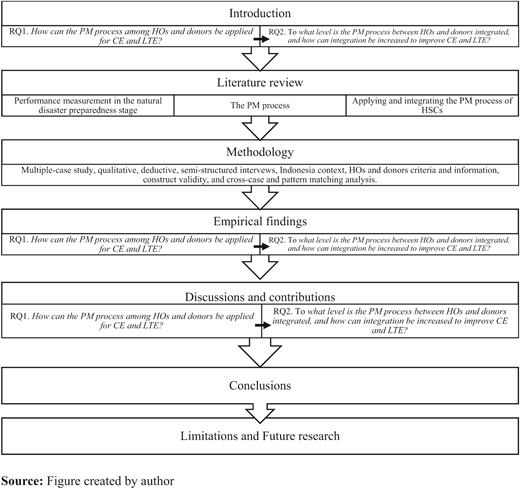
The paper is organized as follows. Section 2 presents a literature review leading to a PM process integration framework. Section 3 provides the methodology used to gather information from six HOs and three donors. Section 4 describes the findings and analysis. Section 5 lays out the discussion. Sections 6, 7 and 8 present the conclusions, implications and future research, respectively.
2. Literature review
The literature review consists of work on performance measurement in the stage of natural disaster preparedness, the PM process and the application and integration of the PM process between HOs and donors in HSCs.
2.1 Natural disaster preparedness stage
Preparedness is a crucial stage while developing a physical network, information technology, collaboration and the prepositioning of relief supplies to deliver aid in a short period (Frennesson et al., 2021). Preparedness involves two objectives: to respond through a temporary network that connects actors, like donors (Jahre et al., 2016), and to deliver goods and services to affected areas at any cost in the shortest possible time (Timperio et al., 2020). These objectives motivate HOs to implement performance measurement to improve CE, labeled as efficiency performance (CE) and the time speed or agility principle, labeled as effectiveness performance (LTE) (Jahre et al., 2021). CE and LTE are important in the preparedness stage because they can improve the response stage (Altay et al., 2018) and minimize the time spent in undertaking the recovery stage (Kiswili et al., 2021).
2.2 The performance management process
PM is necessary for HSCs to capture an overview of the overall strategy and the activities of all actors within the process (Abidi et al., 2014) to improve resource allocation (Santarelli et al., 2015), align goals (Maghsoudi and Pazirandeh, 2016) and monitor logistics performance (Lu et al., 2016). Several frameworks (e.g. BSC and SCOR) have been adapted to HSCs, and these offer a valuable contribution to performance measurement and management (Anjomshoae et al., 2022). However, the frameworks have been adopted to indicate performance measurement, rather than integrate them so as to improve HSC performance (Abidi et al., 2020). Furthermore, the adoption of these frameworks is hindered because they do not provide adequate guidance to actors on selection and implementation (de Waal and Kourtit, 2013) and they leave various implementation aspects un-researched (Patil et al., 2022). It is necessary to set objective criteria for defining standards and targets and for dealing with cultural change, so that organizations understand the purpose of implementing PM (Abidi et al., 2020). These needs can be depicted in a framework – e.g. the PM process (Forslund and Jonsson, 2010; Ferreira et al., 2012; Ülgen and Forslund, 2015).
Papakiriakopoulos and Pramatari (2010) suggested a different framework that consists of data management, business process management and collaboration. Ferreira et al. (2012) proposed a PM process involving strategy, vision, execution and monitoring. A more detailed framework is required to develop PM (Ülgen and Forslund, 2015), but the challenge is that as the framework grows more precise (e.g. the PM process framework in the oil industry), the tougher it is to implement in the field of HSCs (Karar et al., 2021).
The PM process framework proposed by Forslund and Jonsson (2007) can address this issue, as it provides sufficient detail (Ülgen and Forslund, 2015) and is applicable to supply chains and other fields at different periods, including manufacturing companies (Forslund and Jonsson, 2010), textile supply chains (Ülgen and Forslund, 2015), environmental sustainability supply chains (Isaksson et al., 2019), retail supply chains (Bressolles and Lang, 2020) and – possibly – the context of HSCs. This PM process consists of the activities of selecting performance variables, defining performance metrics, setting targets, measuring and analyzing/acting (Ülgen and Forslund, 2015).
2.3 Applying and integrating the performance management process of humanitarian supply chains
In this study, the PM process was operationalized in Table 1 to support both RQ1 and RQ2. In RQ1, the PM process was used as a tool to describe the current application in each activity by HOs and donors. In RQ2, the level of PM process integration between HOs and donors in each activity was identified, with an eye to improving CE and LTE.
The integration of the PM process is not an easy task, as the process involves actors (Agarwal et al., 2019) who have different goals, objectives and missions (Dubey et al., 2015, 2019; Haavisto and Goentzel, 2015; Anjomshoae et al., 2017) as well as unique processes, performance measurement variables and structures (Patil et al., 2022); this can lead to hesitation and skepticism around implementing PM (de Waal and Kourtit, 2013; Anjomshoae et al., 2022) and improving CE and LTE (Agarwal et al., 2022). The differences can lead them to improve the integration of PM, which has been indicated in the context of CSCs (Forslund and Jonsson, 2007, 2010; Ataseven et al., 2020). The PM process is adapted as a framework for HSCs to take on such difficulties, and it consists of the five activities outlined above and described below.
Selecting performance variables – this activity reflects the strategy in CSCs to achieve a high level of integration by having actors agree on which performance variables to select (Forslund and Jonsson, 2010; Ferreira et al., 2012). However, it is not always easy to select performance variables in HSCs, due to the lack of standardization (Jahre and Fabbe-Costes, 2015). Many performance variables are seen as complicated, costly and time-consuming for HOs (Anjomshoae et al., 2022). Various ways of selecting performance variables have emerged: for instance, Abidi et al. (2014) suggested using the SCOR model to collect such performance variables as date, geography, service level and costs. Anjomshoae et al. (2017) adopted a BSC approach to track performance variables based on four perspectives: external, financial, internal process and learning and growth. However, existing research has not particularly studied performance variables in the preparedness stage, instead using them across all stages. The stages of HSC determine the design of performance variables to improve CE and LTE (Dubey et al., 2015). Anjomshoae et al. (2017) provided a list of examples of performance variables that can be used by HOs and donors in the preparedness stage. In the current study’s framework, a low level of PM process integration is operationalized as HOs and donors not agreeing on which performance variables to use to improve CE and LTE.
Defining metrics – defining metrics is challenging for HSCs, due to the competitive environment in which HOs compete for limited donor resources (Abidi et al., 2014). HOs and donors usually rely heavily on CE metrics to link activities in the field and to ensure funding transparency (Tatham and Spens, 2011); as a result, LTE metrics are still scarce. HSCs’ performance is also hindered by other challenges – such as relating performance variables by determining meaningful metrics, producing desired outputs, learning to apply performance measurement for employees and poor data availability and accuracy (Abidi et al., 2014). Many studies have attempted to support HSCs in the definition of metrics, such as by defining metrics through the company’s strategy and jointly discussing metrics (Melnyk et al., 2014). However, defining concrete performance metrics in HSCs is still under-discussed due to conflicting objectives and preferences between actors (Laguna-Salvadó et al., 2019). This point highlights the rarity of performance measurement when it comes to performance metrics in the past few years. Lu et al. (2016) provided a list of examples of defined performance metrics that can be adapted and give insights in their study to HOs and donors on translating their performance variables into defined metrics so that they can improve their performance measurement in the preparedness stage.
Greater divergence in how each metric is defined lowers the integration that actors could achieve. For instance, Forslund and Jonsson (2007) discovered that if actors in CSCs define on-time delivery metrics by more than two out of four items – measurement object, time unit, measurement point and date – then the integration is similarly categorized as high. Furthermore, if actors have a joint metrics dictionary (Forslund and Jonsson, 2010; Ülgen and Forslund, 2015), their level of integration is high. Therefore, a low level of integration in defining metrics is operationalized as HOs and donors defining metrics differently and/or not having a joint metrics dictionary.
Setting targets – performance metrics are recommended to be aligned with the target to improve HSCs (Haavisto and Goentzel, 2015; Jeble et al., 2019). However, measuring performance is often hindered due to conflicts between differing goals – e.g. between short- and long-term goals (Abidi et al., 2013). Divergent goals lead actors to set different target levels for the same metric (Forslund and Jonsson, 2009). Methods to define the target set to measure performance in HSCs are still rare (Haavisto and Goentzel, 2015). Haavisto and Goentzel (2015) adapted goal-setting theory to identify overall and specific targets, whereas Ülgen and Forslund (2015) classified performance target from two perspectives: “average”, meaning the same target level is implemented for all actors (such as a target of four days’ lead time for all suppliers); and “specific”, meaning a unique target level is implemented for particular actors (such as a target of two days’ lead time for the most local supplier but a target of ten days’ lead time for regional suppliers). In this study, integration is operationalized as high if the target is discussed together and is specifically formulated for the involved actors (Forslund and Jonsson, 2007), while a low level of integration is operationalized as HOs and donors not setting specific targets together.
Measuring – the objective of measuring performance in HSCs is to enhance improvement (Abidi et al., 2014) and to collect relevant data in the creation of reports and feedback as the basis for the next step (analyzing/acting) (Forslund and Jonsson, 2010). It is recommended that actors agree on who should measure performance, how often it should be measured, what kind of methods should be used and how the outcomes of the measuring are reported (Ülgen and Forslund, 2015). This information should be shared between actors, and higher visibility – as a result of a willingness to share – can improve operational CE and on-time delivery (LTE) (Maghsoudi and Pazirandeh, 2016). The visibility in sharing information is identified as the form of digitalization that can support the integration of a whole process (Bagchi and Skjoett-Larsen, 2002) and facilitate the information flow (D’haene et al., 2015). Forslund and Jonsson (2010) indicated a high level of integration when electronic exchanges and Web portals are used. Bagchi and Skjoett-Larsen (2002) gave examples such as the level of use of enterprise resource planning and electronic data interchange systems. The more sophisticated the IT tools that are used, the more the integration can be improved. Additionally, in the preparedness stage, HOs need to prepare for natural disasters, and employees should be trained to use the information technology (Howden, 2009). A low level of integration is operationalized as HOs and donors having a low frequency of measuring and communicating/exchanging via e-mail/fax/phone.
Analyzing/acting – proper measurement activity is a prerequisite for conducting analysis/actions (Ülgen and Forslund, 2015). Analyzing/acting must combine joint continuous improvement (Isaksson et al., 2019), proactive decision-making, monitoring and following up on performance and reviewing the performance output between actors (Forslund and Jonsson, 2010). The integration is identified as being high if analysis and actions supporting continuous improvement are conducted jointly so as to increase performance (Forslund and Jonsson, 2007). Furthermore, a cultural change is needed to reduce employees’ resistance to implementing PM (Abidi et al., 2020) in HOs (Anjomshoae et al., 2022). This part is difficult because employees are usually not involved in the meetings on performance measurement and management (Abidi et al., 2020), and because HOs face various challenges, such as complex mechanisms to identify appropriate performance variables. Consequently, HOs share their sensitive data to increase their transparency to donors (Anjomshoae et al., 2022). In the end, integration and performance improvement are enhanced (Isaksson et al., 2019). Analyzing/acting in the PM process integration is operationalized as low when HOs and donors do not analyze and take joint actions to improve CE and LTE. The insights gained through the guidance of PM process integration are operationalized in Table 1.
3. Methodology
Generally, access to obtaining empirical data in HSCs is limited compared to CSCs (Heaslip et al., 2019). Consequently, the nature of HSC research requires an exploratory understanding, which underlines the importance of contextualizing concepts when new knowledge is needed (Kucukaltan et al., 2020). The multiple-case study approach has been suggested as a valid tool to provide deeper understanding of a phenomenon in the research context (Eisenhardt and Graebner, 2007; Cozzolino et al., 2017), to investigate specific phenomena during the study and to offer an exploratory approach (Yin, 2018). Thus, the multiple-case study approach is widely used, especially in the field of humanitarian logistics and supply chain management (Vega, 2018).
The multiple-case study approach entails a qualitative research strategy (Bryman and Bell, 2011). The qualitative research strategy is relevant because it enables the study to examine the concepts in the specific contexts of inquiry (Ketokivi and Choi, 2014) – here, interpreting the CSC context to contextualize it to the HSC context. In addition, this study does not attempt to generate a theory but rather to test existing theory (Ketokivi and Choi, 2014); thus, a deductive method is suitable for this study, taking its point of departure as PM process integration of CSCs to support theoretical thinking and address empirical studies (Bryman and Bell, 2011; Ketokivi and Choi, 2014) (Figure 1).
Nonprobability sampling techniques (e.g. purposive and snowball sampling) are suitable for multiple-case studies, because these studies have no requirement of conducting statistical inferences on a population (Saunders et al., 2015). In this research, the geographical context of Indonesia was selected because it is a country that is prone to various natural disasters – including earthquakes (Kurnio et al., 2021), tsunamis (Yulianto et al., 2021) and volcano eruptions – due to being a part of Ring of Fire, being located between two tectonic plates, and having more than 128 active volcanoes (Timperio et al., 2020). Indonesia is also vulnerable to other natural disasters, such as wildfires, flash floods and landslides (Kusumastuti et al., 2021). The Center for Research and Epidemiology of Disaster (CRED, 2021) ranks Indonesia among the top five countries most frequently hit by natural disasters. Furthermore, Indonesia decided to reform its laws, policies and institutions to coordinate better preparedness after the enormous disaster of the Indian Ocean tsunami in 2004; since then, Indonesia has worked hard to strengthen its disaster preparedness for effective response at all levels, called in the Sendai Framework priority for action. This work was reflected in the response to the September 2018 Sulawesi earthquake and tsunami (CFE-DMHA, 2021). Thus, Indonesia is a realistic geographical context for conducting a study on the natural disaster preparedness stage.
Data collection with HOs was sourced from the official Indonesia database, Social Monitoring and Early Response Unit–Indonesia (SMERU) and donors were sourced from these HOs’ networks. HOs were selected according to the following criteria:
HOs must be working and located in Indonesia.
HOs must be involved in disaster management. SMERU offered list of categories of HOs. In the list of categories, the study chose disaster management category.
HOs must be involved in natural disaster preparedness stages. The e-mail invitation sent to HOs clarify the purpose of the study that would be conducted in the natural disaster preparedness stage. The content of e-mail ensured the study to capture HOs that were working in natural disaster preparedness stage.
The respondents from the HOs must belong to upper-level management (Saunders et al., 2015).
No limitations were set on the size of HOs, as their size was not considered a controlling factor in research questions.
Initially, the database provided 1,000 HOs that work in different areas. The search then was narrowed to HOs that work in disaster management and natural disaster preparedness projects, resulting in 50 HOs. These 50 HOs were approached through a formal e-mail that explained the purpose and overview of the study, the criteria of the HOs that could participate in the study and a request pertaining to their donor contacts. In total, six HOs chose to participate and fulfilled the requirements for the study, and two HOs were willing to provide the contact information of their donors, who were international donors based in the USA and Switzerland. In other words, two participating HOs provided the contact information of their donors for the latter to be part of the study, and other HOs who did not provide donors were still included in the study to support the findings and provide additional insights. Not having dyadic relationships as the unit of analysis enables the study to focus on HOs’ and donors’ perspectives to answer RQ1, and the study draws comparisons between their perspectives. The aim is to understand how the PM process in HSCs between HOs and donors can be integrated in such a way as to improve CE and LTE. This setting enables the present study to use cross-case analysis, to explore the “how” question in a multiple-case study approach (Yin, 2018). Cross-case analysis provides the study with a good basis for generalization (Eisenhardt, 1989). In total, the study gathered empirical data from two types of HSCs actors, six HOs and three donors (nine cases in total). Data were collected from 12 interviewees (HOs and donors). The sample size fulfilled the recommendation of Saunders et al. (2015) which is 5–25 respondents (Table 2).
Due to health protocols to reduce the spread of COVID-19 in Indonesia, all interviews had to be conducted via telephone. The semistructured interviews lasted an average of 60 min with each respondent. The interview guide built on the literature review and its operationalizations to ensure construct validity (Yin, 2018). The interviews introduced the overview and purpose of the study, asking about general information and the operationalized questions provided in Table 1. All interviewees gave consent for the interviews to be recorded and transcribed. To protect confidentiality (e.g. HOs mentioned other donors’ names during the interviews and respondents discussed sensitive issues in the projects), the researchers decided to implement pseudonym codes to categorize the organizations. To ensure reliability and validity, the researchers carefully reviewed all data collected. The research results were sent to each respondent formally, through e-mail and informally, through phone calls to obtain triangulation (Saunders et al., 2015).
Data analysis was performed using cross-case analysis to discern the similarities and differences between the cases (Eisenhardt, 1989) and to obtain findings. Additionally, pattern matching was chosen to compare the results with the pre-established framework. A logic model was applied to determine the complexity of the HSCs during the research; this technique assisted the analysis in presenting a better understanding of the conclusions to readers (Sinkovics, 2018).
4. Empirical findings
The empirical findings are condensed and presented in Table 3.
5. Discussion and contributions
The discussion includes this study’s contributions and is organized by RQ. HOs’ and donors’ perspectives are presented.
5.1 RQ1. How can the PM process among HOs and donors be applied for CE and LTE?
Selecting performance variables – HO3 and HO4 provided the most examples of performance variables compared to other HOs: they listed 5–6 performance variables that were used in their organizations. In contrast, HO1 and HO2 only applied two performance variables. There is no consensus on the selection of performance variables for HOs, which can be seen in the fact that some HOs choose fewer or more variables than other HOs. The source of the variation in performance-variable choices might be due to HOs’ backgrounds, such as their size, goals, strategies, unique works and organizational structures (Patil et al., 2022). Despite differences in their motives for selecting performance variables, they seemed aware of and emphasized CE performance (e.g. total amount of fundraising, total budget allocation and cost of renting facilities and employee training). HO2, HO3 and HO4 also mentioned performance variables that can be related to LTE, such as mode of transportation, level of employee capacity, technology utilization and level of success in conducting training. However, HOs did not identify LTE well for the preparedness stage; although they mentioned LTE, they related it to CE (e.g. HO3 buys some software to improve their speed in collecting accurate information). In another example, HOs provided “level of employee capacity” as an example that represents CE and LTE: they agreed that employees play an essential role in successful humanitarian activities, which is why HOs need to prepare and train their employees to achieve LTE. Fostering learning and training employees at every level of an HO is highly crucial to carrying out humanitarian activities; however, it is challenging (Abidi et al., 2014; Salem et al., 2022). For instance, HO1 mentioned that employees leave the organization during or after training, and HO4 said they need to reduce staff turnover costs due to the investment in employee training. Items, assets and resources (e.g. technology, equipment and facilities) were considered crucial by HOs. Due to their limited budgets, HOs have to increase their CE by allocating resources properly (Abidi et al., 2014). Consequently, HOs tend to focus on the financial aspect, primarily ensuring the transparency of funds (Tatham and Spens, 2011; Anjomshoae et al., 2021; Patil et al., 2022). The dearth of HOs using performance variables is common in HSCs (Anjomshoae et al., 2022) because they encounter such challenges as limited availability and unknown outcomes (Abidi et al., 2020).
From the donors’ perspective, D1, D2 and D3 emphasized CE – for instance, total budget allocation, number of supplies and number of beneficiaries. D3 thought that number of employees and project time were important for measuring LTE. The phenomenon of donors relying more on CE was highlighted by Dubey et al. (2022) and Salem et al. (2022): donors are increasingly demanding the visibility of their donations and how their donations are used.
Defining metrics – most HOs found it difficult to express how metrics were defined: only HO4 could demonstrate how they defined metrics based on their performance variables. For example, they explained the total funds delivered to beneficiaries by aid distribution for 1,000 beneficiaries and that the budget variance percentage for the changes for a project budget must not exceed 10% of the allowance. Other HOs did not explicitly mention how they defined their metrics. The problem of defining metrics is typical due to irregular and uncertain demand for metrics measurement (Agarwal et al., 2022). This finding highlights the lack of proposed metrics (Laguna-Salvadó et al., 2019) and the lack of the implementation of performance metrics in the HSC context (Agarwal et al., 2022). Furthermore, like the performance variables, the metrics mentioned by HOs were primarily related to CE. From the donors’ perspective, some metrics were the same as the performance variables (e.g. the number of beneficiaries and the project time). The number of beneficiaries is related to CE because they would like to know how much money they need to allocate, and the project time is related to LTE. This situation reveals that performance metrics have not been prioritized, which can cause mismatch in terms of what donors intend to measure versus their objectives (Beamon and Balcik, 2008).
Target setting – HO1 and HO3 explained that they set specific targets for their metrics. For example, HO1 shared that they conducted frequent meetings to discuss and agree on targets; however, they did not explain what kind of targets they set and what targets they discussed in the meetings. In contrast, HO3 set very detailed targets, especially regarding time consumption, administration process and financial report; they said this supported them in making decisions about how much money and how many actions needed to be taken in the preparedness projects. Average targets were set in HO4, HO5 and HO6 – the specificity of their targets largely depended on the project – and HO2 did not set any targets for their PM. D1, D2 and D3 set specific targets: they argued that by setting a different specific target for each preparedness project, they were able to engage in the right decision-making about which activities were relevant for each project. The behavior of both HOs and donors reveals that HSCs usually tend to focus on specific targets, which leads HOs and donors to have “different specific” targets for each project in the HSC (Nath et al., 2017). However, these specific targets were meant for projects, not for specific actors (Forslund and Jonsson, 2007); thus, the target-setting activities for both groups of actors were less developed.
Measuring – HO2, HO3 and HO4 measured their performance every month and every six months, HO1 and HO6 measured their performance every year, and HO2 did not measure their performance at all. The frequency of measuring ranges from monthly (Abidi et al., 2020) to yearly (Haavisto and Goentzel, 2015). In addition, the frequency of measuring on the donors’ side varied from monthly to every six months to and every year.
Analyzing/acting – finally, both HOs and donors claimed that they analyzed CE and LTE, and only HO2 did not conduct analyses for CE and LTE. The majority of HOs and donors believe that for the analysis/actions in the PM process to succeed, they need goal alignment, organizational protocol, knowledge and employee management, initial planning, standardization, trust, financial reports, budgeting and time adjustment and evaluation. Thus, they implemented analyses/actions in the preparedness stage to improve CE and LTE. These analyses/actions have also been highlighted in previous studies as important aspects to improving performance (examples include goal alignment (Modgil et al., 2020), organizational protocol (Kiswili et al., 2021), standardization (Frennesson et al., 2021) and evaluation (Polater, 2021).
In summary, HOs and donors implemented the PM process for each activity, which indicated their awareness that CE and LTE must be involved in PM in the preparedness stage. However, the findings also show that HOs and donors tended to describe the PM process activities only vaguely; they described the first PM process activities more detailed then the last. Additionally, many HOs and D1 did not define metrics, as they believed performance variables were sufficient to manage CE and LTE; moreover, HO2 did not go any further in explaining other PM process activities. The findings reveal that HOs and donors have obviously not yet maximized PM in the HSC (Agarwal et al., 2022).
5.2 RQ2. To what level is the PM process between HOs and donors integrated, and how can the integration be increased to improve CE and LTE?
This discussion is split into two parts, following the formulation of RQ2.
5.2.1 RQ2. To what level is the PM process between HOs and donors integrated?
Selecting performance variables – the selected performance variables were not mutually agreed on between HOs and donors, impacting the number of chosen performance variables. For instance, when they were asked about which performance variables had been agreed on, they reduced their lists of performance variables to zero (compared to the performance variables activities selected in RQ1), which translates to no agreed-upon performance variables. This makes it challenging to determine which performance variables in HSCs are meaningful and connected with measurement (Beamon and Balcik, 2008). Hence, the level of integration between HOs and their donors in selecting performance variables is low.
Donors only selected and mutually agreed on a performance variable with HOs. For example, D2 agreed with their HOs to select the number of beneficiaries (CE) as their performance variable. Thus, PM process integration with HOs in this activity is low. Additionally, donors expected HOs to share the mission and certain information at the early stage of the PM process because these are crucial to measuring HSCs’ performance. Their objectives were to determine the funding amount (Patil et al., 2022) and to improve HOs’ visibility and accountability (Agarwal et al., 2019). Furthermore, they also prioritized speed to ensure that the donation was going to the natural disaster area immediately (Davidson, 2006) (e.g. D3 considered the project time).
Defining metrics – all HOs provided general answers when they were asked about a metric dictionary, which resulted in lower integration with donors (Forslund and Jonsson, 2007). This pattern also occurred with donors, who gave general answers that metrics are defined together with HOs and depend on the projects. All three donors defined the metrics as related to the reports and information from HOs (e.g. the number of beneficiaries that received the money), mainly because the donors want to monitor the amount of money that is being spent (Abidi et al., 2020). Consequently, few metrics were defined, and they were disproportionately focused on CE. Furthermore, like HOs, donors did not provide a metric dictionary but instead used different metrics for different projects, which resulted in lower integration with HOs (Forslund and Jonsson, 2007).
Target setting – some HOs claimed they set specific targets with donors. For example, HO1 and HO2 claimed that they set specific targets that were recorded in detailed reports; however, they did not fully explain how the report provided explanations for the specific targets they set for each metric, instead giving more general examples (e.g. time consumption and on-time date were important targets for HOs and their donors). HO5 even shared that they did not want to depend on donors because their goals, metrics and targets differed from those of donors; as a result, targets were decided independently and then applied with other actors (Isaksson et al., 2019), such as donors. Furthermore, some HOs wanted wider targets in the different projects with donors, which points to target mismatches with donors (Haavisto and Goentzel, 2015) and the tendency of HOs to set targets at the organizational level (Schulz and Heigh, 2009; Jeble et al., 2019) but not specifically at the tactical and operational levels (Abidi et al., 2014). Thus, the study revealed that HOs did not set specific targets, even though they said they did, which means the integration in setting targets from the HOs’ side was low.
The same situation applied to donors: donors claimed they set specific targets for HOs, but they did not explain which specific target they aimed for. Some examples were labeled as specific targets, such as having activity records on time and late dates; however, they did not mention how they set those specific targets (e.g. what specific targets did they set and with whom did they set the specific targets?). Donors labeling targets inconsistently and subjectively are also challenges found among actors of CSCs (Ülgen and Forslund, 2015). As a result, a low level of integration in setting targets was discovered on the donors’ side.
Measuring – most HOs (except HO2) measure their metrics and targets on a monthly to yearly basis. The measuring frequency increases the improvement of – and becomes the basis for – the analysis and common actions (Forslund and Jonsson, 2010). Measurement information was shared with donors using basic technologies, such as e-mail and Excel, as well as more advanced technologies, such as the software Banana and Microsoft Power BI. The more advanced technologies facilitate information flow and lead to higher integration (Bagchi and Skjoett-Larsen, 2002; D’haene et al., 2015). HO3 and HO4 have started to invest in sophisticated technology to improve information-sharing and sustain cooperation with donors. The availability of timely and precise information-sharing (e.g. number of beneficiaries supported) is a key feature to successfully managing an HSC. This encourages HOs to invest in sophisticated information technology to improve speed (Abidi et al., 2020) and to provide meaningful information-sharing to donors (Behl et al., 2021). Nevertheless, the availability of advanced technologies did not guarantee that HOs could manage activities in the preparedness stage due to various challenges – e.g. employees found it difficult to use the new technologies to collect and analyze reliable data for HOs and donors (Abidi et al., 2020). Thus, the integration level is still low due to low frequency of communicating reports (Forslund and Jonsson, 2007) and the need for HOs to understand advanced technologies to boost performance (Behl et al., 2021).
Donors believed that measuring HOs was crucial. D2 and D3 used more technologies than D1 in this activity, as they were aware that technologies were helpful in the measuring activity. Their stance is in line with Jeble et al. (2019), who found that technologies can improve information-sharing and are a key success in managing HSCs’ performance. Nevertheless, D2 and D3 infrequently used the technologies to measure and communicate measuring reports with HOs; consequently, the level of integration in this activity is low.
Analyzing/acting – HOs asserted that analyzing and acting should be performed simultaneously with donors; however, it was hard for HOs to conduct analyses and take common actions with donors, so they instead answered questions generally. Furthermore, the analyzing/acting activities HOs conducted individually did not apply to all analyzing/acting activities that they integrated with donors. HOs argued that they analyzed performance variables and targets together, then took common actions through goal alignment, organization protocol, knowledge and employee management, initial planning, evaluation, financial reports, budgeting and time adjustment and information sharing. However, previous activities in the process were poorly integrated with donors, making it hard to determine how HOs could analyze each activity together with donors. Moreover, HOs did not explain how they carry out common actions with donors to improve CE and LTE (e.g. how did they align the goals? How did they conduct the protocol together?); instead, they showed their awareness of the importance of common actions that should be performed together with donors. The difficulties in analyzing and acting together with donors arose due to several challenges, including language barriers, lack of standardization (Jahre and Fabbe-Costes, 2015), differences in vision and mission (Ferreira et al., 2012), lack of digitalization (Dubey et al., 2022) and lack of information-sharing (Bagchi and Skjoett-Larsen, 2002). HO4 and HO5 pinpointed the effects of the challenges that caused miscommunications (e.g. how performance variables should be selected, metrics defined and targets set). Thus, the integration in the final activity is judged as low.
Donors believed that analyzing and acting together could improve the CE and LTE, and they stated the importance of analysis and common actions for improving CE and LTE, such as sharing information and improving standardization. However, donors did not explain how they work with HOs to analyze PM, nor did they list the common actions they take with HOs to improve CE and LTE. They mentioned fewer activities in the analyzing/acting as integrated with HOs compared to activities they performed in the analyzing/acting they did independently. This occurred because it was challenging to communicate and agree on the same actions, which resulted in conflicts of interest (Abidi et al., 2014). D2 mentioned that there are more things that HOs should learn and improve on to increase the CE and LTE. Thus, the integration between donors and their HOs is low.
Overall, the level or degree of PM process integration is still low for both HOs and donors, although some HOs and donors showed an integration in some activities (e.g. measuring and analyzing/acting). Consequently, it must be asked how integration can be increased to improve CE and LTE.
5.2.2 How can PM process integration be increased to improve CE and LTE?
The PM process framework enabled the current study to determine that HOs and donors still have a low level of integration in the PM process. Many factors contribute to this low level of integration, including a lack of a simplified framework to define metrics that have been empirically tested and a lack of standardization in selecting performance variables and defining metrics (Schulz and Heigh, 2009; Jahre and Fabbe-Costes, 2015); differences between short- and long-term goals, and a dearth of methods to define target-setting (Haavisto and Goentzel, 2015; Ülgen and Forslund, 2015); unwillingness to share information, a lack of digitalization and IT integration and a lack of employees trained to use technologies (Bagchi and Skjoett-Larsen, 2002; Maghsoudi and Pazirandeh, 2016; Jeble et al., 2019), which hamper the measuring activity; and HO resistance to cultural change management (Anjomshoae et al., 2022) and an unwillingness for actors to conduct continuous improvement (Abidi et al., 2020), which hamper the analyzing/acting activity.
The relationship between HOs and donors is unequal, given HOs’ heavy dependency on donors. HOs fulfill the requirements to satisfy donors, and donors actively request information from HOs. HOs are more willing to share information, and donors are more willing to manage activities (e.g. providing feedback to HOs) (Anjomshoae et al., 2017). Despite their limited resources, HOs have a greater workload to ensure they meet donors’ standards by developing more performance variables and metrics, setting targets, measuring frequently, using multiple information technologies and taking common actions with donors. HOs keep performing these activities to ensure that the flow of funding from donors is maintained (Anjomshoae et al., 2017). As a result, HOs tend to focus more on CE when they correspond with donors (Beamon and Balcik, 2008) and let LTE remain obscure, even though they claim that LTE is crucial in the preparedness stage. HOs are lacking in some areas because it is hard for them to focus on improving one activity at a time rather than try to meet all requests at once – especially for HOs who have multiple donors, who all use different technologies for communicating report results. HOs have more information technologies than they need; consequently, they are very slow to adopt new technologies and to collect and analyze data (D’haene et al., 2015); and they face difficulties when making decisions (Anjomshoae et al., 2022).
Such situations are unsatisfactory, both for donors (Tatham and Spens, 2011; Dubey et al., 2022) and for HOs. Many respondents felt that the work they have achieved thus far is never enough to improve their CE and LTE; they are confused about what should have been done, what target should have been achieved, and – most fundamentally – how to select performance variables and metrics, given that donors have different approaches for each project. Thus, the desired outcomes are usually unmet, and it is challenging to identify, quantify and develop a PM framework for HOs (Abidi et al., 2014). Anjomshoae et al. (2022) suggested that HSCs move beyond any one specific project to improve their efficiency at a more aggregate level to ease the integration efforts between actors.
Donors should not always dictate performance variables, metrics, targets, measurements and actions, because this can hinder the development of PM with HOs (Abidi et al., 2014). HOs can build strategies to stay competitive and use PM to build relationships with donors (Oloruntoba and Gray, 2009). PM helps improve CE because it enables the sharing of actual data and encourages donors to provide resources (Agarwal et al., 2019). HOs are encouraged to be proactively involved in PM discussions with donors so as to build consensus around goals, resource allocation, continuous improvement and the decision-making process (Anjomshoae et al., 2021; Patil et al., 2022).
Finally, HOs should primarily establish a good foundation of PM by implementing the PM process in their activities, from selecting performance variables to analyzing and acting to improve CE and LTE. In this scenario, the framework for the PM process supports PM: it provides questions for each activity as a guideline for HOs and donors to identify their current level of integration and to improve on it in each activity of the preparedness stage. Success in implementing the PM process framework requires investing in training programs, which can reduce resistance to PM by actors and employees as well as improve their capabilities (Patil et al., 2022), lead to more investing in digitalization (Jeble et al., 2019; Anjomshoae et al., 2022; Patil et al., 2022), overcome language barriers, improve standardization (Jahre and Fabbe-Costes, 2015), align goals (Maghsoudi and Pazirandeh, 2016) and increase willingness to share information (Ahmed et al., 2019).
The pivotal contribution of this study to literature and practice is the operationalized framework, wherein the PM process framework (Forslund and Jonsson, 2007) is adopted to fit HSCs. The PM process framework contributes in two ways. First, it addresses the lack of PM practices in the HSC context by providing practices related to PM process activities, which is relevant in the application of business practices to humanitarian actors to guide the process of implementing PM outlined in (Abidi et al., 2020). In practice, HOs and donors can use the PM process framework to identify their current PM in the disaster preparedness stage and take actions to improve their CE and LTE based on these results. Second, this study generally contributes to HSC literature by suggesting that CE and LTE can be improved through development of the PM process framework (Table 4) with HOs and donors for the stage of natural disaster preparedness. The study also explores how the PM process can integrate various actors and improve CE and LTE. The findings show a lack of integration from the perspectives of both groups of actors in the preparedness stage due to certain challenges and the complexity of HSCs. The PM process framework offers suggestions that have not been put forth in previous studies: for example, a real-time report is suggested as more than just essential technology used in the empirical data, corresponding to Gupta et al. (2022), who highlighted the importance of real-time information sharing between actors.
In addition, the current study offers insights to HOs and donors on improving the level of HSC integration by identifying their current level of integration and then conducting joint activities. The joint activities are described in detail in the PM process framework and can be considered by both groups of upper-level management to improve performance in each project. Furthermore, the study encourages more involvement of HOs in joint activities with donors and recommends that both actors share joint activities and metric dictionaries to facilitate better integration. The study also reveals other important aspects to improving CE and LTE integration, including goal alignment, digitalization, information sharing, cultural management, training programs, language improvement and standardization. Finally, this study ends with several suggestions for further research on PM in HSCs; by proceeding from these suggestions, researchers can develop new research directions to increase knowledge about PM.
6. Conclusions
Presently, it is increasingly essential to integrate PM in HSCs. The current study addresses PM process integration between HOs and donors in the stage of natural disaster preparedness. It adopted the PM process integration framework from Forslund and Jonsson (2007) to describe and assess the level of PM process integration between HOs and donors. The study indicated that the current PM process between HOs and donors could sometimes be only vaguely described and that some activities could not be described at all. The integration between HOs and donors could not support an improvement of CE and LTE. HOs were occupied with fulfilling donors’ requirements to maintain their funding flow; as a result, both actors emphasized improving CE, while interview respondents’ emphasis on LTE was weaker. Furthermore, many challenges – including misalignment of vision and mission, lack of digitalization, lack of standardization, language barriers, lack of training programs for employees, cultural resistance from organizations and employees and more – keep HOs and donors from further integrating the PM process. Thus, both HOs and donors are dissatisfied, and improvement in CE – and especially in LTE – remains elusive.
This study used the PM process framework to assist actors in setting a strong foundation of PM and provided guidelines to integrate the various activities. Both groups of actors are encouraged to integrate each PM process activity by defining clear performance variables and metrics and associating them with CE and LTE; setting a specific target for each metric; measuring the targets; and jointly conducting analysis and engaging in common actions. Furthermore, to make implementation of the PM process framework even more successful, both groups of actors are encouraged to implement similar PM process activities across diverse projects, as well as to improve and align other aspects (e.g. training, digitalization, language barriers, standardization, goal alignment and information sharing).
7. Limitations and future research
The key limitation of this study is the diversity of the case studies, in that it included six HOs from Indonesia and three international donors, and only two HOs could provide donors for the study. Thus, the researchers decided to separate the perspectives and perform cross-case analysis instead of analysis of dyadic relationships between HOs and donors. This approach might affect the impact of conclusions when applying them to other geographical areas and other types of dyadic relationships and disasters.
The study attempted to categorize the level of integration in the PM process and to provide findings, suggestions and future research directions based on this multiple-case study. The study was not intended to analyze any proposed relationship nor to generate findings that are valid for the wider population but rather to illustrate practices and to offer the possibility of adapting a CSC framework (PM process) to the HSC context. In other words, it became one limitation of the current study. Nevertheless, to the best of our knowledge, a PM process integration framework has not been proposed by existing studies; thus, this study may be the first to describe the process of how to analyze and improve CE and LTE so that it can be implemented in an HSC’s PM. This insight is also in line with other studies that first used the PM process in specific areas, such as environmental and sustainable supply chains (Isaksson et al., 2019).
During the study, some reflections led to new potential research directions, as PM could not be successfully integrated without a better understanding of the following aspects.
The efficiency of the integration of the PM process. The current study was the first to use the PM process and provide guidelines for HOs and donors to implement it in five respective activities. Thus, the efficiency of the PM process depends on how well HOs and donors jointly conduct the five activities (in line with Forslund and Jonsson, 2007). This reflection leads to a call for conducting empirical testing with HOs and donors on the efficiency of the integration when actors implement the PM process to improve CE and LTE.
The influence of donors in the integration of the PM process. In the current study, donors played a dominant role, which can affect the integration of the PM process. This insight is in line with (Dubey et al., 2015; Behl and Dutta, 2019): HOs must respond to the pressure from donors to improve their performance in the preparedness stage. Donor pressure can be seen as an external stimulus to Hos, and hence, an independent variable. It would be interesting to study to what degree it can be controlled to improve PM process integration (dependent variable).
Digitalization. Other studies have indicated the benefits and advancements of implementing digitalization to integrate the PM process (Anjomshoae et al., 2021; Marić et al., 2022) and to improve CE and LTE. For example, Jeble et al. (2019) explored how big data and predictive analytics can increase HSCs’ performance; Behl et al. (2021) suggested implementing artificial intelligence (AI) tools to understand the performance metrics of HSCs, so HOs can engage donors better; Gupta et al. (2022) argued that AI and cloud-based systems can enhance meaningful information-sharing between stakeholders; and Patil et al. (2022) mentioned that digitalization could improve the PM integration between various stakeholders. It would be timely to study the ways and trends in digitalization in HSCs in terms of integrating PM to improve CE and LTE.
Cultural intervention, employee training and language barriers. Cultural differences, employee resistance and language barriers are critical challenges that HSCs usually face when implementing a new management approach (Patil et al., 2022) (in this case, PM process integration). Thus, researchers and stakeholders need to consider how training programs should be conducted in order for PM process integration to be embraced by the entire organization and by inter-organizational entities.
The importance of standardization. Standardization is very important, as different entities (HOs and donors) – with different goals, origins, organization structures, projects and sizes – will have a hand in developing PM process integration. Jahre and Fabbe-Costes (2015) found that standardization improves CE and provides better organizational standards that improve cross-functional skills related to PM. Modgil et al. (2020) highlighted that standardization, along with digitalization, can ramp up integration between internal and external actors. Thus, investigating the impact of the degree of standardization of PM process activities (independent variable) on PM process integration would be important to improve CE and LTE.
The authors would like to thank Hugo Richit and Najmus Sadat, Department of Management, School of Business and Economics, Linnaeus University, Växjö, Sweden, for contributing early knowledge and collecting data for the study.
References
Further reading
Executive summary
The study revealed the importance of performance management (PM) to strengthening the integration of humanitarian organizations (HOs) and donors to improve cost-efficiency (CE) and lead-time effectiveness (LTE). However, challenges and gaps identified in both the literature and the field have limited PM’s implementation in humanitarian supply chains (HSCs). In response, the study’s results suggest adopting the PM process, a framework adopted from commercial supply chains, to evaluate the current state of PM’s integration between HOs and donors and to improve them.
The PM process entails five joint activities: selecting performance variables, defining metrics, setting targets, measuring and analyzing and/or acting. First, in selecting performance variables, HOs and donors consensually agree on variables of performance, while in defining metrics they apply the agreed-upon definitions of the variables. Next, in setting targets, HOs and donors set targets to measure performance in HSC, whereas in measuring they measure and exchange the measurement reports. Last, in analyzing and/or acting, HOs and donors analyze their CE and LTE and identify what actions can be taken to improve PM.
The PM process in Table 1 supports HOs and donors in two steps. The first step guides HOs and donors to understand and describe the current state of their PM integration. Encompassing several questions, the framework shown in Table 1 indicates how the PM process can be applied between HOs and donors for improved CE and LTE. Next, the second step helps HOs and donors to determine the extend of the PM process’s integration – that is, high or low – in the activity in question. For inspiration, HOs and donors can see the findings section in this paper to gauge how the framework has been applied in the multiple case studies to describe and assess the integration in the PM process. Finally, HOs and donors can follow the recommendations to improve their PM process integration shown in Table 4.
Altogether, the PM process framework offers a strong foundation for PM and provides guidelines for integrating the five joint activities. HOs and donors are advised to select and define clear performance variables and metrics for CE and LTE, set a clear target for each metric, measure those targets and jointly conduct analysis and identify possible actions. To further facilitate the framework’s implementation, HOs and donors are also advised to align their various goals, train employees in implementing PM process, enhance concepts and tools of digitalization, overcome language barriers, increase the standardization of CE and LTE and exchange information, all of which can be pivotal in future learning plans for HOs and donors.