This study aims to investigate the use of games in humanitarian logistics and disaster management by conducting a systematic review of academic literature to identify trends, gaps and practical contributions over the past decade.
The review followed the Preferred Reporting Items for Systematic Reviews and Meta-Analyses 2020 protocol and included peer-reviewed articles published between 2014 and 2024 in English. Searches were conducted in Scopus and Web of Science, last updated in January 2025. A total of 59 studies were included, describing 65 games. Data extraction considered disaster phase, type, game genre, mode, platform, application, audience and time interval.
Most games focus on disaster response (25), with hydrometeorological events (22) being the most addressed. Digital (39), multiplayer (43) and simulation-based games (40) are predominant. The main application is education and training (33), and most games target professionals (34). A significant increase in publications occurred from 2020 onward. Gaps were identified in games addressing mitigation, reconstruction, social disasters and community engagement.
The review included only peer-reviewed articles in English indexed in Scopus and Web of Science, excluding games outside academic literature. Game availability and usability were also not verified, suggesting future research should address these gaps.
The study offers a structured overview and the creation of an online repository (https://jogoshumanitarios.unimar.br) to facilitate access and adoption of games by researchers, developers and practitioners.
By promoting awareness, preparedness and decision-making skills, the use of serious games in humanitarian contexts can enhance disaster resilience and community engagement. Broad adoption may support more inclusive, collaborative and socially responsive crisis management strategies.
To the best of the authors’ knowledge, this is the first systematic review to map and categorize academic literature on games in humanitarian logistics and disaster management, providing an open-access repository that bridges knowledge gaps and supports more effective and inclusive game development for crisis preparedness.
1. Introduction
Disaster management and humanitarian logistics require innovative solutions to mitigate impacts and improve emergency response (Falagara Sigala and Wakolbinger, 2019).The increasing frequency and severity of disasters highlights the need to improve disaster management strategies. In this context, games offer a promising tool, combining game design with humanitarian logistics to simulate scenarios, strengthen resilience and optimize decision-making in crises (Lukosch and Comes, 2019; Mokhtar et al., 2021). Studies suggest that games enhance experiential learning, foster stakeholder interaction and improve response efficiency (Boyle et al., 2016; Garris et al., 2002). They also provide immediate feedback, enabling adjustments and personalized guidance (Connolly et al., 2012; Garris et al., 2002), while transferring skills to real-world tasks, enhancing professional performance (Boyle et al., 2016; Wouters et al., 2013).
Despite these advances, games applied to disaster management and humanitarian logistics lack systematic analysis. Critical questions remain: What types of disasters do they address? Which phases of the disaster cycle are covered? Are they primarily designed for education, training or awareness-raising? What mechanics and competencies do they develop? Do they realistically simulate field conditions and influence decision-making? The dispersion of information and the absence of a consolidated analytical framework make it difficult to gain a clear overview of existing initiatives. This not only hinders strategic use by researchers and practitioners but also limits innovation in game development and rigorous impact assessment.
To address this gap, this study presents a systematic literature review (SLR) on games applied to humanitarian logistics and disaster management, covering the last 10 years (2014–2024). Following the Preferred Reporting Items for Systematic Reviews and Meta-Analyses (PRISMA) 2020 protocol (Page, et al., 2021a), the review synthesizes and categorizes the games described in academic literature, generating a detailed repository of their characteristics and applications. This mapping allows for the identification of recurring patterns, emerging trends and overlooked areas, offering a foundation to guide future research and development. Specifically, the study answers the following research questions:
What are the predominant characteristics of games used in humanitarian logistics and disaster management?
How have these games evolved over the last decade?
What gaps remain in the literature on this topic?
A central contribution of this SLR is the creation of an open-access online repository (https://jogoshumanitarios.unimar.br), which addresses the fragmentation of information by providing a structured, searchable database. This resource enables researchers, developers and practitioners to filter games by disaster phase, disaster type, application, genre, platform and target audience, thereby enhancing their accessibility and applicability. By bridging the fields of game design and humanitarian logistics, this study offers a comprehensive overview and strategic reference for researchers, developers and decision-makers. It consolidates dispersed knowledge, critically analyzes the evolution of game-based tools in disaster contexts and aims to serve as a milestone for future initiatives in crisis preparedness, response and resilience building.
This article is structured as follows: Section 2 outlines the SLR methodology, including criteria, data sources and selection process; Section 3 presents the results, highlighting key game characteristics; Section 4 discusses findings in relation to existing literature; and Section 5 concludes with practical implications and future research directions.
2. Methodology
This study adopts a SLR as its primary methodological approach to examine games applied to humanitarian logistics and disaster management. The review follows the PRISMA 2020 guidelines to ensure transparency, methodological rigor and replicability (Page, et al., 2021a, 2021b) A combination of clearly defined inclusion and exclusion criteria, along with independent data screening and extraction by multiple reviewers, enhances the accuracy and reliability of the review process. The following subsections detail the specific steps adopted in conducting the SLR.
2.1 Eligibility criteria
Eligible studies were those that focused on games designed to support humanitarian logistics and disaster management, with the aim of enhancing learning, engagement or behavioral change. To ensure relevance and methodological consistency, this review included only peer-reviewed academic articles published in English and indexed in Scopus or Web of Science within the 2014 and 2024 were included. Exclusion criteria were applied to studies older than 10 years, duplicates, unavailable full texts, nonarticle formats (e.g. theses, conference abstracts) and publications in languages other than English.
It is important to note that this review does not represent a state-of-the-art survey of all existing humanitarian logistics and disaster management games. As such, relevant games not covered in the academic literature were not included in this analysis.
2.2 Sources of information and search strategies
The search was conducted in the Scopus and Web of Science databases, with the last update performed on January 24, 2025. The search strategy used Boolean operators and the following keywords: (“humanitarian logistics” OR “disaster management”) AND (“gamification” OR “game”). These terms were applied to article titles, abstracts and keywords to capture relevant publications.
2.3 Selection process and collection of data
The inclusion criteria were applied independently by two reviewers, with disagreements resolved by consensus or a third reviewer. The selection followed three stages:
Title and abstract screening, where four reviewers excluded non-relevant studies;
Full-text evaluation for final eligibility;
Final inclusion of studies meeting the criteria.
2.4 Study data
Data extraction was conducted independently by four reviewers, who identified the information outlined in Table 1 and recorded it in an Excel spreadsheet. This categorization was based on established concepts from key literature in humanitarian logistics, disaster management and game development (Leiras et al., 2017; Marczewski, 2015; Novak, 2017; Rogers, 2013; Salen and Zimmerman, 2003; UNDRR, U.N.O.F.D.R.R, 2020; Wiemker et al., 2015).
To ensure accuracy, a cross-check was conducted using a spreadsheet formula to verify reviewer agreement, generating a true or false value. Discrepancies were resolved by consensus. Missing or unclear data were considered unavailable, and game developers were contacted when necessary. In some cases, when the article did not provide sufficient information for categorization – such as platform, disaster phase or gameplay mode – and when developer or institutional contact information was available, the game developers were contacted for clarification. However, when the articles provided complete data, or when contact details were unavailable or unresponsive, no further action was taken.
2.5 Assessment of risk of bias in studies
Two reviewers independently assessed each study for bias, working without knowledge of each other’s evaluations. No automation tools were used in the bias assessment process. Instead, each study was independently reviewed by two researchers, following a standardized evaluation protocol. This manual and double-blind approach contributed to maintaining consistency and methodological rigor throughout the analysis.
2.6 Synthesis method
After reading, cross-referencing and analyses, the authors consolidated the results using a structured spreadsheet, which served as the foundation for the development of the online database. This led to the creation of the repository https://jogoshumanitarios.unimar.br, providing easy access to the games for researchers, developers and professionals.
Subsequently, each category was analyzed by counting the number of games that fell into it to identify predominant characteristics and detect patterns. In addition, the evolution of these characteristics over the 10-year period (2014–2024) was examined to reveal trends and changes in game development.
3. Systematic literature review results
The results of this SLR follow the PRISMA 2020 guidelines, ensuring a transparent and detailed process. This section presents the study selection flow through the PRISMA diagram, detailing the records identified, selected, excluded and included. It also categorizes the selected studies by disaster phase, disaster type, application, player mode, genre, platform, target audience, interval time.
3.1 Selection of studies
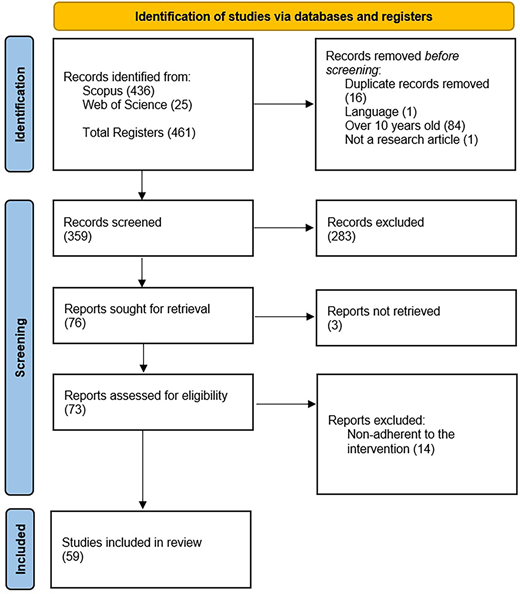
The survey initially identified 460 scientific articles. Applying exclusion criteria, 102 were removed due to age (84), duplication (16), format (1) and language (1).
Next, titles, abstracts and keywords were screened, leading to the removal of 283 articles unrelated to humanitarian logistics and disaster management. Two publications were excluded for lack of full-text access, and after a full reading, 14 more were removed for not aligning with the study’s intervention.
Ultimately, 59 articles were included in this systematic review, with the PRISMA protocol detailed in Figure 1.
3.2 Study characteristics
The 59 studies included in the systematic review present 65 games with a variety of characteristics. Table 2 summarizes the main characteristics of the analyzed studies.
Some games appear in multiple articles, such as Treme-Treme and Do it right: be safer!. Others discuss several games simultaneously, including Hinanjo Unei, Crossroad and Evacuation Simulation Training (Le Dé et al., 2021; Marahatta et al., 2024; Musacchio et al., 2016; Solarino, et al., 2020a, 2020b; Toyoda, 2020). Some studies adapt existing platforms such as Lego, Minecraft and Second Life due to their high customizability, open-ended design and user-generated content capabilities. These features allow users to construct virtual environments, simulate infrastructure and model complex logistical or evacuation scenarios, making them particularly suited for disaster preparedness and response training (Le Dé et al., 2021; Marahatta et al., 2024; Toyoda, 2020). In addition, seven studies did not specify game names, suggesting custom simulations or a lack of methodological detail (Arakawa et al., 2024; Bertazzo et al., 2018; D’Amico et al., 2023; Hosseini et al., 2022; Pardede et al., 2017; Pillai et al., 2019; Tena-Chollet et al., 2016).
3.3 Results of the summaries
The 65 games identified in the analyzed studies were examined based on the categories presented above in Table 1. This classification allowed us to identify patterns and trends in the approaches used.
Table 3 presents the distribution of the predominant characteristics in the games, showing significant trends.
Analysis of the 65 games revealed striking trends in their characteristics. The most discussed phase is the disaster response present in 25 games. As for the type of disaster, hydrometeorological hazards predominate with 22 games with flooding standing out as the most represented disaster (13 games) (Asgary et al., 2024; Bogdan and Cottar, 2022; Chen et al., 2018; D’Amico et al., 2023; Mokhtar et al., 2021; Rismayani et al., 2022; Sermet et al., 2020; Solarino et al., 2024; Suarez, 2015; Toyoda and Tanwattana, 2023; Tsai et al., 2015, 2020; Weyrich et al., 2021).
The main application of games is education and training (33 games) and most of the experiences are multiplayer (43 games). In the genre, simulation largely predominates (40 games), being aimed mainly at professionals in the field (34 games). In terms of platform, digital games are recurrent (39 games) and most of the dynamics take place in a turn-based format (30 games).
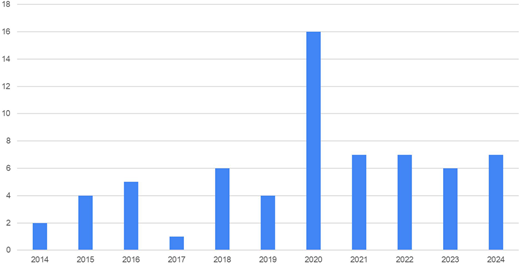
The analysis of the evolution of games over the past decade shows a significant increase, particularly from 2020 onward, as illustrated in Figure 2.
Between 2014 and 2019, game production was modest, peaking at six releases in 2018. From 2020, it surged, reaching 16 games, likely due to rising disaster concerns, COVID-19 and advancements in simulation technologies. Although releases declined after 2020, production remained stable.
The next sections provide a detailed analysis of game characteristics, identifying patterns and trends across disaster phase, type, application, game mode, genre, audience, platform and time interval.
3.3.1 Phase of the disaster addressed by the games
Disaster risk management is typically structured around four main phases: mitigation, which refers to actions aimed at reducing or preventing the impact of hazards; preparedness, involving planning and capacity building for potential events; response, which includes immediate actions taken during and after a disaster to save lives and reduce harm; and reconstruction (or recovery), focused on restoring infrastructure, services and communities after the event. Some games address only one of these phases, while others span multiple phases, as detailed in the following analysis.
The analyzed games were categorized by the disaster phase they address, as shown in Table 1. Some games span multiple phases. Table 4 details their distribution, highlighting their respective titles.
Analysis of the distribution of games according to the phases of the disaster revealed significant trends. The response phase is the most addressed, being present in 25 games, followed by preparation, which appears in 11 titles. Mitigation is explored in six games, while reconstruction appears in isolation in only one. In addition, some games integrate multiple phases, such as the combination of preparation and response (six games) and the full approach of mitigation, preparation, response and reconstruction (four games). Other hybrid formats include mitigation and preparedness (four games) and preparedness, response and reconstruction (two games).
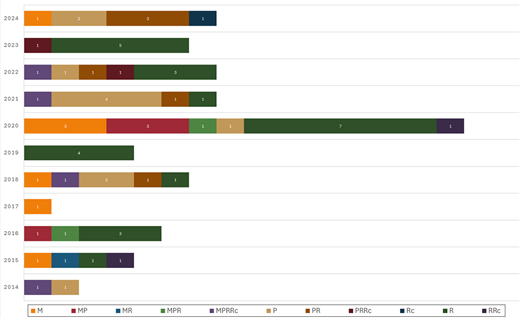
The 10-year analysis highlights trends in disaster phase distribution. Figure 3 shows how mitigation, preparation, response and reconstruction were addressed in games from 2014 to 2024, revealing growth patterns, stagnation or shifts in emphasis over time.
Until 2018, games focused on response, with preparation growing from 2019. In the following years, diversification increased, with mitigation and reconstruction emerging, though less frequently. This indicates a shift toward more integrated approaches in humanitarian logistics games.
3.3.2 Type of disaster addressed by the games
To determine the predominant characteristics of games in humanitarian logistics and disaster management, the UNDRR-ISC Hazard Definition and Classification Review was used to categorize them by disaster type (UNDRR, U.N.O.F.D.R.R, 2020). The extracted data grouped the games into six disaster categories: hydrometeorological, geological, environmental, biological, technological and social, as shown in Table 1. In addition, some games covered multiple disasters or lacked a specified type. Table 5 details the distribution of games by disaster type and title.
Hydrometeorological disasters were the most represented, being the central theme in 22 games. This result highlights the relevance of events such as floods, cyclones and tsunamis in the literature of games focused on this area, possibly due to their global recurrence and significant impact on vulnerable communities.
Geological disasters also had an expressive presence, with 15 games, exclusively addressing this theme. This emphasis may be related to the need to prepare populations for events of great magnitude, such as earthquakes and landslides, which require quick and effective responses.
Environmental disasters were addressed in isolation in five games. The presence of this theme indicates a growing interest in simulating scenarios related to issues such as deforestation, pollution and biodiversity loss, aligning with contemporary environmental concerns.
Social and technological disasters had lower representation, appearing in five and four games, respectively. Similarly, biological disasters have been involved in only one game, which focuses specifically on pandemics. This result suggests that, although these categories are relevant to crisis management, their incorporation into games may still be under development, possibly due to the complexity of their dynamics and the need for more specific approaches to simulation.
Eleven games address different types of disasters simultaneously, reflecting the interconnectedness between the various risks faced in crisis scenarios. Finally, four games did not clearly specify the type of disaster addressed, which may indicate limitations in the description of the scenarios, or a more generalist focus on emergency management.
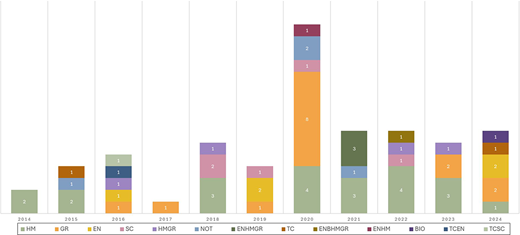
The 10-year evolution of disaster types in humanitarian logistics games reveals notable trends. Figure 4 illustrates the frequency of games on mixed, technological, climatological, geological and hydrological disasters in the analyzed games.
Hydrometeorological disasters dominated with 22 games, particularly between 2020 and 2023, reflecting rising concerns over extreme events. Geological disasters followed with 15 games, peaking in 2020 with 8. Environmental and social disasters appeared in five games, while hybrid disasters totaled nine, highlighting an underexplored integrated approach. Technological disasters were the least represented, with only two games. Despite this dominance, recent trends indicate a growing thematic diversification in humanitarian logistics games.
3.3.3 Application of the game addressed by the games
The games analyzed in the SLR were categorized according to predefined criteria in Table 1, allowing the identification of games in the Education and Training categories, as well as mixed games that encompass both applications. Table 6 presents the distribution of the games analyzed according to their applications in disaster contexts.
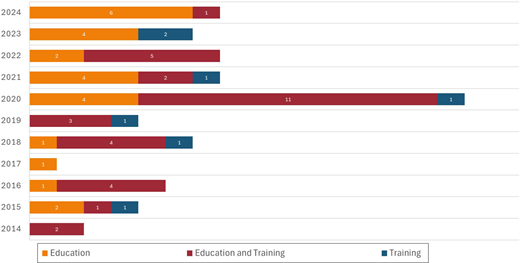
The results of the analysis indicate that the predominant category is Education and Training, with a total of 33 games identified. This suggests a significant trend in the use of serious games as hybrid tools, combining educational elements with hands-on training.
Next, the Education category is observed, which has 25 games, demonstrating the interest in the use of these resources to disseminate knowledge about disasters. Finally, the Training category appears with 7 games, indicating a smaller number of games dedicated exclusively to professional training, possibly due to the complexity involved in the development of realistic simulations. The evolution of the distribution of game applications over the last ten years demonstrates trends that can be observed in Figure 5.
Until 2018, games focused on education and training, with education growing independently from 2020. That year saw a peak, likely due to COVID-19, reinforcing education and training as the most frequent application, totaling 33 games. In the following years, education remained strong (25 games), while training appeared more sporadically (7 games). This suggests a shift toward more specialized applications in humanitarian logistics games.
3.3.4 Player mode covered by the games
The games analyzed were classified according to the player mode for which they were developed. Categories include:
multiplayer;
singleplayer;
multiplayer and singleplayer;
two players; and
unspecified.
Table 7 shows the distribution of the games analyzed according to the player mode.
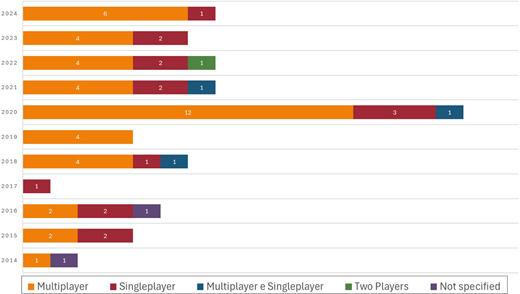
The results of the analysis indicate that the predominant category is that of multiplayer, with a total of 43 games identified. This predominance can be explained by the emphasis on collaboration and learning based on social interaction, fundamental aspects in disaster management scenarios.
Next, the singleplayer category is observed, with 16 games, indicating that there is a significant number of games aimed at individualized learning. The multiplayer and singleplayer categories have three games, while the two players category has a single game registered. Finally, two games did not specify the player mode in the analyzed study. Figure 6 shows the evolution of the distribution of the mode played in the games over the last 10 years.
Multiplayer games grew significantly over time, peaking in 2020 (12 games) amid the rise of educational simulations during COVID-19. While multiplayer remains dominant, single-player games have shown stable distribution without major peaks. This trend highlights the focus on collaborative experiences in humanitarian logistics, reflecting the need to simulate crisis coordination. However, the slower growth of single-player games and limited hybrid modes suggest opportunities for more flexible and customizable approaches.
3.3.5 Game genre covered by games
In this context, game genre refers to the classification of games according to their gameplay structure and core mechanics, following definitions established in the literature on game design and serious games (Marczewski, 2015; Novak, 2017; Salen and Zimmerman, 2003; Wiemker et al., 2015).
The game classification by genre, based on the reviewed articles and Table 1, includes simulation; simulation and strategy; strategy; simulation and role-playing game (RPG); and puzzle and adventure. Table 8 presents the frequency of genres in humanitarian logistics games between 2014 and 2024.
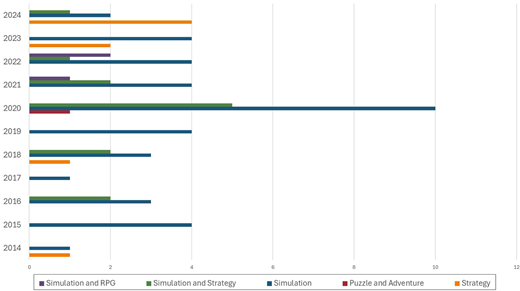
The analysis revealed that the simulation category was the predominant one, with 40 games identified. This predominance reinforces the importance of the simulation-based approach to capacity building in humanitarian logistics and disaster management.
The simulation and strategy category presented 13 games, demonstrating a significant presence of approaches that combine strategic analysis with immersive experiences. The Strategy category was represented by 8, showing a lower presence of games that focus exclusively on this format, although still relevant within the field studied. The simulation and RPG category includes only three games, suggesting that this combination is currently underexplored. The integration of simulation and interactive narrative elements may represent a promising approach to foster collaborative skills and group decision-making, as indicated by the intended goals described in the reviewed studies.
Finally, the puzzle and adventure category had only one game, indicating a less explored approach within the study area. The evolution of the distribution of genres over the last ten years reveals a significant growth of simulation games, which have been consolidated as the main genre since 2015, which can be seen in Figure 7.
Until 2018, this genre was predominant, with moderate growth and fluctuations. In 2020, a sharp increase occurred, likely due to COVID-19, alongside the rise of simulation-strategy hybrids. From 2021–2024, numbers stabilized with slight genre diversification. Strategy games gained traction from 2022, while simulation-RPG hybrids appeared sporadically, suggesting experimentation.
Despite simulation’s dominance, the trend points to more varied approaches, incorporating strategic and narrative elements to enhance complexity and engagement in humanitarian logistics games.
3.3.6 Target audience addressed by games
To identify the target audience, the extracted data was categorized into two classes: games for professionals and games for the community, as presented in Table 1. Table 9 shows the distribution of games according to this categorization.
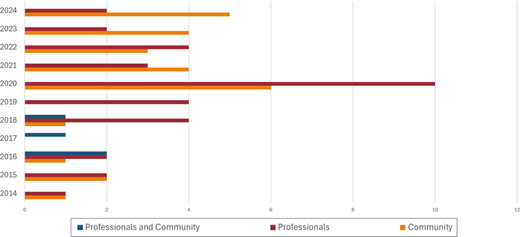
Among the identified games, 34 were developed for professionals focusing on training in disaster management, emergency response and decision-making. These include wargame-based simulations, immersive virtual reality training and strategic management games, with specific sectors like health and public safety also targeted.
Community-driven games total 27, using playful mechanics to teach disaster awareness, risk management and preventive measures, with formats like interactive simulations and board games. Four games cater to both professionals and the community, offering hybrid approaches to engage diverse audiences in disaster management. Figure 8 illustrates the distribution of target audiences in humanitarian logistics games from 2014 to 2024, showing the evolution of these approaches.
Until 2019, games for professionals grew gradually, becoming dominant from that year onward. In 2020, their numbers peaked, likely due to the COVID-19 pandemic and increased demand for specialized training. Community-focused games, though fewer, gained relevance from 2020, showing a more balanced distribution in later years. Games targeting both groups appeared sporadically, suggesting design challenges or a preference for segmented audiences. While professional-focused games remain predominant, the trend points to greater community inclusion, emphasizing the need for public awareness and disaster preparedness.
3.3.7 Platform addressed by games
The games were classified into two main platforms: digital and board games, with one game spanning both. This categorization follows the platform descriptions in Table 1. Table 10 presents their distribution across platforms.
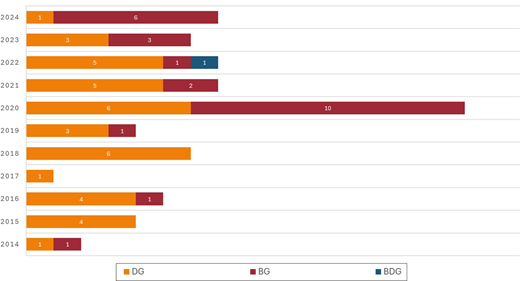
The analysis of the games found in the SLR demonstrates a varied distribution between the platforms. Of the identified games, the majority (39 games) are made up of digital games, while board games are represented in 25 games. In addition, one game combines both approaches, offering both a physical and a digital version. Figure 9 shows the frequency of platform adoption in humanitarian logistics games from 2014 to 2024, highlighting their evolution over the decade.
From 2018, digital games grew steadily, becoming dominant. In 2019, board games gained traction, peaking in 2020 with ten releases, likely driven by demand for interactive training. Their steady release (2021–2024) suggests sustained interest. While digital games remain prevalent, their growth slowed post-2020, indicating platform diversification. Hybrid games were rare, appearing only once. Overall, the rise of board games reflects a strategic shift, expanding training possibilities in humanitarian logistics.
3.3.8 Time interval covered by the games
The time range categories identified by SLR in the analyzed games follow the description set out in Table 1. The analysis revealed both games that combine different time models and others that do not specify a time range in the reviewed articles. Table 11 shows the distribution of the games according to their time interval.
The analysis of time intervals in the 65 games reveals a predominance of turn-based systems (30 games), emphasizing strategic decision-making crucial for disaster management training. Real-time games, though less common (26 games), play a significant role in simulating dynamic emergency responses. Limited-time games were rare (2 games), likely due to the challenge of imposing time constraints without hindering learning. Some games combined approaches (3 games), balancing planning and quick reactions, while 4, did not specify a time model.
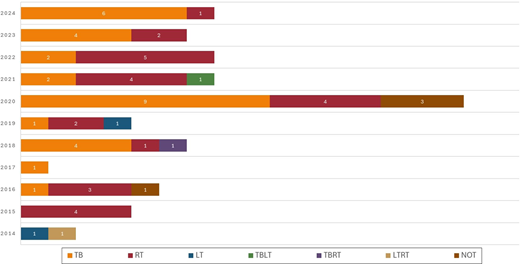
Figure 10 illustrates the distribution of these approaches from 2014 to 2024, highlighting trends in disaster response game development.
The distribution of games by time interval highlights the predominance of turn-based and real-time approaches. Turn-based games are the most common, growing steadily until 2018 and peaking in 2020 with nine releases, reflecting a preference for structured strategic planning in disaster management simulations. Real-time games, the second most frequent (26 titles), saw peaks in 2016 and renewed growth from 2020 to 2022, emphasizing quick decision-making for emergency scenarios. Hybrid approaches were rare, with only one or two cases, while four games lacked time interval specifications, suggesting documentation gaps.
4. Discussion of the results of the systematic literature review
The SLR on humanitarian logistics and disaster management games (2014–2024) highlights a growing use of games for education and training, with a focus on disaster response, predominance of multiplayer formats and digital simulations for professionals.
The predominance of the response phase (25 occurrences) reflects a focus on emergency management, aligning with disaster management literature (Solinska-Nowak et al., 2018). However, the lower representation of mitigation and reconstruction phases highlights a gap, despite their importance for long-term impact reduction. Games can drive behavior change, suggesting potential for more games focusing on these phases. Although some games integrate multiple phases, their limited presence shows a need for more comprehensive tools covering all stages of risk management (Sato et al., 2020; Wouters et al., 2013).
Hydrometeorological hazards, such as Floods are the most addressed events, while humanitarian crises and political instabilities appear less frequently. This bias may be related to the more tangible modeling of natural disasters, as pointed out by (Kankanamge et al., 2020). However, global statistics indicate that socio-economic crises and climate change pose growing challenges in risk management (Solinska-Nowak et al., 2018), reinforcing the need to expand the approach to games to contemplate more complex and multidimensional scenarios.
Studies like those in (Connolly et al., 2012) show that digital and serious games can enhance motivation and learning outcomes, surpassing traditional methods like lectures. This aligns with the findings of this review, which identified 39 digital games. Moreover, the predominance of games focused on education and training (33 occurrences) further reinforces the trend highlighting the potential of serious games as effective training tools.
The focus on professionals (34 occurrences) suggests these games aim to inform and influence field practices, enhancing knowledge retention and decision-making in crises (Wouters et al., 2013). However, fewer games target affected communities, highlighting an opportunity to foster resilience (Solinska-Nowak et al., 2018). Expanding this approach could strengthen disaster preparedness and directly empower those facing these challenges.
A meta-analysis in Wouters et al. (2013) reinforces that serious games can be as effective, or more, than traditional methods when well-designed. This SLR identifies 40 simulation-based games, enhancing knowledge retention and disaster preparedness. The combination of strategy (13) and RPG (3) suggests a focus on strategic decisions and immersive narratives, supporting (Connolly et al., 2012) on the value of interactive elements for engagement. Further research is needed on how different genres influence learning and crisis adaptation.
The prevalence of multiplayer games (43) highlights the focus on collaborative simulations, aligning with research on the importance of teamwork in crisis management (Solinska-Nowak et al., 2018; Wouters et al., 2013). The lower number of single-player games (16) suggests an opportunity to develop experiences that enhance individual learning and autonomous decision-making.
The dominance of digital games (39 titles) reflects advances in interactive technologies, ease of distribution and adaptability for various audiences (Klopfer, 2021). However, the notable presence of board games (25 titles) highlights the continued value of analog approaches for capacity building and awareness, offering accessibility and promoting social interaction. The existence of a hybrid game combining digital and physical versions suggests a promising direction for expanding learning experiences.
The categorization by time interval reveals distinct approaches. Turn-based games (30 titles) dominate, favoring reflection and planning – key for disaster response training (Solinska-Nowak et al., 2018). Meanwhile, real-time games (26 titles) emphasize dynamic simulations, preparing players for rapid decision-making in crisis scenarios (Crookall, 2010).
The analysis of the predominance in each category reveals gaps that need attention: few community-driven games highlight the need for inclusivity, the scarcity of games covering all disaster phases limits impact and the lack of focus on social disasters calls for more research to balance these areas and enhance impact assessment.
A digital repository was created to organize and share the games identified in this SLR. The site https://jogoshumanitarios.unimar.br serves as a practical tool for researchers, educators, developers and professionals, offering easy access to game information. In addition to consolidating knowledge, it promotes the dissemination of these tools and encourages further research on games in disaster management.
5. Final considerations
This SLR shows that while games in humanitarian logistics and disaster management vary, certain trends stand out. Most focus on the disaster response phase, prioritizing professional training and critical scenario simulation. The dominance of digital and multiplayer formats highlights the value of collaboration in crisis management, while the prevalence of simulation games underscores their effectiveness in creating immersive, realistic training environments.
Over the last decade, game development has grown significantly, especially after 2020, likely driven by digital advancements and the demand for interactive disaster response training. There is also a gradual expansion in focus, with more games addressing mitigation and preparedness, though response and reconstruction remain dominant.
Despite progress, gaps remain. Few studies empirically assess these games’ effectiveness in skill development and real-world decision-making. In addition, most games do not integrate all disaster phases, limiting their use as comprehensive training tools. The lack of standardized impact assessment methods further hinders comparisons and best practice adoption.
This study consolidates existing knowledge and provides a structured overview of games in humanitarian logistics and disaster management across the repository. By mapping key features and trends, it serves as a reference for researchers, developers and decision-makers seeking to optimize their use in real-world challenges. Future research should focus on empirically validating their effectiveness and exploring more integrated approaches to increasing resilience and disaster response.
When interpreting the results of this SLR, it is necessary to discuss the limitations inherent to the included studies. Many studies presented small or non-representative samples, compromising the external validity of the results. In addition, the lack of standardization in the measures made comparisons between studies difficult, ranging from subjective assessments to objective tests of knowledge and skills (Solinska-Nowak et al., 2018; Wouters et al., 2013).
Most studies focus on specific disasters like floods and earthquakes, limiting their applicability to diverse scenarios (Solinska-Nowak et al., 2018). In addition, research is often confined to specific cultural and geographic contexts, hindering result generalization. A key limitation is the emphasis on short-term assessments, with little exploration of games’ long-term effects on learning and disaster preparedness. The lack of longitudinal data weakens understanding of their sustained impact (Connolly et al., 2012; Wouters et al., 2013).
The inclusion and exclusion criteria of the studies in the review may have introduced bias, affecting the representativeness of the findings. Relevant studies may have been excluded due to language restrictions, accessibility or other factors.
When considering these limitations, it is relevant to interpret the results of this SLR with caution. Recognizing these limitations helps outline areas for future research, such as the need for more rigorous studies, the standardization of outcome measures and the exploration of a broader range of disaster scenarios and cultural contexts. In addition, developing serious games based on robust instructional design principles can maximize their positive impact on disaster management education and training.
This review has key practical and policy implications. Practically, games are effective tools for education and training in humanitarian logistics and disaster management, suggesting their integration into crisis preparedness programs. Policy-wise, continued investment in adaptable games for various contexts and disasters is crucial (Connolly et al., 2012). Future research should focus on studying the long-term impact of these games and developing standardized assessment methodologies.
The analysis revealed an unbalanced distribution among the identified games with respect to the disaster phases addressed, the genres employed and the types of application. This asymmetry highlights important gaps in the field, which can guide future development initiatives. Specifically, there is a significant opportunity for the creation of new games and tools targeting underexplored contexts, such as the mitigation and reconstruction phases, as well as approaches that foster large-scale collaboration, impact assessment or integration with educational platforms. Thus, the findings of this study not only synthesize the existing knowledge but also provide practical insights for researchers, developers and institutions aiming to expand the use of games in the humanitarian logistics domain.
Furthermore, this review exclusively considered games documented in peer-reviewed academic literature indexed in Scopus and Web of Science, thereby excluding relevant games not associated with scholarly publications. This constitutes a methodological limitation that may overlook valuable tools developed and applied in practice. In addition, the long-term availability and playability of the games included in the review were not systematically assessed, as most source articles did not provide this information. Consequently, it remains unclear whether these games are still accessible, compatible with current platforms or obtainable in the case of physical formats. Future research is encouraged to address these gaps by exploring alternative sources (e.g. grey literature, institutional databases) and evaluating the current usability and accessibility of serious games in the field of humanitarian logistics and disaster management.
Another limitation is the lack of information in most studies regarding the dissemination and actual use of the games (e.g. number of players, reach or context of application). This gap hinders a comprehensive assessment of the real-world impact and adoption of the identified games. Future research should report such data to enhance the external validity and applicability of game-based interventions in humanitarian logistics.