


The purpose of this paper is to explore the humanitarian service management categories that influence long-term transformation within complex community-based service ecosystems.
This study utilizes mixed methods to present a dynamic model that provides insight into the complexities of supplying, distributing and transporting charitable resources to underserved communities. The interdisciplinary study draws on the theory of service-dominant logic and service science, presents critical elements of transformative service research and uses system dynamics approach to propose a visual causal loop model.
This study develops a dynamic model for studying humanitarian service and value propositions in underserved communities. This paper combines the extant literature to emphasize key humanitarian service categories that influence, and are influenced by, service exchanges within community-based contexts.
This paper is limited in providing quantitative methods in analyzing the case study data. However, the research is still helpful in providing acumen via the causal loop diagram to specifically look into each variable and see their cause and effect relationships in the community-based ecosystem. The research represents an opportunity to model the humanitarian aid and relief scenarios to help make more effective decision-making interventions.
The model serves as a managerial tool to determine critical services that optimize resource utilization within the community-based service ecosystems. Insights from this research are broadly applicable to the contexts of humanitarian logistics and supply chain management (HLSCM) solutions for community-based ventures.
This paper conceptualizes how the management of service-for-service exchanges, logistics services and charitable donation management provides transformational humanitarian services and value propositions within underserved communities. This study further provides fundamental contributions by addressing research gaps in the HLSCM domain by supporting service research and the community-based context.
Introduction
There is an increasing interest in service research for understanding how to solve societal challenges within underserved communities (Bitner, 2017; Kovács and Spens, 2011, 2014; Anderson et al., 2013; Heaslip, 2013; Overstreet et al., 2011; Ostrom et al., 2010), and for advancing research on dynamic and complex service ecosystems (Naumann et al., 2017; Letaifa et al., 2016; Chandler and Lusch, 2015). Over the past decade, the service literature extends research on the study of organizations that focus on service deliveries as compared to product-centric distributions (Spohrer and Maglio, 2008). Yet, few studies focus on the humanitarian service deliveries that alleviate environmental, social and economic challenges within impoverished communities (Heaslip, 2015; Özpolat et al., 2015; Ayeni et al., 2014; Heaslip, 2013; Kovács et al., 2010; Kovács and Spens 2011). In addition, although there is research on service ecosystems in business environments (Barile et al., 2016), little is known about the development of ecosystems that support humanitarian services (Heaslip, 2015; Letaifa, 2014) and foster long-term transformation within underserved communities (Drakaki and Tzionas, 2017; Letaifa et al., 2016; Özpolat et al., 2015; Heaslip, 2013; Kovács and Spens, 2011; Kovács et al., 2010; Tomasini and Van Wassenhove, 2009).
Consequently, the consideration to manage service ecosystems may be particularly relevant to community-based enterprises (CBEs) (Peredo and Chrisman, 2006). It is mainly because CBEs, also known as humanitarian aid providers, face complex issues when seeking transformation (Obaze, 2016). Transformation refers to the ability to use services to alleviate the suffering of vulnerable people and to co-create value by influencing long-term uplifting changes within the community. Furthermore, research shows that as the proliferation of services increase to enhance transformation, so does the inherent problems that cause complexities within the service ecosystem (Özpolat et al., 2015; Chandler and Lusch, 2015; Patrício et al., 2011), such as functional silos, ineffective donation management, information asymmetry, waste, shortages due to errors in delivery and increased vulnerability in the ecosystem (Obaze, 2016; Özpolat et al., 2015). Nonetheless, CBEs present the ability to manage service factors that influence transformation. Thus, providing insights into the humanitarian service ecosystem and describing the complex nature of the ecosystem could contribute to theory and practice.
The purpose of this research is threefold. First, the study examines the humanitarian service management categories that enable long-term transformation. Second, the study examines how these service categories influence transformation within underserved communities. In addition to accomplishing the first two aims, using a case study approach, the research visually describes the formation and complex nature of the humanitarian service ecosystem that supports transformation. It is proposed that identifying the critical humanitarian service management categories and observing how they enable transformation, supports the need to understand the transformative community-based humanitarian service ecosystem.
To advance this idea, the main contribution of the paper is to conceptualize the connection of three main categories for the effective management of humanitarian services which include supply chain management (structured service-for-service exchanges), logistics management (service-centric designs and practices) and charitable donation management (operand and operant resource integration) into an ecosystem model. The study contributes to this conceptual development by using extant theory in three stages: first, building on the humanitarian logistics and supply chain management (HLSCM) literature, this study combines the theoretical perspectives of service science and service-dominant logic (S-D logic) to explore the humanitarian service ecosystem gap. Second, transformative service research (TSR) and Blocker and Barrios (2015) view on value propositions are used to describe how the identified humanitarian service categories provide transformation (see Figure 1). The final stage of the conceptual development uses system dynamics (SD) methodology to empirically develop a visual causal loop diagram (CLD). Using data collected from a North Texas CBE, the developed system thinking diagram applies as a learning tool for future researchers and practitioners. The diagram connotes a simpler comprehension of the ecosystem as compared to mainly viewing such systems as mainly complex (Naumann et al., 2017).
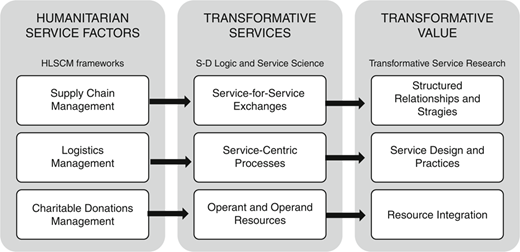
Theoretical frameworks for the humanitarian community-based transformative service ecosystem
Theoretical frameworks for the humanitarian community-based transformative service ecosystem
The following sections outline the rest of this paper. First, the paper reviews the HLSCM literature. Through the theoretical lens of S-D logic and service science that views service as a critical element in meeting needs within an ecosystem, the study identifies three key humanitarian service categories. Next, the TSR framework is used to describe how the categories provide transformative propositions. Then, the conceptual model is developed and presented using the SD method. The paper concludes with findings, limitations, implications for practice and future research opportunities.
Theoretical background
Humanitarian logistics and supply chain management (HLSCM) within underserved communities
HLSCM research to date has evolved from the traditional military setting frameworks (Rutner et al., 2012), to the business frameworks (Mentzer and Kahn, 1995) and to a more recent humanitarian relief arena that considers both individual and societal vulnerability (Kovács and Spens, 2007; Oloruntoba and Gray, 2006). For instance, the humanitarian context adapted the definition of business logistics management by changing the view of the “end-customer” in the supply chain to describe the term “end-beneficiaries.” End-beneficiaries are referred to as people facing vulnerability (Tomasini and Van Wassenhove, 2009) and or considered as “victims of disasters” (Kovács et al., 2010). Kovács et al. (2010) defined humanitarian logistics as “the process of planning, implementing and controlling the efficient, cost-effective flow and storage of goods and materials, as well as related information, from point of origin to point of consumption for the purpose of meeting end-beneficiary’s requirements.” Similarly, other researchers affirm that end-beneficiaries in the supply chain refer to vulnerable end-consumers (Tomasini and Van Wassenhove, 2009) lacking the purchasing power of needed resources (Kovács et al., 2010) and faced with varied types and levels of disasters (Drakaki and Tzionas, 2017).
Building on the evolution of the humanitarian context, there are still gaps that exist. Little research describes key humanitarian service elements and categories (Heaslip, 2015; Kovács and Spens, 2011); the complex nature of seeking transformation (Letaifa et al., 2016), within the service ecosystem that involves end-beneficiaries and local logistics service providers in the co-creation of value (Heaslip, 2015); and the application of humanitarian services that go beyond the post-disaster response and global humanitarian aid frameworks (Tomasini and Van Wassenhove, 2009), especially within developing countries (Ayeni et al., 2014); and sustainable humanitarian aid as employed within community-based contexts (Kovács and Spens, 2011).
Furthermore, research now highlights the importance of discovering the provision of humanitarian aid within underserved communities. First, that there are different connotations of disaster, societal challenges, crises and vulnerability when providing humanitarian aid to end-beneficiaries, specifically in underserved areas (Drakaki and Tzionas, 2017; Kovács et al., 2010). For instance, Kovács and Spens (2011) state that there is a gap in identifying new societal challenges within the community-based supply chain design and in addressing urbanization trends. Simultaneously, Obaze (2016) investigated the issues of food insecurity as a prevalent humanitarian supply chain challenge within impoverished communities. The author describes underserved communities as impoverished, disaster-stricken and remote urban areas where organizations fail to reach and serve many vulnerable people with simpler and available offerings. In historically impoverished communities, research describes such systemic challenges like food insecurity as disasters (Barrett, 2010).
At the same time, among other fields such as the disaster management arena, the term disaster continues to evolve. Research acknowledges that disasters encompass all levels, types and intensity of societal challenges (Yadav and Barve, 2015) and require varied types of responses: pre-, post- and during a disaster to transform the undesired situation (Tomasini and Van Wassenhove, 2009). Disasters are said to describe challenges that embody all types of social vulnerabilities resulting from failed social systems (Yadav and Barve, 2015). Drakaki and Tzionas (2017) describe disasters as “transitions to change that involve vulnerability and require the community to engage in extraordinary efforts.” Interestingly, the authors mention that while there is no universally accepted term for disasters, new structures and strategies are needed to address these “social phenomena that destabilize the social system, causing the norms to fail.”
This further implies that as varied levels of disasters affect functioning systems, and “test the reactivity” of systems (Tomasini and Van Wassenhove, 2009), they require a system – an ecosystem of services to achieve transformation (Letaifa et al., 2016). Concurrently, these extant investigations initiate a service ecosystem discourse on addressing systemic challenges within underserved communities. In sum, the gaps in the literature indicate that the HLSCM field is still evolving and has ample opportunities for new contributions. Thus, this research proposes the importance for understanding the humanitarian service ecosystem that addresses and transforms challenges within underserved communities.
Humanitarian services, service science and S-D logic
Service is described as the resource, process, action and practice that is provided to help those in need (Naumann et al., 2017; Obaze 2016; Anderson et al., 2013), and used for the benefit of another (Vargo and Lusch, 2010). The humanitarian relief-related literature categorizes services as success factors that enable humanitarian aid and influence relief to vulnerable people. Haselkorn and Walton (2009) define humanitarian services as the ability to establish and use effective and sustainable infrastructure to help those in need by providing food, shelter, improved medical care and other resources. Thus, humanitarian services reflect transformational qualities, by either design or potential, to influence societal well-being and co-create value (Heaslip, 2013).
However, although the application of services is not novel in the humanitarian contexts, yet there are observed gaps in identifying the transformational humanitarian service categories, especially within ecosystems (Kovács and Spens 2011; Heaslip, 2015). Service research reveals that services are said to be transformational when they are structured, long-term and sustainable, connected within an ecosystem, include end-beneficiaries into the management and planning processes and co-create value (Letaifa et al., 2016). Importantly, theoretical service frameworks enable researchers to evaluate the relationships between service, transformation and the service ecosystem’s ability to co-create value.
For instance, service science is defined as “an emerging interdisciplinary field that focuses on fundamental science models, theories and applications that drive service innovation, competition, and well-being through co-creation of value” (Ostrom et al., 2010). Past research suggests that service science explains the origin and growth of service systems and provides unique service professionals and researchers with an understanding of service ecosystems (Maglio and Spohrer, 2008; Vargo et al., 2008; Maglio et al., 2006). Furthermore, service science advocates the focus on service ecosystems that have a process (Qiu, 2009) or multiple processes (Sampson, 2012) typically organized, ordered and structured to meet a particular need through all available means, people, information and technology (Vargo et al., 2008).
Also, there is now a handful of service literature that is concerned with the study of service and value propositions within complex ecosystems (Naumann et al., 2017; Chandler and Lusch, 2015; Patrício et al., 2011). The general theory of S-D logic affords foundations for embedding services and value co-creation. The theory highlights the importance of connecting different types of services, suppliers, users and beneficiaries within any system (Vargo and Akaka, 2009). Importantly, this systems thinking view describes service ecosystems as “a relatively self-contained, self-adjusting system of resource-integrating actors, connected by shared institutional logics and mutual value creation through their service exchanges” (Vargo and Lusch, 2010; Barile et al., 2016). However, they are few S-D logic frameworks that describe social and humanitarian systems (Heaslip, 2015). Thus, S-D logic presents a service-centric ecosystems view on connecting all human actors, specifically end-beneficiaries into the humanitarian service ecosystem to co-create value.
Evidently, S-D logic can assist the literature in describing how humanitarian aid is developed and managed when meeting “individual and dynamic” end-beneficiary needs (Heaslip, 2015). Among the main principles of S-D logic, Vargo and Lusch (2008) state that:
The central notions of S-D logic are that fundamental to human well-being, if not survival, is specialization by individuals in a subset of knowledge and skills (operant resources) and exchanging the application of these resources for the application of knowledge and skills they do not specialize. This shift in focus from operand to operant resources has implications for understanding social interaction and structure that are markedly different from the ones suggested by a focus on the exchange of operand resources and potentially has ramifications for understanding exchange processes, dynamics, structures, and institutions beyond commerce.
The authors’ further present ten key service propositions that are fundamental to understanding the service implications that enable transformation (see Table I). Notably, the central tenets of S-D logic favor a service ecosystems view that affords structured service-for-service exchanges, deliver operant and operand resources and focus on economic and social, individual and societal resource integrators, such as end-beneficiaries, in the provision of transformation. In sum, from the S-D logic view: a focus on service provision is important, networks of organizations are encouraged to include all members (end-beneficiaries and social and economic suppliers) within the system, co-creation is emphasized (Barrios and Blocker, 2015; Vargo and Lusch, 2004b, 2008) and the service ecosystem view that embeds varied services (Barile et al., 2016) actualizes transformation (Letaifa et al., 2016).
Implications for humanitarian services using foundational premises of S-D logic
| No. | Premise | Explanation/justification | Humanitarian service implications |
|---|---|---|---|
| FP1 | Service is the fundamental basis of exchange | The application of operant resources (knowledge and skills), “service,” is the basis for all exchange. Service is exchanged for service | Service is important. Beyond the focus on the donation of products – donated knowledgeable and skilled services should also be exchanged |
| FP2 | Indirect exchange masks the fundamental basis of exchange | Goods, money, and institutions mask the service-for-service nature of exchange | Charitable giving masks the service-for-service nature of the exchange. All donations in the humanitarian context are important. However, a focus on the indirect exchange of donated services, especially from donated skills and knowledge is critical. Thus, the transformation of end-beneficiaries by providing operand resources masks the provision of operant resources that provide additional service-for-service exchanges |
| FP3 | Goods are distribution mechanisms for service provision | Goods (both durable and non-durable) derive their value through use – the service they provide | Value of goods is evident in the supply chain. However, services that allow beneficiaries to access the goods and in turn be able to provide services of their own are also important |
| FP4 | Operant resources are the fundamental source of competitive advantage | The comparative ability to cause desired change drives competition | Humanitarian services, volunteers, people’s skills and knowledge, competent information systems, and other value propositions provide a competitive advantage. The focus on the provision of operant resources (skills and knowledge), especially from the transformation of the end-beneficiary provides an advantage |
| FP5 | All economies are service economies | Service (singular) is only now becoming more apparent with increased specialization and outsourcing | All humanitarian organizations and enterprises are service organizations and need a focus on connecting humanitarian service factors to provide services and meet needs |
| FP6 | The customer is always a co-creator of value | Implies value creation is interactional | End-beneficiaries receiving services from humanitarian organizations can also provide services. Humanitarian community-based supply chains that involve all end-beneficiaries in the process are imperative to encourage value creation. Also, the ability to transform the end-beneficiary to becoming a supplier of value presents the service-centric view of humanitarian aid that suggests that the end-beneficiary is always a co-creator of value |
| FP7 | The enterprise cannot deliver value, but only offer value propositions | The firm can offer its applied resources and collaboratively (interactively) create value following acceptance, but cannot create/deliver value alone | CBEs can only offer value propositions. No independent supply chain organization has the power to create or deliver value. Involving the provision of resources from all participants in the supply chain, including end-beneficiaries, offers value. Service organizations cannot act alone. Collaboration with all stakeholders, including end-beneficiaries increase the donations of skills and knowledge |
| FP8 | A service-centered view is inherently customer oriented and relational | Service is customer-determined and co-created; thus, it is inherently customer oriented and relational | Relationships with end-beneficiaries are critical for the supply chain. All parties involved in the service ecosystem include both suppliers and customers |
| FP9 | All economic and social actors are resource integrators | Implies the context of value creation is networks of networks (resource-integrators) | The focus of the transformative service ecosystem that includes all social and economic suppliers, comprising of transformed end-beneficiaries is resource integration. Resource integration refers to service encounters that allow all agents in the ecosystem to become involved in value co-creation |
| FP10 | Value is always uniquely and phenomenological determined by the beneficiary | Value is idiosyncratic, experiential, contextual, and meaning laden | Value can be created and co-created by including and connecting all beneficiaries in the service ecosystem |
Source: Adapted from Vargo and Lusch (2008)
Humanitarian service categories
Past researchers identify key factors relevant for categorizing the successful management of humanitarian services. For instance, Oloruntoba (2010) identifies key factors, also termed as key success factors, as “elements that are vital” for achieving emergency disaster relief. Extant factors identified were adopted from various management studies into the humanitarian (Oloruntoba, 2010; Pettit and Beresford, 2009) and disaster management fields (Yadav and Barve, 2015).
Relevant to the humanitarian context, Pettit and Beresford (2009) identified ten success factors in the emergency relief arena. The factors include strategic planning, supplier relations and collaboration, capacity planning, supply chain strategy, information management, technology utilization, transportation planning, continuous improvement and inventory and resource management. Oloruntoba (2010) further categorized some of these factors into the emergency relief arena by using a case study approach. The author examined the response phase of a global disaster that took place in Australia and identified five overlapping factors. Oloruntoba categorized the five factors into two headings: factors influencing the preparedness and readiness of the relief supply chains, and the unity of direction and cohesive control from responding government disaster management agencies.
Additionally, Yadav and Barve (2015) building on past research, identified 12 critical factors in disaster management. The authors, using interpretive structural modeling, systematically classified the critical factors into clusters of dependence. The factors include risk and need assessment, procurement and donation management, coordination and collaboration with other relief organizations, capacity building, information and communication technology, disaster-resilient infrastructure and transport facilities, strategic planning for emergency relief supply system, agile humanitarian supply chain, government policies and organizational structure, forecasting and early warning systems, inventory management and continuous improvement.
In overview, while these factors apply to the humanitarian aid arena, the authors failed to capture the service-centric and ecosystem perceptions of using these factors. Furthermore, the authors categorized the studied humanitarian supply chain as unstable, unpredictable, inflexible and short-lived. The studies did not capture the inclusion of end-beneficiaries as potential service providers and mainly focused on the product-centric delivery of relief resources. Thus, building on the extant literature, this research broadly categorizes the critical factors into three main service management categories: supply chain management, logistics management and charitable donation management. More specifically, the categories are proposed to address the humanitarian service-centric exchanges, processes and provision of integrated resources that influence long-term transformation within underserved communities.
Supply chain management (SCM)
The central premise of the S-D literature reinforces a focus on services as compared to product distribution. S-D logic emphasizes on service-for-service configurations that connect all people, products and technology within and among service systems. This service-for-service perspective refers to the service interaction within and among all members of the systems such as firms, suppliers, end-customers (end-beneficiaries) and other stakeholders (Vargo and Lusch, 2008). From this view, SCM is suggested to support the service of building value-added supply chain structures that manage relationships in meeting impoverished end-beneficiary needs (McLachlin and Larson, 2011; Overstreet et al., 2011), and the ability to use strategies to form service-for-service interactions and exchanges, especially with end-beneficiaries, to influence sustainable transformation (Letaifa et al., 2016).
SCM supports building appropriate community-based supply chain[1] structures and strategies. SCM is defined as “the systematic, strategic coordination of the traditional business functions and the tactics across business function within a particular company and across businesses within the supply chain, to improve the long-term performance of the individual companies and the supply chain as a whole” (Mentzer et al., 2001). In the humanitarian context, Oloruntoba and Gray (2006) state that SCM presents a “planned approach; that a longer-term, strategic perspective is adopted; and that it is important to coordinate functions” in the supply chain. Mentzer et al. (2001) define supply chains as a set of three or more organizations involved in the flow of people, products, services, finances and information.
Importantly, Tomasini and Van Wassenhove (2009) state that SCM is “a key factor in the overall effectiveness of any humanitarian response.” Furthermore, the authors suggest that SCM services foster preparedness, response and collaboration strategies within the supply chain. Research shows that SCM, as a strategic service, enhances supply chain structures; embody long-term relationships with all stakeholders, including end-beneficiaries; and supports supply chain member selection, collaboration, information and preplanning strategies, and technology utilization to influence sustainability (Maull et al., 2012). Thus, this research proposes using SCM as a service management category to build supply chain structures and strategies that foster different economic and social service-for-service exchanges that include suppliers, distributors and especially end-consumers coming together to achieve combined organizational objectives.
Furthermore, in the community-based context, this research suggests SCM as a service that influences transformation by including end-beneficiaries in the service management process. Thus, increasing dynamic interaction, shared information, knowledge and other resources with the inclusion of end-beneficiaries into the strategic planning and preparedness stages of service provision influences long-term transformation (Letaifa et al., 2016; Muall et al., 2012).
Logistics management
Research recognizes logistics management as a subset of SCM (CSCMP, 2018; Lummus et al., 2001). This research views logistics management as the service-centric process and design that is included in the supply chain to allow for the “well defined and cost effective provision” of needed resources (Lummus et al., 2001). In this view, logistics management is described as the service-centric process that is triggered when SCM plans, strategies and structures influence the need for resources.
In addition, S-D logic recognizes that service-centric processes offer effective operand and operant resources. Operand resources are physical resources on which a service is performed to produce an intended outcome (Vargo and Lusch, 2004a). Operant resources refer to value, core competencies or organizational processes that all human agents in the system offer through the knowledge and skills that can transform the system and produce an intended outcome (Vargo and Lusch, 2004a).
Importantly, research shows that logistics management is the value-adding service-centric processes that enhance the collection, consolidation, storage, handling, controlling and movement of donated operand resources to meet end-beneficiary needs (Obaze, 2016). Furthermore, the service-centric process and design support the long-term and efficient management of operand resources by using various activities that include distribution, inventory, transportation and demand management (Van Wassenhove, 2006). Accordingly, the council of supply chain management professionals (CSCMP, 2018) defines logistics management as “that part of supply chain management that plans, implements, and controls the efficient, effective forward and reverses flow and storage of goods, services and related information between the point of origin and the point of consumption in order to meet customers’ requirements.” This definition further supports the notion for a systematic view that connects logistics management to supply chain management by implementing SCM strategies and structures to enhance logistics processes that meet end-beneficiaries’ needs.
Lummus et al. (2001) define logistics as the movement of physical goods from one location to another. In the humanitarian context, Kovacs and Spens (2007) state that logistics “has always been an important factor in humanitarian aid operations.” The authors state that humanitarian logistics “encompasses a range of activities including preparedness, planning, procurement, transport, warehousing, tracking and tracing and customs clearance” to alleviate the suffering of vulnerable people. Empirical studies show that logistics as a service-centric process enhances the distribution of humanitarian aid (Heaslip, 2015), and denotes the type of transformational qualities, either by design or the potential to influence the well-being of society (Blocker and Barrios, 2015). Particularly, when providing timely and appropriate aid to those in need (Kovács and Spens, 2011), logistics management categorizes a set of service-centric processes that meet welfare needs when and where needed to aid transformation.
Charitable donation management
Finally, this research posits charitable donation management as the third humanitarian service management category. Charitable donation management refers to the management of systems, services, strategies and processes that allow service providers to accept and distribute charitable resources over a period of time and in an ongoing manner (Spector, 2004). Here, the service management focus integrates charitable resources that include donated operand and operant resources from all stakeholders, including end-beneficiaries in an on-going manner.
S-D logic suggests the primary use of services is to offer resource integration. Resource integration refers to service encounters that increase value co-creation through the provision of both operand and operant resources. Primarily, resource integration implies that all human agents, including end-beneficiaries, should be involved in the provision of operand (products) resources and operant (human skills and knowledge) resources to increase value co-creation (Blocker and Barrios, 2015).
As it is, service-for-service exchanges that deliver integrated resources enable competitive advantage (Lusch et al., 2010; Vargo and Lusch, 2008; Vargo et al., 2008). For instance, Pettit and Beresford (2009) suggest that in the humanitarian context, the provision of both product and human resources are essential in providing disaster relief. The authors stress the issue of human resource management in providing humanitarian aid and its advantages to enhance effectiveness. Concerning transformation, Barrios and Blocker (2015) state that value co-creation is enhanced when human agents provide a “portfolio of resources as well as their capabilities” into the supply chain.
Thus, when operand resources are provided to transform vulnerable end-beneficiaries, the inclusion of the transformed end-beneficiaries as potential service providers of operant resources influences value co-creation. The idea is that charitable donations management allows services providers to not only focus on donated product provision to alleviate the suffering of vulnerable people, but also to focus on the management of crucial service encounters that enable better interaction, information sharing and donated knowledge exchanges with and from transformed end-beneficiaries within the supply chain to enhance value co-creation. Therefore, presenting charitable donations management, with a service-centric view of managing donated operand and operant resources presents new insights into ways humanitarian services can influence transformation within underserved areas.
In sum, the appropriability of donations management provides a resource integration perspective that increases the service management of both operant and operand resources into the ecosystem. This further extends the donated product-centric distributions to a service-centric view. Thus, transformation increases when the service ecosystem provides donated resource integration and allows all human agents, especially transformed end-beneficiaries in the community, to donate, transact, collaborate and co-create value in an ongoing manner (Letaifa et al., 2016).
Notably, these preceding factors are not new to HLSCM research. However, this research presents these extant HLSCM concepts in a service-centric view for achieving long-term transformation. Theoretically, mainstream service domain scholars support this shift in perspectives. Thus, in the next sections, the paper explores how the service categories are interconnected in a service ecosystem to achieve transformation.
Transformation, transformative service and value research
Transformation refers to the ability to co-create desired and uplifting changes within the community, and to alleviate the suffering of vulnerable people. The concept of transformation denotes the recent attempt to describe aggregate and multiple ways humanitarian services are connected in an ecosystem to influence transformative value propositions. Spohrer and Maglio (2008) describe services as the action of working together to transform situations. In this community-based context, and building on the service research premise, varied service factors influence transformation when embedded in an ecosystem.
Extant studies discuss the relevance of transformation within the service ecosystem (Letaifa et al., 2016; Blocker and Barrios, 2015). Accordingly, TSR focus on the relationship between service encounters, transformation and social well-being (Ostrom et al., 2010). TSR is defined as “the integration of consumer and service research that centers on creating uplifting changes and improvements in the well-being of consumer entities: individuals, communities and the ecosystem” (Anderson et al., 2013). A primary assumption of TSR is that services and its value propositions are conceptualized into having transformational qualities (Ostrom et al. 2010) and are critical for understanding the dynamics of the service ecosystem (Chandler and Lusch, 2015).
Accordingly, research shows that interconnected services and value propositions play a vital role when exploring how service ecosystems create transformation. Blocker and Barrios state that value propositions occur in dynamic social systems where communities are prompted to learn, adapt and use creative services to support uplifting changes. The authors suggest that services become transformational when embedded into systems, promote relational benefits, service design, service practices and social structures. According to Blocker and Barrios (2015), the use of services to provide value propositions is presented by connecting four main sections of the transformative value framework.
Building on the framework, this paper argues that when service factors, such as SCM, are used to build appropriate structures that foster supply chain relationships and strategies to involve all stakeholders, and include logistics services and charitable donation management into the structure, transformation is influenced (McLachlin and Larson, 2011; Overstreet et al., 2011). For instance, the first section of the transformative value framework supports the idea of structured service-for-service exchanges. Blocker and Barrios state that embedding service structures with service design, service practices and human agents propagate uplifting change.
Accordingly, Stock et al. (2000) describe supply chain structures as “groups of firms across the extended enterprise” that include all suppliers and customers in crafting strategies, plans and coordination mechanisms. Furthermore, Awaysheh and Klassen (2010) highlight that the use of SCM to build supply chain structures, especially when designed and integrated to address social issues, emphasize transparency, information sharing, dependency and distance as main proponents for operational and efficient performance. Thus, this research suggests that the use of SCM, as the sustainable and efficient management of structured service-for-service exchanges, provides value propositions that enhance transformation when the structures are further designed, practiced and integrated.
In addition to structure, this research supports employing logistics service designs and practices in the humanitarian ecosystem. Kovács and Spens (2011) state that in the onsets of disasters, humanitarian logistics needs to be “designed and deployed” immediately to successfully distribute resources to disaster victims. Leading to the next two sections of Barrios and Blocker’s framework that describe the implementation of service design and practices within structures, the framework constitutes using appropriate structures to support service design and practices to transform undesired situations. Thus, it is essential for service-centric processes, such as logistics management to be designed and practiced in the ecosystem to efficiently provide donated resources.
The final section of the value proposition framework warrants a service-centric perception of managing charitable resources by utilizing human agents in the service ecosystem. This value propositions further reflects creating uplifting changes and co-creating value in the community by including end-beneficiaries, as human agents, into the service supply chain. Blocker and Barrios suggest that value propositions take place when human agents provide operant resources. Here, the implication is that, although human agents provide operand resources when embedded in connection with the service design, practices and structure to influence transformation, human agents can also provide operant services in these structures to co-create value. Thus, the deployment of integrated resources through the effective use of human skills and knowledge transforms underserved areas (Pettit and Beresford, 2005) when embedded into the ecosystem.
In sum, connecting the three humanitarian service categories to provide value propositions enables transformation. Beyond the use of SCM and logistics management, connecting charitable donations management into the humanitarian service ecosystem increases transformative value propositions when the added humanitarian service category enables value propositions through the sustainable, long-term and efficient service-centric inclusion of end-beneficiaries, as compared to mainly focusing on only product distribution in the service ecosystem. In this way, building on the value proposition framework, embedded SCM services that provide structured service-for-service exchanges; logistics management design and practices; and charitable donations management that utilizes resource integration from human agents within an ecosystem, influence transformation (see Table II).
Summary of the transformative community-based humanitarian service ecosystem
| Humanitarian service categories | Service propositions | Value propositions | Illustrative implications for connecting categories in a service ecosystem to influence transformation |
|---|---|---|---|
| Supply chain management | Service-for-service exchanges All stakeholders Includes end-beneficiaries | Structure Relationships Strategic planning | Increased decisions and behaviors Quality decision making Better communication Operational performance The inclusion of skills and knowledge in preplanning strategies Sustainability Task transfer Trust Preparation for additional services Reduced decisions and behaviors Reduced disconnections Reduced trust from disconnection Reduced information sharing from disconnection Reduced operational performance from disconnection |
| Logistics management | Service-centric processes Inventory management Distribution management Capacity planning Transportation management | Service design and practice Order fulfillment accuracy Demand planning Capacity planning delivery | Increased benefits Increased order fulfillment Increased distribution of products Increased order handling time Increased desired fill rate Reduced issues and complexities Reduced demand for facilities Reduced storage Reduced waste Reduced order handling errors Reduced wrong choice of vehicles |
| Charitable donations management | Management of operand and operant resources Operand products Operant services | Resource integration Product delivery Service delivery | Product delivery leads to the transformation of human agents Alleviate the suffering of vulnerable people through product delivery Focus on transforming human agents with the provision of operand products Value co-creation through transformed human agents Human agents co-create value providing donated skills and services Focus on including transformed human agents with the provision of operant resources |
Evidently, including service factors and value proposition into service ecosystems can also be complex (Chandler and Lusch, 2015; Patrício et al., 2011). Naumann et al. (2017) describe service ecosystems as complex; and require more insights to understand how the use of services, structures and relationships between diverse organizations engage and enhance the lives of the community. Letaifa (2014) suggests that service researchers need to have a systematic approach to assessing complex service ecosystems. Thus, this research uses the current knowledge of SD methodology to develop a conceptual diagram that describes the research agenda. The diagram provides a visual representation of the delineated humanitarian service categories, transformative value propositions and complex system behavior that is evident in this transformative community-based humanitarian service ecosystem. The following sections present the conceptual diagram and findings of this empirical study.
Methodology
System dynamics (SD)
SD provides the unique ability to understand the complex nature of a service ecosystem. Forrester (1961) introduced SD as the industrial engineering, decision making and modeling method that analyzes complex problems in business and socio-economic systems (Dyson and Chang, 2005). This concept mapping methodology is used to analyze information-feedback, decisions and actions that influence the success of any enterprise (Größler et al., 2008). As a computer-aided approach, SD provides insight into the different variables that exist and are connected in a complex system by using either quantitative or qualitative modeling (Ghadge et al., 2013; Wolstenholme, 1999). This research uses the qualitative SD model, which includes the use of CLDs and archetypal structures, in analyzing the descriptive, judgmental and numerical data (Wolstenholme, 2003) of dynamic and complex system structures (Richmond, 1993; Forrester, 1994).
Causal loop diagrams (CLDs)
Although facing limitations in systems theory (Caldwell, 2012), qualitative modeling presents a relevant and recent trend in the SD literature (Ghadge et al., 2013). Often referred to as systems thinking models, CLDs allow managers to visualize, describe and analyze system behavior within any system (Caldwell, 2012). CLDs provide insight into managerial issues and offer promising learning solutions to complex ecosystem behaviors (Wolstenholme, 1999; Senge and Sterman, 1992). CLDs support research in the social context and provide a method that depicts and simulates dynamic systems, especially in service firms (Größler et al., 2008; Wolstenholme, 1999). To summarize, this study presents some of the challenges faced using the qualitative SD modeling to analyze data. A summary of issues, opportunities and resolutions using this methodology is presented (see Table III).
Summary of issues, opportunities, and resolutions building a system thinking model
| Opportunities | Issues | Resolutions | Citations | |
|---|---|---|---|---|
| Data | Relies on qualitative data Useful for exploring and describing social systems Provides a conceptual model as a visual aid for decision making Helpful in describing and analyzing processes, behavior and complex problems Allows the visual depiction of behavioral data relationships | The longitudinal process to collect data, design and analyze the model May require some form of quantitative analysis to confirm results Quantification of data may increase uncertainty by being non-denumerably infinite Case studies depend on intuitive judgment for analysis Case study data may not apply to a general scenario | First, visualize system behavior then quantifying variables identified to simulate relationships Start with visual diagrams to incite insightful discussion to make the problem clear before a simulation Accept dynamic conclusions to increase the ability to think through the dynamic system Avoid repeating the thought process for analyzing the future model Allow model comparison with other case studies | Coyle (2000), Forrester (1994) |
| Time | Requires a longitudinal study to capture and evaluate the system Time and experience assist in addressing fundamental assumptions about the model | The complex nature of the system requires more time to analyze implicit and explicit issues and system behavior Time constraints prolong the completion of the model The inclination to produce an incomplete model due to time constraints will not aid in quality decisions | Allow time to work with practitioners to provide relevance to research Combine consulting and research to provide different insights before finalizing the model Reiterate findings with experts to confirm and validate findings | Größler et al. (2008), Senge and Sterman (1992) |
| Design | Model complexities provide ample ground for discovery Increases critical thought processes Creates a concise story to abridge complex model Computer models analyze explicit variables | Difficult and intense situations are complex Complexities increase by adding more and different variables (e.g. varied organizations, ephemeral operations, and challenges) into the model Adding more variables make it hard to streamline, understand, and capture all and each characteristic(s), behavior and variable in the model Increases uncertainties with unanswered questions, tensions and debates between practitioners and academics to reach a conclusion and conflicting terms, concepts, and variables | Think systematically and logically about the design problem and how it can be solved Identify key variables that highlight and address the identified situation Focus on the primary task to connect variables to create a concise story Try not to connect all variables to each-other Limit, prioritize, address, and connect critical variables that reoccur based on proximity: best identified and connected to the closest variable of interest Seek to capture the root cause and effect of the feedback behavior Avoid complications by having arrows run across another arrow in the visual model Avoid wandering too far from the original design problem Avoid including unnecessary variable relationships to explain the model | Dyson and Chang (2005) |
| Results | Highlights variable relationships to allow for simplified learning solutions Helps in selecting ideas, variables, and languages for decision making Supports systems thinking and organizational learning process Provides insights into managerial issues | Captures a broader context that may have explicit and implicit variable relationships Complex systems can be counterintuitive by having unknown factors Variable relationships may cause implicit assumptions Explicit model assumptions may cause the model to seem instinctual Variables may have two or more cause and effect relationships Models provide counterintuitive results and may increase disagreements on the conclusion Complex models with too many variables may deter insightful discourse | Counterintuitive results increase conflicting views Focus on increasing the explicit meanings of the model design Iteratively question the purpose of the model to reach an intuitive conclusion Have creative debates and dialogue to highlight intuitive and counterintuitive results of the model Aim to identify the most pressing variable relationship | Daellenbach and McNickle (2005) |
The modeling process follows some of the standard procedures that are outlined by Wolstenholme and Coyle (1983), Cavana and Maani (2000) and Schwaninger and Grösser (2008). As suggested by extant SD researchers, the validity of the model is best depicted when data from the real system under study is used to build the model. Furthermore, the process of model building and cross-checking should be encouraged to validate the model. Importantly, SD researchers suggest that model validation in systems thinking approaches is “impossible” (Diez Roux, 2011; Barlas, 1996). However, system scientists suggest that by combining qualitative and quantitative replication of the hypothesized variable relationships in the model may enhance model validation (Wolstenholme and Coyle, 1983; Checkland, 1995).
Diez Roux (2011) suggests key processes to enhance the credibility of the developed model. The author proposes pattern replication, combining qualitative and quantitative knowledge of modeled processes, comparison of model output to various types of external data and a number of tests and sensitivity analyses that can be used to identify flaws in the model and to improve the model. In addition, to capture reliability, SD researchers suggest models “grounded in data and subjected to a wide range of tests” that “lead to more reliable inferences” about the developed model (Schwaninger and Grösser, 2008; Sterman, 2002; Cavana and Maani, 2000; Forrester, 1994). Nonetheless, there is the tension in using qualitative CLDs for model conceptualization (Barlas, 1996; Forrester, 1994).
To be clear, CLDs provide improved visual comprehension of complex structures and problems by identifying either positive (reinforcing) or negative (balancing) feedback loops[2] (Blair et al., 2007; Forrester, 1994). Positive (reinforcing) feedback loops indicate a positive (+) sign and support the increasing effect of an outcome that influences more of the same behavior. The negative sign (−) shows a decreasing or delayed effect (≠) in the model. A loop that has at least one negative feedback refers to a balancing loop (B). Alternatively, a loop with all positive feedback is termed a reinforcing loop (R).
Recent programs such as I-think©, Powersim©, Stella© and Vensim© have been used to draw CLDs. In this research, the Vensim software, which is a user-friendly interface, is used to visualize and communicate the causal feedback relationships in the complex system. The process begins by using the identified problem as a starting point, and then proceeding with arrows that show causal relationships, either positive or negative, with other variables of interest. The CLD is refined using this software until provisions for robustness, reliability, clarity and practicality of the data is satisfied (Wolstenholme and Coyle, 1983; Cavana and Maani, 2000; Schwaninger and Grösser, 2008). The finalized model is useful for evaluating other models and for making future comparisons.
Case study description
To understand and hypothesize causal connections, behaviors and potential disruptions in the service ecosystem, the case study approach is used (Yin, 2003; Forrester, 1994). Case studies enable researchers to understand aspects of the phenomenon investigated, and to facilitate multiple data collection techniques using field notes, unstructured interviews, focus group meetings with key informants and a variety of archival information as provided by the enterprise (Sjoberg et al., 1991). This ensures data validation by using a triangulation approach (Creswell, 2009; Eisenhardt, 1989). Tellis (1997) asserts that triangulation from accumulated data, investigations, theories and mixed methodologies ensures accuracy and alternative explanations. Therefore, the triangulated approach is helpful in achieving analytical generalization and identifying variables for this study (Yin, 2003).
All transcripts, notes and documents were examined to allow for patterns within data to arise (Strauss and Corbin, 1998). To check for consistency, this research investigates evaluated learning outcomes, addresses established theories and research on relevant literature, employs the assistance of external reviewers at a Northern Texas University to refine the case study protocol. Ideally, data collection conducted through the case study design provides a detailed description of the variables used in the model. The study collected data within a research period of 18 months with the consent of the firm. Site visits began and progressed when key informants at the CBE were contacted. Other participants, sometimes in group settings, were further contacted to confirm observations and conservations during the research phase.
Overall, the research analyzes the service ecosystem of a CBE based in North Texas called DentonS (Pseudonym). It is important to note that the final model highlights the three main service management categories: supply chain management, logistics management and donation management and serves as a preliminary visual representation of the case study. The community-based model begins with the assumption that members of the community have already come together to form the supply chain that includes various donor organizations willing to address the underserved situation.
DentonS operates out of North Texas and serves over 120,000 community members. According to Kouchade (2013), out of the total population, over 90,000 Denton County residents are classified as food insecure resulting from high poverty rates and mental health issues. Located in Denton Texas, DentonS has built a structured supply chain ecosystem that allows suppliers, service providers and community residents to participate in transforming their community. For over 10 years, DentonS maintains a stated mission: “to improve organizational cooperation, increase public involvement and expand community resources.” The mid-size enterprise has under 100 employees and collaborates with other faith-based, non-profit, for-profit and government organizations to provide a plethora of humanitarian services and outreach programs in the community. The organization provides a central location where the various supplier of food, clothing, housing, education, healthcare, mental health, support (social, emotional and spiritual), parenting skills, childcare, legal support, transportation, employment, financial and income services engage in service-for-service exchanges.
As part of the company’s core mission, the company emphasizes on three main motives: collaboration with other local nonprofits in the community, to provide affordable shared office space to other supply chain members and to increase services in one location. The CBE professes to “open doors for people to become self-sufficient.” Self-sufficiency refers to scenarios where a range of struggling individuals that reside in the impoverished community become independent and attain meaningful existence in the community from an array of services (Daugherty and Barber, 2001).
The organization recognizes the complex nature of finding appropriate services where and when needed. The CBE explicitly states that in underserved settings “finding help can be overwhelming. Moreover, when nonprofits are spread out, it can be difficult to find the organizations that can help, let alone find the transportation” to gain access to the needed resources. However, using their supply chain structure, DentonS enhances community welfare by providing service-centric exchanges and processes. Additionally, the organization also enhances value co-creation by supporting the inclusion of transformed “self-sufficient” end-beneficiaries into its supply chain structure.
The CBE designs their service practices to afford shared resources and services, reduce waste, errors and other complexities and achieve collective goals. Stating that their vision is to have a “one-stop-shop” for social services, the organization allows the effective use of its supply line to increase the service delivery of both donated operand and operant resources. Importantly, the layout of the organization was specifically chosen for this research because the CBE reflects an ecosystem of social services that include structured supply chain systems, designed and practiced service-centric delivery and the ability to manage both operand and operant donations. The organization displays an ability to influence transformation by not only increasing product resources in the community but also operant resources (skills and knowledge) to vulnerable end-beneficiaries and from transformed end-beneficiaries.
The organization provides projects that improve collaboration. The enterprise maintains to “show people in our community where they can get involved, expand our community resources, and create opportunities for many people in need to become self-sufficient when they find the help they need all in one place.” A project introduced called a “circle of support” allows the organization to exponentially increase their value propositions in the community by utilizing “self-sufficient” community members to provide donations back into the community-based ecosystem. Here, long-term transformation is stressed when focal end-beneficiaries contact the CBE, become self-sufficient and are then able to offer donated services back to the community.
For instance, DentonS reports occurrences where end-beneficiaries that initiated contact with the ecosystem had initially only needed food products and or housing. However, after establishing a continuous relationship with the enterprise, end-beneficiaries eventually gain access to other combined operant service providers that are part of the enterprise and offer other services such as employment services, youth mentoring, parenting classes and family support and this allows the beneficiaries to attain self-sufficiency. Thus, the self-sufficient end-beneficiaries are then able to provide donated resources back into the community (Daugherty and Barber, 2001).
Within DentonS’ four main principles: “Our community could work better together to help people get back on their feet”; “People in need would have one place to go to find help and answers”; “Organizations located in one space could share costs and ideas”; and “Organizations could save on overhead and offer more donation that go to services,” the CBE stresses structure, service designs, practices and resource integration that support service-for-service exchanges, processes and resources that transform their community.
In summary, by using the three key humanitarian service categories to establish structure, service design and practices and integrating operand and operand resources, CBEs act as an agent of change. By connecting, controlling and managing their supply chains to go beyond delivering products to the impoverished community, the enterprise provides donated and transformative services and value within the ecosystem. The rest of the paper presents the transformative ecosystem model to illustrate how the service categories identified are interconnected to provide long-term transformation. Primarily, using extant theoretical frameworks and case study data, the model contends for the humanitarian service perspective that supports the use of SCM to enhance structured service-for-service exchanges, logistics management to emphasize service-centric design and practices and charitable donation management to highlight donated resource integration in the ecosystem.
The transformative community-based humanitarian service ecosystem model
Given these findings, transformation denotes the sustainable uplifting change of the underserved and impoverished setting as well as the co-creation of value through the provision of integrated resources. This research synthesizes insights from preceding sections as well as the case study data to describe the transformative community-based humanitarian service ecosystem model. The model begins with smaller formulations of the three service categories conjoined into a more complex structure exhibited in Figure 2. This supports the notion that by increasing and embedding services into the ecosystem, complexities increase. The model displays service variables and feedback behavior that are connected when there is a central need for resources in the service ecosystem to attain transformation.
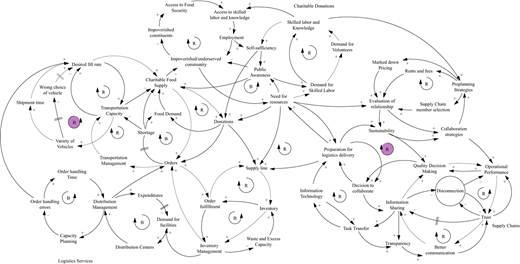
The humanitarian community-based transformative service ecosystem causal loop diagram
The humanitarian community-based transformative service ecosystem causal loop diagram
Structured service-for-service exchanges
To begin, the model displays the decision and feedback behavior that take place to increase the supply of donated resources to impoverished beneficiaries. The model shows the decisions to initiate service-for-service exchanges using evaluation, preplanning, preparation and collaboration strategies to promote quality decision making, transparency, communication, information structures and increased operational performance within the supply chain. Furthermore, the CLD highlights some of the fundamental challenges that the organization faces when deciding to structure their supply chains, such as disconnection and reduced trust.
First, the model shows that relationship management and strategies are used to build the supply chain structure. Supply chain relationships are essential and evaluating such relationships enables the enterprise to increase feedback behaviors such as transparency and operational performance in the ecosystem. Interestingly, this further display the decisions that influence all supply chain members; such as increased trust, collaboration and improved preparation for logistics services. Here, service provisions that support the planning, communication, transparency, information sharing and collaboration strategies from an inter-organizational system of resources, primarily from end-beneficiaries in the supply chain, influence transformation (Heaslip, 2013).
Findings from the case study show that by requiring SCM strategies with various community stakeholders, DentonS reduces issues with asymmetry and disconnection that in turn influence the ability to build trust and increase behaviors, such as information sharing and collaboration in the community-based ecosystem. For instance, the company holds regular meetings with key stakeholders to address issues of disconnection, build trust and enhance their quality decision-making tools as part of their collaboration strategies that will increase the operational performance of their ecosystem. The ecosystem model does not mention a particular supplier. However, it is acknowledged that an ample number of involved stakeholders are engaged and embark on using SCM strategies to donate products and services within the network, ranging from healthcare clinics, banks, government departments (specifically their community-based departments), individuals (residents and skilled professionals such as IT professionals), universities (students and professors from two central universities located in the county) and self-sufficient end-beneficiaries.
Furthermore, the ecosystem model highlights the effect of actively using preplanning strategies to select active and committed suppliers into the ecosystem. For example, selected members of the community are encouraged to become committed suppliers based on their willingness to collaborate, share information and rent office space within a central location. Using the preplanning strategies the organization created a support system, “circle of support,” which increases the access of skilled labor and knowledge from all stakeholders in the community.
As part of their preplanning collaboration strategy, DentonS’ motivates able donors to join the ecosystem and efficiently offer their support services (skills and knowledge) to those in need. The sustainable idea facilitates structure by allowing donors to rent out office spaces in a centralized location, increase community interactions, gain access to end-beneficiaries and work directly with other supply chain members to offer a plethora of support services. The idea further allows the transformation and the inclusion of beneficiaries in the ecosystem to increase integrated resources.
Another advantage of promoting structure in the ecosystem allows each supply chain member to determine the exact resources needed in the community and better know how to influence transformation. The collaborative service-for-service structure allows all community stakeholders to impact value propositions by providing efficient services where needed and when needed. The model shows that SCM in the ecosystem further supports the connection of logistics services to influence transformation. Thus, the model proves that CBEs prefer to go beyond only receiving product donations to focus on the provision of efficient service-centric processes. Here, SCM initiates the service-centric delivery when the supply line increases. This leads to the next part of the model that shows the embedded service-centric process, logistics management, highlights decisions that address the complexities such as shortages, waste and errors and the ability to increase the distribution of support services and donated operand resources.
Service-centric design and practices
The logistics sub-model shows the connection and increase of service-centric processes when the supply line of donations increase. The model shows that the preparation for logistics delivery is prompted from the decisions to structure collaborative service-for-service exchanges that increase resource supply to the impoverished. Furthermore, the need for resources from community donors generates an array of logistics services that include inventory management, distribution management and transportation management. It further supports the notion that logistics is not an isolated part of SCM but a connected and essential part of the service ecosystem (CSCMP, 2018). The logistics system focusses on the decisions and services needed to distribute, deliver, transport and manage information and operand products. For example, when the supply of donated products increase, decisions for transportation management are engaged and this further influences the transformed state of the impoverished situation by meeting demand. This is seen in an instance where cold storage units that were donated to the CBE, activated the need for other donated products and service-centric services such as the delivery, storage and distribution of temperature and time-sensitive products to the underserved community. Hence, the model shows that when the need for resources has a positive relationship with the increase for supply line, this increases service-centric processes such as inventory, order, transportation and distribution management.
Importantly, this describes the complex nature of managing and designing service-centric processes. As logistics services increase, complexities such as errors, wasted capacity and shortages also increase. However, this complex behavior is encouraged because of the increased value propositions that address the complexities when meeting demand. For instance, with the increase of order fulfillment in the system, the model shows how transportation, distribution, order and inventory management play critical roles in the service design and practice of influencing the impoverished situation. Here, a decision to increase transportation capacity (vehicles, drivers and other vehicle resources) allows the ecosystem to positively achieve the desired fill rate to meet demand, especially when additional variables are considered such as shipment time and choice of vehicles.
It further suggests that CBEs can influence order fulfillment and or shortages by efficiently connecting, designing and practicing this service category. For example, an observation from the case study highlighted a specific instance where the enterprise delivered whole wheat bread to a gluten intolerant customer. In that specific instance, although there was the timely provision of the food product to the end-beneficiary, the product delivery accentuated errors in the system when the wrong kinds of products were given to the wrong end-consumer, thereby increasing inventory, waste and excess capacity. The instance among others further showed the importance of designing additional logistics services that not only increase product delivery but reduce errors, excess waste and capacity within the ecosystem. Using additional services, such as capacity planning, enabled the delivery of accurate products to meet demand.
The instance observed, although not depicted in the model, shows how having the appropriate logistics service design and practice within the community-based ecosystem increases transformative value. Furthermore, by considering the addition of other service factors used to reduce complexities in the system, logistics management denotes a set of services that are interconnected to attain transformation. To summarize, logistics service design and practice to meet demand and alleviate end-beneficiary suffering with the accurate, timely and efficient delivery of donated operand products, attains long-term transformation by linking SCM to charitable donations management.
Integration of donated operant and operand resources
The final sub-model describes the notion that the charitable donation system is a fundamental part of the humanitarian service ecosystem. The possibility of planning services that increase integrated resources shifts the focus toward service-centric perceptions of donations management. As the demand for available operand resources increases, the model shows how the management of integrated resources influences the impoverished situation. The model highlights transformation when actions that influence the impoverished situation also influence self-sufficiency in the system.
For instance, the act of providing food products transforms the state of the community – food security. Additionally, by increasing other services, such as providing employment services and other support services to increase employment, these further influences value co-creation by increasing access to skilled labor and knowledge in the impoverished community. Furthermore, this increases public awareness, demand for skilled labor and volunteers and then the donated skilled labor and knowledge in the underserved areas. Thus, as a continuation from the logistics and supply chain system, transformative value is observed when the management of operant and operand resources transform the community and enable a co-creation of services and value.
Charitable donations management highlights the increased operant and operand donations that influence the underserved community. Here, ample resources transcend beyond needing only product donations such as food but also influencing the demand for skilled labor and volunteers that co-create value. The extension into the charitable donation management system provides two main propositions. First, the ecosystem alleviates the suffering of vulnerable people by encouraging structured service-for-service exchanges that supply available resources, increase public awareness and gain better and accurate information about communal beneficiaries to meet demand. Furthermore, the structured systems allow the network to use service-centric processes to supply the resources, reduce errors, waste and lost capacity when meeting demand. As it is, increasing information sharing and knowing what is needed and how to distribute the available resources efficiently and appropriately influences transformation.
Second, the ecosystem co-creates value when the connected service categories reproduce and sustain transformation in the community through operant resources from transformed end-beneficiaries. For example, when DentonS publicizes that they have charitable food products, a new struggling person visits the establishment of wanting food. However, with frequent visits and meeting the immediate need, DentonS builds a relationship with the individual to get more information about them.
With specific information about the individual needs, DentonS crafts strategies with other supply chain members to transform the individual. Using the structured service-for-service system, the enterprise shares information about the individual with the other community network providers. In this case, after ascertaining information on the struggling individual such as having limited access to food due to unemployment, DentonS then provides support services that allow the individual to find the right kind of employment and attain self-sufficiency. Once the enterprise identifies the individual’s skill set, the network provides a vast array of donated services such as job training resume writing and education support services to enable the individual to gain employment. Upon gaining employment, co-creation occurs when the individual in the impoverished state becomes self-sufficient and is then able to rejoin the community-based network by donating their time, finances, skills and knowledge to help others in need.
From this evidence, transformation in the underserved community occurs when humanitarian service categories are interconnected. Linking the three service categories into an ecosystem allows the communities needs to be adequately identified and then met. At this juncture, the service categories present service-centric perspectives that go beyond only product distribution to achieve transformation. From this perspective, as organizations form structures and agree on the service design and practice that emphasizes the uplifting change in an impoverished community, donated and charitable products, as well as human skills and knowledge, are required within the ecosystem. Accordingly, CBEs can accentuate the humanitarian service categories within their community-based ecosystems to advance the greater well-being of society.
Conclusion
To summarize, this research implies that in order to achieve transformation, the use of SCM to provide service-for-service exchanges, build structures and strategies and enhance supply chain relationships should be encouraged. Logistics value propositions and service-centric processes that are designed and practiced to increase meeting needs are essential in the ecosystem, and human agents, including end-beneficiaries, to provide charitable operant and operand resources should be highlighted in the underserved community. Finally, even as donated products are essential in the community-based ecosystem, factors that encourage donated services should be emphasized. Overall, this research proposes the idea for the transformative community-based humanitarian service ecosystem to alleviate the suffering of vulnerable people and to co-create uplifting change by connecting service structures, service design and practice and integrated resources in the underserved community.
This research makes the following contributions: first, the study examines and validates the theory of S-D logic and service science into the humanitarian context by addressing the need to understand the critical services that impact humanitarian aid as compared to mainly product distributions, and the inclusion of end-beneficiaries into the service ecosystem. The research finds that when humanitarian service providers shift their focus from only forming supply chains that distribute donated products into the service perspective that enhances the well-being of the whole community, then the enterprise can focus on forming collaborative and sustainable service structures that influence long-term transformation. Second, in line with S-D logic, the paper further examines service ecosystems. This paper presents an ecosystem perspective that is useful and practical in learning how organizations connect complex and varied systems that deliver service offerings in humanitarian settings and influence transformation.
By combining theoretical frameworks that focus on service ecosystems, additional insights from TSR frameworks highlight the value propositions provided in the service ecosystem. This demonstrates how the ecosystem – connected services – co-creates value in social magnitudes. Using TSR, this research proceeds to conceptualize how the connected service management categories attain transformation through structures, service design, service practices and the inclusion of human agents (end-beneficiary).
Lastly, the study draws on the SD methodology to develop a visual representation of the paper’s research agenda. The developed causal loop model is used to understand the complex nature of the service ecosystems (Özpolat et al., 2015; Lane and Smart, 1996). Considering that little studies display graphical information on the performance or dynamic behavior within social systems (Coyle, 2000), this model may help service ecosystem thinkers and the humanitarian community to analyze strategies for subsequent management action (Barile et al., 2016).
By combining the extant literature, the study develops a visual CLD that describes a new perspective on humanitarian services within underserved communities. The descriptive systems thinking model, as a managerial tool, has implications for managerial strategies to determine critical services, decision variables and feedback behavior when seeking to influence, facilitate and optimize resource utilization within underserved communities (Richmond, 1993). Managers within CBEs such as corporate socially responsible managers from private donor organizations can use this newly developed visual representation to understand the implications for practice, such as sharing information, building trust, creating public awareness, providing better offerings for meeting consumer demands, determining efficient demand and supply lines, stressing for improved order fulfillment processes and overemphasizing the demand for skilled labor and knowledge within underserved communities. Perhaps this would improve the operations and performance of the humanitarian community-based supply chain as compared to promoting disconnection within the ecosystem.
In addition to managerial implications, visual CLD has implications for research. Qualitative SD models are useful for analyzing real-world data (Diez Roux, 2011; Wolstenholme, 1993, 1999). These models can be used for enhanced organizational learning (Checkland, 1995), conceptual analysis through case studies (Forrester, 1994) and for scenario planning and modeling (Cavana and Maani, 2000) in the humanitarian context (Heaslip et al., 2012). Importantly, researchers can use systems thinking as a methodology to provide intellectual foundations for discovering and building theory as it relates to real-world problems. Researchers can use this methodology to broaden and deepen research concerning social organizational arrangements that seek to solve complex humanitarian aid problems (Heaslip et al., 2012; Hoard et al., 2005).
Humanitarian logistics researchers could use this modeling process for theory building (Schwaninger and Grösser, 2008), providing descriptive case studies (Wolstenholme, 1999) and analyzing hypothesized causal influences and relationships using mental models that communicate detailed disaster relief and humanitarian crisis situations (Hoard et al., 2005), especially within community-based settings. For example, Figure 2 provides details on causal relationships in delivering services and products to end-beneficiaries. The CLD provides information about what type of data are important to describe the relationships between the preparation for logistics delivery of food products and the measures needed to support supply chain relationships, such as collaboration strategies and transparency, and also to increase donated services, such as volunteer skills and labor, that in turn increases supply of donated food.
Nonetheless, the main challenge researchers may face using this methodology is that building CLDs for model conceptualization may “fail to identify the system elements that produce dynamic behavior” (Forrester, 1994). Building CLDs without quantifiable variables may cause system scientists to challenge the validity of the model (Caldwell, 2012; Checkland, 1995). Perhaps, this will propel humanitarian researchers to learn how to use CLDs to test emerging theories using well identified, quantifiable and testable hypotheses.
The methodology can be used as a standard system thinking model prior to and after simulation analysis (Homer and Oliva, 2001). Researchers can learn how to introduce new variables and their causal effects and relationships within a system’s structure. Then, researchers could decide to proceed with the stand-alone diagram that is intended to provide insight into managerial issues and to test emerging theories with quantifiable feedback variables.
Limitations and future directions
It is apparent that limitations exist with any research. First, the case study research is limited to achieving universal generalizability. However, while this was not the intention of this method, by providing acumen using existing theories and the use of the CLD, it is suggested that the diagram provides general solutions for problems that deal with descriptive data and hypothesize causal influences within complex systems (Homer and Oliva, 2001). Furthermore, by acknowledging that there are limitations in not using quantitative methods in analyzing the case study data, research shows that using the simulation for future research provides more information on the causal feedback behaviors within each variable as depicted in the model (Coyle, 2000).
CLDs can be visual representations used before or after simulation analysis. Detailed simulation modeling can provide quantitative analysis to test and draw possible interferences captured in the qualitative model. By using simulation, future researchers can address the causal feedback identified, specifically look into each variable to see and confirm their cause and effect relationships in the model. As such, the qualitative SD approach provides an interactive tool to depict process feedback, highlight complicated causal relationships and model key variables in the transformative service ecosystem for future validation.
Also, this research acknowledges that the scale for a social service system is broad and needs further development. Future research can look into creating simpler and smaller visual CLDs to describe the sub-models in the ecosystem. For instance, a model can be developed to describe the supply chain interactions of specific beneficiaries and stakeholders within the community-based setting. Furthermore, while this research highlights the need for preplanning strategies to select the active and committed suppliers in the ecosystem, future research can elaborate on the identification, selection and use of other supply chain strategies not mentioned in the model, such as risk hedging, demand and supply uncertainties and use of limited resources (Mentzer et al., 2001).
Considering the limitation of the single case study data generated from interviews and observations provides research constraints. Future research can further analyze the developed model in other supply chain and community-based scenarios to test its applicability. For example, the model mentions the supply of food products. Future research can investigate other CBEs providing similar types or other types of products such as healthcare products. Also, research can focus on environmental considerations within urban communities (Kovács and Spens 2011). Insights from such investigations can uncover solutions to different systematic challenges that disrupt transformation in underserved areas.
Specifically, to address questions that remain about the causality effects of variables in the model. Future researchers can investigate other contexts. Further research can use empirical research to validate the model in a global setting. Ultimately, there are many more areas and related questions that future research can address such as investigating the types of operant resources that transform end-beneficiaries in the underserved community. Also, how the CBE distributes donated operant resources.
In conclusion, this research has the potential to encourage research on long-term transformation within the underserved communities as well as showcase how the humanitarian service categories: charitable donations management, logistics services and SCM are interconnected within community-based ecosystems. The dynamic model presented, although in the initial stages, provides a conception of understanding, analyzing and assessing the complex nature of transformative humanitarian service and value propositions within underserved communities.
Notes
Structures that afford both economic and social supply chain relationships that include all stakeholders. Community-based supply chains involve a mix of social and economic organizations characterized as active members of the community coming together to form systems that provide value-creating services and products to alleviate challenges facing the community (Obaze, 2016).
The main tenet of system dynamics, as applied by social systems, is that complex behavior within ongoing exchanges between people, material, finances and information characterizes feedback mechanisms (loops) in a CLD.

