This study examines how hotels communicate sustainability practices across digital channels and develops two complementary tools, the Practical Visibility Index (PVI) and the Sustainability Visibility Scorecard (SVS), to assess the visibility, clarity, and thematic breadth of sustainability communication in hospitality.
A quantitative content analysis of 120 eco-certified hotels across five major Greek tourism regions was conducted, supported by descriptive statistics, correlation analysis, and illustrative regression analysis. Presence, Clarity, and Richness were systematically coded from hotel websites and complemented by qualitative insights from published expert statements. The PVI was constructed as a theory-informed composite benchmarking index, while the SVS was designed as an applied scorecard for hotel and destination-level use.
Chain-affiliated hotels tend to communicate more comprehensively but often shift sustainability disclosure to corporate reports, whereas many independent properties rely on generic claims, with notable website omissions. Eco-labels enhance visibility only when supported by specific, multi-theme communication. The SVS complements the PVI by offering an assessment framework and illustrating the visibility of sustainability across digital platforms.
The PVI and SVS provide managers and destination authorities with operational tools to diagnose communication gaps, enhance transparency, and support more coherent and credible sustainability messaging, improving strategic alignment and competitive positioning outcomes.
This study contributes a signaling theory–informed, measurable framework for evaluating sustainability visibility and introduces the SVS as a benchmarking tool for hoteliers and destinations for online sustainability communication.
1. Introduction
1.1 Background and rationale
Sustainability has become an integral pillar of corporate strategy in the global hospitality industry, reflecting growing awareness of environmental, social and governance (ESG) imperatives (Jones et al., 2016). Hotels are under increasing pressure from governments, investors and consumers to demonstrate their commitment to responsible practices and communicate these efforts transparently. Over the past two decades, research in hospitality management has explored multiple dimensions of sustainability, ranging from operational practices to certification systems (Bohdanowicz and Zientara, 2009; Graci and Dodds, 2008; Kapiki, 2012a).
However, limited attention has been devoted to how sustainability-related information is conveyed through digital channels, despite its crucial role in shaping perceptions of hotel credibility and guest decision-making. Recent work highlights the importance of redesigning sustainability communication in online environments (Castillo and Villagra, 2019; Font et al., 2021; Gouda and Halim, 2025). Similar insights emerge from interviews with sustainability experts, who emphasize the need for clearer and more credible communication standards (Almeida et al., 2025). Prior studies (e.g. Shen et al., 2020) also show that sustainability claims are vague, fragmented or unsupported by evidence, resulting in weak signaling of authenticity. This inconsistency limits the effectiveness of such messaging for differentiation and trust.
According to signaling theory (Connelly et al., 2011; Spence, 1973), the credibility of sustainability communication depends not only on authentic practices but also on clarity, frequency and visibility of the signals sent to stakeholders. In hospitality contexts, well-designed online communication can serve as a powerful signal of quality and integrity, whereas incomplete or ambiguous messages may undermine credibility and trust (Tölkes, 2018). This theoretical perspective underscores the need for structured tools that assess both the extent and quality of sustainability communication. In this study, sustainability communication refers to content disclosed online by hospitality actors; sustainability visibility captures how prominently, clearly, and richly this content is presented; digital transparency denotes accessibility and openness of these disclosures in digital environments; and sustainability signaling describes the theoretical mechanism through which visible and transparent communication reduces information asymmetry.
The online visibility of sustainability practices has gained renewed significance with the rise of Online Travel Agencies (OTAs) such as Booking.com, Expedia and Tripadvisor, where potential guests increasingly form impressions of a property before visiting its official website. These platforms have introduced sustainability labels and eco-badges to highlight responsible businesses. Yet, the way hotels present, frame and update sustainability information remains inconsistent and often superficial. This challenge is particularly visible in Mediterranean destinations such as Greece, where despite widespread eco-certification participation, online sustainability communication remains uneven and often underdeveloped (INSETE, 2023; Kapiki, 2012b).
Although relevant, no systematic method exists for evaluating how hotels convey sustainability information online. Existing studies (e.g. Bagheri et al., 2020; Lee et al., 2018) rely on small samples or qualitative assessments, limiting comparability across hotels and destinations. Moreover, there is no replicable measurement framework that captures the multidimensional nature of sustainability visibility across digital channels. As a result, hotel managers lack practical guidance on how effectively their sustainability efforts are communicated and how these messages shape perceptions of credibility and authenticity.
1.2 Literature review and conceptual framework
Research on how hotels communicate responsible practices has expanded significantly over the past decade, driven by growing expectations for transparency and stakeholder trust. More recently, attention has shifted to the communication of sustainability practices through online platforms, where guests increasingly search, compare and evaluate accommodation options. A substantial body of work shows that the way environmental and social responsibility claims are framed and disseminated online can strongly influence guest perceptions, purchasing decisions and brand credibility (Ettinger et al., 2018; Shen et al., 2020; Tölkes, 2018).
A recurring theme in this literature is that sustainability communication in hospitality often suffers from inconsistency, limited depth and lack of strategic integration. Tölkes (2018) notes that many tourism businesses rely on broad sustainability claims with limited evidence, weakening their persuasive potential. Recent bibliometric evidence further confirms this fragmentation, showing that sustainability research in hospitality remains methodologically diverse and lacks unified evaluative frameworks (Blanco-Moreno et al., 2025). Such patterns contribute to what scholars describe as “low-strength sustainability signals”, making it difficult for potential guests to distinguish genuinely committed businesses from those engaging in symbolic communication.
These shortcomings are amplified by structural and organizational factors, including resource constraints and competing marketing priorities, which can fragment sustainability communication efforts across many tourism economies. Santos et al. (2019) highlight that hotels in peripheral destinations struggle to articulate coherent sustainability narratives. Similar patterns are documented across the wider region, where sustainability and responsibility narratives are important for shaping destination image but are rarely communicated with clarity or consistency (Simarmata et al., 2023). These regional parallels underscore the broader relevance of strengthening online sustainability visibility.
A second stream of literature concerns signaling theory, which offers a conceptual foundation for understanding how sustainability information reduces uncertainty between hotels and guests. According to Spence (1973), signaling occurs when one party communicates information to reduce information asymmetries. Connelly et al. (2011) refine this framework by emphasizing that the strength of a signal depends on its clarity, consistency and costliness. In hospitality, sustainability information acts as a quality signal: credible and well-presented communication reduces guests' uncertainty about the hotel's environmental and social performance, whereas vague or ambiguous messages create skepticism and diminish perceived authenticity (Tölkes, 2018). Empirical findings support this mechanism: strong sustainability signals positively influence consumer perceptions, especially in digital contexts (Cao et al., 2024; Rahman et al., 2020). Conversely, weak signals generate doubt and undermine trust (Acampora et al., 2022).
Despite these insights, notable limitations remain at the level of operationalization and measurement. Most prior studies focus on what hotels say (content) rather than how visible or accessible these messages are across digital platforms. Existing assessments typically rely on small-scale qualitative reviews of websites, limiting comparability across destinations. Moreover, current approaches lack a replicable, transparent, multidimensional measurement framework capable of capturing the visibility, clarity and richness of sustainability communication as described by signaling theory.
Although data-driven weighting techniques such as principal component analysis and expert-based methods (e.g. Delphi, AHP) are widely applied and consistent with established index-construction principles (OECD, 2008), hospitality communication studies have more often adopted theory-informed weighting to reflect conceptual importance rather than statistical optimization. In parallel, hospitality sustainability research has highlighted the need to distinguish credible communication from symbolic claims, particularly in online environments where greenwashing risks persist (Font and McCabe, 2017; Myung et al., 2012).
Online Travel Agencies (OTAs) represent an especially underexplored arena. Although platforms such as Booking.com and Expedia have introduced sustainability labels and eco-certified filters, research has not examined systematically how hotels use these features or how visible their sustainability practices are within OTA environments. As discussed earlier, OTAs influence how sustainability information is filtered and compared across hotels, thereby shaping the visibility and perceived strength of sustainability signals during the guest decision process. Yet, empirical evidence on how hotels navigate these features remains limited, and no structured analytical model exists for evaluating such visibility.
Building on these gaps, the present study develops a unified analytical framework that operationalizes sustainability signaling in digital hospitality environments. The framework draws on three interconnected dimensions identified in the literature: presence, referring to whether sustainability information is visible at all, including eco-labels, badges, or certification details; clarity, capturing the specificity, comprehensibility and verifiability of the information; and richness, reflecting the breadth and depth of sustainability themes covered, such as energy efficiency, local sourcing or community engagement.
These dimensions map directly onto the theoretical attributes of signal strength as defined by signaling theory. Taken together, these insights inform the development of the Practical Visibility Index (PVI) introduced in this study. PVI provides a replicable, theory-informed approach to quantify the visibility of sustainability communication across hotel websites, forming the analytical foundation for application to OTA contexts (through the SVS). By translating the three conceptual dimensions into measurable indicators, the PVI offers a structured and transparent method for evaluating how effectively hotels communicate their sustainability practices.
This conceptual foundation also supports the development of the Sustainability Visibility Scorecard (SVS), an applied extension of the PVI designed for managerial and destination-level use. While the PVI functions as the analytical measurement core of the framework, the SVS provides a practitioner-oriented benchmarking tool that enables hotels and destination planners to monitor progress and systematically identify communication gaps. Together, these tools address a well-documented need in the hospitality literature for more structured, credible, and comparable sustainability communication.
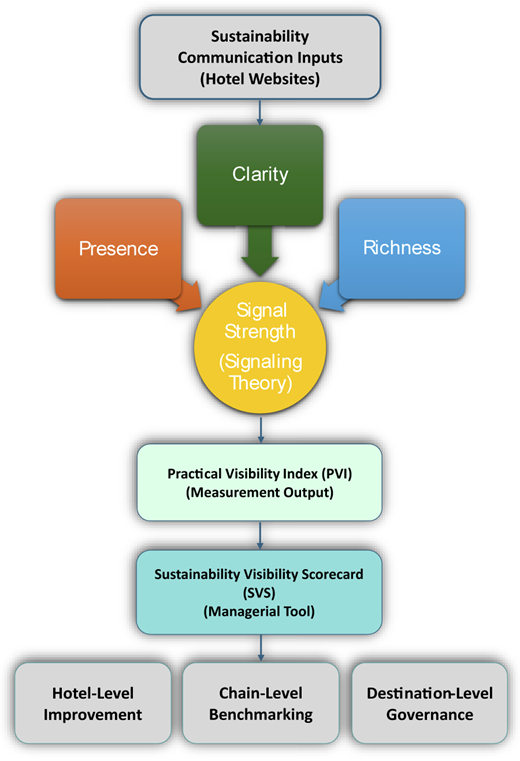
Figure 1 synthesizes the conceptual foundations of this study by illustrating how sustainability communication inputs (Presence, Clarity and Richness) translate into signal strength (signaling theory), are operationalized through the PVI, and extended into a managerial decision-support tool through the SVS.
Related measurement-oriented approaches in marketing and digital communication research typically focus on disclosure volume, sentiment, or platform-specific metrics, whereas the present framework concentrates explicitly on signaling attributes of visibility, clarity, and thematic richness in hospitality contexts (Almeida et al., 2025; Font and McCabe, 2017; Santos et al., 2019).
1.3 Research gap and research questions
Drawing on the conceptual model presented in Figure 1 and the measurement challenges identified in prior research, several research gaps become evident. While interest in sustainability communication has grown, existing studies provide limited insight into how visible, prominent or accessible sustainability messages are across digital channels such as OTAs and hotel websites. Most investigations focus primarily on message content rather than on the structural dimensions of visibility. Moreover, no existing framework captures the multidimensional nature of sustainability visibility, encompassing presence, clarity and thematic richness as conceptualized within signaling theory.
The lack of a structured and replicable measurement tool restricts both academic inquiry and managerial action. Scholars lack a consistent basis for evaluating the strength of sustainability signals online, while hotel managers have limited guidance on diagnosing communication gaps or enhancing digital transparency. The disconnect is especially evident in OTA environments, where sustainability information can strongly influence guest decision-making but remains unevenly presented and empirically underexamined. Addressing these gaps and building on the conceptual framework outlined above, the present study introduces two complementary tools: the PVI, designed to quantify sustainability visibility on hotel websites; and the SVS, which translates this analytical foundation into a managerial benchmarking instrument. Together, these tools contribute to advancing both theory and practice by operationalizing sustainability signaling in digital hospitality environments.
Accordingly, the study addresses the following research questions:
How do hospitality businesses communicate sustainability practices across digital channels?
How can a Practical Visibility Index (PVI) be designed to assess the effectiveness and visibility of these messages?
How can the PVI be translated into a practical benchmarking tool for managerial use (SVS)?
The following section details the methodological approach used to investigate these research questions and to operationalize the study's analytical framework.
2. Method
This study employs a quantitative content-analysis design supported by descriptive and exploratory statistical techniques, complemented by secondary qualitative insights from published expert statements. Because all data were publicly available online, no ethical approval was required. The primary objective is to evaluate how hotels communicate sustainability on their official websites and to construct the Practical Visibility Index (PVI), a structured tool capturing the visibility, clarity and breadth of sustainability information. Hotel websites were selected as the primary data source because they constitute the organization's controlled communication environment, where sustainability narratives are intentionally crafted and updated. To contextualize observed communication patterns, qualitative insights were drawn from expert interviews published in recent sustainability reports and research outputs (Almeida et al., 2025), offering interpretive context for industry-wide communication shortcomings related to vagueness, credibility and verification.
2.1 Sample and data collection
A purposive sampling strategy was applied to compile a dataset of 120 Greek hotels across the three, four and five-star categories. Five major tourism regions (Athens/Attica, Crete, Rhodes, Chalkidiki and the Ionian Islands) were selected to reflect Greece's highest-capacity and most internationally visible accommodation clusters. Candidate hotels were identified through: the international and Greek catalogues of Green Key, the Travelife certification list, the Greek Travel Pages (GTP) directory, and targeted online searches (e.g. “ISO 14001 hotel Athens/Attica”).
Inclusion criteria required an active official website and confirmed visibility in at least one eco-hotel directory or public certification source. As the official EU-Ecolabel registry does not provide Greece-specific listings, EU-Ecolabel hotels were identified through structured searches and verified through the hotels' own disclosures. Due to the limited availability of eco-certified three-star hotels in all five regions, the final sample includes proportionally more four and five-star properties, accurately reflecting the distribution of environmentally proactive hotels in Greece. The purposive focus on eco-certified hotels was intentional and aimed at examining sustainability communication practices where such signaling is most likely to occur; the resulting visibility levels should therefore be interpreted as upper-bound estimates rather than representative of the full hotel population.
The primary data source was each hotel's official website. The following sections were systematically reviewed: dedicated sustainability, CSR or environmental pages; “About us”, “Facilities” or values/mission sections; footer areas displaying certification logos or sustainability statements; downloadable documents such as environmental policy statements, sustainability reports or certificates. For hotels belonging to larger corporate groups, sustainability-related content on corporate websites was also reviewed. Group-level sustainability reports were used for scoring only where they explicitly covered the specific hotel or outlined uniform practices applied across all properties. External platforms (e.g. Booking.com, Google Travel) were not included in PVI scoring, as the PVI is intentionally designed to capture hotel-controlled website communication; platform-level sustainability signaling is addressed separately through the Sustainability Visibility Scorecard (SVS).
2.2 Measures
A structured coding protocol was developed following sustainability-communication literature and a pilot website review. Each hotel was evaluated across three dimensions: A. Presence (0–20). Visibility of sustainability information, including dedicated pages, prominent display of eco-labels, and explicit environmental commitments. Scores ranged from 0 (minimal visibility) to 20 (highly prominent, clearly signposted information). B. Clarity (0–30). Clarity captures three closely related aspects of sustainability communication (specificity, credibility and comprehensibility) which were assessed holistically to reflect the overall intelligibility and trustworthiness of sustainability messages. Vague statements received low scores, whereas precise descriptions of practices (e.g. solar systems, LED lighting, waste-separation systems), explicit standards (ISO 14001), or verified external information received relatively higher scores. Although these aspects are conceptually distinguishable, they were treated as a composite clarity construct in this exploratory study to maintain parsimony; disentangling sub-dimensions was beyond the study's scope. C. Richness (0–50). Thematic breadth of sustainability communication. Seven thematic categories were assessed: a. energy, b. water, c. waste, d. local sourcing/community, e. biodiversity, f. staff welfare, g. climate/carbon management. Descriptions covering only one or two themes scored low; those demonstrating multiple themes with meaningful detail scored high.
Eco-labels and certifications (e.g. Green Key, Travelife, ISO 14001) were also recorded for each hotel. All hotels were coded and assessed by a single researcher using a structured, rule-based coding protocol. While content analysis standards often recommend multiple coders and inter-rater reliability testing (Krippendorff, 2019; Neuendorf, 2017), the single-coder approach was adopted given the exploratory aim of the study and is acknowledged as a methodological limitation, particularly for the Clarity dimension. Each dimension contributes to a total of 100 points based on predetermined weights that mirror signaling-theory expectations: while basic visibility is essential, the credibility and thematic breadth of information are theoretically more influential in strengthening sustainability signals. The unequal scoring ranges follow the costliness principle derived from this theoretical perspective (Connelly et al., 2011; Spence, 1973), whereby signals requiring greater informational effort and coordination (thematic richness) are treated as theoretically stronger and therefore allocated broader score ranges than basic visibility or message clarity.
Practical Visibility Index (PVI). The weighting scheme represents a theory-informed design choice rather than an empirically optimized allocation. Consistent with the signaling logic outlined above, richer and more detailed sustainability communication is conceptualized as more effort-intensive and less easily imitated than basic presence and is therefore treated as a stronger signal. The weights aim to reflect relative signaling emphasis rather than statistical effect sizes. Alternative weighting schemes (e.g. equal-weight or data-driven approaches) were not tested in this study and constitute an important direction for future research. The final PVI score for each hotel is computed by summing the weighted components, enabling transparent comparison across hotels and regions.
2.3 Data analysis
Quantitative data were processed using SPSS and Excel. The analysis comprised: (1) Descriptive statistics to summarize the distribution of PVI component scores, eco-labels and regional/star-category patterns. (2) Exploratory descriptive analyses, including Pearson correlations and comparisons of mean values, to examine patterns of sustainability visibility across hotel categories and regions. (3) Descriptive decomposition of the PVI to illustrate the contribution structure of its constituent dimensions (Presence, Clarity and Richness).
Internal-structure examination: A multiple regression was conducted to descriptively illustrate how the three PVI components (Presence, Clarity and Richness) contribute to the composite score. Since the PVI is defined as a linear aggregation of these components, the resulting R2 of 1.00 is mathematically expected and does not constitute empirical validation. The analysis is therefore used solely to clarify the contribution structure embedded in the index design.
Qualitative thematic interpretation: Insights from published expert statements (Almeida et al., 2025) were analyzed to contextualize observed quantitative patterns, particularly regarding communication challenges and the need for clearer sustainability standards.
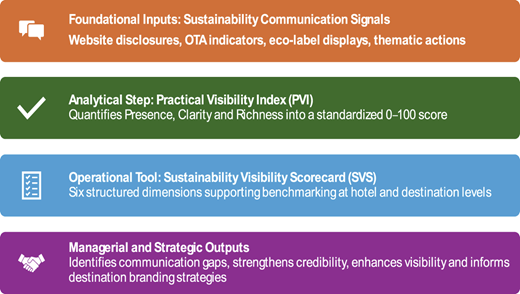
Methodological integration → linking PVI and SVS: Figure 2 below illustrates how foundational sustainability communication inputs are processed through PVI and subsequently operationalized via SVS. The structure highlights methodological continuity between measurement (PVI) and managerial application (SVS). In practice, the PVI is applied first as a diagnostic assessment of online sustainability communication, while the SVS is subsequently used by managers or destination authorities to benchmark results and guide improvement actions. Together, the PVI and SVS form an integrated analytical-to-practical pathway that strengthens the coherence of the study's methodological design and supports its contribution to sustainability-communication research.
3. Results
3.1 Measurement model
This section summarizes the sustainability visibility scores of the 120 hotels in the sample. Descriptive statistics for Presence, Clarity, Richness and the overall PVI illustrate the extent and variability of sustainability communication across hotel websites (Table 1).
The results show substantial variation across all dimensions. Presence scores indicate that most hotels display at least basic sustainability signals, with relatively limited dispersion (SD = 4.83), whereas Clarity and Richness exhibit much wider variation (SDs = 12.48 and 21.89, respectively), reflecting differences in specificity and thematic breadth. The broad range of PVI values (0–100) and the high standard deviation (SD = 35.68) suggest uneven and fragmented sustainability visibility across the sector, consistent with prior evidence on variability in hospitality sustainability communication (Shen et al., 2020; Tölkes, 2018).
To further examine the internal relationships among the three visibility dimensions and the overall index, Pearson correlation coefficients were calculated. These patterns (see Table 2) suggest that the components of the PVI are closely related yet conceptually distinct, complementing the exploratory descriptive analyses described in Section 2.3.
The strong correlations, particularly between Clarity, Richness, and the PVI suggest a coherent multidimensional structure, consistent with the theoretical logic of signaling theory.
Regression analysis: descriptive examination of PVI component structure. The standardized coefficients reflect the predefined weighting scheme of PVI rather than empirically derived effect sizes; accordingly, they are interpreted as a transparent illustration of the index's internal composition, not as evidence of predictive or construct validity, and are reported descriptively to indicate the predefined contribution hierarchy embedded in the PVI design.
3.2 Test of research hypotheses
While no formal inferential tests were performed, the following analyses examine the empirical patterns associated with the study's research expectations.
3.2.1 Regional patterns
The regional comparisons presented below are descriptive and exploratory, as no inferential tests were conducted. Across the five regions examined (Athens/Attica, Crete, Rhodes, Chalkidiki and the Ionian Islands), average sustainability visibility scores show pronounced heterogeneity. Diagnostic checks identified no extreme outliers. The mean regional PVI values (Table S1, Supplementary Material 1) reveal the following patterns:
Rhodes: Highest observed average visibility, supported by several hotels with multi-year certifications and detailed sustainability reporting.
Athens/Attica: Lower observed average visibility, with only some chain-affiliated hotels leveraging corporate sustainability reports, while most independent properties communicate minimally or generically.
Chalkidiki: Strong overall performance, but with a clear mix of very low and very high scorers due to inconsistent communication practices among independent hotels.
Ionian Islands: Lowest average visibility, with a few hotels articulating sustainability well, whereas many others show limited or fragmented communication.
Crete: High average visibility with wide dispersion, reflecting the coexistence of high-performing hotels and others with limited sustainability information.
These regional differences are associated with structural characteristics such as chain presence, certification penetration and regional marketing initiatives. For example, Rhodes benefits from sustained engagement with Green Key and Travelife, while Chalkidiki reflects a diverse accommodation landscape combining large resorts with smaller independent properties. Notably, regional tourism maturity does not necessarily coincide with stronger sustainability signaling; even in highly developed regions such as Crete and the Ionian Islands, visibility scores vary widely.
Component-level results further clarify these patterns. As shown in Table S1 (Supplementary Material 1), Presence is relatively high across regions, indicating widespread use of basic sustainability signals, while gaps between Presence and Richness (particularly in the Ionian Islands and Athens/Attica) suggest limited thematic depth. Rhodes also exhibits comparatively elevated Clarity and Richness, corresponding to higher overall visibility. Taken together, these configurations indicate substantial regional variation in sustainability communication and underscore the value of structured tools such as the PVI and SVS for identifying communication strengths and gaps.
3.2.2 Presence of eco-labelling and certification signals
Across the sample, the most frequently observed certification signals were Green Key, Travelife, and ISO 14001, with the distribution varying significantly by hotel size and category. Eco-label presence contributed notably to the PVI Presence score; however, the mere display of a badge did not necessarily imply comprehensive sustainability communication. Several hotels with internationally recognized certifications nonetheless scored low on clarity or richness because: details of their certification were outdated (e.g. certificates expired in 2024), descriptions were generic and did not specify hotel-level actions, sustainability indicators were buried within general sections unrelated to environmental management. This reinforces a central argument in signaling theory: signals must be credible, specific and sufficiently rich to convey meaningful information (Connelly et al., 2011). In line with this perspective, clarity and thematic richness strengthen signal credibility beyond mere badge display.
3.2.3 Clarity and richness of sustainability communication
Clarity scores indicate that roughly half the hotels provided moderately specific sustainability information, such as “energy-efficient lighting,” “water-saving devices,” or “recycling practices.” However, fewer provided quantitative data or third-party verification details (e.g. audit bodies, renewal dates). Hotels with ISO 14001 tended to score highest in clarity, likely owing to the structured documentation processes associated with the standard. Richness scores revealed the most substantial variation. Some hotels covered a diverse range of sustainability themes, including: local community partnerships, food waste reduction programs, biodiversity conservation, renewable energy implementation, staff training in environmental practices and, carbon footprint reduction. Consistent with Santos et al. (2019), these findings suggest that sustainability communication often remains reactive rather than strategic. Hotels that limit communication to minimal themes or generic descriptions tend to exhibit reduced overall visibility.
3.2.4 Comparisons across star categories
Predictably, five-star hotels scored highest overall, with many reaching PVI values above 80. These hotels typically belong to chains with structured sustainability departments and publicly available sustainability reports. Four-star hotels showed moderate performance, with considerable variation depending on management philosophy and operational capacity. Three-star hotels performed weakest, reflecting limited resources and, in several cases, inconsistent or minimal online disclosure. Nevertheless, the presence of three-star hotels with high PVI scores indicates that resource constraints do not preclude effective communication. Some smaller hotels provided detailed and authentic sustainability narratives that outperformed those of larger properties, suggesting the importance of managerial commitment over scale alone. This pattern further suggests that resource availability alone does not fully explain differences in signaling strength; rather, it highlights the role of managerial prioritization and strategic communication choices in shaping visibility outcomes.
3.2.5 Insights from expert discourse analysis
Supplementary qualitative insights from published expert interviews on hotel sustainability (Almeida et al., 2025) revealed four recurrent themes: 1. Need for clearer and standardized sustainability communication terminology. 2. Growing importance of transparency for differentiation. 3. Rising guest expectations for credible, specific environmental information. 4. Strategic value of linking sustainability with destination branding. These themes support the interpretation that sustainability communication is shifting from a primarily operational concern to an embedded strategic practice, reinforcing the need for consistent frameworks to compare sustainability visibility across hotels and destinations. Such observations are consistent with prior findings on the role of transparency and trust in sustainability communication (Alyahia et al., 2024; Kim, 2019). These qualitative insights reinforce the empirical findings: clearer terminology, greater specificity, and broader thematic communication align with relatively higher PVI scores, suggesting that hotels able to articulate sustainability in structured and credible ways convey theoretically stronger signals.
4. Discussion and conclusions
4.1 Conclusions
This study examined how Greek hotels communicate their sustainability practices across digital channels and introduced two complementary tools, the Practical Visibility Index (PVI) and the Sustainability Visibility Scorecard (SVS), to improve the assessment and management of sustainability communication. The analysis of 120 hotels across five major tourism regions points to substantial heterogeneity in communication practices, with PVI scores ranging from 0 to 100. While a significant number of hotels exhibit advanced, multi-dimensional communication, many provide only partial or minimal information, resulting in fragmented visibility and weak signaling of authenticity, particularly where thematic richness is limited. These insights reinforce concerns in the literature regarding inconsistent and superficial sustainability messaging in hospitality and highlight the need for structured evaluation mechanisms.
The synthesis of the results suggests several recurring tendencies. Chain-affiliated hotels tend to communicate more comprehensively, but often shift sustainability disclosure to corporate reports, requiring guests to seek information beyond the hotel's own digital channels. Regional patterns are also observed: Rhodes exhibited the strongest average visibility, while Athens/Attica and the Ionian Islands recorded comparatively lower levels. These contrasts underline the influence of regional governance structures, managerial capabilities and investment levels on sustainability communication.
Together, PVI and SVS align with sustainable tourism priorities highlighted in expert discourse. Their combined use supports hotels, hotel groups and destinations in adopting more transparent, consistent and impactful sustainability communication strategies, advancing both academic understanding and practical implementation. Overall, this study advances both academic and practical understanding of sustainability signaling in hospitality by moving sustainability communication research from descriptive content mapping toward structured evaluative benchmarking. By offering structured, operational and benchmarkable tools that operationalize signal strength, it enables systematic comparison across hotels and destinations, providing a foundation for more transparent, comparable and impactful communication practices as well as for cumulative research and governance-level monitoring.
4.2 Theoretical implications
4.2.1 Operationalizing sustainability signaling
The study's primary theoretical contribution lies in advancing the operationalization of sustainability signaling within hospitality. By quantifying three core signal attributes (presence, clarity and richness), the PVI translates signaling theory into a measurable and comparable metric, moving beyond descriptive content analysis toward an evaluative framework that captures signal strength rather than mere signal existence (Spence, 1973; Connelly et al., 2011). The findings further indicate that visibility is a multidimensional construct shaped by the depth, specificity and breadth of communication, with thematic richness accounting for a larger share of overall visibility variation than basic presence alone.
Building on these insights, the SVS translates the PVI from a research instrument into an applied governance tool. Whereas the PVI evaluates sustainability communication at the hotel enterprise level, the SVS enables hotels, chains and destination authorities to benchmark performance at portfolio or regional scale. Its structured criteria assist practitioners in identifying shortcomings (e.g. insufficient thematic coverage, weak verification, low online prominence), prioritizing improvements and aligning communication strategies with destination-wide sustainability narratives. This dual functionality (analytical precision and managerial usability) positions the SVS as a distinct contribution within the broader ecosystem of sustainability tools, complementing certification schemes by focusing on visibility rather than operational auditing.
4.2.2 Extending signaling theory in hospitality contexts
The empirical findings are consistent with key principles of signaling theory. High PVI scores were associated with clear, credible and diverse sustainability signals, precisely the forms of communication that reduce information asymmetry between hotels and travelers. Conversely, hotels with low clarity or richness scores, regardless of badge presence, failed to send strong signals, leaving guests uncertain about the authenticity of sustainability commitments.
This reinforces earlier findings by Rahman et al. (2020), Shen et al. (2020) and Tölkes (2018), while highlighting the need for an integrated approach to sustainability communication that goes beyond simple badge display. The findings align with signaling theory by indicating that information specificity (Clarity) and thematic breadth (Richness) are central to perceived signal strength and credibility.
Conceptually, the two tools operationalize the abstract notion of “signal strength” into a measurable and comparable framework, translating signaling theory into practical evaluation instruments applicable across hospitality contexts. Consistent with signaling theory, visibility alone is insufficient to reduce information asymmetry; trust formation depends on the credibility and perceived costliness of signals and their interpretation by receivers (Connelly et al., 2011; Font et al., 2021; Spence, 1973).
4.2.3 Measurement and conceptual differentiation
From a measurement perspective, most sustainability assessment tools in hospitality evaluate the existence and compliance of practices through standardized criteria and audits. By contrast, the PVI and SVS assess how sustainability is communicated and made visible online, focusing on three signal attributes: presence, clarity, and thematic richness. Whereas certification tools operate largely outside hotels' digital communication environments, the PVI/SVS framework examines hotel-controlled websites and platform-level channels where guests form impressions. In this way, the PVI and SVS complement existing assessment systems by addressing a distinct and previously underexplored visibility and signaling gap.
Existing industry initiatives, such as the HRS Hotel Sustainability Assessment Database – Green Stay Initiative (Business Travel News, 2021; Davis, 2024), show that structured sustainability evaluation tools are already used in hospitality procurement. However, the PVI and SVS differ by focusing explicitly on communication visibility rather than operational auditing, positioning them as complementary to certification and procurement systems. This distinction reinforces the theoretical argument, grounded in signaling theory, that credible sustainability signals depend not only on responsible practices but also on their clear, visible, and multidimensional online presentation (Connelly et al., 2011; Spence, 1973).
4.3 Practical implications
4.3.1 Operationalizing sustainability visibility: the SVS framework
Building on evidence-based insights, the study introduces the Sustainability Visibility Scorecard (SVS) as a practitioner-oriented extension of the PVI. While the PVI serves as the core analytical instrument for assessing sustainability visibility at the individual-hotel level, the SVS provides a structured benchmarking tool applicable by: individual hotels (self-assessment and internal improvement), hotel chains (cross-property benchmarking), and destination-level organizations (e.g. tourism boards, municipalities, regional authorities) seeking to assess aggregated sustainability communication in a standardized and comparable manner.
By incorporating OTA sustainability tags, SVS complements the website-focused PVI and captures visibility dynamics across major guest decision platforms. At destination level, SVS functions as a non-intrusive benchmarking tool based on publicly available information, enabling assessment without hotel participation, data sharing, or score verification. In such applications, SVS evaluates sustainability communication by destination authorities themselves rather than individual hotels; accommodation-specific criteria (e.g. eco-label presence) may therefore be recorded under a generic category reflecting destination-level schemes or frameworks relevant to public authorities (e.g. Green Destinations, ISO 37101/37,120, or the European Tourism Indicators System – ETIS).
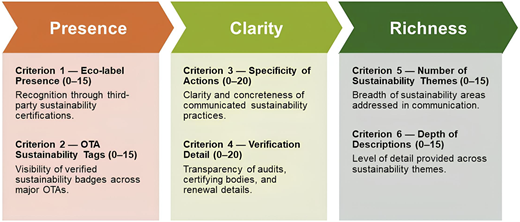
The SVS evaluates: the density and visibility of sustainability signals across a hotel or destination portfolio, the clarity and credibility of communication practices, thematic gaps that weaken perceived responsibility, and opportunities for integrated and strategically aligned sustainability messaging. The Scorecard comprises six criteria mirroring the PVI structure (two for presence, two for clarity, and two for richness), with predefined scoring options (0–15/20) contributing to a total score of 100 points. This structure enables hotel managers and destination planners to benchmark performance and identify priority areas for improvement. An illustrative application of SVS, based on a purposive 10% subsample of hotels from the main dataset, is presented in Table 3.
The illustrative SVS application demonstrates empirical feasibility and practical usefulness. Whereas the PVI focuses on hotel-controlled website communication, the SVS additionally captures platform-level sustainability signaling, particularly through OTA sustainability tags. As a result, SVS scores do not replicate PVI values mechanically but reveal amplification or attenuation of visibility across channels, generating non-redundant, practitioner-relevant insights. More extensive validation is left for future research. To support interpretation of these illustrative results, the structure and components of the SVS are presented in Figure 3.
Figure 3 presents the structure of SVS. By combining diagnostic assessment with the capacity to monitor change over time, SVS functions as a practical and scalable tool for strengthening sustainability communication governance. The full operational version of SVS, including scoring rules, assessment fields, and the practitioner-ready template, is provided as Supplementary Material 2. SVS scores are interpreted as follows: 0–20 = very low visibility; 21–40 = low visibility; 41–60 = moderate visibility; 61–80 = strong visibility; and 81–100 = excellent visibility. These scores are not intended to predict behavioral or market outcomes (e.g. occupancy, price premiums, booking conversions); rather, consistent with signaling theory, they benchmark the visibility and credibility of sustainability communication as a necessary, but not sufficient condition for influencing eco-conscious consumer behavior.
The PVI and SVS are designed as low-cost diagnostic tools applicable by trained hotel staff or external reviewers using publicly available information, primarily hotel websites and major OTA listings. Based on the predefined scoring framework, a single assessment typically requires approximately 30–60 minutes per hotel and does not require specialized software or certification. In this context, “low cost” refers to staff time or limited external review effort, while formal implementation protocols, training materials, and usability testing are left for future research.
4.3.2 Implications for individual hotels
From a managerial perspective, the study's findings underscore the importance of strengthening digital sustainability communication through clearer terminology, verified claims, expanded thematic coverage, and integration of eco-labels across all online platforms. Hotels with weak or generic messaging risk undermining their credibility, even when substantive sustainability initiatives exist. Hotels that invest in structured online visibility, supported by updated certifications, specific claims and multi-theme reporting, strengthen credibility and differentiation.
4.3.3 Implications for destination-level governance
Destination authorities can use the SVS to monitor regional patterns, identify thematic gaps and coordinate communication strategies, while also supporting smaller or resource-constrained hotels in enhancing their visibility. More broadly, the SVS offers a mechanism to strengthen regional coherence and promote a unified sustainability narrative, thereby improving destination branding and competitiveness. Taken together, this indicates that effective sustainability communication is not only a matter of operational performance but also of strategic digital presentation, requiring coordination across destination actors.
4.3.4 Strategic and competitive positioning
Practically, this framework provides managers with a structured pathway from fragmented messaging toward more coherent, evidence-informed sustainability communication aligned with market expectations for transparency and credibility. Prior hospitality research links credible sustainability communication with guest trust, loyalty, willingness to pay, and booking intentions, providing an indirect rationale for strengthening communication visibility, even though return on investment (ROI) is not estimated here (e.g. Acampora et al., 2022; Alyahia et al., 2024; Cao et al., 2024; Font et al., 2021; Graci and Dodds, 2008).
4.4 Limitations and future research
This study has several limitations that should be acknowledged. The analysis relies on single-coder assessment and publicly available online content, which may introduce subjectivity and selection bias. The theory-informed weighting scheme reflects design choices rather than empirically optimized parameters. The PVI and SVS are descriptive tools and are not validated against behavioral or financial outcomes. Finally, the empirical application focuses on Greek hotels, limiting generalizability to other national or institutional contexts.
Future research can extend this work in several directions. The PVI and SVS could be applied to other accommodation types (e.g. rental villas, B&Bs, camping/glamping) and replicated across countries to explore regional and cross-cultural variation in sustainability visibility. Longitudinal designs could track how digital sustainability communication evolves over time, particularly in response to regulatory change, verification mechanisms, or emerging platform features. Further studies could examine how sustainability visibility relates to external outcomes, such as guest trust, booking intentions, review sentiment, certification status, or willingness to pay, and assess whether strong visibility aligns with actual operational performance. Methodologically, future research should test the reliability, validity, and scalability of the PVI and SVS through multi-coder designs, inter-rater reliability testing, alternative weighting schemes, and larger or mixed hotel samples. Disaggregating the Clarity dimension into distinct sub-components and examining their relative influence may further refine the framework. Finally, applied research could explore governance arrangements, usability, and adoption incentives for implementing the SVS at destination level.
The supplementary material for this article (including a graphical abstract) can be found online.