Drawing from social cognitive theory (SCT), this study explains how active involvement in high value-retention (HVR) circular economy (CE) initiatives leads to increased hotel employees' perceptions of CE facilitating behavior and organizational commitment under the boundary conditions of environmental concerns.
A survey with 184 hotel employees involved in CE initiatives was conducted. SPSS v. 31 and Smart PLS-SEM 4 were used to analyze the data.
While the direct effect of HVR CE involvement on organizational commitment was not significant, the true value of the model emerges through its indirect mechanism. Specifically, facilitating behavior fully mediated the relationship between HVR CE involvement and organizational commitment. Furthermore, the moderated mediation effect was significant at mean and high levels of individual environmental concerns.
Practical implications include, but are not limited to, the importance of developing HVR CE initiatives. Hospitality organizations should position employees as core agents of change, supporting them through CE facilitating behaviors and an empowering work environment that enables employees to enact their pro-environmental values.
This study is among the first to empirically evaluate employees' involvement in HVR CE initiatives within hospitality research. Specifically, the micro-foundational cognitive mechanisms of employees' CE involvement are explained.
1. Introduction
Current production-consumption systems create environmental, social, and economic burdens on society. Hotels contribute to these challenges due to intensive resource consumption and waste management issues (Bux and Amicarelli, 2023). As a result, hotels are transitioning from traditional linear models to circular economy (CE) business models (Prikshat et al., 2026; Sorin and Sivarajah, 2021). CE is defined as an economic and production-consumption model aimed at maximizing the lifecycle of products and resources (Kirchherr et al., 2017) while regenerating natural and social capital (Sorin and Sivarajah, 2021). Guided by its “R” principles (e.g. reduce, reuse, and recycle), CE models maximize the lifecycle and intrinsic value of resources (Reike et al., 2022). Thus, high value-retention (HVR) CE initiatives are preferred, keeping resources close to their original state with minimal interference to enable consecutive lifecycles (Reike et al., 2022).
While CE principles gain traction across different industries, hospitality remains in the early adoption stages (Fonseca and Dias, 2025). Unlike manufacturing, where CE can be engineered into product design, the service-oriented nature of hotels dictates that circularity can only be achieved through human-centric interactions (Gaffar et al., 2026). Hotel employees handle the operationalization of CE initiatives at different value-retention stages, such as separating surplus food for local charities (Gaffar et al., 2026) or assessing furniture conditions for reuse and restoration (Fonseca and Dias, 2025). Existing studies establish employees are critical to organizational sustainability, demonstrating that responsible leadership, psychological ownership (Daud et al., 2026), green leadership, and green human resource management (HRM) influence employee green behaviors and organizational outcomes (Patwary et al., 2024; Kaur et al., 2025). Despite these contributions, the specific role of employees remains significantly overlooked in general sustainability and CSR literature compared to firm-level and customer-focused studies (Maneethai et al., 2024).
This gap is especially pronounced within hospitality-specific CE research, which focuses on technical, top-down managerial perspectives (Bittner et al., 2024; Sorin and Sivarajah, 2021), or consumer perspectives (Wu et al., 2024) over employee dynamics. Several studies focus on framework development (Bux and Amicarelli, 2023; De Martino et al., 2025) and CE drivers and barriers (Bittner et al., 2024; Sorin and Sivarajah, 2021). While contributing to the CE discussion in hospitality, treating CE as a technical directive neglects the emotions, values, and identities of individuals (Gaffar et al., 2026), overlooking the role of employees in implementing and shaping CE practices.
To address these gaps, this study draws on social cognitive theory (SCT; Bandura, 1986). Specifically, it examines how HVR CE involvement influences employees' perceptions of CE facilitating behavior, defined as a goal and context-oriented process for implementing new knowledge into practice (Berta et al., 2015), and how this evaluation shapes organizational commitment under the boundary conditions of individual environmental concerns. Conceptually, facilitating behavior is distinct from perceived organizational support. While the latter focuses broadly on the extent to which organizations value employees' contributions and well-being (Eisenberger et al., 1986), facilitating behavior captures how an organization provides the supportive systems, relationships, and effective communication necessary to problem-solve and operationalize complex knowledge (Berta et al., 2015). Drawing on SCT's model of reciprocal interactions, an employee's behavior, environment, and personal factors influence each other cyclically (Bandura, 1986). Facilitating behavior can shape employees' willingness to engage with sustainability efforts by providing the right resources for successful involvement (Chen and Hung-Baesecke, 2014). Following initial CE involvement, employees make cognitive assessments regarding whether the offered facilitation (environmental condition) is sufficient, which ultimately can influence future attitudes and behavior. This assessment is further contingent on individual characteristics, such as environmental concerns. Environmental concerns, or attitudes of apprehension about environmental issues (Schultz, 2001), can influence how employees evaluate facilitating behavior efforts. Employees with high environmental concerns are more likely to view facilitating behavior efforts more positively because organizational actions align with their personal values (Kaur et al., 2025), increasing commitment to the organization.
This study targets a distinct research problem: while hotel CE relies on human-centric execution, current research treats CE as a top-down, technical directive, leaving the micro-foundational mechanisms of employees' actual experiences unexplained. This study highlights what distinguishes HVR CE involvement from general participation in CSR or sustainability initiatives. General CSR participation involves employee participative behaviors, including input on CSR initiatives, and commonly features engagement in volunteer programs (Kim et al., 2010). In contrast, HVR CE involvement demands that employees actively engage in complex behaviors, using diverse technical and cognitive skills to preserve resources at their highest utility close to their original state (Buyukyazici and Quatraro, 2025; Reike et al., 2022), such as directly diagnosing and restoring asset conditions rather than down-cycling them. The fundamental difference lies in the nature of employees' activities: the former focuses on engagement or compliance, while the latter centers on preserving resource value. By evaluating diverse behavioral levels of involvement, this study demonstrates how employees' cognitive assessment and functioning depend on three interacting sets of factors: behavior, environment, and personal factors. Considering the critical role employees play in resource recovery (Bittner et al., 2024; Gaffar et al., 2026), this study advances the literature by elucidating the complex interactions between these key variables and by exploring how diverse CE involvement shapes employees' attitudes in hotel settings. Practically, by understanding the interplay between these variables, hospitality organizations can facilitate CE involvement, leading to the successful implementation of CE initiatives and increased employee commitment.
2. Literature review and hypothesis development
2.1 Social cognitive theory
Bandura's SCT (1986, 2014) suggests that individuals' behavior, personal characteristics, and environment cyclically influence one-another. In hotels, this triadic interactionism can be observed when employees execute CE initiatives (behavior), such as composting food waste to use in the site gardens (Gaffar et al., 2026), which interacts dynamically with their environmental values (personal characteristics) and the structural support (facilitating behavior), such as proper training in composting. Rather than viewing CE as a top-down mandate, SCT allows an evaluation of how these day-to-day interactions shape employee cognitive assessments and subsequent attitudes towards the organization, like organizational commitment.
Multiple researchers have acknowledged the usefulness of SCT in better understanding how sustainability, CE, and external and internal factors influence individuals' behaviors. Examples include how socially responsible HRM influences hotel employees' organizational citizenship behavior for the environment via moral reflectiveness under the boundary condition of responsible leadership (Zhao and Zhou, 2021); and how values, outcomes expectations, and interpersonal influence are key factors driving employee's pro-environmental behavior towards waste minimization (Guo et al., 2022). Offering a fresh angle, this study uses SCT to explain how employees' CE behavior itself drives organizational commitment. Based on SCT interactionist approach (Bandura, 2014), this relationship can be affected by cognitive evaluations of facilitating behavior, as an environmental factor and enabler (Chen and Hung-Baesecke, 2014); and by environmental concerns, as personal factors (Schultz, 2001), which have a potential to enhance or weaken the relationship, depending on employees' perspectives.
2.2 Circular economy involvement and employee commitment
Employee CE involvement can vary significantly depending on how resources are used during activities, defining the resources' value-retention. While organizations commonly use the R-ladder or R-hierarchy when evaluating CE strategies (Toboso-Chavero et al., 2025), CE value retention as synthesized by Reike et al. (2022), focuses on eight reutilization processes and two preventative options to maintain resources' intrinsic values (10-Rs). Their synthesized strategy helps in understanding the level of complexity firms and different stakeholders face when using resources for CE. According to Reike et al. (2022), the preferred resource value retention option, or more complex and responsible CE, is achieved when resources are closest to their original state. In this case, refuse (R0), reduce (R1), and reuse/resell (R2) are considered to have HVR, as resources have shorter loops. Repair (R3), refurbish (R4) and remanufacture (R5) are considered to have medium loops, as producers have to be involved in resource and product upgrades. Repurpose/rethink (R6), recycle (R7), recover (R8), and remine (R9) are considered to have lower-value retention (LVR; long loops), as resources can lose their original purpose.
Based on SCT, individuals engage in enactive learning by performing a behavior and cognitively processing its immediate outcomes, which can inform and motivate them (Schunk and Usher, 2012). In hotels, when an employee is actively involved in HVR CE initiatives, such as rejecting suppliers that use single-use plastics, they witness the direct, high-level impact of their actions firsthand. This contrasts with long-loop LVR CE initiatives, like basic recycling, where employees' efforts can often feel disconnected from the outcome. This involvement in HVR CE initiatives can serve as a cognitive driver, enhancing employees' internal self-efficacy and shaping their outcome expectations (Bandura, 2001). While employees' CE involvement is desirable in any form, when employees are involved in HVR CE initiatives, the possibilities to achieve the desirable results from CE are enhanced. That is because HVR CE initiatives can be more fulfilling to employees as these initiatives achieve higher levels of sustainable development goals (Klein et al., 2022), changing one's emotional state and creating a more positive cognitive outlook, which can lead to other desirable outcomes (Bandura, 2001), such as organizational commitment.
Organizational commitment, defined as the psychological link between employees and organizations characterized by an attachment due to employee's wants, needs, and/or obligations that reduce their likelihood of leaving the organization (Allen and Meyer, 1996), is a common concern in hospitality organizations. Hospitality employees with high organizational commitment are more likely to have lower turnover intentions (Ausar et al., 2016) and present higher organizational citizenship behaviors (Ma et al., 2023). Previous research has found that overall organizational commitment was positively influenced by environmental, social, and governance practices (Kim et al., 2024) and CE resilient strategies changed the affective commitment of faculty members, influencing their voice behavior (Chauhan et al., 2025). Considering these results and drawing on the premises of SCT (Bandura, 1986; Schunk and Usher, 2012), the enactive learning process acts as a personal cognitive driver, influencing individual attitudes and behavior. Specifically, SCT posits that the reciprocity between behavior, personal characteristics, and environment may not have equal strength, nor do all reciprocal influences occur at the same time (Wood and Bandura, 1989). While this interplay implies that attitudes like organizational commitment develop through a complex process, it highlights how hands-on behavior can trigger immediate cognitive shifts. As such, it is expected that involvement in HVR CE can directly optimize employees' internal self-efficacy and outcome expectations, which dynamically translates into initial psychological attachment (commitment) to the organization.
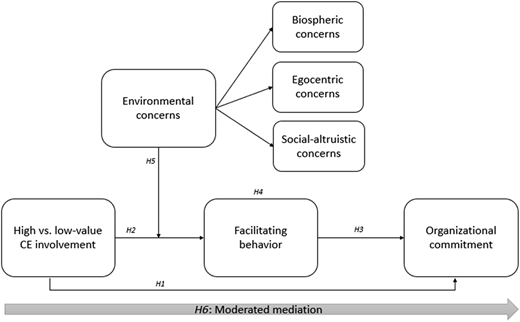
Employees' HVR (vs LVR) CE involvement leads to higher levels of organizational commitment.
2.3 Facilitating behavior as an enabler
Facilitating behavior in an organizational context is related to specific organizational resources and initiatives tailored to employees' needs (Berta et al., 2015). Examples of facilitating behavior include offering incentive systems to reward employees' engagement in CE, inviting employees to share their ideas in the process of developing CE, and developing specific training (Chen and Hung-Baesecke, 2014). Hotel studies have highlighted the role of green climate, green organizational culture, and green training and development as important antecedents and boundary conditions to explain organizational citizenship behavior for the environment (Andoh et al., 2025; Zientara and Zamojska, 2018). Similarly, facilitating behavior has been found to positively influence CSR participation (Chen and Hung-Baesecke, 2014), exchange relationship perceptions, and positive and negative megaphoning (Song and Tao, 2022).
Hospitality employees can understand and internalize the benefits of CE strategies when provided with educational and empowerment opportunities (Bittner et al., 2024). After initial involvement in HVR CE initiatives (vs LVR), employees can better evaluate the system created to facilitate their engagement. That is because HVR CE requires more skills and active involvement to extend the life of resources through, for example, reuse or repair (Klein et al., 2022; Buyukyazici and Quatraro, 2025). Organizations can implement or modify CE practices to transform individuals' cognitive reactions towards processes (Dräger and Letmathe, 2023). For example, Iberostar Group implemented artificial intelligence to monitor food waste. The data generate reports that allow chefs to implement improvements in the production processes, moving them from just cooking to being involved with data input and analysis (Iberostar, 2022). Based on the reciprocal triad of SCT (Bandura, 1986, 2014), it is expected that active involvement with HVR CE initiatives (behavior) will lead to cognitive reassessment of the organization's facilitating behavior (environment), as employees construct expectations from observed conditional relations between environmental events and the outcomes given their actions (Bandura, 1986).
Employee's HVR (vs LVR) CE involvement leads to higher levels of facilitating behavior perceptions.
The transition to CE requires keeping pace with the evolving landscape. Empowering employees with the right training, skills development, and providing a supportive environment should be a priority in hospitality organizations (De Martino et al., 2025; Prikshat et al., 2026). When hospitality employees have the right CE facilitation, including training, motivational and counseling sessions, their morale and understanding of circular workplaces is boosted (Nandy and Rahman, 2025), positively changing how they feel about the organization (Bhanumathi et al., 2025). Drawing from SCT, environmental factors can affect motivational processes and outcomes (Schunk and Usher, 2012). Based on Bandura's argument, motivation is a powerful trigger for new attitudes and behaviors (Bandura, 2001). In this context, facilitating behavior as an environmental factor can trigger motivation and shape attitudes, allowing employees to recognize that their roles are valued by their organizations, fostering a sense of ownership and stronger commitment (Chauhan et al., 2025).
Employees' facilitating behavior perceptions lead to higher levels of organizational commitment.
Being involved with HVR CE initiatives (vs LVR) can bring several benefits for employees and organizations. Specifically, HVR CE activities have higher innovation potential compared to more labor-intensive activities, such as recycling (Schroeder et al., 2018); they require task-specific skills and social cognitive skills, which are transferable to different industries; a valuable resource to employees (Buyukyazici and Quatraro, 2025). As such, organizations strive to provide the necessary resources to enable employees to engage in and operationalize these initiatives. Through assessing CE facilitating behavior, HVR CE involvement can increase self-regulation of motivation (Wood and Bandura, 1989), influencing employees' commitment. This change occurs because employees can obtain new skills and knowledge directly from experience (enactive learning; Schunk and Usher, 2012), as they explore the organizational resources deployed to help them learn, navigate, and successfully implement HVR CE initiatives. Drawing from SCT and its principle of reciprocal determinism (Bandura, 2001), via the cognitive evaluation of the environment (facilitating behavior perceptions), CE involvement (behavior) can indirectly shape employees' motivation and expected outcomes, increasing organizational commitment. Employees' motivation levels act as an enabler of their commitment; how fond employees are of the organization and their willingness to make personal sacrifices for the business unit (Bhanumathi et al., 2025; Jaworski and Kohli, 1993).
Employees' facilitating behavior perceptions mediate the relationship between their CE involvement and organizational commitment, such that HVR (vs LVR) CE involvement has a stronger indirect effect on organizational commitment.
2.4 Environmental concerns as a boundary condition
Environmental concerns are grounded on the importance one places on a set of different issues, including concerns for others, plants and animals, and themselves (Schultz, 2001). Egoistic concerns refer to the importance given and pursuit of personal interests or benefits; social-altruistic refer to concerns of other's welfare; and biospheric concerns refer to the importance given to preserving the environment and biosphere (Chua et al., 2024). Previous studies demonstrated these values shape employees' ecological worldview, driving one's moral norms and behaviors (Chua et al., 2024; Kim et al., 2016).
Environmental concerns have been found to be a strong predictor of pro-environmental behavior in hospitality and tourism research (Lin et al., 2022). Individuals who have high concerns about environmental issues are more self-conscious, strengthening beliefs of personal responsible behavior and promoting positive feelings towards sustainable activities (Foroughi et al., 2022). Following this rationale, it is expected that employees with high environmental concerns will have a more favorable outlook on CE facilitating behaviors, as it aligns with their own personal values. SCT stipulates the agentic perspective, in which individuals are agents of experiences, having the capacity to exercise control over their lives through intentionality and forethought, self-regulation, and self-reflectiveness (Bandura, 2001). Through self-reflection, individuals will evaluate their values, motivations, and the meaning of their pursuits. Specifically, environmental concerns serve as an internal cognitive filter; when employees have high environmental concerns and are involved in HVR CE, their actions and values will be congruent, which is a strong force for motivation (Schunk and Usher, 2012). In that situation, employees' appreciation for the facilitating opportunities can be enhanced. Since social influences and environmental aspects continue to play a role in certain competencies, interests, and values long after individuals make decisions (Bandura, 2001), it is expected that environmental concerns will interact with CE involvement (behavior), influencing how employees evaluate the organizations' facilitating behavior.
Employee's environmental concerns moderate the relationship between CE involvement and facilitating behavior perceptions, such that HVR (vs LVR) leads to higher levels of facilitating behavior when environmental concerns are high.
Recent studies have explored the moderating role of environmental concerns (Kaur et al., 2025; Thanh and Cong, 2025) and the role of organizational support in mediating the relationship between green organizational and leadership factors and employees' behavioral outcomes (Aboramadan et al., 2022; Karatepe et al., 2022). However, the enablers and conditions that can enhance employees' work outcomes in the context of CE, while considering employees' prior involvement, are still under-explored. Based on the SCT interactionist perspective (Bandura, 2014), both internal and external factors influence employees' cognitive processes and subsequent behavior. Employees are more likely to develop positive attitudes (e.g. commitment) when organizations offer activities that employees value (Kim et al., 2024). In addition, environmental concerns can be a critical internal factor that interacts with individuals' cognitive processes, influencing motivation, attitudes, and behaviors (Nosrati et al., 2026). Altogether and based on the triadic reciprocation tenets of SCT (Bandura, 1986), it is expected that involvement in HVR CE will lead to increased organizational commitment as employees that have high environmental concerns can shape their perceptions of facilitating behavior, due to their increased motivation. Figure 1 shows the research model.
Employee's environmental concerns moderate the indirect relationship between CE involvement and organizational commitment via facilitating behavior perceptions, such that the relationship is stronger when employees have HVR (vs LVR) CE involvement and environmental concerns are high.
3. Method
3.1 Ethical approval, sample, and data collection
To evaluate the impact of hotel employees' CE involvement on their commitment, a survey was developed. Prior to data collection, the study procedures were reviewed and approved by the university's institutional review board. Before starting the survey, participants read a detailed cover letter that explained the study's objectives, provided a point of contact, and assured respondents of their voluntary participation and right to withdraw at any time. The cover letter also confirmed that the study adhered to ethical guidelines for human subjects, guaranteeing the anonymity and confidentiality of answers throughout the study.
Data were collected using convenience sampling and Prolific. First, professional networks were contacted to help facilitate the distribution of the survey to employees who have direct contact with CE initiatives. Second, the survey was distributed to pre-qualified hotel employees on Prolific, an established online research platform known for participants who demonstrate high attentiveness and yield higher data quality compared to respondents on other online crowdsourcing panels (Douglas et al., 2023). To encourage participation, an Amazon gift card was offered to respondents. Prolific respondents were paid through the platform.
Several steps were taken to screen the participants. First, participants had to be at least 18 years old, fluent in English, have a minimum of 90% approval rate on Prolific, and live in the U.S., Canada, or Western Europe. North America and Europe are leading the CE market (InsightAce Analytics, 2026; The Business Research Company, 2026) and Western Europe shares similar cultural aspects with North America, such as high individualism scores, influencing environmental behavior (Zeng et al., 2023). Second, participants were asked to confirm they worked or had worked within the last year in hotels. Third, aiming to evaluate if participants understood CE, they were asked to indicate words associated with CE. After that, participants were provided with a definition of CE and asked to confirm that their employer was engaged in such activities. Fourth, they were asked two open-ended questions: one asking them to describe CE initiatives their hotel implemented and one asking them to name a CE initiative they were personally involved in. After these contingency answers were reviewed, only participants with confirmed hotel employment and exposure and involvement to CE hotel initiatives were included for further analysis. Finally, respondents were also screened based on attention checks and a CAPTCHA verification button. Participants were also asked questions related to their organizational commitment, facilitating behavior perceptions, environmental concerns, as well as basic demographic questions.
The final sample comprised a total of 184 respondents (see supplementary material 1 for demographic details). Respondents were on average 37.15 years old (SD = 11.07). The majority of respondents were white (70.65%), female (59.24%), had a 4-year bachelor's degree (36.96%), and lived in the U.S. (57.07%). They were currently working in hotels (97.28%), in the food and beverage department (36.41%), with a tenure of more than10 years in the hospitality industry (30.98%).
3.2 Measures and data analysis
Facilitating behavior and organizational commitment were measured with a 7-point Likert scale, ranging from 1 = strongly disagree to 7 = strongly agree. Specifically, facilitating behavior was measured with five items from Chen and Hung-Baesecke (2014).” A sample item is: “My hotel actively invites ideas from its employees in the process of developing CE initiatives.” “Organizational commitment was measured with five items from Jaworski and Kohli (1993)”. A sample item is: “I feel as though my future is intimately linked to that of my hotel”. Environmental concerns were measured with 12 items from Schultz (2001) using a 7-point Likert scale, ranging from 1 = not at all important to 7 = extremely important. A sample item from biospheric concern is: “I am concerned about environmental problems because of the consequences for animals. ”A sample item from egoistic concern is: “I am concerned about environmental problems because of the consequences for me.” A sample item from social-altruistic concern is: “I am concerned about environmental problems because of the consequences for all people.”
The value retention of CE involvement (high = 1 versus low-value = 0) was dummy-coded based on the open-ended question “Name a circular economy initiative you are/were involved in.” Following Reike et al. (2022), CE involvement was categorized based on the highest level of R-strategy reached by the hotel employees. Since HVR activities represent a higher level of cognitive involvement with CE, even one HVR activity suggests that the employee is operating within an HVR framework, regardless of whether they also perform LVR activities. Therefore, the dummy coding identified the attainment of high-value involvement. Specifically, answers involving refuse, reduce, reuse/resell, repair, and refurbish involvement were considered having HVR CE. Remanufacture, repurpose, recycle, recover, and remine involvement were considered having LVR CE. Country of residency, age, education, and gender were used as control variables, as previous research has found that women, younger generations, and highly educated individuals evaluate sustainability related topics differently (Greening and Turban, 2000; Kim and Austin, 2020; Wang et al., 2022).
The research model was evaluated and hypotheses were tested using SmartPLS 4. PLS-SEM was chosen due to the explanatory nature of this research and the complexity of the structural model, which involves a second-order construct and a moderated mediation relationship. In addition, PLS-SEM provides more flexibility regarding data distribution and small sample sizes (Hair et al., 2019). IBM SPSS v.31 was used to evaluate respondents' demographics and to conduct Harman's single-factor test.
4. Results
4.1 Independent coding
Two researchers independently coded employees' answers using a deductive approach based on the level of CE value retention (10-Rs) as synthesized by Reike et al. (2022). HVR CE involvement was coded as 1, and medium to LVR involvement was coded as 0. The initial intercoder agreement was 88%. All disagreements were discussed and resolved before integrating the code into the quantitative stage. A total of 115 responses were coded as HVR CE involvement, while 69 responses were coded as LVR CE involvement (see supplementary material 2 for coding examples).
4.2 Measurement model and common method bias
The measurement model was evaluated using the disjoint two-stage approach (Becker et al., 2023; Sarstedt et al., 2019). First, the three dimensions of environmental concerns (social-altruistic, biospheric, and egoistic) were tested as independent constructs. Table 1 shows the measurement model details. All items' outer loadings were above 0.7, indicating convergent validity. To resolve a minor collinearity issue found during the structural model evaluation phase (variance inflation factor [VIF] = 3.31 between environmental concerns and facilitating behavior), an evaluation of cross-loadings during the measurement model (stage 1) was conducted (Kock and Lynn, 2012). One item from biospheric concerns (marine life) was removed due to high cross-loading with altruistic concerns (0.68). This deletion preserves the core domain of biospheric concerns, as fauna is still represented in other indicators (e.g. concerns for animals), alongside concerns for flora. Following this item removal, Cronbach's alpha (between 0.82–0.86) and composite reliability (CR) across all constructs (between 0.82–0.92) indicated strong internal consistency. Convergent validity was confirmed, as the average variance extracted (AVE) from each construct was above 0.5. Table 2 presents discriminant validity results from stage 1. Discriminant validity was also supported as all Heterotrait-Monotrait ratio (HTMT) values were lower than 0.90 (Hair et al., 2019). However, social-altruistic concerns and egoistic concerns HTMT value (0.87) exceeded the conservative 0.85 threshold. This higher HTMT value shows that while these dimensions represent different sub-facets, they are part of a broader concept of environmental concerns. As such, environmental concerns were tested as a second-order construct.
As all criteria were satisfied during the first stage of the model evaluation, environmental concerns was evaluated as a higher-order construct. All latent composites for the three dimensions of environmental concerns were saved and included to a high-order reflective construct as indicators during stage 2. The standardized loading values on the higher-order environmental concerns were: altruistic concerns (0.92), biospheric concerns (0.83), and egoistic concerns (0.90), demonstrating indicator reliability (Sarstedt et al., 2019). This higher-order construct showed strong reliability and validity (Cronbach's alpha = 0.86, CR = 0.89, AVE = 0.78) Environmental concerns HTMT values with facilitating behavior (0.33) and commitment (0.27) were all below the conservative threshold of 0.85 (Hair et al., 2019), providing evidence of discriminant validity. The model explained 13% of the variance in facilitating behavior and 38% in organizational commitment, both meeting satisfactory benchmarks (R2 = 0.13 and R2 = 0.38, respectively; Hair et al., 2019). A power analysis using G*Power 3.1.9.7 (f2 = 0.149, based on R2 =0.13, α = 0.05, and 3 predictors) confirmed that the sample size exceeded the 119 respondents sample requirement for robust statistical power (0.80 power threshold; Faul et al., 2009).
To ensure that self-reported answers were not affected by the survey design (common method bias; CMB), Podsakoff et al. (2003) suggested procedures were followed, including respondent anonymity, clear instructions, and survey questions presented on separate pages to increase the distal perception of each measure. Statistical checks confirmed that CMB is not a major concern in this study. Harman's single-factor test, using IBM SPSS v.31, revealed that 31.13% of variance could be explained by a single factor, falling below the 50% threshold suggested by Podsakoff et al. (2003). A full collinearity test (Castillo et al., 2026; Kock and Lynn, 2012) was also performed. A randomly generated numerical dependent variable was created in Excel and imported to Smart PLS, where an alternative model was evaluated, with all latent constructs predicting the random variable. All inner VIF values for the research model and this alternative model were below the commonly adopted threshold of 3.3 (Kock and Lynn, 2012; see supplementary material 3 for details).
4.3 Test of research hypotheses
To test H1-H6, SmartPLS 4 was used. Hypotheses were evaluated considering path coefficients and levels of significance, using 10,000 bootstrapping re-samples with 95% confidence intervals (CI), and controlling for country of residency, age, education, and gender. Tables 3 and 4 show the results. First, while the direct effect between HVR (vs LVR) CE involvement on organizational commitment was not significant (β = 0.22, 95%, p = 0.11), rejecting H1, the total effect was (β = 0.37, p = 0.01), accounting for both the direct and indirect effects. HVR (vs LVR) CE involvement led to increased levels of facilitating behavior perceptions (β = 0.30, p = 0.04), supporting H2. Facilitating behavior perceptions led to higher levels of organizational commitment (β = 0.50, p < 0.001), supporting H3. The mediation effect of facilitating behavior was significant (β = 0.15, 95% CI [0.01, 0.31]), supporting H4 and indicating full mediation. This result indicates that the effect of HVR (vs LVR) CE involvement happens only indirectly by increasing facilitating behavior perceptions, which then drives organizational commitment.
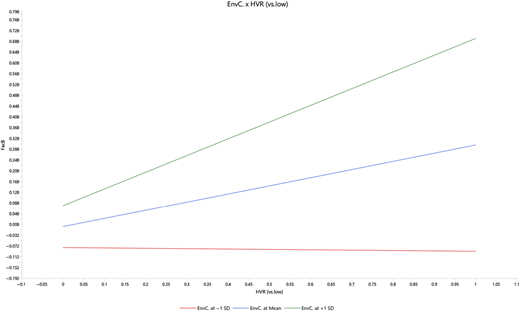
Environmental concerns significantly moderated the relationship between HVR (vs LVR) CE involvement and facilitating behavior (β = 0.32, p = 0.04). A simple slope analysis (see Figure 2) revealed that when environmental concerns were high (+1SD, β = 0.62, p = 0.004) and at the mean level (β = 0.30, p = 0.04), the positive relationship between employees' HVR (vs LVR) CE involvement and facilitating behavior perceptions increased. Thus, H5 was supported. H6 was also supported, as the moderated mediation was confirmed (β = 0.16, 95% CI [0.01, 0.34]). Specifically, when environmental concerns were high (β = 0.31, 95% CI [0.09, 0.56]) and at the mean level (β = 0.15, 95% CI [0.01, 0.31]), HVR (vs LVR) CE involvement enhanced organizational commitment via facilitating behavior perceptions. The only control variable found to be significantly related to the study variables was age. In specific, older employees demonstrated higher organizational commitment (β = 0.19, 95% CI [0.07, 0.30]).
5. Discussion and conclusions
5.1 Discussion
Grounded in SCT (Bandura, 1986, 2014), this study investigated how hotel employees' CE involvement affects individual outcomes. Most hypotheses were supported; when environmental concerns were at mean or high levels, the interaction with HVR CE involvement led to increased levels of facilitating behavior perceptions and organizational commitment. Despite previous studies confirming that leadership and organizational support enhance the positive effects of CSR, green initiatives, and CE on employees' outcomes (e.g. Akoto et al., 2026; Daud et al., 2026; Patwary et al., 2024), the specific cognitive mechanisms to better understand how and why employees react in these contexts have been scarcely explored (Soomro et al., 2026). The focus on facilitating behavior perceptions highlights the operational and structural enabling mechanisms required to engage and execute complex CE initiatives, extending beyond traditional perceptions of care and value captured by organizational support (Aboramadan et al., 2022). Furthermore, while green leadership and green HRM focus on top-down supervisory motivation as a driver of employees' attitudes and behaviors (Patwary et al., 2024; Soomro et al., 2026; Zhao and Zhou, 2021), and green climate reflects shared perceptions of organizational values (Zientara and Zamojska, 2018), the focus on CE involvement puts employees in the driver's seat of sustainable change.
The current study results suggest that introducing HVR CE initiatives alone is not sufficient to automatically yield organizational commitment. Rather, this relationship is mediated by facilitating behavior perceptions and moderated by individual environmental concerns. Although the total effect was significant, the direct effect between HVR CE involvement and organizational commitment was not. From a practical perspective, HVR CE involvement requires specialized cognitive and task-specific skills (Buyukyazici and Quatraro, 2025), which can be perceived as an additional workplace burden if introduced in isolation. Without dedicated resources, supportive systems, relationships, and effective communication necessary to problem-solve (facilitating behavior), HVR CE risks creating role overload instead of commitment. As such, involvement only effectively leads to organizational commitment when employees feel the organization genuinely facilitates their efforts and aligns with their personal values. In line with prior research (Foroughi et al., 2022; Kaur et al., 2025; Thanh and Cong, 2025), environmentally conscious employees exhibit higher self-awareness and respond more favorably to sustainability initiatives explaining why the indirect effect of facilitating behavior increased at medium-to-high moderator levels.
5.2 Theoretical implications
This study offers important theoretical implications. First, this research shifts the hospitality CE literature from a macro-technical perspective to a micro human-centric approach. While prior hospitality research predominantly focused on top-down managerial directive and technical CE (e.g. Bittner et al., 2024), the role of human capital in driving the CE transition in hospitality is critical, yet under-explored (Akoto et al., 2026). By evaluating employees' inherent role in implementing and shaping CE practices (Gaffar et al., 2026), this study uncovers some of the cognitive micro-foundational mechanisms and boundary conditions that determine how hotel employees evaluate and respond to circular initiatives.
Second, this study revealed that HVR CE involvement alone does not directly increase organizational commitment. Because HVR CE initiatives demand specialized task-specific and social-cognitive skills (Buyukyazici and Quatraro, 2025), involvement alone may be perceived as an additional operational burden rather than an empowering activity. This finding extends existing studies on employee green behavior (Aboramadan et al., 2022; Soomro et al., 2026) by showing that advanced task complexity without structural facilitating behavior opportunities does not act as an incentive for other individual attitudes and behaviors.
Third, grounded in SCT (Bandura, 1986), this research identified specific cognitive mechanisms and boundary conditions to explain how and why HVR CE (vs LVR) involvement leads to increased organizational commitment. By showing how the indirect role of facilitating behavior is significantly stronger among employees with high environmental concerns, this study elucidates the triadic reciprocal interaction between personal values, structural enabling conditions, and employee attitudes. In doing so, this study advances the general green and CE literature (Andoh et al., 2025; Karatepe et al., 2022; Nandy and Rahman, 2025) by highlighting that positive perceptions about task-specific structural elements, rather than general perceptions of socio-emotional care, when combined with individual environmental concerns values, is critical to unpack positive spillover effects from CE involvement.
5.3 Practical implications
Key managerial insights for hospitality organizations designing and implementing CE initiatives can be drawn from this research. First, for employees' HVR CE involvement to have a spillover effect on organizational commitment, hospitality organizations should shift from viewing employees as task-performers to viewing them as core agents of change, supporting them with department-specific facilitating behavior activities. For example, in food and beverage departments, managers could implement zero-waste solutions and train employees (Mehrotra et al., 2025), such as kitchen staff, to repurpose prep scraps and unused leftovers into new dish offerings. Maintenance departments would benefit from skill-building programs, such as carpentry and technical training, to extend the lifespan of furniture, fixtures, and equipment rather than quickly replacing assets. Procurement teams should establish CE sourcing policies, prioritizing suppliers offering products as a service and minimal packaging. Housekeeping procedures require redesign to minimize resource consumption without compromising the guest experience (e.g. replacing single-use amenities and using smart dosing systems instead of manually dispensing chemicals).
Second, while implementing CE practices, managers should consider the significant differences in resource availability between hotel business models. Larger hotel chains should leverage economies of scale by investing in digital tracking dashboards that track resource retention value metrics and cost savings across properties. The savings could fund incentive systems and additional training. In contrast, smaller independent properties that face financial challenges should prioritize low-cost initiatives, such as having managers as trainers, establishing local community partnerships (e.g. donating organic waste to compost), and holding listening sessions and surveys, where employees can share their concerns and new ideas related to CE. These initiatives could help hospitality organizations advance their nascent stages of CE implementation by further involving employees (Fonseca and Dias, 2025).
Third, considering the key findings related to employees' environmental concerns and the premise that human involvement is inherent to hotels attainment of CE (Gaffar et al., 2026), organizations should clearly communicate about facilitating behavior options and create an empowering environment where employees can enact their green values (Thanh and Cong, 2025). This could involve streamlining processes that allow employees to get involved in CE and by framing facilitation around continuous learning and open communication. In this scenario, managers can reduce the perceived burden of complex HVR CE tasks, enabling environmentally conscious employees to align their personal values with organizational goals. Finally, hospitality managers should continuously foster the CE culture by being role models, facilitating CE behavior, and by allocating resources to support HVR CE involvement.
5.4 Limitations and future research
While this study provides insightful results for theory and practice, it is not without limitations. First, this research relied on cross-sectional data. Although procedural and statistical solutions were implemented to reduce the impact of CMB, future research could conduct a longitudinal study and utilize a dyadic research design, pairing employee self-report with supervisor-rated performance metrics, capturing a holistic view of CE workplace outcomes. Second, although participants were thoroughly screened, the analysis was based on their answers to short open-ended questions and to quantitative questions. As hospitality organizations are in nascent stages of CE implementation and development (Fonseca and Dias, 2025), a qualitative study with a deeper analysis of employees' cognitive processes and involvement with CE can bring new insights to the hospitality CE literature discussion. Third, while the binary coding allowed for the operationalization and comparison of HVR versus LVR CE involvement effects, there is a risk of losing the nuances of the R-10 framework. Future studies should test the differences between each R-level. Fourth, this study relied on data collected using convenience sampling and online crowdsourcing panels, resulting in a more educated and mostly White sample from the U.S., thereby limiting the generalizability of the findings. Future studies can extend the results by investigating a more diverse set of hospitality employees from tourist destinations that have emerging CE practices (e.g. Asia and Latin America). Finally, other factors such as reasons for CE involvement, time allocated for CE activities, and CE social impact are among the additional factors that can also influence employees' cognitive evaluation of CE. Future studies could investigate these variables for a deeper understanding of employees' CE involvement.