This study aims to develop a theoretical model to explain how older adults engage with smart tourism services by examining five key conditions: user-related, technological, tourism-specific, social mechanisms and experiential feedback. It aims to capture the adaptive strategies older adults adopt in navigating digital tourism environments.
Using a grounded theory approach, this study conducted 50 in-depth interviews with older Chinese adults (users and non-users). Theoretical sampling guided data collection and open, axial and selective coding generated a context-sensitive multi-condition adaptation engagement model.
The model reveals that engagement behavior emerges from dynamic interactions among the five condition clusters. These interactions generate three adaptive outcomes: active use, limited use and non-use. Social support, norms, economic incentives and feedback from prior experiences serve as key mechanisms moderating these trajectories.
By integrating structural, social and experiential factors, this model extends beyond conventional technology adoption frameworks (e.g. technology acceptance model, unified theory of acceptance and use of technology), offering a comprehensive understanding of older adults’ digital engagement in tourism. It provides conceptual and practical insights for designing age-inclusive smart tourism services and policies that respond to the lived realities of aging users.
1. Introduction
Smart tourism, enabled by mobile apps, location-based services and data-driven personalization, has transformed destination management and tourist behavior (Gretzel et al., 2015; Li et al., 2017; Kabadayi et al., 2019; Li et al., 2024). These advances boost convenience and efficiency yet mainly serve younger, digitally fluent users. Older adults encounter multiple barriers, including limited digital literacy, age-related impairments and unfamiliar interfaces. These constrain their participation (Hua et al., 2021; Shin and Baek, 2023; Xu et al., 2023). Although smart tourism has become a prominent theme (Ali et al., 2022) and there has been a shift toward socially embedded research (Lee, 2022), research into elderly users remains scarce. Addressing this gap is critical, given the global trend of population aging and the growing role of digital technologies in tourism.
In China, the disconnect between technological advancement and older adults’ digital engagement is especially pronounced. A total of 18.7% of the population is over 60 (Seventh National Population Census), and that share is set to climb. Meanwhile, smart tourism tools, including e-ticketing, QR-based navigation and WeChat mini-programs, have become central to tourism infrastructure. This creates a digitally intensive environment that amplifies both opportunities and barriers for older adults. China’s collectivist culture and family-centered travel patterns further introduce distinctive relational mechanisms, such as proxy technology use and intergenerational support, which remain underexplored in prior studies. While these features are context-specific, the insights gained have broader theoretical relevance for other rapidly aging societies. They illustrate how social structures, infrastructure and cultural norms interact with individual capacities to shape adaptive engagement with smart tourism services. Understanding these dynamics is crucial for promoting digital inclusion and guiding the design of tourism services for an increasingly aging population.
Existing research on aging and digital inequality has largely focused on everyday technologies such as smartphones and social networks (Braun, 2013; Choudrie et al., 2022), while studies on tourism technology remain limited and fragmented (Wang et al., 2016; Assaker, 2020). Smart tourism’s multi-step, unfamiliar and time-sensitive interactions pose unique challenges for older users, but these challenges are underexplored. Mainstream adoption models such as the technology acceptance model (TAM) proposed by Davis et al. (1989) and the unified theory of acceptance and use of technology (UTAUT) of Venkatesh et al. (2003) have been adapted for older adults (Macedo, 2017; Felber et al., 2024), highlighting psychological constructs such as perceived usefulness and ease of use (Talukder et al., 2020; Ma and Luo, 2024), yet they underplay structural and situational constraints from infrastructure and service availability to real-world usability that critically shape seniors’ tourism experiences. Although a few context-specific extensions have been proposed (Tamilmani et al., 2021; Claudia et al., 2018), they remain fragmented and insufficiently integrated.
To address these gaps, this study develops a context-sensitive framework integrating individual, technological, social and environmental factors to examine older adults’ adaptive engagement in smart tourism. Specifically, the study explores three core questions:
What key conditions influence older adults’ engagement with smart tourism services?
How do embedded social mechanisms interact with these conditions to shape behavioral outcomes?
What adaptive strategies emerge across different contexts?
This study advances the literature by synthesizing structural, social and experiential factors into a context-sensitive multi-condition adaptive engagement model for older adults. Building on established frameworks (e.g. TAM, UTAUT), the model explicitly integrates user-related conditions, technological conditions, tourism-specific constraints, social mechanisms and experiential feedback to explain adaptive outcomes (active use, limited use and non-use). Grounded in interviews with older Chinese adults, this consolidation organizes dispersed constructs into a coherent framework that offers a progressive and integrative contribution, refining theoretical understanding and providing actionable guidance for inclusive interface design, social support strategies and policy interventions to promote digital inclusion in smart tourism.
2. Literature review
2.1 Smart tourism and the aging user: a neglected intersection
Smart tourism research largely focuses on two domains: supply-side studies of service design and infrastructure (Xiang et al., 2021; Hu and Li, 2023) and demand-side investigations of user behavior, experience and needs (Jeong and Shin, 2020; Shin et al., 2023; Singh et al., 2025). Demand-side work primarily targets younger or general populations, leaving older adults underrepresented in the research, despite their growing market share (Otoo et al., 2021; Leung et al., 2024). Existing evidence shows that older users demonstrate lower levels of adoption and engagement with smart tourism services, facing barriers such as interface complexity and inadequate support (Hua et al., 2021; Xu et al., 2023). These disparities indicate that the benefits of smart tourism are unequally distributed across age groups.
Although older adults are increasingly recognized as technology users, many studies still conceptualize them primarily in terms of barriers and limitations rather than as active participants with distinct engagement patterns (Charness and Boot, 2009; Braun, 2013; Xu et al., 2023). Consequently, few studies systematically examine the conditions shaping older adults’ varying levels of engagement with smart tourism services. This issue is particularly salient in China, where a rapidly aging population (18.7% aged 60+; Seventh National Population Census) coincides with widespread digitalization. Technologies such as e-ticketing, QR-based navigation and mobile service platforms have become integral components of tourism infrastructure. In this context, the combination of demographic scale and infrastructural centrality underscores both the policy relevance and research significance of investigating older adults’ engagement with smart tourism services (Xu et al., 2023). While existing studies have identified key barriers, fewer have systematically theorized how users interact with contextual factors (Hua et al., 2021; Tuomi et al., 2023). In short, the intersection of smart tourism and aging is empirically significant yet theoretically underdeveloped. Addressing this gap requires context-sensitive frameworks that move beyond merely identifying barriers to explaining how structural, social and experiential factors jointly shape diverse engagement patterns.
2.2 Technology use among older adults and the limits of mainstream models
Digital inequality in older populations has been widely studied in information systems and consumer behavior, identifying barriers such as physical decline, limited exposure, technology anxiety, prior experience and expectation mismatches (Braun, 2013; Chen and Chan, 2014; Kim et al., 2016; Wang et al., 2017; Macedo, 2017; Fox and Connolly, 2018; Mitzner et al., 2019; Leukel et al., 2021; Choudrie et al., 2022; Cham et al., 2022; Frishammar et al., 2023; Wu et al., 2025). Tourism research is less voluminous than research in other sectors, wherein studies examine adoption and non-use of technologies from information systems to virtual and augmented reality (Pesonen et al., 2015; Wang et al., 2016; Choudrie et al., 2022; Yu et al., 2023; Tuomi et al., 2023; Sancho-Esper et al., 2023; Li, 2023; Zhang et al., 2024; Chen et al., 2024). Yet most studies focus on single-function services in stable settings. They provide limited insight into how older adults navigate smart tourism’s multi-step and dynamic interactions. These interactions are time-sensitive, requiring real-time decisions across multiple devices and environments. This situational complexity challenges static adoption models and underscores the need for frameworks that capture adaptive, context-dependent behavior.
Although widely applied in adoption research, mainstream models such as the TAM (Davis et al., 1989) and UTAUT (Venkatesh et al., 2003) offer limited explanatory power for older adults’ engagement in complex service settings such as smart tourism. Even when extended to aging populations (Chen and Chan, 2014; Macedo, 2017; Talukder et al., 2020; Huang, 2023; Felber et al., 2024; Ma and Luo, 2024; Yang et al., 2025), these frameworks remain centered on psychological predictors, such as perceived usefulness, ease of use, social influence and attitude, while additions such as facilitating conditions, self-efficacy or technology anxiety do little to move beyond an individual-centric paradigm. Recent critiques also highlight TAM’s limitations in hospitality and tourism because of its individual-centric perspective, limited scope, static nature and restricted cultural applicability (Mogaji et al., 2024). Consequently, these models understate the importance of contextual determinants, including infrastructural constraints (e.g. connectivity, transport, service visibility) and relational mechanisms, such as the role of family, caregivers and peers in mediating or substituting technology use. They also tend to depict behavior as static or outcome-driven rather than adaptive and temporally contingent. Few studies examine how psychological constructs interact with broader socio-technical contexts, leaving open how infrastructural and social factors shape ongoing engagement trajectories. While these constructs remain valuable, their explanatory power is constrained in complex, dynamic service environments, underscoring the need for integrative frameworks that combine structural, situational and social factors with adaptive behavioral processes.
2.3 Toward a context-sensitive understanding of older users’ smart tourism adoption
Smart tourism poses unique challenges for older adults: unfamiliar environments, real-time coordination and uneven infrastructure exacerbate digital exclusion. Yet mainstream models such as TAM and UTAUT rarely account for contextual barriers such as infrastructural gaps, technical issues and limited information (Claudia et al., 2018; Tuomi et al., 2023). Although some studies introduce context-specific extensions such as environmental access and community support, these remain fragmented and lack theoretical cohesion (Tamilmani et al., 2021; Claudia et al., 2018). Consequently, it remains unclear how individual capacities, technological affordances, social mechanisms and structural accessibility collectively shape diverse engagement patterns among older adults.
To address this gap, this study adopts a context-sensitive, multi-level approach to explore how diverse conditions jointly shape older adults’ adaptive engagement with smart tourism services. Rather than assuming a linear or uniform adoption process, it investigates how different forms of engagement and disengagement arise from the interaction of multilevel contextual factors. By framing engagement as fluid and contingent, this approach theorizes not only whether older adults use smart tourism technologies, but also how and why their participation varies across contexts. Guided by this perspective, the study uses a grounded theory approach to inductively construct an integrative framework that reflects the lived experiences of older adults navigating smart tourism environments.
3. Methodology
3.1 Research design
This study adopts a constructivist grounded theory approach (Charmaz, 2006; Corbin and Strauss, 2015), allowing theoretical insights to be inductively understood from participants’ lived experiences. Given limited research on older adults’ engagement with smart tourism in China, this method supports contextual exploration of behavioral patterns and mechanisms. Concepts such as digital distance and proxy support served as sensitizing tools, refined through iterative coding and memo-writing. To enhance contextual sensitivity, the lead researcher also conducted naturalistic observations in everyday settings, parks and family gatherings to examine baseline digital behavior and social support, which informed interview design and linked daily practices to tourism-specific challenges.
3.2 Data collection
This study used in-depth interviews to examine older adults’ experiences with smart tourism services and the multifaceted factors shaping their behaviors. The method’s flexibility enabled real-time adaptation to participants’ responses and a richer understanding of emerging themes. Interview questions were designed based on the research objectives and existing literature, covering four areas: demographic background; knowledge, demand and use of smart tourism services; enabling and limiting factors; and personal experiences and perceptions. Follow-up probes were used to elicit detailed narratives about decision-making, barriers and emotional responses.
Participants were recruited through a combination of theoretical sampling and snowballing. Guided by emerging concepts, the research team identified eligible older adults (aged 60 and above, with recent domestic travel experiences) through personal networks and referrals and conducted face-to-face interviews in diverse public settings, including the University of the Elderly, community service centers, parks and tourist attractions in Xiamen. This approach ensured diversity in age, gender, digital literacy and tourism experience. Telephone interviews were conducted when in-person meetings were not feasible because of mobility constraints.
A total of 50 interviews were completed (31 users, 19 non-users) between February and May 2024. Each session lasted 10–30 min (avg. around 20). The majority of interviews ranged between 20 and 30 min, reflecting participants’ conversational pace and comfort. A small proportion (about 10%) was shorter because of time constraints; however, they were retained as they offered confirmatory or contradictory evidence supporting category validation. Following grounded theory principles, emphasis was placed on information density and theoretical saturation rather than absolute duration. Depth was ensured through carefully structured open-ended questions, targeted follow-up probes, iterative sampling and constant comparison. Several interviews yielded multi-layered narratives covering technological adaptation, contextual constraints, emotional responses and social mediation, which together provided sufficient depth for conceptual development.
Data collection ended at 50 interviews based on theoretical saturation. After approximately 40 interviews, key categories such as perceived risk and proxy support were saturated. The remaining interviews helped validate category consistency, identify disconfirming cases and refine linkages. All sessions were recorded with consent and fully transcribed. Table 1 presents participant characteristics.
3.3 Data analysis strategy
Data analysis followed grounded theory’s three-step procedure: open, axial and selective coding. The first author conducted coding and iterative memoing in NVivo 14, while a second researcher independently reviewed the full data set to enhance consistency and interpretive reliability. Discrepancies were resolved through collaborative discussion. Reflexive memos and peer debriefing supported analytical rigor. Theoretical saturation was initially indicated during data collection. This was confirmed during analysis to ensure category integration and validation.
4. Coding analysis and model construction
4.1 Open coding
Interview transcripts were systematically coded line by line in NVivo 14 to identify analytically significant concepts. Constant comparison across cases ensured conceptual clarity and theoretical relevance. This process generated 87 initial concepts and 27 primary categories. Illustrative coding examples are presented in Table 2.
4.2 Axial coding
After open coding, axial coding was applied to relate categories around the core phenomenon of older adults’ smart tourism use. Following the grounded theory paradigm, we organized categories into condition-consequence chains. As shown inTable 3, the original codes were distilled into 13 axial categories under four condition types and one outcome, each with several subcategories.
4.3 Selective coding and model construction
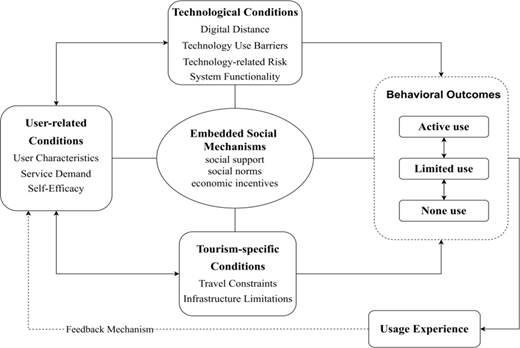
Selective coding identified the core category mechanisms that shape older adults’ smart tourism use and integrated five condition categories with three adaptive outcomes to construct the multi-condition adaptive engagement model (Figure 1). This abstraction was grounded in systematic comparison of participant narratives, ensuring that higher order mechanisms reflect recurring patterns rather than isolated cases.
This model explains older adults’ engagement with smart tourism through five interrelated conditions: user-related, technological, tourism-specific, embedded social mechanisms and experiential feedback. These conditions interact to produce adaptive outcomes along a continuum of active, limited or non-use engagement.
5. Theoretical model explanation
5.1 Behavioral outcomes of older adults in smart tourism
Active users demonstrate high digital literacy, confidence and motivation, using smart tourism services independently for tasks such as route planning and booking (“We often take self-driving tours[…] we use them proficiently,” P14). Positive experiences and social support reinforce their engagement, and many become advocates of these services.
Limited users engage selectively, mainly for basic functions such as navigation or mobile payments (“Mainly use mobile payment[…] rarely use it otherwise,” P20). Advanced features are perceived as irrelevant or difficult, with a preference for real-time assistance from companions (“Machines can’t help when something goes wrong,” P4).
Non-users typically disengage because of age, health and limited literacy, reinforced by low travel demand and educational constraints (“I don’t have much education, I’d rather leave it,” P35). Age stereotypes also discourage use, and many rely on children or tour groups to meet travel needs.
5.2 Underlying conditions and mechanisms shaping behavioral outcomes
5.2.1 User-related conditions.
5.2.1.1 User characteristics.
Physical traits, particularly age-related decline in vision, mobility and health, diminish digital confidence and travel autonomy. “My eyesight isn’t good[…] I have to rely on memory” (P42); “too old and in poor health” (P39). Such limitations increase reliance on family and reduce the necessity of smart tools; “No app can replace family support” (P37). Older adults often prefer real-time human help over digital tools.
Personality attributes such as education and personality shape engagement. Limited schooling hinders digital use: “I didn’t go to school[…] I can’t read, let alone use smart tourism services” (P48). Some avoid asking for help (P18), while others value independence: “Using smart services means I don’t have to rely on others” (P24). Openness to learning encourages use: “I’m willing to ask, and they teach me patiently” (P17).
Cognitive abilities, including memory, learning capacity and processing speed, affect skill acquisition and retention. Slower processing often leads to frustration or withdrawal: “Seniors don’t learn as fast[…] even if they see the benefits” (P20). These traits shape readiness and perceptions of barriers, usefulness and risk.
5.2.1.2 Service demand.
Functional needs drive adoption. Most participants used smart services for specific goals: “I would choose smart services when visiting a place the first time” (P4). Use often stayed basic unless tailored to age-related needs; larger fonts (P11, P28), voice input (P12) and dialect/multilingual support (P33) were seen as essential. Adoption occurred only when services met practical needs with accessible design. Besides, proxy support reduces the need for direct use: “My son handles ticket bookings” (P49); “Tour groups manage everything” (P36).
5.2.1.3 Self-efficacy.
Confidence in digital abilities facilitates adoption. P24’s higher education, frequent travel and smartphone use fostered familiarity and reduced skill anxiety (“Very easy, no problem to operate it”), whereas P42’s lower education and limited experience undermined self-efficacy (“Too high-tech to learn”). Low self-belief, compounded by limited exposure and fewer digital resources, promotes avoidance. Self-efficacy acts as an attitudinal gateway to engagement, shaped collectively by education, mobility and device access.
5.2.2 Technological conditions.
Digital distance reflects perceived closeness or separation from digital technologies, comprising technology acceptance and exposure frequency. Positive acceptance, reinforced by convenience, usefulness and social norms, narrows distance and supports confident use. As active user P12 said: “It’s convenient and useful. Everyone uses smartphones now[…] The smart maps help me reach destinations easily.” In contrast, resistance and obstacles widen distance and reduce engagement because of complex procedures, unclear text, vision issues, infrequent smartphone use, low motivation and no guidance (P42). Frequent exposure fosters familiarity and adoption, whereas limited exposure reinforces disengagement. P18 observed: “More exposure builds familiarity[…] use them more often, you gradually learn.” Reducing digital distance through design, training and support promotes sustained participation.
Technology use barriers manifest in five forms. Sensory-interface barriers arise from design misaligned with age-related decline: “Fonts in some apps are too small” (P1); “Sound is too low, sometimes I can’t hear it” (P22). Procedural barriers involve complex steps and verifications: “Difficult operations and verification codes” (P37). Cognitive barriers reflect struggles with interface logic and abstract terms: “The interface is hard to understand” (P20). Functional barriers denote service failures: “I can’t even tap the interactive points” (P11). Device literacy barriers concern unfamiliarity with smartphones: “Don’t know how to use smartphones” (P44, P50). These barriers interact with user traits and social factors, shaping diverse behavioral responses; coping strategies vary from reliance on family to avoidance.
Technology-related risks include psychological, performance, financial and privacy concerns. Psychological risk arises from anxiety about using unfamiliar interfaces and fear of mistakes: “I’m afraid of hitting the wrong button, don’t dare to mess with it” (P20). Performance risk reflects distrust in reliability. For example, one participant reported, “the hotel sold my room to others” (P24), while another noted that problems were “not resolved promptly” (P50). Financial risk involves fear of fraud or errors: “The less I use it, the lower the risk of being scammed” (P42), showing cautious pragmatism rather than rejection. Privacy risk varies: non-users worry about leaks (“I worry about my personal information getting leaked,” P50), while active users feel less concerned (“I am nobody, my information isn’t that important,” P25). This highlights how risk salience is filtered through personal values and social standing. These risks interact: anxiety fuels distrust, and financial caution amplifies privacy concerns, creating layered vulnerability that hinders engagement.
System functionality, including usefulness, ease of use and reliability, shapes older adults’ engagement. Usefulness refers to solving travel problems or improving efficiency. “It helps find attractions, transport, and dining” (P6); “Booking tickets in advance helps me avoid long queues” (P17). Ease of use hinges on accessible design and learnability. “If it’s quick and easy, we’ll use it. But if there are pop-up ads everywhere, it’s annoying” (P1); “If it’s simple and easy to learn, we’ll naturally use it” (P33). Reliability matters: “Sometimes network is unstable, and the info isn’t reliable” (P6). Shortcomings in any dimension increase resistance, shaped not only by technical or environmental issues but also by socio-cognitive factors such as learning effort, emotional comfort and trust.
5.2.3 Tourism-specific conditions.
Travel constraints arise from physical decline and family concerns, reducing both the opportunity and necessity for digital engagement. Many older adults avoid long-distance travel because of health or stamina issues: “I’m too old to travel far” (P39). They also tend to defer travel decisions to children’s concerns. “My children worry about me traveling alone[…] if I go, I usually join a tour group” (P48). In such cases, assisted or group travel diminishes the need for personal use of smart services.
Infrastructure limitations restrict physical and digital access, making digital services impractical. “When a place has poor connectivity, inconvenient transport, and distant attractions, tour groups work better than smart services” (P25). Regional disparities persist: “Some places support it, others don’t[…] Big cities and rural areas feel completely different” (P13). Visibility was another concern: “If it’s only in service centers[…] it’s useless” (P3). Age-unfriendly design further hindered use: “Fonts are too small, and few facilities suit us” (P11). Such shortcomings constrain engagement regardless of users’ readiness or intent.
5.2.4 Embedded social mechanisms.
Social support reduces cognitive, emotional and operational barriers through informational, technical, emotional and proxy forms. Informational and technical support offers knowledge and hands-on assistance that build self-efficacy and enable trial. “They show me how it works, I’m more willing to try” (P17). Emotional support such as patience and encouragement sustains effort, while negative reactions discourage use. “If my kids are busy and impatient, I avoid asking and use smart services less” (P8). Proxy support meets needs by delegating tasks to family or tour agents, “My family or tour guide handles it; I don’t need to use these” (P36), which can paradoxically reduce direct engagement.
Social norms drive both imitation and exclusion. Demonstrative norms drive imitation: “Everyone uses their phone now, smart tourism will become even more popular” (P29). Social pressure compels reluctant users to conform: “Everyone shops and pays with their phones now, so we have to keep up” (P1). Conventional cognition intensifies alienation when smart services are seen as “for young people” (P42). Personal norms about effort and age also limit engagement: “We’re already this age; why waste effort learning more?” (P23). Thus, social norms shape usage and perceived belonging, embedding digital participation in generational and relational contexts.
Economic incentives. Though seldom acting as primary motivators, discounts and savings can reinforce use when usability and support exist. “Buying tickets online saves money” (P25); “My son taught me how to find group discounts” (P28).
Together, these mechanisms embed digital practices within cultural and relational contexts: they can enable independence or, paradoxically, sustain dependency, shaping adaptive usage patterns.
5.2.5 Feedback mechanism.
Feedback mechanisms shape engagement through experience-driven satisfaction. Positive encounters, marked by convenience, accessibility and utility, enhance confidence and sustain use (“It’s comfortable and convenient,” P25), often prompting peer advocacy (“It’s really convenient. I’d recommend it,” P2). Negative experiences such as technical failures, complex interfaces and unmet expectations undermine trust and deter reuse (“The system failed when I tried to book,” P20). Satisfaction thus operates as both an outcome of prior interactions and a driver of future engagement, making adoption a dynamic, cumulative process.
5.2.6 Interaction among the five conditions.
The five condition clusters jointly shape older adults’ engagement by aligning or misaligning ability, opportunity, necessity and feasibility. Social mechanisms moderate these dynamics: informational, hands-on and emotional support enhance confidence, reduce risks and narrow digital distance, whereas proxy reliance or age stereotypes suppress initiative. Economic incentives reinforce use when usability and support are adequate. Feedback experiences further adjust trajectories – positive encounters strengthen trust and peer diffusion, while negative experiences lower self-efficacy and amplify constraints.
These interactional patterns are grounded in cross-case comparisons. For instance, participants with adequate digital skills, positive norms and supportive feedback typically demonstrated active use. In contrast, those with similar readiness but constrained by negative personal norms about effort or age – or by heavy reliance on proxies, tended toward limited or non-use (e.g. P5, P21 and P29 versus P23 and P24). The abstraction of the model thus arises from systematic comparative coding and category saturation, linking concrete interview evidence to the higher-order mechanisms summarized in Table 4.
6. Discussion and conclusion
6.1 Discussion
This study proposes a multi-condition mechanism model, contributing to three key theoretical dimensions: adaptive engagement patterns, dual-pathway social support and structurally embedded tourism constraints.
6.1.1 Adaptive engagement under conditional influences.
Traditional adoption models (e.g. TAM, UTAUT) emphasize psychological predictors such as perceived usefulness and ease of use, often treating use as a relatively static outcome (Mogaji et al., 2024). Moving beyond binary adoption or linear path models (Venkatesh et al., 2003), this study frames older adults’ smart tourism use as a spectrum of adaptive behaviors. Prior studies have recognized behavioral heterogeneity and diversity among older adults (Pesonen et al., 2015; Macedo, 2017), yet few have embedded it within tourism-specific and multi-level conditions. Our findings show that the three empirical patterns – active, limited and non-use – are situational outcomes shaped by the alignment or misalignment of user readiness, technological affordances, tourism-specific constraints, social scaffolding and feedback mechanisms.
Our findings resonate with cognitive aging literature emphasizing that older adults’ memory, learning efficiency and processing abilities shape their capacity to acquire and maintain new skills (Anderson, 2015; Charness and Boot, 2009). Yet our model further integrates contextual alignment, showing that cognitive readiness must be matched with accessible design, stable infrastructure and supportive environments to transform into sustained engagement. This aligns with usability studies emphasizing that intuitive interface design and functional reliability enhance users’ sense of control and confidence, supporting continued engagement (Hua et al., 2021; Camilleri et al., 2023).
We further introduce digital distance to capture the psychological-behavioral gap between users and technology. Frequent exposure narrows this gap by fostering familiarity and supports the transition from awareness to sustained engagement, consistent with evidence that regular internet use enhances adoption intentions (Braun, 2013) and that habitual use shapes both adoption and ongoing usage patterns (Macedo, 2017). Conversely, complex interfaces or unclear feedback can expand digital distance, hindering continued engagement. This perspective frames engagement as a dynamic, adaptive process, where repeated experience and contextual alignment jointly determine whether cognitive readiness translates into practical use.
In sum, this study positions older adults’ smart-tourism engagement as a context-sensitive, adaptive process, integrating individual cognition, technological design, social environment and experiential feedback, addressing gaps left by previous fragmented context-specific extensions (Tamilmani et al., 2021; Claudia et al., 2018).
6.1.2 Social support as a dual-effect mechanism.
Prior research establishes social support as central to technology uptake (Zimmer and Chappell, 1999; Keating et al., 2022; Fan et al., 2024). Building on this foundation, this study disaggregates support into four functional forms: informational, technical, emotional and proxy, demonstrating a dual-pathway effect. Informational support fills knowledge gaps that deter adoption, an effect shown to be critical for later-life technology adoption (Kim et al., 2016; Wang et al., 2017). Technical and emotional supports further scaffold learning by providing hands-on problem solving and reducing anxiety, thereby enhancing self-efficacy and enabling independent engagement.
By contrast, proxy support, in which family members, companions or service staff act on behalf of older users, often operates as a substitutive mechanism rather than an enabling scaffold. While delegation rapidly meets immediate needs and lowers short-term barriers, repeated substitution risks entrenching dependency, reducing practice opportunities and undermining skill acquisition. This empowerment–substitution tension becomes particularly salient under collectivist cultural contexts and situational conditions.
Social norms, defined as group expectations that shape individual behavior (Ajzen, 1991), help explain why proxy use may be reinforced. In collectivist contexts such as China, norms that emphasize family interdependence, relational harmony and emotional security make proxy assistance both readily available and socially endorsed; consequently, even when digital tools are available and usable, older adults may defer to family or companions, satisfying immediate needs but potentially limiting the development of independent engagement skills. Moreover, although digital services can provide virtual assistance (Tussyadiah, 2014), older travelers frequently prefer real-time human help during journeys because in situ guidance offers immediate feedback, emotional reassurance and practical problem-solving that virtual tools do not always deliver. This behavioral preference further increases the attractiveness of proxy solutions in tourism contexts.
Together, these cultural and situational forces create a boundary condition for social support. Assistance that is available and culturally endorsed may simultaneously satisfy immediate needs and forestall independent engagement. Thus, social-support interventions in tourism should be culturally sensitive and deliberately designed to convert short-term proxy help into scaffolds for skill-building and autonomy.
6.1.3 Structural constraints in tourism accessibility.
Tourism-specific conditions, particularly mobility, infrastructure and environmental accessibility, serve as decisive structural factors shaping older adults’ smart tourism engagement. While prior models have emphasized individual and technical factors (Davis et al., 1989; Morosan and Defranco, 2016; Gretzel et al., 2015), our findings highlight that travel constraints and infrastructure limitations are equally critical. Structural frictions such as limited transportation, weak Wi-Fi and low interface visibility can lead to disengagement despite psychological readiness and supportive social conditions.
By reframing accessibility as a structurally embedded determinant, this study extends Mang et al.’s (2016) insights on infrastructure and adoption, showing that material infrastructures and spatial arrangements shape the link between user conditions and actual engagement. These contextual frictions reduce older adults’ sense of control and the practical usability of digital tools in real travel settings. As a result, disengagement often reflects both individual limitations (e.g. cognitive readiness, self-efficacy) and structural constraints.
Furthermore, structural conditions interact dynamically with social support and feedback mechanisms. Supportive environments characterized by clear guidance, stable connectivity and visible smart facilities reinforce experience satisfaction and feedback, which in turn sustain engagement. Conversely, fragmented infrastructures and complex spatial layouts can offset the benefits of high self-efficacy or robust social support.
Overall, digital engagement in tourism is a place-bound, context-sensitive process shaped by the alignment of user readiness, technological functionality and infrastructural accessibility. Recognizing environmental affordances as active determinants, rather than passive background factors, advances behavioral models and highlights the material dimensions of digital inclusion.
6.2 Theoretical contributions
Building on the discussion of adaptive engagement, dual-pathway social support and structurally embedded tourism constraints, this study offers a progressive and integrative contribution to smart tourism and digital inclusion literature. By consolidating dispersed theoretical and empirical insights into a coherent framework, it clarifies how older adults navigate multilevel conditions to engage with smart tourism technologies.
First, it enriches technology adoption frameworks by proposing an adaptive behavioral model that captures the nuanced, fluid nature of older adults’ engagement with smart tourism services. The model identifies three distinct usage patterns: active, limited and non-use. These patterns arise from the interaction of multilevel contextual conditions, broadening the behavioral lens, especially in smart tourism where temporality, mobility and immediacy are crucial.
Second, it extends social influence theories by revealing the dual role of social support in older adults’ smart tourism engagement, showing that assistance can either empower users or substitute their participation. By specifying how support types interact with cultural norms, it refines existing digital inclusion frameworks and highlights the necessity of culturally and relationally grounded theorizing in contexts shaped by family caregiving and group-based travel contexts.
Third, the study advances digital inclusion literature by emphasizing tourism-specific structural constraints, such as transport, connectivity and service visibility, as decisive factors shaping perceived usefulness and engagement. Treating infrastructure as an active determinant aligns with place-based digital inequality research, introducing a spatially embedded perspective to smart tourism scholarship that has traditionally focused on individual or technical factors.
Together, these contributions reposition older adults as context-sensitive agents navigating multilevel constraints, offering a more holistic and situated understanding of smart tourism use in aging societies.
6.3 Managerial implications
This study provides practical insights to enhance digital inclusion and optimize smart tourism for older adults.
Tiered service design to support adaptive engagement. Smart tourism platforms can accommodate diverse older adult users through a three-tier interface design: beginner (large fonts, one-click ticketing, voice prompts), standard (commonly used functions) and advanced (full functionality). Initial-use guides and clear “help” buttons can trigger on-site or voice assistance. Users or staff can switch modes according to proficiency. For example, a museum self-service terminal could default to beginner mode while allowing staff to upgrade to advanced functions if needed.
Enhancing structural and environmental accessibility. Destination managers can enhance mobility and connectivity by placing service points near resting areas and ensuring stable network coverage. Implementation can be phased, prioritizing primary access and ticketing zones. For example, theme parks can install portable network extenders and situate accessible ticketing counters near benches, reducing physical effort and cognitive demands for older adults.
Progressive social support to transform proxy assistance into empowerment. Progressive support enhances older adults’ independent engagement. For example, museum or attraction staff can demonstrate tasks and then let older visitors complete them independently. Community volunteers provide on-site guidance while encouraging self-operation. App developers can integrate family co-learning features to allow relatives to supervise without replacing user actions. Short tutorials or instructional videos help users learn on the spot, reducing reliance on proxy support.
Building trust through privacy, reliability and incentives. Clear privacy protection, timely fault handling, reliable service guarantees and economic incentives such as discounted tickets, membership benefits or priority access can enhance trust and encourage sustained use. For example, a museum could implement secure login and payment procedures, provide on-site assistance for troubleshooting and offer discounted senior tickets or priority entry to foster safe and confident participation.
Policy measures for age-inclusive tourism infrastructure. Government agencies and tourism authorities should embed age-inclusive standards into infrastructure, technology procurement and annual planning. For instance, funding could support venues to pilot beginner-friendly interfaces, add on-site assistance stations, or adopt voice-enabled kiosks. Annual tourism plans could mandate major attractions implement age-inclusive signage and app accessibility features.
Overall, these recommendations highlight a people-centered and context-sensitive approach to smart tourism. They balance immediate usability with long-term independent engagement, improving travel satisfaction, enhancing older adults’ quality of life and fostering social and digital inclusion.
6.4 Conclusion
This study developed a multi-condition mechanism model explaining older adults’ smart tourism engagement through three adaptive patterns – active, limited and non-use – shaped by five interrelated categories: user characteristics, technological conditions, tourism-specific contexts, social mechanisms and feedback. Using a grounded theory approach, the study integrates insights from established frameworks such as TAM and UTAUT into a context-sensitive and holistic perspective that emphasizes the interaction of structural, psychological, social and experiential factors. This research provides an incremental and integrative contribution by extending understanding of digital participation beyond individual abilities or technological usability, highlighting how multiple conditions jointly shape engagement. These findings enrich knowledge of digital inclusion and offer practical guidance for inclusive smart tourism design and policy.
6.5 Limitations and future prospects
Despite its contributions, this study has several limitations that suggest directions for future research. First, as the framework is based on qualitative analysis, future work could use quantitative or mixed methods to validate and refine the model. Second, the focus on older Chinese users limits generalizability; comparative studies across cultural and infrastructural contexts would enhance external validity. Third, although heterogeneity was acknowledged, subgroup differences (e.g. digital literacy, socioeconomic status, prior experience) require further investigation. Finally, cross-sectional design cannot capture temporal dynamics; longitudinal studies could reveal how engagement evolves over time, while research on non-users may clarify how structural barriers prevent digital participation. Addressing these limitations would strengthen both theoretical and practical insights into digital inclusion in smart tourism.
Corrigendum: It has come to the attention of the publisher that the article, Chen, Y., Shi, Z., Lin, D., and Gupta, R. (2026), “Adaptive engagement in smart tourism: a context-sensitive multi-condition model for older adults”, Journal of Hospitality and Tourism Technology, Vol. ahead-of-print No. ahead-of-print. Link to Adaptive engagement in smart tourism: a context-sensitive multi-condition model for older adultsLink to the cited article, incorrectly listed author Gupta’s affiliation.
This has now been amended from Department of Business and Accounting, Charles Darwin University, Darwin, Australia, and University of Economics and Finance Ho Chi Minh City, Ho Chi Minh, Vietnam to Department of Business and Accounting, Charles Darwin University, Darwin, Australia, and Ho Chi Minh City University of Economics and Finance (UEF), Ho Chi Minh City, Vietnam.
The publisher asks that affiliation information be submitted correctly at submission and confirmed at article proofing stage.