Integrated health and social care initiatives are increasing and health and social care systems are aiming to improve health and social outcomes in disadvantaged groups. There is a global dialogue surrounding improving services by shifting to an integrated health and social care approach. There is consensus of what is “health care”; however, the “social care” definition remains less explored. The authors describe the state of “social care” within the current integrated care literature and identify the depth of integration in current health and social care initiatives.
A narrative literature review, searching Medline, PsychINFO, CINAHL, PubMed, Scopus and Cochrane databases and grey literature (from 2016 to 2021), employing a search strategy, was conducted.
In total. 276 studies were eligible for full-text review, and 33 studies were included and categorised in types: “social care as community outreach dialogues”, “social care as addressing an ageing population”, “social care as targeting multimorbidity and corresponding social risks factors” and “social care as initiatives addressing the fragmentation of services”. Most initiatives were implemented in the United Kingdom. In total, 21 studies reported expanding integrated governance and partnerships; 27 studies reported having health and social care staff with clear integrated governance; 17 had dedicated funding and 11 used data-sharing and the integration of systems’ records.
The authors' demonstrate that social care approaches are expanding beyond the elderly, and these models have been used to respond to multimorbidity [including coronavirus disease 2019 (COVID-19)], targeting priority groups and individuals with complex presentations.
Background
The recognition of social factors impacting health outcomes has been well established (Braveman and Gottlieb, 2014; Amelung et al., 2021; Aboutanos et al., 2019). It is understood that addressing the social needs of health consumers can improve health outcomes at a population level (Amelung et al., 2021; Cartier and Gottlieb, 2020).
It has been postulated that developing systems that foster integrated health and social care (Gottlieb et al., 2017; Braveman and Gottlieb, 2014; Murphy et al., 2017) are fundamental to reducing overreliance on institutional care (e.g. hospital admissions and emergency presentations) and addressing social needs.
Historically, social care efforts have predominately focussed on pension systems, home-help and residential services for the elderly (Peck, 2001; National Academies of Sciences et al., 2020). More recently attention has been placed on social care models addressing integrated social and health-related needs (Cartier and Gottlieb, 2020; Wodchis et al., 2020).
Importantly, policies and legislative frameworks have been developed and evolved to facilitate joined-up health and social care in mature systems, including introducing new care models and accelerating take-up in local areas showing the slowest progress (House of Commons Committee of Public Accounts, 2018).
There has been an expansion of social models of care (and its evaluation) into health care systems, including routine screening for social risks, social needs assessment, integrated global health plans, care coordination, social-based interventions (e.g. social prescribing) primarily originating from the United Kingdom (UK) (Islam, 2020) and the United States of America (USA) (Gottlieb et al., 2017; Cartier and Gottlieb, 2020). However, the definition of what constitutes “social care” and how it should be systematically integrated is less well understood (Amelung et al., 2021).
Key to advancing the global dialogue is a clear definition of what the “social” aspect of integrated health and social care is (Amelung et al., 2021). Without this, there is the risk of (1) social aspects of integrated care being lost within the more dominant field of integrated (community and hospital) healthcare, (2) creating a conceptualisation of integrated health and social care that is too broad and diffuse for new audiences to grasp and (3) certain aspects of social care dominating the dialogue.
Moreover, it has been argued that social care has been consistently perceived as an add-on to health care services, which can be exacerbated by the lack of “parity of esteem” between the health and social care systems (Quilter-Pinner and Hochlaf, 2019).
One of the crucial aspects that could facilitate change in the paradigm is to develop comprehensive integrated health and social care policies at global and local levels. Wodchis et al. (2020) postulate that depth of true integration can be measured by the level of support and expansion of (1) integrated governance and partnerships; (2) integrated workforce and staffing; (3) integrated financing and payment and (4) data-sharing and use (Wodchis et al., 2020). These authors used a hybrid integrated care framework (Peter Long et al., 2017; Leijten et al., 2017; WHO, 2016) to assess the depth of integration of 30 integrated health and social care programmes in high income countries.
Against this backdrop, the severe acute respiratory syndrome COVID-19 (SARS-COV-2) pandemic reemphasised the interdependence of the health and social care sectors. Health systems have started to utilise novel approaches to address social needs of vulnerable communities worldwide (Paremoer et al., 2021; Abrams and Szefler, 2020). The pandemic has accelerated demands for information about patients’ social circumstances to assess for risks of contracting the virus and/or spread it in their community. Novel and expanded social risk screening have been conducted to alert primary care providers about patients whose social challenges put them at higher risk of COVID-19 complications (Gottlieb et al., 2021).
COVID-19 has also driven health systems to incorporate and expand the types of socio-economic risks included in social assessments, including employment, education and housing arrangements. In part, this is driven by new policies or encouragement from health care departments (Gottlieb et al., 2021). As the effects of the pandemic impact on delivery and access to health and social care, it is an appropriate time to apply lessons learnt and to re-assess and enhance efforts to strengthen, scale and sustain integrated health and social care health care (Singu et al., 2020).
Present study
Given the lack of current definition of “social care”, and the lack of clarity on the levels of true integration, a narrative review study sought to (1) describe the current state and types of “social care” within the current integrated care space and (2) assess the level of integration regarding governance and partnerships; workforce and staffing; financing and payment and data-sharing and use in recent integrated health and social care initiatives.
Methods
A narrative review, using an interdisciplinary approach, and broad scope of topics related to social care in the context of integrated health and social care was conducted.
A search of the academic databases was conducted for studies reporting on the design, implementation, effectiveness and experiences of interventions and system change models integrating health and social care for the period 2016 to 2021. This period was chosen given a higher uptake of integrated health and social care initiatives in the last 5 years.
Eligibility criteria
The following inclusion criteria were utilised:
Intervention: Integrated health care and social care interventions that were based in a primary, secondary and tertiary health care settings as well as community and placed based settings. Integrated health care settings without social care were excluded.
Study design: All published study types were included including pilot studies, case studies, randomised controlled trials (RCT), quasi RCT and non-RCT studies.
Population: Participants, defined as enrollees, clients, patients or recipients, of integrated health and social care programmes across the lifespan.
Language: English.
Search strategy
The systematic search was conducted in December 2021 by first the author (GU) using the following: Medline, PsychINFO, CINAHL, PubMed, Scopus and Cochrane and grey literature. This was completed using keyword searches, free search terms and their associated MeSH headings. MeSH headings used included “Integrated”, “Health”, “Social” and “Care”. These searches were replicated as closely as possible across the six databases.
Terms used for the search are outlined below:
 Following the identification of these articles, two reviewers (GU and FCM) independently screened all articles based on their title and abstract for inclusion based on the eligibility criteria described above. Any discrepancies between the two reviewers were revisited again by both reviewers, with a third reviewer (CHS) brought in to reach a consensus if there were still any disagreements. All articles that met our eligibility criteria were reviewed based on their full text by two reviewers (GU and FCM). Discrepancies were also discussed again by both reviewers, with a third reviewer (CHS) brought in to reach a consensus if there were still any disagreements.
Data extraction
One reviewer (GU) extracted data from the included studies utilising CovidenceTM software. Data extracted included study design and location, sampling method, participants, target group, care coordination component/characteristics, health and social health components and characteristics regarding organisation/s or body supporting/leading the system integration.
Framework for analysis
We analysed the extracted data in two steps. First, we undertook an inductive interpretive analysis of the scope of activities within each reported initiatives to determine how “social care” was defined. In the second step, using a framework devised by Wodchis et al. (2020), we reviewed the extent to which each of the described initiatives were integrated beyond the life of a pilot or fixed-term programmes. The core components of this framework and description are synthetised in Table 1.
Results
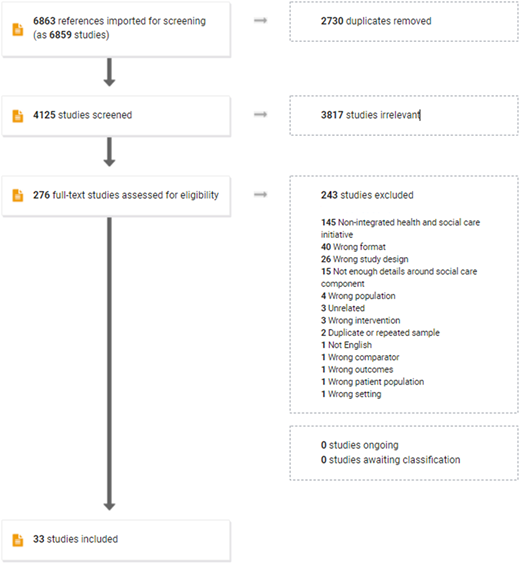
A preferred reporting items for systematic reviews and meta-analyses (PRISMA) flowchart is provided as Figure 1. Of the six databases searched up and until the 30th of November 2021, our searches yielded 4,125 studies. Based on title and abstract screening, 276 studies were eligible for full-text review, with 33 of these studies being included in the final narrative review.
Table 2 provides details on each of the selected studies, country, including aims, study design, type of participants, sample sizes, sampling and relevance (target population). The top 3 countries reporting health and social care initiatives in the literature are the UK (n = 13), followed by the USA (n = 7) and the Netherlands (n = 4). Studies focussed on providing social care for older adults (n = 13) (Terracciano et al., 2021; Aredes et al., 2021; Pruitt et al., 2018; Perman et al., 2021; Mateo-Abad et al., 2020; Vestjens et al., 2019; Spoorenberg et al., 2019; Elston et al., 2019; Wong et al., 2020; Sadarangani et al., 2019; Tong et al., 2020; Doheny et al., 2020; Janse et al., 2016), followed by initiatives targeting social care for multimorbidity (n = 14) (Melvin and Gipson, 2019; Collins et al., 2017; Moretti, 2017; Davenport, 2021; Zarnegar et al., 2017; Eastwood et al., 2019; Talbot et al., 2020; de Vries McClintock et al., 2016; Ismail et al., 2020; White et al., 2021) and corresponding social needs (Aboutanos et al., 2019; Cammy, 2017; Van Dijk et al., 2016; Pauley et al., 2016), initiatives addressing fragmentation of systems more broadly (n = 3) (Bussu and Marshall, 2020; Murphy et al., 2017; Alexander et al., 2018) and initiatives aimed at community outreach in the context of integrated care (n = 3) (Moon et al., 2021; Chng et al., 2021; Sohanpal et al., 2017).
Aim 2. what is the current state and types of “social care” within the current integrated care space?
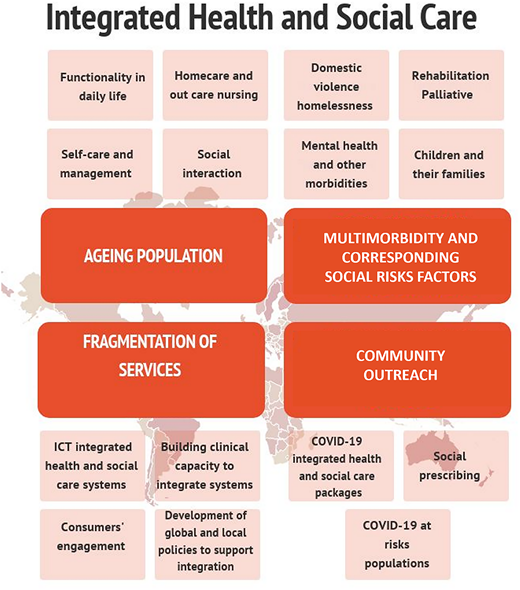
Social care was defined by four main types (Figure 2), including (1) community outreach dialogues, (2) supporting ageing populations, (3) targeting multimorbidity and corresponding social factors and (4) addressing fragmentation of services.
“Social care as community outreach dialogues” involves innovative and emerging social care strategies seeking to address service gaps and past failures when integrating social care enhanced by a dynamic COVID-19 pandemic backdrop.
“Social care as supporting ageing population” is comprised by all the initiatives that focuses on improving health and social outcomes for the elderly (frail, non-frail and dwelling).
“Social care targeting multimorbidity and corresponding social factors” involves initiatives aimed at addressing the needs of varied cohorts with complex needs, including pain management and functionality, acquired brain injury and occupational health, end- of-life social needs, domestic violence (DV), youth and mental health needs amongst others.
The next type is comprised of initiatives addressing fragmentation of services, creating a bridge between health and social care systems. This is primarily approached by exploring global barriers and facilitators of integration at a system level (e.g. evaluation of integrated information technology systems for health and social care).
All initiatives described in the literature (n = 33) had a care coordination component (a dedicated position assigned with the role of coordinating all the aspects of social and health care).
Social care as community outreach
There were three initiatives under this category. There is no doubt that COVID-19 has accelerated the development of social systems and care to address social needs and risks. In 2021, an initiative was implemented to provide community-led and -integrated mental health care and social services in response to the COVID-19 pandemic in Latino communities utilising promotores de salud (community health workers) (Moon et al., 2021). Two other initiatives focussed on social prescribing by utilising community link workers to support vulnerable individuals experiencing social and health multimorbidity in the UK (Chng et al., 2021; Sohanpal et al., 2017). Interestingly, two of the initiatives described in this category emerged in response to accelerated awareness, during the COVID-19 pandemic, of the need to reach and meet the social needs of marginalised populations.
Social care as supporting ageing populations
Selected initiatives that provided health and social care initiatives to older adults (n = 13), focussed on supporting specific needs of the elderly via face to face and/or home based and/or outreach and/or phone based. Key characteristics of “social care” within this category of initiatives include social care assessments and personalised plans to target older adults' social needs. Six initiatives (Perman et al., 2021; Terracciano et al., 2021; Aredes et al., 2021; Vestjens et al., 2019; Doheny et al., 2020; Janse et al., 2016) provided practical support (e.g. paid carers, home carers, home nurse and domestic helpers) and home space adaptation as part of their social care package. One initiative (Pruitt et al., 2018) provided telephone referral services (only) staffed with representatives who have personal experiences with the social service system. Six initiatives (Mateo-Abad et al., 2020; Spoorenberg et al., 2019; Elston et al., 2019; Wong et al., 2020; Sadarangani et al., 2019; Tong et al., 2020) included an intensive service coordination component (outsourcing or establishing connections with existing services) along with capacity building to increase older adults' capability to manage their conditions.
Social care targeting multimorbidity and corresponding social risks factors
In total, 14 selected initiatives aimed at targeting health and social multimorbidity and corresponding risk factors (n = 14). Two initiatives (Melvin and Gipson, 2019; Collins et al., 2017) addressed the health and social needs of (1) people living with HIV. Both provided social care referrals to services (transportation, emergency food assistance, housing and legal service) and delivery of social programmes (music, art and recreational ousting) and care coordination, although only one of them provided in-house low-threshold nursing care services (e.g. health assessments, medication assistance, support and symptom management) (Collins et al., 2017).
Three initiatives focussed on integrated health and social care for (2) people in rehabilitation (Moretti, 2017; Davenport, 2021; Zarnegar et al., 2017). An initiative to address chronic conditions and reduce occupational performance in adults was undertaken with the assistance of occupational therapists (Davenport, 2021); an initiative that used social workers to accompany people with acute brain injury (ABI) and their families for six months to conduct a support path, from hospital discharge to home care and social reintegration (Moretti, 2017) and an initiative that focussed on pain management, that included artistic, musical and horticultural activities, visits and outings as well as supporting social referrals and applications (e.g. for disability benefits for pensions or looking for employment) (Zarnegar et al., 2017).
There were two initiatives that developed integrated social care for (3) families and children experiencing vulnerability and disadvantages (Eastwood et al., 2019; Talbot et al., 2020). Three initiatives provided integrated health and social care for (4) people with mental health and other co-occurring conditions (de Vries McClintock et al., 2016; Ismail et al., 2020; White et al., 2021), utilising a combination of interventions delivered by health and non-health professionals to support adherence to treatment and to assist with application to receive social welfare. Social care initiatives that targeted (5) social risks factors such as intimate partner violence (Aboutanos et al., 2019) and initiatives targeting housing instability (Van Dijk et al., 2016; Pauley et al., 2016) have also been implemented. Finally, one integrated social care focussed on (6) end-of-life care for terminal patients and their families led by social workers (Cammy, 2017).
Social care as patching fragmentation of systems
Of the 33 initiatives selected, 3 aimed at improving fragmentation in health and social care systems (Bussu and Marshall, 2020; Murphy et al., 2017; Alexander et al., 2018). These included a service integration training package targeting clinicians’ literacy around social services when conducting early interventions with children and their families (Alexander et al., 2018); an initiative that identified collaborative approaches and services for all sectors of society and age groups (Murphy et al., 2017) in the context of integrated care in the UK; and a novel system introducing care navigators who support complex adults and help them navigate the health and social care system (Bussu and Marshall, 2020).
Aim 2. What is the level of integration regarding governance and partnerships, workforce and staffing, financing and payment and data-sharing use in the context of integrated health and social care?
We reviewed the literature for evidence that health and social care are being integrated beyond the point of pilots or time-limited programmes and to what extend the initiatives are fostering joint governance and decision-making, integrated workforce and staffing, integrated financing systems and data-sharing and use. Supplementary File outlines the data extracted by category for each initiative in detail.
Of the 33 initiatives reported in the reviewed literature, 11 were jointly led, by either a combination of tertiary education (universities and research centres) organisations and primary health networks or public health systems (hospitals and community/day health centres) and/or non-for-profit organisations (Terracciano et al., 2021; Moretti, 2017; Bussu and Marshall, 2020; Van Dijk et al., 2016; Spoorenberg et al., 2019; Ismail et al., 2020; White et al., 2021; Aboutanos et al., 2019; Zarnegar et al., 2017; Sohanpal et al., 2017; Alexander et al., 2018). In total, 20 initiatives were led by primary health network or hospital systems (Aredes et al., 2021; Pruitt et al., 2018; Collins et al., 2017; Davenport, 2021; Perman et al., 2021; Moon et al., 2021; Mateo-Abad et al., 2020; Eastwood et al., 2020; de Vries McClintock et al., 2016; Talbot et al., 2020; Vestjens et al., 2019; Elston et al., 2019; Melvin and Gipson, 2019; Wong et al., 2020; Sadarangani et al., 2019; Tong et al., 2020; Doheny et al., 2020; Chng et al., 2021; Janse et al., 2016; Murphy et al., 2017), and only one initiative did not report a leading organisation/s (Pauley et al., 2016).
Integrated governance and partnerships
In total, 21 initiatives reported supporting and expanding integrated governance and partnerships by either creating professional networks with experts from other organisations or development of steering and advisory committees (Aredes et al., 2021; Collins et al., 2017; Cammy, 2017; Moretti, 2017; Bussu and Marshall, 2020; Van Dijk et al., 2016; Moon et al., 2021; Mateo-Abad et al., 2020; Eastwood et al., 2020; Talbot et al., 2020; Vestjens et al., 2019; Elston et al., 2019; Wong et al., 2020; Sadarangani et al., 2019; Doheny et al., 2020; White et al., 2021; Aboutanos et al., 2019; Janse et al., 2016; Zarnegar et al., 2017; Murphy et al., 2017; Alexander et al., 2018).
Integrated health and social care roles
In total, 27 initiatives reporting having health and social care staff integrated in practice, with a strong role description and mapping, along with clear integrated governance (Aredes et al., 2021; Terracciano et al., 2021; Pruitt et al., 2018; Cammy, 2017; Moretti, 2017; Bussu and Marshall, 2020; Perman et al., 2021; Pauley et al., 2016; Moon et al., 2021; Mateo-Abad et al., 2020; Eastwood et al., 2020; Talbot et al., 2020; Vestjens et al., 2019; Spoorenberg et al., 2019; Elston et al., 2019; Ismail et al., 2020; Wong et al., 2020; Sadarangani et al., 2019; Tong et al., 2020; Doheny et al., 2020; White et al., 2021; Aboutanos et al., 2019; Chng et al., 2021; Janse et al., 2016; Murphy et al., 2017; Sohanpal et al., 2017; Alexander et al., 2018).
Integrated financing systems
In total, 17 initiatives were designed with dedicated and sustainable funding beyond the scope of their research (Aredes et al., 2021; Bussu and Marshall, 2020; Davenport, 2021; Perman et al., 2021; Van Dijk et al., 2016; Moon et al., 2021; Eastwood et al., 2020; Talbot et al., 2020; Elston et al., 2019; Ismail et al., 2020; Sadarangani et al., 2019; Doheny et al., 2020; White et al., 2021; Chng et al., 2021; Janse et al., 2016; Aboutanos et al., 2019; Mateo-Abad et al., 2020). This was primarily sourced from health systems with ongoing service funding.
Data-sharing and use
In addition, only 11 out of 33 initiatives reported the use of data-sharing and the integration of health and social records as part of their scope of practice (Pruitt et al., 2018; Cammy, 2017; Davenport, 2021; Mateo-Abad et al., 2020; Spoorenberg et al., 2019; Elston et al., 2019; Melvin and Gipson, 2019; Sadarangani et al., 2019; Doheny et al., 2020; White et al., 2021; Aboutanos et al., 2019).
Discussion
We sought to undertake a narrative review of recent literature (2016–2021) to explore current and evolving definitions, dialogues and novel approaches to social care in the context of integrated health and social care. Our review identified 33 integrated health and social initiatives and mapped four types: social care as community outreach dialogues, social care for supporting ageing population, social care targeting multimorbidity and corresponding social risks factors and social care as patching fragmentation of systems and fragmentation of systems. The UK is still leading the development and reporting of national policies and the implementation and evaluation of integrated health and social care initiatives, which are in line with previous reports (Amelung et al., 2021). This suggests that the generation of integrated care policies (dating back the 2000) in the UK has had ripple effects that are now evidence in funding opportunities and service delivery (Amelung et al., 2021) both of which are crucial pillars for full integration of health and social care.
Whilst the most common conceptualisations of integrated health and social care is still manifested in services and programmes for older adults, there is an emerging and significant trend of similar approaches used to address social and health multimorbidity and other social risks factors targeted at vulnerable groups beyond the elderly.
Importantly, the literature we reviewed showed several recent innovations in integrating health and social care. We found integrated health and social care responses to COVID-19 are emerging, primarily in the USA and the UK in the past year and that these are innovative not only in terms of breadth and definition of social care, but also in scale, funding and governance.
Another key innovation is the introduction of the concept of “social prescribing” as a formal service provision deliverable (using service designs and methods taken from “medical prescribing”) included in health plans for consumers (and carers) which also gained traction in 2020 and 2021 (Chng et al., 2021; Sohanpal et al., 2017). This demonstrates that dialogues and understanding around social care has certainly shifted and is now evolving into a more discussed, established and recognised as valid “model of care” (Amelung et al., 2021).
Moreover, health and social care systems have now started to explore the “bigger picture” and dive and explore “why” are the systems fragmented and “how” can this be addressed, considering the perspectives of medical stuff, clinicians, frontline social workers, decision and policies makers, consumers and carers.
Unfortunately, our results indicated that only five initiatives demonstrated “full integration” by reporting “supportive and expanding integrated governance and partnerships”, “integrated workforce and staffing”, “integrated financing and payment” and “integrated data-sharing and use”. Of note, is that data-sharing is still uncommon and the least developed strategy in the reviewed initiatives. This is a recurrent challenge many systems have faced both between sectors (e.g. social vs health care systems) and intra-sector (e.g. within the health system) (Wodchis et al., 2020). Future directions should include the development of global and local policies that foster the integration of health and social care data-sharing, along with dedicated funding to support the development of information technology (IT) systems, IT staff and a dedicated unit that can support access to these data not only for internal quality improvement, but also for advancing knowledge through research whilst ensuring the confidentially of consumers (Wodchis et al., 2020).
Several limitations of this study must be noted. This study utilised only studies written in English language and consequently may have missed health and social care initiatives conducted (and written) in non-English speaking countries and in particular low- and middle-income countries. In addition, this review did not assess the studies using a quality assessment approach (sampling, quality of instruments and research procedures) mainly because our primary goal was to map “definitions of social care”, and its evolution overtime, rather than critically analyse their effectiveness.
Strength of this study includes the use of multiple reviewers for article screening and selection, and the use of an extraction tool, in an attempt to conduct a review with a more systematic approach. In addition, this review also provides with an understanding on how well these initiatives are integrating and fostering systems and that enhance integrated health and social care which is novel.
Conclusion
Social care approaches are expanding beyond assisting the elderly, and these models have been used to outreach vulnerable communities, address social and health system fragmentation and to respond to social and health multimorbidity and other social risks factors. The UK, through their mature policy framework, is delivering and leading most of the published work in integrated health and social care initiatives worldwide.
Integrated governance and partnership and health and social care staff integrated were the more used components in the initiatives reviewed. Structures to achieve full integration, including global and policy generation are still needed, and are particularly essential to support sustainable integrated financing and payments and integrated data-sharing amount multidisciplinary teams.
Funding: The first author (GU) is funded by a National Health Medical Research Centre Integrated Health and Social Health Centre for Research Excellence (No: APP1198477). JE is the Principal Chief Investigator of this grant. CHS, JG and PH are also Chief Investigators on this grant
Research ethics approval and consent to participate: This is a scoping review of literature available and retrieved from scientific databases and as such patients' involvement was not sought.
Availability of data and materials: Data and materials used during the present study are available upon reasonable request from the corresponding author.
Consent for publication: Not applicable.
Authors’ contributions: GU, CHS, JG, JE, SW, KO, CM and PH conceived and designed the study as well as the search terms. GU and FCM screened the studies for inclusion and exclusion and GU was responsible for the data extraction, with assistance from CHS. GU and TF conducted the data analyses. GU and CM draughted the manuscript. All authors made critical revisions, read and approved the final manuscript.