This paper examines how third-sector organizations and volunteers are integrated into health and social care through the development of Family Centers (FCs) in Brescia, Italy. It investigates the structural, operational, and cultural conditions that shape collaboration between third-sector actors and socio-health professionals, identifying barriers and facilitators that affect service co-delivery. The study also explores the co-delivery strategies used to clarify mandates, strengthen referral and information flows, and sustain multi-actor collaboration within an established service ecosystem.
The study used a multi-phase qualitative design combining a targeted literature review with empirical inquiry in the Brescia Family Centers. Data were collected through twelve semi-structured interviews with socio-health professionals and third-sector actors involved in FC planning and delivery (April–July 2024). Interviews were audio-recorded, transcribed verbatim, and coded in NVivo. Findings were developed through abductive analysis and refined by considering negative cases. To validate and deepen interpretation, the interview synthesis informed three participatory workshops that supported collective reflexivity and helped consolidate barriers, facilitators, and co-delivery strategies across the service ecosystem.
Findings show that integrating third-sector partners into the FC model depended on resolving structural, operational, and cultural conditions. Key barriers included a weak FC identity due to the lack of a distinct space and dedicated staffing, role overlap with Counseling Centers, and fragmented coordination across actors and case follow-up. Cultural resistance to non-clinical approaches initially limited the uptake of pedagogical and mediation roles. Facilitators included multidisciplinary collaboration, rapid intake and routing through the FC’s orienting functions, calibrated engagement intensity, and culturally responsive practices that broadened support beyond clinical framings.
This single-case study, focused on early-stage implementation in Brescia, Italy, limits generalizability. Broader, comparative research is needed to assess long-term impacts and applicability in different contexts. Future studies should explore how hybrid governance evolves over time and examine measurable outcomes of third-sector integration in health and social care systems.
The findings offer actionable insights for managers aiming to improve coordination between public services and third-sector actors. Emphasizing role clarity, structured communication, and flexibility can reduce fragmentation and enhance collaborative service delivery.
Understanding how integrating third-sector organizations supports more inclusive, responsive care. This approach strengthens connections to local communities, facilitates access for vulnerable groups, and promotes shared responsibility in addressing complex social and health needs.
This study contributes to the growing literature on integrated care by offering empirical insights into the co-production of family-oriented services through third-sector involvement. It proposes actionable strategies to enhance collaboration and sustainability in hybrid governance models, providing guidance for policymakers, practitioners, and researchers engaged in service innovation and community-based care.
1. Introduction
Since the early 1990s, the third sector in Europe has experienced significant growth, encompassing charities, cooperatives, voluntary organizations, and social enterprises. These entities have evolved into hybrid organizational forms that blend characteristics of state and market actors, thereby challenging traditional classifications (Brandsen and Pestoff, 2006; Evers, 2005). This evolution reflects increasing specialization and differentiation driven by the sector’s expanding role in public service co-production (Hasenfeld and Gidron, 2005). Both national governments and the European Union (EU) increasingly recognize the sector’s social and economic contributions, fostering partnerships to deliver innovative, community-oriented services (Osborne, 2009; Schin et al., 2023). In the field of public health, co-production has become central to addressing rising healthcare costs while promoting patient-centered care (Fusco et al., 2020; World Health Organization, 2023). Co-production entails collaboration among citizens, third-sector organizations, and public entities throughout the phases of policymaking, consultation, design, and implementation (Lelieveldt et al., 2009). Despite increasing policy attention (Zimmer and Pahl, 2018), research on integrating third-sector organizations into health innovation networks, particularly within multi-actor partnerships, remains limited (Mazzei et al., 2019; Sørensen and Torfing, 2022). This gap limits understanding of the sector’s capacity to innovate and contribute to integrated health and social services.
Co-production dynamics pose additional challenges in fostering mutual trust, shared governance, and balanced influence among organizations. Windrum (2014) highlights that co-production necessitates semi-permeable boundaries between complementary providers, enabling reciprocal learning and the co-evolution of competencies. As these interdependencies deepen, the competencies of one organization increasingly affect its co-producers, resulting in co-dependent relationships. However, there is limited research on how external actors influence the adoption and diffusion of innovative practices within the third sector (Lebec and Dudau, 2023; Osborne, 2009).
Over time, scholars have argued that hybrid welfare arrangements are not only collaborative but also arenas of power negotiation (Centeno, 2025; Gillett et al., 2019; Lægreid and Rykkja, 2015). Strokosch and Roy (2024) and Sancino and Jacklin-Jarvis (2016) emphasize that collaboration can reproduce existing asymmetries in authority and resource distribution within public–third sector partnerships. Meanwhile, the involvement of volunteers can lead to symbolic or organizational exploitation when participation substitutes rather than complements professional work (Hustinx et al., 2022).
This study examines a hybrid co-production model (Kekez et al., 2024; Hasenfeld and Gidron, 2005) for implementing Family-Centered Care (FCC) by integrating volunteers and third-sector organizations with socio-health professionals. It seeks to address the following research questions:
Which factors influence collaboration between volunteers and socio-health professionals in integrating third-sector organizations into health and social care models?
How can inter-professional co-delivery approaches facilitate meaningful interactions and enhance service integration?
1.1 The family centered care model
European health and social care systems have increasingly adopted Family-Centered Care (FCC) approaches that emphasize prevention, relational well-being, and intersectoral collaboration (Engle et al., 2021; National Academies of Sciences et al., 2021). This study adopts a co-production perspective, understood as the joint design and delivery of services by professionals, citizens, and third-sector actors (Brandsen and Pestoff, 2006). Within this approach, holistic care denotes the integration of social, psychological, and medical dimensions that contribute to family well-being. The research examines FCC implementation through the collaboration with the ASST Spedali Civili di Brescia, which supported the experimental development of Family Centers (FCs, Centri per la Famiglia) by articulating their identity, defining objectives, and identifying areas for improvement.
Healthcare planning in Italy has evolved progressively from a biomedical to a biopsychosocial model, recognizing the interplay of biological, psychological, and social factors (Istituto Superiore di Sanità, 2021; Kusnanto et al., 2018). FCC embodies this approach by positioning families as central care units and fostering partnerships among healthcare providers, patients, and relatives (Kokorelias et al., 2019; Secunda and Kruser, 2022). These partnerships promote coordinated, comprehensive care across healthcare, education, and social domains (Perrin et al., 2007), as defined by the Institute for Patient- and Family-Centered Care (2012).
The Italian healthcare system adopted FCC principles through progressive legislation, starting with the establishment of family Counseling Centers (CCs) (Legge n. 405, 1975). This evolution led to the creation of FCs, designed to enhance accessibility and address family needs across the entire life cycle. Conceived as community spaces, FCs provide flexible, community-specific responses (Department for Family Policies, 2012). Their implementation is rooted in the broader legal framework of Italian social policy, particularly Law 328/2000 (Legge n. 328, 2000), which established the integrated system of social services and promoted co-responsibility among public, private, and community actors. At the European level, the EU Social Services Directive (European Commission, 2022) reinforces this orientation toward subsidiarity and cross-sector collaboration, framing local welfare innovation within a multilevel governance structure that both enables and constrains regional experimentation.
In Lombardy, FCs have become focal points for social and healthcare integration, supported by recent regional legislation (Regione Lombardia, 2022, 2023). Unlike CCs, which rely primarily on socio-health professionals such as psychologists and social workers, FCs emphasize educational and social support by engaging third-sector organizations and volunteers. Biennial trials (2020–2022) tested co-design practices and innovative intervention methods to strengthen these collaborations.
A cornerstone of the model is the FamILens® framework (Carrà, 2023; Carrà and Moscatelli, 2024), which advances a “think-family” approach to policy and service design. Rooted in principles of family responsibility, relational stability, and active participation (Centro Internazionale Studi Famiglia (CISF), 2023), FamILens® introduces a meso-level governance logic that institutionalizes family participation in decision-making. In contrast to established frameworks, such as WHO’s community-based care (WHO, 2005, 2020), which emphasizes population-level accessibility, and Patient- and Family-Centered Care (PFCC) models focused on micro-level interactions, FamILens® bridges these scales by positioning the family as both beneficiary and co-designer of services. This operational shift from care for families to care with families constitutes its main conceptual innovation. Its distinctiveness lies in viewing policies and interventions through a family impact lens that evaluates effects on cohesion, resilience, and intergenerational well-being, while embedding relational reflexivity to examine how institutional practices shape intra-family dynamics and how families influence service uptake. By formalizing co-design, FamILens® redefines collaboration between institutions and households, connecting policy design, service delivery, and everyday family experience. This makes it particularly suited to FCs in Lombardy, which operate at the intersection of health, education, and social care.
Despite these advances, challenges remain in aligning policy and practice to ensure more structured and continuous family support. Leveraging frameworks like FamILens® and strengthening partnerships between third-sector organizations and public entities are crucial for delivering adaptable, family-centered interventions that are responsive to local needs.
Throughout this paper, the term “volunteers” refers to individuals who provide unpaid support within FC activities. At the same time, “voluntary organizations” or third-sector organizations denote structured, non-profit entities that collaborate with public services. These organizations receive public funding to sustain their activities in continuity with the institutional offer, operating as complementary partners rather than external charities. Similarly, the term “socio-health professionals” refers to individual practitioners (e.g. psychologists, social workers) rather than healthcare institutions. This clarification is necessary given the Italian policy context, where the terms volontariato and terzo settore are often used interchangeably to describe both individual and organizational actors engaged in welfare co-production.
2. Methodology
The study aims to identify key barriers and facilitators in integrating third-sector and volunteer organizations into health and social care models. Additionally, it explores strategies to foster effective collaboration between third-sector organizations and socio-health professionals through an interprofessional co-delivery approach.
To deepen the understanding of dynamics in service co-delivery, twelve semi-structured interviews were conducted with key stakeholders involved in the planning and operation of FCs (Table 1), including socio-health professionals from the Local Health Authority (Azienda Socio-Sanitaria Territoriale, ASST) and third-sector actors, between April and July 2024 (Adeoye-Olatunde and Olenik, 2021). These interviews aimed to capture the perspectives and experiences of individuals directly involved in the project, with a focus on implementation and collaborative processes.
The interviews were structured into several sections (Table 2), each designed to gather comprehensive information on the interviewees’ roles, activities, and perceptions of the new FC relative to the family CCs’ existing services.
The interviews were recorded and transcribed verbatim, with the transcripts serving as the primary data source for coding, using NVivo software. The synthesized data informed the design of three workshops, which were essential for validating findings and fostering collective reflexivity (van Kemenade et al., 2022). The first workshop focused on alignment and the co-definition of the service model, leading to the development of a service model canvas. The second workshop involved analyzing and mapping the ecosystem of actors, services, and relationships based on stakeholder perceptions. The third workshop was oriented toward the formalization and communication of the service, through the co-creation of a service charter, identified as a strategic tool to support the consolidation and further development of the model. The first author’s background in service co-design influenced the focus of the interviews on collaboration and user experience. The researcher’s stance was that of a facilitator rather than an advocate, using design methods to support participants in articulating both enablers and criticalities of the integration process (Vink and Koskela-Huotari, 2022). Peer discussion helped maintain awareness and ensured that the analysis reflected divergent perspectives rather than reinforcing institutional narratives. The results were classified abductively (Veen, 2021) into two main themes: the first examines factors influencing collaboration between third-sector organizations and socio-health professionals in emerging health and social care models, while the second outlines strategies that foster meaningful interaction and strengthen integration through interprofessional co-delivery. Negative cases were considered during the abductive analysis, in line with qualitative research standards that emphasize the value of discrepant evidence for refining categories and strengthening the identification of barriers (Mays and Pope, 2000). However, despite the diversity of professional and organizational roles included in the sample, the study did not capture the perspectives of disengaged volunteers or operators who were less directly involved in FC implementation. The absence of these viewpoints may have constrained the range of negative or divergent experiences available for comparison, potentially reinforcing an emphasis on enabling factors reported by more engaged participants.
3. Results
3.1 Factors influencing effective collaboration between third-sector organizations and socio-health professionals
To examine the factors influencing collaboration, findings are organized across structural, operational, and cultural dimensions (Ager and Strang, 2008; Auschra, 2018). Structural factors refer to governance and resourcing arrangements; operational factors capture coordination routines and workflows; cultural factors reflect norms and professional assumptions that shape collaboration (Anderson et al., 2022; Grindell et al., 2022). Table 3 summarizes the main barriers and facilitators identified.
3.1.1 Structural barriers
Lack of a defined, distinct location: the FC’s identity remained weak because it lacked a clearly identifiable space and a stable, dedicated team. This condition reduced visibility for families and blurred boundaries with the CC, especially when access points and staffing were shared with other services.
The main challenge has been the absence of a defined location and dedicated staff exclusively for the FC. This has made distinguishing the FC from the CC difficult, creating confusion among users who often struggle to differentiate between the two services – FC Project Manager, May 21, 2024.
3.1.2 Operational barriers
Role overlap and limited capacity: operationally, staff were often required to work across both the CC and the FC (including call-center functions), which constrained the FC’s capacity to operate as an independent service and complicated case handling.
The presence of operators who work both at the CC and the FC creates confusion and difficulties in clearly distinguishing the two services – Educator for Mental Health Desk, May 21, 2024.
In addition, the FC’s limited access to dedicated social professionals reduced the breadth and continuity of activities and weakened coordination with third-sector partners. Limited capacity also restricted the systematic involvement of complementary professional figures (e.g. pedagogists).
Often, we do not have the resources available to collaborate with external partners, such as pedagogists […] The FC and the CC have the same operators handling the same cases, but with the addition of the FC’s resources, which can sometimes complicate things rather than simplify them – Social Worker 3, May 29, 2024.
Fragmented coordination along the pathway: communication among health and social professionals and third-sector organizations was inconsistent, particularly regarding shared protocols and follow-up in individual case management. Some actors reported being involved only after initiating a pathway, limiting continuity and mutual understanding.
The lack of communication with other service providers before and after meetings has limited the ability to understand the family situation fully – Linguistic-cultural Mediator 1, May 29, 2024.
3.1.3 Cultural barriers
Resistance to shifting approaches: some clinical professionals were initially hesitant to integrate educational perspectives, slowing the activation of specific FC services such as pedagogical counselling. This was reinforced by local expectations that parenting-related needs should be addressed primarily through psychological frameworks.
Activating pedagogical counseling services has been challenging because the local territory and the consulting figures were not accustomed to working with the educational-pedagogical aspect, preferring the psychological approach – Pedagogist, May 21, 2024.
3.1.4 Structural facilitators
Multidisciplinary collaboration for holistic care: social workers, who had experiences with existing services and had a crucial role in orienting families through the services, perceived integrating diverse professional profiles (e.g. mediators, pedagogists, educators, caregivers) complements clinical roles and expands the range of available interventions, supporting more coordinated responses to complex psychosocial and medical situations.
We expanded services by offering parenting support with a pedagogist, organizing group activities for educators and parents, and collaborating with voluntary organizations. [These new projects and activities] highlight the FC’s ability to provide interventions beyond the scope of the counseling center – Social Worker 1, May 21, 2024.
3.1.5 Operational facilitators
Timely orientation and modular responses: the FC functioned as a low-threshold access point, enabling rapid intake and “routing” of requests. By clarifying needs early and offering brief first-line support, the service reduced waiting times and directed families to the most appropriate pathway. When the FC was not the right setting for a request, staff activated referrals to territorial services, sparing families the burden of navigating multiple providers on their own.
With the FC, we can efficiently manage requests and schedule appointments within 15 days […] Now, with just one or two meetings, we can quickly direct them to the most appropriate services – Social Worker 2, May 29, 2024.
The FC’s flexibility primarily concerned the length and intensity of its engagement with a case. Rather than taking on open-ended case management, the service relied on time-limited consultations with adjustable intensity: support could remain brief for straightforward needs, while explicit exceptions allowed extended engagement for particularly difficult or complex situations. This rule-based calibration helped protect accessibility and sustainability in a free, public service, while still preserving the capacity to respond when continuity was necessary.
The FC typically operates through customized, time-limited consultation meetings. While we generally avoid handling cases that require indefinite support, we make exceptions for particularly complex or severe situations that demand extended or ongoing intervention. We work in this way because, as a free service open to the public, we need to be able to respond to everyone – Social Worker 3, May 29, 2024.
3.1.6 Cultural facilitators
Integrated educational and pedagogical framework for enhanced family support: Integrating educational and pedagogical perspectives expanded the FC’s interpretive lens beyond predominantly clinical or psychological framings. Educational professionals working alongside clinical staff helped reframe certain requests, especially parenting-related concerns, from “individual distress” to everyday educational dynamics, enabling families to access support better matched to their needs. This complementary perspective strengthened the service’s ability to respond to complex situations without defaulting to therapeutic intervention.
The presence of educational figures alongside clinical ones facilitates families’ access to the service and offers comprehensive support beyond mere clinical intervention – Educator for Mental Health Desk, May 21, 2024.
Often, in the Counseling Center, parents seek psychological support when they are struggling to manage their child. However, in many cases, they need the expertise of a pedagogist rather than psychological intervention – Social Worker 3, May 29, 2024.
Adaptive support strategies for diverse family needs: Adaptation occurred through specialized group programs for recurring family challenges (e.g. separation and conflict), which offered preventive, non-therapeutic support formats complementary to one-to-one consultations. Collaboration with the counselling service primarily ensured appropriate escalation when therapeutic pathways were required, without shifting the FC into a treatment role.
We have established support groups for separated parents and families experiencing conflict. While the center does not serve a therapeutic function, collaborations with the counseling service have enabled us to guide families toward more appropriate forms of support […] – Family CC Director June 6, 2024.
3.2 Strategies for co-delivery to enhance service integration
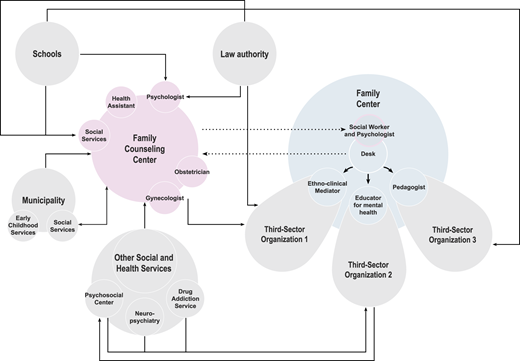
Analyzing the barriers and facilitators to integrating third-sector organizations into community- and family-based care highlighted the importance of defining the FC’s identity within the existing service ecosystem. Interviewees described a dual tension, consistent with Windrum (2014), between embedding the new model within existing structures and distinguishing it from the CC to avoid overlap in roles and functions. This clarification unfolded through a collaborative sensemaking process (Mizrahi-Shtelman, 2019; Vough et al., 2020), during which stakeholders refined the scope, responsibilities, and target populations of each service. While the first workshop led to the development of the service model canvas, highlighting key features emerging from the comparison between regional guidelines and the practices of the Brescia FC, the second workshop represented the primary setting in which this differentiation was operationalized. Participants co-designed an service ecosystem map, situating the FC within a broader network of services, to make explicit entry points, first-contact responsibilities, and expected referral and information flows across FCs, CCs, and other social and healthcare services (Figure 1).
This was a necessary activity because a recurring implementation challenge concerned the FC’s positioning within the CC’s established workflow. Participants described early ambiguity about the FC’s remit and added value, especially in settings where a clinical logic tended to dominate despite the presence of social functions. This lack of differentiation shaped how some interventions were received and sustained.
There was a lack of clarity about who we were as a Family Center. We were entering an ongoing flow of CC activities, and the overlap between FCs and CCs hindered things; what we did and the rationale for some interventions weren’t clear. In some CCs, the clinical-medical side prevailed. [ …] Ethno-cultural mediation, though, worked very well: social workers asked to keep it. The [support] groups didn’t work, but mediation did, because it strongly supported the social side and helped us understand situations better» (Ethno-clinical Mediator, May 21, 2024).
Figure 1 reproduces an excerpt from this artefact as evidence of that negotiation work, showing how the distinction between FCs and CCs was translated into practical decisions about who activates a case, where referrals are directed, and what information should be returned. By making these handovers explicit, the mapping exercise aligned professional roles and reinforced the complementary contributions of FCs and CCs, creating clearer mandates and supporting more reliable referral pathways over time (Table 4).
While many interviewees described constructive collaboration, the results also revealed boundary tensions that exposed where co-delivery remained fragile, particularly at interfaces with clinical services and external institutions. Cultural mediators portrayed their involvement as frequently occurring late in the case trajectory, limiting their capacity to contribute interpretively and repositioning mediation as reactive support rather than an integrated component of care. As one mediator recounted, reflecting on her involvement in a case initiated by the CC and subsequently addressed within a coordinated process with the juvenile court:
First, we need to know what we are going to face. Too often, I arrive without any sense of what to expect; even when continuity is promised, I may be brought in after other colleagues have already been following the case. [ …] I try to create dialogue, but with limited time, I sometimes end up doing only translation. [ …] I often ask for a debrief after the session, but that possibility is not always there» (Linguistic-cultural mediator 1, May 29, 2024).
In practice, late activation constrained mediation to immediate communicative support rather than sustained participation in case interpretation. Mediators also described uneven recognition of their contribution within some clinical and external services, where clinical priorities tended to dominate,
[They] did not see the added value of social activities compared to clinical ones Ethno-clinical Mediator, May 21, 2024).
At the same time, linguistic asymmetries and differing expectations around parental roles complicated engagement with families, often shifting interactions toward conflict management rather than collaborative problem framing. These challenges were compounded by ambiguity around early implementation. In some CC contexts, the FC entered established clinical workflows without a clearly differentiated mandate, limiting integration to episodic collaboration. As a result, intervention formats evolved unevenly: group activities struggled to stabilize, whereas ethno-cultural mediation gained recognition as a practical resource for interpreting complex family situations.
Rather than remaining unresolved, these frictions informed subsequent organizational adjustments. Actors refined referral pathways between FCs and CCs and redesigned outreach strategies through closer collaboration with cultural mediators and community partners. To support these changes, FCs introduced coordination instruments, including service charters, co-designed during the third workshop, functioning as memoranda of understanding (Shapiro et al., 2023), alongside regular coordination meetings and shared basic digital monitoring tools (e.g. Excel templates) to strengthen accountability and communication across organizations.
3.2.1 Focusing on a different target
The FC is a facility dedicated to addressing the comprehensive needs of the whole family unit. Its primary focus is supporting families experiencing collective challenges, including parenting difficulties, psychological distress, and migration-related issues. The center’s strategic role is to offer an integrated approach to family support, combining services that respond to the diverse needs of family members within a unified framework across all stages of family life.
In contrast, family counseling services provide individualized support within the family context. Their primary objective is to address personal development and psychological well-being at the individual level. Specialized counseling services foster personal growth, resolve psychological challenges, and enhance individual resilience within the broader family dynamic.
3.2.2 Designing suitable organizational structures
The FC’s organizational structure is designed to reflect its comprehensive, integrative focus. It operates through a central hub that coordinates a network of satellite locations distributed across the territory. These satellite centers offer integrated, multidisciplinary, and preventive services, enabling the FC to provide a comprehensive range of support tailored to diverse family needs.
In contrast, the CC follows a specialized organizational model prioritizing individualized counseling and therapeutic interventions. Its structure aligns with a traditional centralized healthcare framework, delivering services through distinct standalone units within hospitals or other facilities. Unlike the FC’s hub-and-spoke model, the CC does not feature a central coordinating hub; instead, it relies on separate, distributed units that provide specialized, personalized support independently of each other.
3.2.3 Defining complementary services
The FC’s service delivery system comprises a comprehensive range of initiatives to facilitate families’ orientation and access to essential resources. It supports local services through community-based programs, pedagogical counseling, and parenting assistance while promoting prevention and education through workshops and support groups. Additionally, the center offers a mental health listening desk, which fosters communication among caregivers and provides non-therapeutic, individual support sessions with psychologists or pedagogists.
Unlike the Counseling Center, the FC primarily functions as a consultative resource, offering users immediate guidance. When necessary, initial consultations can evolve into more detailed support or ongoing assistance without formal case management. A key function of the FC is to provide initial orientation, helping users navigate the system and facilitating access to specialized services as needed.
4. Discussion
These findings should be interpreted in relation to the regulatory framework that both enables and constrains the implementation of FCs. While this framework promotes subsidiarity and shared responsibility among public, private, and community actors, it also produces asymmetries in decision-making and accountability. In this context, the institutional coordination required by regional welfare planning can limit FCs’ experimental capacity, reflecting a tension noted by Hustinx et al. (2022) between empowering third-sector organizations and over-institutionalizing their participation. The Brescia case shows how these dynamics are negotiated: identity differentiation, role negotiation, and family-centered reflexivity help stabilize co-production in a system where public professionals, third-sector staff, and volunteers share operational responsibilities. This relational and meso-governance perspective extends existing frameworks by illustrating how institutional and community logics are reconciled through collaborative processes rather than solely through managerial coordination.
Studies by Brandsen and Pestoff (2006) and Lebec and Dudau (2023) demonstrate that the hybrid nature of third-sector organizations presents inherent challenges when partnering with public services. The Brescia case reflects these dynamics: structural limitations, such as the lack of dedicated spaces and restricted access to specialized services, interact with operational barriers, including overlapping roles and inconsistent communication flows, to constrain effective co-delivery. These findings align with the barriers identified by Auschra (2018) while offering empirical depth by showing how these challenges manifest in everyday practice. At the same time, the results indicate that collaboratively clarifying roles, reinforcing service networks, and establishing more structured communication mechanisms can mitigate these barriers and support the integration of third-sector contributions into mainstream services. Instances of unsuccessful integration efforts further underscore these barriers. Attempts to engage migrant mothers, for example, revealed difficulties that extended beyond linguistic uncertainty to include limited familiarity with available services, unclear expectations, and uncertainty about whom to approach for support. One of the main challenges was recruiting women into support group activities, where difficulties arose from internal communication gaps within the CC and from users’ limited understanding of the usefulness of the proposed initiatives. In some cases, participation was further constrained by clinical staff’s skepticism about the added value of social activities compared to clinical interventions.
These experiences were particularly evident in support groups, which struggled to attract sustained participation. Interviewees suggested that the issue did not lie solely in outreach but also in the design and framing of the activities themselves, indicating the need to reconsider both the content and the modes of engagement to better align with the expectations, needs, and perceived relevance of the target population. These challenges underscore the absence of clear, shared entry points for families and reflect the role–negotiation issues observed among professionals: when no single actor is formally mandated or recognized as responsible for initiating first contact or orienting families, coordination becomes fragmented and outreach becomes inconsistent. This challenge is compounded by financial constraints that limit the creation of new roles, making the redistribution of decision-making authority and coordination responsibilities, rather than the addition of tasks, essential for strengthening integration across the FC network. Cultural factors also play a critical role in sustaining cross-sector partnerships. Resistance to non-clinical or innovative approaches within traditional healthcare settings mirrors institutional inertia described in previous studies (Mazzei et al., 2019; Sørensen and Torfing, 2022; Sancino and Jacklin-Jarvis, 2016). The Brescia experience adds nuance by showing how dedicated mediation and educational roles can foster trust, facilitate communication, and reduce friction between socio-health professionals, third-sector actors, and families. These findings underscore that cultural facilitators are as essential as structural and operational arrangements in enabling effective co-delivery of services.
Beyond confirming established theories, this study addresses specific gaps in the literature. Although third-sector involvement in public service delivery is well documented, fewer studies have explored how integration mechanisms function within health and social care systems. By organizing the findings into structural, operational, and cultural dimensions, this research offers a practical framework that clarifies how different organizational factors influence integration processes. It also contributes empirical evidence to discussions of co-delivery in health and social care, where real-world examples remain limited despite extensive theoretical debate (Windrum, 2014).
Although rooted in Italian welfare architecture, the FC model exhibits several features that support its transferability to comparable Southern European systems (Rodrigo et al., 2020). This geographical emphasis is grounded in the shared features of the Mediterranean welfare regime, characterized by fragmented coordination and strong familistic orientations, which, as Ferrera (1996) notes, create comparable conditions for models like the FC to operate and scale. In countries such as Spain (Hidalgo et al., 2022) and Portugal (Nata and Cadima, 2019), where municipal consortia, third-sector providers, and health services already coexist but often operate in parallel, the FC model offers an actionable governance scaffold. Specifically, its modular tools (service charters, shared intake procedures, culturally mediated support pathways, and multi-agency case discussions) can be integrated into existing community family services without institutional restructuring. What requires contextual adaptation is the balance between clinical and social components. In Spain, for instance, primary care social workers already perform orientation roles that resemble the FC filter function (OECD, 2022). In contrast, Portugal’s family support services would particularly benefit from FC-like structured partnership agreements and joint reporting formats (Pinto et al., 2025; Diogo et al., 2024).
From a policy perspective, the FC pilot also offers insights for scaling within Italy’s decentralized welfare system. Rather than replicating the Lombardy configuration wholesale, regional authorities could adopt a modular approach, supported by standardized partnership agreements and flexible funding instruments, thereby reducing their reliance on short-term grants. Mechanisms such as outcome-based funding and social impact bonds could help stabilize third-sector engagement. A regional “policy brief” synthesizing contractual templates and co-design protocols could further support adaptation across diverse local governance contexts.
Future research should investigate how cultural transformations within public institutions facilitate sustained collaboration and identify the operational practices most effective in supporting long-term partnerships between public services and third-sector organizations.
5. Conclusion
The FC experience in Brescia demonstrates how hybrid co-production can enhance integration between social and healthcare systems through design-based facilitation and participatory governance. Conceptually, the study advances hybrid governance debates by showing how subsidiarity and co-production are translated into practice through meso-level coordination devices. Empirically, these devices were progressively articulated through a sequence of co-design workshops, which enabled the definition of the service model, the mapping of the service ecosystem and referral flows, and the formalization of roles and commitments through the service charter. These role negotiations between FCs and CCs, service charters with third-sector partners, and routine coordination/monitoring practices clarify responsibilities and strengthen referrals across public, third-sector, and volunteer actors.
However, the evidence remains provisional, as the pilot phase concluded in 2022 and long-term sustainability has yet to be assessed. Rather than immediate scalability, the main contribution of this experiment lies in its transferability, as it provides principles such as role clarification, family involvement, and third-sector participation that can inform adaptation in other regional contexts. Future evaluation should examine whether these relational and governance mechanisms endure once institutional support and external facilitation diminish.
The research identified critical structural, operational, and cultural factors that influence the effectiveness of integrating and implementing new service co-delivery in traditional service provision.
Key findings include the importance of clearly defined roles and differentiation between new and existing service models to avoid duplication and enhance effectiveness. The study also highlighted barriers, such as inadequate communication and resource constraints, as well as facilitators, including multidisciplinary collaboration, that impact service co-delivery.
While the findings are context-specific, they offer practical implications for policymakers and practitioners seeking to improve service integration through third-sector partnerships. Future research should investigate the long-term effects of these interventions and develop strategies that can be scaled and adapted for use in other contexts, thereby contributing to the broader goal of enhancing social and healthcare services through effective co-production.
In conclusion, this study contributes to understanding how third-sector and volunteer partnerships can be effectively integrated into health service delivery, providing a foundation for further research and practical applications to enhance social and healthcare services.
Disclosures and acknowledgments
Federico De Luca contributed to the research by conducting the literature review, serving as an observer and moderator during the interviews, and managing the data coding process. Daniela Sangiorgi supervised the project, conducted desk research, and participated in the workshops. Cristina Masella made valuable contributions to the manuscript revisions. The authors extend their gratitude to all partners who participated in the interviews.
Declaration of informed consent
The authors confirm that informed consent was obtained from all participants in the research presented in this paper. The consent process provided participants with clear information about the study’s purpose, procedures, potential risks and benefits, and their right to withdraw. Additionally, any measures taken to protect participant confidentiality and privacy are noted. The research methods and interviews conducted underwent a thorough ethical review and received approval from the ethics committee of Politecnico di Milano.