The purpose of this study is to empirically identify the philosophical drivers behind public acceptance of fully automated artificial intelligence (AI) decisions. Specifically, this study tests how the strength of one’s ethical commitment to utilitarianism or deontology and the degree of mind attribution influence acceptability of AI judgments.
In September 2024, an online survey of 3,241 Japanese adults was administered. Respondents rated their acceptance of AI decisions in several scenarios. Ethical orientation was measured via a trolley problem item; belief in AI’s mind attribution by a four-point scale. ANCOVA models treated AI acceptance as the dependent variable, ethical orientation or mind attribution as fixed factors and demographic variables as covariates. Post hoc Tukey’s HSD tests compared adjusted means.
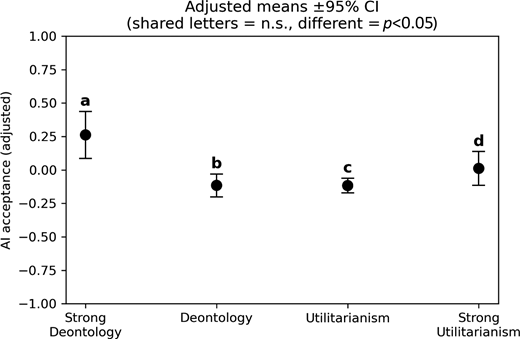
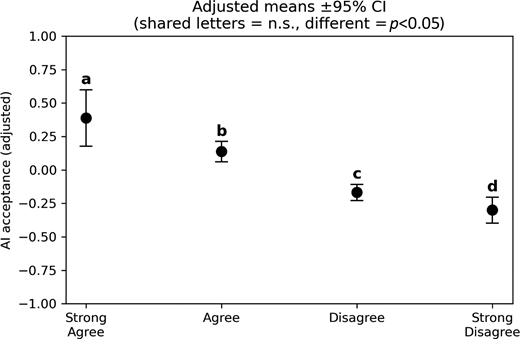
The mere direction of ethical orientation did not predict acceptance; instead, respondents with strong utilitarian or strong deontological orientations showed the highest acceptance. Acceptance increased monotonically with belief that AI could possess a mind; the gap between “strongly agree” and “strongly disagree” reached 0.74 points.
This study modeled mind attribution with a single numeric indicator, even though philosophical discussions of AI’s moral agency and responsibility portray it as a much more complex. This study stops short of incorporating the substantial scholarship on where responsibility should be located in AI.
Prior studies emphasize demographic or psychosocial factors; this research introduces two philosophical variables – ethical orientation and mind attribution – and quantifies their independent effects. The results of this study reveal that “orientation strength” and presumed AI mind attribution shape acceptance, offering a fresh lens on debates over AI moral agency within governance frameworks.
1. Introduction
The aim of this paper is to empirically clarify the philosophical background that underlies people’s acceptance of artificial intelligence (AI)-driven decision-making.
In recent years, AI has begun to support decision processes that were once performed exclusively by humans. Companies now use AI in areas such as recruitment, and AI is being adopted in fields like medical diagnosis. In some domains, AI goes beyond mere support and autonomously carries out the entire cycle of judgment and execution. Targeted advertising on social media is a prime example: based on a user’s attributes, clicks and likes, the system displays ads likely to interest that user. In this case, the full sequence – analysis, judgment and execution – is handled solely by AI.
By contrast, in many other settings, AI still functions only as a decision-support tool. As discussed later, most regulatory frameworks governing AI use – including the EU AI Act – require that human judgment remain involved in decision-making.
For instance, SoftBank Corporation uses AI in its recruitment processes. The purpose is to reduce the workload of reading applicants’ application forms, not to entrust AI with final decision-making. For application forms that AI judges unsuccessful, human review is mandatory, ensuring that no application is rejected solely based on AI judgment (Ministry of Internal Affairs and Communications Japan, 2022). Such practices exemplify AI-supported human decision-making, rather than full automation.
The AI system known as COMPAS (The Correctional Offender Management Profiling for Alternative Sanctions) is used by the Wisconsin Department of Corrections. It was developed to score the recidivism risk of offenders within correctional administration. This example points to a problem accompanying AI-supported human decision-making – namely, automation bias. In that case, the AI assessment was included in the presentence investigation report consulted in determining the defendant’s sentence. Independent media outlet ProPublica reported that the AI exhibited bias, tending to estimate the recidivism risk of Black defendants higher than that of White defendants (Larson et al., 2016).
A lawsuit was filed in Wisconsin claiming that reliance on COMPAS violated the constitutional right to due process, but the state Supreme Court rejected that claim. It did, however, stipulate that the accuracy of COMPAS must be subject to continual review (Larson et al., 2016).
This case raises a broader question: even when AI is said to support human decision-making, how different is a decision that essentially says “because the AI says so” from one in which the AI makes the decision outright? To what extent is “the AI produced this result” an acceptable justification? In its opinion on COMPAS, the court held that judges may consider the AI’s risk score in sentencing, but may not rely on it, yet it offered no clear distinction between consider and rely (Yamamoto and Ozaki, 2018). Commentators have further argued that judges lack the technical expertise to properly analyze AI risk assessments, creating a psychological bias toward deferring to the AI’s output (State v. Loomis, 2017).
Similar concerns arise with large language models (LLMs) such as ChatGPT, released in 2022. How far can we permit decisions that affect individual rights to be based on information generated by an LLM? The EU AI Act explicitly calls attention to this issue.
The Act classifies AI systems according to the level of risk they pose and imposes correspondingly stringent regulations (European Union, 2024). Of particular interest are systems designated high-risk. This category includes AI used for biometric identification; management and operation of critical infrastructure; decisions on access to education and vocational training; recruitment and personnel evaluation; assessment of eligibility for public benefits; law-enforcement applications; border control; and tools that assist judicial authorities in investigating and interpreting facts. High-risk AI systems are subject to rigorous requirements concerning risk management, data governance, detailed technical documentation, record-keeping, transparency and user information, human oversight, robustness and more. Especially noteworthy is the provision on human oversight, which states, inter alia, that operators must: “to remain aware of the possible tendency of automatically relying or over-relying on the output produced by a high-risk AI system (automation bias), in particular for high-risk AI systems used to provide information or recommendations for decisions to be taken by natural persons” (Chapter III Article14[4] [b]).
Thus, in the above-mentioned domains, even if a human makes the final call, we must be alert to the tendency to lean on the AI’s output when reaching a decision. The proper division of labor between AI and humans has, therefore, become a critical issue in contemporary decision-making.
Yet the human decision process – whether that of a recruiter or a judge – is itself largely a black box. Even if we record brain activity while a person is deciding, we cannot tell which factors were considered or how they were weighted. Take interview evaluations: visualizing an interviewer’s brain with fMRI would not reveal how the interviewer integrates and weights an applicant’s work history, personality, certifications, English proficiency, expressiveness, education and so on, because these judgments are holistic and qualitative. Nevertheless, we intuitively sense a difference in acceptance between decisions made by a human black box and those made by an AI black box. Legal philosopher Takehiro Oya explains that, compared with AI decisions, human decisions feel more acceptable “because there is a mouth to give an explanation and a belly to be held accountable, even if only after the fact” (Shishido et al., 2020). In other words, people are more willing to accept a decision when there is someone who can be held responsible and to whom complaints can be addressed if problems arise.
In the Guidelines for the Utilization of AI issued by Japan’s Ministry of Internal Affairs and Communications, the Principle of Proper Use includes human involvement in decision-making as a key point. One illustrative criterion for determining whether human judgment should be involved is the intention of the endl user (Ministry of Internal Affairs and Communications Japan, 2019). The present study’s exploration of AI acceptance contributes directly to this discussion by clarifying who is willing – and who is unwilling – to allow AI to support decision-making.
2. Previous research
A growing body of quantitative research has examined public acceptance of AI. A Pew Research Center survey found that men are more positive toward AI than women and that attitudes become more positive as educational attainment rises (Funk et al., 2020).
Hartwig and colleagues focused on four socially dilemma scenarios – for example, resurrecting deceased singers as holograms for television performances – and surveyed citizens in the USA and Japan about the ethical, social and legal acceptability of each case (Hartwig et al., 2022). Age proved to be the strongest predictor: the older the respondent, the more skeptical they were of AI. Greater knowledge about AI likewise predicted greater skepticism.
Using a similar set of four scenarios, Ikkatai et al. measured attitudes toward AI and asked respondents how strongly eight principles common to national AI guidelines – privacy, accountability, safety and security, transparency and explainability, fairness and non-discrimination, human control of technology, professional responsibility and the promotion of human values – should be considered in each scenario (Ikkatai et al., 2022). Which principles were prioritized varied by scenario, but in three of the four cases, older respondents were more negative toward AI. People with lower interest in science and technology were also more negative than those with higher interest. With respect to AI knowledge, only the scenario involving autonomous weapons showed a negative association between knowledge and acceptance.
An Ipsos global survey reported that roughly half of respondents believed AI should be more strictly regulated by governments and corporations (Ipsos, 2019). A Boston Consulting Group study found that respondents in developing economies tended to favor governmental use of AI, whereas approval was lower in countries such as Switzerland and Austria; millennials and urban residents were generally positive, whereas older and rural residents were negative. Trust in government showed a modest positive correlation with trust in AI (Carrasco et al., 2019).
Araujo et al. (2020) surveyed Dutch citizens to explore how individual characteristics relate to perceived fairness, usefulness and risk of AI decision-making in three domains: media (news recommendations and website blocking), judicial decisions (issuing parking tickets and initiating criminal proceedings) and public health (health-behavior recommendations and decisions on special treatments). Higher education and greater knowledge of programming, AI and algorithms correlated positively with perceived usefulness and fairness. Concerns about online privacy correlated negatively with perceived usefulness and fairness but positively with perceived risk. Confidence in one’s ability to protect personal data online predicted higher perceived usefulness and fairness and lower perceived risk. Age correlated negatively with perceived usefulness and positively with perceived risk.
Schepman and Rodway (2022) found that introverted individuals expressed more positive attitudes toward AI; higher distrust of corporations predicted more negative attitudes, whereas generalized interpersonal trust predicted more positive views of AI’s benefits. Thurman et al (2015) showed that preference for algorithmic rather than editor-selected news declines with age.
Taken together, prior studies have investigated determinants of AI acceptance mainly in terms of socio-demographic attributes such as age and education and in terms of psychological factors. In contrast, this paper focuses on individuals’ ethical and philosophical orientations to probe the more fundamental factors that shape whether people accept or reject AI.
3. Theoretical framework
This paper focuses on two philosophical dimensions of people’s attitudes. The first concerns ethical judgment – traditionally framed as the debate between utilitarianism and deontology. The second concerns whether AI can possess a mind.
3.1 Utilitarianism and deontology
Utilitarianism and deontology constitute one of the best-known disputes in the history of ethics. Utilitarianism, a form of consequentialism, holds that the moral value of an act is determined by its outcomes and gauges right and wrong by the greatest happiness for the greatest number. By contrast, deontology does not treat consequences as the sole consideration; it requires that the act itself be moral.
The accumulated discussion in ethics has long been applied to fields such as medical ethics and bioethics, and it is now being extended to AI ethics. Recent work, for example, shows that people predict AI will deliver utilitarian judgments – an AI-like style of reasoning (Myers and Everett, 2025). Yet empirical research on how the ethical orientation of human recipients interacts with AI output remains limited. With the rapid rise of large language models, AI is expected to play an ever-greater role in decision-making; understanding this issue is, therefore, crucial when we consider whether we can welcome AI as a member of our social community.
Up to now, major concerns in AI ethics have focused on bias, privacy and explainability. To sharpen our understanding of algorithm aversion, consider the following scenario:
You are job hunting. After passing document screening at your first-choice company, you proceed to the first interview. The interview is conducted not by a human but by an AI system that asks questions while you respond to a monitor. Unfortunately, you fail the interview.
Let us analyze this scenario within the conventional AI-ethics framework. According to Blackman (2022), there are three main factors that companies should take into account when deploying AI strategies and products: bias, privacy, and explainability.
Bias: An AI interviewer is presumed to learn from past applicants’ data to formulate questions and evaluate answers, which raises the question of bias. Could there, for example, be gender bias, as once found at Amazon? If the company has historically hired more men, then the AI might rate female applicants lower simply because they are women, thereby reproducing past biases.
Privacy: The AI interviewer continues to learn each time it conducts an interview, storing an applicant’s responses as data for future use. Could it inadvertently reveal sensitive information about previous applicants to others? Might a malicious third party manipulate the system and steal that information?
Explainability: Can the AI adequately explain why it accepted or rejected a candidate? The reasoning process of today’s deep-learning systems remains partly a black box, and even if the code were disclosed, humans would struggle to interpret it. Lack of explainability affects not only candidates’ sense of fairness but also internal decision-making: HR staff must justify hiring choices to upper management, and the explanation “because the AI said so” is unlikely to gain approval.
All three issues concern the consequences of AI decisions. In other words, they reflect a stance that we should refrain from delegating judgment to AI because such risks may arise – a fundamentally utilitarian perspective on risk.
Issues in AI ethics are not confined to bias, privacy and explainability. At a more fundamental level, we must ask how we feel about allowing non-human entities – AI systems or robots – to make decisions that profoundly affect our lives. Some people may feel an instinctive aversion to being judged by AI. Although the question of AI’s responsibility has generated a vast literature, this paper sets that debate aside to focus on deontological algorithm aversion. Such resistance remains even if the three problems are solved technically, and it lies beyond pure logic: even if an AI’s decision is technically and logically flawless, should humans be bound by it? This, we contend, is the key to whether human beings and AI can truly coexist.
Studies in neuroscience and psychology show that people possess both utilitarian and deontological modes of judgment, often described as two distinct systems of thought. These are commonly labeled the intuitive system and the reasoning system (Haidt, 2001). The intuitive system operates on affective cues: it relies on a felt sense of right and wrong and enables rapid, automatic responses to situations. The reasoning system, by contrast, is analytic: it processes information deliberatively, takes more time and can evaluate and revise intuitive judgments (Slovic, 2007). Recent research further suggests that when people reason utilitarian-ly, neural regions associated with emotional suppression and calculation become more active, whereas deontological reasoning shows reduced activity in those areas but longer reaction times, indicating deeper deliberation (Fabre et al., 2024).
In light of these findings, we contend that – even if an AI interviewer were to eliminate all technical flaws – the intuitive resistance many people feel toward having an AI judge them would likely persist to some degree.
The goal of this paper is not to settle the philosophical debate between utilitarianism and deontology. Instead, acknowledging that both modes of thought coexist and that individuals differ in their preferences, we aim to map the distribution of those preferences through survey data. Because people who rely more heavily on intuition may reject AI decisions without reason, we advance the following hypothesis:
Individuals with a deontological orientation are more likely to reject fully automated artificial intelligence decisions.
In our survey, respondents were explicitly instructed to assume that the AI in question has no technical flaws or risks. In other words, they evaluated scenarios under the assumption that AI-based decisions would not produce any adverse outcomes. A finding that people still regard AI decisions as unacceptable in such circumstances would align closely with deontological thinking. Accordingly, we expect that individuals with a deontological orientation will be less willing to accept fully automated AI decisions.
3.2 Perceptions of whether artificial intelligence can possess a mind
Next, we turn to the question of mind. We propose the hypothesis that humans do not want their life prospects to be determined by entities without minds, whereas if AI could possess a mind, then we might accept it as a member of our social community.
But can AI have a mind? This question has been extensively debated in the philosophy of mind. Broadly, two main positions can be identified. First is dualism, which holds that “the mind is a non-physical entity and that the world comprises two kinds of being: non-physical and physical” (Kanesugi, 2007). From this standpoint, it is difficult to imagine that a physical entity such as AI could have a mind.
Second is physicalism (also called material monism), which argues that “the world is composed solely of physical entities” (Kanesugi, 2007). This view makes it easier to conceive of AI as having a mind: if the mind is physical, then it could in principle be analyzed, coded and implanted in AI. It should be noted, however, that some philosophers maintain that the dualism–physicalism divide is not decisive for whether AI can have a mind (Chalmers, 1996).
The controversy between these positions remains unresolved. For our purposes, John Searle’s famous “Chinese Room” thought experiment is especially suggestive (Searle, 1980). It implies that although AI can simulate human behavior, it lacks genuine understanding and, thus, lacks a mind. (Searle himself rejects both physicalism and dualism, labeling his view biological naturalism: the mind can be causally – but not ontologically – reduced to physical reality, and is irreducible from the first-person perspective.)
Markus Gabriel, who refuses to reduce mind to physical facts, adapts Nagel’s (1979) concept of altruism and argues that we have ethics precisely because we recognize the existence of conscious lives other than our own and continually balance self-awareness against the consciousness of others (Gabriel, 2015).
From the foregoing, we derive the following hypothesis:
Individuals who believe that artificial intelligence cannot possess a mind tend to reject fully automated artificial intelligence decisions.
4. Empirical analysis 1
4.1 Procedures and results
4.1.1 Automatic artificial intelligence decision-making and human involvement.
We conducted an online survey of Japanese residents in September 2024. The study was outsourced to Cross Marketing Inc., which distributed the questionnaire to its registered panelists. Quotas were set so that the gender and age distribution of the sample matched that of the Japanese population. After excluding respondents who failed an attention-check items, 3,241 participants remained and constituted the final analytic sample.
Before testing our hypotheses, we first examined whether the presence or absence of human involvement affects people’s acceptance of AI: if preferences do not vary with human oversight, then national policies and our own discussion would lose much of their relevance.
To measure AI acceptance, we asked respondents how they evaluate fully automated AI decisions in concrete situations. The wording was as follows:
Please assume that the following decisions are made fully automatically by AI (artificial intelligence), not by a human.
Imagine that you are the person affected by each decision.
For each item below, which of the two positions, A or B, is closer to your own view? Select the single option that best matches your opinion.
Please assume that the AI has no technical problems or risks:
I can accept a fully automated AI decision.
I cannot accept a fully automated AI decision.
Responses were recorded on a seven-point scale ranging from “closer to A” to “closer to B.”
The specific situations presented were as follows. Items 1–5 correspond to AI systems classified as high-risk under the EU AI Act, while Items 6 and 7 concern AI already in widespread use:
decisions on personnel evaluations related to promotion in the workplace;
decisions on pass/fail of application forms in job applications;
decisions on eligibility for public support such as welfare benefits;
decisions on assessment defendants’ risk of recidivism in criminal justice;
decisions on medical diagnosis in hospitals;
decisions on housing-loan approval; and
decisions on which advertisements to display on social media.
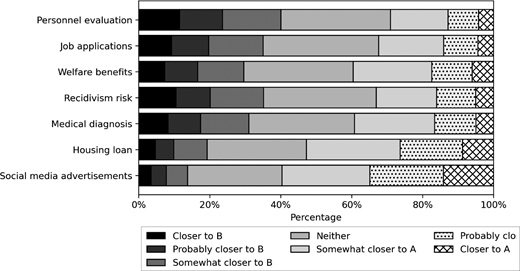
Figure 1 shows the distribution of responses to these questions. Figure 1 reveals a clear contrast between high-risk AI systems and AI applications that are already widespread. For the top five high-risk items, a little more than 30% of respondents (around 40% for personnel evaluation) leaned toward “cannot accept.” In contrast, for the last two items, the share was under 20%. In the case of social-media advertising, roughly 60% of participants leaned toward “can accept a fully automated AI decision.”
To determine whether people’s preferences change when human judgment is involved, we also presented an alternative version of the same scenarios:
Please assume that a human makes the final decision while consulting an AI analysis.
Imagine that you are the person affected by each decision.
AI analysis refers to an action that produces some output relevant to the problem – for example, scoring an entry sheet after analyzing its contents or predicting and scoring a defendant’s likelihood of re-offending after examining the defendant’s information.
For each item below, which of the two positions, A or B, is closer to your own view? Select the single option that best matches your opinion.
Please assume that the AI has no technical problems or risks:
I can accept a human decision that takes the AI analysis into account.
I cannot accept it.
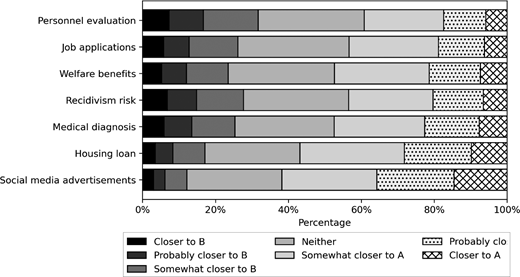
Figure 2 presents the distribution of responses to this question. Overall, the share of negative responses declines slightly when human involvement is added.
We conduct a more detailed examination of whether human involvement has an effect. To clarify the interpretation of the results, the analysis focuses on the five scenarios classified as high-risk under the EU AI Act. The Cronbach’s alpha for responses to the five scenarios was 0.847 (0.896 when human judgment was involved), indicating a certain level of consistency, so the five responses were averaged. The variable scale ranges from −3 to +3, with higher values indicating a more positive response. This is referred to as AI acceptance.
Next, a t-test was conducted to determine whether there was a difference in the average AI acceptance between cases of fully automated AI decision-making and those with human involvement.
The results showed that the mean for fully automated AI decision-making was −0.08 (95% CI: −0.12, −0.04), while the mean for cases with human involvement was 0.24 (95% CI: 0.20, 0.28). In the case of fully automated AI decision-making, both the mean and the 95% confidence interval were negative (indicating unacceptable), whereas with human involvement, both the mean and the 95% confidence interval are positive. Although the difference was not large, it is statistically significant. As demonstrated above, people tend to feel more accepting when human judgment is involved.
4.1.2 Ethical judgment.
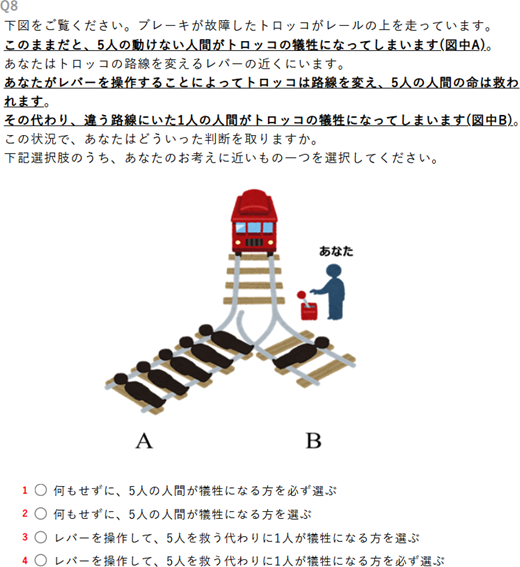
The AI acceptance score derived through the procedure above serves as the dependent variable in our analyses. We next describe the construction of the independent variables. To determine whether respondents lean toward utilitarianism or deontology, we presented the question depicted in Figure 3.
The meaning of the question is as follows:
Please examine the diagram below. A trolley with failed brakes is running along the track. If nothing is done, then five immobilized people on Track A will be struck and killed. You are standing beside a lever that can divert the trolley. By pulling the lever, the trolley will switch to an alternate track, saving those five lives. However, one person on Track B will then be hit and killed.
How would you act in this situation? Select the single option that best reflects your judgment from the list below.
This item is based on the classic trolley problem. Pulling the lever is an active decision that deliberately sacrifices the person on Track B (an act of killing) and, therefore, clashes with deontological ethics, which tends to evoke intuitive resistance to killing with one’s own hands. On the other hand, pulling the lever saves five lives and thus accords with the utilitarian principle of the greatest happiness for the greatest number, treating human life quantitatively.
Accordingly, we interpreted the four response options as follows:
“Do nothing and always allow the five people to die” → strong deontology.
“Do nothing and allow the five people to die” → deontology.
“Pull the lever, saving five lives at the cost of one” → utilitarianism.
“Always pull the lever, saving five lives at the cost of one” → strong utilitarianism.
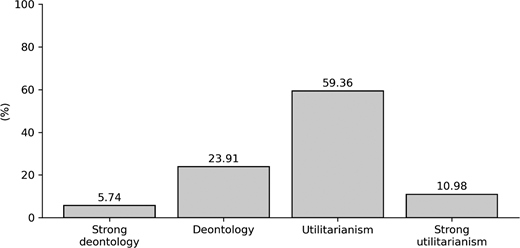
Figure 4 presents the distribution of respondents’ choices. Approximately 59.4% of the sample – that is, a clear majority – chose a utilitarian option. This aligns with earlier work on public preferences for trolley-type algorithms in autonomous vehicles (Bonnefon et al., 2016). The next-largest group, 23.9%, selected a deontological option. Only a small fraction of respondents expressed a strong orientation for either deontology or utilitarianism.
To examine the relationship between ethical orientation and AI acceptance, we conducted an ANCOVA with AI acceptance as the dependent variable, ethical orientation (four levels) as a fixed factor and age, gender and educational attainment as covariates. We then applied a Tukey’s HSD test to the estimated marginal means (with covariates held at their sample means). The results are presented in Figure 5.
Although all pairwise comparisons reached statistical significance, the overall pattern was U-shaped: respondents with strong orientations – whether strongly deontological or strongly utilitarian – are more willing to accept fully automated AI decisions than those whose orientations are weaker.
4.2 Discussion 1
These findings suggest that individuals who hold firm ethical orientations are more inclined to accept fully automated AI decisions. What might this imply? Examining the core ideas of deontology and utilitarianism suggests that each has aspects highly compatible with AI. For example, AI’s rule-governed regularity fits well with deontology, while its predictive performance and efficiency are congenial to utilitarianism. In other words, it is in principle possible to align each value orientation with AI’s characteristics, making it plausible that people would tilt toward acceptance on the basis of AI’s strengths. By contrast, when orientations are not strong, it is harder to fix the priority ordering of values; caution may take precedence and concerns about AI’s black-box nature may come to the fore.
Alternatively, in more down-to-earth terms, we might put it as follows: When individuals who hold firm ethical orientations confront an AI-generated judgment they tend to view the machine’s conclusion as an objective data point and believe that how to respond thereafter remains entirely their own choice. By contrast, if the judgment is rendered by another human, then interpersonal considerations complicate matters: disagreeing with a human decision-maker often requires justification and risks damaging the relationship. An AI, however, poses no such social entanglements; users can ignore or override its output without the burden of face-saving explanations. Consequently, determining a course of action after receiving an AI decision may involve lower psychological costs than deliberating over, or contesting, a human judgment.
Conversely, people who lack confidence in their own ethical stance may prefer to seek input from other humans. Because they wish to canvass additional opinions, they could be more inclined to rely on human rather than AI decision makers.
4.3 Robustness checks
For robustness, we disaggregated the dependent variable by context and ran the same ANCOVA for each (Supplementary File S1). A consistent U-shaped pattern was observed across all contexts, confirming the robustness of the results. The U-shape was more pronounced for items with lower average AI acceptance – namely, personnel evaluation, job applications and recidivism risk. If our earlier assumption is correct – that in the absence of strong ethical orientations people tend to be more cautious – then in contexts where the acceptability of fully automated AI judgments is low to begin with, caution and anxiety may surface even more prominently. (In these three contexts, the trough of the U, including the error bars, was below zero.)
5. Empirical analysis 2
5.1 Procedures and results
To test H2, we used the data from the online survey described earlier. In that survey respondents were asked:
Do you think AI could, in the future, possess a mind similar to that of a human, or do you think it could not?
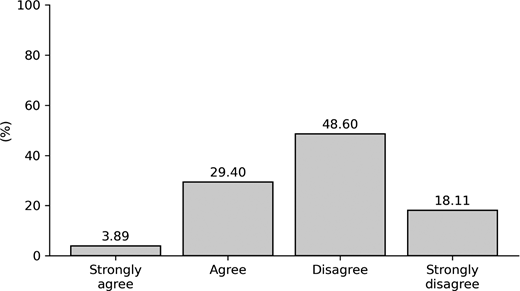
The four-point response scale was “Strongly agree,” “Agree,” “Disagree,” and “Strongly disagree.” Figure 6 shows the distribution of answers. Combined, the “Disagree” and “Strongly disagree” categories account for 66.7% of the sample, indicating that a majority believe AI cannot possess a mind. This finding aligns with the intuitions expressed by philosophers such as John Searle and Markus Gabriel: people do not yet expect AI to have a mind.
Next, to test H2, we analyzed the relationship between respondents’ beliefs about AI’s capacity to possess a mind and their AI-acceptance scores. We conducted an ANCOVA with AI acceptance as the dependent variable, belief in AI mind-possibility (four levels) as a fixed factor and age, gender and educational attainment as covariates. Tukey’s HSD tests were then applied to the estimated marginal means. The results are presented in Figure 7.
Pairwise comparisons revealed statistically significant differences among all groups. AI acceptance rose monotonically as confidence in AI’s potential to possess a mind increased: the mean difference between the “Strongly agree” and “Strongly disagree” groups was 0.74 points. Notably, the contrast between the “Agree” and “Disagree” groups straddled zero, suggesting a qualitative breakpoint: respondents who believe AI could have a mind tend, on average, to accept fully automated AI decisions, whereas those who do not hold this belief tend, on average, to reject them.
5.2 Discussion 2
Building on the preceding findings, we now revisit the relationship between AI and the notion of mind. Legal philosopher Oya argues that when we invite AI into human society, we inevitably confront the issue of vulnerability.
Vulnerability, Oya notes – drawing on Thomas Hobbes – is precisely what drives humans to establish society: our lives are finite and even the strongest among us can be harmed, so we create legal rules to forestall betrayal and protect ourselves. When responsibility is assigned to AI or robots, however, a new problem emerges.
Suppose we hold the deeply rooted belief that responsibility can be borne only by beings capable of being harmed – or at least by entities for whom punishment constitutes more than mere monetary compensation. For example, we ordinarily feel that the loss of life should be repaid by the perpetrator’s own death or, at minimum, by depriving them of a substantial portion of their life; even in financial penalties, we expect sanctions severe enough to be felt as a real loss, proportionate to the offender’s assets. All of these intuitions presuppose vulnerability shared by us.
If AI or robots lack vulnerability or irreplaceability, then such measures become meaningless – victims and their families would find no moral satisfaction in punishment directed at an unfeeling machine (Oya, 2017).
Thus, when AI is deemed responsible for harm, the very act of atonement becomes incoherent, leaving victims with a sense of futility. One hypothesis, then, is that anger directed at an AI that has harmed you feels hollow precisely because the AI cannot experience pain. No matter how vehement the condemnation, an AI will never feel suffering, and the injured party is left only with an empty gesture.
Let us assume that the capacity to be harmed is rooted in the mind attribution. If AI lacks a mind, then it cannot itself be harmed or, perhaps, can it apprehend the injuries of others. People may, therefore, be reluctant to entrust life-altering decisions to such entities. Even if an AI offered near-perfect predictive accuracy, humans might still prefer to rely on their imperfect yet vulnerable fellow humans.
5.3 Robustness checks
For robustness, we disaggregated the dependent variable by context and ran the same ANCOVA for each (Supplementary File S2). A consistent linear pattern was observed across all contexts (the stronger the agreement, the higher the AI acceptance), confirming the robustness of the results.
By context, differences are modest overall, but only in personnel evaluation does the “Strongly agree” category has an error bar that straddles zero, indicating a gentler slope. In personnel evaluation, norms of procedural justice and accountability – standards achievable only through human agency – may be capping the upper bound. By contrast, the steepest slope appears in medical diagnosis, where “Strongly agree” attains the highest level. In clinical settings, the expectation that “having a mind” entails an ability to understand clinical judgment may elevate the acceptance ceiling.
6. Policy implications for ethical artificial intelligence governance
Our findings have two practical implications for the design of oversight and transparency for high-risk AI.
First, we should continue to be cautious about fully automated AI determinations. We observed a U-shaped relationship between ethical orientations and AI acceptance, but approximately 83% of the sample held only weak orientations (Figure 4). Accordingly, the majority is, on average, negative toward AI in high-risk judgments. Therefore, when introducing fully automated AI decisions, human-in-the-loop review should be firmly built in, along with plain-language reasons tied to domain-specific norms and accessible appeal channels.
Second, anthropomorphic design should be properly calibrated with transparency obligations. Acceptance increased monotonically with the belief that AI could possess a mind. While anthropomorphic cues can heighten perceived social presence and thereby raise acceptance, they also risk encouraging over-reliance. For example, in the USA, there has been a series of lawsuits alleging that generative AI was involved in children’s self-harm and suicides (Duffy, 2025). Therefore, in high-risk AI deployments – whatever the anthropomorphic design – there should be explicit disclosures that the system does not possess consciousness or moral agency, combined with human oversight that curbs automation bias (consistent with the EU AI Act’s emphasis on human control and user information).
7. Conclusion
This study investigated two philosophical dimensions that may shape public acceptance of AI-based decisions: individuals’ orientation toward utilitarian versus deontological ethics and their belief about whether AI could ever possess a mind.
Regarding utilitarianism versus deontology, we found no evidence that endorsing either position, in itself, is associated with higher AI acceptance. Instead, the decisive factor was the strength of orientation: respondents who expressed a firm commitment to either ethical stance judged AI decisions significantly more acceptable. We interpreted this pattern through core ideas of deontology and utilitarianism and their affinity with AI’s characteristics.
Additionally, mind attribution did matter: participants who deemed it possible for AI to possess a mind were more receptive to AI decision-making. We interpreted this through the concept of vulnerability.
This study has two main limitations. First, the sample was drawn exclusively from Japan. Prior research reports cross-national heterogeneity in normative trade-offs and orientations for AI governance (e.g. the Moral Machine [Awad et al., 2018]; AI scenarios in the USA and Japan [Hartwig et al., 2022]; cross-national comparisons [Carrasco et al., 2019]). This suggests that ethical orientation strength and mind attribution – and their relationship to AI acceptance – may interact with local moral cultures and technological affinity. Accordingly, we interpret our estimates as culture-conditioned rather than universal. A multi-country replication that harmonizes scenarios and measurement and leverages international instruments would enable us to identify the culture-general and culture-specific components of orientation strength, mind attribution and their relationship to AI acceptance.
Second, our discussion was circumscribed. In particular, the link between mind attribution and AI acceptance could be enriched by integrating the extensive literature on AI moral agency and responsibility. We treated mind as a single scalar variable, yet philosophical debates on AI’s moral agency and responsibility point to a far richer, multidimensional construct. Our analyses, therefore, did not integrate the extensive literature on the loci of responsibility in artificial agents. Bridging empirical acceptance data with normative theories of responsibility is, thus, an essential next step – one that we leave for future research.
Acknowledgements
This study protocol, including all recruitment, informed consent and data-handling procedures, was reviewed and approved by the Ritsumeikan University Ethics Review Committee for Research Involving Human Subjects (approval number Kinugasa-Human-2024–47).
We used a large language model (LLM; OpenAI’s ChatGPT, GPT‑5) in two ways: (a) to assist in debugging and refining portions of the computational model code (e.g., helping to diagnose error messages and suggest fixes, with all model specifications, code structure, and final implementations determined and checked by the author), (b) to support English language editing of the manuscript and cover letter. All analyses, interpretations, theoretical arguments, and final wording were generated, determined, and verified by the author, who takes full responsibility for the content.
References
Further reading
Supplementary material
The supplementary material for this article has been found online.