This study aims to investigate the relationship between artificial intelligence (AI) adoption and digital knowledge management (DKM) performance through the mediating role of digital knowledge capability. Additionally, it examines the moderation of digital culture on the association between digital knowledge capacity and DKM performance, as well as the moderation of AI familiarity on the association between AI adoption and digital knowledge capability.
Using a quantitative study design with a time-lag approach, data were gathered in two waves. Finally, 378 senior managers of palm oil-producing firms in Malaysia responded.
The findings show that AI adoption positively relates to DKM performance through the mediating role of digital knowledge capability. Furthermore, the association between digital knowledge competency and AI adoption is strengthened by AI familiarity. Additionally, the link between digital knowledge competency and DKM performance is considerably moderated by digital culture.
In this contemporary digital era, managers in the palm oil sector may benefit from the findings of this study by achieving greater digital knowledge capability and DKM performance while using advanced digital technologies.
The current research extends the existing knowledge-based view (KBV) theory regarding the effects of organizational knowledge and the adoption of AI. The study also enhances the dynamic capability theory by analyzing the role of knowledge processes induced by AI in organizational pervasiveness and agility in using digital knowledge assets.
1. Introduction
In the modern digital world, there has been an enormous transition in organizational procedures, decision-making processes and competitive forces because of the rapid changes in technology. The conventional management habits are no longer adequate to deal with the dynamics of the business environment, which have contributed to inefficiencies and low productivity in many instances. As a result, organizations are increasingly embracing new high-tech approaches to collect, integrate and distribute vast amounts of data in a systematic manner (Chabalala et al., 2024). Nonetheless, access to digital tools is not sufficient to create value. Without proper knowledge management through digital means, organizations will struggle to convert raw data into valuable insights that can be used to drive innovation, competitiveness and cost efficiency (Di Vaio et al., 2021). Thus, the main problem is not the implementation of digital technologies, but the optimal use of them to improve the performance of digital knowledge management (DKM).
DKM performance can be defined as the capacity of an organization to successfully create, disseminate and use knowledge using digital technologies to meet strategic goals and enhance productivity (Deng et al., 2023). Greater degrees of such performance allow organizations to react to disruptions in the environment and remain competitive in the long term (Gupta et al., 2023). Literature indicates that internal and external knowledge based on organizational systems and employee expertise is a significant factor in improving organizational development and sustainability (Ur Rehman et al., 2024; Waseel et al., 2024; Yu et al., 2022). Nevertheless, the process of attaining high levels of knowledge management is multidimensional, which involves the conversion of various information into useful insights (Abbas and Kumari, 2023). In that respect, digital knowledge capability comes in as the key, as it enables efficient extraction and use of digital resource knowledge (Mele et al., 2024).
Digital knowledge capability describes the capacity of an organization to obtain, process and use knowledge based on highly developed digital technologies, including artificial intelligence (AI) and digital platforms (Wang et al., 2025). This feature allows organizations to transform raw data into usable knowledge, which in turn aids in informed decision-making (Chaudhuri et al., 2023). Based on the knowledge-based perspective (KBV), digital knowledge capability enables companies to gain access to technological resources to improve efficiency and build evidence-based strategies. For example, AI-based solutions can work with a great deal of data and identify patterns and predict disruptions, thereby improving the functionality of DKM (Pal et al., 2024).
The resource-based view (RBV) pays attention to the contribution of organizational resources, particularly digital culture, to the realization of the beneficial outcomes of digital technologies (Serafimova and Vasilev, 2024). Digital culture represents shared organizational values and norms that promote innovation, collaboration and data-driven decision-making (Orero-Blat et al., 2025). A strong digital culture enhances the willingness of the employees to adopt new technologies, reduces resistance to change and enables the exchange of information across organizational borders, which is better performance in DKM. In its turn, low digital culture may lead to distrust in digital systems and the use of outdated practices (Haider and Sundin, 2022). The empirical study also proves the assumption that organizational culture is a major driver or constraint that facilitates or constrains the success of digital transformation and knowledge management programs (Luthra et al., 2025).
The growing importance of digitalization has led to the shift toward more technologically advanced solutions used by organizations to increase efficiency, flexibility and competitiveness (Seyyedi et al., 2024). AI is one such technology, as it has become a transformative technology helping organizations to produce data-driven insights and discover areas of operational inefficiency and react to changing market conditions (Sullivan and Wamba, 2024). AI systems are learning and adaptive systems, which enhance the performance and agility of companies (Rane et al., 2024). In addition, AI enhances the automation of tasks and increases the accuracy of decisions and employee engagement, both of which are critical in achieving company objectives (Tummalapalli et al., 2025).
Despite these benefits, there is still a significant disconnect between intentions to adopt AI and actual use. Although most organizations acknowledge the significance of AI, a much smaller percentage of them manage to incorporate it into their processes (Farmanesh et al., 2025). This is explained by the lack of knowledge management skills, which restricts the potential of organizations to generate value through digital technologies. In line with the knowledge-based view (KBV), knowledge is an important strategic asset, and AI complements the asset by helping organizations to create and use data-driven insights efficiently (Vocke et al., 2019).
In terms of dynamic capabilities, the adoption of AI enhances the creation and use of digital knowledge with regard to the integration of knowledge resources. Nonetheless, the success of this process is determined by the knowledge of AI technologies among workers. AI familiarity is a factor indicating how well employees are aware and at ease when using AI systems in organizational processes (Singh and Chandra, 2023). Increased familiarity enables better use of AI by employees, and low familiarity may result in resistance, mistakes and lower performance results (Li et al., 2023). Therefore, familiarity with AI can be considered a very important moderating variable in the connection between AI adoption and digital knowledge ability.
Though previous researchers have explored the concept of AI adoption concerning innovation, sustainability and performance of organizations (Al-khatib et al., 2024; Gazi et al., 2024; Kassa and Worku, 2025; Jarrahi et al., 2023), the research question that has received minimal attention is how AI is related to the performance of DKM. The current body of research tends to use simplistic models lacking the mediating impact of digital knowledge capability and situational impact of variables such as AI familiarity and digital culture (Zhang et al., 2025; Hashem and Aboelmaged, 2025). Furthermore, the empirical studies of the antecedents of DKM performance have not been developed yet (Zheng, 2024), which implies the necessity of detailed frameworks uniting technological, organizational and individual-level variables.
To cover the gaps, this paper suggests a moderated mediation model, which investigates the effects of AI adoption on the performance of DKM using the digital knowledge capability as a dependent variable, with the moderator variables being AI familiarity and digital culture (Nakash and Bolisani, 2025; Wang et al., 2025; Marjerison et al., 2025). The research is empirical, and the study area is the Malaysian palm oil industry, which is a major contributor to the country’s economy because it has a significant fraction of production and exports in the world (Harun and Laksito, 2022). Despite its economic significance, the industry faces challenges such as declining productivity, plant diseases and increasing sustainability pressures (Nasir et al., 2025). These issues are compounded by poor use of superior digital technologies and lack of knowledge management practice.
In this regard, this study aims to investigate the role of AI adoption in the performance of DKM in terms of digital knowledge capability and the role of this relationship as dependent on AI familiarity and digital culture. The results will have a great theoretical and practical impact, as they will help to realize how organizations can successfully use AI and digital capabilities to improve knowledge management performance and be competitive in dynamic settings.
2. Literature review
2.1 Theoretical background
The present research is based on the dynamic capability theory (DCT) and the KBV, which offers a broad perspective to elucidate the improvement of the performance of DKM through the adoption of AI. DCT focuses on the capability of an organization to build and re-architect its capabilities to respond to the constantly changing environments and attain long-term competitive advantage (Teece et al., 1997). In this regard, AI implementation is a strategic enabler that enhances the capability of digital knowledge by supporting the process of acquiring, integrating and implementing knowledge with the use of sophisticated digital tools. Moreover, the digital culture helps to promote this process by encouraging innovation, education and openness to technological integration, which boosts knowledge usage and performance.
Complementary to this, KBV has the conceptualization of knowledge as the most important organizational resource that forms the basis of competitive advantage (Kogut and Zander, 1996). In this light, AI familiarity becomes a critical knowledge-based resource that will allow the employees to productively interpret and use AI-generated insights, which will empower digital knowledge capabilities. Improved capability, in its turn, facilitates effective creation, sharing and utilization of knowledge, resulting in better DKM performance. This study suggests that through the incorporation of DCT and KBV, AI usage, with the help of the familiarity of the staff and a supportive digital culture, can render organizations able to sense, assimilate and transform digital knowledge resources into higher performance outcomes. This integrated theoretical perspective offers a strong basis to realize how the common influence of technological, human and cultural factors leads to successful DKM.
2.2 Hypothesis development
2.3 Artificial intelligence adoption and digital knowledge capability
AI exhibits advanced digital tools that can process large volumes of data to drive the required knowledge. AI usage supports gathering the information from the environment, disseminating it and implementing it, which is essential to promote innovation in the organization (Sjödin et al., 2023). The insights gathered from using AI save time and play a substantial role in leading digital knowledge capability, which further promotes adaptability by integrating knowledge from the environment (Shaik et al., 2024). Based on DCT, AI facilitates an organization in discovering key insights in an uncertain business environment, which fosters knowledge capability while using the digital platforms. For instance, AI foresees customers’ changing needs and increases management’s understanding of the emerging scenarios, which not only provides the opportunity to adapt but also to seek the required knowledge to exploit those opportunities. Previous literature has also emphasized that AI adoption substantially increases digital knowledge capability (Arroyabe et al., 2024; Lin and Wu, 2025; Rahman et al., 2026); hence, it fosters digital knowledge capability through aligning the digital resources and human knowledge resources and ultimately influences adaptation, innovation and sustainability. This review leads to the following hypothesis:
AI positively relates to digital knowledge capability.
2.4 Artificial intelligence adoption, digital knowledge capability and digital knowledge management performance
Digital knowledge capability explains the ability to seek, integrate and apply knowledge using modern digital tools (Wang et al., 2025). For instance, the adoption of AI in the organization supports attaining knowledge from the environment and sharing it on a dashboard, influencing digital knowledge capability. These advanced digital technologies provide for speedy, reliable and unique insights to be instantly shared across the entire organization, significantly contributing to higher digital knowledge capability (Pal et al., 2024). Irfan et al. (2022) noted that organizations with unique knowledge resources are more resilient and sustainable in a highly volatile business environment.
According to DCT, AI adoption provides suitable information from the environment and significantly contributes to digital knowledge capability (Arroyabe et al., 2024; Alshammari and Alshammari, 2026). For instance, AI can provide agribusiness owners insights from satellite monitoring to highlight the shortcomings in their farming practices and production issues in certain regions. That would not only improve their knowledge, but it would also enable the capacity to exploit the opportunity. Hence, unique insights gathered from AI help the organization to take the information, spread it and implement it successfully and ultimately strengthen DKM performance (Ola-Oluwa, 2024; Al-Husain et al., 2025). Similarly, KBV theory helps in accumulating an organization’s knowledge resources, which are essential to enhancing its digital knowledge capability, ultimately leading to higher DKM performance. With this discussion, we have formed the second and third hypotheses:
Digital knowledge capability positively relates to the digital knowledge management performance.
Digital knowledge capability mediates the relationship between AI adoption and digital knowledge management performance.
2.5 Moderation of artificial intelligence familiarity
AI familiarity describes the level of understanding that firms and their employees have of AI technology and its applications, processes and implementation (Polisetty et al., 2024). Based on KBV theory, employees’ AI familiarity acts as a critical resource for organizations, such as the palm oil industry, to take potential benefits from adopting AI, For instance, AI adoption offers insights from massive data, and when employees are familiar with these technologies, they can maintain the knowledge that is required and useful (Rezaei et al., 2025; Hanif et al., 2026). Additionally, employees with AI experience can learn the special ways to obtain important data for a certain goal and context. Therefore, AI is a tool to gather knowledge from large amounts of data, disseminate it and use it inside the company.
A lack of knowledge about AI might increase skepticism and resistance to the advancement of AI. However, AI familiarity can strengthen the relationship between AI adoption and digital knowledge capability (Wang and Sun, 2025; Chen et al., 2026). It can also be said that employees effectively gather, process and use the knowledge derived from AI adoption when they are familiar with it. Therefore, insights embedded in AI technologies can act as a useful knowledge resource if employees are familiar with AI technologies. This discussion helps form the following two hypotheses:
AI familiarity significantly moderates the relationship between AI adoption and digital knowledge capability.
AI adoption is positively related to digital knowledge management performance through the moderated mediation of AI familiarity and digital knowledge capability.
2.6 Moderation of digital culture
Digital culture refers to the shared values and conventions inside an organization that promote the adoption and use of cutting-edge digital technology in daily operations (Sanyal et al., 2024). Based on KBV theory, knowledge is the potential organizational resource, but the desired outcomes rely on its successful application, integration and sharing in the entire organization. In contrast, digital knowledge capability is the dynamic capacity that supports the collection, sharing and use of information; nevertheless, the pro-digital organizational culture makes it viable to achieve the desired DKM performance (Zhao et al., 2023). For instance, the use of advanced digital tools may help organizations better understand the state of business marketplaces and adapt to these changes.
However, useful outcomes can be achieved if the company fosters a culture of routinely using these advanced digital technologies. The literature has noted that digital culture encourages innovation, networking, collaboration, knowledge sharing and trust in the associated benefits of digital tools (Imron et al., 2021). Hence, the presence of such a culture that embraces technology allows for higher DKM performance (Luthra et al., 2025). It can be said that digital culture may be considered a catalyst in the process of achieving desired knowledge management performance. Conversely, the findings have found that weak digital culture increases employees’ concerns of adoption and trust (Fahmi et al., 2023; Trenerry et al., 2021). Therefore, we have the following two hypotheses:
Digital culture significantly moderates the relationship between digital knowledge capability and digital knowledge management performance.
AI adoption positively relates to the digital knowledge management performance through the mediated moderation of digital knowledge capability and digital culture.
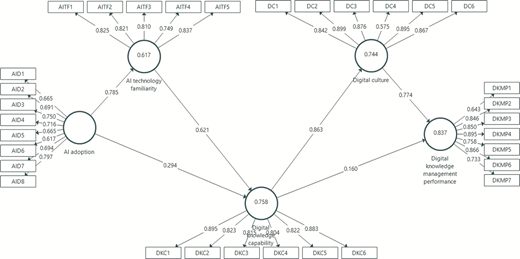
The conceptual framework is provided in Figure 1.
3. Methodology
3.1 Research design, sampling and data collection
The study focused on a positivist philosophical point of view (Maretha, 2023). The study used a descriptive design with a deductive approach, grounded in theoretical conceptions of hypotheses (Osman et al., 2018). The study used the simple random sampling technique for data collection (Noor et al., 2022). Accordingly, as per the Malaysian Palm Oil Association database Link to the Malaysian Palm Oil Association databaseLink to the website of the Malaysian Palm Oil Association database, 625 firms are registered, and more than 450,000 small distributors are engaged in the Malaysian palm oil industry. As per the threshold standard of the Krejcie and Morgan table, the sample size was determined (Morgan, 1970). The study followed a primary data collection procedure through a survey strategy based on a two-wave time-lagged design, with each wave collected within an interval of three weeks, to reduce the problems posed by common method bias (Haider et al., 2019). In the initial wave, information on the adoption of AI technology and digital culture was obtained from managers at palm oil-producing companies in Malaysia. A total of 500 questionnaires were distributed, and valid responses from 397 participants were received (response rate = 79.4%). In the second round, 378 valid and effective questionnaires were acquired with a high participation rate of 95.2% by queries to the same units on digital knowledge capability and DKM performance. Finally, 378 valid samples with a 95.2% response rate were collected for analysis and analyzed using the SPSS and SmartPLS software.
3.2 Questionnaire and pretesting
The study scales were adopted from existing research that consisted of 32 questions. The questions were answered using a five-point Likert scale ranging from “Strongly disagree” to “Strongly agree.” The AI adoption scale adopted from Medcof (1996) consisted of eight items. For AI technology familiarity, five items were adopted from Christensen et al. (2025). Also, digital knowledge capability endorsed six items adopted from Lenka et al. (2017). Luthra et al. (2025) provide six items to measure digital culture. DKM performance used seven items also drawn from Luthra et al. (2025). The study also used six control variables that indirectly influence DKM performance. These control variables include gender, age, qualification, nature of employment, length of service and managerial level.
The questionnaire was sent to three AI professors and experts in digital knowledge and to five senior managers in the Malaysian palm oil industry to corroborate the content validity of the scale. The professors, along with the managers, suggested minor changes. The professors and the managers approved the final version after the changes were made. Moreover, to confirm the empirical context of the content reliability and validity, the resulting 50 samples from the target population, along with their convergent and discriminant validity, were studied. After the reliability and validity were empirically confirmed, the final data set was gathered to perform the analysis.
4. Findings
The research used a two-step methodology of data analysis. Describing statistics was performed in the first step, involving demographic profiling, measures of central tendency (mean) and dispersion (standard deviation), normality (skewness and kurtosis) and correlation (Ali et al., 2019). The second step involved the use of the partial least squares structural equation modeling (PLS-SEM) to determine measurement reliability and validity, as well as to evaluate complex relationships between constructs (Usakli and Rasoolimanesh, 2023). The choice of PLS-SEM was based on its appropriateness in making predictions and mediation and moderation analysis and its strength when using non-normal data and moderate sample sizes, with a focus on explaining R2.
4.1 Common method bias
The study data were collected from managers of palm oil-producing companies in Malaysia. Because of the same target audience scenario, there is a chance that the issue of common method bias may occur in research. In this context, a study was conducted to run a collinearity check using the variance inflation factor (VIF) technique in Table 1. According to the threshold criteria of VIF, if the values of constructs are below or equal to 5.0, there is no issue of collinearity in the data set (Kock, 2015). Likewise, the current results predicted that all values would be within the defined criteria. Therefore, there is no evidence of common method bias, and the data are deemed to be ready for analysis.
4.2 Demographic profile
In Table 2, the demographic characteristics of the respondents are described (Glaser, 2012). Among the samples, 55.82% were male and 44.18% were female, with the largest group (67.20%) being those aged between 31 and 40 years. A majority of respondents have taken an undergraduate degree (69.84%), followed by a Master’s degree (21.96%), an MPhil/MS degree (5.82%) and other qualifications (2.38%). In terms of employment status, the number of permanent staff accounted for 56.61%, as compared with 43.40% on contract service. As for years of employment, close to half (47.35%) had 10–20 years of experience, while 20.90% of them had under 10 years, 19.58% had between 21 and 30 years and 12.17% exceeded at least 30 years. In terms of titles, at the managerial level, most were supervisors (69.84%), followed by assistant managers and deputy managers (11.64%) and (10.85%), and, respectively, and senior managers account for 7.67%. These demographic details highlight a workforce that is working, has a relatively high level of education, and is concentrated in supervisory roles.
4.3 Descriptive statistics and data normality
Table 3 presents the results of the data normality tests and descriptive statistics (Mishra et al., 2019). The demographic constructs with an average score range within 1.40–2.23 have relatively higher skewness (1.838 and 1.489 for education and managerial level, respectively), and they also have kurtosis values, which indicate departure from normality. The mean scores of study variables show that the AI adoption (3.606), AI technology familiarity (3.372), digital knowledge capability (3.322), digital culture (3.126) and DKM performance (3.062) are all at normal levels to some extent. Such procedures [skewness and kurtosis] mostly lie in the possible region of ±2, which indicates that data is reasonably well-judged and ready for further analyses.
4.4 Correlation matrix
In this study, the results of Table 4 were correlated with our study tables (Steiger, 1980). The results also show that demographic variables such as gender, qualification level, type of job, job length and managerial levels in the organization all have relatively low to moderate corresponding coefficients with the main study constructs. By contrast, this study’s main variables also show strong and significant positive correlations at the p < 0.01 level. In other words, AI adoption has a high degree (r = 0.770) of correlation with either familiarity or technology, digital knowledge capability (r = 0.764), digital culture (r = 0.701) and DKM performance yield (r = 0.716). Similarly, digital knowledge capability is highly correlated with overall AI technology familiarity (r = 0.847), digital culture (r = 0.856) and knowledge management performance (r = 0.824). The biggest coefficient of correlation is seen between digital culture and DKM performance (r = 0.905). From this study, we can surmise that both aftereffects interact favorably to give rise and, consequently, to also establish the expected relationships between constructs in our model.
4.5 Measurement model evaluation
To find out whether the constructs are stable and accurate, the study has used confirmatory factor analysis by evaluating the measurement model for model testing (Haji-Othman and Yusuff, 2022). To further establish convergent validity, all factor loadings surpassed 0.50, and average variance extracted (AVE) values went over 0.50. Composite reliability (CR) and Cronbach’s alpha for all the constructs were greater than 0.70, thus demonstrating internal consistency (Hair et al., 2020; Hair et al., 2017). Discriminant validity was confirmed through the Heterotrait-Monotrait (HTMT) ratio, with both demonstrating good values. Overall, the measurement model provided sufficient and reliable validity, which serves as an excellent basis for additional analysis of the structural model.
4.5.1 Convergent validity.
The results of measurement model evaluation for the study constructs are given in Table 5 and illustrated in Figure 2. For all the indices, the item loading was 0.500 or higher, indicating good reliability of the quantitative measures, and nearly all values even exceeded 0.700. For all constructs, alpha ranges from 0.854 to 0.917. CR values, meanwhile, are from 0.885 to 0.935 and thus show strong internal consistency. Finally, the AVE value were all greater than 0.500, ranging from 0.592 up to 0.708, confirming convergent validity. These results confirm the reliability and validity of AI adoption, AI technology familiarity, digital knowledge ability, digital culture and DKM performance measurement. The results elaborated that the convergent validity of constructs is satisfactory and acceptable (Hair et al., 2020; Hair et al., 2010).
4.5.2 Discriminant validity.
In Table 6, the ratios of HTMT are provided to check if the constructs of the research are different. All values of HTMT turned out to be less than the conservative threshold at 0.90. The one exception was between digital knowledge capabilities and DKM performance, which had a correlation coefficient of 0.899, followed by that of AI technology familiarity with respect to digital culture at 0.894. This means that each of these constructs is distinct from the others in an empirical sense, and thus the measurement model exhibits adequate discriminant validity (Yusoff et al., 2020).
4.6 Coefficient of determination (R2, f 2 and Q 2)
Model explanatory power, effect size and predictive relevance are presented in Table 7, which shows a high degree of structural robustness. The R2 and adjusted R2 results suggest significant variances are explained by the endogenous constructs. Digital knowledge capability has the strongest explanatory power of R2 = 0.837, followed by digital culture (R2 = 0.758), AI technology familiarity (R2 = 0.744) and finally AI adoption (R2 = 0.617). The huge f 2 effect size for digital knowledge capability (f 2 = 2.912) and AI adoption (f 2 = 1.609) particularly provides evidence that the exogenous constructs have strong substantive effects in the model. In addition, the Q2 values are positive for all constructs (0.357–0.576), suggesting good predictive relevance, with the highest out-of-sample predictive accuracy observed in digital culture and digital knowledge ability. In conclusion, these findings highlight a high explanatory power and strong predictive accuracy of the model as calculated by Smart PLS.
4.7 Structural model evaluation
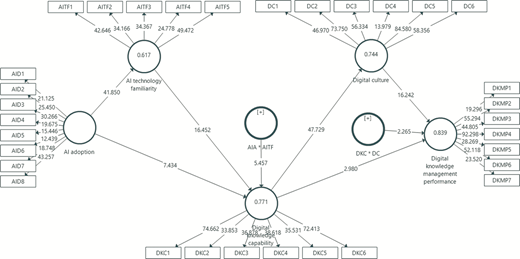
The results of formal hypothesis testing for the proposed model are listed in Table 8 and Figure 3. All seven hypotheses previously put forth have gained unanimous support. Following H1, AI adoption was found to have a positive, significant impact on both digital knowledge and capability (β = 0.346, p < 0.000). H2 shows that digital knowledge capability, in turn, positively influences knowledge management performance (β = 0.143, p = 0.002). The mediating role of digital knowledge capability in the impact of AI adoption on DKM performance (H3) receives support as well (β = 0.050, p = 0.003). The study conducted a mediation analysis (particularly in PLS-SEM) using the variance accounted for (VAF) formula of Hair et al. (2014) to determine whether a mediator accounts for the relationship between an independent and a dependent variable. The formula is:
where “a” is the path between the independent variable and the mediator, b is the path between the mediator and the dependent variable and “c” is the direct effect between the independent and dependent. Hair et al. (2014) point out that a VAF of less than 20% demonstrates no mediation, 20%–80% partial mediation and more than 80% full mediation. As per the current study, it is endorsed that:
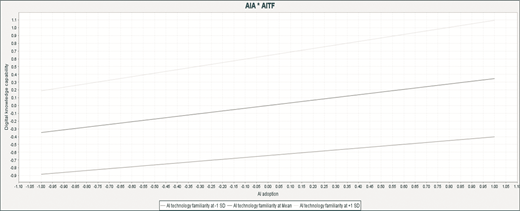
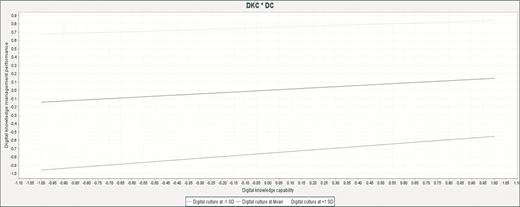
2wFindings underscored that VAF values are within a 20%–80% range and were anticipatory of the partial mediation of digital knowledge capability in the association between the AI adoption and the performance of DKM. Next, with respect to the moderating role that digital knowledge capability plays between AI adoption and knowledge management performance, H4 points out that AI technology familiarization would heighten cooperation among these factors (β = 0.106, p < 0.000), and H5 shows that digital culture would be conducive for enhancing the efficiency of digital knowledge capabilities in raising overall knowledge management retrospective performance (β = 0.061, p = 0.012). The results also confirm the moderation-mediation and mediation-moderation effects, where AI adoption indirectly affects knowledge management performance through AI familiarity and digital knowledge capability (H6: β = 0.072, p = 0.002) or through digital knowledge capability and digital culture (H7: β = 0.225, p < 0.000).
Figures 4 and 5 also demonstrate the moderation effect of AI technology familiarity and digital culture through slope analysis. These figures predicted that the interaction term would affect the slope lines in the charts. In sum, the findings indicate that AI adoption significantly enhances knowledge capability and performance, with its effects boosted by familiarity with AI technology and support from a digital culture.
5. Discussion and implications
5.1 Discussion
This paper reviews how the adoption of AI influences the DKM performance mediated by the digital knowledge capability and moderated by the familiarity with AI technology and digital culture. The results are strong evidence of the hypothesized correlations and present valuable theoretical and practical conclusions. To begin with, the findings substantiate the claim that AI adoption is a significant contributor to the digital knowledge capability that subsequently leads to an improvement in the performance of DKM. Companies that use AI technologies show a high capability of capturing, processing and implementing knowledge (Horani et al., 2025; Kumar, 2025; Zhang et al., 2025). This observation aligns with the KBV, which frames knowledge as one of the key strategic assets in the attainment of a competitive advantage (Kaur, 2025).
Moreover, the favorable correlation between digital knowledge capability and DKM performance is in line with the previous research that highlighted better decision-making and organizational performance because of productive use of knowledge (Hussain et al., 2025; Wang et al., 2025; Al-Husain et al., 2025; González-Prida et al., 2025). Second, the findings of the mediation reveal that digital knowledge capability is an important process by which AI adoption is converted into performance outcomes. This is consistent with the dynamic capability viewpoint, which proposes that technology investments can only generate value once converted into organizational capabilities (Gao et al., 2025; Hashem and Aboelmaged, 2025).
Thirdly, the moderation analysis shows that the familiarity with AI technology enhances the correlation between the adoption of AI and the digital knowledge capability, as knowledgeable employees are more prepared to use AI tools effectively (Shonhe, 2025; Taslim et al., 2025). Likewise, digital culture promotes the effect of digital knowledge capability on DKM performance by promoting collaboration, openness and innovation (Sherani et al., 2025; Rezaei et al., 2025; Wang and Sun, 2025).
Finally, the results of the moderated mediation show that the indirect impact of AI adoption on DKM performance depends on the familiarity of employees and the organizational culture. These findings highlight that the effectiveness of the digitalization of knowledge management is contingent on the match of technology and human capacity as well as cultural environment (Jiang et al., 2025; Chourasia et al., 2024; Murire, 2024; Wang and Zhang, 2025; Cui, 2025; Olan et al., 2022).
5.2 Theoretical contributions
The study builds on the KBV by showing empirically that digital knowledge capability is positively related to the adoption of AI, which subsequently positively influences the performance of DKM. Historically, the concept of AI adoption has been presented as a technological investment, but in this study, AI is described as an enabler of knowledge, which helps to generate, integrate and apply knowledge in an organization. Notably, the moderating effect of AI technology familiarity highlights the fact that the success of AI adoption does not only rely on the availability of technology but also on the absorptive and interpretative abilities of managers. This is consistent with the focus of KBV on tacit, contextualized knowledge as an essential complement to technological adoption, which implies that the results of performance are determined by the interaction between human mastery and digital technologies.
The research also contributes to the DCT by emphasizing the mediating position of digital knowledge capability in the process of transforming AI adoption into better DKM performance. Through DCT, organizations should keep on reconfiguring resources to respond to changing environments. The results indicate that digital culture augments this relationship even further by creating an agile and knowledge-based culture that enhances the worth of knowledge capabilities. This shows that dynamic capabilities are not only technological but also socio-cultural, both in terms of the adoption of AI and the organizational culture that it takes to make good use of AI.
Altogether, this study approaches the technological and socio-cultural aspects to provide a more comprehensive picture of how companies implement AI projects to create, restructure and maintain competitive advantage. It bridges the gap between KBV and DCT by shedding light on the processes by which AI-based knowledge processes can have an effect on organizational agility, learning and performance of hyper-dynamic digital environments.
5.3 Practical implications
Regarding the managerial and organizational implications, the results indicate that the implementation of AI technologies does not necessarily create value unless it is backed by powerful digital capabilities and a facilitating organizational culture. The lack of proper digital skills and culture that can support knowledge sharing and innovation can leave the AI initiatives underused. This means that managers and industry players in the palm oil value chain should invest not just in the infrastructure of AI, but also in training and building the capacity of employees. The findings indicate that technologically capable managers are better positioned to leverage AI adoption to enhance digital knowledge processes, ultimately improving digital knowledge management performance. Thus, the structures of training programs along with the culture of collaboration, learning and adaptability should be integrated into organizations. The AI cannot be viewed as a technological improvement but as a strategic instrument that is used to align human potential, digital technologies and organizational culture to produce sustainable performance results.
In the policy and public administration dimension, the findings highlight how a more detailed institutional framework can be used to facilitate digital transformation in the Malaysian palm oil industry. The development of AI literacy and digital culture should be the priority of policymakers, as specific projects (training programs, incentives and awareness campaigns). Instead of concentrating on technological infrastructure alone, the policies are to foster a supportive environment that promotes innovation and development of knowledge. Also, the regulatory authorities ought to audit the policies that are already in place and implement the necessary changes to promote technological progress. The adaptability of the industry, its efficiency and global competitiveness can be greatly bolstered by a dual focus on increasing the digital skills and a technological culture among the industry stakeholders.
5.4 Conclusion
This study shows that the use of AI can substantially increase the digital knowledge potential of an organization, which subsequently leads to DKM. The results highlight the importance of familiarity with AI and digital culture as facilitating factors that determine the performance of this relationship. Based on the KBV, AI is theorized as a strategic strength that enables an organization to obtain, process and use knowledge to maintain a competitive advantage. At the same time, the research builds upon the DCT by showing that digital knowledge capability is an important mediating variable through which technological investments are converted into performance deliverables. These findings reflect that the value of technology can be achieved only after being embedded into organizational capabilities and facilitated by a favorable cultural environment and the interaction between technology, people and culture.
This study has some limitations, even though it has made its contribution. It is possible that relying on a quantitative design will not be able to capture contextual and behavioral nuances, and future qualitative or mixed-method methods can be considered. Also, the emphasis on the Malaysian palm oil business hinders generalization. The proposed model ought to be confirmed by future studies in different industries and institutional settings to become stronger and more applicable.
Funding
The authors are grateful to the anonymous reviewers and editor for their insightful comments and suggestions. The research was supported by the 2024 Humanities and Social Sciences Research Project of the Ministry of Education (Grant number 24YJA790018); the 2023 Natural Science Foundation of Fujian Province (Grant number 2023J011134); the 2023 Social Science Fund of Fuzhou city (Grant numbers: 2023FZB88); the 2024 Fujian Provincial Social Science Program (Grant number JAS23177); the 2024 Fujian Province Fujian Association for science and technology innovation think tank Research Program (Grant number FJKX-2024XKB040); the 2024 Social Science Fund of Fujian Province (Grant numbers: FJ2024BF009); and the 2025 Natural Science Foundation of Fujian Province (Grant number 2025J08258). The authors would like to express their sincere gratitude to all respondents for their invaluable participation in the data collection of this research. Special thanks to selected hotels for their support and encouragement.