


The purpose of this study is to explore the internal mechanism underlying the ability of the leader–follower relational schema to promote knowledge hiding among employees under conditions of both “congruence” and “incongruence.”
Polynomial regression and response surface analysis were employed to test the research hypotheses. Survey data were collected from 91 leaders and 410 employees across multiple Chinese organizations. Using a mediated response surface model, the authors examined both direct and indirect effects of leader–follower relational schema congruence on followers’ knowledge hiding.
First, leader–follower relational schema congruence is negatively related to employees’ knowledge-hiding behavior, and leader–follower instrumental relational schema congruence is positively related to felt obligation. Second, when congruence is present, employees are less likely to engage in knowledge hiding and feel more obligated in high–high leader–follower expressive relational schema congruence than in low–low congruence. Third, in cases of incongruence, employees are less inclined to hide knowledge and more likely to feel obligated when relational schema incongruence is low–high than when relational schema incongruence is high–low. Finally, leader–follower relational schema congruence influences knowledge hiding through a member’s felt obligation.
Managers should understand the different types of leader–follower relational schema with the goals of managing their knowledge-hiding behaviors more effectively and promoting knowledge sharing and flow within enterprises.
Adopting an implicit, dyadic cognitive perspective, this study integrates social exchange theory and conservation of resources theory to show how leader–follower relational schema congruence shapes felt obligation and reduces knowledge-hiding behavior, thereby offering a more comprehensive, multi-layered explanation.
1. Introduction
In the era of the knowledge economy, knowledge represents an important strategic competitive asset for organizations (Barney, 1991; Bergh et al., 2024; Grant and Phene, 2022). Although organizations attempt to gain a competitive advantage and enhance organizational performance by transforming individual knowledge at the collective level (Grant and Phene, 2022), employees, as the owners of their own intellectual assets, often resist sharing their knowledge (Burmeister et al., 2019; Jafari-Sadeghi et al., 2019). Therefore, when and why does such resistance occur?
To understand this issue, scholars have extensively investigated the antecedents of knowledge sharing (Lei et al., 2023; Sheidae et al., 2021), whereas knowledge hiding remains comparatively underexplored (Černe et al., 2014; Singh, 2019). In fact, as a type of counterproductive knowledge behavior (Serenko and Bontis, 2016; Tsay et al., 2014; Zheng et al., 2017), knowledge hiding can reduce employees’ job satisfaction (Offergelt et al., 2019) and decrease both individual and team creativity (Bogilovic et al., 2017; Černe et al., 2014). Thus, exploring and predicting the factors influencing knowledge hiding are crucial to mitigating its negative effects on organizational performance. To this end, this study adopts a social-cognitive perspective, focusing on how the alignment of unspoken expectations and mental models between leaders and followers (i.e. leader–follower relational schema congruence) shapes knowledge hiding.
Knowledge hiding refers to a form of behavior in which employees intentionally conceal or withhold knowledge that has been requested by another person (Connelly et al., 2012). Although often contrasted with knowledge sharing, the two are distinct; they are not simply opposites and can even coexist within the same individual (Connelly et al., 2019; Ford and Staples, 2010; Hao et al., 2024). Classic definitions frame knowledge hiding as a dyadic, interpersonal behavior between the knowledge hider and seeker (Anand et al., 2022; Chatterjee et al., 2021; Xiong et al., 2021). Because this act is fundamentally relational, early research naturally focused on the individual dispositions of the actors involved, identifying a range of personal antecedents, including employee trait narcissism (Pan et al., 2018; Yang and Zhang, 2021; Ye et al., 2024), territoriality (Singh, 2019), prosocial motivation and perspective taking (Škerlavaj et al., 2018), personal intelligence (Issac and Baral, 2020) and the dark triad (Pan et al., 2018).
However, growing evidence shows that knowledge hiding is highly context dependent, often rooted in broader organizational dynamics such as climate, perceived politics and psychological safety (Kaur and Kang, 2022; Malik et al., 2019; Shrivastava et al., 2021). Studies have thus extended the inquiry to team and organizational levels, examining antecedents such as knowledge sharing climate (Connelly et al., 2012), time pressure (Škerlavaj et al., 2018), workplace bullying and negative workplace gossip (Shah and Hashmi, 2019; Yao et al., 2020), leadership style (Anser et al., 2021; Devi, 2023; Guo et al., 2020) and supervisor knowledge hiding (Arain et al., 2020).
Bridging individual and organizational perspectives, interpersonal relationships serve as conduits through which organizational context is interpreted and enacted by employees (Rockmann and Bartel, 2025). Prior research substantiates this by identifying adverse relational dynamics, such as lack of reciprocation (Butt and Ahmad, 2019; Jafari-Sadeghi et al., 2022) and interpersonal distrust (Geofroy and Evans, 2017; Labafi, 2017), as key antecedents of knowledge hiding. Among these relationships, leader–member exchange (LMX) is particularly potent, as leaders uniquely shape employee interactions, frame their organizational experiences and transmit contextual cues (Scandura and Meuser, 2022). Consequently, while high-quality LMX is known to reduce knowledge hiding (Shi et al., 2021; Zhao et al., 2019), the specific mechanisms and cognitive determinants driving their influence on knowledge hiding remain underexplored (Xiong et al., 2021). This theoretical ambiguity is particularly salient regarding the reciprocal expectations and cognitive prototypes that leaders and followers use to assess their fundamentally interpersonal exchange relationship (Huang et al., 2008).
To address this ambiguity, we propose that a social-cognitive perspective offers a valuable theoretical lens (Tyler and Lind, 1992). Central to this perspective are relational schemas, defined as the implicit cognitive frameworks of expectations and assumptions about relationship interactions, which are essential for understanding how individuals perceive and interpret them (Baldwin, 1992, 1997; Engle and Lord, 1997). When these schemas are congruent, the resulting leader–follower relational schema congruence, the alignment of their implicit expectations and knowledge structures, influences exchange dynamics, thereby shaping both relationship quality and follower behaviors like knowledge hiding. Indeed, reflecting the shared understanding within the dyad, schema congruence has been shown to affect employees’ emotional commitment, innovation performance (Anjali et al., 2021), organizational citizenship behavior (Matta et al., 2015) and turnover intentions (Zhang et al., 2023).
While the importance of schema congruence is clear, the pathway through which schema congruence influences specific cooperative behaviors like knowledge hiding remains underexplored. To better understand this pathway, we propose that the underlying mechanism is employees’ felt obligation – an employee’s perceived duty to reciprocate positive treatment received from leaders or the organization (Eisenberger et al., 2001; Malhotra et al., 2022). Our theoretical framework integrates two complementary perspectives. Social exchange theory (SET) posits that relationships are based on reciprocal exchanges involving both tangible and intangible resources, such as trust, respect and knowledge (Ahmad et al., 2023; Cropanzano and Mitchell, 2005; Emerson, 1976). Within this framework, leader–follower schema congruence enhances the quality of these exchanges by fostering effective communication and behavioral alignment (Engle and Lord, 1997), thereby strengthening employees’ felt obligation and reducing knowledge hiding. In contrast, conservation of resources (COR) theory explains the defensive side: individuals seek to obtain, retain and protect valued resources, especially when confronted with threats (ten Brummelhuis and Bakker, 2012; Duan et al., 2020; Hobfoll et al., 2018). From this perspective, schema incongruence may be perceived as a relational threat, prompting knowledge hiding as a means of conserving valuable intellectual assets. This dual-theory framework leads us to the following research questions:
How do different patterns of leader–follower relational schema congruence influence employee knowledge-hiding behavior?
What is the mediating mechanism through which leader–follower relational schema congruence affects employees’ knowledge-hiding behavior?
As a result, this study makes the following three contributions. First, this study reveals the link between the relational schema and knowledge hiding, a topic that previous studies have rarely explored, and thus enriches the knowledge management literature. Second, it analyses the internal mechanism underlying the impact of the leader–follower relational schema on employees’ knowledge hiding under conditions of both congruence and incongruence, thus broadening the research on knowledge-hiding behavior from the perspective of dynamic matching. Finally, it explores the mediating role of felt obligation and analyses how the dyadic interaction based on relational schemas affects employees’ personal cognition, thus leading to knowledge-hiding behavior.
2. Theoretical development and hypotheses
2.1 Four different congruence scenarios in the leader–follower relational schema
A relational schema refers to a cognitive framework consisting of interpersonal knowledge that individuals rely on to interpret social information and guide appropriate social behaviors (Baldwin, 1992, 1997). Leader–member relational schema congruence implies a similarity between the leader’s and follower’s relational schema. Leaders and followers develop a knowledge structure or relationship mode on the basis of their past interpersonal experience. Factors such as group composition, leadership processes and norms shape shared knowledge structures among group members (Cannon-Bowers and Salas, 2001).
The relational schema formed during relationship communication represents an individual’s role expectations and standards for evaluation. These schemas guide subsequent behaviors and provide insights into the expectations that leaders and members have of each other within social exchanges. They also help in evaluating the quality of LMXs (Huang et al., 2008). Furthermore, the relational schema between leaders and members can be divided into the expressive relational schema and the instrumental relational schema. The former type of schema refers to a cognitive structure in which individuals in binary relationships should be emotionally interdependent and mutually engage in more affective and extrarole exchange behaviors; in contrast, the latter type of schema tends to foster the belief that economic goals should be prioritized in binary relationships and is more representative of interactions within leader–follower dyads that are characterized by low-quality LMX (Tsai et al., 2017; Wang et al., 2021b). Therefore, the leader–follower relational schema indicates that these two parties have their own understandings of the proper mode and characteristics of interpersonal relationships. This situation not only enables individuals to process social and interpersonal information within the organization but also impacts individuals’ emotions and behaviors (Tsai et al., 2017).
However, leaders’ and followers’ relational schema does not always align perfectly, resulting in either “congruence” or “incongruence.” Depending on the situation, leaders and followers may interact differently, which impacts employees’ behaviors. Thus, by categorizing the relational schema of leaders and followers as high or low based on their alignment, four possible congruence scenarios emerge for both expressive and instrumental relational schemas. As shown in Figure 1, these scenarios describe different interaction patterns depending on the degree of alignment between the leader’s and follower’s relational schemas.
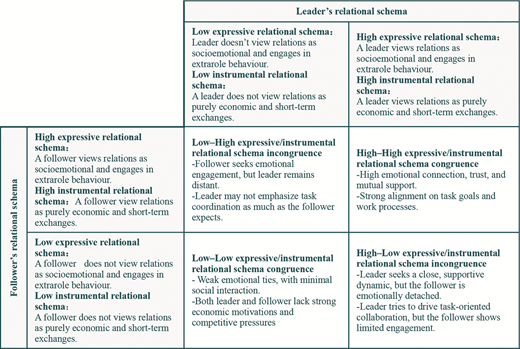
Relational schema combinations between leaders and followers
Source: Authors’ own work
Relational schema combinations between leaders and followers
Source: Authors’ own work
2.2 Congruent effect of the relational schema on felt obligation and knowledge hiding
The relational schema, developed through interactions, is a cognitive framework that shapes how individuals evaluate and explain the nature of the relationship (Holmes, 2000). Different relational schemas reflect varying expectations and provide behavioral guidance in interpersonal contexts (Baldwin, 1992; Tsai et al., 2017). Leaders and followers rely on their schemas to interpret external events and each other’s behavior, thereby shaping their own actions through social exchange (Gioia, 1993; Tsai et al., 2017). Furthermore, relational schemas reflect individuals’ exchange orientations, with people generally preferring interactions that match their existing schemas (Sanchez-Burks, 2002).
When leaders’ and followers’ schemas align, the resulting shared communication patterns and cognitive frameworks enhance mutual understanding and anticipation of actions, reduce uncertainties and improve the overall quality of their interactions (Wang et al., 2021b). Drawing on SET, such alignment facilitates reciprocal exchanges, as both parties can anticipate each other’s behaviors and act in ways that reinforce the relationship (Edwards and Cable, 2009). This positive relational climate creates a virtuous cycle: on the one hand, it cultivates prosocial attitudes like a strong sense of felt obligation to reciprocate; on the other hand, it mitigates the underlying distrust and vulnerability that fuel defensive behaviors. Knowledge hiding is a particularly crucial example of such a behavior, as it can both result from and further damage interpersonal dynamics in the workplace (Jafari-Sadeghi et al., 2022).
Conversely, incongruent schemas can lead to unmet expectations and communication breakdown, making reciprocal behaviors harder to establish, thus straining relationships and reducing psychological satisfaction. As COR theory suggests, this divergence can trigger a downwards spiral of resource loss, increasing the likelihood of knowledge-hiding behavior, as employees protect their valuable resources (Holmgreen et al., 2017).
2.2.1 Expressive relational schema.
When leaders and followers share congruent expressive relational schemas, they align in their views on emotional support, fostering high-quality exchange relationships (Ahmad et al., 2023). This alignment enhances the quality and accuracy of communication, enabling leaders to better understand the needs of their followers. Consequently, leaders can offer more tailored emotional support and cultivate a climate of psychological safety, reinforcing followers’ feelings of accountability and duty (Aggarwal et al., 2020). This supportive environment yields two critical, interrelated outcomes. On a practical level, it reduces perceived threats or work pressures, thus diminishing the motivation for defensive behaviors such as knowledge hiding. In parallel, on a normative level, a powerful norm of reciprocity is invoked when followers receive such valuable and personalized emotional support from their leaders, a dynamic explained by SET (Malhotra et al., 2022). This creates a powerful sense of felt obligation, as followers feel a duty to repay the care and understanding they have received, reinforcing their sense of responsibility to the leader and the relationship.
Leader–follower expressive relational schema congruence is negatively related to employees’ knowledge hiding.
Leader–follower expressive relational schema congruence is positively related to employees’ felt obligation.
2.2.2 Instrumental relational schema.
In contrast to expressive schemas, the instrumental relational schema aligns around economic goals, focusing on material resources and contractual exchanges (Tsai et al., 2017). When leader–follower instrumental schemas are congruent, both parties aim to maximize their tangible benefits, viewing interactions as reciprocal exchanges of resources such as promotions and benefits (Wang et al., 2021a). This shared, calculative mindset leads to two significant consequences for employees.
First, the clarity and predictability inherent in this alignment reduce the workplace ambiguity and uncertainty that often trigger defensive behaviors (Anjali et al., 2021). In such a transactional environment, employees understand that their rewards are directly tied to performance. Withholding valuable information becomes a counterproductive and irrational act, as it directly hinders the achievement of the goals necessary to secure tangible benefits. Consequently, the motivation for knowledge hiding is substantially diminished.
Moreover, this clarity regarding expectations and reward cultivates a transactional form of felt obligation. When followers understand the explicit “rules of the game,” they feel a duty, bound by the principle of reciprocity. When followers clearly understand their leaders’ expectations and responsibilities, they are more likely to feel obligated to fulfill these expectations (Basit, 2021; Lorinkova and Perry, 2019). As a result, they are more likely to identify with work groups and fulfill their responsibilities with their group. This reinforces a strong sense of responsibility to uphold the transactional agreement with the leader. Therefore, we hypothesize the following:
Leader–follower instrumental relational schema congruence is negatively related to employees’ knowledge hiding.
Leader–follower instrumental relational schema congruence is positively related to employees’ felt obligation.
2.3 The differential effect of relational schema congruence on felt obligation and knowledge hiding
When leaders and followers share the same relational schema, either high–high or low–low congruence can emerge, affecting followers’ knowledge-hiding behavior. Congruent schemas facilitate exchange cycles, aligning with social exchange rules such as altruism, which reflect tendencies to reciprocate good deeds within the organization. High-quality LMX often includes an expressive component, leading followers to feel more obligated and less inclined to hide knowledge. Conversely, relationships focused on economic goals exhibit the opposite pattern (Dienesch and Liden, 1986).
2.3.1 Expressive relational schema.
In high–high congruence of the expressive relational schema, both parties engage in emotional interaction, fostering mutual benefits through active communication and emotional integration. In such congruence, leaders provide autonomy and support, whereas followers perceive that leaders care about their interests and career development, leading to a sense of psychological safety. This environment supplies employees with psychological resources, encouraging extrarole behaviors that benefit leaders and the organization and promoting organizational citizenship behavior (Eisenberger et al., 2001; Podsakoff et al., 2000) and reducing knowledge hiding. This deep personal investment from the leader also evokes a strong sense of felt obligation in followers to reciprocate this care. In addition, because knowledge-hiding behavior can lead to guilt, employees who exhibit a highly emotional relational schema are more likely to feel guilty about their nonprosocial self-interested behaviors, thus reducing their knowledge-hiding behavior (Burmeister et al., 2019).
In low–low congruence, the relationship lacks this deep emotional investment. While expectations are aligned, they are aligned at a low, superficial level. This superficial exchange is insufficient to foster a robust climate of psychological safety, so the barrier against knowledge hiding remains relatively high. Furthermore, with minimal emotional resources provided by the leader, followers feel little compelling obligation to reciprocate beyond basic job requirements, resulting in a much weaker sense of felt obligation. Therefore, we posit the following:
High leader–follower expressive relational schemas are associated with less knowledge-hiding behavior than low–low leader–follower expressive relational schemas.
High–high leader–follower expressive relational schemas are associated with higher levels of felt obligation than low–low leader–follower expressive relational schemas.
2.3.2 Instrumental relational schema.
Individuals leverage knowledge as a strategic resource to gain competitive advantages in organizational contexts or interpersonal relationships, thereby maximizing their own interests (Anand et al., 2022). In high–high leader–follower instrumental relational schema congruence, both parties focus on economic intentions in their interactions. This competitive environment fosters a mentality where knowledge is treated as a personal asset, one that can be withheld or preserved to maintain an advantage. As both parties focus on maximizing benefits with minimal effort, knowledge hiding becomes a way to protect their strategic resources (Liao et al., 2019). The emphasis on utilitarianism and short-term gains reduces the felt obligation to share knowledge or engage in extrarole behaviors, as these are seen as unnecessary in the context of their narrowly defined work-based relationship.
Conversely, in low–low instrumental relational schema congruence, the lack of strong economic motivations and competitive pressures creates a more collaborative environment where resource competition is minimized. Since both parties are less focused on using knowledge for personal gain, they can build stronger interpersonal relationships that extend beyond purely transactional goals (Tsai et al., 2017). This reduced focus on competition enhances intrinsic felt obligation – employees feel more connected to their leaders and are more likely to engage in prosocial behaviors, such as sharing knowledge. In this context, knowledge is viewed not as a personal resource to be protected but as a tool for collective success, resulting in less knowledge hiding and a stronger sense of responsibility toward the organization (Zhu et al., 2019). Therefore, we posit the following:
Low–low leader–follower instrumental relational schema are associated with less knowledge-hiding behavior than high–high leader–follower instrumental relational schema.
Low–low leader–follower instrumental relational schema are associated with more felt obligation than high–high leader–follower instrumental relational schema.
2.4 The effect of relational schema incongruence on felt obligation and knowledge hiding
There are situations that exhibit incongruence, including high–low leader–follower schemas and low leader–high follower schemas. These situations are just as significant as congruence in understanding workplace dynamics, though their underlying mechanisms differ. The inherent power asymmetry of the leader-follower exchange is pivotal to understanding this complexity (Neeley and Reiche, 2022). As representatives of the organization, leaders hold substantial power and control over core resources (Xu et al., 2024), while employees often adjust their behavior on the basis of their perception of the leader’s ability to reward or sanction. It is precisely within this power-laden context that relational schema incongruence becomes particularly damaging. It undermines the development of shared interpretations and coordinated responses to events (He et al., 2024), leading to reactions based on misunderstandings. These issues may escalate, with followers who feel their relational expectations are unmet by a powerful leader potentially resorting to knowledge hiding or reducing their felt obligation as a form of retaliation or self-preservation.
2.4.1 Expressive relational incongruence.
When the quality of the leader’s expressive relational schema is high and the follower’s expressive relational schema is low, a dynamic of uneven emotional investment can emerge. According to SET, relationships in the workplace are built upon reciprocal exchanges of tangible and intangible resources, such as emotional support, trust and recognition. Leaders with highly expressive relational schemas actively engage in providing emotional support, encouragement and attentive listening to meet the psychological needs of their followers (Basit, 2021). Leaders’ active emotional engagement with followers can elicit targeted responses, whereas followers with limited expressive relational schema tend to avoid certain interactions for personal reasons. This avoidance may lead to negative coping strategies in feedback provision, resulting in unfavorable evaluations by leaders. Consequently, job insecurity among followers may increase, prompting defensive behaviors aimed at resource protection, such as knowledge hiding and diminished felt obligation.
When the leader’s expressive relational schema is low and the follower’s is high, uneven emotional investment may also occur, as leaders may offer less care and support and withhold emotional resources. However, followers with high-level expressive relational schemas engage proactively, address interpersonal issues optimistically and prioritize relational dynamics over gains and losses (Peng and Wang, 2019). Even if the leader’s expressive relational schema is not high, followers provide some degree of corresponding work support on the basis of the principle of reciprocity with the goal of stabilizing the relationship between the two parties (Wang et al., 2021a). Followers perceive their efforts as valuable when they receive even minimal feedback, which strengthens their sense of obligation. This reciprocal exchange reduces knowledge hiding and encourages continued contribution, as followers aim to maintain balanced relational dynamics. Moreover, according to COR theory, individuals invest resources to protect against resource loss, recover from losses and gain new resources (Duan et al., 2020). When followers receive limited emotional support from their leaders, they may compensate by investing more effort in maintaining the relationship, hoping to secure future emotional or material rewards. This proactive investment mitigates perceived resource loss, reinforcing their sense of obligation and further reducing knowledge-hiding behaviors. Therefore, we propose the following:
In cases of incongruence, followers’ knowledge hiding is lower when the leader–follower expressive relational schema exhibits low–high leader–follower incongruence than when it exhibits high–low leader–follower incongruence.
In cases of incongruence, followers’ felt obligation is greater when the leader–follower expressive relational schema exhibits low–high leader–follower incongruence than when it exhibits high–low leader–follower incongruence.
2.4.2 Instrumental relational schema.
When leader–follower instrumental relational schemas are incongruent, two scenarios can emerge. In high–low incongruence, where leaders emphasize task and resource exchange while followers have lower expectations, followers tend to be less proactive and may avoid additional responsibilities. According to COR theory, individuals’ emotions and behaviors can crossover from one person to another, such as from a leader to followers (Anser et al., 2021; Hobfoll et al., 2018). This transmission of expectations and pressure from leaders with high instrumental schemas may increase the stress experienced by followers with lower expectations. As a result, followers may become defensive, avoiding extra tasks or responsibilities to protect their personal resources. When followers’ behaviors fall short of leaders’ expectations, leaders may perceive them as unwilling to contribute positively, leading to reduced support and rewards. This perceived lack of support can increase followers’ job insecurity and reduce their sense of obligation, making them more cautious about sharing knowledge and leading to more knowledge-hiding behavior, as followers aim to protect their resources and reduce perceived risk.
When the leader–follower instrumental relational schema is characterized by low–high incongruence, the leader places less emphasis on task and resource exchange, but the follower has higher expectations. Followers may still prioritize short-term interests, expecting material rewards in return for their contribution. Motivated by the potential for rewards or recognition, followers proactively share knowledge and complete tasks to demonstrate their value and secure future benefits (Liao et al., 2019). Even leaders with a low instrumental relational schema may reward followers based on performance and immediate contributions. This reciprocity encourages followers to continue contributing, strengthening their feelings of obligation, while reducing knowledge-hiding behaviors, as they anticipate future returns for their efforts. Therefore, we propose the following:
In cases of incongruence, followers’ knowledge hiding is lower when the leader–follower instrumental relational schema exhibits low–high leader–follower incongruence than when it exhibits high–low leader–follower incongruence.
In cases of incongruence, followers’ felt obligation is greater when the leader–follower instrumental relational schema exhibits low–high leader–follower incongruence than when it exhibits high–low leader–follower incongruence.
2.5 The mediating role of felt obligation
Relational schema congruence between leaders and followers plays a crucial role in strengthening feelings of obligation. When leaders and followers share congruent relational schemas, whether emotional or instrumental, their behaviors align with a shared cognitive framework, which enhances mutual understanding and helps fulfill reciprocal expectations (Dai et al., 2022). According to SET, high-quality leader–follower relationships promote the exchange of both emotional and material resources, thereby improving daily interactions and strengthening the overall relationship (Ahmad et al., 2023). By fostering congruence, leaders facilitate social and economic exchanges that build reciprocity and reinforce commitment within the relationship.
As followers perceive emotional and material support from their leaders, their felt obligation to reciprocate increases (Lee et al., 2019a). Previous research has indicated that if individuals feel responsible for their organization, they may be more likely to engage actively in extrarole behaviors (Lorinkova and Perry, 2019). Perceived responsibility mediates the relationship by shifting individuals’ motivations from self-centered to prosocial. As responsibility increases, employees focus less on personal gain and more on organizational interests. This shift moves individuals from egoistic motives to considering the broader impact on the team. Since knowledge hiding is driven by egoism, an increase in felt obligation reduces the likelihood of knowledge hiding, as followers recognize that doing so strengthens team collaboration and improves overall organizational performance. Therefore, a mediating role for felt obligation is hypothesized.
Employees’ felt obligation mediates the effect of expressive relational schema congruence on employees’ knowledge hiding.
Followers’ felt obligation mediates the effect of instrumental relational schema congruence on employees’ knowledge hiding.
In summary, the theoretical model of this study is illustrated in Figure 2.
 This flowchart illustrates the relationships between leader-follower expressive and instrumental relational schema congruence and incongruence, as well as the concepts of employee felt obligation and knowledge hiding. The top sections are labeled with “Leader-follower expressive relational schema congruence” and “Incongruence,” indicating two broader thematic areas. Various paths lead to “Employee’s felt obligation,” marked with hypotheses H1a, H1b, H2a, H2b, H2c, and H2d, along with arrows pointing towards “Employee’s knowledge hiding,” accompanied by hypotheses H3a, H3b, H3c, H3d, H4a, and H4b. The layout organizes hypotheses predominantly flowing left to right and top to bottom, with solid and dotted lines illustrating various relationships. The bottom of the flowchart includes a key that specifies the H1 to H4 hypotheses in relation to the relational schema congruence.
Conceptual model
Source: Authors’ own work
This flowchart illustrates the relationships between leader-follower expressive and instrumental relational schema congruence and incongruence, as well as the concepts of employee felt obligation and knowledge hiding. The top sections are labeled with “Leader-follower expressive relational schema congruence” and “Incongruence,” indicating two broader thematic areas. Various paths lead to “Employee’s felt obligation,” marked with hypotheses H1a, H1b, H2a, H2b, H2c, and H2d, along with arrows pointing towards “Employee’s knowledge hiding,” accompanied by hypotheses H3a, H3b, H3c, H3d, H4a, and H4b. The layout organizes hypotheses predominantly flowing left to right and top to bottom, with solid and dotted lines illustrating various relationships. The bottom of the flowchart includes a key that specifies the H1 to H4 hypotheses in relation to the relational schema congruence.Conceptual model
Source: Authors’ own work
3. Research methods
3.1 Sample and procedure
The majority of the participants in this research were recruited from enterprises in Southeast China, which is known for its rapid economic growth and diverse organizational practices, offering a dynamic setting for studying leader–follower interactions. To reduce the possibility of common method bias (Podsakoff et al., 2012), this study used a multistage and multisource survey design. Data collection was conducted in two phases, enabling cross-validation and consistency checks between data sets obtained at different times. The Chinese context, which emphasizes harmonious relationships, blends traditional values with modern management practices, providing insights that can be valuable across different cultural settings. Additionally, China is one of the countries where data on knowledge hiding are most frequently collected, making it an ideal setting for exploring these dynamics (He et al., 2021).
Ultimately, a total of 651 questionnaires were distributed as part of this study, including 106 questionnaires administered to leaders and 545 questionnaires administered to employees. The leaders were asked to complete their surveys first, followed by their employees, ensuring a one-to-many data matching process. After removing responses with significant missing data, duplicate answers, or uniform responses across all items, a total of 91 leader questionnaires and 410 employee questionnaires were retained, yielding a response rate of 77%.
Most of the 91 leaders included in the sample were female, accounting for 56% of the total. In terms of age, 40.7% of these respondents were between 25 and 35 years old. In terms of education level, one-third of these leaders held a master’s degree or above (34%), followed by those with a junior college degree (33%) and a bachelor’s degree (30.8%). In terms of gender, 50.2% of the followers were female. In terms of education level, the group of followers with a junior high school education or below was the largest (28%), followed by the groups of followers with an undergraduate degree (27.6%), a junior college degree (24.4%) and a master’s degree or above (20%). With respect to the distribution of followers’ work experience, those with less than 1 year of experience accounted for 30% of the total, those with 1–3 years of experience accounted for 32.4%, those with 3–5 years of experience accounted for 14.4% and those with more than 5 years of experience accounted for 23.2%. With respect to the dyadic tenure of followers and leaders, follower pairs with less than 1 year of such tenure were most common (35.1%), while pairs with 1–3 years of tenure accounted for 31.2% of the total, those with 3–5 years of tenure accounted for 13.9% and those with more than 5 years of tenure accounted for 19.8%.
3.2 Variable measurement
The scales used in this paper were revised and designed on the basis of mature scales, and a five-point Likert scale (ranging from 1 = completely disagree to 5 = completely agree) was used for scoring.
The relational schema scale was first developed on the basis of Baldwin’s (1992, 1997) definition and tested in Chinese settings; this scale, developed by Tsai et al. (2017), was used to measure the relational schema. The scale exhibited high reliability and validity in Wang et al.’s research on the influence of relational schema congruence, thus indicating its strong applicability in the Chinese context (Wang et al., 2021a). Therefore, this study used a total of ten items drawn from this scale to measure leader–follower relationship schema congruence. Example items include “leaders and followers should be emotionally attached to each other.”
The measurement of felt obligation was taken from the felt obligation scale developed by Eisenberger et al. (2001). The scale demonstrated good reliability and validity in the study by Wen et al. (2016). A sample item is “I feel a personal responsibility to do my best to help the organization or my colleagues achieve their goals.”
The knowledge hiding scale developed by Connelly et al. (2012) was used to measure knowledge hiding. A study by Wu et al. (2020) on the impact of Zhong Yong thinking on knowledge hiding confirmed its good reliability and validity. A sample item is “agree to help him or her but never intend to do so.”
3.3 Analytical method
In this study, polynomial regression and response surface analysis were used to examine the impact of leader–follower relational schema congruence on followers’ knowledge hiding. Polynomial regression captures nonlinear relationships by including quadratic and interaction terms (Edwards and Parry, 1993), allowing for a more nuanced understanding of how leader and follower perceptions interact. The independent variables were centralized to reduce multicollinearity and simplify interpretation, and quadratic terms were constructed to model curvilinear effects. Response surface analysis visualized and interpreted polynomial regression results (Edwards and Cable, 2009) allowing detailed examination of discrepancy and combined effects on the outcome variable.
3.3.1 Polynomial regression and three-dimensional response surface diagram.
This study used Edwards and Parry (1993)’s polynomial regression approach to analyze how leader–follower schema congruence affects employees’ feelings of obligation and knowledge-hiding behavior. The operation involved the regression of the dependent variable (knowledge hiding) on five polynomials. This process involved constructing the leader’s relational schema (L) with expressive (LE) and instrumental (LI) components and the follower’s relational schema (F) with expressive (FE) and instrumental (FI) components. It included the square terms of the leader’s schema (LE2, LI2) and follower’s schema (FE2, FI2), as well as the interaction terms (LE × FE, LI × FI). The dependent variable (knowledge hiding, Z) was included in the polynomial regression equation, with as the intercept and as the error term:
After the centralized processing of variables, multilayer regression analysis was carried out via formula (1) to explore the complex relationship between the two variables. After testing the hypothesis with polynomial regression, we used the regression data to construct corresponding three-dimensional (3D) response surface plots (Edwards and Parry, 1993) to visually present the regression results. This study observed the influence of the changes in two independent variables, L = −F (incongruent line) and L = F (congruent line), on the result variable Z. Formula (1) can be converted to:
If the curvatures of the incongruence line are significant, that is, if the response surface along the incongruence line is U-shaped, then H1a–H1d is verified. If the slope of the congruence line is significant, H2a−H2d are verified. If the slopes of the incongruence line are significant, H3a–H3d are verified. In the 3D response surface diagram, changes in the dependent variable from the left corner to the right corner reflect the effects when the leader–follower relationship schema is incongruent, while changes from the front corner to the back corner reflect the effects when the schema is congruent. These geometrical changes on the surface correspond to the verification of the hypotheses.
3.3.2 The block variable method was used to test the mediating effect.
Based on the results of the polynomial regression analysis, this paper conducted block variable analysis to verify the indirect effect of leader–follower schema congruence on employees’ knowledge hiding. By constructing the block variable of relational schema congruence, the total effect, indirect effect and mediating effect of the model were determined. Additionally, we calculated the proportion of the mediating effect with the goal of testing its significance. Edwards and Cable (2009) claimed that the block variable method is helpful for testing the direct effect and mediating effect of leader–follower schema congruence on employees’ knowledge hiding (Edwards and Cable, 2009).
4. Data analysis and results
4.1 Reliability, validity and descriptive statistics
Before testing the hypotheses, we conducted a confirmatory factor analysis of the four-factor structural model of the expressive relational schema and the instrumental relational schema. The four-factor model of the expressive relational schema constructed for this study exhibited a better fit than did the other three-factor models ( = 913.696; degrees of freedom [df] = 344; 2.656; root mean square error of approximation [RMSEA] = 0.064; comparative fit index [CFI] = 0.867; incremental fit index [IFI] = 0.868; standardized root mean square residual [SRMR] = 0.063). In addition, the four-factor model of the instrumental relational schema constructed for this study exhibited a better fit than the other three-factor models did (= 859.396; df = 344; 2.498; RMSEA = 0.061; CFI = 0.889; IFI = 0.89; SRMR = 0.077).
Table 1 presents the mean differences, variance and correlation coefficients of the variables, distinguishing between individual and organizational layers for correlation analysis. At the individual level, followers’ expressive relational schema is significantly positively correlated with followers’ instrumental relational schema (r = 0.55, p < 0.01) and employees’ sense of responsibility (r = 0.60, p < 0.01) and significantly negatively correlated with employees’ knowledge hiding (r = −0.54, p < 0.01). Additionally, followers’ instrumental relational schema is positively correlated with employees’ felt obligation (r = 0.36, p < 0.01) and negatively correlated with employees’ knowledge hiding (r = −0.39, p < 0.01). Employees’ felt obligation is negatively correlated with employees’ knowledge hiding (r = −0.47, p < 0.01). At the organizational level, leaders’ expressive relational schema is significantly positively correlated with leaders’ instrumental relational schema (r = 0.38, p < 0.01).
Descriptive statistics, reliabilities and correlations
| Variables | Mean difference | SD | 1 | 2 | 3 | 4 | 5 | 6 | 7 | 8 | 9 |
|---|---|---|---|---|---|---|---|---|---|---|---|
| Individual level | |||||||||||
| Gender | 1.50 | 0.50 | 1 | ||||||||
| Age | 2.83 | 1.35 | 0.06 | 1 | |||||||
| Education | 2.40 | 1.10 | 0.07 | 0.06 | 1 | ||||||
| Years of employment | 2.31 | 1.13 | 0.06 | 0.25** | −0.16** | 1 | |||||
| Work experience | 2.18 | 1.12 | 0.08 | 0.32** | −0.10* | 0.91** | 1 | ||||
| Follower’s ERS | 3.61 | 0.86 | −0.06 | 0.07 | −0.04 | 0.02 | 0.05 | 1 | |||
| Follower’s LRS | 3.45 | 0.97 | −0.15** | 0.09 | 0.10* | −0.09 | −0.02 | 0.55** | 1 | ||
| Felt obligation | 3.74 | 0.77 | 0.04 | −0.02 | −0.02 | 0.11* | 0.08 | 0.60** | 0.36 | 1 | |
| Knowledge hiding | 2.35 | 0.73 | −0.03 | −0.10 | −0.01 | −0.05 | −0.07 | −0.54* | −0.39** | −0.47** | 1 |
| Organizational level | |||||||||||
| Gender | 1.51 | 0.50 | 1 | ||||||||
| Age | 2.99 | 1.16 | 0.16** | 1 | |||||||
| Education | 3.00 | 0.95 | −0.13** | −0.15** | 1 | ||||||
| Position | 1.82 | 0.84 | −0.13** | 0.03 | 0.06 | 1 | |||||
| Leader’s ERS | 3.72 | 0.87 | −0.04 | 0.02 | 0.11* | −0.20** | 1 | ||||
| Leader’ LRS | 3.41 | 1.02 | −0.14** | 0.07 | 0.28** | 0.23** | 0.38** | 1 |
ERS = Expressive relational schema; LRS = Instrumental relational schema
4.2 Hypothesis testing
4.2.1 Test of the effect of the relational schema on felt obligation and knowledge hiding.
The effects of the leader–follower relational schema on knowledge hiding and felt obligation, along with the polynomial regression results from response surface analysis, are shown in Table 2. If the curvatures of the incongruence line are significant, that is, if the response surface along the incongruence line is U-shaped, then H1a–H1d is verified. If the slope of the congruence line is significant, H2a–H2d are verified. If the slopes of the incongruence line are significant, H3a–H3d are verified.
Effect of leader–follower relational schema on knowledge hiding and felt obligation
| Variables | Knowledge hiding | Felt obligation | |||||||||||||||
|---|---|---|---|---|---|---|---|---|---|---|---|---|---|---|---|---|---|
| ERS | LRS | ERS | LRS | ||||||||||||||
| Model 1 | Model 2 | Model 3 | Model 4 | Model 1 | Model 2 | Model 3 | Model 4 | ||||||||||
| B | SE | B | SE | B | SE | B | SE | B | SE | B | SE | B | SE | B | SE | ||
| Constant term | 2.32** | 0.03 | 2.32*** | 0.03 | 2.32** | 0.03 | 2.32*** | 0.03 | 3.73*** | 0.04 | 3.72*** | 0.04 | 3.73*** | 0.04 | 3.72*** | 0.04 | |
| Leader gender | −0.09 | 0.07 | −0.09 | 0.07 | −0.08 | 0.07 | −0.08 | 0.07 | 0.11 | 0.08 | 0.08 | 0.07 | 0.09 | 0.07 | 0.09 | 0.07 | |
| Leader age | −0.09** | 0.03 | −0.08* | 0.03 | −0.09** | 0.03 | −0.09** | 0.03 | 0.02 | 0.03 | 0.02 | 0.03 | 0.03 | 0.03 | 0.03 | 0.03 | |
| Leader education | 0.01 | 0.04 | 0.01 | 0.04 | 0.01 | 0.04 | 0.00 | 0.04 | 0.00 | 0.05 | 0.00 | 0.04 | 0.02 | 0.05 | 0.01 | 0.04 | |
| Leader position | −0.05 | 0.05 | −0.04 | 0.05 | −0.05 | 0.05 | −0.04 | 0.05 | 0.01 | 0.05 | 0.01 | 0.04 | 0.00 | 0.05 | −0.01 | 0.04 | |
| Follower gender | −0.11 | 0.08 | −0.10 | 0.08 | −0.11 | 0.09 | −0.05 | 0.06 | 0.04 | 0.07 | 0.06 | 0.06 | 0.03 | 0.07 | 0.02 | 0.06 | |
| Follower age | −0.03 | 0.02 | −0.02 | 0.02 | −0.02 | 0.02 | −0.02 | 0.02 | −0.04 | 0.02 | −0.03 | 0.02 | −0.05 | 0.03 | −0.03 | 0.03 | |
| Follower education | −0.03 | 0.03 | −0.02 | 0.03 | −0.04 | 0.04 | −0.03 | 0.03 | 0.05 | 0.03 | 0.03 | 0.03 | 0.06 | 0.03 | 0.05 | 0.03 | |
| Follower work experience | −0.03 | 0.10 | −0.04 | 0.09 | −0.04 | 0.11 | −0.10 | 0.10 | 0.13 | 0.08 | 0.18 | 0.08 | 0.13 | 0.11 | 0.13 | 0.10 | |
| Dyadic tenure | 0.01 | 0.11 | 0.04 | 0.10 | 0.01 | 0.12 | 0.09 | 0.11 | −0.07 | 0.08 | −0.14 | 0.08 | −0.07 | 0.10 | −0.09 | 0.09 | |
| Follower’s relational schema (LE/LI) | −0.02 | 0.04 | −0.04 | 0.05 | −0.01 | 0.04 | 0.01 | 0.04 | 0.07 | 0.04 | 0.06 | 0.04 | −0.06 | 0.04 | −0.05 | 0.05 | |
| Leader’s relational schema (FE/FI) | −0.44*** | 0.06 | −0.56*** | 0.05 | −0.36** | 0.10 | −0.53*** | 0.07 | 0.59*** | 0.05 | 0.61*** | 0.06 | 0.46*** | 0.07 | 0.49*** | 0.07 | |
| L2 | 0.04 | 0.04 | 0.00 | 0.05 | 0.02 | 0.04 | 0.00 | 0.04 | |||||||||
| L*F | 0.08 | 0.06 | −0.21 | 0.08 | −0.08 | 0.05 | 0.12 | 0.08 | |||||||||
| F2 | 0.20*** | 0.05 | 0.18** | 0.06 | −0.10* | 0.05 | −0.12 | 0.08 | |||||||||
| Consistent line slope | −0.60*** | −0.52*** | 0.67*** | 0.45*** | |||||||||||||
| Consistent line curvature | 0.31*** | −0.02 | −0.17** | 0.00 | |||||||||||||
| Inconsistent line slope | 0.53*** | 0.54*** | −0.55*** | −0.54*** | |||||||||||||
| Inconsistent line curvature | 0.15* | 0.39*** | 0.003 | −0.24** | |||||||||||||
The table presents unstandardized regression coefficients and standard errors for each measure; values in italics are relevant for tests of hypotheses; *p 0.10; **p 0.05; and ***p 0.001 ERS = expressive relational schema; LRS = instrumental relational schema
Table 2 indicates that the curvature of the incongruent line (LE = −FE) is significant ( = 0.15, p < 0.05), which indicates that the more congruent the expressive relationship schema of leaders and followers is, the lower the degree of knowledge hiding of followers to leaders or colleagues. Similarly, the curvature of the incongruent line (LI = −FI) for the instrumental relational schema on knowledge hiding (=0.39, p < 0.001) and felt obligation ( = −0.24, p < 0.01) is significant, suggesting that greater congruence reduces knowledge hiding and increases felt obligation. Thus, H1a, H1c and H1d are supported. Model 4 shows that the curvature of the incongruent line (LE = −FE) is not significant (a4 = 0.003, p > 0.05), which indicates that the more the expressive relationship schemata of leaders and followers tend to be consistent, the more significant the difference between the followers’ felt obligation of leaders or colleagues and the incongruent ones. Therefore, H1b is not verified.
The slopes of the consistent line (LE = FE) in Table 2 are significant (knowledge hiding: = −0.60, p < 0.001; felt obligation: = 0.67, p < 0.001), indicating that followers’ knowledge-hiding behavior is lower and their felt obligation level is greater when the manager–follower expressive relationship schema is highly congruent than when it is weakly congruent. Therefore, H2a and H2b are verified. The congruence line (LI = FI) had a significant slope (knowledge hiding: = −0.52, p < 0.001; felt obligation: = 0.45, p < 0.001), curvature was not significant, and neither H2c nor H2d was verified.
As shown in Table 2, the slopes along the incongruent line (LE = −FE) are significant (knowledge hiding = 0.53, p < 0.001; felt obligation = −0.55, p < 0.001), which indicates that when “the leader’s expressive relationship schema is lower than that of the follower,” the follower’s knowledge hiding to the leader or colleague is lower, and the felt obligation level is higher than that when “the leader’s expressive relationship schema is higher than that of the follower.” Therefore, H3a and H3b are verified. The slopes along the incongruent line (LI = −FI) are significant (knowledge hiding: = 0.54, p < 0.001; felt obligation: = –0.54, p < 0.001), which indicates that when “the leader’s instrumental relational schema is lower than that of the follower,” the follower’s knowledge hiding to the leader or colleague is lower, and the felt obligation is greater than that when “the leader’s instrumental relational schema is greater than that of the follower.” Therefore, H3c and H3d are verified.
4.2.2 Response surface analysis.
The response surface line of incongruence extends from the left corner of the bottom to the right corner, and the line of congruence extends from the front corner of the bottom to the back corner.
Figure 3(a) shows that knowledge hiding is lower at the back corner (i.e. high–high congruence) and higher at the front corner (i.e. low–low congruence), indicating that followers are less likely to hide knowledge in high–high expressive relational schema congruence than in low–low expressive relational schema congruence, further supporting H2a. Knowledge hiding is also lower in the left corner (i.e. low leader–high follower) than in the right corner (i.e. high leader–low follower), which supports H3a. As Figure 3(b) illustrates, felt obligation is greater in the back corner (i.e. high–high congruence), lower in the front corner (i.e. low–low congruence) and greater in the left corner position (i.e. low leader–high follower) than in the right corner (i.e. high leader–low follower), further supporting H2b and H3b.
 The flowchart presents a conceptual model depicting the relationships between leader-follower expressive relational schema congruence and employee behaviors. At the top, "Leader-follower expressive relational schema congruence" branches out into two main categories: "High-high vs. Low-low" with related hypotheses labelled H1a, H1b, H2a, H2b, H2c, and H2d. In the centre, "Employee's felt obligation" acts as a pivotal node showing the effects of these schemas. The right section presents "Incongruence," introducing hypotheses H3a, H3b, H3c, and H3d under "Leader-follower expressive relational schema incongruence." Arrows connect these elements to illustrate potential influences on "Employee's knowledge hiding." Supporting text boxes identify additional relational schema congruences at the bottom, indicating a structured hierarchy of ideas and notions throughout the model.
Response surfaces
Source: Authors’ own work
The flowchart presents a conceptual model depicting the relationships between leader-follower expressive relational schema congruence and employee behaviors. At the top, "Leader-follower expressive relational schema congruence" branches out into two main categories: "High-high vs. Low-low" with related hypotheses labelled H1a, H1b, H2a, H2b, H2c, and H2d. In the centre, "Employee's felt obligation" acts as a pivotal node showing the effects of these schemas. The right section presents "Incongruence," introducing hypotheses H3a, H3b, H3c, and H3d under "Leader-follower expressive relational schema incongruence." Arrows connect these elements to illustrate potential influences on "Employee's knowledge hiding." Supporting text boxes identify additional relational schema congruences at the bottom, indicating a structured hierarchy of ideas and notions throughout the model.Response surfaces
Source: Authors’ own work
In Figure 3(c), the response surface diagram indicates that employees’ knowledge hiding is lower in the left corner (i.e. low leader–high follower) than in the right corner (i.e. high leader–low follower), thus indicating that employees’ knowledge hiding is lower when the relationship is incongruent and presents a low–high leader–follower instrumental relational schema than when it presents a high–low leader–follower instrumental relational schema, further supporting H3c. However, knowledge hiding is lower in the back corner position (high–high congruence) and higher in the front corner position (low–low incongruence); thus, H2c is not supported. Figure 2(d) shows that felt obligation is greater in the low leader–high follower position (left corner) than in the high leader–low follower position (right corner), thus indicating that employees’ level of felt obligation is greater when the relationship presents a low–high leader–follower instrumental relational schema than when it presents a high–low leader–follower instrumental relational schema, thus providing further evidence to verify H3d. Felt obligation is greater in the back corner (high–high congruence) and lower in the front corner (low–low congruence); thus, H2d is not supported due to a lack of clear relationship.
4.2.3 Test of the mediating effect of felt obligation.
H4a and H4b examine the mediating effect of felt obligation, with the results shown in Table 3. For expressive relational schema congruence, the indirect effect of felt obligation on knowledge hiding is significant (effect value = 0.38, 95% CI = [0.22, 0.55]; relative effect value = 42%). This finding indicates that felt obligation mediates the relationship between expressive relational schema congruence and knowledge hiding. Similarly, the indirect effect of instrumental relational schema congruence on knowledge hiding via felt obligation is significant (effect value = −0.11, 95% CI = [−0.20, −0.04]; relative effect value = 33%), indicating that felt obligation also mediates this relationship. Thus, H4a and H4b are confirmed.
Test of the mediating effect of leader–follower schema congruence on employees’ knowledge hiding
| Model | Effect size | Boot standard error | Boot CI lower limit | Boot CI upper limit | Relative effect size (%) | |
|---|---|---|---|---|---|---|
| Expressive relational schema congruence → felt obligation → knowledge hiding | Mediating effect | 0.38 | 0.09 | 0.22 | 0.55 | 0.42 |
| Direct effect | 0.53 | 0.14 | 0.25 | 0.81 | 0.58 | |
| Total effect | 0.91 | 0.12 | 0.66 | 1.14 | ||
| Instrumental relational schema congruence → felt obligation → knowledge hiding | Mediating effect | −0.11 | 0.04 | −0.20 | −0.04 | 0.33 |
| Direct effect | −0.23 | 0.08 | −0.38 | −0.08 | 0.67 | |
| Total effect | −0.34 | 0.08 | −0.50 | −0.18 | ||
5. Discussions
5.1 Main findings
From the perspective of leader–follower binary relationships, this study focuses on the implicit understanding of interpersonal relational schemas in the workplace. As a data collection method, we distributed paired leader–follower questionnaires to various enterprises to obtain matched data concerning relational schema congruence between leaders and employees. On this basis, we tested the research hypotheses proposed in this paper and reached the following main conclusions:
Leader–follower relational schema congruence is negatively related to employees’ knowledge-hiding behavior, and leader–follower instrumental relational schema congruence is positively related to felt obligation.
When congruence is present, employees are less likely to engage in knowledge hiding and feel more obligated in high–high leader–follower expressive relational schema congruence than in low–low congruence.
In cases of incongruence, employees are less inclined to hide knowledge and more likely to feel obligated when relational schema incongruence is low–high than when relational schema incongruence is high–low.
Leader–follower relational schema congruence influences knowledge hiding through a member’s felt obligation.
The results of this study are in sync with those of previous studies from other cultural contexts, which indicates that the relationship between leaders and followers can affect followers’ feelings of obligation and organizational behavior (Lee et al., 2019b), employment engagement (Loignon et al., 2019) and innovation performance (Anjali et al., 2021).
In addition, as shown in Table 4, the empirical test results indicate that some hypotheses are not supported. The hypothesis that the more congruent the leader–follower expressive relational schema is, the greater the follower’s level of felt obligation has not been verified. This may be because there are some boundary effects on the perception of responsibility under the relationship of emotional interaction between the two sides, and the resulting variables are not all the results of the study that play a role through the matching mechanism (Peng and Wang, 2019). Additionally, if followers already have high autonomy in their roles, emotional alignment with leaders may not increase their felt obligation, as they rely more on intrinsic motivation (Morán et al., 2021).
Hypothesis testing results
| Hypothesis | Supported | ||
|---|---|---|---|
| Congruent effect of relational schema | H1a | Leader–follower expressive relational schema congruence is negatively related to employees’ knowledge hiding | YES |
| H1b | Leader–follower expressive relational schema congruence is positively related to employees’ felt obligation | NO | |
| H1c | Leader–follower instrumental relational schema congruence is negatively related to employees’ knowledge hiding | YES | |
| H1d | Leader–follower instrumental relational schema congruence is positively related to employees’ felt obligation | YES | |
| The differential effect of relational schema congruence | H2a | High–high leader–follower expressive relational schemas are associated with less knowledge-hiding behavior than low–low leader–follower expressive relational schemas | YES |
| H2b | High–high leader–follower expressive relational schemas are associated with higher levels of felt obligation than low–low leader–follower expressive relational schemas | YES | |
| H2c | Low–low leader–follower instrumental relational schema are associated with less knowledge-hiding behavior than high–high leader–follower instrumental relational schemas | NO | |
| H2d | Low–low leader–follower instrumental relational schema are associated with more felt obligation than high–high leader–follower instrumental relational schemas | NO | |
| Cases of incongruence | H3a | Followers’ knowledge hiding is lower when the leader–follower expressive relational schema exhibits low–high leader–follower incongruence than when it exhibits high–low leader–follower incongruence | YES |
| H3b | Followers’ felt obligation is greater when the leader–follower expressive relational schema exhibits low–high leader–follower incongruence than when it exhibits high–low leader–follower incongruence | YES | |
| H3c | Followers’ knowledge hiding is lower when the leader–follower instrumental relational schema exhibits low–high leader–follower incongruence than when it exhibits high–low leader–follower incongruence | YES | |
| H3d | Followers’ felt obligation is greater when the leader–follower instrumental relational schema exhibits low–high leader–follower incongruence than when it exhibits high–low leader–follower incongruence | YES | |
| Mediating effect of felt obligation | H4a | Employees’ felt obligation mediates the effect of expressive relational schema congruence on employees’ knowledge hiding | YES |
| H4b | Followers’ felt obligation mediates the effect of instrumental relational schema congruence on employees’ knowledge hiding | YES | |
The hypothesis that low–low leader–follower instrumental relational schemas result in lower knowledge hiding and greater felt obligation than high–high combination schemas is not supported. This finding indicates that in workplaces, leaders and followers may tend to prioritize short-term interests. In cases where the leader–follower instrumental relational schema is congruent, there remains a focus on short-term interests. This alignment often prompts quicker acquisition of benefits, potentially enhancing employees’ sense of responsibility over time.
5.2 Theoretical contributions
First, previous studies have shown that implicit cognitions in leader–follower interactions significantly influence individual perceptions and subsequent behaviors (Kong et al., 2019). This study provides more research on the role of relational dynamics in knowledge behavior by examining how congruence in leader–follower relational schemas affects employees’ knowledge-hiding behavior (Anand et al., 2022; Scandura and Meuser, 2022). Unlike previous research focused on individual-level variables, this study includes organizational-level variables and explores the dyadic relationship between cognition and behavior through cross-level research. This approach provides a deeper understanding of the factors influencing followers’ tendencies to hide knowledge. In Chinese organizational contexts, expressive and instrumental relationships are deeply embedded. Investigating knowledge-hiding behavior through a relationship-based perspective in these contexts can enrich our understanding of organizational dynamics and behaviors in cultures that emphasize relational orientations.
Second, this study revealed that understanding relational schemas in workplace interpersonal relationships can predict individuals’ level of felt obligation. This finding not only expands research on felt obligation among enterprise employees but also extends the application of relational schema theory beyond the previous focus on individual-level LMX (Wang et al., 2017; Wang et al., 2021a). This research advances the understanding of felt obligation by moving beyond individual variables to analyze leader–follower dynamics. It examines reciprocity, stress reactions and behaviors driven by resource flow in interpersonal communication, highlighting the role of cognitive congruence in leader–follower relationships and its impact on employee behavior. These insights contribute to a broader understanding of how followers’ felt obligation can be predicted.
Third, drawing on SET and COR theory, this paper proposes that congruence in leader–follower relationship schemas indirectly affects employees’ knowledge-hiding behavior through feelings of obligation. Empirical analysis confirms that felt obligation mediates the relationship between relational schema congruence and follower behavior. Different interpersonal relationships influence knowledge-hiding behavior through felt obligation, underscoring its significant impact on behavior. Previous studies have shown that felt obligation can trigger organizational citizenship behavior, leading to more prosocial behaviors (Tost, 2015). This study reveals that both expressive and instrumental relational schema congruence reduce knowledge-hiding behavior by increasing feelings of obligation, thereby advancing our understanding of how leader–follower relational schema congruence affects followers’ knowledge-hiding behavior.
5.3 Managerial implications
The findings of this study offer several practical implications for organizations aiming to reduce knowledge hiding and enhance collaboration through improved leader–follower relational schema congruence. By focusing on strategies that foster alignment in both expressive and instrumental relational schemas, organizations can create a more cooperative and transparent work environment.
First, leaders need to recognize that different relational schemas exist between themselves and their followers. Understanding that followers may have varying expectations and communication styles allows leaders to better navigate and adapt their approach, fostering stronger and more effective relationships. It is essential for leaders to consider cultural influences on these schemas, as the cultural context can shape how relationships are perceived and managed. For example, in East Asian cultures, relationships with other individuals are viewed as the cornerstone of career success (Oh et al., 2014).
Moreover, leadership involves ongoing interactions where leaders adapt their behavior to respond to evolving task requirements and contextual changes (Liao et al., 2019). In situations where relational schema incongruence exists, particularly in low–high settings, leaders should adopt a flexible and adaptable approach. Research suggests that adaptive mechanisms, like those used in real-time monitoring and adjustment systems (Darbandi, 2017), can inform leadership strategies aimed at achieving better alignment in dynamic leader–follower relationships. By implementing adaptive adjustments, leaders can better align leader–follower relational schemas, reducing the risk of miscommunication and knowledge hiding. To further minimize negative outcomes and enhance overall team dynamics, organizations should develop personalized strategies tailored to manage different types of follower schemas. This requires educating leaders on recognizing and addressing varying degrees of incongruence. Training programs can equip leaders with the skills necessary to manage low–high incongruence by emphasizing mutual respect and creating tailored support structures that encourage knowledge sharing, even when relational schemas do not fully align. In addition, data-driven approaches can also be used by managers to analyze communication patterns between leaders and followers. For example, machine learning systems can automatically adapt with minimal human interference (Heidari et al., 2023), providing managers with valuable insights to address relational schema mismatches more effectively. By proactively identifying and resolving issues, such as through open discussions or adjusted communication strategies, leaders can foster stronger relational alignment and reduce the occurrence of knowledge hiding.
Second, managers can leverage schema congruence to reduce knowledge hiding. Research has shown that when leader–follower relational schema congruence is high, employees engage in fewer knowledge-hiding behaviors regarding leaders or other members of the organization. In cases where high–high congruence exists, organizations can leverage the resulting strong sense of felt obligation by fostering an environment that promotes mutual support and collaboration. By empowering autonomy and promoting open discussions, leaders can ensure unified communication, enhance transparency and reduce knowledge hiding driven by information gaps or disengagement. Schemas can be shaped and adjusted to a certain extent through interpersonal interactions (Baldwin, 1992, 1995), and managers can adjust schemas through continuous communication and interaction. For example, regular feedback sessions, such as one-on-one meetings and team discussions, can help leaders and followers adjust their relational schemas in a constantly changing environment. Team-building exercises and goal-setting workshops can also be used to foster congruence in instrumental relational schemas, ensuring that leaders and followers share common objectives. This congruence helps minimize knowledge hiding and promotes greater cooperation and task cohesion.
Third, enterprises and leaders should prioritize fostering a sense of responsibility among employees and understanding their perspectives on organizational development. This study highlights the role of felt obligation in mediating the link between leader–follower schema congruence and knowledge-hiding behavior. Leaders should be encouraged to model a sense of responsibility and commitment, demonstrating these traits in their interactions with followers. Regular discussions on team goals and organizational values can further boost followers’ felt obligation to contribute openly, aligning individual efforts with collective organizational success. Emphasizing emotional support and personal autonomy, along with improving the salary system and reward mechanisms, can further enhance employees’ commitment and reduce knowledge-hiding behavior. This approach fosters a culture of responsibility, enabling employees to engage wholeheartedly in their work and contribute positively to the organization.
5.4 Limitations and directions for future research
This paper examines how the leader–follower relational schema impacts knowledge hiding in organizations, drawing valuable insights and revealing several limitations. First, it is essential to move beyond the simplistic assumption that knowledge hiding is inherently negative or malicious. This complexity is evident in several ways. For instance, some forms of hiding may be rational and even have a prosocial dimension, such as so-called “rationality hiding” (Connelly et al., 2012). Moreover, not all hiding is opportunistic; much of it is defensive or obligatory, driven by ethical, legal or organizational necessity, such as confidentiality obligations or compliance with management directives (Usman et al., 2024). To advance this line of inquiry, scholars must distinguish between knowledge hiding that is malicious or opportunistic in intent and that which is defensive, rationalized or required by organizational or ethical constraints. Furthermore, scholars should broaden their focus to consider a continuum of counterproductive knowledge behaviors, including knowledge hoarding, sabotage and selective sharing (Zhu et al., 2024). Ultimately, exploring the distinct antecedents and implications of these varied behaviors will yield a more nuanced and actionable understanding for organizations (Hernaus et al., 2018).
Second, future studies should deepen the analysis of mediating and moderating mechanisms, as well as boundary conditions. Although this study identifies felt obligation as a key mediator, other factors – such as trust, power distance, job autonomy, organizational digitalization and team composition – may significantly influence how relational schemas shape knowledge hiding. Future research should systematically explore additional mediators and moderators, and rigorously test how context-specific pressures and multi-level interactions alter these relationships (Tse et al., 2018). Such work will clarify the conditions under which schema congruence produces beneficial versus detrimental knowledge outcomes, thereby advancing both theoretical understanding and practical guidance. Moreover, this study focuses primarily on SET and COR theory, which emphasize the concepts of reciprocity, resource preservation and the exchange of social and material resources. These frameworks suggest that individuals’ emotional reactions to work events largely determine their attitudes and subsequent behaviors (Weiss and Cropanzano, 1996). We recommend that future research on relational schemas and knowledge hiding broaden the theoretical scope. For example, affective events theory can be used to explore the influence of leader–follower relational schema on knowledge hiding, providing a deeper understanding of the emotional dynamics at play.
Finally, limitations related to cultural context and measurement tools should not be overlooked. The study was conducted within a specific cultural and organizational context, primarily in southern China. While the findings offer a degree of generalizability, they may not fully apply across diverse cultural settings with different work dynamics and leadership styles. Cultural differences can shape not only the relational schemas individuals develop but also how they respond in various situations. Future studies should explore knowledge hiding across diverse cultural contexts and industries, as suggested by previous research (Xiao and Cooke, 2019), which emphasizes the need for a broader understanding of how this behavior may vary across different settings. Comparative studies could determine whether the observed effects are consistent globally or if they vary significantly depending on cultural and organizational norms.
Author contribution
Xianyue Liu, Conceptualization, Methodology, Validation, Supervision; Peiqi Huang, Formal analysis, Writing – original draft preparation, Visualization; Zhizhong Li, Data Curation, Investigation, Software; Dali Zhao, Writing – reviewing & editing, Data Curation.; Yenchun Jim Wu, Conceptualization, Writing – reviewing & editing.
Ethics statement
This study was conducted in accordance with the Declaration of Helsinki. Ethical review and approval were waived for this study according to Article 32 of Measures for Ethical Review of Life Sciences and Medical Research Involving Human Beings of China.

