This study focuses on leadership in organizations where big data analytics (BDA) is an essential component of corporate strategy. While leadership researchers have conducted promising studies in the field of digital transformation, the impact of BDA on leadership is still unexplored.
This study is based on semi-structured interviews with 33 organizational leaders and subject-matter experts from various industries. Using a grounded theory approach, a framework is provided for the emergent field of BDA in leadership research.
The authors present a conceptual model comprising foundational competencies and higher order roles that are data analytical skills, data self-efficacy, problem spotter, influencer, knowledge facilitator, visionary and team leader.
This study focuses on BDA competency research emerging as an intersection between leadership research and information systems research. The authors encourage a longitudinal study to validate the findings.
The authors provide a competency framework for organizational leaders. It serves as a guideline for leaders to best support the BDA initiatives of the organization. The competency framework can support recruiting, selection and leader promotion.
This study provides a novel BDA leadership competency framework with a unique combination of competencies and higher order roles.
Introduction
As the twenty-first century is moving into its third decade, the digital era is fully upon us with advancements in technology bringing business disruption and institutional change (Larson and DeChurch, 2020; Stonehouse and Konina, 2020). Companies require new skills of their leaders to manage new technologies (Ciarli et al., 2021). This goes beyond the strong influence of social media: today’s way of being successful in business needs to explicitly consider the impact of big data. Within a few years, the ability to analyse big data evolved from a marginal phenomenon into a critical component for remaining competitive in organizations (Davenport, 2006; Kane, 2017). As a result, the opportunities and the challenges of big data analytics (BDA) received considerable attention in information science studies (Abbasi et al., 2016; Chen et al., 2013). Yet the impact of big data on leadership is still largely unexplored (Banks et al., 2019) even though big data has been recognized as a major game changer. Big data influences leaders' behaviours and augments their competency spectrum by adding BDA (Caputo et al., 2019). On a behavioural level, BDA is being recognized as an essential driver of how people operate on all organizational levels (Ciarli et al., 2021). Leaders from any department of the organization (e.g. sales, marketing, operations, engineering, human resources) need to deal with big data in a more sophisticated way: big data leadership asks for skills to explicitly understand the process of data-driven decision-making.
Further, BDA requires new skills that go beyond only adapting to new technologies (Mikalef et al., 2021). While leadership theories such as transformational leadership recognize change as vital for the organization, they do not identify becoming a data-driven organization as a major change initiative by itself.
Our research builds on Mikalef et al. (2021) research providing a preliminary skill set for people working in BDA organizations and arguing that additional research is needed to gain a better understanding of any data-driven competency framework. We aim to build a competency framework that broadens our view of effective leadership in the BDA context, given that these so-called data-driven leaders are defined through a unique composition of skills. While previous research argued that data analytic skills are needed for data scientists to give advice to higher management (Davenport and Patil, 2012), current research suggests the need for explicit attention to data analytics skills in middle as well as top management (Mikalef et al., 2021).
Building on existing leadership research and frameworks (e.g. Costa and Santos, 2017; Boyatzis, 2008; Kane, 2017; Mumford et al., 2000; Spencer and Spencer, 1993) this study links BDA to competency research focused on change in the digital era (Boyatzis, 2008; Mikalef and Krogstie, 2020; Mikalef and Krogstie, 2019; Mikalef et al., 2021; Mikalef et al., 2018a; Mumford et al., 2000) to propose a holistic competency framework with higher order roles.
The competency and skills approach has made a strong contribution to leadership research predicting leader effectiveness (Jena and Sahoo, 2014; Connelly et al., 2000; Yukl, 2013). This leader-centred perspective stipulates that skills and knowledge are competencies that can be learned and developed (Northouse, 2018). Although the popularity of the skills approach has increased over the last two decades which is reflected by a vast increase of journal articles on that topic (from 258 journal articles in the year 2000 to over 1.500 articles published articles in 2022 according to the Scopus database), the conceptual framework behind it pre-dates the digital era (Northouse, 2018). Further, its conceptual framework was mainly tested with military personnel and university students while organizational leaders in various industries have been barely considered (Connelly et al., 2000). In addition, research on leadership theory has focused on the development of leadership competencies for a changing world (see Boyatzis, 2008; Mahoney, 2001; Mumford et al., 2000), yet a competency framework specific to the digital era is still not available.
While research in the field of information systems does contribute to research on competencies needed for the digital era by exploring BDA capabilities, it does so mainly from an organization-centred perspective. It examines the resources an organization needs to build its BDA capabilities. While it identifies tangible, human skills and intangible assets (Gupta and George, 2016), managerial skills are hardly discussed, and, if at all, only negligibly. In addition, information systems studies mainly focus on analytical staff, particularly big data managers and IT staff of the organization (see Ahmad et al., 2016; Akter et al., 2016; Davenport, 2006; Debortoli et al., 2014; Gupta and George, 2016; Mikalef et al., 2019; Mikalef and Krogstie, 2019).
Our study enriches the existing body of leadership research by providing a conceptual link to information systems research for the challenges organizations face with regard to BDA. It explores BDA competencies from a leader-centred perspective, focusing on organizational leaders in various functions on different organizational levels (Mumford et al., 2007). A comprehensive BDA leadership competency framework is developed that contributes to the field by combining recognized and emergent leadership skills in a novel way that better reflects the specific requirements of BDA competencies for leaders. It explicitly takes into account the technological requirements and characteristics of BDA and classifies the identified competencies into five distinct roles, which jointly explain data-driven leadership. These roles show how both task-oriented and relationship-oriented competencies are important for BDA leaders.
Leadership competencies and skills have been researched extensively (Boyatzis, 2008; Mumford et al., 2000), yet the rise of technology demands a different perspective on leadership research. Due to the novelty of the BDA topic in leadership literature, we follow the inductive approach through grounded theory development. Hereby, we create a theoretical foundation for discussion and further research in this newly emergent field with high impact practical applications. This methodology allows for acknowledging the influence of technological determinism, which locates the power of technology with respect to other social and cultural factors (De la Cruz Paragas and Lin, 2016, p. 1529; Smith and Marx, 1994) as well as socio-materialism (Orlikowski, 2007), which in turn conceptualizes how social and materiality aspects are linked within the organizational setting (Kim et al., 2012).
In sum, our study views BDA as a technological force, or materiality, which influences leaders' behaviours and reshapes their competency spectrum. This view opens a new perspective on leadership competency research.
Theoretical background
Leadership competency research
Leadership can be defined as “a process whereby an individual influences a group of individuals to achieve a common goal” (Northouse, 2018, p. 6). Competencies define and describe what leaders need to do to develop goal-directed processes. Thus, possessing the necessary competencies is crucial for anyone in a management or leadership role (Alban-Metcalfe and Alimo-Metcalfe, 2013).
Competencies are commonly defined as skills (Yukl, 2013) involving a specific aptitude, ability or knowledge required to perform a certain task (Bass and Stogdill, 1990; Boyatzis, 1982; Ulrich et al., 1999). Conger and Ready (2004) refine this definition by including specific behaviours and leader roles. Within the framework of this study, skills, as well as knowledge and behaviours, are categorized as competencies. According to Spencer and Spencer (1993) competencies are the relative easiest to develop while traits and motives are more stable and, therefore, difficult to develop.
Competency research originates in the skills approach as well as in ability and cognitive intelligence research (Boyatzis, 2011). As one of the fundamental models, Katz’ (1955) model contains (1) technical skills, (2) human skills and (3) conceptual skill and suggests that these skills are not identical across the organization but vary by organizational level. While human skills are important at every organizational level, technical skills are especially important at the entry level, and conceptual skills are critical at the top level. Zaccaro et al. (2000) provided empirical evidence for Katz’ framework by showing that the leadership skills identified by Katz are positively related to leader effectiveness.
McClelland (1973) built on the skills approach and argued that aptitude and intelligence tests do not predict job performance. Instead, competency models should be used to assess candidates (McClelland, 1973). The competency research was further developed by Boyatzis' study (1982), proposing a competency model to predict leader effectiveness based on interviews with more than 2,000 leaders in 12 organizations. Bass and Stogdill (1990) then divided competencies into two major groups: Task competence and interpersonal competence, e.g. the ability to socialize, to be empathic and to manipulate others. Yukl et al. (2019) proved that task-oriented and relations-oriented leader behaviour are significantly related to leader effectiveness.
Boyatzis (1982) and Spencer and Spencer (1993) contributed to research on leadership effectiveness by identifying and grouping the most relevant competencies. Boyatzis (2008) identified (1) cognitive competencies such as systematic thinking and pattern recognition, (2) emotional intelligence competencies including self-awareness and self-management competencies and (3) social intelligence competencies such as empathy and teamwork. Spencer and Spencer (1993) identified (1) impact and influence, (2) achievement orientation, (3) teamwork and cooperation, (4) analytical thinking, (5) initiative, (6) developing others, (7) self-confidence, (8) directiveness/assertiveness, (9) information seeking, (10) team leadership and (11) conceptual thinking as conducive to leadership effectiveness.
While our study draws on Boyatzis’ (1982) and Spencer and Spencer’s (1993) conceptual frameworks, the role of leaders has changed considerably, and organizations require different leadership competencies (Coetzee et al., 2013; Kane et al., 2019). New models were developed to predict “leadership skills for a changing world” (Mumford et al., 2000, p. 1), or “competencies in the 21st century” (Boyatzis, 2008, p. 1). While these frameworks reflect the increasing pressure on organizations to change and adapt quickly to new business needs, they do not take into account a technology-deterministic perspective. As a result, competencies specifically required for BDA leadership are not reflected in these models. Information systems research elaborates by recognizing competencies specific to BDA (Dong and Triche, 2020; Mikalef et al., 2020). However, information systems research does not reflect research on leadership competency and skills when exploring BDA competencies. Our research closes this gap and combines research on BDA as well as leadership competencies. As a starting point, we outline big data and present the findings of BDA competency research up to date.
Big data
While data gathering, storing and analysing used to be costly and time intensive (Mintzberg, 1989; Simon, 1982), within the last 2 decades, technological innovations enabled data to be captured, processed and stored in vast amounts at steadily declining costs and increasing speed (Davis, 2014; McAfee and Brynjolfsson, 2012; Mikalef et al., 2019; Pierre, 2011). Data processing costs have decreased, but volume and complexity of the data have increased (Lemmon and Lemmon, 2013). The global amount of data is expected to grow to almost 180 zetabytes in 2025 (Sukassini and Velmurugan, 2022). This technological development is the foundation of what is now called “big data” referring to the volume, velocity, variety, veracity and value-contribution of data (Sharda et al., 2013).
With its ubiquitous presence, big data and specifically BDA is perceived as a game changer since it has the potential to give organizations a competitive advantage (Davenport, 2006). BDA can provide valuable insights to take a quick course of action in a rapidly changing, complex environment. Thus, the adoption and implementation of BDA is a top priority within organizations to increase their performance (Wamba et al., 2017). As a result, organizations are looking into ways to make data analytics accessible and easy to handle for their leaders. Leaders increasingly need BDA competencies to process analytical insights, understand BDA’s strategic value and support their organization by using BDA (Persaud, 2020; Caputo et al., 2019; Ciarli et al., 2021; Ransbotham et al., 2015).
BDA competency research
Organizational research on the potential of data analytics was first mentioned by Simon (1945). However, at that time, computing power and storage capacity were not sufficient to pay much attention to the competency of data analytics. Still, in the late 1990s, the impact of BDA was not entirely fathomed, and Simon (1996) merely stipulated that attention must be paid to the further development of technology to utilize data at scale.
It wasn’t until the early 2000s that the decreasing cost of storage and computing power paved the path to its unprecedented relevance. Davenport (2006) recognized BDA as a company’s major asset to gain a competitive advantage and improve business performance. McAfee and Brynjolfsson (2012) support this view by arguing that data-driven decisions are based on evidence and thus, better than intuitive decisions. Information had become a strategic asset (Eckerson, 2012; Redman, 2008), which asks organizational leaders to embrace analytics as a potentially strong business driver (Jain and Sharma, 2014). To do so, companies' leaders needed to understand the process of data-driven decision-making as well as the results of data analytics (Davenport, 2006).
Early studies confirmed the importance of leaders being able to deal with BDA for increased organizational performance: In a quantitative study among 1,000 business executives of telecommunication providers in Malaysia, Ahmad et al. (2016) identified that higher-ranking executives need to feel comfortable with BDA so that BDA could be successfully deployed in the entire organization. Most other research on BDA mainly focused on the BDA capability of a firm (Gupta and George, 2016) taking resource-based theory (RBT) as starting point. RBT stipulates that an organization is perceived as an entity of tangible, intangible and human resources (e.g. skills and knowledge) that together explain an organization’s performance (Grant, 1991). In a study with 108 chief data officers, Gupta and George (2016) validated the relationship between BDA capability and organizational performance by highlighting the importance of human skills for BDA leaders. Sampling 152 business analysts in the United States. Akter et al. (2016) provided empirical evidence for the relevance of leadership competencies such as management capability, technology capability and talent capability. In Akter et al. (2016) conceptual framework, talent capability is composed of BDA technology management know-how, BDA technical know-how, BDA business acumen and BDA relational know-how. Bonesso et al. (2022) contributed to BDA studies by identifying a difference between data scientists' and data analysts' use of competencies.
Mikalef et al. (2018b) contributed to BDA research by examining the skills BDA leaders were looking for in graduates aspiring to become data scientists. Based on semi-structured interviews with 27 industry executives in Europe, Mikalef et al. (2018b) developed a set of skill categories for data scientists: (1) data management and challenges, (2) security, anonymity, privacy, and ethics of data, (3) research thinking, hypothesis formulation and statistical analysis methodologies, (4) data analytics tools, (5) data flow management, visualization and presentation of results, (6) programming and technical skills, artificial intelligence and machine learning, (7) interpersonal and social skills, (8) domain knowledge, (9) business and strategy competences and (10) distributed systems. In a subsequent study, Mikalef and Krogstie (2019) showed, based on surveys of IT executives that skill maturity by industry and required skill type, namely managerial and technical differ. Although the findings are promising, they concentrated on the first sample (N = 202) of this mixed-method study trying to answer skill maturity by industry while the second sample dealing with BDA skill requirements (N = 27) and the sample size of the qualitative part is rather limited (N = 6). In contrast our study puts much stronger emphasis on the qualitative element as its exploratory nature uncovers perspectives that may never have been considered by survey respondents (Thornhill et al., 2009).
In spite of their different focus groups, all studies have in common that they support the relevance for BDA of people-oriented skills as well as task-oriented skills and confirm the view that BDA talent capabilities are essential for business performance. Our study differs from previous studies in the following three aspects: First, previous studies focused on the organization as a whole utilizing resource-based theory. Our study is leader-centric, not organization-centric, providing a new conceptual framework in leadership research using a grounded theory approach based on Gioia et al. (2013). Second, previous studies solely consist of leaders and individual contributors specifically in BDA and data science functions. We broadened the scope and interviewed leaders in various functions within an organization. Our study is generalizable to leaders in different functions within an organization. Third, previous studies proposed a competency model for the organization, while our model follows a differentiated approach by describing a leadership competency model for leaders.
Method
This explorative study builds new theory through induction. Exploration is used to gain experience in the widely unknown domain of BDA leadership research. We utilize the Gioia et al. (2013) methodology for grounded theory development to propose a conceptual framework for BDA leadership competencies. 33 in-depth interviews were conducted with organizational leaders and experts between March 2019 and June 2020. The interviews were fully transcribed and coded with ATLAS.ti 8. In the following section methods, analysis and results are presented.
Subjects
Semi-structured one-on-one interviews were conducted with 33 participants. All interviews were conducted by the lead author to remain consistent throughout the process. As this is an exploratory study, one of very few of its kind, we collected many perspectives at this formative stage. Therefore, we selected participants with a variety of backgrounds. Data gathering started with a first cohort of 4 pilot interviews conducted in March 2019 (A1 – A4). The second cohort consisted of 22 interviews conducted between October and December 2019 (B1 – B22). The third cohort consisted of 7 interviews conducted between April and June 2020 (C1 – C7). The four pilot interviews (A1 – A4) were conducted to test, re-test and improve the questionnaire, as well as for scale development. Since the final interview questions were very similar to the initial ones, the pilot interviews were included in this study. As part of the interview, we also asked participants to fill in a short scale. This survey was adjusted after the pilot interviews; their answers have, therefore, been excluded from the quantitative element of this study.
The participants (A1 – C7) country of operations was delimited to Germany (57.6%), U.S.A. (12.1%), UK (9.1%), Colombia (9.1%), the Netherlands (6.1%), Peru (3.0%) and Switzerland (3.0%). The participants work for companies of various sizes ranging from small SMEs of less than 10 employees to multinational enterprises with over 5,000 employees. These companies operate in a variety of industries including technology (36.4%), consulting services (27.3%), media (6.1%), consumer goods (6.1%), manufacturing (6.1%), financial services (6.1%) and others (12.0%). Respondents held managerial roles in various business functions like sales (24.2%), IT (12.1%), BDA (12.1%), human resources (9.1%), consulting (9.1%), CEOs (9.1%), finance (6.1%), marketing (6.1%), project management (3.0%) and others (9.1%). The sample consists of 27 leaders and 6 subject-matter experts: 69.7% men and 30.3% women.
The non-managerial experts were asked to respond by reflecting on a leadership role. Specifically, we asked them to think about themselves as a data-driven leader, either as a team leader or as leader of their whole organization. The professional experience of the participants was 20 years on average (s.d. = 8.86) (1–5 years = 6.5%, 6–15 years = 29%, 16+ years = 64.5%). The average time in a leadership role was 9 years (s.d. = 6.79) (1–5 years = 43.5%, 6–15 years = 45.8%, 16+ years = 16.7%). The average number of direct reports was 5 (s d. = 3.91).
After the interviews, participants were asked by email whether they worked in a global or local role and about their nationality. 66.6% of respondents operated in a global role while 33.3% operated nationally. Only two participants' nationality differed from their country of operations. For this reason, nationality is not explicitly listed.
Procedure
Given that there is not much work on data-driven leadership to date, our aim was to increase the generalizability of our findings by interviewing a wide range of respondents. To allow for this, we utilized a cross-sectional sampling technique to sample from diverse backgrounds, occupations and organizational levels for a rich variety of beliefs, opinions and perspectives (Carsten et al., 2010; Bryman, 2004). Respondents were invited by email or B2B social media (LinkedIn, Xing) to participate in an interview on data-driven leadership. Prior to the interview, participants received the interview questionnaire and a written privacy notice. Interviews took place via phone or telepresence. The combined length of interviews was 20 h 6 m 19s. The shortest interview was 23 m 46s, while the longest interview lasted for 1 h 0 m 15s. The average length of the interview was 36 m 31s.
The interview was standardized and based on a semi-structured protocol. It consisted of six demographical questions, two priming questions asking participants to explain BDA and what it means to them to be data-driven, and four core questions. The participants were asked about competencies, responsibilities and leader success. The two-part protocol was utilized to develop contextual coding for the BDA leadership competency framework. After the initial 4 interviews to fine-tune the interview setup, 22 interviews were conducted until theoretical saturation was met (Strauss and Corbin, 1998). To obtain an appropriate sample size and a more distributed gender ratio, seven additional interviews were conducted.
After the interview part, the respondents were asked to fill out a survey on leader competencies and indicate to what extent they were relevant for their work. The survey consisted of 14 items divided into two sections. For the first section, we consulted IS literature (Costa and Santos, 2017; Gupta and George, 2016) for item formulation to determine if certain BDA skills defined for data experts are also of importance for organizational leaders. The first section consisted of 10 items in total. An example item is statistical methods. For item formulation of this particular item, we consulted “the conceptual model for the data scientist profile” (Costa and Santos, 2017, p. 731). In the second section, we comprised general leadership skills extracted from existing leadership literature (Bruce and Bruce, 2017; Cleveland, 2001; Mumford et al., 2007). An example item is that of strategic skills based on Mumford et al. (2007), where we asked respondents to rate the importance of strategic skills. The full survey consisted of 24 items. A five-point Likert scale ranging from 1 (not important) to 5 (very important) was used to assess the importance of a particular skill. This quantitative element is seen as supportive of the qualitative “why” of research. Finally, participants were asked to list skills they considered as essential for data-driven leaders.
Coding and analysis
This study uses the Gioia method, which assumes that people constructing their organizational realities are “knowledgeable agents” (Gioia et al., 2013, p. 17). They act as reporters (Gioia et al., 2013) giving an adequate account of the informants' experience. Subsequently, the participants' terms are used instead of the researchers' own terms (Gioia et al., 2013).
The collected data was explored in an iterative process of reading, coding and interpretation until we met theoretical saturation (Glaser and Strauss, 2017). We continuously consulted research literature throughout the study to reveal gaps in the body of leadership theory literature and to generate questions for the questionnaire (Corbin and Strauss, 1990). All interviews were recorded and transcribed for the coding procedure.
In the first coding cycle, we strictly followed interviewees' expressions by applying open coding and in vivo coding techniques (Corbin and Strauss, 1990; Gioia et al., 2013; Locke, 2001). During the coding process, 661 initial first-order codes emerged. Codes were compared to codes, and codes were compared to categories, applying the constant comparison technique by Glaser and Strauss (2017) to identify emerging patterns in the data.
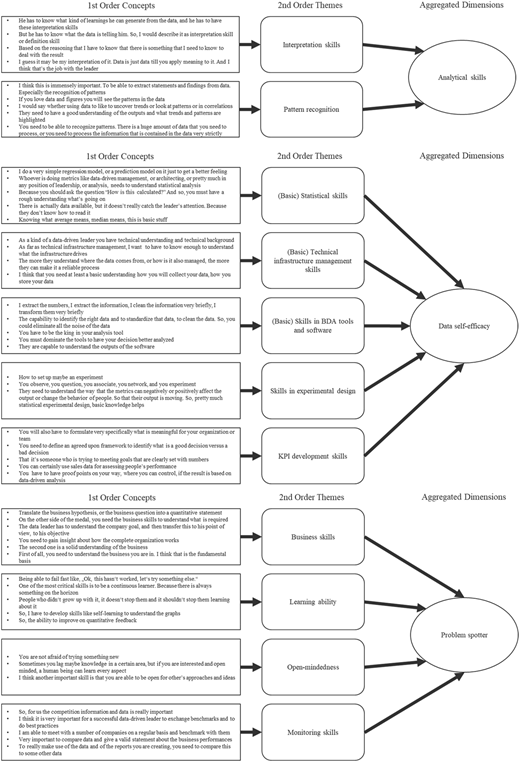
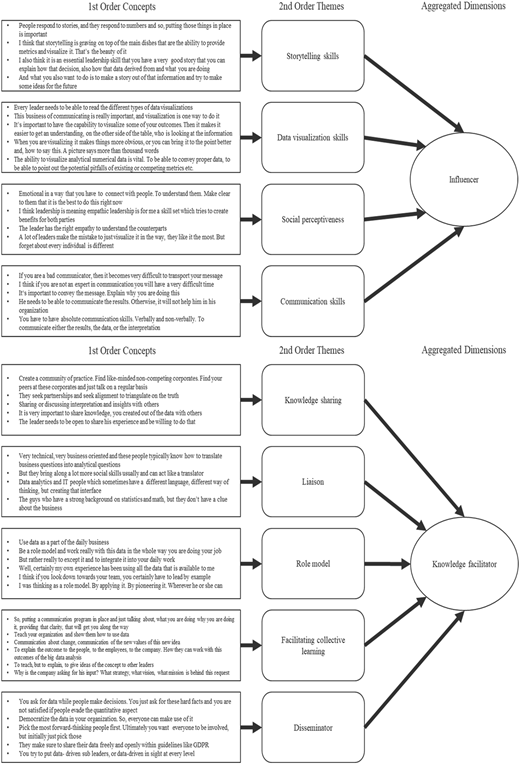
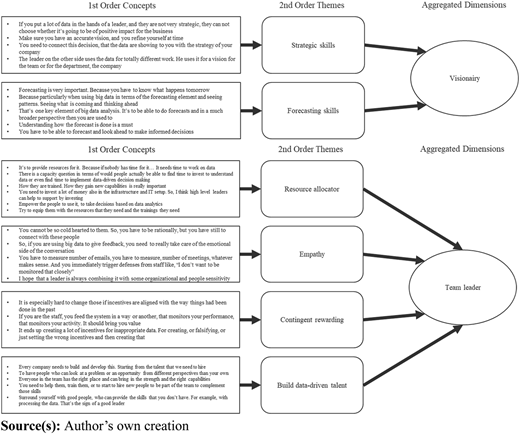
In the second coding cycle we applied axial coding, grouping similarly coded data to reduce the data of initial codes (Glaser, 1978; Saldaña, 2021). Similarities among the different codes emerged and, as a result, we conceptualized 53 interviewee-centric distinct categories (Gioia et al., 2013) within BDA leadership. Next, we dropped second-order categories with a groundedness below 5 because these were not mentioned often enough by the interviewees to be relevant. Subsequently, the quantity of categories decreased to 24. In the third phase of our analysis, we grouped the 24 second-order themes into seven aggregated dimensions. See Figure 1 for the data conceptualization.
Results
First insight into the importance of key BDA competences originating from previous research is achieved by the survey (see Table 1). Communication skills, KPI development skills and cognitive skills were ranked as the most important ones. Those three skills lead the list with a standard deviation smaller than 0.5, indicating that participants gave a very similar rating to these competencies. The mean is at least 4 (on a five-point scale), which shows that these competencies were described as important for data-driven leaders by most of the participants. Interestingly, where communication skills, a relationship-oriented skill, lead the ranking as the most important skill for data-driven leaders, most participants answered the starting question of the interview – “What is a data-driven leader?” – by saying that it is a person who is very rational, analytical and fact-based, all attributes that are more task-oriented.
In the qualitative analysis, seven aggregated dimensions were identified. These aggregated dimensions can be organized into two foundational categories and five distinct roles. The foundational categories are analytical skills and data self-efficacy. They are the prerequisite for the higher order roles which are classified as (1) problem spotter, (2) influencer, (3) knowledge facilitator, (4) visionary and (5) team leader. These roles consist of a combination of several competencies. A competency is very specific. It can be a skill or ability that can be trained. Therefore, a classification into roles is more appropriate because our research showed that there is more to the roles than specific competencies. It is in their combination that a role surfaces, the whole being more than the sum of its parts.
Analytical skills
Analytical skills such as analytical and numerical thinking are the foundations for being data-driven. In order to work on data problems, leaders need strong analytical skills such as interpretation skills and pattern recognition. Interpretation skills describe leaders as being capable of interpreting data that is provided to them. They need to apply meaning to the data by finding patterns and drawing conclusions, understanding the results and assessing their impact on the business. One respondent describes it as follows: “Data is just data until you apply meaning to it. And I think that’s the job of the leader” (C7). Another respondent highlighted the importance of understanding the results: “I think he or she needs to understand what the results mean. The leader needs to rather understand the impact of the results, or the possible impact” (C1).
The reasoning and reflection is more important than the actual data processing. Leaders can leave that to their experts. Within the analytics skills foundational category, interpretation skills can be related to systems thinking which is the ability to “perceive multiple causal relationships in understanding phenomena or events” (Boyatzis, 2011, p. 94).
Data self-efficacy
Data self-efficacy refers to the ability to talk confidently with other stakeholders about BDA so that others gain trust and buy into the leaders' decisions. Data-driven leaders need to look at the data gathering process holistically, understanding how it is created in order to have a data-driven conversation with others:
When you look at your data, you have to be able to understand the processes that went into the creation of that data, and you have to be able to speak intelligently about it. Because, if you are just looking at data in a silo without understanding how it is created, you don’t understand what anomalies mean, you don’t really understand trends. You can’t really uncover what is happening with the data. You just see that there’s a certain layer which is not correlating (B1).
Data self-efficacy can be gained by having a basic understanding of statistical methods, technical infrastructure, as well as BDA tools and software. While statistical methods are required to understand how the numerical results accrue, technical infrastructure management skills are required to understand the possibilities and limitations of the IT infrastructure, e.g. for measuring data points, computing and storage.
Further, a basic understanding of the possibilities and limitations of BDA tools and software is required, as well as skills in experimental design and KPI development in order to lead a data-driven conversation.
By showing confidence with the data, leaders build credibility not only among upper management but also among data scientists and IT experts. This credibility can be achieved by knowing the difficulties and limitations of data gathering, processing and analysis. Thus, leaders need to understand the possibilities of BDA but also its limitations and how the results are derived from data: “If you rely too much on the results of the analysis, it's too one-sided. You also have to have a healthy appetite for data and also an understanding of how the result comes about” (B22).
Data self-efficacy also avoids being manipulated by others who have a stronger grasp of the data. Leaders need to have enough knowledge to ask the right questions on how experiments are set up, how the data was collected and analysed, and whether there are any errors within the calculations, or if the technical infrastructure is sufficient. Skills in KPI development enable leaders to develop appropriate metrics to measure what should be measured in order to track performance and finally derive data-driven decisions from it.
Problem spotter
The problem spotter anticipates business challenges by analysing data and modelling potential solutions. Problem spotters use their monitoring skills to screen the organization, its processes and people, as well as the external environment. A supervisor of field engineers making on-site visits explained how data was utilized to identify issues potentially affecting the business:
So, you might have somebody who is really, really busy but if you look at, for example, the tracker that they may have on their vehicle, you may find out that they are spending two thirds of their day in the car. (B19).
Another respondent also uncovered a business problem in his daily routine to solve with data, by applying a predictive model:
we have a very hard selling process. Our conversion rate is 3–4%. So, we have to call 100 people to get 3 to 4 conversions. This is quite hard. So, some years ago, we applied a predictive model, to identify the clients who have the highest probability to become clients, customers, conversions. After applying this model, we just contacted on average 70% of the customers (B9).
In order to identify potential business challenges, leaders need fundamental business skills such as knowing the market and its players, understanding the organization’s internal processes and how the organization interacts with the external environment.
With metrics such as financial data, customer data and overall performance data, they evaluate how the company is performing against its competitors, detect potential derailers early and make the necessary adjustments. The fundamental skill for problem spotting is a strong learning ability. A basic requirement for identifying new problems is never to be satisfied with the current status quo, but the urge to improve oneself, the team and the entire organization.
In order to identify business challenges, problem spotting helps leaders to keep an open mind and try to recognize everything that potentially provides a competitive edge. Therefore, they listen to the ideas of others to bring in new perspectives. Leaders are continuous learners. They install feedback loops wherever possible to uncover bias and are able to fail and revise until objectives are achieved.
Problem spotting links to two skills: first of all, having a general understanding of the business, as well as the organizational values and processes that drive it. Second, translating the company business objectives into individual business objectives to contribute to the overall goal. Being a competent problem spotter includes an eagerness to try something new. Leaders are open to the ideas of others and want to understand everything that gives them a competitive edge, whether it is a new technology or a new perspective.
Influencer
Positively influencing people is a key competence for leadership in general, and certainly when it comes to using data-based facts that inform others' decisions.
So, on the one hand, you have the data. When you are data-driven, you try to analyse, you want to understand, and then you form an opinion. With your opinion, you want to influence other people. You want to make an impact, and if you cannot make it, then your cognitive skills, or the data you have, it’s not important, or it’s not valuable anymore. So, on the one hand, it’s the data and to work with the data, but on the other hand, it’s to use it and to influence other opinions, or other people with these decisions (B10).
In many instances, leaders must convince audiences with different professional and educational backgrounds and different preferences. These can be homogenous audiences like a functional department, or heterogeneous audiences like a leadership team consisting of members with different business backgrounds like sales or engineering. In order to convince as many stakeholders as possible, leaders need to have social perceptiveness to find agreement among a specific audience and to communicate a story tailored to the audience.
Storytelling helps leaders to convince people to buy into their decisions. Basically, it is framing factual information. The story has two elements: the actual hard data and the story it is wrapped in explaining how a conclusion was reached, and how the conclusions support leaders' decisions.
Leaders need to understand the values, motives and backgrounds of their audience. Based on this information, they prepare the data, story and visualization in such a way that the audience understands it to best support the leaders' decision. This role requires leaders' ability to connect with the people on an emotional level as key to their effectiveness. For example, if their audience consists of other leaders, they need to present the data in a management compatible style. If their audience consists of data scientists, or people with a mathematical background, leaders can strongly focus on numerical data. If the audience is mixed, leaders are required to present the right balance.
Leaders need strong verbal and non-verbal communication skills to communicate the insights and results derived from data. This helps them reduce the complexity of data analysis to a core message, expressing the findings in an easy and plausible way. Communication is key to make the audience understand the reasons behind a decision and to gain their trust. One respondent describes communication as critical for progress: “But if I can’t communicate it [data], then I can’t influence. I can’t get people on board. I can’t drive things forward” (C7).
Knowledge facilitator
As a knowledge facilitator, leaders do not only share their analytical knowledge with others inside and outside of the organization but also encourage knowledge-sharing between peers, subordinates and external stakeholders in order to create a community of trust.
Leaders need to be open and willing to share their experience. There needs to be an environment where you have room for trust, for healthy conflict, where people can openly share their experiences, speak up and talk about their experiences (C1).
Leaders act as the disseminator of information while ensuring that the knowledge and information shared are in line with the compliance requirements and data protection policies of their organization. They facilitate collective learning by educating others in the data-driven approach and explain to them the importance and benefits of BDA. Leaders encourage employees to learn from each other in an environment of trust. They act as liaison persons between organizational units and translate business questions into analytical questions. Additionally, they are role models to others who want to become data-driven by continuously exerting their BDA competencies and living by their values (e.g. trust).
By sharing knowledge, leaders stimulate a data-driven conversation with other leaders. They encourage knowledge transfer and best practice sharing with peers, customers and like-minded non-competing organizations, too. Leaders provide room for other leaders and staff to share their experiences on data openly, creating an environment of trust and healthy conflict. This is their contribution to the learning organization, where “employees continually create, acquire and transfer knowledge, helping their company adapt to the unpredictable faster than rivals” (Garvin et al., 2008, p. 1).
As a liaison person, leaders build a bridge between the field organization, IT and analytical staff. They translate business questions into analytical questions and vice versa. They act as an interface by helping the organization build the skills to interact with the data experts as exemplified by the following quote: “It is also again a character or attitude thing. So, that you can connect departments, speak with people, and then bring together data and decisions” (B10).
Leaders act as a role model leading by example, leveraging data whenever possible in their day-to-day business. They use all data venues available to derive data-driven decisions and are only satisfied with other people’s decisions when those decisions are backed by data.
Knowledge facilitators explain to other stakeholders the benefits of being data-driven at the individual and organizational level. They teach staff and co-workers how to leverage data and how to extract insights from it. They encourage others to share their data knowledge by facilitating collective learning. To take away many people’s fears of change, leaders must be sensitive and patient.
As a disseminator, leaders share data openly and freely within their organization within the guidelines of General Data Protection Regulation as well as compliance, so everyone can make use of it. This is in line with the findings by Shamim et al. (2021) suggesting that leaders should share the BDA results with their operational employees.
Visionary
An essential role of data-driven leaders is to be a visionary. Their responsibility is to predict the future as precisely as possible. This can be achieved through analysing historical and real-time data to identify trends, which in turn help leaders to make decisions for the company’s future. The visionary role consists of strategic skills and forecasting skills. While strategic skills focus on the big picture through the definition of a vision, mission and strategy for the long-term outlook, forecasting skills provide a rather short-term outlook on future operational performance.
Visionary skills originate in the need for an explicit vision, mission and strategy, and how to execute it. It ensures that all team members understand the vision, mission and strategy and can contribute to it. It refers to the ability to anticipate challenges and apply data-driven decision-making to adjust the strategy.
If you have the right vision, if you have the right strategy, and you have the right execution base, then it is possible to act as a leader, and you are visible as a leader, and I think that is for a data-driven leaders exactly the same explanation. If you want to be recognized as a data-driven leader, you have to have a clear vision, strategy, and execution (B4).
Further, leaders need everybody on the team to understand the vision, so that they can focus their data efforts on realizing it:
A leader is making the vision of the company known, right? The company has a mission on what they want to do in the world, and then they need to understand how data would help them achieve that. Through data-driven decision-making there are some areas the company would like to focus their data efforts on like reducing costs. So, one is articulate to get everybody on the team to understand that vision and how they can play a role in it (B11).
The competence of a visionary is linked to having forecasting skills in order to anticipate and model organizational performance for upper management and other stakeholders.
Team leader
The competence of being a team leader refers to the need to delegate tasks, build expertise in their teams and facilitate collaboration. Specifically for data-driven leaders, the goal is to develop a team that follows a data-driven operating model using data for generating insights in their day-to-day business. The team leader’s competence entails hiring the right talent to complete the data-driven skill set within the team. Therefore, leaders need to groom data-driven talent by hiring people whose skills complement the existing team, as well as providing additional training opportunities for existing team members. Leaders need to build the capability of the team to be able to execute the vision:
So, big data is a broad term, right? It means you have very large datasets, and you put a simple analytics package on top of it. You might be running Hadoop getting really technical, trying to come out with very good algorithms. But whatever be the case, you need to grow and develop the team to be able to execute on that vision (B11).
In addition to developing the BDA capabilities of the team, delegation is important. “I think it’s key that you delegate certain aspects of the analysis because you can’t manage everything yourself. So, teamwork is very essential, and you need to be networking within your organization” (C5).
Being a team leader as a BDA competence means using different resources. It also refers to incentives encouraging people to use BDA and integrate it into their day-to-day work. It stands for providing time to their team members to improve their BDA skills through training and self-learning. Additionally, team members are granted time to educate their colleagues and to work on real data problems on a regular basis. Finally, it refers to providing financial resources for the technical infrastructure as well as for BDA tools and software to be used by their teams.
An underlying ability that helps to be a good team leader utilizing BDA is empathy. When providing feedback based on data, being sensitive and empathic is critical, so that is does not damage the relationship or the working atmosphere in the team. Being empathic also means acknowledging that the reason for lower performance is not always immediately obvious and can be highly personal. Leaders always have to ask themselves how they would feel being in the place of their subordinates since being evaluated can lead to stress (Wang et al., 2020). Accordingly, leaders have to connect with their teams on an emotional, human level. “You cannot be so cold-hearted. So, you have to be rational, but you have still to connect with these people.” (B17) The quote supports the view that the relation-oriented component of data-driven leadership is of utmost importance.
A full representation of the BDA leadership competencies with their attributions in the BDA context and a selection of supporting quotes is illustrated in Table 2.
General discussion
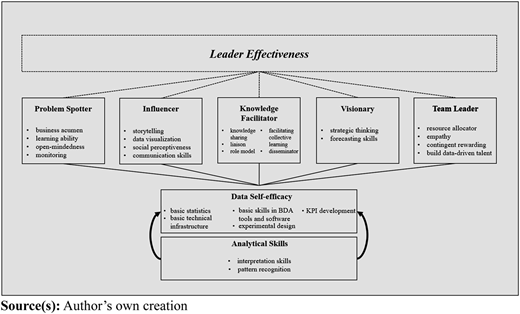
The main purpose of this study was to develop a BDA leadership competency framework for data-driven leaders in organizations. In order to achieve this, we used a grounded theory approach, conducting 33 semi-structured interviews with organizational leaders and experts in different roles. This study is the first to provide a conceptual framework for BDA competencies in leadership research. The conceptual framework which we have developed for that purpose is illustrated and discussed below (see Figure 2).
We identified five distinct competency roles as higher-order categories of BDA leadership: (1) problem spotter, (2) influencer, (3) knowledge facilitator, (4) visionary and (5) team leader. The roles are distributed horizontally from left to right, beginning with the most task-oriented role which is most closely to BDA (problem spotter) and finishing with the most relations-oriented role (team leader).
Compared to other models in leadership research, our model identifies technology and an understanding of technology as the core and the prerequisite for any other competencies. Therefore, we conceptualize two technical competencies, data self-efficacy and analytical skills, as its foundation. They form the prerequisites for any other competencies and specifically the combination thereof, which we conceptualize as roles to make the distinction clear. The concept of roles in a leadership framework ties in with Mintzberg’s (1973) research presenting a model of ten managerial working roles describing the duties of managers.
In previous research such as the three-skill approach (Katz and Kahn, 1978; Katz, 1955), technical skills like analytical skills were mainly associated with lower-level leaders (Katz and Kahn, 1978; Katz, 1955). As opposed to Katz (1955), we classify technical skills as a foundation category required by all leaders within an organization.
Whereas other models are very generic in applicability (see Mumford et al., 2000; Connelly et al., 2000; Zaccaro et al., 1991), our model is focusing on the BDA phenomenon. The competencies in this study are divided into two main categories: people and tasks. The higher order roles together constitute an integrated whole, constructing the data-driven leader. These roles consist of recognized and emergent leadership competencies.
The roles include aptitudes, skills and knowledge that are required for a leader to be effective in a data-driven organization. One underlying fundamental competency are analytics skills that comprise interpretation skills and pattern recognition. These cognitive abilities are the prerequisite for developing statistical skills and other skills, which are an essential element of data self-efficacy. Data self-efficacy differs from self-confidence (Spencer and Spencer, 1993) as it gives leaders confidence in their BDA competencies so that they can assertively engage in discussions with BDA professionals and other leaders. Analytical skills build the foundation for data self-efficacy which in turn is a requirement for higher order roles (problem spotter, influencer, knowledge facilitator, visionary and team leader). Data self-efficacy has a positive effect on the higher-order roles mentioned above. It equips leaders with a BDA foundation to confidently execute on the upper layers.
Theoretical contributions
The present study contributes to the body of knowledge in multiple ways. First, it builds on leadership research and information systems research to evolve as the new discipline of BDA leadership competency research. Second, it takes the leader-centred perspective with the leader as the focal point of examination. Third, it classifies the identified leadership competencies into two foundational categories and five distinct roles. Lastly, our study takes on an integrative approach, combining both task-orientation and data with people. It shows that data-driven leaders and the perception of data-driven leaders differ, as they are not solely task-oriented, rational, number-driven but more people-oriented leaders being communicative and empathic. It points towards BDA leadership as needing very explicitly task-relation and data competencies in combination with people competencies. Neither works without the other. Even at higher management, both may be needed in an integrative way.
The importance of both task-related competencies and relations-oriented competencies is in line with the findings by Mikalef et al. (2018b) and Bonesso et al. (2022). However, both research groups explored the requirements for data scientists and data analysts while our study examined BDA competencies for organizational leaders. Our study goes a step further by specifically answering which task-oriented and relationship-oriented competencies are required by leaders.
Following Kane et al. (2019) approach, we divide the BDA leadership competencies of our framework into two distinct groups. The first group is composed out of recognized leadership skills and the second group consists of newly identified leadership skills that mainly originate from information systems research. Both are discrete entities. The recognized leadership competencies already exist in leadership theory. Our framework elucidates which of the many competencies defined in the past years are of particular importance for the data-driven leader. Furthermore, we combine them in a unique way with the newly identified leadership competencies, which hitherto were only of relevance in information systems theory for the specific function of data experts.
The recognized leadership competencies consist of pattern recognition (Boyatzis, 2011; Spencer and Spencer, 1993), KPI development (Marr, 2012), disseminator (Mintzberg, 1973), business skills (Mumford et al., 2007), learning ability (Yukl, 2013), open-mindedness (Hernández‐Mogollon et al., 2010), monitoring skills (Mintzberg, 1973), strategic skills (Mumford et al., 2007), forecasting skills (Mumford et al., 2015), resource allocator (Mintzberg, 1973), social perceptiveness (Zaccaro et al., 1991), communication skills (Katz, 1955), knowledge sharing (Srivastava et al., 2006), liaison (Mintzberg, 1973), role model (Redman, 2013, Spencer and Spencer, 1993), facilitating collective learning (Yukl, 2012), empathy (Bass and Avolio, 1993; Boyatzis, 2011) and contingent rewarding (Bass and Avolio, 1994).
The emergent leadership competencies comprise statistical skills (Anderson, 2015), technical infrastructure management skills (Kim et al., 2012), skills in BDA tools and software (Akter et al., 2016; Mikalef et al., 2018a), experimental design (McAfee and Brynjolfsson, 2012), storytelling skills (Davenport and Patil, 2012), data visualization skills (Ahmad et al., 2016; Mikalef et al., 2018a) and building data-driven talent (Davenport and Patil, 2012). See Table 3 for an overview.
Our research provides insight how data-driven leaders need a basic understanding of technical skills such as statistical skills, technical infrastructure management skills, and BDA tools and software know-how. This finding is in line with Kane et al. (2019) who indicate that leaders do not have the time, skill set, nor inclination to become as good as data scientists, but need a basic understanding of those fields. Our research provides evidence that the competencies of today’s leaders do not very much differ from those which were required in the past, however, different time-points emphasize certain competencies more than others. This results in a stronger emphasis on BDA leadership competencies. This means that the leadership competencies outlined in this study have gained importance, while others are not as impactful as before.
Not all the competencies provided in our framework are required to the same extent on different organizational levels. Examining the competencies required by data-driven leaders at various organizational levels is outlined as part of our framework and novel compared to previous research. Further, prior leadership research indicates that technical skills are a stronger requirement at the entry management positions while strategic skill requirements increase from mid-to senior management (Mumford et al., 2007). For example, previous research argues that the skill of data visualization is one of the skills needed by data scientists when they advise executives (Davenport and Patil, 2012) and thus data visualization is probably hardly needed by top management. However, our research found that any leader in a BDA-driven organization should at least have a basic understanding of each of the competencies in order to be able to question the data that is presented to them. Today, it is required of high-level executives that they challenge the status quo of data with some expert know-how. Without BDA knowledge, top management will not be able to lead the data-driven conversation. Further research must show how prominent data-driven leaders are on different organizational levels. In addition, data in itself has changed dramatically. There is more data available from different sources (e.g. social media) and a lot faster (real-time data). To process this data and draw timely conclusions from it has changed from the previous requirements (Gupta and George, 2016).
In conclusion, it can be deduced that organizational leaders do not necessarily need to have the highest proficiency in BDA in order to be effective, given that they can rely on their teams' expertise. However, they do need to have a good proficiency level in order to lead, to make decisions and to show direction. Leaders cannot use data to their advantage if they do not possess these necessary competencies. They need to know whether data is of quality, how it is gathered, how it is analysed and how to communicate it. This view is supported by Provost and Fawcett (2013) as they argue that managers and line employees in other functional areas will only get the best from the company’s data-science resources if they have some basic understanding of the fundamental principles themselves. Managers in enterprises without substantial data-science resources need to understand basic principles in order to engage with consultants on an informed basis. This view is supported by Mumford et al. (2000) concept of knowledge, arguing that the effective application of skills depends on knowledge.
Some interviewees indicated that leaders' individual educational background affects their analytical skills. Especially, engineering or mathematical backgrounds were mentioned as beneficial. It was said that engineers are educated to be rational, and fact based with a pronounced problem-solving ability. This suggests that the educational background could serve as a moderator for the analytical skills role. Further research is necessary to provide evidence for this point of view.
Practical implications
This research provides a comprehensive framework for organizational leaders in various business functions (e.g. marketing, sales, IT, operations, human resources) by combining emergent leadership skills and recognized leadership skills in a unique manner. The framework provides a guideline for the competencies leaders should develop in order to best support the BDA strategy and the related BDA projects of the organization. Mikalef et al. (2021) support this view by highlighting the education of top management on data science approaches and applications as well as the training of middle-level managers to successfully overcome organizational inertia during a BDA-driven transformation. The new BDA leadership competency framework presented in this study helps to develop BDA competencies for those leaders. In addition, it provides a platform for defining various proficiency levels of BDA competencies required for specific roles in the organization. Further, the framework serves as a basis for recruiting, selection and promotion decisions, career paths and development plans. By doing so, it provides a valuable tool for an organization to grow BDA competencies and engrain them in their Learning and Development processes. Leaders with BDA skills will make a significant contribution to the human capital of any organisation.
Limitations and strengths of research
Our study does not come without certain limitations. Foremost, instead of putting participants into a situational exercise (Zaccaro et al., 2000) we created a condition in which participants should imagine themselves being data-driven leaders deciding how important a certain skill would be. Thereby, we collected the opinions, values and experiences of various leaders. The findings provide a perspective of the people in the field which is only their perspective. This approach is in line with the research methodology of Mikalef and Krogstie (2019). People are “knowledgeable agents” (Gioia et al., 2013, p. 17) and were selected for their knowledge as organizational leaders or subject-matter experts in the field of BDA. Due to the cross-sectional character of this study, it only provides a snapshot of the specific time frames when the study was carried out between 2019/2020. A longitudinal study could validate the findings. While this study does not provide a 50–50 split of male and female participants reflecting the current underrepresentation of women in organizational leadership roles (Smith et al., 2020), it comprises a statistically relevant number of women. Lastly, only some countries were part of the original sample. For a re-test of the findings, we consider a global sample.
Besides the limitations mentioned, this study also comprises notable strengths. Foremost, for a grounded theory study it contains a considerable sample size of 33 which is above the 15 cases suggested by Miles and Huberman (1994). Furthermore, in addition to organizational leaders, we also interviewed subject-matter experts to get a more holistic view on the topic. While samples of recent studies on BDA leadership skills are mostly national (Mikalef and Krogstie, 2019), this study draws on a multinational sample and, therefore, has a wider scope. It includes companies from SMEs to Fortune 100 enterprises which, in combination with the sample size, leads to rather conclusive evidence of the phenomena. In addition, this study took particular care of a balanced representation of all genders which is a particular achievement in rather male-dominated organizational functions.
The grounded theory approach was applied to create new theory and thus shed new light on leadership competency research and the skills approach. It provides a theoretical foundation for the emergent field of BDA in leadership research.
Conclusion
In conclusion, the results of our study are quite promising as they provide a conceptual framework on BDA competencies for organizational leaders in various industries at different organizational levels. It shows that recognized as well as emergent leadership competencies are required in order to exploit the full potential of BDA in various leadership roles. Our model describes that data-driven leadership combines task-oriented competencies with relationship-oriented competencies. It identifies technical competencies as prerequisites for higher order competencies at all levels. It can serve to inspire further academic research on BDA in the leadership domain. For example, it will be relevant to examine how the BDA competencies are related to specific leadership styles that are identified as important for the current age, such as transformational leadership (Bass and Stogdill, 1990) or servant leadership (Van Dierendonck, 2011).
Additionally, it could be examined whether the BDA leadership competency requirements differ by organizational level, and if leaders who are successful in a non-BDA organization are not likely to succeed in a BDA organization unless they possess these skills. Furthermore, it would be interesting to examine if the roles provided within our conceptual model are more effective if they are combined in one leader or if they are at least present in a leadership team where members compliment another. Further research could explore which composition of competencies as stipulated in our model correlate with innovation building on the work of Mikalef and Krogstie (2020).
In conclusion, our research contributes to exploring BDA competence within the leadership context. Our findings provide leadership researchers with a foundational framework to further examine this rather new research area. It encourages taking a differentiated perspective, crossing boundaries and building bridges between leadership and information systems research. We hope that our study encourages others to take it as a starting point for more research of BDA leadership competencies.