


This paper examines and discusses the need for micro-level analyses of academic entrepreneurship and outlines a micro-level research agenda for the study of academic entrepreneurship.
Based on a review of academic literature on academic entrepreneurship, this study focuses on individual actors and suggests some future research agendas.
The authors highlight that more studies dealing with academic entrepreneurship need to take a micro-level perspective, thereby outline several fruitful avenues of research: (1) star scientists and principal investigators, (2) TTO professionals, (3) graduate entrepreneurs, (4) university administrators, (5) policy makers and funders as well as (6) micro-level organisational routines.
This paper derives three main implications for management practice and policy. First, there is a real need to develop the managerial skills, competencies and capabilities of scientists and individuals. Second, policy makers need to ensure the necessary resources to pursue a paradigm shift towards more entrepreneurial thinking and action and create adequate incentives. Third, firms need to offer support and guidance on how to best commercialise and transfer scientific knowledge and ideally complement support structures of universities and research institutes.
This paper provides an organising framework for the study of micro-level academic entrepreneurship and emphasises the need to focus further on individual actors and how their actions, behaviours and approaches contribute to academic entrepreneurship in different institutional, environmental and cultural contexts.
1. Micro-level academic entrepreneurship: a research agenda
1.1 Introduction
Universities fulfil an important institutional role in society. The institutional support that they provide is thereby of growing strategic importance to support industrial development, national entrepreneurship and innovation policy agendas and broader national economic and social policy agendas (see Gregersen et al., 2009). This in turn means that universities, while still fulfilling their traditional core missions of teaching and research, are broadening their mission remit to embrace what is termed as “third mission” activities (Gulbrandsen and Slipersaeter, 2007; Montesinos et al., 2008; Zomer and Benneworth, 2011). This has resulted in universities creating formal institutional structures such as technology transfer offices, centres of entrepreneurship, cooperative research centres, etc. (Cunningham et al., 2020; Dolan et al., 2019) to support “third mission” activities. Such formal structures support engagement that is primarily focused on building and strengthening university-industry collaborations. This also has involved universities becoming entrepreneurial universities in order to meet the growing demand from government and industry to support economic and industrial development (see Kirby, 2006; Guerrero et al., 2015; Urbano and Guerrero, 2013).
In order to address this paradigm shift, universities usually put in place new internal policies, procedures and initiatives to encourage and support scientists and graduates to realise the commercial potential of their research endeavours and activities through academic entrepreneurship activities (see Czarnitzki et al., 2016; Haeussler and Colyvas, 2011; Braunerhjelm, 2007). This has created challenges for individual scientists and universities how best to support academic entrepreneurship that yields the desired benefits for stakeholders while also undertaking teaching and research activities (Audretsch and Göktepe-Hultén, 2015; Colyvas and Powell, 2009). Scientists are now being required to take on many additional managerial and leadership responsibilities beyond those that they have been trained on as part of their early career formation, particularly through their doctoral studies, typically also including some international experiences (Jonkers, 2011; Varki and Rosenberg, 2002). Therefore, the local institutional supports, culture and the institutional experience with respect to academic entrepreneurship does matter and influences how scientists pursue this activity (see Braunerhjelm, 2007; Lawson and Sterzi, 2014).
Against this background within the literature, there has been an increasing focus on many facets of academic entrepreneurship as well as some more critical reflections (see Bozeman et al., 2013; Grimaldi et al., 2011; O'Shea et al., 2004; Wright, 2014). Siegel and Wright (2015) argue that there is a need for more rigour and more theoretical development in this research domain. In particular, Wright (2014, p. 322), in charting a research agenda for academic entrepreneurship on various contexts, i.e. temporal, institutional, social and spatial, outlines a “synthesis of micro and marco levels”. This acknowledges the micro-level contributions to shaping academic entrepreneurship at the individual level. Studies on academic entrepreneurs have primarily focused on the macro level which has advanced our understanding of how different entrepreneurship and innovation ecosystems perform with various configurations of resources, assets and policy instruments (Audretsch et al., 2019; Cantner et al., 2020; Thai and Turkina, 2014; Wennekers et al., 2002). Bozeman et al. (2013) acknowledges this tension between studies either focussing on the micro level and not taking account of contextual issues or not taking account of the role of individual dynamics. Ultimately, it is the individual scientist/faculty/member that initiates academic entrepreneurship within their social context and environment responding to the macro environment. This local environment and whether those involved in department decision making support or are experienced when it comes to academic entrepreneurship influences the behaviour of scientists to pursue this activity (Bercovitz and Feldman, 2008). While there is a growing body of studies that have focused more on individual scientists there is a need to more explicitly take a micro-level approach to better understand how academic entrepreneurship actually happens. Such studies complement our marco level codified knowledge of academic entrepreneurship and the macro–micro level intersections that create value (O'Kane et al., 2019; Cunningham et al., 2018). Furthermore, there have been recent calls within the literature for more micro-level studies and analysis (see Albats et al., 2018; Cunningham and O'Reilly, 2018). The purpose of this paper is to outline a micro-level research agenda for the study of academic entrepreneurship.
The remainder of this paper is structured as follows. The next section highlights the need for micro-level analyses on academic entrepreneurship. Section 3 outlines a research agenda for academic entrepreneurship. Section 4 describes insights derived from studies of this special issue. Section 5 discusses implications for management practice and policy. A final section concludes.
2. Academic entrepreneurship—the need for micro-level analyses
Academic entrepreneurship can accrue benefits to universities, scientists and entrepreneurs (Wood, 2011) and can take many forms (Lacetera, 2009). Simply put, academic entrepreneurship is where scientists are involved in the commercialisation and transfer of their research to industry. Klofsten and Jones Evans (2000, p. 301) posit that academic entrepreneurship refers to activities that are outside normal teaching and research activities and classify different types of academic entrepreneurship – testing, sales, external teaching, spin-off firms, patenting/licensing, consulting, contracted research and large-scale science projects. Wright (2007, p. vii) states that academic entrepreneurship “relates to the development of commercialization beyond the traditional focus on licensing of innovations to the creation of new ventures that involve the spinning-off of technology knowledge generated by universities”. Shane (2004) focuses on different aspects of university spin-offs such as finance, performance, people and processes and provides insights into the complexities and nuances of successful academic entrepreneurship and also highlights some of the challenges. In essence, it is about scientists becoming entrepreneurs (Goethner et al., 2012), whereby academic entrepreneurship has become what Colyvas and Powell (2007) term as a “venerated practice” within academic institutions.
However, more recently researchers have argued for the need for broader definitions and interpretations of academic entrepreneurship beyond university spin-offs and patents (see Abreu and Grinevich, 2013; Wadhwani et al., 2017). For example, Cantaragiu (2012, p. 687) argues: “Academic entrepreneurship is a practice performed with the intention to transfer knowledge between the university and the external environment in order to produce economic and social value both for external actors and for members of the academia, and in which at least a member of academia maintains a primary role”. According to Siegel and Wright (2015), the focus of academic entrepreneurship is on external benefits to society and economy, involves students, alumni and uses different university institutional mechanisms to support entrepreneurial activities such as TTOs, incubators, science parks, cross campus entrepreneurship programmes, business plan competitions, etc. Moreover, Friedman and Silberman (2003) argue that academic entrepreneurship should be viewed as a process as it is made up of several continuous activities. However, such academic entrepreneurship activities are challenging to replicate in developing economies (Fischer et al., 2019). Nevertheless, the role of the individual scientist is still somewhat overlooked and poorly understood (Urban and Chantson, 2019). There also is a need for scientists to be true to themselves when it comes to pursuing academic entrepreneurship (see Zou et al., 2019).
Considering these broader interpretations of academic entrepreneurship, taking a micro-level perspective not alone advances our understanding of how the micro-level interplays with the macro level to realise the benefits of academic entrepreneurship for individual actors. More importantly, it potentially provides a corpus of evidence that individual actors at the micro level can enhance their own managerial and leadership practices when they directly or indirectly engage in academic entrepreneurship. This also ensures continued research and practice relevance that informs and potentially shapes institutional environments and social contexts where academic entrepreneurship activities are undertaken. Taking the micro level forms an essential and critical perspective in advancing our understanding of academic entrepreneurship and builds on studies that have taken this perspective (see Albats et al., 2018; Bjerregaard, 2009).
In other academic fields such as strategic management, embracing a micro-level approach to studying individuals, processes and practices has advanced the study of strategy (see Johnson et al., 2003). Different methodological approaches have been used to unearth the lived reality of strategy and strategists at the micro level within firms that has contributed to theory development and to practice (see Bencherki et al., 2019; Denis et al., 2007; Frandsen and Johansen, 2015; Kearney et al., 2019; Jarzabkowski et al., 2007; Salvato, 2003; Samra-Fredericks, 2003). Bearing in mind some of challenges of taking a micro-level approach that have been articulated in different fields (see Björkman et al., 2012; Kwon et al., 2014) and the dangers of contextualisation that have been highlighted in the entrepreneurship field (see Welter et al., 2019) taking a micro-level perspective is essential to affirm the very conceptual, theoretical and empirical foundations that academic entrepreneurship, entrepreneurial ecosystems and university-industry collaborations are built on. Moreover, there is a need to better understand the processes that underpin academic entrepreneurship at the micro level. Process studies in strategy offer some theoretical grounding to inform such studies.
3. Academic entrepreneurship—a research agenda
Research on academic entrepreneurship has been broad in scope and has focused on issues such as incentives (Henrekson and Rosenberg, 2000), returns (Åstebro et al., 2013), university culture (Braunerhjelm, 2007), organisational forms (Wood, 2009), drivers (Laukkanen, 2003) and barriers (Davey et al., 2016). Empirical studies have also focused on different countries such as Australia (Zhao, 2004), the UK (Haeussler and Colyvas, 2011), the USA (Toole and Czarnitzki, 2007), France (Manifet, 2008), South Africa (Grundling and Steynberg, 2008), Sweden (Goldfarb et al., 2001) and Ireland (Klofsten and Jones-Evans, 2000). Research on academic entrepreneurship has thereby focused on the issues of ownership, particularly patents (see Audretsch and Göktepe-Hultén, 2015; Czarnitzki et al., 2016; Halilem et al., 2017), gender (Abreu and Grinevich, 2017; Cunningham et al., 2017a; Goel et al., 2015) and social capital (Mosey and Wright, 2007). Collectively, these and other studies have advanced our understanding of how different elements contribute to the development, sustainability and the value that is created through academic entrepreneurship. Nevertheless, there is a need to focus further on individual actors and how their actions, behaviours, approaches and routines contribute to academic entrepreneurship in different institutional, environmental and cultural contexts. The subsequent sections focus on these individual actors and associated routines and suggest some future research agendas that advance our understanding of academic entrepreneurship at the micro level (see also Figure 1).
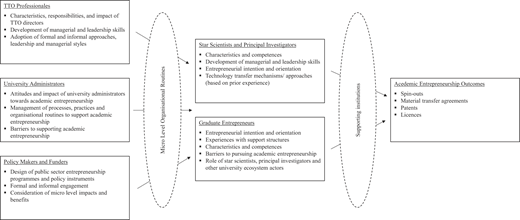
Star scientists and principal investigators: There is an established literature on star scientists and how they can contribute to academic entrepreneurship and more broadly to innovation as well as economic performance (see Calderini et al., 2007; Moretti and Wilson, 2017; Hess and Rothaermel, 2011; Zucker and Darby, 2001, 2006, 2007). For example, Toole and Czarnitzki (2007), based on a study of SBIR biomedical academic entrepreneurs, find that firms associated with these star scientists performed better. However, there has been little focus on developing their managerial skills and competences that are required to be an effective star scientist. There is also a growing literature on scientists in the PI role and these empirical studies address different aspects of this boundary spanning role (Cunningham et al., 2016, 2017a, 2019; Del Giudice et al., 2017; Mangematin et al., 2014; Menter, 2016; O'Kane, 2018; O'Kane et al., 2015a; Romano et al., 2017). An emerging theme within this strand of literature is that PIs need to develop their managerial skills and competencies beyond their core career formation focused on becoming an excellent scientist (Cunningham et al., 2015; Cunningham and O'Reilly, 2019). Consequently, there is a need for future studies to focus on star scientists and principal investigators in universities, public research organisations and private sector R&D labs that examine their entrepreneurial intention, orientation and behaviours towards pursing collaborations and academic entrepreneurship. Moreover, future studies need to focus on how they develop their managerial and leadership skills.
TTO professionals: There has been a burgeoning literature on TTOs and how they support academic entrepreneurship and build effective university-industry collaborations (see Anderson et al., 2007; Chapple et al., 2005; O'Kane et al., 2015b; Siegel et al., 2003). This reflects the growth of the establishment of TTOs in universities worldwide over the last three decades (see Leyden and Link, 2015). However, at the micro level, there is a lack of any empirical focus on the role of TTO directors in shaping, influencing and supporting academic entrepreneurship within universities. In the day to day activities and interactions, academic and graduate entrepreneurs engage with TTO professionals – commercialisation officers – to support them in their pursuit of academic entrepreneurship. From a practice perspective, there are worldwide professional bodies to support such TTO professionals – AUTM, PraxisAuril – but there is a dearth of studies that specifically examine at the micro level which formal and informal approaches, leadership and managerial styles they adopt as part of their academic entrepreneurship support. What managerial and leadership skills and competences do TTO professionals need to develop and possess to support academic entrepreneurship? Moreover, there is a need for studies to examine the role characteristics and responsibilities of TTO directors along with the micro-level strategies that they adopt to support academic entrepreneurship – irrespective of the discipline background. What managerial and leadership TTOs need to have in order to support effective academic entrepreneurship. Moreover, future studies should examine how TTO directors influence their meso and macro environments to enhance academic entrepreneurship in the short and longer term at the micro level. Drawing on the non-market strategies literature in strategic management (see Lawton and Rajwani, 2015) could form the basis of understanding how TTO directors manage the political dynamics within their immediate institutional environment and beyond to support academic entrepreneurship.
Graduate entrepreneurs: More universities are investing in supporting graduates who wish to pursue academic entrepreneurship. This can include entrepreneurship programmes, incubators, accelerators, business plan competitions, entrepreneurship clubs and mentoring programmes (Al-Dajani et al., 2014; Hallen et al., 2014; Matlay and Gimmon, 2014; Nabi and Holden, 2008; McMullan and Gillin, 1998; Kirby, 2004; Watson et al., 2018). Such activities and supports can be part of students' formal educational programmes or through extra-curricular activities. They focus on validating business ideas and propositions and also developing the individual skills, capabilities and competencies of the entrepreneur. There is a growing body of empirical studies that have examined the entrepreneurial intentions and orientation of graduate entrepreneurs (see Arranz et al., 2017; Barba-Sánchez and Atienza-Sahuquillo, 2018; Marques et al., 2018; Meoli et al., 2020). However, there is a need for future studies to examine at the micro level the graduate entrepreneurship participation experiences of using the array of supports designed to realise their academic entrepreneurship ambitions. Do they enhance their skills and competences – leadership and managerial? Even with these supports, what barriers do they experience when pursuing academic entrepreneurship? What role do star scientists, PIs and other university ecosystem actors play in supporting them informally as well as formally in developing their leadership and managerial skills and competences?
University administrators: There is an acknowledgement that those in faculty and university leaders do influence academic entrepreneurship and affect whether academic entrepreneurship activities are actually legitimate and valued within their institution (see Crow et al., 2019; Siegel, 2018; Hayter et al., 2018). They contribute formally and informally to the development of faculty member careers. Symbolically and through formal faculty and departmental processes, academics will take their direction setting through these means to decide whether they should pursue academic entrepreneurship as part of their portfolio of activities. Future studies are needed to explore the attitudes of university administrators towards academic entrepreneurship as well as exploring what processes, practices and organisational routines they have initiated or managed within their institutions to support academics at any career stage including student and graduate entrepreneurs. Moreover, empirical insights into what barriers they have encountered in supporting academic entrepreneurship is worthy of further research. Also future studies need to focus on how university administrators support the leadership and managerial skills of faculty that intend or are pursing academic entrepreneurship.
Within universities, there is a cohort of professional staff that are responsible to support the professional development of academic staff, particularly early career academics. There is also a cohort of research management professional staff that support academics in their pursuit of acquiring competitive research funding. These professional support staff provide essential and vital support for academics in their pursuit of academic entrepreneurship, yet there have been no empirical studies to date that have examined how these individual actors influence, shape and support the actual academic entrepreneurship intentions, behaviours and activities of individual academics. These professional support staff, similar to TTO professionals, are usually part of wider professional body communities who have amassed a wealth of knowledge and practices. Examining how they shape micro-level academic entrepreneurship through a variety of formal and informal practices, processes and organisational routines constitutes another fruitful avenue of research.
Policy makers and funders: Policy makers' role is creating the macro level conditions that enable academic entrepreneurship to flourish and grow within universities and public research labs. Through public entrepreneurship programmes, policy makers design publicly funded research programmes that are designed to support university–industry collaborations and academic entrepreneurship, particularly patents and spin-out firms, to ultimately increase regional wealth (Lehmann and Menter, 2016). Moreover, funding agencies support scientists in the principal investigator role and increasingly many of these funded programmes require them to pursue academic entrepreneurship based on their scientific discoveries. In essence, we know little about how policy makers and funding agencies design public sector entrepreneurship programmes and policy instruments aimed at encouraging more academic entrepreneurship and how they take account of micro-level impacts and benefits. A new strand of research is necessary to explore this and to examine how policy makers and funders engage formally and informally with micro-level academic entrepreneurship and how do they incorporate the managerial development of scientists in the design and implementation of public entrepreneurship and innovation programmes.
Micro-level organisational routines: The focus on individuals engaging in or supporting micro-level academic entrepreneurship is one significant strand of research that needs to be pursued by researchers. There is also a need for further research that examines the micro-level routines and processes within TTOs, incubators, accelerators, (cooperative) research centres that support individuals pursuing different forms of academic entrepreneurship. Such micro-level routines may not be homogeneous across institutions in one country let alone different countries. Some of these routines and processes may be informal rather than formal and may influence the level of academic entrepreneurship, giving scientists even greater confidence to pursue academic entrepreneurship. These in turn influence and shape the managerial skills and approaches adopted by scientists and other individual actors. Using micro-level organisational routines provides insights into biases, learnt routines and habits, individual preferences as well as power and social interactions that are imbedded in micro routines (see Aggerholm and Asmuß, 2016; Lin et al., 2017).
In the first instance there is a need to identify the micro-level organisational routines within each of these facilitating organisations that effectively enhance individual academic entrepreneurship performance and productivity. In particular what formal and informal supports contribute to the management develop of individual pursuing or supporting academic entrepreneurship. Second, a strand of research could focus on undertaking large-scale inter-country studies of these facilitating organisations to better understand how such organisational routines and managerial practices facilitate and enhance academic entrepreneurship for individual actors, particularly scientists in the PI role. Another strand of research could focus on the analytical techniques and decision making processes that these facilitating organisations use to allocate resources to support individuals to support academic entrepreneurs particularly the development of their leadership and managerial skills to undertake these activities effectively.
4. First insights into micro-level academic entrepreneurship
The purpose of this special issue is to deepen and advance our understanding of academic entrepreneurship at the micro level. In particular, this special issue focuses on how management development approaches, institutional settings and supports encourage and shape individual actors, particularly scientists, in their active participation in academic entrepreneurship. With this special issue, we wanted to explore how scientific actors are empowered to engage in their entrepreneurial endeavours both inside and outside their institutions. To advance our understanding of the micro level, we were particularly interested in exploring at the micro level how academic entrepreneurship ultimately creates value through the interplay of various actors. Against this background, we want to briefly present an array of papers of both conceptual and empirical nature that have examined micro-level academic entrepreneurship (see Table 1).
Overview of special issue papers
| Author | Title | Purpose | Results/ Implications |
|---|---|---|---|
| Neves and Brito (2020) | Academic entrepreneurship intentions: A systematic literature review | Comprehensive assessment of the motives and intentions of scientists to get involved in knowledge exploitation activities | This paper offers guidelines for building a scale of intentions assessment that may help universities and policy makers to further stimulate entrepreneurship activities as well as implement effective and value-driven policies |
| de Araujo, Martens and Costa (2020) | Entrepreneurial university: An exploratory model for higher education | Clarification of characteristics of entrepreneurial universities beyond the commercialisation of knowledge in the context of an entrepreneurial ecosystem | This study contributes to our understanding of the transformation of traditional universities towards entrepreneurial universities and serves as a starting point for empirical investigations |
| Gubbins, Harrington and Hines (2020) | Social support for academic entrepreneurship: Towards a definition and conceptual model | Exploration of the individual level considerations that affect the design of social support systems for academic entrepreneurs | This paper highlights the challenges associated with designing a supportive culture to foster academic entrepreneurship and stresses the need for multi-faceted, flexible and adaptive social support systems |
| Carl (2020) | From technical to social innovation – The changing role of principal investigators within entrepreneurial ecosystems | Examination of the influence of the paradigm shift from technical to social innovation on principal investigators | This paper outlines the influential role of principal investigators within entrepreneurial ecosystems and emphasises the need for support that may also be accompanied by a reconsideration of universities' missions and visions |
| Foncubierta-Rodríguez, Martín-Alcáza and Perea-Vicente (2020) | Measuring the human capital of scientists in the principal investigator role | Proposition of a human capital measurement scale to unearth the necessary competencies of principal investigators at the micro level | This paper advances our understanding of the competencies that PIs require to be effective: (1) research knowledge, (2) open-mind research ability, (3) research perform ability, (4) stoic research skill, (5) innovation skill and (6) critical skill |
| Guerrero, Urbano and Gajón (2020) | Entrepreneurial university ecosystems and graduates' career patterns: Do entrepreneurship education programs and university business incubators matter? | Provision of insights about how graduates' career patterns are influenced by entrepreneurial university ecosystems | This study provides insights concerning the potential benefits of implementing programs aimed at increasing the levels of academic entrepreneurship in the context of Latin American universities |
| Jones and Coates (2020) | A micro level view of knowledge co-creation through industry-university collaboration in a multi-national corporation | Identification of the barriers and success factors required for the creation of environments supporting technology transfer activities | This paper highlights that education, external knowledge experts and business wide inclusion constitute critical turning points in a project. Considering these factors prior to commencing the project may help to overcome potential barriers to transferring knowledge |
| Davey and Galán-Muros (2020) | Understanding entrepreneurial academics—How they see their environment differently | Investigation of the differences in the perception of the environment for academic entrepreneurship among European scientists | This paper calls for a broader view of academic entrepreneurship beyond the traditional sole focus on spin-off creation and R\D commercialisation and highlights the importance of appropriate support mechanisms for entrepreneurial activities |
The first paper of this special issue, written by Neves and Brito (2020) entitled “Academic entrepreneurship intentions: A systematic literature review”, offers a comprehensive assessment of the motives and intentions of scientists to get involved in knowledge exploitation activities. Based on a systematic literature review, this paper presents guidelines for building a scale of intentions assessment that may help universities and policy makers to further stimulate entrepreneurship activities as well as implement effective and value-driven policies.
The second paper entitled “Entrepreneurial university: An exploratory model for higher education” (Ruiz et al. 2020) by de Araujo et al. (2020) focuses on the clarification of characteristics of entrepreneurial universities beyond the commercialisation of knowledge in the context of an entrepreneurial ecosystem. It thereby contributes to our understanding of the transformation of traditional universities towards entrepreneurial universities and serves as a starting point for empirical investigations.
In their study “Social support for academic entrepreneurship: Towards a definition and conceptual model”, Gubbins et al. (2020) explore the individual level considerations that affect the design of social support systems for academic entrepreneurs. This paper highlights the challenges associated with designing a supportive culture to foster academic entrepreneurship and stresses the need for multi-faceted, flexible and adaptive social support systems.
The next paper “From technical to social innovation – The changing role of principal investigators within entrepreneurial ecosystems” by Carl (2020) examines the impact of the paradigm shift from technical to social innovation on principal investigators. It thereby connects two emerging research fields: (1) entrepreneurial ecosystems and (2) social innovation. This paper outlines the influential role of principal investigators within entrepreneurial ecosystems and emphasises the need for support that may also be accompanied by a reconsideration of universities' missions and visions.
The fifth paper entitled “Measuring the human capital of scientists in the principal investigator role” by Foncubierta-Rodríguez et al. (2020) proposes a human capital measurement scale to unearth the necessary competencies of principal investigators at the micro level. This paper advances our understanding of the competencies that PIs require to be effective: (1) research knowledge, (2) open-mind research ability, (3) research perform ability, (4) stoic research skill, (5) innovation skill and (6) critical skill. Moreover, this measurement scale might facilitate selection and self-assessment processes.
The sixth study “Entrepreneurial university ecosystems and graduates' career patterns: Do entrepreneurship education programs and university business incubators matter?” by Guerrero et al. (2020) analyses graduates' career patterns and how those are influenced by entrepreneurial university ecosystems. This study provides insights concerning the potential benefits of implementing programs aimed at increasing the levels of academic entrepreneurship in the context of Latin American universities.
The next paper “A micro level view of knowledge co-creation through industry-university collaboration in a multi-national corporation” by Jones and Coates (2020) identifies the barriers and success factors required for the creation of environments supporting technology transfer activities. This paper highlights that education, external knowledge experts and business wide inclusion constitute critical turning points in a project. Considering these factors prior to commencing the project may help to overcome potential barriers to transferring knowledge.
The final paper “Understanding entrepreneurial academics – How they see their environment differently” by Davey and Galán-Muros (2020) investigates the differences in the perception of the environment for academic entrepreneurship among European scientists. This paper calls for a broader view of academic entrepreneurship beyond the traditional sole focus on spin-off creation and R&D commercialisation and highlights the importance of appropriate support mechanisms for entrepreneurial activities.
5. Implications for management practice and policy
Based on this collection of papers and our posited research agenda, there are three main implications for management practice and policy. First, there is a real need to develop the managerial skills, competencies and capabilities of scientists so that they are better equipped to undertake any form of academic entrepreneurship activities. Some progress has been made with respect to scientists in the PI role to identify requisite skills that they require to act as scientific entrepreneurs. Institutional support structures are thereby necessary, yet not sufficient mechanisms to foster academic entrepreneurship. Hence, training of managerial and leadership responsibilities needs to be offered early on, probably already during the doctoral studies of future scientists.
Second, policy makers have the task to promote academic entrepreneurship. On the one hand, policy makers need to ensure the necessary resources and competences to pursue a paradigm shift within the academic sector towards more entrepreneurial thinking and action. On the other hand, policy makers need to create adequate incentives that encourage the paradigm shift on the macro level (towards entrepreneurial universities) but especially also on the micro level (towards academic entrepreneurs). Both prerequisites need to be reflected in respective funding schemes that provide sufficient financial resources to universities and scientists. Strategic investments are necessary to enable and drive this change within the academic sector and beyond.
Third, firms need to acknowledge the managerial and leadership challenges that scientists face while taking on additional responsibilities beyond teaching and research. In the context of university-industry collaborations, firms need to offer support and guidance how to best commercialise and transfer scientific knowledge. Ideally, the support structures of universities and research institutes would be complemented by industry and thus cover the entire innovation process from knowledge creation to knowledge exploitation. Ultimately, also firms might thereby benefit from a higher transition of scientific towards economic knowledge.
6. Conclusions
Due to the paradigm shift of universities towards knowledge transfer, innovation and commercialisation, universities are increasingly expected to deliver tangible outcomes, for example through academic spin-outs, material transfer agreements, patents, or licenses. Such a shift has changed the nature and scope of academic entrepreneurship within universities and public research organisations. Research on academic entrepreneurship has been broad in scope and focus. Literature in this field has examined performance and impact of academic entrepreneurship activities and approaches that are shaped by institutional and national contexts and policy environments and has identified critical levers for encouraging entrepreneurial activities within the academic context. The extant literature in this field has shed light on processes and mechanisms supporting or impeding the transformation of universities, has yet neglected to focus on the micro level, hence individual scientists, other university institutional individual actors and those who affect them. Within the field of academic entrepreneurship, there is a growing research focus as well as several empirical studies that deal with scientists in the principal investigator role and how these actors are shaped and influenced within their scientific environment, i.e. their academic institutions, as well as beyond, e.g. through public funding bodies. One of the interesting issues to emerge from this body of research to date is the lack of and need for management development of individual actors to support their academic entrepreneurship behaviours.
This special issue shall serve as a starting point to deepen and advance our understanding of academic entrepreneurship at the micro level. In particular, how management development approaches, institutional settings and supports encourage and shape individual actors, particularly scientists, in their active participation in academic entrepreneurship. This special issue has focused on how scientific actors are empowered to engage in their entrepreneurial endeavours both inside and outside their institutions. It thus concentrated on relevant actors and decision-makers of academic ecosystems and their specific roles in supporting scientific outcomes that are meant to create value for society, ranging from academic actors such as TTO directors and deans to policy makers defining and incentivising distinct scientific trajectories and behaviours. Our focus was to explore at the micro level how changes in the academic setting are initiated, expedited and governed and how these changes influence individual actors' behaviours with respect to academic entrepreneurship. Furthermore, we were interested in exploring at the micro level how academic entrepreneurship ultimately creates value through the interplay of these various actors. Moreover, from a management development and organisational structure perspective, a focus of this special issue was to explore other individual institutional actors within and outside university or public research organisations that support, enable or constrain individual academic entrepreneurship.
Beyond the already outlined avenues of research, future studies might focus on external factors that influence and shape individual micro-level academic entrepreneurship behaviour. It is still unclear, which organisational conditions are needed to establish an entrepreneurial spirit and academic entrepreneurship across academic and graduate communities. It would be interesting to know how relevant, sufficient and impactful existing formal institutional and management development supports in enhancing micro-level academic entrepreneurship and empowering individual actors such as scientists, graduates and students are: How do institutional mechanisms shape the academic entrepreneurship processes and individual academics'/scientists' behaviours within universities and public research organisations? What factors influence micro-level academic entrepreneurship failure? What management development supports accelerate academic entrepreneurship at the micro level? Adopting a plurality of research methods (Cunningham et al., 2017b), these and further questions need to be addressed and answered in order to broaden our understanding of academic entrepreneurship on a micro level and be able to provide useful guidelines for all involved actors in the context of academic entrepreneurship.

