


This study aims to investigate the effects of transformational and transactional leaders’ behaviors on employees’ affective commitment and organizational citizenship behavior in the context of nonprofit organizations (NPOs). Additionally, this study attempts to examine the role of work engagement, as an intervening mechanism as work engagement in NPOs has been empirically neglected (Park et al., 2018).
Data were conducted from 400 employees working in Italian NPOs in the North of Italy. For verifying the hypotheses of this study, structural equation modeling techniques were implemented.
It was found that both transformational and transactional leaderships influenced positively affective commitment and organizational citizenship behavior, and work engagement was revealed to have significant positive mediating effects on the relationship between the variables examined in this study.
The results of this study may be beneficial to leaders and supervisors of NPOs, specifically regarding the influence of the leaders’ behaviors on the employees’ outcomes.
Due to the limited number of studies conducted on leadership in nonprofit organizations, this study theoretically and empirically contributes to the leadership literature as it is the first study to investigate the two styles of leadership on work-related outcomes via work engagement in the nonprofit sector.
1. Introduction
Currently, organizations, including NPOs, have been faced with fast-changing environment, complexities and globalization, which gained the attention of HR professionals regarding the importance of leadership in organizations due to its influence on service quality, employees’ retention and their overall business performance (Barling et al., 1996; Parry and Sinha, 2005; Sirianni and Frey, 2001).
In NPOs, it can be seen from the increasing importance of these organizations that the leaders of these organizations are faced with significantly complicated managerial tasks and duties (Fowler, 2013b; Lewis, 2001), including scarce resources and ambiguous work environments, suggesting that leaders in NPOs need to possess the competencies and attributes found in managers. Specifically, leaders in these organizations require effective managerial ability, personal integrity, vision and aspiration to successfully work with volunteers and employees of their organizations.
Leadership is seen as an interpersonal influence occurring through a communication system with the objective of achieving the organization’s goals (Birasnav, 2014). It has also been documented in previous studies that leadership could influence organizations and individuals (Hentrich et al., 2017; Humphrey, 2012), which could be seen from an effective leader who is capable of influencing the followers to behave in a manner, which promotes positive outcomes for the organization. Furthermore, these leaders contribute to more benefits to the workplace compared to any other human resource in the organization (Gibson et al., 1991). Therefore, leadership that is capable of influencing employees’ performance, satisfaction, and effectiveness (Turner and Muller, 2005) and promoting positive employee’s attitudes (Bhal and Ansari, 2007) is crucial in the organization.
In general, leadership as a topic of research has been a significant field of study since the past decade.
Works of research primarily focused on transformational and transactional leadership styles (Bass and Avolio, 1993; Hassi, 2018; Rowold and Rohmann, 2009; Tims et al., 2011; Vecchio et al., 2008), which have been proven as highly useful approaches of increasing the effectiveness of leaders (Boehm et al., 2015). In this case, leaders are capable of stimulating, mobilizing and inspiring their employees to achieve the desired objectives (Andersen, 2016). Several scholars have approached the subject of leadership in terms of the influence of the leaders’ behaviors on their followers (Clawson, 2008). It is documented in previous literature that leadership influences the work outcomes of the employees, including satisfaction, commitment, citizenship behaviors and innovation (Alkahtani, 2015; Chandra and Priyono, 2016; Haghighi and Maleki, 2016; Hassi, 2018; Le and Lei, 2017; Walumbwa et al., 2005; Yao et al., 2014; Yıldız et al., 2014). More specifically, transformational and transactional leadership were found to affect employees’ attitudes and behaviors (Bono and Judge, 2003; Judge and Piccolo, 2004).
Despite the increasing awareness of the significance of leadership in NPOs, the roles of the leaders were discussed in a few works of literature (Cornforth, 2014; Parsehyan, 2017). To illustrate, although the transformational-transactional leadership stream had been widely discussed in the business sector, this subject was overlooked in NPOs (Rowold and Rohman, 2009). Furthermore, most of the works of leadership research in NPOs were mainly based on the analysis of boards rather than the individual styles of leadership (Hailey, 2006). Recently, several endeavors have been carried out to add more insights into the leadership literature in NPOs. To illustrate, some researchers examined the participative and instrumental types of leadership and their impact on work engagement in the social cooperatives in Italy (Sarti, 2014), the impact of transformational leaders on organizational culture and NGOs effectiveness in Indian NGOs (Shiva and Suar, 2012), the impact of transformational leadership on culture and innovation in the nonprofit organizations in the USA (Jaskyte, 2004), and the impact of servant leadership on organizational commitment and organizational citizenship behavior in Italian profits and NPOs (Bobbio et al., 2012).
Regardless of the numerous empirical studies in the field of leaders-followers’ work-related attitudes and behaviors in the private sector, several suggestions have been made in various studies for further investigations on the crucial role of leadership in the leader-follower interactions in NPOs (Hailey, 2006; Park et al., 2018; Rowlod and Rohman, 2009). With several studies conducted on the relationship between leadership styles and employees’ work outcomes (e.g. Aboramadan et al., 2020; Cicero et al., 2007, 2010; Cicero and Pierro, 2007; Gatti et al., 2017; Quintana et al., 2015; Sarti, 2014; Spitzbart, 2013), insufficient empirical support is still present regarding the consequences of the leaders-followers relationship in the nonprofit context. There is also an inadequate insight into the effects of leadership on employees’ work-related outcomes in NPOs (Park et al., 2018). Therefore, further empirical studies are required to examine the role of leadership in stimulating employees’ behaviors and attitudes.
Overall, although the role of work engagement has been explored in the business research, it has not been adequately addressed as an intervening mechanism leadership and employee outcomes in NPOs (Park et al., 2018). In the context of NPOs, this study aims to investigate the impacts of leadership styles, namely transactional and transformational leadership, on employee’s affective commitment and OCB within these organizations. This article provides several insights on the importance of work engagement as an intervening mechanism in the outcomes of the leaders-employees relationship.
2. Theory and hypotheses development
2.1 Leadership styles
Leadership style is perceived as a pattern of influencing individuals’ behaviors (Zigarmi et al., 2004). Different leadership styles have been investigated in previous literature, and it was found in Woods and King's (2012) study that transformational and transactional leadership were the most studied leadership styles. To be specific, transformational leaders refer to the leaders who are followed by their subordinates to achieve the organization objectives, and this phenomenon is indicated through the subordinates’ trust and respect for the leader (Bass, 1985). Meanwhile, it has been agreed that transformational leadership is composed of several elements, namely charisma, inspirational motivation, intellectual stimulation, individualized consideration and personal recognition.
Charisma is known as a category of personality traits, which lead to the influence of the leaders on the individuals’ behaviors and feelings (Riggio, 2009). This element has been viewed as an important variable in generating respect and trust (Bealer and Bhanugopan, 2014). Meanwhile, inspirational motivation refers to the leaders’ ability to articulate a compelling vision for their followers (Bass, 1985), instill confidence in the followers, and inspire them (Bass and Bass, 2008). Furthermore, intellectual stimulation refers to the extent to which the leaders enhance their followers’ ability and skills to think and analyze problems (Bass, 1985). As the fourth component of transformation leadership, individualized consideration emphasizes on the role of the leaders in coaching and mentoring their followers for the aim of releasing their potential through learning opportunities (Avolio et al., 1999; Bass and Riggio, 2006). On the other hand, personal recognition focuses on the leaders’ appreciation of employees’ achievements and the provision of rewards to the deserving employees (Rafferty and Griffin, 2004).
Empirical evidence demonstrates the benefits contributed by transformational leadership to the organization and the members. It was found in previous studies that transformational leadership was a significant predictor of organizational citizenship behavior (Hassi, 2018), high performance (Jing, 2018), job satisfaction (Aydogmus et al., 2018; Spitzbart, 2013), affective commitment (Lee, 2005), generating profits (Brandt et al., 2016), trust in leaders (Holtz and Harold, 2008), motivation (Charbonneau et al., 2001), team learning (Bucic et al., 2010) and innovation (Boerner et al., 2007).
On another note, the idea of transactional leadership is that the leader sets the work guidelines to be followed by the employees (Bass, 1985; Kanungo, 2001). Therefore, this type of leadership is more associated with maintaining the flow of the operations inside the organization. Transactional leaders are also responsible for setting objectives, determining the requirements of the task, and defining roles to encourage subordinates’ loyalty, reduce their resistance and promote achievements based on rewards (Deichmann and Stam, 2015).
The transactional leadership style consists of two dimensions, namely contingent rewards and management by exception. Specifically, the contingent reward is mainly based on the assumption that leaders identify the tasks together with the expected rewards to be obtained by employees on their achievements (Antonakis et al., 2003). In this case, there exists an agreement between the leader and the followers based on the motivation regarding the rewards and sanctions. In other words, transactional leaders provide rewards as the targets to be achieved by the employees. In the case of management by exception, leaders oversee followers’ performance and take corrective actions during the occurrence of major deviations from the plan (Slocum and Hellriegel, 2007). The leadership literature provides support regarding the relationship between transactional leadership and job satisfaction (Clabaugh et al., 2000; Epitropaki and Martin, 2005; Spitzbart, 2013), organizational commitment (Jabeen et al., 2015) and organizational effectiveness (Bass and Riggio, 2006).
Finally, our theoretical support for the links between transformational-transactional leadership and employees’ attitudes and behaviors is well-rooted in social exchange theory (Blau, 1964). Building on this theory, we can argue that there is a sort of reciprocation between the leader and the followers.
For instance, if followers perceive the transformational leader as motivating and personally recognizing their abilities, they are more likely to reciprocate by displaying positive attitudes and behaviors. Similarly, if followers perceive their transactional leader as fair, they will be motivated to pay back by demonstrating positive work-related attitudes and behaviors.
2.2 A closer look into leadership research in NPOs
Leadership in NPOs as a research topic has gained significant interest from academics and researchers due to the continuous change and challenges faced by these organizations. In the era of limited financial and human resources, including the constantly changing work environment, the leaders in NPOs have to exercise their roles in creative and innovative manners to achieve the organization’s objectives (Golensky, 2011).
In general, employees in NPOs are not properly remunerated compared to their counterparts in business companies and governments (Bittschi et al., 2015). As a result, the employees’ perceptions of being appreciated would be distorted, resulting in lower engagement in work (Hulkko-Nyman et al., 2012). Therefore, leaders in NPOs play a significant role in ensuring positive workplace outcomes due to the continuous efforts of these organizations to enhance employee’s commitment (Vecina et al., 2013), work engagement (Park et al., 2018) and performance (Erdurmazli, 2019).
Empirically, the research of leadership in NPOs has flourished in the last decade in different geographical parts of the world. Among the topics investigated in previous research is the role of leadership in enhancing employees’ attitudes and behaviors, and the impact of leadership on organizational effectiveness, performance and innovativeness. For illustration, in a study by Mitchell (2015) on the relationship between leadership values and the reputation of organizational effectiveness in US NGOs, it was found that NGOs led by leaders who possessed dedication, professionalism and diverse working strategies demonstrated higher levels of a reputation for effectiveness. Another study in the US context by Jaskyte (2004) revealed that transformational leadership was a significant predictor of organizational culture due to its positive implications for innovativeness in NPOs. Meanwhile, Reed and Ferrari (2017) found that transformational leadership of deacons was service-oriented, with a focus placed on the overall health of the organization. A study was also conducted by Allen et al. (2018) on the impacts of servant leadership on organizational commitment via structural empowerment in a US nonprofit organization, and it was found that structural empowerment had a significant mediating effect on the relationship between servant leadership and organizational commitment. On the other hand, Brimhall (2019) found a positive relationship between transformational leaders’ behaviors and the perceptions of inclusion, which influenced organizational commitment and perceived group performance.
In Europe, various studies were conducted in the leadership research in NPOs, such as the study by Benevene et al. (2018), which found a positive relationship between ethical leadership and Italian volunteers’ intention to remain and affective commitment. Two other studies in Italy found that participative and instrumental styles of leadership were positively related to the vigor component of work engagement in human services organizations (Sarti, 2014), while servant leadership was a significant determinant of extra-role behaviors and organizational commitment (Bobbio et al., 2012). In a study conducted by Megheirkouni (2016) in the UK, it was found that management by the exception of transactional leaders and idealized behaviors of transformational leaders were essential in upgrading the organizational learning in British nonprofit sports. Meanwhile, a study by Rowold and Rohman (2009) in Germany found that both transformational-transactional leadership and positive emotions were positively associated among the musicians in German Orchestras. Moreover, it was found by Rowold et al. (2014) that LMX was the most important variable in explaining job satisfaction, while transformational leadership was a determinant of organizational commitment in German NPOs.
In other parts of the world, transformational leadership was found to mediate the relationship between project success and project managers’ characteristics in Pakistani NPOs (Hassan et al., 2017), while the relationship between transformational leadership and job satisfaction was fully mediated by trust and self-efficacy in a nonprofit organization of higher education in Turkey (Yıldız and Şimşek, 2016). In the case of NPOs in India, transformational leadership was shown to have an indirect influence on organizational effectiveness by promoting organizational culture (Shiva and Suar, 2012).
The above review of the leadership-followers research in NPOs shows that the role of work engagement as an intervening variable between leadership and employees’ outcomes has not yet been examined and needs further examination in the nonprofit research. This was supported by Bakker and Albrecht (2018) in their recent review, which suggested the need to examine the antecedents and outcomes of work engagement in sectors like the nonprofit one.
2.3 Leadership and affective commitment
Affective commitment is defined as an individual’s emotional attachment to the organization, involvement and identification with the organization (Allen and Meyer, 1990; Meyer and Herscovitch, 2001). Employees with high levels of affective commitment have a higher possibility of remaining in the organization due to their less intention to quit (Meyer and Allen, 1991). Furthermore, being the most notable factor of other behaviors (Lavelle et al., 2007), affective commitment provides a highly accurate explanation of organizational commitment (Sabella et al., 2016). More specifically, an affective commitment was found to positively influence job-related behaviors and attitudes, such as job satisfaction (Marcovitz et al., 2007) and organizational citizenship behavior (Liu, 2009).
Leadership was found to play a significant role in enhancing organizational commitment (Dick, 2011; Jackson et al., 2013; Kim, 2012). To illustrate, transformational leaders are capable of influencing their subordinates’ affective commitment by strengthening their intrinsic motivation, linking their efforts with goals attainment and enhancing their personal commitment to the vision of the organization (Avolio et al., 2004). In other words, transformational leaders motivate their followers to display a high performance (Avolio et al., 1999), encourage the followers to look past their interests, and concentrate on the general interest of the organization (Bass and Avolio, 1997). As a result, a favorable climate could be created, which aligned followers’ values with the objectives and values of the organization.
The relationship between transformational leadership and affective commitment was empirically established by several studies in the business contexts (e.g. Bass and Riggio, 2006; Kim, 2014; Koh et al., 1995; Lee et al., 2017; Meyer et al., 2002; Walumbwa and Lawler, 2003). It was found by other studies by Walumbwa et al. (2005) in Nigeria, Gillet and Vandenberghe (2014) in France and Kim (2007) in Korea that transformational leadership had a positive effect on the affective commitment. In the case of the relationship between transactional leadership and affective commitment, Kim (2001) and Kim (2007) found that transactional leaders’ behaviors were positively related to employees’ affective commitment. Furthermore, Sayadi (2016) found that high affective commitment among Irani teachers was associated with transactional leadership. Moreover, dimensions of transactional leadership had a significant positive influence on employees’ affective commitment (Mesu et al., 2012). Based on the aforementioned arguments, the following hypotheses were developed in this study:
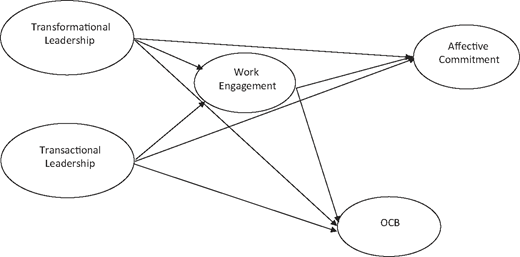
Transformational leadership has a positive influence on employees’ affective commitment in NPOs.
Transactional leadership has a positive influence on employees’ affective commitment in NPOs.
2.4 Leadership and organizational citizenship behavior
Organizational citizenship behavior (OCB) refers to the extra-role actions performed by employees beyond their work, which contribute to the organization’s development (Organ, 1997). These actions are not necessarily recognized by the rewarding scheme in the organization (Podsakoff et al., 2000) as they are the voluntary acts demonstrated by employees at their own will (Humphrey, 2012). Notably, OCB contributes to reinforced and maintained psychological and social work, which supports the employees’ job performance (Organ, 1997). Moreover, OCB was found to be beneficial in building social capital and improving the overall effectiveness of the organization (Bolino et al., 2002; Nielsen et al., 2012; Podsakoff et al., 2014).
It was theorized that transformational leadership plays a significant role in promoting OCB, allowing transformational leaders to motivate their subordinates to perform beyond their jobs and to challenge work complexities (Bass and Avolio, 1990). This implies that transformational leaders can expand employees’ willingness to get involved in extra-role performance, enhancing the OCB (Podsakoff et al., 1990). In this case, transformational leaders could influence the employees to perceive their jobs as more challenging and meaningful to influence their level of engagement in OCB (Boerner et al., 2008). It should be noted that although several studies in diverse contexts found that transformational leadership influenced OCB (e.g. Abu Nasra and Heilbrunn, 2015; Carter et al., 2014; Jha, 2014; Khalili, 2017; MacKenzie et al., 2001; Nguni et al., 2006; Podsakoff et al., 1990; Purvanova et al., 2006; Wang et al., 2011), the empirical support on the effects of transformational leadership and OCB in NPOs, were not thoroughly established.
On the other hand, it could be seen that transactional leadership plays a significant role in promoting OCB. The contingent reward behaviors are possibly linked to the followers’ OCB as the followers’ decision to engage in OCB acts relies mainly on their belief about potential incentives and rewards (Barbuto and Story, 2011). Therefore, followers need to act within the system of rewards and sanctions. Provided that transactional leadership mainly aims to create economic exchange-based relationships (Whittington et al., 2009) based on clear performance standards, the extra-role behaviors will be rewarded by the transactional leaders as far as the behaviors support the leader’s standpoint. Empirically, some studies found a positive link between the dimension of rewards contingent and OCB (Barbuto and Story, 2011; Piccolo and Colquitt, 2006) and between management by exception and OCB (Nahum-Shani and Somech, 2011). Based on the previous discussion, the following hypotheses were formulated in this study:
Transformational leadership has a positive influence on employees’ OCB in NPOs.
Transactional leadership has a positive influence on employees’ OCB in NPOs
2.5 The role of work engagement
Two decades ago, the notion of work engagement received attention from several scholars and practitioners (Aboramadan et al., 2020; Aboramadan et al., 2019; Wollard and Shuck, 2011). According to Bakker et al. (2008), work engagement defines the level of motivation and positive connection of an individual to his work. It has often been conceptualized into three dimensions, namely vigor, dedication and absorption, as suggested by Schaufeli et al. (2002). Provided that an employee who is engaged in his work demonstrates high energy, sense of achievement at work, and engagement in work experiences, it could be seen that engagement represents an energetic and positive state of the employee at work. It was proven in the academic research of organizational behavior that engagement was associated with lower turnover, higher productivity, increased levels of organizational commitment, and improved job performance (Rana et al., 2014; Schaufeli et al., 2002) and higher engagement was found to significantly improve employees’ mental health (Robertson and Cooper, 2010) and reduce job burnout (Biggs, 2011). In spite of a number of studies that investigated the leadership-engagement relationship in the business sector, there was a limited number of the body of empirical support regarding this relationship in NPOs.
The assumption that transformational leadership plays a vital role in enhancing employee's engagement is well rooted in theory (Breevaart and Bakker, 2018; Bakker et al., 2011; Buckingham and Coffman, 2014; Parker and Griffin, 2011). Moreover, transformational leadership was found to increase employee’s motivation due to the significance it holds to the followers (Avolio and Yammarino, 2002). More specifically, transformational leaders place their vision and confidence in their followers’ capability to achieve this vision in the future (Seibert et al., 2011), implying that leaders delegate their vision to the followers and encourage their abilities to perform the desired objectives. As a result, the followers’ energy and dedication to their work are strengthened. Meanwhile, Dai et al. (2013) argued that through the transformational leadership style, employees are more willing to engage themselves in their work and sacrifice for the general interest of the organization.
Empirical evidence was established in the business literature regarding the relationship between transformational leadership and work engagement. To illustrate, Li et al. (2018) demonstrated a positive relationship between transformational leaders’ behaviors and work engagement among Chinese knowledge workers. Similarly, other studies in different contexts supported the hypothesis that transformational leadership and work engagement were significantly linked (e.g. Amor et al., 2020; Ghadi et al., 2013; Hawkes et al., 2017; Hayati et al., 2014; Tims et al., 2011).
Although transformational leadership showed to be a significant predictor of employees’ engagement, transactional leadership, on the other hand, may contribute to promoting high levels of engagement. According to Bass and Avolio (1995), the leaders of contingent rewards clearly identify the organization’s objectives and communicate their expectations to their subordinates to achieve the goals. This action could motivate employees (Bass, 1985) and increase their engagement regardless of the lack of the inspirational appeal of the leaders, who adopt the transaction style of leadership.
On the relationship between transactional leadership and work engagement, the studies of Breevaart et al. (2014), Judge and Piccolo (2004) and Padmanathan (2010) found a positive relationship between transactional leadership and work engagement.
It could be seen that work engagement could play a mediating role between several job resources and employees’ outcomes. To illustrate, Hakanen et al. (2006) found that organizational commitment had a positive association with work engagement, and it mediated the relationship between job resources and organizational commitment. Meanwhile, other studies found that work engagement was a significant mediating variable between transformational leadership and OCB (Purvanova et al., 2006) and between charismatic leadership and work engagement (Babcock-Roberson and Strickland, 2010). Therefore, it is believed that with effective implementation of a leadership style, there would be a higher probability that employees would be engaged in their work, ultimately showing higher levels of dedication and extra-role behaviors. Based on this discussion, the following hypotheses were formulated:
Work engagement mediates the relationship between (a) transformational leadership and affective commitment and (b) transformational leadership and OCB in NPOs.
Work engagement mediates the relationship between (a) transactional leadership and affective commitment and (b) transactional leadership and OCB in NPOs.
3. Research method
This research adopts a quantitative-analytical research design with the aim of proposing a model of the effects of both transformational and transactional leadership on one attitudinal variable (affective commitment) and one behavioral variable (OCB) where work engagement is to be intervening mechanism as presented in Figure 1.
3.1 Participants and procedures
Data were collected from staff-level employees with nonexecutive job titles at Italian nonprofit organizations in the north of Italy. The field of work of these organizations is to care for the elderly and disabled people, social development, education and immigration. In this stage, online-based questionnaires were distributed to 1,200 employees via email. As Italian is the main mean of communication used in the Italian workplace, the self-administered questionnaires were translated from English into Italian using the back-translation method (Brislin, 1986). A total of 400 questionnaires were gathered and used for statistical analysis with a response rate of 33.33%, which was acceptable as there was no consensus among social science researchers on the minimum threshold for an acceptable response rate (Fowler, 2013a). Notably, the participation in the study was completely voluntary, and respondents were promised to receive the descriptive statistics of the study to encourage participation.
The average age of the respondents was 38.3 years old, and the majority of the respondents were male (61.4%). In the case of the respondents’ educational background, 20.5% of the respondents held a bachelor’s degree, 70.5% held a master’s degree, while 8% had a PhD. As for their working experience, 33.5% of the respondents had worked for over three years, 60% had worked for three to seven years and 6.5% had worked for over seven years. In respect of the respondents’ position in the organization, 73% of the respondents held administrative positions, while 27% held administrative and project management titles.
3.2 Instrumentation
The online-based questionnaire consisted of three sections, in which the first section covered personal information of the respondents, the second section presented the questions on leadership styles (transformational and transactional leadership), and the third section covered questions on employees’ outcomes, including work engagement, OCB and affective commitment. All the variables were measured using 7-point scales ranging from 1 (absolute disagreement) to 7 (absolute agreement).
Transformational and Transactional leadership: Participants assessed the transformational leadership of their supervisors using three scales of charisma, intellectual stimulation and personal recognition. Both charisma and intellectual stimulation scales were adopted from Bass (1984) while personal recognition was adopted by Rafferty and Griffin (2004) (Chi2/df = 1.587; comparative fit index (CFI) = 0.957; Tucker–Lewis Index (TLI) = 0.953; and root-mean-square error of approximation (RMSEA) = 0.038). The Cronbach’s alpha for transformational leadership amounted to 0.873.
In assessing transactional leadership, 11 items were used, which consisted of two dimensions of rewards contingent and management by exception borrowed from the Multifactor Leadership Questionnaire by Bass (1985) (Chi2/df = 1.520; CFI = 0.962; TLI = 0.958; and root mean square error of approximation RMSEA = 0.036). The aforementioned items consisted of namely contingent (seven items) and management by exception (four items). Additionally, the Cronbach’s alpha for transactional leadership amounted to 0.846.
Work engagement: A 9-item scale obtained from the Utrecht Work Engagement Scale by Schaufeli et al. (2006) was used. Accordingly, a sample item used is “when I wake up, I feel going to work,” and the Cronbach’s alpha for work engagement amounted to 0.814.
Individual OCB: The assessment of this construct involved the adaption of 6-items withdrawn from the scale developed by Williams and Anderson (1991). A sample item used is “I help my colleagues when their workload is heavy,” and the Cronbach’s alpha for OCB amounted to 0.761.
Affective commitment: This was assessed using the 8-item scale developed by Allen and Meyer (1990). A sample item used for this assessment is “I would be very happy to spend the rest of my career with my cooperative,” and the Cronbach’s alpha for affective commitment amounted to 0.846.
4. Analysis strategy
Using SPSS 22.0 Harman test, correlations, internal consistency values and descriptive statistics were calculated, while AMOS 22.0 was used to check for the measurement model and structural model. Confirmatory factor analysis and structural model were examined using the maximum likelihood method (Anderson and Gerbing, 1988). The following fit indices were used to evaluate the measurement model and structural model; Chi2/df, Tucker–Lewis coefficient (TLI), comparative-fit index (CFI) and root mean square error of approximation (RMSEA). Following the method of Preacher and Hayes (2004), mediation analysis was examined, adopting the 5000-sample bootstrapping technique.
5. Common method bias assessment, reliability, validity and confirmatory factor analysis
As the data collected in this study originated from a single source and based on the suggestions by Podsakoff et al. (2003), Harman’s single factor test was utilized to assess the degree of common method bias. The results of the exploratory factor analysis generated five factors in which the measured variables did not load to a single factor and the general factor does not explain a majority of variance (32.024%), which was below the cutoff value of 50 percent. This gives an indication that the data is free of common bias. Therefore, it was indicated that the data were free of common bias. Meanwhile, confirmatory factor analysis was implemented to assess the measures from the independence and distinctiveness perspective. This analysis was conducted, via AMOs 22, for the hypothesized model, resulting in a highly acceptable fit from the fit indices (Chi2/df = 1.447; CFI = 0.966; TLI = 0.962; RMSEA = 0.033).
Based on the results of the measurement model, the average variance extracted (AVE) and composite reliability (CR) (Fornell and Larcker, 1981), were used to ensure the validity and reliability of the instrument. It could be seen from the results in Table 1 that the AVEs of all the measures were higher than 0.50, while all the CRs of all the measures exceeded 0.70 (Fornell and Larcker, 1981). Overall, the loadings for all the items exceeded 0.7, as per the rule by Hair et al. (2016). Therefore, the convergent validity of all the measures was confirmed from the results.
AVEs and CRs
| Composite reliability (CR) | Average variance extracted (AVE) | |
|---|---|---|
| (TFL) | 0.725 | 0.603 |
| (TSL) | 0.820 | 0.569 |
| (WE) | 0.817 | 0.529 |
| (OCB) | 0.768 | 0.527 |
| (AC) | 0.850 | 0.533 |
Note(s): (TFL): Transformational Leaderships, (TSL): Transactional Leadership, (WE): Work Engagement, (OCB): Organizational Citizenship Behavior, (AC): Affective commitment
6. Results
Table 2 presents the descriptive statistics for the research variables, which included the minimum and maximum statistics, mean, standard deviation and correlations among all the variables in this study. The values of minimum, maximum, mean and standard deviations for transformational leadership amounted to 3.33, 6.75, 5.249 and 0.620, respectively, while the values of minimum, maximum, mean and standard deviations amounted to 3.25, 6.88, 5.17 and 0.643, respectively. As for work engagement, the values of minimum, maximum, mean and standard deviations amounted to 3.25, 6.75, 5.39 and 0.731, respectively, while the values of minimum, maximum, mean and standard deviations for OCB amounted to 1.67, 6.67, 4.65 and 0.824, respectively. The values of minimum, maximum, mean and standard deviations for affective commitment amounted to 2.80, 6.60, 5.13 and 0.745, respectively (see Table 2).
Descriptive statistics and Pearson correlations
| Min | Max | Mean | SD | 1 | 2 | 3 | 4 | 5 | 6 | 7 | 8 | 9 | |
|---|---|---|---|---|---|---|---|---|---|---|---|---|---|
| Gender | 1 | 2 | 1.39 | 0.487 | 1 | ||||||||
| Experience | 1 | 3 | 1.73 | 0.569 | 0.605** | 1 | |||||||
| Education | 1 | 3 | 2.14 | 0.727 | 0.816** | 0.737** | 1 | ||||||
| Position | 1 | 2 | 1.27 | 0.445 | 0.769** | 0.539** | 0.725** | 1 | |||||
| TFL | 3.33 | 6.75 | 5.25 | 0.620 | –0.061 | –0.069 | –0.086 | –0.029 | 1 | ||||
| TSL | 3.25 | 6.88 | 5.17 | 0.643 | –0.039 | –0.016 | –0.065 | –0.036 | 0.596** | 1 | |||
| WE | 3.25 | 6.75 | 5.39 | 0.731 | –0.032 | –0.054 | –0.083 | –0.005 | 0.479** | 0.448** | 1 | ||
| OCB | 1.67 | 6.67 | 4.65 | 0.824 | 0.004 | 0.000 | –0.033 | 0.010 | 0.443** | 0.439** | 0.758** | 1 | |
| AC | 2.80 | 6.60 | 5.134 | 0.745 | 0.035 | 0.004 | –0.001 | 0.029 | 0.506** | 0.442** | 0.793** | 0.694** | 1 |
Note(s): ** Correlation is significant at the 0.01 level (2-tailed), TFL: Transformational Leadership; TSL: Transactional Leadership; WE: Work Engagement; OCB: Organizational Citizenship Behavior; AC: Affective Commitment
Positive correlations were found between two styles of leadership, work engagement, OCB and affective commitment. The examples of these correlations included transformational leadership and work engagement (r = 0.479, p = 0.000), transformational leadership and OCB (r = 0.443, p = 0.000) and transformational leadership and affective commitment (r = 0.506, p = 0.000). Other significant correlations were found between transactional leadership and work engagement (r = 0.448, p = 0.000), transactional leadership and OCB (r = 0.439, p = 0.000) and transactional leadership and affective commitment (r = 0.442, p = 0.000).
6.1 Hypothesis testing
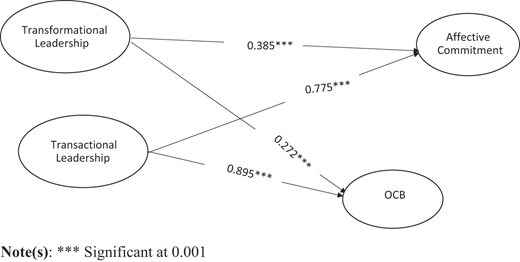
To verify the hypotheses between the studied variables proposed in this study, AMOs 22 was utilized, and two structural equations were developed. In the first structural model of this study, the mediating variable was excluded to observe the effects of independent variables on the dependent variables. As a result, a good fit of data was obtained from the structural equation (Chi2/df = 1.773; CFI = 0.946; TLI = 0.941; RMSEA = 0.044).
Based on the results of model 1 presented in Figure 2, it was indicated from the standardized coefficients that transformational leadership was a significant predictor of affective commitment (β = 0.385, p = 0.000), and transformational leadership had a significant positive effect on OCB (β = 0.272, p = 0.000). Similarly, transactional leadership was found to have a significant positive effect on affective commitment (β = 0.775, p = 0.000) and OCB (β = 0.895, p = 0.000). Overall, the results of this study supported H1, H2, H3 and H4.
Meanwhile, to verify the mediating hypothesis H5 and H6, a second structural equation model was developed including the mediator (work engagement). As a result, a good fit of the data was obtained from the modification indices (CMIN2/df = 1.776; CFI = 0.940; TLI = 0.935; RMSEA = 0.044). The results in Table 3 demonstrated the direct and indirect effects of the partial mediation structural equation model. The indirect effects of work engagement were significant between transformational leadership and affective commitment (β = 0.368, p = 0.000), transformational leadership and OCB (β = 0.387, p = 0.000), transactional leadership and affective commitment (β = 0.349, p = 0.000), and transactional leadership and OCB (β = 0.368, p = 0.000). To determine the type of the mediation, we need to look at the significance of the direct effects with the presence of the mediator following the suggestions of Hair et al. (2016). The direct effects of transformational leadership on OCB (β = 0.004, p > 0.05), transactional leadership on OCB (β = 0.076, p > 0.05), and transactional leadership on affective commitment (β = -0.007, p > 0.05) were not significant, suggesting a full mediation in the relationship the examined variables. However, only the direct effect of transformational leadership on affective commitment (β = 0.429, p = 0.000) was significant, indicating a partial mediation effect of work engagement on the relationship between these variables.
Standardized coefficients of Partially mediated SEM model)
| Path (direct effects) | Standardized coefficients |
|---|---|
| WE < ---TFL | 0.429*** |
| OCB < ---TFL | 0.004 |
| AC < ---TFL | 0.134** |
| WE < ---TSL | 0.408*** |
| OCB < ---TSL | 0.076 |
| AC < ---TSL | −0.007 |
| OCB < ---WE | 0.901*** |
| AC < ---WE | 0.856*** |
| Indirect Effects | Standardized coefficients |
| OCB < ---WE < ---TFL | 0.387*** |
| AC < ---WE < ---TFL | 0.368*** |
| OCB < ---WE < ---TSL | 0.368*** |
| AC < ---WE < ---TSL | 0.349*** |
Note(s): *** sig at 0.001, ** sig at 0.05
7. Discussion
This research aimed to investigate the impacts of transformational and transactional leadership styles on employees’ outcomes in NPOs. The results of this study provided empirical support on the mediating role of work engagement in the relationship between leadership styles and both affective commitment and OCB. Moreover, it was found that transformational leaders’ behaviors had a positive effect on the employees’ affective commitment, and this result was consistent with the finding in the previous research conducted by Gillet and Vandenberghe (2014), Kim (2007), and Walumbwa et al. (2005), which found a positive relationship between transformational leadership and affective commitment in different cultures. These results could be explained by the fact that transformational supervisors lead their employees to transcend their self-interests for the general interests of the organization (Bass and Avolio, 1997), use vision and mission to allow subordinates to easily identify themselves with the organization (Jackson et al., 2013), and recognize the values of employees (Fairlie, 2011), which would contribute to a sense of commitment among the employees.
It was also found that transformational leadership influenced OCB among employees, which was in line with the findings in previous research, in which the positive effect of transformational leadership on OCB was established (e.g. Abu Nasra and Heilbrunn, 2015; Khalili, 2017; Nguni et al., 2006; Purvanova et al., 2006; Wang et al., 2011). The results suggest that the adoption of transformational leadership behaviors could enhance the involvement of employees into extra-role behaviors (OCB), which transcended their job definitions. Furthermore, it was proven that the use of transactional leadership contributed to an enhanced affective commitment, which suggested that there was a positive relationship between transactional leadership and affective commitment. This finding was also consistent with previous empirical studies (e.g. Kim, 2001; Mesu et al., 2012; Ramezaninezhad et al., 2011; Sayadi, 2016).
Moreover, the result of this study illustrated that transactional leadership influenced OCB among employees, which was in line with the results found in the previous studies by Barbuto and Story (2011), Nahum-Shani and Somech (2011) and Piccolo and Colquitt (2006), which revealed the positive impact of transactional leadership on OCB. Therefore, OCB among employees might be influenced by rewards and punishment tactics, implying that the transactional behaviors of supervisors encourage extra-role behaviors among the employees. Finally, the results revealed that work engagement played a significant partial mediating role in the relationship between transformational leadership and affective commitment. Moreover, work engagement exerted a significant full mediation effect between transformational leadership and OCB, transactional leadership and OCB and transactional leadership and affective commitment.
These results were in line with the results in previous research, which suggested that work engagement mediated the relationship between job resources and organizational commitment (Hakanen et al., 2006) and the relationship between job resources and OCB (Babcock-Roberson and Strickland, 2010; Purvanova et al., 2006). This implies that with the effective practice of leadership style by the leaders (whether transformational or transactional), employees would feel more engaged in their jobs, and subsequently show higher levels of commitment and display extra-role behaviors.
8. Implications
This study is one of the very few studies that examine the impacts of transactional and transformational leadership on employees’ attitudes and behaviors in nonprofits. Previous research has mainly focused on examining each type of different leadership styles separately (Rowold et al., 2014). Therefore, the current study enriches the leadership literature given the scholarly calls to further investigate the topic.
Practically, the results of our study provide insights on how the attitudes and behaviors of employees in nonprofits can be influenced by their leaders’ and supervisors’ behaviors. Moreover, the study recommends nonprofits to highlight the importance of leadership development in their organizations. Therefore, training programs for leaders could be developed, with the purpose of providing leaders with the right means and tactics to create a work environment where employees feel that their jobs are important to them and they can demonstrate positive work-related outcomes. Still, it is essential that these training programs consider local leadership styles to overcome any potential resistance (Ardichvili, 2001).
Furthermore, our results suggest that the presence of both transactional and transformational leadership is important for work engagement among nonprofits, as leaders can perform well when using both styles (Zigarmi et al., 2004). Every leader needs to use different styles of leadership (Bass and Riggio, 2006). Hence, nonprofits leaders should pay attention to the usefulness and application of both transactional and transformational leadership styles because an effective leader can utilize different leadership strategies to influence others (Yukl, 2010). Building on that, this study can be also useful to different types of nonprofits (civil societies, charities, NGOs, humanitarian organizations) to figure
out the effectiveness of their leadership styles and their influence on the followers. Hence, by affecting employees’ attitudes and behaviors, this will ultimately benefit the community and the targeted beneficiary these organizations serve.
Finally, the results of the current study provide insights for nonprofits on the importance of recruiting leaders to improve the organization’s performance and fulfill the leader-organization fit. Hence, nonprofits need to select leaders who are knowledgeable about different leadership styles and their consequences in the workplace. The results recommend nonprofits senior management to enhance their awareness of different leadership styles in order to encourage employees to demonstrate effective behaviors.
8.1 Limitations and future research
Our results need to be carefully interpreted, as our research has a number of limitations. The first issue is the research design, which limits the possibility of examining causality among the studied variables. Hence, future studies should consider longitudinal studies to allow for cause-effect assessment (Cohen et al., 2011). Second, the research used Italian nonprofits to investigate the research hypotheses, which might limit the generalizability of the results. Although our results are consistent with previous theoretical and empirical support in leadership literature, the results still need to be replicated using a larger sample from other European contexts. Third, the research relies on data gathered from the same source: an issue, which might introduce a common bias method. Future research might consider collecting data from different sources. Another limitation in our research is the use of the self-response measures, which might introduce the response bias (Podsakoff and Organ, 1986).
Fourth, in our research outcome variables, such as work engagement, were not analyzed in its three dimensions (vigor, dedication and absorption), and hence, future research might analyze each of these dimensions as a separate outcome. Fifth, this research investigated work engagement as mediating leadership styles and the dependent variables. Future research should further consider the intervening role of subordinates’ job characteristics in the organization (Gillet and Vandenberghe, 2014). Sixth, our research investigated the relationship between study’ variables without controlling for the respondents’ demographics; therefore, future research should replicate the study in other contexts and control for employees’ demographics profile.
Future research should also analyze the effects of the dimensions of both transactional and transformational leadership on work-related outcomes (Hassi, 2018), to examine the predictive power of each of these dimensions. Future studies should also examine other types of leadership (e.g. servant leadership, ethical leadership, participative leadership, etc.) in the nonprofit context and their impacts on work-related attitudes and behaviors. Finally, another potential research endeavor is to replicate the study in both profit and nonprofit sectors to check for any differences between these two contexts.

