This study aims to explain how information technology (IT)-enabled organizational change occurs at varying rates due to the specific characteristics of small and medium-sized enterprises (SMEs). The paper investigates the primary determinants of IT-enabled organizational change in these organizations.
By integrating the resource-based view, organizational learning theory and the entrepreneurial digital ecosystem perspective, this research develops a comprehensive model for analyzing IT-enabled organizational change in SMEs. The conceptual model encompasses five key dimensions: entrepreneurship, technology, human capital, strategic governance and the digital ecosystem. Empirical data were collected from a representative survey of Spanish SMEs, and logistic regression analysis was applied to assess the impact of these factors on the likelihood of IT-enabled organizational change.
The findings reveal that SMEs led by older or less entrepreneurially driven owners and/or managers are less likely to engage in IT-enabled organizational change. In contrast, SMEs with high digital maturity, motivated and digitally skilled staff, formalized digital strategies and active external collaboration in digital projects are more proactive in implementing IT-enabled organizational changes. Additionally, SMEs that lack formally assigned digitalization roles or concentrate these responsibilities solely on the owner/manager tend to exhibit lower levels of IT adoption.
This research offers a novel perspective by combining theoretical frameworks with empirical data to examine IT-enabled organizational change specifically within SMEs. The study’s model provides actionable insights by identifying the organizational characteristics and external factors most essential for driving digital transformation in smaller firms, an area often overshadowed by research on larger organizations.
1. Introduction
The advancement of information technology (IT) poses a disruptive process that transforms our economies and societies at different levels. Companies need to adapt their product portfolios, their internal and external processes, and their business models to accommodate the digital developments in order to leverage the potential of these new technologies. Therefore, the IT adoption process most often leads to a process of organizational change in companies (Kotarba, 2018; Hanelt et al., 2021; vom Brocke et al., 2021; Zoppelletto et al., 2023).
IT provides opportunities to enhance efficiency by reconfiguring a company’s internal organization (Cha et al., 2015; Brynjolfsson and Hitt, 2020). Digitalization, understood as the process of adopting and implementing IT, propels the transformation of human resource management using computers, telecommunication networks, and other electronic media towards improving productivity by means of lowering costs and creating additional value (Montero Guerra et al., 2023; Zhang and Chen, 2023). The organization needs to be adapted to the digital flow of processes and information, and hence certain tasks, responsibilities, and roles disappear, others arise anew, while still others are transferred between employees and departments. In some cases, a major transformation in organizational routines, models, and structure is met with direct consequences for the structure and functioning of the inter-organizational networks in which the companies are involved, and may even imply a redefinition of organizational boundaries (Hanelt et al., 2021; vom Brocke et al., 2021). All these organizational changes, which are crucial for productivity gains to be attained from IT adoption (Han and Dong, 2023; Kumar et al., 2024; Meier at al., 2025) are encompassed by the concept of IT-enabled organizational change (Besson and Rowe, 2012; vom Brocke et al., 2021).
In particular, small and medium-sized enterprises (SMEs) exhibit a delay in their IT adoption process compared to large corporations and must overcome the challenge of their digitalization in order to maintain and gain competitiveness and, hence, to ensure their survival and foster growth (OECD, 2020; Eller et al., 2020; Meier et al., 2025). However, the digitalization process in SMEs is conditioned by the particular characteristics of this type of company, such as the personal characteristics of the entrepreneurs, the limitation of their resources (e.g. financial, human, technological), and the deficiencies in their management and organization (Gonçalves et al., 2025; Marino-Romero et al., 2024; Romero and Mammadov, 2024). This suggests that the patterns of IT adoption and its organizational impact in SMEs differ from those in large corporations (Li et al., 2018; Eller et al., 2020; Zoppelletto et al., 2023). However, the specific factors that condition the process of IT-enabled organizational change in SMEs have yet to be investigated in the literature. The extant literature is predominantly qualitative (vom Brocke et al., 2021) and presents a bias towards studies focused on large companies and not on SMEs. In an effort to fill this gap in the literature, this paper is guided by the following general research question:
GRQ: What are the key determinants of IT-enabled organizational change in SMEs?
From this general question, five specific research questions are derived to guide our study:
Do entrepreneurs’ personal characteristics influence IT-enabled organizational change in SMEs?
Does the level of technological maturity influence IT-enabled organizational change in SMEs?
Does staff digital readiness influence IT-enabled organizational change in SMEs?
Do the characteristics of digital strategy management influence IT-enabled organizational change in SMEs?
Does external cooperation influence IT-enabled organizational change in SMEs?
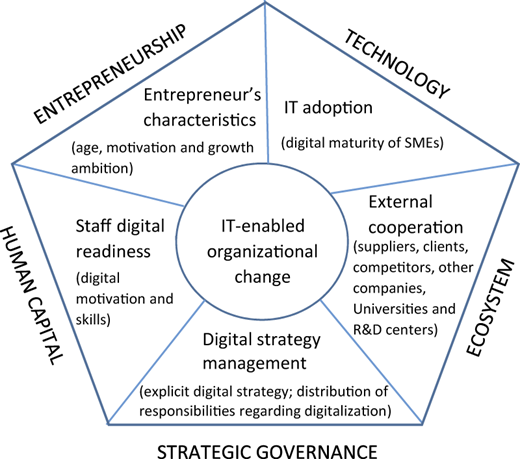
From a theoretical perspective, this paper contributes to the literature by proposing a conceptual model of IT-enabled organizational change. The model builds on prior research on IT-enabled organizational change and integrates elements of the resource-based view (Barney, 1991; Wade and Hulland, 2004), the organizational learning theory (Levitt and March, 1988; Zollo and Winter, 2002), and the entrepreneurial digital ecosystem approach (Sussan and Acs, 2017). Our model seeks to explain how IT-enabled organizational change is manifested at different rates as a result of the characteristics of the SMEs. In this respect, differentiation is made between five critical dimensions that condition IT-enabled organizational change: entrepreneurship, technology, human capital, strategic governance, and ecosystems.
From an empirical perspective, our research analyzes the key determinants of IT-enabled organizational change in SMEs using a representative sample of SMEs in Spain. Our results show that those companies with older and less entrepreneurially motivated business owners/managers are less open to the introduction of IT-enabled organizational change. Furthermore, those SMEs with higher levels of digital maturity and of staff’s digital readiness, that have professionally defined digital strategic management and are willing to cooperate with external partners in digital projects, are more active in the implementation of IT-enabled organizational changes.
The rest of the paper is organized as follows. Section 2 presents the theoretical framework of our analysis and postulates the research hypotheses. Section 3 describes the data used and the methodology applied in this research. The results are presented in Section 4 and discussed in Section 5. The paper ends with a conclusion section that summarizes its findings, highlights its contribution, derives several management implications and outlines limitations and potential directions for future research.
2. Theoretical background
2.1 Literature review and theoretical framework
The organization of work has been transformed by the adoption and implementation of IT in the companies. Due to digitalization, many employees currently work in “self-organized, non-hierarchical, geographically and/or organizationally dispersed teams, using new working methods, such as design thinking” (Weber et al., 2022). Furthermore, enterprise digital management systems, such as enterprise resource planning (ERP) and customer relationship management (CRM) have increased in use. These systems, when adopted in a company, transfer their own logic to the strategy, structure, and culture of the organization, and trigger substantial organizational changes (Markus, 2004; vom Brocke et al., 2021). As a result of IT-enabled organizational change, companies can adopt organizational designs of a more flexible nature that allow them to interact with other actors within digital ecosystems (Hanelt et al., 2021). Moreover, the impact of IT on organizational change could increase with the irruption of generative artificial intelligence (Kanitz et al., 2023; Mammadov et al., 2024).
Complementary organizational changes are needed since the adoption of IT alone cannot guarantee an increase in firm productivity and successful outcomes for the organization. The organizational changes that complement the adoption of IT include new job designs, the training of new skills, the restructure of departments and business units, changes in business processes and workflow, new human resource policies (regarding hiring, performance evaluation, and compensation), new management systems, and redesigned spatial layouts (Markus, 2004; Hanelt et al., 2021; Erjavec et al., 2023).
In the last three decades, a branch of literature has explored IT-enabled organizational change from a variety of disciplines and perspectives. In this respect, Besson and Rowe (2012) and, more recently, vom Brocke et al. (2021) have specifically reviewed the literature on IT-enabled organizational transformation.
Organizational change prompted by information technologies has been analyzed through the lenses of a variety of theoretical frameworks. Organizational learning theory and the resource-based view (RBV) are among the theories more commonly adopted as foundations for research in this topic (Cha et al., 2015; vom Brocke et al., 2021). The RBV presents the company as a set of resources that support several competitive advantages for the organization (Barney, 1991; Wade and Hulland, 2004). In this respect, IT-enabled organizational change requires both specific technological and human resources. However, the successful implementation of this technology also depends upon certain transformation capabilities in the company, as suggested by the theories on organizational learning and dynamic capabilities (Levitt and March, 1988; Zollo and Winter, 2002; Cha et al., 2015; Sarfo et al., 2024). In this respect, the role of leadership and the management of the transformation process are critical factors in the response to the changes in business environment associated with the digital revolution, since they allow organizations to adapt their resources and routines in response to shifting market conditions and competitive pressures. As a third theoretical foundation, the digital entrepreneurial ecosystem concept (Sussan and Acs, 2017) has highlighted the role of Schumpeterian entrepreneurs in founding digital companies and developing innovative products and services, whereby the role of interaction with different partners is emphasized. These interactions can also facilitate the process of IT-enabled organizational change in SMEs, enabling such companies to overcome some of the limitations associated with their smaller size (Aminullah et al., 2022; Romero and Mammadov, 2024).
Upon these theoretical bases and prior research on IT-enabled organizational change, we propose an integrated theoretical model that differentiates between five key dimensions that condition IT-enabled organizational change in SMEs. Certainly, other factors may influence this process; however, in our view, these five dimensions are the fundamental determinants shaping jointly IT-enabled organizational change in such companies. Next, we will present these five critical dimensions:
Entrepreneurship. As Weber et al. (2022) state, previous research has not sufficiently studied the impact of leaders on organizational change, particularly concerning IT-enabled organizational change. In this respect, it is necessary to take into account that the role of entrepreneurs is critical in the organization and performance of SMEs (Romero and Martínez-Román, 2012; Hadjielias et al., 2022), with their personal characteristics influencing IT adoption in these companies (Li et al., 2018; Romero and Mammadov, 2024). Entrepreneurial leadership is a key factor in IT-enabled organizational change in SMEs, since it acts as an engine for change and creates the organizational culture and conditions that support the organizational transformation (Schiuma et al., 2024).
Technology. The organizational change driven by IT is obviously of a technological nature. IT modifies the internal process, the interaction with external partners, and the organization of companies in different directions. Therefore, the level and characteristics of the particular technologies and applications that the company adopt and implement constitute a fundamental determinant of the associated organizational change of the company (Han and Dong, 2023; Romero and Mammadov, 2024).
Human Capital. Digital knowledge and skills are a key resource that leverage the organizational change in the company (Davenport and Redman, 2020; Eller et al., 2020). The capacity of implementing the organizational changes necessary to successfully adopt IT in the company is conditioned by the digital human capital and individual digital capabilities available within the organization (Markus, 2004; Scuotto et al., 2021; Montero Guerra and Danvila-Del Valle, 2024) and by the staff attitude towards those changes (Weber et al., 2022; Hooi and Chan, 2023; Reimer et al., 2024).
Strategic Governance. The development and results of IT adoption are conditioned by how the company integrates IT, digital capabilities, and other resources into their operations. The optimal management of the IT adoption process and the implementation of related organizational changes thereby depend on strategic and governance issues, such as the existence of an explicit and formalized digital strategy and the distribution of responsibilities associated with its implementation (Bharadwaj et al., 2013; Hanelt et al., 2021; Rêgo et al., 2022).
Ecosystem. Organizational change is not only the result of internal process, but it is also conditioned by environmental factors and the influence of external partners. Interaction with external actors can be a useful mechanism for SMEs to drive their digitalization (Hanelt et al., 2021). Digital ecosystems represent business environments characterized by a network of interdependencies generated through IT (Senyo et al., 2019; Kopalle et al., 2020). Thus, the integration of SMEs in such digital ecosystems can induce substantial organizational changes affecting both the external process to dialog and interact with external partners and the internal process within the organization.
These five dimensions jointly condition the process of IT-enabled organizational change, and encompass the critical resources necessary to successfully implement the changes and the strategic management of the resources within the organization, as shown in Figure 1.
2.2 Research hypotheses
In this section, the research hypotheses that are subsequently evaluated in the empirical part of this paper are postulated according to the analytical framework presented in Figure 1.
From the perspective of the entrepreneurial dimension, younger entrepreneurs may be more open to leveraging IT to change the organization of their companies, in contrast with older entrepreneurs who could be inclined towards a more conservative management (Jeyaraj et al., 2006; Cesaroni et al., 2011). Similarly, entrepreneurs with a greater ambition for growth may be inclined to implement organizational changes in their companies associated with the adoption of IT if they believe that these transformations can untangle potential growth for the firm (Romero and Mammadov, 2024). Conversely, necessity entrepreneurs who engage in business activities solely to escape unemployment or unsatisfactory labor conditions may be less motivated to introduce IT-enabled organizational changes in their SMEs (Block and Sandner, 2009; Fernández-Serrano et al., 2019). In this regard, we put forward the following hypothesis:
The introduction of IT-enabled organizational changes in SMEs is influenced by the entrepreneur’s age, motivation, and growth ambition.
IT adoption in companies typically occurs in distinct stages, and constitutes an accumulative process. These stages, commonly differentiated as digitization, digitalization, and digital transformation (Gong and Ribiere, 2021; Verhoef et al., 2021), imply evolving levels of complexity. Digitization involves encoding analog information into a digital format, thereby enabling storage, processing, and transmission by computers. Digitalization, on the other hand, refers to the use of IT to modify existing business processes across various areas such as production, distribution, communication, and management. Lastly, digital transformation represents the most advanced phase, and signifies a company-wide change that leads to the development of new business models. In this sequential process, the initial steps may not necessarily drive significant organizational changes, while more advanced developments often lead to substantial transformations in organizational processes within companies.
The progression of this process is conditioned by investment in IT and its applications (Hanelt et al., 2021; Han and Dong, 2023). SMEs with higher levels of IT adoption may need to implement more profound organizational changes to effectively integrate these technological resources into their internal processes. Furthermore, their higher digital maturity enables such SMEs to better recognize the potential of their IT investments and leverage them more effectively to achieve greater efficiency through organizational transformation (Romero and Mammadov, 2024). In this regard, the following hypothesis is proposed:
SMEs with a higher level of IT adoption are more likely to introduce IT-enabled organizational changes.
IT adoption and implementation in SMEs is usually characterized by a project-oriented approach and the absence of a holistic view formalized in a global digital strategy (Matt et al., 2015; Rêgo et al., 2022; Zoppelletto et al., 2023). A digital strategy can be defined as “organizational strategy formulated and executed by leveraging digital resources to create differential value” (Bharadwaj et al., 2013, p. 472). Given the absence of such a specific strategy, IT adoption in SMEs is often based on individual and disconnected initiatives of the owner/manager, other members of the management team, and of specific employees (Kohli and Melville, 2019; Meier et al., 2025). This unplanned ad hoc approach may hamper the introduction of IT-enabled organizational innovations (Eller et al., 2020; Romero and Mammadov, 2024).
Likewise, as Ghosh et al. (2022) point out, the organizational structure of the company can influence the process of digital transformation. In this respect, in SMEs, there is often a key person (or a small group of people) who leads and manages IT adoption in the company. These leaders may also act as digital entrepreneurs, who search for business opportunities associated with the digitalization of their companies and push the organization to exploit them (Weber et al., 2022; Xia et al., 2023). Consequently, the role of these digital leaders and the distribution of responsibilities regarding digitalization critically condition the introduction of IT-enabled organizational change. However, there is an insufficient amount of research that focuses on the specific individuals (and units) who lead and manage the digitalization of SMEs, and questions how different styles of leadership and governance structures influence the results of the process (Zoppelletto et al., 2023).
In SMEs, it is most frequently the business owner/manager who assumes the most important decisions regarding IT adoption, either by taking the leading role or in collaboration with others (Zoppelletto et al., 2023; Meier et al., 2025). Nevertheless, in certain cases, a Chief Digital Officer (CFO) is appointed to develop the responsibilities associated with the digital transformation of the SMEs, although this executive role is more often found in large companies, which can rely on sufficient resources and organizational culture to implement this type of internal structure (Erjavec et al., 2023; Zoppelletto et al., 2023). In some cases, IT responsibilities are spread across different units, departments, or individuals, or the process arises from a variety of spontaneous initiatives undertaken by different people (Romero and Mammadov, 2024). Previous research fails to identify which organizational design is the most efficient for IT adoption and implementation of SMEs (Matt et al., 2015; Ghosh et al., 2022). However, the situation where the owner or manager personally oversees digitalization tasks and responsibilities can pose a limitation (Giotopoulos et al., 2017; Romero and Mammadov, 2024). Owners/managers in SMEs may possess limited digital knowledge and skills, along with a narrow perspective on the potential of IT. Furthermore, they may face time constraints that hinder their ability to assess and successfully implement IT adoption. These considerations could be extended to the case when the IT responsibilities are not clearly defined and assigned. In both situations, the governance structure in the company can act as a barrier for the implementation of IT-enabled organizational change. Therefore, the following hypothesis is proposed:
SMEs that implement an explicit digital strategy with formally assigned responsibilities, not concentrated solely on the owner/manager, are more likely to introduce IT-enabled organizational changes.
IT can reshape the entire organization, with human capital presenting a key element of this organizational change. On one hand, the acceptance of employees is critical for the successful IT adoption in a company. In this respect, IT-enabled organizational change needs to overcome the organizational inertia that determines the degree of stickiness of the organization structure and must delimit the effort required to propel this change (Besson and Rowe, 2012). One of the sources of inertia in organization is the psychology inertia associated with employees that may be overwhelmed by their negative emotions raised by their perception of the implications of IT adoption. In this respect, individuals can suffer fear of learning and so-called “computer anxiety” (Hackbarth et al., 2003). Moreover, employees may perceive IT adoption as a potential risk, through believing this change could jeopardize their jobs or lead to disruptions and drawbacks (Polites and Karahanna, 2012). This would give rise to resistance to change (Markus, 2004), thereby hindering IT-enabled organizational change. Having internal support among staff is crucial for achieving significant IT-enabled organizational change. Therefore, building organizational awareness of the challenges of digitalization facilitates IT adoption and its successful implementation (Trzeciak, 2024).
Similarly, IT adoption and implementation requires individuals to take on new tasks and roles, which necessitates the training of employees, hiring new individuals with IT expertise, and/or seeking external consultancy services (Cha et al., 2015; Han and Dong, 2023; Montero Guerra and Danvila-Del Valle, 2024). Digital skills constitute a form of human capital that assumes a primary role in the process of IT adoption (Matt et al., 2015; Giotopoulos et al., 2017; Eller et al., 2020). Hence, employees who are particularly motivated towards digitalization and possess the requisite skills are more likely to actively contribute to organizational changes associated with the company’s IT adoption process. In this respect, the following hypothesis is proposed:
SMEs characterized by a greater digital readiness of their staff (in terms of digital motivation and skills) are more likely to introduce IT-enabled organizational changes.
Finally, SMEs can facilitate their IT-enabled organizational change by engaging in collaborations with other stakeholders within their business ecosystem (Sussan and Acs, 2017; Kryeziu et al., 2024; Meier et al., 2025) and by developing an open innovation approach (Chesbrough, 2003). These possible partners include other companies of the same group, suppliers, customers, competitors or other companies in the same sector, companies of other sectors, Universities, and centers of public or private research (Fernández-Serrano et al., 2019; Brynjolfsson and Hitt, 2020; Chan et al., 2022). In this respect, the following hypothesis is proposed:
SMEs that are more open to collaboration with external partners are more likely to introduce IT-enabled organizational changes.
3. Data and methodology
3.1 Data collection
The data was gathered through a survey conducted for this research during the second quarter of 2022, targeting Spanish SMEs with between 1 and 200 employees. The SMEs included in the survey were randomly selected from the System of Iberian Balance Analyses (SABI) database. The sample is statistically representative of the SME population in Spain, with a margin of error of ±5.0% and a 95% confidence level, based on a binomial distribution assumption (p = q = 0.5, representing the most conservative scenario). The research employed computer-assisted telephone interviewing (CATI) as the survey method. Fieldwork yielded a response rate of 21.5%, with no significant bias detected between respondents and non-respondents. An initial version of the questionnaire used in this research was tested through 10 personal interviews with business owners/managers of SMEs. The feedback gathered from these pilot interviews allowed us to make improvements to the instrument. Our raw dataset consisted of 841 observations. After conducting a data cleaning process to remove inaccurate and incomplete observations, the final dataset for this study comprises 821 valid responses. The data analysis was conducted using SPSS software (version 29.0.1.0).
3.2 Variable description
Dependent variable: IT-enabled organizational change. Entrepreneurs/managers were asked whether, during the 2019–2021 period, their companies “had introduced organizational changes that involve a digitalization process”. The answers were coded as a binary variable (1 = yes; 0 = no). The question explicitly stated that organizational changes could include various aspects, such as the introduction of new methods or internal practices in work organization or company procedures, improved distribution of responsibilities, or new approaches to managing external relations with other companies or institutions. This question was adapted from the Community Innovation Survey (CIS) (Eurostat, 2016).
Explanatory variables. A set of explanatory variables are included in our econometric specification associated with the factors presented previously in Section 2.
Entrepreneur’s personal characteristics. Three variables related with the personal characteristics of the entrepreneurs are considered in this analysis. The first variable is the entrepreneur’s age. The second is related with the entrepreneurial motivations, and particularly captures whether entrepreneurs were driven by necessity motivation. They were therefore asked to what extent they got involved in their business activity to escape unemployment and job insecurity. The third variable refers to their ambition for business growth. Business owners/managers were asked whether in relation to the future of their companies they wanted it to be as big as possible versus manageable by themselves or with few employees. The latter two questions were adapted from Fernández-Serrano et al. (2019), with responses coded using 5-point Likert scales.
IT adoption. As a basic indicator of the level of digital maturity, the percentage of the company’s total staff that use computers, tablets, and/or mobile phones with Internet connection for business purposes, is included in this analysis. This question was adopted from the Survey on the Use of Information and Communication Technologies and E-Commerce in Companies, conducted by the National Statistics Institute of Spain (Instituto Nacional de Estadística, 2019).
Digital strategy management. Two aspects regarding the management of the digital transformation process are considered in this study. First, the existence (or absence) of a formal digital transformation strategy in the company, which has been identified as a critical factor for successful digital transformation (Eller et al., 2020; Bhattacharya and Pant, 2024; Meier et al., 2025), is captured by a binary variable. Second, the distribution of responsibilities regarding the digital transformation of the company is considered. In this respect, four alternatives are differentiated based on prior research (Ghosh et al., 2022; Zoppelletto et al., 2023; Meier et al., 2025). The responsibilities of digital transformation can either be largely assigned to a specific person/department, be shared among various departments/managers of the company, be assumed by the entrepreneur/manager themselves, or be left without a defined distribution of responsibilities in this area. These four possible situations are coded by using binary variables that take the value of 1 for the option adopted by a company and 0 in the remaining alternatives.
Staff digital readiness. Two variables are considered regarding this aspect. First, a variable approaches the attitudes of the staff towards digitalization. Prior literature has described how these attitudes can range widely, from a negative perception of the process—resulting in resistance to its development—to a positive stance, embracing the process and actively collaborating in its implementation, while also including indifference and a lack of awareness about the relevance of this process (Hackbarth et al., 2003; Polites and Karahanna, 2012; Vial, 2019; Balzano and Marzi, 2024). For this research, we asked about the extent to which employees were motivated regarding the company’s digital transformation. We used a multiple-choice question to which business owners/managers had to respond with one of the following four alternatives: (1) Employees show resistance to the changes associated with the digital transformation of the business; (2) Employees are unaware of the potential and relevance of digital transformation for the company; (3) Employees are aware of the importance of digitalization but are not motivated about it; and (4) Employees are highly motivated regarding the digital transformation of the company. The answers were treated as an ordinal variable.
The second variable related to the staff’s digital readiness refers to employees’ digital competencies. Here, a binary variable is used, taking a value of 1 if the company conducted training activities to enhance staff IT skills within the three years preceding the survey, and 0 if not. This question was also adapted from the Survey on the Use of Information and Communication Technologies and E-Commerce in Companies (Instituto Nacional de Estadística, 2019).
External cooperation. Interaction with external actors within digital ecosystems has been identified as a key channel for fostering the IT adoption in SMEs (Brynjolfsson and Hitt, 2020; Chan et al., 2022; Meier et al., 2025). To assess the cooperative profile of SMEs in this respect, we constructed a synthetic index that captures their cooperation with different types of external actors. This index is based on six binary variables that indicate whether the company collaborates on digitalization-related activities with: (1) other companies within the same group, (2) suppliers, (3) customers, (4) competitors or other companies in the same sector, (5) companies from other sectors, and (6) universities, higher education institutions, or public or private research centers. The index is calculated as the sum of these six binary variables.
Control variables.
Firm size: Company size is measured by the number of employees.
Sectors: The SMEs in the dataset are categorized into four sectors: industry, construction, trade, and services. Dummy variables are incorporated into the models for the first three sectors, with the service sector used as the reference category.
Table 1 presents the descriptive statistics for the variables in the analysis. The average company in the survey is a small company operating in the services sector in which more than 70% of the employees work with computers or other electronic equipment. The average entrepreneur/manager of these companies is a fifty-year-old individual who often takes on the responsibilities related to digitalization (in 44.5% of companies). However, it is also equally common for these responsibilities to be shared among various departments/officers (44.0%). The majority of the companies in the sample usually have an explicit and ongoing digital strategy. Almost 40% of the companies interviewed had introduced organizational changes associated with a digitalization process in the three years previous to the time of the survey.
3.3 Econometric modeling
This analysis uses logistic regression to assess the impact of independent variables on the binary variable representing IT-enabled organizational change. The binary logistic regression method is often used in the literature on organizational change and IT adoption (Hiebl et al., 2017; Sıcakyüz and Yüregir, 2020; Bracci et al., 2022).
The econometric model can be expressed as follows:
In (1), p stands for the probability that , where y represents the dummy capturing IT-enabled organizational change, are the independent variables (explanatory and control variables), and denote the regression coefficients .
The probability that a SME has adopted IT-enabled organizational changes for a given value of is, represented by the following expression:
4. Results
The results of the estimated models are presented in Table 2. Regarding the control variables, only firm size shows a (positive) statistically significant effect. Accordingly, larger SMEs appear to have greater probabilities of introducing IT-enabled organizational changes. Therefore, larger firms appear to have better access to human, technological, and financial resources, which facilitates the adoption of IT and the implementation of organizational changes driven by these technological advancements. Furthermore, these results suggest that IT-driven organizational change is not confined to specific sectors, but is widely observed across the economy.
Regarding the explanatory variables in the models, first, older owners/managers are observed to negatively influence the implementation of IT-enabled organizational changes in SMEs. These owners and managers appear to be more conservative and resistant to change, possibly due to a limited familiarity with IT. The same applies to those entrepreneurs motivated by necessity reasons, who do not explore the potential benefits of organizational changes associated with IT adoption. In contrast, those owners and managers with greater ambition for growth drive IT-enabled organizational changes in their companies. These entrepreneurs recognize the potential of IT-driven organizational change as a catalyst for productivity growth in SMEs and strive to leverage it. Overall, these results are consistent with Hypothesis H1 presented in Section 2.
Secondly, the results indicated that those SMEs which have adopted IT more actively, so that a higher percentage of their staff use computer or similar electronic equipment in their work activity, have a statistically-significantly higher probability of introducing IT-enabled organizational changes. This result supports Hypothesis H2 and indicates that the level of digital maturity influences SMEs' ability to convert IT investments into effective organizational change.
Thirdly, those SMEs that count with an explicit and ongoing digital strategy show higher statistically-significant probabilities to introduced IT-enabled organizational changes. In addition, it is observed -see the first model in Table 2- that those SMEs in which the responsibilities regarding digitalization are assigned by a specific department in charge of a CDO or are formally distributed by different departments have higher probabilities of implement IT-enabled organizational changes. On the contrary, when those responsibilities are assumed by the own owner/manager or are not clearly assigned the probabilities of observing IT-enabled organizational changes are significantly lower (see the second model in Table 2). These results are consistent with Hypothesis H3, suggesting that a formalized, strategically designed, and professionalized approach to digitalization facilitates IT-enabled organizational change in SMEs. In contrast, a spontaneous, unplanned approach to IT adoption, coupled with a lack of specialized management for the digitalization process, hinders IT-driven organizational transformation.
Fourth, a higher motivation of the employees regarding the company’s digitalization efforts is observed to have a positive effect on the implementation of IT-enabled organizational changes in SMEs. Conversely, employee resistance to digitalization represents a critical obstacle to IT-enabled organizational change in SMEs. Without employee involvement, the potential of IT to drive organizational change in SMEs will remain untapped. In addition, those SMEs that carried out training activities for improving the digital skills of their employees have higher probabilities to introduce IT-enabled organizational changes. This result confirms that IT adoption in companies must be accompanied by reskilling and upskilling of staff to effectively drive organizational change. From this perspective, IT and digital skills serve as complementary assets for firms. Overall, these findings indicate that staff’s digital readiness facilitates the introduction of IT-enabled organizational changes in SMEs, supporting Hypothesis H4.
Finally, the results show that those SMEs that are more open to collaborating with diverse external partners in issues related with digitalization are more likely to implement IT-enabled organizational changes. Collaboration on IT projects with companies within the same business group, suppliers, customers, competitors, other companies in similar or different sectors, as well as universities, higher education institutions, and research centers, can serve as a key channel for driving organizational change in SMEs. Interactions with these partners often stimulate organizational change, as companies must adapt their internal routines and processes to align with the characteristics of their collaborators. This evidence supports Hypothesis H5, which indicates that the participation of SMEs in digital ecosystems can be a source of internal transformation of the company.
5. Discussion
As highlighted by Markus (2004), an IT-enabled organizational change is a double-faced process driven by technological push, but it also has an organizational dimension that is critical for the successful and profitable implementation of IT in the company. In this paper, a conceptual model is proposed that differentiates between five factors as determinants of IT-enabled organizational change in SMEs, wherein both the technological and the organizational dimensions are considered.
From a technological perspective, the capacity of the companies to implement IT-enabled organizational changes can be interpreted as a dynamic capability that is developed by the firm as a result of a learning process. IT adoption comes as a process in which a step forward prepares the company to take a new step successfully. In this respect, our results suggest that digital maturity is a key predictor of further IT-enabled organizational changes by SMEs. This conclusion is in line with that of Armstrong and Sambamurthy (1999) and Mammadov et al. (2024).
Regarding organizational dimensions, the entrepreneurial profile of a company constitutes a key factor in the influence on IT-enabled organizational change. In SMEs, this entrepreneurial orientation is closely linked to the personal characteristics of business owners and managers. Our findings suggest that older entrepreneurs, motivated by necessity and lacking growth ambitions, may inhibit such change in SMEs. In contrast, younger business owners/managers, driven by intrinsic or opportunity-based motivations and high growth ambitions, could more likely foster IT-enabled organizational change. This evidence is consistent with the conclusions of Cesaroni et al. (2011) regarding the effect of entrepreneurs' age on IT adoption in SMEs. However, we extend their analysis by demonstrating that the entrepreneurial orientation of owners/managers has an additional impact, fostering IT-enabled organizational change.
Furthermore, this paper emphasizes the role of strategic governance as a key antecedent of IT-enabled organizational change. In this context, SMEs, especially microenterprises, are often marked by management of a less professional nature, the absence of a clear strategy, and a simple governance structure, where critical decisions are concentrated in the hands of the business owner/manager. According to our findings, this approach hinders the organizational changes needed to fully leverage the benefits of IT adoption. These conclusions are in line with those of Giotopoulos et al. (2017) and Romero and Mammadov (2024), referred to IT adoption and digital innovation, respectively. According to our analysis, the most unfavorable situation for IT-enabled organizational change occurs in SMEs that fail to formally assign digitalization responsibilities, which suggests a lack of interest in this area, and both hinders the IT adoption and limits potential organizational changes. In contrast, according to our results, concentrating these responsibilities in a specific department is the most effective governance model for driving IT-enabled organizational change in SMEs. Positive effects are also observed in SMEs that formally distribute these responsibilities across multiple departments. This analysis offers novel insights into the most effective organizational models for leveraging IT-enabled organizational change in SMEs.
As many authors have noted, human capital is a crucial element in the digital transformation of companies (Giotopoulos et al., 2017; Eller et al., 2020; Ullrich et al., 2023). In this context, we highlight the role of staff digital readiness as a key factor that influences IT-enabled organizational change in SMEs. Specifically, we observed that training activities aimed at enhancing digital skills exert a positive impact on facilitating IT-enabled organizational change. It is equally important to foster a digital culture within the organization that promotes positive employee attitudes toward IT adoption. Our findings, consistent with Trzeciak (2024), demonstrate that SMEs with highly motivated staff regarding digitalization are more effective at implementing IT-enabled organizational changes.
Lastly, the company’s profile in terms of external cooperation is another key determinant of IT-enabled organizational change in SMEs. Our results show that the adoption of an open innovation approach to IT promotes organizational change, and affects both internal processes and relationships with external partners. This finding suggests that the development of digital ecosystems, where SMEs can actively participate, stimulates organizational change by creating favorable environmental conditions and generating synergetic effects. This is in line with previous analyses by Aminullah et al. (2022) and Bejjani et al. (2023). In this respect, our results emphasize the importance of extending collaborative relationships with various types of external partners.
6. Conclusions
Over the years, organizations have made significant investments in IT, which has prompted questions regarding the returns on these investments. In numerous instances, the benefits become evident only when companies restructure the organization to leverage the potential of IT capabilities. This challenge presents certain particularities in the case of SMEs. In this paper, we specifically explore the determinants of IT-enabled organizational change for SMEs in Spain.
6.1 Theoretical and empirical contributions
The theoretical contribution of this paper consists of the proposal for a conceptual model to explain IT-enabled organizational change in SMEs. This model represents an integrated framework that combines the resource-based view (Barney, 1991; Wade and Hulland, 2004), the organizational learning theory (Levitt and March, 1988; Zollo and Winter, 2002), and the entrepreneurial digital ecosystem (Sussan and Acs, 2017). It is specifically adapted to the unique characteristics of SMEs, whereas previous literature has predominantly focused on large companies. In this model, five key dimensions that influence IT-enabled organizational change are identified: entrepreneurship, technology, human capital, strategic governance, and ecosystems. These dimensions represent complementary assets for SMEs, fostering IT-enabled organizational change.
Our analysis highlights critical aspects of IT-enabled organizational change in SMEs that have been underexplored in prior studies. Specifically, the personal characteristics of entrepreneurs play a pivotal role in SMEs—an aspect overlooked in the literature. Additionally, our model addresses the characteristics of strategic governance in IT-enabled organizational change from the viewpoint of SMEs. This is particularly relevant for smaller companies, which frequently face significant limitations in this area due to a lack of professional and specialized management expertise.
From an empirical perspective, our research contributes to the literature by providing results based on a statistically representative sample of SMEs in Spain. Based on this dataset, we provide quantitative evidence of the key determinants of IT-enabled organizational change in SMEs, thereby contributing to a stream of literature that has primarily focused on case studies of large companies (Ghosh et al., 2022; Rêgo et al., 2022).
Our results indicate those SMEs with older, less entrepreneurially motivated owners/managers tend to be less open to introducing IT-enabled organizational changes, whereas SMEs with greater growth ambitions are more inclined to implement such changes. Furthermore, SMEs with higher levels of digital maturity and staff readiness—characterized by the availability of digital skills and a positive attitude toward digitalization—are more likely to implement IT-enabled organizational changes. In particular, our analysis offers a key insight by demonstrating that employees’ favorable motivation stimulates IT-enabled organizational change, whereas a negative attitude poses a significant obstacle to it.
Similarly, companies with a formalized and ongoing digital strategy are better equipped to leverage digitalization for the advancement of organizational change. However, SMEs often lack such a strategy’s implementation. Additionally, the distribution of responsibilities for digitalization within the company directly influences IT-enabled organizational change. Those SMEs that do not formally assign IT responsibilities or concentrate them solely on the business owner/manager -a common scenario among the SMEs observed- tend to be less active in this area. In contrast, the delegation of these responsibilities to a specific department appears to be the most effective model for driving organizational change in SMEs.
Lastly, SMEs that are more open to collaborating with external partners on digital projects are also generally more proactive in implementing IT-enabled organizational changes. These cooperative relationships are observed to stimulate and facilitate IT-enabled organizational changes in the companies involved, as they need to adapt their internal processes to interact effectively with these partners.
These results enhance understanding of the most effective organizational models for fostering IT-enabled organizational change in SMEs.
6.2 Practical implications
Our analysis presents several practical implications regarding the management of SMEs. In this respect, our results suggest that SMEs should define new formalized roles to lead their digital transition and they should not permit this transformation process to be conducted by the business owners/managers, as it is often the case.
Not only should SMEs modify their governance structure, but they should also combat the resistance to change, thereby promoting the digital culture across the whole organization. These companies should redefine organizational tasks, activities, processes, and structures to take advantage of IT adoption and boost their productivity and competitiveness. In doing so, it is critical to invest in the digital skills both of their managerial teams and of the general workforce.
Furthermore, SMEs benefit from an open approach to digitalization that harnesses the transformative potential of IT through collaboration with external actors within digital ecosystems. Therefore, it is important for SMEs to be more receptive and proactive in collaborating with external partners in the digital field.
Lastly, all these considerations should be coherently integrated into SME management and organization within the framework of an explicit digital strategy, which entails a reflective process on the potential and risks associated with ongoing and accelerated digital developments. In this regard, SMEs should move away from their common approach to IT, which often relies on the development of disconnected projects driven by individual initiatives.
6.3 Limitations and future lines of research
This research has certain limitations. Firstly, the measurements used for some dimensions could be further refined and improved. Secondly, the results may have been influenced to some extent by the impact of the COVID-19 pandemic, which significantly accelerated the digitalization of SMEs due to the constraints imposed by confinement measures. Thirdly, the findings may be partially shaped by the specific context of SMEs in Spain.
From this perspective, it would be valuable to apply the approach presented in this article to data from other time periods and other countries. Additionally, it would be interesting to broaden the scope of the analysis to examine the impact of IT-enabled organizational change on the performance of SMEs, particularly in terms of profitability and growth. Such an extension could offer valuable insights into how organizational change serves as a critical channel for the successful adaptation of SMEs to the ongoing digital revolution.
Funding: This article is part of the R&D&I project entitled “Entrepreneurial factor, digital ecosystems, and digital transformation of SMEs” – DIGIPYME- (PID2020-113384GB-I00), funded by MICIU/AEI/10.13039/501100011033.