


This article explores how employees, as active meaning-makers, interpret and respond to organizational restructuring based on their group identity and organizational history. Adopting a Social Identity Theory (SIT) lens, the study investigates how identity disruption shapes emotional and behavioral responses to change, addressing calls for critical, multilevel perspectives that move beyond behaviorist models and consider restructuring as a relational and discursive process.
A quantitative case study was conducted within a healthcare organization undergoing restructuring, using Structural Equation Modeling to analyze responses from 228 employees categorized into Already Present Group (APG), Newcomers Group (NCG) and a Control Group (CG). Change Confidence, Cynicism, Anxiety and Intention to Quit were measured through validated scales, with results controlled for tenure, age and gender.
Findings reveal that the APG, characterized by stronger historical identification with the pre-change organization, reports significantly lower levels of Change Confidence and higher levels of Cynicism and Intention to Quit compared to the NCG. In contrast, NCG members exhibit response patterns more similar to those of the CG. The results further indicate that the Anxiety-buffering role of Change Confidence operates only within historically embedded groups. Overall, the findings suggest that employees' responses to restructuring are not uniform but are shaped by group identity–based interpretations and historically grounded attachments, which condition how psychological resources are mobilized during organizational change.
The study's cross-sectional design limits insights into the evolution of responses over time. Conducting longitudinal studies in diverse sectors could enhance generalizability and explore dynamic changes in group identity.
Managers should tailor communication and engagement strategies based on group identity and organizational history. Strengthening Change Confidence through targeted interventions can mitigate resistance and improve adaptation during restructuring.
By examining a restructuring process within a public healthcare organization, this study highlights how identity-based reactions to change can have broader societal consequences. In healthcare settings, restructuring-related disengagement and turnover may disrupt continuity of care, exacerbate workforce shortages and ultimately affect service quality. The findings therefore underscore the importance of identity-sensitive change management practices not only for organizational effectiveness but also for the resilience and public value of healthcare systems.
This study extends change readiness research by conceptualizing Change Confidence as a socially embedded, identity-contingent mechanism informed by SIT. It moves beyond an individualistic view of readiness by examining how organizational history and group identity shape employees' confidence and engagement during restructuring. Using a multi-group structural model, the study examines group-specific patterns of adaptation within a healthcare restructuring context, contributing to a more relational understanding of readiness for change.
Introduction
Organizational restructuring is frequently presented in managerial discourse as a rational and technical response to improve efficiency, reallocate resources or adapt to environmental pressures (Burke, 2018; Armenakis and Harris, 2009). Yet decades of research in organizational change show that such framings only partially capture the nature of restructuring and tend to obscure its deeper social, symbolic and emotional dimensions. Restructuring is rarely experienced as a neutral or purely procedural event; rather, it disrupts meaning, identity, and continuity, transforming not only formal structures but also the lived realities of employees (Vaara, 2003; Marshak, 2016). These disruptions are intensified in contexts where professional roles, interdependencies and value systems are tightly interwoven, making change simultaneously an operational and existential challenge.
In this sense, restructuring is more than an administrative adjustment: it becomes a site where identity is renegotiated and belonging redefined. Such dynamics are particularly salient in healthcare organizations, where transformations are frequent, politically sensitive and emotionally demanding (McKinley, 2016; de Jong et al., 2016). In environments characterized by high interdependence, substantial emotional labor and complex intergroup relations, overlooking identity and belonging can lead to resistance, withdrawal and disengagement, ultimately undermining the intended goals of restructuring (Barkema et al., 2002; Dess and Picken, 2000; Axtell et al., 2002). Moreover, given the societal relevance of healthcare, failures in restructuring can negatively affect service continuity, employee well-being and the broader social legitimacy of public institutions.
Despite this, much of the organizational change literature remains predominantly focused on individual-level constructs such as readiness, leadership and resistance (Oreg et al., 2011; Choi, 2011). Recent integrative reviews increasingly conceptualize readiness, resistance and engagement not as stable individual dispositions, but as relational and contextually embedded orientations shaped by social interaction, organizational history and situational conditions (Teerikangas et al., 2026). While these perspectives have yielded valuable insights, they often underplay how group identity, shared history and belongingness shape both the interpretation and enactment of change. This leaves relational, symbolic and performative dimensions underexplored, where performativity refers to employees' ongoing enactment and negotiation of identities through practices, interactions and narratives, thereby co-producing change rather than merely responding to it (Butler, 1997; Gherardi, 2019). As a result, change readiness is often conceptualized as an individual psychological trait rather than as an emergent property shaped by group membership, collective sensemaking and historical attachment.
At this stage, it is important to clarify that although the theoretical framing of this study draws on relational and discursive perspectives, traditionally associated with qualitative inquiry, the empirical investigation adopts a quantitative case study design. Specifically, the study employs Structural Equation Modeling (SEM) and multi-group comparisons to examine how historically grounded group identities shape employees' reactions to restructuring. Although concepts such as performativity, discursive identity and processuality originate in qualitative traditions, they can nonetheless inform the construction and interpretation of quantitative models when understood as measurable expressions of shared sensemaking processes.
Building on Social Identity Theory (SIT) (Tajfel and Turner, 1986; Ashforth and Mael, 1989; Hogg and Terry, 2000), the study focuses on two groups within the same organization: the Already Present Group (APG), whose identity is deeply tied to the pre-change organization, and the Newcomers Group (NCG), whose attachments are more fluid or nascent. From a SIT perspective, reactions such as Change Confidence (CC), Cynicism, Anxiety and Intention to Quit (ITQ) are understood not merely as individual psychological responses but as socially and historically situated expressions of group identity (Bouckenooghe et al., 2023; Bordia et al., 2011). In this study, change confidence is not introduced as a new variable; it is an established readiness-to-change construct (Holt et al., 2007) that I reinterpret as a socially embedded resource shaped by group identity and organizational history. Positioned at the core of the theoretical model, CC functions as the key mediating mechanism linking identity disruption to emotional and behavioral outcomes. This framing makes restructuring a meaningful context in which identity, affect and collective history intersect to influence employees' capacity to adapt.
From a theoretical perspective, restructuring can be understood not only as a managerial intervention but also as a discursive and psychological event, an arena in which employees actively interpret, negotiate and reframe the meaning of change through their group identities. Change can thus be theorized as a co-constructed process shaped simultaneously by organizational strategies and employees' everyday sensemaking practices (By et al., 2018; Kuipers et al., 2014; Weick, 1995). Adopting a multigroup, multilevel approach allows this study to challenge the implicit assumption that change responses are uniform or primarily individual. Instead, emotions and attitudes are shown to emerge from shared narratives, discursive positions and group-based evaluations of continuity or rupture (Ferrari, 2023a; Lupina-Wegener et al., 2020). Recent contributions further emphasize the central role of identity and psychosocial conditions in shaping organizational responses to contemporary transformations (Singh et al., 2025; Hein-Pensel, 2026). Within this framework, such dynamics may manifest as Cynicism, functioning both as resistance and as a defensive response to identity threat (Thundiyil et al., 2015; Ferrari, 2021), or as ITQ, a symbolic form of withdrawal aimed at preserving belongingness when perceived continuity is compromised (Elstak et al., 2015; Raeder, 2023). However, comparatively less attention has been paid to how historically grounded group identities shape confidence-based readiness mechanisms during internal restructuring processes.
In sum, although extensive, the organizational change literature still offers limited insight into how groups with distinct organizational histories interpret and respond to the same restructuring process, or how identity-based mechanisms shape these heterogeneous reactions. Addressing this gap is essential not only for advancing theory by reframing readiness as a relational and socially embedded phenomenon, but also for improving practice, by informing the design of restructuring processes that mitigate identity threats, support employee well-being and foster sustainable change. This issue is particularly salient in healthcare settings, where change failure and increased turnover have consequences that extend beyond the organization, disrupting care continuity, exacerbating staff shortages and potentially compromising patient safety and service quality. Given the high interdependence and capacity constraints of public healthcare systems, failed restructuring efforts impose significant social costs, making the study of identity- and history-based readiness not only an organizational concern but a societal one.
Responding to this gap, the original contribution of this article lies in advancing readiness-to-change research beyond an individual trait perspective by conceptualizing CC as an identity-contingent, socially embedded mechanism. Using multi-group SEM, the study examines whether the effects of CC on Anxiety and ITQ differ systematically across groups exposed to the same restructuring event, thereby providing configurational evidence on when and for whom confidence buffers strain during internal change.
Theoretical background
Organizational restructuring is often approached through managerial and procedural lenses, yet it also constitutes a deeply social and psychological event that disrupts identities, belongingness and organizational meaning (de Jong et al., 2016; Lee and Teo, 2005; Oreg and Sverdlik, 2026). Belongingness plays a central role in well-being and engagement by sustaining shared identity, cohesion and trust when continuity is preserved. However, when restructuring threatens this continuity, the same identity anchors may become sources of tension and strain (Hogg, 2000). While recent research has examined how organizational identity evolves in response to large-scale transformations (Hein-Pensel, 2026), the present study shifts attention to internal restructuring, focusing on how identity continuity and disruption are experienced by historically distinct groups within the same organization.
Research shows that employees who share a strong sense of identity and belonging may embrace and sustain new routines when change is perceived as consistent with their group norms and values (Jimmieson et al., 2008; Hogg and Terry, 2000). However, when change threatens the continuity of that identity, the same mechanisms can generate resistance, Anxiety or withdrawal. Evidence-based syntheses further emphasize that disengagement-related responses, such as withdrawal and turnover intentions, represent particularly critical outcomes of change processes, often more detrimental than open resistance or critical engagement (Oreg et al., 2013). Despite this relational complexity, much of the organizational change literature still conceptualizes adaptation primarily as an individual process, giving limited attention to the group-level dynamics that shape how change is interpreted and enacted (Bouckenooghe et al., 2023). This narrow focus obscures how individual attitudes are influenced and amplified through collective interactions, even though change is inherently a multilevel phenomenon (Rafferty et al., 2013). SIT addresses this blind spot by viewing identity not as a fixed attribute but as relational and discursively constructed, formed and sustained through interactions, narratives and shared meaning-making (Fachin and Langley, 2023; Langley, 1999; Tajfel and Turner, 1986; Ashforth and Mael, 1989). From this perspective, group identity provides the foundation for collective sensemaking (Baumeister and Leary, 1995; Hogg and Terry, 2000), positioning employees as active participants who interpret restructuring, negotiate belonging and shape its outcomes through their group identities.
In the context of restructuring, group history matters. Newcomers can be understood as liminal actors whose organizational identities are still under construction. Research on organizational socialization (Van Maanen and Schein, 1979; Bauer et al., 2007) highlights how newcomers often rely on adaptive strategies and flexible identity work to integrate into new organizational settings, making them more open to renegotiating meanings and practices during restructuring, precisely because they do not experience the same disruption of identity continuity as APG members. The APG, with strong attachments to pre-existing roles and norms, may perceive change as a threat to group continuity. In contrast, the NCG, entering the organization during or after restructuring, is less anchored in the legacy identity and more flexible in forming new attachments (Bordia et al., 2011; Vakola et al., 2013). This differentiation supports a more dynamic view of how belongingness and identity interact with change perceptions. This APG–NCG distinction is not meant to represent fixed identity categories, but a theoretically informed proxy for identity continuity and disruption, consistent with SIT's emphasis on temporal and symbolic boundaries.
Disruptions to shared identity during restructuring often trigger resistance, heighten change Anxiety and Cynicism, and foster withdrawal behaviors such as Intention to Quit (Fugate, 2013; Vakola, 2016). It is therefore essential to investigate mechanisms that can buffer against these negative outcomes. One such mechanism is CC, which reflects employees' sense of competence and support in navigating change (Ferrari, 2023a; Holt et al., 2007; Oreg et al., 2011). CC reflects employees' perceived competence in managing restructuring tasks and is associated with higher engagement and reduced Anxiety (Holt et al., 2007; Neves, 2009). However, as Bandura (1986) notes, confidence is not purely internal; it has social roots. Group-based identity and collective support contribute significantly to the development of CC. In APG, whose members are embedded in a pre-existing identity, restructuring threatens the social bases of CC. As belongingness weakens, so does confidence. Conversely, NCG members, lacking strong ties to prior structures, are less disrupted by change and more open to reconstructing new group identities. This fosters higher CC and facilitates smoother adaptation (Fugate, 2013). In this framework, CC reflects not only individual appraisals of competence but also a socially embedded resource influenced by group identity and historical attachment. Because restructuring disrupts the relational bases that sustain CC in historically grounded groups, members of the APG are expected to report lower CC than Newcomers, whose identities are more fluid and less tied to pre-change meanings.
From this, a first hypothesis emerges:
The Already Present Group (APG) will report lower levels of Change Confidence (CC) compared to the Newcomers Group (NCG).
While change Cynicism is traditionally conceptualized as a stable individual trait, linked to dispositional skepticism or past experiences of failed change initiatives (Wanous et al., 2000; Choi, 2011), recent perspectives offer a more relational and contextualized interpretation. Within this frame, Cynicism is seen as a form of emotional and discursive sensemaking, especially when the collective identity of a group is destabilized (Ferrari, 2021, 2023a). Drawing on SIT (Tajfel and Turner, 1986), Cynicism can emerge as a symbolic reaction when a group perceives its status or continuity as threatened by organizational transformation. The APG, with deep-rooted attachments to the pre-change structure, may experience restructuring not simply as a shift in tasks, but as a rupture in their collective narrative. In such scenarios, Cynicism functions as a defensive mechanism to reassert coherence and resist the imposed change discourse (Elstak et al., 2015; Raeder, 2023). Conversely, the NCG is less likely to exhibit high Cynicism, as their identity is not entangled with the previous organizational structure. Their absence of symbolic loss makes them more open to adopting new frames of meaning and purpose (Vakola et al., 2013).
The Already Present Group (APG) will report higher levels of change-related cynicism compared to the Newcomers Group (NCG).
Change-related Anxiety is typically associated with uncertainty, loss of control, and ambiguity of role and purpose during organizational restructuring (Kiefer, 2002). Yet literature invites a broader understanding of Anxiety as a socially embedded emotion, one that signals the disruption of normative and relational anchors that sustain identity and meaning (Sverdlik and Oreg, 2023). Within the identity-based framework adopted in this study, CC functions as a relational resource: it emerges from collective history, mutual recognition and group-based efficacy cues. According to Bandura (1986), confidence is shaped not merely by individual appraisal but by social interaction and perceived collective efficacy. When CC is embedded within a strong and historically cohesive group identity, as in the APG, it can provide the social scaffolding needed to buffer Anxiety and support emotional adaptation. Shared history and mutual recognition thus operate as protective mechanisms that translate CC into emotional stability during restructuring (Haslam et al., 2022). Conversely, in the NCG, where group identity is still forming, CC may lack the same relational depth and therefore exert a weaker Anxiety-reducing effect. Anxiety may be lower overall in this group, but it is also less likely to be buffered through collective identification. Thus, while CC benefits employees across the organization, its Anxiety-mitigating effects are expected to be strongest among APG members, whose identity depth anchors CC in a richer social context.
Change Confidence is negatively associated with Anxiety, particularly among members of the Already Present Group (APG).
ITQ is often treated as an outcome of dissatisfaction or misalignment between individual and organizational values. However, from a social identity perspective, ITQ can also reflect a symbolic withdrawal, a response to identity threat rather than functional discontent (Thompson et al., 2021). For APG members, restructuring often represents a break in the psychological contract, undermining the relational and normative foundations that sustain their role identity. In such contexts, leaving the organization may serve to preserve group coherence and personal continuity (Elstak et al., 2015; Raeder, 2023). ITQ thus becomes an act of resistance: not a failure to adapt, but a refusal to assimilate into a new order that negates the group's historical meaning. Lang et al. (2022) argue that threats to group continuity prompt strong emotional and behavioral reactions aimed at re-establishing identity security. In contrast, the NCG's emerging identity is not invested in past structures, and the organizational environment into which they enter already reflects post-change conditions. For them, adaptation does not imply identity loss but the opportunity for identity construction. ITQ in this group is likely to be lower, as the symbolic stakes of restructuring are less pronounced.
The Already Present Group (APG) will report higher levels of Intention to Quit (ITQ) compared to the Newcomers Group (NCG).
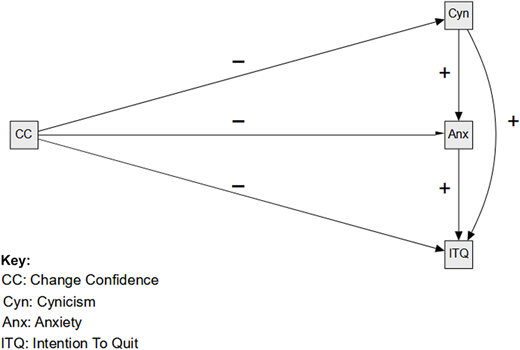
To fully capture the complexity of organizational restructuring, it is not sufficient to examine relationships solely between individual variables. The study's endogenous constructs, CC and Cynicism, are closely interconnected and, in turn, strongly influence outcomes such as Anxiety and ITQ. In addition, prior research shows that CC itself can shape Cynicism (Ferrari, 2023), with higher CC potentially reducing Cynicism and thereby mitigating change-related Anxiety (Reichers et al., 1997; Ferrari, 2023a). Finally, lower Anxiety can then decrease ITQ (Baquero et al., 2025), illustrating the cascading nature of these effects.
The interdependencies highlighted in the literature suggest, in line with systemic–relational perspectives (Donati, 1985; Emirbayer, 1997), the need for an approach that goes beyond testing linear associations between variables. Constructs such as CC, Cynicism and ITQ are not merely individual attributes but emerge from networks of interactions, shared histories and collective identities that shape how change is interpreted and enacted. While SEM is traditionally used to test predefined quantitative relationships, in this study, it offers a valuable means to operationalize and model the interdependencies generated by relational and discursive identity processes. A multi-group SEM framework allows for the simultaneous estimation of direct and indirect effects, as well as comparisons across groups with distinct histories and identities. This methodological choice enables the examination of how historically grounded group identities shape responses to restructuring, though it remains limited in fully capturing the fluid and processual nature of identity work.
Figure 1 summarizes the theoretical model explored in this study.
Moderating factors
Individual differences theory (e.g. Kunze et al., 2013) suggests that everyday routine seeking, cognitive rigidity and emotional aversion to change should be more pronounced for staff members who are long-tenured; therefore, results of the empirical exploration of the theoretical model should be controlled for tenure.
Furthermore, previous empirical evidence argues that due to differing cognitive structures, individuals react differently to the same change message (Armenakis and Harris, 2009). Hence, findings should also be controlled for age and gender.
Finally, Previous Change History (PCH) should be included as a control variable in studies on organizational change because it significantly influences employees' attitudes, perceptions and responses to new change initiatives. According to Bordia et al. (2011), past experiences with organizational change create a psychological framework through which employees evaluate subsequent changes.
Research design
The research setting
This study investigates a restructuring process within the Cardio-Chest-Vascular Department at a University Clinic in northern Italy. In August 2023, three formerly autonomous operational units were merged into a single department, resulting in the emergence of three distinct employee groups. This case was deliberately selected because it represents a prototypical pattern of restructuring in European socio-healthcare organizations, which constitute the backbone of universalistic healthcare systems. Such organizations are often under intense pressure to simultaneously achieve efficiency and effectiveness due to increasingly constrained budgets and the growing expectations of multiple stakeholders (Barkema et al., 2002; Dess and Picken, 2000). These pressures frequently lead to mergers of clinical units and service integration initiatives aimed at improving coordination, resource allocation and performance standards (Gunnigle et al., 2013; Shook and Roth, 2011). However, the outcomes of such initiatives are often disappointing, with hoped-for synergies not fully realized (Karamustafa-Köse et al., 2022). In line with Yin's (2018) methodological logic of analytical generalization, this context can therefore be considered a theoretically informative typical case for examining identity-based reactions to restructuring in public healthcare settings. In healthcare organizations, restructuring often unfolds alongside broader transformation efforts aimed at improving service quality and managerial performance, frequently supported by technological change (Dahlia et al., 2025). Against this backdrop, understanding identity-based readiness mechanisms becomes critical to prevent unintended consequences such as disengagement and turnover.
While organizational restructuring is among the most extensively studied forms of organizational change (Cartwright and Schoenberg, 2006), many factors remain underexplored, particularly from the perspective of change recipients (Oreg et al., 2013). In healthcare specifically, a common yet under-investigated scenario is the merger of pre-existing organizational units to improve efficiency and optimize service delivery. These processes bring together personnel with different professional and organizational histories: in this case, the APG consisted of staff from the original units prior to restructuring, whose identities were closely tied to historical norms and routines, while the NCG comprised professionals hired or transferred during the merger. A Control Group (CG) included employees whose daily activities remained unaffected by the change. While necessarily simplified, this temporal categorization aligns with SIT's logic of identity salience triggered by organizational events, and provides an analytically meaningful way to distinguish groups in a restructuring context.
Drawing on SIT (Ashforth and Mael, 1989; Hogg and Terry, 2000), the distinction between APG and NCG is conceptualized not through tenure alone, but through the temporal relationship to the restructuring event. Since SIT does not prescribe a fixed timeframe for group identity formation, the choice to differentiate groups based on their pre- or post-restructuring entry allows for a context-sensitive classification aligned with organizational identity dynamics.
Four key considerations inform this decision. First, temporal proximity to change matters: APG employees had time to internalize the prior culture, while NCG members entered under different structural and symbolic conditions. Second, historical ties differ: APG members maintain relational and psychological connections to the legacy organization, making them more susceptible to perceiving restructuring as disruptive. NCG members, lacking these attachments, may align more easily with new norms and processes. Third, the practicality of group assignment supports this approach, avoiding arbitrary tenure thresholds while maintaining theoretical consistency. Fourth, and most critically, social identity processes underpin the group differentiation: APG identities are shaped by continuity with the past, whereas NCG identities are more attuned to post-change realities.
By using the restructuring event as a natural boundary, the study captures meaningful differences in identity salience, sense of belonging, and reactions to change across groups. As single-case studies enable in-depth exploration of change within revelatory settings (Pettigrew, 1990; Yin, 2009), this research applies a quantitative case study design to test hypotheses related to group-based identity disruption and adaptability. Although cross-sectional and nonrandomized by nature, such designs are especially suited to organizational change research, allowing for a fine-grained, contextually grounded understanding of how restructuring is differentially experienced across identity groups.
Investigated variables and tools utilized
Exogenous variables
Organizational History: the population was categorized into three groups:
Group A: existing employees operating in the Operational Units involved in the restructuring process (APG), who have undergone a change in their daily activities.
Group B: employees health professionals either newly hired or transferred from other clinics, who have undergone a change in their daily activities (NCG).
Control Group: employees involved in the restructuring but only formally, without any impact on their daily operations (CG).
Endogenous variables
For the purpose of this research, the change confidence subscale from the Italian version (Cronbach's alpha = 0.9123) of the Readiness to Change questionnaire proposed by Holt and colleagues, (2007) was utilized in order to measure the employees' CC level and perceived support level. Examples of items are “When I heard about this change, I thought it suited my skills/attitude perfectly”.
Change Cynicism (Cynicism) is measured with the Italian version of the Wanous et al. (2000) questionnaire (Cronbach's alpha = 0.77). An example of an item is “The people responsible for solving problems around here are overloaded with too many job responsibilities”.
Anxiety level is measured with the Italian version of the Tyrer et al. (1984) short Anxiety scale (Cronbach's alpha = 0.77). An example of an item is “I felt uncomfortably flustered about the new job at hand.”
ITQ: 3 ad-hoc items (Cronbach's alpha = 0.70). Ad hoc items were used to capture context-specific withdrawal intentions during restructuring, reflecting the institutional characteristics of public healthcare employment. An example of an item is “I have seriously considered the idea of requesting a transfer to another department.”
Control variables
Age, Tenure and Gender: each is measured with a single item.
The Previous Change History is measured with the Italian version of the Poor Change History by Bordia et al. (2011), (Cronbach's Alpha = 0.833). An example of an item is “The organizational change was positive.”
Table 1 shows a summary of variables, constructs, measurement tools and sources.
Summary of variables, constructs, measurement tools, and sources
| Variable | Construct definition | Measurement tool | Source |
|---|---|---|---|
| Change Confidence | Perceived self-efficacy and support in managing organizational change | Change Confidence subscale from Italian version of Readiness to Change Questionnaire (Holt et al., 2007) | Holt et al. (2007) |
| Change Cynicism | Pessimism and skepticism toward the success and sincerity of change initiatives | Italian version of Wanous et al. (2000) questionnaire | Wanous et al. (2000) |
| Anxiety | Emotional response to change, reflecting discomfort and distress | Italian version of Tyrer et al. (1984) short anxiety scale | Tyrer et al. (1984) |
| Intention to Quit | Tendency to leave the organization as a response to change | 3 ad-hoc items developed for the study | Ad hoc, Cronbach's Alpha = 0.70 |
| Previous Change History | Employee perceptions of previous organizational changes | Italian version of Poor Change History scale | Bordia et al. (2011) |
| Control Variables | Demographic and organizational tenure indicators | Single-item measures for Age, Tenure and Gender | Standard demographic items |
Data gathering
The data collection took place 1 year into the implementation of the new organizational model, consistently with prior studies on structural change in organizations (e.g. Bordia et al., 2004; Caldwell et al., 2009). This study involved the voluntary and anonymous participation of adult employees in a public healthcare organization. No sensitive personal data or clinical information was collected, and participants were not subjected to any form of manipulation or intervention. In line with institutional and national regulations in Italy, and given the noninvasive, survey-based nature of the research, formal ethical approval was not required.
Data gathering began in September 2023 and was completed in December of the same year. Three hundred and eight questionnaires were distributed to all the employees involved directly or indirectly in the restructuring, and 228 correct questionnaires (Merged Group (93 APG + 60 NCG) = 153; Control Group = 75) were collected, hence the return rate was approximately 74%, a highly valuable one. The nonrespondent bias was assessed by comparing the responses from early and last waves with a t-Test, such as the first and last quarter of responses. No significant difference emerged (p = 0.05). Since data for both endogenous and exogenous variables were collected simultaneously using the same measurement instrument, Harman's one-factor test (Harman, 1976) was conducted. The test results show that a single factor accounts for 28.65% of the variance, which is below the recommended threshold of 50% (Podsakoff and Organ, 1986). This suggests that common method bias is unlikely to contaminate the dataset. A power analysis has been carried out to identify the sample size required in order to detect a given difference in a single mean with specified power (99) and significance (0.05): the sample dimension (n = 228) satisfies these methodological needs.
Findings
Descriptive statistics
From a descriptive point of view, the APG shows the lowest average levels of CC, higher than average levels of ITQ and values in line with the other groups of change-related Anxiety. Table 2 presents the descriptive statistics comparing restructured groups (APG and NCG) with the CG.
Descriptive statistics
| CC | Cynicism | Anxiety | ITQ | |||||||||
|---|---|---|---|---|---|---|---|---|---|---|---|---|
| APG | CG | NCG | APG | CG | NCG | APG | CG | NCG | APG | CG | NCG | |
| Descriptive statistics | ||||||||||||
| Valid | 93 | 75 | 60 | 92 | 75 | 60 | 93 | 75 | 60 | 93 | 75 | 60 |
| Mean | 2.800 | 3.264 | 3.117 | 2.950 | 2.672 | 2.500 | 2.600 | 2.472 | 2.625 | 2.929 | 1.760 | 1.833 |
| Std. Deviation | 0.369 | 0.286 | 0.412 | 0.626 | 0.602 | 0.560 | 0.699 | 0.391 | 0.287 | 1.552 | 0.956 | 1.159 |
Note(s): APG = Already Present Group; CG = Control Group; NCG = Newcomers Group CC = Change Confidence
ITQ = Intention to Quit
Hypotheses testing
A series of ANOVA post-hoc tests was conducted to verify the significance of the difference between the means, considering the control variables. CH does not show significant differences between the groups considered (F(2, 228) = 1.741; p = 0.179). There were significant differences between groups in ITQ levels (F(2, 228) = 14.076, p < 0.001), where APG showed the highest level. The differences among groups in the levels of Anxiety were not significant (F(2, 228) = 1.657, p = 0.0194), but females showed a higher level of Anxiety (F(1, 227) = 13.052, p < 0.001) than males. The tenure is associated only with Anxiety levels, which have the highest values in the 6–10 ys range. (F(3, 227) = 4.766, p = 0.003). The APG group, compared to the other groups, has lower levels of CC (F(2, 228) = 24.796, p < 0.001) and higher levels of Cynicism (F(2, 228) = 5.725, p = 0.004). In summary, the APG group shows significantly higher levels of ITQ and Cynicism; it also features lower levels of CC. Therefore, H1 is supported; H2 is supported; H3 is supported; H4 is supported.
SEM analysis
To capture heterogeneity across groups and the complexity of relationships among the hypothesized variables, the hypotheses were tested using SEM. SEM is particularly appropriate because the analysis focuses not only on estimating direct effects, but on testing a mediating mechanism – CC – and its group-contingent functioning through the simultaneous estimation of interdependent paths across the APG, NCG and CG. This approach enables direct comparison of structural relationships across groups, allowing the identification of both shared patterns and meaningful differences in how identity-based mechanisms operate during restructuring.
APG model shows a good fit (AIC = 592.053; BIC = 622.444 with n = 93), confirmed by additional fit measures: Comparative Fit Index (CFI) = 1.000; Tucker–Lewis Index (TLI) = 1.000; Root mean square error of approximation (RMSEA) = 0.000; Standardized root mean square residual is close to zero (SRMR = 5.267 × 10⁻⁴). R2 ITQ = 0.447; R2 Anxiety = 0.171; R2 Cynicism = 0.109.
NPG model shows a good fit (AIC = 255.036; BIC = 280.168 with n = 60), confirmed by additional fit measures: Comparative Fit Index (CFI) = 1.000; Tucker–Lewis Index (TLI) = 1.093; Root mean square error of approximation (RMSEA) = 0.000; Standardized root mean square residual is close to zero (SRMR = 1.939 × 10⁻¹⁴). R2 ITQ = 0.723; R2 Anxiety = 0.043; R2 Cynicism = 0.151.
CG model shows a good fit (AIC = 319.571; BIC = 347.381 with n = 75), confirmed by additional fit measures: Comparative Fit Index (CFI) = 1.000; Tucker–Lewis Index (TLI) = 1.000; Root mean square error of approximation (RMSEA) = 0.000; Standardized root mean square residual is close to zero (SRMR = 1.633 × 10⁻¹⁴). R2 ITQ = 0.522; R2 Anxiety = 0.407; R2 Cynicism = 0.252.
CC has a negative impact on Anxiety, but not in the NCG group. Cynicism has a negative impact on Anxiety in the CG but not in the APG and NCG. In the CG, the CC shows a positive impact on the ITQ (0.819, p = 0.006), unlike in the APG and NCG groups, where it has a negative impact. Cynicism positively impacts ITQ in all groups. Moreover, in all groups, Anxiety positively impacts ITQ, albeit to a lesser extent in APG. Finally, in all groups, CC impacts ITQ negatively.
Table 3 shows a synopsis of the estimates parameters.
Synopsis of the estimates parameters
| Predictor | Outcome | APG | NCG | CG |
|---|---|---|---|---|
| CC | Anxiety | −0.580*** | −0.168 | −0.611*** |
| Cynicism | Anxiety | −0.002 | 0.014 | 0.184** |
| CC | ITQ | −0.710** | −0.752** | 0.912** |
| Cynicism | ITQ | 0.695* | 1.121*** | 0.383* |
| Anxiety | ITQ | 0.836*** | 1.898*** | 1.746*** |
| CC | Cynicism | −0.524*** | −0.655*** | −1.058*** |
Note(s): *p < 0.05, **p < 0.01, ***p < 0.001
CC = Change Confidence; Cynicism = Cynicism/Pessimism; Anxiety = Change-related Anxiety; ITQ = Intention to Quit
Findings suggest that the APG group in general is the most vulnerable in the case of organizational restructuring: it shows the highest levels of ITQ and Cynicism, and the lowest levels of CC. Conversely, the NCG group exhibits levels of change Cynicism, ITQ and CC analogous to CG. Finally, in the NCG, unlike the rest of the sample, there is no significant relationship between CC levels and Anxiety reduction. These results, slightly divergent from those suggested by the available literature, will be discussed in the next section.
Discussion
Discussion of findings in relation to the literature
The findings of this study offer a nuanced understanding of how group identity shapes employees' interpretations of organizational restructuring. Given the societal role of healthcare organizations, these identity-driven reactions to restructuring have implications that reach beyond the workplace, potentially affecting continuity of care and system-level performance.
The support for H1 suggests that identity continuity, rather than identity strength alone, plays a central role in shaping how organizational change is appraised. Members of the APG, whose sense of belonging was deeply anchored in the pre-change organization, tended to interpret restructuring as a disruption to established norms and meanings. This pattern is consistent with Fugate's (2013) emphasis on the role of contextual and historical factors in shaping change responses, as well as with SIT's claim that identity stability provides an important basis for navigating uncertainty. At the same time, the findings indicate that when identity continuity is perceived as threatened, reactions such as reduced CC and heightened concern are more likely to emerge, rather than being automatic consequences of identity strength per se.
The results also point to the socially embedded nature of CC. Rather than operating solely as an individual cognitive resource, CC appears to be shaped through shared experiences, mutual recognition and collective expectations, in line with relational accounts of meaning-making (Donati, 1985; Emirbayer, 1997). For APG members, the erosion of these relational anchors during restructuring was associated with lower CC. However, when CC is sustained, it tends to coincide with stronger commitment and lower ITQ, echoing prior evidence on the protective role of efficacy and perceived support (Niu, 2010; Klassen and Chiu, 2011; Akhtar et al., 2013; Chesnut and Burley, 2015), while leaving open questions about the conditions under which such protection can be maintained.
Support for H2 further illustrates the contingent nature of identity-based responses during change. The significantly higher levels of Cynicism observed among APG members suggest that Cynicism cannot be reduced to a stable dispositional trait, but is shaped by contextual and historical factors associated with perceived identity threat (Choi, 2011; Wanous et al., 2000). At the same time, the finding that Cynicism is associated with Anxiety only within the CG complicates a uniform interpretation of Cynicism as either inherently dysfunctional or uniformly protective. This pattern aligns with the literature's ambivalent view of Cynicism as both a pessimistic orientation that can undermine confidence (Thundiyil et al., 2015) and a defensive response that may help preserve group coherence when identity continuity is challenged (Ferrari, 2021, 2023a). Rather than exerting consistent effects across contexts, Cynicism appears to operate differently depending on group positioning and identity stability, highlighting the need to interpret cynical reactions to change as situational and relational rather than universally maladaptive.
H3 is supported, albeit in a nuanced way. Consistent with the identity-based framework developed in the theoretical background, CC reduced Anxiety only among members of the APG, while no comparable effect emerged for the NCG. This finding reinforces the view of CC as a socially embedded resource rather than a purely individual appraisal. When confidence is anchored in a shared organizational history and a cohesive group identity, as in the APG, it can provide meaning, continuity, and emotional stability during restructuring, in line with SIT and Bandura's (1986) emphasis on the social foundations of efficacy.
At the same time, the absence of significant differences in overall Anxiety levels across groups complicates a straightforward identity-threat interpretation. Rather than translating directly into heightened Anxiety, identity disruption appears to operate more indirectly, shaping how effectively confidence-based resources can be mobilized. This pattern suggests that identity influences emotional responses to change less through uniform affective reactions and more through mediating mechanisms such as CC. In this sense, the findings extend prior work on socially embedded Anxiety (Kiefer, 2002; Sverdlik and Oreg, 2023) by showing that identity does not necessarily amplify Anxiety per se, but conditions the pathways through which employees cope with uncertainty during restructuring.
Finally, the confirmation of H4 highlights the identity-driven nature of ITQ. APG members reported significantly higher ITQ than both NCG and the CG. This finding is consistent with research showing that ITQ may reflect symbolic withdrawal when individuals experience a rupture in their narrative continuity (Elstak et al., 2015; Raeder, 2023). Quitting, in this sense, becomes a form of identity preservation rather than simply dissatisfaction. Newcomers, whose identity is not rooted in the pre-change environment, do not display this reaction, aligning with theories of flexible identity construction during socialization (Van Maanen and Schein, 1979; Bauer et al., 2007).
Taken together, these findings invite a move beyond an exclusively individualistic reading of change responses, while also cautioning against overly deterministic identity-based interpretations. The results suggest that group identities and organizational histories shape how restructuring is interpreted, how emotions are regulated, and how behavioral intentions develop, but they do so in indirect and contingent ways. The multigroup SEM analysis indicates that constructs such as CC, Cynicism, Anxiety and ITQ do not simply reflect stable individual dispositions, but emerge from relational processes, shared expectations, and collective sensemaking (Bouckenooghe et al., 2023). At the same time, the uneven and sometimes indirect effects observed across groups highlight that identity-based mechanisms do not operate uniformly, and that their influence may depend on mediating resources and contextual conditions.
In this sense, the findings respond to calls for more explicitly multilevel approaches to organizational change (Rafferty et al., 2013; By et al., 2018), while also extending them by showing that structural change does not translate mechanically into emotional or behavioral outcomes. Rather, restructuring intersects with the symbolic and relational worlds of organizational groups in contingent ways that can both enable and constrain adaptation. This highlights the importance of theories of change that account not only for identity and organizational history, but also for the mediated and conditional pathways through which these factors shape employees' responses. Consistent with recent recipient-centered reviews, the results support an interpretation of change responses as embedded in relational and temporal conditions rather than as purely individual reactions, while also drawing attention to the limits of cross-sectional designs in capturing the underlying processual dynamics (Oreg et al., 2013; Oreg and Sverdlik, 2026; Teerikangas et al., 2026).
Theoretical contributions
Beyond hypothesis testing, this study provides broader scenario-level insights into how groups with unique organizational histories respond to restructuring. While past research has primarily focused on individual-level experiences (Rafferty and Restubog, 2010), this study responds to calls for a multilevel approach (Rafferty et al., 2013), incorporating both individual and collective levels of analysis. It also addresses the neglected issue of intra-organizational diversity during change processes (By et al., 2018; Kuipers et al., 2014). The use of SEM demonstrates how intertwined group identities, shared histories and relational dynamics shape reactions to restructuring, particularly through constructs like CC and Cynicism. As Bouckenooghe et al. (2023) emphasize, focusing solely on individual-level change responses risks overlooking the emergent, collective nature of reactions rooted in shared identity, emotional contagion and group dynamics. The multilevel framework adopted here shows that responses such as ITQ and Anxiety are influenced not only by individual traits or leadership but also by the socio-historical context of group identity and belongingness. this framework captures the interplay between agency (employees' active sensemaking and negotiated responses) and structure (group identity and organizational history), showing how employees, through their social identities, actively shape their experiences of restructuring rather than simply reacting to it.
Overall, this study extends SIT to the context of internal restructuring, emphasizing the central role of group identity in shaping heterogeneous responses to the same structural event. It demonstrates that historical attachments and identity formations influence how employees interpret and react to change, underscoring the value of a multilevel perspective. By adopting a relational and discursive lens, identity is framed as interactional and co-constructed (Langley, 1999; Fachin and Langley, 2023), with restructuring understood as a process negotiated through shared meanings and practices. These processual insights are translated into a quantitative design through a multi-group SEM framework. While SEM is typically used to test predefined relationships, the findings show its suitability for capturing outcomes of relational and discursive identity work, such as CC, Cynicism and ITQ, across distinct groups. Although it cannot replicate the fluidity of qualitative approaches, SEM offers a complementary means to operationalize and compare identity-driven responses in restructuring contexts.
The study's contributions are threefold: extending SIT to internal restructuring, operationalizing relational and discursive identity dynamics in a quantitative framework, and reframing CC as a socially embedded, identity-driven construct. Together, these insights enhance SIT's applicability and inform more identity-sensitive change management practices.
Conclusion
This study highlights the importance of group identity in shaping employees' responses to organizational restructuring, drawing on SIT to interpret patterned differences across groups (Lupina-Wegener et al., 2023). Among the groups examined, the APG, characterized by a shared organizational history, exhibited higher levels of ITQ and Cynicism, along with lower levels of CC, compared to the other groups. These patterns suggest that historically grounded attachments and perceived disruptions to belonging are associated with heightened perceptions of threat during restructuring. In contrast, the NCG, whose identity was less tied to the pre-change organization, showed levels of CC, ITQ and Cynicism comparable to those of the CG. Notably, CC displayed a protective association with Anxiety only within the APG, indicating that the Anxiety-buffering role of confidence may depend on the presence of a deeply embedded group identity.
These findings speak to longstanding critiques of the organizational change literature, which has often emphasized strategic intent and leadership agency while devoting less attention to the identity-based experiences of change recipients (Oreg et al., 2013, Ferrari, 2023b; Pettigrew et al., 2001). Rather than directly observing identity negotiation processes, the study provides empirical evidence of group-contingent associations that are consistent with a relational and symbolic interpretation of change. In this sense, the results extend the application of SIT to restructuring contexts by illustrating how collective history and group positioning are linked to differential emotional and behavioral outcomes, adding nuance to existing debates on resistance, emotion and identity in organizational change (Thompson et al., 2021; Ferrari, 2023a).
Finally, the study integrates insights from SIT, social exchange theory (Kurtessis et al., 2017), and readiness-to-change frameworks to show how identity and relational history jointly condition responses to restructuring. While the cross-sectional design limits causal and processual inferences, the observed patterns highlight the potential consequences of neglecting identity dynamics in public service organizations. In healthcare settings, where efficiency-driven reforms are increasingly common, overlooking group identity and belonging may contribute to disengagement and turnover, with implications for staff stability, service continuity and institutional resilience. From this perspective, the findings suggest that historically and identity-sensitive change strategies are not only relevant for organizational effectiveness, but also for sustaining the public value of healthcare systems.
Theoretical contributions and implications for future research
The contribution of this study is threefold and rests on a specific form of innovation: it introduces an identity-contingent view of readiness mechanisms, tests it configurationally across historically distinct groups and does so in a sector where restructuring has high public value implications.
This study contributes to organizational change theory by emphasizing the need to move beyond individual-centric models and adopt a multilevel perspective on restructuring processes (By et al., 2018; Rafferty et al., 2013). It shows that change recipients' reactions are not homogenous but are shaped by group-specific histories and identities. In doing so, it supports calls for greater attention to the valorization of group differences in shaping behavioral responses to organizational transformation (Oreg et al., 2013, Ferrari, 2023b; Vakola, 2016).
Theoretically, this study advances SIT as a framework for explaining how organizational history shapes group-based reactions to change. By adopting a relational and discursive perspective (Langley, 1999; Fachin and Langley, 2023), identity is conceptualized as an interactional and co-constructed process through which restructuring disrupts or enables ongoing identity work and collective meaning-making. Comparing groups with different temporal and symbolic ties to the organization, the findings show how identity-based processes shape outcomes such as CC, Cynicism and ITQ. This perspective is further enriched through dialogue with social exchange theory (Eisenberger et al., 1990) and readiness-to-change frameworks (Holt et al., 2007), offering an integrated view of how relational, psychological and structural elements interact during organizational change. By focusing on identity-contingent confidence mechanisms, the study complements recent research on identity and transformation (Hein-Pensel, 2026) and on psychosocial predictors of readiness (Singh et al., 2025), extending these debates to intra-organizational group dynamics in healthcare contexts.
Methodologically, the use of SEM allows the estimation of interdependent and mediated relationships between variables, showing how constructs conceptually informed by relational and discursive perspectives can be examined within a quantitative framework. Accordingly, the contribution of the study does not lie in the method per se, but in its use to test identity-contingent mechanisms of change readiness within a single restructuring context.
Finally, the study points to promising future directions, including exploring trust (Mishra and Spreitzer, 1998), psychological capital (Avey et al., 2009) and perceptions of organizational justice (Oreg and van Dam, 2009) as critical forces in shaping fair, inclusive and identity-sensitive restructuring practices.
Implication for practice.
Building directly on the empirical findings, this study shows that organizational restructuring is a complex process that generates heterogeneous responses across employee groups with different organizational histories. In public healthcare settings, these dynamics have broader societal implications, as restructuring-related turnover and disengagement can disrupt continuity of care, exacerbate workforce shortages, and ultimately affect service quality. The findings therefore suggest that mitigating identity threats is not only critical for organizational effectiveness, but also for sustaining the resilience and public value of healthcare systems.
The results indicate that employees' reactions to restructuring are shaped by identity-contingent mechanisms rather than by uniform individual dispositions. In particular, the finding that CC buffers negative outcomes only among historically embedded employees highlights the need for identity-sensitive change management practices. Managers should avoid standardized communication and support strategies and instead tailor interventions to employees' organizational histories, for example by explicitly acknowledging legacy roles, addressing concerns about continuity and reinforcing group-based sources of confidence where identity disruption is most salient.
The group-specific pathways identified through the SEM analysis further suggest that managerial interventions should be designed with a clear understanding of which mechanisms operate for which groups. For instance, communication strategies can be personalized to reflect the symbolic meaning of change for different subgroups, while engagement initiatives can be selectively activated to foster appropriate forms of commitment rather than assuming that the same practices will be effective across all employees.
Finally, the findings caution against linear and one-size-fits-all models of change intervention. Relationships often assumed to be straightforward, such as those between managerial support and Anxiety or between CC and ITQ, were shown to vary depending on employees' historical embeddedness. This variability underscores the importance of adopting a systemic and context-sensitive approach to change management, in which interventions are continuously adjusted in light of group-specific identity dynamics rather than applied uniformly.
Limitations
This article highlights several limitations alongside its contributions. First, the research does not track changes in employee reactions over time, limiting the ability to capture how cognitive, emotional and behavioral responses evolve post-restructuring. Longitudinal studies are needed to test whether the relationships observed here hold in the medium to long term and to explore whether personal characteristics moderate these dynamics over time.
Second, while the use of SEM allowed for the identification of reciprocal and indirect relationships between variables, this methodology has inherent limitations. Specifically, it may overlook other relevant endogenous variables, and the fixed exogenous variable of organizational history reflects a deliberate design choice that excludes other contextual factors. Moreover, although SEM proved suitable for operationalizing outcomes of relational and discursive identity work, it inevitably simplifies the inherently fluid and evolving nature of identity processes. Future research could integrate SEM with qualitative, process-oriented methods to better capture the temporal, interactional and emergent aspects of restructuring dynamics.
Third, this research is based on a single-case study conducted in a public university hospital. While this design enabled a deep and contextually rich exploration of a prototypical restructuring process, it inevitably limits the generalizability of the findings. Single-case studies cannot fully capture the variability of restructuring experiences across different organizational contexts or national healthcare systems. Future research would benefit from multi-case or cross-sectoral comparative designs to examine whether similar identity-driven dynamics emerge in diverse restructuring scenarios. In addition, the use of ad hoc items for ITQ limits comparability with studies employing standardized turnover intention scales. Replicating these findings using validated multi-item instruments or longitudinal designs could help assess actual mobility outcomes in public healthcare contexts.
A further limitation concerns the binary distinction between the APG and the NCG. While this classification captures temporal proximity to the restructuring event and is theoretically consistent with SIT's emphasis on identity continuity and disruption, it inevitably simplifies identity dynamics that may, in practice, be more nuanced or overlapping. Hybrid or evolving identifications, especially in professionalized healthcare settings, may not be fully captured by this dichotomy. Future research could therefore adopt more granular or longitudinal approaches to explore shifting identity configurations across time and contexts.
In addition, although the sample size is relatively large, it reflects the actual organizational population involved in the restructuring process. While this reduces sampling bias, it may increase the risk of overfitting in complex models. Future studies could therefore test the robustness of these findings in smaller or differently composed samples and across multiple organizational settings. Furthermore, as the data are cross-sectional, processual and discursive dynamics are inferred from observed patterns rather than directly observed, and should be examined through longitudinal or qualitative research designs.
Finally, this study was conducted in a public organization, which may have unique characteristics influencing group history and change reactions. The generalizability of the findings is limited, and further research in different sectors would be valuable.

