
Skip to article sections
Purpose

Literature is abundant in identifying challenges related to multi-actor and cross-sector collaboration needed in circular economy transitions. This conceptual paper applies theoretical perspectives from the Industrial Marketing and Purchasing literature (IMP) to better understand these challenges and the underlying mechanisms of network change. Specifically, we examine the theoretical constructs of adaptations, interconnectedness, and embeddedness to provide insights into network change in the circular economy transition. This approach thus takes the behavioral instead of technical approach to CE.

Design/methodology/approach

The paper is a conceptual study in which existing literature on CE is enriched by employing knowledge from the literature on business relationships and industrial networks. The present study seeks to develop a model by using the IMP theories as method theories to increase understanding of CE transitions.

Findings

We develop a set of fundamental premises that reconcile the gaps in the CE literature and provide guidance for facilitating network change in CE transitions. Finally, we develop a theoretical model of network change in CE transitions, including solutions to address the identified challenges.

Originality/value

The findings of the present study offer a contribution to the existing literature on CE transition, especially the theoretical discussion related to CE challenges. The paper conceptually advances the literature on CE transition by proposing three premises depicting the network change mechanisms toward CE.

The circular economy (CE) is central in advancing sustainable development and securing the future of the planet. It aims to reshape production, distribution, and consumption processes to prioritize reducing, reusing, recycling and recovering materials, thereby extracting greater value from resources (Kirchherr et al., 2018). The responsibility of transitioning toward a CE primarily lies with businesses, regulators and policymakers, as it requires rethinking and redesigning production and consumption (Geissdoerfer et al., 2017; Kirchherr et al., 2018). Lately, consumers and scholars have also been considered as important enablers of CE transitions (Kirchherr et al., 2023).

Existing CE literature highlights that collaboration across supply chains and industries is essential for implementing circular solutions (e.g. Kanda et al., 2021; Cantu and Tunisini, 2023; Kanda, 2023) and that transitioning to a CE requires simultaneous network changes (e.g. Schultz et al., 2024). These can range from individual behavioral changes (e.g. Khan and Soomro, 2025; Musova et al., 2025), to organizational behavior (e.g. Bertassini et al., 2021), to systemic solutions that involve multiple, networked organizations (Harrison et al., 2023a, b). This is challenging because it necessitates developing new resource combinations, reorganizing activities among actors and collaborating with new partners to explore and implement various types of adaptations (Dubois et al., 2023). These activities may depend on organizational behavior, as well as conflict with existing network structures, regulatory frameworks and market mechanisms. Therefore, to better understand and mitigate the challenges of CE, we focus on the network change in CE transitions.

This conceptual paper aims to advance the understanding of CE transitions by enriching existing literature (Dzhengiz et al., 2023; Grafström and Aasma, 2021; Toth-Peter et al., 2023) with insights from the Industrial Marketing and Purchasing (IMP) research tradition (Håkansson and Snehota, 1995). Specifically, it draws on IMP research on interorganizational relationships and industrial networks, which offers a valuable framework for examining the dynamics of interaction (i.e. organizational behavior) among actors and groups of actors, as well as processes of network change within business contexts (Håkansson and Gadde, 2018). Since the 1970s, IMP research has focused on uncovering the underlying processes of interaction between organizations within industrial networks rather than offering prescriptive managerial tools such as checklists or decision rules (Baraldi et al., 2007). IMP research focuses on business exchange as embedded in long-term relationships between buyers and sellers, characterized by complex patterns of interaction, mutual adaptation and interdependence (Håkansson, 1982). These relationships are not simply transactional but involve actors engaging in various activities to transform and combine resources in ways that support shared goals (Ritter and Gemünden, 2003).

The IMP view emphasizes that the actors are not abstract organizational units but are constituted by individuals within firms. A foundational assumption in IMP research is that companies are purposive actors, that is, entities that act with intent based on goals that are shared, interpreted and pursued by individuals within them (Håkansson and Snehota, 1995). These individuals play an important role in shaping the behavior of the organization through their decisions, interactions and adaptations, ultimately contributing to the formation and evolution of interconnected business network structures.

Three central constructs from the IMP research tradition are used to examine network change in CE transitions. Adaptations refer to the behavioral modifications that organizations make at the individual, group or corporate level to meet the needs of another organization (Hagberg-Andersson, 2006; Vellesalu et al., 2025). Interconnectedness describes how firms are dependent on each other’s resources, creating interdependence through inter-organizational relationships (Ritter, 2000; Keränen et al., 2021). Embeddedness refers to firms’ relationships with, and dependence on, various types of networks, as well as how firms (or sets of firms) are connected to different network structures (Halinen and Törnroos, 1998; Brüel Grönberg and Hulthén, 2022). Consequently, we ask: How can the constructs of adaptations, interconnectedness, and embeddedness explain network change in CE transitions and how can these constructs help to overcome the challenges?

In terms of methodology, the present study seeks to develop a model by using the IMP theories as method theories to increase our understanding of CE transitions. Jaakkola (2020) suggests that such modeling enables explaining a sequence of events and how they lead to a certain kind of result, such as the importance of network change in CE transitions. The paper is structured in the following way: we first review the CE transitions literature to identify network-related challenges. We then discuss the central constructs of adaptations, interconnectedness, and embeddedness derived from the IMP literature. Further, we develop a set of fundamental premises that reconcile the gaps in the CE literature and provide guidance for facilitating network change in CE transitions. We also discuss practical examples, based on existing literature, to illustrate the role of the three analyzed constructs in practice in CE transitions. Finally, we develop a theoretical model of network change in CE transitions, including solutions to address the identified challenges.

Challenges related to implementation of a CE have been widely discussed in the literature (for reviews, see, e.g. Dzhengiz et al., 2023; Grafström and Aasma, 2021; Toth-Peter et al., 2023). Literature is rich in identifying and categorizing different challenges, barriers and obstacles prohibiting the transition toward CE. For example, Kirchherr et al. (2018) categorize CE barriers into cultural, regulatory, market and technological barriers. However, most existing studies that discuss CE challenges take the focal firm perspective, without considering the complexity added by the relationship and network levels (Fraccascia et al., 2019). More recent research (e.g. Siemieniako et al., 2022) has highlighted the importance of broader perspectives when studying circularity and sustainability endeavors in business markets, like collaboration in relationships and networks, where the integration of CE strategies transcends the business boundaries.

Transitions to circular systems have been highlighted as involving network-type collaboration among various actors and organizations (Keränen et al., 2021; Dzhengiz et al., 2023; Toth-Peter et al., 2023). According to Korhonen et al. (2018), CE necessitates interorganizational sustainability management from the network members and it challenges the whole network in terms of leadership, responsibilities, risks, and sharing of potential gains and losses. Such a holistic multi-actor perspective is needed as the circular flows of materials tend to cross organizational, administrative and geographical boundaries (Korhonen et al., 2018). Accordingly, firms need to change from being firm-centric and become network-centric (Khan et al., 2022). However, weak cooperation throughout the supply-chain has been noted as a key challenge in CE (Grafström and Aasma, 2021). A few studies (e.g. Dzhengiz et al., 2023; Toth-Peter et al., 2023) have highlighted that CE implementations are challenging because of this necessity of multi-actor collaboration, where different stakeholders may have different interests, expectations, aims and worldviews, potentially resulting in conflicts in the division of costs and benefits related to collaboration in the network at micro, meso and macro levels (Khan et al., 2022).

CE often transcends beyond the traditional network of suppliers and customers and requires new actors handling the new activities related to the circulated resources (Schultz et al., 2024). These activities cut across previously disparate industries and sectors (Ghisellini et al., 2016) and include different types of actors than in regular innovation networks, including universities, policymakers, governance institutions and regulatory bodies (Melander and Pazirandeh, 2019; Melander and Arvidsson, 2022; Kanda et al., 2021; Moggi and Dameri, 2021; Harrison et al., 2023a, b).In the literature, these new actors and their tasks and roles in CE systems have been examined, for example, from the perspective of entrepreneurship and start-ups, who may act as powerful engines for innovation processes needed to support the CE transition (Van Opstal and Borms, 2023), but who tend to face the challenge of not developing the viability of the business model and building up the needed collaboration networks and their position in it (Melander and Lind, 2022). On the other hand, as the nature and perception of the circulated materials as waste and a critical raw material has been challenging from legislative and from cultural and social perspectives (De Jesus and Mendonça, 2018; Korhonen et al., 2018), the waste-creating firms can be reluctant in entering a CE business, without a clear business model and supporting networks. Khan et al. (2022) further identify operational barriers to CE that relate to the lack of infrastructure to close the loop, whereas Grafström and Aasma (2021) suggested that the systems for collecting and handling the waste can insufficiently impact the quality of the materials, resulting in supply of the materials being nonexistent. Thus, developing and implementing CE activities does not take place in isolation, but requires collaboration with both existing and new supply chain partners as well as societal actors.

The mobilization and integration of new actors, resources, and activities required to join original value chains typically necessitates and results in restructuring or even dismantling the existing industry structures, practices and relationships (Harrison et al., 2023a, b; Toth-Peter et al., 2023). According to Keränen et al. (2021), changes in networks, when transitioning toward circularity, take place at firm, network, and macro levels, and are highly interconnected, creating a chain of changes. However, this is problematic as Khan et al. (2022) highlight that structural barriers such as unclear distribution of responsibility and changes in supply chains may cause changes that actors experience as disruptions in the normal business making. Indeed, clarifying the roles and responsibilities as well as risks, resources and control mechanisms within the CE system may result in restructuring of the existing systems (Korhonen et al., 2018). Furthermore, changes to existing industry structures and regimes might be highly challenging because of the resource-intensive infrastructures, causing lock-in and path dependence that can create resistance within the network (De Jesus and Mendonça, 2018; Korhonen et al., 2018). On the other hand, technical solutions for CE can have limited practical application due to economic and market limitations, resulting in tensions in terms of the change (De Jesus and Mendonça, 2018). In sum, we identify three network-related challenges that relate to the way different actors collaborate and work toward CE transitions: 1) holistic multi-actor collaborations, 2) need for new actors, resources and activities, and 3) restructuring of existing networks (see Table 1). Challenges related to holistic multi-actor collaborations refer to the way activities in CE transition are not conducted by a single actor, but activities are required from a multitude of stakeholders across sectors and industries. Challenges associated with the need for new actors, resources and activities reflect the emergence of new roles and tasks in CE systems that are not handled by any of the existing actors in the industry but necessitate new business or even entrepreneurship. Challenges connected to restructuring existing networks depict the confrontation between the existing, established industry structures, regimes and market mechanisms and the state-of-affairs for the sought-after CE transition, reflecting the changes required at the systemic level.

To understand the network-related challenges of CE transitions, we now introduce the theoretical premises of the three IMP constructs and elaborate their connection to CE transitions.

3.1.1 Theoretical premises of adaptations

Different research streams have referred to the need for modifications at the company level in relation to adapting to the external environment. In microeconomics, Alchian (1950) described adaptation as organizations making modifications to the conditions of their environment. While Alchian described that some organizations are successful due to luck, he emphasized the importance of conscious adaptations to specific environmental conditions as a key to success. In organization theory, companies can differentiate by adapting their internal structure to the environment, or to conditions determined by the market (Von Corswant, 2005). Moreover, it was argued that adapting to rapid changes in the business environment can be better dealt with by choosing “to buy” rather than “to make.” That is, companies can focus their resources on adapting to changes in the environment, while the independent suppliers are better able to develop the required production technologies and transportation systems (Gadde et al., 2010).

The IMP research stream argues that adapting to suppliers or customers is as important as adapting to the business environment (Brennan et al., 2003; Mouzas, 2024). Adaptations, as described in IMP, refer to a component of interaction between companies (Johanson and Mattsson, 1987), besides simple resource exchanges (Håkansson, 1982). Adaptations take place between two actors (e.g. a supplier and a buyer), when they make modifications to achieve economically beneficial solutions for both sides. Adaptations may be a result of purposeful transformations in the way actors control activities and resources and the way actors combine and recombine activities and resources (Mouzas, 2024). For example, Håkansson (1982) exemplified both suppliers and customers adapting product specifications, product design, manufacturing processes, planning, delivery procedures, stockholding, administrative procedures, and financial procedures. Therefore, adaptations as defined in the IMP research can be technical, organizational and knowledge-based, and have consequences beyond the directly involved actors (Håkansson, 1982).

Adaptations can be made at individual, group or organizational levels (Hagberg-Andersson, 2006). For example, formal adaptations take place at organizational levels, since such modifications can be a response to technology, market or industry norms (Brennan and Turnbull, 1999), and relate to contractual or regulatory requirements. Informal adaptations go beyond formal adaptations and are seen as more important for demonstrating commitment in a business relationship (Brennan and Turnbull, 1999; Hagberg-Andersson, 2006), for example by adapting to the cultural traditions of a partner (Brennan and Turnbull, 1995). Nevertheless, adaptations are a prerequisite for further developing and continuing long-term business relationships (Hallén et al., 1991). However, too much adaptation may result in too strong a dependence on the relationship (Hagberg-Andersson, 2006).

Adaptations can be categorized into “hard” and “soft” adaptations. Hard adaptations relate mainly to changes to products and production facilities. For example, resource efficiency can be improved if production facilities are adapted to each other, or when the material flow between production facilities is improved (Von Corswant, 2005). Soft adaptations relate to human behavior (Schmidt et al., 2007), such as the previously named administrative and knowledge-based modifications (Gadde and Håkansson, 1993). For example, changes to personnel and organization structure may be more informal and therefore motivated by showing higher levels of commitment and trust. Managers often disregard the importance of soft adaptations and instead focus on products and production processes only. Therefore, it may be more beneficial to see both hard and soft adaptations as important for developing relationships, as it may contribute to competitive advantage (Schmidt et al., 2007).

3.1.2 Connecting adaptations to CE transitions

Challenges related to the necessary restructuring of existing network structures can be better understood through the concept of adaptations. As previously described, IMP argues for the importance of adapting to one’s counterparts in business relationships (Brennan et al., 2003). In contrast to making modifications based on changes in the broader business environment, focusing on dyadic adaptations first enables companies to better coordinate their activities (Håkansson and Snehota, 1995). This dyadic perspective is important, since the willingness to adapt facilitates coordination between two companies (Brennan et al., 2003) and can lead to improved collaboration and innovation (Choi and Hara, 2018). While mutual adaptations between suppliers and buyers occur frequently in long-term business relationships (Brennan et al., 2003), those that oppose changes can constrain further developments and collaboration (Håkansson, 1990).

In relation to restructuring existing network structures to enable the transition to CE, the focus is often on “hard” adaptations. That is, products and production processes can be modified to enable more efficient resource utilization or more efficient flow of materials (e.g. Sabatini et al., 2021; Melander and Lind, 2022; Vellesalu et al., 2025). However, making changes of this kind has been described to be challenging due to power imbalances and supply chain position of the focal company (Franco, 2017), fragmented supply chains (Adams et al., 2017) and rigidity of business routines (De Jesus and Mendonça, 2018). Regardless of previous research identifying such challenges, these often focus on the firm-level perspective and overlook the importance of “soft” adaptations. We argue that more focus should be given to behavioral changes on individual and organizational levels, specifically based on the unique conditions of each business relationship (Gadde et al., 2010). Thus, a business relationship perspective to adaptations may serve as a starting point for restructuring of existing network structures that will enable the dyadic and consequently collective transition to CE.

Based on this, we propose the following:

Premise 1.

CE transition is facilitated by a focus on mutual adaptations in business relationships, to ensure alignment between the companies first at the dyadic level and then extending to broader restructuring of existing network structures.

3.2.1 Theoretical premises of interconnectedness

The importance of interconnectedness of firms has been acknowledged in many research fields. In the field of sociology, for example, Cook and Emerson (1978) highlight the need to study network exchange and related network connections. According to these scholars, network exchange refers to a set of two or more connected exchange relationships, which are dependent upon exchange (or nonexchange) in other relationships Cook and Emerson (1978). Inspired by this view, the IMP research stream describes interconnectedness as how a single relationship is directly and indirectly connected to other relationships (Blankenburg and Johanson, 1992) and how that relationship positively or negatively influences and is influenced by other relationships (Håkansson and Snehota, 1995, p. 17).

When firms become connected, they form a larger set of interlinked resources and activities, creating an aggregated structure and a form of organization, which is referred to in the IMP research as a business network (e.g. Håkansson and Snehota, 1995). Within these networks, relationships do not exist independently from each other, since a given relationship does not just influence the relationship itself, but other relationships in the same network (Ritter, 2000). In these networks, relationships are thus a result of enactment that allow networks to change (Håkansson and Snehota, 1995, p. 19). In business networks, interconnectedness tends to create a chain effect, propagating whole sequences of changes or actions in a relationship through the network (Håkansson and Snehota, 1995, p. 20).

The central property of business networks is the interdependence between the relationships (Cook and Emerson, 1978). Such interdependencies emerge from adaptations made to the technologies employed and knowledge combined by the two firms, social relationships between individuals, shared administrative routines and systems, and legal ties (Håkansson and Snehota, 1995, pp. 12–16). At the network level, interdependencies are built in the interactions of numerous direct and indirect relationships, thus connecting the relationships together (Håkansson and Johanson, 1992). However, while interconnectedness describes how firms and their resources are connected to a larger set of firms (Håkansson and Snehota, 1995, p. 40), interdependence indicates a stronger connection between these firms (Prenkert et al., 2022). To stress the difference, the two actors can be interconnected, but they are not always interdependent, as firms can be connected without influencing each other (e.g. Baraldi and Strömsten, 2006). In the extant literature, interconnections have been investigated through the explorations on the interconnectedness of firms (Ford et al., 1998) and their activity links (e.g. Håkansson et al., 2009), resource ties (e.g. Prenkert et al., 2022), actor bonds (Hartmann and Herb, 2015) and the interconnectedness of business relationships (Håkansson and Snehota, 1995).

3.2.2 Connecting interconnectedness to CE transitions

Interconnectedness permits a better understanding of the challenges related to introducing new actors, resources and activities into the CE system. As previously described, the connections between firms and their relationships make these relationships dependent on each other, meaning that relationships influence and are influenced by other relationships (Håkansson and Snehota, 1995, p. 17). Importantly, IMP research highlights that it is important to understand these connections between relationships of a given firm as well as between relationships of different firms (Håkansson and Snehota, 1995, p. 19). Therefore, we argue that mapping interconnections and identifying and facilitating multiple direct and indirect connections are critical in transitions to a CE, as such connections may either promote or hinder the change (Håkansson and Snehota, 1995, p. 21). For example, identifying a new actor and its connections, which did not play an important role initially, may now be required to circulate resources between existing network actors (Jia et al., 2020).

IMP suggests a focus on interconnectedness to propagate changes (e.g. toward sustainability) throughout the network (e.g. Harrison et al., 2023a, b). Business relationships and networks are more than the sum of their parts; they can foster creativity and innovations between firms (e.g. Dhanaraj and Parkhe, 2006; Perks et al., 2017). For example, innovative circular construction projects are enabled due to business relationships that give actors access to each other’s resources (Köhler et al., 2022). Consequently, by collaborating with other companies and sharing resources, companies can achieve more than they would alone (e.g. Hermes and Mainela, 2014; Thornton et al., 2013; Ritvala and Salmi, 2010). However, CE advocates need to make the invisible activity links and resource ties between firms and managers visible in order to leverage them for change (e.g. O’Toole and McGrath, 2018; Ritter and Gemünden, 2003; Vesalainen and Hakala, 2014). This can make it possible for companies to manage existing and new resources and related activities internally to their networks as well as facilitate symbiosis between different industries (Ferasso et al., 2020).

Based on this, we propose the following:

Premise 2.

CE transition is facilitated by a focus on interconnectedness between companies and their resources and activities, to ensure more effective integration of new actors and entailing coordination of activities and resources to existing networks.

3.3.1 Theoretical premises of embeddedness

The seminal work on embeddedness was conducted in sociology by Granovetter (1985), who coined the term to illustrate interorganizational behavior that is “constrained by ongoing social relations,” emphasizing that “to construe them as independent is a grievous misunderstanding” (p. 482). Before Granovetter (1985) solidified embeddedness into a definitive concept, it was used in sociology as a sensitizing concept (see Blumer, 1954). For example, Berger and Luckmann (1966) used embeddedness in their seminal book, but more as a noun or mise-en-scène rather than a definite concept (see p. 71, 195). Berger and Luckmann’s (1966) work significantly influenced the IMP corpus, particularly in its early stages, where embeddedness was used to signify a constructivist ontology and acknowledge the interpretation of meaning within a business context (Tikkanen, 1996). Therefore, the early use of “embeddedness” within the IMP work aimed to highlight the social construction of reality and its contextual nature as a key element.

Håkansson and Snehota (1995) were among the first IMP scholars to emphasize that business relationships are embedded within surrounding networks and play a pervasive and consequential role in business. The term “embedded” or “embeddedness” appears eleven times in their seminal book, with Granovetter (1985) cited three times, including once for the definition of embeddedness. The use of “embedded” or “embeddedness” primarily serves as a sensitizing concept, illustrating the context in which activities occur. Halinen and Törnroos (1998) arguably provide the most refined theorization and definitive use of embeddedness within the IMP network thinking. They propose six different types of embeddedness in networks: temporal, spatial, social, political, market and technological.

Besides these early IMP insights (Håkansson and Snehota, 1995; Halinen and Törnroos, 1998), the construct of embeddedness has influenced IMP work in many ways. One stream of IMP research has attempted to understand how well managers understand their own embeddedness (i.e., introspection), leading to concepts such as network horizon (Anderson et al., 1994), network pictures (e.g. Kragh and Andersen, 2009; Ramos et al., 2012) and network competence or capability (e.g. O’Toole and McGrath, 2018; Ritter and Gemünden, 2003; Vesalainen and Hakala, 2014). Later, the idea of embeddedness sparked scholars to consider network initiation and intentional collective change, leading to concepts such as network mobilizing (e.g. Hermes and Mainela, 2014; Thornton et al., 2013; Ritvala and Salmi, 2010) and network orchestration (e.g. Dhanaraj and Parkhe, 2006; Perks et al., 2017). IMP researchers have also considered the embeddedness of individuals in network logics (Gonçalves et al., 2019; Ojansivu and Medlin, 2018). Recently, IMP researchers have shown that the embeddedness of relationships leads to a more effective diffusion of environmental business practices throughout supply networks (Cantu and Tunisini, 2023).

3.3.2 Connecting embeddedness to CE transitions

The challenge of multi-actor collaborations can be better understood with the construct of embeddedness, which emphasizes the sedimented social knowledge and historical build-up inherent in business relationships (Håkansson and Snehota, 1995). Business relationships do not begin ex nihilo (Gonçalves et al., 2019; Ojansivu and Medlin, 2018) and new actors demanding change might lack the necessary historical knowledge to overcome inertia. Consequently, advocates of CE need to collaborate with managers who possess the requisite historical knowledge of business relationships and connected networks.

Like interconnectedness, embeddedness entails continuous, collective and incremental change within business relationships (Håkansson and Snehota, 1995; Halinen and Törnroos, 1998). CE advocates must grasp these relational dynamics and links between firms, which we argue to facilitate the transition toward a CE in the network by allowing the initiation and coordination of multi-actor collaborations at the network level to advance CE transitions (see Harrison et al., 2023a, b). In multi-actor collaborations, it is often the mindset and limited understanding of “mental” network boundaries that leads managers astray (Anderson et al., 1994; Kragh and Andersen, 2009; Ramos et al., 2012). CE advocates must understand that business relationships and networks are not devoid of self-interest, and therefore, aligning individual and collective interest among various actors is crucial for achieving change. For example, when a company has a limited view of the business network, they are a part of (Brüel Grönberg and Hulthén, 2022), and they are not able to understand how their transition to CE is dependent on other actors. Thus, we propose that understanding the embedded nature of business relationships and networks is necessary in planning multi-actor collaborations needed in CE transitions.

Based on this, we propose the following:

Premise 3.

CE transition is facilitated by a focus on embeddedness by reconciling coordination and support between companies based on past experiences and future expectations to achieve the individual and collective CE goals.

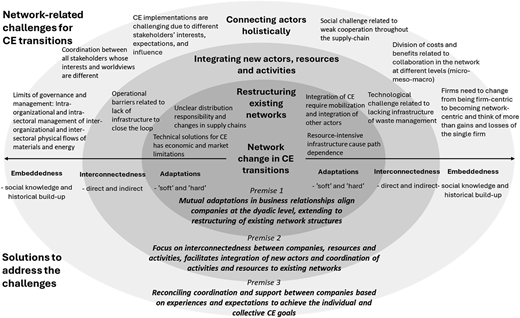
The network-related challenges identified from the existing literature on CE transitions can be explicated through the constructs of adaptations, interconnectedness and embeddedness derived from the IMP literature. These constructs are strongly intertwined and layered, and each has an impact on one another, but they allow explaining the network change needed to overcome the identified network-related challenges in CE transitions. Figure 1 illustrates our theoretical model for understanding the network change in CE transitions.

The figure also illustrates the solutions to address the identified network-related challenges, based on the three premises defined in the previous section. Mutual adaptations empower firms to coordinate their activities and resources by allowing modifications, for example to technologies employed or knowledge shared by the firms. Adaptations thus bind the relationship partners within the network together, developing interdependencies between the parties and further connecting them to a broader set of firms and their relationships, i.e. to network, either directly or indirectly. These adaptations between firms create interconnectedness in a specific wider institutional network context.

The highly interconnected network may gradually change the historically shaped context of a network – embeddedness – when those adaptive changes in dyadic relationships are propagated by the interconnectedness of the actors and their relationships throughout the business network. The model also illustrates the connected nature of the constructs by placing adaptations at the core and adding interconnectedness and embeddedness as upper layers, forming the mechanism for the network change.

In the following, we will provide practical case examples of our theoretical model for understanding the network change in CE transitions. In all these examples, CE transitions do not occur in a vacuum. Companies must understand how each actor’s goals, routines, incentives, and constraints are shaped by their position in the business relationship network. The success of such transitions depends not only on technical innovation or sustainability vision, but on the capacity of organizations to understand and reconfigure the intra- and inter-organizational structures in which they are situated. Aligning diverse interests and overcoming relational inertia are therefore central challenges for practitioners and scholars of organizational change in sustainability contexts.

4.1.1 Case: strategic collaboration between Renault and Veolia in enabling circular economy transitions

Renault’s partnership with Veolia to enable closed-loop recycling of end-of-life EV batteries illustrates how strategic adaptation in inter-organizational relationships drives CE transitions. In 2021, Renault joined a consortium with Veolia and Solvay to jointly invest in recycling infrastructure and processes for lithium-ion battery metals in Europe – addressing regulatory and strategic pressures for resource circularity (Renault Group, 2021; Reuters, 2024).

The collaboration involved hard adaptations – restructuring logistics, formal co-investment agreements and shared data protocols—to manage the physical and contractual flow of battery materials. Simultaneously, it required soft adaptations, including cross-industry trust-building and cognitive alignment among engineers, compliance teams and sustainability professionals.

By embedding their collaboration within the context of evolving EU regulations and partnering with civil society (such as the Ellen MacArthur Foundation), Renault and Veolia not only advanced their own circular capabilities but also influenced broader industry norms (Aarikka-Stenroos et al., 2021). The case demonstrates how dyadic adaptations – both structural and relational - can catalyze systemic change in pursuit of a CE.

4.1.2 Case: fairphone and the role of interconnectedness in circular economy transition

Fairphone’s journey toward circularity underscores the importance of uncovering invisible activity links and resource ties within complex supply networks. Initially constrained by limited visibility beyond first-tier suppliers, Fairphone expanded its scope to map deeper supply chain connections, including mining operations and component manufacturers (Wernink and Strahl, 2014). This revealed hidden dependencies and enabled collaborative efforts with NGOs and industry partners to improve traceability and ethical sourcing (Kirchherr et al., 2018).

By making these embedded relationships transparent, Fairphone fostered alignment among diverse actors, facilitating collective action and organizational change across its network (Feldman and Orlikowski, 2011). This case illustrates how recognizing interconnectedness is vital for coordinating multi-stakeholder collaborations necessary for systemic CE transitions.

4.1.3 Case: IKEA and the embeddedness of circular textile transitions

IKEA’s strategic commitment to becoming a circular business by 2030 illustrates how embeddedness shapes organizational change in multi-actor sustainability transitions (IKEA, 2020; Ellen MacArthur Foundation, 2020). Specifically, IKEA’s efforts to transform its textile supply chains – from linear to circular models – required deep engagement with a global network of actors, including raw material suppliers, manufacturers, logistics partners, recyclers and NGOs. These supply chain partners operate within distinct regional socio-economic, regulatory and cultural contexts, which constrain or enable circular practices. For example, cotton producers in South Asia are embedded in legacy production systems and labor dynamics, while recyclers in Europe face stricter material purity regulations and capital constraints. Without a systems-level understanding of these embedded institutional and relational contexts, IKEA would not have been able to initiate coordinated change. To overcome these challenges, IKEA invested in long-term supplier partnerships, initiated take-back programs, and collaborated with industry alliances like the Ellen MacArthur Foundation to develop shared CE standards. These actions recognize that sustainability transitions are not technical fixes but socially embedded processes requiring alignment across networked actors (Granovetter, 1985; Möller and Halinen, 2017). This case illustrates that advancing circularity in complex value networks requires organizations to navigate and reconfigure the institutional and relational embeddedness of their business relationships – a key consideration for change management in sustainability-focused transformation.

The study concludes that network-related challenges for CE transitions result from the well-acknowledged characteristics of industrial networks affecting their change. Network change toward CE takes place through adaptations allowing the restructuring of existing networks, through interconnectedness enabling integrating new actors, resources and activities and through embeddedness allowing connecting multiple actors holistically, across industries and sectors. Adaptations, interconnectedness and embeddedness in inter-organizational networks bring about changes in the networks, but such processes are complex and difficult to control. They necessitate close collaboration, including interaction and joint value creation.

The findings of the present study offer contribution to the existing literature on CE transition, especially the theoretical discussion related to CE challenges (e.g. Fraccascia et al., 2019; Geissdoerfer et al., 2023; Kanda et al., 2021; Moggi and Dameri, 2021). The paper conceptually advances the literature on CE transition by proposing three premises depicting the network change mechanisms toward CE. The three premises collectively provide an enhanced understanding of how to facilitate network change for CE transition. By considering these three premises, companies can better understand the multifaceted nature of network changes required for a successful CE transition. The study provides two main contributions to CE literature.

Firstly, the present study focuses on network and collaboration-related challenges and reveals that the acknowledged CE challenges necessitate a specific focus on the network change mechanisms through adaptations, interconnectedness and embeddedness. The existing knowledge on CE transitions is rich in describing the challenges and pointing out the deficiencies in systems (Dzhengiz et al., 2023; Geissdoerfer et al., 2023; Grafström and Aasma, 2021), but our study extends this knowledge by revealing how the network-related challenges can be better understood through the nature of business relationships and networks through which also the networks are in constant change. The call for more collaboration between actors across sectors and industries is well acknowledged in previous literature (Grafström and Aasma, 2021; Dzhengiz et al., 2023; Jia et al., 2020; Korhonen et al., 2018) and the present study provides novel insight into how intensified collaboration facilitates the network change toward CE transition. Increased interaction and awareness of counterparts facilitate the needed adaptations, shape the interconnections between new and existing actors, resources and activities, but also allows capturing the embedded nature of the network that helps form the holistic understanding necessary in CE.

Secondly, the findings of the present study further elaborate on the holistic and contingent nature of CE transition. Existing literature has pointed out that the change toward CE extends beyond single firms and covers entire value networks, sectors, industries and markets (Kanda, 2023). The present study extends this understanding by explicating these change mechanisms covering wider networks. Our findings help direct the focus on the nature and functions of networks, instead of business models (e.g. Kanda et al., 2021), stakeholder governance (Schultz et al., 2024) or interorganizational and intersectoral management (Korhonen et al., 2018). By understanding the dynamics of network change, a more nuanced view of the changes needed for CE transition in different industries can be depicted. Through such understanding of the adaptations made and to be made, existing interconnectedness as well as the interconnectedness that emerges through new adaptations and the way actors and activities become embedded in these changing systems, it is possible to identify key issues enabling the transition toward CE in networks.
Aarikka-Stenroos
,
L.
,
Ritala
,
P.
and
Thomas
,
L.D.
(
2021
), “Circular economy ecosystems: a typology, definitions, and implications”, in
Research Handbook of Sustainability Agency
, pp. 
260
-
276
.
Adams
,
K.T.
,
Osmani
,
M.
,
Thorpe
,
T.
and
Thornback
,
J.
(
2017
), “
Circular economy in construction: current awareness, challenges and enablers
”,
Proceedings of the Institution of Civil Engineers-Waste and Resource Management
, Vol. 
170
No. 
1
,
Thomas Telford
, pp. 
15
-
24
, doi: .
Alchian
,
A.A.
(
1950
), “
Uncertainty, evolution, and economic theory
”,
Journal of Political Economy
, Vol. 
58
No. 
3
, pp. 
211
-
221
, doi: .
Anderson
,
J.C.
,
Håkansson
,
H.
and
Johanson
,
J.
(
1994
), “
Dyadic business relationships within a business network context
”,
Journal of Marketing
, Vol. 
58
No. 
4
, pp. 
1
-
15
, doi: .
Baraldi
,
E.
and
Strömsten
,
T.
(
2006
), “
Embedding, producing and using low weight: value creation and the role of the configuration of resource interfaces in the networks around Holmen’s newsprint and IKEA’s Lack table
”,
IMP Journal
, Vol. 
1
No. 
1
, pp. 
52
-
97
.
Baraldi
,
E.
,
Brennan
,
R.
,
Harrison
,
D.
,
Tunisini
,
A.
and
Zolkiewski
,
J.
(
2007
), “
Strategic thinking and the IMP approach: a comparative analysis
”,
Industrial Marketing Management
, Vol. 
36
No. 
7
, pp. 
879
-
894
, doi: .
Berger
,
P.
and
Luckmann
,
T.
(
1966
),
The Reality of Everyday Life, the Social Construction of Reality: A Treatise in the Sociology of Knowledge
,
Doubleday & Company
,
New York
.
Bertassini
,
A.C.
,
Ometto
,
A.R.
,
Severengiz
,
S.
and
Gerolamo
,
M.C.
(
2021
), “
Circular economy and sustainability: the role of organizational behaviour in the transition journey
”,
Business Strategy and the Environment
, Vol. 
30
No. 
7
, pp. 
3160
-
3193
, doi: .
Blankenburg
,
D.
and
Johanson
,
J.
(
1992
), “
Managing network connections in international business
”,
Scandinavian International Business Review
, Vol. 
1
No. 
1
, pp. 
5
-
19
, doi: .
Blumer
,
H.
(
1954
), “
What is wrong with social theory?
”,
American Sociological Review
, Vol. 
19
No. 
1
, pp. 
3
-
10
, doi: .
Brennan
,
R.
and
Turnbull
,
P.
(
1995
), “
Adaptations in buyer-seller relationships
”,
11th IMP Conference
,
Manchester Federal School of Business and Management
.
Brennan
,
R.
and
Turnbull
,
P.W.
(
1999
), “
Adaptive behavior in buyer–supplier relationships
”,
Industrial Marketing Management
, Vol. 
28
No. 
5
, pp. 
481
-
495
, doi: .
Brennan
,
R.
,
Turnbull
,
P.W.
and
Wilson
,
D.T.
(
2003
), “
Dyadic adaptation in business-to-business markets
”,
European Journal of Marketing
, Vol. 
37
Nos
11/12
, pp. 
1636
-
1665
, doi: .
Brüel Grönberg
,
S.
and
Hulthén
,
K.
(
2022
), “
Disembedding air from e-commerce parcels: a joint challenge for supply chain actors
”,
Industrial Marketing Management
, Vol. 
107
, pp. 
396
-
406
, doi: .
Cantu
,
C.L.
and
Tunisini
,
A.
(
2023
), “
A circular innovation strategy in a supply network context: evidence from the packaging industry
”,
Journal of Business and Industrial Marketing
, Vol. 
38
No. 
13
, pp. 
220
-
238
, doi: .
Choi
,
Y.
and
Hara
,
Y.
(
2018
), “
The performance effect of inter-firm adaptation in channel relationships: the roles of relationship-specific resources and tailored activities
”,
Industrial Marketing Management
, Vol. 
70
, pp. 
46
-
57
, doi: .
Cook
,
K.S.
and
Emerson
,
R.M.
(
1978
), “
Power, equity and commitment in exchange networks
”,
American Sociological Review
, Vol. 
43
No. 
5
, pp. 
721
-
739
, doi: .
De Jesus
,
A.
and
Mendonça
,
S.
(
2018
), “
Lost in transition? Drivers and barriers in the eco-innovation road to the circular economy
”,
Ecological Economics
, Vol. 
145
, pp. 
75
-
89
, doi: .
Dhanaraj
,
C.
and
Parkhe
,
A.
(
2006
), “
Orchestrating innovation networks
”,
Academy of Management Review
, Vol. 
31
No. 
3
, pp. 
659
-
669
, doi: .
Dubois
,
A.
,
Hedvall
,
K.
and
Sundquist
,
V.
(
2023
), “
No concept is an island: conceptualising (in) the industrial network approach
”,
Journal of Business and Industrial Marketing
, Vol. 
38
No. 
13
, pp. 
211
-
219
, doi: .
Dzhengiz
,
T.
,
Miller
,
E.M.
,
Ovaska
,
J.P.
and
Patala
,
S.
(
2023
), “
Unpacking the circular economy: a problematizing review
”,
International Journal of Management Reviews
, Vol. 
25
No. 
2
, pp. 
270
-
296
, doi: .
Ellen MacArthur Foundation
(
2020
), “
IKEA and the Ellen MacArthur foundation enter strategic partnership to accelerate the circular economy transition
”,
available at:
 https://ellenmacarthurfoundation.org/news/ikea-and-the-ellen-macarthur-foundation-enter-strategic-partnership
Feldman
,
M.N.
and
Orlikowski
,
W.J.
(
2011
), “
Theorizing practice and practicing theory
”,
Organization Science
, Vol. 
22
No. 
5
, pp.
1240
-
1253
, doi: .
Ferasso
,
M.
,
Beliaeva
,
T.
,
Kraus
,
S.
,
Clauss
,
T.
and
Ribeiro-Soriano
,
D.
(
2020
), “
Circular economy business models: the state of research and avenues ahead
”,
Business Strategy and the Environment
, Vol. 
29
No. 
8
, pp. 
3006
-
3024
, doi: .
Ford
,
D.
,
Gadde
,
L.-E.
,
Håkansson
,
H.
,
Lundgren
,
A.
,
Snehota
,
I.
,
Turnbull
,
P.
and
Wilson
,
D.
(
1998
),
Managing Business Relationships
,
John Wiley and Sons
,
Chichester
.
Fraccascia
,
L.
,
Giannoccaro
,
I.
,
Agarwal
,
A.
and
Hansen
,
E.G.
(
2019
), “
Business models for the circular economy: opportunities and challenges
”,
Business Strategy and the Environment
, Vol. 
28
No. 
2
, pp. 
430
-
432
, doi: .
Franco
,
M.A.
(
2017
), “
Circular economy at the micro level: a dynamic view of incumbents’ struggles and challenges in the textile industry
”,
Journal of Cleaner Production
, Vol. 
168
, pp. 
833
-
845
, doi: .
Gadde
,
L.-E.
and
Håkansson
,
H.
(
1993
),
Professional Purchasing
,
Routledge
,
London
.
Gadde
,
L.-E.
,
Håkansson
,
H.
and
Persson
,
G.
(
2010
),
Supply Network Strategies
, (2nd ed.) ,
Wiley
,
Chichester
.
Geissdoerfer
,
M.
,
Savaget
,
P.
,
Bocken
,
N.M.
and
Hultink
,
E.J.
(
2017
), “
The circular economy–a new sustainability paradigm?
”,
Journal of Cleaner Production
, Vol. 
143
, pp. 
757
-
768
, doi: .
Geissdoerfer
,
M.
,
Santa-Maria
,
T.
,
Kirchherr
,
J.
and
Pelzeter
,
C.
(
2023
), “
Drivers and barriers for circular business model innovation
”,
Business Strategy and the Environment
, Vol. 
32
No. 
6
, pp. 
3814
-
3832
, doi: .
Ghisellini
,
P.
,
Cialani
,
C.
and
Ulgiati
,
S.
(
2016
), “
A review on circular economy: the expected transition to a balanced interplay of environmental and economic systems
”,
Journal of Cleaner Production
, Vol. 
114
, pp. 
11
-
32
, doi: .
Gonçalves
,
S.M.
,
da Silva
,
R.V.
and
Teixeira
,
N.
(
2019
), “
Individual actors and embeddedness in business-to-business interactions
”,
Industrial Marketing Management
, Vol. 
76
, pp. 
181
-
191
, doi: .
Grafström
,
J.
and
Aasma
,
S.
(
2021
), “
Breaking circular economy barriers
”,
Journal of Cleaner Production
, Vol. 
292
, 126002, doi: .
Granovetter
,
M.
(
1985
), “
Economic action and social structure: the problem of embeddedness
”,
American Journal of Sociology
, Vol. 
91
No. 
3
, pp. 
481
-
510
, doi: .
Hagberg-Andersson
,
Å.
(
2006
), “
Does adaptation pay off?
”,
Industrial Marketing Management
, Vol. 
35
No. 
2
, pp. 
202
-
209
, doi: .
Håkansson
,
H.
(
1982
),
International Marketing and Purchasing of Industrial Goods
,
John Wiley and Sons
,
Chichester
.
Håkansson
,
H.
(
1990
), “
Technological collaboration in industrial networks
”,
European Management Journal
, Vol. 
8
No. 
3
, pp. 
371
-
379
, doi: .
Håkansson
,
H.
and
Gadde
,
L.E.
(
2018
), “
Four decades of IMP research–the development of a research network
”,
IMP Journal
, Vol. 
12
No. 
1
, pp.
6
-
36
, doi: .
Håkansson
,
H.
and
Johanson
,
J.
(
1992
), “A model of industrial networks”, in
Axelsson
,
B.
and
Easton
,
G.
(Eds),
Industrial Networks- A New View of Reality
,
Routledge
,
London
, pp. 
28
-
34
.
Håkansson
,
H.
and
Snehota
,
I.
(
1995
),
Developing Relationships in Business Networks
,
Routledge
,
London
.
Håkansson
,
H.
,
Ford
,
D.
,
Gadde
,
L.-E.
,
Snehota
,
I.
and
Waluszewski
,
A.
(
2009
),
Business in Networks
,
John Wiley and Sons
,
Chichester
.
Halinen
,
A.
and
Törnroos
,
J.Å.
(
1998
), “
The role of embeddedness in the evolution of business networks
”,
Scandinavian Journal of Management
, Vol. 
14
No. 
3
, pp. 
187
-
205
, doi: .
Hallén
,
L.
,
Johanson
,
J.
and
Seyed-Mohamed
,
N.
(
1991
), “
Interfirm adaptation in business relationships
”,
Journal of Marketing
, Vol. 
55
No. 
2
, pp. 
29
-
37
, doi: .
Harrison
,
D.
,
Munksgaard
,
K.B.
and
Prenkert
,
F.
(
2023a
), “
Coordinating activity interdependencies in the contemporary economy: the principle of distributed control
”,
British Journal of Management
, Vol. 
34
No. 
3
, pp. 
1488
-
1509
, doi: .
Harrison
,
D.
,
Prenkert
,
F.
,
Hasche
,
N.
and
Carlborg
,
P.
(
2023b
), “
Business networks and sustainability: past, present and future
”,
Industrial Marketing Management
, Vol. 
111
, pp. 
A10
-
A17
, doi: .
Hartmann
,
E.
and
Herb
,
S.
(
2015
), “
Interconnectedness of actor bonds in service triads–a social capital perspective
”,
Industrial Marketing Management
, Vol. 
44
, pp. 
154
-
165
, doi: .
Hermes
,
J.W.
and
Mainela
,
T.
(
2014
), “
Mobilizing crisis management networks–entrepreneurial behavior in turbulent contexts
”,
Industrial Marketing Management
, Vol. 
43
No. 
6
, pp. 
967
-
976
, doi: .
IKEA
(
2020
), “
The IKEA sustainability report FY20
”,
available at:
 https://www.ikea.com/se/sv/files/pdf/c3/e2/c3e2b54b/ikea_sustainability_report_fy20.pdf (
accessed
 2 July 2025).
Jaakkola
,
E.
(
2020
), “
Designing conceptual articles: four approaches
”,
AMS Review
, Vol. 
10
No. 
1
, pp. 
18
-
26
, doi: .
Jia
,
F.
,
Yin
,
S.
,
Chen
,
L.
and
Chen
,
X.
(
2020
), “
The circular economy in the textile and apparel industry: a systematic literature review
”,
Journal of Cleaner Production
, Vol. 
259
, 120728, doi: .
Johanson
,
J.
and
Mattsson
,
L.-G.
(
1987
), “
Interorganizational relations in industrial systems: a network approach compared with the transaction-cost approach
”,
International Studies of Management and Organization
, Vol. 
17
No. 
1
, pp. 
34
-
48
, doi: .
Kanda
,
W.
(
2023
), “
Systems and ecosystems in the circular economy: what’s the difference?
”,
Circular Economy
, Vol. 
1
No. 
3
, pp. 
1
-
10
, doi: .
Kanda
,
W.
,
Geissdoerfer
,
M.
and
Hjelm
,
O.
(
2021
), “
From circular business models to circular business ecosystems
”,
Business Strategy and the Environment
, Vol. 
30
No. 
6
, pp. 
2814
-
2829
, doi: .
Keränen
,
O.
,
Komulainen
,
H.
,
Lehtimäki
,
T.
and
Ulkuniemi
,
P.
(
2021
), “
Restructuring existing value networks to diffuse sustainable innovations in food packaging
”,
Industrial Marketing Management
, Vol. 
93
, pp. 
509
-
519
, doi: .
Khan
,
S.A.R.
,
Shah
,
A.S.A.
,
Yu
,
Z.
and
Tanveer
,
M.
(
2022
), “
A systematic literature review on circular economy practices: challenges, opportunities and future trends
”,
Journal of Entrepreneurship in Emerging Economies
, Vol. 
14
No. 
5
, pp. 
754
-
795
, doi: .
Khan
,
A.N.
and
Soomro
,
M.A.
(
2025
), “
Empowering change: leadership, flexibility, and the path to circular economy success
”,
Journal of Organizational Change Management
, Vol. 
ahead-of-print
 
No. ahead-of-print
, doi: .
Kirchherr
,
J.
,
Piscicelli
,
L.
,
Bour
,
R.
,
Kostense-Smit
,
E.
,
Muller
,
J.
,
Huibrechtse-Truijens
,
A.
and
Hekkert
,
M.
(
2018
), “
Barriers to the circular economy: evidence from the European Union (EU)
”,
Ecological Economics
, Vol. 
150
, pp. 
264
-
272
, doi: .
Kirchherr
,
J.
,
Yang
,
N.H.N.
,
Schulze-Spüntrup
,
F.
,
Heerink
,
M.J.
and
Hartley
,
K.
(
2023
), “
Conceptualizing the circular economy (revisited): an analysis of 221 definitions
”,
Resources, Conservation and Recycling
, Vol. 
194
, 107001, doi: .
Köhler
,
J.
,
Sönnichsen
,
S.D.
and
Beske-Jansen
,
P.
(
2022
), “
Towards a collaboration framework for circular economy: the role of dynamic capabilities and open innovation
”,
Business Strategy and the Environment
, Vol. 
31
No. 
6
, pp. 
2700
-
2713
, doi: .
Korhonen
,
J.
,
Honkasalo
,
A.
and
Seppälä
,
J.
(
2018
), “
Circular economy: the concept and its limitations
”,
Ecological Economics
, Vol. 
143
, pp. 
37
-
46
, doi: .
Kragh
,
H.
and
Andersen
,
P.H.
(
2009
), “
Picture this: managed change and resistance in business network settings
”,
Industrial Marketing Management
, Vol. 
38
No. 
6
, pp. 
641
-
653
, doi: .
Melander
,
L.
and
Arvidsson
,
A.
(
2022
), “
Green innovation networks: a research agenda
”,
Journal of Cleaner Production
, Vol. 
357
, 131926, doi: .
Melander
,
L.
and
Lind
,
F.
(
2022
), “
A start-up’s collaboration in networks for sustainable freight transport: a micro-meso-macro approach to innovation
”,
Supply Chain Management
, Vol. 
27
No. 
7
, pp. 
211
-
222
, doi: .
Melander
,
L.
and
Pazirandeh
,
A.
(
2019
), “
Collaboration beyond the supply network for green innovation: insight from 11 cases
”,
Supply Chain Management
, Vol. 
24
No. 
4
, pp. 
509
-
523
, doi: .
Moggi
,
S.
and
Dameri
,
R.P.
(
2021
), “
Circular business model evolution: stakeholder matters for a self-sufficient ecosystem
”,
Business Strategy and the Environment
, Vol. 
30
No. 
6
, pp. 
2830
-
2842
, doi: .
Möller
,
K.
and
Halinen
,
A.
(
2017
), “
Managing business and innovation networks–from strategic nets to business fields and ecosystems
”,
Industrial Marketing Management
, Vol. 
67
, pp. 
5
-
22
, doi: .
Mouzas
,
S.
(
2024
), “
Towards a theory of interfirm adaptation in business relationships
”,
Industrial Marketing Management
, Vol. 
120
, pp. 
206
-
215
, doi: .
Musova
,
Z.
,
Musa
,
H.
and
Rech
,
F.
(
2025
), “
Circular economy challenges: a bibliometric exploration of cognitive and behavioral barriers
”,
Journal of Organizational Change Management
, Vol.
ahead-of-print
No.
ahead-of-print
, doi: .
Ojansivu
,
I.
and
Medlin
,
C.J.
(
2018
), “
To whose drum are we marching? Change in business networks through a contextual logics perspective
”,
Industrial Marketing Management
, Vol. 
70
, pp. 
141
-
155
, doi: .
O'Toole
,
T.
and
McGrath
,
H.
(
2018
), “
Strategic patterns in the development of network capability in new ventures
”,
Industrial Marketing Management
, Vol. 
70
, pp. 
128
-
140
, doi: .
Perks
,
H.
,
Kowalkowski
,
C.
,
Witell
,
L.
and
Gustafsson
,
A.
(
2017
), “
Network orchestration for value platform development
”,
Industrial Marketing Management
, Vol. 
67
, pp. 
106
-
121
, doi: .
Prenkert
,
F.
,
Hedvall
,
K.
,
Hasche
,
N.
,
Frick
,
J.E.
,
Abrahamsen
,
M.H.
,
Aramo-Immonen
,
H.
,
Wagrell
,
S.
,
Bocconcelli
,
R.
,
Harrison
,
D.
,
Huang
,
L.
,
Huemer
,
L.
,
Kask
,
J.
,
Landqvist
,
M.
,
Pagano
,
A.
,
Perna
,
A.
,
Poblete
,
L.
and
Ratajczak-Mrozek
,
M.
(
2022
), “
Resource interaction: key concepts, relations and representations
”,
Industrial Marketing Management
, Vol. 
105
, pp. 
48
-
59
, doi: .
Ramos
,
C.
,
Henneberg
,
S.C.
and
Naudé
,
P.
(
2012
), “
Understanding network picture complexity: an empirical analysis of contextual factors
”,
Industrial Marketing Management
, Vol. 
41
No. 
6
, pp. 
951
-
972
, doi: .
Renault Group
(
2021
), “
Groupe Renault, Veolia and Solvay join forces to recycle end-of-life EV battery metals in a closed loop
”,
Press release March 18, available at:
 https://media.renaultgroup.com/groupe-renault-veolia-solvay-join-forces-to-recycle-end-of-life-ev-battery-metals-in-a-closed-loop/
Reuters
(
2024
), “
Suez takes stake in Renault recycling unit the future is NEUTRAL
”,
October 3, available at:
 https://www.reuters.com/markets/europe/suez-takes-stake-renault-recycling-unit-future-is-neutral-2024-10-03/
Ritter
,
T.
(
2000
), “
A framework for analyzing interconnectedness of relationships
”,
Industrial Marketing Management
, Vol. 
29
No. 
4
, pp. 
317
-
326
, doi: .
Ritter
,
T.
and
Gemünden
,
H.G.
(
2003
), “
Network competence: its impact on innovation success and its antecedents
”,
Journal of Business Research
, Vol. 
56
No. 
9
, pp. 
745
-
755
, doi: .
Ritvala
,
T.
and
Salmi
,
A.
(
2010
), “
Value-based network mobilization: a case study of modern environmental networkers
”,
Industrial Marketing Management
, Vol. 
39
No. 
6
, pp. 
898
-
907
, doi: .
Sabatini
,
A.
,
O'Toole
,
T.
and
Gregori
,
G.L.
(
2021
), “
Integrating sustainability in business network initiation: the case of an Italian pasta maker
”,
Journal of Business and Industrial Marketing
, Vol. 
36
No. 
10
, pp. 
1894
-
1908
, doi: .
Schmidt
,
S.O.
,
Tyler
,
K.
and
Brennan
,
R.
(
2007
), “
Adaptation in inter-firm relationships: classification, motivation, calculation
”,
Journal of Services Marketing
, Vol. 
21
No. 
7
, pp. 
530
-
537
, doi: .
Schultz
,
F.C.
,
Valentinov
,
V.
,
Kirchherr
,
J.
,
Reinhardt
,
R.J.
and
Pies
,
I.
(
2024
), “
Stakeholder governance to facilitate collaboration for a systemic circular economy transition: a qualitative study in the European chemicals and plastics industry
”,
Business Strategy and the Environment
, Vol. 
33
No. 
3
, pp. 
2173
-
2192
, doi: .
Siemieniako
,
D.
,
Mitręga
,
M.
and
Kubacki
,
K.
(
2022
), “
The antecedents to social impact in inter-organizational relationships–a systematic review and future research agenda
”,
Industrial Marketing Management
, Vol. 
101
, pp. 
191
-
207
, doi: .
Thornton
,
S.C.
,
Henneberg
,
S.C.
and
Naudé
,
P.
(
2013
), “
Understanding types of organizational networking behaviors in the UK manufacturing sector
”,
Industrial Marketing Management
, Vol. 
42
No. 
7
, pp. 
1154
-
1166
, doi: .
Tikkanen
,
H.
(
1996
), “
Pohjoismaisen verkostolähestymistavan tieteenfilosofiset perusteet
”,
Liiketaloudellinen Aikakauskirja
, Vol. 
45
, pp.
384
-
406
,
(In Finnish)
.
Toth-Peter
,
A.
,
de Oliveira
,
R.T.
,
Mathews
,
S.
,
Barner
,
L.
and
Figueira
,
S.
(
2023
), “
Industry 4.0 as an enabler in transitioning to circular business models: a systematic literature review
”,
Journal of Cleaner Production
, Vol. 
393
, 136284, doi: .
Van Opstal
,
W.
and
Borms
,
L.
(
2023
), “
Startups and circular economy strategies: profile differences, barriers and enablers
”,
Journal of Cleaner Production
, Vol. 
396
, 136510, doi: .
Vellesalu
,
A.
,
Hjelmgren
,
D.
and
Lind
,
F.
(
2025
), “
Circular product development from a multi-level perspective: adaptations in business networks
”,
Industrial Marketing Management
, Vol. 
128
, pp. 
88
-
100
, doi: .
Vesalainen
,
J.
and
Hakala
,
H.
(
2014
), “
Strategic capability architecture: the role of network capability
”,
Industrial Marketing Management
, Vol. 
43
No. 
6
, pp. 
938
-
950
, doi: .
Von Corswant
,
F.
(
2005
), “Organizing interactive product development”, in
Managing Product Innovation
, Vol. 
13
, pp. 
1
-
209
, doi: .
Wernink
,
T.
and
Strahl
,
C.
(
2014
), “Fairphone: sustainability from the inside-out and outside-in”, in
D’heur
,
M.
(Ed.),
Sustainable Value Chain Management, CSR, Sustainability, Ethics & Governance
,
Springer
,
Cham
, pp.
123
-
139
, doi: .
Published by Emerald Publishing Limited. This article is published under the Creative Commons Attribution (CC BY 4.0) licence. Anyone may reproduce, distribute, translate and create derivative works of this article (for both commercial and non-commercial purposes), subject to full attribution to the original publication and authors. The full terms of this licence may be seen at Link to the terms of the CC BY 4.0 licence.

Data & Figures

Figure 1
A circular diagram of C E transition challenges and solutions across embeddedness, interconnectedness, and adaptations.The diagram shows three concentric ovals with a double-headed arrow labeled “Network change in C E transitions” running horizontally through the center. The top half above the arrow is titled “Network-related challenges for C E transitions,” while the lower-left half below the arrow is labeled “Solutions to address the challenges.” In the top section, the innermost oval is labeled “Restructuring existing networks” and contains four challenge statements: “Unclear distribution responsibility and changes in supply chain” “Technical solutions for C E have economic and market limitations” “Integration of C E requires mobilization and integration of other actors” “Resource-intensive infrastructure causes path dependence” The middle oval is labeled “Integrating new actors, resources and activities” and includes the following challenges: “Operational barriers related to lack of infrastructure to close the loop” “Technical challenge related to lacking infrastructure of waste management.” The outermost oval is labeled “Connecting actors holistically” and contains the following challenges: “C E implementations are challenging due to different stakeholders’ interests, expectations, and influence” “Coordination between all stakeholders whose interests and worldviews are different” “Limits of governance and management: Intra-organizational and intra-sectoral management of inter-organizational and inter-sectoral physical flows of materials and energy” “Social challenge related to weak cooperation throughout the supply chain” “Division of costs and benefits related to collaboration in the network at different levels (micro–meso–macro)” “Firms need to change from being firm-centric to becoming network-centric and think of more than gains and losses of the single firm.” Below the central arrow, the “Solutions to address the challenges” section spans horizontally from left to right and includes the following progression: “Embeddedness” and includes “social knowledge and historical build-up” “Interconnectedness” and includes “direct and indirect” “Adaptations” and includes “‘soft’ and ‘hard’” This pattern, from “Embeddedness” to “Interconnectedness” to “Adaptations,” is mirrored symmetrically on both left and right ends of the bottom section. In the center, three premises are listed in italic text: The innermost oval: Premise 1: “Mutual adaptations in business relationships align companies at the dyadic level, extending to restructuring of existing network structures” The middle oval: Premise 2: “Focus on interconnectedness between companies, resources and activities, facilitates integration of new actors and coordination of activities and resources to existing networks” The outermost oval: Premise 3: “Reconciling coordination and support between companies based on experiences and expectations to achieve the individual and collective C E goals.”

Network change in CE transitions. Source: Authors’ work

Figure 1
A circular diagram of C E transition challenges and solutions across embeddedness, interconnectedness, and adaptations.The diagram shows three concentric ovals with a double-headed arrow labeled “Network change in C E transitions” running horizontally through the center. The top half above the arrow is titled “Network-related challenges for C E transitions,” while the lower-left half below the arrow is labeled “Solutions to address the challenges.” In the top section, the innermost oval is labeled “Restructuring existing networks” and contains four challenge statements: “Unclear distribution responsibility and changes in supply chain” “Technical solutions for C E have economic and market limitations” “Integration of C E requires mobilization and integration of other actors” “Resource-intensive infrastructure causes path dependence” The middle oval is labeled “Integrating new actors, resources and activities” and includes the following challenges: “Operational barriers related to lack of infrastructure to close the loop” “Technical challenge related to lacking infrastructure of waste management.” The outermost oval is labeled “Connecting actors holistically” and contains the following challenges: “C E implementations are challenging due to different stakeholders’ interests, expectations, and influence” “Coordination between all stakeholders whose interests and worldviews are different” “Limits of governance and management: Intra-organizational and intra-sectoral management of inter-organizational and inter-sectoral physical flows of materials and energy” “Social challenge related to weak cooperation throughout the supply chain” “Division of costs and benefits related to collaboration in the network at different levels (micro–meso–macro)” “Firms need to change from being firm-centric to becoming network-centric and think of more than gains and losses of the single firm.” Below the central arrow, the “Solutions to address the challenges” section spans horizontally from left to right and includes the following progression: “Embeddedness” and includes “social knowledge and historical build-up” “Interconnectedness” and includes “direct and indirect” “Adaptations” and includes “‘soft’ and ‘hard’” This pattern, from “Embeddedness” to “Interconnectedness” to “Adaptations,” is mirrored symmetrically on both left and right ends of the bottom section. In the center, three premises are listed in italic text: The innermost oval: Premise 1: “Mutual adaptations in business relationships align companies at the dyadic level, extending to restructuring of existing network structures” The middle oval: Premise 2: “Focus on interconnectedness between companies, resources and activities, facilitates integration of new actors and coordination of activities and resources to existing networks” The outermost oval: Premise 3: “Reconciling coordination and support between companies based on experiences and expectations to achieve the individual and collective C E goals.”

Network change in CE transitions. Source: Authors’ work

Close Figure 1
Table 1

Identification of network and collaboration-related challenges of CE

Network and collaboration-related challenges in CE transitions identified in the existing literatureReferenceIdentified category of the challenge
Operational barriers related to lack of infrastructure to close the loopKhan et al. (2022) Need for new actors, resources and activities
Technological challenge related to lacking infrastructure of waste managementGrafström and Aasma (2021) Need for new actors, resources and activities
Difficulties to close the loop when many necessary actors are outside the scope of the traditional value chain, sometimes even transcending across industriesKanda et al. (2021) Need for new actors, resources and activities
The struggles of coordinating interorganizational activities that formerly were considered to be too different to be coordinated such as previously unrelated activities across industriesHarrison et al. (2023a, b) Need for new actors, resources and activities
Firms need to change from being firm-centric to becoming network-centric and think of more than gains and losses of the single firmKhan et al. (2022) Holistic multi-actor collaborations
Division of costs and benefits related to collaboration in the network at different levels (micro-meso-macro)Khan et al. (2022) Holistic multi-actor collaborations
Social challenge related to weak cooperation throughout the supply-chainGrafström and Aasma (2021) Holistic multi-actor collaborations
CE implementations are challenging due to different stakeholders’ interests, expectations, and influenceToth-Peter et al. (2023) Holistic multi-actor collaborations
Limits of governance and management: Intra-organizational and intra-sectoral management of interorganizational and intersectoral physical flows of materials and energyKorhonen et al. (2018) Holistic multi-actor collaborations
Managing collaborations of a wide variety of stakeholders with often different interests and worldviewsDzhengiz et al. (2023) Holistic multi-actor collaborations
Resource-intensive infrastructure causing lock-in and path dependenceDe Jesus and Mendonça (2018) Restructuring existing networks
Technical solutions for CE often have limited practical application due to economic and market limitationsDe Jesus and Mendonça (2018) Restructuring existing networks
Limits posed by path-dependency and lock-in: first technologies retain their market position despite in-efficiencyKorhonen et al. (2018) Restructuring existing networks
New CE business models necessitates interorganizational cooperation and interorganizational sustainability management which require clarifying; who is the leader in the network, who bears the biggest responsibility, who gains the most from the network operation, who loses the most if the project is unsuccessful or faces the biggest risks, what is the overall budget of the network, who controls it and which actors contribute to it, what is the network decision-making platform, who organizes it etc.Korhonen et al. (2018) Restructuring existing networks
Structural barriers such as unclear distribution responsibility and changes in supply chains causing disruptionsKhan et al. (2022) Restructuring existing networks
Integration of CE strategies transcends the business boundaries, which requires mobilization and integration of other actors making the coordination problematicToth-Peter et al. (2023) Restructuring existing networks
Source(s): Authors’ work

Supplements

References

Aarikka-Stenroos
,
L.
,
Ritala
,
P.
and
Thomas
,
L.D.
(
2021
), “Circular economy ecosystems: a typology, definitions, and implications”, in
Research Handbook of Sustainability Agency
, pp. 
260
-
276
.
Adams
,
K.T.
,
Osmani
,
M.
,
Thorpe
,
T.
and
Thornback
,
J.
(
2017
), “
Circular economy in construction: current awareness, challenges and enablers
”,
Proceedings of the Institution of Civil Engineers-Waste and Resource Management
, Vol. 
170
No. 
1
,
Thomas Telford
, pp. 
15
-
24
, doi: .
Alchian
,
A.A.
(
1950
), “
Uncertainty, evolution, and economic theory
”,
Journal of Political Economy
, Vol. 
58
No. 
3
, pp. 
211
-
221
, doi: .
Anderson
,
J.C.
,
Håkansson
,
H.
and
Johanson
,
J.
(
1994
), “
Dyadic business relationships within a business network context
”,
Journal of Marketing
, Vol. 
58
No. 
4
, pp. 
1
-
15
, doi: .
Baraldi
,
E.
and
Strömsten
,
T.
(
2006
), “
Embedding, producing and using low weight: value creation and the role of the configuration of resource interfaces in the networks around Holmen’s newsprint and IKEA’s Lack table
”,
IMP Journal
, Vol. 
1
No. 
1
, pp. 
52
-
97
.
Baraldi
,
E.
,
Brennan
,
R.
,
Harrison
,
D.
,
Tunisini
,
A.
and
Zolkiewski
,
J.
(
2007
), “
Strategic thinking and the IMP approach: a comparative analysis
”,
Industrial Marketing Management
, Vol. 
36
No. 
7
, pp. 
879
-
894
, doi: .
Berger
,
P.
and
Luckmann
,
T.
(
1966
),
The Reality of Everyday Life, the Social Construction of Reality: A Treatise in the Sociology of Knowledge
,
Doubleday & Company
,
New York
.
Bertassini
,
A.C.
,
Ometto
,
A.R.
,
Severengiz
,
S.
and
Gerolamo
,
M.C.
(
2021
), “
Circular economy and sustainability: the role of organizational behaviour in the transition journey
”,
Business Strategy and the Environment
, Vol. 
30
No. 
7
, pp. 
3160
-
3193
, doi: .
Blankenburg
,
D.
and
Johanson
,
J.
(
1992
), “
Managing network connections in international business
”,
Scandinavian International Business Review
, Vol. 
1
No. 
1
, pp. 
5
-
19
, doi: .
Blumer
,
H.
(
1954
), “
What is wrong with social theory?
”,
American Sociological Review
, Vol. 
19
No. 
1
, pp. 
3
-
10
, doi: .
Brennan
,
R.
and
Turnbull
,
P.
(
1995
), “
Adaptations in buyer-seller relationships
”,
11th IMP Conference
,
Manchester Federal School of Business and Management
.
Brennan
,
R.
and
Turnbull
,
P.W.
(
1999
), “
Adaptive behavior in buyer–supplier relationships
”,
Industrial Marketing Management
, Vol. 
28
No. 
5
, pp. 
481
-
495
, doi: .
Brennan
,
R.
,
Turnbull
,
P.W.
and
Wilson
,
D.T.
(
2003
), “
Dyadic adaptation in business-to-business markets
”,
European Journal of Marketing
, Vol. 
37
Nos
11/12
, pp. 
1636
-
1665
, doi: .
Brüel Grönberg
,
S.
and
Hulthén
,
K.
(
2022
), “
Disembedding air from e-commerce parcels: a joint challenge for supply chain actors
”,
Industrial Marketing Management
, Vol. 
107
, pp. 
396
-
406
, doi: .
Cantu
,
C.L.
and
Tunisini
,
A.
(
2023
), “
A circular innovation strategy in a supply network context: evidence from the packaging industry
”,
Journal of Business and Industrial Marketing
, Vol. 
38
No. 
13
, pp. 
220
-
238
, doi: .
Choi
,
Y.
and
Hara
,
Y.
(
2018
), “
The performance effect of inter-firm adaptation in channel relationships: the roles of relationship-specific resources and tailored activities
”,
Industrial Marketing Management
, Vol. 
70
, pp. 
46
-
57
, doi: .
Cook
,
K.S.
and
Emerson
,
R.M.
(
1978
), “
Power, equity and commitment in exchange networks
”,
American Sociological Review
, Vol. 
43
No. 
5
, pp. 
721
-
739
, doi: .
De Jesus
,
A.
and
Mendonça
,
S.
(
2018
), “
Lost in transition? Drivers and barriers in the eco-innovation road to the circular economy
”,
Ecological Economics
, Vol. 
145
, pp. 
75
-
89
, doi: .
Dhanaraj
,
C.
and
Parkhe
,
A.
(
2006
), “
Orchestrating innovation networks
”,
Academy of Management Review
, Vol. 
31
No. 
3
, pp. 
659
-
669
, doi: .
Dubois
,
A.
,
Hedvall
,
K.
and
Sundquist
,
V.
(
2023
), “
No concept is an island: conceptualising (in) the industrial network approach
”,
Journal of Business and Industrial Marketing
, Vol. 
38
No. 
13
, pp. 
211
-
219
, doi: .
Dzhengiz
,
T.
,
Miller
,
E.M.
,
Ovaska
,
J.P.
and
Patala
,
S.
(
2023
), “
Unpacking the circular economy: a problematizing review
”,
International Journal of Management Reviews
, Vol. 
25
No. 
2
, pp. 
270
-
296
, doi: .
Ellen MacArthur Foundation
(
2020
), “
IKEA and the Ellen MacArthur foundation enter strategic partnership to accelerate the circular economy transition
”,
available at:
 https://ellenmacarthurfoundation.org/news/ikea-and-the-ellen-macarthur-foundation-enter-strategic-partnership
Feldman
,
M.N.
and
Orlikowski
,
W.J.
(
2011
), “
Theorizing practice and practicing theory
”,
Organization Science
, Vol. 
22
No. 
5
, pp.
1240
-
1253
, doi: .
Ferasso
,
M.
,
Beliaeva
,
T.
,
Kraus
,
S.
,
Clauss
,
T.
and
Ribeiro-Soriano
,
D.
(
2020
), “
Circular economy business models: the state of research and avenues ahead
”,
Business Strategy and the Environment
, Vol. 
29
No. 
8
, pp. 
3006
-
3024
, doi: .
Ford
,
D.
,
Gadde
,
L.-E.
,
Håkansson
,
H.
,
Lundgren
,
A.
,
Snehota
,
I.
,
Turnbull
,
P.
and
Wilson
,
D.
(
1998
),
Managing Business Relationships
,
John Wiley and Sons
,
Chichester
.
Fraccascia
,
L.
,
Giannoccaro
,
I.
,
Agarwal
,
A.
and
Hansen
,
E.G.
(
2019
), “
Business models for the circular economy: opportunities and challenges
”,
Business Strategy and the Environment
, Vol. 
28
No. 
2
, pp. 
430
-
432
, doi: .
Franco
,
M.A.
(
2017
), “
Circular economy at the micro level: a dynamic view of incumbents’ struggles and challenges in the textile industry
”,
Journal of Cleaner Production
, Vol. 
168
, pp. 
833
-
845
, doi: .
Gadde
,
L.-E.
and
Håkansson
,
H.
(
1993
),
Professional Purchasing
,
Routledge
,
London
.
Gadde
,
L.-E.
,
Håkansson
,
H.
and
Persson
,
G.
(
2010
),
Supply Network Strategies
, (2nd ed.) ,
Wiley
,
Chichester
.
Geissdoerfer
,
M.
,
Savaget
,
P.
,
Bocken
,
N.M.
and
Hultink
,
E.J.
(
2017
), “
The circular economy–a new sustainability paradigm?
”,
Journal of Cleaner Production
, Vol. 
143
, pp. 
757
-
768
, doi: .
Geissdoerfer
,
M.
,
Santa-Maria
,
T.
,
Kirchherr
,
J.
and
Pelzeter
,
C.
(
2023
), “
Drivers and barriers for circular business model innovation
”,
Business Strategy and the Environment
, Vol. 
32
No. 
6
, pp. 
3814
-
3832
, doi: .
Ghisellini
,
P.
,
Cialani
,
C.
and
Ulgiati
,
S.
(
2016
), “
A review on circular economy: the expected transition to a balanced interplay of environmental and economic systems
”,
Journal of Cleaner Production
, Vol. 
114
, pp. 
11
-
32
, doi: .
Gonçalves
,
S.M.
,
da Silva
,
R.V.
and
Teixeira
,
N.
(
2019
), “
Individual actors and embeddedness in business-to-business interactions
”,
Industrial Marketing Management
, Vol. 
76
, pp. 
181
-
191
, doi: .
Grafström
,
J.
and
Aasma
,
S.
(
2021
), “
Breaking circular economy barriers
”,
Journal of Cleaner Production
, Vol. 
292
, 126002, doi: .
Granovetter
,
M.
(
1985
), “
Economic action and social structure: the problem of embeddedness
”,
American Journal of Sociology
, Vol. 
91
No. 
3
, pp. 
481
-
510
, doi: .
Hagberg-Andersson
,
Å.
(
2006
), “
Does adaptation pay off?
”,
Industrial Marketing Management
, Vol. 
35
No. 
2
, pp. 
202
-
209
, doi: .
Håkansson
,
H.
(
1982
),
International Marketing and Purchasing of Industrial Goods
,
John Wiley and Sons
,
Chichester
.
Håkansson
,
H.
(
1990
), “
Technological collaboration in industrial networks
”,
European Management Journal
, Vol. 
8
No. 
3
, pp. 
371
-
379
, doi: .
Håkansson
,
H.
and
Gadde
,
L.E.
(
2018
), “
Four decades of IMP research–the development of a research network
”,
IMP Journal
, Vol. 
12
No. 
1
, pp.
6
-
36
, doi: .
Håkansson
,
H.
and
Johanson
,
J.
(
1992
), “A model of industrial networks”, in
Axelsson
,
B.
and
Easton
,
G.
(Eds),
Industrial Networks- A New View of Reality
,
Routledge
,
London
, pp. 
28
-
34
.
Håkansson
,
H.
and
Snehota
,
I.
(
1995
),
Developing Relationships in Business Networks
,
Routledge
,
London
.
Håkansson
,
H.
,
Ford
,
D.
,
Gadde
,
L.-E.
,
Snehota
,
I.
and
Waluszewski
,
A.
(
2009
),
Business in Networks
,
John Wiley and Sons
,
Chichester
.
Halinen
,
A.
and
Törnroos
,
J.Å.
(
1998
), “
The role of embeddedness in the evolution of business networks
”,
Scandinavian Journal of Management
, Vol. 
14
No. 
3
, pp. 
187
-
205
, doi: .
Hallén
,
L.
,
Johanson
,
J.
and
Seyed-Mohamed
,
N.
(
1991
), “
Interfirm adaptation in business relationships
”,
Journal of Marketing
, Vol. 
55
No. 
2
, pp. 
29
-
37
, doi: .
Harrison
,
D.
,
Munksgaard
,
K.B.
and
Prenkert
,
F.
(
2023a
), “
Coordinating activity interdependencies in the contemporary economy: the principle of distributed control
”,
British Journal of Management
, Vol. 
34
No. 
3
, pp. 
1488
-
1509
, doi: .
Harrison
,
D.
,
Prenkert
,
F.
,
Hasche
,
N.
and
Carlborg
,
P.
(
2023b
), “
Business networks and sustainability: past, present and future
”,
Industrial Marketing Management
, Vol. 
111
, pp. 
A10
-
A17
, doi: .
Hartmann
,
E.
and
Herb
,
S.
(
2015
), “
Interconnectedness of actor bonds in service triads–a social capital perspective
”,
Industrial Marketing Management
, Vol. 
44
, pp. 
154
-
165
, doi: .
Hermes
,
J.W.
and
Mainela
,
T.
(
2014
), “
Mobilizing crisis management networks–entrepreneurial behavior in turbulent contexts
”,
Industrial Marketing Management
, Vol. 
43
No. 
6
, pp. 
967
-
976
, doi: .
IKEA
(
2020
), “
The IKEA sustainability report FY20
”,
available at:
 https://www.ikea.com/se/sv/files/pdf/c3/e2/c3e2b54b/ikea_sustainability_report_fy20.pdf (
accessed
 2 July 2025).
Jaakkola
,
E.
(
2020
), “
Designing conceptual articles: four approaches
”,
AMS Review
, Vol. 
10
No. 
1
, pp. 
18
-
26
, doi: .
Jia
,
F.
,
Yin
,
S.
,
Chen
,
L.
and
Chen
,
X.
(
2020
), “
The circular economy in the textile and apparel industry: a systematic literature review
”,
Journal of Cleaner Production
, Vol. 
259
, 120728, doi: .
Johanson
,
J.
and
Mattsson
,
L.-G.
(
1987
), “
Interorganizational relations in industrial systems: a network approach compared with the transaction-cost approach
”,
International Studies of Management and Organization
, Vol. 
17
No. 
1
, pp. 
34
-
48
, doi: .
Kanda
,
W.
(
2023
), “
Systems and ecosystems in the circular economy: what’s the difference?
”,
Circular Economy
, Vol. 
1
No. 
3
, pp. 
1
-
10
, doi: .
Kanda
,
W.
,
Geissdoerfer
,
M.
and
Hjelm
,
O.
(
2021
), “
From circular business models to circular business ecosystems
”,
Business Strategy and the Environment
, Vol. 
30
No. 
6
, pp. 
2814
-
2829
, doi: .
Keränen
,
O.
,
Komulainen
,
H.
,
Lehtimäki
,
T.
and
Ulkuniemi
,
P.
(
2021
), “
Restructuring existing value networks to diffuse sustainable innovations in food packaging
”,
Industrial Marketing Management
, Vol. 
93
, pp. 
509
-
519
, doi: .
Khan
,
S.A.R.
,
Shah
,
A.S.A.
,
Yu
,
Z.
and
Tanveer
,
M.
(
2022
), “
A systematic literature review on circular economy practices: challenges, opportunities and future trends
”,
Journal of Entrepreneurship in Emerging Economies
, Vol. 
14
No. 
5
, pp. 
754
-
795
, doi: .
Khan
,
A.N.
and
Soomro
,
M.A.
(
2025
), “
Empowering change: leadership, flexibility, and the path to circular economy success
”,
Journal of Organizational Change Management
, Vol. 
ahead-of-print
 
No. ahead-of-print
, doi: .
Kirchherr
,
J.
,
Piscicelli
,
L.
,
Bour
,
R.
,
Kostense-Smit
,
E.
,
Muller
,
J.
,
Huibrechtse-Truijens
,
A.
and
Hekkert
,
M.
(
2018
), “
Barriers to the circular economy: evidence from the European Union (EU)
”,
Ecological Economics
, Vol. 
150
, pp. 
264
-
272
, doi: .
Kirchherr
,
J.
,
Yang
,
N.H.N.
,
Schulze-Spüntrup
,
F.
,
Heerink
,
M.J.
and
Hartley
,
K.
(
2023
), “
Conceptualizing the circular economy (revisited): an analysis of 221 definitions
”,
Resources, Conservation and Recycling
, Vol. 
194
, 107001, doi: .
Köhler
,
J.
,
Sönnichsen
,
S.D.
and
Beske-Jansen
,
P.
(
2022
), “
Towards a collaboration framework for circular economy: the role of dynamic capabilities and open innovation
”,
Business Strategy and the Environment
, Vol. 
31
No. 
6
, pp. 
2700
-
2713
, doi: .
Korhonen
,
J.
,
Honkasalo
,
A.
and
Seppälä
,
J.
(
2018
), “
Circular economy: the concept and its limitations
”,
Ecological Economics
, Vol. 
143
, pp. 
37
-
46
, doi: .
Kragh
,
H.
and
Andersen
,
P.H.
(
2009
), “
Picture this: managed change and resistance in business network settings
”,
Industrial Marketing Management
, Vol. 
38
No. 
6
, pp. 
641
-
653
, doi: .
Melander
,
L.
and
Arvidsson
,
A.
(
2022
), “
Green innovation networks: a research agenda
”,
Journal of Cleaner Production
, Vol. 
357
, 131926, doi: .
Melander
,
L.
and
Lind
,
F.
(
2022
), “
A start-up’s collaboration in networks for sustainable freight transport: a micro-meso-macro approach to innovation
”,
Supply Chain Management
, Vol. 
27
No. 
7
, pp. 
211
-
222
, doi: .
Melander
,
L.
and
Pazirandeh
,
A.
(
2019
), “
Collaboration beyond the supply network for green innovation: insight from 11 cases
”,
Supply Chain Management
, Vol. 
24
No. 
4
, pp. 
509
-
523
, doi: .
Moggi
,
S.
and
Dameri
,
R.P.
(
2021
), “
Circular business model evolution: stakeholder matters for a self-sufficient ecosystem
”,
Business Strategy and the Environment
, Vol. 
30
No. 
6
, pp. 
2830
-
2842
, doi: .
Möller
,
K.
and
Halinen
,
A.
(
2017
), “
Managing business and innovation networks–from strategic nets to business fields and ecosystems
”,
Industrial Marketing Management
, Vol. 
67
, pp. 
5
-
22
, doi: .
Mouzas
,
S.
(
2024
), “
Towards a theory of interfirm adaptation in business relationships
”,
Industrial Marketing Management
, Vol. 
120
, pp. 
206
-
215
, doi: .
Musova
,
Z.
,
Musa
,
H.
and
Rech
,
F.
(
2025
), “
Circular economy challenges: a bibliometric exploration of cognitive and behavioral barriers
”,
Journal of Organizational Change Management
, Vol.
ahead-of-print
No.
ahead-of-print
, doi: .
Ojansivu
,
I.
and
Medlin
,
C.J.
(
2018
), “
To whose drum are we marching? Change in business networks through a contextual logics perspective
”,
Industrial Marketing Management
, Vol. 
70
, pp. 
141
-
155
, doi: .
O'Toole
,
T.
and
McGrath
,
H.
(
2018
), “
Strategic patterns in the development of network capability in new ventures
”,
Industrial Marketing Management
, Vol. 
70
, pp. 
128
-
140
, doi: .
Perks
,
H.
,
Kowalkowski
,
C.
,
Witell
,
L.
and
Gustafsson
,
A.
(
2017
), “
Network orchestration for value platform development
”,
Industrial Marketing Management
, Vol. 
67
, pp. 
106
-
121
, doi: .
Prenkert
,
F.
,
Hedvall
,
K.
,
Hasche
,
N.
,
Frick
,
J.E.
,
Abrahamsen
,
M.H.
,
Aramo-Immonen
,
H.
,
Wagrell
,
S.
,
Bocconcelli
,
R.
,
Harrison
,
D.
,
Huang
,
L.
,
Huemer
,
L.
,
Kask
,
J.
,
Landqvist
,
M.
,
Pagano
,
A.
,
Perna
,
A.
,
Poblete
,
L.
and
Ratajczak-Mrozek
,
M.
(
2022
), “
Resource interaction: key concepts, relations and representations
”,
Industrial Marketing Management
, Vol. 
105
, pp. 
48
-
59
, doi: .
Ramos
,
C.
,
Henneberg
,
S.C.
and
Naudé
,
P.
(
2012
), “
Understanding network picture complexity: an empirical analysis of contextual factors
”,
Industrial Marketing Management
, Vol. 
41
No. 
6
, pp. 
951
-
972
, doi: .
Renault Group
(
2021
), “
Groupe Renault, Veolia and Solvay join forces to recycle end-of-life EV battery metals in a closed loop
”,
Press release March 18, available at:
 https://media.renaultgroup.com/groupe-renault-veolia-solvay-join-forces-to-recycle-end-of-life-ev-battery-metals-in-a-closed-loop/
Reuters
(
2024
), “
Suez takes stake in Renault recycling unit the future is NEUTRAL
”,
October 3, available at:
 https://www.reuters.com/markets/europe/suez-takes-stake-renault-recycling-unit-future-is-neutral-2024-10-03/
Ritter
,
T.
(
2000
), “
A framework for analyzing interconnectedness of relationships
”,
Industrial Marketing Management
, Vol. 
29
No. 
4
, pp. 
317
-
326
, doi: .
Ritter
,
T.
and
Gemünden
,
H.G.
(
2003
), “
Network competence: its impact on innovation success and its antecedents
”,
Journal of Business Research
, Vol. 
56
No. 
9
, pp. 
745
-
755
, doi: .
Ritvala
,
T.
and
Salmi
,
A.
(
2010
), “
Value-based network mobilization: a case study of modern environmental networkers
”,
Industrial Marketing Management
, Vol. 
39
No. 
6
, pp. 
898
-
907
, doi: .
Sabatini
,
A.
,
O'Toole
,
T.
and
Gregori
,
G.L.
(
2021
), “
Integrating sustainability in business network initiation: the case of an Italian pasta maker
”,
Journal of Business and Industrial Marketing
, Vol. 
36
No. 
10
, pp. 
1894
-
1908
, doi: .
Schmidt
,
S.O.
,
Tyler
,
K.
and
Brennan
,
R.
(
2007
), “
Adaptation in inter-firm relationships: classification, motivation, calculation
”,
Journal of Services Marketing
, Vol. 
21
No. 
7
, pp. 
530
-
537
, doi: .
Schultz
,
F.C.
,
Valentinov
,
V.
,
Kirchherr
,
J.
,
Reinhardt
,
R.J.
and
Pies
,
I.
(
2024
), “
Stakeholder governance to facilitate collaboration for a systemic circular economy transition: a qualitative study in the European chemicals and plastics industry
”,
Business Strategy and the Environment
, Vol. 
33
No. 
3
, pp. 
2173
-
2192
, doi: .
Siemieniako
,
D.
,
Mitręga
,
M.
and
Kubacki
,
K.
(
2022
), “
The antecedents to social impact in inter-organizational relationships–a systematic review and future research agenda
”,
Industrial Marketing Management
, Vol. 
101
, pp. 
191
-
207
, doi: .
Thornton
,
S.C.
,
Henneberg
,
S.C.
and
Naudé
,
P.
(
2013
), “
Understanding types of organizational networking behaviors in the UK manufacturing sector
”,
Industrial Marketing Management
, Vol. 
42
No. 
7
, pp. 
1154
-
1166
, doi: .
Tikkanen
,
H.
(
1996
), “
Pohjoismaisen verkostolähestymistavan tieteenfilosofiset perusteet
”,
Liiketaloudellinen Aikakauskirja
, Vol. 
45
, pp.
384
-
406
,
(In Finnish)
.
Toth-Peter
,
A.
,
de Oliveira
,
R.T.
,
Mathews
,
S.
,
Barner
,
L.
and
Figueira
,
S.
(
2023
), “
Industry 4.0 as an enabler in transitioning to circular business models: a systematic literature review
”,
Journal of Cleaner Production
, Vol. 
393
, 136284, doi: .
Van Opstal
,
W.
and
Borms
,
L.
(
2023
), “
Startups and circular economy strategies: profile differences, barriers and enablers
”,
Journal of Cleaner Production
, Vol. 
396
, 136510, doi: .
Vellesalu
,
A.
,
Hjelmgren
,
D.
and
Lind
,
F.
(
2025
), “
Circular product development from a multi-level perspective: adaptations in business networks
”,
Industrial Marketing Management
, Vol. 
128
, pp. 
88
-
100
, doi: .
Vesalainen
,
J.
and
Hakala
,
H.
(
2014
), “
Strategic capability architecture: the role of network capability
”,
Industrial Marketing Management
, Vol. 
43
No. 
6
, pp. 
938
-
950
, doi: .
Von Corswant
,
F.
(
2005
), “Organizing interactive product development”, in
Managing Product Innovation
, Vol. 
13
, pp. 
1
-
209
, doi: .
Wernink
,
T.
and
Strahl
,
C.
(
2014
), “Fairphone: sustainability from the inside-out and outside-in”, in
D’heur
,
M.
(Ed.),
Sustainable Value Chain Management, CSR, Sustainability, Ethics & Governance
,
Springer
,
Cham
, pp.
123
-
139
, doi: .

Languages

or Create an Account

Close subscription notice
Close access options
